Affiliate Disclosure: As an Amazon Associate, we earn from qualifying purchases. This does not affect the price you pay.
Spine thicknesses on this page run from 2.0 mm to 4.7 mm. That single number decides more about what a fixed blade can do than the steel, the handle or the price.
A thin blade cuts and a thick blade survives. Two millimetres parts wood, rope and food cleanly because there is almost no wedge behind the edge — and it will take a set if you hammer it through a log. Four point seven millimetres will baton firewood all afternoon and wedges rather than slices when you ask it to prepare food. Neither is better; they are different tools wearing the same description.
The second specification that matters is the grind, and exactly one listing here names it. A Scandi grind — a single wide bevel with nothing behind it — bites into wood, controls depth, and resharpens by simply laying the bevel flat on a stone. Nine makers leave you to guess.
Everything else in these listings is adjectives. Two publish no steel grade at all, four publish no spine thickness, and one manages to state its blade thickness as both 0.8 and 0.08 inches in consecutive bullets.
$4.99 to $50.15 below, and the $15.84 knife is the one we would buy.
Our Quick Picks
 Best OverallMorakniv Companion 4.1 Inch
Hardened 12C27 stainless at 2 mm thick, 8.5 inches overall and 3.9 ounces with the sheath, with every figure published.
 Best for BushcraftCVLIFE 5.2 Inch D2 Bushcraft
A 4.7 mm full-tang D2 blade at 59–61 HRC with a modified Scandi grind, jimping and an adjustable-retention sheath.
 Best SpecifiedKizer Cabox 3.36 Inch D2
D2 steel in a 3.36-inch drop point on a G10 handle, published at 8.12 inches overall, 3.2 mm thick and 4.26 ounces.
At a Glance
Ten Knives, Sorted by the Numbers That Decide Use
Blade length, spine thickness, steel and grind. The spine column tells you whether it cuts or whether it survives.
| # | Model | Blade | Spine | Steel | Grind | Standout | Main Drawback | Check Price |
|---|---|---|---|---|---|---|---|---|
| 1 |
 Morakniv Companion 4.1 Inch Morakniv Companion 4.1 Inch |
4.1 in | 2.0 mm | 12C27 stainless | Not stated | A complete specification and the thinnest spine here, which is the point | 2 mm is too thin to baton firewood with | View on Amazon |
| 2 |
 CVLIFE 5.2 Inch D2 Bushcraft CVLIFE 5.2 Inch D2 Bushcraft |
5.2 in | 4.7 mm | D2, 59–61 HRC | Modified Scandi | The only listing on this page that names its grind geometry | 4.7 mm is a poor slicer by design | View on Amazon |
| 3 |
 Kizer Cabox 3.36 Inch D2 Kizer Cabox 3.36 Inch D2 |
3.36 in | 3.2 mm | D2 | Drop point | Publishes blade, overall, thickness and weight to the decimal | $50.15 — the dearest knife on this page | View on Amazon |
| 4 |
 Morakniv Craftline Basic 511 Morakniv Craftline Basic 511 |
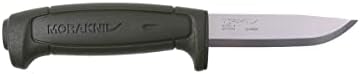
3.6 in | 2.0 mm | High carbon | Not stated | Honest that carbon steel rusts and tells you to oil it | Its own listing gives two different blade thicknesses | View on Amazon |
| 5 |
 Kizer Drop Bear 2.57 Inch Kizer Drop Bear 2.57 Inch |
2.57 in | Not stated | D2, 58–62 HRC | Drop point | Under 2.77 oz with hidden tweezers and a toothpick in the handle | 2.57 inches is too small for camp work | View on Amazon |
| 6 |
 Freelander D2 Part-Serrated Freelander D2 Part-Serrated |
Not stated | 5 mm | D2 | Plain + serrated | A 5 mm spine and a combination edge in one blade | Serrations cannot be resharpened at home | View on Amazon |
| 7 |
 SPITZKANTE 3.07 Inch Neck Knife SPITZKANTE 3.07 Inch Neck Knife |
3.07 in | Not stated | 5Cr14MoV | Tanto | A one-piece full tang at 3.53 oz including the sheath | 5Cr14MoV is a soft budget stainless | View on Amazon |
| 8 |
 Mossy Oak 14-Inch Bowie Mossy Oak 14-Inch Bowie |
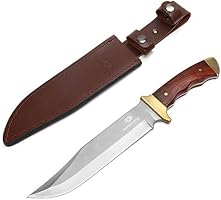
8.5 in | 3.7 mm | 3CR13 | Clip point | Fourteen inches overall, with a leather sheath and a brass guard | Its own listing says not to chop firewood with it | View on Amazon |
| 9 |
 4 Inch Tanto Horizontal Carry 4 Inch Tanto Horizontal Carry |
4.0 in | Not stated | Not stated | Tanto | Four dollars ninety-nine for a full-tang fixed blade | No steel, thickness, weight or hardness is published | View on Amazon |
| 10 |
 Purple Dragon Kukri High Carbon Purple Dragon Kukri High Carbon |
Kukri curve | Not stated | High carbon | Not stated | A kukri geometry, which concentrates force where nothing else here can | No dimensions or steel grade are published | View on Amazon |
Blade lengths, spine thicknesses, steels, prices and specifications are taken from each manufacturer’s Amazon listing as displayed on 27 August 2026 through a United States connection, and may change. Nothing here is legal advice. Fixed-blade knives are more heavily regulated than folders in many United States jurisdictions, with rules varying by state and often by city on carry, concealment and blade length; check the regulations that apply where you live and travel. One listing states its blade thickness as both “0.8 inch” and “0.08 in (0.2 cm)” in consecutive bullets, and its blade length as 91 centimetres rather than 91 millimetres; both are reported as published rather than silently corrected, since a reader comparing figures across this page would otherwise be misled. Four listings publish no spine thickness and two publish no steel grade; where a figure is absent the table says so rather than estimating. Sales ranks are shown as displayed and can be pooled across a variant family.
Scroll the table sideways to see every column
How We Chose These Ten
We researched current listings, compared manufacturer specifications and documentation, and examined recurring patterns in customer feedback. We did not carry out hands-on testing, and nothing below is presented as measured performance data.
- Spine thickness recorded first, or its absence noted — it decides whether the knife slices or batons, and four listings omit it
- Grind type reported where stated — exactly one listing names its geometry, and it is the one that matters most
- Steel and hardness recorded as published — the range here runs from 3CR13 to D2 at 59–61 HRC
- A verified live buy box — all ten confirmed purchasable in the United States on 27 August 2026
- Contradictions reported rather than corrected — one listing gives two different blade thicknesses
- Weight noted where published — stated with or without the sheath, as each maker gives it
- No overlap with our published knife and EDC guides — every knife here is new to the site
The Ten in Detail
1. Morakniv Companion 4.1 Inch — Best Overall

Two millimetres of spine is the thinnest blade on this page, and it is the reason this knife slices better than anything else here.
Key Specifications
| Blade length | 4.1 inches (104 mm) |
|---|---|
| Blade thickness | 0.08 in (2.0 mm) |
| Total length | 8.5 inches (217 mm) |
| Weight with sheath | 3.9 oz (110 g) |
| Steel | Hardened 12C27 stainless |
| Maker’s claim | Stays sharp longer than carbon steel and is less prone to rust |
| Handle | Ergonomic polymer, high-friction grip, finger guard |
| Sheath | Polymer with belt clip |
| Rank | #11,624 in its category |
| Price | $15.84 |
| Best For | Carving, food prep and camp work — which is most of what a knife does |
Why We Recommend It
Spine thickness is the trade nobody explains. A thick blade is strong enough to hammer through a log and terrible at cutting, because the wedge behind the edge has to force material apart as it passes. A thin blade parts wood, rope and food cleanly and will eventually take a set or snap if you use it as a chisel. Thicknesses on this page run from 2.0 mm to 4.7 mm — more than double — and that single number decides what the knife is actually for.
12C27 is a fine-grained Swedish stainless that takes a very keen edge for a stainless steel, and Morakniv’s claim that it beats carbon steel on both sharpness retention and rust resistance is a fair description of why this alloy exists.
Every figure is published — blade length, thickness, total length, weight with the sheath — in both imperial and metric. Three knives on this page manage that.
The finger guard and high-friction handle matter more on a fixed blade than on a folder, because there is no lock and nothing stopping your hand running forward if it slips.
Pros
- Complete published specification in both units
- 12C27 stainless takes a keen edge and resists rust
- 2 mm spine slices exceptionally well
- 3.9 oz with the sheath
- Finger guard and high-friction handle
- $15.84 from a maker that has made these for a century
Cons
- Too thin to baton with
- Polymer handle looks and feels utilitarian
- Not full tang — a partial tang design
- Sheath is friction-fit rather than adjustable
- Rank #11,624
- No grind type stated
Best for: Almost everything a camp knife does, except splitting wood.
2. CVLIFE 5.2 Inch D2 Bushcraft — Best for Bushcraft

One listing on this page names its grind. It is the specification that decides how a fixed blade actually cuts, and nine makers leave it out.
Key Specifications
| Blade length | 5.2 inches |
|---|---|
| Spine thickness | 0.18 in (4.7 mm) — thickest here |
| Steel | D2 tool steel |
| Hardness | 59—61 HRC |
| Grind | Modified Scandi with a reinforced micro-bevel |
| Tip | Drop point |
| Spine feature | Anti-slip jimping |
| Handle | 5-layer: core, red liners, high-traction scales |
| Sheath | Weather-resistant polymer, adjustable retention screw |
| Rank | #17,614 in its category |
| Price | $29.99 |
| Best For | Carving wood, which is what a Scandi grind exists to do |
Why We Recommend It
A Scandi grind is a single wide bevel running from the edge partway up the blade, with no secondary bevel behind it. That geometry bites into wood and controls the depth of the cut, which is why it is the traditional bushcraft grind and why it makes feather sticks and tent pegs easy. It is also the simplest grind to resharpen — you lay the whole bevel flat on a stone and the angle sets itself, so there is nothing to judge. The “modified” part is a small micro-bevel added at the edge to stop it chipping, which is a sensible compromise on a hard steel.
4.7 mm is the thickest spine here, and combined with a full tang that means this is the knife on this page you can hammer through a log without concern. It also means it wedges rather than slices when you are cutting food.
D2 at 59—61 HRC holds an edge a long time and is not fully stainless — dry it.
An adjustable retention screw on the sheath is the detail that stops a knife rattling loose or gripping too hard to draw.
Pros
- The only listing here that names its grind
- 4.7 mm full tang — batons firewood
- D2 at a published 59—61 HRC
- Adjustable sheath retention screw
- Jimping on the spine for thumb control
- Five-layer handle absorbs impact
Cons
- Thick spine slices poorly
- D2 is not fully stainless — dry it after use
- 5.2 inches is long for food prep
- Heavier than the Moras
- Rank #17,614
- $29.99
Best for: Wood: feather sticks, tent pegs, batoning and shelter building.
3. Kizer Cabox 3.36 Inch D2 — Best Specified

Three point two millimetres is the middle of this page, and the middle is where a general-purpose knife belongs.
Key Specifications
| Blade length | 3.36 in (85.3 mm) |
|---|---|
| Overall length | 8.12 in (206.2 mm) |
| Blade thickness | 0.13 in (3.2 mm) |
| Weight | 4.26 oz (120.9 g) |
| Steel | D2 tool steel |
| Blade shape | Drop point — sturdy tip, pronounced belly |
| Handle | G10 |
| Sheath | Durable, with a wide lanyard hole |
| Rank | #16,500 in its category |
| Price | $50.15 |
| Best For | A middle-weight knife that does everything reasonably well |
Why We Recommend It
A 3.2 mm spine is thick enough to be confident with and thin enough to cut properly. It will take light batoning through kindling without complaint and it will still slice an apple, break down a rabbit or cut cordage without wedging. That is the compromise most people actually want, and it sits between the 2 mm Moras that slice beautifully and cannot be hammered, and the 4.7 mm bushcraft blade that hammers happily and cuts like a chisel.
A drop point is the right shape for that role. The spine curves down to meet the tip, giving a strong point that will not snap under prying and a long curved belly that does the slicing — unlike the tanto points elsewhere here, which are strong and have no belly at all.
Every dimension is published to a decimal place, in both units, which is what you want when you are buying a knife you cannot handle first.
G10 handle scales — glass fibre in epoxy, impervious to water and grippy when wet.
Pros
- Full specification published in both units
- 3.2 mm spine is the sensible middle
- Drop point — strong tip with a real belly
- D2 tool steel
- G10 handle, waterproof and grippy
- Wide lanyard hole in the sheath
Cons
- $50.15 — dearest on this page
- No hardness figure published
- No grind type stated
- D2 needs drying after use
- Rank #16,500
- Sheath retention is not adjustable
Best for: One knife for camping, hunting and general outdoor work.
4. Morakniv Craftline Basic 511 — Cheapest Quality
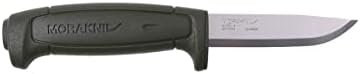
The listing states the blade is 0.8 inches thick in one bullet and 0.08 inches in the next. It also gives the blade length as 91 centimetres.
Key Specifications
| Blade length | 3.6 inches |
|---|---|
| Blade thickness | Stated as both “0.8 inch” and 0.08 in (2.0 mm) |
| Total length | 8.1 inches (206 mm) |
| Weight | 3.9 oz (110 g) |
| Steel | High carbon |
| Maker’s warning | Carbon steel rusts — wipe and oil after use |
| Handle | Large impact-resistant, ergonomic |
| Sheath | Hard plastic combi-sheath with belt clip and Smart Button System |
| Rank | #5,699 in its category |
| Price | $10.99 |
| Best For | A working knife you will actually maintain, at the lowest sensible price |
Why We Recommend It
Both are obvious unit slips — 0.08 inches and 91 millimetres are correct, and 0.8 inches would be a crowbar — but we report them as published rather than quietly fixing them, because a reader comparing thicknesses across this page would be badly misled by the larger figure. It is a good general reminder to sanity-check any specification against the others in its category.
What the listing gets admirably right is the carbon steel warning. “Carbon steel rusts, so wipe and oil the blade after use” is stated plainly, where most makers of carbon-steel knives simply say “high carbon” and let the buyer find out. Carbon takes a keener edge and sharpens more easily than stainless; the price is that it will spot within days if left damp.
The Smart Button system on the sheath lets several knives clip to one another, which is a genuinely thoughtful detail for a tradesman carrying a set.
$10.99 for a properly made working knife is the value benchmark of this page.
Pros
- $10.99 for a genuinely well-made knife
- Honest that carbon steel rusts
- Carbon takes a keener edge than stainless
- 3.9 oz with a belt-clip sheath
- Smart Button system clips knives together
- Rank #5,699 — second highest here
Cons
- Listing gives two different blade thicknesses
- Blade length stated as 91 cm rather than 91 mm
- Carbon steel needs oiling after every use
- 2 mm spine is too thin for batoning
- Not full tang
- No grind type stated
Best for: Trade and camp work for someone who will wipe and oil it.
5. Kizer Drop Bear 2.57 Inch — Lightest Here

A fixed blade you actually carry beats a better one in a drawer, and under 2.77 ounces is the weight that makes that happen.
Key Specifications
| Blade length | 2.57 inches |
|---|---|
| Weight | Under 2.77 oz — lightest here |
| Steel | D2, HRC 58—62 |
| Blade shape | Drop point |
| Handle | Olive green G10, non-slip texture |
| Hidden tools | Tweezers and toothpick |
| Sheath | Kydex, adjustable tension |
| Carry | Horizontal, vertical or neck |
| Service | Lifetime against defects in material and workmanship |
| Rank | #16,372 in its category |
| Price | $37.99 |
| Best For | Carrying a fixed blade every day without noticing it |
Why We Recommend It
The argument for a small fixed blade over a folder is that there is no lock and no pivot — nothing to fail, nothing to clean out, and no mechanism between your hand and the work. The argument against has always been carrying it, because a sheath knife is bulky and sits awkwardly. At 2.57 inches and under three ounces, worn horizontally on a belt or on a neck cord, that objection largely disappears. It becomes a folder’s replacement rather than a camp knife.
Tweezers and a toothpick hidden in the handle is a Swiss Army idea transplanted, and the tweezers in particular are the tool people actually reach for — splinters, ticks, thorns.
D2 at 58—62 HRC is the widest published hardness band here, and the top of it is genuinely hard.
Kizer offer lifetime service against defects, which two makers on this page do and eight do not.
Pros
- Under 2.77 oz — lightest here
- Tweezers and toothpick hidden in the handle
- D2 at a published 58—62 HRC
- Kydex with adjustable tension
- Horizontal, vertical or neck carry
- Lifetime service against defects
Cons
- 2.57 inches is too small for camp tasks
- No spine thickness published
- $37.99 for a very small knife
- No grind type stated
- D2 needs drying after use
- Rank #16,372
Best for: Everyday carry, as a replacement for a folding knife rather than a camp knife.
6. Freelander D2 Part-Serrated — Thickest Full Tang

A combination edge puts two tools on one blade, and the serrated half is the half you cannot maintain.
Key Specifications
| Spine thickness | 5 mm full tang |
|---|---|
| Steel | D2 |
| Edge | Combination — plain and serrated |
| Handle | Contoured, non-slip in wet or cold |
| Sheath | Custom-fitted Kydex |
| Stated uses | Batoning, camping, survival, hiking, bushcraft |
| Rank | #10,974 in its category |
| Price | $24.99 |
| Best For | Rope and webbing alongside wood, in one blade |
Why We Recommend It
Serrations cut fibrous material — rope, webbing, seatbelt, cordage — far better than any plain edge, because the points concentrate force and the scallops trap the fibres instead of letting them slide away. On a survival knife that is a genuinely useful capability. The cost is permanent: each scallop needs a tapered rod worked individually, and a flat stone simply grinds the points off. So half of this blade will get dull and stay dull, and the other half will be sharpened normally.
Five millimetres is the second thickest spine here, and the listing explicitly names batoning as an intended use — which at that thickness with a full tang is a fair claim.
D2 with no hardness figure published, where two other D2 knives here give 58—62 and 59—61.
A custom-fitted Kydex sheath holds by friction on the blade shape rather than by a strap, which is faster to draw and silent.
Pros
- 5 mm full tang — genuinely batonable
- Serrated section handles rope and webbing
- Custom-fitted Kydex sheath
- D2 tool steel
- Contoured non-slip handle
- $24.99
Cons
- Serrations cannot be resharpened at home
- No blade length published
- No hardness figure published
- No grind type stated
- Thick spine slices poorly
- Rank #10,974
Best for: Cutting rope and processing wood with the same knife.
7. SPITZKANTE 3.07 Inch Neck Knife — Best Neck Carry

Neck carry solves a real problem: a belt sheath is in the way when you sit down, drive, or wear a pack with a hip belt.
Key Specifications
| Blade length | 3.07 inches |
|---|---|
| Total length | 5.63 inches |
| Weight with sheath | 3.53 oz |
| Steel | 5Cr14MoV stainless |
| Construction | One-piece full tang |
| Blade shape | Tanto |
| Handle | Textured ABS, anti-slip |
| Carry | Horizontal on a belt or around the neck |
| Rank | #7,989 in its category |
| Price | $14.99 |
| Best For | Wearing a fixed blade where a belt sheath would be in the way |
Why We Recommend It
A knife worn on a cord under a shirt is out of the way of everything and still reachable with one hand. That is why neck knives exist and why they are small — anything much over three inches becomes uncomfortable and obvious. The 3.53-ounce weight quoted here includes the sheath, which is the honest way to state it for a knife you will be wearing rather than carrying.
One-piece full tang means the blade and the tang are a single piece of steel with scales attached, which at this size is straightforward to make and effectively unbreakable.
5Cr14MoV is a soft budget stainless — it will dull faster than the D2 blades on this page and come back on any sharpener in minutes, which for a knife used for small jobs is a reasonable trade.
The tanto point is the reservation: strong for puncturing, no belly for slicing, and awkward for the fine work a small knife is usually asked to do.
Pros
- Neck or horizontal belt carry
- One-piece full tang construction
- 3.53 oz including the sheath
- Textured ABS grips when wet
- Publishes blade and total length
- $14.99
Cons
- 5Cr14MoV is soft and dulls quickly
- Tanto point has no belly for slicing
- No spine thickness published
- No grind type stated
- ABS handle rather than G10
- Rank #7,989
Best for: Wearing a small fixed blade under a shirt rather than on a belt.
8. Mossy Oak 14-Inch Bowie — Largest Here
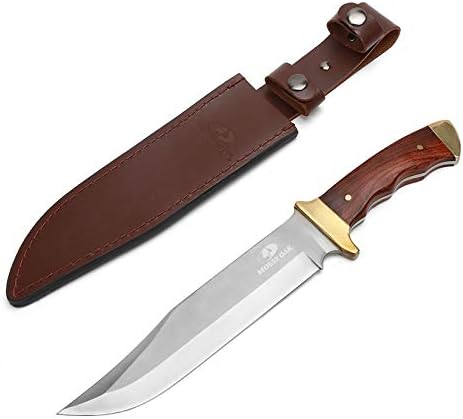
A fourteen-inch bowie with a brass guard and a leather sheath, and a listing that tells you not to chop with it.
Key Specifications
| Blade length | 8.5 in (215 mm) — longest here |
|---|---|
| Overall length | 14 in (355 mm) |
| Blade thickness | 3.7 mm |
| Steel | 3CR13 |
| Blade shape | Clip point |
| Handle | 5.5 in rosewood, full tang, brass pommel and guard |
| Sheath | Genuine leather with snap fastener |
| Maker’s warning | “This hunting knife cannot be used for chopping firewood” |
| Rank | #14,199 in its category |
| Price | $21.99 |
| Best For | Presentation and light field work, not chopping |
Why We Recommend It
That warning is the most useful sentence on this page and it deserves credit rather than mockery. A blade this size looks like a chopper, and 3CR13 is a soft, inexpensive stainless — it will take a set or chip if swung into seasoned wood. Saying so directly, in the listing, is considerably more honest than letting a buyer discover it on a camping trip. It repositions the knife accurately: a large field knife for cutting, skinning and presentation, not a substitute for a hatchet.
A clip point is the classic bowie shape — the spine is “clipped” away near the tip to produce a fine, controllable point with a long belly behind it. Excellent for skinning and detail work.
Rosewood, brass and leather is a traditional package that will age well and needs occasional oiling, unlike the polymer and Kydex elsewhere here.
3.7 mm across 8.5 inches of soft steel is why the warning exists.
Pros
- Full dimensions published including handle length
- Honest that it cannot chop firewood
- Genuine leather sheath with a snap fastener
- Full tang through a rosewood handle
- Brass pommel and guard
- Clip point excels at skinning and detail
Cons
- 3CR13 is soft for a blade this size
- Explicitly not for chopping
- 14 inches is impractical to carry
- Leather and rosewood need maintenance
- Rank #14,199
- No hardness figure published
Best for: Field dressing and display, with the maker’s own limits respected.
9. 4 Inch Tanto Horizontal Carry — Cheapest Here

Five bullet points, all about what the knife is for, and not one about what it is made of.
Key Specifications
| Blade length | 4.0 inches |
|---|---|
| Construction | Full tang |
| Blade shape | Tanto |
| Carry | Horizontal, for quick draw |
| Steel | Not published |
| Spine thickness | Not published |
| Weight | Not published |
| Stated uses | Backpacking, fishing, camping, bushcraft, food prep, firewood |
| Rank | #18,988 in its category |
| Price | $4.99 — cheapest here |
| Best For | A spare in a pack, at a price where the specification hardly matters |
Why We Recommend It
No steel, no hardness, no spine thickness, no weight. On a page where three knives publish complete dimension sets and two publish hardness bands, this one publishes nothing measurable at all — and simultaneously claims it will process firewood, which is a claim you cannot evaluate without knowing the spine thickness and the steel. We report the absence rather than filling it in.
At $4.99 there is a legitimate case for it as a spare. A knife in the bottom of a rucksack, in a car, in a bug-out bag or lent to someone who will not return it costs almost nothing here, and a full-tang four-inch blade with a sheath is genuinely useful even if the steel is mediocre.
Horizontal carry is a real feature, keeping the knife flat against the belt rather than dangling, which matters when wearing a pack.
Tanto again: strong point, no belly, awkward for food prep despite the listing suggesting it.
Pros
- $4.99 — cheapest on this page
- Full tang construction at that price
- Horizontal carry keeps it flat on a belt
- Sheath included
- Reasonable as a pack spare
- 4-inch blade is a useful general size
Cons
- No steel named at all
- No thickness, weight or hardness published
- Claims firewood processing with no spine figure
- Tanto point is poor for food prep
- No grind type stated
- Rank #18,988
Best for: A spare knife for a pack or a car, bought on price alone.
10. Purple Dragon Kukri High Carbon — Best Chopper

A kukri is the one blade shape on this page actually designed to chop, and the reason is geometry rather than mass.
Key Specifications
| Shape | Kukri — forward-curving |
|---|---|
| Steel | High carbon, forged |
| Handle | Natural ebony, full tang, finger grooves, integrated guard |
| Groove | Channels moisture away from the handle |
| Sheath | Embossed black, durable |
| Blade length | Not published |
| Spine thickness | Not published |
| Rank | #21,204 in its category |
| Price | $39.99 |
| Best For | Chopping, which the geometry is specifically designed for |
Why We Recommend It
The forward curve moves the centre of percussion toward the tip and angles the edge into the work. When you swing it, the impact lands at a point well ahead of your hand with the edge presented at an effective angle rather than square-on, which concentrates the force into a smaller contact area and drives the cut deeper for the same effort. It is the same principle as a felling axe, worked into a knife-sized tool, and it is why the shape has survived for centuries essentially unchanged.
The groove along the blade is described as channelling moisture away from the handle, which on a chopping tool used in wet conditions is a practical detail rather than decoration.
Ebony is dense, oily and stable, and it will outlast polymer — it also needs occasional oiling and will crack if allowed to dry out completely.
No blade length, no thickness, no hardness, which on a tool whose whole point is impact is a real gap.
Pros
- Kukri geometry genuinely chops
- Forged high-carbon steel
- Natural ebony full-tang handle
- Finger grooves and an integrated guard
- Fluid-channelling groove along the blade
- Embossed sheath included
Cons
- No blade length or thickness published
- No hardness figure or steel grade
- High carbon rusts without oiling
- Ebony cracks if allowed to dry out
- Curved blade is poor for fine slicing
- Rank #21,204
Best for: Clearing, chopping and heavy camp work, where the curve does the work.
Spine Thickness Decides the Job
Sorted by spine. This is the column that tells you what the knife is for.
| Knife | Spine | Blade | Slices | Batons |
|---|---|---|---|---|
| Morakniv Companion | 2.0 mm | 4.1 in | Excellently | No |
| Morakniv 511 | 2.0 mm | 3.6 in | Excellently | No |
| Kizer Cabox | 3.2 mm | 3.36 in | Well | Lightly |
| Mossy Oak Bowie | 3.7 mm | 8.5 in | Well | Explicitly not |
| Freelander | 5 mm | Not stated | Poorly | Yes |
| CVLIFE | 4.7 mm | 5.2 in | Poorly | Yes |
| Kizer Drop Bear | Not stated | 2.57 in | Well | No |
| SPITZKANTE | Not stated | 3.07 in | Fair | No |
| 4-Inch Tanto | Not stated | 4.0 in | Unknown | Claimed |
| Purple Dragon Kukri | Not stated | Not stated | Poorly | Chops |
The two 2 mm Moras and the two thick bushcraft blades are opposite tools, and the 3.2 mm Kizer sits sensibly between them. Note the two rows worth caution: one knife claims firewood processing while publishing no spine thickness at all, and one publishes 3.7 mm across 8.5 inches of soft steel while its own listing states it cannot be used for chopping. Where a maker declines to publish a thickness and simultaneously claims heavy use, treat the claim as unsupported rather than assuming a figure.
Carbon or Stainless, and Which Steels Are Actually Here
Sorted by what the steel will do rather than what it costs.
| Steel | On this page | Edge retention | Rusts? |
|---|---|---|---|
| D2 (59–62 HRC) | Four knives | Very good | Somewhat — dry it |
| 12C27 stainless | Morakniv Companion | Good | Resistant |
| High carbon | Morakniv 511, Kukri | Good, keenest edge | Readily — oil it |
| 5Cr14MoV | SPITZKANTE | Modest | Resistant |
| 3CR13 | Mossy Oak Bowie | Modest | Resistant |
| Not stated | 4-Inch Tanto | Unknown | Unknown |
D2 dominates the middle of this page and it is genuinely good steel — hard, long-lasting, and not fully stainless, so it wants drying after use and should not be stored damp inside a Kydex sheath. Carbon steel takes the keenest edge of anything here and sharpens most easily, at the cost of rusting within days if neglected; one Morakniv listing states that plainly, which is more than most carbon-steel sellers manage. 12C27 is the sensible all-rounder. The soft stainless steels at the bottom dull quickly and forgive everything.
Best Alternatives
| Alternative | Why Consider It | Better For | Main Trade-Off |
|---|---|---|---|
| A folding knife | Pockets, and far fewer carry restrictions | Everyday urban carry | A lock is a point of failure |
| A hatchet | Actually designed to chop and split | Firewood and shelter building | No fine work at all |
| A folding saw | Cuts wood faster than any knife, safely | Processing branches and poles | Only cuts wood |
| A machete | Long reach for clearing vegetation | Brush, trails and undergrowth | Unwieldy, and poor at everything else |
What the Money Actually Buys
$4.99 to $15.84 — the 4-inch tanto, Morakniv 511, SPITZKANTE, Morakniv Companion. The best value on this page, and it contains our overall pick. Two properly made Scandinavian working knives with complete specifications sit here, alongside a neck knife and a five-dollar pack spare.
$21.99 to $29.99 — Mossy Oak Bowie, Freelander, CVLIFE. Where the thick blades live. The only knife on this page that names its grind is here, along with the two spines rated for batoning and a 14-inch bowie with a leather sheath.
$37.99 to $50.15 — Kizer Drop Bear, Purple Dragon Kukri, Kizer Cabox. Brand, service and specification. Both Kizers publish detailed figures and carry lifetime service against defects; the kukri buys a chopping geometry nothing else here has.
What to Check Before You Buy
Read the Spine Thickness Before Anything Else
It is the specification that decides what the knife can do, and it varies by more than double across this roundup — from 2.0 mm to 4.7 mm. A thin spine means almost no wedge behind the edge, so the blade parts material cleanly: wood shavings, rope, food, game. A thick spine means the blade can be struck through a log with another piece of wood without deforming, and that same mass forces material apart rather than slicing it. Neither is better in the abstract. What matters is that four listings here do not publish the figure at all, and one of those simultaneously claims the knife will process firewood.
Look for the Grind, Because Almost Nobody States It
Exactly one listing in this roundup names its grind, and it is arguably the most informative specification a fixed blade can publish. A Scandi grind is a single wide bevel running from the edge partway up the blade with no secondary bevel behind it — it bites into wood and controls the depth of a cut, which is why it is the traditional bushcraft geometry. It is also the easiest grind to maintain: lay the whole bevel flat on a stone and the angle sets itself, so there is nothing to judge by eye. Flat and convex grinds slice better and carve worse. Where no grind is stated, you are buying blind on the single dimension that most affects how the knife feels in use.
Decide Between Carbon and Stainless Honestly
Carbon steel takes the keenest edge of anything in this roundup and sharpens most easily, which is why traditional working knives have used it for centuries. It also rusts — genuinely, within days, if put away damp — and one Morakniv listing here states that plainly and tells you to wipe and oil the blade after use, which most carbon-steel sellers do not. Stainless steels like 12C27 resist corrosion and hold a good edge with far less attention. D2, which four knives here use, sits between the two: hard, long-lasting and only semi-stainless, so it wants drying and should not live damp inside a Kydex sheath.
Check the Tang, and What ‘Full Tang’ Means Here
A full tang is a single piece of steel running the entire length of the handle, with scales attached either side — there is no join, so there is nothing to work loose under impact. It is what you want on anything you will baton, pry with or use hard. Several knives in this roundup state it explicitly and one describes a “one-piece full tang”. Note that the two Morakniv knives here are not full tang, and that is a deliberate design choice rather than a flaw: they are working knives built to slice, at 2 mm thick, where the tang would never be the limiting factor. Match the construction to the spine thickness.
Match the Blade Shape to the Work
Four shapes appear here and they are not interchangeable. A drop point curves the spine down to a strong tip with a long belly behind it — the best general-purpose shape, good at slicing and controllable for detail. A clip point removes material from the spine near the tip to give a fine, precise point, which is why it is the classic skinning and hunting shape. A tanto has an angular reinforced tip with no belly at all: strong for puncturing, poor for slicing and awkward for food. A kukri curves forward to concentrate impact toward the tip, which makes it the only shape here designed to chop.
Understand the Sheath You Are Getting
Three materials appear in this roundup and each behaves differently. Kydex is thermoformed plastic that grips the blade by friction, holds it silently and securely, and can have its retention adjusted with a screw on the better examples — it also traps moisture against the blade, which matters with carbon and D2 steels. Polymer sheaths with belt clips are lighter and simpler. Leather is traditional, quiet and comfortable, and it absorbs water and the tannins in it will corrode a blade left sheathed wet. Whatever you get, dry the knife before it goes back in, particularly if the steel is not fully stainless.
Check Local Rules, Because Fixed Blades Are Treated Differently
In many United States jurisdictions a fixed blade is regulated more strictly than a folding knife of the same blade length, and rules vary by state and frequently by city — commonly around concealment, blade length, and where the knife may be carried. Blades in this roundup run from 2.57 inches to 8.5, and one knife is 14 inches overall, so the range spans a very wide regulatory field. None of the listings here raises the subject at all. This article is not legal advice and cannot be; look up the regulations where you live and travel before buying something you intend to carry rather than keep at a campsite.

Common Mistakes
- Batoning a 2 mm blade. It slices beautifully and it will take a set.
- Buying a thick blade for food prep. 4.7 mm wedges rather than slices.
- Ignoring the grind. Only one listing here states it, and it changes everything.
- Storing D2 or carbon damp in a Kydex sheath. Neither is fully stainless.
- Trusting a heavy-use claim with no spine figure. One knife here does exactly that.
- Chopping with a soft-steel bowie. Its own listing tells you not to.
- Assuming fixed-blade carry rules match folder rules. They often do not.
Who Should Buy Which
Buy the Morakniv Companion at $15.84 unless you need to baton. 12C27 stainless at 2 mm, a complete published specification, a finger guard and 3.9 ounces with the sheath.
Buy the CVLIFE at $29.99 for bushcraft. The only knife here that names its grind, on a 4.7 mm full tang in D2 at 59–61 HRC, with adjustable sheath retention.
Buy the Kizer Cabox at $50.15 for one knife that does everything. 3.2 mm is the sensible middle, in D2, on a G10 handle, with every dimension published.
Buy the Morakniv 511 at $10.99 if you will oil it. Carbon steel takes the keenest edge here, and the listing is honest that it rusts.
Buy the Kizer Drop Bear at $37.99 to carry every day. Under 2.77 ounces, three carry positions, and tweezers hidden in the handle.

Frequently Asked Questions
How thick should a fixed blade knife be?
It depends entirely on whether you want to cut or to survive impact, and the range in this roundup runs from 2.0 mm to 4.7 mm. A 2 mm spine has almost no wedge behind the edge, so it slices wood, rope and food beautifully — and it will bend or take a set if you hammer it through a log. A 4.5 mm or thicker spine on a full tang can be batoned all day and wedges rather than slices when you ask it to prepare food. Around 3 to 3.5 mm is the sensible general-purpose middle, handling light batoning while still cutting properly. Be wary of any knife claiming heavy use without publishing a thickness at all; four listings here do not.
What is a Scandi grind and does it matter?
It matters a great deal, and exactly one listing in this roundup names its grind at all. A Scandi grind is a single wide bevel running from the cutting edge partway up the blade, with no secondary bevel behind it. That geometry bites deep into wood and gives excellent control over how deep a cut goes, which is why it is the traditional bushcraft and carving grind. The second advantage is maintenance: you lay the entire bevel flat on a sharpening stone and the correct angle sets itself, so there is no angle to judge or hold. Flat and convex grinds slice more efficiently and carve less well; a hollow grind is keener still and weaker at the edge.
Is carbon or stainless steel better in a fixed blade?
Carbon takes a keener edge and sharpens more easily; stainless needs far less attention. Carbon steel — used by two knives in this roundup — will develop rust spots within days if put away damp, and one listing states this plainly and tells you to wipe and oil the blade after every use, which is unusually honest. Stainless steels such as 12C27 resist corrosion well and still hold a good working edge. D2, used by four knives here, is a semi-stainless tool steel: harder than either, excellent edge retention, and it still wants drying after use, especially since it is often paired with a Kydex sheath that traps moisture against the blade.
Do I need a full tang fixed blade knife?
For batoning, prying or any heavy impact work, yes. A full tang is one continuous piece of steel running the entire length of the handle with scales pinned either side, so there is no join to work loose and nothing to fail under shock. Most of the thicker knives in this roundup are full tang and say so. It is worth noting that the two Morakniv knives here are not, and that is a deliberate choice rather than a shortcoming: at 2 mm thick they are built to slice and carve, and the tang would never be the part that failed. Match construction to intended use — a full tang on a thin slicing blade buys nothing.
What blade shape should I choose?
A drop point for general use, which is what most people should buy. The spine curves down to meet the tip, producing a strong point that resists snapping and a long curved belly that does the actual slicing — it handles food, cordage, carving and field dressing competently. A clip point, the classic bowie shape, removes material from the spine near the tip for a finer, more precise point, which suits skinning and detail work. A tanto has an angular reinforced tip and no belly at all: very strong for puncturing, awkward for almost everything else. A kukri curves forward to concentrate impact near the tip and is the only shape here genuinely designed to chop.
Are fixed blade knives legal to carry?
It varies considerably, and in many United States jurisdictions fixed blades are treated more strictly than folding knives of the same blade length — with rules differing by state and often by city on concealment, blade length and where a knife may be carried at all. The knives in this roundup range from a 2.57-inch neck knife to a 14-inch bowie, which spans an extremely wide regulatory field, and not one of the ten listings raises the subject. This article cannot be and is not legal advice. Look up the regulations that apply where you live and where you travel before buying something you intend to carry rather than keep at a campsite or in a workshop.
Final Verdict
12C27 stainless at 2 mm, 8.5 inches overall and 3.9 oz with the sheath, with every figure published in both units. It slices better than anything here. $15.84.
The only listing on this page that names its grind — a modified Scandi — on a 4.7 mm full tang in D2 at 59 to 61 HRC, with an adjustable-retention sheath. $29.99.
Blade, overall length, thickness and weight all published to the decimal, in D2 on a G10 handle, at the 3.2 mm middle that does everything reasonably well. $50.15.
Spine thickness runs from 2.0 mm to 4.7 mm on this page, and that number decides whether you have bought a slicer or a splitter. Four listings do not publish it, and one of those claims it processes firewood.
Only one maker names its grind, which is the specification that most affects how a fixed blade feels in the hand and how easily you can keep it sharp.
After that it is just carbon or stainless, and whether you will actually wipe and oil a blade that rusts in exchange for the keenest edge here.
The knife we would buy costs $15.84 and publishes every figure it has.