Affiliate Disclosure: As an Amazon Associate, we earn from qualifying purchases. This does not affect the price you pay.
Three separate brands on this page make the same claim in almost the same words. One says steel conducts heat 18 times faster than a pizza stone. Two others say 20 times.
They are all describing the same piece of physics, and it is real. Carbon steel conducts at roughly 45 to 50 watts per metre-kelvin. Cordierite ceramic manages about 3. That is the entire reason a steel gives you a blistered, crisp base in a domestic oven where a stone gives you a pale one — heat leaves steel and enters cold wet dough far faster than the dough can pull the surface temperature down.
So why does anyone still buy stone? Because of one sentence, on the cheapest product here: “Stone absorbs moisture.” Ceramic and cordierite are porous, and as the base bakes they wick water out of it. Steel is solid and non-porous and does the opposite — any moisture the dough releases has to escape sideways as steam. On a wet, high-hydration dough that difference is genuinely felt.
Then there is the cost nobody puts in the headline: weight. The steels here run from 10.8 to 17.6 pounds. Once one of those is in your oven it tends to stay there, because taking it out is a two-handed job with mitts and somewhere heatproof to put it down.
Below: ten stones and steels from $22.51 to $139, which of them can crack, and the one listing that rates a solid slab of carbon steel to 375°F.
Our Quick Picks
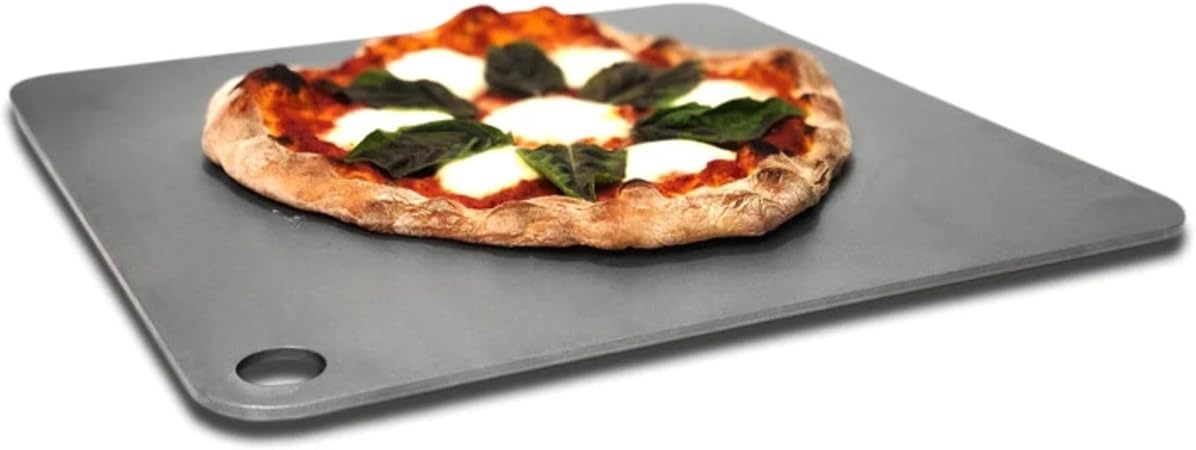 Best OverallThermiChef 16×16 Pizza Steel
A quarter-inch square steel ranked #2 in the whole category — and the only listing here that explains why thickness is a choice.
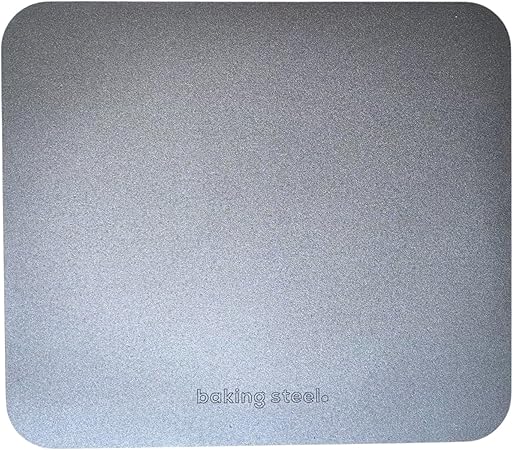 Most PremiumThe Original Baking Steel 14×16
The steel that invented the category in 2012 — pre-seasoned, made in Massachusetts, and still the reference point.
 Best BudgetGoodCook Ceramic Stoneware 14.75
Twenty-two dollars for a proper porous stoneware stone with a carrying rack — the cheapest way into the technique.
At a Glance
Ten Pizza Stones and Steels Compared
Material first, because steel and stone are not variants of one thing — then size, weight and the stated heat ceiling.
| # | Model | Material | Size | Weight | Max Heat | Standout | Main Drawback | Check Price |
|---|---|---|---|---|---|---|---|---|
| 1 |
 ThermiChef 16×16 Pizza Steel ThermiChef 16×16 Pizza Steel |
Carbon steel, 1/4 in | 16 x 16 in square | 17.6 pounds | 1000°F stated | #2 in Pizza Pans & Stones, and it explains its own thickness | 17.6 pounds to lift in and out of a hot oven | View on Amazon |
| 2 |
 The Original Baking Steel 14×16 The Original Baking Steel 14×16 |
Solid American steel, 1/4 in | 14 x 16 in | 15 pounds | 1000°F stated | The product that created this category, made in Massachusetts | $139, the most expensive here | View on Amazon |
| 3 |
 GoodCook Ceramic Stoneware 14.75 GoodCook Ceramic Stoneware 14.75 |
Ceramic stoneware | 14.75 in round | 4.6 pounds | 500°F — lowest stone here | Porous stone that absorbs moisture from the base | 500°F is low, and ceramic cracks | View on Amazon |
| 4 |
 Hans Grill Cordierite 15×12 Hans Grill Cordierite 15×12 |
Cordierite stone | 15 x 12 in rectangular | 7.8 pounds | 1112°F stated | 13,849 reviews and #1 in Pizza Grilling Stones | 7.8 pounds of ceramic that can still crack | View on Amazon |
| 5 |
 Chef Pomodoro 16-Inch Steel Chef Pomodoro 16-Inch Steel |
Seasoned carbon steel | 16 x 13.25 in | 6.64 kg | 932°F stated | Arrives seasoned, so no preparation at all | 14.6 pounds, and it still rusts if stored wet | View on Amazon |
| 6 |
 Artisan Steel 16 x 14.25 Artisan Steel 16 x 14.25 |
Carbon steel, 1/4 in | 16 x 14.25 in | 16 pounds | 375°F in the spec field | Low-friction surface that channels steam away | A solid steel slab listed at 375°F | View on Amazon |
| 7 |
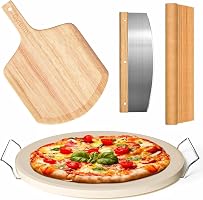 Gyreuni 13-Inch Stone Set Gyreuni 13-Inch Stone Set |
Cordierite stone | 13 in round | 2.93 kg | 1472°F — highest here | Five pieces including an oak peel and a serving rack | 13 inches is small for a family pizza | View on Amazon |
| 8 |
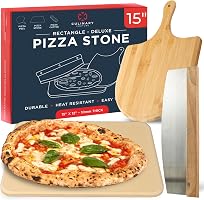 Culinary Couture 15×12 Set Culinary Couture 15×12 Set |
Cordierite stone | 15 x 12 in rectangular | 3.04 kg | 1000°F stated | Full-size rectangular stone with peel and cutter | No soap, ever — and the listing shouts it | View on Amazon |
| 9 |
 13×13 Baking Steel 13×13 Baking Steel |
Carbon steel, 0.25 in | 13 x 13 in square | 4.89 kg | Not stated | Steel physics for $39.99 | Only 45 reviews, and 13 inches is small | View on Amazon |
| 10 |
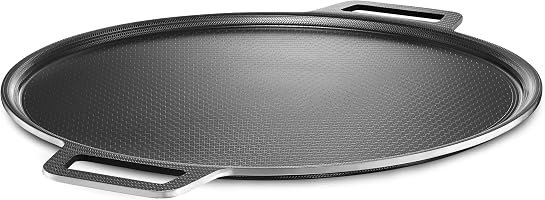 HexClad Hybrid Pizza Steel HexClad Hybrid Pizza Steel |
Ceramic-coated hybrid steel | For pizzas to 14 in | 703 g | 900°F stated | Claims no preheating is required | 703 g — a fraction of every other steel here | View on Amazon |
Specifications, prices, ratings and review counts are taken from each manufacturer’s Amazon listing as displayed on 22 August 2026 via a United States connection, and may change. Both pizza stones and pizza steels are included because they are competing answers to the same problem and are cross-shopped as one purchase; the Material column identifies which is which. Stated maximum temperatures are reproduced as published and several are clearly unreliable: the Artisan Steel lists 375°F for a solid quarter-inch carbon steel slab, which is the lowest figure in this roundup on the material with by far the highest genuine tolerance, and is reported as a data-entry error rather than a limitation. Conductivity claims of 18x and 20x versus ceramic are quoted from three separate manufacturers and are consistent with published thermal conductivity figures for carbon steel and cordierite. The HexClad Hybrid Pizza Steel is included with its published weight of 703 g noted prominently, because thermal mass is proportional to mass and that figure is roughly a twentieth of the heaviest slab here. Amazon’s Pizza Pans & Stones node contains only three true ceramic stones, so candidates were sourced by ASIN and by search page rather than from the node alone. Three further candidates could not be confirmed in stock at the time of writing and were excluded rather than reported as unavailable.
Scroll the table sideways to see every column
How We Chose These Pizza Stones and Steels
We researched current listings, compared manufacturer specifications and documentation, and examined recurring patterns in customer feedback. We did not carry out hands-on testing, and nothing below is presented as measured performance data.
- Steel or stone — conductivity against porosity — the one real decision here
- Weight — 10.8 to 17.6 pounds, and it decides whether it ever leaves the oven
- Whether it can crack — every stone here can; no steel here can
- Size against your oven and your pizza — 13 inches takes a 12-inch pizza and no more
- Stated heat ceiling — 500°F to 1472°F, and one figure that cannot be right
- What comes with it — a wooden peel is what launches a pizza successfully
The 10 Best Pizza Stones and Steels, Reviewed
1. ThermiChef 16×16 Pizza Steel — Best Overall

Second in the entire Pizza Pans & Stones category, and the only listing on this page that treats thickness as a decision rather than a boast.
Key Specifications
| Material | Carbon steel |
|---|---|
| Thickness | 1/4 inch |
| Size | 16 x 16 in square |
| Weight | 17.6 pounds — heaviest here |
| Max pizza | 15 inches |
| Max temperature | 1000°F stated |
| Conductivity claim | Up to 20× a ceramic stone |
| Care | Hand wash |
| Rank | #2 in Pizza Pans & Stones |
| Rating | 4.7 from 337 reviews |
| Price | $73.99 |
| Best For | A first steel, sized and specified properly |
Why We Recommend It
Its third bullet is the most useful sentence in this roundup: a quarter inch is “the most versatile thickness, providing the right balance between heat retention and weight for most home ovens”. Steel comes in 1/4 and 3/8 inch and thicker; more steel stores more heat and takes longer to preheat, and at some point it becomes something you cannot lift. Quarter inch is where that trade settles for a domestic oven, and almost nobody says so.
Square rather than rectangular is a real advantage. A 16 by 16 inch slab takes a 15-inch pizza in any orientation, and because it is symmetrical you can rotate the pizza mid-bake without hunting for the long axis. Most steels are rectangular, which wastes rack space in one direction.
The 20× conductivity claim is not marketing. Steel conducts heat at roughly 45 to 50 watts per metre-kelvin; cordierite ceramic manages about 3. That ratio is why a steel produces a crisp, blistered base in a domestic oven where a stone gives you a pale one — heat moves out of steel into wet dough far faster than the dough can cool it.
Seventeen and a half pounds is the honest cost. This lives in the oven permanently for most people, because taking it out is a two-handed job with mitts and somewhere heatproof to put it.
It fits most full-size ovens, and the listing tells you to measure — which at this weight is advice worth taking before ordering.
Pros
- #2 in Pizza Pans & Stones
- Explains why 1/4 inch is the right thickness, which nothing else does
- Square, so a 15-inch pizza fits in any orientation
- 1000°F stated ceiling
- 20× the conductivity of a ceramic stone
- 4.7 stars
Cons
- 17.6 pounds — the heaviest item in this roundup
- Effectively lives in your oven permanently
- Long preheat, as all steels have
- Hand wash, and it will rust if left wet
- Measure your oven before ordering
Best for: Anyone buying their first steel who wants the sensible thickness and shape.
2. The Original Baking Steel 14×16 — Most Premium
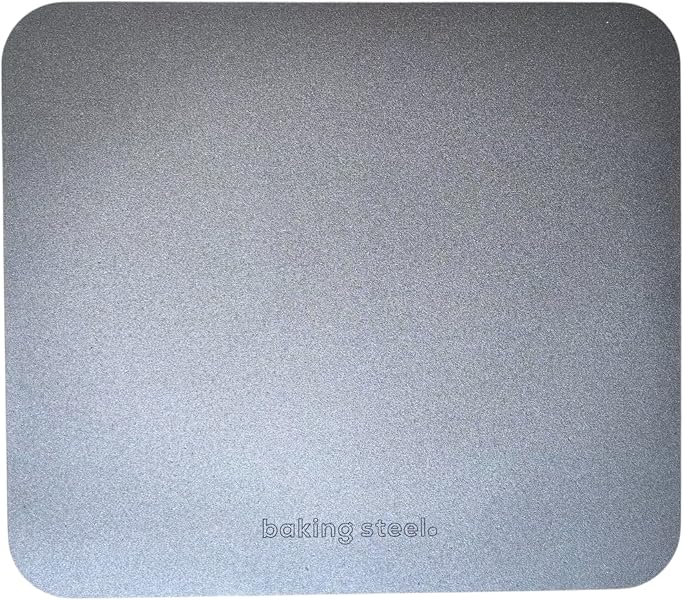
A hundred and thirty-nine dollars, and a genuinely interesting origin: the founder was working at his family’s steel business, read Modernist Cuisine’s suggestion that steel outperforms stone, and started cutting slabs. That was 2012 and every product on this page with the word steel in it followed.
Key Specifications
| Material | Solid American steel |
|---|---|
| Thickness | 1/4 inch |
| Size | 14 x 16 in |
| Weight | 15 pounds |
| Finish | Pre-seasoned |
| Max temperature | 1000°F stated |
| Origin | Manufactured in Massachusetts |
| Claim | 18× faster than a pizza stone |
| Rank | #19 in Pizza Pans & Stones |
| Rating | 4.6 from 598 reviews |
| Price | $139 |
| Best For | Buying once, from the company that worked it out first |
Why We Recommend It
“Crack-proof, virtually indestructible” is the real argument over stone. Ceramic and cordierite crack — from thermal shock, from a knock, from being stored badly — and a cracked stone is finished. Steel does not crack under any domestic circumstance. The listing notes customers still using theirs from the original run, which after thirteen years is a meaningful claim rather than a warranty phrase.
Pre-seasoned matters more on steel than people expect. Bare steel rusts, and a pizza steel spends its life in a humid oven and then a cupboard. A polymerised seasoning layer, like a carbon steel pan’s, is what stops that — and arriving with one means you can use it immediately.
18× faster than a stone, which is consistent with the 20× claimed by two other brands here and with the underlying physics. All three figures are describing the same conductivity gap.
Fifteen pounds and 14 by 16 inches is a slightly smaller footprint than the ThermiChef and two and a half pounds lighter, which for a slab you occasionally need to move is not nothing.
What you pay for is provenance and American manufacturing, not performance a $39.99 steel cannot match. That is a legitimate reason to buy and it is worth being clear that it is the reason.
Pros
- The product that created the category, in 2012
- Made in Massachusetts from solid American steel
- Pre-seasoned and ready to use
- Crack-proof where every stone here is not
- 1000°F stated ceiling
- Owners still using units from the first production run
Cons
- $139 — the most expensive item in this roundup
- 15 pounds
- A $39.99 steel does the same physics
- Hand wash, and it rusts if stored wet
- #19 in the category, behind cheaper steels
- Long preheat
Best for: Anyone buying once and happy to pay for American steel and the original.
3. GoodCook Ceramic Stoneware 14.75 — Best Budget

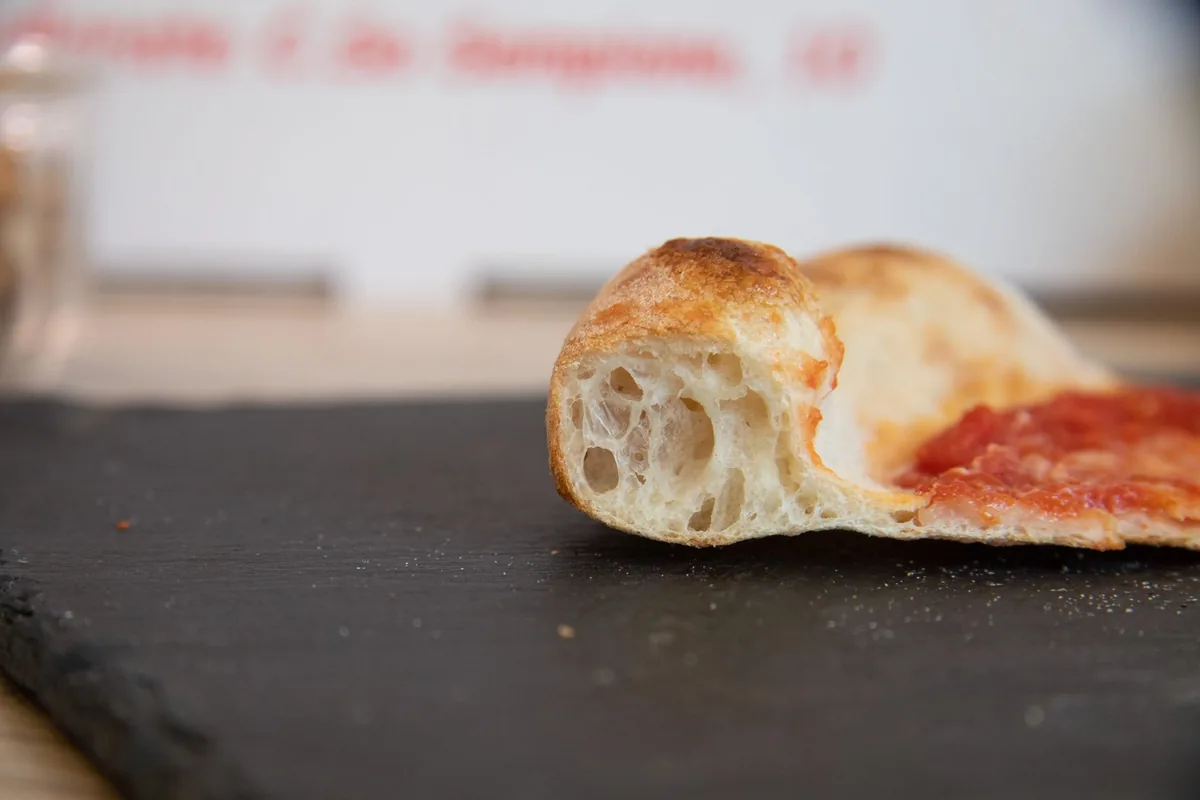
Twenty-two fifty for a 14.75-inch stoneware stone with a metal rack. If you have never baked on a stone and want to find out whether it changes anything, this is the cheapest honest answer.
Key Specifications
| Material | Ceramic stoneware |
|---|---|
| Size | 14.75 in round |
| Weight | 4.6 pounds — lightest stone here |
| Included | Stone and metal carrying rack |
| Max temperature | 500°F stated |
| Property | Porous — absorbs moisture |
| Care | Hand wash |
| Rank | #52 in Pizza Pans & Stones |
| Rating | 4.2 from 752 reviews |
| Price | $22.51 |
| Best For | Trying the technique cheaply, and going oven to table |
Why We Recommend It
Its second bullet states the one thing steel cannot do: “Stone absorbs moisture; for baking perfectly crispy crust pizza.” This is the genuine argument for stone over steel and it gets lost in the conductivity numbers. Ceramic and cordierite are porous, so as the base cooks they wick moisture out of the dough. Steel is non-porous and does the opposite — it conducts heat in ferociously but any moisture the base releases has to escape as steam. For a wet, high-hydration dough that difference is real.
The metal rack is more useful than it sounds. A hot stone has to go somewhere when it comes out, and a rack with a handle turns it into something you can carry to the table and serve from.
500°F is the lowest ceiling on this page by a wide margin, and it is the number to weigh against the price. Other stones here state 1000°F, 1112°F and 1472°F. Pizza wants a very hot oven, and 500°F is roughly where a domestic oven tops out — so this is usable, with no headroom at all, and it rules out the grill.
4.2 stars is the lowest rating here, and cheap ceramic stones earn that honestly: they crack. Thermal shock from a cold stone into a hot oven, or a splash of water onto a hot one, and it is done.
Pros
- $22.51, the cheapest way into stone baking
- Porous stoneware genuinely absorbs moisture from the base
- Metal carrying rack included, and it serves at the table
- 14.75 inches, a full-size round
- Only 4.6 pounds
- Nothing to season or maintain
Cons
- 500°F ceiling — the lowest on this page
- 4.2 stars, the lowest rating here
- Ceramic cracks from thermal shock and cannot be repaired
- Not suitable for a grill
- #52 in the category
- Nowhere near steel’s conductivity
Best for: Finding out whether a stone changes your pizza, for the price of a takeaway.
4. Hans Grill Cordierite 15×12 — Best Stone

Thirteen thousand eight hundred and forty-nine reviews. Nothing else in this roundup has a tenth of that, and it is #1 in Pizza Grilling Stones.
Key Specifications
| Material | Toughened porous cordierite |
|---|---|
| Size | 15 x 12 in rectangular |
| Weight | 7.8 pounds |
| Max temperature | 1112°F stated |
| Included | Stone and wooden peel |
| Use | Oven and BBQ |
| Care | Hand wash, warm water only |
| Rank | #1 in Pizza Grilling Stones |
| Rating | 4.4 from 13,849 reviews — most here |
| Price | $49.98 |
| Best For | Stone baking with the largest evidence base on this page |
Why We Recommend It
Cordierite is the material worth knowing about. It is a magnesium-iron-aluminium silicate with a very low coefficient of thermal expansion, which means it barely changes size as it heats. That is precisely what stops thermal shock cracking — a stone cracks because one part expands faster than another, and cordierite expands so little that the stress never builds. It is why kiln shelves are made of it, and why cordierite stones survive where cheap ceramic ones split.
1112°F is 600°C, and it is a genuine grill and wood-fired-oven rating rather than an oven one. This is a stone you can put on a barbecue.
Rectangular at 15 by 12 is the practical shape for a domestic oven rack, and it takes bread as readily as pizza — the listing lists pies, pastry, calzone and artisan bread, which is what a stone is genuinely good for beyond pizza.
The peel is included and it is a wooden one, which is the correct choice for launching: dough sticks far less to wood than to metal, and a wooden peel is what you want for getting the pizza onto the stone. Metal peels are for retrieving.
Hand wash with warm water only, no soap — porous stone absorbs detergent and will give it back to your next pizza.
Pros
- 13,849 reviews — by far the largest sample here
- #1 in Pizza Grilling Stones
- Cordierite resists thermal shock where cheap ceramic cracks
- 1112°F, genuinely grill-rated
- Wooden peel included, which is the right kind for launching
- Bakes bread as well as pizza
Cons
- 7.8 pounds and still breakable if knocked
- Nowhere near steel’s conductivity
- No soap, ever — porous stone absorbs it
- Stains permanently and that is normal
- 4.4 stars
- Long preheat
Best for: Anyone who wants a stone rather than a steel, on the best evidence available.
5. Chef Pomodoro 16-Inch Steel — Best Pre-Seasoned Steel

Sixty-three dollars for a pre-seasoned 16-inch steel. The Original Baking Steel is $139 and the Artisan is $89.99, and all three are quarter-inch slabs doing identical physics.
Key Specifications
| Material | Seasoned carbon steel |
|---|---|
| Size | 16 x 13.25 in |
| Weight | 6.64 kg / 14.6 pounds |
| Finish | Pre-seasoned, ready to use |
| Max temperature | 932°F stated |
| Care | Hand wash |
| Rank | #17 in Pizza Pans & Stones |
| Rating | 4.6 from 677 reviews |
| Price | $62.99 |
| Best For | A 16-inch steel without the seasoning chore or the $139 |
Why We Recommend It
Pre-seasoning is the feature and it saves a genuinely tedious job. A bare steel arrives raw and needs oiling and baking several times before it stops rusting and releasing badly — the same process as a carbon steel pan, but on a fifteen-pound slab that barely fits in the oven. Arriving seasoned removes an evening’s work.
It does not make the seasoning permanent. Wash it, leave it damp, and it will rust like any other carbon steel. Wipe it dry and put it back in the oven, which is where most people keep it anyway.
Sixteen by 13.25 inches takes a 15-inch pizza with a little room, and is a more oven-friendly rectangle than a 16 by 16 square if your rack is shallow.
Its durability bullet is the honest comparison: steel “can withstand high temperatures without cracking or breaking” and is “less prone to damage” than stone. That is the whole case for steel over stone in one line, alongside the conductivity.
932°F is 500°C, one of several oddly precise Celsius conversions in this category.
Pros
- Pre-seasoned, so no preparation at all
- Full 16-inch surface for a 15-inch pizza
- $62.99 against $139 for the same physics
- 932°F stated ceiling
- Cannot crack, unlike every stone here
- 4.6 from 677 reviews
Cons
- 14.6 pounds
- Seasoning still needs maintaining or it rusts
- Hand wash only
- Long preheat, as all steels have
- Rectangular, so orientation matters on a shallow rack
Best for: A full-size steel at a sensible price, with the boring part already done.

6. Artisan Steel 16 x 14.25 — Made in the USA
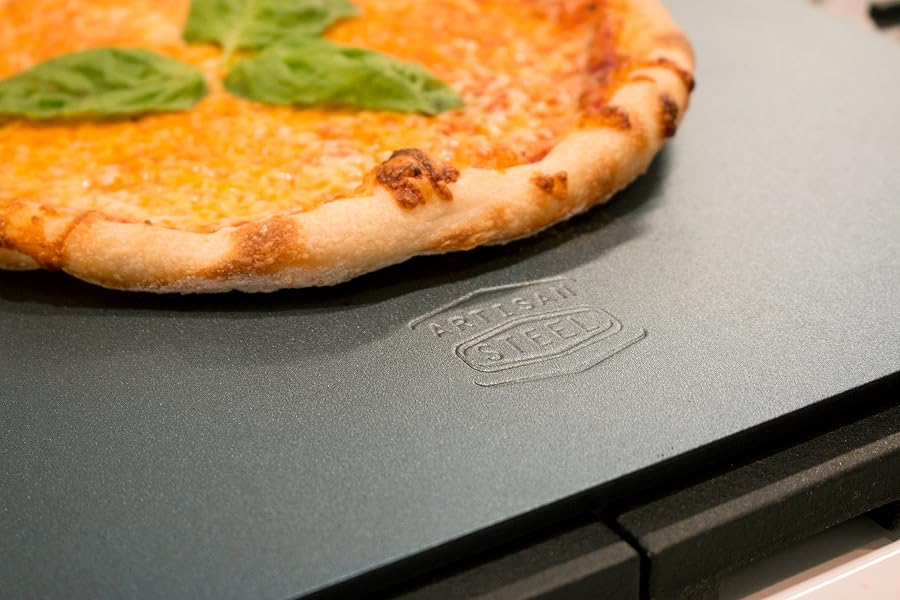
The Maximum Temperature field on this listing reads 375°F. It is a solid sixteen-pound slab of quarter-inch carbon steel. Steel melts somewhere around 2,500°F.
Key Specifications
| Material | Carbon steel |
|---|---|
| Thickness | 0.25 in |
| Size | 16 x 14.25 in |
| Weight | 16 pounds |
| Surface | Low friction, channels steam away |
| Max temperature | 375°F, per the specification field |
| Origin | Made in the USA |
| Care | Hand wash |
| Rank | #57 in Pizza Pans & Stones |
| Rating | 4.7 from 1,011 reviews |
| Price | $89.99 |
| Best For | American-made steel, ignoring the temperature field |
Why We Recommend It
That figure cannot be right and it is the lowest on this page — lower than the $22.51 ceramic stone, on the material with the highest genuine tolerance in the roundup. Every other steel here states between 900 and 1000°F. Treat it as a data-entry error rather than a limitation, because a pizza steel used at 375°F would be pointless: the entire technique depends on running the oven as hot as it will go.
The low-friction surface claim is a real and under-discussed one. Launching a pizza off a peel onto a rough surface is where home pizza goes wrong — the dough catches, folds, and you get a calzone. A smoother slab releases the dough more predictably. The listing also notes it “allows steam to channel away”, which is the partial answer to steel’s one weakness against porous stone.
Made in the USA, like the Original Baking Steel, at fifty dollars less.
4.7 stars from 1,011 reviews is the best-supported rating among the steels here, which suggests the temperature field has not troubled anyone who actually owns one.
Sixteen pounds puts it second-heaviest in this roundup.
Pros
- 4.7 from 1,011 reviews — best-supported steel rating here
- Made in the USA at $50 less than the original
- Low-friction surface makes launching more predictable
- Channels steam away, addressing steel’s weakness
- Quarter-inch, the versatile thickness
- Cannot crack
Cons
- Maximum Temperature field reads 375°F, which is not credible
- 16 pounds, second heaviest here
- $89.99
- Hand wash, and it will rust if left wet
- #57 in the category
- Not pre-seasoned
Best for: American-made steel for less than the original — and ignore the 375°F field.
7. Gyreuni 13-Inch Stone Set — Most Complete Set
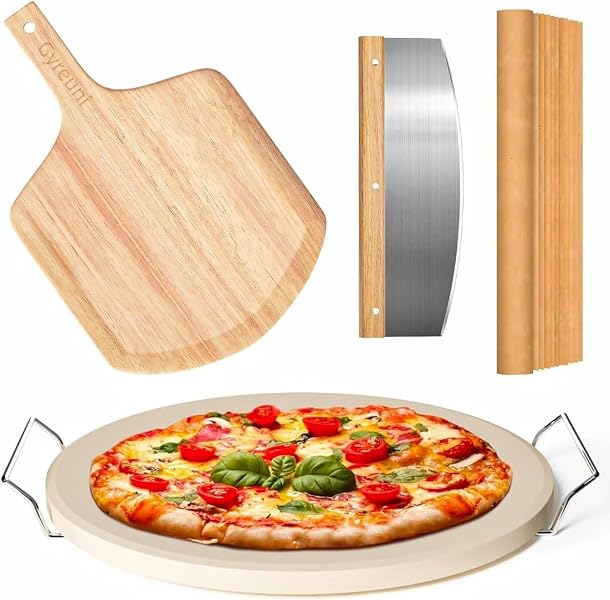
Thirty-eight dollars for a cordierite stone, a solid oak peel, a serving rack and a cutter. Rated to 1472°F, which is 800°C and the highest figure on this page.
Key Specifications
| Material | FDA-safe cordierite stone |
|---|---|
| Size | 13 in round |
| Weight | 2.93 kg |
| Max temperature | 1472°F — highest here |
| Included | Stone, 12 in oak peel, serving rack, cutter |
| Pieces | 5 |
| Care | Hand wash |
| Rank | #18 in Pizza Pans & Stones |
| Rating | 4.5 from 1,279 reviews |
| Price | $37.99 |
| Best For | Everything needed to start, in one box |
Why We Recommend It
That rating is what cordierite is for. It is the material kiln shelves are made from, and 1472°F puts this comfortably into wood-fired and pizza-oven territory rather than just domestic ovens — which matters if you ever put it in an outdoor oven, where cheap ceramic simply fails.
The oak peel is the piece that makes the set worth buying. Almost everyone launching their first pizza does it badly, and a wooden peel is far more forgiving than metal because dough sticks to it much less. Buying stone and peel separately typically costs more than this whole set.
The serving rack is a safety item rather than an accessory, and the listing says so — a 1472°F-rated stone coming out of an oven needs somewhere to land that is not your worktop.
Thirteen inches is the limitation. That takes a 12-inch pizza comfortably and nothing larger, where the steels here handle 15 inches. For one or two people it is fine; for a family pizza night it means baking in sequence.
Cordierite still cracks if you shock it — far less readily than ceramic, but it is not steel. Let it heat with the oven and never run it under a tap while hot.
Pros
- 1472°F — the highest rating in this roundup
- Five pieces including a solid oak peel
- Cordierite resists thermal shock properly
- Serving rack included for safe removal
- $37.99 for the whole set
- 4.5 from 1,279 reviews
Cons
- 13 inches takes only a 12-inch pizza
- Still crackable, unlike steel
- Nowhere near steel’s conductivity
- Hand wash, no soap
- Long preheat
- Small for a family
Best for: A complete first setup, for one or two people, in a single box.
8. Culinary Couture 15×12 Set — Best Large Stone Set
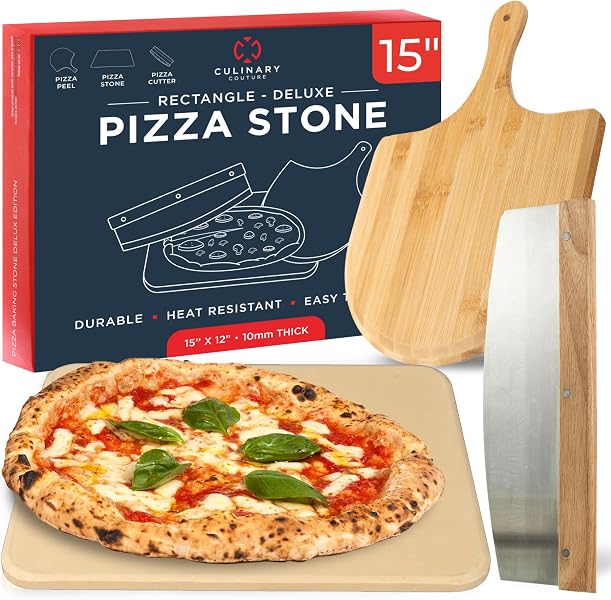
Thirty dollars for a 15 by 12 inch cordierite stone, a wooden peel and a cutter. That is the same footprint as the Hans Grill at twenty dollars less, with a shorter track record.
Key Specifications
| Material | Premium cordierite |
|---|---|
| Size | 15 x 12 in rectangular |
| Weight | 3.04 kg |
| Max temperature | 1000°F stated |
| Included | Stone, wooden peel, cutter |
| Property | Porous — absorbs excess moisture |
| Care | Water only — do not use soap |
| Rank | #9 in Pizza Grilling Stones |
| Rating | 4.5 from 204 reviews |
| Price | $29.99 |
| Best For | A full-size stone and peel without spending fifty dollars |
Why We Recommend It
Rectangular at 15 by 12 is the right size for a domestic oven, and noticeably more useful than the 13-inch round: it takes a 14-inch pizza, two loaves side by side, or a tray of bread rolls.
Its care instruction is in capitals for a reason: DO NOT USE SOAP. This is the most commonly ignored rule with stone and the consequence is permanent. Cordierite is porous by design — that is the entire mechanism by which it wicks moisture out of a base — and porous means it absorbs detergent too, then releases it into the next thing you bake. Water and a scraper is the whole cleaning routine, and staining is normal and harmless.
1000°F covers oven and grill, though not the 1472°F the Gyreuni claims.
The porosity claim is the genuine stone advantage and this listing leads with it — the surface absorbs excess moisture from the dough, which is the one thing a steel physically cannot do.
204 reviews is a modest sample next to the Hans Grill’s 13,849, and it is the main reason to pay the extra twenty dollars for the better-established stone.
Pros
- Full 15 x 12 in surface for $29.99
- Wooden peel and cutter included
- Cordierite rated to 1000°F for oven and grill
- Porous surface wicks moisture from the base
- Takes a 14-inch pizza or two loaves
- 4.5 stars
Cons
- Only 204 reviews against 13,849 for the Hans Grill
- Soap ruins it permanently
- Cracks if thermally shocked
- Nowhere near steel’s conductivity
- Long preheat
- Stains, permanently and normally
Best for: A full-size stone and peel for thirty dollars, if the smaller sample does not worry you.
9. 13×13 Baking Steel — Cheapest Steel

Forty dollars for a quarter-inch carbon steel slab. The Original Baking Steel is $139 for the same thickness and the same material, on a larger footprint.
Key Specifications
| Material | 0.25 in ultra-conductive carbon steel |
|---|---|
| Size | 13 x 13 in square |
| Weight | 4.89 kg / 10.8 pounds |
| Conductivity claim | Up to 20× a ceramic stone |
| Included | Manual |
| Care | Hand wash |
| Rank | #77 in Pizza Pans & Stones |
| Rating | 4.4 from 45 reviews |
| Price | $39.99 |
| Best For | Steel performance on a budget and a smaller oven |
Why We Recommend It
The physics does not care what you paid. Quarter-inch carbon steel conducts heat at the same rate regardless of brand, and this listing makes the same 20×-versus-ceramic claim as the ThermiChef. What more money buys elsewhere is size, pre-seasoning, American manufacture and a track record — not a crisper base.
Thirteen by thirteen is the compromise. That takes a 12-inch pizza comfortably and not much more, and at 10.8 pounds it is the lightest steel here by four pounds — which makes it the only one on this page that is genuinely easy to take in and out of the oven.
Square, so orientation never matters, and it suits a smaller or shallower oven that a 16-inch slab will not fit.
No maximum temperature is published, which for solid carbon steel is a smaller omission than it would be on a coated product — there is nothing to degrade.
Forty-five reviews is a very small sample and the honest reason to hesitate. It is enough to know the product exists and arrives; it is not enough to know how it holds up.
Pros
- $39.99 for genuine quarter-inch steel
- Same conductivity as steels three times the price
- 10.8 pounds — the only steel here that is easy to move
- Square, fits shallow ovens
- Cannot crack
- Manual included
Cons
- Only 45 reviews — almost no track record
- 13 inches takes a 12-inch pizza at most
- No maximum temperature published
- Not pre-seasoned; it will rust if neglected
- #77 in the category
- Unfamiliar brand
Best for: Steel performance on a budget, in a smaller oven, accepting a thin track record.
10. HexClad Hybrid Pizza Steel — Lightest, and the Odd One
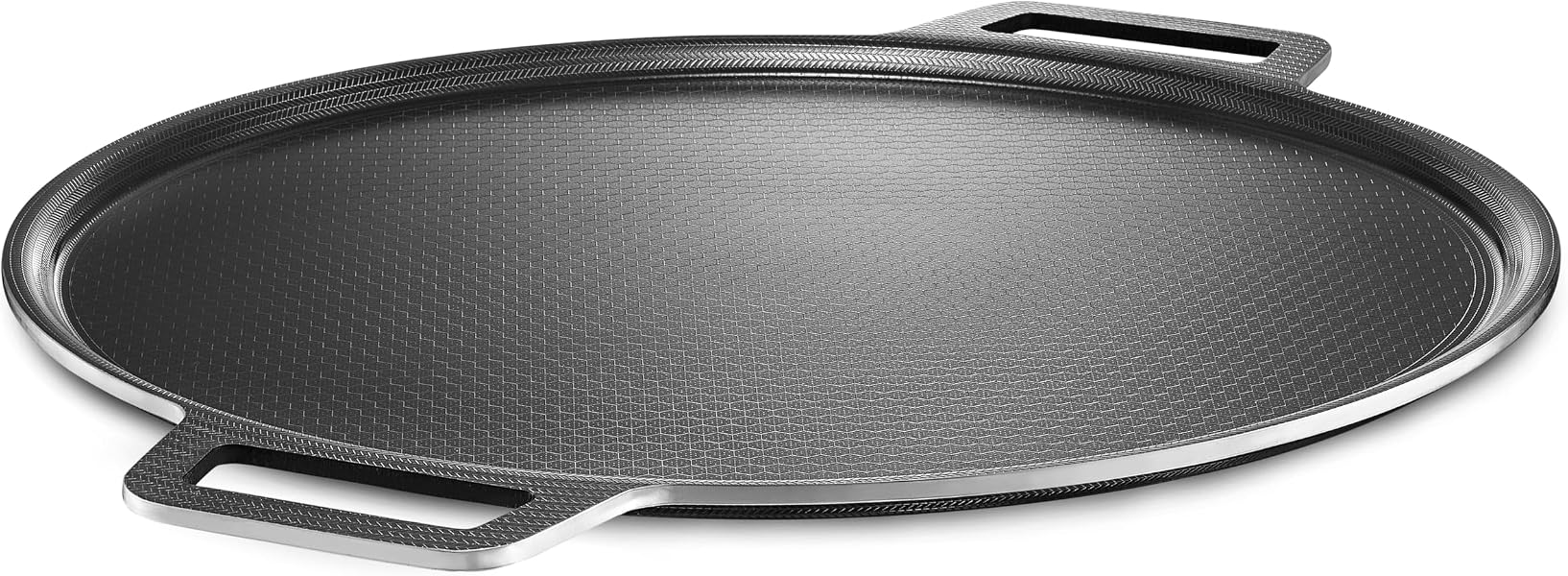
Highest rating in this roundup at 4.8, and the single most unusual product on the page. It weighs 703 grams. The ThermiChef weighs 17.6 pounds — about eleven times as much.
Key Specifications
| Material | Tri-ply with TerraBond ceramic, laser-etched |
|---|---|
| Fits | Pizzas up to 14 in |
| Weight | 703 g — lightest here by far |
| Max temperature | 900°F stated |
| Claim | No preheating required |
| Use | Oven, BBQ, and any cooktop including induction |
| Care | Hand wash only |
| Rank | #64 in Pizza Pans & Stones |
| Rating | 4.8 from 480 reviews — highest here |
| Price | $129 |
| Best For | Nonstick release and versatility rather than thermal mass |
Why We Recommend It
That weight difference matters, because thermal mass is what a pizza steel is. The reason a steel crisps a base is not only conductivity but stored energy: a heavy slab holds a large reservoir of heat and dumps it into cold wet dough without its own surface temperature collapsing. Stored heat is proportional to mass. A 703-gram plate simply cannot hold what a 15-pound slab holds, and it will drop temperature when the pizza lands in a way the heavy steels will not.
Which makes the “no preheating required” claim coherent rather than contradictory. HexClad is not selling thermal mass; it is selling a tri-ply pan in the shape of a pizza steel — fast to heat because there is little of it, nonstick because of the hybrid ceramic surface, and usable on a hob or a barbecue. Judge it as versatile cookware and it makes sense. Judge it as a pizza steel and it is missing the main ingredient.
The hybrid surface is genuinely good at what it does — a laser-etched steel grid standing proud of ceramic nonstick, metal-utensil safe, and it means a pizza will not weld to it, which every bare steel here can do.
4.8 stars from 480 reviews suggests owners are pleased, and most of them are probably using it as the versatile pan it is.
$129 puts it second-most-expensive here, above three real steels.
Pros
- Highest rating in this roundup at 4.8
- Nonstick hybrid surface — nothing welds to it
- 703 g, so it is genuinely easy to handle
- Works on a hob and induction, not just in the oven
- No preheating needed
- 900°F stated, and metal-utensil safe
Cons
- 703 g means very little thermal mass, which is the point of a steel
- $129, above three full-weight steels
- Coating will degrade where bare steel would not
- Takes pizzas only up to 14 inches
- Hand wash only
- Not really competing with the slabs here
Best for: Nonstick versatility and easy handling — not the crispest base on this page.
Steel or Stone: Conductivity Against Porosity
Two materials, two different mechanisms, one purchase decision.
| Pizza steel | Pizza stone | |
|---|---|---|
| Thermal conductivity | ~45–50 W/m·K | ~3 W/m·K |
| Manufacturers’ own claim | 18–20× a stone | — |
| Absorbs moisture from the base | No — solid | Yes — porous |
| Can it crack | Never | Yes, and it is then finished |
| Weight here | 10.8 to 17.6 lb | 4.6 to 7.8 lb |
| Price here | $39.99 to $139 | $22.51 to $49.98 |
| Rusts | Yes, if stored wet | No |
| Best for | Crispest possible base, fast | Wet doughs, bread, and the grill |
If you want the crispest base a domestic oven can produce, buy steel — the conductivity gap is large, well documented, and the manufacturers are not exaggerating it. If you bake a lot of bread, work with very wet doughs, or want something you can take to a barbecue and not worry about, stone has real advantages: it wicks moisture, it costs half as much, it weighs half as much, and it does not rust. The one thing to be clear about is that these are not two grades of the same product. They fail differently, they cook differently, and a stone is not simply a cheap steel.
What the Stated Ceilings Actually Say
From 375°F to 1472°F, and the pattern is not what you would expect.
| Product | Material | Stated maximum | Credible? |
|---|---|---|---|
| Gyreuni 13-Inch Set | Cordierite | 1472°F | Yes — kiln-shelf material |
| Hans Grill 15×12 | Cordierite | 1112°F | Yes |
| ThermiChef 16×16 | Carbon steel | 1000°F | Yes |
| Original Baking Steel | Carbon steel | 1000°F | Yes |
| Culinary Couture 15×12 | Cordierite | 1000°F | Yes |
| Chef Pomodoro 16-Inch | Carbon steel | 932°F | Yes |
| HexClad Hybrid | Coated steel | 900°F | The coating, not the steel |
| GoodCook Stoneware | Ceramic | 500°F | Yes — plain ceramic is weaker |
| 13×13 Baking Steel | Carbon steel | Not stated | — |
| Artisan Steel 16×14.25 | Carbon steel | 375°F | No |
Read that column by material and it mostly makes sense: cordierite is what kiln shelves are made from and carries the highest figures, plain ceramic is the weakest, and coated products are limited by the coating rather than the substrate. Then there is the Artisan Steel, whose specification field rates a sixteen-pound slab of quarter-inch carbon steel to 375°F — lower than the $22.51 ceramic stone, on the most heat-tolerant object on the page. Steel does not begin to care until well over a thousand degrees. It is a data-entry error, its 1,011 reviewers plainly ignore it, and it is a useful reminder that the specification block and the product are different things.
Best Alternatives
| Alternative | Why Consider It | Better For | Main Trade-Off |
|---|---|---|---|
| Unglazed quarry tiles | Pennies each, and genuinely work | Covering a whole oven rack cheaply | Sourcing food-safe unglazed ones |
| A heavy cast iron pan, inverted | You may own one; huge thermal mass | One small pizza | Small, and awkward to launch onto |
| A perforated pizza pan | Holes let steam out; no preheat needed | Frozen and everyday pizza | Nothing like the base heat |
| An outdoor pizza oven | Real 900°F+ heat, which no domestic oven gives | Neapolitan pizza in 90 seconds | A different budget entirely |
| An upturned heavy baking sheet | Free, and preheats with the oven | Trying the technique tonight | Thin, so very little stored heat |
What Each Price Tier Actually Buys
$22.51 to $39.99 — GoodCook, Culinary Couture, Gyreuni, 13×13 Steel. Both materials are represented here and this tier is genuinely good value: a full-size cordierite stone with a wooden peel for $29.99, a five-piece set for $37.99, or a real quarter-inch steel for $39.99. The physics of the $39.99 steel is identical to the $139 one.
$49.98 to $73.99 — Hans Grill, Chef Pomodoro, ThermiChef. Where the best-supported products sit. The Hans Grill has 13,849 reviews and the top rank in Pizza Grilling Stones; the ThermiChef is #2 in Pizza Pans & Stones and is the only listing that explains its own thickness. This is the tier to buy from.
$89.99 to $139 — Artisan Steel, HexClad, Original Baking Steel. American manufacture, the company that invented the category, or a hybrid nonstick surface. None of these produces a crisper base than the $39.99 steel; they buy provenance, size and coating.
The pattern: price buys size, origin and finish. It does not buy conductivity, because that is a property of the material and not the brand. The cheapest steel here and the most expensive one are both quarter-inch carbon steel.
How to Choose a Pizza Stone or Steel
Decide Between Conductivity and Porosity
This is the whole choice. Steel conducts heat roughly fifteen to twenty times better than cordierite, which is why it produces a crisper, more blistered base in a domestic oven — three manufacturers on this page quote 18× or 20× and the physics supports them. Stone is porous, so it absorbs moisture out of the dough as it bakes, which steel physically cannot do. For most pizza, steel wins. For very wet doughs, for artisan bread, and for anything going on a barbecue, stone earns its place — and it costs and weighs about half as much.
Take the Weight Seriously Before You Buy
The steels here weigh between 10.8 and 17.6 pounds and that is not incidental — stored heat is proportional to mass, so the weight is the feature. The consequence is that most people never take it out again: shifting a 17-pound slab from a hot oven needs two hands, mitts and somewhere heatproof to put it. It then absorbs energy on every preheat, pizza or not. If you want something you can store in a cupboard, buy a stone, or buy the lightest steel here at 10.8 pounds.
Match the Size to Your Oven, Then Your Pizza
A 13-inch stone takes a 12-inch pizza and nothing more; a 16-inch steel handles 15 inches. Bigger is generally better because a larger thermal reservoir holds temperature when the pizza lands — but the slab must leave two or three inches of clearance around it for hot air to circulate, or the oven cannot maintain even heat. Measure the interior width of your oven rather than guessing, particularly before ordering something that weighs seventeen pounds and is awkward to return.
Preheat Far Longer Than Feels Reasonable
This is where most people go wrong and no product fixes it. Your oven’s thermostat reports the air temperature, and the air reaches temperature long before a fifteen-pound slab does — the beep means nothing. A steel or stone needs 45 minutes to an hour at maximum temperature to become genuinely saturated with heat. Launch onto an under-heated slab and you get exactly the pale, floppy base you bought the thing to avoid. Put it in cold, turn the oven to its highest setting, and wait.
Never Shock a Stone, and Never Wash It with Soap
Stones crack because one part expands faster than another, so heat them with the oven from cold and never put a cold stone into a hot one or splash water on a hot one. Cordierite resists this far better than plain ceramic — it is the material kiln shelves are made from — which is why the cordierite stones here carry ratings of 1000°F and above while the plain ceramic one states 500°F. And use water only: porous stone absorbs detergent and gives it back to your next pizza. Staining is permanent, normal and harmless.
Get a Wooden Peel, Not a Metal One, for Launching
The failure everyone experiences at least once is the pizza folding on itself halfway off the peel. Dough sticks far less to wood than to metal, so a wooden peel is the right tool for launching and a metal one is for retrieving. Three products in this roundup include a wooden peel, which is worth more than it sounds because buying stone and peel separately usually costs more than the set. Flour or semolina the peel, build the pizza fast, and do not let it sit — a dressed pizza starts sticking within a minute.
Common Pizza Stone Buying Mistakes
- Preheating for twenty minutes. The oven beeps long before a fifteen-pound slab is saturated. Give it an hour.
- Washing a stone with soap. It is porous, it absorbs the detergent, and the next pizza tastes of it.
- Putting a cold stone into a hot oven. Thermal shock is what cracks them, and a cracked stone is finished.
- Buying a steel without weighing the weight. Seventeen pounds effectively becomes part of your oven.
- Assuming a stone and a steel are the same thing. One is porous and cracks; the other conducts and rusts.
- Launching from a metal peel. Dough sticks to metal; use wood to launch and metal to retrieve.
- Letting a dressed pizza sit on the peel. It starts sticking within a minute and then folds.
- Leaving a steel wet. It is bare carbon steel and it will rust exactly like a pan.
- Trusting the specification block. One steel here is rated to 375°F, which is not possible.
Which Pizza Stone or Steel Should You Buy?
Buy the ThermiChef if you want a steel and want it right. #2 in the category, square so orientation never matters, and the only listing that explains why a quarter inch is the sensible thickness.
Buy the Original Baking Steel if you are buying once and want the American-made original, pre-seasoned and effectively indestructible.
Buy the GoodCook stoneware if you want to find out whether any of this changes your pizza, for $22.51 — and you can live with 500°F.
Buy the Hans Grill stone if you want stone on the best evidence available. 13,849 reviews, #1 in Pizza Grilling Stones, cordierite to 1112°F, peel included.
Buy the Chef Pomodoro if you want a full-size steel that arrives seasoned, for less than half the price of the original.
Buy the Artisan Steel if you want American-made steel at $50 under the original — and disregard the 375°F in the specification field.
Buy the Gyreuni set if you are starting from nothing and cooking for one or two. Stone, oak peel, rack and cutter for $37.99.
Buy the Culinary Couture set if you want a full-size stone and a wooden peel for thirty dollars.
Buy the 13×13 steel if you want steel physics cheaply, have a smaller oven, and want the one slab here you can actually lift.
Buy the HexClad if you want a nonstick, hob-capable, easy-to-handle plate — understanding that at 703 g it is not doing what the heavy steels do.
Frequently Asked Questions
Is a pizza steel better than a pizza stone?
For crust, yes, and by a large margin. Carbon steel conducts heat at roughly 45 to 50 watts per metre-kelvin against about 3 for cordierite ceramic — three separate manufacturers in this roundup quote 18x or 20x, and that is consistent with the physics. More heat moves into the base faster, which is what produces a crisp, blistered, leopard-spotted crust in a domestic oven. Stone keeps two genuine advantages: it is porous, so it wicks moisture out of the dough, and it costs and weighs about half as much. Steel also rusts and stone cracks.
How long should I preheat a pizza stone or steel?
Forty-five minutes to an hour at your oven’s maximum temperature, and this is the single most common mistake. Your oven’s thermostat measures air temperature, and air heats far faster than a fifteen-pound slab of steel — so the ready beep tells you nothing about the thing you are actually baking on. An under-heated slab produces exactly the pale, soft base you bought it to prevent. Put it in a cold oven on the middle or lower-middle rack, turn the oven as high as it goes, and leave it long after it says it is ready.
Will a pizza stone crack?
It can, and thermal shock is almost always the cause: one part of the stone expands faster than another and the stress splits it. That is why you heat a stone with the oven from cold, never put a cold stone into a hot oven, and never splash water on a hot one. Material matters a great deal here — cordierite has a very low coefficient of thermal expansion and is what kiln shelves are made from, which is why the cordierite stones in this roundup are rated to 1000°F and above while the plain ceramic one states 500°F. Steel cannot crack at all.
Can you wash a pizza stone with soap?
No, and it is permanent if you do. A stone works precisely because it is porous — that is the mechanism by which it draws moisture out of the base — and porous means it absorbs detergent just as readily, then releases it into whatever you bake next. Scrape off stuck-on residue with a bench scraper once the stone is cool, and use plain water if you need it. Dark staining is normal, permanent and completely harmless; a well-used stone looks terrible and works better than a new one.
What size pizza stone or steel should I buy?
Large enough for your pizza, small enough for your oven. A 13-inch round takes a 12-inch pizza and no more; a 16-inch slab handles 15 inches. Bigger is generally better because a larger mass holds temperature better when cold dough lands on it — but you need two to three inches of clearance around it for hot air to circulate, or the oven cannot maintain even heat. Measure your oven’s interior rather than guessing, especially before ordering something that weighs seventeen pounds.
Do I need a pizza peel?
For launching onto a preheated surface, effectively yes — and it should be wooden. Dough sticks far less to wood than to metal, which is why wooden peels are used to launch and metal ones to retrieve. Three of the products in this roundup include a wooden peel, and buying stone and peel separately generally costs more than the set. Flour or semolina the peel generously, build the pizza quickly, and get it into the oven — a dressed pizza begins sticking to the peel within about a minute.
Does a pizza steel rust?
Yes. It is bare carbon steel and it behaves exactly like a carbon steel pan — leave it damp and it will rust. The fix is the same too: keep a light seasoning on it, wipe it dry after cleaning, and store it somewhere dry, which for most people means leaving it in the oven. Two steels in this roundup arrive pre-seasoned, which saves an evening of oiling and baking a fifteen-pound slab. Surface rust that does appear can be scrubbed off and the steel re-seasoned; it is not fatal the way a cracked stone is.
Can I leave a pizza steel in the oven all the time?
Most people do, and it is the practical answer given the weight. There is one real cost: a fifteen-pound slab absorbs energy on every preheat, so your oven takes longer to come up to temperature and uses more power even when you are baking a tray of biscuits. It also blocks some airflow, which can affect how evenly other things cook, so keep it on a lower rack. If that bothers you, the lightest steel in this roundup is 10.8 pounds and genuinely liftable; the stones are lighter still.
Final Verdict
#2 in the category, square, and the only listing that explains its own thickness.
The American-made original that created the category, pre-seasoned and crack-proof.
$22.51 for porous stoneware with a carrying rack — the cheapest honest way in.
The argument in this category has a clear answer and a real caveat, and both are worth stating plainly.
The answer is steel. It conducts heat roughly fifteen to twenty times better than ceramic, the manufacturers who claim 18× and 20× are not exaggerating, and that gap is the difference between a crisp blistered base and a pale one in an ordinary domestic oven. It cannot crack, and the cheapest quarter-inch steel here does exactly the same physics as the one costing three and a half times more.
The caveat is that stone still does one thing steel cannot. It is porous, and it pulls moisture out of the dough while it bakes — which on a wet, high-hydration dough or a loaf of bread genuinely matters. Stone is also half the weight, half the price and does not rust.
Whichever you buy, the thing that will actually decide your pizza is the preheat. Your oven beeps when the air is hot, and the air is hot long before a fifteen-pound slab is. Give it an hour at full heat. That costs nothing and it matters more than the choice between the two.