Affiliate Disclosure: As an Amazon Associate, we earn from qualifying purchases. This does not affect the price you pay.
Think about the last slice you cut off a loaf. The blade goes down cleanly, and then somewhere in the final half inch your knuckles reach the board, you tilt the handle up, and you saw the bottom crust apart at an angle.
That is not you being careless. It is the shape of the knife. On a straight bread knife the handle sits in line with the blade, so there is no clearance between your hand and the board — and the last part of every cut is made with the blade tipped, which is exactly why the bottom crust tears and the final slice is always the worst one.
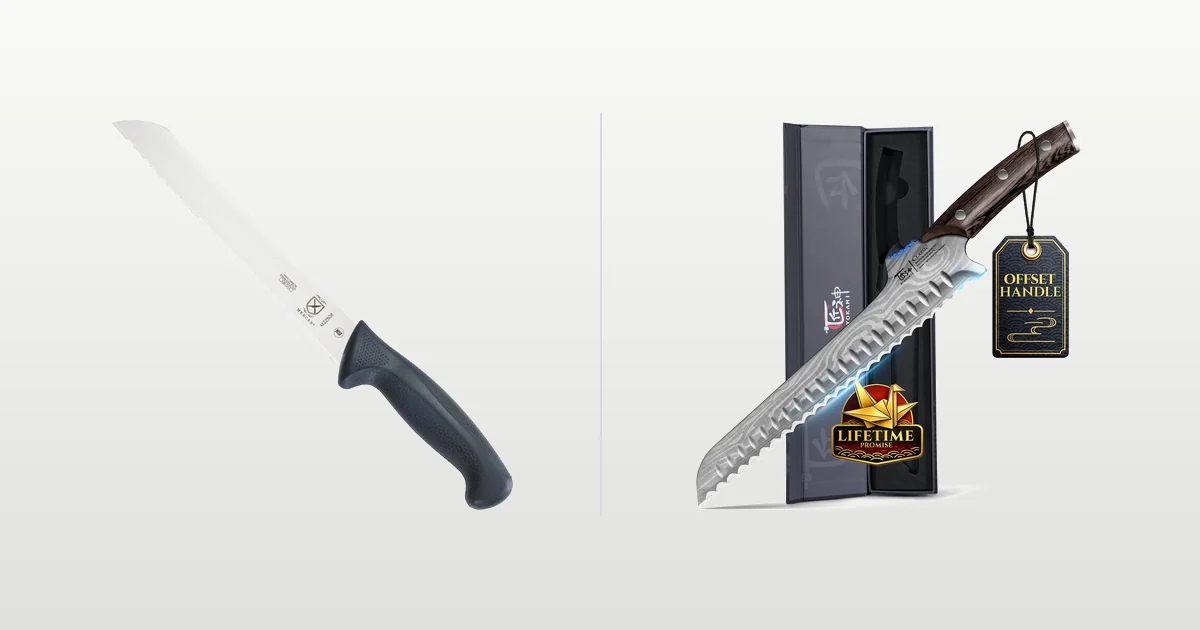
Bakeries solved this decades ago with an offset handle, raised on a neck above the blade line so the blade can lie flat while your hand stays clear. One knife in this roundup has it, and its listing spells out the consequence: with the blade level, every serration contacts the board instead of just the tip, so the cut finishes in one stroke.
The second thing worth knowing before you spend anything: a serrated edge cannot be honed, and sharpening one means working each gullet individually with a tapered rod. Almost nobody does. Which makes a bread knife closer to a consumable than a chef’s knife is — and explains why the most-reviewed knife on this page costs $12.99 and holds 4.8 stars across 11,627 reviews.
Below: ten bread knives from $5.99 to $74.99, wavy edges against pointed ones, and why blade length matters more than almost anything else.
Our Quick Picks
 Best OverallMercer Culinary Millennia 8-Inch
One-piece high-carbon Japanese steel with a handle that grips when wet — the bread knife that culinary schools issue alongside the chef’s knife.
 Most PremiumHOSHANHO 10-Inch Japanese
Cobalt-alloyed Japanese steel and a pakkawood handle — the only bread knife here that names a serious alloy.
 Best BudgetOmesata Serrated Bread Knife
Seven dollars, 304 stainless, a wavy edge and #10 in the category — the cheapest knife here that is not a compromise.
At a Glance
Ten Bread Knives Compared
Blade length first, because it decides whether you cross a loaf in one stroke — then serration type, handle and the review count behind each rating.
| # | Model | Blade Length | Serration | Handle | Reviews | Standout | Main Drawback | Check Price |
|---|---|---|---|---|---|---|---|---|
| 1 |
 Mercer Culinary Millennia 8-Inch Mercer Culinary Millennia 8-Inch |
8 inches | Wavy edge | Santoprene, textured | 416 reviews at 4.7 | #1 in Bread Knives, and the same steel professionals use | Straight handle — knuckles meet the board | View on Amazon |
| 2 |
 HOSHANHO 10-Inch Japanese HOSHANHO 10-Inch Japanese |
10 inches | Serrated, vacuum heat-treated | Pakkawood | 1,132 reviews at 4.8 | Japanese 10Cr15CoMoV — cobalt-alloyed steel in a bread knife | $74.99, five times the category leader | View on Amazon |
| 3 |
 Omesata Serrated Bread Knife Omesata Serrated Bread Knife |
12.6 inches overall | Wavy edge | ABS | 1,528 reviews at 4.7 | #10 in Bread Knives for $6.98 | 3.2 ounces — the lightest here | View on Amazon |
| 4 |
 Orblue Serrated 13-Inch Orblue Serrated 13-Inch |
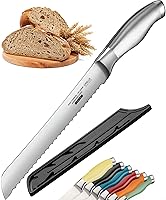
13 inches overall | Wavy edge, 2.2 mm | Stainless steel | 11,627 reviews at 4.8 | The best-supported rating in this roundup by ten times | All-steel handle is slippery wet | View on Amazon |
| 5 |
 SYOKAMI Offset 10.5-Inch SYOKAMI Offset 10.5-Inch |
10.5 inches | Serrated, full board contact | Wood, raised offset | 247 reviews at 4.7 | Offset handle — the one real fix for knuckles on the board | Only 247 reviews | View on Amazon |
| 6 |
 imarku 10-Inch German imarku 10-Inch German |
10 inches | Independent serrations | Pakkawood | 2,264 reviews at 4.7 | German high-carbon steel with a large review base | 15.2 ounces — heaviest here | View on Amazon |
| 7 |
 PAUDIN 10-Inch PAUDIN 10-Inch |
10 inches | Razor-sharp serration | Pakkawood | 1,540 reviews at 4.6 | 56+ HRC stated — the only hardness figure here | #120 in Bread Knives | View on Amazon |
| 8 |
 ABIOTO 11-Inch Sourdough ABIOTO 11-Inch Sourdough |
11 inches | One-sided serrations | Thermoplastic rubber | 245 reviews at 4.7 | One-sided serrations and a rubber grip | 16 ounces, and only 245 reviews | View on Amazon |
| 9 |
 10-Inch Wave Edge Full Tang 10-Inch Wave Edge Full Tang |
10 inches | Wave edge, 1.8 mm | Polypropylene, full tang | 3,281 reviews at 4.5 | Full tang and 10 inches for $11.99 | Unbranded, and 4.5 is the second lowest here | View on Amazon |
| 10 |
 Mezzo High Carbon Sourdough Mezzo High Carbon Sourdough |
13 inches overall | Serrated | Acacia wood | 339 reviews at 4.4 | Six dollars, and an acacia handle | 4.4 stars — the lowest here | View on Amazon |
Specifications, prices, ratings and review counts are taken from each manufacturer’s Amazon listing as displayed on 22 August 2026 via a United States connection, and may change. Blade length and overall length are distinguished where a listing gives both; several listings publish only an overall figure, which includes the handle and is not the cutting length. Serration type is recorded as each listing describes it — wavy or scalloped edges present a continuous curve, while pointed or independent serrations are individually ground — and no listing here publishes a serration pitch. Only one product states a blade hardness. The Mercer Millennia bread knife shows #1 in Bread Knives and #214 in Kitchen & Dining, and the Mercer Millennia chef’s knife, which is not serrated, displays the identical pair of figures; this is Amazon pooling ranks across a variant family, so the badge is earned by this knife and borrowed by its sibling. A 5-inch serrated utility knife returned by the same search was excluded as a different product. Three further bread knives were verified live but excluded for rank or sample size.
Scroll the table sideways to see every column
How We Chose These Bread Knives
We researched current listings, compared manufacturer specifications and documentation, and examined recurring patterns in customer feedback. We did not carry out hands-on testing, and nothing below is presented as measured performance data.
- Blade length against a real loaf — a blade shorter than the loaf means a sawing stroke and a ragged face
- Whether the handle is offset — the only design that clears the board on the final half inch
- Serration type — wavy grips crust without tearing crumb; pointed bites harder and is rougher on soft bread
- Handle material in a wet, floury hand — this is a sawing tool used with force
- Weight — mass carries the stroke through a hard crust
- Review count, since ratings here cluster — samples run from 245 to 11,627
The 10 Best Bread Knives, Reviewed
1. Mercer Culinary Millennia 8-Inch — Best Overall

Fourteen dollars, #1 in Bread Knives, and the same one-piece high-carbon Japanese steel and Santoprene handle as the Millennia chef’s knife.
Key Specifications
| Blade length | 8 inches |
|---|---|
| Edge | Wavy serration |
| Steel | One-piece high-carbon Japanese |
| Handle | Santoprene with textured finger points |
| Weight | 5.6 ounces |
| Rank | #1 in Bread Knives, #214 in Kitchen & Dining |
| Rating | 4.7 from 416 reviews |
| Price | $13.99 |
| Best For | Anyone who wants the professional answer and no theory |
Why We Recommend It
A wavy edge is the right serration for bread and it is worth knowing why. Pointed, saw-toothed serrations bite aggressively and tear a soft crumb; a wavy or scalloped edge presents a continuous curved cutting surface that grips the crust without ripping what is underneath. On a soft sandwich loaf that is the difference between slices and wreckage.
Santoprene is the same reason this knife appears in professional kitchens as its chef’s-knife sibling. A bread knife is used with a long sawing stroke and real forward pressure, often on a crust that resists, and a handle that turns slippery mid-stroke is genuinely dangerous. Rubber grips wet; wood does not.
Eight inches is shorter than most bread knives here, and that is a real trade. A long blade lets you cut a wide sourdough boule in one continuous stroke; eight inches means sawing back and forth across a large loaf, which is where ragged slices come from. For sandwich loaves and baguettes it is ample.
A note on the rank. This knife shows #214 in Kitchen & Dining and #1 in Bread Knives — and so does the Mercer Millennia chef’s knife, which is not serrated. Amazon pools ranks across a variant family, so both products display the family’s position. Here the badge is genuinely earned by this knife; on the chef’s knife it is borrowed.
Pros
- #1 in Bread Knives and #214 in all of Kitchen & Dining
- One-piece high-carbon Japanese steel
- Santoprene handle grips through a wet sawing stroke
- Wavy edge cuts crust without tearing crumb
- $13.99
- Light at 5.6 oz
Cons
- Eight inches is short for a large sourdough boule
- Straight handle, so knuckles reach the board
- Rank is shared across the Millennia variant family
- High-carbon steel needs drying
- Serrations cannot be honed like a plain edge
- Plain looks
Best for: Sandwich loaves, baguettes, and anyone who wants the professional default.
2. HOSHANHO 10-Inch Japanese — Most Premium

Seventy-five dollars for a bread knife, and the only one on this page that names a genuinely premium alloy: 10Cr15CoMoV.
Key Specifications
| Blade length | 10 inches |
|---|---|
| Steel | 10Cr15CoMoV Japanese high carbon |
| Treatment | Vacuum heat-treated |
| Handle | Pakkawood |
| Weight | 8 ounces |
| Rank | #28 in Bread Knives |
| Rating | 4.8 from 1,132 reviews |
| Price | $74.99 |
| Best For | Someone who wants a bread knife to last, not to replace |
Why We Recommend It
That extra Co is cobalt, and in stainless cutlery steel it raises hardness and wear resistance. It is the same steel used in this maker’s chef’s knives, and it is unusual to see it in a serrated blade — because most manufacturers reason, correctly, that a serrated edge does not get sharpened much anyway.
Which is exactly why hardness matters more here than on a plain-edged knife, not less. A chef’s knife that dulls gets honed and sharpened; a serrated knife largely does not, so the edge it arrives with has to last. Harder steel holds those serration points longer, and on a bread knife that translates directly into years of service rather than a sharper first cut.
Vacuum heat treatment is a real process rather than a phrase: hardening in a vacuum prevents oxidation and decarburisation at the surface, so the finished edge is as hard as the interior. It is what good knife factories do and what cheap ones skip.
Ten inches handles a large boule in a single stroke, which eight inches cannot.
Pakkawood is resin-impregnated hardwood — warm and grippy like wood, stable like plastic. A good compromise, and still less secure in a wet hand than rubber.
Pros
- 10Cr15CoMoV cobalt-alloyed steel, named outright
- Vacuum heat-treated for a genuinely hard edge
- 10 inches spans a large sourdough boule
- 4.8 stars from 1,132 reviews
- Pakkawood is stable where plain wood is not
- Hardness matters more on a knife you will not sharpen
Cons
- $74.99 — five times the #1 seller
- #28 in Bread Knives despite the specification
- Pakkawood is less secure wet than rubber
- Hand wash and dry
- Serrations still cannot be honed
- Hard steel chips if levered
Best for: Anyone buying one bread knife to keep, who understands serrations do not get sharpened.
3. Omesata Serrated Bread Knife — Best Budget

Six dollars ninety-eight, 4.7 stars, 1,528 reviews and #10 in Bread Knives. In a category where the edge cannot easily be restored, that combination is worth thinking about carefully.
Key Specifications
| Overall length | 12.6 inches |
|---|---|
| Edge | Wavy serration |
| Steel | 304 stainless |
| Handle | ABS |
| Weight | 3.2 ounces — lightest here |
| Rank | #10 in Bread Knives, #4,616 in Kitchen & Dining |
| Rating | 4.7 from 1,528 reviews |
| Price | $6.98 |
| Best For | A bread knife you will replace rather than maintain |
Why We Recommend It
Here is the argument for buying cheap in this category specifically. A serrated edge cannot be honed and is awkward to sharpen — each gullet has to be worked individually with a tapered rod, which almost nobody does. So a bread knife is closer to a consumable than a chef’s knife is: it arrives sharp, stays usable for years, and eventually stops cutting cleanly. At seven dollars you replace it without a thought. At seventy-five you have to care.
304 stainless is the food-grade standard — 18% chromium, 8% nickel, genuinely rust-proof. It is softer than the high-carbon steels here, which for a serrated edge matters less than it would on a plain one.
Three point two ounces is very light, and on a bread knife that is more of a drawback than elsewhere. Weight helps a sawing stroke carry through a hard crust; a light blade needs you to supply all the force.
ABS is a hard plastic handle — the least grippy material on this page when wet, and the reason this is seven dollars.
The wavy edge is the right choice and matches what the #1 knife uses.
Pros
- $6.98 with 1,528 reviews at 4.7
- #10 in Bread Knives
- 304 stainless is properly rust-proof
- Wavy edge, the correct serration for bread
- Cheap enough to replace when it dulls
- 12.6 inches overall gives real reach
Cons
- ABS handle is the least grippy here when wet
- 3.2 oz is too light to help through a hard crust
- Softer steel than the high-carbon knives here
- No blade guard
- Serrations cannot be honed
- Straight handle — knuckles reach the board
Best for: Treating a bread knife as a consumable, which is the honest way to treat one.
4. Orblue Serrated 13-Inch — Most Reviewed
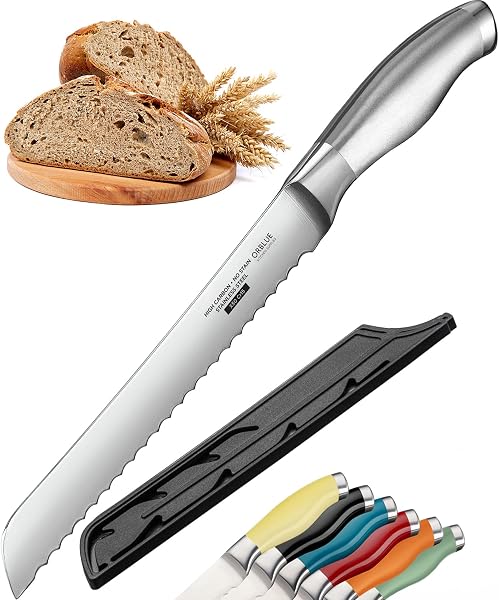
Eleven thousand six hundred and twenty-seven reviews at 4.8 stars. The next largest sample in this roundup is 3,281, and this costs $12.99.
Key Specifications
| Overall length | 13 inches |
|---|---|
| Edge | Wavy serration |
| Blade thickness | 2.2 mm at the spine, 0.1 mm at the edge |
| Handle | Stainless steel |
| Weight | 0.23 kg |
| Rank | #2 in Bread Knives, #851 in Kitchen & Dining |
| Rating | 4.8 from 11,627 reviews |
| Price | $12.99 |
| Best For | Anyone who wants the safest bet on the evidence |
Why We Recommend It
That sample size is the whole argument. Ratings across this page cluster between 4.4 and 4.8, so the star figure separates almost nothing — what separates them is how many people stand behind it. A 4.8 across eleven thousand buyers has survived every kind of loaf, every kind of hand and several years of use. A 4.8 across 247 has not.
The thickness figures are unusually specific and genuinely informative: 2.2 mm at the spine tapering to 0.1 mm at the edge. A thick spine gives the blade rigidity so it does not flex mid-stroke through a dense crust — flex is what makes slices come out wedge-shaped — while a fine edge does the cutting. Almost no bread knife listing gives either number.
Thirteen inches overall puts real blade length behind a large loaf, and it is the second longest here.
The all-stainless handle is the compromise. It is hygienic, seamless and effectively permanent — and it is smooth metal in a hand that may be wet or buttery. Compared with Santoprene it is a genuine step down in security for a knife used with force.
#2 in Bread Knives, behind only a knife whose rank is shared across a variant family.
Pros
- 11,627 reviews — ten times the next largest sample here
- 4.8 stars at $12.99
- #2 in Bread Knives and #851 in Kitchen & Dining
- States blade thickness at spine and edge
- Rigid 2.2 mm spine resists flex through hard crust
- 13 inches of reach
Cons
- Smooth steel handle is slippery when wet or buttery
- No finger guard or bolster
- Steel handle stays cold and shows marks
- Serrations cannot be honed
- Straight handle — knuckles reach the board
- Steel grade not stated
Best for: The evidence-led choice, if you can live with a metal handle.
5. SYOKAMI Offset 10.5-Inch — Best Offset

This is the only knife on this page that solves the problem every bread knife has, and its listing states it plainly.
Key Specifications
| Blade length | 10.5 inches |
|---|---|
| Handle | Wood, raised offset |
| Design | Offset — handle above blade line |
| Serration | Engineered for full board contact |
| Overall | 15.22 inches |
| Rank | #69 in Bread Knives |
| Rating | 4.7 from 247 reviews |
| Price | $32.99 |
| Best For | Anyone who has grazed their knuckles finishing a slice |
Why We Recommend It
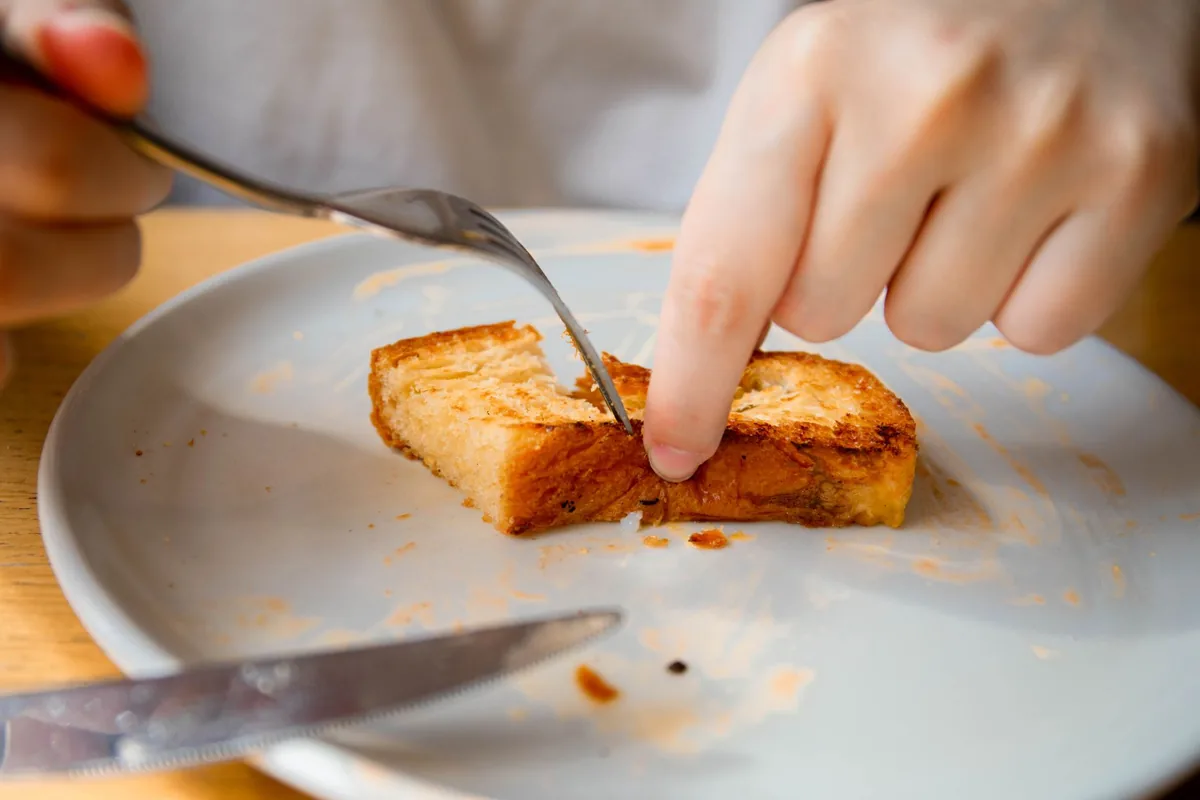
On a straight bread knife your knuckles hit the board before the blade finishes the cut. The handle sits in line with the blade, so as you reach the bottom of a slice there is no clearance — you either graze your hand or, more often, you lift the handle slightly and saw the last half inch at an angle. That is why the bottom crust tears and why the final slice of a loaf is always the worst one.
An offset handle sits above the blade line on a raised neck, so the blade can lie flat on the board with your hand several centimetres clear. The listing’s second claim follows from the first: with the blade level, every serration contacts the board rather than just the tip, so the cut completes in one stroke instead of a sawing finish.
It is the standard shape in bakeries for exactly this reason, and it is strange that it is rare in domestic knives. If you cut a lot of bread, the difference on the last half inch of every slice is immediate.
Ten and a half inches of blade spans a large sourdough.
The costs are honest: 247 reviews is a thin sample, the offset shape is awkward in a knife block or a drawer, and a wooden handle is less secure wet than rubber.
Pros
- Offset handle clears the board — the one real design fix
- Full serration contact means a one-stroke cut
- The shape bakeries actually use
- 10.5 inches spans a large loaf
- 4.7 stars
- Solves the torn bottom crust
Cons
- Only 247 reviews
- Offset shape is awkward to store
- Wooden handle is less secure in a wet hand
- $32.99
- #69 in Bread Knives
- Serrations cannot be honed
Best for: Anyone who cuts bread often and is tired of ruining the last half inch.
6. imarku 10-Inch German — Best Mid-Price

Thirty-two dollars, 2,264 reviews, #22 in Bread Knives — and fifteen ounces, which makes it nearly five times the weight of the cheapest knife here.
Key Specifications
| Blade length | 10 inches |
|---|---|
| Steel | German high-carbon stainless |
| Serration | Independent serrated edges |
| Handle | Pakkawood |
| Weight | 15.2 ounces — heaviest here |
| Rank | #22 in Bread Knives, #5,549 in Kitchen & Dining |
| Rating | 4.7 from 2,264 reviews |
| Price | $31.99 |
| Best For | Hard crusts, where weight does the work |
Why We Recommend It
Weight is genuinely useful in a bread knife, unlike in a chef’s knife. Cutting a hard crust is a sawing action against real resistance, and a heavy blade carries momentum through the stroke so you push less. The light knives on this page make you supply all the force, which is when the blade skids across the crust instead of biting.
German high-carbon steel means a softer, tougher edge than the Japanese steels here — less likely to chip on a hard crust, and a specification that matters less on a serrated edge because the serration points do the work rather than a fine continuous edge.
“Independent serrated edges” is the listing’s description of pointed, individually-ground serrations rather than a continuous wavy scallop. Pointed serrations bite harder into a tough crust; they are also more aggressive on soft crumb. This is a crusty-loaf knife more than a sandwich-loaf one.
Pakkawood handle, stable and warm, and less grippy wet than rubber.
Fifteen ounces will feel like a lot to anyone used to a light knife, and for slicing soft bread it is more than you need.
Pros
- 2,264 reviews at 4.7 — a real sample
- Weight carries the stroke through a hard crust
- German high-carbon steel resists chipping
- #22 in Bread Knives
- 10 inches spans a large loaf
- Pakkawood is stable and handsome
Cons
- 15.2 oz is heavy for slicing soft bread
- Pointed serrations are aggressive on soft crumb
- Pakkawood less secure wet than rubber
- $31.99
- Straight handle — knuckles reach the board
- Serrations cannot be honed
Best for: Crusty sourdough and hard-crusted loaves, where weight helps.
7. PAUDIN 10-Inch — Only Stated Hardness

Rockwell 56+. It is the only hardness figure published anywhere in this roundup, and in a category built on the words “razor sharp” that is worth something.
Key Specifications
| Blade length | 10 inches |
|---|---|
| Steel | German high-carbon stainless |
| Hardness | 56+ HRC — stated |
| Handle | Pakkawood |
| Weight | 8 ounces |
| Overall | 15.3 inches |
| Rank | #120 in Bread Knives |
| Rating | 4.6 from 1,540 reviews |
| Price | $29.99 |
| Best For | Anyone who wants a number rather than an adjective |
Why We Recommend It
56 HRC is the European kitchen standard and the right target for a serrated blade. Harder steel — 60 and above, as on Japanese chef’s knives — holds a finer edge but is more brittle, and the tips of serrations are exactly the kind of thin projecting feature that chips. A slightly softer, tougher steel keeps its serration points intact through years of contact with a wooden board.
That is the quiet argument for German steel in bread knives specifically, even for people who prefer Japanese steel in a chef’s knife. The failure mode of a serrated edge is broken points, not a rolled edge, and toughness prevents it.
Eight ounces is a sensible middle weight — enough to carry a stroke, not so much that it is tiring across a whole loaf.
Ten inches of blade in a 15.3-inch knife, with a pakkawood handle matching the imarku and the HOSHANHO.
#120 in Bread Knives at 4.6 from 1,540 reviews — a solid product that is not selling as well as knives a quarter of the price, which is the pattern across this entire page.
Pros
- Publishes a hardness figure, 56+ HRC — unique here
- 56 HRC is the right toughness for serration points
- 1,540 reviews at 4.6
- Sensible 8 oz middle weight
- 10 inches spans a large loaf
- Pakkawood handle
Cons
- #120 in Bread Knives — low rank for the specification
- $29.99 against $6.98 for a 4.7-rated knife
- Pakkawood is less grippy wet than rubber
- Straight handle — knuckles reach the board
- Serrations cannot be honed
- Emoji-heavy listing copy
Best for: Anyone who wants a stated specification instead of adjectives.
8. ABIOTO 11-Inch Sourdough — Longest Blade

Eleven inches, the longest blade in this roundup, with a rubber handle and serrations ground on one side only.
One-sided serrations are a real design decision and worth understanding.
Key Specifications
| Blade length | 11 inches — longest here |
|---|---|
| Serration | One-sided |
| Handle | Thermoplastic rubber, 5 in, textured |
| Weight | 16 ounces |
| Overall | 15.75 inches |
| Rank | #408 in Bread Knives |
| Rating | 4.7 from 245 reviews |
| Price | $24.99 |
| Best For | Large sourdough boules, and wet hands |
Why We Recommend It
Grinding the serrations on one face only makes the edge asymmetric, like a chisel. The flat side runs true against the loaf while the ground side does the cutting, which produces a straighter cut and, the maker argues, keeps the points sharp longer because there is more metal behind each one. It is the same principle as a single-bevel Japanese knife, applied to a serration.
Eleven inches is what a large boule actually needs. A round sourdough can be nine or ten inches across, and cutting it with an eight-inch blade means a sawing stroke that starts and stops — which is precisely how you get a ragged face. A blade longer than the loaf crosses it in one pass.
Thermoplastic rubber is the correct handle material for a knife used with force, and only two knives on this page have it. A five-inch textured grip is generous, and it stays secure when your hands are floury or wet.
Sixteen ounces is the heaviest blade here, tied with nothing else, and that suits crusty bread and tires you on soft.
245 reviews and #408 in Bread Knives is the thin part. The design reasoning is sound; the evidence base is small.
Pros
- 11 inches — longest blade here, spans a full boule
- One-sided serrations for a straighter cut
- Thermoplastic rubber handle grips when wet or floury
- 5-inch textured grip
- 4.7 stars
- Built specifically for sourdough
Cons
- Only 245 reviews and #408 in Bread Knives
- 16 ounces is heavy for soft bread
- One-sided grind is harder to sharpen if you ever try
- $24.99
- Straight handle — knuckles reach the board
- Long blade needs drawer or block space
Best for: Large sourdough boules and floury hands — on a thin review base.
9. 10-Inch Wave Edge Full Tang — Best Cheap Long Blade

Eleven ninety-nine, 3,281 reviews, ten inches of blade and a full tang. On paper that is a lot of knife for the money.
Key Specifications
| Blade length | 10 inches |
|---|---|
| Edge | Wave edge |
| Thickness | 1.8 mm |
| Handle | Polypropylene, full tang |
| Weight | 5 ounces |
| Rank | #107 in Bread Knives |
| Rating | 4.5 from 3,281 reviews |
| Price | $11.99 |
| Best For | A long blade on the smallest budget |
Why We Recommend It
Full tang is unusual at this price and it matters on a bread knife more than most. The steel running the full length of the handle is what stops a blade working loose where it meets the grip — and a bread knife applies more leverage at that join than any other kitchen knife, because you are sawing hard against resistance. Cheap knives with a partial tang are exactly where that failure shows up.
1.8 mm is thinner than the Orblue’s 2.2 mm spine, which means slightly more flex through a dense crust and a bit more chance of a wedge-shaped slice. It is also lighter and easier to steer.
Ten inches for twelve dollars is the genuine value here — most knives at this price are eight inches, which is short for a large loaf.
4.5 stars is the second lowest rating on this page, across a large 3,281-review sample — so unlike the small-sample knives here, that figure is a settled result rather than an early impression.
No brand, no steel grade, no country of origin. At twelve dollars that is the trade, and the review count is the only real reassurance on offer.
Pros
- Full tang at $11.99 — genuinely uncommon
- 3,281 reviews, second largest sample here
- 10 inches of blade for twelve dollars
- Wave edge, correct for bread
- 1.8 mm blade is light and easy to steer
- Polypropylene handle survives a dishwasher
Cons
- 4.5 stars, second lowest here on a large sample
- No brand, steel grade or origin stated
- Thinner blade flexes more than the Orblue’s
- 5 oz is light for hard crusts
- Straight handle — knuckles reach the board
- Serrations cannot be honed
Best for: A long blade for twelve dollars, with enough reviews to know what you are getting.
10. Mezzo High Carbon Sourdough — Cheapest Here

Five ninety-nine, and #23 in Bread Knives. It is the cheapest knife in this roundup and it still ranks above products costing five times as much.
Key Specifications
| Overall length | 13 inches |
|---|---|
| Steel | High-carbon stainless |
| Handle | Acacia wood |
| Weight | 6.56 ounces |
| Rank | #23 in Bread Knives, #9,760 in Kitchen & Dining |
| Rating | 4.4 from 339 reviews — lowest here |
| Price | $5.99 |
| Best For | A second bread knife, or a first one at no risk |
Why We Recommend It
An acacia handle at six dollars is genuinely unexpected — almost everything at this price uses moulded plastic. Acacia is a dense hardwood that resists moisture reasonably well, and it looks considerably better than ABS. It also needs occasional oiling and should never be left in water, which is a real maintenance ask on a six-dollar knife most people will treat carelessly.
High-carbon stainless is stated without a grade, which at this price is as much detail as anyone should expect.
Six and a half ounces is a reasonable middle weight — more useful through a crust than the 3.2-ounce Omesata.
4.4 stars from 339 reviews is the lowest rating here, and it is worth reading against the price rather than against the other knives. Nothing on this page is bad; this is simply the one where the most buyers found something to complain about, and it costs six dollars.
Given that serrated edges are effectively unsharpenable at home, a six-dollar knife with a wood handle and a category rank of #23 is a defensible way to approach the whole problem — buy, use, replace.
Pros
- $5.99 — cheapest knife in this roundup
- #23 in Bread Knives, above knives five times the price
- Acacia wood handle at a plastic-handle price
- 6.56 oz is a usable middle weight
- 13 inches overall
- Cheap enough to treat as consumable
Cons
- 4.4 stars, the lowest rating on this page
- Only 339 reviews
- Acacia needs oiling and must not soak
- Steel grade not stated
- Straight handle — knuckles reach the board
- Serrations cannot be honed
Best for: A no-risk first bread knife, or a spare for the second kitchen drawer.
Why the Last Half Inch Goes Wrong
Straight handle against offset. One knife here is offset.
| Straight handle | Offset handle | |
|---|---|---|
| Hand clearance at the board | None | Several centimetres |
| Blade angle at the end of a cut | Tilted up | Flat |
| Serrations touching the board | Tip only | All of them |
| Bottom crust | Torn or sawn | Cut through |
| Knuckles | Graze the board | Clear it |
| Storage | Fits a block or drawer | Awkward — raised neck |
| In this roundup | Nine knives | SYOKAMI only |
This is the clearest example in the whole series of a solved problem that most of a category ignores. Every bakery uses offset bread knives, for a reason anyone who has cut a loaf can feel: with the handle raised, the blade lies flat on the board through the entire stroke, so the cut completes rather than tearing. The trade-offs are real but small — an offset knife is awkward in a block, and the shape looks odd until you use one. Nine of the ten knives here are straight, which tells you about how kitchen knives are designed and marketed rather than about what works.
Wavy or Pointed, and Why It Changes the Crumb
Two different edges, sold under the same word.
| Edge type | How it cuts | Best on | In this roundup |
|---|---|---|---|
| Wavy / scalloped | Continuous curve grips without biting | Soft loaves, sandwich bread | Mercer, Orblue, Omesata, wave-edge 10-inch |
| Pointed / independent | Individual teeth bite aggressively | Hard crusts, sourdough | imarku, PAUDIN, HOSHANHO |
| One-sided | Asymmetric grind, flat on one face | Straight cuts through boules | ABIOTO |
| Full board contact | Every point reaches the board | Finishing the bottom crust | SYOKAMI (offset) |
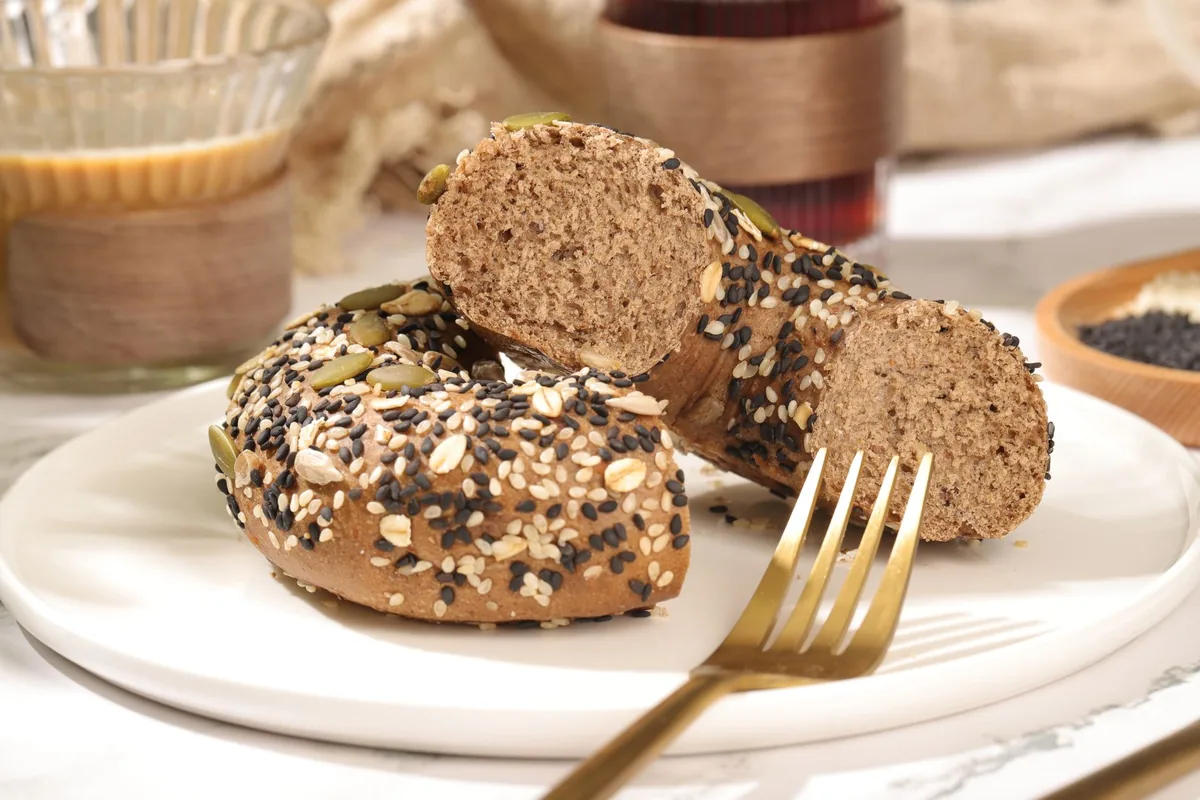
The distinction is real and almost never explained. A wavy edge is a continuous curved cutting surface — it grips a crust and slices what is underneath without tearing, which is what a soft sandwich loaf needs. Pointed serrations are individual teeth, and they bite through a hard sourdough crust far more decisively while doing more damage to a delicate crumb. If you mostly buy soft bread, wavy. If you bake or buy crusty loaves, pointed. Almost no listing frames it as a choice, and several use the words interchangeably.
Best Alternatives
| Alternative | Why Consider It | Better For | Main Trade-Off |
|---|---|---|---|
| An electric knife | Effortless, perfectly even slices | Arthritis, and carving joints | Bulky, noisy, another appliance |
| A bread slicing guide | Uniform thickness every time | Anyone slicing for sandwiches | One more object to store |
| A chef’s knife, very sharp | You already own one | Soft rolls and cutting in half | Crushes a crusty loaf |
| A serrated utility knife | Small, cheap, handles tomatoes too | Rolls, bagels, citrus | Too short for a loaf |
| Buying bread pre-sliced | No knife, no crumbs, no argument | Sandwich bread | Not an option for a bakery boule |
What Each Price Tier Actually Buys
$5.99 to $13.99 — Mezzo, Omesata, Wave Edge 10-inch, Orblue, Mercer Millennia. This tier contains #1, #2, #10 and #23 in Bread Knives, the largest review count on the page by ten times, and the professional Santoprene handle. Given that a serrated edge is effectively unsharpenable, there is a serious argument that the category is solved here and everything above is refinement.
$24.99 to $32.99 — ABIOTO, PAUDIN, imarku, SYOKAMI. Where design decisions arrive: an offset handle, one-sided serrations, a stated hardness figure, or fifteen ounces of weight to carry a stroke through a hard crust. This is the tier to buy from if a specific problem is bothering you.
$74.99 — HOSHANHO. Cobalt-alloyed Japanese steel, vacuum heat-treated. On a knife you will never sharpen, edge retention is arguably worth more than it is on a chef’s knife — which is the honest case for spending this much.
The pattern: price buys steel quality and thoughtful design, not a better rating. The two 4.8-star knives here cost $12.99 and $74.99.
How to Choose a Bread Knife
Buy a Blade Longer Than Your Loaf
This is the single most useful rule and it is easy to check. A round sourdough boule is commonly nine or ten inches across; an eight-inch blade cannot cross it in one pass, so you saw — and every time the stroke stops and restarts, the face of the loaf tears a little. Ten to eleven inches covers almost any domestic loaf. Watch for listings that quote an overall length including the handle: a 15-inch knife may have a 10-inch blade, and it is the blade that has to reach.
Look for an Offset Handle if You Cut Bread Often
An offset handle sits above the blade line on a raised neck, so the blade lies flat on the board while your hand stays clear. It fixes the one thing every straight bread knife gets wrong — the last half inch of the cut, where your knuckles reach the board and you tilt the blade to finish, tearing the bottom crust. It is the standard shape in bakeries and it is rare in domestic knives. One knife in this roundup has it. The costs are awkward storage and an odd-looking knife.
Match the Serration to the Bread You Buy
Wavy or scalloped edges present a continuous curved cutting surface: they grip a crust and slice the crumb underneath without tearing it, which is what soft sandwich loaves need. Pointed or independent serrations are individual teeth that bite far more decisively through a hard sourdough crust, and are correspondingly rougher on a delicate interior. Most listings use serrated for both. If you mostly eat soft bread, look for wavy; if you bake crusty loaves, look for pointed teeth.
Treat the Edge as Effectively Permanent
You cannot hone a serrated knife the way you hone a plain edge, and sharpening one properly means working each individual gullet with a tapered ceramic or diamond rod — possible, tedious, and something almost nobody does. That has a real buying consequence: the edge a bread knife arrives with is broadly the edge you keep. It also means hardness matters more here than on a chef’s knife, because the serration points have to survive years of contact with a board, and it makes a cheap knife a genuinely defensible choice.
Take the Handle Seriously, Because You Push Hard
A bread knife is used with a long sawing stroke and real forward force, frequently with floury or buttery hands. That combination is why professional kitchens use rubber-handled bread knives: Santoprene and thermoplastic rubber stay secure when wet, and only two knives on this page have them. Pakkawood is stable and reasonably grippy. Bare stainless steel handles look elegant and are the least secure option here, which on a tool you are actively pushing is worth weighing.
Let Weight Do the Work on Crusty Loaves
Unlike a chef’s knife, where lightness aids control, a heavier bread knife genuinely helps. Cutting a hard crust is a sawing action against resistance, and mass carries momentum through the stroke so you press less — pressing is what makes a blade skid across a crust instead of biting into it. The spread here runs from 3.2 to 16 ounces. For soft bread, light is fine and less tiring. For sourdough with a proper crust, the heavier knives on this page are noticeably easier.
Common Bread Knife Buying Mistakes
- Buying a blade shorter than your loaf. Sawing across a boule is what tears the face.
- Reading overall length as blade length. A 15-inch knife may have a 10-inch blade.
- Assuming all serrations are the same. Wavy suits soft bread; pointed suits hard crusts.
- Expecting to sharpen it. Each gullet needs a tapered rod, and almost nobody does it.
- Choosing a smooth steel handle. You push hard on this knife, often with floury hands.
- Using a bread knife on a plate. Ceramic destroys serration points faster than anything.
- Buying light for a crusty loaf. Without weight the blade skids instead of biting.
- Putting a wood-handled knife in the dishwasher. It splits the handle and dulls the edge.
- Judging on stars alone. Four knives here rate 4.7 on samples from 245 to 2,264.
Which Bread Knife Should You Buy?
Buy the Mercer Millennia if you want the professional answer. #1 in Bread Knives, one-piece high-carbon Japanese steel, and a handle that grips when wet, for $13.99.
Buy the HOSHANHO if you want a bread knife to keep. Cobalt-alloyed Japanese steel, vacuum heat-treated, ten inches — and edge retention matters most on a knife you will never sharpen.
Buy the Omesata if you accept that bread knives are semi-disposable. Seven dollars, #10 in the category, 1,528 reviews.
Buy the Orblue if you want the safest bet on the evidence — 11,627 reviews at 4.8 for $12.99, with a rigid 2.2 mm spine.
Buy the SYOKAMI if you cut bread often and are tired of ruining the last half inch. The only offset handle here.
Buy the imarku if you cut crusty sourdough. Fifteen ounces of German high-carbon steel carries the stroke.
Buy the PAUDIN if you want a stated hardness figure rather than adjectives. 56+ HRC, which is the right toughness for serration points.
Buy the ABIOTO if your loaves are large and your hands are floury. Eleven inches and a proper rubber grip.
Buy the wave-edge 10-inch if you want a long full-tang blade for twelve dollars and 3,281 reviews to back it.
Buy the Mezzo if you want a spare, or a first bread knife at no real risk.
Frequently Asked Questions
How long should a bread knife be?
Longer than the loaf you cut, which for most households means ten to eleven inches. A round sourdough boule is commonly nine or ten inches across, and a blade that cannot cross it in a single pass forces you to saw — every time the stroke stops and restarts you tear the face of the loaf a little. Eight inches is fine for sandwich loaves and baguettes. Watch the wording: many listings quote an overall length that includes the handle, so a knife described as 15 inches may have a 10-inch blade.
Can you sharpen a serrated bread knife?
Yes, but not the way you sharpen a plain edge, and almost nobody bothers. A honing steel does nothing useful because there is no continuous edge to realign. Proper sharpening means working each individual gullet with a tapered ceramic or diamond rod, matching the existing angle, one scallop at a time — it takes patience and it is easy to do badly. The practical consequence is that the edge a bread knife arrives with is broadly the edge you keep, which is why a well-made cheap one is a defensible purchase.
What is the difference between a wavy and a pointed serration?
A wavy or scalloped edge is a continuous curved cutting surface. It grips a crust and slices the crumb beneath without tearing, which is what soft sandwich bread needs. Pointed or independent serrations are individually ground teeth that bite far more aggressively — much better through a hard sourdough crust, and rougher on a delicate interior. Most listings call both simply serrated, so you often have to look at the photograph. If you mostly eat soft bread, choose wavy; for crusty loaves, choose teeth.
Why does the bottom crust always tear?
Because your knuckles reach the board before the blade finishes the cut. On a straight bread knife the handle is in line with the blade, so there is no clearance — and in the last half inch you instinctively tilt the handle up and saw through the bottom crust at an angle instead of cutting it. An offset handle, raised above the blade line, fixes this completely: the blade stays flat through the whole stroke and every serration reaches the board. It is standard in bakeries and rare in domestic knives.
Is an expensive bread knife worth it?
Less than in most categories, for one specific reason: you will not be sharpening it. Money buys better steel, which on a serrated blade means the serration points survive longer — a genuine benefit over years. It also buys design: an offset handle, a rubber grip, a longer blade, more weight. What it does not buy is a better rating. In this roundup a $74.99 knife and a $12.99 knife both hold 4.8 stars, and the $12.99 one has ten times the reviews behind it.
What else can you use a bread knife for?
Anything with a firm skin over soft flesh, where a plain edge would crush rather than cut. Tomatoes are the classic example — a serrated blade grips the skin and slices without squashing. The same applies to citrus, melons, sponge cakes and layered cakes, where a long blade cuts a level surface that a short one cannot. It is also the right tool for slicing a cooked ham or a large roast if you have no carving knife. Avoid using it on anything hard.
Should a bread knife handle be wood or rubber?
Rubber, if you are choosing on function. A bread knife is used with a long sawing stroke and real forward pressure, often with floury or buttery hands, and Santoprene or thermoplastic rubber stays secure exactly when that matters. Only two knives in this roundup have rubber handles. Pakkawood is a reasonable compromise — resin-impregnated wood, stable and warm. Bare stainless steel is the most elegant and the least secure, which is a genuine consideration on a knife you actively push.
How do I stop bread squashing when I slice it?
Let the serrations do the work and stop pressing down. A serrated blade cuts on the draw, so the technique is a long, light sawing stroke — pressure crushes a soft loaf before the edge gets through it. Let very fresh bread cool completely first, because warm crumb compresses far more easily. Turn a crusty loaf on its side so you cut through the crust once rather than twice. And use a blade longer than the loaf, so you can complete each cut in a single pass.
Final Verdict
#1 in Bread Knives with professional steel and a handle that grips when wet, for $13.99.
Cobalt-alloyed Japanese steel, vacuum heat-treated — edge retention on a knife you cannot sharpen.
$6.98 and #10 in the category, with 1,528 reviews at 4.7.
Two facts shape this category and neither one appears on the packaging.
The first is that you will almost certainly never sharpen this knife. A serrated edge cannot be honed, and restoring one means working every gullet individually with a tapered rod. So the edge it arrives with is the edge you keep, which makes a bread knife closer to a consumable than any other knife in the drawer — and makes the $6.98 one at #10 in the category a more serious proposition than it looks.
The second is the shape. Nine of the ten knives here put the handle in line with the blade, which guarantees that the last half inch of every cut is made with your knuckles against the board and the blade tilted. Bakeries fixed this with an offset handle a very long time ago, and exactly one knife in this roundup has one.
So: buy a blade longer than your loaf, match the serration to whether your bread is soft or crusty, get a handle that grips when your hands are floury — and if you cut bread most days, seriously consider the offset. It is the only thing on this page that fixes a problem rather than describing one.