Affiliate Disclosure: As an Amazon Associate, we earn from qualifying purchases. This does not affect the price you pay.
A pepper mill is a container with one working part. The wood, the glass, the stainless finish and the height are all packaging — what actually grinds is a burr about an inch across, hidden in the base.
That part comes in two materials, and the choice decides what the mill should hold.
Ceramic will not corrode, so it takes salt and pepper equally. Steel shears peppercorns more cleanly, releasing more aroma — and salt will pit and eventually seize it. Peugeot cuts its pepper and salt mechanisms differently for exactly this reason.
Which makes it worth noticing how many listings here hedge. Four of these ten are sold as a "salt or pepper grinder", and one of those has a stainless mechanism that salt will slowly destroy.
The second thing to check is whether the coarseness adjustment is numbered. Almost every mill claims to be adjustable; only four of the ten say how many settings they have, and a setting you cannot name is a setting you cannot return to.
Our Quick Picks
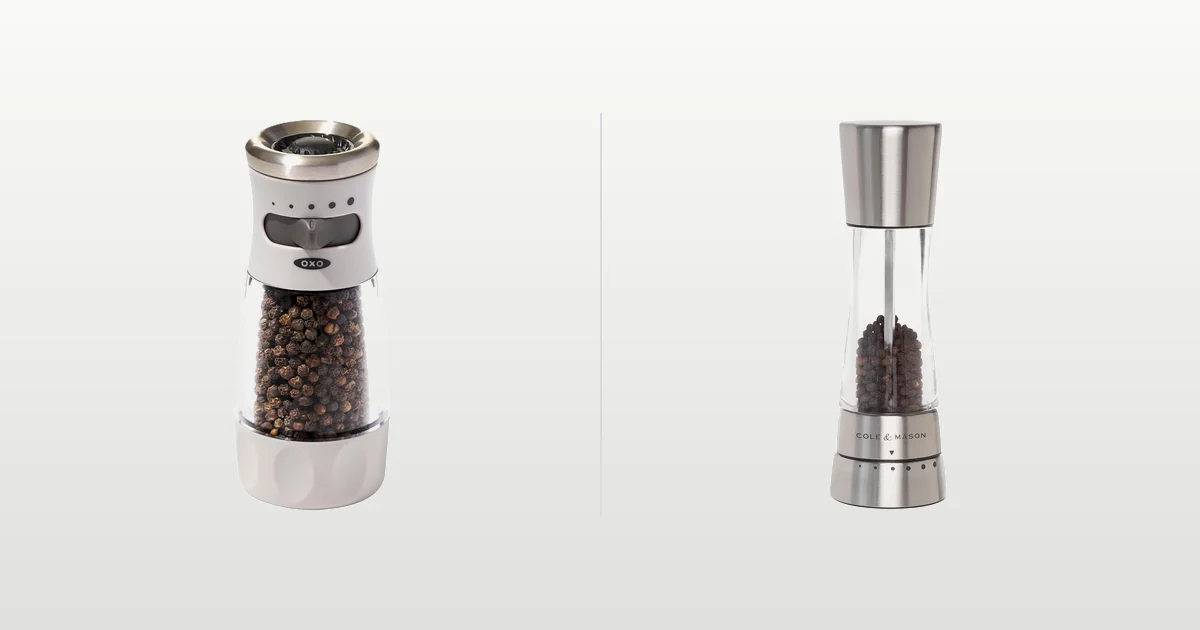
 Best OverallOXO Good Grips Contoured
Five numbered grind settings, a non-corroding ceramic mechanism and a clear body so you can see when it needs refilling.
 Best ValueEbaco Original Stainless
The same five-setting ceramic arrangement as mills costing three times more, in glass, at $6.98.
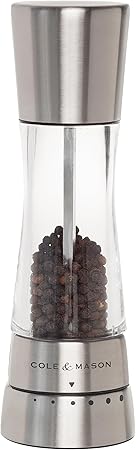 Best Premium ManualCole & Mason Derwent
Six numbered grind levels through a stainless mechanism, in a 7.5-inch stainless body built for a table.
At a Glance
Ten Pepper Grinders Compared
Mechanism first, because it decides whether the mill should hold pepper, salt or both — then whether the settings are countable.
| # | Model | Type | Mechanism | Grind Settings | Body | Standout | Main Drawback | Check Price |
|---|---|---|---|---|---|---|---|---|
| 1 |
 OXO Good Grips Contoured OXO Good Grips Contoured |
Manual | Ceramic | 5, numbered | Clear BPA-free body | States five settings and shows the fill level | Ceramic is the safe choice, not the sharp one | View on Amazon |
| 2 |
 Ebaco Original Stainless Ebaco Original Stainless |
Manual | Ceramic rotor | 5, numbered | Glass with stainless top | Five stated settings for under seven dollars | Six ounces is a small chamber | View on Amazon |
| 3 |
 Cole & Mason Derwent Cole & Mason Derwent |
Manual | Stainless steel | 6, numbered | Stainless steel | Six levels from an established British maker | $59.95, joint dearest here | View on Amazon |
| 4 |
 MAGNUM by Unicorn MAGNUM by Unicorn |
Manual, side crank | Steel burrs | Wide range, bottom wing nut | ABS and steel | The mill professional kitchens buy | $59.00, and it is not beautiful | View on Amazon |
| 5 |
 Peugeot Paris u’Select Peugeot Paris u’Select |
Manual | Patented steel | 6 preset, via base ring | PEFC beech wood | Two centuries of mechanism design | $33.95, 4.4 stars and a capacity field that is wrong | View on Amazon |
| 6 |
 CIRCLE JOY Gravity Electric CIRCLE JOY Gravity Electric |
Electric, gravity-activated | Ceramic | Adjustable core, unnumbered | Sold as a matched pair | #1 in Pepper Mills, and it is a set of two | Batteries, and no numbered settings | View on Amazon |
| 7 |
 Kuhn Rikon Ratchet Grinder Kuhn Rikon Ratchet Grinder |
Manual, ratchet lever | Ceramic | Dial on the base | Plastic, 8.5 inch | A lever instead of a twist, for stiff wrists | Plastic body at $25.77 | View on Amazon |
| 8 |
 Gulex Wood 8-Inch Gulex Wood 8-Inch |
Manual | Ceramic | Adjustable, unnumbered | Carved oak | Solid oak at under nine dollars | No window, and no setting count | View on Amazon |
| 9 |
 XWXO 10-Inch Oak Mill XWXO 10-Inch Oak Mill |
Manual | Ceramic rotor | Adjustable, unnumbered | Natural oak, no plastic | Ten inches and a 4–5 oz chamber | Dimensions field lists the height as a width | View on Amazon |
| 10 |
 JIDSPWLS Electric with LED JIDSPWLS Electric with LED |
Electric | Stainless mechanism | Adjustable, unnumbered | Stainless, 7.2 inch | An LED that lights what you are seasoning | Batteries, and one mill not two | View on Amazon |
Specifications, prices and ratings are taken from each manufacturer’s Amazon listing as displayed on 21 August 2026 and may change. Grind settings are recorded as numbered only where the manufacturer states a count; six of the ten claim adjustable coarseness without saying how many positions exist. Mechanism material is taken from each listing’s own description, and several mills sold as suitable for “salt or pepper” use steel mechanisms that salt will corrode over time. Two listing errors are flagged rather than corrected: the Peugeot Paris gives a capacity of “7 cups” for a mill roughly two inches across, and the XWXO gives a product dimension of 10.6 inches wide for a 10-inch-tall mill, which is the height entered in the wrong field. The CIRCLE JOY is supplied as a matched pair of two mills; every other product here is a single mill. Four further mills were excluded as near-duplicates of models already included, including a second Gulex.
Scroll the table sideways to see every column
How We Chose These Pepper Grinders
We researched current listings, compared manufacturer specifications and documentation, and examined recurring patterns in customer feedback. We did not carry out hands-on testing, and nothing below is presented as measured performance data.
- Ceramic or steel mechanism — the only working part, and it determines whether salt is safe in it
- Whether the settings are numbered — only four listings here state a count, and a nameless setting cannot be repeated
- Capacity, where stated — the specification that decides how often refilling annoys you
- Manual, electric or lever — three ways of turning the burr, suiting three different hands
- Whether you can see the level — glass and clear bodies warn you; wood and stainless never do
- Single mill or a pair — one product here supplies two, which changes the price comparison entirely
The 10 Best Pepper Grinders, Reviewed
1. OXO Good Grips Contoured — Best Overall

Five settings, and OXO says how many. That sounds trivial until you read the rest of this category, where almost every listing claims "adjustable coarseness" and only four state a number.
Ceramic mechanism, clear body, $22.95.
Key Specifications
| Type | Manual |
|---|---|
| Mechanism | Ceramic, non-corrosive |
| Grind settings | 5, from fine powder to coarse |
| Body | Clear BPA-free plastic with stainless accents |
| Adjustment | Rotating tab |
| Dimensions | 2.5″W x 5″H |
| Weight | 9.44 ounces |
| Rank | #3 in Pepper Mills |
| Best For | The sensible default, and the mill most kitchens should own |
Why We Recommend It
A numbered adjustment is what makes a setting repeatable. A mill with a continuous screw can be dialled anywhere and returned to nowhere; five detents mean the coarse grind you liked on steak last week is still setting four this week. It is the same argument as numbered browning controls on a toaster.
Ceramic is the versatile mechanism rather than the best one for pepper. It will not corrode, so it handles salt as happily as peppercorns, and it will not absorb odours. What it does not do is cut peppercorns quite as cleanly as hardened steel — ceramic tends to crush where steel shears.
For a mill that might hold either, that trade is the right way round.
The clear body is an underrated convenience. Wooden and stainless mills give you no warning at all, and the moment you discover a pepper mill is empty is invariably the moment you need it.
Pros
- Five numbered grind settings, so a setting can be returned to
- Ceramic mechanism resists corrosion and holds no odours
- Clear body shows the fill level
- #3 in Pepper Mills
- 4.7 stars
- Contoured grip designed around OXO’s usual accessibility thinking
Cons
- $22.95, dearer than several capable mills here
- Ceramic crushes peppercorns rather than shearing them
- Plastic body will not suit every table
- 5 inches tall, shorter than most here
- One mill only, so salt needs a second purchase
Best for: Most kitchens. Numbered settings, a mechanism that suits salt or pepper, and a visible level.
2. Ebaco Original Stainless — Best Value

Six ninety-eight, five numbered settings, a ceramic rotor and a glass body. It is #2 in Pepper Mills at 4.7 stars.
The OXO above has the same setting count and the same mechanism type for $22.95.
Key Specifications
| Type | Manual |
|---|---|
| Mechanism | Heavy-duty ceramic grinding rotor |
| Grind settings | 5, adjustable by twisting |
| Body | Glass with rust-proof stainless steel top |
| Capacity | 3/4 cup |
| Dimensions | 2.6″W x 5.3″H |
| Weight | 240 g |
| Rank | #2 in Pepper Mills |
| Best For | Buying two — one for salt, one for pepper — for the price of one OXO |
Why We Recommend It
Which makes this the buy-two option, and that matters more than the saving. Salt and pepper want different treatment: salt is abrasive and corrosive, pepper is oily and hard. Owning one mill for each avoids cross-contaminating flavours and means neither mechanism is doing a job it was not set up for. At seven dollars, two mills cost less than one of most rivals here.
The glass body shows the level, like the OXO and unlike every wooden mill on this page.
Three-quarters of a cup is a genuine capacity claim, though the specification field elsewhere records six ounces — the two are broadly consistent, which is more than several listings here manage.
The obvious caution is longevity. A seven-dollar mill with a glass body is not a heirloom, and the ceramic rotor will wear before a hardened steel one would. At this price that is a reasonable trade rather than a flaw.
Pros
- $6.98 with five numbered grind settings
- Ceramic rotor, safe for salt as well as pepper
- Glass body shows the level at a glance
- Rust-proof stainless top
- #2 in Pepper Mills at 4.7 stars
- Cheap enough to buy a matched pair
Cons
- Glass body is breakable
- Ceramic will wear sooner than hardened steel
- 5.3 inches, small for table service
- Capacity stated two ways across the listing
- Unfamiliar brand
Best for: The best value here, and the sensible way to end up with a proper pair.
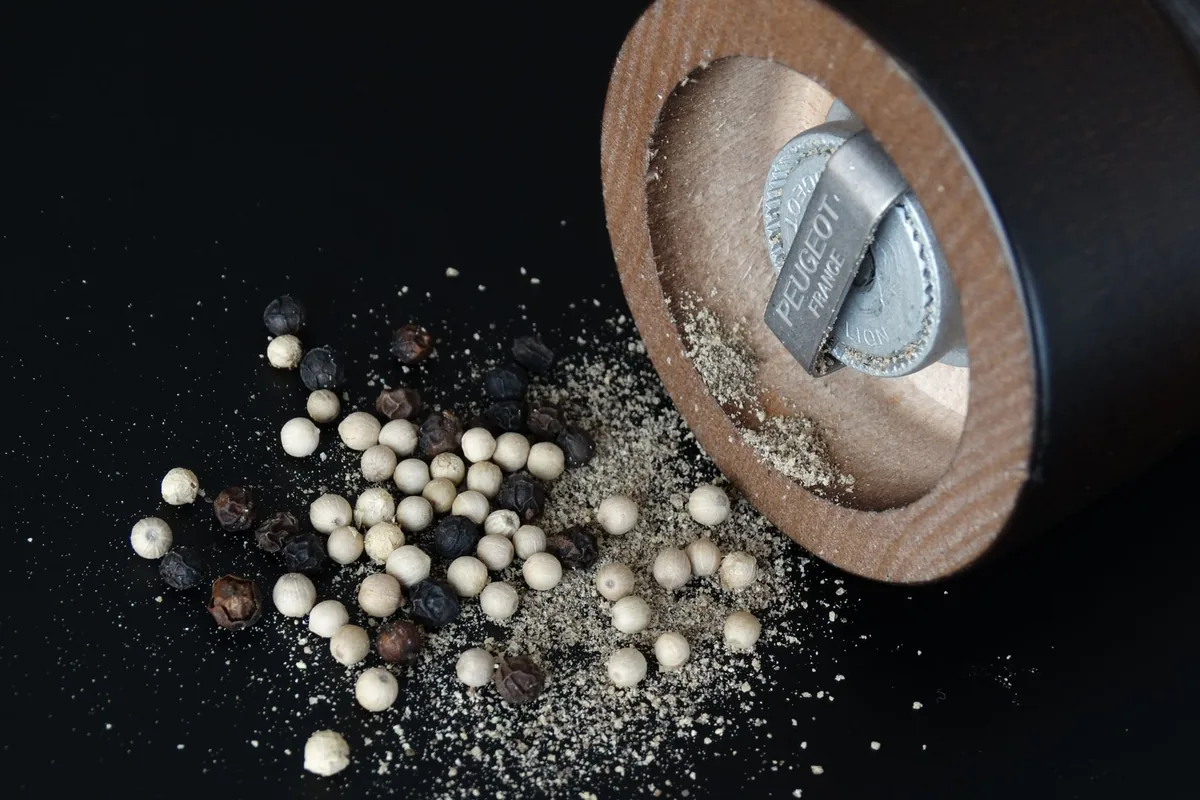
3. Cole & Mason Derwent — Best Premium Manual

Six grind levels, which is the highest stated number in this roundup, through a steel mechanism rather than ceramic.
Cole & Mason has been making these since 1919, and at $59.95 this is the joint most expensive mill here.
Key Specifications
| Type | Manual |
|---|---|
| Mechanism | Stainless steel |
| Grind levels | 6 |
| Body | Stainless steel |
| Height | 7.52 inches |
| Weight | 290 g |
| Sealing | Keeps ground spice away from moisture and dust |
| Rank | #7 in Pepper Mills |
| Best For | A mill that lives on the table and is expected to last |
Why We Recommend It
Steel is the traditional mechanism for pepper and there is a reason. Peppercorns are hard, brittle and oily; hardened steel burrs shear them into flakes, which releases the aromatic oils along the fracture. Ceramic tends to crush instead, producing more dust and slightly less aroma. Cole & Mason’s own description — stripping pepper "down to its individual layers" — is describing exactly that shearing action.
The corollary is that this should not hold salt. Salt corrodes steel, and a steel mechanism used for salt will pit and eventually seize. Manufacturers who make both usually sell a separate stainless or ceramic salt mill for this reason.
Seven and a half inches is table height, where the 5-inch mills here are really worktop tools.
At sixty dollars you are buying the mechanism’s lifespan and the brand’s century of them, not extra settings — six against the OXO’s five is not what the money is for.
Pros
- Six numbered grind levels, the most stated here
- Steel mechanism shears peppercorns rather than crushing them
- Stainless body suited to table service
- 7.5 inches tall
- Established maker with a very long track record
- 4.7 stars
Cons
- $59.95, joint most expensive in this roundup
- Steel mechanism should not be used for salt
- No window to check the level
- #7 in Pepper Mills despite the rating
- One mill, so a salt mill is an extra purchase
Best for: A table mill bought once, for pepper only.
4. MAGNUM by Unicorn — Best Steel Burrs

The Unicorn Magnum is the mill that turns up in professional kitchens, and its design explains why: a side crank rather than a twisting top, so you can grind continuously with one hand while the other is doing something else.
Steel burrs, a wing nut on the base, and a tray to catch the dust.
Key Specifications
| Type | Manual, side crank |
|---|---|
| Mechanism | Steel burrs, “Superiore” mechanism |
| Adjustment | Wing nut on the base, wide range |
| Body | ABS plastic and steel |
| Included | Tray to catch pepper dust |
| Origin | Crafted in Italy |
| Dimensions | 3″W x 6″H |
| Weight | 290 g |
| Best For | Anyone who grinds a lot of pepper and cares more about output than looks |
Why We Recommend It
The crank is the whole point. Twisting a conventional mill grinds only while your wrist rotates, which is a few seconds at a time; a crank turns indefinitely. If you season a large pan or a whole roast, the difference is substantial and immediately obvious.
Steel burrs again, and again that means pepper only. Salt will corrode them.
Bottom-adjusted coarseness with a wing nut is a continuous range rather than numbered detents — more precise in principle, harder to return to a remembered setting in practice. That is the opposite trade to the OXO’s five clicks.
The honest caveat is the material and the look. An ABS plastic body at $59.00 is a hard sell next to a stainless Cole & Mason at the same price, and this is a working tool rather than a table ornament. It is also 3 inches wide, which is bulky for its 6-inch height.
Pros
- Side crank grinds continuously, unlike any twist mill here
- Steel burrs shear peppercorns for maximum aroma
- Wide continuous coarseness range
- Dust-catching tray included
- Made in Italy
- 4.7 stars
- The mill professional kitchens actually use
Cons
- $59.00 for an ABS plastic body
- Steel burrs rule out salt
- Continuous adjustment cannot be returned to a numbered setting
- Bulky at 3 inches wide
- Not a table-presentable mill
- #13 in Pepper Mills
Best for: High-volume pepper grinding, where output beats appearance.
5. Peugeot Paris u’Select — Best Heritage

Peugeot made pepper mills for eighty years before it made cars, and the mechanism is what the name means in a kitchen. The u’Select ring at the base clicks between six preset grinds.
Thirty-three ninety-five, PEFC-certified beech.
Key Specifications
| Type | Manual |
|---|---|
| Mechanism | Patented Peugeot steel, engineered specifically for pepper |
| Settings | u’Select ring, 6 presets |
| Body | PEFC-certified beech wood |
| Height | 7.09 inches |
| Weight | 9.12 ounces |
| Finish | Chocolate |
| Rank | #15 in Pepper Mills |
| Best For | A mill chosen for the mechanism’s reputation and the wood on the table |
Why We Recommend It
The u’Select system is the most thought-through adjustment here. It sits at the base rather than the top, so you set it without removing anything, and it clicks into named positions rather than sliding freely — combining the repeatability of detents with a range wide enough to run from espresso-fine to cracked.
Peugeot cuts its pepper mechanisms differently from its salt ones, which is the clearest possible statement that these are not interchangeable jobs. This is a pepper mill and should be used as one.
Two listing problems worth flagging. The capacity field reads "7 cups", which is impossible for a 7-inch mill roughly two inches across — a decimal or unit error. And at 4.4 stars this is the lowest-rated mill in this roundup, which for a product at this price and with this reputation is worth weighing.
PEFC certification means the beech is from sustainably managed forest, which almost no other wooden mill here states.
Pros
- Patented mechanism cut specifically for pepper
- u’Select base ring gives six repeatable presets
- PEFC-certified beech wood
- Adjustment at the base, no disassembly needed
- Two centuries of mechanism development
- Table-presentable at 7 inches
Cons
- 4.4 stars, the lowest rating in this roundup
- Capacity field reads “7 cups”, which is an error
- $33.95 with no window to check the level
- Should not be used for salt
- #15 in Pepper Mills
Best for: Buyers who want the mechanism with the longest pedigree, on a wooden body.

6. CIRCLE JOY Gravity Electric — Best Electric

This is the best-selling product in Pepper Mills and it is #378 in the whole of Kitchen & Dining. It is also a set of two, which no other product in this roundup is.
Tip it over and a gravity switch starts the motor.
Key Specifications
| Type | Electric, gravity-activated |
|---|---|
| Mechanism | Ceramic |
| Operation | One-handed; tipping starts the grind |
| Adjustment | Adjustable core, no setting count stated |
| Supplied as | A matched set of two |
| Capacity | 135 ml each |
| Weight | 340 g |
| Rank | #1 in Pepper Mills |
| Best For | One-handed seasoning while you are cooking with the other hand |
Why We Recommend It
The pair is the reason to consider it seriously. Ceramic mechanisms handle salt and pepper equally well, so a matched set solves the whole seasoning problem in one purchase — where the steel mills here can only ever do half of it.
Gravity activation is genuinely one-handed, which matters more than it sounds when the other hand is holding a pan. Twisting a manual mill needs two hands or a very firm grip.
What you give up is repeatability and batteries. The coarseness adjusts by turning the core, with no stated number of settings, so you cannot reliably return to a grind you liked. And a mill that needs batteries is a mill that will be flat at some point.
One hundred and thirty-five millilitres each is a modest chamber, so expect regular refilling if you season heavily.
Pros
- #1 in Pepper Mills and #378 in all of Kitchen & Dining
- Supplied as a matched salt and pepper pair
- Genuinely one-handed gravity operation
- Ceramic mechanism suits salt and pepper alike
- 4.7 stars
- $22.99 for two mills
Cons
- No stated number of grind settings
- Battery powered, so it will eventually be flat
- 135 ml chamber needs frequent refilling
- Motor noise where a manual mill is silent
- Ceramic crushes rather than shears peppercorns
Best for: Cooks who season one-handed, and anyone who wants both mills settled at once.
7. Kuhn Rikon Ratchet Grinder — Best for Limited Grip

Every other manual mill in this roundup is operated by twisting a top against a body, which requires grip strength and wrist rotation together. This one is worked by rocking a lever.
Kuhn Rikon says so directly: easy on the wrists, and intended for people who have difficulty with conventional mills.
Key Specifications
| Type | Manual, ratchet lever |
|---|---|
| Mechanism | Ceramic grinding stone |
| Operation | Rock the ratchet handle back and forth |
| Adjustment | Dial on the base, fine to coarse |
| Suitable for | Salt, pepper and spices |
| Height | 8.5 inches |
| Weight | 3.2 ounces |
| Rank | #8 in Pepper Mills |
| Best For | Arthritis, weak grip, or anyone who finds twisting a mill uncomfortable |
Why We Recommend It
That is a genuine accessibility feature rather than a gimmick, and it is rare in this category. Arthritis, reduced grip strength and hand injuries all make a standard mill difficult or painful, and the alternative is usually pre-ground pepper — which is the thing a mill exists to avoid.
The ratchet also produces a more consistent grind than a twist, because the lever delivers even force through each stroke where a wrist rotation naturally varies.
Ceramic mechanism, so salt is fine, and Kuhn Rikon explicitly lists salt, pepper and spices.
At 3.2 ounces it is by far the lightest mill here, which is part of the same design intent — less weight to hold up.
Twenty-five seventy-seven for a plastic body is the cost of the mechanism, not the materials.
Pros
- Ratchet lever instead of a twist, genuinely easier on wrists and grip
- Consistent grind from even lever force
- Ceramic mechanism handles salt, pepper and spices
- Base dial adjusts fine to coarse
- 3.2 ounces, the lightest mill here
- 8.5 inches, tall enough for the table
Cons
- $25.77 for a plastic body
- No numbered settings, only a dial
- 4.6 stars, slightly below most of this roundup
- Unusual look on a dining table
- #8 in Pepper Mills
Best for: Anyone for whom a conventional mill is uncomfortable — a real and underserved need.
8. Gulex Wood 8-Inch — Best Budget Wooden

Solid oak, eight and a half inches, ceramic mechanism, $8.99. The Peugeot further up this page is beech at $33.95 and the Baltique is birch at $29.99.
It is #6 in Pepper Mills at 4.7 stars.
Key Specifications
| Type | Manual |
|---|---|
| Mechanism | Hard ceramic |
| Body | Oak, carved from a single piece |
| Adjustment | Adjustable coarseness, no count stated |
| Height | 8.5 inches |
| Weight | 261 g |
| Rank | #6 in Pepper Mills |
| Rating | 4.7 out of 5 stars |
| Best For | A wooden table mill without a wooden-mill price |
Why We Recommend It
Wood is chosen for the table rather than the mechanism, and that is worth being clear about. The grinding is done by the ceramic burr inside, which is much the same component you will find in a seven-dollar glass mill; the oak is what makes it presentable at dinner.
If the mill lives on the worktop, the wood is not doing anything for you.
Carved from a single piece rather than turned from laminated blocks, which is more resistant to splitting at the joints over time.
The absence of a stated setting count puts it with the majority here — only four mills in this roundup say how many settings they have, and this is not one of them.
No window, as with every wooden mill, so you will discover it is empty at the worst moment.
Pros
- $8.99 for a solid oak body
- Carved from one piece rather than laminated
- Ceramic mechanism suits salt or pepper
- 8.5 inches, proper table height
- #6 in Pepper Mills at 4.7 stars
- A quarter the price of the branded wooden mills here
Cons
- No stated number of grind settings
- No window to check the level
- Ceramic rather than steel for pepper
- Wood needs keeping dry
- Unfamiliar brand
Best for: A presentable wooden table mill at a fraction of the branded price.
9. XWXO 10-Inch Oak Mill — Largest Capacity

Ten inches and a four-to-five-ounce chamber, against the 135 ml of the electric set and the six ounces of the cheapest glass mill.
Fifteen ninety-nine, oak, ceramic rotor, 4.7 stars.
Key Specifications
| Type | Manual |
|---|---|
| Mechanism | Ceramic rotor |
| Body | Natural oak, no plastic components |
| Capacity | 4 to 5 oz |
| Height | 10 inches |
| Adjustment | Adjustable, no count stated |
| Rank | #12 in Pepper Mills |
| Rating | 4.7 out of 5 stars |
| Best For | Households that get through pepper and resent refilling |
Why We Recommend It
Capacity is the specification this category quietly ignores, and it is the one that governs how often the mill annoys you. Refilling a pepper mill means unscrewing a top, finding the peppercorns, and spilling some — a large chamber simply removes several of those occasions a year.
"No plastic material" is a real distinction here, because several wooden mills use a plastic mechanism housing hidden inside the wood. Oak plus ceramic throughout is a more honest construction.
The dimensions field reads 10.6 inches wide, which is plainly the height entered in the wrong box — a ten-inch-wide pepper mill does not exist. Read it as height.
Height is not purely aesthetic. A tall mill grinds over a pan without your hand being in the steam, and reaches across a table without being passed.
Pros
- 4 to 5 oz chamber, the largest capacity here
- Ten inches tall, grinds over a pan comfortably
- Oak and ceramic with no plastic
- $15.99 for a full-size wooden mill
- 4.7 stars
- #12 in Pepper Mills
Cons
- Dimensions field lists the height as a width
- No stated grind setting count
- No window to check the level
- Ceramic rather than steel for pepper
- Tall mills topple more easily on a crowded table
Best for: Heavy pepper users who are tired of refilling.
10. JIDSPWLS Electric with LED — Cheapest Electric

Nine ninety-nine for an electric mill, against $22.99 for the gravity set above — though that one is two mills and this is one.
It is #4 in Pepper Mills at 4.7 stars.
Key Specifications
| Type | Electric |
|---|---|
| Mechanism | Stainless steel |
| Operation | One-handed automatic |
| Light | LED, warm rather than blue-white |
| Adjustment | Adjustable coarseness, no count stated |
| Height | 7.2 inches |
| Weight | 7.68 ounces |
| Rank | #4 in Pepper Mills |
| Best For | One-handed electric grinding on the smallest budget |
Why We Recommend It
The LED is a better idea than it sounds. Grinding pepper over a dark pan is genuinely difficult to judge, and seasoning by sound is how food ends up over-peppered. A light pointed at the target shows you what has actually landed. JIDSPWLS makes a point of the light being warm rather than blue-white, which reads food colour more honestly.
The mechanism is listed as stainless steel, which puts it with the pepper-focused mills here rather than the ceramic all-rounders — and means salt will corrode it over time, despite the listing offering it for both.
That hedging is common across this category and worth noticing: several listings sell one mechanism as suitable for "salt or pepper" when the material really only suits one.
Battery powered, with no stated setting count and no window.
Pros
- $9.99, cheapest electric mill here
- One-handed automatic operation
- Warm LED shows where the pepper is landing
- 7.2 inches, usable at the table
- #4 in Pepper Mills at 4.7 stars
- Stainless mechanism suits pepper
Cons
- Sold for salt or pepper, but a steel mechanism corrodes with salt
- No stated grind setting count
- Battery powered
- Single mill, not a pair
- No window to check the level
Best for: The cheap way into one-handed electric grinding, used for pepper only.
Ceramic or Steel, and What Each One Should Hold
The only working part in the mill, and the specification most listings mention once and move on from.
| Ceramic | Steel | |
|---|---|---|
| Mills here | Six | Four |
| Corrodes with salt | No | Yes |
| Safe for salt | Yes | No — it will pit and seize |
| Action on peppercorns | Crushes | Shears into flakes |
| Aroma released | Good | Better |
| Absorbs odours | No | No |
| Wear over time | Wears sooner | Holds an edge longer |
| Typical price here | $6.49 – $22.99 | $9.99 – $59.95 |
The practical rule is short: if the mill will ever hold salt, it needs ceramic; if it is dedicated to pepper, steel gets more out of the corns. The complication is that four listings here are sold as a "salt or pepper grinder" regardless of which mechanism they contain — including a $9.99 electric mill with a stainless mechanism offered for both. Nothing prevents you putting salt in it, and nothing warns you that doing so shortens its life. If you want both, either buy two ceramic mills or buy a ceramic pair, which is what the category best seller supplies.
Which Mills Will Tell You How Many Settings They Have
Every mill here claims adjustable coarseness. Four say what that means.
| Mill | Settings stated | How it adjusts |
|---|---|---|
| Cole & Mason Derwent | 6 levels | Top adjustment |
| Peugeot Paris u’Select | 6 presets | Ring at the base, clicks into position |
| OXO Good Grips | 5 levels | Rotating tab |
| Ebaco Original | 5 settings | Twist the top |
| MAGNUM by Unicorn | Wide range, not counted | Wing nut on the base |
| Kuhn Rikon Ratchet | Not counted | Dial on the base |
| CIRCLE JOY Electric | Not counted | Adjustable core |
| JIDSPWLS Electric | Not counted | Not described |
| Gulex Wood | Not counted | Not described |
| XWXO Oak | Not counted | Not described |
A continuous adjustment is not worse than a stepped one in principle — the Unicorn’s wing nut covers a wider range than any set of detents — but it is worse at being repeated. If you like your pepper coarse on eggs and fine in a sauce, you will be resetting by trial every time rather than clicking to a known position. Note that the two mills with six numbered settings are also the two most expensive here, and the two with five cost $22.95 and $6.98, which suggests the feature is not what the money buys.
Best Alternatives
| Alternative | Why Consider It | Better For | Main Trade-Off |
|---|---|---|---|
| Pre-ground pepper | No equipment, no effort, very cheap | Convenience and baking by weight | Aroma fades within weeks of grinding; it is mostly dust |
| A mortar and pestle | Total control, cracks corns coarsely, costs little | Coarse cracked pepper for steak | Slow, and hopeless for fine grinding |
| A dedicated spice grinder | Handles cumin, coriander and whole spices as well | Anyone grinding more than pepper | Electric, bulkier, and needs cleaning between spices |
| A disposable grinder from the supermarket | No purchase decision at all | A holiday flat or a one-off | Coarse fixed grind, and you throw the mechanism away |
| Cracking corns under a pan | Free, instant, very coarse | Steak au poivre | Uneven, and it scatters |
What Each Price Tier Actually Buys
$6.49 to $9.99 — Ebaco, Gulex Wood, JIDSPWLS Electric. Remarkable value, and the tier where the sensible purchase probably sits. The Ebaco offers five numbered settings and a ceramic rotor for $6.98 — the same arrangement as the $22.95 OXO — and buying two of them solves salt and pepper together.
$15.99 to $22.99 — XWXO Oak, OXO Good Grips, CIRCLE JOY Electric. Build and convenience. The XWXO holds four to five ounces so you refill less; the OXO adds a clear body and OXO’s grip design; the CIRCLE JOY is #1 in the category and supplies two mills for the price of one rival.
$25.77 to $33.95 — Kuhn Rikon Ratchet, Peugeot Paris. Two very different specialisms at similar money: a lever mechanism for anyone who cannot comfortably twist, and a patented six-preset mechanism from the maker with the longest history in the category.
$59.00 to $59.95 — MAGNUM by Unicorn, Cole & Mason Derwent. Steel mechanisms built to last, aimed at opposite users. The Unicorn is a professional tool with a side crank and a plastic body; the Cole & Mason is a stainless table mill with six numbered levels.
The pattern: eight of these ten are rated 4.7 stars, spanning $6.49 to $59.95, and the lowest-rated mill here is the $33.95 one. Money buys mechanism longevity, numbered settings and table presence. It does not buy a better grind at the start, and it does not buy a higher rating.
How to Choose a Pepper Grinder
Decide Whether It Will Ever Hold Salt
This single question settles the mechanism. Ceramic burrs do not corrode and take salt and pepper equally; steel burrs shear peppercorns more cleanly and will pit and eventually seize if you put salt through them. Manufacturers who make both usually cut the two mechanisms differently, which tells you they are not interchangeable jobs. Be careful with listings sold as a “salt or pepper grinder” — four here are, and at least one of those contains steel.
Prefer Numbered Settings to “Adjustable”
Almost every mill in this category claims adjustable coarseness, and only four of these ten say how many positions that means. A continuous screw or wing nut gives a wider range but no way to return to a grind you liked; five or six detents let you go back to setting four next Sunday. If you use coarse pepper on some things and fine on others, that repeatability is the difference between a mill you dial in and one you fiddle with every time.
Buy Two Mills, Not One
Salt and pepper want separate mills — not just to avoid mixing flavours, but because salt is abrasive and corrosive in a way peppercorns are not. The cheapest sensible route is two ceramic mills at around seven dollars each, which costs less than one mid-range mill and solves the whole problem. One product in this roundup is supplied as a matched electric pair, which is the other clean answer, and it is the category best seller.
Check the Capacity if You Season Heavily
This is the specification most listings omit and the one that governs day-to-day irritation. Chambers here run from 135 ml on the electric pair to four or five ounces on the tallest wooden mill, and refilling means unscrewing a top, finding the peppercorns and spilling a few. If you cook every day, the largest chamber you can accommodate removes several of those occasions a year for no extra money.
Think About Whether You Can See the Level
Glass and clear-bodied mills show what is left; wooden and stainless mills tell you nothing until they stop producing pepper, invariably mid-recipe. It is a small thing that becomes a recurring annoyance, and it is the main practical argument for a clear body over a handsome one. Two mills in this roundup have visible chambers and both are among the cheapest here.
Match the Action to the Hands Using It
A conventional mill needs grip strength and wrist rotation at the same time, which is uncomfortable or impossible for anyone with arthritis or a hand injury — and the usual fallback is pre-ground pepper, which defeats the point. One mill here uses a ratchet lever specifically to solve that, and two use electric motors that need no grip at all. If someone in the house struggles with jars and bottle tops, this matters more than the mechanism material.
Common Pepper Grinder Buying Mistakes
- Putting salt in a steel mill. It corrodes the burr and will eventually seize it, whatever the listing says.
- Treating “adjustable” as a specification. Six of these ten never say how many settings exist.
- Buying one mill for both jobs. Two ceramic mills cost less than one mid-range mill and keep the flavours separate.
- Choosing on the body material. The wood, glass or steel is packaging; the burr is the product.
- Ignoring capacity. A 135 ml chamber needs refilling far more often than a five-ounce one.
- Buying a wooden mill for the worktop. Wood is for the table, and it hides the level.
- Overlooking grip difficulty. A twist mill is genuinely hard for arthritic hands, and one mill here solves it.
- Assuming electric means better. It means one-handed, and it means batteries.
Which Pepper Grinder Should You Buy?
Buy the OXO Good Grips if you want one mill and no thinking. Five numbered settings, a ceramic mechanism that takes salt or pepper, and a body that shows the level.
Buy the Ebaco Original if you would rather have two mills than one. Five stated settings and a ceramic rotor for $6.98, so a matched pair costs under fourteen dollars.
Buy the Cole & Mason Derwent if the mill lives on the table and is meant to last. Six numbered levels through a steel mechanism, for pepper only.
Buy the MAGNUM by Unicorn if you grind a lot of pepper. A side crank turns continuously where a twist mill gives you a few seconds at a time.
Buy the Peugeot Paris if you want the mechanism with the longest pedigree and a base ring that clicks into six repeatable presets.
Buy the Kuhn Rikon if twisting a mill is uncomfortable. The ratchet lever is the only design here that addresses grip properly.
Buy the CIRCLE JOY set if you season one-handed and want salt and pepper settled in one purchase.
Buy the XWXO if refilling annoys you, or the Gulex if you want oak on the table for under nine dollars.
Frequently Asked Questions
Ceramic or stainless steel pepper grinder mechanism — which is better?
It depends entirely on what goes in it. Ceramic burrs do not corrode, so they handle salt and pepper equally and will not absorb odours; they crush peppercorns rather than shearing them, which produces slightly more dust and marginally less aroma. Hardened steel burrs shear the corns into flakes, releasing oils along the fracture, which is why traditional pepper mills use them — but salt will pit and eventually seize steel. The practical rule is ceramic if the mill might ever hold salt, steel if it is dedicated to pepper. Peugeot cuts its pepper and salt mechanisms differently for precisely this reason.
Can I use the same grinder for salt and pepper?
You can use the same mill for both only if its mechanism is ceramic, and even then it is not ideal — residual pepper oils will flavour the salt and vice versa. With a steel mechanism you should not, because salt is corrosive and will damage the burr over time regardless of what the listing claims. Four mills in this roundup are marketed as a “salt or pepper grinder” without distinguishing, and one of those has a stainless mechanism. The cheapest clean solution is two ceramic mills, which in this roundup costs about fourteen dollars for the pair.
How many grind settings do I actually need?
Fewer than you might think, but they should be countable. Five or six positions comfortably covers everything from a fine dust for sauces to a coarse crack for steak, and the value is in being able to return to a setting rather than in the number of them. Only four mills in this roundup state a count at all; the rest describe adjustable coarseness with no positions named, which means resetting by trial each time. A continuous adjustment like a base wing nut offers a wider range and worse repeatability — a reasonable trade for a dedicated pepper mill, a poor one for a mill you keep changing.
Are electric pepper grinders worth it?
For one specific situation, yes. An electric mill grinds one-handed and continuously, which matters when the other hand is holding a pan or when grip strength is limited. The category best seller is electric and supplies a matched salt-and-pepper pair, which is a genuinely tidy solution. Against that, they need batteries, they make noise where a manual mill is silent, and neither electric mill in this roundup states how many grind settings it has. If you season standing at the hob with a pan in one hand, they earn their place; otherwise a manual mill does the same job with nothing to go flat.
Why does freshly ground pepper taste different from pre-ground?
Because most of what you taste in pepper is volatile. Piperine provides the heat and is relatively stable, but the aroma comes from essential oils that begin evaporating the moment the corn is broken open. Pre-ground pepper has usually been sitting in a warehouse and then a cupboard for months, by which point much of that has gone and what remains is heat and dust. Grinding at the point of use is the entire argument for owning a mill, and it is also why the burr material matters: shearing the corn releases oils along a clean fracture, where crushing liberates less of them.
How do I stop my pepper grinder jamming?
Use whole black peppercorns and nothing else. Pink peppercorns are soft and gummy, and mixed rainbow blends often include them; they clog burrs. Anything oily — dried chillies, allspice in quantity — will do the same. Do not overfill, since a packed chamber prevents the corns from feeding properly, and avoid damp, which makes salt cake and pepper stick. If a mill does jam, running a small quantity of raw rice through it will usually clear the burr, though it is worth checking your manufacturer does not advise against it.
Should a pepper mill be wood, glass or stainless steel?
That is a decision about the table, not the pepper — the grinding is done by a burr inside, and a nine-dollar oak mill and a sixty-dollar stainless one may use similar ceramic mechanisms. Glass and clear bodies have one functional advantage: you can see the level and refill before it runs out, where wood and stainless give no warning at all. Wood suits a dining table, stainless suits a modern kitchen, and if the mill lives permanently on the worktop next to the hob, the material is doing nothing for you at all.
How tall should a pepper grinder be?
Taller than most people buy, if it is used at the hob. Heights here run from 5 to 10 inches, and a tall mill lets you grind over a hot pan without your hand in the steam, and reach across a table without the mill being passed. The trade-offs are storage — a 10-inch mill will not fit in many cupboards or under wall units — and stability, since tall mills topple more easily on a crowded table. A mill kept beside the cooker benefits from height; one kept in a drawer does not.
Final Verdict
Five numbered settings, a non-corroding ceramic mechanism and a body that shows the level.
The same five settings and ceramic rotor for $6.98 — cheap enough to buy a matched pair.
Six numbered levels through a steel mechanism, from a maker with a century of them.
Everything visible about a pepper mill is packaging. The oak, the glass, the brushed stainless and the height decide how it looks on a table and nothing about how it grinds — that is done by a burr an inch across, hidden in the base, which the listing usually mentions once.
Get that part right and the rest follows. Ceramic if the mill might ever hold salt; steel if it is pepper only and you want the most aroma out of the corn. And treat the four listings here sold as a "salt or pepper grinder" with care, because at least one of them contains a mechanism salt will slowly ruin.
Then check whether the settings are numbered, because six of these ten will not tell you. And buy two mills rather than one — at seven dollars each for a ceramic pair, that costs less than a single mid-range mill and finally puts salt and pepper in the right places.