Affiliate Disclosure: As an Amazon Associate, we earn from qualifying purchases. This does not affect the price you pay.
Cheese comes off a good grater in separate fluffy threads that melt on contact. Off a bad one it comes off in damp, squashed granules that clump in the pan.
The difference is not the metal, the shape or the price. It is how the holes were made.
Stamped blades are punched out of sheet steel, which leaves a slightly raised, rounded burr around every aperture. That edge tears and presses food as much as it cuts. Photo-etched blades are cut chemically instead, leaving no burr at all, so the tool shaves a clean sliver.
It is the single most consequential specification in this category, and only three of the ten listings below mention it. The rest describe outcomes — "razor sharp", "durable sharp", "fantastic results" — which tell you nothing about the manufacturing.
The other thing worth knowing before the table: this category contains four genuinely different mechanisms, and the most duplicated of them — the three-drum rotary with a suction base — turned up six times in near-identical form between $16.45 and $26.99.
Our Quick Picks
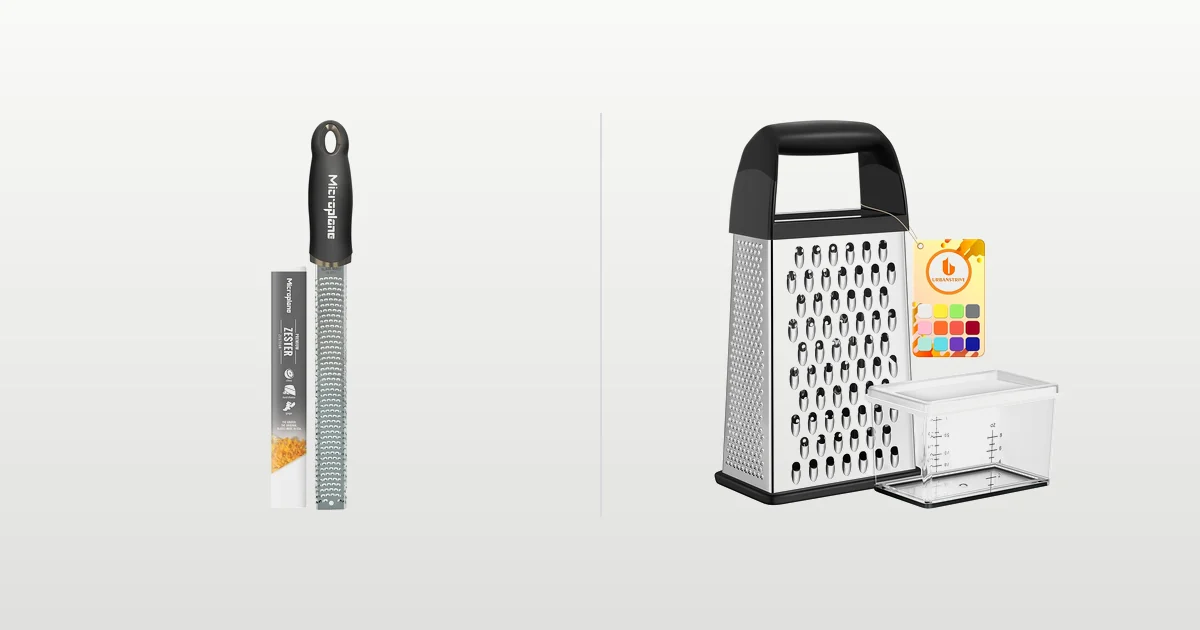
 Best OverallMicroplane Premium Classic 18/8
Photo-etched 18/8 blades that shave parmesan into fluffy mounds instead of pressing it into a paste.
 Best Box GraterUrbanstrive Box Grater
Four surfaces, a container that catches what you grate, and the best-selling grater in the category at $9.98.
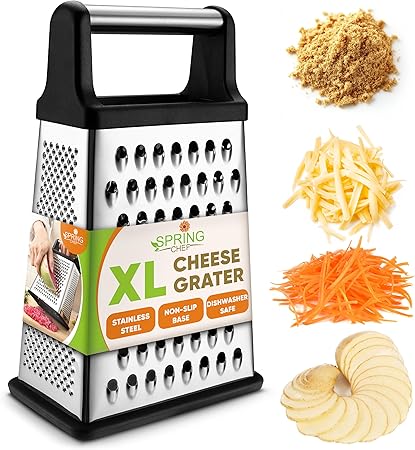 Best Flat GraterSpring Chef XL Flat Grater
An extra-wide flat face that takes a whole block of cheddar in fewer passes, at 4.8 stars.
At a Glance
Ten Cheese Graters Compared
Mechanism first, then whether the blades are etched or stamped — which is what decides the texture.
| # | Model | Type | Blade Cut | Surfaces | Material | Standout | Main Drawback | Check Price |
|---|---|---|---|---|---|---|---|---|
| 1 |
 Microplane Premium Classic 18/8 Microplane Premium Classic 18/8 |
Rasp | Photo-etched | 1, ultra fine | 18/8 stainless steel | Photo-etched blades that shave rather than tear | One surface, so it does one thing | View on Amazon |
| 2 |
 Urbanstrive Box Grater Urbanstrive Box Grater |
Box, 4 sides | Not stated | 4: coarse, medium, fine, slicing | 304 stainless steel | #1 in Graters with a catch container | Blade cut never specified | View on Amazon |
| 3 |
 Cambom Rotary Hand Crank Cambom Rotary Hand Crank |
Rotary drum | Not stated | 3 interchangeable drums | 430 stainless drums, BPA-free body | #1 in Cheese Graters with a suction base | Six near-identical rivals in this category | View on Amazon |
| 4 |
 Spring Chef XL Flat Grater Spring Chef XL Flat Grater |
Flat, extra wide | Not stated | 1 wide surface | Stainless steel | Extra-wide face shreds a block fast | One texture only | View on Amazon |
| 5 |
 OXO Good Grips Etched Coarse OXO Good Grips Etched Coarse |
Flat, coarse | Etched | 1 coarse surface | Stainless steel | Etched blades on a coarse surface, which is rare | Coarse only, no fine option | View on Amazon |
| 6 |
 Zyliss Classic Rotary Zyliss Classic Rotary |
Rotary drum | Not stated | 1 drum | Stainless steel | NSF certified and it folds flat | One drum, where rivals give three | View on Amazon |
| 7 |
 Deiss PRO Zester Deiss PRO Zester |
Rasp | Razor-sharp, cut not stated | 1 fine surface | Stainless steel | #1 in Zesters at $10.72 | Etching not explicitly claimed | View on Amazon |
| 8 |
 Geedel Rotary Grater Geedel Rotary Grater |
Rotary drum | Not stated | 3 drums | Food-grade ABS and stainless | Ships with a pusher, jar and suction base | Another three-drum rotary in a crowded field | View on Amazon |
| 9 |
 Microplane Classic Zester Microplane Classic Zester |
Rasp | Photo-etched, made in USA | 1 fine surface | Stainless steel | Photo-etched blades for $12.99 | Same single texture as its dearer sibling | View on Amazon |
| 10 |
 BonCera Ceramic Garlic Plate BonCera Ceramic Garlic Plate |
Ceramic plate | Moulded ridges | 1 ridged surface | Ceramic | Grates garlic and ginger without metal | Useless for cheese | View on Amazon |
Specifications, prices and ratings are taken from each manufacturer’s Amazon listing as displayed on 21 August 2026 and may change. “Blade cut” records only what each listing states: both Microplane models specify photo-etching and the OXO specifies etched blades; the remaining seven describe sharpness without naming a manufacturing method and are recorded as not stated, which in this category generally indicates stamped construction. Amazon files these products across three subcategories — Graters, Cheese Graters and Zesters — and the rank positions given refer to whichever subcategory each listing sits in. Six rotary drum graters with three interchangeable blades and a suction base appeared in our verification with near-identical descriptions at prices from $16.45 to $26.99; three are included here and three were excluded as duplicates. Amazon’s Peeling, Grating & Slicing Tools node also contains peelers, mandolines, choppers and egg slicers, all of which were filtered out before verification.
Scroll the table sideways to see every column
How We Chose These Cheese Graters
We researched current listings, compared manufacturer specifications and documentation, and examined recurring patterns in customer feedback. We did not carry out hands-on testing, and nothing below is presented as measured performance data.
- Whether the blades are etched or stamped — the specification that decides whether cheese shaves or tears, and only three listings state it
- Mechanism — box, flat, rasp, rotary and ceramic plate are four different tools, not four price points
- Number of surfaces — one texture done well against four textures done adequately
- Steel grade where named — 304 and 18/8 resist citrus acid; 430 is more prone to spotting
- Safety at the end of a block — the last inch is where box graters take fingertips and rotaries do not
- Genuine graters — peelers, mandolines, choppers and egg slicers from the same node were filtered out
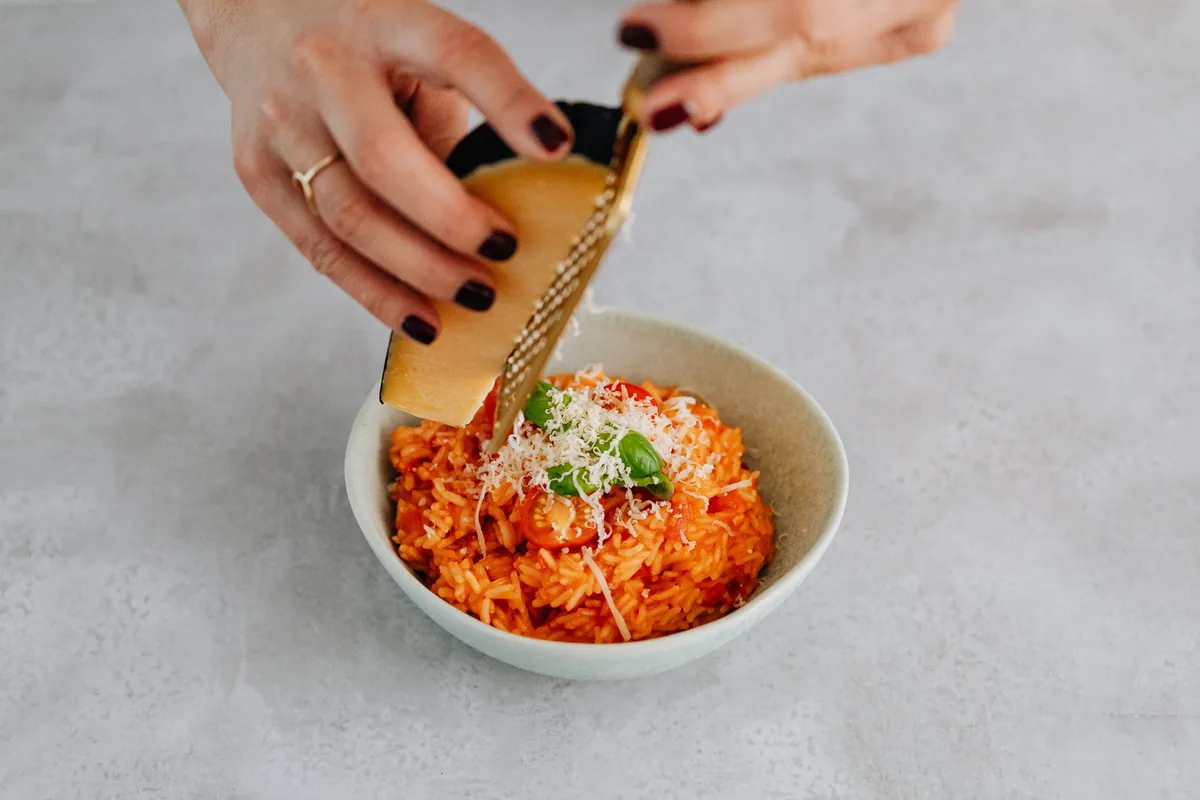
The 10 Best Cheese Graters, Reviewed
1. Microplane Premium Classic 18/8 — Best Overall

Microplane’s blades are photo-etched rather than stamped, and that single manufacturing difference is what separates this from almost everything else in the category.
Four point eight stars, the joint highest rating in this roundup.
Key Specifications
| Type | Rasp / hand grater |
|---|---|
| Blade cut | Photo-etched |
| Surfaces | 1, ultra fine |
| Material | 18/8 stainless steel |
| Uses | Citrus zest, hard cheese, ginger, garlic, nutmeg, chocolate |
| Dimensions | 12″L x 1.31″W x 1″H |
| Weight | 110 g |
| Rating | 4.8 out of 5 stars |
| Best For | Hard cheese and citrus zest, done properly |
Why We Recommend It
Stamped blades are punched out of sheet metal, which leaves a raised, slightly rounded burr around each hole. That edge pushes and tears food as much as it cuts it, which is why cheese from a cheap grater comes off in squashed clumps and why your knuckles catch.
Photo-etching removes metal chemically instead, producing a genuinely sharp edge with no burr. The tool shaves rather than scrapes, so parmesan comes off as separate fluffy threads that melt almost instantly, and citrus zest lifts without dragging the bitter white pith underneath.
Two listings in this roundup say their blades are etched. The rest do not say, which almost always means stamped.
Eighteen-eight stainless is the same grade as 304 — genuinely food grade and corrosion resistant, which matters on a tool that meets lemon juice constantly.
The limitation is honest: one surface, one texture. This does fine grating superbly and coarse grating not at all.
Pros
- Photo-etched blades shave rather than tear
- 4.8 stars, joint highest in this roundup
- 18/8 stainless resists citrus acid
- Zest lifts without dragging the pith
- Parmesan comes off fluffy and melts fast
- 110 g, stores in a drawer
Cons
- One surface only — no coarse or slicing option
- $17.95 for a single-function tool
- Long 12-inch shape needs drawer space
- No cover in this listing
- Filed under Zesters rather than Cheese Graters
Best for: Hard cheese, citrus and ginger — the fine end of grating, done right.
2. Urbanstrive Box Grater — Best Box Grater

Ten dollars, four surfaces and #1 in Graters. A box grater is the most versatile shape in the category and this is the version most people buy.
Key Specifications
| Type | Box grater, 4 sides |
|---|---|
| Surfaces | Coarse, medium, fine, plus a slicing face |
| Material | 304 stainless steel, stated as 95% |
| Container | Included, catches and measures |
| Handle | Ergonomic non-slip |
| Dimensions | 4.9″L x 2.95″W x 12.2″H |
| Weight | 0.33 kg |
| Rank | #1 in Graters |
| Best For | One tool that covers every grating texture |
Why We Recommend It
The container is what makes a box grater usable rather than annoying. Grating onto a board means cheese escaping in every direction and a second job moving it; a box that catches its own output turns it into one step, and it lets you see how much you have.
Four surfaces genuinely do four different jobs. Coarse for cheddar on a jacket potato, medium for melting, fine for parmesan, and a slicing face for cucumber and courgette. Nothing else on this page spans that range.
What the listing never says is how the blades are cut. "304 stainless steel (95%)" describes the metal, not the edge, and box graters at this price are almost universally stamped rather than etched — so expect it to tear a little where a Microplane shaves.
For coarse work that hardly matters. For parmesan it does.
Twelve inches tall is a lot of drawer, which is the standing objection to box graters.
Pros
- #1 in Graters and $9.98
- Four surfaces cover every grating texture
- Container catches and measures what you grate
- 304 stainless steel
- Non-slip ergonomic handle
- 4.7 stars
Cons
- Blade cutting method never stated, so almost certainly stamped
- 12.2 inches tall and awkward to store
- Four faces means four things to clean
- Coarse faces tear soft cheese more than they cut it
- Unfamiliar brand
Best for: The one-tool answer, if you can find the drawer space.
3. Cambom Rotary Hand Crank — Best Rotary

The best seller in Cheese Graters specifically, and a completely different mechanism from everything above it: the food goes in a hopper and a drum does the work.
Key Specifications
| Type | Rotary drum, hand crank |
|---|---|
| Drums | 3 — coarse shred, fine shred, slicing |
| Drum material | 430 stainless steel |
| Body | Food-grade BPA-free plastic |
| Base | Suction cup, for marble or glass |
| Power | None required |
| Dimensions | 6.5″L x 5.5″W x 10.8″H |
| Rank | #1 in Cheese Graters |
| Best For | Grating a lot of cheese without holding it |
Why We Recommend It
The reason to want one is that your hand never touches the blade or the cheese. On a box grater the last inch of a block is a genuine hazard and usually gets thrown away; a rotary holds the cheese under a sprung pusher and grates it down to almost nothing.
It is also much faster for volume — a whole block for a lasagne rather than a handful over pasta.
The suction base is the specification that decides whether it works. A rotary needs one hand to crank and one to press, which leaves nothing holding the unit down. Cambom specifies suction for marble and glass; on textured or wooden worktops suction bases hold far less well, which is worth knowing before ordering.
430 stainless for the drums is a magnetic, lower-chromium grade — adequate and less corrosion resistant than the 304 or 18/8 used elsewhere here.
Note the crowd. Six rotary graters appeared in this category with near-identical three-drum, suction-base specifications; three are on this page. Compare prices before choosing.
Pros
- #1 in Cheese Graters
- Three interchangeable drums for shredding and slicing
- Your hand never touches the blade
- Grates a block down to almost nothing
- Suction base for stability
- Far faster than a box grater for volume
Cons
- Suction bases hold poorly on wood or textured worktops
- 430 stainless is less corrosion resistant than 304
- $26.99, dearest grater here
- Many parts to dismantle and wash
- Six near-identical rivals in the same category
Best for: Volume grating, and anyone who has grated their knuckles.
4. Spring Chef XL Flat Grater — Best Flat Grater
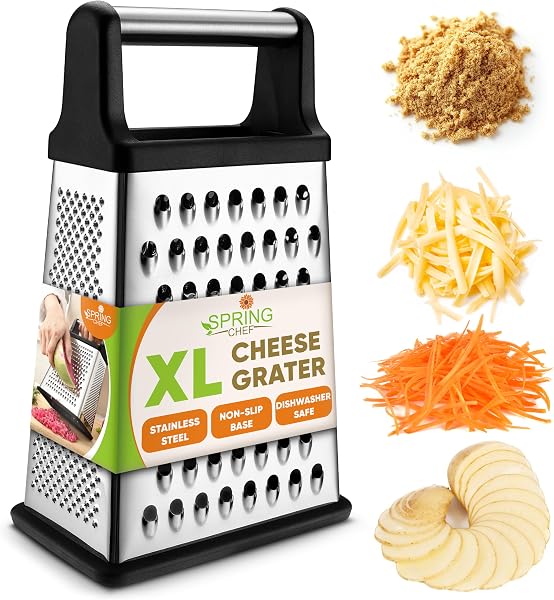
Joint highest rated in this roundup at 4.8 stars, and the reason is width. A wider grating face means fewer strokes for the same block.
Fourteen dollars, 0.18 kg, and it lies flat in a drawer.
Key Specifications
| Type | Flat / paddle grater, extra wide |
|---|---|
| Surfaces | 1, extra wide |
| Material | Stainless steel |
| Dimensions | 6″L x 5″W x 9.2″H |
| Weight | 0.18 kg |
| Rating | 4.8 out of 5 stars |
| Rank | #2 in Cheese Graters |
| Also grates | Vegetables as well as cheese |
| Best For | Shredding blocks quickly without a box grater’s bulk |
Why We Recommend It
A flat grater is the compromise between a box and a rasp, and it is an underrated one. It stores like a rasp, grates at box-grater speed on one texture, and works over a bowl or straight onto a plate without the food being trapped inside a box you then have to reach into.
What you give up is the other three surfaces. A box grater does coarse, medium, fine and slicing; this does one thing well, and if you want parmesan dust as well as cheddar shreds you need a second tool.
The blade cut is not specified, like most of this page. "Fantastic results without the fatigue" describes an outcome rather than a manufacturing method.
At 0.18 kg it is the second lightest grater here, and it is the one most likely to actually get used, because getting it out costs nothing.
Pros
- 4.8 stars, joint highest rating in this roundup
- Extra-wide face shreds a block in fewer passes
- Stores flat, unlike a box grater
- Works over a bowl or straight onto a plate
- 0.18 kg
- #2 in Cheese Graters at $13.99
Cons
- One texture only
- Blade cutting method not specified
- No container or cover
- Less versatile than a box grater
- Cheese still lands wherever you point it
Best for: The grater most likely to get used, because it is never in the way.
5. OXO Good Grips Etched Coarse — Best Etched Coarse

This is the only coarse grater in the roundup that states its blades are etched. Everything else coarse is stamped, or does not say.
Key Specifications
| Type | Flat grater, coarse |
|---|---|
| Blade cut | Etched |
| Surfaces | 1, coarse |
| Material | Stainless steel |
| Cover | Included, protects surface and hands |
| Ideal for | Semi-soft cheese, potato, courgette, onion, cabbage, butter, apple |
| Dimensions | 13.58″L x 4.09″W x 1″H |
| Weight | 1.92 ounces |
| Best For | Semi-soft cheese and vegetables, without tearing them |
Why We Recommend It
That combination matters more than it sounds. Etched blades are usually associated with fine rasps and citrus zest, and stamped holes with coarse work — which is why cheap coarse graters shred semi-soft cheese into smeared clumps and turn a courgette to mush. A sharp coarse edge cuts cleanly through soft material rather than crushing it.
The named uses tell you the design intent: semi-soft cheeses, potatoes, courgette, onion, cabbage, butter and apples. Every one of those is soft enough to be damaged by a blunt stamped hole.
The cover is a real inclusion. A 13.58-inch etched blade loose in a drawer is unpleasant to reach past and dulls against everything else in there. Two graters here include one.
At 1.92 ounces it is the lightest tool on this page, and like the Spring Chef it stores flat.
Pros
- Etched blades, stated — rare on a coarse grater
- Cuts soft cheese and vegetables cleanly rather than crushing them
- Protective cover included
- 1.92 ounces, lightest here
- Stores flat
- OXO’s usual grip design
- #3 in Graters
Cons
- Coarse only — no fine or slicing surface
- $14.99 for a single texture
- 13.58 inches long
- No container to catch the output
- Orange colourway will not suit every kitchen
Best for: Semi-soft cheese and vegetables, cut rather than crushed.

6. Zyliss Classic Rotary — Best Restaurant-Grade

NSF certification is the specification here, and it is the only third-party certification anywhere in this roundup.
It means the tool meets a public-health standard for commercial food equipment — materials, cleanability, and construction without crevices that trap food.
Key Specifications
| Type | Rotary drum, hand crank |
|---|---|
| Drums | 1 |
| Certification | NSF certified for restaurant use |
| Storage | Folds flat |
| Pressure needed | Little, per the manufacturer |
| Suits | Hard cheeses, chocolate, nuts |
| Dimensions | 6.3″L x 4.45″W x 3.15″H |
| Weight | 6.88 ounces |
| Best For | Table-side grating and hard cheese, with commercial certification |
Why We Recommend It
That last part is the practically useful bit. Rotary graters have a hopper, a drum, a crank and a pusher, and cheap ones have seams and recesses where cheese packs in and stays. A design certified for restaurant use has been assessed on whether it can actually be cleaned.
It folds flat, which is rare for a rotary — the others here are rigid, bulky objects that take real cupboard space for a single-purpose tool.
The trade is one drum rather than three. The rotary graters above and below it come with coarse, fine and slicing drums; this has one, so it grates and does not slice. For hard cheese, chocolate and nuts — the uses Zyliss names — that is the drum you want anyway.
No suction base either, which means you hold it rather than the worktop holding it — better on a wooden table, worse for large volumes.
At 4.4 stars it is the lowest-rated product in this roundup.
Pros
- NSF certified, the only third-party certification here
- Folds flat for storage, unique among the rotaries
- Requires little pressure
- Hand-held, so no suction base to fail
- 6.88 ounces, light for a rotary
- Easy disassembly for cleaning
Cons
- One drum only, where rivals supply three
- 4.4 stars, lowest in this roundup
- $24.95 for a single-function tool
- No suction base for high-volume work
- Blade cutting method not stated
Best for: Hard cheese at the table, with a certification nothing else here carries.
7. Deiss PRO Zester — Best Value Rasp

Ten seventy-two and #1 in Zesters, against $17.95 for the Microplane above. The shape and the job are the same.
Key Specifications
| Type | Rasp / hand grater |
|---|---|
| Surfaces | 1, fine |
| Blade | Razor-sharp stainless steel, rust resistant |
| Uses | Parmesan, garlic, nutmeg, chocolate, citrus, ginger |
| Dimensions | 1.77″L x 1.02″W x 14.76″H |
| Weight | 6.7 ounces |
| Rank | #1 in Zesters |
| Price | $10.72 |
| Best For | Microplane-style grating at two-thirds the price |
Why We Recommend It
What differs is the disclosure. Microplane names photo-etching as its manufacturing process; Deiss says "razor-sharp stainless steel blade that won’t rust" — a description of the result rather than the method. It may well be etched; the listing does not commit.
Given it is #1 in its subcategory at 4.5 stars, buyers are evidently satisfied with the sharpness.
Rust resistance is a genuine concern on a zester, more than on any other grater. Citrus juice is acidic and gets into every one of hundreds of tiny apertures, and a poorly specified steel will show orange spotting within months if it is not dried properly.
Deiss makes the anti-box-grater argument openly, describing box graters as bulky, unsafe and hard to clean. That is a fair characterisation of the alternative, and the counter is that a rasp does one texture where a box does four.
At 14.76 inches it is the longest tool here, which gives more grating stroke and less drawer.
Pros
- #1 in Zesters at $10.72
- Rust-resistant blade, which matters most on a citrus tool
- 14.76 inches gives a long grating stroke
- Handles cheese, garlic, nutmeg and chocolate
- 6.7 ounces
- Two-thirds the price of the Microplane
Cons
- Does not state whether blades are etched or stamped
- One texture only
- 14.76 inches is long for a drawer
- 4.5 stars, below both Microplanes here
- No cover included
Best for: The value route to fine grating, if the etching claim is not essential to you.
8. Geedel Rotary Grater — Best Equipped Rotary

Second in Graters overall, and the most completely equipped of the rotary designs here: three drums, a feeding jar, a pusher and a suction base all listed as included.
Key Specifications
| Type | Rotary drum, hand crank |
|---|---|
| Drums | 3 — slicing, shredding, grinding |
| Included | Feeding jar, handle, 3 blades, pusher, suction base |
| Body | Food-grade ABS, BPA free |
| Base | Suction |
| Dimensions | 4.72″L x 4.92″W x 9.37″H |
| Weight | 12.8 ounces |
| Rank | #2 in Graters |
| Best For | Rotary grating with everything in the box |
Why We Recommend It
The pusher is the part that matters and the part cheap rotaries skimp on. It is what holds the cheese against the drum, and it is the only thing standing between your fingertips and a rotating blade as the block gets short. A rotary without a proper sprung pusher is either unsafe at the end of a block or wasteful, because you stop early.
Three drums cover slicing, shredding and grinding, which makes this closer to a box grater in versatility than to the single-drum Zyliss.
Its material honesty is above average for the category — food-grade ABS named directly, BPA-free stated, stainless blades — though like almost everything here it does not say how those blades are cut.
The caution is the crowd. Three-drum rotary graters with suction bases are the most duplicated product in this category; six appeared in our verification with near-identical descriptions, between $16.45 and $26.99. Compare on price.
Pros
- #2 in Graters
- Three drums for slicing, shredding and grinding
- Pusher, feeding jar and suction base all included
- Food-grade BPA-free ABS named
- 12.8 ounces
- 4.6 stars
Cons
- One of six near-identical three-drum rotaries in this category
- Blade cutting method not stated
- Suction base needs a smooth worktop
- $25.47
- Many components to dismantle and dry
Best for: The best-equipped rotary — but check its near-twins on price first.
9. Microplane Classic Zester — Best Cheap Etched

Twelve ninety-nine for photo-etched blades made in the USA, against $17.95 for the Premium 18/8 version above.
Both are 4.8 stars.
Key Specifications
| Type | Rasp / hand grater |
|---|---|
| Blade cut | Photo-etched, made in USA |
| Surfaces | 1, fine |
| Material | Stainless steel |
| Uses | Citrus zest, hard cheese, ginger, garlic, spices |
| Dimensions | 12″L x 1.3″W x 1.3″H |
| Weight | 2.08 ounces |
| Rating | 4.8 out of 5 stars |
| Best For | The etched-blade advantage on the smallest budget |
Why We Recommend It
The difference between the two Microplanes is the steel, not the cut. Both use the same photo-etching process; the Premium specifies 18/8 stainless, while this one says stainless steel without a grade. On a tool that meets lemon juice constantly, the named grade is worth something — but only if you leave it wet, which you should not.
Photo-etching is genuinely the differentiator in this category, and it is worth restating why: chemically etched edges have no burr, so the blade shaves a clean sliver instead of tearing at the food and pushing it. It is the reason parmesan from a Microplane is fluffy and parmesan from a stamped grater is granular and damp.
At 2.08 ounces this is essentially a blade with a handle, and it stores anywhere.
One surface, again. Both Microplanes here do fine grating and nothing else, which is why most kitchens end up owning one of these and one box grater.
Pros
- Photo-etched blades at $12.99
- Made in the USA, stated
- 4.8 stars, joint highest here
- 2.08 ounces
- Handles zest, hard cheese, ginger and spices
- Five dollars less than the Premium version
Cons
- Steel grade not specified, unlike the Premium 18/8
- One texture only
- 12 inches long in a drawer
- No cover included
- #16 in Graters despite the rating
Best for: The cheapest way to own an etched blade, and most kitchens should.
10. BonCera Ceramic Garlic Plate — Best for Garlic

A ceramic plate with moulded ridges is the oldest grating technology on this page and the only non-metal one, and it exists for a specific pair of ingredients.
Key Specifications
| Type | Ceramic grating plate |
|---|---|
| Surface | Moulded ceramic ridges |
| Material | Ceramic, non-corrosive |
| Cleaning | Dishwasher and microwave safe |
| Uses | Garlic, ginger, wasabi, nutmeg, hard cheese in small amounts |
| Dimensions | 5.25″L x 5.25″W x 1″H |
| Weight | 11.3 ounces |
| Rank | #17 in Graters |
| Best For | Garlic and ginger paste, and keeping the smell out of your metal tools |
Why We Recommend It
Garlic and ginger are the problem it solves. Both are fibrous and both clog a metal rasp, packing into the apertures where they oxidise and leave a smell that transfers to the next thing you grate. Ceramic ridges are blunter and further apart; they crush and shear fibrous material into a paste rather than trying to slice it.
Ceramic is also non-reactive and non-porous, so it holds nothing. Garlic on a steel rasp is a lingering problem; garlic on a ceramic plate rinses off.
The plate catches what it grates, which no rasp does — you grate directly into the dish and can add oil to it, which is how a garlic paste or a dipping sauce is actually made.
It is genuinely poor at cheese beyond a small amount of hard parmesan, and hopeless at anything requiring volume. This is a companion to a real grater, not a replacement.
Dishwasher and microwave safe, which nothing else on this page claims.
Pros
- Handles garlic and ginger, which clog metal rasps
- Non-porous ceramic holds no smell
- Grates directly into a dish that catches it
- Dishwasher and microwave safe
- No metal to corrode or rust
- Attractive enough to serve from
Cons
- Useless for volume cheese grating
- Ceramic ridges dull far sooner than steel
- Breakable
- $15.98 for a single narrow purpose
- #17 in Graters, the lowest visibility here
Best for: Garlic, ginger and wasabi — the jobs that ruin a metal grater.
Etched or Stamped, and Why It Changes the Cheese
Three listings here name their manufacturing method. Seven describe the result instead.
| Photo-etched | Stamped | |
|---|---|---|
| Graters here | Microplane Premium, Microplane Classic, OXO | The other seven, by omission |
| How the hole is made | Metal removed chemically | Punched from sheet |
| Edge | Sharp, no burr | Raised burr around each aperture |
| Action on food | Shaves a clean sliver | Tears and presses |
| Parmesan result | Separate fluffy threads | Damp granules that clump |
| Citrus zest | Lifts rind, leaves the pith | Drags pith and juice |
| Effort needed | Little | Noticeably more |
| Price here | $12.99–$17.95 | $9.98–$26.99 |
Note the price row. The etched graters here cost $12.99 to $17.95; the most expensive product in the roundup is a $26.99 rotary that does not state its blade cut at all. So this is not a premium feature you have to buy your way into — it is a manufacturing choice that some makers advertise and most do not mention. Where a listing describes sharpness in adjectives rather than naming a process, stamped is the safe assumption, and for coarse work on cheddar or potato it genuinely does not matter much. For parmesan and zest it is the whole difference.
Four Mechanisms, Four Different Tools
These are not four price tiers of the same product. They do different things.
| Rasp | Box | Flat | Rotary drum | Ceramic plate | |
|---|---|---|---|---|---|
| Graters here | Three | One | Two | Three | One |
| Textures | One, very fine | Four | One | Three drums | One, paste |
| Hand near blade | Yes | Yes | Yes | No | Yes |
| Volume speed | Slow | Moderate | Fast | Fastest | Very slow |
| Storage | Flat, in a drawer | 12 inches tall | Flat | Bulky | Flat |
| Best at | Parmesan, zest, nutmeg | Everything, adequately | Blocks of cheddar | Volume, and block ends | Garlic and ginger |
| Price range here | $10.72–$17.95 | $9.98 | $13.99–$14.99 | $24.95–$26.99 | $15.98 |
The row worth pausing on is “hand near blade”. On every design except the rotary, the last inch of a block is grated with your fingertips a few millimetres from the surface — which is why most people throw that inch away. A rotary holds the cheese under a pusher and takes it down to almost nothing, which over a year is a meaningful amount of cheese. That, rather than speed, is the real argument for the bulkiest tool here. The honest conclusion is that most kitchens want two: a rasp for fine work and either a box or a flat grater for volume.
Best Alternatives
| Alternative | Why Consider It | Better For | Main Trade-Off |
|---|---|---|---|
| Pre-shredded bagged cheese | No grating and no washing up | Convenience | Coated in anti-caking starch, so it melts badly and costs more per gram |
| A food processor with a shredding disc | Grates a kilo in seconds | Large batches and entertaining | Absurd for a handful, and the washing up takes longer than grating |
| A vegetable peeler | Makes wide parmesan shavings | Salads and finishing a dish | Shavings, not shreds — it will not melt into a sauce |
| A sharp knife | You already own one | Crumbly and semi-soft cheeses | Slow, and hopeless on hard cheese |
| A mandoline | Slices thinly and evenly | Firm cheeses and vegetables | Slices rather than shreds, and genuinely dangerous |
What Each Price Tier Actually Buys
$9.98 to $13.99 — Urbanstrive Box, Deiss PRO, Microplane Classic, Spring Chef XL. The best value in the category, and it contains three of the four subcategory leaders. The Microplane Classic gives you photo-etched blades for $12.99, and the Spring Chef and Microplane are the joint highest rated products here at 4.8 stars.
$14.99 to $17.95 — OXO Etched Coarse, BonCera Ceramic, Microplane Premium. Specialisation. Etched blades applied to a coarse surface, a ceramic plate for the garlic and ginger that clog metal, and 18/8 steel on the Microplane for citrus work.
$24.95 to $26.99 — Zyliss Rotary, Geedel Rotary, Cambom Rotary. The rotary tier, and the only mechanism that keeps your hand off the blade. The Zyliss is NSF certified and folds; the other two supply three drums and a suction base. None of the three states how its blades are cut.
The pattern: the two highest-rated graters here cost $12.99 and $13.99, and the most expensive product is rated 4.5. Money buys mechanism — specifically the rotary format — rather than a better cutting edge, which is available for under thirteen dollars.
How to Choose a Cheese Grater
Look for the Word “Etched”
It is the only specification in this category that reliably predicts how the cheese comes off. Etched blades are chemically cut and have no burr, so they shave; stamped blades are punched and have a raised lip that tears. Three listings here say which they use, and all three are etched. Where a listing offers adjectives instead — razor sharp, durable sharp, ultra sharp — assume stamped, and understand that for coarse cheddar or potato that is perfectly acceptable.
Decide Which Texture You Actually Need
Fine and coarse are not preferences, they are cooking decisions. Finely grated hard cheese melts almost on contact, which is what you want stirred into a sauce or over hot pasta. Coarse shreds hold their shape and brown, which is what you want on a gratin or in a toasted sandwich. A rasp does the first superbly and the second not at all; a box grater does all four textures adequately. Most kitchens genuinely need two tools rather than one compromise.
Think About the Last Inch of the Block
Every grater except a rotary puts your fingertips a few millimetres from the blade as the cheese runs out, which is why most people stop and discard that last piece. A rotary holds the block under a sprung pusher and grates it down to almost nothing, and your hand never approaches the drum. Over a year that is a real quantity of cheese, and it is the strongest practical argument for the bulkiest and most expensive format here.
Check the Steel Grade if You Zest Citrus
Graters are unusually hard on steel because acidic juice gets into hundreds of tiny apertures that cannot be dried properly. Grades containing nickel — 304, or 18/8, which is the same thing — resist that best. The 430 and 420 grades used in some rotary drums have less chromium and no nickel, and will spot sooner if the tool is left wet. Four listings here name a grade; five say only “stainless steel”.
Buy a Cover or Accept a Dulled Blade
A 12- to 14-inch etched blade loose in a drawer knocks against every other utensil in there, which dulls it and makes the drawer unpleasant to reach into. Two graters in this roundup include a cover and it is a genuine longevity feature, not packaging. If the one you want has no cover, store it in a knife block slot or a sleeve rather than the utensil drawer.
Keep Garlic Away From Your Good Rasp
Garlic and ginger are fibrous and oily, and they pack into the fine apertures of a rasp where they oxidise and leave a smell that transfers to whatever you grate next. Metal rasps are genuinely bad at both. A ceramic plate with moulded ridges crushes fibrous material into a paste instead of trying to slice it, holds no odour because it is non-porous, and costs about sixteen dollars — which is cheaper than ruining a Microplane.
Common Cheese Grater Buying Mistakes
- Assuming all graters cut the same way. Etched blades shave; stamped blades tear, and only three listings here say which.
- Buying one grater for every texture. A rasp and a box grater do different jobs, and most kitchens need both.
- Choosing a rotary without checking the worktop. Suction bases hold on glass and marble, and poorly on wood or textured surfaces.
- Grating garlic on a fine metal rasp. It clogs the apertures and the smell transfers to everything after it.
- Leaving a grater to drain wet. Citrus acid in the apertures will spot lower-grade steel within months.
- Storing a bare etched blade in a drawer. It dulls against everything else in there.
- Buying pre-shredded instead. It is coated in anti-caking starch, which is why it melts into strings rather than sauce.
- Paying rotary prices for a stamped blade. The dearest grater here does not state its cut; a $12.99 one is etched.
Which Cheese Grater Should You Buy?
Buy the Microplane Premium Classic if you grate hard cheese and zest citrus. Photo-etched 18/8 blades, 4.8 stars, and it shaves where others tear.
Buy the Urbanstrive Box Grater if you want one tool for every texture. Four surfaces, a catch container and #1 in Graters for $9.98.
Buy the Spring Chef XL if you shred blocks of cheddar and hate box graters. 4.8 stars, extra wide, and it stores flat.
Buy the Microplane Classic if you want etched blades for the least money. $12.99, made in the USA, same rating as the Premium.
Buy the OXO Etched Coarse if you grate soft cheese and vegetables — the only coarse grater here with etched blades.
Buy the Cambom or Geedel rotary if you grate in volume and want your hand off the blade — and compare their near-twins on price first.
Buy the Zyliss if you want a rotary that folds away and carries a restaurant certification.
Buy the BonCera plate if you grate garlic and ginger, and want them nowhere near your rasp.
Frequently Asked Questions
What is the difference between etched and stamped grater blades?
How the holes are made, and it changes the result more than any other factor. Stamped blades are punched out of sheet steel, which leaves a slightly raised, rounded burr around each aperture — that lip tears and presses food as much as it cuts, which is why cheese from a cheap grater comes off in damp clumps and why it takes real effort. Photo-etching removes metal chemically instead, leaving a sharp edge with no burr, so the blade shaves a clean sliver. Only three of the ten listings in this roundup state which method they use, and all three are etched.
Why does my grated cheese clump together?
Two likely causes. If you are grating it yourself, the blade is probably stamped and is pressing the cheese rather than cutting it — the resulting granules are slightly compressed and damp, and they stick. Warmer cheese makes this much worse, so chilling a block for twenty minutes before grating helps noticeably. If it is pre-shredded from a bag, the cause is different: bagged cheese is coated in potato starch or cellulose to stop it caking, and that coating is also what makes it melt into strings rather than a smooth sauce.
Is a rotary cheese grater worth it?
For volume and for safety, yes. A rotary holds the cheese in a hopper under a sprung pusher and turns it against a drum, so your hand never approaches the blade — which means you can grate a block right down to the last piece instead of discarding the inch that would put your fingertips at risk. It is also considerably faster for a large quantity. The trade-offs are bulk, a lot of parts to wash, and a suction base that holds well on glass or marble and poorly on wood. Note also that they are the most duplicated design in the category.
What grater is best for parmesan?
A fine rasp with etched blades, without much question. Hard aged cheeses are dense and dry, and an etched blade shaves them into separate light threads that melt almost on contact and sit properly on pasta. A stamped grater turns the same cheese into damp granules that clump, and a box grater’s fine face usually clogs. The two Microplanes in this roundup are built for exactly this and cost $12.99 and $17.95. For volume parmesan — a whole bowl for a table — a rotary with a fine drum is faster.
How do I stop a grater rusting?
Dry it properly rather than leaving it to drain, and pay attention to the steel grade when buying. Graters are unusually hard on metal because acidic citrus juice gets into hundreds of tiny apertures where water sits and cannot evaporate easily. Grades containing nickel — 304, also written 18/8 — resist corrosion best; 430 and 420, which appear in some rotary drums, contain no nickel and less chromium and will show orange spotting sooner. After washing, shake the tool out and let it air dry fully before it goes in a drawer.
Can I put a cheese grater in the dishwasher?
Most are dishwasher safe and hand washing is still better for the blade. Dishwasher detergent is abrasive and alkaline, which dulls fine etched edges faster than washing by hand, and the wash rarely clears cheese out of small apertures anyway — it bakes it on in the dry cycle instead. The practical routine is to rinse immediately under a hot tap with a brush, before the cheese dries. One product in this roundup, a ceramic plate, is genuinely better in the dishwasher because it has no edge to dull.
Why does garlic ruin a fine grater?
Because it is fibrous and oily rather than dry and dense like hard cheese. The fibres wrap around and pack into the fine apertures of a rasp instead of passing through, where they oxidise and leave a smell that transfers to the next thing you grate — usually citrus zest, where it is very noticeable. Ceramic grating plates exist for exactly this: the ridges are blunter and further apart, so they crush garlic and ginger into a paste rather than trying to slice them, and the non-porous surface holds no odour.
How many graters does a kitchen need?
Two, realistically. A fine rasp handles hard cheese, citrus zest, nutmeg and chocolate, and does nothing else well. A box or flat grater handles cheddar, potato, carrot and courgette in volume, and cannot produce a fine dust. Trying to do both with one tool means either clogging a rasp or accepting torn shreds from a coarse face. In this roundup a Microplane and a box grater together cost about $23, which is less than the single most expensive product on the page.
Final Verdict
Photo-etched 18/8 blades that shave rather than tear, at 4.8 stars.
Four surfaces, a catch container and #1 in Graters, for $9.98.
4.8 stars, an extra-wide face and it stores flat in a drawer.
The thing that decides whether grated cheese is fluffy or clumped is not the price, the shape or the steel. It is whether the holes were punched or etched — and seven of these ten listings will not tell you which.
The three that do are all etched, and they cost $12.99, $14.99 and $17.95. The most expensive product on this page is a $26.99 rotary that describes its blades only as stainless steel. So the specification that matters most is available cheaply and is not what the money buys.
What money does buy is mechanism, and the rotary format earns it in two specific ways: speed on volume, and grating a block down to the last inch without your fingertips near the blade. Beyond that, buy two tools rather than one — a rasp and a box grater together cost less than the dearest single product here, and between them they do everything this category can do.