Affiliate Disclosure: As an Amazon Associate, we earn from qualifying purchases. This does not affect the price you pay.
The fastest thermometer on this page costs $16.99. The slowest digital one costs $43.99. The most expensive, at $125.00, is beaten on paper by three units under thirty dollars.
That is not a mistake in the pricing. It is what happens when everyone is allowed to print their own number.
Nine of these ten publish an accuracy figure. Four claim ±0.5°F, one claims ±0.9°F, three claim ±1°F and one claims ±1.8°F. The figures are easy to compare and almost meaningless on their own, because the interesting question is not what the number is but who checked it.
On that question the field splits three ways. Five simply state a figure. Two say “NIST certified”, which is a phrase rather than a certificate — NIST publishes standards and maintains references, it does not certify consumer products. One is admirably careful and says ±0.5°F is achievable via laboratory calibration, which means the instrument can reach it, not that yours has. One states that every unit is individually tested and ships a NIST-traceable certificate in the box. That one costs $125.00.
Whether that is worth $115 more than a $9.99 thermometer ranked #19 on Amazon is the actual decision here, and for most home cooking the answer is no.
Our Quick Picks
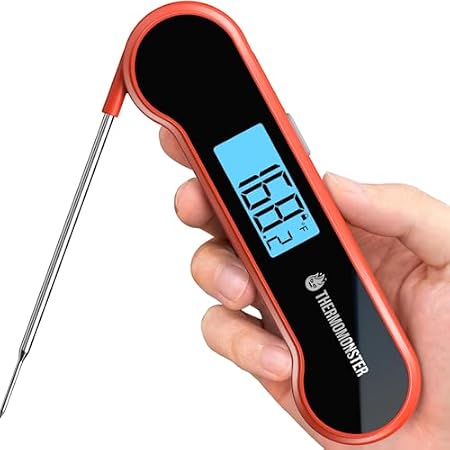 Best ValueThemomonster 0.5 Sec Digital
Half a second and half a degree for $16.99 — the same two numbers the $125.00 thermometer publishes, at an eighth of the price.
 Best DocumentedThermoWorks Thermapen ONE
One second, ±0.5°F, and the only thermometer here that ships a calibration certificate for the individual unit you receive.
 Most PopularInstant Read Digital 1-2 Sec
One to two seconds, ±1°F, IP67 and a 4000-hour battery for $9.99 — and a sales rank of #19.
At a Glance
Ten Thermometers, and Who Stands Behind the Numbers
Claimed speed, claimed accuracy, and what verification — if any — the listing offers for it. Notice that speed runs almost inversely to price.
| # | Model | Claimed Speed | Claimed Accuracy | Verified By | Range | Standout | Main Drawback | Check Price |
|---|---|---|---|---|---|---|---|---|
| 1 |
 Themomonster 0.5 Sec Digital Themomonster 0.5 Sec Digital |
0.5 sec | ±0.5°F | NIST claimed | -58 to 572°F | The fastest claim and the tightest accuracy figure on this page, at $16.99 | ‘NIST certified’ is not the same as a certificate in the box | View on Amazon |
| 2 |
 ThermoWorks Thermapen ONE ThermoWorks Thermapen ONE |
1 sec | ±0.5°F | Certificate included | Not published | Each unit individually tested, with a NIST-traceable certificate in the box | One second is slower than three cheaper thermometers claim | View on Amazon |
| 3 |
 Instant Read Digital 1-2 Sec Instant Read Digital 1-2 Sec |
1–2 sec | ±1°F | Self-declared | -58 to 572°F | Rank #19 — the most bought product on this entire page | ±1°F is twice the tolerance of the certificated units | View on Amazon |
| 4 |
 Lavatools Javelin PRO Classic Lavatools Javelin PRO Classic |
2–3 sec | ±0.5°F* | NSF, CE, RoHS, UKCA | Not published | Four separate certifications, and honest wording about how accuracy is reached | The ±0.5°F is stated as achievable via laboratory calibration | View on Amazon |
| 5 |
 ThermoMaven 0.5 Sec Professional ThermoMaven 0.5 Sec Professional |
0.5 sec | ±0.5°F | NIST claimed | Not published | An upgraded probe with higher thermal conductivity, at 0.5 seconds | $29.99 for the same published figures as a $16.99 unit | View on Amazon |
| 6 |
 Digital 1-2S with Foldable Probe Digital 1-2S with Foldable Probe |
2 sec | ±1°F | Self-declared | -58 to 572°F | Max/min memory and built-in calibration at $9.98 | 2 seconds is four times the fastest claim here | View on Amazon |
| 7 |
 TempPro TempSwift 1 Sec TempPro TempSwift 1 Sec |
1 sec | ±0.9°F | Self-declared | -58 to 572°F | A 5.3-inch probe keeps your hand well clear of the heat | No waterproofing is claimed anywhere in the listing | View on Amazon |
| 8 |
 Meat Thermometer Digital Waterproof Meat Thermometer Digital Waterproof |
2–3 sec | ±1°F | Self-declared | -58 to 572°F | Cooking temperatures printed on the body itself | 2—3 seconds is the slowest digital reading here | View on Amazon |
| 9 |
 Rubbermaid Commercial Pocket Rubbermaid Commercial Pocket |
Instant | Not published | NSF certified | 0 to 200°F | No battery to die, and NSF certification | 0–200°F cannot read a grill, oil or sugar | View on Amazon |
| 10 |
 TempPro TempScan 2-in-1 IR + Probe TempPro TempScan 2-in-1 IR + Probe |
2–3 sec | ±1.8°F | Self-declared | Probe 572°F, IR 1022°F | An infrared gun for stones and pans plus a probe for meat | ±1.8°F is the loosest accuracy claim on this page | View on Amazon |
Speeds, accuracies, prices and specifications are taken from each manufacturer’s Amazon listing as displayed on 24 August 2026 through a United States connection, and may change. All speed and accuracy figures are manufacturer claims; we have not conducted independent timing or calibration testing, and the “Verified By” column reports what each listing says about verification rather than any test of our own. Note that two listings use the phrase “NIST certified”: NIST publishes standards and maintains traceable references but does not certify consumer products, and neither listing states that a certificate is supplied. One listing states ±0.5°F is achievable via laboratory calibration, which describes capability rather than the unit as shipped. One product on this page is mechanical, publishes no accuracy figure, and reads only to 200°F. Sales ranks are shown as displayed and can be pooled across a variant family.
Scroll the table sideways to see every column
How We Chose These Ten
We researched current listings, compared manufacturer specifications and documentation, and examined recurring patterns in customer feedback. We did not carry out hands-on testing, and nothing below is presented as measured performance data.
- The claimed speed recorded exactly as published — 0.5, 1, 1–2, 2 and 2–3 seconds all appear here
- The claimed accuracy recorded, and its verification separately — the figure and the evidence are different things
- Careful wording preserved — one maker says accuracy is ‘achievable via laboratory calibration’ and that matters
- A verified live buy box — all ten confirmed purchasable in the United States on 24 August 2026
- A mechanical option included — because a battery-free NSF thermometer suits kitchens electronics do not
- An infrared option included — a pizza stone cannot be probed, and nothing else here reads a surface
- No overlap with our published grill and kitchen tool guides — every thermometer here is new to the site
The Ten Thermometers in Detail
1. Themomonster 0.5 Sec Digital — Best Value
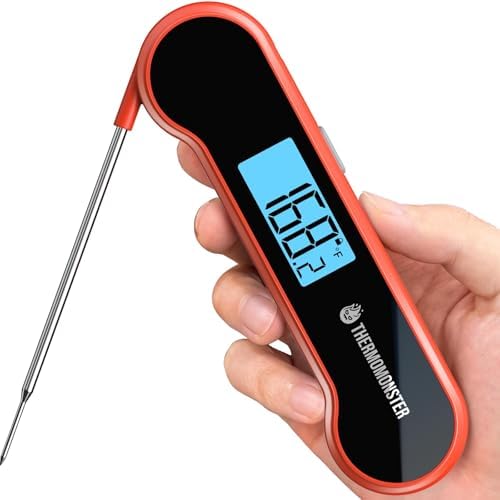
Half a second, half a degree, seventeen dollars. The $125.00 thermometer on this page publishes one second and half a degree.
Key Specifications
| Claimed speed | 0.5 seconds |
|---|---|
| Claimed accuracy | ±0.5°F |
| Verification wording | “NIST certified ±0.5°F precision” |
| Sensor | Professional thermocouple, described as industrial-leading |
| Probe | 4 inches |
| Display | Auto-flip large LCD, left- and right-handed |
| Water resistance | Described as 100% waterproof, washable under running water |
| Power management | Motion-sensing wake, auto-sleep |
| Rank | #79 in its category |
| Price | $16.99 |
| Best For | Getting the headline numbers without the instrument-grade price |
Why We Recommend It
A thermocouple genuinely is faster than a thermistor, and that is what the 0.5-second claim rests on. Thermocouples generate a voltage at a junction of two metals and respond almost instantly; the thermistors in cheap thermometers have to physically warm up before their resistance changes. If this is really a thermocouple probe, the speed is plausible.
The accuracy claim needs reading carefully. “NIST certified” is a phrase several listings on this page use, and it is not quite a thing — NIST publishes standards and provides traceable references, but it does not certify consumer products. What a serious maker offers instead is a NIST-traceable calibration certificate for your individual unit. One thermometer here does that. This one states the claim without the document.
The auto-flip display and motion wake are features that cost nothing to include and are absent from thermometers three times the price.
Rank #79 says the market has found it.
Pros
- 0.5 seconds and ±0.5°F for $16.99
- Thermocouple sensor, which supports the speed claim
- Auto-flip display works either-handed
- Temperature lock holds the reading away from heat
- Motion-sensing wake and auto-sleep
- Rank #79
Cons
- “NIST certified” with no certificate specified
- 4-inch probe is short for a deep roast
- No warranty term published
- No NSF certification
- Accuracy is self-declared, not documented per unit
- Unbranded sensor sourcing
Best for: Everyone who wants the best published numbers and does not need them proven.
2. ThermoWorks Thermapen ONE — Best Documented
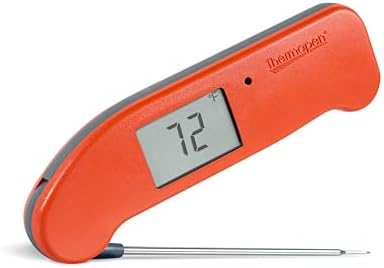
Three thermometers on this page claim to be twice as fast as this one, and two of them cost less than a fifth as much. That is the whole argument in one sentence.
Key Specifications
| Claimed speed | 1 second |
|---|---|
| Claimed accuracy | ±0.5°F (±0.3°C) |
| Verification | NIST-traceable calibration certificate; each unit individually tested |
| Warranty | 5 years |
| Water resistance | IP67 |
| Display | Full 360° auto-rotating, intelligent backlight |
| Activation | Motion-sensing; powers on when the probe is opened |
| Certification | NSF certified |
| Support | US-based customer care and technical support |
| Rank | #2,278 in its category |
| Price | $125.00 |
| Best For | Anyone who needs the number to be right, not merely printed |
Why We Recommend It
What $125.00 buys is not speed. It is evidence. Every thermometer here publishes an accuracy figure; this is the only one that states each unit is individually tested and ships with a NIST-traceable calibration certificate recording the result. That is the difference between a specification and a measurement. A ±0.5°F claim with no verification behind it is a design target; a certificate is a statement about the object in your hand.
Traceability is the concept doing the work. A NIST-traceable calibration means the reference used to test your unit can be followed back through an unbroken chain of calibrations to a national standard. Without that chain, ‘accurate to half a degree’ is accurate relative to something nobody has named.
A five-year warranty on a $125.00 tool is a longer commitment than anything else here offers, and one of the few durable proxies for build quality.
The 360° rotating display and probe-activated power are conveniences. They are not why this costs what it costs.
Pros
- Individually tested with a NIST-traceable certificate
- 5-year warranty — longest here
- NSF certified for commercial use
- IP67 sealed
- Full 360° auto-rotating display
- US-based support
Cons
- $125.00 — by far the most expensive here
- 1 second is slower than three cheaper claims
- No temperature range published in the listing
- Rank #2,278
- No temperature lock feature listed
- Overkill for occasional cooking
Best for: Anyone cooking to a food-safety number rather than to a preference.
3. Instant Read Digital 1-2 Sec — Most Popular

Rank #19. Nothing else on this page is within sixty places, and the next best sits at #79.
Key Specifications
| Claimed speed | 1—2 seconds |
|---|---|
| Claimed accuracy | ±1°F / ±1°C |
| Verification | Self-declared |
| Range | -58°F to 572°F |
| Water resistance | IP67 sealed, rinsable |
| Housing | Shock-resistant ABS |
| Battery | 4000+ hours, auto-sleep and motion wake |
| Storage | Built-in magnet |
| Calibration | User calibration function |
| Rank | #19 — highest on this page by a wide margin |
| Price | $9.99 |
| Best For | The one to buy if you are buying only one and want it to cost nothing |
Why We Recommend It
At $9.99 this is the thermometer that gets bought, kept in a drawer and actually used, and there is a real argument that a thermometer you own beats a more accurate one you did not buy. Chicken is safe at 165°F; a ±1°F instrument tells you whether you are at 160 or 170, which is the question that matters. The certificated units answer a more precise question that most home cooking does not ask.
±1°F is double the tolerance of the ±0.5°F instruments here, and it is self-declared with no certificate. For a steak you are pulling at 130°F, one degree is inside the noise of where you put the probe.
The user calibration function is the feature to use. Ice water sits at 32°F; boiling water at sea level at 212°F. Both are free references, and a thermometer with a calibration function lets you correct against them.
4000 hours of battery with motion wake means years of ordinary use.
Pros
- Rank #19 — the most bought item on this page
- $9.99
- IP67 sealed and rinsable
- 4000+ hour battery with motion wake
- User calibration function
- Magnetic storage and backlit display
Cons
- ±1°F is twice the tolerance of the certificated units
- Accuracy entirely self-declared
- 1—2 seconds against 0.5 claimed elsewhere
- No NSF certification
- No warranty term published
- Unbranded
Best for: Almost everybody. Calibrate it in ice water and it will do most of what the $125 one does.
4. Lavatools Javelin PRO Classic — Best Certified

Read the accuracy line twice. “Superb accuracy of ±0.5°F achievable via laboratory calibration.”
Key Specifications
| Claimed speed | 2—3 seconds |
|---|---|
| Claimed accuracy | ±0.5°F, stated as achievable via laboratory calibration |
| Certification | NSF, CE, RoHS and UKCA |
| Sensor | Proprietary high-performance Japanese sensor |
| Display | 2 inch, 180° auto-rotating, motion-activated backlight |
| Water resistance | IP65 |
| Battery | 4000+ hours, auto-sleep and motion wake |
| Press coverage | Named by America’s Test Kitchen, Wirecutter and NBC News |
| Rank | #1,872 in its category |
| Price | $43.99 |
| Best For | Commercial kitchens that need certification without the flagship price |
Why We Recommend It
That qualifier is unusually honest and it changes the meaning. It says the instrument is capable of half-degree accuracy when calibrated in a laboratory — not that the unit in the box has been. Compare it with the flagship on this page, which states each unit is individually tested and ships the certificate. Both are truthful. They are describing different things, and most listings here would have printed the number without the clause.
Four certifications is more than anything else here carries. NSF matters for commercial kitchens; CE, RoHS and UKCA are regulatory rather than performance marks, but they indicate a manufacturer running a real compliance programme.
IP65 is lower than the IP67 on several cheaper units. IP65 resists jets of water; IP67 survives immersion. For a tool that gets rinsed, that is a genuine difference.
2—3 seconds is the slowest digital claim on this page, from the second most expensive digital thermometer.
Pros
- Four certifications — NSF, CE, RoHS, UKCA
- Honest wording about how ±0.5°F is reached
- Japanese sensor rather than unspecified
- 2-inch 180° auto-rotating display
- 4000+ hour battery
- Widely recommended in the specialist press
Cons
- 2—3 seconds — slowest digital claim here
- IP65, below the IP67 of cheaper rivals
- ±0.5°F is capability, not a per-unit measurement
- $43.99
- No temperature range published
- Rank #1,872
Best for: Commercial use where certification matters more than the last half-second.
5. ThermoMaven 0.5 Sec Professional — Fastest Claim

Thermal conductivity is the right thing to talk about, and this is the only listing here that names it.
Key Specifications
| Claimed speed | 0.5 seconds |
|---|---|
| Claimed accuracy | ±0.5°F |
| Verification wording | “NIST certified accuracy” |
| Probe | Precision-upgraded, higher sensitivity and thermal conductivity |
| Water resistance | IP67 |
| Display | Auto-rotating, ambidextrous intelligent backlight |
| Storage | Hook and magnet |
| Power management | Smart sleep function |
| Rank | #1,600 in its category |
| Price | $29.99 |
| Best For | Buyers who want the fastest claim from a named brand |
Why We Recommend It
Probe response time is not mostly about the sensor; it is about getting heat to the sensor. A probe tip has mass, and that mass has to reach food temperature before the element inside it can report anything. Thinning the tip and using a metal that conducts heat quickly is precisely how you cut a reading from three seconds to half a second. A maker discussing conductivity is discussing the actual mechanism rather than the marketing number.
IP67 rather than IP65 puts this above the $43.99 unit on sealing.
The pricing is the awkward part. This publishes 0.5 seconds and ±0.5°F, with ‘NIST certified’ wording and no stated certificate — which is exactly what the $16.99 thermometer on this page publishes. The extra $13.01 buys a named brand and a stated probe upgrade, not a different specification.
Rank #1,600 against #79 for the cheaper unit with the same numbers.
Pros
- 0.5 seconds — fastest claim on this page
- ±0.5°F claimed
- Names thermal conductivity as the mechanism
- IP67 sealed
- Auto-rotating ambidextrous display
- Hook and magnet storage
Cons
- Same published figures as a $16.99 rival
- “NIST certified” with no certificate specified
- No temperature range published
- No warranty term published
- No NSF certification
- Rank #1,600 against #79 for the cheaper unit
Best for: Buyers who want a brand name behind the fastest number on the page.
6. Digital 1-2S with Foldable Probe — Best Memory Functions

Max/min memory on a ten-dollar thermometer is a feature the $125.00 unit does not list.
Key Specifications
| Claimed speed | 2 seconds |
|---|---|
| Claimed accuracy | ±1°F |
| Verification | Self-declared |
| Range | -58°F to 572°F |
| Probe | 180° foldable; folding switches the unit on and off |
| Memory | Max/min recall |
| Lock | Temperature hold |
| Calibration | Built-in calibration function |
| Water resistance | IP67, magnetic backing |
| Rank | #164 in its category |
| Price | $9.98 |
| Best For | Grilling, where max/min tells you what the hot spot did |
Why We Recommend It
Max/min is more useful on a grill than it sounds. Probe a roast in three places and the instrument remembers the highest and lowest readings, which tells you the spread across the joint rather than a single point — and the spread is what decides whether the thin end is overcooked while the thick end is raw. It also lets you check a grill’s hot and cool zones without writing anything down.
The built-in calibration function is the one to use. Ice water is 32°F and boiling water at sea level is 212°F, so any thermometer with a calibration offset can be corrected against a free reference. That closes most of the gap between a self-declared ±1°F and a certificated ±0.5°F, for nothing.
The folding probe switching the unit on and off is the correct design — there is no separate button to forget.
2 seconds is honest and slow. Four times the fastest claim here, for $9.98.
Pros
- Max/min memory, absent from far dearer units
- Built-in calibration function
- Temperature lock holds the reading
- 180° folding probe powers the unit
- IP67 and magnetic
- $9.98, rank #164
Cons
- 2 seconds against 0.5 claimed elsewhere
- ±1°F self-declared
- No certification of any kind
- No warranty term published
- Folding hinge is a wear point
- Unbranded
Best for: Grilling and roasting, where knowing the spread beats knowing one number.
7. TempPro TempSwift 1 Sec — Longest Probe

Probe length is a specification almost nobody compares, and it decides how close your hand gets to 500°F.
Key Specifications
| Claimed speed | 1 second |
|---|---|
| Claimed accuracy | ±0.9°F |
| Verification | Self-declared |
| Probe | 5.3 inches, food-grade stainless steel — longest on this page |
| Range | -58°F to 572°F |
| Water resistance | Not claimed |
| Auto-off | After 10 minutes idle |
| Storage | Hanging hole, lanyard, probe tip cover |
| Batteries | Included |
| Rank | #390 in its category |
| Price | $8.97 |
| Best For | Deep roasts, tall loaves and anything you have to reach into |
Why We Recommend It
A 4-inch probe on a large roast means your knuckles are inside the oven. At 5.3 inches this is the longest here, and the extra inch and a third is the difference between reaching the centre of a turkey breast comfortably and doing it fast with your forearm against the rack. It also reaches the middle of a tall sourdough loaf, which is why the listing mentions bread specifically — and bread is a genuine use, since a loaf is done at 205—210°F internal rather than by colour.
±0.9°F is an oddly specific claim and slightly better than the ±1°F of its price rivals, though equally self-declared.
No waterproofing is claimed at all, which on a page where $9.98 buys IP67 is the clearest omission here. Wipe it, do not rinse it.
A probe tip cover is a small thing that stops the tip bending in a drawer, which is the commonest way these die.
Pros
- 5.3-inch probe — longest on this page
- 1 second claimed, at $8.97
- ±0.9°F, marginally tighter than its price rivals
- Probe tip cover protects the tip in a drawer
- Batteries included
- Rank #390
Cons
- No waterproofing claimed at all
- No magnet
- No calibration function
- Accuracy self-declared
- No certification
- 10-minute auto-off is slow to save battery
Best for: Deep roasts, whole birds and bread, where reach matters more than sealing.
8. Meat Thermometer Digital Waterproof — Cheapest Digital

The temperature chart printed on the body is the feature, and it is a better one than the price suggests.
Key Specifications
| Claimed speed | 2—3 seconds |
|---|---|
| Claimed accuracy | ±1°F |
| Verification | Self-declared |
| Range | -58°F to 572°F |
| Probe | 304 stainless steel, food grade |
| Reference | Meat types and target temperatures printed on the body |
| Water resistance | Described as waterproof; no IP figure given |
| Storage | Internal magnet and large hanging hole |
| Size | 6.1 inches |
| Rank | #966 in its category |
| Price | $6.99 — cheapest on this page |
| Best For | A second thermometer, or a first one for someone learning |
Why We Recommend It
Knowing the number is the hard part, not reading it. Poultry at 165°F, ground meat at 160°F, whole cuts of beef and pork at 145°F with a rest — these are the figures people look up on a phone with greasy hands, or guess. Printing them on the instrument means the answer is where the question is. It is the sort of detail that appears on cheap tools and disappears on expensive ones.
304 stainless is the right specification for a food probe, being the grade used for commercial food equipment.
2—3 seconds is the slowest digital claim on this page. At $6.99 that is a fair trade, but note that $9.98 buys 2 seconds and $9.99 buys 1—2.
‘Waterproof’ with no IP figure is weaker than an IP67 claim. It probably survives a rinse; nothing here says how deep or how long.
Pros
- $6.99 — cheapest on this page
- Cooking temperatures printed on the body
- 304 stainless food-grade probe
- Backlit display for night grilling
- Magnet and hanging hole
- Rank #966
Cons
- 2—3 seconds — slowest digital reading here
- “Waterproof” with no IP figure quoted
- ±1°F self-declared
- No calibration function
- No certification
- No warranty term published
Best for: A spare for the grill, or a first thermometer for a new cook.
9. Rubbermaid Commercial Pocket — Best Battery-Free
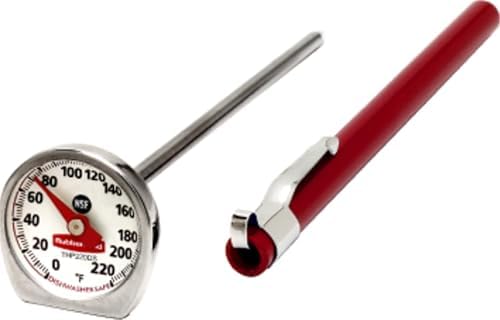
Two hundred degrees Fahrenheit is the whole story, and it is both the limitation and the point.
Key Specifications
| Type | Mechanical dial — no electronics |
|---|---|
| Range | 0°F to 200°F (-17°C to 95°C) |
| Claimed accuracy | Not published |
| Power | None — battery free |
| Certification | NSF certified |
| Cleaning | Dishwasher safe at commercial temperatures |
| Construction | Stainless steel with shatterproof lens |
| Sheath | Protective sheath with pocket clip |
| Dimensions | 5 in x 1.4 in x 1.25 in |
| Rank | #560 in its category |
| Price | $11.59 |
| Best For | Line cooks, food safety checks and drawers where batteries die |
Why We Recommend It
Everything you actually need to measure for food safety sits below 200°F. Poultry is done at 165°F, ground meat at 160°F, whole cuts at 145°F, and the danger zone runs 40—140°F. A dial covering 0—200°F puts all of those across a wide arc of the face, which is easier to read precisely than the same span compressed into a scale that also has to reach 572°F.
What it cannot do is everything else. Frying oil at 350°F, sugar at 300°F, a grill surface, a pizza stone — all off the scale. This is a food thermometer, not a cooking thermometer, and the listing says as much when it directs you to test food outside the oven or grill.
No battery is a real advantage in a professional kitchen, where a dead thermometer at service is a problem and NSF certification may be a requirement.
Dishwasher safe at commercial temperatures is something no electronic thermometer here can claim.
Pros
- No battery to fail
- NSF certified for commercial kitchens
- Dishwasher safe at commercial temperatures
- Stainless steel with a shatterproof lens
- Protective sheath with pocket clip
- 0—200°F spread across a wide dial face
Cons
- 200°F ceiling — no oil, sugar, grill or stone
- No accuracy figure published
- Mechanical dials need periodic recalibration
- Slower to settle than a thermocouple
- No backlight for night grilling
- Not for high-heat cooking at all
Best for: Food-safety checks in a working kitchen, where batteries and glass are liabilities.
10. TempPro TempScan 2-in-1 IR + Probe — Best for Surfaces

A pizza stone cannot be probed. That is why this exists.
Key Specifications
| Type | Infrared surface gun plus contact probe |
|---|---|
| Probe speed | 2—3 seconds |
| Probe accuracy | ±1.8°F |
| Probe range | -58°F to 572°F |
| Infrared range | -58°F to 1022°F |
| Optics | 12:1 distance-to-spot, adjustable emissivity |
| Memory | Max, min and average |
| Reference | Internal temperatures listed on the back |
| Stated limitation | Not for measuring human body temperature |
| Rank | #1,970 in its category |
| Price | $29.99 |
| Best For | Pizza stones, griddles and cast iron, where nothing can be probed |
Why We Recommend It
Surface temperature is a genuinely separate measurement, and one every other thermometer on this page is incapable of. A pizza stone at 550°F and one at 750°F look identical and bake completely differently; the same is true of a griddle, a wok or a cast-iron pan you are about to sear in. An infrared gun reads the surface from a distance instead of touching it.
Adjustable emissivity is the specification that makes it usable. Infrared thermometers infer temperature from emitted radiation, and how much a surface emits varies with material — polished metal emits far less than stone or cast iron, so a fixed-emissivity gun reads shiny surfaces badly wrong. Being able to set it is what separates a tool from a toy.
The probe is the weakest here. ±1.8°F at 2—3 seconds is the loosest and among the slowest on the page, so treat this as an infrared gun that happens to include a probe.
The listing states plainly it is not for human body temperature. Worth repeating.
Pros
- Reads surfaces to 1022°F, which nothing else here can
- Adjustable emissivity for metal, stone and iron
- 12:1 distance-to-spot optics
- Max, min and average memory
- Folding probe wakes and sleeps the unit
- Reference temperatures printed on the back
Cons
- ±1.8°F is the loosest claim on this page
- Probe takes 2—3 seconds
- Explicitly not for human body temperature
- Infrared cannot read internal doneness at all
- $29.99 for a probe that a $9.98 unit beats
- Rank #1,970
Best for: Pizza stones, griddles and searing pans — buy it as a second instrument, not a first.
Speed Runs Backwards Against Price
Sort this page by claimed speed and the prices scatter. Sort it by price and the speeds do not improve.
| Thermometer | Claimed Speed | Claimed Accuracy | Price |
|---|---|---|---|
| Themomonster | 0.5 sec | ±0.5°F | $16.99 |
| ThermoMaven | 0.5 sec | ±0.5°F | $29.99 |
| TempPro TempSwift | 1 sec | ±0.9°F | $8.97 |
| ThermoWorks Thermapen ONE | 1 sec | ±0.5°F | $125.00 |
| Instant Read 1–2 Sec | 1–2 sec | ±1°F | $9.99 |
| Digital Foldable Probe | 2 sec | ±1°F | $9.98 |
| Lavatools Javelin PRO | 2–3 sec | ±0.5°F* | $43.99 |
| Cheapest Digital | 2–3 sec | ±1°F | $6.99 |
| TempPro TempScan IR | 2–3 sec | ±1.8°F | $29.99 |
An $8.97 thermometer and a $125.00 one both claim one second. A $16.99 one claims half a second, twice as fast as the flagship. And the second most expensive digital thermometer here, at $43.99, publishes the slowest digital figure on the page. If speed claims were comparable in any rigorous sense, this table would be sorted by price. It is not, which tells you the claims are not measured the same way — and that the number alone is not what you are buying.
What $115 More Actually Buys
The cheapest well-ranked thermometer here is $9.99. The flagship is $125.00. Here is the difference, stated fairly.
| $9.99 Instant Read | $125.00 Thermapen ONE | |
|---|---|---|
| Claimed speed | 1–2 sec | 1 sec |
| Claimed accuracy | ±1°F | ±0.5°F |
| Individually tested | No | Yes |
| Certificate supplied | No | NIST-traceable |
| Warranty | Not published | 5 years |
| NSF certified | No | Yes |
| Sealing | IP67 | IP67 |
| User calibration | Yes | Not listed |
| Rank | #19 | #2,278 |
The honest summary: $115 buys evidence, a warranty and a certification, not a faster reading. If you are cooking chicken to 165°F, a calibrated ±1°F instrument answers your question completely, and the $9.99 unit has a calibration function the flagship does not list. If you are running a kitchen where a health inspector may ask, or you want the number in your hand to be demonstrably right rather than asserted, the certificate is the product.
Best Alternatives
| Alternative | Why Consider It | Better For | Main Trade-Off |
|---|---|---|---|
| A leave-in probe thermometer | Stays in the meat and alarms at target | Long roasts and smoking | Slow, and useless for spot checks |
| A wireless meat probe | No cable, tracks a whole cook from a phone | Briskets and overnight smokes | Expensive, and another battery to charge |
| A candy or fry thermometer | Clips to the pan and reads to 400°F+ | Deep frying and sugar work | Single purpose, and slow |
| Touch and timing | Free, and how cooks worked for centuries | Experienced hands on familiar cuts | Unreliable on poultry, where the risk is real |
What the Money Actually Buys
$6.99 to $11.59 — five thermometers. Remarkably good. Between them this band offers IP67 sealing, user calibration, max/min memory, a 5.3-inch probe, printed temperature references, magnets and 4000-hour batteries. One of them is ranked #19 on the whole category. What none of them offers is any verification of its accuracy claim.
$16.99 to $29.99 — Themomonster, ThermoMaven and the infrared gun. The two digital units here publish the tightest figures on the page, 0.5 seconds and ±0.5°F, on thermocouple sensors. The infrared gun is a different instrument entirely and the only way to read a pizza stone.
$43.99 — Lavatools Javelin PRO. Four certifications and the most carefully worded accuracy claim on the page. You are buying compliance and a named Japanese sensor, not speed — it publishes the slowest digital figure here.
$125.00 — ThermoWorks Thermapen ONE. Individual testing, a NIST-traceable certificate, NSF certification and five years of warranty. It is the only instrument on this page whose accuracy is a measurement rather than a specification.
What to Check Before You Buy
Separate the Accuracy Figure From Its Evidence
Nine of these ten publish an accuracy figure and they cluster tightly, from ±0.5°F to ±1.8°F. The figures cost nothing to print. What differs is what stands behind them: five listings simply state a number, two use the phrase “NIST certified” without describing a certificate, one carefully says its ±0.5°F is achievable via laboratory calibration, and one states that each unit is individually tested and ships with a NIST-traceable certificate. Traceable means the reference used to test your unit can be followed back through an unbroken chain to a national standard. Without that chain, half a degree is half a degree relative to nothing in particular.
Ask Whether You Need Half a Degree at All
Most cooking decisions are made at five-degree resolution, not half-degree. Poultry is safe at 165°F, ground meat at 160°F, whole cuts at 145°F with a rest, and a steak pulled at 130°F rests to medium rare. A ±1°F instrument answers all of those without ambiguity, and the variation from where you put the probe — two inches apart in the same roast can differ by ten degrees — dwarfs the instrument’s error. The case for a certificated ±0.5°F is strongest in commercial kitchens, in sugar work where a few degrees changes the set, and for anyone who simply wants to stop wondering.
Use the Calibration Function, Because It Is Free Accuracy
Several thermometers in this roundup include a user calibration offset, and it closes most of the gap between a self-declared claim and a certificated one at no cost. A slurry of crushed ice and water, stirred and left a minute, sits at 32°F; water at a rolling boil sits at 212°F at sea level, dropping about one degree per 500 feet of elevation. Check both, and if the reading is off, correct it. Do this when the thermometer is new and every few months after, since drift is the normal failure mode of a cheap sensor rather than sudden death.
Check the Probe Length Against What You Cook
Probe lengths in this roundup run from 4 inches to 5.3, and the difference decides how far your hand goes into a 450°F oven. A short probe is fine for steaks, burgers and chicken pieces on a grill you can lean over. A whole turkey, a large roast or a tall sourdough loaf wants the extra reach, and bread is a real use for a thermometer since a loaf is done at 205 to 210°F internal rather than by colour or by knocking. Length also matters for liquids, where you need to reach the middle of a pot rather than the surface.
Look for IP67 Rather Than the Word Waterproof
Ingress protection ratings are specific: IP65 resists jets of water, IP67 survives temporary immersion. Several thermometers here publish IP67, one publishes IP65, and one simply says “waterproof” with no figure at all — while another claims no water resistance whatsoever, which on a tool that goes from raw chicken to a rinse under the tap is the most consequential omission on this page. It matters for hygiene rather than for weather: a thermometer that cannot be washed properly after touching raw poultry is a cross-contamination risk in a way that no amount of accuracy compensates for.
Consider a Mechanical Thermometer for a Working Kitchen
One product in this roundup has no electronics at all: a mechanical dial, NSF certified, dishwasher safe at commercial temperatures, with no battery to die mid-service. Its ceiling is 200°F, which sounds crippling until you notice that every food-safety temperature that exists sits below it — the danger zone runs 40 to 140°F and the highest target is 165°F. What it cannot do is frying oil, sugar, a grill surface or a pizza stone. As a dedicated food-safety instrument for a line cook it is arguably better suited than anything else here; as your only thermometer it is not enough.
Remember That No Probe Reads a Surface
A pizza stone at 550°F and one at 750°F look identical and bake completely differently, and no contact thermometer in this roundup can tell them apart — you cannot insert a probe into stone. That is a separate instrument: an infrared gun reads emitted radiation from a distance. If you buy one, insist on adjustable emissivity, because how strongly a surface emits varies by material and a fixed-emissivity gun reads polished metal badly wrong. Treat it as a second instrument rather than a first; the infrared unit here has the loosest probe accuracy on the page.

Common Mistakes
- Comparing accuracy figures without asking who verified them. Five here are simply asserted.
- Reading ‘NIST certified’ as a certificate. NIST does not certify consumer products.
- Paying for half a degree you will never use. Most cooking is decided at five-degree resolution.
- Never calibrating. Ice water is 32°F and costs nothing to check against.
- Probing in one spot. Two inches apart in the same roast can differ by ten degrees.
- Buying a thermometer that cannot be washed. It goes from raw chicken to your hand.
- Expecting a probe to read a pizza stone. That needs infrared, and adjustable emissivity.
Who Should Buy Which
Buy the $9.99 Instant Read if you are buying one thermometer. Rank #19, IP67, a 4000-hour battery and a calibration function. Calibrate it in ice water and it answers every question home cooking asks.
Buy the Themomonster at $16.99 if you want the best published numbers. 0.5 seconds and ±0.5°F on a thermocouple, for an eighth of the flagship’s price.
Buy the Thermapen ONE at $125.00 if the number has to be provable. Individually tested, NIST-traceable certificate, NSF, five years.
Buy the Rubbermaid at $11.59 for a professional line. No battery, dishwasher safe, NSF — and every food-safety temperature is under its 200°F ceiling.
Buy the TempScan at $29.99 as a second instrument if you own a pizza oven, a griddle or cast iron. Nothing else here reads a surface.
Frequently Asked Questions
How accurate does an instant read thermometer need to be?
For nearly all home cooking, ±1°F is more than enough, and every digital thermometer in this roundup claims that or better. The reason is that instrument error is small compared with the variation in the food itself: probe the same roast two inches apart and the readings can differ by ten degrees, which swamps a half-degree specification entirely. The decisions you make are also coarse — poultry safe at 165°F, ground meat at 160°F, whole cuts at 145°F, a steak pulled around 130°F. Tighter accuracy earns its money in commercial kitchens where a health inspector may ask, in sugar work where a few degrees changes the set, and for cooks who simply want to stop second-guessing the tool.
What does NIST certified mean on a thermometer?
Strictly, it is not a thing, and two listings in this roundup use the phrase anyway. NIST — the US National Institute of Standards and Technology — publishes measurement standards and maintains reference instruments, but it does not certify consumer products. What a serious manufacturer offers instead is a NIST-traceable calibration certificate: a document stating that your individual unit was tested against a reference which can itself be followed back through an unbroken chain of calibrations to a national standard. One thermometer in this roundup states that every unit is individually tested and ships that certificate. Another is unusually careful and says its figure is achievable via laboratory calibration, describing capability rather than the unit in the box.
How do I calibrate an instant read thermometer?
Two free reference points do the job. Fill a glass with crushed ice, top it with water, stir it and let it sit for a minute — that slurry is 32°F, and it must be mostly ice rather than mostly water. Insert the probe without touching the sides and read it. For the upper point, bring water to a rolling boil: that is 212°F at sea level, falling roughly one degree for every 500 feet of elevation, so adjust if you live high. Several thermometers in this roundup include a calibration offset that lets you correct the reading directly; if yours does not, note the error and mentally apply it. Check when new and every few months after, since gradual drift is how cheap sensors fail.
Why is my expensive thermometer slower than a cheap one?
Because the speed figures are manufacturer claims measured however each manufacturer chose to measure them, and there is no common test. In this roundup a $16.99 unit claims half a second, a $125.00 flagship claims one second, and a $43.99 unit claims two to three. A genuine mechanism does separate fast probes from slow ones — thermocouples respond almost instantly where thermistors must physically warm up, and a thinner tip with better thermal conductivity gets heat to the sensor faster — so the differences are not imaginary. But comparing one brand’s 0.5 seconds to another’s 1 second is comparing two different experiments. Treat published speed as a rough class indicator, not a ranking.
Do I need an infrared thermometer as well?
Only if you cook on surfaces, in which case nothing else will do. No contact probe can read a pizza stone, a griddle, a wok or a cast-iron pan, because there is nothing to insert the probe into — and a stone at 550°F and one at 750°F look identical while baking completely differently. An infrared gun measures emitted radiation from a distance and solves that problem. If you buy one, insist on adjustable emissivity: how strongly a surface radiates varies by material, and polished metal in particular reads badly wrong on a fixed setting. Buy it as a second instrument rather than a first, since infrared cannot tell you anything about the inside of a chicken.
Is a battery-free mechanical thermometer any good?
For food-safety checking in a working kitchen, it is arguably better suited than the digital options. The mechanical unit in this roundup is NSF certified, dishwasher safe at commercial temperatures, has a shatterproof lens and cannot go flat halfway through service — three real advantages on a professional line. Its ceiling is 200°F, which sounds limiting until you notice that every food-safety temperature sits below it: the danger zone runs 40 to 140°F and the highest common target is 165°F for poultry. What it cannot measure is frying oil, sugar syrup, a grill surface or a pizza stone, and it settles more slowly than a thermocouple. As a dedicated safety instrument, excellent; as your only thermometer, not enough.
Final Verdict
0.5 seconds and ±0.5°F on a thermocouple sensor for $16.99 — the same headline figures as the $125.00 flagship, minus the certificate.
The only thermometer here whose accuracy is a measurement rather than a specification: individually tested, NIST-traceable certificate, NSF, five-year warranty. $125.00.
Rank #19 on the whole category at $9.99, with IP67 sealing, a 4000-hour battery and a calibration function the flagship does not list.
Every thermometer on this page publishes a number. One of them proves it. That is the only structural difference in the category, and it costs $115.
Speed claims run backwards against price here — $16.99 claims half a second, $125.00 claims one, $43.99 claims two to three — which tells you the claims are not measured the same way and should not be ranked as though they were.
For home cooking, buy the $9.99 unit ranked #19 and calibrate it in ice water. That correction is free and closes most of the gap to instruments costing twelve times as much.
Buy the certificate if you cook for other people professionally, or if you would simply rather know than assume.