Affiliate Disclosure: As an Amazon Associate, we earn from qualifying purchases. This does not affect the price you pay.
Salad spinners all do one thing, and they all do it. Put wet leaves in a basket, spin the basket, centrifugal force takes the water off. There is no version of this that fails.
Which is why the ratings are useless here: thirteen of the fourteen we verified sit at exactly 4.4 stars, and the fourteenth is 4.5. Nothing in that spread separates a $17.49 spinner from a $39.95 one.
So the money is going somewhere else, and it is going into the bowl. Every plastic spinner here costs $17.49 to $33.91. Every stainless one costs $33.53 to $39.95. The mechanisms are the same crank, knob and pump across both groups.
A steel bowl is genuinely better as a bowl — it will not scratch, stain or hold onto vinaigrette, and it goes to the table looking like tableware. It is also completely opaque, so you cannot see whether the leaves are dry, and not one stainless listing on this page mentions that.
One more thing the specifications hide: the quoted capacity is the outer bowl. The greens go in the basket, which is always smaller. Exactly one manufacturer here publishes both figures.
Our Quick Picks
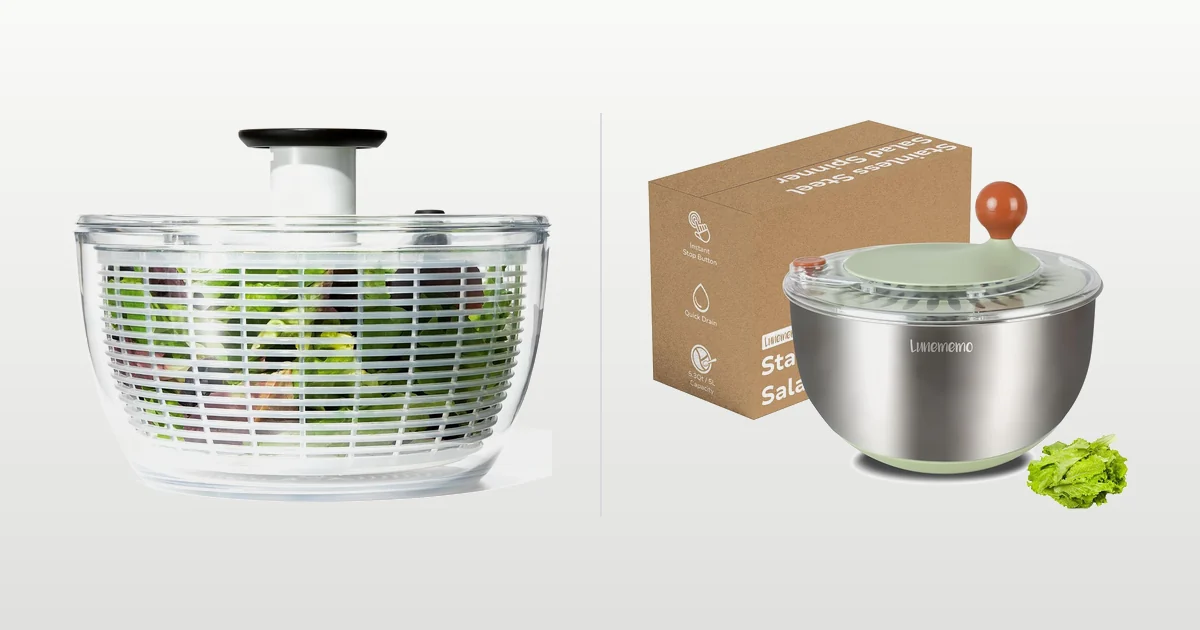
 Best OverallOXO Good Grips 6.22 Qt
The pump mechanism the whole category copied, in a clear 6.22-quart bowl with a brake and a flat lid for storage.
 Best ValueAmazon Basics 4.2 Qt
A knob, a stop feature, a non-skid base and straining holes in the lid — the whole job for under nineteen dollars.
 Highest RatedOurokhome 6.3 Qt
A pump lid whose internals come completely out for washing — the one hygiene problem this category otherwise ignores.
At a Glance
Ten Salad Spinners Compared
Bowl material and mechanism first, because those are what actually differ — then capacity and whether it can be stopped.
| # | Model | Bowl | Mechanism | Capacity | Brake | Standout | Main Drawback | Check Price |
|---|---|---|---|---|---|---|---|---|
| 1 |
 OXO Good Grips 6.22 Qt OXO Good Grips 6.22 Qt |
Plastic, clear | One-touch pump | 6.22 quarts | Yes, brake button | OXO invented the one-touch pump | $32.95 for a plastic bowl | View on Amazon |
| 2 |
 Amazon Basics 4.2 Qt Amazon Basics 4.2 Qt |
Plastic | Spin knob | 4.2 quarts | Yes, stop feature | Everything the pricier plastic spinners do, for $18.94 | A knob needs two hands | View on Amazon |
| 3 |
 Ourokhome 6.3 Qt Ourokhome 6.3 Qt |
Plastic | One-hand press pump | 6.3 quarts | Yes | The only lid here that fully comes apart | Still 4.5 stars, only just above the rest | View on Amazon |
| 4 |
 Farberware Pro Pump Farberware Pro Pump |
Plastic | Pro pump | 6.65 qt bowl, 5.25 qt basket | Not stated | States bowl and basket capacity separately | No brake mentioned | View on Amazon |
| 5 |
 Lunememo Stainless 5.3 Qt Lunememo Stainless 5.3 Qt |
304 stainless steel | Crank handle | 5.3 quarts | Yes, quick stop | A steel bowl that goes to the table | You cannot see the greens | View on Amazon |
| 6 |
 Cuisinart 3 Qt Cuisinart 3 Qt |
Plastic | Spin knob | 3 quarts | Not stated | Small enough to actually store | 3 quarts is one or two people | View on Amazon |
| 7 |
 18/8 Stainless 4.8 Qt Crank 18/8 Stainless 4.8 Qt Crank |
18/8 stainless steel | Precise crank | 4.8 quarts | Not stated | Crank control aimed at delicate leaves | No brand name on the listing | View on Amazon |
| 8 |
 Brigii 4.24 Qt Brigii 4.24 Qt |
Plastic | Turn handle | 4.24 quarts | Not stated | Double drainage design | Handle mechanism, and no stated brake | View on Amazon |
| 9 |
 EDELHAUS Stainless 5.3 Qt EDELHAUS Stainless 5.3 Qt |
Stainless steel | Crank with instant stop | 5.3 quarts | Yes, instant stop | Instant stop and drain control | $39.95, dearest here, in a crowded cluster | View on Amazon |
| 10 |
 3 Qt Mesh Basket Spinner 3 Qt Mesh Basket Spinner |
Plastic | Lock and spin | 3 quarts | Locking spinner | $17.49 with a mesh rather than slotted basket | 3 quarts, and no brand name | View on Amazon |
Specifications, prices and ratings are taken from each manufacturer’s Amazon listing as displayed on 21 August 2026 and may change. Capacity is reproduced as stated and refers to the outer bowl on every listing except the Farberware, which is the only one to publish both a bowl figure (6.65 qt) and a basket figure (5.25 qt); the usable capacity of every other spinner here is correspondingly smaller than the number quoted. Ratings in this category are exceptionally uniform — thirteen of the fourteen live spinners we verified are rated 4.4 stars and the fourteenth 4.5 — so rating differences are not treated as meaningful. Five near-identical 5.3-quart stainless spinners appear in this node under five different brand names at prices from $33.53 to $39.95, with matching weights and near-identical descriptions; two are included here and three were excluded as duplicates. Amazon’s Salad Tools & Spinners node also contains salad dressing shakers, dressing containers, a salad maker and a fruit segmenter, all of which were filtered out before verification. A SUSTEAS spinner was excluded for having no listed price.
Scroll the table sideways to see every column
How We Chose These Salad Spinners
We researched current listings, compared manufacturer specifications and documentation, and examined recurring patterns in customer feedback. We did not carry out hands-on testing, and nothing below is presented as measured performance data.
- Bowl material, because it is what the price tracks — plastic runs $17 to $34 here; stainless runs $34 to $40 for the same mechanisms
- Mechanism: pump, crank or knob — a pump works one-handed, a crank controls speed, a knob is simplest and cheapest
- Whether it has a brake — a loaded basket free-spins for a long time without one
- How the lid cleans — the gear train sits in a sealed lid that water gets into, and one design opens
- Real capacity, not quoted capacity — the basket is always smaller than the bowl, and one listing admits it
- Actual spinners — dressing shakers, a salad maker and a fruit segmenter from the same node were filtered out
The 10 Best Salad Spinners, Reviewed
1. OXO Good Grips 6.22 Qt — Best Overall

OXO invented the one-touch pump salad spinner, and this is it: #1 in the category and #56 in the whole of Kitchen & Dining.
Press the pump with one hand and the basket spins. Press the button and it stops.
Key Specifications
| Bowl | Clear plastic, 6.22 quarts |
|---|---|
| Mechanism | One-touch pump, one-handed |
| Brake | Yes — button stops the basket |
| Storage | Pump locks flat into the lid |
| Doubles as | Serving bowl; basket doubles as a colander |
| Dimensions | 10.25 x 10.25 x 6.75 inches |
| Weight | 2.5 pounds |
| Rank | #1 in Salad Spinners, #56 in Kitchen & Dining |
| Best For | Almost everyone, and the design everything else is measured against |
Why We Recommend It
One-handed operation is the entire argument for a pump. Crank and knob mechanisms need one hand to hold the bowl steady and the other to turn, which means the spinner has to be on a surface and you have to be standing over it. A pump with a non-slip base can be worked with one hand while the other is doing something else.
The brake matters more than it sounds. A basket carrying wet greens has real momentum and will keep turning for a long time; a button that stops it immediately is the difference between checking the leaves and waiting for them.
The clear bowl is the specification the stainless models further down this page give up. You can see whether the greens are actually dry without opening anything, and the bowl goes straight to the table as a serving bowl.
At $32.95 for plastic it costs about the same as the stainless spinners here, which is what buys you the mechanism rather than the material.
Pros
- #1 in Salad Spinners and #56 in all of Kitchen & Dining
- One-touch pump works with a single hand
- Brake button stops the basket immediately
- Clear bowl shows whether the greens are dry
- Pump locks flat so it stores neatly
- Bowl serves, basket strains
- 6.22 quarts, family sized
Cons
- $32.95, the same money as a stainless spinner
- Plastic bowl will scratch over years
- 2.5 pounds, heaviest plastic model here
- Pump mechanism has more parts to fail than a knob
- 4.4 stars, which is what almost everything here scores
Best for: The default answer, and the mechanism the rest of the category imitates.
2. Amazon Basics 4.2 Qt — Best Value

Eighteen dollars and ninety-four cents, #3 in Salad Spinners, and it does the same four things the $39.95 spinner does: washes, spins, drains and stops.
Key Specifications
| Bowl | Plastic, BPA-free, 4.2 quarts |
|---|---|
| Mechanism | Spin knob |
| Stop | Yes, stop feature included |
| Draining | Straining holes in the lid, no need to remove the cover |
| Base | Non-skid |
| Basket | Removable, doubles as a colander |
| Dimensions | 9.8 x 9.5 x 7 inches |
| Rank | #3 in Salad Spinners |
| Best For | The sensible amount to spend on a salad spinner |
Why We Recommend It
The straining holes in the lid are the feature to notice. Without them you lift the whole lid off to pour the water away, which means putting a wet mechanism down on the worktop. With them you tip the assembled spinner over the sink and the water leaves through the top.
Three spinners here have that; the rest do not mention it.
A knob rather than a pump is the real compromise, and it is a modest one. You need one hand on the bowl and one on the knob, so the spinner has to sit on a surface. In exchange there are fewer moving parts to break, which is part of why this costs half what the pump models do.
Four point two quarts is enough for two or three people, and the basket comes out to serve as a colander.
Pros
- $18.94, and #3 in Salad Spinners
- Straining holes let you drain without removing the lid
- Stop feature to halt the basket
- Non-skid base
- Removable basket doubles as a colander
- BPA-free
- Fewer moving parts than a pump
Cons
- Knob mechanism needs two hands
- 4.2 quarts is modest for a large household
- Plastic bowl
- 4.4 stars, like nearly everything here
- Amazon’s own brand, so no independent maker behind it
Best for: The value pick: the same job as spinners costing twice as much.
3. Ourokhome 6.3 Qt — Highest Rated

At 4.5 stars this is the highest-rated spinner in the roundup — by a tenth of a star, because thirteen of the fourteen we verified sit at exactly 4.4.
The reason to look closer is the lid.
Key Specifications
| Bowl | Plastic, 6.3 quarts |
|---|---|
| Mechanism | One-hand press pump |
| Lid | Fully removable internals for cleaning |
| Servings | Stated at 4 to 6 |
| Base | Non-slip |
| Dimensions | 10.4 x 10.4 x 6.5 inches |
| Weight | 2.56 pounds |
| Rating | 4.5 out of 5 stars |
| Best For | Anyone who has ever wondered what is growing inside a spinner lid |
Why We Recommend It
Salad spinner lids are hard to clean and nobody mentions it. The pump or knob drives a gear train sealed inside the lid, water gets in during every use, and on most designs there is no way to open it. Over a year that becomes a genuinely unpleasant closed box.
Ourokhome’s internals come out completely. That is the single most useful difference on this page and it is buried in the third bullet point.
Six point three quarts is the second largest here, and the listing puts it at four to six servings, which is a realistic figure rather than an optimistic one.
One-hand press operation puts it alongside the OXO on mechanism, at $28.99 rather than $32.95.
The honest caveat is that a tenth of a star across this category means very little — the ratings here are so uniform that they cannot separate these products.
Pros
- Lid internals fully removable, unique in this roundup
- 6.3 quarts, second largest here
- One-hand press pump
- 4.5 stars, the highest here
- $28.99, cheaper than the OXO
- Stated at 4 to 6 servings
Cons
- 4.5 versus 4.4 is not a meaningful gap in this category
- Plastic bowl
- 2.56 pounds
- Unfamiliar brand
- #14 in Salad Spinners despite the rating
Best for: The best-designed lid here, which is the part you never think about until it smells.
4. Farberware Pro Pump — Largest Capacity

Six point six five quarts for the bowl, five point two five for the basket. Farberware is the only manufacturer in this roundup that publishes both.
Key Specifications
| Bowl | Plastic, 6.65 quarts |
|---|---|
| Basket | 5.25 quarts |
| Mechanism | Pro pump |
| Draining | Built-in draining system |
| Dimensions | 10.31″L x 10.31″W x 7.44″H |
| Weight | 1.4 pounds |
| Colour | Green |
| Rank | #4 in Salad Spinners |
| Best For | Large batches, and anyone who wants an honest capacity figure |
Why We Recommend It
That distinction is not pedantry. Every spinner’s quoted capacity is the outer bowl, and the greens go in the basket, which is always smaller — here by nearly a quart and a half. So a "6.65 quart" spinner holds about 5.25 quarts of lettuce, and a "3 quart" one holds rather less than three.
Read every other capacity figure on this page with that in mind.
At 1.4 pounds it is the lightest spinner here despite being the largest, which suggests a thinner-walled bowl than the OXO’s.
No brake is mentioned anywhere, which on a pump-driven basket of this size is a real omission — a full 5.25-quart basket carries a lot of momentum and will keep spinning.
The built-in draining system means water leaves without the lid coming off, like the Amazon Basics.
Pros
- Largest capacity here: 6.65 qt bowl, 5.25 qt basket
- The only listing that states bowl and basket capacity separately
- Built-in draining system
- 1.4 pounds, lightest spinner in this roundup
- Pump mechanism for one-handed use
- #4 in Salad Spinners
Cons
- No brake or stop mentioned in the listing
- Very light for its size, suggesting thin walls
- $33.91 for a plastic bowl
- Green colourway will not suit every kitchen
- 4.4 stars
Best for: Big batches, from the only listing honest about what the basket actually holds.
5. Lunememo Stainless 5.3 Qt — Best Stainless

Three hundred and four stainless steel is the same grade used for good cookware: rust-resistant, non-reactive, and it will not scratch or stain the way plastic does after a few years of tomato and vinaigrette.
Five point three quarts, crank handle, $35.98.
Key Specifications
| Bowl | 304 stainless steel, 5.3 quarts |
|---|---|
| Mechanism | Crank handle |
| Stop | Quick dry and stop function |
| Base | Non-slip |
| Materials | BPA-free plastic lid |
| Weight | 2.35 pounds |
| Rank | #5 in Salad Spinners |
| Price | $35.98 |
| Best For | A spinner that doubles as a proper mixing and serving bowl |
Why We Recommend It
The bowl is the reason to buy this and the reason not to. Steel makes a genuinely good serving and mixing bowl — it goes from spinner to table to fridge and looks like a bowl rather than an appliance part. It is also completely opaque, so you cannot see whether the leaves are dry without stopping and lifting the lid.
Every stainless spinner in this roundup shares that trade, and none of their listings mentions it.
A crank gives finer control than a pump, because you govern the speed continuously rather than in pumps — useful for delicate herbs that bruise at high speed.
Note the price cluster. Five near-identical 5.3-quart stainless spinners appear in this category under five different brand names, priced between $33.53 and $39.95. They are almost certainly the same product; buy on price.
Pros
- 304 stainless bowl doubles as a proper mixing and serving bowl
- Will not scratch, stain or absorb odours like plastic
- Crank gives continuous speed control for delicate leaves
- Quick-stop function
- Non-slip base
- 5.3 quarts
Cons
- Opaque bowl — you cannot see whether the greens are dry
- $35.98, roughly double the plastic value pick
- One of five near-identical 5.3 qt stainless spinners here
- Crank needs two hands
- 4.4 stars
Best for: Anyone who wants a serving bowl that happens to spin.
6. Cuisinart 3 Qt — Best Compact

Salad spinners are bulky, awkwardly round objects that live in the least accessible cupboard. This one is 8.25 inches across and 6.75 deep, which is genuinely smaller than everything else here.
It is #2 in the category at $17.99.
Key Specifications
| Bowl | Plastic, 3 quarts |
|---|---|
| Mechanism | Spin knob |
| Base | Non-skid |
| Draining | Add and drain water without removing the lid |
| Dimensions | 8.25 x 6.75 x 8.25 inches |
| Weight | 1.43 pounds |
| Rank | #2 in Salad Spinners |
| Price | $17.99 |
| Best For | One or two people, and cupboards that are already full |
Why We Recommend It
Size is the constraint people underestimate. A 6.3-quart spinner is over ten inches wide and does not stack, so it takes a whole shelf. If a spinner is annoying to get out, it does not get used, and an unused spinner is worse than a smaller one.
Three quarts is one or two people’s worth of leaves — and remember the basket is smaller than the bowl, so the working capacity is nearer two.
Draining without removing the lid is included, which not every spinner at this price offers.
No stop or brake is mentioned, so expect the basket to free-spin after you stop turning.
Pros
- #2 in Salad Spinners at $17.99
- Genuinely compact at 8.25 inches across
- Drains without removing the lid
- Non-skid base
- 1.43 pounds
- Established brand
Cons
- 3 quarts, and the basket holds less than that
- No brake or stop mentioned
- Knob mechanism needs two hands
- Plastic bowl
- 4.4 stars
Best for: Small households and full cupboards, from a name you recognise.
7. 18/8 Stainless 4.8 Qt Crank — Best Crank Control

Eighteen-eight is the same stainless grade as 304 under a different naming convention, and this listing is unusual in naming the greens it is designed around: kale and collards as well as lettuce.
Key Specifications
| Bowl | 18/8 stainless steel, 4.8 quarts |
|---|---|
| Lid and parts | BPA-free ABS |
| Mechanism | Crank, described as precise control |
| Suits | Lettuce, kale, collards and sturdier greens |
| Dimensions | 10 x 10 x 7 inches |
| Weight | 2.4 pounds |
| Rank | #10 in Salad Spinners |
| Price | $35.99 |
| Best For | Kale, collards and anything you would rather not batter |
Why We Recommend It
Speed control is the reason that matters. A pump spinner accelerates hard on each stroke, which is fine for robust romaine and rough on soft herbs and delicate leaves — basil in particular bruises and blackens where it hits the basket wall. A crank lets you spin slowly.
Sturdy greens have the opposite problem: kale holds water in its crinkles and needs a faster, longer spin than lettuce.
One crank turn is not one basket turn, since the gearing multiplies it — which is what makes a crank usable rather than exhausting.
No brand appears anywhere in the listing, and no stop function is described. At $35.99 alongside four near-identical stainless rivals, that anonymity is worth weighing.
Pros
- 18/8 stainless bowl, equivalent to 304 grade
- Crank gives continuous control over spin speed
- Names the greens it suits, including kale and collards
- BPA-free ABS lid components
- 4.8 quarts
- 10-inch footprint
Cons
- No brand identified in the listing
- No stop or brake described
- Opaque bowl
- $35.99, among the dearest here
- 4.4 stars
- #10 in Salad Spinners
Best for: Delicate herbs and sturdy greens, where spin speed should not be fixed.
8. Brigii 4.24 Qt — Best Double Drainage
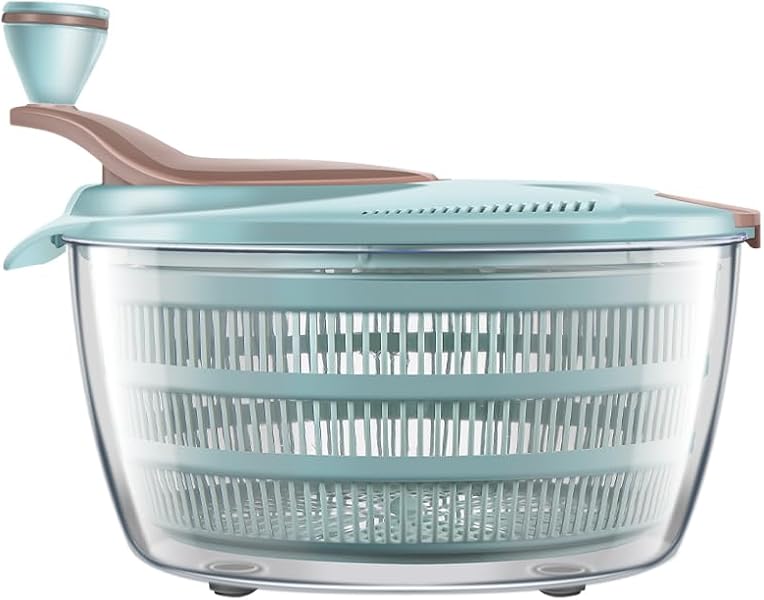
Four point two four quarts, a turn handle, and a footprint under eight inches square — narrower than most of this roundup, though taller at 9.25 inches.
Key Specifications
| Bowl | Plastic, 4.24 quarts |
|---|---|
| Mechanism | Turn handle |
| Drainage | Double drainage design |
| Also suits | Berries and fruit as well as greens |
| Dimensions | 7.87 x 7.87 x 9.25 inches |
| Weight | 1.76 pounds |
| Rank | #11 in Salad Spinners |
| Price | $29.99 |
| Best For | Berries and soft fruit as much as salad leaves |
Why We Recommend It
The berry use case is worth taking seriously. Raspberries and strawberries are the produce most ruined by water clinging to them, because it dilutes them and accelerates mould in the fridge. A spinner dries them in seconds and extends their life by days, and it is the job most spinner owners never think to use it for.
The gentler action of a handle rather than a pump suits soft fruit better too.
"Double drainage" is not explained in detail, but appears to mean water can leave through both the basket and the bowl rim.
At $29.99 it costs more than the two plastic spinners above it and ranks below both, which makes it a harder recommendation on price alone.
Pros
- Double drainage design
- Handle action is gentle enough for berries and soft fruit
- Under 8 inches square, narrow footprint
- 4.24 quarts
- 1.76 pounds
- Doubles as a fruit washer
Cons
- $29.99, dearer than better-ranked plastic spinners here
- No brake or stop described
- “Double drainage” is not explained
- 9.25 inches tall
- 4.4 stars
- #11 in Salad Spinners
Best for: Households that wash a lot of berries, not just leaves.
9. EDELHAUS Stainless 5.3 Qt — Most Expensive

Thirty-nine ninety-five is the highest price in this roundup, and it buys a 5.3-quart stainless spinner with a crank and an instant stop.
So does $33.53, from a different brand, in this same category.
Key Specifications
| Bowl | Stainless steel, 5.3 quarts |
|---|---|
| Mechanism | Crank |
| Stop | Instant stop and drain control |
| Materials | Stainless steel and BPA-free plastic |
| Weight | 2.35 pounds |
| Rank | #7 in Salad Spinners |
| Price | $39.95 |
| Positioning | Described as “not too big, not too small” |
| Best For | Buyers who want the stop function and do not mind paying the cluster’s top price |
Why We Recommend It
This is the clearest case of white-label pricing on the page. Five spinners here share the same 5.3-quart stainless format, the same 2.35 to 2.42 pound weight, the same crank-and-stop description and five different brand names, spread across $33.53 to $39.95.
Where specifications, weights and photographs converge this closely, the sensible assumption is one factory and several importers — and the sensible response is to buy whichever is cheapest on the day.
The instant stop is genuinely worth having, and not every spinner here describes one. A loaded basket free-spinning for twenty seconds after you finish is the small daily irritation this removes.
"Not too big, not too small" is the listing’s own positioning, which is honest about 5.3 quarts sitting deliberately between the 3-quart compacts and the 6-quart family models.
Pros
- Instant stop and drain control
- 304-grade stainless construction
- 5.3 quarts, a genuine middle size
- BPA-free plastic components
- #7 in Salad Spinners
- Doubles as a serving bowl
Cons
- $39.95, most expensive spinner in this roundup
- Four near-identical rivals here, one at $33.53
- Opaque bowl
- Crank needs two hands
- 4.4 stars
Best for: Only if it is the cheapest of the cluster on the day you look.
10. 3 Qt Mesh Basket Spinner — Cheapest Here

Seventeen forty-nine, three quarts, and a mesh basket instead of the slotted plastic ones almost everything else here uses.
Key Specifications
| Bowl | Plastic, 3 quarts |
|---|---|
| Basket | Mesh |
| Mechanism | Locking spinner |
| Draining | Add and drain water without removing the lid |
| Also suits | Fruit and vegetables generally |
| Dimensions | 8.15 x 8.1 x 6.15 inches |
| Weight | 1.32 pounds |
| Rank | #9 in Salad Spinners |
| Best For | A first spinner, or a second one for a holiday flat |
Why We Recommend It
Mesh is a real difference for small produce. Slotted baskets have gaps wide enough for blueberries, capers, small herb leaves and torn rocket to escape into the bowl below, where they sit in the water you just spun off. A fine mesh holds them.
It is also harder to clean, because the mesh traps fragments a smooth slot would release.
The locking mechanism is a safety feature rather than a convenience one — it keeps the lid on while the basket is at speed, which matters more on cheap spinners where the lid fit is less precise.
Three quarts and 1.32 pounds make this the smallest and lightest spinner here, and the working capacity in the basket is smaller still.
No brand is named anywhere, which at $17.49 is not surprising and is worth knowing.
Pros
- $17.49, cheapest spinner in this roundup
- Mesh basket holds berries and small leaves that slotted baskets lose
- Locking lid for safety at speed
- Drains without removing the lid
- 1.32 pounds and 8 inches, smallest here
- #9 in Salad Spinners
Cons
- 3 quarts, and the basket holds less
- No brand identified
- Mesh is harder to clean than slots
- No brake described
- 4.4 stars, like nearly everything here
Best for: The cheapest way in, and the best basket here for berries.
The Bowl Is What You Are Paying For
Sorted by material. The mechanisms appear on both sides of the line; the prices do not.
| Spinner | Bowl | Mechanism | Price |
|---|---|---|---|
| 3 Qt Mesh Basket | Plastic | Lock and spin | $17.49 |
| Cuisinart 3 Qt | Plastic | Knob | $17.99 |
| Amazon Basics 4.2 Qt | Plastic | Knob | $18.94 |
| Ourokhome 6.3 Qt | Plastic | Pump | $28.99 |
| Brigii 4.24 Qt | Plastic | Handle | $29.99 |
| OXO 6.22 Qt | Plastic | Pump | $32.95 |
| Farberware Pro | Plastic | Pump | $33.91 |
| Lunememo 5.3 Qt | 304 stainless | Crank | $35.98 |
| 18/8 Stainless 4.8 Qt | 18/8 stainless | Crank | $35.99 |
| EDELHAUS 5.3 Qt | Stainless | Crank | $39.95 |
The line falls between $33.91 and $35.98, and it is a material line rather than a quality one. Every stainless spinner here uses a crank; every pump here is plastic. That is not coincidence — a pump mechanism needs a moulded column through the middle of the bowl, which is straightforward in plastic and awkward in pressed steel. So choosing stainless is also choosing a crank, and choosing one-handed operation means choosing plastic. Nobody states this, and it is the actual decision the category presents.
Pump, Crank or Knob
Three mechanisms, and they suit three different things you might be drying.
| Pump | Crank | Knob | |
|---|---|---|---|
| Spinners here | Three | Three | Three |
| Hands needed | One | Two | Two |
| Speed control | Little — each stroke accelerates hard | Continuous | Moderate |
| Best for | Robust leaves, romaine, spinach | Delicate herbs, and kale that holds water | General use on a budget |
| Moving parts | Most | Moderate | Fewest |
| Bowl material here | Always plastic | Usually stainless | Plastic |
| Price range here | $28.99–$33.91 | $35.98–$39.95 | $17.49–$18.94 |
The knob column is the value story: fewest parts to fail, lowest price, and it dries lettuce exactly as well as the others do. The case for a pump is genuinely one-handed operation, which matters if you are doing three things at once. The case for a crank is speed control, which sounds like a refinement until you spin basil at full pump speed and watch it bruise against the basket wall — delicate herbs want slow, and kale wants long and fast, and only a crank gives you both.
Best Alternatives
| Alternative | Why Consider It | Better For | Main Trade-Off |
|---|---|---|---|
| A clean tea towel | Free, and you already own several | Small quantities, herbs | Slow, bruises leaves, and you own a wet towel |
| A colander and a shake | Costs nothing extra | A quick rinse before cooking | Leaves stay too wet for dressing to cling |
| A pillowcase, swung outdoors | Genuinely effective centrifugal drying | Large batches, gardens, allotments | Absurd indoors, and you need somewhere to swing it |
| Buying pre-washed bagged salad | No washing or drying at all | Convenience | Costs far more per gram and lasts days less |
| A mesh strainer over a bowl in the fridge | Air-dries slowly with no equipment | Overnight prep | Takes hours, not seconds |
What Each Price Tier Actually Buys
$17.49 to $18.94 — 3 Qt Mesh, Cuisinart 3 Qt, Amazon Basics 4.2 Qt. The tier that makes the most sense, and it contains the #2 and #3 sellers in the category. Knob mechanisms, plastic bowls, draining without removing the lid, and one of them has a mesh basket that will actually hold blueberries.
$28.99 to $33.91 — Ourokhome, Brigii, OXO, Farberware. Pumps and capacity. This is where one-handed operation appears, along with the category’s best seller and the only lid on this page whose internals come out for cleaning. Capacities run from 4.24 to 6.65 quarts.
$35.98 to $39.95 — Lunememo, 18/8 Stainless 4.8 Qt, EDELHAUS. Stainless steel, and with it a crank rather than a pump, and an opaque bowl. What you gain is a serving bowl that will look the same in ten years; what you lose is the ability to see the leaves and the option of one-handed spinning.
The pattern: thirteen of the fourteen spinners we checked are rated 4.4 stars, spanning $17.49 to $39.95. Money buys bowl material, mechanism and capacity. It does not buy a better result, because the physics of a spinning basket does not improve with price.
How to Choose a Salad Spinner
Decide Whether You Want a Bowl or a Window
This is the real choice, and no listing frames it. A stainless bowl is the better bowl — it will not scratch or stain, it does not hold onto vinaigrette, and it goes to the table as tableware. A clear plastic bowl lets you see whether the leaves are actually dry without stopping and opening anything. Both are defensible; you cannot have both, and the stainless option costs roughly twice as much for a mechanism that is no better.
Match the Mechanism to What You Dry
A pump accelerates hard on every stroke, which is fine for romaine and rough on basil and soft herbs that bruise against the basket wall. A crank lets you spin slowly for delicate leaves and long and fast for kale, which holds water in its crinkles. A knob sits in between, costs half as much and has the fewest parts to break. If you mostly dry lettuce, the cheapest mechanism here does the job as well as the dearest.
Halve the Quoted Capacity in Your Head
Every capacity figure in this category is the outer bowl, and the greens go in the basket inside it. Exactly one manufacturer here publishes both numbers, and the gap is nearly a quart and a half — a 6.65-quart spinner with a 5.25-quart basket. Apply that ratio to everything else: a 3-quart spinner holds noticeably less than three quarts of leaves, which is one or two people rather than three.
Insist on a Brake
A basket loaded with wet greens carries real momentum and will keep turning for a surprisingly long time after you stop driving it. Without a brake you either wait or you jam it with your hand. Four spinners here state one; the rest do not mention it. It is the difference between checking the leaves immediately and standing there watching a basket spin down, several times per salad.
Ask How the Lid Comes Apart
The gear mechanism lives in a sealed lid, water enters it every time you use the spinner, and on nine of these ten there is no way to open it and dry it. That is how spinners end up smelling, and it is why they get thrown away while still working perfectly. One design in this roundup has fully removable lid internals, and it is worth a great deal more than the tenth of a star that separates it from the rest.
Measure the Cupboard First
Spinners are round, bulky, and do not stack with anything. The largest here is over ten inches across and takes a whole shelf; the smallest is 8.15 inches and fits alongside other things. A spinner that is a nuisance to get out stops being used, and an unused 6-quart spinner dries fewer leaves than a 3-quart one you can reach. Buy for the cupboard as much as for the household.

Common Salad Spinner Buying Mistakes
- Shopping on ratings. Thirteen of the fourteen here score exactly 4.4 stars, from $17.49 to $39.95.
- Reading the quoted capacity as usable capacity. That figure is the bowl; the basket is always smaller.
- Buying stainless for performance. It is a better bowl and an identical spinner, at roughly double the price.
- Not checking for a brake. A loaded basket free-spins for a long time, and six spinners here never mention one.
- Ignoring the lid. Water gets into the gear housing every use, and only one design here opens for cleaning.
- Pump-spinning delicate herbs. Basil and soft leaves bruise against the basket wall at full speed.
- Using a slotted basket for berries. They fall through into the water you just spun off.
- Buying bigger than the cupboard. A spinner that is hard to reach is a spinner that stays there.
Which Salad Spinner Should You Buy?
Buy the OXO Good Grips if you want the one everyone buys. One-touch pump, a brake, a clear 6.22-quart bowl and #56 in all of Kitchen & Dining.
Buy the Amazon Basics 4.2 Qt if you want the same job done for $18.94. A knob, a stop feature and straining holes in the lid.
Buy the Ourokhome if you have ever wondered what is inside a spinner lid. It is the only one here whose internals come out.
Buy the Lunememo or the EDELHAUS if you want a stainless bowl that serves at the table — and buy whichever of the 5.3-quart cluster is cheapest on the day, because they are near-identical.
Buy the Farberware if you dry large batches and appreciate a manufacturer that publishes the basket capacity as well as the bowl.
Buy the 4.8 Qt crank model if you dry delicate herbs or kale and want to control the speed.
Buy the Cuisinart 3 Qt if your cupboard is full, or the 3 Qt mesh model if you wash a lot of berries.
Frequently Asked Questions
Do salad spinners actually work?
Yes, and they are one of the few kitchen tools where the physics is simple enough that every version works. Spinning the basket throws water outward through the holes and into the bowl, and a few seconds removes far more water than shaking a colander or patting with a towel. It matters because oil-based dressing will not stick to wet leaves — it slides off and pools at the bottom of the bowl, leaving the salad both bland and soggy. Dry leaves also keep several days longer in the fridge, since surface water accelerates rot.
Is a stainless steel salad spinner better than plastic?
It is a better bowl and an identical spinner. Stainless will not scratch, stain or absorb the smell of vinaigrette, it does not warp, and it looks like tableware rather than an appliance part when it goes to the table. Against that, it is completely opaque — you cannot see whether the leaves are dry without stopping and lifting the lid — and in this roundup every stainless model costs $33.53 to $39.95 against $17.49 to $33.91 for plastic. Note too that every stainless spinner here uses a crank, because pump mechanisms need a moulded column that suits plastic.
What size salad spinner do I need?
Smaller than the quoted number suggests, because that figure describes the outer bowl and your greens go in the basket inside it. The one manufacturer here that publishes both shows the gap: a 6.65-quart bowl with a 5.25-quart basket. As a rough guide, 3 quarts suits one or two people, 4 to 5 quarts suits three or four, and 6 quarts and up is for entertaining or for bulk-prepping greens for the week. Remember that spinners are round and do not stack, so the largest models take an entire cupboard shelf.
Pump, crank or knob — which mechanism is best?
It depends on what you dry. A pump is the only genuinely one-handed mechanism, which is useful when the other hand is busy, but each stroke accelerates hard and that bruises basil and other soft herbs against the basket wall. A crank gives continuous speed control, so you can go gently on herbs and long and fast on kale, which holds water in its crinkles. A knob is the simplest, cheapest and has the fewest parts to fail, and for drying ordinary lettuce it performs exactly as well as the other two.
How do you clean a salad spinner?
The bowl and basket are straightforward — most are dishwasher safe on the top rack, and they rinse easily by hand. The lid is the problem. It contains the gear mechanism that drives the basket, water enters it during every use, and on most designs it is sealed and cannot be opened. The best you can usually do is rinse it, shake it out thoroughly and stand it upside down to drain before storing. One spinner in this roundup has fully removable lid internals, which is the only real solution and is rarer than it should be.
Can you use a salad spinner for anything besides salad?
Several things, and they are arguably better uses. Berries are the standout: raspberries and strawberries hold water that dilutes them and speeds up mould, and thirty seconds in a spinner adds days to their fridge life. Herbs washed and spun dry keep far better than damp ones. It also works for shredded cabbage before slaw, for rinsed grains and pasta you want drier, and for potatoes before roasting, where surface water is the enemy of crisping. Some models suit this better than others — a mesh basket holds small items that fall through slots.
Why is my dressing not sticking to the salad?
Because the leaves are wet, almost certainly. Oil and water do not mix, so a film of water on a leaf physically prevents an oil-based dressing from adhering — the dressing runs off and collects at the bottom of the bowl, which is why the last forkful is drowned and the rest tastes of nothing. This is the single problem a salad spinner solves, and it is why chefs dry greens obsessively. Dress the leaves immediately after spinning and toss with your hands rather than utensils, which bruise them.
Are expensive salad spinners worth it?
Not for performance. The ratings in this category are remarkably uniform — thirteen of the fourteen live models we checked sit at exactly 4.4 stars across a price range from $17.49 to $39.95 — which tells you buyers are not finding meaningful differences in how well they work. What money buys is bowl material, a pump instead of a knob, larger capacity and small conveniences like a brake or a removable lid. Those are real, but the cheapest spinner here dries lettuce as thoroughly as the dearest.
Final Verdict
The pump the category copied, with a brake, a clear bowl and #56 in all of Kitchen & Dining.
The same job, a stop feature and lid draining, for $18.94.
The only lid here whose internals come out for cleaning — the problem nobody else solves.
This is a category where the product works regardless of what you spend. Thirteen of the fourteen spinners we verified are rated 4.4 stars, from seventeen dollars to forty, because a basket spun fast throws water off leaves and there is no premium version of that.
What the money actually buys is the bowl. Plastic runs $17 to $34 and lets you see the leaves; stainless runs $34 to $40, serves beautifully at the table and shows you nothing. And because pumps need a moulded column that suits plastic, choosing steel also means choosing a crank — a link no listing here spells out.
So buy for the cupboard and the bowl, halve the quoted capacity in your head, and check two things almost nobody mentions: whether it has a brake, and whether the lid comes apart. The second one is why spinners get thrown away, and exactly one product on this page has solved it.