Affiliate Disclosure: As an Amazon Associate, we earn from qualifying purchases. This does not affect the price you pay.
One pan in this roundup states its maximum oven temperature as 550°F in its specification field, and 302°F in its own bullet points. Same listing. Same page. A gap of 248 degrees.
It is not alone. A titanium pan here publishes 500°F in one place and 1000°F in another. A ceramic pan gives 600°F and 425°F. A hybrid gives 850°F and 425°F. Five of these ten publish two different oven ceilings, and none of them explains which one you are supposed to work to.
Here is the rule, and once you have it the whole category becomes readable. The big number is the metal. The small number is the part that fails first — the handle, the glass lid, or the coating itself. You cannot put the body in the oven without the handle attached, so the small number is the one that governs.
The proof is at the bottom of this page. The pan with the lowest ceiling here states 350°F, and its handle is plastic. Not bakelite, not steel — plastic. That figure has nothing to do with the ceramic coating or the aluminium body. It is a statement about the bit you hold.
Below: ten pans from $14.98 to $150.00, what each one’s real ceiling is, and the second thing half these listings bury — whether the pan works on an induction hob at all.
Our Quick Picks
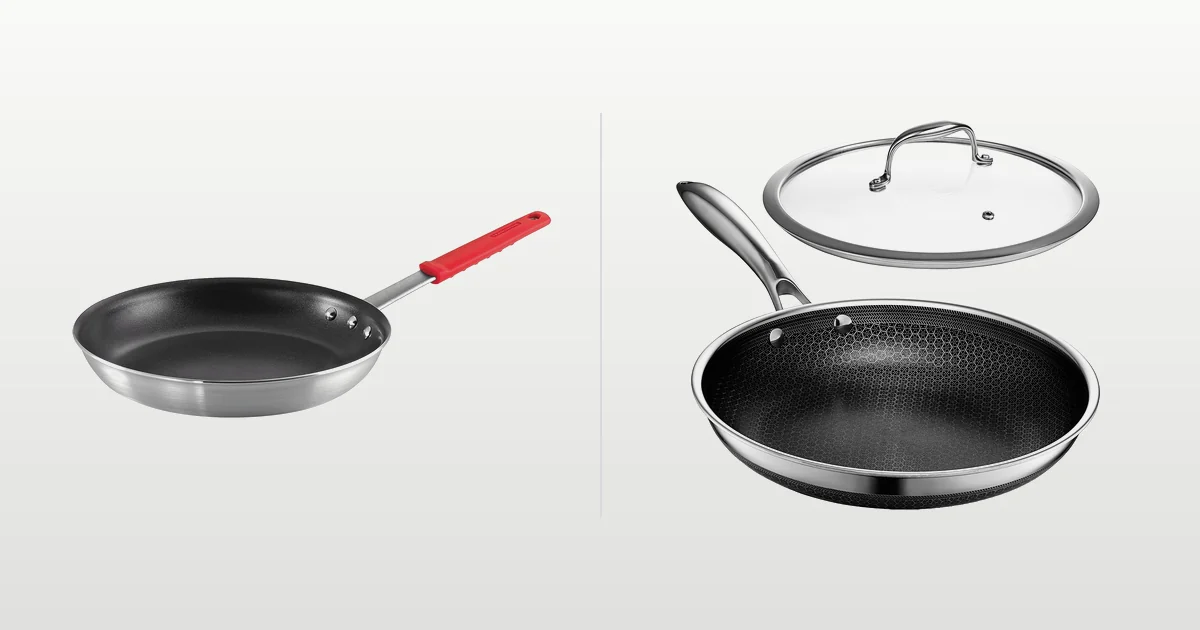
 Best OverallTramontina Professional 12-Inch
A restaurant pan with NSF certification and a lifetime warranty at twenty-one dollars — and the only listing here whose two temperature figures agree.
 Most PremiumHexClad Hybrid 10-Inch
A laser-etched hexagonal steel grid standing proud of a ceramic coating — the most interesting idea in this roundup, at the highest price.
 Best BudgetCAROTE Classic Granite 8-Inch
The best-selling skillet on Amazon at $14.98, induction ready, with a higher stated ceiling than the $91.81 T-Fal.
At a Glance
Ten Nonstick Frying Pans Compared
Coating first, then the oven ceiling — where a listing gives two, both are shown — and then induction, which four of these ten do not support.
| # | Model | Coating | Size | Oven Ceiling | Induction | Standout | Main Drawback | Check Price |
|---|---|---|---|---|---|---|---|---|
| 1 |
 Tramontina Professional 12-Inch Tramontina Professional 12-Inch |
Reinforced nonstick on aluminium | 12 inches | 400°F — one number, stated twice | No — gas, electric and ceramic only | NSF certified with a lifetime warranty, for $20.99 | Not induction compatible | View on Amazon |
| 2 |
 HexClad Hybrid 10-Inch HexClad Hybrid 10-Inch |
Steel mesh over TerraBond ceramic | 10 inches, with lid | 900°F for the pan; 400°F appears too | Yes | Laser-etched steel peaks protect the coating between them | $150, ten times the category’s best seller | View on Amazon |
| 3 |
 CAROTE Classic Granite 8-Inch CAROTE Classic Granite 8-Inch |
Granite-effect nonstick on aluminium | 8 inches | 482°F, in the spec field only | Yes | #1 in Skillets and #57 in all of Kitchen & Dining | Bakelite handle, and no oven figure in the bullets | View on Amazon |
| 4 |
 T-Fal Ultimate 3-Piece Set T-Fal Ultimate 3-Piece Set |
Titanium-reinforced hard anodized | 8, 10.25 and 12 inches | 400°F — agrees across the listing | No — excludes induction | 4.8 stars, the highest in this roundup | Not induction, and it is not obvious until bullet five | View on Amazon |
| 5 |
 SENSARTE Ceramic 8+10 Inch SENSARTE Ceramic 8+10 Inch |
Ceramic, PFAS and PTFE free | 8 and 10 inches | 550°F in the spec field, 302°F in the bullets | Yes | Best-rated ceramic pan here | Its two stated ceilings are 248°F apart | View on Amazon |
| 6 |
 Blue Diamond Hybrid 10-Inch Blue Diamond Hybrid 10-Inch |
Diamond-textured ceramic on tri-ply steel | 10 inches | 850°F pan, 425°F glass lid — stated clearly | Compatible Devices field says both | Hybrid construction at a quarter of the HexClad price | Induction field lists induction and non-induction | View on Amazon |
| 7 |
 GreenPan Valencia Pro 8-Inch GreenPan Valencia Pro 8-Inch |
Diamond-infused ceramic, hard anodized | 8 inches | 600°F in the field; 425°F also appears | Yes | America’s Test Kitchen and Good Housekeeping winner | Item weight listed as 18.42 g | View on Amazon |
| 8 |
 Sikiilu Titanium Pro 12-Inch Sikiilu Titanium Pro 12-Inch |
None — textured titanium surface | 12 inches, with lid and spatula | 500°F in the field; 1000°F in the text | Yes | Coating Description field reads “No coating” | Titled pure titanium; body is four-ply with an aluminium core | View on Amazon |
| 9 |
 All-Clad HA1 2-Piece Set All-Clad HA1 2-Piece Set |
PTFE on hard anodized aluminium | 8 and 10 inches | 500°F, in the bullets only | Yes | One of the few listings that says PTFE out loud | 4.0 stars — the lowest in this roundup | View on Amazon |
| 10 |
 GreenLife Soft Grip 2-Piece GreenLife Soft Grip 2-Piece |
Sand-derived ceramic | 7 and 10 inches | 350°F — the lowest here | No | Cheapest ceramic pair on this page | 350°F ceiling and a plastic handle | View on Amazon |
Specifications, prices and ratings are taken from each manufacturer’s Amazon listing as displayed on 21 August 2026 and may change. Where a listing publishes two different maximum oven temperatures, both are reproduced rather than reconciled: the SENSARTE gives 550°F in its Maximum Temperature field and 302°F in its bullets, the Sikiilu gives 500°F and 1000°F, the GreenPan gives 600°F and 425°F, the HexClad gives 900°F and 400°F, and the Blue Diamond gives 850°F for the pan and 425°F for its glass lid, which is the only one of the five to explain the difference. Two further specification errors are reported as published: the GreenPan Valencia Pro lists an item weight of 18.42 g for a hard-anodized 8-inch pan, and the Blue Diamond Compatible Devices field lists both “Smooth Surface Induction” and “Smooth Surface Non Induction”. The Sikiilu is titled a pure titanium pan while its own construction bullet describes a four-ply body with an aluminium core and stainless exterior, and its Coating Description field reads “No coating”. Amazon’s Skillets node also contains saucepans, saute pans, whole cookware sets, an electric skillet and a cast-iron chainmail scrubber, all filtered out before verification. Bare tri-ply stainless pans were excluded as not being nonstick. Five further pans were verified live but excluded for coating-type redundancy.
Scroll the table sideways to see every column
How We Chose These Nonstick Frying Pans
We researched current listings, compared manufacturer specifications and documentation, and examined recurring patterns in customer feedback. We did not carry out hands-on testing, and nothing below is presented as measured performance data.
- Whether the stated oven ceiling is consistent — five of these ten publish two different figures
- What the handle is made of — it is usually the handle, not the coating, that sets the limit
- Induction compatibility — four of these ten will not work on an induction hob
- What the coating actually is — ceramic, PTFE, hybrid and textured metal behave differently
- Body construction — hard anodized and tri-ply hold a coating longer than pressed aluminium
- Price against expected life — every coating here is a consumable, so cost per year is the real figure
The 10 Best Nonstick Frying Pans, Reviewed
1. Tramontina Professional 12-Inch — Best Overall

#147 in the whole of Kitchen & Dining, 4.6 stars, and twenty-one dollars for a twelve-inch pan that restaurants actually use. It is also the only pan on this page whose oven ceiling appears once and means it.
Key Specifications
| Coating | Reinforced nonstick |
|---|---|
| Body | Heavy-gauge aluminium |
| Size | 12 inches |
| Oven ceiling | 400°F / 204°C — spec field and bullet agree |
| Induction | No — gas, electric and ceramic glass only |
| Handle | Aluminium with a removable silicone sleeve |
| Weight | 1.75 kg |
| Certification | NSF certified, made in Brazil |
| Warranty | Lifetime |
| Rank | #6 in Skillets, #147 in Kitchen & Dining |
| Rating | 4.6 out of 5 stars |
| Best For | Anyone without an induction hob who wants one pan to keep |
Why We Recommend It
NSF certification is the credential that matters here and almost nothing else in this roundup has it. NSF is a real standard with real inspection behind it, covering materials, cleanability and construction for commercial food service. A pan carrying it has been tested rather than described.
The lifetime warranty on a $20.99 nonstick pan is remarkable, and worth reading carefully. Nonstick coatings wear out — every one of them, on every pan on this page — and a lifetime warranty covers manufacturing defects rather than a coating that has stopped releasing after three years. It still says something about how the pan is built.
400°F, stated in the specification field and repeated in the bullets. That consistency sounds like a low bar until you read the rest of this page, where five listings publish two different ceilings and leave you to work out which one binds.
The removable silicone handle sleeve is the clever part. Silicone is why most pans cannot go in a hot oven; take the sleeve off and the aluminium handle underneath goes in without it. It also means the sleeve can be replaced when it perishes, which on a fixed handle would end the pan.
It is not induction compatible, and that is stated in the third bullet and in the Compatible Devices field as “Smooth Surface Non Induction”. On a pan ranked sixth in the whole category, this is the specification most likely to catch someone out.
Pros
- NSF certified — a real tested standard, not a claim
- Lifetime warranty at $20.99
- #6 in Skillets and #147 in all of Kitchen & Dining
- Its two stated oven figures agree at 400°F
- Removable, replaceable silicone handle sleeve
- Twelve inches of heavy-gauge aluminium for the price of a takeaway
Cons
- Not induction compatible — check your hob first
- 400°F is a low ceiling for oven finishing
- 1.75 kg is heavy for a 12-inch pan
- Plain black; nothing to look at
- The lifetime warranty does not cover coating wear
Best for: Gas and electric hobs, big batches, and anyone who wants a restaurant pan for twenty dollars.
2. HexClad Hybrid 10-Inch — Most Premium

One hundred and fifty dollars for a ten-inch pan, against $14.98 for the category’s number one. The technology is genuinely different, and the price is genuinely enormous.
Key Specifications
| Coating | TerraBond ceramic between raised stainless peaks |
|---|---|
| Body | Tri-ply with an aluminium core |
| Size | 10 inches, 2.6 quarts, with tempered glass lid |
| Oven ceiling | 900°F in the spec field; 400°F also appears |
| Induction | Yes — all hobs |
| Utensils | Metal utensil safe |
| Handle | Stainless steel |
| Weight | 3 pounds |
| Warranty | Lifetime against manufacturing defects |
| Rank | #4 in Skillets, #625 in Kitchen & Dining |
| Rating | 4.4 out of 5 stars |
| Best For | People who want to sear properly and still fry an egg |
Why We Recommend It
The hybrid idea is the best engineering on this page. A laser-etched hexagonal grid of stainless steel stands slightly proud of the ceramic nonstick in the valleys between. Your spatula, and the base of a steak, ride on the steel peaks; the nonstick sits below the wear surface where nothing scrapes it. That is why the pan can honestly claim to be metal-utensil safe, which almost no coated pan can, and why it sears better than a smooth nonstick — you get steel-to-food contact and browning that a fully coated pan cannot produce.
It does not make the coating permanent. The ceramic in the valleys still degrades with heat and time, and when it does you have a stainless pan with a textured base. That is a better end state than a flaking nonstick, and it is not the same as never wearing out.
Note the two temperatures. The specification field says 900°F and the figure 400°F also appears in the listing text. Nine hundred is the tri-ply steel body; no ceramic or polymer nonstick coating survives anywhere near it. Treat the lower number as the one that governs how you should actually use the pan — that is the rule across this entire page.
Tri-ply with an aluminium core is proper cookware construction: aluminium conducts, steel gives the surface and the induction response, and the pan heats evenly rather than in a ring.
4.4 stars at $150 is a fair result for a pan this expensive, and it is below the $14.98 CAROTE and the $20.99 Tramontina.
Pros
- Steel peaks shield the nonstick from utensils and scraping
- Genuinely metal-utensil safe, which coated pans are not
- Sears far better than a smooth nonstick
- Tri-ply aluminium core — even heating on any hob
- Induction ready, lid included, lifetime warranty
- Fails gracefully: a worn one is still a usable steel pan
Cons
- $150 — ten times the category’s best seller
- Spec field says 900°F; the coating cannot take that
- The ceramic in the valleys still wears out
- 4.4 stars, below two pans under $21 here
- 3 pounds is heavy for a 10-inch pan
- Hexagonal texture is fiddly to scrub
Best for: Cooks who sear steak and fry eggs in the same pan and will pay to stop choosing.
3. CAROTE Classic Granite 8-Inch — Best Budget

Fifty-seventh in the whole of Kitchen & Dining. Not fifty-seventh in pans — fifty-seventh across every product Amazon files under Kitchen & Dining, at $14.98.
Key Specifications
| Coating | Granite-effect nonstick, PFOA and PFOS free |
|---|---|
| Body | Aluminium with a magnetic stainless base |
| Size | 8 inches |
| Oven ceiling | 482°F — specification field only |
| Induction | Yes — all cooktops |
| Handle | Bakelite |
| Weight | 0.59 kg |
| Care | Avoid dry heating |
| Rank | #1 in Skillets, #57 in Kitchen & Dining |
| Rating | 4.6 out of 5 stars |
| Best For | Eggs, one-person cooking, and anyone replacing a worn pan cheaply |
Why We Recommend It
The reason to take this seriously is the maths of nonstick. Every coating on this page will stop releasing eventually — that is what coatings do. So the real question is cost per year, and a $14.98 pan that lasts two years costs $7.50 a year while a $99.99 pan that lasts four costs $25. Buying cheap nonstick and replacing it without sentiment is a completely defensible strategy, and 4.6 stars across a #1 category rank says a lot of people have reached it.
482°F is a genuinely high stated ceiling — higher than the $91.81 T-Fal set and the $20.99 Tramontina, both of which state 400°F. It appears only in the specification field, never in the bullets, which is the reverse of the usual pattern on this page.
The magnetic stainless base makes it induction ready, which several far more expensive pans here are not.
“Avoid Dry Heating” is the care instruction, and it is the one that kills nonstick pans. An empty pan on high heat reaches coating-destroying temperatures within a minute or two because there is no food absorbing the energy. Put the oil in first.
Bakelite handle — a thermoset plastic that resists heat well on the hob and is the reason to be careful about that 482°F oven figure, which describes the pan.
Pros
- #1 in Skillets and #57 in all of Kitchen & Dining
- $14.98 — cheap enough to replace without regret
- 482°F stated ceiling, higher than pans five times the price
- Induction ready via a magnetic stainless base
- PFOA and PFOS free
- 4.6 stars, joint highest rating on this page
Cons
- Oven figure appears in the spec field and nowhere else
- Bakelite handle, not steel
- Eight inches is a one-or-two-egg pan
- No warranty terms published
- Granite-effect coatings are thin; treat it as a consumable
Best for: Eggs, small jobs, and anyone who would rather replace a pan than baby one.
4. T-Fal Ultimate 3-Piece Set — Highest Rated

Four point eight stars, the highest rating in this roundup, on a three-pan set at $91.81. And it will not work on an induction hob.
Key Specifications
| Coating | Titanium-reinforced nonstick |
|---|---|
| Body | Hard anodized forged aluminium |
| Set | 8, 10.25 and 12 inch fry pans |
| Oven ceiling | 400°F, broiler safe — consistent throughout |
| Induction | No — all other hobs |
| Feature | Thermo-Spot heat indicator |
| Handle | Riveted silicone over anodized metal |
| Weight | 4 pounds for the set |
| Rank | #26 in Skillets, #1,668 in Kitchen & Dining |
| Rating | 4.8 out of 5 stars — highest here |
| Best For | A complete non-induction pan set bought once |
Why We Recommend It
Thermo-Spot is the feature that earns the rating. A pattern in the centre of the pan turns solid red when the surface reaches proper cooking temperature. That sounds like a gimmick and solves a real problem: the two commonest cooking mistakes are putting food into a pan that is too cold, which makes it stick and steam, and overheating an empty nonstick pan, which destroys the coating. A visual cue fixes both, and it is the kind of thing that quietly raises a lot of people’s cooking.
Hard anodized is a genuine construction difference, not a finish. Aluminium is electrochemically treated to grow a thick oxide layer that is far harder than the metal beneath — more scratch resistant, non-reactive, and a better base for a coating to key into. It is why hard-anodized pans keep their nonstick longer than pressed aluminium ones.
Three sizes is the right way to buy pans. Eight inches for eggs, 10.25 for a stir-fry or a couple of chicken breasts, twelve for anything for four people. Buying them together costs less than buying them separately and they stack.
Now the ceiling: 400°F, and the listing is consistent about it. That is genuinely restrictive if you finish dishes in the oven — a frittata at 425°F is outside it. On the other hand it is one honest number rather than the two contradictory ones elsewhere on this page.
Not induction. It is in the fifth bullet, phrased as “suitable for all stove tops, excluding induction”. On a $91.81 set, that deserves to be in the title.
Pros
- Highest rating in this roundup at 4.8 stars
- Thermo-Spot indicator prevents the two commonest pan mistakes
- Three sizes cover essentially every job
- Hard anodized body holds its coating longer
- Consistent, honest 400°F figure
- Riveted silicone handles
Cons
- Not induction compatible, and it is buried in bullet five
- 400°F rules out oven-finishing at normal roasting heat
- $91.81, and the $14.98 CAROTE is rated only 0.2 lower
- #26 in Skillets despite the top rating
- Four pounds of pans to store
Best for: Gas and electric kitchens buying a full set once.
5. SENSARTE Ceramic 8+10 Inch — Worst Contradiction

This listing states its maximum temperature as 550°F in the specification field. Its fifth bullet reads “Oven safe to 302°F”. Both appear on the same page.
Key Specifications
| Coating | Natural ceramic, SGS approved |
|---|---|
| Free from | PFAS, PTFE, PFOA, PFOS, APEO, lead, cadmium |
| Body | Cast aluminium with a magnetic stainless base |
| Set | 8 and 10 inch pans |
| Oven ceiling | 550°F per the spec field; 302°F per the bullets |
| Induction | Yes — all cooktops |
| Handle | Bakelite, stay-cool |
| Weight | 2 kg for the pair |
| Rank | #29 in Skillets, #2,489 in Kitchen & Dining |
| Rating | 4.5 out of 5 stars |
| Best For | PFAS-free cooking on any hob — kept out of a hot oven |
Why We Recommend It
Two hundred and forty-eight degrees apart is not a rounding error, and the low number is almost certainly the real one. 302°F is 150°C, which is a suspiciously exact metric figure and precisely the sort of limit a bakelite handle carries. The 550°F is what the cast aluminium body will take. Since you cannot put the body in the oven without the handle attached, 302°F is the number that governs — and 302°F is below almost every oven-finishing temperature there is.
That is the whole lesson of this page in one listing. Where two figures appear, the large one describes the metal and the small one describes the part that fails first: the handle, the lid or the coating. Believe the small one.
The coating itself is well specified. SGS approved and free of intentionally added PFAS, PTFE, PFOA, PFOS, APEO, lead and cadmium — that is a longer and more specific list than most of this page offers, and “intentionally added” is the honest legal phrasing.
Cast aluminium rather than pressed is a real advantage: thicker, more resistant to warping, and it holds heat better when cold food goes in.
Induction ready and 4.5 stars, which makes it the best-rated ceramic pan on this page — ahead of the GreenPan at $69.99 and the GreenLife at $40.55.
Pros
- Best-rated ceramic set here at 4.5 stars
- Specific, SGS-approved list of what the coating excludes
- Cast aluminium body resists warping
- Induction ready
- Two sizes for $57.99
- Stay-cool bakelite handle
Cons
- Publishes 550°F and 302°F as its oven limit in the same listing
- 302°F rules out virtually all oven finishing
- Ceramic coatings lose release faster than PTFE
- Bakelite handle rather than steel
- 2 kg for two pans is heavy
Best for: PFAS-free hob cooking on any cooktop — provided the pan never sees an oven.
6. Blue Diamond Hybrid 10-Inch — Best Hybrid Value

Thirty-nine ninety-nine for laser-etched hybrid construction that HexClad charges $150 for. It is also the one listing on this page that handles its two temperatures honestly.
Key Specifications
| Coating | PFAS-free ceramic with a diamond-textured finish |
|---|---|
| Body | Tri-ply stainless steel |
| Size | 10 inches |
| Oven ceiling | 850°F pan and broiler; 425°F for glass lids |
| Induction | Field lists both induction and non-induction |
| Utensils | Rated 10× more metal-utensil safe |
| Handle | Cast riveted, stay-cool |
| Rank | #75 in Skillets, #10,947 in Kitchen & Dining |
| Rating | 4.1 out of 5 stars |
| Price | $39.99 |
| Best For | Hybrid searing without the HexClad price |
Why We Recommend It
Read how it puts it: the pan “withstands 850°F oven/broiler use (glass lids to 425°F)”. Two numbers, both stated, with the reason for the difference in brackets. That is all any of these listings needed to do, and it is the exception here rather than the rule.
The hybrid principle is the same as the HexClad’s — a laser-etched raised steel texture with PFAS-free ceramic nonstick in the recesses, so utensils and food ride on steel while the coating sits below the wear surface. Tri-ply stainless underneath. At $39.99 against $150 the value case is obvious, and the rating gap is real: 4.1 against 4.4.
The Compatible Devices field lists both “Smooth Surface Induction” and “Smooth Surface Non Induction”, which cannot both be a limitation. A tri-ply stainless body is normally induction-ready, so this reads as a specification field filled in carelessly rather than a real restriction — but on a $40 pan bought for an induction hob, that is worth confirming before ordering.
“10× more metal utensil safe” and “4× more nonstick” are comparative claims with no stated baseline, which is the least useful form a specification can take.
4.1 stars and #75 in Skillets is the weakest showing among the pans here worth recommending, and hybrid pans do divide people — the textured surface is fiddlier to clean than smooth nonstick.
Pros
- Hybrid steel-and-ceramic construction for $39.99
- States both its temperatures and explains the difference
- Tri-ply stainless body
- PFAS-free ceramic coating
- Cast riveted stay-cool handle
- Far more utensil-tolerant than smooth nonstick
Cons
- Compatible Devices field lists induction and non-induction
- 4.1 stars and #75 in Skillets
- “10×” and “4×” claims have no stated baseline
- Textured surface is fiddly to scrub
- Ceramic in the recesses still wears out
Best for: Anyone who wants hybrid searing and will not spend $150 to get it.
7. GreenPan Valencia Pro 8-Inch — Best Reviewed Ceramic

Seventy dollars for an eight-inch pan, with the best independent testing record on this page and one of the lowest ratings on it. Both facts are informative.
Key Specifications
| Coating | Diamond-infused ceramic, metal utensil safe |
|---|---|
| Free from | PFAS, PFOA, lead, cadmium |
| Body | Duoforged hard anodized aluminium |
| Size | 8 inches, 6 cups |
| Oven ceiling | 600°F per the field; 425°F also appears |
| Induction | Yes — magneto induction base |
| Handle | Stainless steel |
| Awards | America’s Test Kitchen and Good Housekeeping |
| Rank | #23 in Skillets, #3,440 in Kitchen & Dining |
| Rating | 4.1 out of 5 stars |
| Best For | Ceramic nonstick chosen on independent testing rather than marketing |
Why We Recommend It
Named best ceramic nonstick by America’s Test Kitchen and a Good Housekeeping award in 2023. Those are among the few genuinely independent, methodical cookware tests that exist, and they carry more weight than any claim a listing makes about itself.
So why 4.1 stars? Almost certainly because ceramic nonstick has a shorter release life than PTFE, and expectation scales with price. A ceramic coating is a sol-gel silica layer; it releases beautifully when new and loses that over one to three years, faster under high heat and polymerised oil. Someone paying $70 for an eight-inch pan expects longer than someone paying $15, and reviews measure the gap between expectation and outcome rather than quality in absolute terms.
Hard anodized and Duoforged — the body is pre-treated before anodizing, producing a genuinely tough, scratch-resistant shell. This is the best-built body among the ceramic pans here.
Two ceilings again: 600°F in the field, 425°F elsewhere in the listing. As everywhere on this page, work to the lower one.
The Item Weight field reads 18.42 g. That is about two-thirds of an ounce, for a hard-anodized eight-inch frying pan. It is a data-entry failure rather than anything about the pan, and it sits oddly on the most independently validated product in the roundup.
Pros
- Best ceramic nonstick per America’s Test Kitchen
- Good Housekeeping award winner
- Duoforged hard anodized body — the toughest ceramic body here
- Metal utensil safe, unusually for ceramic
- PFAS, PFOA, lead and cadmium free
- Induction ready
Cons
- 4.1 stars, joint lowest ceramic rating here
- $69.99 for a single 8-inch pan
- Publishes 600°F and 425°F in the same listing
- Item weight given as 18.42 g, which is impossible
- Ceramic release fades faster than PTFE
Best for: Anyone buying ceramic on evidence rather than packaging — and replacing it when it fades.
8. Sikiilu Titanium Pro 12-Inch — No Coating At All

Ninety dollars, and the Coating Description field reads: “No coating”. That is unusual enough to be worth taking seriously in a roundup of nonstick pans.
Key Specifications
| Coating | “No coating”, per the specification field |
|---|---|
| Surface | Hammered titanium micro-texture, branded TitanGlide |
| Body | Four-ply: titanium, aluminium core, stainless exterior |
| Size | 12 inches, with lid and spatula |
| Oven ceiling | 500°F in the field; 1000°F in the text |
| Induction | Yes |
| Handle | Titanium |
| Rank | #62 in Skillets, #9,356 in Kitchen & Dining |
| Rating | 4.4 out of 5 stars |
| Price | $89.99 |
| Best For | Acidic cooking, and anyone who wants no coating to wear out |
Why We Recommend It
What it actually offers is texture instead of chemistry. The surface is hammered to create micro-textures that hold a film of oil, so food sits partly on oil rather than metal. That is the same principle as a well-seasoned carbon steel pan or a hammered wok, and it is genuinely durable in the way a coating is not — there is nothing to flake, scratch through or degrade with heat. It is also not nonstick in the way a coated pan is. A cold egg dropped into a dry one will stick.
Titanium’s real advantage here is chemical. It is biologically inert and does not react with acid, so tomato, lemon and vinegar can be cooked in it indefinitely without metallic taste or leaching — which bare aluminium and cast iron both struggle with.
The title says “Food-Grade Pure Titanium”. The construction bullet says four-ply, with an aluminium core and a stainless steel exterior. Both are true and they describe different parts: titanium is the cooking surface, aluminium does the conducting because pure titanium conducts heat poorly, and steel makes it induction-compatible. It is a sensible design and it is not a pure titanium pan.
Two ceilings again, and the widest gap here: 500°F in the specification field against 1000°F in the listing text, a two-fold difference. With no coating to protect, the binding limit is more likely the handle than the metal.
Pros
- No coating — nothing to flake, scratch or degrade
- Titanium is inert, so acidic food is fine indefinitely
- Four-ply with an aluminium core for even heating
- Induction ready
- Lid and spatula included
- 4.4 stars, above three pans costing more
Cons
- Not nonstick in the way a coated pan is — oil is required
- Publishes 500°F and 1000°F in the same listing
- Titled pure titanium; it is a four-ply pan with an aluminium core
- $89.99 for a texture rather than a coating
- #62 in Skillets
- Unfamiliar brand with no warranty terms stated
Best for: Acidic cooking, high heat, and anyone tired of replacing coatings.
9. All-Clad HA1 2-Piece Set — Names Its Chemistry

A hundred dollars for two pans, 4.0 stars — the lowest rating in this roundup — and the only listing here that uses the word PTFE about its own coating.
Key Specifications
| Coating | PTFE nonstick, PFOA free |
|---|---|
| Body | Heavy-gauge hard anodized aluminium, steel base |
| Set | 8 and 10 inch fry pans |
| Oven ceiling | 500°F, stated in the bullets |
| Induction | Yes |
| Utensils | Nylon, silicone or wood only |
| Handle | Double-riveted stainless steel |
| Care | Hand wash recommended |
| Origin | Designed in Pennsylvania, made in China |
| Rank | #16 in Skillets, #1,892 in Kitchen & Dining |
| Rating | 4.0 out of 5 stars — lowest here |
| Best For | People who want PTFE and want to be told it is PTFE |
Why We Recommend It
That candour is worth something in a category built on what things are free of. Almost every pan on this page leads with PFAS-free, PFOA-free, toxin-free. All-Clad says plainly that it uses high-quality PTFE and that the pan is PFOA free. Those are different claims and the distinction matters: PTFE is the polymer, PFOA was a processing chemical phased out of cookware manufacturing years ago. A PTFE pan being PFOA-free is normal, not a distinction.
PTFE also has a real advantage over ceramic that this category has stopped mentioning: it lasts longer. A PTFE coating typically keeps its release for several years where ceramic fades in one to three. The reason the market has moved to ceramic is chemical concern rather than performance.
500°F, stated in the bullets and absent from the specification fields — the opposite arrangement to the CAROTE. It is a high and plausible figure for a hard anodized body with steel handles, and PTFE itself begins breaking down not far above it, which is why the number sits where it does.
Double-riveted stainless handles and hard anodized bodies are proper construction, and they are what the All-Clad name is for.
4.0 stars is the real story. Nonstick is a consumable, and a $99.99 pair that stops releasing after three years generates far more disappointment than a $14.98 pan that does the same — which is exactly why the two cheapest pans on this page hold the joint highest rating and the most expensive sit at 4.0 and 4.4.
Pros
- Says PTFE plainly instead of talking around it
- PTFE holds its release longer than ceramic
- Hard anodized bodies with double-riveted steel handles
- 500°F, the highest credible ceiling here
- Induction ready
- Two sizes covering most jobs
Cons
- 4.0 stars — the lowest rating in this roundup
- $99.99, and rated below a $14.98 pan
- Hand wash recommended despite the price
- No oven figure in the specification fields
- Nylon, silicone or wood utensils only
- Designed in the USA, made in China
Best for: Anyone who wants PTFE’s longer life and prefers a maker that names it.
10. GreenLife Soft Grip 2-Piece — Lowest Oven Ceiling

Three hundred and fifty degrees. That is the lowest stated oven ceiling on this page by fifty degrees, and it is the clearest proof of what these numbers actually measure.
Key Specifications
| Coating | Ceramic nonstick, derived from sand |
|---|---|
| Free from | PFAS, PFOA, lead, cadmium |
| Set | 7 and 10 inch pans |
| Oven ceiling | 350°F — lowest in this roundup |
| Induction | No |
| Handle | Plastic, soft grip |
| Base | Reinforced wobble-free |
| Dishwasher | Safe |
| Rank | #54 in Skillets, #7,954 in Kitchen & Dining |
| Rating | 4.4 out of 5 stars |
| Price | $40.55 |
| Best For | A first kitchen, on the hob only |
Why We Recommend It
Look at the handle material: plastic. Not bakelite, not stainless — plastic, soft grip. A ceramic coating tolerates far more than 350°F and so does an aluminium body; a soft plastic handle does not. The ceiling on this pan is not a statement about the cooking surface at all. It is a statement about the part you hold.
That is the rule for reading every pan on this page. Where a listing gives one low number, look at the handle. Where it gives two, the big one is the metal and the small one is the handle, the lid or the coating. In practice 350°F rules out finishing a frittata, roasting in the pan, or anything under a grill.
The coating is honestly described. Ceramic nonstick derived from sand — which is literally what a sol-gel silica coating is — and free of PFAS, PFOA, lead and cadmium. No overclaiming.
Not induction compatible, listed as “Smooth Surface Non Induction”.
4.4 stars is a good result, and better than the $69.99 GreenPan and the $99.99 All-Clad. At $40.55 for two pans, expectations are proportionate and mostly met — which is the pattern that runs through the ratings in this entire category.
Pros
- 4.4 stars, ahead of pans costing twice as much
- Two sizes for $40.55
- PFAS, PFOA, lead and cadmium free
- Honest description of what the coating is
- Wobble-free reinforced base
- Dishwasher safe
Cons
- 350°F ceiling — the lowest in this roundup
- Plastic handle, which is why the ceiling is so low
- Not induction compatible
- No oven finishing of any kind
- #54 in Skillets
- Turquoise will not suit every kitchen
Best for: A first kitchen or a student flat, used on the hob and never in the oven.
The Two Ceilings, and Which One Binds
Both figures as published. The right-hand column is the one to cook to.
| Pan | Spec field | Elsewhere in the listing | What limits it |
|---|---|---|---|
| SENSARTE Ceramic | 550°F | 302°F | Bakelite handle |
| Sikiilu Titanium | 500°F | 1000°F | Handle, not the metal |
| HexClad Hybrid | 900°F | 400°F | The ceramic in the valleys |
| GreenPan Valencia Pro | 600°F | 425°F | The ceramic coating |
| Blue Diamond Hybrid | 850°F | 425°F glass lid | The lid — stated plainly |
| All-Clad HA1 | Not in the field | 500°F | PTFE itself |
| CAROTE Granite | 482°F | Not in the bullets | Bakelite handle |
| Tramontina Pro | 400°F | 400°F | Consistent |
| T-Fal Ultimate | 400°F | 400°F | Consistent |
| GreenLife Soft Grip | 350°F | — | Plastic handle |
Only two pans here publish one number and mean it, and both are the cheap ones. Everywhere else you are being shown the pan body’s tolerance as a headline figure while the real constraint sits in a bullet, or is not stated at all. The tell is the handle: bakelite and plastic handles cap a pan somewhere between 300 and 400°F regardless of what the metal can take, and stainless handles are what let a pan honestly claim 500°F. If a listing shows you a big number and a plastic handle in the photograph, believe the photograph.
Four of These Will Not Work on Induction
Including the highest-rated pan on this page and the sixth best seller in the category.
| Pan | Price | Induction | Where the listing says so |
|---|---|---|---|
| T-Fal Ultimate 3-Piece | $91.81 | No | Bullet five, “excluding induction” |
| Tramontina Professional | $20.99 | No | Bullet four and the spec field |
| GreenLife Soft Grip | $40.55 | No | Compatible Devices field |
| Blue Diamond Hybrid | $39.99 | Field says both | Contradictory spec field |
| CAROTE Granite | $14.98 | Yes | Magnetic stainless base |
| HexClad Hybrid | $150.00 | Yes | Tri-ply steel body |
| SENSARTE Ceramic | $57.99 | Yes | Magnetic stainless base |
| GreenPan Valencia Pro | $69.99 | Yes | Magneto induction base |
| Sikiilu Titanium | $89.99 | Yes | Four-ply with steel exterior |
| All-Clad HA1 | $99.99 | Yes | Stated in the bullets |
Induction hobs work by inducing a current in the pan itself, so the base has to be ferrous — plain aluminium is invisible to them and simply will not heat. Manufacturers solve it by bonding a magnetic stainless disc to the base, and the ones that have not done so bury the fact in the fourth or fifth bullet rather than the title. The $14.98 pan here is induction ready and the $91.81 set is not, which is not a quality difference but a construction one. If you have an induction hob, check this before anything else on the page — and if you are unsure about a pan you already own, a fridge magnet held to the base is the whole test.
Best Alternatives
| Alternative | Why Consider It | Better For | Main Trade-Off |
|---|---|---|---|
| Cast iron | Never wears out, sears better than anything here | Steak, cornbread, high heat | Heavy, needs seasoning, hates acid |
| Carbon steel | Builds its own slick surface; restaurant standard | Eggs once seasoned, high heat | Seasoning takes patience and can strip |
| Tri-ply stainless | Permanent, oven safe to any temperature, best fond | Sauces, searing, anything finished in the oven | Genuinely sticks; needs technique |
| A cheap pan replaced often | Lowest cost per year in this whole category | Eggs and everyday frying | Waste, and a drawer of dead pans |
| Enamelled cast iron | No seasoning, handles acid, lasts decades | Braises and shallow frying | Not nonstick, and heavy |
What Each Price Tier Actually Buys
$14.98 to $20.99 — CAROTE, Tramontina. The two highest-rated pans on this page and the #1 and #6 sellers in the category. One is induction ready with a 482°F ceiling; the other is NSF certified with a lifetime warranty and is not induction ready. Between them they cover most kitchens, and nothing above this tier makes an egg release better.
$39.99 to $57.99 — Blue Diamond, GreenLife, SENSARTE. Where coating chemistry becomes the pitch. PFAS-free ceramic in three forms: hybrid steel-and-ceramic, cheap and cheerful, and the best-rated ceramic here. Also where the contradictory temperature figures start.
$69.99 to $99.99 — GreenPan, Sikiilu, T-Fal, All-Clad. Body construction improves genuinely — hard anodized, Duoforged, four-ply — and the ratings do not follow. This tier holds both the highest rating on the page at 4.8 and the lowest at 4.0.
$150.00 — HexClad. The best idea in this roundup: a laser-etched steel grid standing proud of the coating so utensils never touch it. Ten times the category leader, rated 0.2 stars below it.
The pattern: money buys body construction, induction compatibility and a higher honest ceiling. It does not buy a coating that lasts forever, because that does not exist — which is why the ratings run backwards.
How to Choose a Nonstick Frying Pan
Find Both Oven Numbers, Then Believe the Smaller One
Five of the ten pans here publish two different oven ceilings, sometimes hundreds of degrees apart. The large figure describes the metal body; the small one describes the handle, the glass lid or the coating — and since you cannot put the body in an oven without its handle, the small figure is the one that governs. Check the specification field and the bullets separately, because they frequently disagree, and when they do, cook to the lower one.
Look at the Handle Before the Coating
It is the handle that usually sets the oven limit, and you can read it off the photograph. Plastic caps a pan around 350°F, which is the lowest figure in this roundup and belongs to the only pan here with a plastic handle. Bakelite manages roughly 300 to 400°F. Stainless steel is what lets a pan honestly claim 500°F and above. If a listing advertises a big number and the photograph shows a soft-grip plastic handle, the number is about the metal and not about anything you can actually do.
Check Induction First if You Have It
Four of these ten will not work on an induction hob, including the highest-rated pan on this page and the sixth best seller in the category. Induction needs a ferrous base to induce a current in; plain aluminium is invisible to it and simply will not heat. Manufacturers who have bonded a magnetic stainless disc to the base say so proudly; those who have not put it in the fourth or fifth bullet. The definitive test on a pan you already own is a fridge magnet — if it sticks to the base, induction will work.
Treat the Coating as a Consumable and Do the Maths
Every nonstick coating on this page will stop releasing eventually. Ceramic typically fades in one to three years; PTFE usually lasts longer. Nothing lasts forever, no warranty covers it, and this is the single fact the category is built on not saying out loud. So compare on cost per year rather than price. A $15 pan replaced every two years costs less than a $100 pan replaced every four, and it explains why the two cheapest pans here are also the two highest rated.
Prefer Hard Anodized or Tri-Ply Bodies
The body outlives the coating, and it determines how evenly the pan cooks and how long the coating survives. Hard anodizing grows a thick, very hard oxide layer on aluminium — more scratch resistant, non-reactive, and a better surface for a coating to key into. Tri-ply bonds aluminium between steel for even heat and induction compatibility. Both are meaningfully better than pressed aluminium and both cost more. If you are spending above about forty dollars, this is what you should be getting for it.
Never Heat an Empty Nonstick Pan
Dry heat is what destroys these coatings, and it happens faster than people expect. An empty pan on a high burner has no food absorbing energy, so the surface temperature climbs past what any coating tolerates within a minute or two — and both PTFE and ceramic degrade well below what a gas flame produces. One pan in this roundup carries “Avoid Dry Heating” as its official care instruction, which is honest of it. Add the oil first, use medium heat, and a cheap pan will outlast an expensive one that gets preheated empty.
Common Nonstick Frying Pan Buying Mistakes
- Trusting the headline oven temperature. Five listings here publish two, and the big one describes the metal.
- Not checking induction. Four of these ten will not heat on an induction hob at all.
- Preheating empty on high. Dry heat destroys a coating faster than years of normal use.
- Expecting a coating to last. None of them do, at any price, and no warranty covers it.
- Buying an expensive pan to avoid replacing pans. That is why the $99.99 set here rates 4.0.
- Using metal utensils on smooth nonstick. Only the hybrid pans here are genuinely rated for it.
- Ignoring the handle material. A plastic handle caps the pan around 350°F whatever the box says.
- Putting the glass lid in a hot oven. Lids are often rated hundreds of degrees below the pan.
- Assuming PFAS-free means longer lasting. Ceramic is the chemical answer, not the durability one.
Which Nonstick Frying Pan Should You Buy?
Buy the Tramontina Professional if you cook on gas or electric. NSF certified, lifetime warranty, twelve inches, one honest 400°F figure, $20.99.
Buy the HexClad if you want to sear a steak and fry an egg in the same pan and never think about utensils. The steel grid protects the coating that everything else here exposes.
Buy the CAROTE if you want the sensible answer. #1 in Skillets, induction ready, 482°F, and cheap enough to replace without a second thought.
Buy the T-Fal set if you need three sizes at once and do not have induction. Highest rated here, with a heat indicator that genuinely improves how people cook.
Buy the SENSARTE pair if you want PFAS-free ceramic on any hob — and keep them out of the oven, whatever the specification field says.
Buy the Blue Diamond Hybrid if the HexClad idea appeals and $150 does not. Same principle, quarter of the price, and it explains its own temperatures properly.
Buy the GreenPan Valencia Pro if you choose on independent testing. America’s Test Kitchen and Good Housekeeping both picked it.
Buy the Sikiilu Titanium if you cook acidic food or simply want nothing on the surface that can wear out — accepting that it needs oil.
Buy the All-Clad HA1 if you want PTFE’s longer life from a maker willing to name it, and hard-anodized bodies with steel handles.
Buy the GreenLife pair if you are furnishing a first kitchen cheaply and will only ever use them on the hob.
Frequently Asked Questions
Why do frying pans list two different oven temperatures?
Because the pan is not one material. The large figure describes what the metal body tolerates — often 500 to 900°F for hard anodized aluminium or tri-ply steel — while the small figure describes whichever component gives up first: the handle, the glass lid, or the nonstick coating. Five of the ten pans in this roundup publish both, generally putting the impressive number in the specification field and the real one in a bullet. Since you cannot put a pan body in an oven without its handle attached, the smaller number is always the one that governs how you can actually use it.
How long does a nonstick coating last?
Ceramic coatings typically hold good release for one to three years; PTFE usually lasts longer, often three to five. Neither lasts forever and no warranty in this category covers the coating wearing out — the lifetime warranties cover manufacturing defects. This is the central fact the category avoids stating, and it explains the ratings: in this roundup the two cheapest pans hold the joint highest rating while the two most expensive sit at 4.4 and 4.0, because a coating failing at $15 is a fair deal and the same failure at $100 is a disappointment.
Will a nonstick pan work on an induction hob?
Only if it has a ferrous base, and four of the ten pans here do not. Induction works by inducing an electrical current directly in the pan, which requires magnetic material — plain aluminium is invisible to an induction hob and will not heat at all. Manufacturers add a bonded magnetic stainless disc to the base to solve this, and the ones who have done it advertise it. The ones who have not tend to bury it in the fourth or fifth bullet. To test a pan you already own, hold a fridge magnet to the base: if it sticks firmly, induction will work.
Is ceramic nonstick better than PTFE?
They trade against each other. Ceramic is a sol-gel silica coating with no fluorinated compounds, which is why it dominates the PFAS-free marketing that now covers this category, and it tolerates higher temperatures than PTFE. PTFE releases at least as well and typically lasts appreciably longer before it stops working. So ceramic is the answer to a chemical concern rather than a durability one. Notably, only one listing in this roundup uses the word PTFE about its own coating; everything else describes what it is free of.
What is a hybrid frying pan?
A pan with a laser-etched raised metal pattern standing slightly proud of a nonstick coating in the recesses between. Utensils and the base of whatever you are cooking ride on the steel peaks, while the coating sits below the wear surface where nothing scrapes it. That gives two real advantages: genuine metal-utensil tolerance, which almost no coated pan can claim, and much better searing, because you get steel-to-food contact and browning that a fully coated surface cannot produce. The coating in the valleys still degrades with time — it just is not being scratched away.
Why does my nonstick pan stop working?
Usually heat, not scratching. Dry-heating an empty pan is the fastest way to destroy a coating: with no food absorbing energy, the surface races past what any coating tolerates within a minute or two. After that come high-heat searing, oil polymerising into a hard invisible film that ruins release, dishwasher detergent, and metal utensils. If a pan has developed a sticky brown haze rather than obvious damage, that is polymerised oil and it can sometimes be removed with a baking soda paste — genuine coating failure cannot be reversed.
Is an expensive nonstick pan worth it?
For the body, sometimes; for the coating, no. Money buys hard-anodized or tri-ply construction that heats more evenly and holds a coating longer, a stainless handle that raises the honest oven ceiling, and induction compatibility. It does not buy a coating that survives indefinitely, because none does. The rational approach is cost per year: a $15 pan replaced every two years is cheaper than a $100 pan replaced every four. Buy the expensive pan for even heat and oven range if you need those, not to escape replacing pans.
What size frying pan should I buy?
Eight inches for eggs and one-person cooking, ten to ten and a half as the general-purpose pan, and twelve inches when you are cooking for four or more. Size matters more than most people allow for: food crowded into a pan that is too small releases moisture faster than it can evaporate, so it steams instead of browning, and no coating will rescue that. If you are buying one pan, ten inches is the compromise. If you are buying a set, the three sizes in this roundup’s T-Fal set are the standard spread for good reason.
Final Verdict
NSF certified with a lifetime warranty and one honest 400°F figure, for $20.99.
A steel grid that shields the nonstick from every utensil, and sears like bare steel.
#1 in Skillets, induction ready, 482°F, and cheap enough to treat as a consumable.
The uncomfortable fact under this whole category is that you are buying something that wears out, and nobody selling it wants to say so. There is no coating on this page that will still release perfectly in ten years, no warranty that covers it, and no price that fixes it.
Which is why the ratings run backwards. The $14.98 pan and the $20.99 pan hold the joint highest score here and the top category rank; the $99.99 set sits at 4.0. Not because cheap pans are better, but because a rating measures the distance between what you paid and what you got, and that distance grows with the price of the pan.
So do two checks before you buy. Find both oven temperatures and work to the smaller one, because the big number is the metal and the small one is the handle you cannot detach. Then check induction, because four of these ten will not heat on an induction hob and most of them mention it in the fifth bullet.
After that, spend on the body rather than the coating — hard anodized or tri-ply, with a steel handle — and accept that in three years you will be doing this again. The pan that makes peace with that costs fifteen dollars and is the best seller in the category.