Affiliate Disclosure: As an Amazon Associate, we earn from qualifying purchases. This does not affect the price you pay.
The word “tactical” on this page covers a 2.95-inch folding pocket knife and a 9.375-inch knife with an American powder steel, along with two fixed-blade sheath knives that do not fold at all.
It is an adjective, not a specification. Nothing about the shape, size, steel, lock or intended use is implied by it, which is why a search for it returns a $9.99 folder and a $103.80 folder side by side.
Two things do vary meaningfully, and they are the only two worth comparing.
The lock. Six of these use a liner lock, which you release by pushing a thin steel liner sideways — with your thumb, into the path the blade is about to close through. One uses an axis lock, which works from either side and keeps your hand out of the arc. One uses a Tri-Ad lock with a shock-absorbing stop pin. Two have no lock at all, because they are fixed blades.
The steel. It runs from 4034 — among the softest stainless used in knives — to S35VN. And the inversion is worth noting: the $47.59 knife here uses 4034, while a $9.99 knife uses D2.
Our Quick Picks
 Best LockCold Steel Recon 1 Tanto 4 Inch
American S35VN with a diamond-like carbon coating, a Tri-Ad lock, and the only complete specification sheet on this page.
 Best Value LockMossy Oak 4 Inch Axis Lock
An axis lock, a G10 handle and a full dimension set for $14.49 — with the softest steel on this page.
 Best Steel ValueFLISSA KOSMO D2 G10 Green
D2 tool steel behind a G10 handle at 4.4 ounces, with a flipper and a liner lock, for under ten dollars.
At a Glance
Ten Knives, Sorted by the Two Things That Differ
Folding or fixed, blade length, the steel and the lock. Read the last two columns; the rest is marketing.
| # | Model | Type | Blade | Steel | Lock | Standout | Main Drawback | Check Price |
|---|---|---|---|---|---|---|---|---|
| 1 |
 Cold Steel Recon 1 Tanto 4 Inch Cold Steel Recon 1 Tanto 4 Inch |
Folder | 4.0 in | S35VN + DLC | Tri-Ad | American S35VN steel and the strongest lock design here | $103.80 — ten times the cheapest knife on this page | View on Amazon |
| 2 |
 Mossy Oak 4 Inch Axis Lock Mossy Oak 4 Inch Axis Lock |
Folder | 4.0 in | 7Cr17MoV, 54–58 HRC | Axis | An axis lock at $14.49, which is genuinely unusual | 7Cr17MoV at 54–58 HRC is the softest steel here | View on Amazon |
| 3 |
 FLISSA KOSMO D2 G10 Green FLISSA KOSMO D2 G10 Green |
Folder | Not stated | D2 | Liner | D2 tool steel and a G10 handle for $9.99 | The listing gives two different sizes across its own variants | View on Amazon |
| 4 |
 Dragon Creek D2 Fixed Blade Brown Dragon Creek D2 Fixed Blade Brown |
Fixed blade | 5.3 in | D2, 60 HRC | None — fixed | No lock to fail, because there is no lock | It is a sheath knife, not a pocket knife | View on Amazon |
| 5 |
 Smith & Wesson M&P SWMP13BS Smith & Wesson M&P SWMP13BS |
Folder | 3.5 in | 8Cr13MoV | Liner + guard | A limited lifetime warranty at $20.39 | 8Cr13MoV is ordinary budget stainless | View on Amazon |
| 6 |
 Legal 6680 Ball Bearing 2.95 Inch Legal 6680 Ball Bearing 2.95 Inch |
Folder | 2.95 in | 440C | Liner | Deliberately sub-three-inch, and it explains why | Serrated, so it cannot be resharpened at home | View on Amazon |
| 7 |
 NedFoss DA75 3-in-1 NedFoss DA75 3-in-1 |
Folder | 3.9 in | 8Cr14MoV | Liner | A seatbelt cutter and glass breaker on an aluminium spine | 3.9 inches is long for everyday pocket carry | View on Amazon |
| 8 |
 FLISSA KOSMO D2 Second Variant FLISSA KOSMO D2 Second Variant |
Folder | Not stated | D2 | Liner | Identical to the other FLISSA at the same price | Its size field says 3.3 inches where the sibling says 3 | View on Amazon |
| 9 |
 Dragon Creek D2 Fixed Blade Black Dragon Creek D2 Fixed Blade Black |
Fixed blade | 5.3 in | D2, 60 HRC | None — fixed | Twenty-one cents cheaper than the identical brown version | Also a sheath knife rather than a pocket knife | View on Amazon |
| 10 |
 Smith & Wesson SWMP4LS Assisted Smith & Wesson SWMP4LS Assisted |
Folder | 3.6 in | 4034 | Liner + safety | A safety lock as well as a liner lock, plus assisted opening | 7.6 oz and 4034 steel — the heaviest and softest here | View on Amazon |
Blade lengths, steels, hardness figures, prices and specifications are taken from each manufacturer’s Amazon listing as displayed on 27 August 2026 through a United States connection, and may change. Nothing here is legal advice. Knife carry rules in the United States vary by state and frequently by city, commonly around blade length and sometimes around assisted-opening mechanisms; blades in this roundup run from 2.95 to 5.3 inches and one knife is spring-assisted, so check the regulations where you live and travel. Only one listing here raises the subject. Two listings of what appears to be the same knife give different blade lengths — 3 inches in one size field and 3.3 in the other — and both are reported as published rather than reconciled; that difference straddles a common legal threshold, so measure rather than rely on it. Two products in this roundup are fixed-blade sheath knives rather than folders and are marked as such. Sales ranks are shown as displayed and can be pooled across a variant family.
Scroll the table sideways to see every column
How We Chose These Ten
We researched current listings, compared manufacturer specifications and documentation, and examined recurring patterns in customer feedback. We did not carry out hands-on testing, and nothing below is presented as measured performance data.
- Lock type identified for every knife — it is the component that fails and the one that can cut you closing it
- Steel named and hardness recorded where published — the range here runs from 4034 to S35VN
- Folding and fixed both included — the search term returns both, and the difference is fundamental
- A verified live buy box — all ten confirmed purchasable in the United States on 27 August 2026
- Blade length recorded, because carry rules turn on it — 2.95 to 5.3 inches across this page
- Weight noted where published — 4.2 to 7.6 ounces, and weight decides whether it gets carried
- No overlap with our published knife and EDC guides — every knife here is new to the site
The Ten in Detail
1. Cold Steel Recon 1 Tanto 4 Inch — Best Lock

Every knife on this page is called tactical. Only the lock and the steel actually differ, and this one has the best of both.
Key Specifications
| Type | Folding |
|---|---|
| Blade length | 4.0 inches |
| Blade thickness | 3.5 mm |
| Steel | American S35VN with DLC coating |
| Lock | Tri-Ad |
| Handle | 5.375 in G-10 |
| Overall length | 9.375 inches |
| Weight | 5.2 oz |
| Clip | Ambidextrous pocket or belt |
| Rank | #20,888 in its category |
| Price | $103.80 |
| Best For | Anyone who wants the lock and the steel to be the best available |
Why We Recommend It
The Tri-Ad lock is a reinforced lockback with a stop pin, and the stop pin is the point. A conventional lock takes the shock of impact directly on the locking face, which over time peens and deforms it until the blade develops play. Tri-Ad interposes a hardened pin that absorbs that shock, so the lock geometry stays intact. It is slower to disengage than a liner lock and considerably stronger, and it is the reason this design has the reputation it does.
S35VN is a powder-metallurgy stainless developed for knife blades, with niobium added for finer carbides — it holds an edge far longer than the 7Cr and 8Cr steels elsewhere here and resharpens more slowly in exchange. The DLC coating adds hardness and corrosion resistance to the surface.
This is also the only listing on the page with a complete specification: blade length, blade thickness, steel, handle length and material, overall length and weight. Everything else here publishes a subset.
Rank #20,888 is the lowest on this page, which is what a hundred-dollar folder does in a category where the median is under thirty.
Pros
- Tri-Ad lock — strongest design here
- American S35VN, the best steel on this page
- DLC coating for hardness and corrosion resistance
- Complete published specification, uniquely
- 5.2 oz for a 9.375 inch knife
- Ambidextrous pocket or belt clip
Cons
- $103.80 — by far the dearest here
- 4-inch blade exceeds several common carry limits
- S35VN is slow to resharpen
- Tri-Ad is stiffer to close than a liner lock
- Tanto point has no belly for slicing
- Rank #20,888
Best for: Hard use, where the lock failing matters more than the price.
2. Mossy Oak 4 Inch Axis Lock — Best Value Lock

An axis lock at fourteen dollars is the surprise on this page, and it is the lock most worth having if you value your thumb.
Key Specifications
| Type | Folding |
|---|---|
| Blade length | 4.0 inches |
| Blade thickness | 0.11 inches |
| Overall length | 8.25 inches |
| Weight | 4.2 oz — lightest here |
| Steel | 7Cr17MoV, HRC 54—58 |
| Lock | Axis lock |
| Handle | G10, anti-slip, moisture resistant |
| Opening | Thumb stud, one-handed |
| Rank | #16,601 in its category |
| Price | $14.49 |
| Best For | The best lock mechanism available under fifteen dollars |
Why We Recommend It
Almost every folding knife here uses a liner lock, which you disengage by pushing a steel liner sideways with your thumb — directly into the path the blade is about to swing through. An axis lock instead uses a spring-loaded bar running through both handle scales, which you pull back with thumb and forefinger from either side. Your hand is never in the arc, it works equally well left or right handed, and the bar engages across the full width of the tang rather than on a thin liner edge.
The trade is the steel. 7Cr17MoV at 54 to 58 HRC is soft — it will dull noticeably faster than the D2 and S35VN blades here, and it will come back on any cheap sharpener in minutes. For a knife you actually use and maintain, that is a reasonable bargain.
4.2 ounces is the lightest thing on this page, and weight is what decides whether a folder gets carried.
Full dimensions published — length, thickness, overall and weight — which only two knives here manage.
Pros
- Axis lock, ambidextrous, thumb out of the blade path
- $14.49 for a lock design usually costing far more
- 4.2 oz — lightest knife here
- Full dimensions and hardness published
- G10 handle, anti-slip and moisture resistant
- Thumb stud one-handed opening
Cons
- 7Cr17MoV at 54—58 HRC is soft
- Dulls faster than the D2 blades here
- 4-inch blade exceeds several common carry limits
- No warranty term published
- Rank #16,601
- Stonewash finish hides scratches but shows grease
Best for: The best lock on this page for a tenth of the flagship’s price.
3. FLISSA KOSMO D2 G10 Green — Best Steel Value

D2 at $9.99 is the best steel-per-dollar on this page by a wide margin.
Key Specifications
| Type | Folding |
|---|---|
| Steel | D2 tool steel |
| Handle | G10 — strong, light, waterproof, corrosion resistant |
| Folded length | 4.5 inches |
| Weight | 4.4 oz |
| Opening | Quick-open flipper, one-handed |
| Lock | Safety liner lock |
| Carry | Deep pocket clip |
| Rank | #6,547 in its category |
| Price | $9.99 |
| Best For | Tool-steel edge retention at the lowest price on this page |
Why We Recommend It
D2 is a high-carbon, high-chromium tool steel — not fully stainless, but close — and it is genuinely hard. It holds an edge markedly longer than the 7Cr and 8Cr budget stainless steels that dominate this category, and the trade is that it is more difficult to resharpen and can develop surface spotting if left wet. Finding it under ten dollars, paired with a G10 handle rather than moulded plastic, is unusual.
G10 is the other reason to look at this. It is glass fibre in epoxy resin: dimensionally stable, impervious to water, grippy when wet, and the material expensive knives use. Two of the three dearest knives here have it and so does this one.
The listing is inconsistent about size. This variant’s size field reads 3 inches and an identical-looking variant reads 3.3, while both describe a 4.5-inch folded length — so the blade figure is not reliable from the listing alone.
A liner lock rather than an axis or Tri-Ad, which is the compromise at this price.
Pros
- D2 tool steel at $9.99
- G10 handle, the material premium knives use
- 4.4 oz and a deep pocket clip
- Flipper opening, one-handed
- Waterproof and corrosion-resistant handle
- Rank #6,547
Cons
- Size field contradicts the sibling variant
- Liner lock puts your thumb in the blade path
- D2 is harder to resharpen than 7Cr or 8Cr
- D2 can spot if stored damp
- No blade length stated clearly
- No warranty term published
Best for: Edge retention on a budget, if you can sharpen a hard steel.
4. Dragon Creek D2 Fixed Blade Brown — Not a Folder
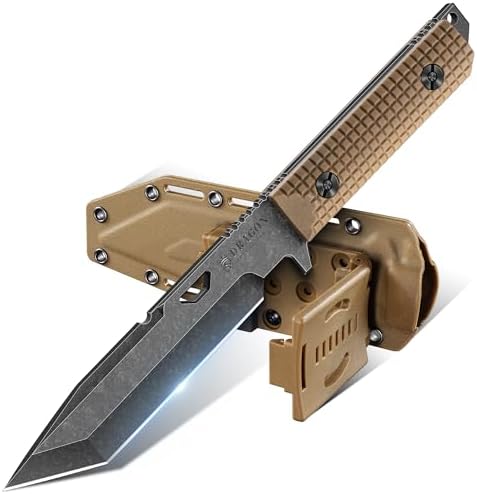
This is a sheath knife. It appears in a search for tactical folders because the word covers both, which is precisely the problem.
Key Specifications
| Type | Fixed blade, full tang |
|---|---|
| Blade length | 5.3 inches |
| Steel | D2 |
| Hardness | 60 HRC |
| Edge | 15° V-shaped |
| Finish | Black stonewash |
| Handle | G10, checked pattern, double riveted |
| Sheath | Adjustable Kydex, waist or backpack |
| Uses stated | Food prep, chopping kindling, cutting rope, breaking glass |
| Rank | #8,849 in its category |
| Price | $26.99 |
| Best For | Anyone who wanted a camp knife and searched the wrong word |
Why We Recommend It
A fixed blade has no lock, and therefore no lock to fail. The tang runs the full length of the handle as one piece of steel, so there is no pivot, no liner, no spring and no mechanism — which is why fixed blades are what people actually take camping. Everything a folding knife’s lock is trying to approximate, a fixed blade simply has. The cost is that it cannot go in a pocket and it is more heavily regulated in many places.
D2 at 60 HRC with a 15° V edge is a properly specified blade: hard, keen, and ground narrow enough to slice rather than wedge.
Kydex is thermoformed plastic that grips the blade by friction and holds it silently and securely, unlike leather which softens and stretches. Adjustable mounting means it rides where you want it.
It is 21 cents dearer than the identical black version further down this page.
Pros
- No lock, because it is a fixed blade
- D2 at a published 60 HRC
- 15° V edge, properly specified
- Full tang with double-riveted G10
- Adjustable Kydex sheath
- $26.99
Cons
- Not a pocket knife — needs a belt
- Fixed blades are more regulated in many places
- 5.3 inches is long for everyday carry
- D2 spots if stored damp in Kydex
- Rank #8,849
- No warranty term published
Best for: Camping and outdoor work, where a lock is a weakness rather than a feature.
5. Smith & Wesson M&P SWMP13BS — Best Warranty

A limited lifetime warranty on a twenty-dollar knife is the reason this is here.
Key Specifications
| Type | Folding |
|---|---|
| Blade length | 3.5 inches |
| Overall length | 8.2 inches |
| Weight | 4.9 oz |
| Steel | 8Cr13MoV black oxide high-carbon stainless |
| Blade | Serrated clip point |
| Lock | Liner lock with finger guard |
| Opening | Finger flipper and ambidextrous thumb knobs |
| Handle | Aluminium, black and tan |
| Warranty | Limited lifetime |
| Rank | #12,461 in its category |
| Price | $20.39 |
| Best For | A recognised name with a lifetime warranty, cheaply |
Why We Recommend It
Warranties are rare in this category. Two knives on this page carry one and eight publish nothing at all, which on a mechanical object with a pivot, a spring and a lock is a meaningful difference — folders fail at the lock and the pivot far more often than the blade wears out. Both warranted knives here are from the same maker.
8Cr13MoV is the workhorse budget stainless: reasonably tough, easy to sharpen, moderately corrosion resistant, and used across most knives in the ten-to-thirty-dollar band. It is a fair match for the price and it is not the D2 or S35VN found elsewhere here.
The finger guard is a genuine safety feature on a serrated blade, which requires more force to start a cut and is therefore more likely to slip.
Serrations mean this cannot be resharpened at home without a tapered rod, which for a knife with a lifetime warranty is an odd pairing.
Pros
- Limited lifetime warranty at $20.39
- Publishes blade, overall length and weight
- Finger guard behind a serrated edge
- Ambidextrous thumb knobs plus a flipper
- Aluminium handle keeps weight to 4.9 oz
- Recognised brand
Cons
- Serrations cannot be resharpened at home
- 8Cr13MoV is ordinary budget steel
- 3.5-inch blade exceeds some carry limits
- Liner lock rather than axis or Tri-Ad
- Rank #12,461
- Aluminium is cold and slippery when wet
Best for: A warranty-backed folder from a known name, for twenty dollars.
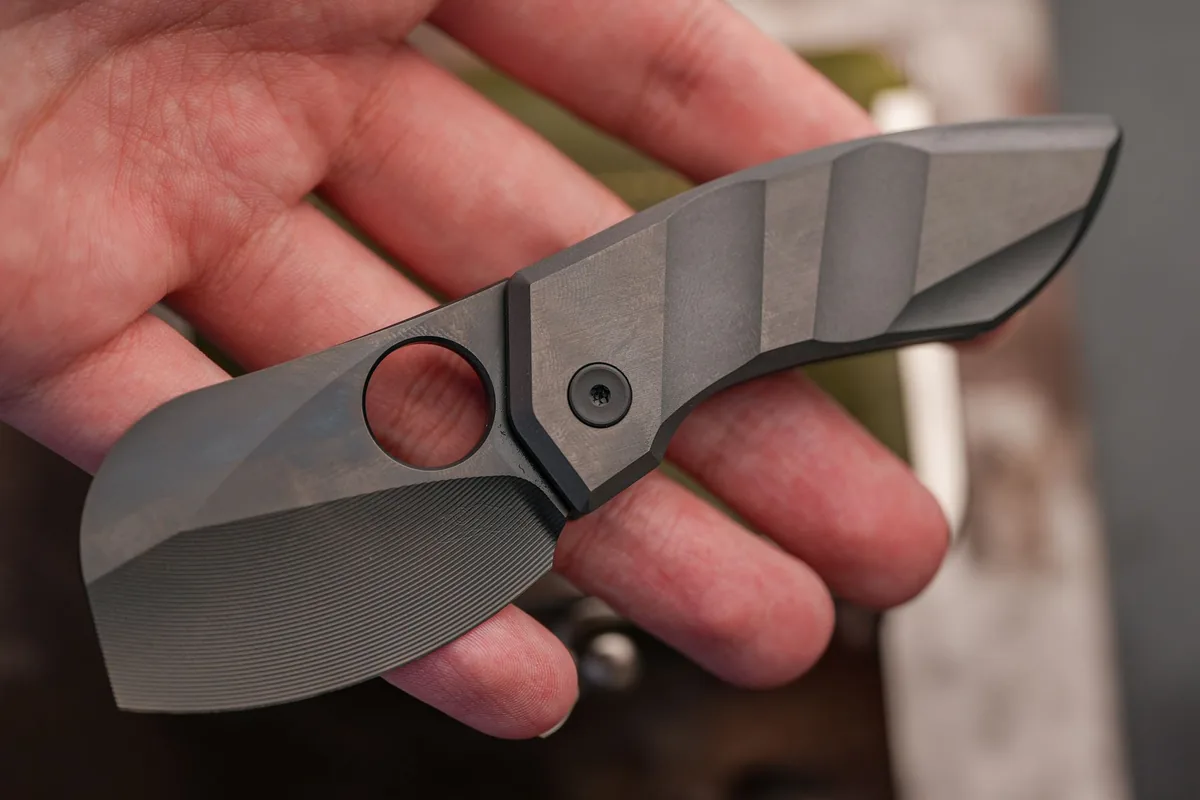
6. Legal 6680 Ball Bearing 2.95 Inch — Best for Carry Rules

Rank #284, far ahead of anything else here, and the only listing on the page that raises the question of where you can carry it.
Key Specifications
| Type | Folding |
|---|---|
| Blade length | 2.95 inches |
| Steel | 440C |
| Pivot | Ball bearing |
| Extras | Glass breaker, seat belt cutter, pocket clip, lanyard hole |
| Opening | Non-spring |
| Case | Protective case included |
| Maker’s note | States sub-3-inch non-spring knives are generally legal to carry, and to check local laws |
| Rank | #284 — highest on this page |
| Price | $39.90 |
| Best For | Carrying without first researching your local rules |
Why We Recommend It
“Pocket knives (no spring) with blade under 3 INCHES are primarily tools and generally legal to own and carry in all states…check local laws.” That is the correct framing: blade length and opening mechanism are the two attributes most commonly restricted, this knife is specified at 2.95 inches with no spring assistance to sit inside the common thresholds, and the maker still tells you to look up your own regulations. Blades on this page run from 2.95 to 5.3 inches, so the range spans both sides of typical limits.
A caged ball-bearing pivot is what makes a flipper open crisply rather than needing a practised flick, and it is unusual at this price.
440C is a good stainless — harder and more corrosion resistant than the 7Cr and 8Cr steels here, softer than D2.
The serrated edge is the reservation, as always: excellent on rope and webbing, and impossible to restore at a kitchen sink.
Pros
- Rank #284 — best selling knife on this page
- 2.95 inches and non-spring, deliberately
- The only listing here that mentions carry law
- Ball-bearing pivot for a smooth flipper
- 440C is a genuinely good stainless
- Glass breaker, belt cutter and case included
Cons
- Serrated edge cannot be resharpened at home
- $39.90 is dear for a sub-3-inch folder
- Liner lock rather than axis or Tri-Ad
- No weight or overall length published
- No warranty term published
- Unbranded
Best for: Everyday carry inside the common legal thresholds.
7. NedFoss DA75 3-in-1 — Best Emergency Tools

A glass breaker and a seatbelt cutter are the features that make a knife a car knife rather than a pocket knife.
Key Specifications
| Type | Folding |
|---|---|
| Blade length | 3.9 inches |
| Steel | 8Cr14MoV, black oxide coated |
| Blade shape | Drop point |
| Handle | G10 and aluminium combined |
| Emergency tools | Seatbelt cutter and glass breaker |
| Opening | Thumb stud |
| Lock | Liner |
| Rank | #7,568 in its category |
| Price | $29.99 |
| Best For | A car knife, where the emergency tools are the actual point |
Why We Recommend It
Both address the same scenario and neither works with a blade. A jammed seatbelt under tension cannot be sawn through safely with a knife edge near a person; a recessed hook blade cuts the webbing without exposing a point. Toughened side windows do not break with impact from a flat object, but they shatter instantly from a hardened point concentrating force on a small area — which is what the tungsten or steel tip on the pommel is for. Three knives on this page have both.
A drop point is the right blade shape for general use: a curved belly for slicing and a fine controllable tip, unlike the tanto points elsewhere here.
8Cr14MoV is a small step above 8Cr13MoV, with slightly more carbon — still budget stainless, easy to sharpen, corrosion resistant.
Combining G10 with aluminium gives grip where your fingers sit and rigidity where the tools are mounted.
Pros
- Seatbelt cutter and glass breaker built in
- Drop point — belly for slicing, fine tip
- G10 and aluminium handle combination
- 8Cr14MoV with a black oxide coating
- Thumb stud one-handed opening
- Rank #7,568
Cons
- 3.9 inches is long for pocket carry
- Liner lock rather than axis or Tri-Ad
- No weight or overall length published
- No warranty term published
- Aluminium sections get cold and slippery
- $29.99
Best for: The glovebox, where the glass breaker matters more than the blade.
8. FLISSA KOSMO D2 Second Variant — Same Knife, Different Spec

This is the same knife as the FLISSA above, at the same price, with a different blade length in its size field.
Key Specifications
| Type | Folding |
|---|---|
| Steel | D2 tool steel |
| Handle | G10 |
| Folded length | 4.5 inches |
| Weight | 4.4 oz |
| Size field | 3.3 inches — sibling variant says 3 inches |
| Opening | Quick-open flipper |
| Lock | Safety liner lock |
| Rank | #8,455 in its category |
| Price | $9.99 |
| Best For | Demonstrating that the published blade length is not reliable |
Why We Recommend It
One says 3 inches and this one says 3.3, and both describe a 4.5-inch folded length with a 4.4-ounce weight. A folded length of 4.5 inches physically constrains the blade to something under that, so both figures are plausible — but they cannot both be right for the same knife, and the difference of three tenths of an inch straddles the three-inch threshold that carry rules most commonly use. If that threshold matters where you live, this listing does not give you a number you can rely on.
Everything else is identical: D2 tool steel, G10 handle, flipper opening, liner lock, deep pocket clip.
The two variants rank nearly two thousand places apart — #6,547 and #8,455 — at the same $9.99, which is ordinary marketplace behaviour rather than a difference in the product.
Buy whichever is in stock, and measure the blade yourself if the length matters legally.
Pros
- D2 tool steel at $9.99
- G10 handle, waterproof and grippy
- 4.4 oz with a deep pocket clip
- Flipper opening, one-handed
- Same specification as its better-ranked sibling
- Available when the other variant is not
Cons
- Blade length contradicts the sibling listing
- 3.0 versus 3.3 inches straddles a common legal threshold
- Liner lock rather than axis or Tri-Ad
- D2 spots if stored damp
- No warranty term published
- Rank #8,455
Best for: The same purchase as its sibling, with a caution about the stated length.
9. Dragon Creek D2 Fixed Blade Black — Cheapest Fixed Blade
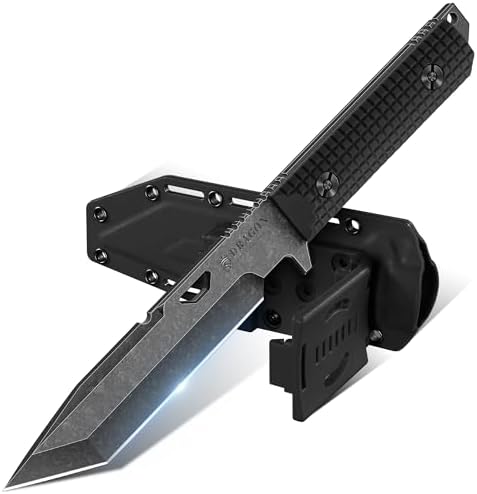
Identical to the brown Dragon Creek above, ranked 24 places apart, priced 21 cents lower.
Key Specifications
| Type | Fixed blade, full tang |
|---|---|
| Blade length | 5.3 inches |
| Steel | D2 at 60 HRC |
| Edge | 15° V-shaped |
| Handle | G10, checked, double riveted |
| Sheath | Adjustable Kydex |
| Finish | Black stonewash |
| Rank | #8,873 in its category |
| Price | $26.78 |
| Best For | The same knife as the brown one, for 21 cents less |
Why We Recommend It
Colourway pricing is worth a moment in every category, and here it happens to be trivial — twenty-one cents. Elsewhere on the site we have found the same product varying by thirteen dollars between colours. The habit worth keeping is to click through the colour options on any listing before buying, because they are priced and discounted independently and it costs ten seconds to check.
Everything said about the brown version applies here. A full tang with no lock and no pivot, D2 hardened to 60 HRC, a 15-degree V edge and an adjustable Kydex sheath that rides on a belt or a pack.
The black stonewash finish hides scratches better than a bright blade, which on a knife destined for a pack or a belt is a practical rather than cosmetic advantage.
Store it out of the sheath if it gets wet. D2 is not fully stainless and Kydex holds moisture against the blade.
Pros
- Same D2 at 60 HRC as the brown version
- 21 cents cheaper for identical specification
- No lock and no pivot to fail
- 15° V edge on a full-tang blade
- Adjustable Kydex sheath
- Black stonewash hides wear
Cons
- Not a pocket knife — needs a belt
- Fixed blades are more regulated in many places
- D2 can spot if left damp in Kydex
- 5.3 inches is long for everyday carry
- Rank #8,873
- No warranty term published
Best for: The same camp knife as the brown one, marginally cheaper.
10. Smith & Wesson SWMP4LS Assisted — Heaviest Here

Forty-seven dollars fifty-nine for 4034 steel, while a nine-dollar-ninety-nine knife on this page uses D2. That is the price-to-steel inversion of the category.
Key Specifications
| Type | Folding, assisted |
|---|---|
| Blade length | 3.6 inches |
| Overall length | 8.6 inches |
| Weight | 7.6 oz — heaviest here |
| Steel | 4034 black oxide high-carbon stainless |
| Opening | M.A.G.I.C. assisted, flipper actuator |
| Lock | Liner lock plus a safety lock |
| Handle | Aluminium with rubber inlay |
| Extras | Glass breaker and seatbelt cutter |
| Warranty | Limited lifetime |
| Rank | #15,478 in its category |
| Price | $47.59 |
| Best For | A secondary safety lock, if you can carry the weight |
Why We Recommend It
4034 is a low-carbon stainless at the bottom of the knife-steel range — softer than the 7Cr17MoV here, well below the 8Cr steels, and a different world from D2 or S35VN. It resists rust well and takes an edge easily, and it loses that edge quickly. What you are paying for on this knife is not the blade: it is the assisted mechanism, the secondary safety lock, the emergency tools and the lifetime warranty.
A safety lock is a genuine feature on an assisted knife. Assisted opening means a spring completes the deployment once started, which is exactly what you do not want happening in a pocket — a separate lock immobilises the blade closed.
7.6 ounces is very heavy for a folder, nearly double the lightest knife here, and weight is the commonest reason a knife stops being carried.
Assisted opening is also treated differently in some jurisdictions, independently of blade length.
Pros
- Secondary safety lock immobilises the blade closed
- Limited lifetime warranty
- Glass breaker and seatbelt cutter included
- Publishes blade, overall length and weight
- Rubber inlay improves grip on aluminium
- M.A.G.I.C. assisted deployment
Cons
- 4034 is the softest steel on this page
- 7.6 oz — nearly double the lightest here
- $47.59 buys better steel elsewhere on this page
- Assisted opening is restricted in some places
- Serrated, so not resharpenable at home
- Rank #15,478
Best for: Emergency use in a vehicle, where weight and steel matter least.
The Lock Is the Part That Matters
Four mechanisms across ten knives, and they are not equivalent.
| Lock | How you release it | Thumb in the blade path? | On this page |
|---|---|---|---|
| None (fixed blade) | Nothing to release | No | Two knives |
| Tri-Ad | Lockback bar, stop pin absorbs shock | No | One knife |
| Axis | Spring bar pulled from either side | No | One knife |
| Liner + safety | Push the liner; separate lock holds it shut | Yes | One knife |
| Liner | Push the liner sideways with your thumb | Yes | Five knives |
Most cuts from a folding knife happen while closing it, not while using it, and a liner lock is the design that puts your thumb directly in the arc the blade swings through. An axis lock is released with thumb and forefinger from either side of the handle and keeps your hand clear entirely; a Tri-Ad lock adds a hardened stop pin so impact shock does not deform the locking face over time. Six of these ten use liner locks, which is the compromise you make below about fifteen dollars — except that the axis-locked knife here costs $14.49.

Steel, Price, and Why They Do Not Track
Sorted by steel quality rather than price. Notice how little the two have to do with each other.
| Knife | Steel | Hardness | Price |
|---|---|---|---|
| Cold Steel Recon 1 | S35VN + DLC | Not stated | $103.80 |
| FLISSA KOSMO | D2 | Not stated | $9.99 |
| FLISSA KOSMO (2nd) | D2 | Not stated | $9.99 |
| Dragon Creek Brown | D2 | 60 HRC | $26.99 |
| Dragon Creek Black | D2 | 60 HRC | $26.78 |
| Legal 6680 | 440C | Not stated | $39.90 |
| NedFoss DA75 | 8Cr14MoV | Not stated | $29.99 |
| S&W SWMP13BS | 8Cr13MoV | Not stated | $20.39 |
| Mossy Oak | 7Cr17MoV | 54–58 HRC | $14.49 |
| S&W SWMP4LS | 4034 | Not stated | $47.59 |
The two cheapest knives on this page use D2, a hard tool steel that holds an edge far longer than the 7Cr and 8Cr budget stainless around them — and the second most expensive uses 4034, which sits at the bottom of the knife-steel range. That does not make the expensive knife bad; you are paying for an assisted mechanism, a secondary safety lock, emergency tools and a lifetime warranty. It does mean that price is a poor proxy for edge retention here, and that reading the steel name is worth more than reading the price.
Best Alternatives
| Alternative | Why Consider It | Better For | Main Trade-Off |
|---|---|---|---|
| A plain EDC folder | No aesthetic baggage, same function | Everyday cutting | Fewer emergency extras |
| A fixed-blade camp knife | No lock and no pivot to fail | Camping, batoning, outdoor work | Needs a belt, more regulated |
| A multi-tool | Pliers, drivers and a blade together | Repairs and work sites | Heavy, and the blade is an afterthought |
| A dedicated rescue tool | Belt cutter and window punch, no blade | Keeping in a car | Cannot cut anything else |
What the Money Actually Buys
$9.99 to $20.39 — both FLISSAs, Mossy Oak, S&W SWMP13BS. The most interesting band on the page. It contains the best lock here at $14.49, D2 tool steel at $9.99, the lightest knife at 4.2 oz and a lifetime warranty at $20.39. Nothing above it improves the steel except the flagship.
$26.78 to $39.90 — both Dragon Creeks, NedFoss, Legal 6680. Fixed blades with published 60 HRC hardness, emergency tools, and the only knife here specified around carry law. This is where the specifications get properly detailed.
$47.59 — S&W SWMP4LS. Assisted opening, a secondary safety lock and a lifetime warranty, on the softest steel here. You are buying the mechanism, not the blade.
$103.80 — Cold Steel Recon 1. S35VN, a Tri-Ad lock and the only complete specification sheet on the page. It is the best knife here by some distance and it costs more than four of the others combined.
What to Check Before You Buy
Ignore the Word and Read the Lock
“Tactical” is unregulated and carries no meaning: in this roundup it is applied to a 2.95-inch pocket folder, a 9.375-inch premium folder and two fixed-blade sheath knives. What genuinely varies is the lock. Six knives here use liner locks, released by pushing a thin steel liner sideways with your thumb — directly into the path the blade closes through, which is how most folding-knife injuries happen. An axis lock uses a spring bar pulled from either side and keeps your hand clear. A Tri-Ad lock adds a hardened stop pin that absorbs impact so the locking face does not deform over years of use. A fixed blade has no lock and therefore nothing to fail.
Read the Steel Name, Not the Price
Steels in this roundup run from 4034 at the bottom to S35VN at the top, and price tracks that ordering poorly. The two cheapest knives here use D2, a hard high-carbon tool steel that holds an edge substantially longer than the 7Cr and 8Cr stainless steels around them — while the second most expensive knife uses 4034, one of the softest stainless steels found in knives. Roughly: 4034 and 7Cr are soft, easy to sharpen and quick to dull; 8Cr is the workhorse middle; 440C is a step up; D2 is hard and holds an edge at the cost of easy sharpening and some rust resistance; S35VN is a premium powder steel.
Decide Whether You Actually Want a Folder
Two products in this roundup are fixed-blade knives with Kydex sheaths, and they appear in the same search because the word covers both. The distinction is fundamental. A folding knife carries a pivot, a spring and a lock — three things that can fail, and a lock is only ever an approximation of what a fixed blade simply has. A full tang runs as one piece of steel from tip to pommel with nothing to disengage. If the knife is for camping, batoning kindling or heavy outdoor work, a fixed blade is the more sensible tool. If it needs to live in a pocket and be legal in town, it has to fold.
Check Blade Length and Opening Mechanism Against Local Rules
Blades here run from 2.95 inches to 5.3, and one knife is spring-assisted. Both attributes are commonly regulated in the United States, with three inches and three and a half being frequent thresholds, and some jurisdictions treating assisted or automatic mechanisms differently from manual folders. Only one listing in this roundup raises the subject — it specifies 2.95 inches with no spring deliberately, states that such knives are generally legal, and still tells you to check locally, which is the correct advice. Note also that two listings of what appears to be the same knife publish 3 and 3.3 inches, which straddles a threshold; measure rather than trust it.
Weigh It, Because Weight Decides Whether You Carry It
The figures published here run from 4.2 ounces to 7.6 — nearly double — and weight is the commonest reason a knife stops being carried and starts living in a drawer. Under about five ounces a folder clipped inside a pocket effectively disappears; above seven it announces itself all day and gets left behind whenever you dress differently. The heaviest knife here is also one of the dearest and uses the softest steel, which is a combination worth thinking about. Only half the listings in this roundup publish a weight at all, and where they do not, the aluminium-handled models are generally the heavier ones.
Treat G10 as a Genuine Quality Marker
Handle material is one of the few places where the premium knives and the cheap ones here actually converge, and it is worth knowing why. G10 is woven glass fibre set in epoxy resin, machined rather than moulded: it is dimensionally stable, completely impervious to water, unaffected by temperature, and textured so it grips when wet or gloved. It is what the $103.80 knife uses and it is also what a $9.99 knife here uses. Aluminium looks premium and is cold, slippery when wet and dents; moulded plastic is neither strong nor grippy. If two knives are otherwise similar, take the one with G10 scales.
Avoid Serrations Unless You Cut Rope for a Living
Three knives in this roundup have serrated edges, and serrations are excellent at exactly one thing: sawing through rope, webbing and fibrous material that a plain edge would slip off. They cannot be sharpened at home — each scallop needs a tapered rod worked individually, and a flat stone simply grinds the points off — so a serrated knife is effectively a consumable. It is a strange pairing on a knife carrying a lifetime warranty. For general cutting, a plain drop point gives you a curved belly for slicing and a fine tip for detail, and it can be brought back by anyone with a stone and ten minutes.
Common Mistakes
- Buying on the word ‘tactical’. It describes a 2.95-inch folder and a sheath knife alike.
- Assuming price tracks steel. A $9.99 knife here uses D2; a $47.59 one uses 4034.
- Ignoring the lock. Six of these put your thumb in the blade’s path to close them.
- Trusting a published blade length. Two listings of one knife differ by 0.3 inches.
- Buying serrations for general use. They cannot be resharpened at a kitchen sink.
- Overlooking weight. 7.6 ounces is a knife that stays at home.
- Storing D2 damp in a Kydex sheath. It is not fully stainless and will spot.
Who Should Buy Which
Buy the Cold Steel Recon 1 at $103.80 if the lock has to hold. S35VN, a Tri-Ad lock with a shock-absorbing stop pin, and the only complete specification on this page.
Buy the Mossy Oak at $14.49 for the best value lock. An axis lock keeps your thumb out of the blade path, at a tenth of the flagship’s price, in the lightest knife here.
Buy the FLISSA at $9.99 for the steel. D2 tool steel and a G10 handle for under ten dollars is the best material value on this page.
Buy the Dragon Creek at $26.78 if it is going camping. A full-tang D2 blade at 60 HRC with no lock to fail, in an adjustable Kydex sheath.
Buy the Legal 6680 at $39.90 if you have not checked your rules. 2.95 inches, non-spring, and the only listing here that tells you to look them up.

Frequently Asked Questions
What actually makes a knife tactical?
Nothing, in any regulated or technical sense — it is a marketing adjective. In this roundup the word is applied to a 2.95-inch folding pocket knife, a 9.375-inch folder with a premium American steel, and two fixed-blade sheath knives with Kydex sheaths. There is no shared blade shape, size, steel, lock or intended use. In practice “tactical” tends to signal a black or stonewashed finish, a G10 or aluminium handle, a pocket clip and often a glass breaker and seatbelt cutter — appearance and accessories rather than performance. The two attributes that genuinely differ between these knives are the lock mechanism and the blade steel, and neither is implied by the word.
Which knife lock is strongest?
Among the designs in this roundup, the Tri-Ad lock and the axis lock are both substantially better than the liner lock that six of these use. A liner lock wedges a thin strip of spring steel behind the blade tang, and you release it by pushing that strip sideways with your thumb — directly into the arc the blade closes through, which is how most folding-knife injuries happen. An axis lock uses a spring-loaded bar that engages across the full tang and is pulled back from either side, keeping your hand clear and working equally well left or right handed. A Tri-Ad lock is a reinforced lockback with a hardened stop pin that absorbs impact shock so the locking face does not deform over years.
What is the best steel for a tactical knife?
It depends on whether you would rather sharpen often or sharpen well. The steels in this roundup run roughly in this order: 4034 and 7Cr17MoV are soft, resist rust, take an edge in minutes and lose it quickly; 8Cr13MoV and 8Cr14MoV are the workhorse budget middle; 440C is a genuine step up; D2 is a hard high-carbon tool steel that holds an edge far longer but is harder to resharpen and can spot if stored damp; S35VN is a premium powder-metallurgy stainless. Note that price tracks this poorly here — the two cheapest knives use D2 while the second most expensive uses 4034.
Should I get a folding or fixed blade tactical knife?
Fixed if it is going outdoors, folding if it is going in a pocket. A fixed blade is one continuous piece of steel from tip to pommel with no pivot, no spring and no lock — there is simply nothing to fail, which is why fixed blades are what people take camping and why they handle batoning and heavy work that would destroy a folder. The costs are that it cannot be pocketed, needs a sheath on a belt, and is more heavily regulated in many places. A folder trades that robustness for carryability, and the quality of the lock is what determines how much of the robustness you keep.
Are glass breakers and seatbelt cutters worth having?
In a car, yes; in a pocket, they are mostly bulk. Both address the same emergency and neither works with the blade. A seatbelt under tension cannot be sawn safely with an edge near a person, so a recessed hook blade is used instead; toughened side windows do not shatter from a flat impact but break instantly when a hardened point concentrates force on a tiny area, which is what the pommel spike is for. Three knives in this roundup have both. If the knife lives in a glovebox they are genuinely valuable. If it lives in your pocket, they add weight and a pointed pommel for a scenario you may never meet.
Is an expensive tactical knife worth it?
It depends entirely on which expensive knife. In this roundup the $103.80 model genuinely buys you more: a premium S35VN blade, the strongest lock design here, and the only complete published specification. The $47.59 model buys an assisted mechanism, a secondary safety lock, emergency tools and a lifetime warranty on top of one of the softest steels on the page. Meanwhile a $14.49 knife has the second-best lock here and a $9.99 knife has D2 tool steel. So the honest answer is that money buys locks, warranties and mechanisms reliably, and buys better steel only sometimes — read the steel name before the price tag.
Final Verdict
An American S35VN blade with a DLC coating behind a Tri-Ad lock whose stop pin absorbs the shock that deforms ordinary locking faces. $103.80.
An axis lock — ambidextrous, and it keeps your thumb out of the blade’s path — in the lightest knife on this page, at $14.49.
D2 tool steel and a G10 handle for $9.99, which is the best material-per-dollar on this page by a distance.
“Tactical” covers a 2.95-inch folder and a 9.375-inch knife on this page, plus two fixed blades that do not fold at all. The word tells you nothing.
The lock and the steel tell you everything. Six of these use liner locks that put your thumb in the blade’s path; one uses an axis lock and costs $14.49.
And price is a poor guide to steel. The two cheapest knives here are D2. The second dearest is 4034.
Read those two lines in any listing and you can ignore everything else on the page.