Affiliate Disclosure: As an Amazon Associate, we earn from qualifying purchases. This does not affect the price you pay.
The knife is not the purchase. The blade is, and there are three incompatible standards on this page.
Trapezoid utility blades — the classic shape — fit six of these, and one listing states outright that it takes universal blades. 18 mm snap-off fits two, and is the format warehouses and building sites actually stock. 9 mm snap-off fits one and is the light-duty version. A twelfth knife uses single-edge razor blades from a different family altogether.
None of those interchange. Buy a knife whose blade you cannot get from the same supplier as everything else, and in six months you have a handle.
The second thing that matters is how you renew the edge. Snap-off blades give a dozen fresh edges from one blade with nothing but the end cap. Trapezoid blades are swapped — instantly on most of these, and with a screwdriver on one, which in the middle of a shift is the difference between a working tool and a blunt one.
$4.59 to $23.97 below, and the cheapest thing here is an envelope opener rather than a warehouse knife.
Our Quick Picks
 Best OverallWORKPRO 3-Pack All Metal
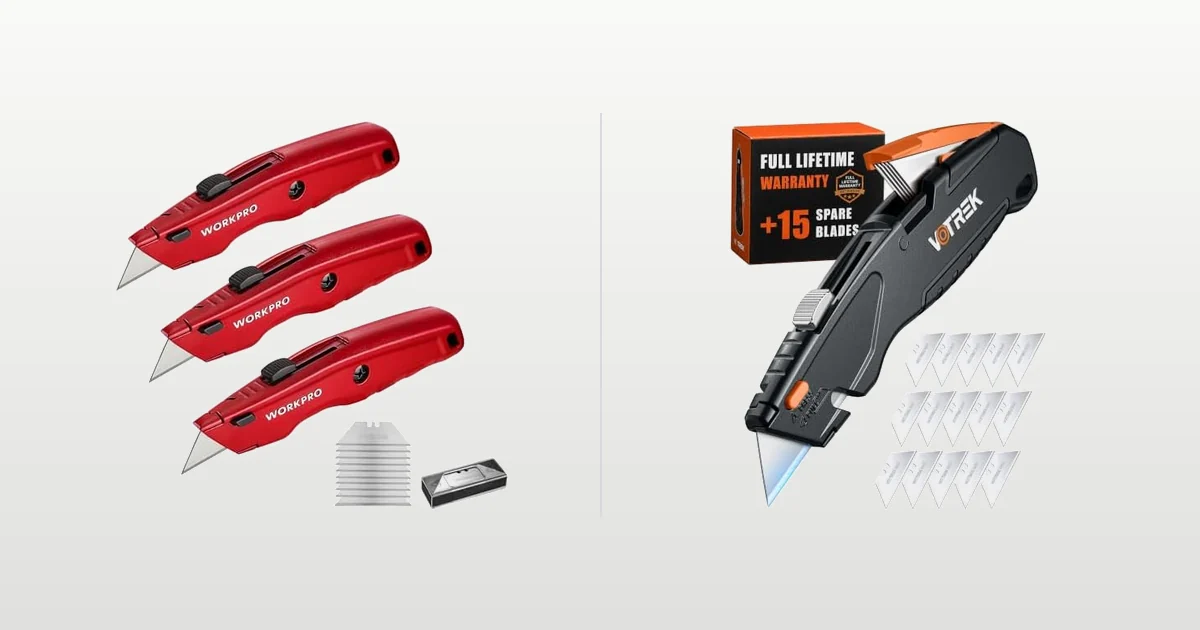
Three aluminium-alloy knives with SK5 blades, tool-free quick change and ten spares, tested to a 1.5-metre drop.
 Best for a TeamREXBETI 12-Pack 18mm Snap-Off
Twelve knives with 18 mm SK5 snap-off blades, reinforced safety locks and compatibility with standard replacement blades.
 Best Blade StorageVOTREK Metal with Blade Storage
An aluminium box cutter with an internal compartment holding the spare blades, tool-free changing and ten SK5 spares included.
At a Glance
Ten Knives, Sorted by What Feeds Them
Blade standard, how many knives you get, how the edge is renewed and what the body is made of. The first column is the buying decision.
| # | Model | Blade Type | Quantity | Blade Change | Body | Standout | Main Drawback | Check Price |
|---|---|---|---|---|---|---|---|---|
| 1 |
 WORKPRO 3-Pack All Metal WORKPRO 3-Pack All Metal |
Trapezoid | 3 knives | Quick change, tool-free | Aluminium alloy | Three metal knives, ten spare blades and a 1.5 m drop test | Trapezoid blades must be replaced, not snapped | View on Amazon |
| 2 |
 REXBETI 12-Pack 18mm Snap-Off REXBETI 12-Pack 18mm Snap-Off |
18 mm snap-off | 12 knives | Snap a segment | Engineering-grade | Twelve knives at 71 cents each, on the commonest warehouse blade standard | Plastic bodies rather than metal | View on Amazon |
| 3 |
 VOTREK Metal with Blade Storage VOTREK Metal with Blade Storage |
Trapezoid | 1 knife | Tool-free quick change | Aluminium alloy | Spare blades live inside the handle, so they are never lost | One knife, where the job usually needs several | View on Amazon |
| 4 |
 Klein Tools FLICKBLADE 2-in-1 Klein Tools FLICKBLADE 2-in-1 |
Folding | 1 knife | Universal blades | Aluminium | A folding knife and scraper in one, taking universal blades | $17.98 for a single knife | View on Amazon |
| 5 |
 DIYSELF 2-Pack All Metal DIYSELF 2-Pack All Metal |
Trapezoid | 2 knives | Needs a screwdriver | Aluminium alloy | A 0.6-inch profile that genuinely fits a shirt pocket | Blade changes require a standard screwdriver | View on Amazon |
| 6 |
 TIFICAL 4-Pack 9mm Snap-Off TIFICAL 4-Pack 9mm Snap-Off |
9 mm snap-off | 4 knives | Snap a segment | Thickened ABS | Twelve fresh edges per blade, in the smallest snap-off size | 9 mm blades flex and snap under real load | View on Amazon |
| 7 |
 TIFICAL 4-Pack 18mm Snap-Off TIFICAL 4-Pack 18mm Snap-Off |
18 mm snap-off | 4 knives | Snap a segment | Thick hard plastic | The heavy-duty snap-off standard at $1.50 a knife | No metal in the body at all | View on Amazon |
| 8 |
 DIYSELF 12-Pack All Metal DIYSELF 12-Pack All Metal |
Single-edge razor | 12 knives | Tap to open and close | All metal sheath | Twelve metal-bodied knives at 75 cents each | Single-edge razor blades rather than trapezoid | View on Amazon |
| 9 |
 INTERNET’S BEST 2-Pack Rubber Grip INTERNET’S BEST 2-Pack Rubber Grip |
Trapezoid | 2 knives | Red button release | Metal with rubber | A rubber-gripped metal body and a one-button blade release | $9.98 a knife — dearest per unit here | View on Amazon |
| 10 |
 4-Pack Package Opener 4-Pack Package Opener |
Small razor | 4 knives | Not stated | ABS shell | Four openers for $4.59, with a push-and-release blade | This is a letter opener, not a warehouse knife | View on Amazon |
Blade types, quantities, prices and specifications are taken from each manufacturer’s Amazon listing as displayed on 27 August 2026 through a United States connection, and may change. Three mutually incompatible blade standards appear on this page — trapezoid utility, 18 mm snap-off and 9 mm snap-off — plus single-edge razor blades, and none of them interchange; each product’s entry states which it takes. Cost-per-knife figures are our own arithmetic from the pack size and listed price. Only two listings publish a drop-test rating (both 1.5 metres) and where none is given the table says so rather than assuming. Note that one product in this roundup is a light-duty package opener rather than a warehouse tool, and one requires a standard screwdriver to change its blade; both are flagged in their entries. Snapped-off blade segments are extremely sharp and should go into a purpose-made sharps container rather than a bin. Sales ranks are shown as displayed and can be pooled across a variant family.
Scroll the table sideways to see every column
How We Chose These Ten
We researched current listings, compared manufacturer specifications and documentation, and examined recurring patterns in customer feedback. We did not carry out hands-on testing, and nothing below is presented as measured performance data.
- Blade standard identified for every knife — three incompatible formats appear here and none interchange
- Cost per knife calculated — pack sizes run from one to twelve, so sticker price means little
- Blade change method recorded — one of these needs a screwdriver, which matters mid-shift
- A verified live buy box — all ten confirmed purchasable in the United States on 27 August 2026
- Body material and drop rating noted — two publish a 1.5 m drop test and eight publish nothing
- Blade storage flagged where built in — the spare packet is what actually gets lost
- No overlap with our published knife and cutter guides — every tool here is new to the site
The Ten in Detail
1. WORKPRO 3-Pack All Metal — Best Overall

Three knives and ten blades in one box is the right unit of purchase, because in a warehouse the knife is not what runs out.
Key Specifications
| Blade type | Standard trapezoid utility |
|---|---|
| Quantity | 3 knives, 10 extra blades |
| Body | Aluminium alloy with rust-free powder coat |
| Weight | 3.2 oz |
| Drop test | 1.5 metres |
| Blade steel | SK5 |
| Positions | 3 adjustable blade depths |
| Retraction | Locks within the metal frame |
| Dimensions | 6.3 x 1.7 x 0.9 inches |
| Rank | #117 — highest on this page |
| Price | $23.97 |
| Best For | A warehouse where knives get lost and blades must always be to hand |
Why We Recommend It
What you are actually buying in this category is a blade supply, and the handle is the delivery mechanism. A utility knife will outlast hundreds of blades; what stops work is a dull edge and no spare within reach. Buying three bodies means one lives on the bench, one in a pocket and one in the van, and ten spares means nobody is cutting cardboard with a blunt blade because the box is in the office.
The 1.5-metre drop test is a real specification and worth having: these get dropped onto concrete constantly, and a cracked plastic body puts a loose razor blade on the floor.
SK5 is a Japanese high-carbon tool steel, the standard for utility blades — hard, takes a very fine edge, and rusts if left damp.
Three adjustable blade depths is the feature that stops you scoring the contents of a box: set it to just past the cardboard thickness and you cannot cut what is inside.
Pros
- Rank #117 — best selling here
- Three knives and ten blades in one purchase
- Aluminium alloy, tested to a 1.5 m drop
- Tool-free quick blade change
- Three adjustable blade depths
- 3.2 oz with published dimensions
Cons
- Trapezoid blades are replaced, not snapped
- $23.97 is the second dearest here
- SK5 rusts if stored damp
- No blade storage in the handle
- Retraction is manual, not automatic
- Blades are a recurring cost
Best for: The default warehouse purchase: enough knives, enough blades, metal bodies.
2. REXBETI 12-Pack 18mm Snap-Off — Best for a Team

Seventy-one cents a knife, and the blade standard is the one every hardware shop stocks.
Key Specifications
| Blade type | 18 mm SK5 snap-off |
|---|---|
| Quantity | 12 knives — most here |
| Cost per knife | $0.71 |
| Blade renewal | Snap off a dull segment, no tools |
| Compatibility | Standard 18 mm replacement blades |
| Lock | Reinforced safety lock |
| Body | Thickened engineering-grade material, anti-slip |
| Cuts | Cardboard, drywall, carpet, roofing paper, plastic sheeting |
| Rank | #1,258 in its category |
| Price | $8.49 |
| Best For | Issuing a knife to everybody, and never running a resupply |
Why We Recommend It
18 mm snap-off is the workhorse format of warehouses and construction sites, and REXBETI says so explicitly: standard 18 mm replacement blades, commonly used in warehouse, construction and packaging. That matters more than any feature on the knife. A tool whose consumable you can buy anywhere, in any quantity, from any supplier, is a tool that keeps working; one taking a proprietary blade is a tool that dies when the last spare goes.
Snap-off blades change the economics entirely. A single 18 mm blade carries a row of scored segments — when the tip dulls you snap it off with the end cap and a fresh edge appears, with no tools and no disassembly. One blade is effectively a dozen blades.
At twelve knives, losing one costs seventy-one cents, which is the correct attitude to a tool that lives in an apron pocket and gets left on pallets.
The trade is the body. Engineering plastic rather than aluminium, so it will not survive drops the way the metal knives here will.
Pros
- 12 knives at $0.71 each
- Standard 18 mm blades available everywhere
- Snap-off segments give a dozen edges per blade
- Reinforced safety lock
- Anti-slip thickened body
- One-handed slide operation
Cons
- Plastic body, not metal
- No drop-test rating published
- Snap-off segments leave sharp waste to dispose of
- No blade storage in the handle
- Rank #1,258
- Thinner blades flex more than trapezoid
Best for: Kitting out a team, where the blade standard matters more than the handle.
3. VOTREK Metal with Blade Storage — Best Blade Storage

The spare blades live inside the handle. That is the whole idea and it solves the actual failure mode.
Key Specifications
| Blade type | Trapezoid, SK5 |
|---|---|
| Storage | Built-in internal compartment for spare blades |
| Blade change | Tool-free, quick |
| Included | 10 extra SK5 blades |
| Positions | 3 precise blade lengths |
| Lock | Safety lock |
| Body | Aluminium alloy, 1.5 m drop tested |
| Handling | Ergonomic, ambidextrous, one-handed |
| Rank | #506 in its category |
| Price | $6.48 |
| Best For | Anyone who has ever needed a fresh blade and had none within reach |
Why We Recommend It
Blades do not get lost individually, they get lost as a packet. The little cardboard box of spares ends up in a drawer, a toolbox, someone else’s apron or the bin, and the knife in your hand becomes useless the moment its edge goes. A compartment in the handle means the resupply travels with the tool — you are never more than thirty seconds from a fresh edge, and there is nothing separate to keep track of.
Combined with tool-free changing, that is a complete answer: pop the compartment, swap the blade, carry on. Compare it with another knife on this page that requires a standard screwdriver to change a blade.
The same 1.5-metre drop test as the WORKPRO, in an aluminium body, for a quarter of the price — because you get one knife rather than three.
Ambidextrous one-handed operation matters when the other hand is holding the box.
Pros
- Spare blades stored inside the handle
- Tool-free quick blade change
- Ten SK5 blades included
- Aluminium alloy, 1.5 m drop tested
- Three precise blade lengths
- $6.48, and ambidextrous
Cons
- One knife only
- Trapezoid blades are replaced, not snapped
- No dimensions or weight published
- SK5 rusts if left damp
- Rank #506
- Blades are a recurring cost
Best for: A single well-thought-out knife that always has its own resupply.
4. Klein Tools FLICKBLADE 2-in-1 — Best Built

Two locking positions is the feature here, and it is the difference between cutting a box open and cutting the box’s contents open.
Key Specifications
| Format | Folding, not sliding |
|---|---|
| Dual function | Utility knife and scraper |
| Lock positions | Two — angled for precision, standard for cutting |
| Storage | Built-in, holds an additional blade |
| Body | Aluminium, drop and impact resistant |
| Blades | 3 triple-ground carbon steel included |
| Compatibility | Universal utility blades |
| Maker | Klein Tools |
| Rank | #1,973 in its category |
| Price | $17.98 |
| Best For | A tradesman’s pocket rather than a warehouse drawer |
Why We Recommend It
An angled blade position is for shallow, controlled work — scoring tape along a seam, trimming a label, opening a carton without reaching the goods inside. A standard position presents the blade square for full-depth cuts through cardboard, plastic sheeting or carpet. Most knives here adjust depth by sliding the blade further out, which changes how much steel is exposed but not the angle at which it meets the work.
Universal blade compatibility is stated explicitly, which is the specification that matters most in this category — the knife takes the same trapezoid blades every hardware shop sells.
The scraper function handles adhesive residue, labels and paint, which is a genuinely separate job that otherwise ruins a good blade.
A folding format rather than sliding means fewer moving parts in the blade path and no slider to jam with cardboard dust, though it is slower to deploy.
Pros
- Two locking positions — angled and standard
- Converts to a scraper
- Takes universal utility blades
- Built-in storage for a spare blade
- Aluminium body, drop resistant
- Three triple-ground blades included
Cons
- $17.98 for one knife
- Folding is slower to deploy than sliding
- No drop-test figure published
- No dimensions or weight published
- Rank #1,973
- Blade storage holds one spare, not ten
Best for: Trades work where the scraper and the angled position earn their keep.
5. DIYSELF 2-Pack All Metal — Slimmest Body

A 0.6-inch profile is genuinely slim, and the screwdriver requirement is the price of it.
Key Specifications
| Blade type | SK-5 trapezoid |
|---|---|
| Quantity | 2 knives |
| Body | Aluminium alloy shell |
| Length | 5.9 inches |
| Profile | 0.6 inches thick |
| Blade change | Standard screwdriver required |
| Lock | Slider locks the blade firmly |
| Carry | Built-in lanyard hole |
| Colours | 8 available |
| Rank | #870 in its category |
| Price | $7.99 |
| Best For | Pocket carry, if you do not change blades mid-shift |
Why We Recommend It
Tool-free blade changes need a mechanism, and a mechanism needs thickness. The knives on this page that swap blades at the press of a button carry a spring, a catch and a release inside the handle. Fixing the blade with a screw instead removes all of that, which is how this one gets down to 0.6 inches and into a shirt pocket. It also means that when the edge dulls halfway through unloading a pallet, you need a screwdriver.
For a knife carried personally rather than issued at a station, that is a defensible trade — you change the blade at the start of a shift, not during one.
An aluminium shell with a screw-fixed blade also means no wobble: the listing notes the housing fits snugly against the blade, and blade play is the commonest complaint about cheap sliders.
Eight colours matters more than it sounds in a shared workplace, where colour-coding tools by person or department is how they come back.
Pros
- 0.6 inch profile fits a shirt pocket
- Aluminium shell with no blade wobble
- SK-5 blades and a lanyard hole
- Eight colours for tool identification
- Two knives for $7.99
- 5.9 inches, published
Cons
- Blade change needs a screwdriver
- Not practical to re-blade mid-shift
- No blade storage in the handle
- No drop-test rating published
- Rank #870
- Only 2 knives
Best for: Personal pocket carry, changed at the start of the day rather than during it.
6. TIFICAL 4-Pack 9mm Snap-Off — Lightest Duty

Nine millimetres is the small snap-off standard, and the width is the whole story.
Key Specifications
| Blade type | 9 mm snap-off |
|---|---|
| Segments | 12 per blade |
| Quantity | 4 knives, four colours |
| Body | Thickened ABS |
| Snapping | Tail cap holds the blade to snap it safely |
| Lock | Slider locks blade position |
| Uses | Cartons, wallpaper, plastic, leather, paper, vinyl, film |
| Rank | #1,110 in its category |
| Price | $5.39 |
| Best For | Opening packages and light cartons, not heavy warehouse cutting |
Why We Recommend It
A 9 mm blade is about half the width of an 18 mm one, and it flexes. That is fine and even desirable for wallpaper, film, vinyl and light cartons, where a thin flexible edge follows a curve and cuts cleanly. Push it through double-wall cardboard, carpet or a taped-up pallet wrap and it will bend, bind and eventually snap at a segment line under load rather than when you choose. For genuine warehouse work the 18 mm standard is the one to buy.
The tail cap is the correct way to snap a blade — it grips the spent segment so it breaks cleanly and does not fly, which is exactly how people cut themselves doing it with pliers.
Twelve segments per blade means one blade lasts a very long time in light use, and 9 mm blades are cheap and universally stocked.
Four colours across four knives, at $1.35 each, for desks, post rooms and stockrooms rather than loading bays.
Pros
- 12 fresh edges per blade
- Tail cap snaps segments safely
- $1.35 per knife across four colours
- 9 mm blades are cheap and universal
- Thin blade follows curves cleanly
- Slider locks the blade position
Cons
- 9 mm blades flex under real load
- ABS body rather than metal
- Not suited to double-wall cardboard or carpet
- No drop-test rating
- Rank #1,110
- Snapped segments are sharp waste
Best for: Post rooms and stockrooms, where the cutting is light and frequent.
7. TIFICAL 4-Pack 18mm Snap-Off — Best Snap-Off Value

This is the same maker’s 9 mm cutter scaled up to the width that actually handles a warehouse.
Key Specifications
| Blade type | 18 mm snap-off |
|---|---|
| Quantity | 4 knives |
| Cost per knife | $1.50 |
| Blade steel | High carbon |
| Lock | Advanced mechanism with locking slider |
| Body | Thick, hard plastic, ergonomic |
| Cuts | Boxes, cardboard, rubber, plastic, vinyl, leather |
| Rank | #2,039 in its category |
| Price | $5.99 |
| Best For | The right blade width for warehouse work, at the lowest price |
Why We Recommend It
Eighteen millimetres is the heavy-duty snap-off standard, and the extra width is not about the cutting edge — it is about rigidity. A wider blade resists flexing sideways under load, which is what lets it go through double-wall cardboard, banding, rubber and carpet without binding or breaking where you did not intend. Every warehouse and construction site stocks 18 mm blades for this reason, and it is the same standard the twelve-pack elsewhere on this page uses.
Four knives at $1.50 each is the cheapest way onto the correct blade standard, and it is sixty cents dearer in total than the same brand’s 9 mm four-pack.
The locking slider is the safety feature that matters: a blade that creeps back into the handle mid-cut is how the other hand gets cut.
Hard plastic rather than metal means it will not survive being dropped from a forklift, which at $1.50 is arguably the point.
Pros
- 18 mm — the correct warehouse blade standard
- $1.50 per knife across four
- Locking slider prevents blade creep
- High-carbon snap-off blades
- Ergonomic thick-plastic handle
- Handles rubber, vinyl and leather
Cons
- No metal in the body
- No drop-test rating published
- No blade storage in the handle
- Rank #2,039
- Snapped segments need safe disposal
- No spare blades included
Best for: Getting onto the right blade standard for the least money.
8. DIYSELF 12-Pack All Metal — Most Metal Knives

Twelve all-metal knives for $8.99 is the value outlier on this page, and the blade type is the caveat.
Key Specifications
| Blade type | Single-edge razor, SK5 |
|---|---|
| Quantity | 12 knives |
| Cost per knife | $0.75 |
| Body | All metal sheath |
| Operation | Tap to open, tap to close |
| Blade fit | Housing fits snugly, prevents wobble |
| Secondary use | Razor scraper |
| Guarantee | 30-day refund |
| Rank | #2,499 in its category |
| Price | $8.99 |
| Best For | Twelve metal knives for less than one good one |
Why We Recommend It
Single-edge razor blades are the thin rectangular ones used in scrapers, not the thicker trapezoid utility blades. They are extremely sharp, very cheap, universally available, and considerably more fragile — they will snap under lateral load rather than bend. For opening cartons, slitting tape, cutting film and scraping labels they are ideal. For carpet, banding or anything requiring force through a thick material, a trapezoid or 18 mm snap-off blade is the right tool.
An all-metal sheath at seventy-five cents a knife is remarkable, and it is the thing that survives being dropped and stepped on.
Tap to open, tap to close is the fastest action on this page, which over hundreds of cartons a shift is not a trivial advantage.
The snug housing preventing blade wobble is worth noting, because a rattling blade in a cheap slider is what makes a cut wander.
Pros
- 12 all-metal knives at $0.75 each
- Metal sheath survives drops
- Tap to open and close — fastest action here
- Blades fit snugly, no wobble
- Doubles as a razor scraper
- 30-day refund guarantee
Cons
- Single-edge razor blades snap under lateral load
- Not suited to carpet or banding
- No blade storage in the handle
- No drop-test rating published
- Rank #2,499
- Very sharp blades to handle when changing
Best for: Carton opening and scraping in quantity, where thin blades are enough.
9. INTERNET’S BEST 2-Pack Rubber Grip — Best Grip

A rubber over-moulding on a metal body is the detail that separates this from every other metal knife here.
Key Specifications
| Blade type | Trapezoid razor |
|---|---|
| Quantity | 2 knives, 5 spare blades |
| Body | Durable metal with rubber grip |
| Blade change | Extend, press the red button, swap |
| Retraction | Adjustable, locks into the metal frame |
| Dimensions | 6 in long x 1.5 in wide |
| Included | Refill pouch with 5 blades |
| Rank | #2,864 in its category |
| Price | $19.95 |
| Best For | Cold stores and wet work, where a bare metal handle slips |
Why We Recommend It
Bare aluminium is slippery, and it is worse in exactly the conditions warehouses create. Cold hands, damp cardboard dust, gloves, a bit of grease from a pallet truck — and a smooth metal handle rotates in the grip at the moment you are applying force through a blade. A rubber grip over a metal frame gives you the drop resistance of metal with a surface that stays put. It is a standard feature on professional hand tools and rare at this price point.
The red-button release is a genuinely good mechanism: extend the blade, press once, the blade comes free. No screwdriver, no disassembly, no small parts to drop on a warehouse floor.
A refill pouch rather than a loose box keeps the five spares together and flat enough to live in an apron pocket.
$9.98 per knife is the highest unit price here, and buys the grip and the mechanism rather than more knives.
Pros
- Rubber grip over a metal body
- One-button blade release, no tools
- Refill pouch with 5 spare blades
- Published dimensions, 6 x 1.5 inches
- Adjustable retractable blade
- Grips when cold, wet or gloved
Cons
- $9.98 per knife — dearest unit price here
- Only 2 knives
- No drop-test rating published
- No blade storage inside the handle
- Rank #2,864
- Rubber over-moulding can perish over years
Best for: Cold stores, chill rooms and anywhere hands and handles get wet.
10. 4-Pack Package Opener — Cheapest Here

The blade only comes out while your finger is pushing the button, which is a genuine safety design and a genuine limitation.
Key Specifications
| Blade type | Small razor |
|---|---|
| Quantity | 4 knives, four colours |
| Body | High-quality ABS shell |
| Action | Blade retracts the moment you release the button |
| Coating | Skin-friendly grip |
| Intended for | Express boxes, envelopes, letters, paper tape, plastic and food bags |
| Rank | #3,343 in its category |
| Price | $4.59 — cheapest here |
| Best For | Desks, post rooms and anywhere the cutting is envelopes |
Why We Recommend It
Dead-man operation means the knife cannot be left open. Release the button and the blade retracts on its own, so it never sits in a pocket or on a bench with an exposed edge — which is the single commonest way people are cut by box cutters. In an office post room, a school, or anywhere untrained hands pick tools up, that is exactly the right behaviour.
It is also why this is not a warehouse knife. Holding a button forward for the length of a long cut through double-wall cardboard is tiring and imprecise, and the small blade has neither the width nor the rigidity for it. The listing is honest about the intended use: express boxes, envelopes, letters, paper tape.
$1.15 a knife across four colours makes it a sensible thing to leave on desks rather than issue to a picking team.
ABS with a skin-friendly coating, and no metal anywhere.
Pros
- Blade retracts automatically on release
- Cannot be left open in a pocket
- $1.15 per opener across four colours
- Four colours for shared spaces
- Skin-friendly grip coating
- Honest about its intended use
Cons
- A package opener, not a warehouse knife
- Holding the button is tiring on long cuts
- Small blade lacks rigidity
- ABS body with no metal
- No blade change method stated
- Rank #3,343
Best for: Desks, post rooms and offices — not loading bays.
The Three Blade Standards, and What They Cost Per Knife
Blade format first, then price per unit. These are the only two numbers that matter.
| Knife | Blade Standard | Knives | Per Knife |
|---|---|---|---|
| REXBETI 12-Pack | 18 mm snap-off | 12 | $0.71 |
| DIYSELF 12-Pack | Single-edge razor | 12 | $0.75 |
| 4-Pack Opener | Small razor | 4 | $1.15 |
| TIFICAL 9mm | 9 mm snap-off | 4 | $1.35 |
| TIFICAL 18mm | 18 mm snap-off | 4 | $1.50 |
| DIYSELF 2-Pack | Trapezoid | 2 | $4.00 |
| VOTREK | Trapezoid | 1 | $6.48 |
| WORKPRO 3-Pack | Trapezoid | 3 | $7.99 |
| INTERNET’S BEST | Trapezoid | 2 | $9.98 |
| Klein FLICKBLADE | Trapezoid (universal) | 1 | $17.98 |
Two things fall out of this. First, the snap-off and razor formats dominate the cheap end because the knives are simple plastic sliders, while trapezoid knives carry a blade-change mechanism and cost more per unit. Second, quantity is the correct way to buy for a warehouse: knives are lost, borrowed, dropped into skips and left on pallets, and a seventy-one-cent knife is a consumable while an eighteen-dollar one is an asset somebody has to be responsible for. Standardise on one blade format across the site, then buy the bodies to suit.
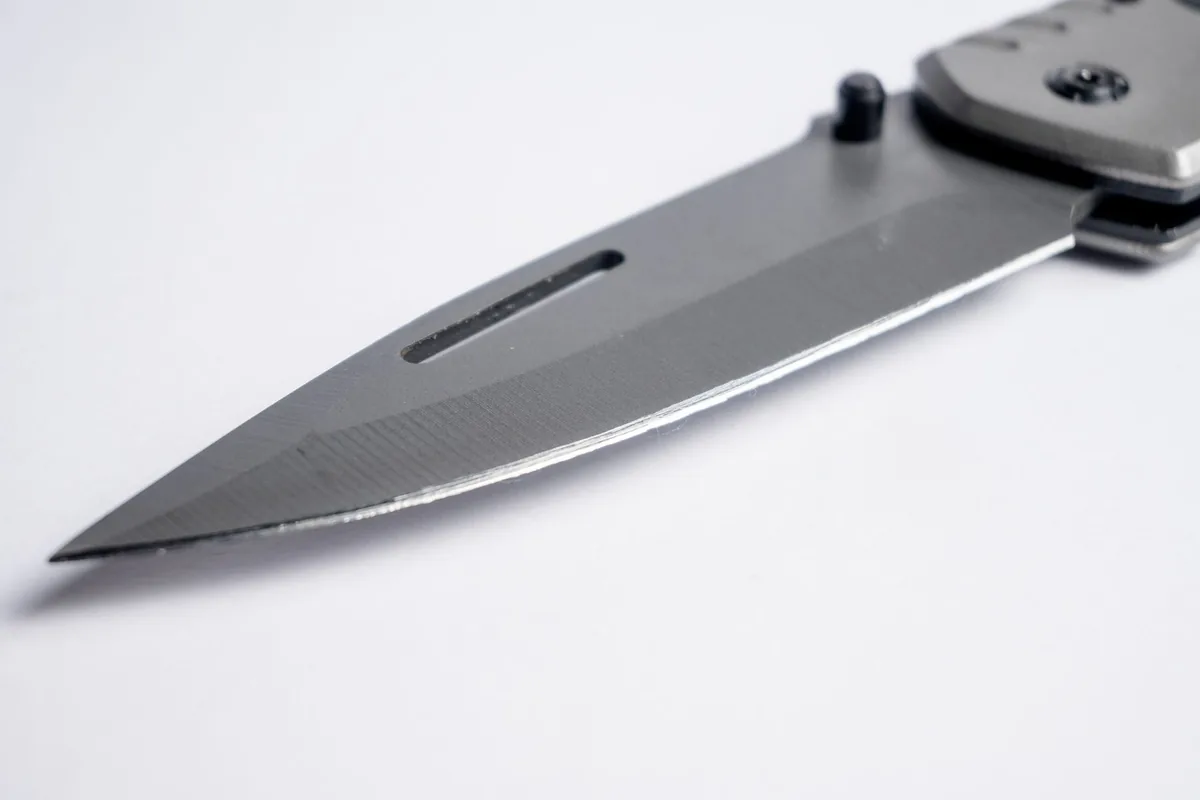
Snap-Off or Replace
Two ways to get a fresh edge, and they suit different workplaces.
| Snap-Off | Replaceable Trapezoid | |
|---|---|---|
| Fresh edges per blade | 12 segments | One per blade |
| Tools needed | None — end cap | None, usually |
| Speed mid-shift | Seconds | Seconds, or a screwdriver |
| Blade rigidity | 18 mm good, 9 mm poor | Good |
| Waste produced | Sharp segments | Whole blades |
| Availability | Universal in 9 and 18 mm | Universal |
| Cheapest here | $0.71 per knife | $4.00 per knife |
| On this page | Three knives | Six knives |
Snap-off wins on economy and on how quickly an edge is renewed without leaving the aisle. Trapezoid wins on rigidity and on the quality of the bodies available — every metal, drop-tested knife on this page is a trapezoid design. The deciding factor is usually disposal: snapping segments produces a stream of very sharp fragments that must go into a proper sharps container, and a warehouse without one will end up with them in bin liners, which is how cleaners get hurt.
Best Alternatives
| Alternative | Why Consider It | Better For | Main Trade-Off |
|---|---|---|---|
| A safety cutter with a hooded blade | The blade never contacts skin | High-turnover sites and untrained staff | Slower, and it cannot cut anything thick |
| Carton openers with a ceramic blade | Never rusts, holds an edge far longer | Damp and food environments | Brittle, and expensive to replace |
| A pair of heavy shears | No exposed blade at all | Banding, strapping and film | Useless on flat cardboard |
| A tape splitter | Cuts only the tape seam, never the goods | Retail and returns processing | Single purpose |
What the Money Actually Buys
$4.59 to $8.99 — the four-pack opener, both TIFICALs, DIYSELF 2-pack, REXBETI, DIYSELF 12-pack. The quantity tier, and where a warehouse should probably shop. Twelve knives at seventy-one cents on the correct 18 mm standard, or twelve all-metal bodies at seventy-five. Nothing here is drop-rated.
$6.48 to $19.95 — VOTREK, Klein, INTERNET’S BEST. Single knives and pairs, bought for a feature: blades stored inside the handle, a scraper and two locking angles, or a rubber grip over metal. These are personal tools rather than issued stock.
$23.97 — WORKPRO. Three drop-tested aluminium knives and ten spare blades in one box, at rank #117. The most complete answer here for a working site, and the only one that solves quantity and quality together.
What to Check Before You Buy
Standardise on One Blade Format
This roundup contains three mutually incompatible blade standards plus a fourth razor type, and none of them interchange. Trapezoid utility blades fit the majority and are stocked everywhere; 18 mm snap-off is the format warehouses and construction sites actually run on; 9 mm snap-off is the light-duty version; single-edge razor blades are a different family again. The practical consequence is that a site running three knife types needs three blade stock lines, and the one that runs out is always the one you need. Pick a format, buy every body to suit it, and check that the blade is described as standard or universal rather than proprietary.
Buy Quantity, Because Knives Disappear
Utility knives are lost at a rate no other hand tool matches. They go into skips inside flattened boxes, into pockets that go home, onto pallets that ship out, and behind racking. Pack sizes in this roundup run from one to twelve, and the cost per knife runs from seventy-one cents to $17.98 — a factor of twenty-five. At the cheap end a knife is a consumable and nobody has to account for it; at the expensive end it becomes an asset somebody signs for, which is a management overhead as much as a cost. For a working site, buy twelve cheap bodies on the right blade standard rather than one good one.
Check How the Blade Changes, Because It Happens Mid-Shift
Blades dull halfway through a pallet, not conveniently at the end of a shift. Most knives here change blades with a button or a catch in a few seconds; one requires a standard screwdriver, which in practice means the knife stays blunt until someone walks back to the tool store. Snap-off designs sidestep the problem entirely: the end cap grips a spent segment, you snap it off, and a fresh edge is exposed with no tools and no disassembly. If the tool is issued to people who will not walk anywhere to maintain it — which is most people — make the edge renewable where they stand.
Put the Spare Blades Inside the Handle
Blades are not lost one at a time; the packet is lost all at once. The little cardboard box of spares ends up in a drawer, a toolbox, someone else’s apron or a bin, and the knife becomes useless the moment its edge goes. Two knives in this roundup have a compartment in the handle holding spares, which means the resupply travels with the tool and there is nothing separate to track. It is a small feature with a disproportionate effect on whether people are cutting with sharp blades, and it costs almost nothing — one of the two knives with it is $6.48.
Match Blade Width to the Material
Snap-off blades come in 9 mm and 18 mm and they are not interchangeable in either the knife or the job. A 9 mm blade is thin and flexible, which is exactly right for film, wallpaper, vinyl and light cartons, where it follows a curve cleanly. Pushed through double-wall cardboard, carpet, banding or taped pallet wrap it flexes, binds and eventually snaps at a segment line under load rather than when you choose — which is both a wasted blade and a hazard. 18 mm is rigid enough for genuine warehouse material and is what sites stock. If in doubt, buy 18 mm and accept slightly less finesse.
Use the Blade Depth Setting
Several knives here offer three fixed blade positions, and the shallowest is the one that saves money. A blade extended fully will cut through a carton and into whatever is inside it — which on a pallet of retail goods means damaged stock, a returns process and a write-off far larger than the knife cost. Setting the blade to protrude only slightly further than the thickness of the cardboard makes that impossible. One knife in this roundup goes further with two locking angles rather than depths, presenting the edge shallowly for scoring tape and squarely for full cuts.
Plan Where the Spent Blades Go
This is the part nobody specifies and it causes real injuries. A snap-off knife produces a steady stream of extremely sharp fragments, and a trapezoid knife produces whole used blades; both go through a bin liner without resistance, and the person who finds out is the cleaner emptying it. Any site using these needs a purpose-made sharps container at each cutting station, and it needs to be the obvious nearest place to put a spent segment — otherwise they go in the nearest bin, into a pocket, or onto a shelf. It costs very little and it is the single most useful thing to organise alongside the knives.
Common Mistakes
- Running three blade standards on one site. The one that runs out is the one you need.
- Buying one good knife instead of twelve cheap ones. They get lost, not worn out.
- Choosing a knife that needs a screwdriver. It will stay blunt until someone walks back.
- Using 9 mm blades on heavy cardboard. They flex, bind and snap where they like.
- Extending the blade fully. That is how you cut the goods inside the carton.
- Keeping spares in a separate box. The box is what gets lost, not the blades.
- Putting spent segments in a bin liner. The cleaner finds them the hard way.
Who Should Buy Which
Buy the WORKPRO 3-pack at $23.97 if you want it solved properly. Three drop-tested aluminium knives, ten spare blades, three depth settings, and rank #117 on the whole category.
Buy the REXBETI 12-pack at $8.49 to kit out a team. Seventy-one cents a knife on the 18 mm standard every site already stocks.
Buy the VOTREK at $6.48 if you keep losing spare blades. The spares live inside the handle, and it is drop-tested aluminium with tool-free changing.
Buy the Klein at $17.98 for trades work. A scraper, two locking angles and universal blade compatibility in an aluminium body.
Buy the INTERNET’S BEST at $19.95 for cold or wet work. A rubber grip over a metal frame, which bare aluminium cannot match when hands are cold.

Frequently Asked Questions
What blade do warehouse utility knives use?
There are three common standards and they do not interchange. Trapezoid utility blades are the classic shape and fit the majority of knives in this roundup; they are stocked by every hardware supplier and one listing here states explicitly that it takes universal blades. 18 mm snap-off is the format most warehouses and construction sites actually run on, where a scored blade lets you break off a dull segment to expose a fresh edge. 9 mm snap-off is the light-duty version of the same idea. A fourth type, single-edge razor blades, appears on one product here. The important thing is to standardise a site on one format rather than stocking three.
Are snap-off or replaceable blades better for warehouse work?
Snap-off wins on economy and speed, trapezoid wins on rigidity and body quality. A snap-off blade carries around twelve scored segments, so one blade gives a dozen fresh edges and renewing it takes seconds with the end cap and no tools — which matters when the edge dulls halfway through a pallet. Trapezoid blades are thicker and more rigid, better suited to carpet, banding and heavy board, and every metal drop-tested knife in this roundup is a trapezoid design. The deciding factor is often disposal: snapping segments produces a stream of very sharp fragments that need a proper sharps container rather than a bin liner.
How many utility knives should a warehouse buy?
More than you think, because they are lost rather than worn out. Utility knives disappear into skips inside flattened cartons, onto pallets that ship out, into pockets that go home and behind racking, at a rate no other hand tool matches. Pack sizes in this roundup run from one to twelve and the cost per knife from seventy-one cents to $17.98 — a factor of twenty-five. At the cheap end the knife is a consumable nobody has to account for; at the top end it becomes an asset someone signs for, which is an administrative cost on top of the purchase. For a working site, buy quantity on the correct blade standard.
How do I stop cutting the contents of the box?
Use the blade depth setting, which several knives in this roundup provide and almost nobody adjusts. Extending the blade fully means it will pass straight through a carton and into whatever is inside, and on a pallet of retail goods that produces damaged stock and a write-off worth far more than the knife. Setting the blade to protrude only slightly further than the cardboard thickness makes it physically impossible. One knife here goes further and offers two locking angles rather than depths — a shallow angled position for scoring tape along a seam, and a square position for full-depth cutting.
What should I do with used blades and snapped segments?
Put them in a purpose-made sharps container, sited at each cutting station. This is the part no listing specifies and it causes genuine injuries: both whole used blades and snapped-off segments pass through a bin liner without any resistance, and the person who discovers them is usually the cleaner emptying it. A sharps container needs to be the obvious nearest place to put a spent segment, otherwise they end up in the nearest bin, in a pocket or on a shelf. It costs very little and it is the most useful thing to organise alongside the knives themselves.
Are metal-bodied box cutters worth the extra?
For anything dropped onto concrete, yes. Two knives in this roundup publish a 1.5-metre drop test, both aluminium alloy, and eight publish nothing at all. A cracked plastic body does not merely stop working — it can put a loose razor blade on the floor, which is a different order of problem. That said, an all-metal 12-pack here costs seventy-five cents a knife, so metal is not necessarily expensive. The one place metal is a genuine disadvantage is grip: bare aluminium turns in a cold, damp or gloved hand, which is why one knife here over-moulds rubber onto a metal frame.
Final Verdict
Three drop-tested aluminium knives with ten spare blades, tool-free changing and three depth settings — rank #117 on the whole category. $23.97.
Twelve knives at seventy-one cents each on the 18 mm snap-off standard every warehouse already stocks, with reinforced safety locks. $8.49.
The spare blades live inside the aluminium handle, so the resupply travels with the tool — drop-tested and tool-free to change. $6.48.
You are buying a blade supply, not a knife. Three incompatible standards appear on this page and none of them interchange, so pick one and buy every body to suit it.
Then buy quantity. These are lost rather than worn out, and the range here runs from seventy-one cents a knife to $17.98 for the same basic job.
Make the edge renewable where people stand. One knife here needs a screwdriver, which means it stays blunt; snap-off blades give twelve edges with nothing but the end cap.
And put a sharps container at every cutting station before the first blade is snapped.