Affiliate Disclosure: As an Amazon Associate, we earn from qualifying purchases. This does not affect the price you pay.
Two of the ten pressure cookers below connect to anything. The other eight are called smart because they have buttons.
That is not a complaint about honesty, because there is no standard the word has to meet. But it is worth seeing how far it stretches. Instant Pot describes thirteen one-touch buttons on a cooker with no connectivity as “Customizable Smart Programs”. Midea calls its one-touch modes “Smart Cooking Programs”. One $39.95 cooker describes its 24-hour delay start as a “Smart 24-Hour Delay Start Timer”. That is a clock.
Sort the page by what the control system actually does and three tiers appear. Two are connected — they pair with an app that drives the cooker through guided recipes and lets you monitor it remotely. One is adaptive: the CUCKOO uses fuzzy logic to detect grain type and internal temperature and change its behaviour mid-cycle. Seven are preset machines running fixed programs to fixed timers.
The sting is that the genuinely adaptive one never uses the word smart in its product title, and the cheapest machine here uses it twice.
Ten below, $39.95 to $503.99, sorted by what their control systems can actually do.
Our Quick Picks
 Best OverallInstant Pot Duo Crisp Ultimate Lid
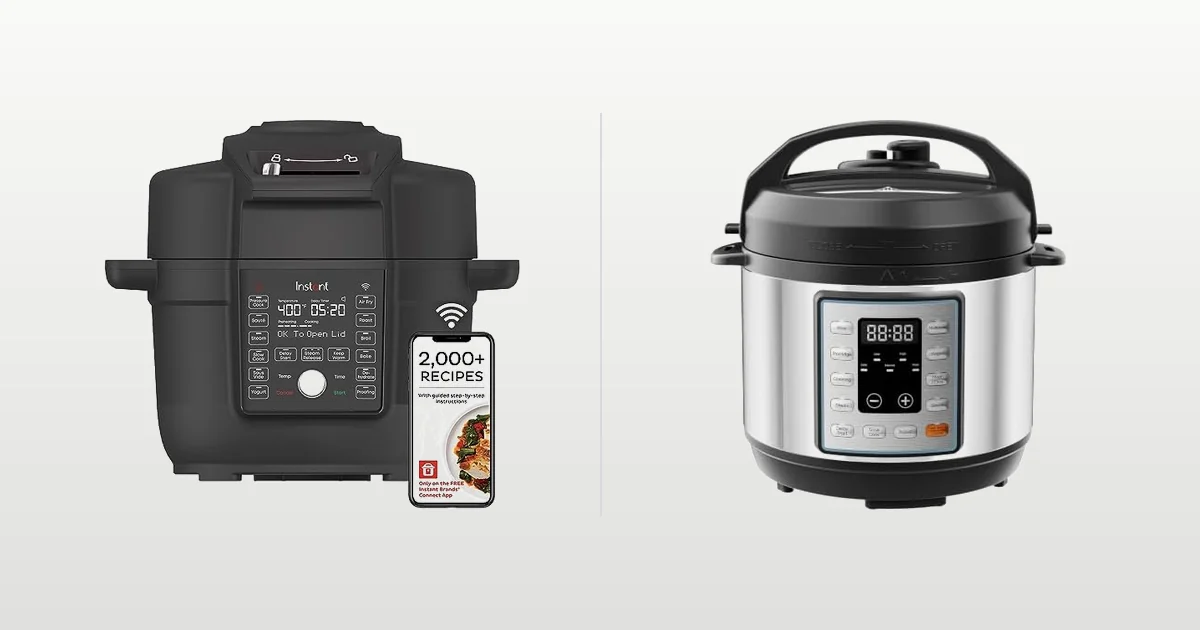
Genuine WiFi, an app with more than two thousand interactive recipes, and one lid that switches between pressure cooking and air frying.
 Best RankInstant Pot RIO Wide 7.5QT
Seven and a half quarts on a wide searing base, with thirteen one-touch programs Instant Pot describes as customisable smart programs.
 CheapestOLIXIS 10-In-1 3 Quart
Ten presets, a ceramic nonstick pot and a 24-hour delay timer, in a 3-quart body costing under forty dollars.
At a Glance
Ten Cookers, Sorted by What the Controls Do
Control type, function count, capacity, and the one specification each maker chose to lead on.
| # | Model | Control | Functions | Capacity | Detail | Standout | Main Drawback | Check Price |
|---|---|---|---|---|---|---|---|---|
| 1 |
 Instant Pot Duo Crisp Ultimate Lid Instant Pot Duo Crisp Ultimate Lid |
WiFi | 13-in-1 | 6.5 qt | 1500 W | One of only two here that connects to anything | $237.42, and the app is the reason | View on Amazon |
| 2 |
 Instant Pot Pro Plus Instant Pot Pro Plus |
App | 10-in-1 | 6 qt | NutriBoost | App control for sixty-eight dollars less | No air frying at this price | View on Amazon |
| 3 |
 CUCKOO Twin Pressure CRP-LHTR0609FW CUCKOO Twin Pressure CRP-LHTR0609FW |
Fuzzy logic | Induction | 23 modes | Twin pressure | The only unit here that senses and adapts rather than counting down | $503.99, and it never says ‘smart’ in the title | View on Amazon |
| 4 |
 Instant Pot RIO Wide 7.5QT Instant Pot RIO Wide 7.5QT |
13 presets | 7-in-1 | 7.5 qt | Wide base | Rank #206, and ‘smart programs’ here means one-touch buttons | No app and no connectivity | View on Amazon |
| 5 |
 Instant Pot Pro 8QT Instant Pot Pro 8QT |
28 presets | 10-in-1 | 8 qt | 1400 W | Twenty-eight one-touch programs, the most here | Still no connectivity at $199.99 | View on Amazon |
| 6 |
 Ninja HyperHeat PC201 Ninja HyperHeat PC201 |
2x faster | 9-in-1 | 6.5 qt | PFAS-free | The only maker here that does not claim to be smart | 9.5-inch pot needs the counter space | View on Amazon |
| 7 |
 Midea 12-in-1 8 Quart Midea 12-in-1 8 Quart |
12-in-1 | 8 qt | Stainless | REALSAFE | Twelve functions and a stainless inner pot for $106.99 | ‘Smart cooking programs’ is again just presets | View on Amazon |
| 8 |
 CAREY DPC-9SS CAREY DPC-9SS |
9.5 qt | Canning mode | Digital LED | Auto lock | A dedicated pressure canning function with automatic controls | Electric canners have real USDA caveats | View on Amazon |
| 9 |
 6Qt 9-in-1 Touchscreen 6Qt 9-in-1 Touchscreen |
12 presets | 1000 W | 24h delay | 16+ safety | Twelve presets and a touchscreen for under seventy dollars | Unbranded, with no maker record | View on Amazon |
| 10 |
 OLIXIS 10-In-1 3 Quart OLIXIS 10-In-1 3 Quart |
10-in-1 | 3 qt | Ceramic | 24h delay | Forty dollars, and it calls its presets smart too | Three quarts limits it to one or two people | View on Amazon |
Specifications and prices are taken from each manufacturer’s Amazon listing as displayed on 24 August 2026 through a United States connection, and may change. Control type is classified from each listing’s own description: connected means an app pairing is stated; adaptive means the listing describes sensing that changes behaviour during a cycle; preset means one-touch programs running fixed times. There is no standard defining ‘smart’ in this category, so every use of the word here is legitimate as written. Function counts are the manufacturers’ own and inflate easily — several listed functions share one mechanism with different timings. Electric multi-cookers are not currently USDA-endorsed for pressure canning low-acid foods, regardless of what a canning button is called; consult current preserving guidance before relying on any of them for that. Sales ranks are shown as displayed and can be pooled across a variant family — the Ninja rank here is shared across colour variants.
Scroll the table sideways to see every column
How We Chose These Ten
We researched current listings, compared manufacturer specifications and documentation, and examined recurring patterns in customer feedback. We did not carry out hands-on testing, and nothing below is presented as measured performance data.
- Control type classified from the listing’s own words — because the word smart is applied to buttons, timers and WiFi alike
- Connectivity recorded where stated — two of ten pair with an app; eight have no connectivity at all
- A verified live buy box — all ten confirmed purchasable in the United States on 24 August 2026
- No overlap with our four published pressure cooker guides — every cooker here is new to the site
- All three control tiers represented — connected, adaptive and preset, so the difference is visible
- Inner pot material noted — stainless, ceramic and conventional nonstick all appear, and they age differently
- Brand concentration acknowledged — Instant Pot holds four of ten slots because it dominates the category

The Ten Cookers in Detail
1. Instant Pot Duo Crisp Ultimate Lid — Best Overall

This is one of two products on this page that connects to anything. The other eight call themselves smart and mean buttons.
Key Specifications
| Connectivity | WiFi — pairs with the Instant Connect app |
|---|---|
| App | 2,000+ interactive recipes with step-by-step guidance and remote monitoring |
| Functions | 13 — pressure, air fry, slow cook, sous vide, dehydrate, proof and more |
| Lid | One lid switches between pressure and air frying, no attachments |
| Capacity | 6.5 quarts, up to 6 servings |
| Steam release | Activated from the control panel, with an ‘OK to Open Lid’ message |
| Power | 1500 W, 120 V 60 Hz, UL & ULC listed |
| Safety | 11+ features including overheat protection |
| Rank | #29,323 in its category |
| Price | $237.42 |
| Best For | Anyone who actually wants the connected features they are paying for |
Why We Recommend It
The app is the entire argument for the price. Instant Connect gives you guided recipes that drive the cooker directly — the appliance sets its own time and pressure for each step rather than asking you to. That is a genuine difference from a preset, because a preset is one fixed program and a guided recipe is a sequence that changes as you go.
Remote monitoring is the other real function. Being able to see from another room that a two-hour pressure cycle has finished and switched to keep-warm is a small thing that turns out to matter, and no amount of one-touch buttons on the front panel provides it.
The single-lid design is the mechanical achievement here. Most pressure-and-air-fry combinations ship two lids and expect you to swap and store the spare. This one switches modes without changing anything, which removes the most common reason those machines stop being used for air frying.
Rank #29,323 is low, and that is what connected appliances do — they sell in far smaller numbers than the $119.99 model four rows down. It is not evidence against the machine.
Pros
- Genuine WiFi with app-guided cooking
- 2,000+ interactive recipes that drive the cooker
- 13 functions from one lid, no attachments to swap
- Panel-activated steam release with a clear prompt
- 1500 W, the most power on this page
- Dishwasher-safe pot, rack and cover
Cons
- $237.42 — second most expensive here
- Rank #29,323, far behind the simpler models
- The app is the value, and apps get discontinued
- 6.5 qt is mid-sized for the money
- More parts to store than a plain pressure cooker
- Connected features are irrelevant if you never use them
Best for: Anyone buying the word smart and expecting it to mean connected.
2. Instant Pot Pro Plus — Best Connected Value

App control, sixty-eight dollars cheaper than the model above, and a pot you can put in the oven.
Key Specifications
| Connectivity | Pairs with the Instant Connect app |
|---|---|
| App | 2,000+ interactive recipes, remote monitoring |
| Functions | 10 — including sous vide, canning, yogurt and sterilising |
| NutriBoost | Pulses while cooking to mix ingredients for texture in rice, soups and risotto |
| Steam release | WhisperQuiet, one-touch or from the app |
| Pot | Stainless with a thick aluminium core, oven-safe to 350°F |
| Capacity | 6 quarts, up to 6 servings |
| Power | 1200 W, UL and ULC listed, 10+ safety mechanisms |
| Rank | #31,658 in its category |
| Price | $169.99 |
| Best For | Connected cooking without paying for the air fryer lid |
Why We Recommend It
NutriBoost is the feature worth understanding because it is the one genuinely novel mechanism on this page. It pulses the contents gently during cooking to keep them circulating, which addresses a real weakness of pressure cooking — ingredients settle and stratify in a sealed pot, so rice and risotto come out unevenly hydrated. Agitation during the cycle is a sensible answer and nobody else here does it.
An oven-safe pot to 350°F is more useful than it sounds. Sear in the cooker, pressure cook, then finish uncovered in the oven, all in one vessel. Most inner pots are not rated for this.
WhisperQuiet steam release is a real quality-of-life feature. A standard quick release is startlingly loud, which is why people leave pots to depressurise naturally and lose twenty minutes. A diffused release makes the fast option usable.
The canning function needs a caveat: electric multi-cookers are not USDA-approved for pressure canning low-acid foods, whatever the button is called. Use it for water-bath-suitable recipes and read the guidance before anything else.
Pros
- App control at $169.99, the cheapest connected unit here
- NutriBoost pulsing is unique on this page
- Pot is oven-safe to 350°F
- WhisperQuiet release makes fast venting usable
- Stainless pot with a thick aluminium core
- 10 functions including sous vide
Cons
- Rank #31,658 — lowest of the Instant Pots here
- No air frying capability
- Canning function is not USDA-approved for low-acid foods
- 1200 W against 1500 on the model above
- App dependency for the headline feature
- 6 quarts is standard rather than generous
Best for: Anyone who wants the app and does not need the air fryer.

3. CUCKOO Twin Pressure CRP-LHTR0609FW — Most Actually Intelligent

It detects what grain you put in and adjusts. It also never uses the word smart in its product title.
Key Specifications
| Control | Smart Fuzzy Logic — detects grain type and internal temperature, adapts automatically |
|---|---|
| Heating | Induction, surrounding the inner pot rather than heating from below |
| Twin pressure | Choose high-pressure or non-pressure cooking per recipe |
| Modes | 23, including GABA and brown rice, porridge, scorched rice and baby food |
| Capacity | 6 cups uncooked, 12 cups cooked |
| Display | LED panel |
| Keep warm | Automatic |
| Rank | #42,006 in its category |
| Price | $503.99 |
| Best For | Rice, and anyone who wants control that actually responds |
Why We Recommend It
This is the only genuinely adaptive machine on this page. Fuzzy logic here means the cooker reads internal temperature and grain behaviour during the cycle and changes what it does in response — extending soak, adjusting heat, altering the finish. Every other “smart” product in this roundup runs a fixed program to a fixed timer. That is the difference between a thermostat and an alarm clock, and it is the distinction the word smart ought to be marking.
Induction heating surrounds the pot rather than warming it from a plate underneath, which gives far more even heat and much finer control. It is why this costs what it costs.
Twin pressure is the unusual second idea. You choose whether a given batch cooks under pressure at all — high pressure for speed and texture on brown rice, no pressure for delicate grains that turn to paste under it.
Understand what you are buying. This is a rice cooker first. It is superb at grains and it is not a general-purpose 10-in-1 multi-cooker, and at $503.99 it is more than four times the price of the best-ranked product here.
Pros
- Genuinely adaptive fuzzy-logic control
- Induction heating surrounds the pot for even heat
- Twin pressure — pressure or no pressure per recipe
- 23 modes including GABA and scorched rice
- Automatic keep-warm with grain detection
- The only sensing control system on this page
Cons
- $503.99 — by far the most expensive here
- A rice cooker, not a general multi-cooker
- 6 cups uncooked is modest for the price
- Rank #42,006
- No app or connectivity of any kind
- Overkill unless you cook rice constantly
Best for: Rice, daily, by someone who will notice the difference.
4. Instant Pot RIO Wide 7.5QT — Best Rank

Instant Pot calls these “Customizable Smart Programs”. They are thirteen buttons.
Key Specifications
| Functions | 7 — pressure, slow cook, sauté, steam, rice, yogurt, warm |
|---|---|
| Programs | 13 one-touch options, described as ‘Customizable Smart Programs’ |
| Connectivity | None |
| Capacity | 7.5 quarts, up to 7 servings |
| Base | Wide — 35% more cooking area than a 12-inch skillet |
| Pot | 18/8 stainless, tri-ply bottom, anti-spin |
| Steam release | Easy-Release, WhisperQuiet |
| Power | 1200 W, UL & ULC listed, 10+ safety mechanisms |
| Rank | #206 — best on this page |
| Price | $119.99 |
| Best For | Almost everyone, if you accept that smart means presets |
Why We Recommend It
The naming is the point, and it is not dishonest. A one-touch program does encode real knowledge — the right pressure and time for rice, for beans, for a roast — and having that built in genuinely helps. But it is a menu of fixed recipes, not a system that senses anything, and Instant Pot’s own use of the word smart on a machine with no connectivity tells you how little the term constrains anyone.
The wide base is the real feature. Thirty-five percent more area than a 12-inch skillet means you can brown a full batch of meat in one go instead of three, and browning in batches is the single most tedious step in most pressure-cooker recipes.
An anti-spin pot is a small, sensible fix. Standard inner pots rotate when you stir or scrape, which makes searing awkward; this one locks against tabs in the housing.
Rank #206 is the best figure on this page by a wide margin, at the lowest price of any Instant Pot here. If you were going to buy one thing from this list without thinking hard, this is the defensible choice.
Pros
- Rank #206 — far ahead of anything else here
- $119.99, cheapest Instant Pot on this page
- 7.5 quarts, largest capacity here
- Wide base browns a full batch in one pass
- Anti-spin 18/8 stainless tri-ply pot
- WhisperQuiet Easy-Release
Cons
- No connectivity despite ‘smart programs’ branding
- Only 7 functions, fewest here
- No sous vide or air frying
- 1200 W for a 7.5 qt pot is modest
- Status lights rather than a full display
- Tall with the lid on — check cupboard height
Best for: The sensible default, as long as you know what you are not getting.
5. Instant Pot Pro 8QT — Most Presets

Twenty-eight one-touch programs. If presets are what smart means in this category, this is the smartest machine here.
Key Specifications
| Functions | 10 — including sous vide, sterilise, bake and yogurt |
|---|---|
| Programs | 28 one-touch options — most on this page |
| Connectivity | None |
| Capacity | 8 quarts, up to 8 servings |
| Preheat | 20% faster, cooking up to 70% faster than slow cooking |
| Steam release | Gentle switch with a diffusing cover |
| Power | 1400 W, UL & ULC listed |
| Included | Extra sealing ring and stainless steamer with handles |
| Rank | #626 in its category |
| Price | $199.99 |
| Best For | Anyone who wants the deepest preset library without an app |
Why We Recommend It
Preset depth is worth more than preset count sounds. Twenty-eight options against thirteen on the RIO means the categories are narrower — separate programs for different cuts and grains rather than one generic setting you then adjust. For anyone who cooks from the panel rather than from a recipe, that is the practical difference between the two machines.
An extra sealing ring in the box is a genuinely thoughtful inclusion. Silicone rings absorb odours and are the standard consumable on any pressure cooker; most owners discover this when their oatmeal tastes of curry. Having a second from day one lets you keep one for savoury and one for sweet.
Fourteen hundred watts in an 8-quart pot is the right relationship — large pots on modest elements take a long time to reach pressure, and preheat is the part of the cycle people forget when they read ‘70% faster’.
Rank #626 is second best here, and at $199.99 you are paying eighty dollars over the RIO for three more functions, half a quart less, and eighteen fewer minutes of your life per week.
Pros
- 28 one-touch programs, most on this page
- Rank #626, second best here
- 1400 W suits the 8-quart capacity
- Extra sealing ring included from new
- Diffusing cover makes steam release quiet
- 10 functions including sous vide and sterilise
Cons
- No connectivity at $199.99
- Eighty dollars more than the better-ranked RIO
- 8 quarts is too large for one or two people
- No air frying
- Preset count is not the same as capability
- Large footprint on a counter
Best for: Cooks who work from the control panel rather than from an app.
6. Ninja HyperHeat PC201 — Fastest

Ninja does not call this smart anywhere. It calls it fast, and then explains how.
Key Specifications
| Speed | HyperHeat builds pressure to cook up to 2x faster |
|---|---|
| Functions | 9 — pressure, slow cook, rice, sous vide, steam and more |
| Pot | Removable SimpliServe ceramic nonstick, 100% PFAS-free |
| Cooking surface | 9.5-inch diameter for searing without crowding |
| Capacity | 6.5 qt — a 4-lb chicken or 5-lb roast, 8–10 people |
| Rice | White rice in as little as 8 minutes, quinoa in 5 |
| Power | 1200 W heating system |
| Marketing note | Compares its power directly against Instant Pot |
| Rank | #4,481, pooled across colour variants |
| Price | $169.99 |
| Best For | Speed, and a pot that goes from cooker to table |
Why We Recommend It
That is worth crediting on a page like this one. Where eight competitors use a word that means nothing in particular, Ninja makes a specific mechanical claim — that HyperHeat reaches pressure faster — and points at the thing responsible. Preheat is genuinely most of the wait in pressure cooking, so attacking it is attacking the right problem.
PFAS-free ceramic nonstick is a real specification, not a slogan. PFAS are the fluorinated compounds behind conventional nonstick, and ceramic coatings avoid them entirely at the cost of a shorter useful life — ceramic loses its release properties faster than PTFE does. It is a trade some buyers now want made explicitly.
SimpliServe means the pot comes out and goes on the table, which removes a serving dish from the washing-up. Small, and you notice it every time.
Note the pooled rank. #4,481 is shared across Ninja’s colour variants, so it describes the family rather than this particular finish.
Pros
- Makes a specific mechanical speed claim, not a vague one
- Roughly 2x faster to pressure
- PFAS-free ceramic nonstick pot
- 9.5-inch searing surface, widest here
- Removable pot goes cooker to table
- Rice in 8 minutes, quinoa in 5
Cons
- Rank pooled across colour variants
- Ceramic nonstick wears out faster than PTFE
- No connectivity and no preset depth claim
- 1200 W for 6.5 qt
- Comparative marketing against a named rival
- Wide base needs real counter space
Best for: Anyone who wants speed and can do without the vocabulary.
7. Midea 12-in-1 8 Quart — Most Functions

Eight quarts and twelve functions for $106.99. On paper this is the best value on the page.
Key Specifications
| Functions | 12 — pressure, sauté, steam, slow cook, oatmeal, soup, rice, chili, yogurt and more |
|---|---|
| Programs | One-touch cooking modes, described as ‘Smart Cooking Programs’ |
| Connectivity | None |
| Inner pot | Stainless steel, dishwasher safe |
| Capacity | 8 quarts |
| Safety | REALSAFE system — 9-in-1 protection including pressure limit and over-temperature |
| Speed | Up to 70% faster than traditional methods |
| Rank | #9,462 in its category |
| Price | $106.99 |
| Best For | Maximum functions and capacity for the money |
Why We Recommend It
A stainless inner pot rather than a coated one is the specification that matters most for longevity. Nonstick coatings on pressure cooker pots are scraped by metal utensils, scoured after searing and subjected to repeated thermal cycling, and they fail within a few years. Bare stainless does not fail; it just needs deglazing rather than wiping.
Twelve functions is the highest count here, though function counts inflate easily — oatmeal, soup, chili and rice are all the same mechanism with different times, and listing them separately is a marketing convention rather than a capability claim.
The REALSAFE system is nine separate protections including pressure limiting and over-temperature cut-off, which is comparable to the ten or eleven Instant Pot cites. Safety architecture in this category is mature and broadly equivalent across brands.
‘Smart Cooking Programs’ again means one-touch buttons, with no connectivity anywhere on the listing.
Pros
- 12 functions, most on this page
- Stainless inner pot outlasts nonstick
- 8 quarts at $106.99 — best value per quart
- REALSAFE nine-way protection
- Dishwasher-safe pot and lid
- Rank #9,462
Cons
- No connectivity despite ‘smart programs’ branding
- Function count is inflated by similar modes
- No wattage published
- Stainless sticks more than nonstick when searing
- 8 quarts is too big for small households
- No sous vide or air frying
Best for: Anyone who wants the most pot and the most modes for the least money.
8. CAREY DPC-9SS — Best for Canning

Nine and a half quarts with a canning rack, and automatic management of time, pressure and temperature.
Key Specifications
| Canning | Dedicated function with built-in safety controls managing time, pressure and temperature |
|---|---|
| Modes | Pressure cook, slow cook, steam and water bath |
| Display | Digital LED with preset programs |
| Safety | Automatic lock lid, float valve and pressure regulation |
| Capacity | 9.5 quarts — largest here |
| Inner pot | Removable nonstick |
| Included | Canning and steam racks |
| Rank | #11,785 in its category |
| Price | $153.47 |
| Best For | Water-bath preserving, with the low-acid caveat understood |
Why We Recommend It
Read this section before you buy it for canning. The USDA does not currently endorse electric multi-cookers for pressure canning low-acid foods — vegetables, meats, most soups — because their internal pressure and temperature cannot be independently verified the way a dial or weighted gauge on a stovetop canner can. That is a caution about the appliance class, not about this unit specifically, and it applies to every electric canner sold.
What it is genuinely good for is water-bath processing — jams, jellies, pickles, chutneys and anything high-acid — where the requirement is holding a rolling boil for a set time, and automatic control is a real convenience over watching a stockpot.
Automatic time, pressure and temperature management is closer to genuinely smart behaviour than most of this page manages, because a canning cycle must hold conditions rather than simply run a timer.
The word Smart is in the product name, and there is no connectivity. That is the pattern.
Pros
- Dedicated canning function with automatic control
- 9.5 quarts — largest capacity here
- Canning and steam racks included
- Automatic lid lock and float valve
- Water bath mode as well as pressure
- Genuinely holds conditions rather than counting down
Cons
- Not USDA-endorsed for low-acid pressure canning
- ‘Smart’ in the name, no connectivity
- Nonstick inner pot rather than stainless
- Rank #11,785
- 9.5 quarts is large for everyday cooking
- Read preserving guidance before relying on it
Best for: High-acid water-bath preserving, by someone who has read the guidance.
9. 6Qt 9-in-1 Touchscreen — Best Budget 6-Quart

Seventy dollars for six quarts, twelve presets and a touchscreen. The specification sheet is competitive with machines at twice the price.
Key Specifications
| Functions | 9 — pressure, slow cook, steam, sauté, bake, rice, warm |
|---|---|
| Presets | 12 one-touch, on an IMD touchscreen |
| Power | 1000 W |
| Delay start | 24 hours |
| Capacity | 6 quarts, serves up to 6 |
| Pot | Nonstick |
| Safety | 16+ features — lid lock, steam release, overheat and pressure safeguards |
| Rank | #17,861 in its category |
| Price | $69.98 |
| Best For | A capable 6-quart cooker at the lowest sensible price |
Why We Recommend It
Sixteen-plus safety features is the highest count on this page, above Instant Pot’s stated eleven and Midea’s nine. Safety architecture in pressure cooking is well understood and largely standardised, so a high count from an unbranded maker is reassuring rather than remarkable — it means they have implemented the conventional set.
An IMD touchscreen at $69.98 is in-mould decoration, where the graphics are sealed inside the panel rather than printed on top. It does not wear off, which is the usual failure on cheap control panels.
A 24-hour delay start is genuinely useful and is the feature most often missing at this price — load in the morning, come home to food.
The trade is the brand. There is no maker record here, no app, no warranty detail, and a nonstick pot that will not last like stainless. At $69.98 against $119.99 for the best-ranked Instant Pot, the fifty-dollar gap buys you a company that will still exist.
Pros
- $69.98 — cheapest 6-quart here
- 12 one-touch presets on an IMD touchscreen
- 16+ safety features, most stated on this page
- 24-hour delay start
- 1000 W in a 6-quart pot
- Touchscreen graphics sealed against wear
Cons
- Unbranded with no maker record
- Nonstick pot rather than stainless
- No connectivity of any kind
- 1000 W is the lowest here
- Rank #17,861
- No warranty detail published
Best for: The lowest sensible price for a full-size, fully featured pot.
10. OLIXIS 10-In-1 3 Quart — Cheapest

Thirty-nine ninety-five, and the listing uses the word smart twice — once for its presets and once for a timer.
Key Specifications
| Functions | 10 presets — rice, meat, stew, yogurt, canning and more |
|---|---|
| Described as | ‘Ten smart presets’ and a ‘Smart 24-Hour Delay Start Timer’ |
| Connectivity | None |
| Capacity | 3 quarts |
| Inner pot | Food-grade ceramic nonstick |
| Body | Stainless steel outer |
| Delay | 24-hour start, with automatic keep-warm |
| Safety | Triple protection — release valves and heat sensors |
| Rank | #4,054 in its category |
| Price | $39.95 |
| Best For | One or two people, or a second pot for side dishes |
Why We Recommend It
A delay timer described as smart is where this vocabulary ends up. A 24-hour delay start is a clock. It is a useful clock, and it is the same mechanism that has been in rice cookers for forty years. Nothing about it senses, adapts or connects, and calling it smart costs the seller nothing because there is no definition to breach.
Three quarts is genuinely small, and that is its argument rather than its flaw. Most pressure cooker recipes scale down badly because a minimum liquid volume is needed to generate steam, so a small pot cooking small portions works better than a large pot half empty. As a second cooker for rice or vegetables alongside a main pot, it earns its counter space.
Ceramic nonstick avoids PFAS and wears faster than PTFE, the same trade the Ninja makes at four times the price.
Rank #4,054 at $39.95 makes this the best-ranked budget option here by a wide margin.
Pros
- $39.95 — cheapest on this page
- Rank #4,054, strong for the price
- Ceramic nonstick avoids PFAS
- 24-hour delay start with keep-warm
- 3 quarts suits small-batch recipes properly
- Stainless outer body
Cons
- 3 quarts is too small for a family
- Calls a delay timer ‘smart’
- Ceramic coating wears faster than PTFE
- No connectivity
- Triple safety protection, fewest stated here
- Unfamiliar brand
Best for: One or two people, or a second pot running alongside a bigger one.
Connected Against Preset, at Similar Money
Both are Instant Pots. Only one of them talks to anything.
| Instant Pot Pro Plus | Instant Pot Pro 8QT | |
|---|---|---|
| App connectivity | Yes — Instant Connect | No |
| Guided recipes | 2,000+ interactive | No |
| Remote monitoring | Yes | No |
| One-touch programs | 10 functions | 28 programs |
| Capacity | 6 qt | 8 qt |
| Power | 1200 W | 1400 W |
| Rank | #31,658 | #626 |
| Price | $169.99 | $199.99 |
The cheaper machine is the connected one, and it ranks fifty times worse. That gap is the clearest evidence on this page that buyers are not, in fact, buying connectivity — they are buying capacity and preset depth, and the Pro at $199.99 gives them more of both. If the app is not something you will genuinely use, the unconnected machine is the better appliance.
What Each Control System Actually Does
Three tiers, and only one of them is what the word implies.
| Cooker | Control tier | Connects | Senses & adapts | Price |
|---|---|---|---|---|
| Instant Pot Duo Crisp Ultimate Lid | Connected | WiFi + app | No | $237.42 |
| Instant Pot Pro Plus | Connected | App | No | $169.99 |
| CUCKOO Twin Pressure | Adaptive | No | Fuzzy logic, grain + temp | $503.99 |
| CAREY DPC-9SS | Preset+ | No | Holds canning conditions | $153.47 |
| Instant Pot Pro 8QT | Preset | No | No | $199.99 |
| Instant Pot RIO Wide | Preset | No | No | $119.99 |
| Ninja HyperHeat | Preset | No | No | $169.99 |
| Midea 12-in-1 | Preset | No | No | $106.99 |
| 6Qt 9-in-1 Touchscreen | Preset | No | No | $69.98 |
| OLIXIS 3 Quart | Preset | No | No | $39.95 |
Notice which products avoid the word entirely. Ninja never claims to be smart — it claims to be fast and explains the mechanism. CUCKOO, the only machine here that genuinely senses and adapts, does not put smart in its title either. The heaviest users of the word are the machines with the least behind it, which is exactly what you would expect from a term nothing constrains.
Best Alternatives
| Alternative | Why Consider It | Better For | Main Trade-Off |
|---|---|---|---|
| A stovetop pressure cooker | No electronics to fail, higher pressure, decades of life | Anyone who wants the cooking, not the computer | You manage the heat yourself |
| A plain 7-in-1 electric cooker | The presets people actually use, for far less | Most households, most of the time | No app, no sous vide, no air frying |
| A slow cooker plus a rice cooker | Two simple machines that each do one thing well | Cooks who batch and forget rather than rush | Two appliances to store |
| A Dutch oven | No electronics at all, works on any hob or oven | Braises and stews where speed is not the point | Hours rather than minutes |
What the Money Actually Buys
$39.95 to $119.99 — OLIXIS, 6Qt Touchscreen, Midea, Instant Pot RIO Wide. The value tier, and it contains the best-ranked product on the page at #206. Nothing here connects to anything, and none of it needs to. The Midea’s stainless inner pot and the RIO’s wide searing base are the two specifications in this tier that will still matter in five years.
$153.47 to $199.99 — CAREY, Ninja HyperHeat, Instant Pot Pro Plus, Instant Pot Pro. Where the decisions get interesting. The Pro Plus is the cheapest genuinely connected machine; the Pro has the deepest preset library; the Ninja is the fastest to pressure; the CAREY is the only one built around holding conditions rather than counting down.
$237.42 to $503.99 — Duo Crisp Ultimate Lid, CUCKOO. Two completely different arguments for spending more. The Instant Pot buys you WiFi, app-guided cooking and air frying from one lid. The CUCKOO buys you induction heating and a control system that actually reads what is happening inside the pot — and it is a rice cooker.
What to Check Before You Buy
Decide Whether You Want Connected, Adaptive or Preset
These are three genuinely different things and the word smart covers all of them. Connected means the cooker pairs with an app that can drive it through a multi-step recipe and report back remotely — two machines here do this. Adaptive means the cooker senses conditions inside the pot and changes its behaviour mid-cycle, which exactly one machine here does. Preset means a menu of fixed programs, each a stored time and pressure, which is what the remaining seven mean and what most buyers are actually getting.
Presets Are Not a Consolation Prize
Worth saying plainly, because the point of this article is not that presets are bad. A one-touch bean program encodes genuine knowledge about the right pressure and duration, and having it built in saves looking anything up. Preset depth varies substantially and is worth comparing directly: the Instant Pot Pro offers 28 one-touch options against 13 on the RIO, which means narrower, more specific categories rather than one generic setting you then adjust yourself. If you cook from the panel, that difference matters more than connectivity ever will.
An App Is a Dependency as Well as a Feature
The two connected machines here are worth having if you will use the guided recipes, and it is worth being clear-eyed about what you are relying on. App-driven features stop working when an app is discontinued, when a phone OS update breaks compatibility, or when a manufacturer decides to retire a product line’s cloud service. The pressure cooker underneath keeps working exactly as before, so nothing is bricked — but the feature you paid the premium for is not permanent in the way a stainless pot is.
Check the Inner Pot Material
This is the specification most likely to determine how long the machine stays pleasant to use, and three different answers appear here. Stainless steel does not degrade — it stains, it needs deglazing rather than wiping, and it will outlive the electronics. Conventional nonstick releases easily and wears out within a few years of searing and scrubbing. Ceramic nonstick, on two machines here, avoids PFAS entirely and loses its release properties faster than PTFE does. All three are defensible; only stainless is permanent.
Preheat Is the Part of ‘Faster’ Nobody Counts
Almost every listing here claims cooking up to 70% faster than traditional methods, and that figure describes the pressure cycle only. It excludes the time the cooker spends getting to pressure, which on a large pot with a modest element can be fifteen or twenty minutes. This is why the relationship between wattage and capacity matters more than either number alone: 1400 watts in an 8-quart pot is sensible, and 1000 watts in a 6-quart pot means waiting. One maker here attacks preheat directly and says so.
Steam Release Quality Decides Whether You Use It
A standard quick release is genuinely startling — a jet of steam and a noise that makes people leave the room. The practical consequence is that owners stop using quick release, let the pot depressurise naturally instead, and lose fifteen to twenty minutes on every meal, which quietly undoes the speed advantage they bought. Several machines here address it with diffusing covers or damped valves, and one activates release from the control panel with a clear prompt when the lid is safe to open.
Treat Electric Canning Claims Carefully
One machine here has a dedicated canning function with automatic control of time, pressure and temperature, and it is genuinely useful for high-acid water-bath preserving — jams, pickles, chutneys. For low-acid foods such as vegetables, meats and most soups, the USDA does not currently endorse electric multi-cookers for pressure canning, because their internal conditions cannot be independently verified the way a dial or weighted gauge on a stovetop canner can. That is a caution about the whole appliance class rather than about any one product.
Common Mistakes
- Assuming ‘smart’ means connected. Eight of these ten have no connectivity of any kind.
- Paying for an app you will not open. The unconnected Instant Pot Pro ranks fifty times better than the connected one.
- Reading function counts as capability. Oatmeal, soup, chili and rice are one mechanism with four names.
- Ignoring the inner pot material. Nonstick wears out; stainless outlives the electronics.
- Believing ‘70% faster’ includes preheat. It does not, and preheat is where large pots lose the time.
- Buying 8 quarts for two people. Pressure recipes need minimum liquid; a half-empty large pot cooks worse.
- Pressure canning low-acid food in an electric cooker. The USDA does not endorse it, whatever the button says.
Who Should Buy Which
Buy the Instant Pot RIO Wide at $119.99 unless something specific pushes you elsewhere. Rank #206 by a wide margin, 7.5 quarts, a wide searing base and an anti-spin stainless pot — and no pretence that its buttons are anything but buttons.
Buy the Duo Crisp Ultimate Lid at $237.42 if you genuinely want connected. Real WiFi, app-guided recipes that drive the cooker, and pressure plus air frying from a single lid.
Buy the CUCKOO at $503.99 if you cook rice every day. Induction heating and fuzzy-logic control that reads grain type and temperature — the only machine here whose controls actually respond to anything.
Buy the Midea at $106.99 for the most pot and modes per pound. Eight quarts, twelve functions, and a stainless inner pot that will outlast the electronics.
Buy the OLIXIS at $39.95 as a second cooker. Three quarts is the right size for small-batch recipes that scale badly in a big pot.

Frequently Asked Questions
What does ‘smart’ actually mean on a pressure cooker?
Usually, that it has preset buttons. There is no standard the word has to meet in this category, so it is applied to three quite different things. Two machines in this roundup are genuinely connected, pairing with an app that can drive the cooker through a multi-step guided recipe and let you monitor progress remotely. One is genuinely adaptive, using fuzzy logic to detect grain type and internal temperature and change its behaviour during the cycle. The remaining seven use smart to describe one-touch programs, which are stored combinations of time and pressure — useful, but a menu rather than an intelligence. The clearest illustration is a $39.95 cooker whose listing describes its 24-hour delay start as a Smart 24-Hour Delay Start Timer. That is a clock.
Is a WiFi pressure cooker worth it?
Only if you will use the guided recipes, and the sales figures suggest most people do not. The two connected machines here rank #29,323 and #31,658, while the unconnected Instant Pot RIO Wide at $119.99 ranks #206 — a gap of more than a hundredfold. What connectivity genuinely gives you is app-driven recipes where the appliance sets its own time and pressure for each step rather than asking you to, plus the ability to check from another room whether a long cycle has finished. Both are real conveniences. Against that, an app is a dependency: it can be discontinued or broken by a phone update, and when that happens the cooker still works but the feature you paid extra for does not.
How many cooking functions do I actually need?
Fewer than the listings suggest, because function counts inflate easily. A 12-in-1 cooker is not doing twelve mechanically different things — oatmeal, soup, chili, stew and rice are all the same pressure mechanism with different times and pressures, listed separately because a bigger number sells better. The functions that genuinely differ are pressure cooking, slow cooking, sautéing, steaming, sous vide, yogurt and air frying, because each uses the hardware differently. In practice most owners use pressure, sauté and slow cook, and almost nobody uses yogurt more than once. Compare preset depth within a function instead: 28 one-touch options across ten functions is more useful than twelve function names.
What is fuzzy logic in a rice cooker?
It is a control system that senses conditions and adjusts, rather than running a fixed timer. A basic rice cooker heats until the water is gone and then switches to warm. A fuzzy-logic cooker monitors internal temperature and how the grain is behaving through the cycle and modifies what it does in response — extending soaking, changing heat, altering the finishing stage — which is why it can handle brown rice, GABA rice, porridge and white rice properly rather than approximately. One machine in this roundup uses it, and it is the only genuinely adaptive control system on the page. It is also, notably, the one product here that does not use the word smart in its product title.
Can I pressure can in an electric pressure cooker?
For high-acid foods processed in a water bath — jams, jellies, pickles, chutneys — yes, and one machine here has a dedicated function that manages the cycle automatically, which is genuinely more convenient than watching a stockpot. For low-acid foods such as vegetables, meats and most soups, the USDA does not currently endorse electric multi-cookers for pressure canning. The reason is verification: a stovetop canner has a dial or weighted gauge that lets you confirm the pressure and therefore the temperature actually reached, and an electric cooker’s internal conditions cannot be independently checked. This is a caution about the appliance class rather than about any particular unit, and it applies regardless of what the button on the front is called.
Why does my pressure cooker take so long when it claims 70% faster?
Because that figure describes the pressure cycle and excludes preheating. Before any cooking happens the machine has to bring its contents to temperature and build pressure, which on a large pot with a modest heating element can take fifteen to twenty minutes, and on a full 8-quart pot of cold liquid longer still. Then there is depressurising at the end, which on a natural release adds another ten to twenty. A recipe listed as eight minutes at pressure is realistically forty minutes door to door. The specification that predicts this is wattage relative to capacity: 1400 watts in an 8-quart pot is well matched, whereas 1000 watts in a 6-quart pot means waiting. One manufacturer here targets preheat specifically and explains the mechanism rather than just claiming a percentage.
Final Verdict
Genuine WiFi, app-guided recipes that drive the cooker, and pressure plus air frying from one lid. $237.42.
Rank #206 by a wide margin, 7.5 quarts, a wide searing base and an anti-spin stainless pot. $119.99.
Ten presets, a ceramic pot and a 24-hour delay for $39.95 — right-sized for small-batch cooking.
Smart means presets here, eight times out of ten. Instant Pot applies it to thirteen buttons on a cooker with no connectivity. Midea applies it to one-touch modes. A forty-dollar machine applies it to a delay timer. None of that is dishonest, because nothing defines the word — which is exactly why it cannot help you choose.
The two products that avoid it are the interesting ones. Ninja claims speed and names the mechanism. CUCKOO, the only cooker here whose controls actually sense and adapt, does not use the word at all.
So sort by what the controls do. Connected if you will genuinely use an app. Adaptive if you cook rice seriously enough to notice. Preset for everyone else — which is most people, and there is nothing second-rate about it.
Then buy the RIO Wide at $119.99, and spend the difference on a stainless pot that will outlast the electronics inside whatever you chose.