Affiliate Disclosure: As an Amazon Associate, we earn from qualifying purchases. This does not affect the price you pay.
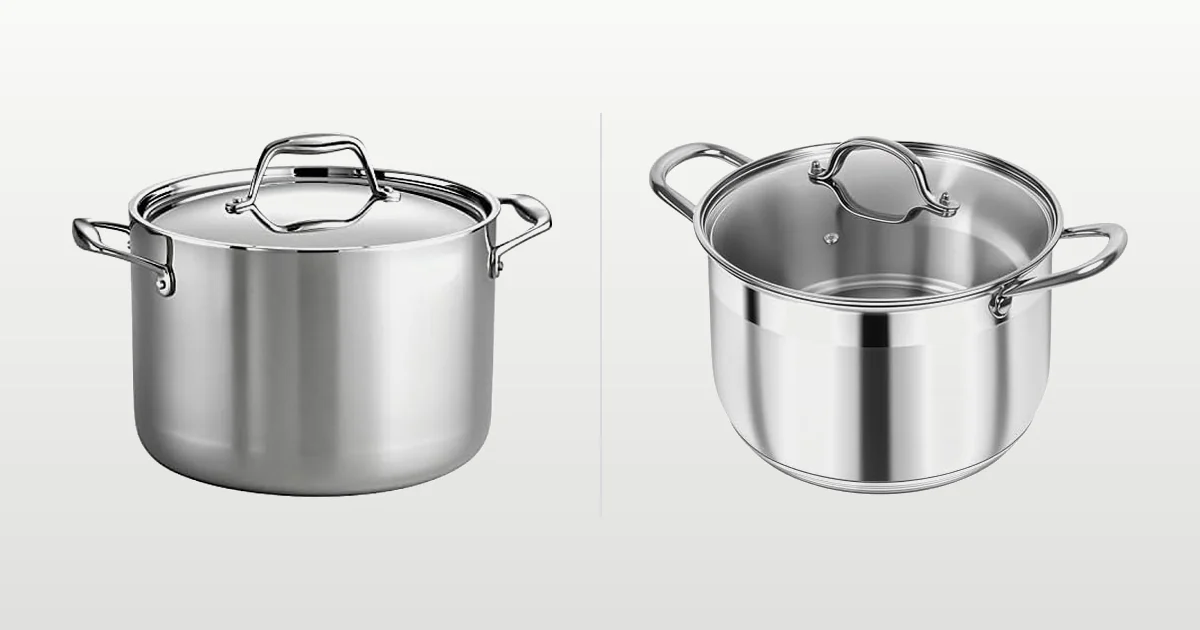
A stock pot spends its working life full of liquid at 212°F. That number does not change however much the pot cost.
This matters because the thing cookware is sold on — heat distribution — is largely solved for you here by the contents. Liquid circulates and equalises its own temperature by convection far more effectively than any arrangement of metal, so the fully clad walls that transform a sauté pan are doing very little in a pot of soup. The $82.99 clad pot and the $24.72 disc-base pot boil water identically.
Base construction is not irrelevant — a thick chowder, a chilli or a reduction will scorch on a thin bottom, and that is a real failure. But it is the only place the money buys performance.
What actually varies here is more mundane and nobody leads with it. Capacity runs from 5 quarts to 16, and 16 quarts of liquid weighs over thirty pounds. Oven ceilings run from 300°F to 900°F, and on most of these pots the limiting component is the glass lid rather than the pot — two listings say so and the rest leave you to work it out. Four of the ten are nonstick, in a vessel where almost nothing sticks.
$24.72 to $169.00 below, and the pot we would buy is the second cheapest.
Our Quick Picks
 Best OverallTramontina Signature Tri-Ply 8 Quart
Fully clad tri-ply construction with an aluminium core running up the walls, NSF certified, oven safe to 500°F and warranted for life.
 Best ValueCook N Home Basics 8 Quart
Mirror-polished 18/10 stainless with an aluminium disc bonded between steel layers, at less than a third of the price of the clad pot above.
 Best MarkingsSunhouse 11 Quart Tri-Ply Bottom
Eleven quarts with a bonded tri-ply bottom, copper-tone stay-cool handles, and volume markings printed inside the pot.
At a Glance
Ten Pots, and Where the Money Actually Goes
Capacity, base construction, published oven limit and cooking surface. Read capacity first and construction last.
| # | Model | Capacity | Base | Oven Limit | Surface | Standout | Main Drawback | Check Price |
|---|---|---|---|---|---|---|---|---|
| 1 |
 Tramontina Signature Tri-Ply 8 Quart Tramontina Signature Tri-Ply 8 Quart |
8 qt | Fully clad | 500°F | Bare steel | NSF certified with a lifetime warranty, and clad all the way up the walls | $82.99 — more than three of these pots put together | View on Amazon |
| 2 |
 Cook N Home Basics 8 Quart Cook N Home Basics 8 Quart |
8 qt | Disc base | 500°F pot | Bare 18/10 | Names the alloy and publishes separate pot and lid ceilings | A disc base can scorch a thick sauce more readily than full cladding | View on Amazon |
| 3 |
 Sunhouse 11 Quart Tri-Ply Bottom Sunhouse 11 Quart Tri-Ply Bottom |
11 qt | Tri-ply bottom | Oven safe | Bare steel | Interior measurement markings, which nothing else here has | The title says 11 quarts and the size field says 12 | View on Amazon |
| 4 |
 Amazon Basics 8 Quart Encapsulated Amazon Basics 8 Quart Encapsulated |
8 qt | Encapsulated base | 500°F without lid | Bare steel | States plainly that the 500°F figure excludes the lid | Heavy-gauge steel makes it noticeably weighty when full | View on Amazon |
| 5 |
 IMUSA 16 Quart Stainless IMUSA 16 Quart Stainless |
16 qt | Stainless | Not stated | Bare steel | Sixteen quarts — three times the smallest pot on this page | Sixteen quarts of liquid weighs over thirty pounds | View on Amazon |
| 6 |
 Kirecoo 12 Quart 5-Layer Base Kirecoo 12 Quart 5-Layer Base |
12 qt | 5-layer base | Not stated | Nonstick interior | A five-layer bottom, the most layers published on this page | A nonstick coating inside a stock pot has almost nothing to do | View on Amazon |
| 7 |
 HexClad 10QT Hybrid HexClad 10QT Hybrid |
10 qt | Tri-ply clad | 900°F | Hybrid steel/ceramic | 900°F and metal-utensil safe, which no coated pot manages | $169.00 — more than five of these pots combined | View on Amazon |
| 8 |
 CAROTE 8QT Full Clad Tri-Ply CAROTE 8QT Full Clad Tri-Ply |
8 qt | Fully clad | Oven safe | Bare 18/8 | Full tri-ply cladding for $24.98, a third of the price of the clad pot above | A 12-month warranty against a lifetime one elsewhere | View on Amazon |
| 9 |
 Gotham Steel 5 Quart Strainer Lid Gotham Steel 5 Quart Strainer Lid |
5 qt | Solid aluminium | 300°F | Ti-Cerama ceramic | A locking strainer lid that drains pasta without a colander | 300°F is the lowest oven ceiling on this page | View on Amazon |
| 10 |
 CAROTE 6 Quart Granite Nonstick CAROTE 6 Quart Granite Nonstick |
6 qt | Die-cast, triple ply | Not stated | Granite nonstick | A rivetless interior, so there is nothing inside for food to catch on | A 5mm coating in a pot that mostly boils water | View on Amazon |
Capacities, materials, prices and specifications are taken from each manufacturer’s Amazon listing as displayed on 25 August 2026 through a United States connection, and may change. One listing states two different capacities — 11 quarts in its product title and 12 quarts in its size field — and both are reported rather than resolved. Five listings publish no oven temperature at all; where a figure is absent the table says so rather than estimating one. Note that oven ratings frequently exclude the lid: one pot states 500°F for the pot and 350°F for the lid, another states 500°F “without the lid”, and a third states 900°F for the pot and 400°F for the glass lid. Where a maker gives a single figure with a glass lid fitted, treat the lid as the limiting component. One listing carries a California chemical disclosure naming chromium, nickel, iron and manganese; these are constituents of stainless steel generally. Sales ranks are shown as displayed and can be pooled across a variant family.
Scroll the table sideways to see every column
How We Chose These Ten
We researched current listings, compared manufacturer specifications and documentation, and examined recurring patterns in customer feedback. We did not carry out hands-on testing, and nothing below is presented as measured performance data.
- Capacity treated as the primary specification — 5 to 16 quarts here, and it decides what the pot can actually do
- Base construction distinguished from full cladding — they are different things and only one of them matters much in this shape
- Oven limits recorded, including lid caveats — three listings separate pot from lid; five publish nothing
- A verified live buy box — all ten confirmed purchasable in the United States on 25 August 2026
- Coated and bare pots both included — four here are nonstick, and we say where that helps and where it does not
- Handle and weight considerations noted — 16 quarts of liquid is over 30 lb before you count the pot
- No overlap with our published cookware guides — every pot here is new to the site
The Ten Pots in Detail
1. Tramontina Signature Tri-Ply 8 Quart — Best Overall

This is the best-built pot here and the honest question is whether a stock pot needs to be this well built.
Key Specifications
| Capacity | 8 quarts |
|---|---|
| Construction | Tri-ply clad — aluminium core through base and walls |
| Oven limit | 500°F |
| Cooktops | Gas, electric, induction and ceramic glass |
| Lid | Stainless steel, seals in moisture |
| Handles | Riveted stainless |
| Certification | NSF certified |
| Warranty | Lifetime |
| Dishwasher | Safe |
| Rank | #489 — highest on this page |
| Price | $82.99 |
| Best For | One pot, bought once, that a health inspector would also accept |
Why We Recommend It
Fully clad means the aluminium layer runs up the sides, not just across the base. On a sauté pan that matters enormously, because you brown food against the walls. In a stock pot you are almost always boiling or simmering liquid, and liquid distributes heat by convection far more effectively than any metal — so the walls are being heated by the soup rather than the other way round.
Where cladding does earn its money is the base, and only for thick things. A reduction, a thick chowder or a chilli left to catch will scorch on a thin bottom, and that is a real failure that a good base prevents.
A stainless lid rather than glass is the detail that raises the oven limit. Two pots on this page are capped by their glass lids at 350°F and 300°F; this one goes to 500°F complete.
NSF certification and a lifetime warranty are the only pairing of their kind on this page, and rank #489 says the market has noticed.
Pros
- Fully clad, not just a disc base
- NSF certified — unique here alongside nothing else
- Lifetime warranty
- 500°F with the lid on, because the lid is steel
- Rank #489, best selling on this page
- Works on every cooktop including induction
Cons
- $82.99 — dearest apart from the HexClad
- Cladding matters least in this pot shape
- 8 quarts is mid-sized for stock
- Steel lid means you cannot see in
- Bare steel needs preheating to stop sticking
- Heavier than a disc-base pot
Best for: Buying one pot for life, where the certification and warranty are the point.
2. Cook N Home Basics 8 Quart — Best Value

This pot publishes two oven temperatures where everyone else publishes one, and the second is the honest one.
Key Specifications
| Capacity | 8 quarts |
|---|---|
| Steel | 18/10 stainless, mirror polished |
| Base | Aluminium disc between steel layers |
| Oven limit | 500°F pot; lids 350°F |
| Cooktops | Gas, electric, glass, ceramic, halogen and induction |
| Lid | Tempered glass with steam vent |
| Handles | Riveted stainless, wide and deep |
| Storage | Stackable |
| Dishwasher | Safe |
| Rank | #5,768 in its category |
| Price | $24.72 |
| Best For | Almost everyone — this is what a stock pot actually needs to be |
Why We Recommend It
“Oven safe up to 500°F and lids safe up to 350°F” is the clearest statement on this page. A tempered glass lid is the weakest component in almost every pot here, and a maker who separates the two figures is telling you something the others leave you to discover. If you braise in the oven with the lid on, 350°F is your actual ceiling.
18/10 is a named alloy — 18% chromium for corrosion resistance, 10% nickel for the finish and the non-reactivity — where most listings here say only “stainless steel”.
A disc base is the right economy in a stock pot. The aluminium sits where the heat enters and the walls are heated by the liquid anyway; you are paying $58.27 less than the fully clad pot for a difference you will notice only when reducing something thick.
Wide, deep riveted handles matter at this size, because eight quarts of stock weighs about seventeen pounds before you count the pot.
Pros
- Publishes pot and lid ceilings separately
- Names 18/10 as the alloy
- $24.72 — a third of the clad pot’s price
- Wide, deep handles for a heavy lift
- Glass lid with a steam vent
- Stackable for storage
Cons
- Disc base can scorch thick reductions
- Glass lid caps oven use at 350°F
- No warranty term published
- Rank #5,768
- Mirror polish shows every mark
- Bare steel sticks if not preheated
Best for: The default stock pot, and the one most kitchens should buy.
3. Sunhouse 11 Quart Tri-Ply Bottom — Best Markings

Measurement markings inside a stock pot sound trivial until you make stock, at which point they are the most useful feature here.
Key Specifications
| Capacity | 11 quarts (size field states 12 — see note) |
|---|---|
| Base | 3-ply bonded, alternating steel and aluminium |
| Markings | Interior measurement markings |
| Handles | Copper-tone, stated to remain cool |
| Lid | Tempered glass with steam vent |
| Cooktops | Induction, gas, ceramic, electric, halogen; magnetised base |
| Oven | Safe, no temperature stated |
| Dishwasher | Safe |
| Rank | #2,849 in its category |
| Price | $42.99 |
| Best For | Stock and reductions, where knowing the volume is the whole job |
Why We Recommend It
Stock is defined by reduction. You start with a pot of water and bones and you finish when the volume has fallen by a third, or a half, and every recipe describes it that way because there is no other honest measure. Without markings you judge it by eye against a memory of where the level was two hours ago, which is why home stock comes out inconsistent. Graduations turn that into a reading, exactly as the volume markings on a dough container do for bulk fermentation.
Stay-cool handles matter more as capacity rises. Eleven quarts of liquid is roughly twenty-three pounds, and you are lifting it off a hot ring; handles that have been sitting over the burner make that considerably worse.
Note the capacity discrepancy. The product title says 11 quarts and the listing’s size field says 12. We report both rather than choose, because a quart either way changes what fits.
A tri-ply bonded bottom rather than full cladding, which for boiling is the sensible economy.
Pros
- Interior volume markings — unique on this page
- Copper-tone handles stated to stay cool
- 11 quarts suits real stock making
- Tri-ply bonded base
- Magnetised base works on induction
- Glass lid with steam vent
Cons
- Title says 11 quarts, size field says 12
- No oven temperature published
- No warranty term published
- Rank #2,849
- Copper-tone finish is a matter of taste
- Markings wear with abrasive cleaning
Best for: Making actual stock, where you reduce by volume and need to see it.
4. Amazon Basics 8 Quart Encapsulated — Best Documented Limit

“Oven-safe up to 500 degrees F (without the lid)” is four words of parenthesis doing a lot of work.
Key Specifications
| Capacity | 8 quarts |
|---|---|
| Steel | Heavy gauge stainless |
| Base | Aluminium encapsulated |
| Oven limit | 500°F without the lid |
| Lid | Tempered glass with a steam hole |
| Handles | Riveted stainless side handles |
| Cooktops | All, including induction |
| Warranty | 1-year limited |
| Dishwasher | Safe |
| Rank | #2,658 in its category |
| Price | $49.89 |
| Best For | Anyone who wants the caveat written down rather than implied |
Why We Recommend It
Almost every pot here ships with a tempered glass lid, and glass is the component that fails first in an oven. Most listings quote a single oven figure and leave you to assume it covers the whole assembly. Two pots on this page are explicit — this one excludes the lid from its 500°F rating, and another states 500°F for the pot and 350°F for the lid. The rest are silent, which in practice means you should treat any glass lid as the limiting part.
An encapsulated base is a slab of aluminium sandwiched between steel layers and sealed at the rim, which is the same idea as a disc base with the edge finished so nothing can corrode into the join.
Heavy-gauge steel is a real specification and a mixed blessing. It resists denting and warping and it makes an eight-quart pot heavier to lift when it is full.
A one-year warranty against a lifetime warranty elsewhere on this page for $33.10 more.
Pros
- States the 500°F figure excludes the lid
- Aluminium-encapsulated base sealed at the rim
- Heavy-gauge steel resists warping
- Induction compatible
- 1-year limited warranty
- Glass lid with steam hole
Cons
- Heavy when full — and 8 quarts is 17 lb of liquid
- Only a 1-year warranty
- $49.89 for a disc-base pot
- No alloy grade published
- Rank #2,658
- Glass lid caps practical oven use
Best for: Cooks who read the parentheses and want the limits stated.
5. IMUSA 16 Quart Stainless — Largest Here

Sixteen quarts is a different category of object, and the practical limit is not the pot. It is you.
Key Specifications
| Capacity | 16 quarts — largest here |
|---|---|
| Material | Stainless steel |
| Lid | Matching tight-fitting cover |
| Handles | Riveted for secure transport |
| Stated uses | Stock, seafood boils, pasta, stews, batch cooking |
| Oven limit | Not stated |
| Base construction | Not specified |
| Disclosure | Lists chromium, nickel, iron, manganese, copper and aluminium content |
| Rank | #5,329 in its category |
| Price | $32.99 |
| Best For | Seafood boils, canning, and cooking for more than eight people |
Why We Recommend It
Sixteen quarts of water weighs about thirty-three pounds, and the pot adds several more. Lifting that off a burner and carrying it to a sink is a genuine hazard, and it is why professional kitchens drain large pots with a spigot or ladle them down before moving them. If you buy this size, plan to empty it in stages rather than tip it — and check that it fits under your tap, because filling a pot too tall for the faucet is the other common surprise.
The chemical disclosure on this listing is worth explaining rather than fearing. Chromium, nickel, iron and manganese are simply what stainless steel is made of; the notice is a California labelling requirement rather than a warning specific to this pot.
No base construction is specified, which at this size and price almost certainly means a single-layer bottom — fine for boiling, poor for anything thick.
$2.06 a quart is the cheapest capacity on this page by a wide margin.
Pros
- 16 quarts — largest capacity here
- $2.06 per quart, cheapest capacity on the page
- Riveted handles for a heavy lift
- Tight-fitting cover retains heat
- Right size for seafood boils and canning
- Simple, with nothing to wear out
Cons
- 33 lb of liquid when full — genuinely heavy
- Base construction not specified
- No oven temperature stated
- May not fit under a kitchen tap
- Single-layer base will scorch thick soups
- Rank #5,329
Best for: Seafood boils, canning and feeding a crowd — not everyday soup.
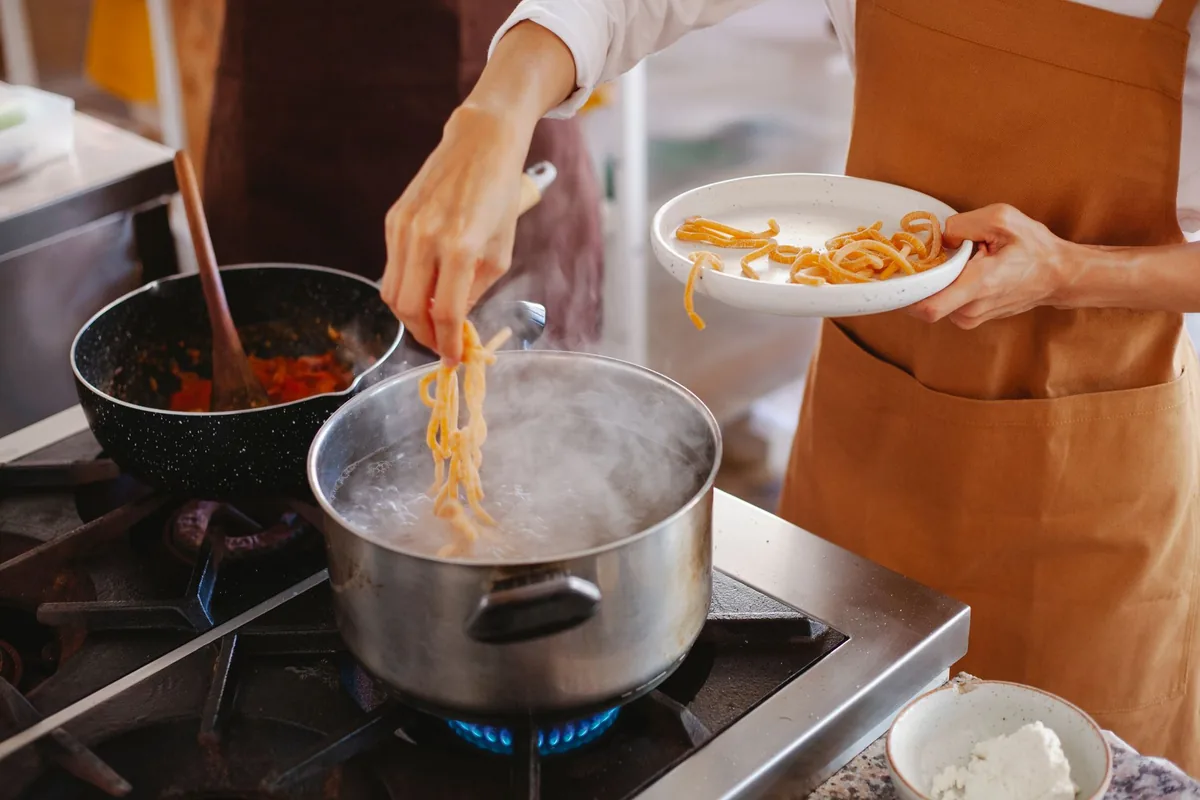
6. Kirecoo 12 Quart 5-Layer Base — Thickest Base
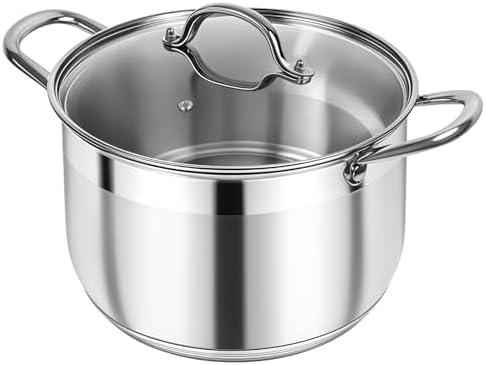
Five layers in the base is the most on this page. The nonstick interior is the part that puzzles us.
Key Specifications
| Capacity | 12 quarts |
|---|---|
| Base | 5-layer thickened |
| Interior | Nonstick coating |
| Lid | Glass, for visibility |
| Handles | Riveted stainless, ergonomic |
| Cooktops | Gas, electric, ceramic, halogen |
| Oven limit | Not stated |
| Stated uses | Boiling, blanching, braising, simmering |
| Rank | #1,781 in its category |
| Price | $41.99 |
| Best For | Big batches where a thick base prevents scorching |
Why We Recommend It
Nonstick exists to release food that would otherwise bond to hot metal — eggs, fish, pancakes. A stock pot spends its life full of liquid at or below boiling point, and liquid does not stick. What you get in exchange is a coating with a temperature ceiling, a wear life measured in years, and a surface that rules out metal utensils and aggressive scrubbing. Four pots on this page are coated and it is the least useful place in a kitchen to put a coating.
The five-layer base, by contrast, addresses the one thing that does go wrong. Thick soups, chillies and reductions scorch on a thin bottom, and more mass between the burner and the food is the direct fix.
No oven temperature is published, which given a coating and a glass lid is the figure you would most want.
Twelve quarts at $41.99 is $3.50 a quart, and rank #1,781 is strong.
Pros
- Five-layer base — most published here
- 12 quarts at $3.50 a quart
- Glass lid for visibility
- Riveted ergonomic handles
- Rank #1,781
- Thick base genuinely helps thick soups
Cons
- Nonstick has almost no purpose in a stock pot
- No oven temperature published
- Coating adds a wear item and a ceiling
- No metal utensils
- Not listed as induction compatible
- No warranty term published
Best for: Large batches of thick soup, where the base does the work and the coating does not.
7. HexClad 10QT Hybrid — Highest Heat Limit

Nine hundred degrees in a pot that will spend most of its life at 212°F is an odd specification — until you read the deep frying line.
Key Specifications
| Capacity | 10 quarts |
|---|---|
| Construction | Tri-ply with aluminium core |
| Surface | Laser-etched hexagonal steel over TerraBond ceramic |
| Oven limit | 900°F (glass lid 400°F) |
| Utensils | Metal utensil safe |
| Dimensions | 15.5 in diameter, 7.5 in high, 5 lb |
| Stated uses | Chilli, steaming shellfish, canning, deep frying |
| Warranty | Lifetime against defects, commercial use excluded |
| Dishwasher | Friendly |
| Rank | #3,495 in its category |
| Price | $169.00 — dearest here |
| Best For | Deep frying, where a high ceiling and a wide base genuinely matter |
Why We Recommend It
Deep frying is the one stock-pot job where temperature actually matters, and it runs at 350 to 375°F rather than boiling point. That immediately rules out the pot on this page capped at 300°F, makes the glass-lidded ones marginal, and is the reason a high ceiling is worth anything at all here. The 15.5-inch diameter also gives real surface area, which is what keeps oil temperature stable when cold food goes in.
Metal utensil safety follows from the hexagonal geometry: food rides on raised steel ridges while the ceramic sits in the valleys below, so a spoon runs across steel rather than into a coating.
Note the lid caveat — the pot takes 900°F and the tempered glass lid takes 400°F, which is the same pattern as every other glass-lidded pot here, simply stated openly.
$169.00 buys a coating in a pot that mostly does not need one, and a genuinely excellent deep fryer and braiser.
Pros
- 900°F ceiling — highest here by far
- Metal utensil safe, unique among the coated pots
- 15.5-inch diameter suits deep frying
- Tri-ply with an aluminium core
- Lifetime warranty against defects
- Publishes exact dimensions and weight
Cons
- $169.00 — dearest on this page
- Glass lid is limited to 400°F, not 900
- A coating is largely wasted on boiling liquid
- Warranty excludes commercial use
- Rank #3,495
- Wide base takes two burners’ worth of hob space
Best for: Deep frying and braising, where the ceiling and the diameter earn the money.
8. CAROTE 8QT Full Clad Tri-Ply — Cheapest Clad

This is fully clad tri-ply at $24.98, against $82.99 for the fully clad pot at the top of this page.
Key Specifications
| Capacity | 8 quarts |
|---|---|
| Construction | Full tri-ply clad |
| Steel | 18/8 stainless, PFAS, PFOA and PFOS free |
| Exterior | Ceramic outer layer, stain resistant |
| Handles | Double riveted |
| Rim | Flared for drip-free pouring |
| Lid | Well-sealed glass |
| Cooktops | Induction, gas, electric, ceramic, halogen |
| Warranty | 12 months |
| Rank | #2,138 in its category |
| Price | $24.98 |
| Best For | Getting clad construction without paying clad prices |
Why We Recommend It
The specification is genuinely the same class of construction, and the difference is in what surrounds it: NSF certification, a lifetime warranty and a steel lid on one, a twelve-month warranty and a glass lid on the other. Whether that is worth $58.01 depends entirely on whether you value the guarantee, because the metal doing the cooking is arranged the same way.
The flared rim is an underrated detail. Pouring stock from a straight-rimmed pot runs liquid down the outside; a flared edge breaks the stream cleanly. On a pot you will decant repeatedly, it matters.
18/8 rather than 18/10 means slightly less nickel — marginally less lustrous and marginally more prone to staining, functionally equivalent for cooking.
The outer ceramic layer is about keeping the outside clean rather than about cooking, and on a pot that lives on a hob that is a fair thing to sell.
Pros
- Full tri-ply cladding at $24.98
- Flared rim pours without dribbling
- Named 18/8 stainless, PFAS free
- Ceramic exterior resists staining
- Double riveted handles
- Works on every cooktop including induction
Cons
- 12-month warranty against a lifetime elsewhere
- No oven temperature published
- Glass lid limits practical oven use
- 18/8 stains slightly more readily than 18/10
- Rank #2,138
- No NSF or other certification
Best for: Clad construction on a budget, if you can live without the guarantee.
9. Gotham Steel 5 Quart Strainer Lid — Best Strainer
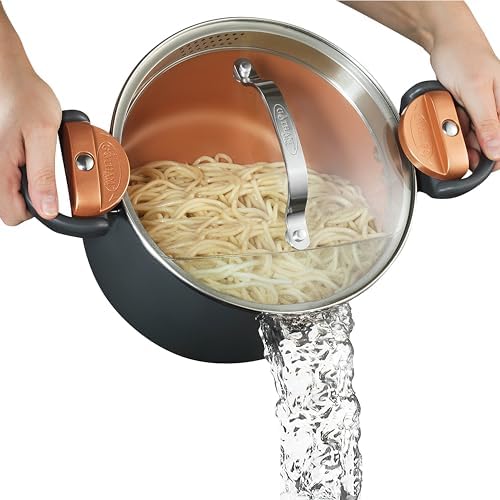
This is a pasta pot that has been filed under stock pots, and judged as a pasta pot it is very good.
Key Specifications
| Capacity | 5 quarts — smallest here |
|---|---|
| Body | Solid aluminium, under 3 lb |
| Coating | Ti-Cerama triple-coated ceramic, titanium reinforced |
| Lid | Locking strainer lid, tempered glass |
| Handles | Twist and lock, for spill-free draining |
| Oven limit | 300°F — lowest on this page |
| Free from | PFOA, PFOS, lead and cadmium |
| Testing | Independent third-party labs |
| Rank | #2,077 in its category |
| Price | $28.99 |
| Best For | Pasta on a weeknight, in a kitchen with no room for a colander |
Why We Recommend It
The locking strainer lid removes a step and a piece of equipment. Draining pasta normally means lifting a heavy pot, tipping it into a colander in the sink, then tipping the pasta back — three transfers, a hot colander to wash, and the pasta cooling on the way. A lid that twists and locks lets you pour the water straight out of the pot. In a small kitchen that is genuinely worth having.
Under three pounds is the other real advantage, because a lightweight pot is much easier to control while tipping boiling water.
The 300°F oven ceiling is the lowest here and is the trade for a coated aluminium body. That rules out deep frying entirely, and it is below the temperature most braises want.
Five quarts is too small for stock in any meaningful sense — it is a pasta and vegetable pot, and the listing is fairly clear about that.
Pros
- Locking strainer lid drains without a colander
- Under 3 lb — easy to control when full
- Ceramic coating free of PFOA, PFOS, lead and cadmium
- Twist-and-lock handles for safe pouring
- Third-party lab tested
- Tempered glass lid for visibility
Cons
- 300°F — lowest oven ceiling here
- 5 quarts is too small for real stock
- Aluminium body dents more easily than steel
- Coating is a wear item
- Not suitable for deep frying
- Rank #2,077
Best for: Weeknight pasta in a small kitchen, rather than stock in any quantity.
10. CAROTE 6 Quart Granite Nonstick — Easiest to Clean

A rivetless interior is the one nonstick argument that holds up in a pot this shape.
Key Specifications
| Capacity | 6 quarts |
|---|---|
| Body | Die-cast aluminium, triple-ply enlarged heating area |
| Coating | Granite nonstick, 5 mm, PFOS and PFOA free |
| Interior | Rivetless — nothing protruding inside |
| Cleaning | Wipe clean |
| Oven limit | Not stated |
| Guarantee | 100% refund or replacement for delivery defects |
| Stated uses | Oatmeal, soups, sauces, gravies |
| Rank | #5,035 in its category |
| Price | $25.98 |
| Best For | Milky and starchy things that genuinely do stick |
Why We Recommend It
Rivets are where pots actually get dirty. Handles are riveted rather than welded because rivets survive thermal cycling, and each rivet head is a protruding lump inside the cooking surface with a rim that traps food and needs scrubbing. Casting the body so the handles attach without piercing the interior removes that entirely. It is a real advantage and it has nothing to do with the coating.
And this is the pot where a coating earns something. The stated uses — oatmeal, milk-based soups, sauces and gravies — are exactly the starchy, protein-rich liquids that bond to hot steel and take twenty minutes to soak off. For those, nonstick is genuinely useful; for a stock or a pasta boil it does nothing.
A 5mm coating thickness is an unusual thing to publish and suggests a genuinely thick application rather than a wash.
No oven temperature is stated, which for a coated aluminium pot is the number you would want most.
Pros
- Rivetless interior — nothing to trap food
- Coating genuinely helps with porridge and milk soups
- 5 mm coating thickness published
- Die-cast body resists deformation
- PFOS and PFOA free
- $25.98 for six quarts
Cons
- No oven temperature published
- Coating is wasted on stock and pasta
- Aluminium body, not steel
- Coating is a wear item with a finite life
- No metal utensils
- Rank #5,035
Best for: Porridge, chowders and milk-based soups — the liquids that actually stick.
Fully Clad or Disc Base, and Whether It Matters Here
Two constructions, both sold as “even heating”. In a stock pot the difference is smaller than the price gap.
| Fully Clad | Disc or Encapsulated Base | |
|---|---|---|
| Aluminium runs | Base and walls | Base only |
| Boiling water | Identical | Identical |
| Simmering stock | Identical | Identical |
| Thick chilli or reduction | Better | Can scorch if thin |
| Browning on the walls | Better | Poorer — rarely relevant here |
| Weight | Heavier | Lighter |
| Cheapest here | $24.98 | $24.72 |
| Dearest here | $169.00 | $49.89 |
The interesting line is the last two. A fully clad tri-ply pot on this page costs $24.98 and a disc-base pot costs $24.72 — twenty-six cents apart — so the construction argument is not really a price argument at all any more. What separates the $82.99 clad pot from the $24.98 one is NSF certification, a lifetime warranty and a steel lid rather than glass. Buy cladding if it is nearly free, which here it is; do not pay a large premium for it in a pot that mostly boils.
How Much Pot You Need, and How Heavy That Is
Capacity is the specification that actually decides this purchase. Here is what each size means in practice.
| Size | Full Weight of Liquid | Suits | On This Page |
|---|---|---|---|
| 5 qt | ~10 lb | Pasta for four, vegetables | One pot |
| 6 qt | ~12 lb | Soup for four, porridge | One pot |
| 8 qt | ~17 lb | Stock, soup, pasta for six | Four pots |
| 10–12 qt | ~21–25 lb | Batch stock, chilli, deep frying | Three pots |
| 16 qt | ~33 lb | Seafood boils, canning, crowds | One pot |
Eight quarts is the size most kitchens should buy and four of these ten are that size, which tells you the market agrees. Above ten quarts the constraint stops being the hob and starts being you: a full 16-quart pot holds over thirty pounds of liquid, which is not something to lift off a burner and carry to a sink. Plan to ladle large pots down before moving them, and check the pot fits under your tap before ordering — a stock pot too tall for the faucet has to be filled by jug, every time.
Best Alternatives
| Alternative | Why Consider It | Better For | Main Trade-Off |
|---|---|---|---|
| A large dutch oven | Goes from hob to oven, holds heat superbly | Braises and stews under 7 quarts | Heavy, and expensive per quart |
| A pressure cooker | Makes stock in an hour rather than six | Anyone short of time | Smaller capacity, no reduction by evaporation |
| A slow cooker | Set it overnight and forget it | Hands-off stock and broth | Cannot reduce, and no boiling |
| A tall pasta insert | Drains without lifting the pot | Pasta specifically | Reduces usable capacity |
What the Money Actually Buys
$24.72 to $32.99 — Cook N Home, CAROTE tri-ply, CAROTE granite, Gotham Steel, IMUSA. The best part of this page by some distance. It contains a fully clad tri-ply pot, an 18/10 pot that publishes its lid ceiling separately, and sixteen quarts of capacity for $32.99. Nothing above this band boils water better.
$41.99 to $49.89 — Kirecoo, Sunhouse, Amazon Basics. Bigger pots and better documentation. Interior volume markings, a five-layer base, and an explicit statement that the 500°F rating excludes the lid.
$82.99 — Tramontina. The certification tier. NSF, a lifetime warranty, a steel lid that lets the whole pot go to 500°F, and full cladding. Rank #489 says a lot of people think this is worth it, and for a buy-once purchase it is defensible.
$169.00 — HexClad. A 900°F ceiling, metal-utensil safety and a 15.5-inch base. Bought as a deep fryer and braiser it makes sense; bought as a stock pot it is an expensive way to boil water.
What to Check Before You Buy
Start With Capacity, Not Construction
Capacity is the specification that determines whether the pot can do the job at all, and everything else is refinement. Eight quarts suits most households — enough for a batch of stock, soup for six, or pasta for a family — and four of the ten pots in this roundup are that size. Below that you are into pasta-pot territory; above ten quarts you are buying for seafood boils, canning or genuinely large batches. Remember that capacity is nominal and you cannot fill a pot to the brim: allow a couple of inches of headroom for a rolling boil, which effectively costs you a quart or two of usable volume on any of these.
Weigh What a Full Pot Actually Holds
This is the constraint nobody mentions and it becomes the deciding factor at larger sizes. Water weighs a little over two pounds per quart, so a full 8-quart pot holds around seventeen pounds of liquid, a 12-quart holds twenty-five, and the 16-quart pot in this roundup holds over thirty — before you add the weight of the pot itself. Lifting that off a hot burner and carrying it to a sink is a genuine scalding hazard. Look for wide, deep, securely riveted handles, prefer handles stated to stay cool, and with anything above ten quarts plan to ladle the contents down before you move it rather than tipping it.
Treat the Lid as the Oven Limit
Oven ceilings in this roundup run from 300°F to 900°F, and on most of these pots the limiting component is not the pot. It is the tempered glass lid. Three listings are explicit about the distinction — one states 500°F for the pot and 350°F for the lids, another states 500°F “without the lid”, and a third gives 900°F for the pot and 400°F for the glass. Five listings publish no oven figure whatsoever. If you braise with the lid on, assume the glass governs unless the maker says otherwise, and note that the only pot here with a steel lid is also the only one rated to 500°F fully assembled.
Understand Why Cladding Matters Less in This Pot
Fully clad construction runs an aluminium core through the walls as well as the base; a disc or encapsulated base puts the aluminium only at the bottom. In a sauté pan that difference is transformative, because you brown food against the sides. In a stock pot you are almost always boiling or simmering liquid, and liquid distributes heat by convection far more effectively than metal does — the walls are being heated by the soup, not the other way round. Where the base genuinely matters is with thick contents: a chilli, a chowder or a reduction will scorch on a thin bottom. Buy a good base; do not pay a large premium for clad walls here.
Question Nonstick in a Pot of Liquid
Four of the ten pots in this roundup have a coated interior, and in a vessel whose contents sit at or below boiling point there is very little for a coating to release. What you take on instead is a temperature ceiling, a wear item with a finite life, a ban on metal utensils and a surface that cannot be scrubbed hard. There is one genuine exception, and one listing here names it: starchy and milk-based liquids — porridge, chowders, milk soups, gravies — really do bond to hot steel and take a long soak to remove. If those are what you cook, a coating earns its place. For stock and pasta it does nothing at all.
Look for Interior Volume Markings If You Make Stock
Stock is defined by reduction: you simmer until the volume has fallen by a third or a half, and every recipe describes it in exactly those terms because there is no better measure. Without graduations you are judging the level against a memory of where it was two hours ago, which is the main reason home stock comes out inconsistent from batch to batch. One pot in this roundup prints measurement markings inside the wall, and it is the only one that does. It is the same principle as volume markings on a dough container, and it turns a guess into a reading for no extra cost.
Check It Fits Under Your Tap and On Your Hob
Two physical checks worth making before ordering, both of which people discover afterwards. A tall stock pot may not fit upright under a kitchen faucet, which means filling it by jug every single time — annoying at eight quarts and genuinely tedious at sixteen. And a wide pot can crowd its neighbours: one pot in this roundup measures 15.5 inches across, which on a standard four-burner hob overlaps the adjacent ring and makes it unusable while the pot is on. Publish figures are not always given, so measure the space you have and prefer listings that state dimensions rather than only capacity.
Common Mistakes
- Paying a large premium for full cladding. In a pot of boiling liquid it changes very little.
- Assuming the oven rating includes the lid. On most of these the glass is the limit.
- Buying nonstick for stock or pasta. Nothing sticks; you have bought a wear item.
- Underestimating the weight. Sixteen quarts of liquid is over thirty pounds.
- Filling to the brim. A rolling boil needs a couple of inches of headroom.
- Not checking it fits under the tap. Otherwise you fill it by jug forever.
- Using a thin base for chilli or reduction. That is the one thing that really does scorch.
Who Should Buy Which
Buy the Cook N Home at $24.72 unless you have a specific reason not to. 18/10 steel, a proper disc base, induction compatible, and the clearest oven statement on this page — 500°F for the pot, 350°F for the lid.
Buy the Tramontina at $82.99 if you want to buy once. NSF certified, lifetime warranty, fully clad, and a steel lid so the whole pot goes to 500°F.
Buy the Sunhouse at $42.99 if you actually make stock. Interior volume markings are the only feature on this page that improves the food.
Buy the IMUSA at $32.99 if you need capacity. Sixteen quarts at $2.06 a quart, for seafood boils and canning — and plan to ladle it down before lifting.
Buy the CAROTE tri-ply at $24.98 if you want cladding cheaply. Genuine full tri-ply for twenty-six cents more than a disc-base pot.
Frequently Asked Questions
What size stock pot do I need?
Eight quarts suits most households, and four of the ten pots in this roundup are that size for good reason — it holds a batch of stock, soup for six, or pasta for a family. Below that, around five or six quarts, you are really buying a pasta and vegetable pot. Above ten quarts you are buying for seafood boils, canning or batch cooking, and the constraint shifts from your hob to your arms: a full 16-quart pot holds over thirty pounds of liquid before you count the pot itself. Remember also that capacity is nominal — you need a couple of inches of headroom for a rolling boil, so usable volume is a quart or two below the stated figure.
Is a tri-ply clad stock pot worth the extra money?
Less than in any other pot shape, and the prices in this roundup make the point. Fully clad construction runs an aluminium core through the walls as well as the base, which transforms a sauté pan because you brown food against the sides. A stock pot is almost always full of liquid at or below boiling point, and liquid equalises its own temperature by convection far more effectively than metal does, so the walls are being heated by the soup rather than the reverse. Where base construction genuinely matters is with thick contents — a chilli, chowder or reduction will scorch on a thin bottom. Note that a fully clad pot here costs $24.98 and a disc-base pot $24.72, so if cladding is nearly free, take it.
Can a stock pot go in the oven?
Usually yes, but the limit is often the lid rather than the pot, and five listings in this roundup publish no oven figure at all. Three are explicit about the distinction: one states 500°F for the pot and 350°F for the lids, another gives 500°F “without the lid”, and a third gives 900°F for the pot alongside 400°F for its tempered glass lid. Tempered glass is simply less heat tolerant than steel, so if you braise with the lid on, assume the glass governs unless told otherwise. The only pot here rated to 500°F fully assembled is the one with a stainless steel lid instead of glass — which is a good reason to prefer one.
Do I want a nonstick stock pot?
For most cooking, no. Four pots in this roundup have coated interiors, and in a vessel whose contents sit at or below boiling point there is very little for a nonstick surface to release — while you take on a temperature ceiling, a ban on metal utensils, a surface you cannot scrub hard, and a coating that will eventually wear out and cannot be renewed. There is one real exception, which one listing names directly: starchy and milk-based liquids such as porridge, chowder, milk soups and gravies genuinely do bond to hot steel and take a long soak to shift. If that is most of what you cook, a coating earns its keep. For stock, pasta and vegetable soups it does nothing.
What is the difference between a stock pot and a dutch oven?
Shape, material and what they are for. A stock pot is tall and relatively narrow, usually thin-walled steel, and the height is deliberate — it minimises the surface area exposed to air so that a long simmer loses less to evaporation, which is exactly what you want when extracting flavour from bones over six hours. A dutch oven is wide and shallow with heavy cast iron or clad walls, designed to hold and radiate heat evenly for braising, and the wide base gives you room to brown meat before adding liquid. Use a stock pot for stock, soup, pasta and boiling; use a dutch oven for braises, stews and anything that starts with searing.
Why does my soup scorch on the bottom of the pot?
Because the base is thin and the contents are thick. While a pot contains freely moving liquid, convection keeps everything at much the same temperature and nothing catches. Once the contents thicken — a reduced stock, a chilli, a chowder, a starchy soup — that circulation slows or stops, and the layer sitting on the hot base can exceed the temperature of the rest and caramelise, then burn. More mass between the burner and the food is the direct fix, which is why base construction is the one place cladding genuinely earns money in this pot shape. One pot in this roundup publishes a five-layer base for exactly this reason. Stirring and a lower flame do the rest.
Final Verdict
Fully clad tri-ply, NSF certified, lifetime warranty, and a steel lid so the whole pot reaches 500°F. Rank #489. $82.99.
18/10 stainless on a proper disc base, induction compatible, and the only listing to publish pot and lid ceilings separately. $24.72.
Interior volume graduations — the one feature on this page that improves the food, because stock is defined by how far it reduces. $42.99.
Water boils at 212°F in a $24.72 pot and in a $169.00 pot. The heat-distribution engineering that sells cookware is largely done for you here by convection in the liquid itself.
The one place construction genuinely matters is the base, and only once the contents get thick enough to stop circulating — a chilli, a chowder, a reduction. Everything else is warranty, certification and lid material.
So buy on capacity, on handles you can lift safely, and on whether the lid caps your oven at 350°F. Eight quarts covers most kitchens; sixteen quarts weighs over thirty pounds when full.
The pot we would buy is $24.72, and the only reason to spend more is a lifetime warranty and an NSF stamp.