Affiliate Disclosure: As an Amazon Associate, we earn from qualifying purchases. This does not affect the price you pay.
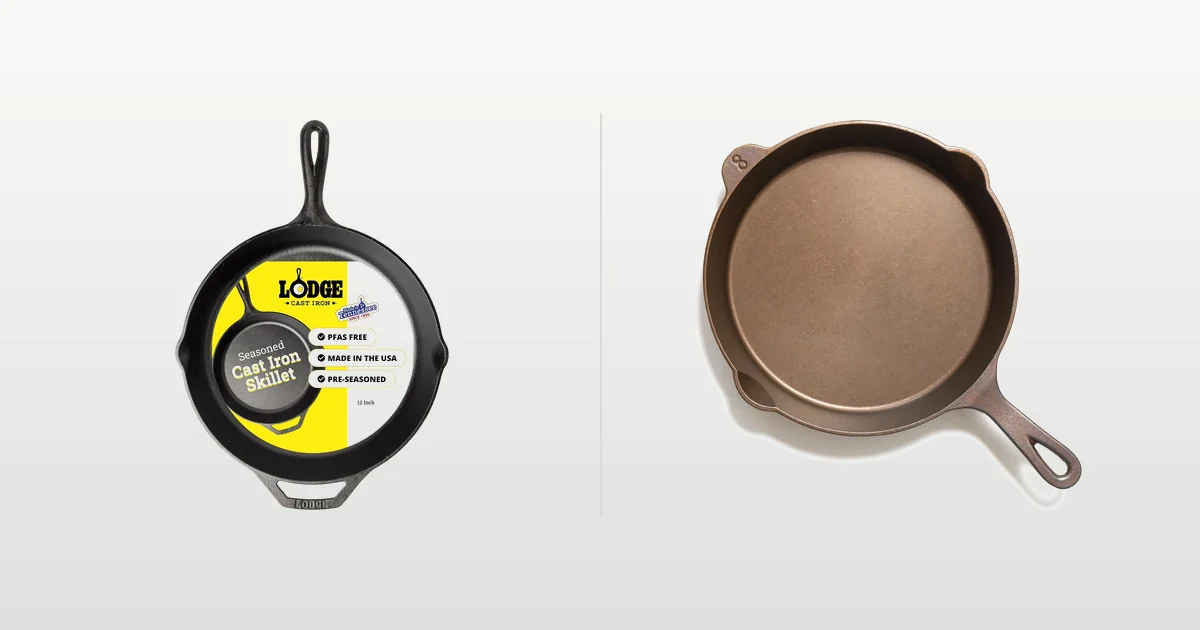
The $175 skillet on this page explains the whole category in one sentence of its own listing: “Machined for a smooth surface and enjoyable cooking experience — just like Griswolds and Wagners of old.”
That is a real historical claim. Cast iron pans made before roughly the 1950s had their cooking surfaces machined flat and polished after casting. The industry stopped, because machining is a slow extra step that adds cost, and modern mass-market pans ship with the raw sand-cast texture straight out of the mould — faintly pebbled, and noticeably grippier when new.
So the category has quietly split in two. At one end, a thirty-dollar Lodge with 131,764 reviews and a rough surface that gets slicker over a decade as seasoning fills the texture. At the other, small American makers charging three to six times as much to machine or polish that surface flat, selling you the ten years of seasoning up front.
And a third route has appeared that neither camp talks about: nitriding — hardening the iron chemically so the surface is sealed and smoothed without machining it at all.
The other number that moved is weight. Old pans were thinner and lighter; the $175 one weighs 4 pounds at 10.5 inches where a modern 12-inch weighs 7.9. Below: ten skillets from $23.99 to $175, and what a smooth surface is actually worth.
Our Quick Picks
 Best OverallLodge 12-Inch Skillet
The pan almost everyone means when they say cast iron — thirty dollars, #2 in Skillets, and 131,764 reviews behind it.
 Most PremiumLancaster Lightweight 10.5-Inch
Cast, machined and seasoned in Pennsylvania — a deliberate recreation of the smooth, light pans made a century ago.
 Best BudgetUtopia Kitchen 12-Inch
Twenty-five dollars, 27,356 reviews and #9 in Skillets — the cheapest way to a full-size cast iron pan.
At a Glance
Ten Cast Iron Skillets Compared
Surface finish first, because that is the real divide — then size, weight and how the pan is seasoned.
| # | Model | Surface | Size | Weight | Seasoning | Standout | Main Drawback | Check Price |
|---|---|---|---|---|---|---|---|---|
| 1 |
 Lodge 12-Inch Skillet Lodge 12-Inch Skillet |
Sand-cast, pebbled | 12 inches | 3.58 kg / 7.9 lb | Pre-seasoned, vegetable oil | #2 in Skillets, and 131,764 reviews | Rough surface, and 7.9 pounds of it | View on Amazon |
| 2 |
 Lancaster Lightweight 10.5-Inch Lancaster Lightweight 10.5-Inch |
Machined smooth | 10.5 inches | 4 pounds | Two coats of grapeseed oil | Machined like a Griswold, cast in Pennsylvania | $175, and 10.5 inches | View on Amazon |
| 3 |
 Utopia Kitchen 12-Inch Utopia Kitchen 12-Inch |
Sand-cast | 12 inches | 3.44 kg / 7.6 lb | Pre-seasoned, vegetable oil | 27,356 reviews at $24.99 | 450°F is the lowest ceiling here | View on Amazon |
| 4 |
 Lodge Dual Handle 12-Inch Lodge Dual Handle 12-Inch |
Sand-cast | 12 inches | 3 kg / 6.6 lb | Natural vegetable oil | 4.8 stars — highest rating here, from 22,812 reviews | Two loop handles mean no long lever | View on Amazon |
| 5 |
 COOKLIFE Lightweight 12-Inch COOKLIFE Lightweight 12-Inch |
Polished smooth | 12 inches | 6.1 pounds | Pre-seasoned | Polished surface and 30% lighter, per the listing | $99.99, and only 198 reviews | View on Amazon |
| 6 |
 Rachael Ray NITRO Rachael Ray NITRO |
Nitrided | Title says 12 in; contents say 10 | 6.1 pounds | Nitriding seals the surface | A third route: hardening the iron itself | Title says 12 inch, the listing ships a 10 inch | View on Amazon |
| 7 |
 EWFEN 3-Piece Set EWFEN 3-Piece Set |
Sand-cast, smooth finish claimed | 6, 8 and 10 inches | 4.59 kg for three | Natural vegetable oil | Three sizes for $23.99 | No 12-inch in the set | View on Amazon |
| 8 |
 EDGING CASTING 17-Inch EDGING CASTING 17-Inch |
Sand-cast | 17 inches | 6.69 kg / 14.7 lb | Pre-seasoned | Seventeen inches, for a crowd or a campfire | 14.7 pounds, and it will not fit every oven | View on Amazon |
| 9 |
 Cuisinart Enameled 10-Inch Cuisinart Enameled 10-Inch |
Porcelain enamel | 10 inches | 6 pounds | None required | No seasoning, and it goes in the dishwasher | Enamel chips, and cannot be repaired | View on Amazon |
| 10 |
 Cuisinel 15-Inch With Scraper Cuisinel 15-Inch With Scraper |
Sand-cast | 15 inches | Listed as 16 ounces | Pre-seasoned | A 15-inch pan with a scraper and handle cover | Item weight listed as 16 ounces, which is impossible | View on Amazon |
Specifications, prices, ratings and review counts are taken from each manufacturer’s Amazon listing as displayed on 22 August 2026 via a United States connection, and may change. This roundup exists because an earlier attempt at this keyword concluded, on the basis of directly-scraped data, that too few cast iron skillets were in stock to build a comparison; that conclusion was wrong, the data was a geolocation artifact, and every product below was verified in stock from a United States connection. Several specification-field errors are reported as published rather than corrected: the Cuisinel 15-inch skillet lists an item weight of 16 ounces, which is impossible for a pan of that size, and a care instruction truncated to “Dishwa,”; the Rachael Ray NITRO is titled a 12-inch pan while both its Included Components field and its first bullet describe a 10-inch skillet; the Lodge 12-inch, Utopia, EWFEN and EDGING CASTING listings all give Compatible Devices as gas only, which is wrong for ferrous cast iron and contradicted by other Lodge listings in the same roundup; and the Cuisinart enamelled fry pan displays a bestseller rank in Woks & Stir-Fry Pans rather than in a fry pan category, which is most likely Amazon pooling ranks across the Chef’s Classic Enameled range rather than a filing error. Stated maximum temperatures of 450°F and 500°F are reproduced as published and are conservative for bare cast iron, which has no coating to degrade. Eighteen further cast iron products were verified live but excluded as griddles, grill pans, Dutch ovens or brand duplicates.
Scroll the table sideways to see every column
How We Chose These Cast Iron Skillets
We researched current listings, compared manufacturer specifications and documentation, and examined recurring patterns in customer feedback. We did not carry out hands-on testing, and nothing below is presented as measured performance data.
- Surface finish — machined, polished, nitrided or raw sand-cast — the real difference
- Weight against size — old pans were lighter; modern ones are not, and it is felt
- How it is seasoned, and whether you must — oil seasoning improves; nitriding and enamel do not
- Handle design — one long lever or two loops decides who can lift it
- Review count behind the rating — samples here run from 33 to 131,764
- Whether the listing is accurate — two here misstate size or weight outright
The 10 Best Cast Iron Skillets, Reviewed
1. Lodge 12-Inch Skillet — Best Overall

One hundred and thirty-one thousand, seven hundred and sixty-four reviews. That is more than every other product in this roundup combined, several times over, and it sits at 4.6 stars for thirty dollars.
Key Specifications
| Surface | Sand-cast, lightly pebbled |
|---|---|
| Size | 12 inches |
| Weight | 3.58 kg / 7.9 pounds |
| Seasoning | Pre-seasoned with vegetable oil |
| Handle | Cast iron teardrop |
| Max temperature | 500°F stated |
| Care | Hand wash, oven safe |
| Coating | None — PFAS free |
| Rank | #2 in Skillets, #133 in Kitchen & Dining |
| Rating | 4.6 from 131,764 reviews |
| Price | $29.90 |
| Best For | Almost everyone, and the honest default |
Why We Recommend It
This is the pan that defines the category, and its surface is the thing this whole page is about. Lodge sand-casts and leaves the cooking surface as it comes out of the mould — slightly pebbled, faintly rough to a fingertip. That texture is why a new Lodge sticks more than people expect and why it improves for years: seasoning builds into the texture and gradually fills it, so the pan you own in a decade is smoother than the one you bought.
Vintage pans were not made this way. Griswold and Wagner machined the cooking surface flat and glassy, and that is the finish the expensive pans further down this page are recreating. Lodge stopped machining decades ago because it is a slow, expensive extra step — and it is the single reason a Lancaster costs six times as much.
Seven point nine pounds is heavy, and that is not an accident either. Thickness is thermal mass, and thermal mass is why a cast iron pan holds its temperature when a cold steak lands on it. It is also why you will not be tossing anything in this.
Pre-seasoned with vegetable oil and nothing else. No coating, no PFAS, and a surface you can strip back and rebuild indefinitely if you ever mistreat it.
The Compatible Devices field reads “Gas” only, which is wrong — cast iron is ferrous and works on induction, and Lodge’s other pans in this roundup list it correctly.
Pros
- 131,764 reviews at 4.6 — the largest sample by far
- #2 in Skillets and #133 in all of Kitchen & Dining
- $29.90 for a 12-inch pan that outlives you
- No coating at all, and strippable back to bare iron
- Seasoning improves for years as it fills the texture
- Oven, grill and campfire safe
Cons
- Sand-cast surface is rough and sticks more when new
- 7.9 pounds — genuinely heavy to handle
- Compatible Devices field wrongly lists gas only
- Hand wash, and it rusts if left wet
- 500°F stated ceiling is conservative for bare iron
- Long handle gets hot; no helper handle
Best for: Almost anyone. It is the default for good reason and nothing here beats it on value.
2. Lancaster Lightweight 10.5-Inch — Most Premium

Its third bullet is the clearest statement of what this category argument is about: “Machined for a smooth surface and enjoyable cooking experience — just like Griswolds and Wagners of old.”
Key Specifications
| Surface | Machined smooth |
|---|---|
| Size | 10.5 inches — the Lancaster No. 8 |
| Weight | 4 pounds |
| Seasoning | Two coats of grapeseed oil |
| Origin | Cast, machined and seasoned in Pennsylvania |
| Hobs | Gas, electric coil and induction |
| Care | Hand wash |
| Rank | #341 in Skillets |
| Rating | 4.6 from 113 reviews |
| Price | $175 |
| Best For | Anyone who has used a vintage pan and wants that surface new |
Why We Recommend It
That is a real historical claim, not marketing. Cast iron pans made before roughly the 1950s had their cooking surfaces machined flat and polished after casting. The industry dropped the step because it is slow and adds cost, and modern mass-market pans ship with the raw sand-cast texture instead. Vintage Griswolds sell for serious money on that basis alone, and Lancaster exists to make a new one.
The practical difference is release from the first day. A machined surface has far less texture for food to key into, so a lightly seasoned smooth pan behaves like a well-used rough one. You are buying, in effect, the ten years of seasoning build-up that a Lodge needs to become slick.
Four pounds for 10.5 inches is remarkable, and it is the other half of the recreation — old pans were thinner and lighter. It heats faster and responds faster than a thick modern pan, at some cost in raw thermal mass.
Seasoned with grapeseed oil, twice, which is a high-smoke-point oil that polymerises cleanly.
Only 113 reviews, and #341 in Skillets — this is a small American maker, not a volume product, and at $175 it will stay that way. The rating is good and the sample is thin.
Pros
- Machined smooth — releases well from the first day
- Four pounds for 10.5 inches, genuinely light
- Cast, machined and seasoned in Pennsylvania
- Faster to heat and more responsive than thick modern iron
- Works on induction
- A deliberate recreation of pre-war pan making
Cons
- $175 — six times the Lodge
- Only 113 reviews and #341 in Skillets
- 10.5 inches, smaller than the 12-inch pans here
- Less thermal mass than a heavy pan
- Hand wash and full seasoning maintenance still apply
- Small-batch availability
Best for: Anyone who has cooked on an old Griswold and wants that surface without hunting one down.
3. Utopia Kitchen 12-Inch — Best Budget

Five dollars less than the Lodge, a tenth of a star lower, and 27,356 reviews. In a category where the product is essentially iron and oil, that is a serious value proposition.
Key Specifications
| Surface | Sand-cast |
|---|---|
| Size | 12 inches |
| Weight | 3.44 kg / 7.6 pounds |
| Seasoning | Pre-seasoned with vegetable oil |
| Max temperature | 450°F stated — lowest here |
| Care | Hand wash |
| Coating | None — PFAS free |
| Rank | #9 in Skillets, #1,071 in Kitchen & Dining |
| Rating | 4.5 from 27,356 reviews |
| Price | $24.99 |
| Best For | A first cast iron pan, or a second one for the campsite |
Why We Recommend It
Cast iron is one of the few categories where the cheap option is genuinely close to the expensive one, because there is very little to get wrong. It is iron, cast in a mould, seasoned with oil. There is no coating to fail, no motor, no electronics and no proprietary technology. What separates pans is surface finish, weight distribution and handle design — and at the budget end, mostly nothing.
Seven point six pounds is marginally lighter than the Lodge, which at this size is neither here nor there.
450°F is the lowest stated ceiling in this roundup, and it is worth treating as a data-entry conservatism rather than a real limit. Bare cast iron has no coating to degrade and Lodge states 500°F for an identical object; iron itself is untroubled by anything a domestic oven does. Still, if you routinely finish steaks under a broiler, buy the pan that states the higher number.
Pre-seasoned with vegetable oil and usable from the box, improving from there.
Also ranked #3 in Chef’s Pans, which is a second node it has been filed into — a reminder that Amazon’s categories overlap more than they look.
Pros
- $24.99 for a full 12-inch cast iron pan
- 27,356 reviews at 4.5 stars
- #9 in Skillets
- No coating — iron and oil only
- Marginally lighter than the Lodge
- Works on the hob, in the oven, on a grill or a campfire
Cons
- 450°F, the lowest stated ceiling here
- Sand-cast surface, rough when new
- 7.6 pounds
- Hand wash, and it rusts if left wet
- Compatible Devices field lists gas only
- Less brand history than Lodge
Best for: A first cast iron pan, a campsite pan, or a second 12-inch without paying twice.
4. Lodge Dual Handle 12-Inch — Best Handles

Four point eight stars from 22,812 reviews. That is the highest rating in this roundup on a sample large enough to be certain of, and it costs twenty-seven dollars.
Key Specifications
| Surface | Sand-cast |
|---|---|
| Size | 12 inches |
| Weight | 3 kg / 6.6 pounds — lightest 12-inch here |
| Handles | Dual assist loops |
| Seasoning | Natural vegetable oil |
| Hobs | Gas, electric coil and induction |
| Care | Hand wash |
| Rank | #13 in Skillets |
| Rating | 4.8 from 22,812 reviews — highest here |
| Price | $27 |
| Best For | Anyone who finds a loaded 12-inch skillet hard to lift |
Why We Recommend It
Two loop handles instead of one long one is a bigger change than it sounds. A 12-inch skillet full of food weighs about ten pounds, and a single long handle puts all of that on one wrist at the end of a lever — which is how people drop them and how the pan tips. Two loops let you lift it square with both hands, close to the body. If wrist strength is a limit, this is the pan.
It also makes it the lightest 12-inch here at 6.6 pounds, a full pound under the standard Lodge, because a long cast iron handle is a surprising amount of metal.
The trade is that you cannot use it one-handed, and you cannot shake or toss anything. Loop handles are for lifting a heavy pan out of an oven, not for pan technique.
It is also the shape that goes to the table — a dual-handle pan is a serving dish in a way a long-handled skillet is not, and it will hold heat through a meal.
Same sand-cast surface as every other Lodge, and the same slow improvement with use.
Pros
- 4.8 stars from 22,812 reviews — highest here
- 6.6 pounds, the lightest 12-inch in this roundup
- Dual loops lift square with both hands
- $27
- Correctly listed for induction
- Goes from oven to table and holds heat
Cons
- Cannot be used one-handed, ever
- No tossing or shaking
- Sand-cast surface, rough when new
- Loops get as hot as the pan
- Hand wash only
- Takes more cupboard width than a skillet
Best for: Weaker wrists, heavy oven work, and anyone who serves from the pan.
5. COOKLIFE Lightweight 12-Inch — Smoothest Modern Finish

A hundred dollars, and it makes the same two claims as the $175 Lancaster: smoother than traditional cast iron, and meaningfully lighter.
Key Specifications
| Surface | Fine-polished smooth |
|---|---|
| Size | 12 inches |
| Weight | 6.1 pounds — stated 30% lighter than traditional |
| Seasoning | Pre-seasoned |
| Included | Skillet, wooden spatula, cooking kit, recipes |
| Max temperature | 500°F |
| Hobs | Gas, electric coil, induction and non-induction |
| Rank | #287 in Skillets |
| Rating | 4.3 from 198 reviews |
| Price | $99.99 |
| Best For | The smooth-and-light idea, in a full 12-inch, for under a hundred |
Why We Recommend It
Six point one pounds for a 12-inch pan is the striking figure. The Lodge 12-inch is 7.9 pounds and the Utopia 7.6, so the stated 30% reduction is roughly consistent with what the others weigh. Less iron means faster heating and easier handling; it also means less stored heat, so a cold steak will pull the surface temperature down further than it would in a heavy pan. That is a real trade rather than a free win.
The polishing claim is the same argument as the Lancaster’s machining — a smoother surface has less texture for food to key into, so it releases better before years of seasoning have built up. Whether a fine polish equals proper machining is a fair question, and the price gap suggests the makers think not.
It lists every hob type including induction, correctly, where two cheaper pans here wrongly list gas only.
A wooden spatula, a cooking kit and recipes are included, which is either useful or packaging depending on how you feel about starter kits.
4.3 from 198 reviews is the weakest showing among the pans worth recommending here, and #287 in Skillets. At a hundred dollars in a category whose leader costs thirty, that is what you would expect.
Pros
- Polished surface releases better than sand-cast from new
- 6.1 pounds — light for a 12-inch
- Correctly listed for induction and every other hob
- 500°F stated
- Spatula and recipes included
- A third less than the Lancaster for a larger pan
Cons
- $99.99, over three times the Lodge
- 4.3 stars from only 198 reviews
- Less iron means less stored heat
- #287 in Skillets
- Polished is not the same as machined
- Hand wash only
Best for: The smooth-and-light idea in a full 12 inches, without paying Lancaster money.
6. Rachael Ray NITRO — Nitrided Surface

Fifty dollars, and a genuinely different approach to the problem this page is about. Rather than machining the surface smooth or leaving it rough, the iron itself is nitrided.
Key Specifications
| Surface | Nitrided — sealed and smoothed |
|---|---|
| Size | Title states 12 in; included components state 10 in |
| Weight | 6.1 pounds |
| Handles | Cast iron with helper handle |
| Features | Pour spouts both sides |
| Max temperature | 500°F |
| Hobs | All, including induction |
| Rank | #289 in Skillets |
| Rating | 4.0 from 254 reviews — lowest here |
| Price | $49.99 |
| Best For | Rust resistance without a seasoning routine |
Why We Recommend It
Nitriding is a real metallurgical process, not a coating. The pan is heated in a nitrogen-rich atmosphere so nitrogen diffuses into the surface layer and forms hard iron nitrides. The listing describes it as sealing and smoothing “all the little nooks and crannies”, which is accurate — it hardens the surface and closes the porosity that makes bare cast iron rust. The result is a pan far more forgiving of being left wet than a seasoned one.
What you give up is the ability to improve it. A seasoned pan gets better for decades because you keep adding polymerised oil to the texture. A nitrided surface is what it is on day one and stays that way. It also cannot be stripped and rebuilt if neglected, because the nitride layer is the surface.
Then read the size fields. The title says 12 inch. The Included Components field says “10" Skillet with Helper Handle and Pour Spouts”, and the first bullet says “NITRO Cast Iron 10-Inch Skillet”. Two of the three say ten, so ten is almost certainly what ships — but on a $49.99 pan that is a two-inch discrepancy nobody should have to catch.
Pour spouts on both sides are genuinely useful and rare on cast iron; draining fat from a skillet is otherwise a two-hand, one-spatula operation.
4.0 stars is the lowest rating in this roundup, from 254 reviews.
Pros
- Nitrided surface resists rust far better than seasoning
- Smoother than sand-cast without machining
- Pour spouts on both sides
- Helper handle for lifting
- Works on every hob including induction
- No seasoning routine to maintain
Cons
- Title says 12 inch; two other fields say 10 inch
- 4.0 stars, the lowest rating here
- The surface cannot be improved or rebuilt with use
- $49.99 against $29.90 for a Lodge
- #289 in Skillets
- Hand wash only
Best for: Anyone who wants cast iron heat and refuses to maintain a seasoning.
7. EWFEN 3-Piece Set — Best Set

Three cast iron skillets for $23.99. That is less than one Lodge 12-inch, and it is ranked #50 in Skillets.
Key Specifications
| Surface | Sand-cast, smooth finish claimed |
|---|---|
| Set | 6, 8 and 10 inch skillets |
| Weight | 4.59 kg for all three |
| Seasoning | 100% natural vegetable oil |
| Max temperature | 500°F |
| Free from | PFOA and PTFE |
| Care | Hand wash |
| Rank | #50 in Skillets, #7,488 in Kitchen & Dining |
| Rating | 4.4 from 662 reviews |
| Price | $23.99 |
| Best For | Eggs, sides and single portions alongside a big pan |
Why We Recommend It
Small cast iron pans earn their place more easily than large ones. A six-inch skillet is the right size for two eggs, a single chicken thigh, toasting spices or a portion of cornbread, and it heats in a fraction of the time a 12-inch takes. Most people who own one big cast iron pan reach for it less than they expect precisely because it is slow to heat and heavy to wash; a small one gets used daily.
Six, eight and ten inches is a sensible ladder and stops at ten — there is no 12-inch here, so this complements a big pan rather than replacing one.
Seasoned with 100% natural vegetable oil and explicitly free of PFOA and PTFE, which on bare cast iron is a statement of the obvious but a welcome one.
The listing claims a smooth finish, which at this price means a finer sand-cast texture rather than machining. Do not expect Lancaster.
4.4 from 662 reviews is a modest but real sample, and the price makes the risk small.
Pros
- Three skillets for $23.99 — less than one Lodge
- #50 in Skillets
- Small pans heat fast and get used daily
- 6, 8 and 10 inches is a sensible ladder
- 500°F stated
- Iron and oil only, PFOA and PTFE free
Cons
- No 12-inch, so it complements rather than replaces
- “Smooth finish” means finer sand-cast, not machined
- Compatible Devices field lists gas only
- Hand wash all three
- 662 reviews is a modest sample
- Three pans to season and store
Best for: Eggs, sides and single portions — alongside a big pan rather than instead of one.
8. EDGING CASTING 17-Inch — Largest Here

Seventeen inches across and fourteen and a half pounds empty. Before anything else: measure your oven, and think about your hob.
Key Specifications
| Surface | Sand-cast, pre-seasoned |
|---|---|
| Size | 17 inches — largest here |
| Weight | 6.69 kg / 14.7 pounds |
| Handles | Two integrated smooth loops |
| Max temperature | 500°F |
| Care | Hand wash, oven safe |
| Rank | #347 in Skillets |
| Rating | 4.5 from 230 reviews |
| Price | $59.79 |
| Best For | Camping, big fry-ups and cooking for six or more |
Why We Recommend It
The case for a very large cast iron pan is crowding. Cast iron sears because it holds heat, and the fastest way to lose that is to fill the pan — cold food dropped into a crowded skillet pulls the surface temperature below searing point and everything releases water and stews. A 17-inch surface gives eight chicken thighs or a full fry-up the room to actually brown.
It is a camping pan as much as a kitchen one, and that is where the size makes most sense: over a fire, on a grill, or on a wide outdoor burner where a domestic hob ring cannot heat it evenly. On a standard hob a 17-inch pan will have a hot centre and cool edges.
Two integrated loop handles are the only sane choice at this weight, and the listing notes they are smooth — at 14.7 pounds plus food you want no sharp casting edges.
Fourteen and a half pounds empty is genuinely a lot. Loaded, this is a two-handed lift with proper mitts and somewhere cleared to put it down.
4.5 from 230 reviews, and #347 in Skillets — a niche product doing a niche job well.
Pros
- Seventeen inches — room to brown rather than steam
- Two integrated smooth loop handles
- 500°F stated, and campfire capable
- $59.79 for a very large pan
- 4.5 stars
- Pre-seasoned
Cons
- 14.7 pounds empty, and much more loaded
- Will not fit many domestic ovens — measure first
- Too wide for a single hob ring to heat evenly
- Compatible Devices field lists gas only
- #347 in Skillets
- Hand wash a very heavy pan
Best for: Campfires, grills and cooking for six or more — not everyday hob use.
9. Cuisinart Enameled 10-Inch — Best Enamelled

Forty-five dollars, and the one pan on this page that sidesteps the entire smooth-versus-rough argument — because the cooking surface is glass.
Key Specifications
| Surface | Porcelain enamel over cast iron |
|---|---|
| Size | 10 inches |
| Weight | 6 pounds |
| Seasoning | None required |
| Dishwasher | Safe |
| Handles | Wide cast iron, oven-safe knob |
| Colour | Provencal blue |
| Rank | Displays #264 in Woks & Stir-Fry Pans |
| Rating | 4.5 from 468 reviews |
| Price | $45.50 |
| Best For | Cast iron heat with none of the maintenance |
Why We Recommend It
Enamel is porcelain fused to the iron, and it changes what the pan is for. There is no seasoning to build or protect, no rust risk, and it does not react with acid — so a long tomato or wine braise is fine, where the same dish would strip a seasoned pan back to grey metal in one go. It also goes in the dishwasher, which no other pan in this roundup does.
What you lose is the surface that improves. Enamel is not non-stick and never becomes non-stick; it is a smooth hard glaze that food will stick to if the pan is not hot enough or oiled. A well-seasoned bare pan genuinely outperforms it for eggs.
Enamel chips, and a chipped pan is finished. Knock the rim, drop the lid on it, or shock it with cold water while hot, and the glaze cracks — after which the exposed iron rusts and cannot be re-glazed. This is the one failure mode bare cast iron does not have.
It does not alter flavours or absorb odours, which is a real advantage over a seasoned pan that has cooked fish.
It displays a rank of #264 in Woks & Stir-Fry Pans, which is not what a 10-inch round fry pan is. The likeliest explanation is not a filing mistake but Amazon pooling ranks across a listing family: Cuisinart’s Chef’s Classic Enameled line includes woks alongside fry pans, and a shared rank appears on every member. Either way it is a reminder that a category badge can describe a range rather than the pan in front of you.
Pros
- No seasoning to build or maintain, ever
- Dishwasher safe — unique in this roundup
- Handles acidic braises that would strip a seasoned pan
- Does not absorb odours or alter flavours
- Wide handles and an oven-safe knob
- 4.5 from 468 reviews
Cons
- Enamel chips and cannot be repaired
- Never becomes non-stick the way a seasoned pan does
- Displays a Woks & Stir-Fry Pans rank, likely shared across the Chef’s Classic range
- 6 pounds for only 10 inches
- Thermal shock cracks the glaze
- $45.50
Best for: Acidic cooking, dishwasher users, and anyone who will not maintain a seasoning.
10. Cuisinel 15-Inch With Scraper — Biggest Value Bundle

The Item Weight field on this listing reads 16 ounces. A 15-inch cast iron skillet weighs somewhere between ten and twelve pounds. One pound is roughly what the silicone handle cover weighs.
Key Specifications
| Surface | Sand-cast, pre-seasoned |
|---|---|
| Size | 15 inches |
| Weight | Listed as 16 ounces |
| Included | Skillet, pan scraper, silicone handle holder |
| Handles | Assist loop plus long handle, pour spouts |
| Max temperature | 500°F |
| Rank | #648 in Skillets |
| Rating | 4.4 from 33 reviews |
| Price | $49.99 |
| Best For | A very large pan with the accessories that make it usable |
Why We Recommend It
The bundle is the actual point and it is well chosen. A silicone handle cover solves the defining nuisance of cast iron — the handle reaches the same temperature as the pan, so every transfer needs a cloth you have to find first. A pan scraper is the correct tool for cleaning seasoned iron: hard plastic lifts stuck food without touching the seasoning, where a metal scourer strips it and soap is unnecessary.
Fifteen inches is very large — between the 12-inch pans here and the 17-inch EDGING CASTING — and the same caveats apply about oven width and heating evenly on a domestic ring.
An assist loop opposite the long handle, plus pour spouts, which together make a heavy pan genuinely manageable: two-handed lift, and you can drain fat without a spatula.
Thirty-three reviews is very little, and it is the honest reason to hesitate. The bundle is sensible and the pan is almost certainly fine; there is simply not enough evidence yet to say so.
The care field reads “Dishwa,” — a truncated entry that presumably meant dishwasher, which bare cast iron emphatically is not.
Pros
- Silicone handle cover solves cast iron’s main nuisance
- Pan scraper is the correct cleaning tool for seasoned iron
- Assist loop and pour spouts on a heavy pan
- 15 inches for $49.99
- 500°F stated
- Pre-seasoned
Cons
- Item weight listed as 16 ounces — impossible
- Only 33 reviews
- Care field reads a truncated “Dishwa,” on a pan that must never go in one
- #648 in Skillets
- Too wide for one hob ring to heat evenly
- Measure your oven first
Best for: A very large pan bought as a bundle — accepting a thin review history.
Machined, Polished, Nitrided or Raw
Four different answers to the same surface problem.
| Finish | How it is made | Behaviour when new | In this roundup |
|---|---|---|---|
| Machined | Cut and polished flat after casting | Slick immediately | Lancaster — $175 |
| Fine polished | Abrasive-finished, not cut | Noticeably smoother | COOKLIFE — $99.99 |
| Nitrided | Nitrogen hardens and seals the iron | Smooth and rust-resistant | Rachael Ray NITRO — $49.99 |
| Raw sand-cast | Left as it leaves the mould | Grippy; improves for years | Lodge, Utopia, EWFEN, EDGING |
| Enamelled | Porcelain fused over the iron | Smooth, never non-stick | Cuisinart — $45.50 |
The honest summary is that machining sells you time. A raw sand-cast pan starts grippy and becomes genuinely slick after a few years of use as seasoning fills the texture — the finish everyone praises in an inherited pan is just decades of cooking. A machined pan behaves that way from the first week, and you pay roughly six times as much for the head start. Nitriding is the interesting outlier because it solves rust rather than texture, and enamel opts out of the argument entirely. None of these makes a pan sear better; iron is iron, and the searing comes from mass and heat.
Weight Is the Other Thing Modern Pans Changed
Pre-war pans were thinner. Sorted by weight against size.
| Skillet | Size | Weight | Pounds per inch of diameter |
|---|---|---|---|
| Lancaster Lightweight | 10.5 in | 4 lb | 0.38 |
| COOKLIFE Lightweight | 12 in | 6.1 lb | 0.51 |
| Lodge Dual Handle | 12 in | 6.6 lb | 0.55 |
| Utopia Kitchen | 12 in | 7.6 lb | 0.63 |
| Lodge 12-Inch | 12 in | 7.9 lb | 0.66 |
| EDGING CASTING | 17 in | 14.7 lb | 0.86 |
| Rachael Ray NITRO | 10 in | 6.1 lb | 0.61 |
| Cuisinart Enamelled | 10 in | 6 lb | 0.60 |
Read the right-hand column rather than the raw weight, because a 17-inch pan is obviously heavier than a 10-inch one. What it shows is a real spread: the Lancaster carries under 60 per cent of the iron per inch that a standard Lodge does. Thinner iron heats faster and responds faster when you move it off the burner, which is why old pans are prized by people who cook eggs in them. Thicker iron stores more heat and recovers better when a cold steak lands, which is why heavy modern pans sear so well. Neither is better — but if you have ever found a 12-inch skillet too heavy to use often, the light end of this table is the fix, and it costs money.
Best Alternatives
| Alternative | Why Consider It | Better For | Main Trade-Off |
|---|---|---|---|
| A vintage Griswold or Wagner | Machined smooth and light, the original article | Anyone willing to hunt and restore | Collector prices, and rust to strip |
| Carbon steel | Same seasoning, half the weight, faster response | Eggs, stir-frying, restaurant work | Less stored heat for searing |
| Enamelled cast iron | No seasoning, no rust, acid-safe | Braises and tomato dishes | Chips permanently; never non-stick |
| A cheap pan and a polishing pad | Sand your own smooth surface for a few dollars | Anyone with patience and a sander | An hour of work and a lot of dust |
| A stainless clad pan | Lighter, dishwasher safe, no maintenance | Sauces and everyday cooking | No thermal mass; genuinely sticks |
What Each Price Tier Actually Buys
$23.99 to $29.90 — EWFEN set, Utopia, Lodge 12-inch, Lodge Dual Handle. This tier contains the two highest review counts in the roundup, the highest rating, and three skillets for the price of one. Cast iron is iron and oil, and at this end you are getting essentially the same metal the expensive pans use, with a rougher finish and more weight.
$45.50 to $59.79 — Cuisinart enamelled, Rachael Ray NITRO, Cuisinel 15-inch, EDGING CASTING 17-inch. Where you buy a specific escape: from seasoning (enamel), from rust (nitriding), or from a pan that is too small (15 and 17 inches). None of these is a better everyday skillet than a $29.90 Lodge.
$99.99 to $175 — COOKLIFE, Lancaster. Surface finish and weight, which is the only thing money genuinely buys in this category. A polished or machined face that releases food from day one, and 20 to 40 per cent less iron to lift. Whether that is worth three to six times the price depends entirely on how much you cook and how much a heavy pan bothers you.
The pattern: price buys time and lightness, not performance. Every pan here sears identically, because searing is a property of hot iron and every one of these is hot iron.
How to Choose a Cast Iron Skillet
Decide Whether You Are Buying Smoothness or Waiting For It
This is the only real question in the category. A raw sand-cast pan — Lodge, Utopia, most of what sells — starts grippy and becomes properly slick after a few years, as seasoning gradually fills the cast texture. A machined or polished pan behaves that way immediately, and costs three to six times as much. Both end up in a similar place; you are choosing between money and patience. If you have ever cooked on an inherited pan and wondered why yours is not like that, the answer is usually forty years of use, not a better pan.
Weigh the Pan Before You Fall in Love With It
A 12-inch cast iron skillet is around 7.9 pounds empty and about ten with food in it, held at the end of a lever. That is the single commonest reason a cast iron pan ends up at the back of a cupboard. Two fixes exist: a dual-handle design, which lets you lift square with both hands and is the lightest 12-inch in this roundup, or a deliberately lightweight pan, which carries 20 to 40 per cent less iron per inch of diameter. Both are cheaper than a pan you never use.
Ignore the Induction Field and Trust the Metal
Four listings in this roundup state that their cast iron pan works on gas only. Cast iron is ferrous, induction works by inducing a current in ferrous metal, and cast iron is among the best possible induction cookware. Lodge’s dual-handle pan lists induction correctly while Lodge’s own 12-inch skillet does not, which tells you this is a specification-field problem and not a product one. If you cook on induction, every bare cast iron pan on this page will work.
Treat 450°F and 500°F Ceilings as Conservative
Bare cast iron has no coating to degrade, and iron itself is untroubled by anything a domestic oven or grill can produce — these pans are cast at temperatures well over 2,000°F. The stated figures here are manufacturer caution, and the fact that two identical objects state 450°F and 500°F respectively rather makes the point. The genuine limits are a silicone handle cover, if fitted, and enamel, which does have a real ceiling and does crack.
Season by Cooking, Not by Ritual
Seasoning is polymerised oil bonded to iron, and the most effective way to build it is to fry things in the pan. The maintenance routine is short: wash with hot water and a scraper or brush, dry it on the hob until no moisture remains, wipe a very thin film of oil over the surface, and put it away. That is all. A little soap will not destroy modern seasoning, but standing water will rust it and an acidic tomato sauce simmered for an hour will strip it back to grey — which is repairable, by cooking.
Buy Small if You Want to Use It Daily
People buy 12-inch pans and reach for them less than they expect, because a big cast iron skillet is slow to heat, heavy to move and awkward to wash. A 6 or 8-inch pan heats in a couple of minutes, weighs almost nothing by comparison, and handles two eggs, a piece of fish or a portion of cornbread. One roundup entry gives three small skillets for less than the price of a single 12-inch, and for most households that is the more useful purchase.

Common Cast Iron Skillet Buying Mistakes
- Expecting a new sand-cast pan to be non-stick. It is rough, and it takes years to fill in.
- Believing the gas-only field. Cast iron is ferrous and excellent on induction.
- Buying 12 inches when you will use 8. Big pans are slow to heat and end up unused.
- Leaving it wet. Standing water rusts bare iron overnight; dry it on the heat.
- Simmering tomato sauce in a new pan. Acid strips young seasoning back to grey metal.
- Buying enamel expecting non-stick. Enamel is smooth glass; it is not a release surface.
- Shocking a hot pan with cold water. It can warp bare iron and will crack enamel.
- Judging on the star rating alone. Samples here run from 33 reviews to 131,764.
- Assuming an expensive pan sears better. Every pan here is iron; searing comes from mass and heat.
Which Cast Iron Skillet Should You Buy?
Buy the Lodge 12-Inch if you want the honest default. #2 in Skillets, 131,764 reviews, $29.90, and it will outlive you.
Buy the Lancaster if you have cooked on a vintage pan and want that machined surface new. Four pounds, made in Pennsylvania, slick from the first week.
Buy the Utopia Kitchen if you want a full 12-inch pan for twenty-five dollars. 27,356 reviews say it does the job.
Buy the Lodge Dual Handle if a loaded skillet is hard on your wrist. Highest rating here at 4.8, and the lightest 12-inch.
Buy the COOKLIFE if you want the polished, lighter idea in a full 12 inches without paying Lancaster money.
Buy the Rachael Ray NITRO if rust is what puts you off cast iron — nitriding seals the surface. Check which size actually ships.
Buy the EWFEN set if you want small pans you will actually use daily. Three skillets for less than one Lodge.
Buy the EDGING CASTING 17-inch if you cook for six or over a fire — and you have measured your oven.
Buy the Cuisinart enamelled if you want cast iron heat with no seasoning, no rust, and acidic braises on the menu.
Buy the Cuisinel 15-inch if you want a very large pan with the handle cover and scraper that make it usable.

Frequently Asked Questions
Why is my cast iron skillet not non-stick?
Because modern pans are sand-cast and left with the texture they come out of the mould with. Before about the 1950s manufacturers machined the cooking surface flat and polished it, which is why inherited Griswold and Wagner pans feel like glass — and why they are prized. A new Lodge or Utopia starts grippy and becomes genuinely slick over years as seasoning gradually fills that texture. You can shortcut it by buying a machined or polished pan, which costs three to six times as much, or by sanding your own smooth.
Is an expensive cast iron skillet worth it?
It depends what you want from it. Every pan in this roundup sears identically, because searing is a function of hot iron and mass, and a $29.90 Lodge has just as much of both as a $175 Lancaster. What money genuinely buys is surface finish — a machined face that releases food from day one instead of after several years — and weight, since the premium pans carry roughly half the iron per inch of diameter. If a heavy pan puts you off cooking, that is worth real money. If it does not, the cheap end of this category is excellent.
Can you use cast iron on an induction hob?
Yes, and it is among the best possible induction cookware. Induction works by inducing an electrical current in ferrous metal, and cast iron is solid iron — it couples with an induction field better than most stainless. This is worth stating because four listings in this roundup give their Compatible Devices as gas only, including Lodge’s 12-inch skillet, while Lodge’s own dual-handle pan correctly lists induction. That is a specification-field error, not a product limitation. The only real induction caution is that heavy iron can scratch a glass surface, so lift rather than slide.
How do I season a cast iron skillet?
Mostly by cooking in it. The formal method is to wipe an extremely thin film of a high smoke point oil over the whole pan, wipe it back off so it looks dry, and bake it upside down at around 450°F for an hour — the oil polymerises into a hard layer bonded to the iron. Repeat a few times for a new bare pan. After that, ordinary maintenance is enough: wash with hot water and a brush or scraper, dry it on the hob until no moisture is left, wipe a trace of oil over the surface, and put it away.
Can you use soap on cast iron?
Yes, in moderation, and this is one of the most persistent kitchen myths. The advice dates from when soap meant lye, which genuinely did strip seasoning. Modern washing-up liquid is a mild detergent and a quick wash will not remove a polymerised oil layer bonded to iron. What genuinely damages cast iron is leaving it wet, soaking it, running it through a dishwasher, or simmering something acidic in it for an hour. Wash it, dry it on the heat, oil it lightly, and it will be fine.
What size cast iron skillet should I buy?
Ten to twelve inches if you are buying one, and smaller than you think if you want to use it often. A 12-inch pan weighs around 7.9 pounds empty and about ten loaded, held on one wrist at the end of a handle — which is exactly why so many end up unused at the back of a cupboard. A 6 or 8-inch skillet heats in a couple of minutes and handles eggs, fish, a single chicken thigh or cornbread. One entry here gives three small pans for less than a single 12-inch, which for most households is the more useful buy.
What is nitrided cast iron?
Cast iron that has been heated in a nitrogen-rich atmosphere so nitrogen diffuses into the surface and forms hard iron nitrides. It is a metallurgical treatment rather than a coating — the surface is chemically part of the pan. The practical effects are that it is smoother than raw sand-cast iron and considerably more resistant to rust, so it tolerates being left damp in a way a seasoned pan does not. The trade is that it cannot improve with use the way oil seasoning does, and it cannot be stripped and rebuilt if neglected.
Should I buy enamelled or bare cast iron?
Bare, for most cooking. Enamel removes the maintenance entirely — no seasoning, no rust, dishwasher safe, and acidic braises are fine where they would strip a seasoned pan back to grey. But enamel is a hard glaze, not a release surface: it never becomes non-stick the way a well-seasoned bare pan does, and if you chip it the pan is finished, because exposed iron under enamel rusts and cannot be re-glazed. Bare iron is more forgiving of abuse and more rewarding of care.
Final Verdict
#2 in Skillets with 131,764 reviews, for $29.90 — the honest default.
Machined smooth and four pounds, made in Pennsylvania — a vintage pan, new.
A full 12-inch pan at $24.99, with 27,356 reviews behind it.
Cast iron is the one category in this series where the cheap product and the expensive product are made of exactly the same thing. Iron and oil. There is no coating to fail, no motor, no electronics, and no proprietary technology worth the name.
What separates them is a manufacturing step that the industry dropped seventy years ago. Pans used to be machined smooth after casting; now they are sold with the texture of the mould, and small American makers charge three to six times as much to put the machining back. Both approaches arrive at a slick pan — one immediately, one after a decade of cooking. You are buying time, not performance.
The other thing that changed is weight, and it matters more than people admit. A 12-inch skillet at nearly eight pounds is the reason a lot of cast iron lives at the back of a cupboard. If that is you, a dual-handle pan or a deliberately light one is a better purchase than a bigger one.
And whatever you buy, ignore the field that says gas only. Cast iron works on induction, four listings here say otherwise, and one manufacturer manages to contradict itself between two of its own pans.