Affiliate Disclosure: As an Amazon Associate, we earn from qualifying purchases. This does not affect the price you pay.
Search for a chef knife for big hands and thirty products come back. One of them mentions hand size in its title, and it is built for small hands.
That is the SANMEIHO 6-inch, which says so in four of its five bullet points and is a perfectly good little knife. Nobody in this search sells a chef knife explicitly for large hands, and the specification that would answer the question — handle length — is published exactly once across all thirty listings. One knife states 5.12 inches. The other twenty-nine say nothing.
What they say instead is “ergonomic”, which appears on nine of the ten knives below and is never quantified anywhere.
So the question has to be answered from proxies, and the most useful one is not a number at all — it is handle shape. A contoured Western handle with moulded finger scallops is sized for an average hand and dictates where your fingers sit. A large hand straddles the ridges instead of settling into the hollows, and after an hour of prep those ridges are pressing into the joints. An octagonal or straight handle has the same cross-section along its whole length and imposes nothing.
Ten knives below, $14.53 to $89.99, sorted by how well the handle gets out of your way.
Our Quick Picks
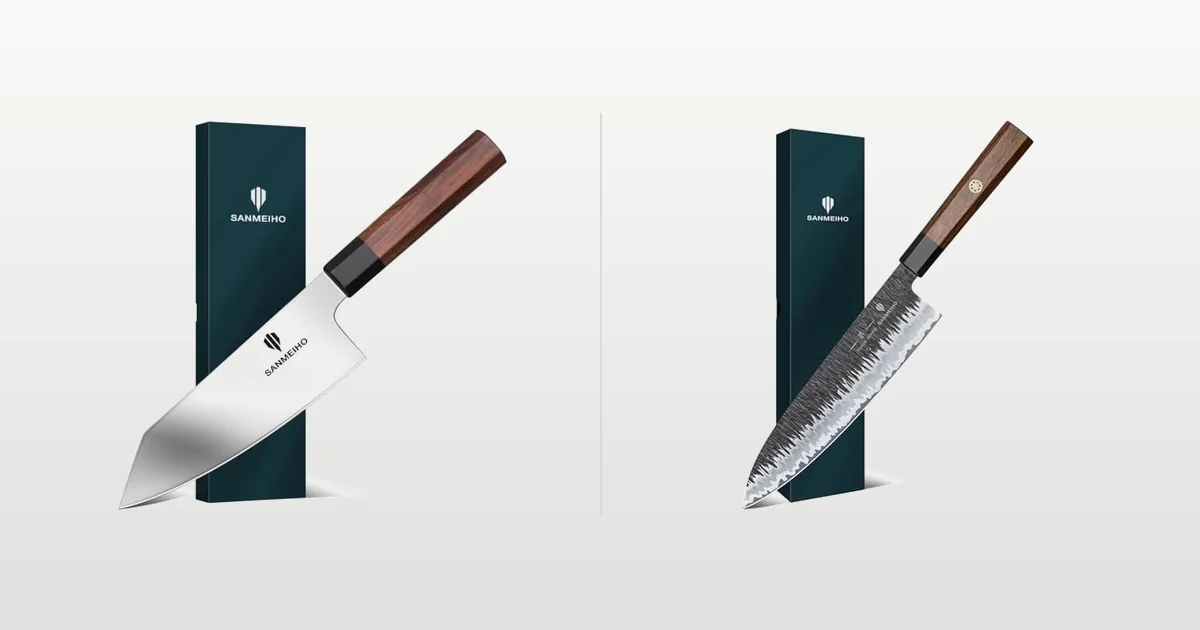
 Best OverallSANMEIHO 8 Inch Gyuto
Nine-layer clad steel around a 10Cr15MoV core at 62 HRC, on a G10 and rosewood handle with no moulded finger positions.
 Best OctagonalFAMCÜTE 8 Inch
Five layers of 9Cr18MoV at HRC 62 on a non-slip octagonal handle — the traditional shape at a mid-range price.
 Best KnownVictorinox Fibrox Pro 8 Inch
The knife most professional kitchens actually use — a 7.9-inch stamped blade on a thermoplastic elastomer handle, dishwasher safe.
At a Glance
Ten Knives, and What They Will Tell You
Blade length, the specification each maker leads on, handle material and shape where described, and what is missing.
| # | Model | Blade | Detail | Handle | Spec | Standout | Main Drawback | Check Price |
|---|---|---|---|---|---|---|---|---|
| 1 |
 SANMEIHO 8 Inch Gyuto SANMEIHO 8 Inch Gyuto |
8 in | 62 HRC | G10 + rosewood | 12° edge | A straight handle with no finger scallops to fight | Handle length never stated | View on Amazon |
| 2 |
 HOSHANHO 9 Inch Kiritsuke HOSHANHO 9 Inch Kiritsuke |
9 in | 8 layers | Octagonal | 2.5 mm | Nine inches, and an octagonal handle that fits any hand | Kiritsuke profile is demanding to use | View on Amazon |
| 3 |
 FAMCÜTE 8 Inch FAMCÜTE 8 Inch |
8 in | HRC 62 | 5 layers | Non-slip | An octagonal handle at fifty dollars, with a published hardness | Handle length never stated | View on Amazon |
| 4 |
 Huusk Viking Knife Huusk Viking Knife |
5.12 in handle | 5.9 in blade | 11 in overall | Full tang | The only listing in thirty that publishes a handle dimension | A butcher profile, not a chef knife | View on Amazon |
| 5 |
 Victorinox Fibrox Pro 8 Inch Victorinox Fibrox Pro 8 Inch |
7.9 in | TPE grip | Dishwasher safe | Since 1884 | The professional standard, with a grip that works wet | A contoured Western handle | View on Amazon |
| 6 |
 KAWAHIRO 8.27 Inch VG10 KAWAHIRO 8.27 Inch VG10 |
8.27 in | VG10 | 13.4 in overall | Hand-forged | VG10, the benchmark Japanese kitchen steel | Handle described only as engineered | View on Amazon |
| 7 |
 ENOKING 7.5 Inch Cleaver ENOKING 7.5 Inch Cleaver |
7.5 in | 1.39 lb | Full tang | German steel | The heaviest knife here, with a full-tang wooden handle | 1.39 lb is a lot of knife to hold | View on Amazon |
| 8 |
 imarku Santoku 7 Inch imarku Santoku 7 Inch |
7 in | Pakkawood | Hollow edge | Wrist tension | Rank #1,372 with a Pakkawood handle at $26.62 | Seven inches is short for a large hand | View on Amazon |
| 9 |
 PAUDIN 8 Inch Chef Knife PAUDIN 8 Inch Chef Knife |
8 in | 5Cr15MoV | Wood handle | Gift box | An eight-inch blade for $31.99 | Published dimensions are inconsistent | View on Amazon |
| 10 |
 SANMEIHO 6 Inch — For Small Hands SANMEIHO 6 Inch — For Small Hands |
6 in | 0.25 lb | Sandalwood | Small hands | The only listing here that addresses hand size at all | It addresses the opposite hand size | View on Amazon |
Specifications and prices are taken from each manufacturer’s Amazon listing as displayed on 24 August 2026 through a United States connection, and may change. Handle length is published by exactly one of the thirty products returned by this search, at 5.12 inches; every other figure in the handle column here is inferred from handle shape, overall length minus blade length, or is absent. Where a listing’s published dimensions are internally inconsistent — one here mixes millimetres and inches — we report them as published rather than silently correcting. Blade lengths are the manufacturers’ own. Hardness figures are given only where stated; four listings publish one. Sales ranks are shown as displayed and can be pooled across a variant family. Nothing on this page is a substitute for holding a knife before buying it where that is possible.
Scroll the table sideways to see every column
How We Chose These Ten
We researched current listings, compared manufacturer specifications and documentation, and examined recurring patterns in customer feedback. We did not carry out hands-on testing, and nothing below is presented as measured performance data.
- Handle shape recorded where described — because it matters more than length and is stated more often
- Handle length recorded where published — exactly one listing gives one, at 5.12 inches
- A verified live buy box — all ten confirmed purchasable in the United States on 24 August 2026
- No overlap with our published chef knife and kitchen knife guides — every knife here is new to the site
- Blade length recorded for all ten — the best available proxy, since makers scale knives as whole objects
- Hardness noted where stated — four publish one; it separates the Japanese knives from the budget steels
- The knife for small hands included deliberately — it is the only listing in thirty to address hand size at all
The Ten Knives in Detail
1. SANMEIHO 8 Inch Gyuto — Best Overall

The handle is a straight profile with no finger scallops moulded into it. That is the single most useful property here for a large hand.
Key Specifications
| Blade | 8 inches, gyuto profile |
|---|---|
| Steel | 9 layers of high-carbon stainless around a 10Cr15MoV core |
| Hardness | 62 HRC — joint highest here |
| Edge angle | 12 degrees |
| Handle | G10 and rosewood with a decorative brass pin |
| Handle shape | Straight profile, no moulded finger scallops |
| Finish | Hand-forged hammered texture |
| Rank | #22,666 in its category |
| Price | $35.99 |
| Best For | Large hands, because the handle does not tell them where to go |
Why We Recommend It
Moulded finger grooves are sized for an average hand, and a large hand does not fit them. When a handle has scallops for individual fingers, it dictates exactly where your hand must sit. If your fingers are wider than the spacing, they straddle the ridges instead of sitting in the hollows, and the ridges press into the joints. Over an hour of prep that is the difference between comfortable and painful. A handle with a consistent cross-section imposes nothing — you grip where you like and slide forward or back as the job changes.
G10 is glass fibre in epoxy resin, which is dimensionally stable, waterproof and grippier when wet than polished wood. Pairing it with rosewood gives the traction where it matters and the warmth where it shows.
Sixty-two HRC with a twelve-degree edge is a serious specification at $35.99. Both figures are published, which almost nothing else in this search manages.
What it does not tell you is handle length, and neither does anything else here except one knife. That is the problem this whole page is about.
Pros
- Straight handle with no finger scallops to fight
- Publishes 62 HRC and a 12° edge angle
- 9-layer clad steel around a 10Cr15MoV core
- G10 grips when wet, rosewood for comfort
- $35.99 for a genuinely specified knife
- Hand-forged hammered finish sheds food
Cons
- Handle length never stated
- Rank #22,666
- 62 HRC chips if used on bone or frozen food
- No blade height published
- Hand-forged finish means unit-to-unit variation
- Unfamiliar brand
Best for: Large hands that want a handle imposing no fixed grip position.
2. HOSHANHO 9 Inch Kiritsuke — Longest Blade
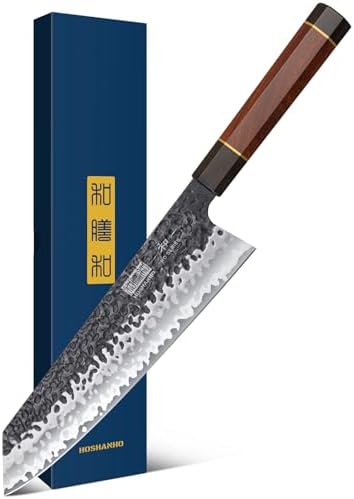
An octagonal handle has the same cross-section along its whole length. There is nowhere it expects your fingers to be.
Key Specifications
| Blade | 9 inches — longest here |
|---|---|
| Profile | Kiritsuke — a flat-profile hybrid of gyuto and usuba |
| Steel | 8 layers of composite steel, 10Cr15CoMoV core |
| Edge | Hand-sanded to 12–15 degrees per side |
| Thickness | 2.5 mm |
| Handle | Natural rosewood, octagonal |
| Why octagonal | Uniform cross-section — no fixed grip position |
| Rank | #16,339 in its category |
| Price | $84.99 |
| Best For | Large hands wanting the most blade and the most handle |
Why We Recommend It
That is the Japanese tradition’s answer to the problem, and it predates ergonomics as a marketing word. A wa-handle — octagonal, D-shaped or oval — is a straight tapered section with no contouring, which means it accommodates any hand size because the hand chooses its own position. Western handles evolved the opposite way, contoured to a supposed average, and the further you are from that average in either direction the worse they suit you.
Nine inches is the longest blade in this roundup, and blade length correlates loosely with handle length — makers scale the whole knife. In the absence of a published handle dimension, which nobody here provides, blade length is the best proxy available.
A kiritsuke is a demanding profile. It is much flatter than a gyuto, which suits push-cutting and long draw slices and punishes the rocking motion most Western cooks default to. Buy it knowing that.
Rosewood needs occasional oiling and must not go in a dishwasher, which the listing states directly.
Pros
- Octagonal handle imposes no grip position
- 9 inches — longest blade here
- 8-layer composite over a 10Cr15CoMoV core
- Hand-sanded 12–15° edge per side
- 2.5 mm blade is thin and precise
- Rosewood will not crack or deform
Cons
- Kiritsuke profile punishes rocking cuts
- Handle length never stated
- $84.99, second most expensive here
- Rosewood needs oiling and no dishwasher
- Not for bones or frozen food
- Rank #16,339
Best for: Experienced cooks with large hands who push-cut rather than rock.
3. FAMCÜTE 8 Inch — Best Octagonal

Octagonal, non-slip and fifty dollars. The shape that suits large hands best is not an expensive shape.
Key Specifications
| Blade | 8 inches |
|---|---|
| Steel | 5 layers of 9Cr18MoV |
| Hardness | HRC 62 — joint highest here |
| Handle | Non-slip octagonal |
| Why octagonal | Uniform section, so any hand finds its own position |
| Balance | Described as balanced for precise control |
| Corrosion | Stated rust and corrosion resistance |
| Rank | #12,927 in its category |
| Price | $49.99 |
| Best For | The traditional handle shape without paying premium prices |
Why We Recommend It
Octagonal handles are cheaper to make than contoured ones, which is a useful thing to know. A wa-handle is essentially a tapered block with eight flats — no complex moulding, no left- and right-handed versions, no tooling for finger scallops. The reason they are less common in Western kitchens is convention rather than cost, and it means the handle geometry that accommodates every hand size is available at every price point.
HRC 62 on 9Cr18MoV is a high hardness on a high-chromium stainless, which gives excellent edge retention and good corrosion resistance together — an unusual combination, since the two normally trade against each other.
Five layers rather than the eight or nine above is fewer, and layer count is largely cosmetic in any case — the cladding is soft steel protecting a hard core, and what matters is the core.
Rank #12,927 puts it mid-table here, and at $49.99 it sits between the budget knives and the eighty-dollar Japanese pieces.
Pros
- Non-slip octagonal handle at $49.99
- HRC 62 published on 9Cr18MoV
- Octagonal shape suits any hand size
- Good corrosion resistance for a hard steel
- Described as balanced blade to handle
- Established seller with service support
Cons
- Handle length never stated
- 5 layers, fewest of the clad knives here
- Layer count is largely cosmetic
- Rank #12,927
- 62 HRC is brittle against bone or frozen food
- Octagonal handles feel unfamiliar at first
Best for: Anyone wanting the traditional handle shape at a sensible price.
4. Huusk Viking Knife — Only One With a Handle Length

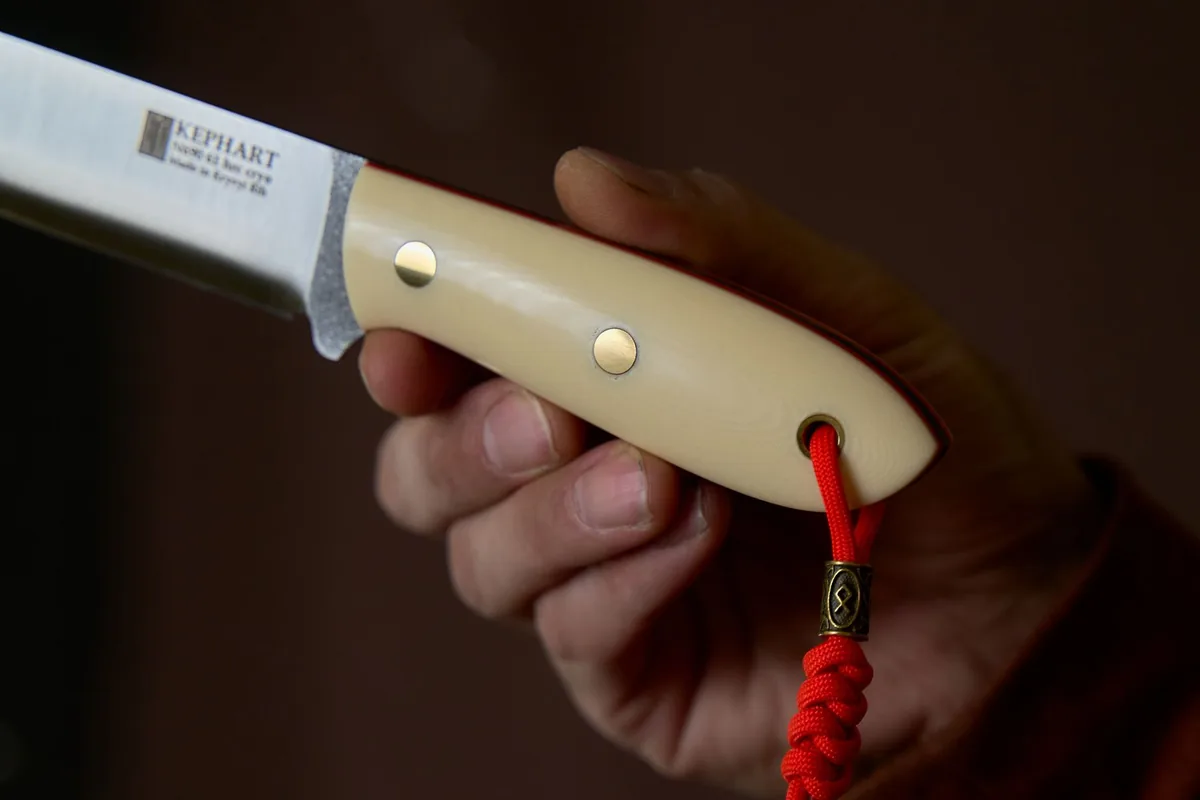
Handle length 5.12 inches. Across thirty results in this search, exactly one listing states that number, and this is it.
Key Specifications
| Handle length | 5.12 inches — the only one published in this entire search |
|---|---|
| Blade length | 5.9 inches |
| Overall length | 11 inches |
| Steel | Japanese high-carbon |
| Construction | Full tang |
| Handle | Shaped wood |
| Profile | Viking-style butcher knife, not a conventional chef knife |
| Rank | #14,979 in its category |
| Price | $14.53 |
| Best For | Proving the point — and cheap enough to try the dimension on |
Why We Recommend It
That is the finding this whole page rests on. Someone searching for a chef knife for big hands wants one dimension — how long the handle is — and it is published once in thirty products. Every other listing offers the word ergonomic instead, which appears on nine of the ten knives here and is never once quantified.
Five point one two inches is a useful reference point to carry. A large adult male hand typically measures around 4 to 4.5 inches across the palm at the knuckles, so a handle of about 5 inches gives room for a full four-finger grip with the index finger forward on the spine. Below about 4.5 inches, a large hand starts to overhang.
The knife itself is not a chef knife. It is a Viking-style butcher blade with a deep belly and a distinctive shape, good for meat and awkward for the fine vegetable work a gyuto handles easily. It appears in this search because of its handle and its price.
At $14.53 it is by far the cheapest thing here, and full tang at that price is genuinely good.
Pros
- The only listing in thirty to publish a handle length
- 5.12-inch handle suits a large grip
- Full tang construction at $14.53
- Publishes blade and overall length too
- Japanese high-carbon steel
- Cheapest knife on this page
Cons
- Not a chef knife — a butcher profile
- Deep belly is awkward for fine vegetable work
- High-carbon steel will rust if left wet
- Rank #14,979
- Handle wood needs care
- Blade is only 5.9 inches
Best for: Anyone who wants to test what a 5.12-inch handle feels like for £11.
5. Victorinox Fibrox Pro 8 Inch — Best Known

Rank #1,052 — the best figure on this page by a wide margin — and it is the knife most commercial kitchens issue.
Key Specifications
| Blade | 7.9 inches, stainless steel |
|---|---|
| Handle | Thermoplastic elastomer (TPE), non-slip even when wet |
| Handle type | Contoured Western profile |
| Care | Dishwasher safe — unusual for a quality knife |
| Maker | Victorinox, Switzerland, since 1884 |
| Warranty | Lifetime against defects in material and workmanship |
| Rank | #1,052 — best on this page |
| Price | $48.86 |
| Best For | Anyone who wants the professional default, if the handle suits |
Why We Recommend It
The Fibrox handle is the reason, and it is a genuine mixed case for large hands. TPE is a soft polymer that grips reliably when wet or greasy, which is why food-service kitchens standardise on it. But it is a contoured Western handle with a swell and a defined profile, which means it does suggest a hand position. It is a gentle contour rather than deep finger scallops, so most large hands get on with it — but it is not the neutral shape an octagonal handle offers.
Dishwasher safe is genuinely rare on a knife worth owning, and it is why these survive commercial service. Hand washing is still better for the edge.
A stamped blade rather than forged means it is lighter and more flexible than the Japanese knives here, with no bolster. For a large hand the absence of a bolster is an advantage — nothing blocks a pinch grip well forward on the blade.
A lifetime warranty from a company operating since 1884 is the strongest provenance on this page.
Pros
- Rank #1,052, best on this page
- TPE grips reliably when wet or greasy
- Dishwasher safe, rare on a good knife
- Lifetime warranty from an 1884 maker
- No bolster, so a pinch grip goes well forward
- The professional kitchen default
Cons
- Contoured Western handle suggests a hand position
- Handle length never stated
- Stamped rather than forged — lighter and more flexible
- Softer steel than the Japanese knives here
- Plain looks
- Edge needs more frequent honing
Best for: Anyone who wants the professional standard and finds the contour comfortable.

6. KAWAHIRO 8.27 Inch VG10 — Best Steel

Thirteen point four inches overall against an 8.27-inch blade. Subtract and the handle is about five inches — which is the closest thing to an answer most of these listings offer.
Key Specifications
| Blade | 8.27 inches |
|---|---|
| Overall length | 13.4 inches — implies roughly a 5-inch handle |
| Steel | VG10 |
| Finish | Hand-forged black |
| Thickness | 0.12 inches / roughly 3 mm |
| Balance | Stated as balanced between blade and handle |
| Case | Wooden storage case included |
| Rank | #29,107 in its category |
| Price | $89.99 |
| Best For | Steel quality, with handle length inferred rather than stated |
Why We Recommend It
That subtraction is the workaround worth knowing. Where a maker gives blade length and overall length but not handle length — which several here do — the difference is the handle plus the bolster, and it is close enough to be useful. Two knives on this page permit that calculation. The rest give one figure or none.
VG10 is the benchmark Japanese kitchen steel and the reason to buy this. It is a high-carbon stainless with vanadium and cobalt, typically hardened to 60–61 HRC, and it holds an edge notably better than the 5Cr and 9Cr grades elsewhere in this roundup while still resisting rust. It is what most quality Japanese kitchen knives use when the maker is not making a point of something more exotic.
The handle is described as meticulously engineered, which tells you nothing about its shape or size. This is the pattern across the category.
At $89.99 it is the most expensive knife here, and the wooden case suggests it is bought as a gift as often as a tool.
Pros
- VG10 is the benchmark Japanese kitchen steel
- Overall length published, so handle can be inferred
- Hand-forged black finish
- Roughly 3 mm blade stock
- Wooden storage case included
- Holds an edge far better than 5Cr grades
Cons
- $89.99 — most expensive on this page
- Handle shape and length never described
- Rank #29,107
- Hand-forged finish varies between units
- Black coating wears at the edge
- Presentation case adds cost, not function
Best for: Buyers prioritising steel, who will infer the handle from the overall length.
7. ENOKING 7.5 Inch Cleaver — Biggest Grip

One point three nine pounds. Weight is a specification large hands often want and small hands rarely do.
Key Specifications
| Blade | 7.5 inches, cleaver profile |
|---|---|
| Weight | 1.39 lb — heaviest here |
| Steel | German high-carbon stainless |
| Construction | Full tang, not welded |
| Handle | Ergonomically designed wood |
| Use | Meat, bone-in cuts, heavy chopping |
| Care | Keep dry — high carbon content means rust risk |
| Rank | #20,833 in its category |
| Price | $27.99 |
| Best For | Large hands doing heavy work rather than fine prep |
Why We Recommend It
Heavier knives suit stronger hands, and that is a real relationship rather than a stereotype. A heavy blade does more of the work by momentum, so the cook applies less force per cut, which is comfortable if you have the grip strength to control it and tiring if you do not. Cleavers and Serbian-style chef knives are deliberately mass-forward for exactly this reason, and they are the profiles most often recommended to people who find standard chef knives insubstantial.
Full tang rather than welded is stated explicitly, and on a heavy chopping knife it matters more than on a light one — a welded joint between blade and tang is precisely what fails when you lever through a joint.
The trade is precision. A cleaver profile with a tall flat blade is superb at chopping and poor at anything requiring a tip. It will not fillet, it will not score, and rocking it is awkward.
High carbon content means it will rust if left wet, which the listing states directly.
Pros
- 1.39 lb suits strong hands and heavy work
- Full tang, explicitly not welded
- German high-carbon steel
- $27.99 for a substantial forged knife
- Mass-forward balance does the work for you
- Tall blade gives good knuckle clearance
Cons
- 1.39 lb is tiring for long fine prep
- Cleaver profile has no useful tip
- High carbon will rust if left wet
- Rocking motion is awkward
- Handle length never stated
- Rank #20,833
Best for: Large, strong hands doing heavy chopping rather than delicate work.
8. imarku Santoku 7 Inch — Best Rank Value

Rank #1,372 at $26.62. It is the value pick on this page, and it is also the second shortest knife here.
Key Specifications
| Blade | 7 inches, santoku profile |
|---|---|
| Steel | Japanese high-carbon stainless, rust resistant |
| Edge | Scalloped hollow edge to reduce sticking |
| Handle | Pakkawood, described as minimising wrist tension |
| Profile | Santoku — flatter than a gyuto, no pronounced tip |
| Rank | #1,372 — second best here |
| Price | $26.62 |
| Best For | Value, if seven inches is enough knife for your hand |
Why We Recommend It
Blade length is the only proxy for handle length that these listings reliably give, and seven inches is on the short side. Makers scale knives as whole objects, so a seven-inch santoku generally carries a shorter handle than an eight- or nine-inch gyuto from the same factory. For a large hand that is the wrong direction, and it is worth weighing against the excellent rank and price.
Pakkawood is resin-impregnated laminated hardwood, which is dimensionally stable, waterproof and considerably tougher than natural wood. It is the sensible handle material at this price and will not crack the way untreated rosewood can.
The scalloped hollow edge is functional rather than decorative — the dimples break the vacuum that forms between a flat blade face and a wet slice, so potato and cucumber fall away instead of clinging.
A santoku has a flat profile and a sheepsfoot tip, which suits push-cutting and is poor for rocking or for any work needing a point.
Pros
- Rank #1,372, second best on this page
- $26.62 — excellent value
- Pakkawood is stable and waterproof
- Hollow edge stops food clinging
- Rust-resistant Japanese stainless
- Comes in a presentation box
Cons
- 7 inches is short, implying a shorter handle
- Handle length never stated
- Santoku profile is poor for rocking
- No pronounced tip for fine work
- Hardness not published
- Contoured handle rather than octagonal
Best for: Value buyers, if a shorter knife and handle suits the hand.
9. PAUDIN 8 Inch Chef Knife — Cheapest 8-Inch

Eight inches for $31.99, and a set of published dimensions that cannot all be in the same units.
Key Specifications
| Blade | 8 inches |
|---|---|
| Steel | 5Cr15MoV stainless |
| Pattern | Waved decorative finish |
| Handle | Wood, integrated with the blade |
| Uses | Bread, vegetables, fillets, meat |
| Packaging | Gift box |
| Note | Published dimensions mix units and are not reliable |
| Rank | #8,760 in its category |
| Price | $31.99 |
| Best For | An eight-inch blade at the lowest price here |
Why We Recommend It
We report listing data as published. This listing gives a length of 203 and a width of 45 alongside a height of 2 — figures that only make sense if the first two are millimetres and the third is not. Two hundred and three millimetres is exactly eight inches, so the blade length is consistent; the rest is a units error somewhere in the data feed. It is a small thing and it is precisely the sort of small thing that makes dimension shopping in this category frustrating.
5Cr15MoV is a soft budget stainless, roughly comparable to a low-end German steel. It will not hold an edge like the 62 HRC Japanese knives above and it sharpens back in minutes on anything, which for a knife used daily and honed often is a defensible trade.
The wave pattern is decorative, unlike the hollow edge on the imarku — it is etched rather than ground, so it does nothing to stop food sticking.
An eight-inch blade is the right length for most large hands, and at $31.99 this is the cheapest way to it on this page.
Pros
- 8-inch blade for $31.99
- Rank #8,760
- Soft steel sharpens back in minutes
- Wooden handle integrated with the blade
- Gift box included
- Cheapest 8-inch knife here
Cons
- Published dimensions mix units and cannot be right
- 5Cr15MoV is soft and dulls quickly
- Wave pattern is decorative, not functional
- Handle length never stated
- No hardness figure published
- Handle shape not described
Best for: An eight-inch blade at the lowest price, accepting soft steel.
10. SANMEIHO 6 Inch — For Small Hands — The Opposite

Search for a chef knife for big hands and this is the only result that mentions hand size. It is for small hands, and says so four times.
Key Specifications
| Blade | 6 inches — shortest here |
|---|---|
| Weight | 0.25 lb — lightest here |
| Handle | Red sandalwood |
| Stated audience | Cooks with smaller hands, mentioned in four of five bullets |
| Steel | Japanese high-carbon |
| Uses | Chopping, slicing, dicing, sashimi |
| Rank | #20,315 in its category |
| Price | $39.99 |
| Best For | Small hands — it is here to show what is missing for large ones |
Why We Recommend It
It is included precisely because of that. Across thirty results, one manufacturer thought hand size was worth designing around and naming in the product title — and the hand size they chose was the small one. Nobody in this search sells a knife explicitly for large hands, which is why the question cannot be answered from the listings and has to be answered from proxies instead.
The proxies, in order of usefulness: handle shape first, because an octagonal or straight handle fits any hand while a contoured one does not; then blade length, because makers scale knives as whole objects; then overall length minus blade length, where both are given; then weight, since heavier knives suit stronger grips.
This knife is a competent small chef knife. Six inches, a quarter of a pound, red sandalwood, and genuinely well suited to the hands it names. If someone in your household has been complaining that an eight-inch knife is unwieldy, this is the answer to that.
For a large hand it is the wrong knife on every measure, and that is the point of its inclusion.
Pros
- The only listing here that addresses hand size
- Genuinely well suited to small hands
- 0.25 lb, lightest and most manoeuvrable here
- Red sandalwood handle
- Japanese high-carbon steel
- Publishes weight and blade length
Cons
- Built for small hands, not large ones
- 6 inches is the shortest blade here
- Handle will be short for a large grip
- Rank #20,315
- $39.99 for the shortest knife on this page
- Sandalwood needs oiling
Best for: Small hands. It is on this page to show what large hands are not offered.
Octagonal Against Contoured
Two good knives at similar money, and the handles work in opposite ways.
| FAMCÜTE 8 Inch | Victorinox Fibrox Pro | |
|---|---|---|
| Handle shape | Octagonal | Contoured Western |
| Imposes a grip position | No | Somewhat |
| Handle material | Wood composite | TPE, grips when wet |
| Blade | 8 in | 7.9 in |
| Hardness | HRC 62 | Not stated |
| Dishwasher safe | No | Yes |
| Rank | #12,927 | #1,052 |
| Price | $49.99 | $48.86 |
The Victorinox is the better-proven knife by a wide margin and the one professional kitchens actually issue. Its contour is gentle rather than deeply scalloped, so most large hands get on with it perfectly well. But it does have a defined profile with a swell, and the octagonal handle simply does not — you grip where your hand wants to and slide forward for fine work or back for chopping. If previous knives have left ridges pressing into your fingers, that is the difference to try.
What Each Listing Actually Tells You About the Handle
One number, nine adjectives.
| Knife | Handle length | Handle shape | Blade | Hardness | Price |
|---|---|---|---|---|---|
| Huusk Viking | 5.12 in — stated | Shaped wood | 5.9 in | No | $14.53 |
| KAWAHIRO VG10 | ~5 in inferred | Not described | 8.27 in | No | $89.99 |
| HOSHANHO Kiritsuke | Not stated | Octagonal | 9 in | No | $84.99 |
| FAMCÜTE 8 Inch | Not stated | Octagonal | 8 in | HRC 62 | $49.99 |
| SANMEIHO 8 Inch Gyuto | Not stated | Straight, no scallops | 8 in | 62 HRC | $35.99 |
| Victorinox Fibrox Pro | Not stated | Contoured Western | 7.9 in | No | $48.86 |
| ENOKING Cleaver | Not stated | Contoured wood | 7.5 in | No | $27.99 |
| imarku Santoku | Not stated | Contoured Pakkawood | 7 in | No | $26.62 |
| PAUDIN 8 Inch | Not stated | Not described | 8 in | No | $31.99 |
| SANMEIHO 6 Inch | Not stated | Sandalwood | 6 in | No | $39.99 |
One published handle length in the whole field, and one more that can be inferred by subtracting blade length from overall length. Everything else in that column comes from how the maker described the shape, which is why shape rather than size is the practical filter here. Note also that the four knives publishing a hardness figure are all Japanese-style, and that none of the Western knives here states one.
Best Alternatives
| Alternative | Why Consider It | Better For | Main Trade-Off |
|---|---|---|---|
| A 10-inch chef knife | Longer blades carry longer handles as a rule | Large hands wanting maximum grip length | Unwieldy on a small board, and harder to store |
| Rehandling an existing knife | A cutler can fit a handle sized to your hand exactly | Anyone with a blade they already like | Costs more than most knives on this page |
| A Chinese cleaver | Very tall blade, generous handle, huge knuckle clearance | Heavy chopping with a full grip | No tip, and a real learning curve |
| Buying in person | The only way to know before you own it | Everyone, where a shop is reachable | Far less choice than online |
What the Money Actually Buys
$14.53 to $35.99 — Huusk, imarku, ENOKING, PAUDIN, SANMEIHO 8 Inch. The value tier, and it contains both the only published handle length on the page and the best straight-handled option. The SANMEIHO gyuto at $35.99 publishes 62 HRC and a 12-degree edge, which is a serious specification at that price.
$39.99 to $49.99 — SANMEIHO 6 Inch, Victorinox, FAMCÜTE. Where the professional default sits alongside the cheapest octagonal handle. The Victorinox is the safest purchase on this page by record and rank; the FAMCÜTE is the one to try if contoured handles have not worked for you.
$84.99 to $89.99 — HOSHANHO Kiritsuke, KAWAHIRO VG10. Steel and blade length. The KAWAHIRO brings VG10, the benchmark Japanese kitchen steel, and publishes an overall length you can subtract from. The HOSHANHO brings the longest blade here at nine inches on an octagonal handle — the best combination on the page for a large hand, if you can work a kiritsuke profile.
What to Check Before You Buy
Look at Handle Shape Before Handle Size
This is the practical answer, because shape is described far more often than size and matters at least as much. A contoured Western handle is moulded to a supposed average hand, frequently with scallops for individual fingers, and it dictates where your hand sits. If your fingers are wider than the spacing, they straddle the ridges rather than settling into them, and after an hour the ridges are pressing into the joints. An octagonal, D-shaped or straight handle has a consistent cross-section along its length and imposes nothing at all — you grip where you like and move as the job changes.
Use Blade Length as a Proxy for Handle Length
Since almost nobody publishes the number you want, this is the workable substitute. Manufacturers scale knives as whole objects, so an eight- or nine-inch blade generally carries a longer handle than a six- or seven-inch one from the same maker. It is not exact and it is considerably better than nothing. For a large hand, eight inches is a sensible floor and nine gives more room still. The single published handle length in this search is 5.12 inches, which sits on an eleven-inch overall knife — a useful reference point to carry into other listings.
Subtract Where Both Lengths Are Given
A few listings publish blade length and overall length without ever naming the handle, and the difference between them is the handle plus any bolster. One knife here gives 8.27 inches of blade in 13.4 inches overall, which puts the handle at roughly five inches. That is close enough to be genuinely useful when comparing against a knife you already own and find comfortable or cramped. Measure the handle of your current chef knife with a tape, write the number down, and use it as the benchmark every time a listing gives you enough to calculate.
Check Blade Height for Knuckle Clearance
The other complaint large hands have about chef knives is knuckles hitting the board, and the specification that governs it is blade height at the heel rather than anything to do with the handle. A taller blade lifts your grip further from the board. Very few listings publish it, but blade profile is a reliable indicator: cleavers and Chinese-style knives are tallest, gyutos and kiritsuke are moderately tall, and santoku and utility profiles are shallower. One knife on this page is a cleaver at 1.39 pounds, and its knuckle clearance is the best here by a wide margin.
Treat ‘Ergonomic’ as Meaning Nothing
The word appears on nine of the ten listings in this roundup and is never once attached to a measurement. It is used to describe a TPE handle, a Pakkawood handle, an octagonal rosewood handle, a full-tang wooden handle and a sandalwood handle — five materially different shapes, all ergonomic. Nothing prevents its use and nothing defines it, which makes it exactly as useful here as ‘smart’ is on a pressure cooker or ‘compact’ on a countertop oven. Read past it to the shape and the material, which are described far more honestly.
Consider Weight as Part of the Fit
Heavier knives suit stronger grips, and this is a genuine relationship rather than a stereotype. A heavy blade does more of the work through momentum, so you apply less force per cut — comfortable if you have the grip strength to control it, and tiring if you do not. That is why cleavers and Serbian-style chef knives get recommended to people who find standard chef knives insubstantial. The spread on this page runs from a quarter of a pound to nearly a pound and a half, a nearly sixfold range, and weight is published more often than handle length is.
Hold One If You Possibly Can
Worth saying plainly at the end of an article built on published specifications: none of this beats picking a knife up. Hand size is not one dimension but several — palm width, finger length, grip span — and how a handle feels depends on all of them plus how you actually cut. If a cookware shop is reachable, thirty seconds holding three knives will tell you more than every listing in this search combined. Where that is not possible, buy from somewhere with a returns policy and treat the first week as the fitting.
Common Mistakes
- Expecting a listing to state handle length. One in thirty does.
- Reading ‘ergonomic’ as a specification. Nine of ten say it and none quantifies it.
- Assuming contoured means comfortable. Contours are sized for an average hand, not a large one.
- Buying a 6 or 7-inch knife for a big hand. Makers scale the handle with the blade.
- Ignoring blade height. Knuckle clearance is a separate problem from grip length.
- Overlooking the subtraction. Blade length and overall length together give you the handle.
- Buying without a returns policy. This is a fit question, and fit cannot be read off a page.
Who Should Buy Which
Buy the SANMEIHO 8-inch Gyuto at $35.99 as the default. A straight handle with no finger scallops, 62 HRC and a 12-degree edge published, and an eight-inch blade — the best combination here for a large hand at a sensible price.
Buy the FAMCÜTE at $49.99 if contoured handles have never suited you. A non-slip octagonal handle imposes no grip position at all, with HRC 62 behind it.
Buy the HOSHANHO Kiritsuke at $84.99 for the most blade and the most handle. Nine inches on an octagonal rosewood handle — provided you push-cut rather than rock.
Buy the Victorinox at $48.86 if you want the safest purchase on the page. Rank #1,052, a lifetime warranty, dishwasher safe, and a gentle contour most large hands find perfectly comfortable.
Buy the Huusk at $14.53 to find out what a 5.12-inch handle feels like. It is the only knife in this search that tells you, and it costs less than lunch.
Frequently Asked Questions
What handle length do I need for large hands?
Around five inches is a reasonable target, and the frustrating part is how hard that is to verify. Exactly one listing across the thirty results in this search publishes a handle length, at 5.12 inches on an eleven-inch overall knife. For reference, a large adult male hand typically measures roughly four to four and a half inches across the palm at the knuckles, so a handle of about five inches allows a full four-finger grip with the index finger forward on the spine of the blade. Below about four and a half inches a large hand begins to overhang the end. The most practical thing you can do is measure the handle of a knife you already own and find comfortable, write the number down, and use it as your benchmark whenever a listing gives you enough information to calculate.
Why do contoured handles hurt large hands?
Because they are shaped for an average hand and they dictate where your fingers go. A contoured Western handle, particularly one with scallops moulded for individual fingers, positions your grip whether it fits you or not. If your fingers are wider than the scallop spacing, they end up straddling the ridges between the hollows rather than sitting in them, which concentrates pressure on the finger joints. For a few minutes that is unnoticeable; over an hour of prep it becomes the reason you put the knife down. An octagonal, D-shaped or plain straight handle has the same cross-section along its whole length, so there is no position it expects you to adopt — you hold it where your hand naturally sits and slide forward or back as the task changes.
Is a longer blade better for big hands?
Usually yes, though the reason is indirect. Manufacturers design knives as whole objects and scale the handle along with the blade, so an eight- or nine-inch chef knife generally carries a longer, fuller handle than a six- or seven-inch one from the same maker. Since handle length is almost never published, blade length is the most reliable proxy you have. Eight inches is a sensible minimum for a large hand and nine gives more room again. There is a genuine trade-off: longer blades are less manageable on a small chopping board, harder to store in a block or drawer, and slightly slower for fine detail work. But if the complaint is a cramped grip, going up in blade length usually addresses it.
What is an octagonal handle and why does it help?
It is the traditional Japanese wa-handle shape: a straight, gently tapered section with eight flat faces and no contouring of any kind. Its advantage for hand size is that it has the same cross-section along its whole length, so it does not position your fingers anywhere in particular. A small hand grips it near the front, a large hand grips it wherever is comfortable and can slide forward for fine work or back for chopping without fighting a moulded shape. The flats also give a positive reference for blade orientation, so you always know which way the edge is pointing without looking. Two knives in this roundup have one, and octagonal handles are cheaper to manufacture than contoured ones, so the shape is available at every price.
Does blade height matter as much as handle size?
It addresses a different complaint, and if your problem is knuckles hitting the board then it matters more. Blade height at the heel determines how far your grip sits above the cutting surface, so a taller blade lifts your hand clear. This is a separate issue from grip length entirely — you can have a knife with a perfectly comfortable handle that still has you rapping your knuckles on the board with every chop. Very few listings publish blade height, but the profile tells you: cleavers and Chinese-style knives are the tallest by a wide margin, gyuto and kiritsuke profiles are moderately tall, and santoku and utility knives are shallower. The cleaver in this roundup has the best knuckle clearance here.
Is there any knife actually made for big hands?
Not in this search, which is the finding this article is built on. Across thirty results exactly one product mentions hand size in its title, and it is a six-inch knife explicitly designed for small hands, which says so in four of its five bullet points. Nobody here markets to the opposite case. Some Japanese makers do offer longer handles as an option and a few Western brands make an extended-handle line, but they are not what a general search surfaces, and none appeared in this one. The practical route is therefore to filter on handle shape rather than waiting for a listing that names your hand size, to prefer eight or nine inches of blade, and to buy somewhere with a returns policy so that the first week can function as the fitting.
Final Verdict
A straight handle with no finger scallops, 62 HRC and a 12° edge published, on an 8-inch gyuto. $35.99.
A non-slip octagonal handle that imposes no grip position, with HRC 62 behind it. $49.99.
Rank #1,052, dishwasher safe, lifetime warranty and the knife professional kitchens issue. $48.86.
The specification you want is published once in thirty listings. One knife states a handle length of 5.12 inches. The other twenty-nine offer the word ergonomic, which appears on nine of the ten knives here and is attached to five materially different handle shapes.
So filter on shape instead, because shape is described honestly. An octagonal or straight handle has one cross-section along its length and lets your hand sit where it wants. A contoured handle with finger scallops was sized for someone else, and the further your hand is from that average the more you will feel the ridges.
Then use blade length as your proxy — eight inches as a floor, nine if you can work the profile — and subtract blade from overall wherever a listing gives you both.
And if a shop is within reach, go and hold three. Thirty seconds of that beats every specification on this page, including ours.