Affiliate Disclosure: As an Amazon Associate, we earn from qualifying purchases. This does not affect the price you pay.
Buried in the listing for a six-pack of replacement blades, in capital letters, is the sentence that should decide this purchase:
“DOES NOT Fit 3.0 INCH RazorSafe Series Knives.”
Both knives are made by Outdoor Edge. Both are called RazorSafe. Both are in this roundup. And their blades are not interchangeable.
That is the thing nobody tells you about replaceable-blade knives: you are not buying a knife, you are buying into a blade format, and you will be buying that format for as long as you own the handle. If the maker discontinues it, changes it, or stops trading, what you have left is a grip with a slot in it.
Two of the ten below take universal blades. One uses the standard contractor razor blade that fits every box cutter ever made; one uses #60 scalpel blades, a craft and medical standard. Both are stocked by dozens of manufacturers and will still be on shelves in a decade. The other eight are proprietary.
Ten below, $11.99 to $49.99, sorted by what happens when you run out of blades.
Our Quick Picks
 Best OverallGerber EAB Mini
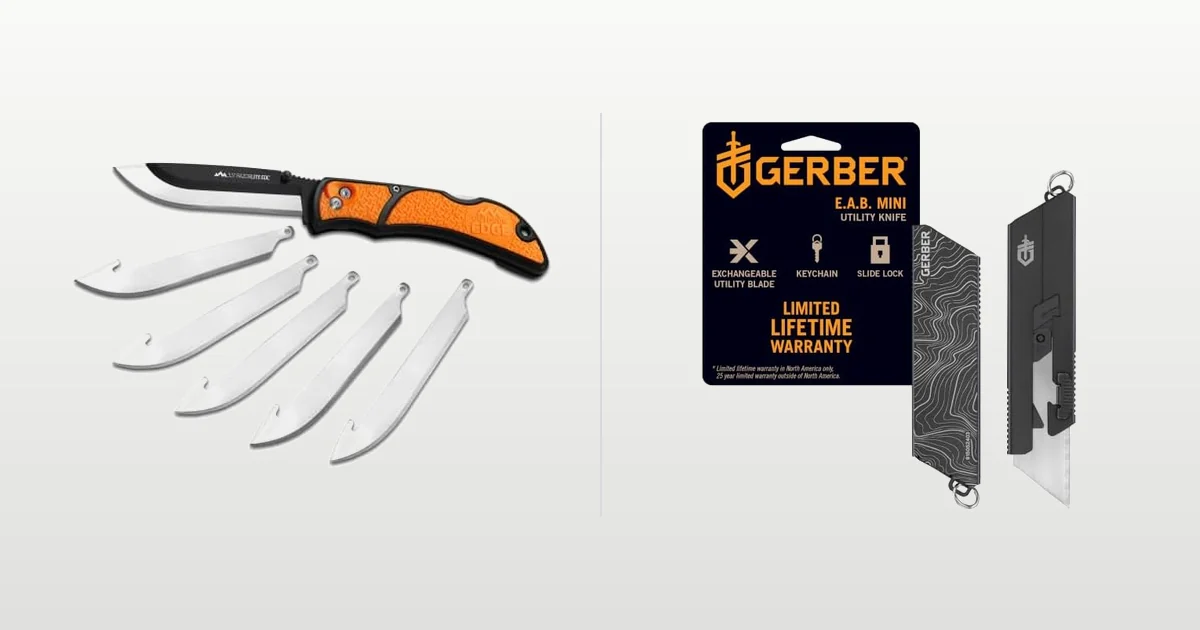
A pocket utility knife that takes the ordinary trapezoid razor blade sold in every hardware shop — no proprietary format, no supply to be tied to.
 Best SystemOutdoor Edge RazorLite EDC 3.5"
A 3.5-inch replaceable blade in a 420J2 stainless holder with a Grivory frame, six blades included, from the company that defined this category.
 Safest ChangeGerber Vital 2.8 Inch
A 2.8-inch drop point with tool-less blade replacement Gerber describes as safer than rival exchangeable-blade knives, plus a large finger choil.
At a Glance
Ten Knives, Sorted by What They Reload With
Blade format and length, how many blades come in the box, the change mechanism, and the one specification each maker leads on.
| # | Model | Blade | Included | Detail | Spec | Standout | Main Drawback | Check Price |
|---|---|---|---|---|---|---|---|---|
| 1 |
 Gerber EAB Mini Gerber EAB Mini |
0.7 in | Standard blade | 1.3 oz | 4.2 in | It takes a standard contractor utility blade you can buy anywhere | 0.7 inches of exposed edge | View on Amazon |
| 2 |
 Outdoor Edge RazorLite EDC 3.5" Outdoor Edge RazorLite EDC 3.5" |
3.5 in | 6 blades | 420J2 holder | Grivory | The most complete replaceable-blade system here, with six blades in the box | Proprietary RazorSafe format | View on Amazon |
| 3 |
 Gerber Vital 2.8 Inch Gerber Vital 2.8 Inch |
2.8 in | 6 blades | Tool-less | 1.3 oz | Gerber claim their change is safer than other EABs on the market | 2.8-inch blades are proprietary | View on Amazon |
| 4 |
 Klein Tools 44218 Hawkbill Klein Tools 44218 Hawkbill |
Hawkbill | Captive screw | Lockback | Belt clip | A hooked blade for stripping cable, from a trade tool brand | Ships with no spare blades at all | View on Amazon |
| 5 |
 Outdoor Edge RazorPro L Outdoor Edge RazorPro L |
3.5 in | 12 blades | TPR handle | Belt sheath | Twelve blades in the box, and a belt sheath to carry them | Same proprietary format as the RazorLite | View on Amazon |
| 6 |
 FLISSA 3-in-1 Hunting FLISSA 3-in-1 Hunting |
3 blade types | 16 blades | G10 | Liner lock | Drop point, gut hook and utility blades in one handle | Rank #86,133 is very low | View on Amazon |
| 7 |
 Outdoor Edge Onyx EDC 3.0" Outdoor Edge Onyx EDC 3.0" |
3.0 in | 3 blades | 1.9 oz | 6.8 in | Same brand, same system, and it will not take the 3.5-inch blades | Only three blades included | View on Amazon |
| 8 |
 TRUE Swift Edge TRUE Swift Edge |
3.5 in | 3CR13 | 2-step release | Saw blade | The only listing here that publishes its blade steel and finish | Rank #113,346 is very low | View on Amazon |
| 9 |
 Folding Scalpel with #60 Blades Folding Scalpel with #60 Blades |
#60 scalpel | 10 blades | Steel handle | Liner lock | It takes #60 scalpel blades, which are a genuine standard | A scalpel is not a general-purpose knife | View on Amazon |
| 10 |
 Outdoor Edge RazorSafe Blades, 6-Pack Outdoor Edge RazorSafe Blades, 6-Pack |
3.5 in | 420J2 | 6 pieces | Blades only | The consumable itself, and the listing that explains the compatibility trap | There is no knife in the box | View on Amazon |
Specifications and prices are taken from each manufacturer’s Amazon listing as displayed on 24 August 2026 through a United States connection, and may change. Blade format is classified from each listing’s own description: universal means a widely manufactured standard size not tied to one brand, and proprietary means a format supplied by the knife’s own maker. Within the RazorSafe system, 3.5-inch and 3.0-inch blades are not interchangeable, which the replacement blade listing states in capitals; both sizes appear in this roundup. One product here is a packet of blades with no knife in it and is included because it documents that incompatibility and because the running cost belongs in the comparison. Blade steel is named on only two of these ten listings. Sales ranks are shown as displayed and can be pooled across a variant family — four RazorLite listings and two RazorPro listings share a rank.
Scroll the table sideways to see every column
How We Chose These Ten
We researched current listings, compared manufacturer specifications and documentation, and examined recurring patterns in customer feedback. We did not carry out hands-on testing, and nothing below is presented as measured performance data.
- Blade format identified as universal or proprietary — because it determines whether you can still buy blades in ten years
- Blades included in the box recorded — the range here runs from none to sixteen, and it is a real cost difference
- A verified live buy box — all ten confirmed purchasable in the United States on 24 August 2026
- No overlap with our published razor knife and pocket knife guides — every product here is new to the site
- The change mechanism noted — captive screw, push button, tool-less — they fail and injure differently
- Blade steel recorded where named — only two of ten name a grade, which for a consumable is odd
- A blade-only pack included deliberately — it is the running cost, and it documents the compatibility trap

The Ten Products in Detail
1. Gerber EAB Mini — Best Overall

It takes the same trapezoid razor blade every box cutter in the world takes. That is the entire argument, and it is a strong one.
Key Specifications
| Blade format | Standard contractor-grade utility razor blade |
|---|---|
| Why that matters | Universal — available in any hardware shop, forever, in packs of 100 |
| Blade length | 0.7 inches exposed |
| Overall length | 4.2 inches |
| Weight | 1.3 oz |
| Carry | Pocket clip, slim profile |
| Warranty | Gerber limited lifetime |
| Rank | #1,920 — best on this page |
| Price | $11.99 |
| Best For | Anyone who wants a knife they will never have to source blades for |
Why We Recommend It
Every other knife on this page ties you to one manufacturer. Proprietary blades are a genuine ongoing dependency: if the maker discontinues the line, changes the format, or simply goes out of business, your knife becomes a handle. A standard utility blade is a commodity made by dozens of companies, stocked in every hardware shop and DIY store, and sold in packs of a hundred for the price of a sandwich. In ten years it will still be on the shelf.
Zero point seven inches of exposed edge is the trade. This is a box opener and a cord cutter, not a knife for food or field work. What it does, it does with a blade sharper than anything you could sharpen yourself.
One point three ounces and 4.2 inches folded makes it genuinely pocketable alongside keys, which is why it ranks where it does.
A lifetime warranty on an $11.99 tool is Gerber selling the handle rather than the blade, which is exactly the right way round for this category.
Pros
- Takes universal contractor utility blades
- Blades cost pennies and are stocked everywhere
- Rank #1,920 — best on this page
- $11.99 with a limited lifetime warranty
- 1.3 oz and 4.2 inches folded
- Publishes blade, overall length and weight
Cons
- Only 0.7 inches of exposed edge
- Useless for food or field dressing
- Standard blades rust quickly if left damp
- No lock type published
- Blade change exposes a bare razor
- Not a knife for anything but cutting open
Best for: Anyone who wants a replaceable-blade knife with no supply chain attached.
2. Outdoor Edge RazorLite EDC 3.5" — Best System

Six blades in the box. This is the system the whole category was built around, and it is genuinely well engineered.
Key Specifications
| Blade format | Outdoor Edge RazorSafe 3.5 inch — proprietary |
|---|---|
| Blades included | 6 |
| Blade holder | 420J2 stainless with black oxide coating |
| Blade steel | Japanese 420J2 |
| Frame | Grivory fibreglass/nylon polymer, non-slip |
| Change method | Remove and insert, no tools |
| Support | Outdoor Edge service for life |
| Rank | #3,384, pooled across four RazorLite listings |
| Price | $34.99 |
| Best For | Field dressing, where a fresh edge matters more than a durable one |
Why We Recommend It
The blade holder is the product, not the blade. A 420J2 stainless carrier with a black oxide coating supports the thin replaceable blade along its full length, which is what stops these knives flexing and snapping in use — the failure mode that makes people distrust the concept. Outdoor Edge has been refining this since the 1990s and it shows.
Field dressing is where replaceable blades genuinely beat sharpening. Hide and hair dull an edge extraordinarily fast, and stopping to strop mid-animal is unpleasant and slow. Swapping in a factory-sharp blade takes seconds and the edge is better than anything achievable in the field.
Grivory is a glass-fibre-reinforced nylon — the same material Cold Steel uses for non-metallic handles — and it is rigid, waterproof and grips when wet or bloody.
Note the pooled rank. #3,384 is shared across four RazorLite listings, so it describes the family rather than this colour and blade count.
Pros
- Six blades included in the box
- 420J2 blade holder supports the blade fully
- Grivory frame grips when wet
- Tool-free blade changes
- Service-for-life support
- The most refined system in this category
Cons
- Proprietary RazorSafe blade format
- 3.5-inch blades do not fit 3.0-inch RazorSafe knives
- Rank pooled across four listings
- Thin blades are not for prying or batoning
- $34.99 before you buy more blades
- Blade change exposes a bare razor edge
Best for: Hunters, and anyone who values a fresh edge over a durable one.

3. Gerber Vital 2.8 Inch — Safest Change

The blade change is the dangerous part of owning one of these knives, and Gerber is the only maker here that says so directly.
Key Specifications
| Blade | 2.8 inches, stainless drop point |
|---|---|
| Blades included | 6 replacements |
| Change method | Tool-less, described as safer than other EABs |
| Overall length | 6.9 inches |
| Weight | 1.3 oz |
| Grip | Large finger choil |
| Warranty | Gerber limited lifetime |
| Rank | #23,612 in its category |
| Price | $37.34 |
| Best For | Anyone nervous about handling bare replacement blades |
Why We Recommend It
Understand what you are handling. A replacement blade is a bare, factory-sharp edge with no handle, and you are pushing it into a slot with your fingers. The commonest injury with these knives is not from using them but from loading them, and it happens because people rush a fiddly mechanism with cold or wet hands. Gerber’s claim to a safer exchange than rival exchangeable-blade knives is a claim about that specific moment.
A large finger choil is the other safety feature and it matters more on a thin replaceable blade than on a solid one. The choil gives your index finger a positive stop so your hand cannot slide forward onto the edge when the blade bites unexpectedly.
Two point eight inches and 1.3 ounces makes this the lightest field knife here, and Gerber publishes blade, overall length and weight, which several rivals do not.
Rank #23,612 is low, and the blades are proprietary to the Vital system.
Pros
- Tool-less change stated as safer than rivals
- Large finger choil stops the hand sliding forward
- 6 blades included
- 1.3 oz and 6.9 inches overall
- Publishes blade, overall length and weight
- Gerber limited lifetime warranty
Cons
- Proprietary 2.8-inch blade format
- Rank #23,612
- $37.34 is high for the blade length
- Thin blades flex under lateral load
- Blade steel grade not named
- Bare blades still need careful handling
Best for: Anyone who has cut themselves changing a blade and does not want to again.
4. Klein Tools 44218 Hawkbill — Best Specialist

A hawkbill hooks the material and pulls it into the edge. For stripping cable that is the correct geometry, and for almost nothing else.
Key Specifications
| Blade | Stainless hawkbill — curved, hooked profile |
|---|---|
| Purpose | Cable skinning and stripping |
| Change method | Captive screw — the screw stays in the knife |
| Blades included | None — sold separately |
| Lock | Lockback |
| Opening | Thumb stud in the blade holder |
| Handle | Curved with rubberised grip |
| Carry | Integrated flat steel belt clip |
| Rank | #12,883 in its category |
| Price | $26.98 |
| Best For | Electricians, and anyone who cuts toward themselves regularly |
Why We Recommend It
The curve does the work. A straight blade skids off a round cable sheath; a hooked one catches it and draws it onto the edge as you pull, which is why this profile has been the electrician’s standard for a century. It also cuts safely toward yourself, because the point curves away from your hand rather than toward it.
A captive screw is the right retention method for a trade tool. The screw stays in the knife when loosened, so it cannot be dropped into a wall cavity, a ceiling void or a patch of gravel — which is exactly where these knives get used. It is slower than a push-button system and much harder to lose parts from.
No spare blades in the box is worth knowing before you order. Klein states plainly that blades are sold separately, which makes this the only knife here that arrives with exactly one edge.
Klein is a trade brand rather than a knife brand, and the rubberised handle, lockback and steel belt clip all reflect that.
Pros
- Hawkbill geometry is correct for cable stripping
- Captive screw cannot be dropped and lost
- Lockback holds the blade through the pull
- Integrated flat steel belt clip
- Thumb stud for one-handed opening
- Trade brand build quality
Cons
- Ships with no spare blades at all
- Hawkbill is poor for general cutting
- Proprietary blade format
- Captive screw is slower than a button release
- Rank #12,883
- No blade length published
Best for: Electricians and cable work. It is a specialist tool, not an EDC knife.
5. Outdoor Edge RazorPro L — Most Blades

Twelve blades. That is roughly a season of field dressing without buying anything else.
Key Specifications
| Blades included | 12 — most on this page |
|---|---|
| Blade type | Single-edged stainless, RazorSafe 3.5 inch |
| Handle | Bright orange TPR, contoured and textured |
| Why orange | Visible if dropped in leaf litter or snow |
| Sheath | Camo nylon, belt or pack mounted |
| Grip | Slip-free when wet |
| Support | Service for life, made in Denver, Colorado |
| Rank | #18,496, pooled with a sibling listing |
| Price | $49.99 |
| Best For | A full season of field dressing without resupplying |
Why We Recommend It
Work out the running cost before you compare knives. Replaceable-blade knives have a purchase price and a consumption rate, and the second one is what you actually live with. A knife shipping with twelve blades at $49.99 and one shipping with three at $21.99 are not four dollars apart in practice — they are separated by however many blade packs you buy over the next two years. Twelve is the most generous allocation here by a distance.
Bright orange is a functional choice, not a styling one. A dark knife set down during field dressing disappears into leaf litter, mud or snow within seconds, and hunters lose them constantly. Orange TPR is the same reasoning behind blaze clothing.
A TPR handle grips when wet, which on a knife used with wet hands in cold weather is the specification that matters most.
Rank #18,496 is pooled with a sibling RazorPro listing, so it describes the pair.
Pros
- 12 blades included — most on this page
- Bright orange handle is visible when dropped
- TPR grips reliably when wet
- Camo nylon belt sheath included
- Same proven RazorSafe blade holder
- Service for life from a US maker
Cons
- Proprietary RazorSafe format
- Rank pooled with a sibling listing
- $49.99 — second most expensive here
- Orange handle is conspicuous for EDC
- Thin blades unsuited to heavy work
- Blade steel grade not named on this listing
Best for: Hunters who want a full season of edges in one purchase.
6. FLISSA 3-in-1 Hunting — Most Versatile

Three blade shapes in one handle. That is what a replaceable-blade system makes possible and almost nobody offers.
Key Specifications
| Blade types | 3 — drop point, gut hook, utility |
|---|---|
| Blades included | 16 — most on this page |
| Handle | G10, lightweight with anti-slip texture |
| Lock | Liner lock |
| Intended use | Hunting, gutting, light cutting |
| Design note | Thin blades for precision rather than power |
| Rank | #86,133 in its category |
| Price | $16.99 |
| Best For | Getting three blade shapes without buying three knives |
Why We Recommend It
This is the most interesting idea on the page. Once the blade is a consumable that slots in and out, there is no reason every blade has to be the same shape. A gut hook is a specialised tool most people would never buy as a separate knife; here it is one of the shapes you already own. The drop point handles general work, the utility blade handles packaging and cord, and the gut hook does the one job it is superb at.
Sixteen blades is the largest allocation here, spread across the three types, which softens the low rank considerably as a value proposition.
The listing is honest about the limitation: precision over power, thin blades that work best for gutting and light cutting. That is a fair description of every knife in this roundup and most makers do not say it.
Rank #86,133 is by far the lowest here, and G10 with a liner lock at $16.99 from an unfamiliar brand is a bet on an untested product. The idea is better than the track record.
Pros
- Three blade shapes swap into one handle
- 16 blades included, most on this page
- Gut hook without buying a dedicated knife
- G10 handle with anti-slip texture
- Liner lock safety mechanism
- Honest about being for precision, not power
Cons
- Rank #86,133 — lowest on this page
- Proprietary three-format blade system
- Unfamiliar brand with no service record
- Thin blades unsuited to anything heavy
- Three formats means three things to run out of
- No blade steel grade published
Best for: Hunters who want a gut hook and a drop point without carrying two knives.
7. Outdoor Edge Onyx EDC 3.0" — The Incompatible One

Outdoor Edge’s own replacement blade pack states it in capitals: it does not fit the 3.0-inch knives. This is that knife.
Key Specifications
| Blade length | 3.0 inches |
|---|---|
| Overall length | 6.8 inches |
| Weight | 1.9 oz |
| Blades included | 3 |
| Blade steel | 44J2 stainless, heat treated and hand finished |
| Handle | Grivory glass nylon composite |
| Lock | Lockback safety |
| Compatibility | Requires 3.0-inch RazorSafe blades — not the 3.5-inch |
| Rank | #16,138, pooled with a sibling listing |
| Price | $21.99 |
| Best For | EDC — provided you order the right blades |
Why We Recommend It
That is the trap in this whole category, and it exists inside a single brand’s range. The RazorSafe 3.5-inch blade pack fits the Razor-Lite, Razor-Lite EDC, Razor-Pro and Onyx-EDC knives. It explicitly does not fit the 3.0-inch Onyx-Lite. Two knives from one manufacturer, both called RazorSafe, both in this roundup, and their consumables are not interchangeable. Ordering a blade pack without checking the length is an easy and entirely avoidable mistake.
Taken on its own merits it is the best EDC option in the system. One point nine ounces and 6.8 inches overall is genuinely pocketable, and 3.0 inches sits under more local carry limits than 3.5 does.
A lockback rather than a liner lock releases from the spine, away from the closing path, which on a knife with a razor blade in it is the safer arrangement.
Only three blades in the box, against six on the RazorLite and twelve on the RazorPro.
Pros
- 1.9 oz and 6.8 inches — genuinely pocketable
- 3.0 inches clears more carry limits than 3.5
- Lockback releases away from the blade path
- 44J2 blades heat treated and hand finished
- Grivory composite handle
- Publishes blade, overall length and weight
Cons
- Will not take the 3.5-inch RazorSafe blades
- Only 3 blades included
- Rank pooled with a sibling listing
- Easy to order the wrong blade pack
- Proprietary format with two incompatible sizes
- Thin blades not for heavy work
Best for: EDC carry — and write ‘3.0 inch’ on the box before you reorder blades.
8. TRUE Swift Edge — Best Specified

3CR13 stainless, black oxide finish, drop point, 3.5 inches. It is the only listing on this page that tells you all four.
Key Specifications
| Blade length | 3.5 inches, drop point |
|---|---|
| Blade steel | 3CR13 stainless — published |
| Finish | Black oxide — published |
| Blades included | 3 — two fine edge and one saw |
| Release | Two-step system for cutting control and simple replacement |
| Included | Steel clip and a blade storage case |
| Rank | #113,346 in its category |
| Price | $37.35 |
| Best For | Anyone who wants to know what the blade actually is |
Why We Recommend It
Blade steel is the specification this category hides. Nine of these ten listings describe their blades as razor-sharp, high-quality or precision-ground and never name a grade — which is odd, given the blade is the part you buy repeatedly. TRUE naming 3CR13 is useful even though 3CR13 is a soft budget stainless, because it sets an expectation: these will dull quickly and that is fine, since you are throwing them away rather than sharpening them.
A saw blade in the pack is the second good idea here. Like the FLISSA’s three shapes, it uses the format to give you a tool you would not otherwise carry — and a saw is genuinely useful for small branches and bone.
A blade storage case is a small, sensible inclusion. Loose spare blades in a pack or pocket are exactly how people cut themselves reaching for something else.
Rank #113,346 is very low, and $37.35 for three blades of soft steel is not obvious value against the six-blade Gerber at the same price.
Pros
- Publishes blade steel, finish, shape and length
- Includes a saw blade as well as two fine edges
- Two-step release gives cutting control
- Blade storage case included
- Steel pocket clip
- The most transparent listing on this page
Cons
- Rank #113,346 — very low
- 3CR13 is a soft budget stainless
- Only 3 blades for $37.35
- Proprietary blade format
- No weight or overall length published
- Poor value against six-blade rivals
Best for: Anyone who wants the blade specification stated rather than implied.
9. Folding Scalpel with #60 Blades — Second Universal Format

A #60 scalpel blade is a standard size. Like the contractor blade at the top of this page, it is not tied to whoever made this handle.
Key Specifications
| Blade format | #60 scalpel — a standard hobby and craft size |
|---|---|
| Why that matters | Widely available from craft and medical suppliers, not one brand |
| Blades included | 10 |
| Handle | Stainless steel, wear and moisture resistant |
| Lock | Liner lock |
| Carry | Pocket clip and lanyard hole |
| Rank | #30,305 in its category |
| Price | $14.99 |
| Best For | Fine detail work — modelling, crafts, precise trimming |
Why We Recommend It
That makes two universal formats in this roundup and seven proprietary ones. Scalpel blades in standard sizes are made by many manufacturers for craft, modelling and medical use, sold in boxes of a hundred, and they will still be available long after this particular handle is discontinued. If the lock-in problem is what worries you, these are your two options.
A scalpel edge is a different tool from a utility blade. It is thinner, sharper and far more fragile — superb for fine detail, trimming, modelling and anything requiring a precise line, and it will snap if you twist it. Do not buy this expecting to open packaging all day.
A stainless handle rather than polymer adds weight and durability, and it will not soften if left somewhere hot.
Ten blades at $14.99 is generous, and replacements cost very little indeed.
Pros
- Takes standard #60 scalpel blades
- Second non-proprietary format on this page
- 10 blades included at $14.99
- Blades available from many suppliers
- Stainless handle with liner lock
- Exceptionally fine edge for detail work
Cons
- A scalpel is fragile and snaps if twisted
- Not suited to general cutting or packaging
- Rank #30,305
- Unbranded handle with no service record
- Very fine edge is easy to damage
- Bare scalpel blades are unusually easy to cut yourself on
Best for: Modelling, crafts and fine trimming — not everyday box opening.
10. Outdoor Edge RazorSafe Blades, 6-Pack — Not a Knife

Rank #2,999 for a packet of blades. That figure tells you something important: people are buying these repeatedly.
Key Specifications
| Contents | 6 replacement blades — knife NOT included |
|---|---|
| Blade length | 3.5 inches |
| Blade steel | Japanese 420J2 |
| Fits | Razor-Lite, Razor-Lite EDC, Razor-Pro and Onyx-EDC |
| Does NOT fit | 3.0 inch RazorSafe knives — the Onyx-Lite OX-30 |
| Why it is here | It is the running cost, and it documents the compatibility trap |
| Rank | #2,999 — second best on this page |
| Price | $13.99 |
| Best For | Owners of the right knife — check the length first |
Why We Recommend It
This is the ongoing cost of every knife on this page and it belongs in the comparison. A replaceable-blade knife is a razor handle, and the honest purchase price includes what you will spend keeping it fed. Six blades for $13.99 is a little over two dollars an edge, against a conventional knife where sharpening is free forever. For field dressing that trade is clearly worth it; for opening parcels it is worth thinking about.
The compatibility notice is the most useful text on this page. In capitals it lists the four knives it fits and states plainly that it does not fit the 3.0-inch RazorSafe knives. One of those 3.0-inch knives is in this very roundup. Two products, one brand, one system name, incompatible consumables.
Japanese 420J2 is a soft, highly corrosion-resistant stainless — the right choice for a disposable blade, where rust resistance in a damp pocket matters more than edge retention.
Do not buy this expecting a knife. The first line of the listing says so in capitals, and it is here so that nobody does.
Pros
- Documents exactly which knives it fits and does not
- Rank #2,999, second best on this page
- Six blades for $13.99, around $2.30 an edge
- Japanese 420J2 resists corrosion well
- Makes the running cost visible
- Fits four separate Outdoor Edge models
Cons
- Not a knife — blades only
- Does not fit the 3.0-inch RazorSafe knives
- Only fits one manufacturer’s system
- Around $2.30 per edge is a real running cost
- 420J2 is soft and dulls quickly
- Easy to order the wrong length
Best for: Existing owners. Check whether your knife is 3.0 or 3.5 inches first.
Universal Format Against Proprietary System
Two ways to own a knife that never needs sharpening.
| Gerber EAB Mini | Outdoor Edge RazorLite 3.5" | |
|---|---|---|
| Blade format | Standard contractor blade | Proprietary RazorSafe |
| Where to buy blades | Any hardware shop | One manufacturer |
| Blades in the box | 1, fitted | 6 |
| Exposed edge | 0.7 in | 3.5 in |
| Weight | 1.3 oz | Not stated |
| Rank | #1,920 | #3,384 |
| Price | $11.99 | $34.99 |
The Outdoor Edge is the better knife and the better system — a proper 420J2 holder, a Grivory frame, six blades and a service-for-life policy. What it cannot give you is independence. The Gerber’s 0.7-inch edge does far less, and it does it with a blade you can replace from any shop in any town for the next thirty years. Which matters more depends entirely on whether you are field dressing a deer or opening a parcel.

What Each One Reloads With, and How Many You Get
Format, blade count and running cost across the field.
| Product | Format | Blades in box | Steel named | Rank | Price |
|---|---|---|---|---|---|
| Gerber EAB Mini | Universal contractor | 1 fitted | No | #1,920 | $11.99 |
| Folding Scalpel | Universal #60 scalpel | 10 | No | #30,305 | $14.99 |
| Outdoor Edge RazorSafe blades | Proprietary 3.5 in | 6, no knife | 420J2 | #2,999 | $13.99 |
| Outdoor Edge RazorLite 3.5" | Proprietary 3.5 in | 6 | 420J2 | #3,384 | $34.99 |
| Klein 44218 Hawkbill | Proprietary hawkbill | 0 — sold separately | No | #12,883 | $26.98 |
| Outdoor Edge Onyx 3.0" | Proprietary 3.0 in | 3 | 44J2 | #16,138 | $21.99 |
| Outdoor Edge RazorPro L | Proprietary 3.5 in | 12 | No | #18,496 | $49.99 |
| Gerber Vital | Proprietary 2.8 in | 6 | No | #23,612 | $37.34 |
| FLISSA 3-in-1 | Proprietary, 3 shapes | 16 | No | #86,133 | $16.99 |
| TRUE Swift Edge | Proprietary 3.5 in | 3 | 3CR13 | #113,346 | $37.35 |
Two rows deserve a second look. The Klein ships with no spare blades at all — it states that blades are sold separately, so it arrives with exactly one edge. And the third row is a packet of blades with no knife in it, ranked #2,999, which is the second best figure on this page. People are buying blades repeatedly, which is precisely the point: the purchase price is the handle, and the running cost is the rest of your ownership.
Best Alternatives
| Alternative | Why Consider It | Better For | Main Trade-Off |
|---|---|---|---|
| A conventional knife and a sharpener | Sharpening is free forever, and the edge is yours to control | Anyone who enjoys maintaining tools | A stropped edge never matches a factory one |
| A snap-off utility knife | Cheapest possible fresh edge, no format to be tied to | Cardboard, carpet and site work | Snapped segments are fragile and awkward to dispose of |
| A dedicated box cutter | Safer, retractable, purpose-built for packaging | Warehouse and mail-room use | Useless for anything but packaging |
| A fixed-blade hunting knife | No mechanism to fail, and it can be batoned | Heavy field work | Needs sharpening exactly when you least want to |
What the Money Actually Buys
$11.99 to $16.99 — Gerber EAB Mini, Outdoor Edge blade pack, Folding Scalpel, FLISSA. Both universal formats live here, along with the largest blade allocation on the page at sixteen. If independence from a single supplier is what you want, this tier is the whole answer, and the EAB Mini at $11.99 ranks best on the page.
$21.99 to $37.35 — Onyx EDC, Klein, RazorLite, Gerber Vital, TRUE. Where the engineering is. Proper blade holders, lockbacks, captive screws and tool-less changes. This is also where the compatibility trap sits, with 3.0-inch and 3.5-inch RazorSafe knives eight dollars apart and taking different blades.
$49.99 — Outdoor Edge RazorPro L. The most expensive knife here and the most blades of any knife, at twelve, with a belt sheath and a high-visibility handle. For a hunting season it is the lowest cost per edge on the page.
What to Check Before You Buy
Check the Format Before the Knife
This is the decision, and almost nobody makes it deliberately. A replaceable-blade knife commits you to a consumable, and that consumable is either a widely made standard or one company’s product. Two knives here take universal blades — the ordinary contractor razor blade and the #60 scalpel — and both are made by dozens of manufacturers, sold in boxes of a hundred, and stocked in ordinary shops. The other eight tie you to one supplier for the life of the handle. Neither choice is wrong, but you should know which one you are making.
Beware Incompatibility Within a Single Brand
Outdoor Edge sells 3.0-inch and 3.5-inch RazorSafe knives, and the blades do not interchange. Their own replacement blade listing states in capitals that the 3.5-inch pack fits the Razor-Lite, Razor-Lite EDC, Razor-Pro and Onyx-EDC, and does not fit the 3.0-inch Onyx-Lite. Two knives from the same range, sharing a system name, with incompatible consumables — and both appear in this roundup, eight dollars apart. Note which size you bought, write it somewhere, and check it before every reorder.
Count the Blades in the Box, Then Price the Refills
The allocation here runs from none to sixteen, which is a substantial hidden difference in what you are actually paying. One knife ships with no spares at all because blades are sold separately; another includes twelve. At around $2.30 an edge for a six-pack, a knife with twelve blades has roughly twenty-eight dollars of consumable in the box and one with three has about seven. Compare knives on purchase price plus what it takes to get them to a working blade count, not on the sticker alone.
The Blade Change Is the Dangerous Part
A replacement blade is a bare, factory-sharp edge with no handle, and you push it into a slot with your fingers. The characteristic injury with these knives happens during loading rather than cutting, usually because someone is rushing a fiddly mechanism with cold or wet hands. Mechanisms differ meaningfully: push-button releases are fast and put fingers close to the edge, captive screws are slower and keep the parts contained, and one maker here explicitly claims a safer exchange than rivals. Change blades sitting down, in good light, without hurrying.
Dispose of Used Blades Properly
A dulled replaceable blade is still sharp enough to open a hand, and it is now loose. Dropping used blades into a kitchen bin is how somebody else gets cut, and the bag itself will not contain them. The right approach is a rigid container — the blade packet itself, a jar, or a purpose-made sharps tin — kept until it is full and then disposed of sealed. Some blade packs are designed to take used blades back into the box for exactly this reason, and it is worth checking whether yours does.
Thin Blades Are Not Prying Blades
Every knife here uses a blade far thinner than a conventional knife, because it has to slide into a holder. That geometry is what makes them cut so well and what makes them snap. Levering, twisting, prying open a tin, or digging at anything will break a replaceable blade, sometimes explosively. One listing is refreshingly direct about this, describing its knife as precision over power and best suited to gutting and light cutting. Treat that as true of the entire category, not just that product.
Note Which Blade Shapes the System Offers
Once the blade is a consumable, there is no reason every blade has to be the same shape, and two makers here exploit that. One offers drop point, gut hook and utility blades that all fit the same handle; another includes a saw blade alongside two fine edges. That is a genuine advantage over a fixed knife, because a gut hook or a saw is a tool most people would never buy separately. It also means more formats to keep track of and more things to run out of.

Common Mistakes
- Buying the knife without checking the blade format. The format is what you will be buying for years.
- Assuming one brand’s blades all fit. RazorSafe 3.0-inch and 3.5-inch are not interchangeable.
- Ignoring how many blades come in the box. The range here is zero to sixteen.
- Rushing the blade change. That is when people get cut, not while cutting.
- Prying with a replaceable blade. They are thin by design and they snap.
- Binning used blades loose. They stay sharp enough to injure whoever handles the bag.
- Expecting a named blade steel. Only two of these ten listings give one.
Who Should Buy Which
Buy the Gerber EAB Mini at $11.99 unless you need a long blade. It takes the standard contractor razor blade that every hardware shop on earth stocks, it weighs 1.3 ounces, it has a lifetime warranty and it ranks best on this page. No supply chain, no format to be locked into.
Buy the Outdoor Edge RazorLite at $34.99 if you are field dressing. The 420J2 holder and Grivory frame are the most refined execution in this category, and six blades come in the box.
Buy the RazorPro L at $49.99 for a whole season. Twelve blades, a belt sheath, and a bright orange handle you will not lose in leaf litter.
Buy the Klein 44218 at $26.98 if you strip cable. A hawkbill and a captive screw are the right answers for that job — and order blades at the same time, because it ships without any.
Buy the Folding Scalpel at $14.99 for fine work. #60 blades are a genuine standard, ten come in the box, and refills cost almost nothing.

Frequently Asked Questions
Why would I want a knife with replaceable blades?
Because a fresh factory edge beats a maintained one, and because some jobs destroy an edge faster than you can restore it. Field dressing is the clearest case: hide and hair dull a blade extraordinarily quickly, and stopping mid-animal to strop is slow and unpleasant, whereas swapping in a new blade takes seconds and gives you an edge sharper than anything achievable outdoors. The same logic applies to cardboard, carpet, roofing felt and anything abrasive. The trade is that you are now buying a consumable, at roughly two dollars an edge, where a conventional knife and a stone would cost you nothing after the initial purchase.
What is the difference between a universal and a proprietary blade?
A universal blade is a standard size manufactured by many companies and sold everywhere. The ordinary trapezoid contractor razor blade that fits every box cutter is one; the #60 scalpel blade used in craft and modelling is another. Both are stocked in ordinary shops, cost pennies, and will still be available in a decade regardless of what happens to the company that made your handle. A proprietary blade is made only by the knife’s manufacturer, for that system. Eight of the ten products in this roundup use proprietary formats. The knives are frequently better engineered, and the risk is that you are dependent on one company continuing to make and stock that exact part.
Will blades from one knife fit another?
Often not, and sometimes not even within the same brand. The clearest illustration is in this roundup: Outdoor Edge’s RazorSafe replacement blade pack states in capital letters that it fits the Razor-Lite, Razor-Lite EDC, Razor-Pro and Onyx-EDC knives, and does not fit the 3.0-inch RazorSafe knives. Both a 3.0-inch and a 3.5-inch RazorSafe knife appear on this page, priced eight dollars apart and sharing a system name, and their consumables are not interchangeable. Before reordering blades, check the blade length of your specific model rather than the brand or the series name.
Is changing the blade dangerous?
It is the most dangerous part of owning one of these knives, and worth taking seriously. A replacement blade is a bare, factory-sharp edge with no handle at all, and the operation involves pushing it into a slot with your fingers. Most injuries with these knives happen during loading rather than during use, usually because someone is hurrying a fiddly mechanism with cold, wet or gloved hands. The mechanisms genuinely differ: push-button releases are quick but bring fingers close to the edge, captive screws are slower and keep the components contained, and one manufacturer here claims a safer exchange than rival designs. Change blades sitting down, in good light, and never in a hurry.
How should I dispose of used blades?
In a rigid sealed container, never loose in a bin. A blunt replaceable blade is still sharp enough to cause a serious cut, and once it is in a bin bag it becomes a hazard to whoever lifts that bag — which may be you, and may be a refuse worker. The practical approach is to keep the packet the blades came in, or a jam jar or tin, and return each used blade to it until it is full, then seal it before disposal. Some blade packaging is designed to accept used blades back for precisely this reason. It costs nothing and it is the single most neglected part of owning one of these knives.
Can I pry or lever with a replaceable-blade knife?
No, and this is the one genuine weakness of the whole category. The blades are far thinner than a conventional knife blade because they have to slide into a holder, and that thinness is exactly what makes them cut so cleanly. It also means they will snap under lateral load — twisting, levering, prying at a lid, or digging into anything. When a thin hardened blade fails it can break suddenly and throw fragments. One listing in this roundup is admirably direct about it, describing the knife as designed for precision rather than power and best used for gutting and light cutting. Take that as a description of every product on this page.
Final Verdict
Takes the universal contractor razor blade, weighs 1.3 oz, ranks #1,920 and carries a lifetime warranty. $11.99.
A 420J2 blade holder, Grivory frame and six blades in the box — the most refined execution here. $34.99.
Tool-less replacement Gerber states is safer than rival designs, plus a large finger choil. $37.34.
You are not choosing a knife. You are choosing a blade format, and you will be living with it for as long as you own the handle.
Two of these ten free you from that entirely. The standard contractor blade and the #60 scalpel are made by dozens of companies and sold in ordinary shops, and they will outlast any brand on this page. The other eight are better knives tied to a single supplier.
And check the length, not just the brand. Outdoor Edge’s own blade packet says in capitals that it does not fit their 3.0-inch knives — two products in this roundup, one system name, incompatible refills.
Buy the EAB Mini at $11.99 if independence matters, the RazorLite at $34.99 if the job is field dressing, and either way keep a jar for the used blades.