Affiliate Disclosure: As an Amazon Associate, we earn from qualifying purchases. This does not affect the price you pay.
Blade lengths on this page run from 1.75 inches to 3.5 inches. Exactly one of these ten listings mentions that where you live may have an opinion about that number.
That listing specifies a 2.68-inch blade and non-assisted opening deliberately, states that it is legal to carry in most US states, and tells you to check your local regulations. It is the only one that treats a first-time buyer as a first-time buyer.
The thresholds that recur most often are three inches and three and a half, and some places treat assisted-opening mechanisms differently from manual ones. Rules vary by state and frequently by city, so we are not going to tell you what yours are — but we have put the blade length and the opening mechanism in the table for every knife here, because those are the two numbers that decide the question.
After that, the choices that matter for a beginner are unglamorous: a lock you can disengage without putting your thumb in the blade’s path, a steel soft enough to resharpen on anything, and a knife light enough that you actually carry it.
$5.97 to $26.20 below, and the cheapest knife here has the hardest steel on the page.
Our Quick Picks
 Best OverallGerber Paraframe I 3 Inch
A three-inch drop point on an open stainless frame with a frame lock and a limited lifetime warranty, at $21.97.
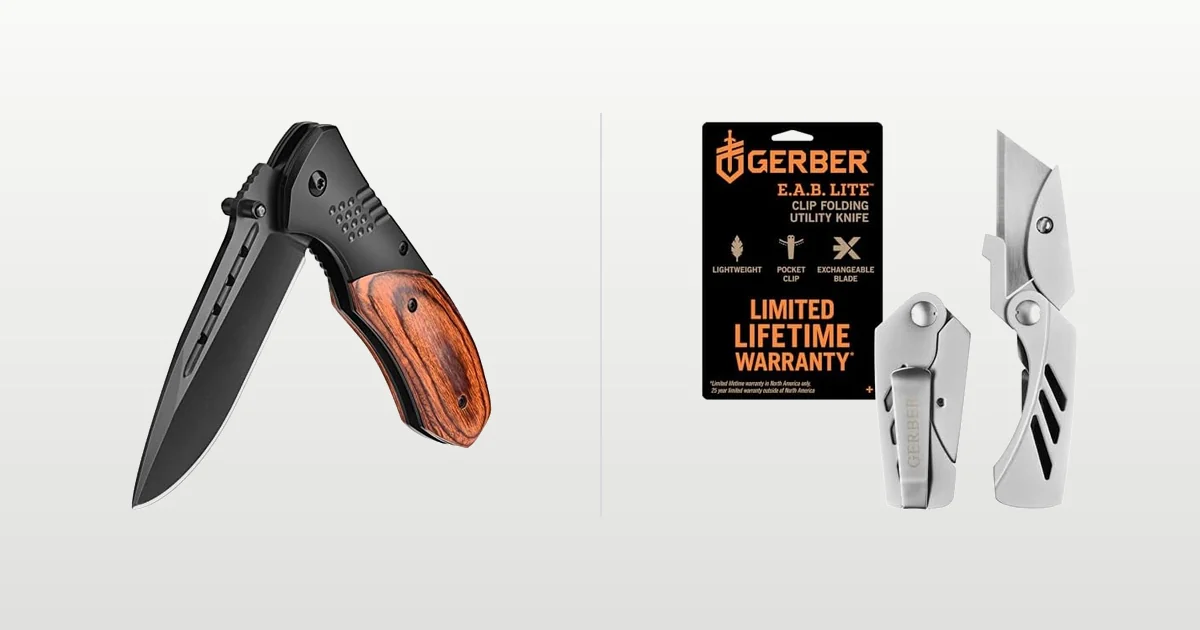
 Best for Carry RulesTactical Legal 2.68 Inch Serrated
A deliberately sub-three-inch, non-assisted 440C blade at 60 HRC — and the only listing here that raises the question of where you can carry it.
 Never Needs SharpeningGerber EAB Lite Razor Knife
A folding handle for a standard contractor razor blade, with a money clip and a limited lifetime warranty, at 2.2 ounces.
At a Glance
Ten Knives, With the Two Numbers That Decide Carry
Blade length, steel and hardness, lock type and opening mechanism. Read the first and last columns before anything else.
| # | Model | Blade | Steel | Lock | Opening | Standout | Main Drawback | Check Price |
|---|---|---|---|---|---|---|---|---|
| 1 |
 Gerber Paraframe I 3 Inch Gerber Paraframe I 3 Inch |
3.0 in | Stainless | Frame lock | Manual | An open frame that cannot trap dirt, under a lifetime warranty | No steel grade or hardness is published | View on Amazon |
| 2 |
 Tactical Legal 2.68 Inch Serrated Tactical Legal 2.68 Inch Serrated |
2.68 in | 440C, 60 HRC | Liner lock | Non-assisted | The only listing on this page that mentions carry law at all | A serrated edge is much harder to sharpen later | View on Amazon |
| 3 |
 Gerber EAB Lite Razor Knife Gerber EAB Lite Razor Knife |
1.5 in | Utility razor | Liner lock | Manual | It takes replaceable contractor blades, so it is always sharp | 1.5 inches is a box opener, not a knife | View on Amazon |
| 4 |
 Kershaw Misdirect 2.9 Inch Kershaw Misdirect 2.9 Inch |
2.9 in | 4Cr13 / 4Cr14* | Frame lock | Assisted | Kershaw’s Everyday Starter Series, made by a knife company since 1974 | The listing names two different steels for the same blade | View on Amazon |
| 5 |
 KEXMO Wood Handle 2.98 Inch KEXMO Wood Handle 2.98 Inch |
2.98 in | 3Cr13, 56–59 HRC | Liner lock | Flipper | Publishes seven measurements, which nothing else here does | 3Cr13 at 56–59 HRC is soft steel | View on Amazon |
| 6 |
 BRILLIRARE AUS10 2.6 Inch BRILLIRARE AUS10 2.6 Inch |
2.6 in | AUS10, 60–62 HRC | Liner lock | Manual | Japanese AUS10 at 60–62 HRC for $5.97 | Hard steel chips if a beginner pries with it | View on Amazon |
| 7 |
 Smith & Wesson Benji Keychain Smith & Wesson Benji Keychain |
1.75 in | 8Cr13MoV | Frame lock | Flipper | A keychain knife with a bottle opener and a lifetime warranty | 1.75 inches limits it to very small jobs | View on Amazon |
| 8 |
 FUNBRO 7Cr13MoV Tanto FUNBRO 7Cr13MoV Tanto |
3.0 in | 7Cr13MoV | Liner lock | Ball bearing flipper | A ball-bearing pivot, which is rare at eight dollars | A tanto point is poor for the fine work beginners do | View on Amazon |
| 9 |
 Safety Lock 3.4 Inch Aluminium Safety Lock 3.4 Inch Aluminium |
3.4 in | 440C black oxide | Liner lock + button | Thumb studs | A button lock as well as a liner lock | 3.4 inches exceeds several common carry thresholds | View on Amazon |
| 10 |
 Spring Assisted 3.5 Inch Tanto Spring Assisted 3.5 Inch Tanto |
3.5 in | 440, 60 HRC | Liner lock | Spring assisted | Ships with spare screws, a screwdriver and paracord | Spring assisted at 3.5 inches is the most restricted combination here | View on Amazon |
Blade lengths, steels, prices and specifications are taken from each manufacturer’s Amazon listing as displayed on 26 August 2026 through a United States connection, and may change. Nothing here is legal advice. Knife carry rules in the United States vary by state and frequently by city or county, commonly around blade length and sometimes around assisted-opening or automatic mechanisms; check the regulations that apply where you live and travel before carrying anything. Only one listing in this roundup raises the subject at all. One listing names two different steel grades for the same blade (4Cr13 in its title and 4Cr14 in its bullets) and quotes the blade at both 2.9 and 3 inches; both figures are reported as published rather than resolved. Four listings publish a hardness figure and six do not; three publish a warranty term and seven do not. Sales ranks are shown as displayed and can be pooled across a variant family.
Scroll the table sideways to see every column
How We Chose These Ten
We researched current listings, compared manufacturer specifications and documentation, and examined recurring patterns in customer feedback. We did not carry out hands-on testing, and nothing below is presented as measured performance data.
- Blade length recorded first for every knife — because it is the specification most likely to be regulated where you live
- Opening mechanism stated as manual, flipper or assisted — assisted opening is treated differently in some jurisdictions
- Lock type identified — a beginner should know whether closing it puts a thumb in the blade’s path
- A verified live buy box — all ten confirmed purchasable in the United States on 26 August 2026
- Steel and hardness reported where published — four listings give a figure and six do not
- Weight noted where available — the commonest reason a first knife stops being carried
- No overlap with our published pocket knife and EDC guides — every knife here is new to the site
The Ten in Detail
1. Gerber Paraframe I 3 Inch — Best Overall
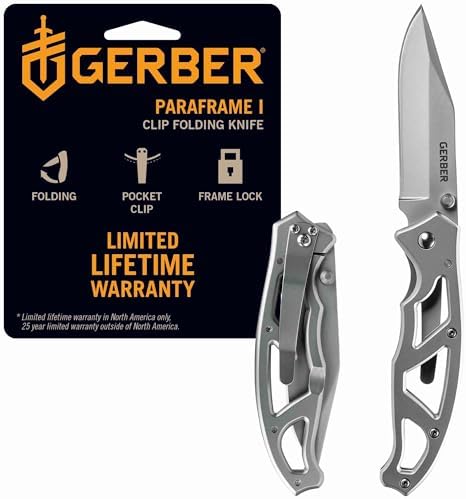
The open frame is the reason to start here, and it is a maintenance decision rather than a styling one.
Key Specifications
| Blade length | 3.0 inches |
|---|---|
| Blade shape | Drop point, plain edge |
| Overall length | 7.01 inches |
| Lock | Frame lock |
| Opening | Manual |
| Handle | Open stainless steel frame — skeletonised |
| Carry | Pocket clip |
| Steel grade | Not published |
| Warranty | Limited lifetime |
| Rank | #2,240 in its category |
| Price | $21.97 |
| Best For | A first knife that is simple enough to understand completely |
Why We Recommend It
A folding knife is a hinge that lives in your pocket, and pockets are full of lint. Most folders enclose the pivot inside two handle slabs, so grit, fluff and pocket debris collect where you cannot see them and the action gets gritty within months — and a beginner does not yet know to flush and re-oil a pivot. A skeletonised frame is open on both sides: you can see the whole mechanism, rinse it under a tap and dry it, and there is nowhere for anything to hide.
A frame lock is the simplest strong lock there is. Part of the handle itself bends inward behind the blade, so the thing holding the knife open is a slab of the frame rather than a thin separate liner. Fewer parts, more metal, and it is obvious by eye whether it is engaged.
Three inches is the length most carry rules are written around — see the guide below — which makes this a sensible default rather than an edge case.
A limited lifetime warranty on a $21.97 knife is a genuine commitment, and only three products here carry one.
Pros
- Open frame rinses clean and hides no grit
- Frame lock is the simplest strong lock
- Limited lifetime warranty
- 3 inch blade sits at the common legal threshold
- 7.01 inches overall and genuinely light
- Established maker with easy spares
Cons
- No steel grade or hardness published
- Open frame is less comfortable in hard use
- No thumb stud — nail nick opening
- Bare steel handle is slippery when wet
- Rank #2,240
- $21.97 is mid-priced here
Best for: A first pocket knife you can take apart mentally and never worry about.
2. Tactical Legal 2.68 Inch Serrated — Best for Carry Rules

One listing out of ten mentions the law. It is the only one that treats a beginner as a beginner.
Key Specifications
| Blade length | 2.68 inches — deliberately sub-3 inch |
|---|---|
| Steel | 440C stainless |
| Hardness | 60 HRC |
| Lock | Liner lock |
| Opening | Non-assisted |
| Edge | Serrated |
| Extras | Seatbelt cutter, glass breaker, pocket clip |
| Maker’s note | States it is legal to carry in most US states and to check local law |
| Rank | #4,182 in its category |
| Price | $7.99 |
| Best For | A first knife bought without knowing your local rules |
Why We Recommend It
Blade length limits are the commonest restriction on carrying a folding knife, and they vary by state and often by city. Three inches and three and a half inches are the thresholds that recur most often, and some places additionally restrict assisted-opening mechanisms. This knife is specified at 2.68 inches with non-assisted opening precisely to sit inside the common limits, and the listing says so — while also telling you to check your own local regulations, which is the correct advice and which we repeat here.
440C at 60 HRC is a real specification and a good one: a genuinely hard, corrosion-resistant stainless that holds an edge well.
The serration is the reservation. Serrated edges cut rope and webbing brilliantly and cannot be sharpened at home without a tapered rod, so a beginner ends up with a knife that dulls and stays dull.
$7.99 is nearly the cheapest here, which makes it a low-risk way to find out whether you carry a knife at all.
Pros
- The only listing here that mentions carry law
- 2.68 inches is inside the common thresholds
- Non-assisted opening avoids a second restriction
- 440C at a published 60 HRC
- Seatbelt cutter and glass breaker
- $7.99
Cons
- Serrated edge cannot be resharpened at home
- Liner lock rather than a frame lock
- No overall length or weight published
- No warranty term stated
- Rank #4,182
- Unbranded
Best for: Anyone who has not yet checked what they are allowed to carry.
3. Gerber EAB Lite Razor Knife — Never Needs Sharpening

Most people who carry a pocket knife use it to open packages. This is a knife that admits it.
Key Specifications
| Blade | Replaceable contractor-grade utility razor |
|---|---|
| Blade length | 1.5 inches |
| Overall length | 5.1 inches |
| Weight | 2.2 oz |
| Lock | Liner lock |
| Carry | Handle doubles as a money clip |
| Sharpening | None — replace the blade |
| Warranty | Limited lifetime |
| Rank | #1,911 in its category |
| Price | $12.99 |
| Best For | The honest truth that most everyday cutting is opening boxes |
Why We Recommend It
A folding handle for a standard utility blade solves the beginner’s real problem, which is sharpening. Every other knife on this page will go dull within months of daily use, and a beginner has no stone, no angle guide and no practice — so what they actually carry after six months is a blunt knife. Replaceable blades cost a few pence each, come in packs of a hundred at any hardware shop, and are sharper than anything you will produce freehand. You never learn to sharpen, and you never need to.
Two point two ounces is the lightest thing here, and weight is the reason first knives get left at home.
The money clip is a genuinely good carry solution for something this flat — it rides against notes or a card rather than flopping in a pocket.
A razor blade is fragile in a way a knife is not. It snaps if you twist it and it is not built for carving, prying or any lateral load.
Pros
- Replaceable blades — never needs sharpening
- 2.2 oz, the lightest knife here
- Money clip carry keeps it flat in a pocket
- Limited lifetime warranty
- Blades cost pennies and are available everywhere
- 5.1 inches overall closed and open
Cons
- 1.5 inches is a box opener rather than a knife
- Razor blades snap under lateral load
- No carving, whittling or food prep
- Liner lock on a very thin frame
- Rank #1,911
- Blade changes need care
Best for: Opening boxes, mail and packaging — which is what most people actually cut.
4. Kershaw Misdirect 2.9 Inch — Best Made

Kershaw calls this part of its Everyday Starter Series, which is an unusually honest piece of product naming.
Key Specifications
| Blade length | 2.9 inches (listing also states 3 inches) |
|---|---|
| Blade shape | Reverse tanto, plain edge |
| Steel | 4Cr13 in the title, 4Cr14 in the bullets |
| Finish | BlackWash — hides scratches |
| Lock | Frame lock |
| Opening | SpeedSafe assisted |
| Handle | Bead-blasted stainless steel |
| Carry | Clip supports left or right tip-up, right tip-down |
| Overall | 7 inches, 3.2 oz |
| Maker | Kershaw, established 1974 |
| Rank | #5,054 in its category |
| Price | $26.20 |
| Best For | A first knife from a company that only makes knives |
Why We Recommend It
The BlackWash finish is aimed squarely at a first knife. A new knife acquires scratches within a fortnight — from keys, from the clip, from being set down on concrete — and on a polished blade every one of them shows. A tumbled, pre-worn finish hides them, so the knife stops looking damaged and starts looking used. It sounds cosmetic and it materially changes whether a beginner keeps carrying the thing.
Assisted opening is the caveat and it cuts both ways. A spring completes the opening once you start it, which is fast and confident — and it is a mechanism some jurisdictions treat differently from a manual folder. Check before you carry.
The listing names two different steels — 4Cr13 in the title and 4Cr14 in the bullets. Both are budget Chinese stainless grades of similar character; we report both as published rather than choosing.
Frame lock, 3.2 oz, and a clip with three carry positions is a properly considered package at $26.20.
Pros
- From a dedicated knife maker since 1974
- BlackWash finish hides the scratches beginners inflict
- Frame lock with assisted opening
- Clip supports three carry positions
- Sold explicitly as a starter knife
- Reverse tanto is a genuinely useful shape
Cons
- Two different steel grades named in one listing
- Blade quoted at both 2.9 and 3 inches
- Assisted opening is restricted in some places
- $26.20 — dearest here
- Bare steel handle is cold and slippery
- Rank #5,054
Best for: Beginners who would rather buy from a knife company than a marketplace brand.
5. KEXMO Wood Handle 2.98 Inch — Most Specified
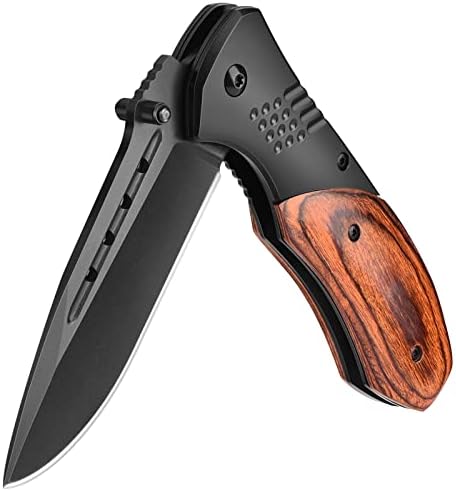
Seven published measurements at $9.99, where a $26.20 knife cannot decide what steel it is made of.
Key Specifications
| Blade length | 2.98 inches |
|---|---|
| Blade thickness | 0.1 inches |
| Handle length | 3.91 inches |
| Overall length | 6.89 inches |
| Weight | 3.5 oz |
| Steel | 3Cr13 stainless |
| Hardness | 56—59 HRC |
| Lock | Liner lock |
| Opening | Finger flipper plus ambidextrous thumb stud |
| Handle | Vintage rosewood with finger indentations |
| Rank | #1,649 in its category |
| Price | $9.99 |
| Best For | Knowing exactly what you are getting for ten dollars |
Why We Recommend It
Blade length, blade thickness, handle length, overall length, weight, steel and hardness — all stated. That is the complete specification of a folding knife and no other listing on this page provides it. It also lets you check the important thing: 2.98 inches is inside the three-inch threshold that carry rules most commonly use, by two hundredths of an inch.
3Cr13 at 56–59 HRC is soft, and that is not entirely bad for a beginner. It will dull faster than the 60 HRC steels here, and it will come back on absolutely any sharpener including the cheap pull-through kind — whereas hard steel punishes bad technique by chipping. A first knife that forgives is worth something.
Both a flipper and a thumb stud means two ways to open it one-handed, and a beginner can find out which suits them.
Rosewood scales with finger indentations grip far better than the bare steel handles elsewhere here, particularly wet.
Pros
- Publishes seven separate measurements
- 2.98 inches sits just inside the 3-inch threshold
- Soft steel resharpens on anything
- Flipper and thumb stud — two opening methods
- Rosewood scales with finger indentations
- $9.99 and rank #1,649
Cons
- 3Cr13 at 56—59 HRC dulls comparatively fast
- Liner lock rather than frame lock
- 3.5 oz is the heaviest here
- Wood scales need occasional care
- No warranty term published
- Glass breaker adds bulk
Best for: Beginners who want the full specification and a forgiving edge.

6. BRILLIRARE AUS10 2.6 Inch — Hardest Steel

Sixty to sixty-two HRC in Japanese AUS10, for five dollars ninety-seven. That combination deserves a second look and a caution.
Key Specifications
| Blade length | 2.6 inches |
|---|---|
| Steel | Japanese AUS10 stainless |
| Hardness | 60—62 HRC — hardest here |
| Treatment | Precisely ground and ice-hardened |
| Overall length | 6.1 inches |
| Blade thickness | 0.12 inches |
| Weight | 2.3 oz |
| Handle | Aluminium, non-slip |
| Lock | Liner lock; glass breaker |
| Rank | #5,728 in its category |
| Price | $5.97 — cheapest here |
| Best For | Edge retention, if you already know not to pry with a knife |
Why We Recommend It
Hardness buys edge retention and costs toughness, and beginners are exactly the people who test toughness. A blade at 60–62 HRC holds a keen edge far longer than the 56–59 HRC knives here — and it is correspondingly more brittle at the apex, so prying open a paint tin, twisting it in a cut, or dropping it point-first onto tile is more likely to chip it than bend it. A chipped edge is far harder to fix than a dull one.
Ice hardening is a real heat-treatment step, chilling the steel well below freezing after quenching to convert retained austenite, which raises hardness and stability.
2.3 ounces and 6.1 inches overall makes this the second lightest knife here, and light knives are the ones that actually get carried.
At $5.97 it is the cheapest thing on this page, which is a reasonable way to discover whether you want to carry a knife at all.
Pros
- AUS10 at 60—62 HRC, hardest on this page
- Ice-hardened, with full dimensions published
- 2.3 oz and 6.1 inches overall
- Aluminium handle grips wet hands
- 2.6 inches is well inside common thresholds
- $5.97, cheapest here
Cons
- Hard steel chips rather than bends under abuse
- Harder to resharpen than the soft-steel knives
- Liner lock rather than frame lock
- No warranty term published
- Rank #5,728
- Unbranded
Best for: Anyone who wants a keen edge and will not use a knife as a pry bar.
7. Smith & Wesson Benji Keychain — Smallest Here

The knife you carry beats the knife you own, and 1.75 inches on a keyring is carried without thinking about it.
Key Specifications
| Blade length | 1.75 inches — shortest folding blade here |
|---|---|
| Steel | 8Cr13MoV high-carbon stainless |
| Blade shape | Modified tanto |
| Handle | G-10 |
| Lock | Frame lock |
| Opening | Ultra-Glide with finger flipper |
| Carry | Dual-function money clip / pocket clip |
| Extra | Bottle opener |
| Weight | 2.72 oz |
| Warranty | Limited lifetime |
| Rank | #4,875 in its category |
| Price | $14.00 |
| Best For | Carrying something every day without deciding to |
Why We Recommend It
Almost every first pocket knife gets left in a drawer. It is slightly too heavy, slightly too bulky, and on the days you dress differently it does not come along — so when you need it, it is at home. A blade small enough to live on a keyring removes that decision entirely: it is wherever your keys are, which is everywhere. A very short blade also stays clear of the length thresholds that carry rules are built around.
G-10 is a serious handle material — glass fibre in epoxy resin, dimensionally stable, grippy when wet and effectively impervious. It is what expensive knives use, and it is unusual at $14.00.
8Cr13MoV is the workhorse budget stainless: reasonably tough, easy to sharpen, mildly corrosion resistant. It is the steel most first knives should have.
A frame lock and a limited lifetime warranty on something this small is more than the price suggests.
Pros
- 1.75 inches goes on a keyring and is always there
- G-10 handle, unusual at this price
- Frame lock and limited lifetime warranty
- Money clip doubles as a pocket clip
- Bottle opener built in
- 8Cr13MoV sharpens easily
Cons
- 1.75 inches is too short for many tasks
- No leverage for anything firm
- 2.72 oz is heavy for its size
- Listed overall length of 2.5 in appears to be closed length
- Rank #4,875
- Tanto tip is weak for fine point work
Best for: Being the knife that is actually with you when you need one.
8. FUNBRO 7Cr13MoV Tanto — Smoothest Action

A ball-bearing pivot at $7.99 is the specification that stands out, and for a beginner it matters more than it sounds.
Key Specifications
| Blade length | 3.0 inches |
|---|---|
| Steel | 7Cr13MoV stainless |
| Blade shape | Tanto |
| Pivot | Ball bearing |
| Opening | Flipper, ambidextrous |
| Lock | Liner lock |
| Handle | Black-coated stainless with texture |
| Extra | Glass breaker |
| Rank | #4,157 in its category |
| Price | $7.99 |
| Best For | Learning to open a knife one-handed, smoothly |
Why We Recommend It
Most cheap folders pivot on washers — usually phosphor bronze or nylon — and the action is stiff, gritty and needs breaking in. A caged ball bearing race under the blade removes almost all of that friction, so the flipper works first time rather than requiring a practised flick. A beginner learning to open a knife one-handed fails far more often on a stiff pivot, and concludes the technique is beyond them when it is really the hardware.
The tanto point is the reservation. That angular tip is strong for puncturing and poor at everything a beginner actually does — there is no belly for slicing and no fine point for picking at a splinter, a knot or a stitch.
7Cr13MoV is a middling budget stainless, softer than 440C and easy to bring back.
Three inches exactly puts it right on the common threshold rather than safely inside it.
Pros
- Ball-bearing pivot makes one-handed opening work
- Ambidextrous flipper for left or right hand
- Textured coated handle grips well
- Glass breaker on the pommel
- 7Cr13MoV resharpens easily
- $7.99
Cons
- Tanto tip is poor for fine, delicate work
- 3.0 inches sits exactly on a common threshold
- No hardness figure published
- No overall length or weight given
- Liner lock rather than frame lock
- Rank #4,157
Best for: Learning one-handed opening without fighting a stiff pivot.
9. Safety Lock 3.4 Inch Aluminium — Largest Blade

Three point four inches is a real working blade and it is also the length most likely to cause a problem.
Key Specifications
| Blade length | 3.4 inches |
|---|---|
| Steel | 440C stainless, black oxide coated |
| Lock | Liner lock plus a lock button |
| Opening | Thumb studs, right and left hand |
| Handle | Aluminium |
| Coating | Black oxide for corrosion resistance |
| Extras | Pocket clip |
| Rank | #6,320 in its category |
| Price | $8.95 |
| Best For | People who have confirmed their local rules allow this length |
Why We Recommend It
The thresholds that recur most often in US carry rules are three inches and three and a half. A 3.4-inch blade clears the first and sits just under the second, which means whether you can carry it depends entirely on where you are — and rules differ not only by state but frequently by city. This listing does not mention the subject at all. If you buy it, check your own local regulations first, because the knife itself gives you no guidance.
The lock button is a genuine safety feature for a beginner. A liner lock is disengaged by pushing the liner sideways with your thumb, which puts your thumb in the path of the closing blade — the commonest way people cut themselves closing a folder. A button moves your hand out of the way.
440C in black oxide is a good corrosion-resistant combination for a knife that will live in a pocket.
Aluminium keeps it light for its size, though no weight is published.
Pros
- Lock button keeps your thumb out of the blade path
- 440C with black oxide corrosion coating
- 3.4 inches is a genuinely useful working length
- Ambidextrous thumb studs
- Aluminium handle keeps weight down
- $8.95
Cons
- 3.4 inches exceeds several common thresholds
- The listing never mentions carry rules
- No hardness, weight or overall length published
- No warranty term stated
- Rank #6,320
- Unbranded
Best for: Confident buyers who have already checked what their locality permits.
10. Spring Assisted 3.5 Inch Tanto — Most Equipped

Supplying a spare clip screw and a screwdriver is a small kindness nobody else on this page bothers with.
Key Specifications
| Blade length | 3.5 inches — longest here |
|---|---|
| Steel | 440 stainless, TI-NI coated |
| Hardness | 60 HRC |
| Opening | Spring assisted |
| Lock | Liner lock |
| Clip | Removable, with 3 screws including a spare and a screwdriver |
| Extras | Lanyard hole and paracord included |
| Blade shape | Tanto |
| Rank | #2,619 in its category |
| Price | $9.98 |
| Best For | Camping and work use, where carry rules are not in question |
Why We Recommend It
Pocket clip screws come loose and get lost, and that is how knives disappear. The clip works its way off in a pocket, the knife is no longer secured, and it falls out somewhere. Three screws with a spare and the correct driver in the box means you can tighten it when it loosens and replace the one that goes missing — and it means you can move or remove the clip to suit how you carry.
The combination to think about is 3.5 inches and spring assistance. Both are the features most likely to be restricted, and this knife has both. It is the least suitable choice on this page for someone who has not checked their local rules, and a perfectly good one for camping, work or use on your own property.
440 at 60 HRC with a TI-NI coating is a hard, well-protected blade.
Rank #2,619 makes it the second best selling knife here, which says something about what people actually buy.
Pros
- Spare clip screw and screwdriver included
- Removable clip for flexible carry
- 440 at a published 60 HRC
- TI-NI coating resists corrosion
- Paracord and lanyard hole included
- Rank #2,619, second best selling here
Cons
- 3.5 inches and spring assisted — the most restricted pairing here
- The listing never mentions carry rules
- Tanto tip is poor for fine work
- No weight or overall length published
- Liner lock rather than frame lock
- No warranty term stated
Best for: Camping, work sites and property use rather than everyday town carry.
The Two Numbers That Decide Where You Can Carry It
Blade length and opening mechanism, for every knife here. Check them against your own local rules.
| Knife | Blade | Opening | Price |
|---|---|---|---|
| Smith & Wesson Benji | 1.75 in | Flipper | $14.00 |
| Gerber EAB Lite | 1.5 in | Manual | $12.99 |
| BRILLIRARE | 2.6 in | Manual | $5.97 |
| Tactical Legal 2.68" | 2.68 in | Non-assisted | $7.99 |
| Kershaw Misdirect | 2.9 in | Assisted | $26.20 |
| KEXMO | 2.98 in | Flipper | $9.99 |
| Gerber Paraframe I | 3.0 in | Manual | $21.97 |
| FUNBRO | 3.0 in | Flipper | $7.99 |
| Safety Lock 6681 | 3.4 in | Thumb studs | $8.95 |
| Spring Assisted 6688 | 3.5 in | Spring assisted | $9.98 |
Four knives here sit comfortably under 2.7 inches, four cluster right at or just under three, and two are longer. Two use assisted or spring-assisted mechanisms. If you have not checked your local rules, the safest starting point is a short, manually opened blade — and the one listing on this page that engineered itself around that fact says so in its own description. None of this is legal advice and none of it substitutes for reading the regulations where you live.
What a First Knife Actually Needs
Four decisions, and the expensive answer is not always the right one for a beginner.
| Beginner-friendly | Harder to live with | |
|---|---|---|
| Steel hardness | 56–59 HRC — forgives, resharpens on anything | 60–62 HRC — holds an edge, chips |
| Edge | Plain — sharpenable at home | Serrated — needs a tapered rod |
| Lock | Frame lock or button | Liner lock — thumb in the path |
| Blade shape | Drop point — belly and a fine tip | Tanto — strong point, no belly |
| Weight | 2–2.5 oz — gets carried | 3.5 oz — gets left at home |
| Sharpening | Replaceable blades — none needed | Learn a stone, or carry it dull |
The uncomfortable truth in the last row is that most first knives are dull within six months, because sharpening is a skill nobody arrives with. Two responses on this page are sensible: buy soft steel that comes back on any cheap sharpener, or buy the razor-blade knife and never sharpen anything. Buying the hardest steel here at 60–62 HRC is the option that looks best on paper and punishes the mistakes beginners actually make — prying, twisting, and dropping it point-first.
Best Alternatives
| Alternative | Why Consider It | Better For | Main Trade-Off |
|---|---|---|---|
| A Swiss Army knife | Scissors, screwdriver, tweezers, and a modest blade | General usefulness over pure cutting | No lock on many models, no pocket clip |
| A multi-tool | Pliers are what most people actually needed | Repairs, work and travel | Heavy, bulky and slow to deploy |
| A fixed-blade with a sheath | No pivot, no lock, nothing to fail | Camping and outdoor work | Not pocketable, and more heavily regulated |
| A dedicated box cutter | Sharper than any folder, blades cost pennies | Opening packaging, which is most of it | Not a knife for anything else |
What the Money Actually Buys
$5.97 to $9.99 — BRILLIRARE, Tactical Legal, FUNBRO, Safety Lock, Spring Assisted, KEXMO. Six knives, and between them the hardest steel here, the only mention of carry law, a ball-bearing pivot, a lock button, a spare clip screw and the most complete specification on the page. Nothing above this band cuts better.
$12.99 to $14.00 — Gerber EAB Lite and Smith & Wesson Benji. Both solve the carrying problem rather than the cutting one: a razor knife that never needs sharpening, and a keyring blade that is always with you. Both carry limited lifetime warranties.
$21.97 to $26.20 — Gerber Paraframe I and Kershaw Misdirect. Brand, warranty and considered design: an open frame that rinses clean, and a starter-series knife from a company that has made only knives since 1974. You are buying support and finish rather than sharpness.
What to Check Before You Buy
Check Your Local Rules Before the Specifications
This is the first thing and only one listing in this roundup raises it. Knife carry regulations in the United States vary by state, and frequently by city or county on top of that. The restriction that appears most often is blade length, with three inches and three and a half being common thresholds, and some places additionally treat assisted-opening or automatic mechanisms differently from a manual folder. The blades here run from 1.75 to 3.5 inches and two of them are spring assisted, so the range spans both sides of typical limits. We have put both numbers in the table for every knife. Look up the rules where you live and travel — this article is not legal advice and cannot be.
Understand the Lock, Because It Is How People Get Cut
Most cuts from a folding knife happen while closing it, not while using it. A liner lock is released by pushing a thin steel liner sideways with your thumb — which places your thumb directly in the path the blade is about to swing through, and if the blade releases early it closes onto it. A frame lock works the same way but uses a much thicker slab of the handle, which is stronger and gives more warning. A lock button moves your hand out of the arc entirely. Six knives in this roundup use liner locks, three use frame locks and one adds a button. For a first knife, prefer a frame lock or a button, and close every knife slowly and deliberately.
Buy Softer Steel, Not Harder
This is counterintuitive and it is right for a beginner. Hardness is measured in HRC and the knives here run from 56 to 62. A blade at 60–62 HRC holds a keen edge markedly longer, which sounds like the obvious choice — and it is also more brittle at the very edge, so prying open a tin, twisting the blade in a cut or dropping it point-first is more likely to chip it than bend it. A chipped edge takes far more work to repair than a dull one. Softer steel at 56–59 HRC dulls sooner and comes back on absolutely any sharpener, including the cheap pull-through kind. Beginners make exactly the mistakes hard steel punishes.
Avoid Serrations on a First Knife
One knife in this roundup has a serrated edge and it cuts rope, webbing and seatbelt material better than any plain blade here. The problem arrives in month four. A serrated edge cannot be sharpened on a flat stone — each scallop needs a tapered rod worked individually, and dragging serrations across a whetstone grinds the points off and makes things worse. So a beginner with a serrated knife has a tool that dulls and then stays dull permanently. A plain edge can be brought back by anyone with ten minutes and any sharpener at all, which is the whole point of a first knife: it should teach you maintenance rather than defeat it.
Weigh It, Because Weight Decides Whether You Carry It
The knife in your pocket is worth more than the better knife in your drawer, and the reason first knives end up in drawers is almost always weight and bulk. The figures here run from 2.2 ounces to 3.5, which does not sound like a meaningful spread until something has been clipped inside a pocket for twelve hours. Under about two and a half ounces a folder disappears; above three it announces itself all day and gets left behind on the days you dress differently. Only five listings here publish a weight at all. If you are choosing between two otherwise similar knives, take the lighter one.
Prefer a Drop Point Over a Tanto
Three knives here have tanto blades — the angular shape with a flat main edge meeting a separate straight tip. It is genuinely stronger at the point and it is the wrong shape for what beginners actually do. There is no belly, meaning no curved section, so slicing anything requires a sawing motion rather than a draw; and the reinforced tip is blunt in profile, so picking at a knot, a splinter, a stitch or a staple is awkward. A drop point has a gentle curve for slicing and a fine controllable tip for detail. If your knife will mostly open packaging, cut string and handle small jobs, the drop point is the shape to learn on.
Consider Replaceable Blades and Skip Sharpening Entirely
Every knife in this roundup except one will be blunt within a few months of daily use, and sharpening is a skill that takes practice, a stone and a consistent angle — none of which a beginner has. The alternative is a folding handle that takes standard contractor razor blades: it is always factory-sharp, blades cost pennies in packs of a hundred at any hardware shop, and there is nothing to learn. The trade is that a razor blade is thin and snaps under any lateral load, so it opens boxes, mail and packaging brilliantly and cannot carve, pry or handle food prep. Given how most people actually use a pocket knife, that is a smaller compromise than it sounds.

Common Mistakes
- Buying before checking local rules. Nine of these ten listings never mention them.
- Choosing the hardest steel available. 60–62 HRC chips where softer steel bends.
- Buying serrations on a first knife. They cannot be resharpened at home, ever.
- Closing a liner lock quickly. Your thumb is in the path the blade swings through.
- Picking a tanto for everyday tasks. No belly to slice with, blunt profile at the tip.
- Ignoring weight. Over three ounces and the knife stays home on half your days.
- Assuming you will learn to sharpen. Most people never do; buy accordingly.
Who Should Buy Which
Buy the Gerber Paraframe I at $21.97 as a default first knife. Three inches, a frame lock, an open frame you can rinse clean, and a limited lifetime warranty.
Buy the 2.68-inch Tactical Legal at $7.99 if you have not checked your rules. It is specified sub-three-inch and non-assisted on purpose, and it is the only listing here that tells you to look the regulations up.
Buy the Gerber EAB Lite at $12.99 if you will never sharpen anything. Replaceable contractor blades, 2.2 ounces, a money clip and a lifetime warranty.
Buy the KEXMO at $9.99 if you want the full specification. Seven published measurements, 2.98 inches, and soft steel that comes back on any sharpener.
Buy the Smith & Wesson Benji at $14.00 if your knife keeps staying home. A 1.75-inch blade on a keyring is the one that is always with you.
Frequently Asked Questions
What blade length should a beginner pocket knife have?
Somewhere between about 2.5 and 3 inches for most people, and the reason is as much regulatory as practical. Knife carry rules in the United States vary by state and frequently by city, and the thresholds that appear most often are three inches and three and a half — so a blade comfortably under three inches keeps you inside the common limits in more places. Practically, that length also covers virtually everything a pocket knife is genuinely used for: opening packaging, cutting string and tape, food at a desk, small repairs. Longer blades are useful for camping and work but add weight, bulk and regulatory questions. Check the rules where you live and travel; only one listing in this roundup mentions the subject at all.
What is the difference between a liner lock and a frame lock?
Both hold the blade open by wedging a piece of spring steel behind it, and the difference is what that piece is. A liner lock uses a thin separate liner inside the handle; a frame lock uses a section of the handle frame itself, which is considerably thicker and therefore stronger. The practical difference for a beginner is safety when closing. To release either lock you push the metal sideways with your thumb, which puts your thumb directly in the arc the blade is about to swing through — and a thin liner gives you less warning and less resistance than a thick frame. One knife in this roundup adds a lock button instead, which moves your hand out of the path entirely and is the safest arrangement here.
Is harder steel better in a pocket knife?
Not for a beginner, which surprises people. Hardness is quoted in HRC and the knives in this roundup range from 56 to 62. A harder blade holds its edge substantially longer, and it is also more brittle right at the apex — so prying open a paint tin, twisting the blade in a cut, or dropping it point-first onto a hard floor is likely to chip it rather than bend it, and a chip is far more work to repair than a dull edge. Softer steel around 56 to 59 HRC dulls faster and comes back on any sharpener, including the cheap pull-through kind. Since beginners make precisely the mistakes that hard steel punishes, softer is the more forgiving choice.
Should a first pocket knife be plain or serrated?
Plain, and this is one of the few clear-cut answers in the category. Serrated edges cut rope, webbing and fibrous material better than any plain blade, and they cannot be sharpened at home: each scallop needs a tapered rod worked individually, and a flat whetstone simply grinds the serration points off. So a beginner who buys serrated has a knife that dulls over some months and then stays dull permanently, since nobody buys a specialist rod for a ten-dollar knife. A plain edge can be restored by anyone with any sharpener and a little patience, which is what a first knife should encourage. One knife in this roundup is serrated and it is otherwise well specified.
Is assisted opening a good idea for a beginner?
It is genuinely easier to use and it carries a complication. An assisted-opening knife has a spring that takes over once you have started the blade moving with a flipper or stud, so it deploys quickly and confidently — which removes the fumbling that puts beginners off one-handed opening. The complication is regulatory: some jurisdictions treat assisted or automatic mechanisms differently from manual folders, independently of blade length. Two knives in this roundup are assisted, one of them at 3.5 inches, which is the combination most likely to be restricted. If you have not checked your local rules, a manual folder with a ball-bearing pivot gives you a smooth action without the question.
How do I keep a pocket knife sharp if I have never sharpened one?
Either buy steel soft enough to forgive you, or buy a knife that never needs it. Softer blades around 56 to 59 HRC come back on any inexpensive sharpener, so the skill barrier is low and mistakes are recoverable — this is the practical argument for not buying the hardest steel available. The other route is a folding handle that takes standard replaceable utility razor blades: it is always factory-sharp, replacements cost pennies, and there is nothing to learn at all. One knife in this roundup works that way. Whatever you choose, wipe the blade dry after use and put a drop of light oil on the pivot occasionally; most first knives are ruined by neglect rather than by use.
Final Verdict
Three inches, a frame lock, and a skeletonised frame you can rinse clean rather than pick lint out of — under a limited lifetime warranty. $21.97.
Specified at 2.68 inches and non-assisted on purpose, and the only listing on this page that tells you to check your local regulations. $7.99.
Takes standard contractor razor blades, weighs 2.2 oz, clips to your notes and carries a limited lifetime warranty. $12.99.
Blade lengths here run from 1.75 to 3.5 inches, and nine of these ten listings never mention that the number might matter where you live. Check your own local rules first; nothing on this page is legal advice.
After that, a first knife needs less than the marketing suggests. A lock that keeps your thumb out of the blade’s path, a plain edge rather than serrations, and a drop point rather than a tanto.
And buy softer steel, not harder. 60 to 62 HRC holds a beautiful edge and chips when you pry with it, which is exactly what beginners do.
The best knife here is whichever one is light enough that it is in your pocket on the day you need it.