Affiliate Disclosure: As an Amazon Associate, we earn from qualifying purchases. This does not affect the price you pay.
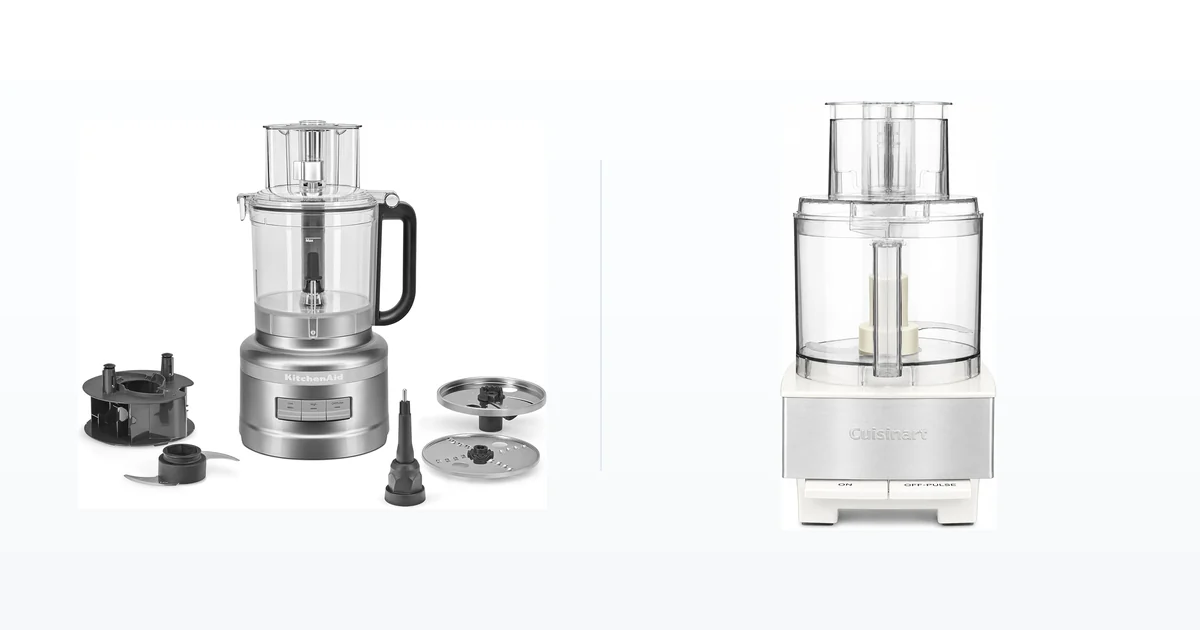
KitchenAid food processors are best known for one feature: an externally adjustable slicing disc that changes thickness with a lever rather than a disc swap. That, plus in-bowl storage for the blades, is what people are usually paying the brand premium for.
Worth saying plainly: when we checked availability, only one KitchenAid processor was actually purchasable — the 13-cup KFP1317. The rest of the range showed as unavailable. Rather than list models you cannot buy, this guide leads with that one and compares it honestly against processors from Cuisinart, Hamilton Beach, BLACK+DECKER and Ninja that did verify.
We compared ten machines on bowl capacity, motor power, disc and blade selection, assembly design and weight. This guide is for anyone deciding whether the KitchenAid is worth it, or whether something else suits their cooking better.
Our Quick Picks
 Best KitchenAidKitchenAid 13-Cup KFP1317
The KitchenAid model that verified as available, with an externally adjustable slicing disc and in-bowl blade storage.
 Most PowerfulCuisinart 14-Cup DFP-14BCWNY
Fourteen cups and 720 watts — the most capacity and the most power in this comparison.
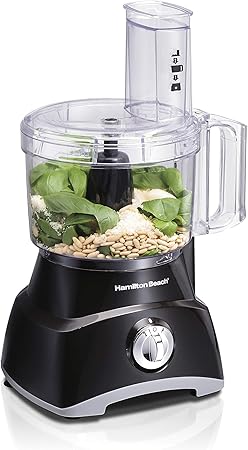 Best ValueHamilton Beach 8-Cup
Eight cups and 450 watts at a fraction of the price, and only 5 lb to lift out of a cupboard.
At a Glance
Food Processor Comparison
The available KitchenAid alongside nine verified alternatives, on capacity, power and design.
| # | Model | Capacity | Power | Best For | Notable Part | Key Advantage | Main Drawback | Check Price |
|---|---|---|---|---|---|---|---|---|
| 1 |
 KitchenAid 13-Cup KFP1317 KitchenAid 13-Cup KFP1317 |
13 cup | 300 W | Adjustable slicing | In-bowl storage caddy | Externally adjustable ExactSlice disc | Lowest wattage of the large models | View on Amazon |
| 2 |
 Cuisinart 14-Cup DFP-14BCWNY Cuisinart 14-Cup DFP-14BCWNY |
14 cup | 720 W | Heavy work and dough | Stainless steel | 720 W, the highest here | Heaviest at 18 lb | View on Amazon |
| 3 |
 Cuisinart 11-Cup Cuisinart 11-Cup |
11 cup | 625 W | Everyday family prep | Dishwasher safe | Strong motor in a smaller body | Still 16.9 lb | View on Amazon |
| 4 |
 Hamilton Beach 8-Cup Hamilton Beach 8-Cup |
8 cup | 450 W | Everyday chopping and shredding | Stainless S-blade | Light at 5 lb for a full-size bowl | 450 W limits heavy dough | View on Amazon |
| 5 |
 BLACK+DECKER 8-Cup BLACK+DECKER 8-Cup |
8 cup | 450 W | Simple setup | Stainless S-blade | Lid acts as the locking mechanism | 450 W limits heavy work | View on Amazon |
| 6 |
 BLACK+DECKER Processor & Chopper BLACK+DECKER Processor & Chopper |
8 cup | 450 W | Straightforward prep | Stainless blade | Same easy-assembly design | Limited accessories | View on Amazon |
| 7 |
 Ninja Foodi Power Blender & Processor Ninja Foodi Power Blender & Processor |
4.5 lb bowl | 1200 W | Blending and processing | Processing lid and discs | Blender and processor in one base | Two sets of parts to store | View on Amazon |
| 8 |
 Sangcon 5-in-1 Combo Sangcon 5-in-1 Combo |
47 oz | 350 W | Several small jobs | Chopper bowl and cups | Four containers in one set | 350 W is modest | View on Amazon |
| 9 |
 Ninja Express Chop Ninja Express Chop |
16 oz | 200 W | Herbs, garlic and onions | One-piece bowl | Two pounds, always to hand | Too small for real batches | View on Amazon |
| 10 |
 Reemix 1.5-Cup Mini Reemix 1.5-Cup Mini |
1.5 cup | 100 W | The smallest jobs | Compact footprint | Small enough to live on the counter | 100 W is very limited | View on Amazon |
Only the 13-cup KFP1317 verified as available from KitchenAid’s range at the time of writing; other models showed as unavailable. Amazon lists the Ninja Foodi’s capacity as "4.5 pounds", which is a weight rather than a bowl volume.
Scroll the table sideways to see every column
How We Chose These Food Processors
We researched current listings, compared manufacturer specifications and documentation, and examined recurring patterns in customer feedback. We did not carry out hands-on testing, and nothing below is presented as measured performance data.
- Motor power — the specification that decides whether a machine stalls on dough
- Bowl capacity — matched to the batches you actually make
- Disc and blade selection — how much of the work the machine can do without extra purchases
- Slicing adjustment — whether thickness changes need a disc swap
- Assembly design — how fiddly the bowl and lid are to lock together
- Weight — whether it is light enough to be taken out and used
- Cleaning — how many parts need washing after every use
- Storage — where the blades and discs live between uses
- Availability — whether the model can actually be bought
- Support — brand track record and replacement parts
The 10 Best Food Processors Compared
1. KitchenAid 13-Cup KFP1317 — Best KitchenAid
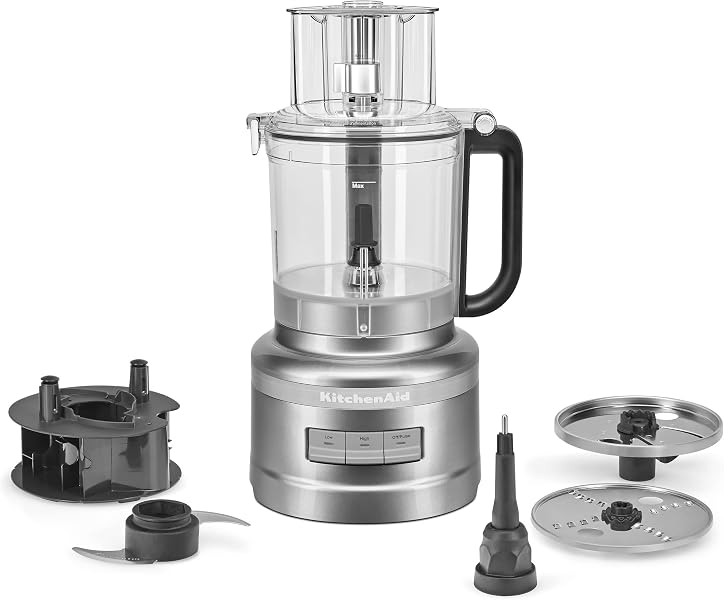
The externally adjustable slicing disc is the feature that distinguishes KitchenAid’s larger processors: you change slice thickness with a lever on the outside of the bowl rather than swapping discs.
Key Specifications
| Capacity | 13 cups |
|---|---|
| Power | 300 W |
| Brand | KitchenAid |
| Model | KFP1317 |
| Slicing | Externally adjustable ExactSlice disc, thick to thin |
| Storage | All-in-one in-bowl storage caddy for blades and discs |
| Weight | 12.1 lb |
| Best For | Cooks who slice a lot and want it adjustable mid-task |
Why We Recommend It
For anything where thickness matters — potatoes for a gratin, cucumbers for pickling, apples for a tart — that turns a disc change into a lever movement, and you can adjust partway through a batch.
The in-bowl storage caddy is the other practical touch. Blades and discs live inside the work bowl instead of loose in a drawer, which is safer and stops them going missing.
At 300 W it is the lowest-powered of the large processors here; the Cuisinart 14-cup is listed at 720 W. For slicing and shredding that matters little, but for heavy dough it is worth knowing.
Pros
- Externally adjustable slicing thickness without swapping discs
- All blades and discs store inside the bowl
- 13-cup bowl handles large batches
- The KitchenAid model that verified as purchasable
Cons
- 300 W is low compared with rival large processors
- Heavier than mid-size models at 12.1 lb
- Most other KitchenAid processors did not verify as available
Best for: Cooks who slice and shred often and want thickness control on the fly.
2. Cuisinart 14-Cup DFP-14BCWNY — Most Powerful

Cuisinart’s 14-cup has been the default recommendation in this category for years, and the reason is the motor: 720 W is more than double the KitchenAid’s rating.
Key Specifications
| Capacity | 14 cups |
|---|---|
| Power | 720 W |
| Material | Stainless steel |
| Model | DFP-14BCWNY |
| Controls | On and Off/Pulse |
| Bowl | Lexan work bowl with extra-large feed tube |
| Weight | 18 lb |
| Best For | Dough, large batches and heavy prep |
Why We Recommend It
That matters specifically for dough. Kneading is where underpowered processors stall, overheat or walk across the counter, and this is the model people buy when that has happened to them.
The extra-large feed tube reduces pre-cutting, which is most of the tedium in food processing. At 18 lb it is the heaviest here and is not an appliance you will move in and out of a cupboard.
Pros
- 720 W, the most powerful motor in this comparison
- Fourteen cups, the largest bowl here
- Extra-large feed tube reduces pre-cutting
- Simple two-button On and Pulse control
Cons
- Heaviest unit here at 18 lb
- Large permanent counter footprint
- Only two speeds plus pulse
Best for: Anyone who kneads dough or processes in genuinely large quantities.
3. Cuisinart 11-Cup — Best Mid-Size

Eleven cups is the size most households actually need. It handles a batch of hummus, a full head of cabbage or a double batch of pastry without the 14-cup’s counter presence.
Key Specifications
| Capacity | 11 cups |
|---|---|
| Power | 625 W |
| Material | Plastic housing |
| Cleaning | Dishwasher-safe parts |
| Weight | 16.9 lb |
| Best For | Family cooking without the largest footprint |
Why We Recommend It
At 625 W the motor is close to the larger model and comfortably ahead of the 450 W mid-range machines, so it will not stall on firmer work.
Dishwasher-safe parts matter more on a processor than on most appliances, because there are simply more components — bowl, lid, pusher, blade and discs after every use.
Pros
- 625 W handles firm ingredients without stalling
- Eleven cups suits most family batches
- Dishwasher-safe parts
- Smaller footprint than the 14-cup
Cons
- Still heavy at 16.9 lb
- Plastic housing rather than metal
- Fewer accessories than the KitchenAid
Best for: Families who want real power without the largest machine on the counter.
4. Hamilton Beach 8-Cup — Best Value

Most food processing is chopping onions, shredding cheese and making salsa. None of that needs 700 watts, and this covers it for far less money.
Key Specifications
| Capacity | 8 cups |
|---|---|
| Power | 450 W |
| Blade | Stainless steel S-blade |
| Disc | Reversible shredding disc |
| Feed chute | Large |
| Weight | 5 lb |
| Best For | Everyday chopping, shredding and salsa |
Why We Recommend It
At 5 lb it is dramatically lighter than the large machines, which changes how often it actually gets used — a 5 lb appliance comes out of the cupboard, an 18 lb one tends not to.
The large feed chute reduces pre-cutting, and the reversible shredding disc covers coarse and fine in one part rather than two.
Pros
- Only 5 lb, so it actually gets used
- Eight cups covers most everyday batches
- Reversible shredding disc
- Large feed chute reduces pre-cutting
Cons
- 450 W is not enough for regular dough kneading
- Fewer discs than the premium machines
- Plastic construction throughout
Best for: Everyday cooks who chop and shred more than they knead.
5. BLACK+DECKER 8-Cup — Best Easy Assembly
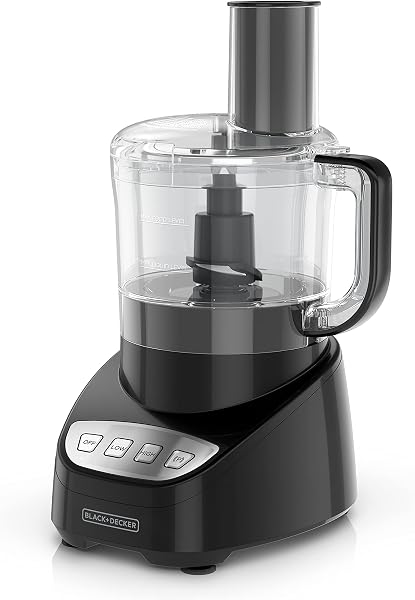
The most common complaint about food processors is not performance, it is assembly — lining up the bowl, twisting it into place, then fighting the lid interlock.
Key Specifications
| Capacity | 8 cups |
|---|---|
| Power | 450 W |
| Blade | Stainless steel S-blade |
| Assembly | Bowl sets on base, lid locks it |
| Material | Metal and plastic |
| Best For | Anyone who finds processor assembly fiddly |
Why We Recommend It
BLACK+DECKER’s design sets the bowl straight onto the base and uses the lid itself as the locking mechanism, which removes the alignment step entirely.
Eight cups and 450 W puts it in the same practical bracket as the Hamilton Beach: fine for salsa, hummus and shredding, not the machine for regular dough.
Pros
- No twisting to align the bowl
- Lid doubles as the locking mechanism
- Eight-cup capacity for most batches
- Stainless S-blade
Cons
- 450 W is not a dough machine
- Fewer discs than premium models
- Amazon does not list a weight for this model
Best for: Cooks who have given up on a processor because assembly annoyed them.
6. BLACK+DECKER Processor & Chopper — Best Simple Alternative

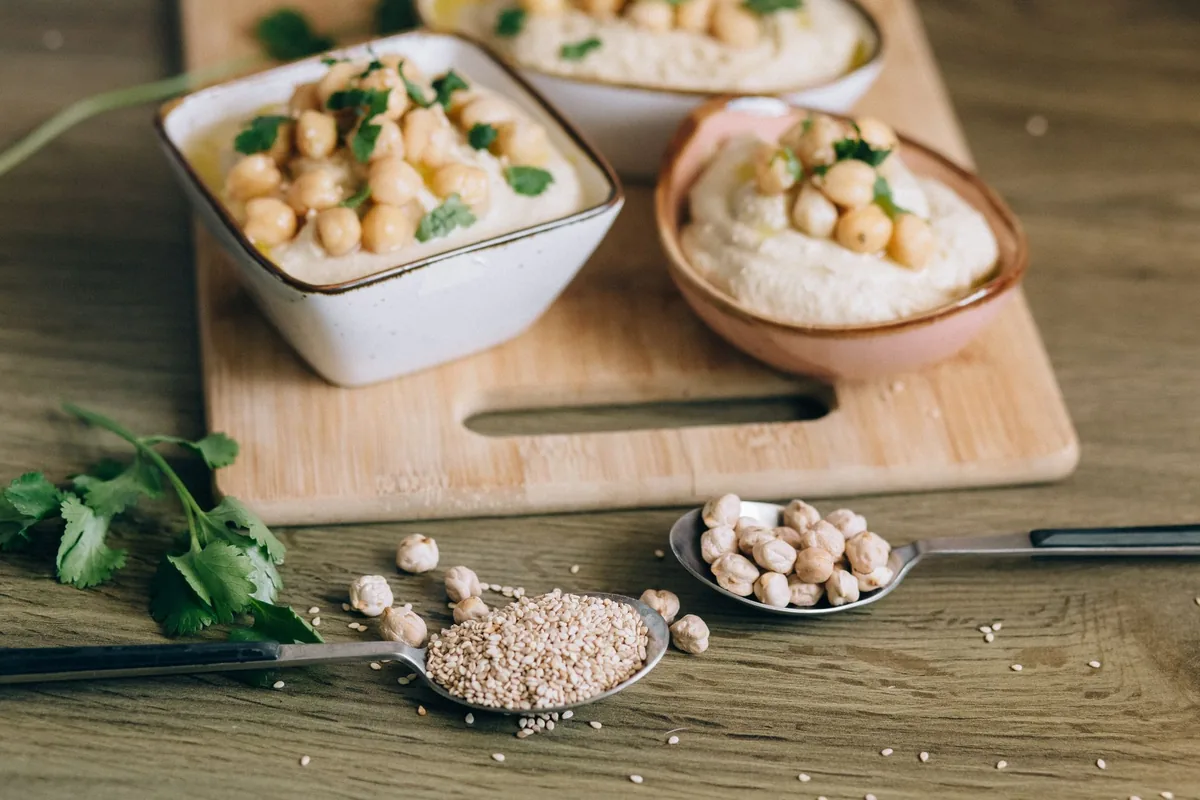
BLACK+DECKER lists this specifically for salsas, nut butter and hummus, which is an honest description of what an eight-cup 450 W machine does well.
Key Specifications
| Capacity | 8 cups |
|---|---|
| Power | 450 W |
| Blade | Stainless steel |
| Assembly | Bowl sets on base, lid locks it |
| Material | Plastic housing |
| Best For | Salsa, hummus, nut butters and everyday chopping |
Why We Recommend It
Nut butter is worth calling out because it is the one everyday job that genuinely tests a processor — it takes several minutes of continuous running and heats the motor.
The same lid-as-lock assembly makes it quick to set up, and the eight-cup bowl covers normal household batches.
Pros
- Simple drop-on assembly
- Eight cups for normal household batches
- Handles nut butters and hummus
- Stainless blade
Cons
- 450 W will slow on long nut butter runs
- Limited disc selection
- Plastic housing
Best for: Everyday prep where salsa and dips are the main jobs.
7. Ninja Foodi Power Blender & Processor — Best Combo

Most kitchens do not have counter space for a blender and a food processor. This uses one powerful base for both, swapping the jug for a processing bowl and discs.
Key Specifications
| Bowl | Processing bowl with feed chute |
|---|---|
| Power | 1200 W |
| Motor | Stated 1600 peak watts with smartTORQUE |
| Functions | 7 |
| Processing | Enhanced processing lid with select-cut discs |
| Weight | 12.1 lb |
| Best For | Kitchens without room for both a blender and a processor |
Why We Recommend It
Ninja states a 1600 peak watt motor with smartTORQUE designed not to stall, which is the usual weakness of combination machines — they tend to be a good blender and a mediocre processor.
The honest trade is storage: you still own two sets of parts, they just share a motor. Note also that Amazon lists the capacity field as "4.5 pounds", which is a weight rather than a volume.
Pros
- One motor base serves as blender and processor
- Stated 1600 peak watts, designed not to stall
- Select-cut processing discs included
- Saves counter space over two appliances
Cons
- Two sets of parts still need storing
- Amazon’s capacity field gives a weight, not a volume
- Compromises against a dedicated processor for large dry batches
Best for: Small kitchens choosing between a blender and a processor.
8. Sangcon 5-in-1 Combo — Best Budget Multi

This is aimed at households doing many small jobs rather than one big one: a smoothie, a salsa, some minced meat, a sauce — each with its own container on a shared base.
Key Specifications
| Pitcher | 47 oz, stated BPA-free |
|---|---|
| Chopper bowl | 2.5 cups |
| Cups | 18 oz and 11 oz |
| Power | 350 W |
| Material | ABS plastic and stainless steel |
| Weight | 5.5 lb |
| Best For | Smoothies, sauces, salsa and small chopping jobs |
Why We Recommend It
Sangcon lists it for parents and small kitchens, and the four-container setup is genuinely practical if your cooking is varied and small-scale.
At 350 W it is the least powerful full-size option here, so treat it as a chopper and blender rather than a processor for dough or heavy shredding.
Pros
- Four containers cover blending, chopping and travel drinks
- Stated BPA-free pitcher
- Light at 5.5 lb
- Very inexpensive for the number of parts
Cons
- 350 W is the lowest power of the full-size options
- Not suitable for dough or heavy shredding
- Four containers means a lot to store
Best for: Households doing many small varied jobs rather than large batches.
9. Ninja Express Chop — Best Mini

Most days you need to chop one onion or a handful of herbs, and pulling out an 18 lb processor for that never happens. A 2 lb chopper does.
Key Specifications
| Bowl | 16 ounces |
|---|---|
| Power | 200 W |
| Material | Plastic |
| Functions | Mince, chop, grind and blend |
| Weight | 2 lb |
| Best For | Garlic, herbs, onions and small quantities |
Why We Recommend It
Ninja lists it for mincing, chopping, grinding and blending small quantities, which is an accurate description — it is a finishing tool rather than a batch machine.
Sixteen ounces is genuinely small. Treat it as a companion to a larger processor, or as the only machine you need if you cook in small quantities.
Pros
- Only 2 lb, so it stays accessible
- Right size for garlic, herbs and one onion
- Simple one-piece bowl to wash
- Very inexpensive
Cons
- Sixteen ounces will not handle a real batch
- 200 W is for soft ingredients only
- No slicing or shredding discs
Best for: Everyday small chopping jobs alongside a larger machine.
10. Reemix 1.5-Cup Mini — Best Smallest

The smallest machine here, and its argument is the same as the Ninja’s taken further: a chopper you never put away is a chopper you use every day.
Key Specifications
| Capacity | 1.5 cups |
|---|---|
| Power | 100 W |
| Material | ABS plastic |
| Functions | Shredding, dicing, grinding and mixing |
| Weight | 0.8 kg |
| Best For | Garlic, ginger, nuts and single-portion prep |
Why We Recommend It
Reemix lists it for shredding, dicing, grinding and mixing, and at 1.5 cups it suits garlic, ginger, nuts and single-portion quantities.
At 100 W it is genuinely limited. This is not an alternative to a food processor, it is an alternative to a knife for small repetitive jobs.
Pros
- Small enough to leave on the counter permanently
- Light at 0.8 kg
- Right size for garlic, ginger and nuts
- Very cheap
Cons
- 100 W handles only soft, small quantities
- 1.5 cups is a single-portion capacity
- No discs, blades only
Best for: Small repetitive prep jobs where a full processor is overkill.
KitchenAid 13-Cup vs Cuisinart 14-Cup
The two large processors here, and they are built around different priorities.
| Feature | KitchenAid KFP1317 | Cuisinart DFP-14BCWNY |
|---|---|---|
| Capacity | 13 cups | 14 cups |
| Power | 300 W | 720 W |
| Slicing | Externally adjustable, no disc swap | Fixed discs |
| Blade storage | In-bowl caddy | Separate |
| Weight | 12.1 lb | 18 lb |
| Main advantage | Change slice thickness with a lever | More than double the motor power |
| Main drawback | 300 W is low for heavy dough | No adjustable slicing |
Choose the KitchenAid if: you slice a lot and want thickness control without stopping to change discs.
Choose the Cuisinart if: you knead dough or process firm ingredients in volume, where 720 W against 300 W is decisive.

Full-Size Processor or Mini Chopper?
The question worth asking before spending on a large machine: what do you actually chop?
| Feature | Hamilton Beach 8-Cup | Ninja Express Chop |
|---|---|---|
| Capacity | 8 cups | 16 ounces |
| Power | 450 W | 200 W |
| Slicing and shredding discs | Yes | No |
| Weight | 5 lb | 2 lb |
| Typical use | Salsa, shredding, batches | One onion, garlic, herbs |
| Main advantage | Handles real batches and discs | Light enough to use daily |
| Main drawback | Still a machine to get out | Cannot slice or shred |
Choose the full-size processor if: you shred cheese, slice vegetables or make batches of dip.
Choose the mini chopper if: your honest answer is garlic, onions and herbs — a big machine will sit unused.
Best Alternatives
| Alternative | Why Consider It | Better For | Main Trade-Off |
|---|---|---|---|
| Cuisinart 11-Cup | 625 W in a smaller body | Family batches with real power | Still 16.9 lb |
| BLACK+DECKER 8-Cup | Bowl drops on, lid locks it | Anyone who finds assembly fiddly | 450 W limits dough |
| Ninja Foodi Power Blender | One base for blending and processing | Small kitchens | Two sets of parts to store |
| Sangcon 5-in-1 | Four containers on one base | Many small varied jobs | 350 W is modest |
| Reemix 1.5-Cup | Small enough to leave out | Garlic, ginger and nuts | 100 W and tiny capacity |
How Much Food Processor Do You Need?
Mini choppers of 1.5 cups to 16 ounces handle garlic, herbs, nuts and one onion. They cost very little, weigh almost nothing and get used daily precisely because they never go in a cupboard.
Mid-size processors of 8 to 11 cups with 450 to 625 W cover the overwhelming majority of home cooking: salsa, hummus, shredded cheese, sliced vegetables and pastry. This is where most people should buy.
Large processors of 13 to 14 cups with 300 to 720 W are for batch cooking and dough. Power matters more than capacity in this tier — kneading is what exposes an underpowered motor, and the two large machines here differ by more than double.
How to Choose a Food Processor
Match Power to Dough, Not to Chopping
Chopping and shredding are undemanding; almost any motor manages them. Kneading dough is what separates machines, because it loads the motor continuously. If you make pastry or bread, look at 600 W and up. If you do not, 450 W is genuinely enough.
Buy for the Batch, Not the Maximum
Bowl capacity is a working figure, not a filling one — liquids in particular cannot be filled to the rim. An 8-cup bowl handles most household batches; 13 or 14 cups is for entertaining, preserving and dough.
Check Whether Slicing Thickness Adjusts
Most processors change slice thickness by swapping discs. KitchenAid’s larger models adjust externally with a lever, so you can go from thick to thin mid-batch. If you slice often, that is the single feature most worth paying for.
Count the Parts You Will Wash
A processor generates washing-up: bowl, lid, pusher, blade and any discs used. Machines with fewer, dishwasher-safe parts get used more. This is the most common reason an expensive processor ends up in a cupboard.
Weight Decides How Often It Gets Used
An 18 lb processor lives on the counter or it never comes out. A 5 lb one can be stored and still used. Be honest about your counter space before buying the largest machine.
Look at How the Bowl Locks
Assembly is the most-complained-about part of using a processor. BLACK+DECKER’s design drops the bowl on and locks with the lid; others require alignment and twisting. If a previous processor annoyed you, this is probably why.
Think About Where the Blades Live
Loose discs and blades in a drawer are both a hazard and easy to lose. KitchenAid’s in-bowl caddy stores everything inside the work bowl. It is a small thing that materially affects whether you use the accessories at all.
Consider a Mini Chopper Instead
If your honest answer to "what do you chop?" is onions, garlic and herbs, a 2 lb chopper will serve you better than a 15 lb processor, cost a fraction as much, and actually get used.
Common Food Processor Buying Mistakes
- Buying capacity instead of power. A big bowl on a weak motor still stalls on dough.
- Assuming a processor replaces a blender. They do different jobs; only combo machines attempt both.
- Ignoring the number of parts to wash. It is the main reason processors stop being used.
- Buying large with no counter space. An 18 lb machine in a cupboard is a wasted purchase.
- Overfilling with liquids. Bowl capacity is a dry figure; liquids leak past the seal.
- Expecting a mini chopper to slice. Choppers have blades, not discs.
- Running a small motor continuously. Nut butters need several minutes and will overheat a 200 W machine.
- Not checking availability before setting your heart on a model. Most of KitchenAid’s range did not verify as purchasable.
Who Should Buy a Food Processor?
A processor earns its counter space if you regularly make:
- Dips and spreads — hummus, pesto and salsa are the classic uses
- Shredded cheese and vegetables — far faster and more consistent than a box grater
- Evenly sliced vegetables — for gratins, salads and pickling
- Pastry and dough — where a strong motor genuinely saves effort
- Nut butters and ground nuts — jobs that need sustained running
- Batch prep — a week of chopped vegetables in one session
Who May Not Need One?
If you cook for one or two and mostly chop an onion and some garlic, a mini chopper or a decent knife will do the job with far less washing up. If you mainly make smoothies and soups, a blender is the right appliance. And if counter space is genuinely tight, a combination machine or a small chopper beats a large processor that lives in a cupboard.
Frequently Asked Questions
Which KitchenAid food processor should I buy?
When we checked, the 13-cup KFP1317 was the model that verified as available; the rest of the range showed as unavailable. It offers KitchenAid’s externally adjustable ExactSlice disc and in-bowl blade storage, though at 300 W it is less powerful than rival large processors.
What is the difference between a food processor and a blender?
A processor uses a flat S-blade and discs in a wide bowl to chop, slice, shred and knead relatively dry ingredients. A blender uses a tall narrow jug and a vortex to liquidise. Combination machines such as the Ninja Foodi attempt both from one motor base, with some compromise on each.
How many watts does a food processor need?
For chopping, shredding and slicing, 450 W is plenty. For pastry and bread dough, look for 600 W or more, because kneading loads the motor continuously and is where underpowered machines stall or overheat. The machines here range from 100 W to 720 W.
What size food processor bowl is best?
Eight to eleven cups suits most households and covers salsa, hummus, shredded cheese and sliced vegetables. Thirteen to fourteen cups is for entertaining, batch prep and dough. Under two cups is a chopper rather than a processor, useful for garlic, herbs and nuts.
Can a food processor knead bread dough?
A powerful one can. Look for 600 W or more and a dough blade; the Cuisinart models here are the strongest in that respect. Lower-powered machines may manage a small batch of pastry but will struggle with bread dough and can overheat if pushed.
Is adjustable slicing worth paying for?
If you slice frequently, yes. Most processors change thickness by swapping discs, which means stopping, unloading and rinsing. KitchenAid’s externally adjustable disc changes with a lever, including partway through a batch. If you mostly chop and shred, it is not worth the premium.
Are food processor parts dishwasher safe?
Usually the bowl, lid, pusher, blade and discs are, while the motor base never is. Check the individual manual, since some blades are recommended for hand washing to preserve their edge. The number of parts is worth considering before buying, since every use generates several.
Do I need a full-size processor or a mini chopper?
Be honest about what you chop. If it is garlic, herbs and one onion, a 1.5-cup or 16-ounce chopper does it in seconds, costs very little and stays on the counter. A full-size processor only earns its space if you slice, shred or make batches of dip.
Final Verdict
Externally adjustable slicing and in-bowl blade storage in the one KitchenAid model that verified as purchasable.
Fourteen cups and 720 watts — the machine to buy if you knead dough or process firm ingredients in quantity.
Eight cups, 450 watts and only 5 lb, which covers everyday chopping and shredding for a fraction of the price.
Choosing a food processor comes down to five things: how much power your heaviest job actually needs, what batch size you make, whether adjustable slicing would change how you cook, how many parts you are willing to wash, and whether the machine is light enough that you will take it out. Answer the dough question first — it separates the 450 W machines from the 700 W ones more sharply than anything else.