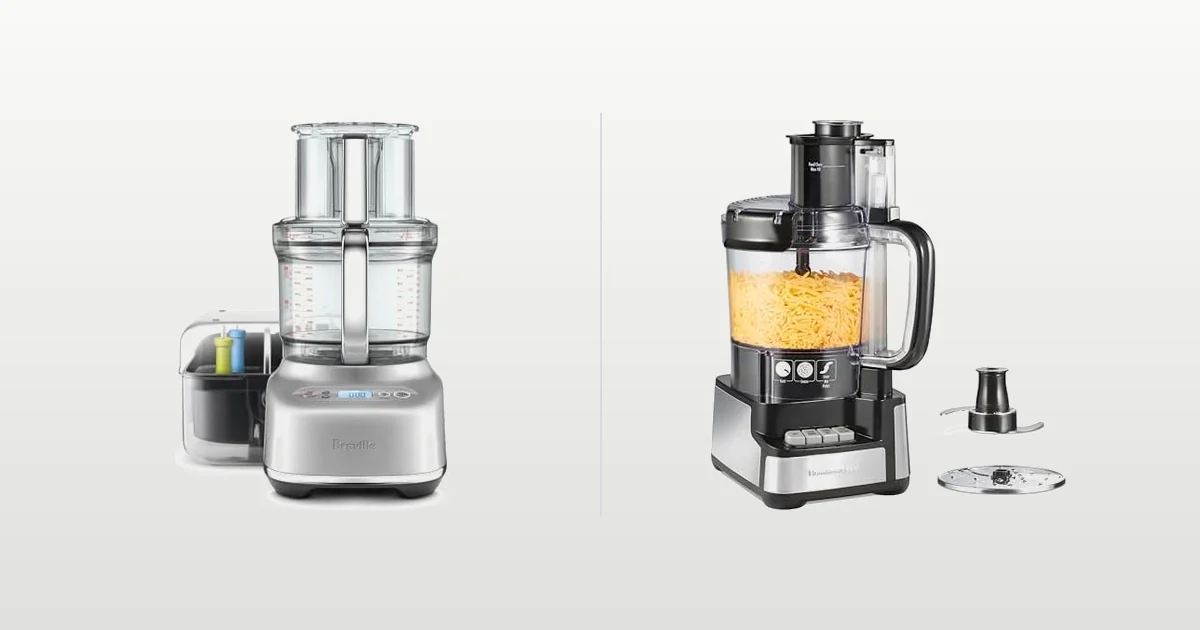
Affiliate Disclosure: As an Amazon Associate, we earn from qualifying purchases. This does not affect the price you pay.
You will use the slicing disc more than any other part of a food processor, and almost no listing tells you how many thicknesses it can cut.
The standard fitting is a reversible disc: slicing on one face, shredding on the other, one thickness each. Listings describe it as “reversible slicing and shredding disc” and move on, which sounds like versatility and means two settings. Want your gratin thinner? There is no thinner.
Of the ten machines here, one publishes a number: the Breville offers 24 adjustable slicing sizes. One more — the KitchenAid — lets you change thickness from outside the bowl while it runs, which turns slice thickness from a decision you commit to into a dial you turn. The other eight say nothing at all, and what they mean is two.
The same silence covers power. Six of these ten publish no wattage. And nobody except KitchenAid addresses the thing that actually kills food processors: a drawer full of loose sharp discs that you stop wanting to reach into.
Ten machines below, from $59.99 to $499.95 — and the best-selling one costs $69.99.
Our Quick Picks
 Best OverallKitchenAid KFP1318 13-Cup
Slice thickness adjusted from the outside while it runs, and every blade and disc stored inside the bowl — the two problems this category usually ignores.
 Best ValueHamilton Beach Stack & Snap 12
A sealed 12-cup bowl, big-mouth chute and assembly with no twisting — and by far the best-selling machine on this page.
 Most AdjustableBreville Sous Chef 16
Twenty-four adjustable slicing sizes and a second 6-cup bowl — the only machine here that treats slice thickness as a continuous variable.
At a Glance
Ten Food Processors, Compared on Slicing and Storage
Bowl capacity, what the slicing disc actually offers, where the blades live, and the one extra specification each listing chose to publish.
| # | Model | Capacity | Slicing | Storage | Detail | Standout | Main Drawback | Check Price |
|---|---|---|---|---|---|---|---|---|
| 1 |
 KitchenAid KFP1318 13-Cup KitchenAid KFP1318 13-Cup |
13 cups | Exact Slice, external | In-bowl caddy | One-click bowl | Adjust slice thickness from outside, without opening the bowl | No wattage published anywhere | View on Amazon |
| 2 |
 Breville Sous Chef 16 Breville Sous Chef 16 |
16 cups | 24 slice sizes | Multiple discs | 6-cup second bowl | Twenty-four slicing thicknesses — nothing else here states a number | $499.95, five times the median | View on Amazon |
| 3 |
 Cuisinart FP-130 13-Cup Cuisinart FP-130 13-Cup |
13 cups | Fine and medium reversible | Chopping blade | High/Low/Pulse | A new motor platform designed around attachments | Slicing is two reversible discs, not adjustable | View on Amazon |
| 4 |
 Cuisinart Elemental 13-Cup Cuisinart Elemental 13-Cup |
13 cups | Reversible discs | Chopping blade | Elemental design | Cuisinart’s design-led line at the top of its range | $299.99, and rank over a million | View on Amazon |
| 5 |
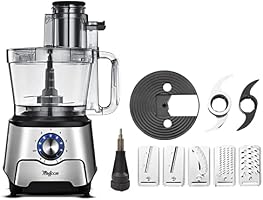 Magiccos 14-Cup 1000 W Magiccos 14-Cup 1000 W |
14 cups | Reversible discs | 1000 W stated | Large capacity | A stated 1000 W, the highest figure on this page | Unfamiliar brand at a mid price | View on Amazon |
| 6 |
 GE 12-Cup Food Processor GE 12-Cup Food Processor |
12 cups | Reversible discs | 550 W stated | 3-opening tube | A feed tube with three stackable openings for different food sizes | 550 W is modest for 12 cups | View on Amazon |
| 7 |
 Hamilton Beach Stack & Snap 12 Hamilton Beach Stack & Snap 12 |
12 cups | Reversible disc | 450 W stated | Sealed bowl | A sealed 12-cup bowl and the best rank in this roundup | 450 W is the lowest power here | View on Amazon |
| 8 |
 Hamilton Beach Big Mouth Duo Hamilton Beach Big Mouth Duo |
12 + 4 cups | Reversible disc | 500 W stated | Dual bowls | A 4-cup bowl included, so the big one stays clean | Two bowls means two things to store | View on Amazon |
| 9 |
 Maydarol 14-Cup XL Maydarol 14-Cup XL |
14 cups | Reversible discs | 600 W stated | XL bowl | 14 cups and 600 W for $107.99 | No brand history whatsoever | View on Amazon |
| 10 |
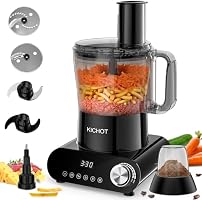 KICHOT 12-Cup KICHOT 12-Cup |
12 cups | Reversible discs | Not stated | Vegetable chopper | Twelve cups for $59.99, the lowest price here | No wattage and the thinnest listing on the page | View on Amazon |
Specifications and prices are taken from each manufacturer’s Amazon listing as displayed on 23 August 2026 through a United States connection, and may change. The Slicing column records what a listing states: “reversible discs” means a disc offering slicing on one face and shredding on the other, which provides one thickness of each unless a further figure is given. Where a listing publishes no wattage that is recorded as unstated rather than estimated, and peak versus sustained ratings are not distinguished by the listings themselves. Capacities are the manufacturer’s bowl figures and are not liquid capacities except where a sealed bowl is specifically claimed. Sales ranks are shown as displayed and can be pooled across a variant family.
Scroll the table sideways to see every column
How We Chose These Ten
We researched current listings, compared manufacturer specifications and documentation, and examined recurring patterns in customer feedback. We did not carry out hands-on testing, and nothing below is presented as measured performance data.
- A bowl of 12 cups or more — the search returns 3-cup mini choppers and 8-cup machines; only genuine large-capacity processors are here
- What the listing says about slicing thickness — adjustable, multiple discs, or a single reversible disc — recorded as stated
- A verified live buy box — all ten confirmed purchasable in the United States on 23 August 2026
- No overlap with our pizza dough roundup — nine candidates already appeared there and were excluded
- A published wattage, or an honest note that there is none — six of these ten publish no power figure
- Whether blade storage is addressed at all — one machine of ten solves it
- Brand and price spread — nine brands from $59.99 to $499.95
The Ten Food Processors in Detail
1. KitchenAid KFP1318 13-Cup — Best Overall

Adjust the slice thickness from outside the bowl, and store every disc inside it. Both are answers to problems most makers pretend do not exist.
Key Specifications
| Capacity | 13 cups |
|---|---|
| Slicing | Exact Slice disc, externally adjustable thick to thin |
| Adjustment | From outside the bowl, without disassembly |
| Storage | In-bowl caddy holds all blades and discs |
| Assembly | Twist-free, one-click bowl with latched lid |
| Cleaning | Warm water and dish soap |
| Rank | #175,547 in its category |
| Price | $199.99 |
| Best For | Anyone who has stopped using a processor because of the discs |
Why We Recommend It
External adjustment changes how you actually cook. On almost every other processor, changing slice thickness means stopping, unlatching the lid, lifting out a wet disc, flipping or swapping it, and reassembling. Which means in practice you do not change it — you accept whatever thickness the disc is set to and move on. An external control turns thickness into something you dial rather than something you commit to.
The in-bowl caddy solves the reason processors get abandoned. A food processor comes with a chopping blade, a dough blade and two or three discs, all sharp, all awkward, all destined for a drawer where you will eventually cut yourself reaching past them. Storing them inside the bowl means the machine is one object rather than a machine plus a hazard.
One-click assembly matters more than it sounds. The twist-and-lock bowls on older designs require alignment you cannot see, and the machine refuses to start until you get it right. That is a small, repeated frustration that decides whether a processor lives on the worktop.
No wattage is published, which is the specification gap here and a common one — six of these ten publish no power figure at all.
Pros
- Slice thickness adjustable from outside the bowl
- In-bowl caddy stores every blade and disc
- One-click, twist-free bowl assembly
- Latched lid
- 13 cups of genuine capacity
- Solves storage, which is why processors get abandoned
Cons
- No wattage published
- $199.99
- Low sales rank for a major brand
- Caddy takes up bowl volume when stored
- External adjustment mechanism is another part to fail
- No dough-specific claims
Best for: Anyone whose last food processor ended up in a cupboard because of the discs.
2. Breville Sous Chef 16 — Most Adjustable

Twenty-four slicing sizes. Every other machine on this page gives you a reversible disc — thick on one side, thin on the other. Two.
Key Specifications
| Capacity | 16 cups, plus a 6-cup bowl |
|---|---|
| Slicing | 24-size adjustable slicer |
| Also included | Reversible shredding disc, French fry disc |
| Range of tasks | Slice, shred, French fry, mince, puree |
| Extras | Breville+ guided recipes and classes |
| Design intent | Consistent size for even cooking and presentation |
| Rank | #22,497 in its category |
| Price | $499.95 |
| Best For | Anyone for whom slice consistency is the actual goal |
Why We Recommend It
This is the specification the category quietly avoids. A reversible slicing disc offers exactly two thicknesses, and most listings describe it as “reversible slicing and shredding” without ever saying so. Twenty-four positions is not a marketing count — it is a genuinely different tool, the difference between accepting two options and choosing the right one for a gratin, a slaw or a crisp.
Consistency is the argument the listing actually makes, and it is the correct one. Evenly sized pieces cook evenly; that is the whole reason to use a machine rather than a knife. A processor that can only cut two thicknesses is a processor that cooks two ways.
The 6-cup second bowl is the underrated inclusion. A 16-cup bowl is absurd for chopping a shallot, and a small bowl means the big one stays clean for the job that needs it. Machines without one either dirty an enormous bowl or leave you doing small jobs by hand.
Five hundred dollars is the obvious objection, and it is a fair one. This is a machine for someone whose cooking genuinely turns on consistent knife work, not for someone who chops an onion twice a week.
Pros
- 24 adjustable slicing sizes — unique on this page
- 16-cup bowl plus a 6-cup bowl for small jobs
- French fry disc included alongside slice and shred
- Consistency is the stated design goal
- Guided recipe platform included
- Best rank of the premium machines here
Cons
- $499.95 is five times the median price
- Very large footprint
- No wattage published
- Two bowls means more to store
- Far more machine than most households need
- Recipe platform is a subscription-style extra
Best for: Cooks for whom evenly sized slices are the point rather than a nicety.
3. Cuisinart FP-130 13-Cup — Best Motor Platform

Two reversible discs is four thicknesses — twice what most machines here offer, and a sixth of the Breville.
Key Specifications
| Capacity | 13 cups |
|---|---|
| Slicing | Fine and medium reversible slicing/shredding discs |
| Thicknesses available | Four, across two reversible discs |
| Controls | High, Low and Pulse paddles |
| Blade | Chopping blade included |
| Design | New motor platform supporting further attachments |
| Rank | #65,688 in its category |
| Price | $229.99 |
| Best For | Buyers planning to add attachments over time |
Why We Recommend It
Two discs rather than one is a meaningful step. Fine and medium, each reversible for slicing and shredding, gives four distinct cuts instead of the usual two. It is not adjustable slicing, but it is a genuine widening of what the machine can produce and Cuisinart is one of the few to include both as standard.
A platform designed for attachments is a long-term argument. The listing leads on the motor being built to support a variety of functions and accessories, which matters if you expect to add a dicing kit or a spiraliser later. It also means the base is engineered for loads beyond the standard discs.
Paddle controls rather than buttons is a small ergonomic win with wet hands — a broad paddle is easier to hit accurately than a small button when your fingers are covered in dough.
No wattage and no slicing adjustment are the two gaps. At $229.99, thirty dollars above the KitchenAid, you get an extra disc and lose external adjustment and the storage caddy.
Pros
- Fine and medium discs give four cuts, not two
- Motor platform built for further attachments
- High/Low/Pulse paddle controls are easy with wet hands
- 13 cups of real capacity
- Cuisinart’s long track record in this category
- Chopping blade included
Cons
- No adjustable slicing thickness
- No wattage published
- $229.99 is above the KitchenAid with fewer conveniences
- No blade storage solution
- Discs must be swapped by hand to change cut
- Low rank
Best for: Someone building a system over time rather than buying one finished machine.
4. Cuisinart Elemental 13-Cup — Most Premium Cuisinart

Three hundred dollars for the same 13 cups as the $229.99 FP-130, from the same maker.
Key Specifications
| Capacity | 13 cups |
|---|---|
| Slicing | Reversible discs |
| Line | Elemental, Cuisinart’s design-led range |
| Position | Most expensive Cuisinart in this roundup |
| Blade | Chopping blade included |
| Rank | #1,219,945 in its category |
| Price | $299.99 |
| Best For | Buyers who want the Cuisinart name in a particular finish |
Why We Recommend It
The honest question is what the extra seventy dollars buys, and on the published specification the answer is finish and design rather than capability. Same capacity, reversible discs rather than adjustable slicing, no wattage published. The Elemental line is Cuisinart’s styling-led range and it is priced accordingly.
A rank above 1.2 million is the most striking figure in this roundup. Sales rank measures how much of something sells, and by that measure this is selling very little indeed — against #65,688 for the FP-130 and #3,242 for the cheapest machine here. That gap is worth weighing seriously on an appliance you expect to keep for a decade.
None of which makes it a poor machine. It is a Cuisinart 13-cup processor and will do what those do. It is simply the most expensive way to buy that on this page, without a specification that justifies it.
We record what the listing states, and the listing states considerably less than the FP-130’s does about discs, controls and motor.
Pros
- Cuisinart build and support
- 13 cups of genuine capacity
- Design-led finish for a visible worktop
- Reversible slicing and shredding discs
- Chopping blade included
- Established brand warranty
Cons
- $299.99 for no stated capability advantage
- Rank above 1.2 million — by far the lowest here
- No adjustable slicing
- No wattage published
- Cheaper Cuisinart offers more discs and controls
- Least-detailed listing of the three Cuisinarts
Best for: Someone who wants this specific finish and is not buying on specification.
5. Magiccos 14-Cup 1000 W — Most Power
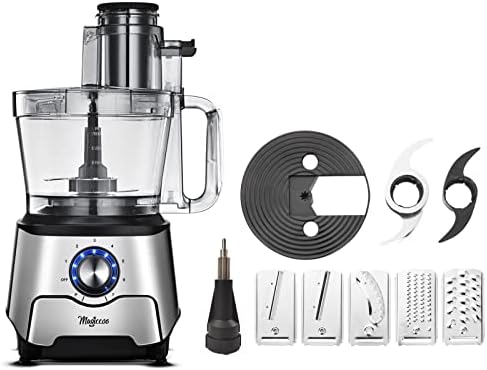
A thousand watts against 14 cups is about 71 watts per cup — comfortably the best ratio on this page.
Key Specifications
| Capacity | 14 cups |
|---|---|
| Power | 1000 W, stated |
| Watts per cup | About 71, the highest ratio here |
| Slicing | Reversible discs |
| Position | Highest published wattage in this roundup |
| Rank | #43,479 in its category |
| Price | $147.99 |
| Best For | Buyers who weight published power heavily |
Why We Recommend It
Wattage matters most for the heaviest jobs — dense doughs, hard root vegetables, nut butters — where the motor is under sustained load rather than pulsing. Against the 450 W and 500 W Hamilton Beach machines driving 12 cups, this has more than twice the power per unit of bowl.
Treat the figure with the usual caution. The listing does not say whether 1000 W is a sustained or a peak rating, and wattage claims from brands without a track record are the least externally checked numbers in small appliances. We record it as stated.
Fourteen cups is genuinely large, above the 13-cup standard this category clusters around, and the extra volume is useful for batch prep where you would otherwise process in two goes.
Slicing is reversible discs — two thicknesses — with no adjustment, which is the pattern across everything here except the Breville and KitchenAid.
Pros
- 1000 W stated — highest on this page
- About 71 watts per cup, the best ratio here
- 14 cups exceeds the 13-cup standard
- $147.99 undercuts the branded 13-cup machines
- Reasonable rank for an unknown brand
- Genuine batch-prep capacity
Cons
- Not stated whether wattage is sustained or peak
- No brand track record
- No adjustable slicing
- No disc storage solution
- Wattage claims at this tier are rarely verified
- 14 cups is a large thing to store
Best for: Spec-led buyers who want maximum published power per dollar.

6. GE 12-Cup Food Processor — Best Feed Tube

Three stackable feed openings — whole vegetables, smaller items, and liquids — rather than one compromise-sized tube.
Key Specifications
| Capacity | 12 cups, with measurement markings |
|---|---|
| Power | 550 W, stated |
| Speeds | High, Low, Pulse |
| Feed tube | Large, with three stackable openings |
| Why three openings | Whole items, smaller foods and liquids |
| Handle | Ergonomic, on the bowl |
| Rank | #106,442 in its category |
| Price | $149.99 |
| Best For | Reducing the pre-cutting a processor is supposed to save you |
Why We Recommend It
The feed tube is where a processor either saves time or wastes it. A tube sized for whole potatoes lets small items rattle around and fall over, producing wedges instead of slices. A tube sized for carrots means quartering every potato first, which is the pre-cutting the machine was meant to eliminate. Three nested openings addresses both ends properly.
Measurement markings on the bowl is a small thing that turns the processor into a measuring jug for anything you have just made in it — useful for batters, sauces and anything going into a tin.
Five hundred and fifty watts for 12 cups is about 46 per cup, which is modest — roughly two-thirds the Magiccos ratio. For chopping and slicing that is fine; for heavy dough it is the component that will complain.
Reversible discs again, so two thicknesses, and no adjustment. At $149.99 that puts it against the Magiccos with less power and less capacity, offset by the feed tube design and a brand people know.
Pros
- Three stackable feed openings for different food sizes
- 550 W published when six machines here publish nothing
- Measurement markings on the bowl
- High/Low/Pulse controls
- Ergonomic bowl handle
- Recognised brand
Cons
- 550 W is modest for a 12-cup bowl
- No adjustable slicing thickness
- 12 cups is below the 13-cup standard here
- No disc storage
- $149.99 buys more capacity and power elsewhere
- Low rank
Best for: Anyone who resents pre-cutting food to fit the machine that was meant to cut it.
7. Hamilton Beach Stack & Snap 12 — Best Value

Rank #3,242 against tens and hundreds of thousands for everything else here. An enormous number of people bought this and kept buying it.
Key Specifications
| Capacity | 12 cups, sealed bowl |
|---|---|
| Power | 450 W, stated |
| Assembly | Stack & Snap, no twisting or aligning |
| Feed chute | Big Mouth — fits a whole potato or tomato |
| Why sealed matters | Holds liquid volumes without leaking |
| Rank | #3,242 — the best in this roundup |
| Price | $69.99 |
| Best For | The sensible default, at a third of the branded machines |
Why We Recommend It
A sealed bowl is a real specification, not marketing. Most processor bowls have a gap around the central spindle, which is fine for dry chopping and leaks the moment you make a soup, a batter or a sauce. A sealed bowl means the stated 12 cups is usable with liquid, which is the difference between a chopper and a machine you can actually make things in.
Stack & Snap removes the alignment problem that makes people give up on food processors. There is no twisting, no hunting for the position where the safety interlock engages — you stack it and it snaps.
Four hundred and fifty watts is the lowest figure on this page, at about 38 watts per cup. For chopping, slicing and shredding it is adequate. For heavy dough it is the limiting component, and this machine makes no dough claims.
At $69.99 with the best rank here by two orders of magnitude, this is the machine most people should probably buy and the specification tells you why: nothing exotic, everything that matters, no assembly frustration.
Pros
- Best rank in this roundup by a wide margin
- Sealed bowl handles liquids without leaking
- Stack & Snap needs no twisting or alignment
- Big Mouth chute fits whole vegetables
- 450 W published
- $69.99
Cons
- 450 W is the lowest power here
- No adjustable slicing thickness
- 12 cups rather than 13 or 14
- No disc storage solution
- Not suited to heavy dough
- Plastic build reflects the price
Best for: Most households, most of the time, at a third of the price of the branded machines.
8. Hamilton Beach Big Mouth Duo — Best Two-Bowl

Seventy dollars for a 12-cup bowl and a 4-cup bowl. The Breville charges $499.95 for the same idea at a larger scale.
Key Specifications
| Capacity | 12 cups, plus a 4-cup bowl |
|---|---|
| Power | 500 W, stated |
| Small bowl use | Herbs, garlic, small quantities |
| Discs | Reversible slicing/shredding, plus S-blade |
| Feed | Fits whole food, reducing pre-cutting |
| Rank | #71,213 in its category |
| Price | $70.19 |
| Best For | Households doing both batch prep and small chopping |
Why We Recommend It
A second small bowl is the most practical feature in this category. Nobody chops one shallot in a 12-cup bowl — the blade spins above the food and flings it up the sides. So the big machine sits unused for small jobs and you reach for a knife instead. A 4-cup bowl is what makes a processor useful daily rather than occasionally.
Five hundred watts across 12 cups is about 42 per cup, slightly better than its Stack & Snap sibling and still modest. In the small bowl that same motor is driving a third of the volume, which is where it feels genuinely powerful.
Reversible disc plus S-blade is the standard kit — two slicing thicknesses, no adjustment, which is the pattern everywhere here except two machines.
The trade is storage, and it is the recurring theme of this page: more capability means more parts, and parts are what send appliances into cupboards.
Pros
- Includes a 4-cup bowl for small jobs
- 500 W published
- Whole food fits the feed chute
- Reversible disc plus S-blade
- $70.19 for two bowls
- Makes the machine useful for daily small tasks
Cons
- Two bowls to store as well as the machine
- 500 W is modest for 12 cups
- No adjustable slicing
- No disc storage caddy
- Mid-table rank
- Plastic construction
Best for: Households that chop small quantities often and batch-prep occasionally.
9. Maydarol 14-Cup XL — Best Budget Large

Fourteen cups for $107.99. The nearest branded 13-cup machine is $199.99.
Key Specifications
| Capacity | 14 cups |
|---|---|
| Power | 600 W, stated |
| Watts per cup | About 43 |
| Slicing | Reversible discs |
| Position | Cheapest 14-cup machine here |
| Rank | #40,719 in its category |
| Price | $107.99 |
| Best For | Maximum bowl volume for the money |
Why We Recommend It
Capacity per dollar is the entire argument, and it is a strong one if volume is what you need. Ninety dollars less than the KitchenAid, with an extra cup of bowl and a published wattage the KitchenAid does not give.
Six hundred watts across 14 cups is about 43 per cup, which sits in the middle of this page — better than the Hamilton Beach machines, well short of the Magiccos.
What you are not buying is any of the conveniences. No adjustable slicing, no disc storage, no second bowl, no sealed-bowl claim, no named assembly system. It is a large bowl, a motor and the standard discs.
Unknown brands are the recurring trade in this category, and on a motorised appliance with a warranty that may or may not be honoured, that is a more serious consideration than it is on a knife or a pan.
Pros
- 14 cups for $107.99 — best capacity per dollar
- 600 W published
- Larger than the 13-cup standard
- Reasonable watts-per-cup ratio
- Reversible discs included
- Undercuts branded 13-cup machines by $90
Cons
- No brand history or service record
- No adjustable slicing
- No disc storage or second bowl
- No sealed-bowl claim
- Warranty support is unproven
- Large footprint to store
Best for: Buyers who want maximum capacity and will accept an unknown brand.
10. KICHOT 12-Cup — Cheapest
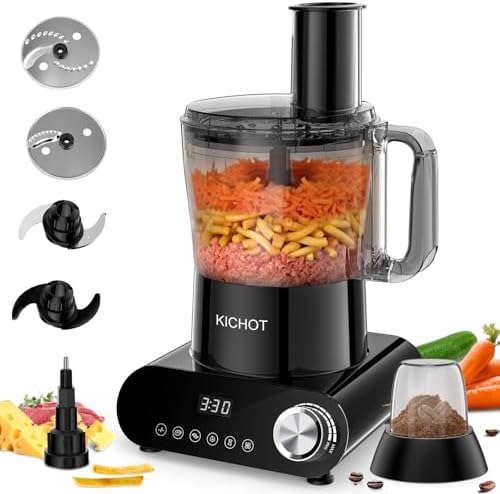
Sixty dollars for twelve cups, and no wattage, no assembly system and no disc detail anywhere.
Key Specifications
| Capacity | 12 cups |
|---|---|
| Power | Not stated |
| Slicing | Reversible discs |
| Positioning | Food processor and vegetable chopper |
| Specification detail | The least of any machine here |
| Rank | #104,982 in its category |
| Price | $59.99 |
| Best For | Occasional use at the lowest price that still buys 12 cups |
Why We Recommend It
The gaps are the review. No power figure, no sealed-bowl claim, no named assembly mechanism, no storage. Compared with the $69.99 Hamilton Beach — which publishes 450 W, names its sealed bowl and its Stack & Snap assembly, and holds rank #3,242 — ten dollars is a very small saving for that much less information.
Twelve cups is real capacity and the machine will chop and slice. For someone who will use it a few times a year, buying the cheapest thing that does the job is a defensible position and this is it.
For anything more than occasional use, the comparison above is hard to argue with. The specification gap between this and the Hamilton Beach is much larger than the price gap.
We record what is stated rather than inferring a wattage from the price, which is the same approach taken to the least-specified products in our knife and mini fridge roundups.
Pros
- $59.99 — cheapest here
- 12 cups of genuine capacity
- Reversible discs included
- Adequate for occasional chopping and slicing
- Low-risk way to find out if you will use one
- Simple to operate
Cons
- No wattage published anywhere
- Least-specified machine in this roundup
- No sealed-bowl or assembly claims
- No disc storage
- Only $10 below a far better-documented machine
- No brand track record
Best for: Occasional users buying the cheapest thing that genuinely holds 12 cups.
Twenty-Four Thicknesses Against Two
The only machine here that publishes a slicing count, against the standard fitting everyone else uses.
| Breville Sous Chef 16 | A typical reversible disc | |
|---|---|---|
| Slicing thicknesses | 24 adjustable sizes | One |
| Shredding | Reversible disc included | One, on the reverse face |
| Changing thickness | Adjust the slicer | Not possible |
| Second bowl | 6 cups included | None |
| French fry disc | Included | No |
| Price | $499.95 | $59.99 to $229.99 |
Five hundred dollars is a great deal of money for slice thickness, and for most cooking two thicknesses is genuinely enough. But it is worth understanding that this is the axis the price is buying — not capacity, not power, but whether you get to choose.
Ten Dollars, and Everything the Listing Tells You
The cheapest machine here against the best-selling one.
| KICHOT 12-Cup | Hamilton Beach Stack & Snap | |
|---|---|---|
| Price | $59.99 | $69.99 |
| Wattage stated | None | 450 W |
| Sealed bowl | Not claimed | Yes |
| Assembly | Not described | Stack & Snap, no twisting |
| Feed chute | Not described | Big Mouth, fits a whole potato |
| Rank | #104,982 | #3,242 |
Ten dollars separates them. One publishes a wattage, names a sealed bowl that will hold liquid without leaking, names an assembly system that removes the alignment problem, and outsells the other by a factor of thirty. This is the clearest illustration on the page that the cheapest option is rarely the best value.
Best Alternatives
| Alternative | Why Consider It | Better For | Main Trade-Off |
|---|---|---|---|
| A mandoline slicer | Genuinely adjustable thickness for very little money | Precise slicing of firm vegetables | No chopping, shredding or pureeing |
| A good chef’s knife | Free if you own one, and infinitely adjustable | Small quantities, and anyone who enjoys it | Slow, and consistency depends on you |
| A stand mixer with a slicer attachment | Uses a motor you already own | Kitchens already built around a mixer | Attachments are expensive and fiddly |
| A mini chopper | Cheap, small, easy to wash | Herbs, garlic, one onion | No slicing or shredding at all |
What the Money Actually Buys
$59.99 to $107.99 — KICHOT, Hamilton Beach ×2, Maydarol. This tier contains the best-selling machine on the page and the best capacity per dollar. What you get is a bowl, a motor and a reversible disc; what you do not get is adjustable slicing or anywhere to put the blades. The Hamilton Beach at $69.99 is the machine most households should probably buy.
$147.99 to $229.99 — Magiccos, GE, KitchenAid, Cuisinart FP-130. The step up buys either published power, a better feed tube, or in the KitchenAid’s case the two genuine conveniences on this page: external slice adjustment and in-bowl blade storage. This is where the money starts changing what using the machine feels like.
$299.99 to $499.95 — Cuisinart Elemental, Breville Sous Chef. Two very different propositions. The Breville buys 24 slicing sizes, 16 cups and a second bowl. The Elemental buys a finish, at $70 above a better-specified Cuisinart, and carries a sales rank above 1.2 million.
What to Check Before You Buy
Find Out How Many Thicknesses You Actually Get
This is the specification the category avoids. “Reversible slicing and shredding disc” means one slicing thickness and one shredding coarseness — the reversibility is between two different jobs, not two thicknesses of the same job. If a listing does not state a number or describe an adjustment, assume one. Only two machines here offer more, and only one publishes a count.
External Adjustment Changes Whether You Use It
Changing thickness on most processors means stopping, unlatching, lifting out a wet disc, swapping or flipping it, and reassembling. In practice people do not bother, so the machine has one setting. A control that adjusts from outside the bowl while it runs turns thickness into something you actually vary. It is one of only two conveniences on this page that changes daily use.
Ask Where the Blades Are Going to Live
A food processor arrives with a chopping blade, sometimes a dough blade, and two or three discs — all sharp, all awkward. In most kitchens they end up loose in a drawer, which is both a hazard and the main reason the machine stops being used. Exactly one machine here stores them inside the bowl. It is worth more than it sounds.
A Sealed Bowl Is the Difference Between Chopping and Cooking
Most processor bowls have a gap around the central spindle. That is fine for dry chopping and leaks the moment you make a soup, a sauce or a batter. A specifically claimed sealed bowl means the stated capacity is usable with liquid. One machine here names it; the others do not mention it either way.
Set Wattage Against Bowl Size, Not Alone
Six of these ten publish no power figure. Among those that do, the spread against capacity runs from about 38 watts per cup to about 71 — nearly double. That ratio matters for dense loads: hard root vegetables, nut butters, heavy doughs. For chopping and slicing, almost anything here is adequate, and a missing wattage is more a disclosure problem than a performance one.
Check the Feed Tube Against Real Vegetables
A tube too small means quartering every potato, which is the pre-cutting the machine was supposed to save you. A tube too large lets small items tip over and come out as wedges. Machines that offer several nested openings, or a chute genuinely sized for a whole potato, are solving a real daily annoyance rather than adding a bullet point.
A Small Second Bowl Decides How Often It Gets Used
Nobody chops one shallot in a 12-cup bowl — the blade spins above the food and throws it up the sides. So the machine sits unused for small jobs and you reach for a knife. A 4-cup or 6-cup second bowl is what makes a large processor a daily tool rather than a batch-prep appliance, and two machines here include one at very different prices.
Common Mistakes
- Reading “reversible disc” as adjustable. It reverses between slicing and shredding, not between thicknesses.
- Buying on bowl capacity alone. Thirteen cups of bowl is not thirteen cups of anything liquid unless the bowl is sealed.
- Ignoring where the discs will be stored. A drawer of loose blades is how these machines end up unused.
- Saving ten dollars on the cheapest listing. On this page that ten dollars costs you a wattage, a sealed bowl and an assembly system.
- Chopping small quantities in a large bowl. The blade spins above the food; use a second bowl or a knife.
- Assuming a missing wattage means a weak motor. Two of the best-built machines here publish none.
- Filling the bowl to the line with liquid. Unless it is a sealed bowl, it will find the spindle.
Who Should Buy Which
Buy the Hamilton Beach Stack & Snap at $69.99 unless you have a specific reason not to. Sealed bowl, published wattage, no-twist assembly, and rank #3,242 against tens of thousands for everything else.
Buy the KitchenAid if the discs are what put you off last time. External slice adjustment and an in-bowl caddy are the only two genuine convenience features on this page.
Buy the Breville if consistent slice thickness is the actual goal. Twenty-four sizes, 16 cups and a 6-cup second bowl — and understand that this is what $499.95 is buying.
Buy the Hamilton Beach Duo if you chop small things often, because the 4-cup bowl is what makes a large processor a daily tool.
Buy the Maydarol if you simply want the most bowl for the money and will accept an unknown brand for it.
Frequently Asked Questions
How many slice thicknesses does a food processor actually give you?
Usually one, though the listings make it sound like more. The standard fitting is a reversible disc: slicing on one face and shredding on the other. It reverses between two different jobs, not between two thicknesses of the same job, so unless a machine states otherwise you get exactly one slice thickness and one shred coarseness. Of the ten machines in this roundup, only the Breville publishes a count — 24 adjustable sizes — and only the KitchenAid offers adjustment at all, from outside the bowl while running. The other eight say nothing, and what nothing means is one.
Is 13 cups too big for a normal household?
For everyday chopping, yes, and that is the real argument for a second bowl rather than a smaller machine. A 12 to 14 cup bowl is excellent for batch prep, a big tray of vegetables, or several kilos of anything. It is genuinely bad at one shallot, because the blade spins above the food and flings it up the sides rather than cutting it. Two machines here include a small second bowl — a 4-cup on the Hamilton Beach Duo at $70.19 and a 6-cup on the Breville at $499.95 — and that single addition is what turns a batch-prep appliance into something used daily.
Does wattage matter on a food processor?
It matters for dense loads and barely at all for the rest. Chopping vegetables, slicing and shredding put light, intermittent demands on a motor; hard root vegetables, nut butters and heavy dough put sustained load on it, and that is where a 450-watt machine driving a 12-cup bowl will complain and a 1000-watt machine will not. Set the figure against bowl size rather than reading it alone — the spread across the machines here that publish anything runs from about 38 watts per cup to about 71. Six of the ten publish no figure whatsoever, which is a disclosure gap rather than proof of a weak motor.
What is a sealed bowl and do I need one?
A sealed bowl closes the gap around the central spindle where the blade assembly passes through. Most processor bowls have that gap, which is invisible and irrelevant when you are chopping onions and becomes obvious the first time you puree a soup and it runs out of the bottom onto the base. If you intend to make anything wet — sauces, batters, soups, hummus at volume — a sealed bowl means the stated capacity is actually usable. Only one machine in this roundup specifically claims it, and the others do not address it either way.
Where should the blades and discs be stored?
This is the question that decides whether you keep using the machine, and only one manufacturer here answers it. A food processor arrives with a chopping blade and two or three discs, all sharp on both faces and awkward to hold. In most kitchens they go in a drawer, where they are a hazard to reach past and gradually get avoided. The KitchenAid stores all of them inside the bowl in a caddy, so the machine is a single object. If your last processor ended up in a cupboard, this is very likely why.
Is the most expensive machine here worth five times the cheapest?
Only if slice consistency is genuinely what you are buying. The Breville at $499.95 gives 24 adjustable slicing sizes, 16 cups, a 6-cup second bowl and a French fry disc; the Hamilton Beach at $69.99 gives 12 sealed cups, 450 watts, one slice thickness and the best sales rank on this page by a factor of thirty. For chopping, slicing and shredding in a domestic kitchen, the cheap machine does the job. The expensive one does a job the cheap one cannot do at all, which is cutting to a thickness you choose — and whether that is worth $430 depends entirely on how much your cooking turns on it.
Final Verdict
External slice adjustment and an in-bowl caddy for every blade — the two conveniences that decide whether a processor keeps getting used.
A sealed 12-cup bowl, 450 W published, no-twist assembly and rank #3,242 — thirty times better-selling than anything else here. $69.99.
24 adjustable slicing sizes, 16 cups and a 6-cup second bowl. The only machine here that lets you choose a thickness.
Buy the Hamilton Beach Stack & Snap at $69.99 unless something specific pushes you elsewhere. It publishes its wattage, names a sealed bowl that will hold liquid, removes the assembly alignment problem entirely, and holds rank #3,242 against tens and hundreds of thousands for every other machine on this page. That gap is the clearest signal in this roundup.
Buy the KitchenAid at $199.99 if a previous processor ended up in a cupboard. External slice adjustment and an in-bowl storage caddy are the only two features here that change what using the machine is like day to day, and the second one addresses the actual reason these appliances get abandoned.
And know what you are not getting anywhere else. Eight of these ten machines give you a single slice thickness and do not say so. The word to look for is not “reversible” — that describes slicing on one face and shredding on the other. It is a number, or the word “adjustable”, and on this page it appears exactly twice.