Affiliate Disclosure: As an Amazon Associate, we earn from qualifying purchases. This does not affect the price you pay.
One blender in this roundup advertises 1800 watts. Another advertises 385. They make broadly similar smoothies, and the reason is printed on a third listing that almost nobody reads carefully.
The Amazon Basics machine below states its power as “700W peak power (500W rated)”. Same motor, two numbers, a 29 per cent gap. Peak is what a motor draws for an instant at startup or under a stall. Rated is what it sustains while actually blending. Only one listing here publishes both.
Three machines quote peak figures — 1800 and 1600 among them — and four quote a plain wattage with no qualifier at all. Comparing those two kinds of number as though they were the same thing is the main way blender listings mislead, and it is why this roundup ranks on jar capacity, jar material and what each listing actually claims rather than on the biggest number.
For smoothies specifically, two things matter more than watts anyway: whether the blade design moves frozen fruit back down into the blades, and whether the jar is glass or plastic.
Our Quick Picks
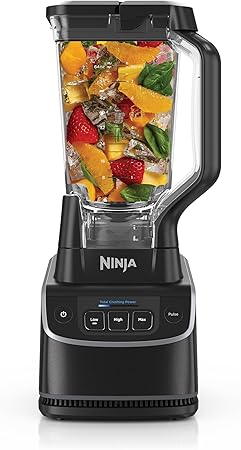 Best OverallNinja UltraCrush BP201
One of the few listings here that quotes a plain wattage rather than a peak figure, on the largest pitcher in the roundup.
 Best Glass JarHamilton Beach Wave Crusher
A 40 oz glass jar and fourteen functions for under fifty dollars, with the lowest stated wattage here.
 Best BudgetBLACK+DECKER Crush Master
Ten speeds, a 48 oz jar and a four-point blade, at the cheapest credible price in the roundup.
At a Glance
Ten Smoothie Blenders Compared
Capacity, stated power, jar material and speeds, with peak-watt claims marked as peak rather than presented as output.
| # | Model | Capacity | Stated Power | Jar | Speeds | Standout | Main Drawback | Check Price |
|---|---|---|---|---|---|---|---|---|
| 1 |
 Ninja UltraCrush BP201 Ninja UltraCrush BP201 |
72 oz | 1000 W | Plastic | 3 speeds | States a plain wattage, not a peak figure | Only 3 speeds | View on Amazon |
| 2 |
 Ninja Detect TB301 Ninja Detect TB301 |
72 oz | 1800 W peak | Plastic | 10 speeds | Adjusts speed and time automatically | 1800 is a peak figure, not rated output | View on Amazon |
| 3 |
 Ninja Compact Kitchen System Ninja Compact Kitchen System |
64 oz | 1200 W | Plastic | 3 speeds | Blender and food processor in one base | 3 speeds and a tall footprint | View on Amazon |
| 4 |
 Ninja TWISTi DUO SS151 Ninja TWISTi DUO SS151 |
34 oz | 1600 W peak | Plastic | 5 speeds | Built-in tamper pushes food onto the blades | Smallest capacity of the Ninjas | View on Amazon |
| 5 |
 Hamilton Beach Wave Crusher Hamilton Beach Wave Crusher |
40 oz | 385 W | Glass | 14 functions | Glass jar at a budget price | Lowest wattage in the roundup | View on Amazon |
| 6 |
 Oster Classic 8-Speed Oster Classic 8-Speed |
6 cups | 700 W | Glass | 8 speeds | Dial controls, glass jar, nothing to learn | Listing is thin on detail | View on Amazon |
| 7 |
 Oster Classic 16-Speed Oster Classic 16-Speed |
6 cups / 1.4 L | 400 W | Glass | 16 speeds | Includes a 3-cup food chopper | 400 W limits ice work | View on Amazon |
| 8 |
 BLACK+DECKER Crush Master BLACK+DECKER Crush Master |
48 oz | 400 W | Plastic | 10 speeds | Ten speeds and a 48 oz jar for around thirty dollars | 400 W and a plastic jar | View on Amazon |
| 9 |
 Amazon Basics 700 W Amazon Basics 700 W |
50 oz | 700 W peak / 500 W rated | Glass | 6 speeds | The only listing here that publishes both peak and rated watts | 3.3 rating is the lowest here | View on Amazon |
| 10 |
 magic bullet Combo magic bullet Combo |
48 oz + 16 oz | 600 W | Plastic | 3 speeds | Pitcher and to-go cup on one base | 600 W is modest for ice | View on Amazon |
Specifications and ratings are taken from each manufacturer’s Amazon listing as displayed on 20 August 2026 and may change. Where a listing says “peak” we have kept the word: Ninja’s Detect quotes 1800 peak watts and the TWISTi 1600 watts peak, which are not equivalent to the plainly-stated 1000 W and 1200 W on other Ninja models. Amazon Basics is the only listing here publishing both figures for the same motor, at 700 W peak and 500 W rated. Four of these ten machines are made by Ninja, which reflects how heavily that brand dominates this category rather than any preference on our part.
Scroll the table sideways to see every column
How We Chose These Smoothie Blenders
We researched current listings, compared manufacturer specifications and documentation, and examined recurring patterns in customer feedback. We did not carry out hands-on testing, and nothing below is presented as measured performance data.
- Whether the wattage is peak or rated — a peak figure and a rated figure are not comparable, and most listings do not say which they mean
- Jar material — glass does not scratch, cloud or retain odours; plastic is lighter and will not break
- Blade and circulation design — frozen fruit fails by forming an air pocket, so getting it back onto the blades is the real problem
- Usable capacity — 72 oz makes four smoothies, 34 oz makes one
- Height against a wall cabinet — two machines here are over 17 inches tall
- Rating taken at face value — one machine here sits at 3.3, and we have said so rather than quietly ranking it low
The 10 Best Blenders for Smoothies, Reviewed
1. Ninja UltraCrush BP201 — Best Overall
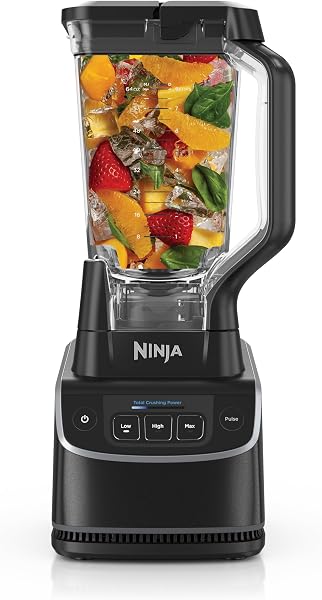
Ninja states 1000 watts here without the word “peak” attached, which is unusual in this category and makes the figure more trustworthy than the 1800 and 1600 numbers elsewhere in this roundup.
A 72 oz pitcher is the largest here and makes four generous smoothies in one go, which is the practical reason to buy this over a personal blender.
Key Specifications
| Pitcher capacity | 72 fl oz |
|---|---|
| Stated wattage | 1000 watts |
| Jar material | Plastic |
| Speeds | 3 |
| Ice | Total Crushing technology, per listing |
| Dimensions | 7.3″D x 12″W x 7.3″H |
| Model | BP201 |
| Rating | 4.6 out of 5 stars |
| Best For | Family-sized smoothies without paying for a peak-watt headline |
Why We Recommend It
Total Crushing is Ninja’s stacked-blade arrangement, which attacks ingredients at several heights in the jar rather than only at the bottom. For frozen fruit and ice — the two things that break cheap blenders — that is the design difference that matters.
Three speeds is the obvious limitation on paper. In practice smoothies use full power and pulse, so the speed count matters far less here than it would on a mixer.
Pros
- 1000 W stated plainly, not as a peak figure
- Largest pitcher in the roundup at 72 oz
- Stacked blades attack ice at multiple heights
- 4.6 rating
- Lowest profile here at 7.3 inches deep
Cons
- Only 3 speeds
- Plastic pitcher will scratch and stain over time
- 12-inch width needs counter space
- No personal to-go cups included
Best for: Households making several smoothies at once.
2. Ninja Detect TB301 — Most Powerful
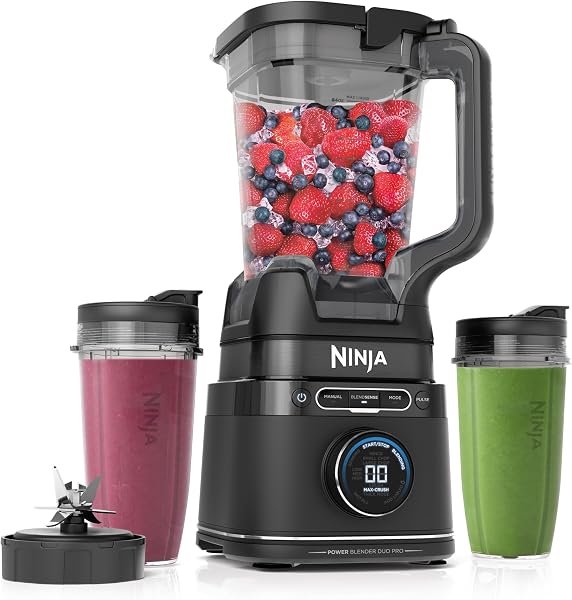
BlendSense is the genuinely interesting feature: the blender senses the load and sets its own speed and duration, which removes the guesswork about how long a frozen smoothie needs.
It shares the 4.6 rating and the 72 oz pitcher with the UltraCrush above, at nearly twice the price.
Key Specifications
| Pitcher capacity | 72 fl oz |
|---|---|
| Stated wattage | 1800 peak watts |
| Jar material | Plastic |
| Speeds | 10 |
| Smart feature | BlendSense adjusts speed and time automatically |
| Included | Cups |
| Dimensions | 6.88″D x 8.38″W x 17.5″H |
| Model | TB301 |
| Rating | 4.6 out of 5 stars |
| Best For | Set-and-forget blending |
Why We Recommend It
Read the wattage carefully. Ninja specifies 1800 peak watts. Peak is the momentary maximum the motor draws at startup or under a stall, not the power it sustains while blending. The UltraCrush’s plainly-stated 1000 W is a more conservative claim, and the two machines are far closer in practice than 1800 against 1000 suggests.
Ten speeds plus automatic control is more granularity than a smoothie needs, but it is useful if the same machine also handles soups, salsas and nut butters.
Pros
- BlendSense sets speed and time for you
- 72 oz pitcher plus to-go cups
- 10 speeds for jobs beyond smoothies
- 4.6 rating
- Tallest useful capacity-to-footprint ratio here
Cons
- 1800 W is a peak figure, not sustained output
- 17.5 inches tall, will not fit under most cabinets
- Roughly double the UltraCrush price for the same pitcher
- Plastic jar
Best for: Buyers who want the machine to make the decisions.
3. Ninja Compact Kitchen System — Highest Rated

4.8 is the highest rating in this roundup, and 1200 watts is stated plainly rather than as a peak figure. On the two measures that matter most, this is the strongest machine here.
What justifies the price is the second job: a 5-cup processor bowl with chopping and dough blades runs off the same motor base.
Key Specifications
| Pitcher capacity | 64 fl oz |
|---|---|
| Stated wattage | 1200 watts |
| Jar material | Plastic |
| Speeds | 3, with Auto-iQ programmes |
| Also includes | 5-cup Precision Processor bowl, chopping and dough blade |
| Blades | Stacked Blade Assembly plus Pro Extractor Blades |
| Dimensions | 7.5″D x 8.25″W x 17.25″H |
| Model | AMZ493BRN |
| Rating | 4.8 out of 5 stars |
| Best For | One base that blends, chops and kneads |
Why We Recommend It
Auto-iQ runs preset pulse-and-pause patterns rather than holding one speed, which works better on frozen fruit than a constant blitz — the pauses let ingredients fall back onto the blades.
At 17.25 inches tall it has the same cabinet problem as the Detect. Measure before buying if it will live under a wall unit.
Pros
- Highest rating in the roundup at 4.8
- 1200 W stated plainly, not as a peak figure
- Food processor bowl and dough blade included
- Auto-iQ pulse patterns suit frozen fruit
- Two appliances sharing one motor base
Cons
- 17.25 inches tall
- Only 3 speeds
- More machine than a smoothie-only buyer needs
- Plastic jar and bowl
Best for: Small kitchens replacing both a blender and a food processor.
4. Ninja TWISTi DUO SS151 — Best for Thick Smoothies

Thick smoothies fail in a predictable way: the mixture forms an air pocket around the blades and spins uselessly. The usual fix is adding liquid, which thins the drink you were trying to make thick.
A tamper solves it properly by pushing ingredients down onto the blades while the motor runs. This is the only machine in the roundup that has one, and it is built into the lid rather than sold separately.
Key Specifications
| Capacity | 34 fl oz |
|---|---|
| Stated wattage | 1600 watts peak |
| Jar material | Plastic |
| Speeds | 5, with 5 functions |
| Key feature | Built-in Twist Tamper |
| Dimensions | 6.5″D x 8.3″W x 13.8″H |
| Model | SS151 |
| Rating | 4.5 out of 5 stars |
| Best For | Thick, low-liquid smoothies and nut butters |
Why We Recommend It
At 34 oz the capacity is half the big Ninjas — this makes one or two servings, not four. That is the trade for the tamper and the smaller footprint.
The 1600 figure is watts peak, abbreviated “WP” in the listing. As with the Detect, treat it as a startup maximum rather than sustained output.
Pros
- Built-in tamper, unique in this roundup
- Genuinely handles thick, low-liquid blends
- Compact at 6.5 inches deep
- 5 functions covering more than smoothies
- 4.5 rating
Cons
- 34 oz makes one or two servings, not four
- 1600 WP is a peak figure
- Dearer than the 72 oz UltraCrush
- Plastic jar
Best for: Anyone who makes thick smoothie bowls or nut butter rather than drinkable smoothies.
5. Hamilton Beach Wave Crusher — Best Glass Jar

Glass is the reason to choose this. A plastic jar scratches, clouds and holds the smell of whatever you last blended; glass does none of that and can go in the dishwasher indefinitely.
Hamilton Beach’s Wave Action design pushes the mixture continuously down into the blades, which is the same problem the Ninja tamper solves by hand.
Key Specifications
| Jar capacity | 40 fl oz |
|---|---|
| Stated wattage | 385 watts |
| Jar material | Glass |
| Functions | 14 |
| Ice | Wave Action system, per listing |
| Dimensions | 9.5″D x 6.9″W x 15″H |
| Finish | Stainless steel |
| Rating | 4.3 out of 5 stars |
| Best For | Smoothies in glass rather than plastic |
Why We Recommend It
385 watts is the lowest figure in this roundup, and unlike the Ninjas it is not a peak number. For soft fruit, yoghurt and leafy greens that is entirely sufficient. For a jar full of ice, it is the weakest machine here and you should expect to work in smaller batches.
Fourteen functions on a 385 W motor is marketing rather than capability, but the underlying machine has a long track record.
Pros
- Glass jar rather than plastic
- Wave Action circulates the mixture into the blades
- Dishwasher-safe jar that will not cloud
- Stainless finish at a budget price
- Long-established design
Cons
- 385 W, the lowest here, and not a peak figure
- Glass jar is heavy to pour and can break
- 14 functions overstates what the motor can do
- 4.3 rating is mid-pack
Best for: Daily smoothie drinkers who do not want plastic.
6. Oster Classic 8-Speed — Best Simple Machine

Seven hundred watts stated plainly, a glass jar and eight speeds on a dial. There is nothing to configure and nothing to misread, which is a genuine feature when three of the machines above quote peak wattages.
Oster’s Classic series has been sold in roughly this form for decades, and the threaded jar-to-base fitting is one of the more durable arrangements in blenders.
Key Specifications
| Jar capacity | 6 cups |
|---|---|
| Stated wattage | 700 watts |
| Jar material | Glass |
| Speeds | 8 |
| Base material | Plastic |
| Dimensions | 8.8″D x 10.2″W x 13.8″H |
| Rating | 4.4 out of 5 stars |
| Best For | Straightforward blending with no menus |
Why We Recommend It
The listing itself is unusually sparse — it publishes base material and colour but little else, with no ice-crushing claim and no blade description. We have not filled those gaps with assumptions.
At 13.8 inches it fits under most wall cabinets, unlike the taller Ninjas.
Pros
- Glass jar at a mid-budget price
- 700 W stated plainly, no peak-watt marketing
- Eight speeds on a simple dial
- Fits under most cabinets at 13.8 inches
- Long-running design with a durable jar fitting
Cons
- Listing publishes very little detail
- No ice-crushing claim made
- Plastic base
- No to-go cups or extra attachments
Best for: Buyers who want a blender, not a kitchen system.
7. Oster Classic 16-Speed — Most Speeds

Sixteen speeds is the widest range here, running from pulse to puree. For smoothies that is more than you need, but it is genuinely useful if the same machine makes soups, sauces and salsas.
The 3-cup chopper jar is the practical addition — small-batch chopping is awkward in a full-size blender jar.
Key Specifications
| Jar capacity | 6 cups / 1.4 litres |
|---|---|
| Stated wattage | 400 watts |
| Jar material | Glass |
| Speeds | 16, from pulse to puree |
| Also includes | 3-cup BPA-free chopper jar with stainless S-blade |
| Dimensions | 9.25″D x 14″W x 13.7″H |
| Rating | 4.3 out of 5 stars |
| Best For | Fine control and small-batch chopping |
Why We Recommend It
Four hundred watts is the constraint. With sixteen speeds on a 400 W motor, the top settings are about blade speed rather than torque. Frozen fruit and ice will need liquid and patience; soft ingredients are fine.
Like its 8-speed sibling it uses a glass jar, which at this price is increasingly rare.
Pros
- 16 speeds, the widest range here
- Glass jar plus a 3-cup chopper jar
- Two jar sizes for different batch sizes
- Fits under cabinets at 13.7 inches
- Established Oster design
Cons
- 400 W is low for ice and frozen fruit
- 16 speeds oversells what the motor can do
- 14-inch width is the widest here
- 4.3 rating is mid-pack
Best for: Cooks who blend more than smoothies and want a chopper too.
8. BLACK+DECKER Crush Master — Best Budget

The four-point blade is the feature worth noting: it blends at multiple levels in the jar rather than only at the base, which is the same principle behind Ninja’s stacked blades at a fraction of the price.
Ten speeds and a 48 oz jar at this price is a lot of specification for the money.
Key Specifications
| Jar capacity | 48 fl oz / 6 cups |
|---|---|
| Stated wattage | 400 watts |
| Jar material | Plastic, with PerfectPour spout |
| Speeds | 10 |
| Blade | 4-point multi-level stainless steel |
| Dimensions | 7.8″D x 10.8″W x 12.9″H |
| Model | BL2010BP |
| Rating | 4.2 out of 5 stars |
| Best For | A first blender on a tight budget |
Why We Recommend It
Four hundred watts and a plastic jar are the honest limits. This will make a smoothie from soft fruit, yoghurt and greens without complaint. A jar packed with ice will make it work hard, and the plastic will scratch over a year of daily use.
At 12.9 inches it is among the shorter machines here and fits under most cabinets.
Pros
- Cheapest credible machine in the roundup
- 4-point blade works at multiple levels
- 10 speeds and a 48 oz jar
- PerfectPour spout actually pours cleanly
- Short enough for under-cabinet storage
Cons
- 400 W struggles with a full jar of ice
- Plastic jar scratches with daily use
- 4.2 rating, lowest of the branded machines
- No glass jar option
Best for: First blenders, students, and anyone blending soft ingredients.
9. Amazon Basics 700 W — Most Honest Spec

This listing does something no other blender here does: it states “700W peak power (500W rated)”. Those two numbers describe the same motor, and the gap between them is about 29 per cent.
Apply that to the machines above and the marketing becomes legible. A blender advertising 1800 peak watts is not sustaining 1800 watts while it works.
Key Specifications
| Jar capacity | 50 fl oz / 6 cups |
|---|---|
| Stated wattage | 700 W peak, 500 W rated |
| Jar material | Glass |
| Speeds | 6, pre-programmed |
| Dimensions | 6.65″D x 8.35″W x 14.9″H |
| Rating | 3.3 out of 5 stars |
| Best For | Understanding what every other listing is not telling you |
Why We Recommend It
The rest of the specification is ordinary and reasonable: a 50 oz glass jar, six pre-programmed settings, a compact 6.65-inch footprint.
The rating is the problem. At 3.3 out of 5 this is the lowest-scoring product in the roundup by a wide margin, and that is a meaningful signal. It earns its place here for the honesty of its specification rather than as a recommendation over the branded machines.
Pros
- Publishes peak and rated wattage, uniquely here
- Glass jar at the lowest price in the roundup
- Compact 6.65-inch depth
- Six pre-programmed settings
- Makes every other listing’s wattage claim readable
Cons
- 3.3 rating, by far the lowest here
- Rated output is 500 W, not 700
- No brand service network behind it
- Six preset speeds only, no manual dial
Best for: Buyers who want a glass jar cheaply and have read the rating honestly.
10. magic bullet Combo — Best Personal Plus Pitcher

The genuine convenience of a personal blender is blending straight into the vessel you carry out of the door, with no decanting and one part to wash. The genuine limitation is that it only makes one drink.
This does both: a 48 oz pitcher for the family batch and a 16 oz to-go cup, on one 600 W base.
Key Specifications
| Pitcher capacity | 48 fl oz |
|---|---|
| Cup capacity | 16 oz with to-go lid |
| Stated wattage | 600 watts |
| Jar material | Plastic |
| Speeds | 3 |
| Blade | Cross blade |
| Lid | Heavy-duty with removable cap for adding liquid |
| Dimensions | 6″D x 6.5″W x 14.12″H |
| Rating | 4.3 out of 5 stars |
| Best For | Blending into the cup you drink from |
Why We Recommend It
Six hundred watts stated plainly, with no peak qualifier, puts it above the Oster and BLACK+DECKER machines and below the Ninjas — which is roughly where the price sits too.
At 6 inches deep it has the smallest footprint of any full-size machine here. The cross blade handles soft fruit and greens easily; a jar packed with ice is beyond it.
Pros
- Pitcher and to-go cup share one base
- Smallest footprint of any full-size machine here
- 600 W stated plainly, no peak qualifier
- Removable lid cap for adding liquid mid-blend
- Easy to clean, per listing
Cons
- 600 W is modest for a full jar of ice
- Only 3 speeds
- Plastic throughout
- 4.3 rating is mid-pack
Best for: Commuters who want one machine for batch smoothies and to-go drinks.
Peak Watts or Rated Watts?
This is the single most useful distinction in blender marketing, and one listing in this roundup spells it out.
| Peak wattage | Rated wattage | |
|---|---|---|
| What it measures | Momentary maximum draw at startup or stall | Power sustained while blending |
| Quoted by | Ninja Detect 1800 W, Ninja TWISTi 1600 WP, Consciot-style listings | Amazon Basics 500 W rated |
| Typical gap | — | Around 29% lower on the one machine that publishes both |
| Useful for comparison | Only against another peak figure | Yes, but almost nobody publishes it |
| Plainly-stated figures here | — | Ninja 1000 W and 1200 W, Oster 700 W and 400 W, magic bullet 600 W, Hamilton Beach 385 W |
The practical rule: if a listing says “peak”, mentally discount it by roughly a quarter to a third before comparing it with a plainly-stated figure. And treat an unqualified number from a reputable brand as more informative than a bigger number with “peak” attached. On that basis the Ninja UltraCrush’s plain 1000 W is a stronger claim than the Detect’s 1800 peak — which is why it, not the Detect, is the pick here.
Glass Jar or Plastic?
For a machine used daily on acidic fruit and frozen ingredients, this decides how the blender looks and smells in two years.
| Glass | Plastic | |
|---|---|---|
| Models here | Hamilton Beach, both Osters, Amazon Basics | Both large Ninjas, TWISTi, Compact Kitchen System, BLACK+DECKER, magic bullet |
| Scratching and clouding | Does not scratch or cloud | Scratches and clouds with daily use |
| Odour retention | None | Retains garlic, onion and berry smells |
| Weight when full | Heavy to pour | Light |
| If dropped | Breaks | Survives |
| Typical price here | $26–$70 | $30–$150 |
If the blender only ever makes smoothies, glass is the better long-term choice and it is available here from $26 to $70. If it doubles as a food processor for salsa, soup and nut butter, or if it lives in a busy household where things get dropped, plastic is the pragmatic answer — and note that every machine over $79 in this roundup uses it.
Best Alternatives
| Alternative | Why Consider It | Better For | Main Trade-Off |
|---|---|---|---|
| Personal bullet blender | Blends into the cup you drink from | One smoothie a day, commuting | Cannot make a family batch |
| Immersion blender | Blends in the pot or jug, stores in a drawer | Soups and sauces | Poor at ice and frozen fruit |
| Food processor | Handles dry and solid ingredients | Chopping, dough, nut butter | Leaks with thin liquids |
| High-end vacuum blender | Removes air for a smoother, less separated drink | Serious daily smoothie drinkers | Several times the price of anything here |
| Masticating juicer | Extracts juice rather than blending pulp | Juice without fibre | Slow, and discards the fibre you wanted |
What Blender Power Actually Buys You
385–400 watts — Hamilton Beach and both budget machines. Fine for soft fruit, yoghurt, milk and leafy greens. A full jar of ice will stall them or require added liquid and patience. Do not read the Oster’s 16 speeds or the Hamilton Beach’s 14 functions as capability; they describe blade speed settings, not torque.
600–700 watts — magic bullet, Oster 8-speed, Amazon Basics. The practical middle. Frozen fruit works if you add liquid and pulse. This is enough power for the smoothies most people actually make.
1000–1200 watts plainly stated — Ninja UltraCrush and Compact Kitchen System. Genuinely handles ice and frozen fruit without pre-thawing. These are the two most trustworthy power claims in the roundup because neither carries a “peak” qualifier.
1600–1800 peak watts — Ninja TWISTi and Detect. Strong machines, but the headline number is a startup maximum rather than sustained output. Buy them for BlendSense and the built-in tamper respectively, not because the number is larger than 1200.
The blade matters as much as the motor. Ninja’s stacked blades, BLACK+DECKER’s four-point blade and Hamilton Beach’s Wave Action all address the same failure: frozen fruit forming an air pocket around a single bottom blade. A 400 W machine that circulates well can outperform a stronger one that does not.
How to Choose a Blender for Smoothies
Check Whether the Wattage Says “Peak”
It is one word and it changes the meaning entirely. Amazon Basics publishes 700 W peak against 500 W rated on the same motor — a 29 per cent gap. If a listing gives only a peak figure, discount it before comparing. If it gives a plain figure, it is making the more conservative and more useful claim.
Match Capacity to How Many People Drink
72 oz makes about four smoothies, 48 oz makes two to three, 34 oz makes one. Buying a 72 oz pitcher for a single daily smoothie means washing a large jar every morning; buying 34 oz for a family means blending twice.
Decide Glass or Plastic Before Anything Else
This is the specification you live with. Glass stays clear and odour-free for years and is available here from $26. Plastic is lighter, survives drops, and is what every machine above $79 in this roundup uses. There is no wrong answer, but there is a wrong one for you.
Look at How the Machine Moves Frozen Fruit
Smoothies fail when frozen fruit forms a pocket around the blades. Three designs address it: a tamper that pushes ingredients down (Ninja TWISTi), stacked blades that cut at several heights (Ninja), and circulation systems that pull the mixture back down (Hamilton Beach Wave Action, BLACK+DECKER’s 4-point blade). One of these matters more than 200 extra watts.
Measure Your Cabinet Height
The Ninja Detect is 17.5 inches tall and the Compact Kitchen System 17.25. Most wall cabinets sit 18 inches above the worktop. Several machines here are under 14 inches. This is the specification most likely to force a return.
Read the Rating, Including the Bad One
Nine of these ten sit between 4.2 and 4.8. One sits at 3.3. We have included it because its listing is uniquely honest about peak versus rated wattage, but the rating gap is real and should weigh heavily against it as a purchase.
Common Smoothie Blender Buying Mistakes
- Comparing a peak wattage with a rated one. 1800 peak watts and 1000 plainly-stated watts are much closer in practice than the numbers suggest.
- Buying watts instead of blade design. A machine that circulates frozen fruit back onto the blades beats a stronger one that lets it form an air pocket.
- Choosing a 72 oz pitcher for one daily smoothie. You will wash a large jar every morning for a single drink.
- Ignoring jar material. A plastic jar used daily on berries and greens will be scratched and cloudy within a year.
- Reading speed count as power. Sixteen speeds on a 400 W motor is sixteen blade speeds, not more torque.
- Forgetting to measure cabinet height. Two machines here exceed 17 inches.
- Adding liquid to fix a stalled thick smoothie. That thins the drink; a tamper solves it properly.
Which Blender Should You Buy?
Buy the Ninja UltraCrush if you want the best balance here — a plainly-stated 1000 watts, the largest pitcher in the roundup, and stacked blades that genuinely handle ice.
Buy the Hamilton Beach Wave Crusher if you want a glass jar and blend mostly soft fruit and greens. Accept that 385 watts is the lowest here and work in smaller batches with ice.
Buy the Ninja TWISTi if you make thick smoothie bowls or nut butters. The built-in tamper is the only real solution to a blend that stalls, and nothing else here has one.
Buy the Ninja Compact Kitchen System if you also want a food processor and dough blade on the same base, and you have 17.25 inches of clearance.
Buy the BLACK+DECKER Crush Master if budget is the constraint and your smoothies are soft fruit, yoghurt and greens rather than ice.
Buy the magic bullet Combo if you want to blend into a to-go cup on weekdays and a pitcher at weekends.
Frequently Asked Questions
What is the difference between peak watts and rated watts on a blender?
Peak wattage is the momentary maximum the motor draws, typically at startup or when it stalls. Rated wattage is what it sustains while blending. The Amazon Basics blender in this roundup is the only listing that publishes both for the same motor — 700 W peak against 500 W rated, a gap of about 29 per cent. Ninja’s Detect quotes 1800 peak watts; that is not comparable with a plainly-stated 1000 W figure.
How many watts do you need for a smoothie blender?
For soft fruit, yoghurt and greens, 385 to 400 watts is genuinely enough — the Hamilton Beach here manages on 385. For frozen fruit and ice without pre-thawing, look for around 1000 watts stated plainly, as on the Ninja UltraCrush. Blade design matters as much as the motor: circulating frozen fruit back onto the blades is the actual problem being solved.
Is a glass or plastic blender jar better for smoothies?
Glass does not scratch, cloud or hold odours, and it is dishwasher-safe indefinitely — better for a machine used daily on fruit. Plastic is lighter, cheaper to make large, and survives being dropped. Four machines here use glass and six use plastic, and every machine above $79 in this roundup is plastic.
Why does my blender stall on thick smoothies?
Because the mixture forms an air pocket around the blades and they spin without contacting anything. Adding liquid fixes it but thins the drink. The proper fix is a tamper that pushes ingredients down while the motor runs — the Ninja TWISTi is the only machine in this roundup with one built into the lid.
What size blender do I need?
A 72 oz pitcher makes roughly four smoothies, 48 oz makes two to three, and 34 oz makes one. Match it to how many people drink at once rather than buying the largest available, because a big jar for a single daily smoothie is a large thing to wash every morning.
Do more speeds make a better blender?
Not for smoothies, which mostly use full power and pulse. The Oster 16-speed here runs a 400 W motor, so the extra settings change blade speed rather than adding torque. More speeds help with soups, salsas and gradual purees.
Can a cheap blender crush ice?
Some can, in small amounts, with liquid added. The 385 to 400 watt machines here will manage a few cubes but will struggle with a packed jar. If ice is a daily requirement, the plainly-stated 1000 W and 1200 W Ninjas are the machines built for it.
Why are so many of these blenders made by Ninja?
Because Ninja dominates this category on Amazon. Four of the ten machines here are Ninja models, which reflects what is actually available and well-reviewed rather than a preference. They are also, notably, the brand quoting both the most trustworthy plain wattages and the least trustworthy peak ones.
Final Verdict
A plainly-stated 1000 watts rather than a peak figure, the largest pitcher here at 72 oz, and stacked blades that handle ice without pre-thawing.
A 40 oz glass jar that will not scratch, cloud or hold odours, with a circulation system that pulls the mixture back into the blades.
Ten speeds, a 48 oz jar and a genuine multi-level blade for the lowest credible price in the roundup.
The number on the front of a blender box is the least reliable thing about it. One listing here quotes 1800 peak watts, another 385 plain watts, and a third quietly publishes both figures for its own motor so you can see the size of the gap — 700 peak against 500 rated.
So buy in this order. Check whether the wattage carries the word “peak”, and discount it if it does. Pick the jar material you want to live with, because that decides how the machine looks in two years. Size the jar to the number of drinks, not to the biggest number available. Look for a tamper, stacked blades or a circulation system, because moving frozen fruit back onto the blades is the actual engineering problem. Then measure your cabinet height.
Do that and you will usually land on a mid-power machine with a well-designed blade and the right jar — and you will not have paid for eight hundred watts that were never going to reach the fruit.