Affiliate Disclosure: As an Amazon Associate, we earn from qualifying purchases. This does not affect the price you pay.
The traditional boot knife is a dagger — symmetrical, sharpened on both sides, made to be drawn from a boot top. It is also the single configuration most likely to be illegal to carry.
A great many US states name double-edged blades specifically in their statutes, commonly under the old language of “dirks and daggers”, and restrict them regardless of how short they are. A 3-inch dagger can be prohibited in a place where a 4-inch single-edged knife is not, because the restriction turns on the second edge rather than on length.
Manufacturers have an answer, and two knives below use it. A false edge is a bevel ground along the spine and then deliberately left unsharpened. You get the dagger profile; the knife remains single edged in law. A spear point, on the third knife here, achieves the same thing more elegantly — symmetrical shape, one sharpened side.
Of the ten knives below, four are double or triple edged, two carry a false edge, and four are plainly single edged. That split is the most important thing on this page, and it is not what most buyers are comparing.
One listing also states a blade thickness of 40 millimetres, which would be an inch and a half. We report it as published.
Our Quick Picks
 Best OverallSOG Instinct
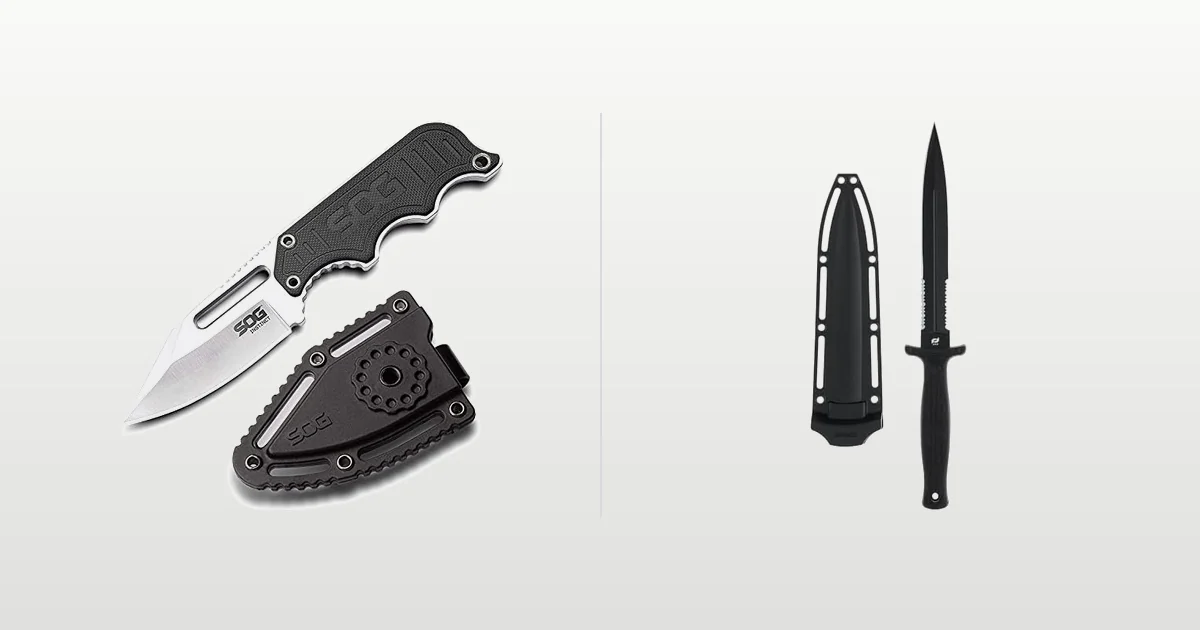
A 2.3-inch full-tang single edge in a 5.9-inch knife weighing 2.3 ounces, with a G10 handle and a clip-and-chain sheath.
 Best BudgetSmith & Wesson FDE Boot Knife
A 2.75-inch single edge in a 6.25-inch knife weighing 1.6 ounces, with finger guards and a hard polymer sheath — for under fourteen dollars.
 Best False EdgeSmith & Wesson SWHRT3BF
A 3.5-inch blade with a false edge — a ground bevel on the spine that is left blunt on purpose — in a 7.5-inch full-tang knife.
At a Glance
Ten Knives, Sorted by Edge Configuration
Blade length, how many edges are actually sharpened, overall size, and the one specification each maker leads on.
| # | Model | Blade | Edge | Size | Detail | Standout | Main Drawback | Check Price |
|---|---|---|---|---|---|---|---|---|
| 1 |
 SOG Instinct SOG Instinct |
2.3 in | Single edge | 2.3 oz | G10 handle | Single edged, 2.3 inches, and three ways to carry it | Too small for anything but light cutting | View on Amazon |
| 2 |
 Smith & Wesson FDE Boot Knife Smith & Wesson FDE Boot Knife |
2.75 in | Single edge | 1.6 oz | Finger guards | Every dimension published, single edged, $13.59 | 8Cr13MoV is entry-grade steel | View on Amazon |
| 3 |
 Kershaw Secret Agent Kershaw Secret Agent |
4.4 in | Spear point | Overmold | Multi-mount | Kershaw call it an updated take on a classic boot knife | 4.4 inches crosses several carry limits | View on Amazon |
| 4 |
 Smith & Wesson SWHRT3BF Smith & Wesson SWHRT3BF |
3.5 in | False edge | 4.4 oz | Thumb press | A false edge is a bevel that is deliberately never sharpened | Looks like a dagger, which invites questions | View on Amazon |
| 5 |
 Old Timer 162OT Old Timer 162OT |
3.8 in | False edge | 3.9 oz | Leather | Sawcut delrin and a leather belt sheath, at $29.60 | Leather needs care that polymer does not | View on Amazon |
| 6 |
 CIVIREVIC Boot-Style CIVIREVIC Boot-Style |
2.8 in | Single edge | ABS | Belt + boot | Full tang and single edged for $15.99 | Rank pooled across three CIVIREVIC listings | View on Amazon |
| 7 |
 Schrade Delta Class Needle Magnum Schrade Delta Class Needle Magnum |
7.5 in | Double edged | 12.5 in | Serrated | Seven and a half inches, double edged and serrated | Double edged and 7.5 inches — restricted in many places | View on Amazon |
| 8 |
 Smith & Wesson H.R.T. 9-Inch Smith & Wesson H.R.T. 9-Inch |
4.7 in | Double edged | 7.7 oz | Hand guard | The traditional double-edged boot dagger, honestly presented | Double edged, with all that follows from it | View on Amazon |
| 9 |
 Reapr BOOT Knife Reapr BOOT Knife |
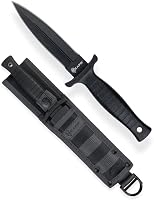
4.75 in | Double edged | 3Cr13 | Nylon sheath | States a blade thickness of 40 mm, which cannot be right | Double edged, and the specification is wrong | View on Amazon |
| 10 |
 M48 Cyclone M48 Cyclone |
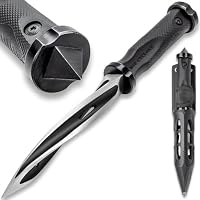
5.75 in | Tri-edged | 10.5 in | Glass breaker | A triple-edged spiral blade, which is not a cutting tool | Cast stainless and a tri-edge that cannot be sharpened | View on Amazon |
Specifications and prices are taken from each manufacturer’s Amazon listing as displayed on 23 August 2026 through a United States connection, and may change. Edge configuration is recorded from each listing’s own description. This article is not legal advice. Knife law is set at state and often city level, and many statutes restrict double-edged blades, dirks and daggers separately from and in addition to any length limit; some turn on whether a blade is sharpened on both sides, others on a knife’s design or appearance, which a false edge may or may not satisfy. Employment in law enforcement does not create a general exemption, and department policy is separate again. Check all of it where you live before buying. Note also that this search returns a pair of work boots among the knives. Sales ranks are shown as displayed and can be pooled; three CIVIREVIC listings and two M48 listings here share a rank with siblings.
Scroll the table sideways to see every column
How We Chose These Ten
We researched current listings, compared manufacturer specifications and documentation, and examined recurring patterns in customer feedback. We did not carry out hands-on testing, and nothing below is presented as measured performance data.
- Edge configuration recorded for every knife — because it is the specification most likely to decide legality
- Blade length recorded where published — seven of ten publish one; the range is 2.3 to 7.5 inches
- A verified live buy box — all ten confirmed purchasable in the United States on 23 August 2026
- No overlap with our fourteen published knife guides — every knife here is new to the site
- Single-edged, false-edged and double-edged all included — so the trade-off is visible rather than assumed
- Full tang noted where stated — because rat-tail tangs are the usual failure point on cheap fixed blades
- One listing error reported as published — a stated 40 mm blade thickness, left uncorrected
The Ten Knives in Detail
1. SOG Instinct — Best Overall

Single edged, under two and a half inches, and it can be carried three ways. That combination is rarer on this page than it should be.
Key Specifications
| Blade length | 2.3 inches, full tang |
|---|---|
| Overall length | 5.9 inches |
| Weight | 2.3 ounces |
| Edge | Single — the least legally exposed configuration here |
| Steel | 5Cr15MoV, satin polished |
| Handle | Textured G10 with finger grooves and jimping |
| Carry | Sheath with clip and neck chain — boot, belt or neck |
| Rank | #23,468 in its category |
| Price | $34.97 |
| Best For | Boot carry without the legal complications of a dagger |
Why We Recommend It
This is the boot knife least likely to cause a problem. A single-edged blade under 2.5 inches sits below the thresholds in most jurisdictions and avoids the dirk-and-dagger language that catches four other knives in this roundup entirely. Nothing about that is an accident — SOG sells it as an EDC and neck knife first and a boot knife second.
G10 with finger grooves and jimping is real ergonomics. G10 is glass fibre in epoxy resin, compressed and cured; it is unaffected by water, does not swell or shrink, and grips better when wet than the rubber and ABS handles elsewhere here. On a knife that lives in a boot, in weather, that matters.
Full tang at 2.3 ounces means the steel runs the whole length of the handle rather than a thin stub pinned into a moulding — the usual failure point on cheap fixed blades.
5Cr15MoV is a soft budget stainless, comparable to 420HC. It will not hold an edge long and comes back in minutes on almost anything, which for a backup knife is a reasonable trade.
Pros
- Single edged, avoiding dagger restrictions
- 2.3 inches sits below most length limits
- Full tang at only 2.3 ounces
- G10 handle grips well wet
- Boot, belt or neck carry from one sheath
- Rank #23,468, second best here
Cons
- 5Cr15MoV is soft and dulls quickly
- 2.3 inches limits it to light cutting
- $34.97 is mid-priced for the size
- No guard — the choil does that work
- Satin finish is reflective
- Too small for gloved hands under load
Best for: Anyone who wants boot carry and does not want a dagger.
2. Smith & Wesson FDE Boot Knife — Best Budget

One point six ounces, thirteen dollars fifty-nine, and it tells you every measurement.
Key Specifications
| Blade length | 2.75 inches, single edge |
|---|---|
| Overall length | 6.25 inches |
| Weight | 1.6 ounces — lightest here |
| Steel | 8Cr13MoV, black oxide coated |
| Handle | FDE rubberised |
| Guards | Finger guards to prevent slipping |
| Sheath | Hard polymer with lanyard hole |
| Warranty | Limited lifetime |
| Rank | #36,027 in its category |
| Price | $13.59 |
| Best For | The cheapest sensible boot knife on this page |
Why We Recommend It
Smith & Wesson publish dimensions consistently, and three of their knives appear in this roundup for that reason. Overall length, blade length and weight on every listing, in both imperial and metric — which sounds unremarkable until you notice how many competitors here give none of the three.
Single edged and 2.75 inches puts it in the same comparatively safe legal position as the SOG above, at a third of the price.
Finger guards do the work a full crossguard would. On a boot knife drawn from an awkward angle, the hand needs something stopping it sliding forward onto the edge, and moulded guards achieve that without the bulk of a dagger guard that would catch on a boot top.
8Cr13MoV is entry-grade Chinese stainless — broadly equivalent to AUS-8 on paper and usually run softer. Black oxide coating reduces glare and slows corrosion on the flats but not on the sharpened edge.
Pros
- $13.59 — cheapest here by a wide margin
- 1.6 ounces, lightest on this page
- Single edged and 2.75 inches
- Publishes blade, overall length and weight
- Finger guards without a bulky crossguard
- Limited lifetime warranty
Cons
- 8Cr13MoV is entry-grade and usually run soft
- Rubberised handle degrades over years
- Hard polymer sheath rattles
- Black oxide wears off the edge immediately
- Rank #36,027
- No neck carry option
Best for: Anyone who wants a light single-edged boot knife for as little as possible.
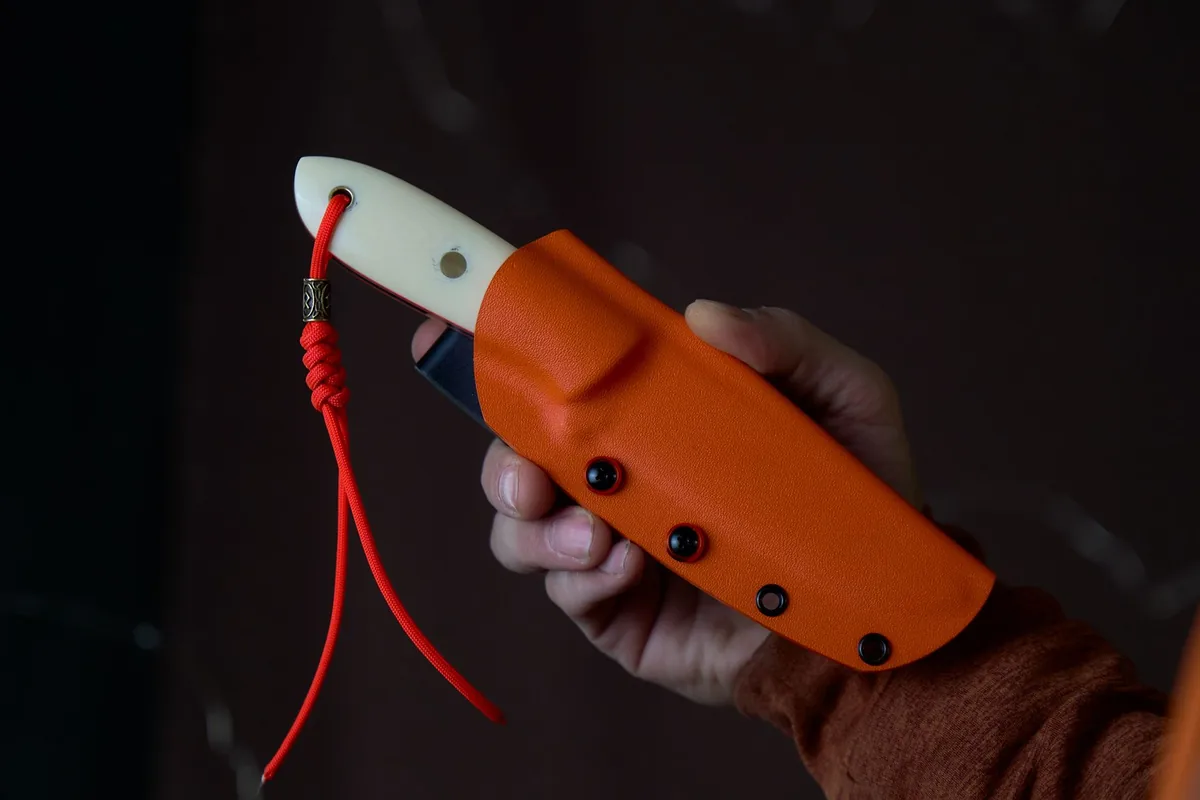
3. Kershaw Secret Agent — Best Classic

Kershaw describe it in their own listing as an updated take on a classic boot knife, which is a fair account of what it is.
Key Specifications
| Blade length | 4.4 inches, spear point, plain edge |
|---|---|
| Steel | 8Cr13MoV with black-oxide finish |
| Handle | Glass-filled nylon with textured over-mould |
| Sheath | Moulded ABS, multiple mounting options |
| Carry | Belt clip for waistband carry, among others |
| Maker | Kershaw, making knives since 1974 |
| Positioning | An updated take on a classic boot knife |
| Rank | #55,496 in its category |
| Price | $33.99 |
| Best For | Anyone who wants the traditional profile from a known brand |
Why We Recommend It
A spear point is symmetrical in shape but sharpened on one side, and that distinction is the whole reason this knife can be sold where several others here cannot. The blade looks like a dagger — the point is centred on the axis of the handle, the profile tapers evenly from both sides — while remaining legally a single-edged knife. It is the same commercial logic as the false edges further down this page, executed more elegantly.
The overmould is the practical upgrade. Glass-filled nylon is rigid and slippery; moulding a textured rubber layer over it gives the rigidity of the substrate with a surface that grips. This is how most quality budget handles are now made.
Multiple mounting options matter more than the boot framing. The moulded sheath takes a belt clip for waistband carry among others, and in practice almost nobody carries a knife in a boot daily — it is slow to reach, uncomfortable when seated and easily lost.
Four point four inches is long, and crosses the common 2.5-inch and 4-inch thresholds in a number of places.
Pros
- Spear point gives the dagger look, single edged
- Textured overmould grips better than bare nylon
- Moulded sheath with several mounting options
- Kershaw brand record since 1974
- Black-oxide finish reduces glare
- $33.99 for a well-made fixed blade
Cons
- 4.4 inches exceeds several common carry limits
- 8Cr13MoV is entry-grade steel
- No weight or overall length published
- Rank #55,496
- Glass-filled nylon under the overmould feels hollow
- Boot carry is impractical for daily use
Best for: The classic profile, from a maker with a real track record.
4. Smith & Wesson SWHRT3BF — Best False Edge

A false edge is a bevel ground along the spine and then deliberately not sharpened. It exists almost entirely for legal reasons.
Key Specifications
| Blade length | 3.5 inches, false edge |
|---|---|
| Overall length | 7.5 inches |
| Weight | 4.4 ounces |
| What a false edge is | A bevel ground on the spine and left unsharpened |
| Steel | 7Cr17MoV, black oxide, high carbon stainless |
| Handle | Thermoplastic rubber, full tang |
| Security | Finger guards and thumb press |
| Sheath | Nylon fibreglass |
| Rank | #57,276 in its category |
| Price | $16.99 |
| Best For | Understanding the compromise the whole category is built on |
Why We Recommend It
This is the compromise that defines the boot knife market. The traditional boot knife is a dagger — symmetrical, double edged, designed to be drawn from a boot top. Double-edged blades are also named specifically in a great many state statutes, frequently as “dirks and daggers”, and restricted regardless of how short they are. So manufacturers grind the bevel that gives the profile and stop before sharpening it. You get the shape; the knife stays single edged in law.
Whether that helps you depends entirely on where you are. Some statutes turn on whether the blade is sharpened on both sides, in which case a false edge is a complete answer. Others use language about a knife’s design or appearance, in which case it may not be. This is a question for the rules where you live, not for a product listing.
The thumb press and finger guards are what let you push hard on a knife with no real crossguard.
Full tang at $16.99, with every dimension published, is genuinely good value.
Pros
- False edge keeps the profile and the legal status
- Full tang construction at $16.99
- Publishes blade length, overall length and weight
- Finger guards plus a thumb press
- 7Cr17MoV black oxide resists corrosion
- Nylon fibreglass sheath is durable
Cons
- Looks like a dagger, which can invite questions
- False edge may not satisfy every statute
- 3.5 inches crosses the 2.5-inch limits
- 7Cr17MoV is soft budget steel
- 4.4 ounces is heavy for the size
- Rank #57,276
Best for: Anyone who wants the dagger profile and a single-edged blade.
5. Old Timer 162OT — Best Sheath

Sawcut delrin and brown leather. This is the only knife here that is not trying to look tactical.
Key Specifications
| Blade length | 3.8 inches, false edge |
|---|---|
| Overall length | 7.8 inches |
| Weight | 3.9 ounces |
| Steel | High carbon stainless, full tang |
| Handle | Sawcut delrin slabs |
| Security | Front bolster |
| Sheath | Brown leather belt sheath |
| Warranty | Old Timer lifetime warranty |
| Rank | #242,141 in its category |
| Price | $29.60 |
| Best For | Anyone who wants a traditional knife rather than a tactical one |
Why We Recommend It
Delrin is an acetal resin moulded with a sawcut texture to imitate stag or bone, and it has been the standard traditional handle material for decades because it is dimensionally stable, does not absorb moisture and holds a grip pattern indefinitely. Against the rubber overmoulds and glass-filled nylons elsewhere on this page it is a different design tradition entirely.
The front bolster is the traditional answer to the same problem the moulded finger guards solve on the Smith & Wesson knives — a raised metal collar between blade and handle that stops the hand sliding forward.
Leather is a genuine trade-off rather than an upgrade. It is quieter than polymer, sits more comfortably against the body and ages well; it also holds moisture against a blade if the knife is sheathed wet, which is how carbon-bearing steels pit. Dry it before it goes away.
Rank #242,141 is very low and reflects a traditional product in a market that mostly buys tactical styling.
Pros
- Leather belt sheath, quieter and more comfortable
- Sawcut delrin is stable and grips indefinitely
- Front bolster prevents the hand sliding forward
- Full tang with every dimension published
- Old Timer lifetime warranty
- Traditional styling rather than tactical
Cons
- Leather traps moisture against the blade if sheathed wet
- Rank #242,141 — very low
- Steel described only as high carbon stainless
- 3.8 inches crosses common limits
- False edge still reads as a dagger
- No boot-specific mounting
Best for: Anyone who would rather carry something traditional than something tactical.

6. CIVIREVIC Boot-Style — Cheapest Full Tang

Full tang, single edged, 2.8 inches, sixteen dollars. On specification alone that is the best value here.
Key Specifications
| Blade length | 2.8 inches, full tang |
|---|---|
| Edge | Single |
| Steel | High carbon steel, stonewashed finish |
| Handle | Non-slip ABS, ergonomic |
| Sheath | ABS, primarily belt carry with a boot-style option |
| Construction | True full tang through the handle |
| Rank | #36,139, shared across three CIVIREVIC listings |
| Price | $15.99 |
| Best For | Full-tang construction and a single edge at the lowest price |
Why We Recommend It
Full tang at this price is worth noting. The cheap fixed-blade failure mode is a rat-tail tang — a narrow stub of steel pinned or glued into a moulded handle, which snaps at the joint under lateral load. A true full tang runs the full width and length of the handle with the scales attached either side. CIVIREVIC state it explicitly.
Stonewashing is a finish, not a treatment. The blade is tumbled with abrasive media to leave a uniformly scuffed surface, which hides scratches and reduces glare. It does not change the steel’s hardness or edge retention, whatever a listing implies.
Note the pooled rank. Three CIVIREVIC listings in this search share #36,139, which means Amazon treats them as one product family — the figure describes all three together, and comparing the variants against each other on rank tells you nothing.
The steel is named only as “high carbon”, which is not a grade. Expect it to rust if neglected, since carbon steels without meaningful chromium do.
Pros
- Full tang construction at $15.99
- Single edged and 2.8 inches
- Non-slip ABS handle
- Belt carry with a boot-style option
- Stonewashed finish hides scratches
- Second cheapest knife here
Cons
- Rank pooled across three CIVIREVIC listings
- Steel named only as ‘high carbon’, not a grade
- Carbon steel will rust if neglected
- No weight or overall length published
- ABS handle is basic
- Unfamiliar brand with no record
Best for: The cheapest genuinely full-tang, single-edged option on this page.
7. Schrade Delta Class Needle Magnum — Longest Blade

Rank #19,870 is the best on this page. The knife is 12.5 inches long and double edged, which will not fit in a boot and will not be legal in many places.
Key Specifications
| Blade length | 7.5 inches — longest here |
|---|---|
| Overall length | 12.5 inches |
| Handle length | 5 inches |
| Edge | Double edged and serrated |
| Steel | 7Cr17MoV high carbon stainless, black |
| Handle | Textured TPE wrap with lanyard hole |
| Sheath | Black leather with securing strap and belt clip |
| Warranty | Limited lifetime |
| Rank | #19,870 — best on this page |
| Price | $24.64 |
| Best For | Almost nobody carrying a boot knife, despite the rank |
Why We Recommend It
Read the dimensions before the category. A 5-inch handle and a 7.5-inch blade is a large fixed-blade knife by any measure. Calling it a boot knife stretches the term past breaking — this belongs on a belt or in a pack, and Schrade’s own sheath is a leather belt rig rather than a boot clip.
Double edged is the significant fact. A great many US states name double-edged blades specifically in their statutes, often as dirks and daggers, and restrict them regardless of length. Adding 7.5 inches to that puts this knife outside what is permitted in a considerable number of places, and no amount of good value changes that.
The serrations on a double edge make it very effective on rope and webbing and correspondingly awkward to maintain — you have two edges to sharpen and one of them is serrated.
At $24.64 with a lifetime warranty and a leather sheath it is genuinely well priced for what it is. Check your local rules before buying it, not after.
Pros
- Rank #19,870, best on this page
- 7.5-inch blade with a 5-inch handle
- Leather sheath with securing strap and belt clip
- Limited lifetime warranty
- $24.64 for a large fixed blade
- Serrations cut rope and webbing aggressively
Cons
- Double edged — restricted in many states regardless of length
- 12.5 inches overall will not fit in a boot
- 7.5 inches is far over every common carry limit
- Two edges to maintain, one serrated
- 7Cr17MoV is soft budget steel
- Category label does not match the product
Best for: Belt or pack carry, where local law permits it. It is not a boot knife.
8. Smith & Wesson H.R.T. 9-Inch — Classic Dagger

This is what a boot knife traditionally is: a double-edged dagger with a guard, worn in a boot top.
Key Specifications
| Blade length | 4.7 inches, double edged |
|---|---|
| Overall length | 9 inches |
| Weight | 7.7 ounces — heaviest here |
| Steel | 7Cr17MoV high carbon stainless |
| Handle | Black rubber wrapped |
| Guard | Full hand guard against slipping |
| Sheath | Belt or boot sheath |
| Warranty | Limited lifetime |
| Rank | #34,739 in its category |
| Price | $23.99 |
| Best For | The traditional pattern — where it is legal to carry |
Why We Recommend It
It is included because it is the reference pattern, and because understanding it explains every false edge and spear point elsewhere on this page. The symmetrical double-edged blade, the full crossguard, the 9-inch overall length — this is the shape the category was built on, and the shape modern manufacturers keep redesigning around for legal reasons.
A full hand guard is genuinely safer than moulded finger guards when a knife is drawn hard from a boot top and the hand arrives at speed. It is also what makes the knife bulky and slow to draw, and what catches on clothing.
Seven point seven ounces is heavy — nearly five times the Smith & Wesson FDE further up this page, from the same manufacturer. In a boot, that weight is noticeable with every step.
Double edged means the same legal exposure as the Schrade above. Many states name dirks and daggers specifically and restrict them irrespective of blade length. Check before buying.
Pros
- The traditional boot dagger pattern
- Full hand guard is safer under a hard draw
- Publishes blade, overall length and weight
- 7Cr17MoV with a rubber-wrapped handle
- $23.99 with a limited lifetime warranty
- Belt or boot sheath included
Cons
- Double edged — specifically restricted in many states
- 7.7 ounces, heaviest on this page
- 4.7 inches crosses common length limits
- Full guard catches on clothing and slows the draw
- Nearly five times the weight of its own stablemate
- 7Cr17MoV is soft budget steel
Best for: The traditional pattern, for anyone who has checked that it is legal where they are.
9. Reapr BOOT Knife — Listing Error to Note
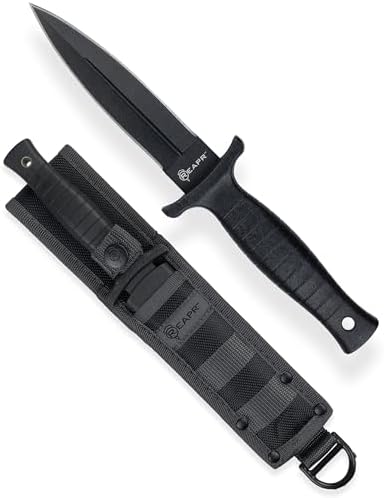
The listing states “40 mm Blade Thickness”. Forty millimetres is an inch and a half — thicker than the blade is wide.
Key Specifications
| Blade length | 4.75 inches, double edged |
|---|---|
| Steel | 3Cr13 stainless, black oxide coated |
| Stated thickness | 40 mm — see below; almost certainly 4.0 mm |
| Handle | Hi-Grip fibreglass-loaded TPR, moulded |
| Sheath | 1680D nylon web with an inner moulded scabbard |
| Carry | Boot or over-the-shoulder |
| Retention | Lanyard hole in the handle |
| Rank | #156,235 in its category |
| Price | $19.99 |
| Best For | Nothing, until the specification is corrected |
Why We Recommend It
We report listing errors as published rather than quietly correcting them. A 40 mm thick blade is not a knife; it is a bar of steel. The figure is almost certainly 4.0 mm, which would be a sensible and fairly robust thickness for a 4.75-inch fixed blade, and the decimal point has been lost somewhere between the factory and the listing. But we cannot verify that from the page, and neither can you.
It matters because thickness is a real specification. A 4 mm blade is stiff and takes prying it should not; a 2 mm blade is a slicer. The number a buyer uses to tell those apart is the one this listing has got wrong, and the error has apparently gone uncorrected long enough to be worth flagging.
3Cr13 is soft, low-carbon stainless — the cheapest grade in common use, which sharpens in seconds and dulls almost as fast.
Double edged, with everything that implies. Combined with the specification problem and rank #156,235, there is little reason to choose this over the single-edged knives above.
Pros
- 1680D nylon sheath with a moulded inner scabbard
- Boot or over-the-shoulder carry options
- Lanyard hole for retention
- Fibreglass-loaded TPR handle grips when wet
- Black oxide reduces reflection
- $19.99
Cons
- Published blade thickness of 40 mm is plainly wrong
- Double edged — restricted in many states
- 3Cr13 is the softest steel on this page
- Rank #156,235
- No overall length or weight published
- Specification error undermines the rest of the listing
Best for: Nothing, while its own listing contradicts itself.
10. M48 Cyclone — Most Unusual
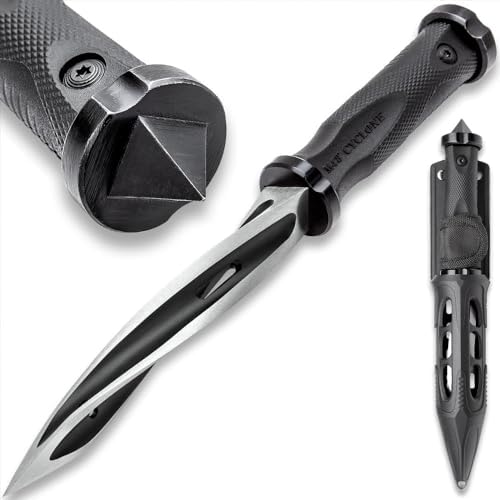
A triple-edged spiral blade is not a knife in any useful sense. It cannot slice, and it cannot be sharpened.
Key Specifications
| Blade length | 5 3/4 inches |
|---|---|
| Overall length | 10 1/2 inches |
| Blade | Cast stainless, twisted triple-edge spiral |
| Stated purpose | Piercing — ‘deep, clean penetration’ |
| Handle | Glass-fibre-reinforced nylon |
| Pommel | Stainless glass breaker |
| Sheath | Custom Vortec belt sheath |
| Rank | #135,072, shared with a sibling listing |
| Price | $74.99 |
| Best For | Display. It is not a practical cutting tool |
Why We Recommend It
Understand what a tri-edged blade actually is. Three edges twisted around a central axis produce a shape optimised entirely for piercing, which the listing says plainly — “precision penetration”, “deep, clean piercing”. It has no flat cutting surface, so it will not slice webbing, cut cord or perform any of the tasks that occupy a knife on this page. And a spiral edge cannot be laid on a stone, so once dull it stays dull.
Cast stainless is the other flag. Blades are normally stamped or forged from rolled stock and then heat treated; casting produces a coarser grain structure and is used where the shape is too complex to machine economically. It is a manufacturing choice made for the spiral, and it does not favour edge quality.
The glass-breaker pommel is the one genuinely useful feature, and it appears on far cheaper knives.
At $74.99 this is the most expensive product on the page, and rank #135,072 is pooled with a sibling listing. It is bought as an object rather than a tool, and there is nothing wrong with that as long as the buyer knows.
Pros
- Stainless glass-breaker pommel
- Custom moulded belt sheath
- Glass-fibre-reinforced nylon handle
- Visually distinctive
- 10.5 inches overall, substantial in the hand
- Unusual manufacturing
Cons
- Tri-edged spiral cannot slice anything
- Cannot be sharpened once dull
- Cast stainless has a coarser grain than rolled stock
- $74.99 — most expensive here
- Rank pooled with a sibling listing
- Multi-edged and 5.75 inches — legally exposed
Best for: A display piece. Do not buy it expecting to cut anything with it.
Single Edge Against Double Edge
Two knives from the same manufacturer, and the difference is not the steel.
| S&W FDE Boot Knife | S&W H.R.T. 9-Inch | |
|---|---|---|
| Edge | Single | Double |
| Blade length | 2.75 in | 4.7 in |
| Overall length | 6.25 in | 9 in |
| Weight | 1.6 oz | 7.7 oz |
| Restricted as a dagger | No | In many states |
| Guard | Moulded finger guards | Full hand guard |
| Price | $13.59 | $23.99 |
Same manufacturer, same warranty, similar budget steels. One weighs 1.6 ounces, carries anywhere and clears the thresholds in most places; the other weighs nearly five times as much and belongs to the category a great many statutes name explicitly. If you want the traditional dagger you should have it — but you should choose it knowing that the second edge is what creates the exposure, not the extra two inches.
How Many Edges Are Actually Sharpened
The column that matters, for all ten.
| Knife | Edge | Blade | Overall | Weight | Price |
|---|---|---|---|---|---|
| SOG Instinct | Single | 2.3 in | 5.9 in | 2.3 oz | $34.97 |
| S&W FDE | Single | 2.75 in | 6.25 in | 1.6 oz | $13.59 |
| CIVIREVIC | Single | 2.8 in | Not stated | Not stated | $15.99 |
| Kershaw Secret Agent | Single (spear point) | 4.4 in | Not stated | Not stated | $33.99 |
| S&W SWHRT3BF | False edge | 3.5 in | 7.5 in | 4.4 oz | $16.99 |
| Old Timer 162OT | False edge | 3.8 in | 7.8 in | 3.9 oz | $29.60 |
| S&W H.R.T. | Double | 4.7 in | 9 in | 7.7 oz | $23.99 |
| Reapr BOOT | Double | 4.75 in | Not stated | Not stated | $19.99 |
| M48 Cyclone | Tri-edged | 5.75 in | 10.5 in | Not stated | $74.99 |
| Schrade Needle Magnum | Double + serrated | 7.5 in | 12.5 in | Not stated | $24.64 |
Note that the best-ranked knife on this page is the one at the bottom of this table: 7.5 inches, double edged and serrated, 12.5 inches overall. It is good value and it will not fit in a boot, and in a considerable number of places it cannot legally be carried at all. Rank measures units sold, not suitability, and this category is a clear demonstration of the gap.
Best Alternatives
| Alternative | Why Consider It | Better For | Main Trade-Off |
|---|---|---|---|
| An ankle-carry folder | Legal in far more places, and far more comfortable | Anyone who wants a blade below the knee | Slower to deploy than a fixed blade |
| A neck knife | Faster to reach than a boot, and lighter | Backup carry under a shirt | Visible if the collar shifts |
| A pocket-clip folder | The carry position almost everyone actually uses | Daily carry of any kind | No boot-top concealment |
| A dedicated rescue tool | Seatbelt hook and window punch, no blade to regulate | Extraction work, and restricted jurisdictions | Cannot do general cutting |
What the Money Actually Buys
$13.59 to $19.99 — S&W FDE, CIVIREVIC, S&W SWHRT3BF, Reapr. The best-value tier, and it contains the lightest knife here at 1.6 ounces, the cheapest full tang, and the clearest example of a false edge. It also contains the knife whose listing states a 40 mm blade thickness.
$23.99 to $34.97 — S&W H.R.T., Schrade, Old Timer, Kershaw, SOG. Where the named brands sit. This tier spans the entire edge spectrum — a 7.5-inch double-edged serrated blade at $24.64 and a 2.3-inch single-edged G10 knife at $34.97 — which is the range this category covers under one label.
$74.99 — M48 Cyclone. Three times the price of most of this page for a cast tri-edged spiral blade that cannot slice and cannot be sharpened. It is a display piece, and the glass-breaker pommel is its only practical feature.
What to Check Before You Buy
Count the Sharpened Edges First
This is the specification most likely to determine whether you can carry the knife at all, and it is the one buyers skip. Many state statutes name dirks and daggers — meaning double-edged blades — as a restricted category in their own right, separate from and additional to any blade-length limit. That means a short dagger can be prohibited where a longer single-edged knife is fine. Four of the ten knives here are double or triple edged. Establish the rule where you live before comparing anything else.
Understand What a False Edge Is For
A false edge is a bevel ground along the spine of the blade and then deliberately not sharpened. It exists almost entirely so that a knife can have the symmetrical dagger profile buyers want while remaining, in law, a single-edged knife. Whether it achieves that depends on the statute: some turn on whether the blade is actually sharpened on both sides, in which case a false edge is a complete answer, while others use language about design or appearance, in which case it may not be. Two knives here have one, and a third uses a spear point to the same end.
Be Honest About Boot Carry
Very few people who buy boot knives carry them in boots for long. The draw is slow, it is essentially impossible while seated or driving, the knife is uncomfortable against the ankle on a full shift, and boot tops are where things get lost. Look at what the manufacturers actually ship: Schrade includes a leather belt sheath, Kershaw a moulded sheath with several mounting options including a waistband clip, SOG a clip and a neck chain. The category name describes a tradition more than a carry method.
Check for a Full Tang
The characteristic failure of a cheap fixed blade is the tang — a narrow rat-tail stub of steel pinned or glued into a moulded handle, which snaps at the joint under any lateral load. A full tang runs the entire width and length of the handle with scales attached either side, and it is the difference between a knife that can be pried with and one that becomes two pieces. Four listings here state full tang explicitly. Where a listing does not say, assume it does not have one.
Weight Matters More Here Than Anywhere
A knife on a belt is carried by your hips; a knife in a boot is lifted by your leg with every step. The spread on this page is large — 1.6 ounces for the Smith & Wesson FDE against 7.7 ounces for the H.R.T. from the same manufacturer, nearly five times as much. That difference is imperceptible in a pocket and thoroughly noticeable at the ankle after a few hours. Four of these listings publish no weight at all, which for this carry position is a meaningful omission.
Treat a Tri-Edged Blade as an Ornament
One knife here has three edges twisted around a central axis. That geometry is optimised for piercing and nothing else — there is no flat cutting surface, so it will not slice webbing or cut cord, which is what a knife on duty actually does. It also cannot be laid on a sharpening stone, so once the edges dull they stay dull. The listing is honest about the intent, describing penetration rather than cutting. Buy it as an object if you like it, but do not expect it to work as a tool.
Dry a Leather Sheath Before You Store It
Two knives here ship with leather. Leather is quieter than moulded polymer, sits more comfortably against the body and improves with age, which is why traditional makers still use it. It also absorbs and holds moisture, and a blade sheathed wet sits in that moisture indefinitely — which is how the carbon-bearing stainless steels used across this page develop pitting. Wipe the blade and leave the sheath open to dry. Polymer sheaths do not have this problem and do rattle.
Common Mistakes
- Comparing blade lengths and ignoring edge count. The second edge is what many statutes actually restrict.
- Assuming a false edge settles the question. It depends on whether your statute turns on sharpening or on appearance.
- Buying on rank. The best-ranked knife here is 12.5 inches long and will not fit in any boot.
- Planning to carry it in a boot. Slow to draw, impossible seated, and most of these ship with belt sheaths.
- Skipping the tang. If a listing does not say full tang, assume a rat-tail stub in a moulded handle.
- Ignoring weight. The spread here is 1.6 to 7.7 ounces, and a boot carries it with every step.
- Sheathing a blade wet in leather. That is how these steels pit.
Who Should Buy Which
Buy the SOG Instinct at $34.97 for the least complicated answer. Single edged, 2.3 inches, 2.3 ounces, full tang, G10, and a sheath that clips to a belt, a boot or a neck chain.
Buy the Smith & Wesson FDE at $13.59 to spend as little as possible sensibly. Single edged, 2.75 inches and 1.6 ounces, with every dimension published and a lifetime warranty.
Buy the S&W SWHRT3BF at $16.99 if you want the dagger profile without the second edge. A false edge, a full tang and a thumb press for $17.
Buy the Kershaw Secret Agent at $33.99 for the classic look done properly. A spear point is symmetrical in shape and sharpened on one side, from a maker with fifty years of record.
Buy the Old Timer 162OT at $29.60 if you would rather carry something traditional. Sawcut delrin, a front bolster and a leather belt sheath — just dry it before you put it away.

Frequently Asked Questions
Are double-edged boot knives legal to carry?
In many places, no, and this is the single most important thing to establish before buying one. A great many US states name double-edged blades specifically in their statutes, frequently using the traditional language of dirks and daggers, and restrict them as a category in their own right rather than by length. The practical consequence is counterintuitive: a 3-inch dagger can be prohibited somewhere a 4.5-inch single-edged knife is perfectly legal, because the rule turns on the second sharpened edge. Four of the ten knives in this roundup are double or triple edged. City ordinances frequently add further restrictions, and department policy is a separate matter again for anyone carrying professionally. None of this can be determined from a product listing, and this article is not legal advice — check the rules where you actually live.
What is a false edge, and does it make a knife legal?
A false edge is a bevel ground along the spine of a blade and then deliberately left unsharpened. It exists so that a knife can carry the symmetrical dagger profile that buyers find appealing while remaining a single-edged knife in fact. Two knives in this roundup have one, and a third achieves the same result with a spear point — a blade whose shape is symmetrical about the handle axis but which is sharpened on only one side. Whether it resolves the legal question depends entirely on how your jurisdiction words its statute. Where the rule turns on whether a blade is sharpened on both sides, a false edge is a complete answer. Where it refers to a knife’s design, appearance or its being of a type primarily intended as a stabbing weapon, it may not be.
Do people actually carry knives in their boots?
Rarely, and rarely for long. A boot draw requires bending to the ankle, which is slow standing up and essentially impossible sitting down or driving. The knife presses on the ankle throughout a shift, boot tops are an excellent place to lose things, and the whole arrangement competes with a pocket clip that is faster in every respect. The clearest evidence is what the manufacturers ship: Schrade includes a leather belt sheath, Kershaw a moulded sheath with several mounting options including a waistband clip, SOG a sheath with a clip and a neck chain. Boot knife has become a description of a blade shape — slim, symmetrical, guarded — rather than a statement about where it goes.
Why does one listing say the blade is 40 mm thick?
Because it is a misprint that has not been corrected, and we report listing errors as published rather than quietly fixing them. Forty millimetres is just over an inch and a half, which would make the blade thicker than it is wide and would not be a knife at all. The intended figure is almost certainly 4.0 millimetres, a sensible and fairly robust thickness for a 4.75-inch fixed blade, with the decimal point lost somewhere between the factory specification and the Amazon listing. We cannot verify that from the page and neither can a buyer, which is the point. Blade thickness is a real specification that distinguishes a stiff prying-tolerant knife from a thin slicer, and it is exactly the number this listing has got wrong.
Is a full tang worth paying for on a small knife?
Yes, and it is usually the difference between a knife that lasts and one that fails at a predictable point. The cheap fixed-blade construction is a rat-tail tang, where a narrow stub of steel extends from the blade and is pinned or glued into a moulded handle. Under any sideways load — prying, twisting, levering — it snaps at that joint, and it does so without warning. A full tang runs the entire width and length of the handle with scales attached to either side, so the load is carried by the whole piece of steel. Four listings in this roundup state full tang explicitly, one of them at $15.99. Where a listing is silent on the point, it is safe to assume there is a stub inside the handle.
Why is a tri-edged spiral blade a bad idea?
Because it is optimised for one thing at the cost of everything a knife is normally for. Three edges twisted around a central axis produce a shape built entirely for piercing, and the listing says so directly, describing precision penetration and deep clean piercing rather than cutting. There is no flat cutting surface anywhere on the blade, so it will not slice webbing, cut cord, open packaging or trim anything — which is the entire practical workload of a knife carried for work. It also cannot be laid flat on a sharpening stone, so once the edges dull there is no realistic way to restore them. It is a well-made object and it is not a tool, and at $74.99 it is the most expensive product on this page.
Final Verdict
Single edged, 2.3 inches, 2.3 ounces, full tang and G10, with boot, belt or neck carry from one sheath. $34.97.
Single edged, 2.75 inches, 1.6 ounces, every dimension published and a lifetime warranty, for $13.59.
The dagger profile with only one sharpened side, full tang and a thumb press, at $16.99.
Count the sharpened edges before you compare anything else. The traditional boot knife is a dagger, and the double edge is exactly what a great many state statutes name and restrict — independently of length, so a short dagger can be prohibited where a longer single-edged knife is not.
That is why false edges exist. A bevel ground on the spine and deliberately left blunt gives the profile without the second edge, and a spear point does the same thing more gracefully. Whether either satisfies your local statute depends on how that statute is worded, which is a question for where you live rather than for a product page.
Be honest about the carry position too. Almost nobody carries a knife in a boot for long, and most of these ship with belt sheaths because the manufacturers know it.
Buy the SOG Instinct if you want the fewest complications, the $13.59 Smith & Wesson if you want the fewest dollars, and check your state before you buy either.