Affiliate Disclosure: As an Amazon Associate, we earn from qualifying purchases. This does not affect the price you pay.
"Programmable" covers two quite different things on a pressure cooker, and the listings rarely distinguish them. One is a row of preset buttons — soup, beans, poultry — which set a fixed time and pressure you cannot change. The other is genuine control: editing those presets, saving your own, or setting exact time and pressure per recipe.
If you cook the same handful of dishes, editable presets are worth far more than a longer list of fixed ones. If you follow recipes from elsewhere, you want a cooker that lets you dial in whatever they specify rather than approximating with the nearest button.
We compared ten current electric models on programming depth, display feedback, inner pot material, safety design and capacity. This guide is for anyone choosing between a preset panel and real control.
Our Quick Picks
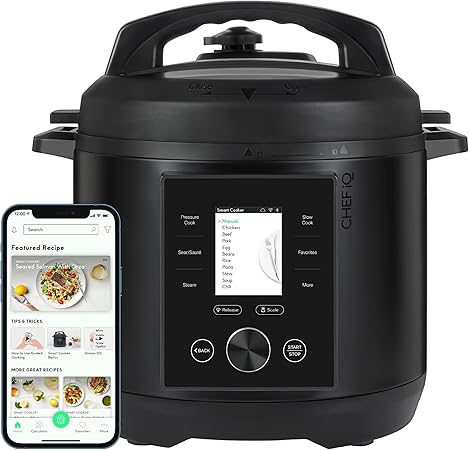 Most ProgrammableCHEF iQ Smart Cooker
Programming that goes beyond presets — recipes send exact time and pressure parameters to the cooker.
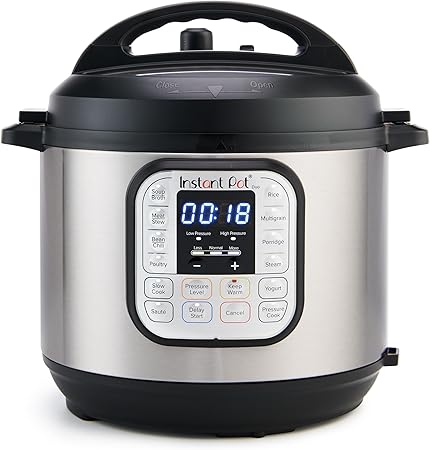 Best Value ProgrammableInstant Pot Duo 7-in-1
Thirteen one-touch programs and a stainless tri-ply pot, at the lowest price of any programmable model here.
 Best Everyday ProgrammableInstant Pot Duo Plus 9-in-1
Fifteen one-touch programs and a display that shows time, temperature and pressure as it cooks.
At a Glance
Programmable Pressure Cooker Comparison
Ten electric cookers compared on how much of the cooking you can actually control.
| # | Model | Capacity | Programs | Best For | Inner Pot | Key Advantage | Main Drawback | Check Price |
|---|---|---|---|---|---|---|---|---|
| 1 |
 CHEF iQ Smart Cooker CHEF iQ Smart Cooker |
6 qt | 10-in-1 + app | Deep programming control | Aluminum pot | Built-in scale and app-set parameters | Relies on an app for the best of it | View on Amazon |
| 2 |
 COSORI 9-in-1 13 Presets COSORI 9-in-1 13 Presets |
5.8 qt | 13 presets | Saving your own settings | Stainless steel | Customise and save any preset | Amazon lists conflicting wattage | View on Amazon |
| 3 |
 Instant Pot Pro 10-in-1 Instant Pot Pro 10-in-1 |
6 qt | 28 programs | Breadth of programs | Stainless steel | Twenty-eight one-touch options | Above budget pricing | View on Amazon |
| 4 |
 Instant Pot Duo Plus 9-in-1 Instant Pot Duo Plus 9-in-1 |
6 qt | 15 programs | Everyday programmed cooking | Stainless (18/8) | Clear real-time cooking display | No app or connectivity | View on Amazon |
| 5 |
 Instant Pot Duo 7-in-1 Instant Pot Duo 7-in-1 |
6 qt | 13 programs | Programmable on a budget | Stainless (18/8) | Thirteen programs at the lowest price | Basic display | View on Amazon |
| 6 |
 COSORI 6QT 9-in-1 COSORI 6QT 9-in-1 |
6 qt | 13 presets | Programmed cooking with safeguards | Ceramic-coated | Twelve stated safety features | Ceramic coating wears | View on Amazon |
| 7 |
 KINGBULL 8QT 12-in-1 KINGBULL 8QT 12-in-1 |
8 qt | 12 programs | Large programmed batches | Stainless steel | Eight quarts with twelve programs | Nonstick inner pot | View on Amazon |
| 8 |
 Instant Pot RIO Mini 4QT Instant Pot RIO Mini 4QT |
4 qt | 7-in-1 | Programmed cooking, small | Stainless steel | Progress indicator on a small unit | Fewer programs | View on Amazon |
| 9 |
 Instant Pot Duo Crisp 11-in-1 Instant Pot Duo Crisp 11-in-1 |
6 L | 15 programs | Pressure cooking plus air frying | Stainless steel | Two lids, eleven functions | Heavy at 19.6 lb | View on Amazon |
| 10 |
 Nuwave Duet Nuwave Duet |
6 qt | 450-in-1 | Fine pressure regulation | 18/10 stainless | 200 pressure adjustments per cycle | Heaviest here at 27 lb | View on Amazon |
COSORI’s 13-preset model is listed at 1500 W while its closely related 6QT sibling is listed at 1100 W; confirm on the listing. Nuwave’s "450-in-1" is marketing arithmetic, not 450 distinct functions.
Scroll the table sideways to see every column
How We Chose These Programmable Pressure Cookers
We researched current listings, compared manufacturer specifications and documentation, and examined recurring patterns in customer feedback. We did not carry out hands-on testing, and nothing below is presented as measured performance data.
- Programming depth — fixed presets, editable presets, or full manual parameter control
- Saving your own settings — whether the cooker remembers how you actually cook
- Display feedback — whether you can see pressure and temperature, not just a countdown
- Inner pot material — stainless, ceramic-coated or nonstick, and how each ages
- Steam release design — where the steam goes and where your hand has to be
- Capacity — matching batch size to household without constant splitting
- Extra functions — sous vide, air frying, probe cooking and similar
- Cleaning — which parts the maker states are dishwasher safe
- Listing accuracy — whether stated specifications hold together
- Support — brand track record, parts and recipe ecosystem
The 10 Best Programmable Pressure Cookers
1. CHEF iQ Smart Cooker — Most Programmable
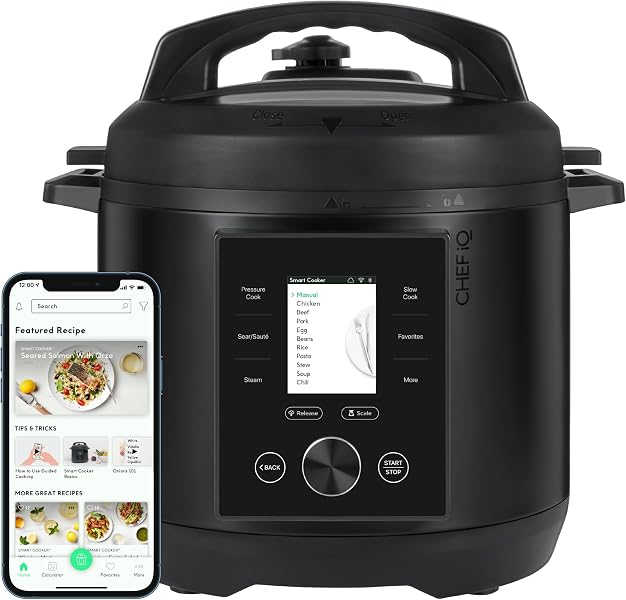
Most "programmable" pressure cookers give you a row of preset buttons. This one lets guided recipes push exact cooking parameters to the appliance, which is a different order of control.
Key Specifications
| Capacity | 6 quarts |
|---|---|
| Functions | 10-in-1 |
| Power | 1000 W |
| Connectivity | WiFi and Bluetooth via the CHEF iQ app |
| Scale | Built-in, four smart sensors |
| Pressure release | Automatic, three release settings |
| Pot material | Aluminium with ABS and PP plastic housing |
| Weight | 10.4 lb |
| Best For | Cooks who want to control every parameter |
Why We Recommend It
The built-in scale is the genuinely unusual part: four sensors weigh ingredients in the pot, so recipes can adjust by weight rather than assuming your idea of "two cups" matches theirs.
Automatic pressure release with three settings removes the one manual step most electric cookers still demand. The trade-off is dependence on the app — used purely as a button-panel cooker, it is less compelling.
Pros
- Guided recipes send exact time and pressure to the cooker
- Built-in scale weighs ingredients in the pot
- Automatic release with three settings
- WiFi and Bluetooth for remote monitoring
Cons
- Best features depend on the app
- Aluminium pot rather than stainless
- More setup than a simple preset panel
Best for: Cooks who want to control and save exact parameters, not just press a preset.
2. COSORI 9-in-1 13 Presets — Best Custom Presets

The feature that matters here is not the preset count but that you can change them. Adjust the time and temperature of any preset, save it, and add or remove presets from the panel.
Key Specifications
| Capacity | 5.8 quarts |
|---|---|
| Functions | 9-in-1 with 13 presets |
| Power | 1500 W per Amazon’s spec table; COSORI’s 6QT sibling is listed at 1100 W |
| Presets | Pressure cook, rice, steam, sterilize, porridge, stew, bean/grain, meat, slow cook, sauté, ferment, sous vide |
| Display | Real-time progress bar |
| Venting | 30° backward-angled release, offset seal/vent button |
| Best For | Cooks who repeat the same dishes and want them saved |
Why We Recommend It
For anyone who cooks the same six dishes repeatedly, that turns a generic appliance into one configured for your kitchen — which is what programmability should mean.
The safety design is thoughtful too: the seal/vent button sits away from the steam release and the release itself is angled 30° backwards. Note that Amazon lists 1500 W here while COSORI’s closely related 6QT model is listed at 1100 W; confirm on the listing.
Pros
- Any preset can be edited and saved
- Presets can be added or removed from the panel
- Real-time progress bar on the display
- Backward-angled steam release and offset vent button
Cons
- Amazon’s wattage figure conflicts with the sibling model
- 5.8 quarts is slightly under the usual 6
- Fewer third-party recipes than Instant Pot
Best for: Cooks who make the same dishes often and want them saved as one-touch settings.
3. Instant Pot Pro 10-in-1 — Best Program Range

If programmability to you means having a button for whatever you are making, this has the longest list — twenty-eight programs across ten cooking functions.
Key Specifications
| Capacity | 6 quarts |
|---|---|
| Functions | 10, including sous vide, bake and sterilize |
| Power | 1200 W |
| Programs | 28 one-touch options |
| Inner pot | Stainless steel |
| Steam release | Gentle release switch with diffusing cover |
| Weight | 6 kg |
| Best For | Cooks who want breadth without configuring anything |
Why We Recommend It
Instant Pot states the Pro preheats 20% faster than slow cooking methods and cooks up to 70% faster, and the diffusing steam cover makes release quieter than the sharp jet on cheaper models.
The stainless inner pot has no coating to wear, which over years of programmed cooking matters more than the button count.
Pros
- Twenty-eight programs, the widest built-in range here
- Ten functions including sous vide and bake
- Diffusing cover makes steam release quieter
- Stainless pot with no coating to fail
Cons
- Priced above the budget bracket
- More programs than most people use
- Larger and heavier than the Duo
Best for: Cooks who want a button for everything without configuring it themselves.
4. Instant Pot Duo Plus 9-in-1 — Best Everyday Programmable

The Duo Plus sits between the basic Duo and the Pro, and the upgrade that actually matters is the display — dedicated indicators for time, temperature and pressure rather than a bare countdown.
Key Specifications
| Capacity | 6 quarts |
|---|---|
| Functions | 9: pressure cook, slow cook, sauté, sous vide, steam, sterilize, keep warm, rice, yogurt |
| Programs | 15 one-touch options |
| Power | 1000 W |
| Display | Dedicated time, temperature and pressure indicators |
| Inner pot | 18/8 stainless steel, anti-spin tri-ply base |
| Weight | 12.4 lb |
| Best For | Everyday programmed cooking without connectivity |
Why We Recommend It
Knowing whether the cooker is still coming up to pressure or has started counting down removes most of the confusion beginners have with programmed pressure cooking.
The anti-spin tri-ply stainless pot is a small but real improvement: the pot stays put while you sauté rather than turning as you stir.
Pros
- Display shows time, temperature and pressure separately
- Fifteen programs across nine functions
- Anti-spin tri-ply stainless pot
- Easy-Release steam switch
Cons
- No app or connectivity
- Presets cannot be edited and saved
- Heavier than the basic Duo at 12.4 lb
Best for: Everyday cooks who want clear feedback and no app to manage.
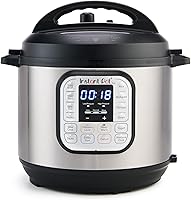
5. Instant Pot Duo 7-in-1 — Best Value Programmable
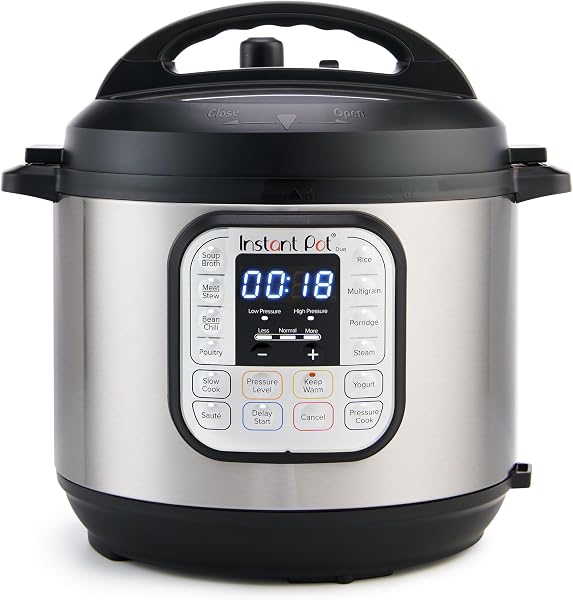
The Duo is the model that made programmable pressure cooking mainstream, and for most people it remains the right first purchase.
Key Specifications
| Capacity | 6 quarts |
|---|---|
| Functions | 7: pressure cook, slow cook, sauté, steam, rice, yogurt, keep warm |
| Programs | 13 one-touch options |
| Power | 1000 W, 120 V |
| Inner pot | 18/8 stainless steel with tri-ply bottom |
| Weight | 14.6 lb |
| Best For | A first programmable pressure cooker |
Why We Recommend It
Thirteen programs cover soup, stew, beans, rice, poultry and cake, which is more than most households use. The tri-ply stainless pot sears properly and has no coating to fail.
The display is basic compared with the Duo Plus and Pro, showing a countdown rather than separate pressure and temperature indicators, which is the main thing you give up.
Pros
- Thirteen programs at the lowest programmable price
- Stainless tri-ply pot with no coating to wear
- The largest recipe community of any cooker
- Easy-Release steam switch
Cons
- Basic display with no pressure indicator
- Presets cannot be customised and saved
- Heaviest of the Instant Pot 6-quart models at 14.6 lb
Best for: Anyone buying their first programmable pressure cooker.
6. COSORI 6QT 9-in-1 — Best Safety Design
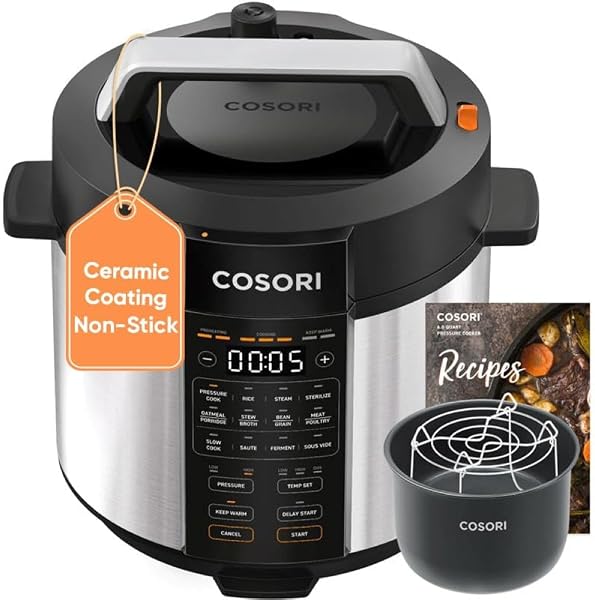
Programmability is only useful if you are comfortable operating the appliance, and COSORI has clearly thought about the moment people are most nervous — releasing steam.
Key Specifications
| Capacity | 6 quarts |
|---|---|
| Functions | 9-in-1 with 13 presets |
| Power | 1100 W |
| Safety | 12 stated features, double-layer anti-scalding lid, overheat protection |
| Venting | 30° backward-angled release, offset seal/vent button |
| Inner pot | Ceramic-coated, dishwasher safe |
| Weight | 11.9 lb |
| Best For | Programmed cooking with the steam path designed away from you |
Why We Recommend It
The seal/vent button sits away from the valve and the release is angled 30° backwards, both aimed at keeping hands out of the steam path. A double-layer anti-scalding lid and overheat protection are also listed.
The ceramic-coated pot releases food easily and is dishwasher safe, though a coating will not last as long as bare stainless.
Pros
- Steam release angled away from the user
- Twelve stated safety features
- Thirteen presets including sous vide and ferment
- Ceramic pot and lid are dishwasher safe
Cons
- Ceramic coating wears faster than stainless
- Fewer third-party recipes than Instant Pot
- Preset-led design gives less manual control
Best for: Nervous or first-time users who want programming plus a safer steam path.
7. KINGBULL 8QT 12-in-1 — Best Large Programmable

Most programmable cookers are six quarts. If you cook for six or more, eight quarts removes the constant batch-splitting that a smaller pot forces.
Key Specifications
| Capacity | 8 quarts |
|---|---|
| Functions | 12-in-1 |
| Power | 1200 W |
| Programs | Soup, meat/stew, bean/chili, poultry, slow cook, sauté, rice, multigrain, porridge, steam, yogurt, cake |
| Display | LED timer with pressure indicators |
| Inner pot | Nonstick |
| Serves | Stated as up to 8 people |
| Weight | 14.3 lb |
| Best For | Programmed cooking for larger households |
Why We Recommend It
Twelve programs cover the standard set, and the LED display carries pressure indicators alongside the timer so you can see what stage it has reached.
The inner pot is nonstick rather than bare stainless. That makes cleaning easier but means it will wear, and it is less suited to hard searing than a tri-ply stainless pot.
Pros
- Eight quarts for larger households
- Twelve one-touch programs
- LED display with pressure indicators
- Stated to serve up to eight people
Cons
- Nonstick pot will wear over time
- Less established brand than Instant Pot or COSORI
- Large footprint at 8 quarts
Best for: Larger households who want programmed cooking without splitting batches.
8. Instant Pot RIO Mini 4QT — Best Compact Programmable

Four quarts is an unusual and useful size — larger than the 3-quart minis that cap out at two portions, small enough to store easily.
Key Specifications
| Capacity | 4 quarts |
|---|---|
| Functions | 7: pressure cook, slow cook, sauté, steam, rice, yogurt, keep warm |
| Power | 800 W |
| Display | Progress indicator showing cooking status |
| Inner pot | Stainless steel |
| Serves | Stated as up to 4 servings |
| Weight | 10.9 lb |
| Best For | Students, singles and small families |
Why We Recommend It
Instant Pot states it offers the same cooking surface as an 8-inch pan, which is what makes sautéing practical rather than token in a small cooker.
The progress indicator is the notable addition at this price, showing whether the cooker is heating, cooking or releasing rather than leaving you guessing.
Pros
- Four quarts suits up to four servings
- Progress indicator shows cooking status
- Same cooking surface as an 8-inch pan
- Compact and easy to store
Cons
- Seven functions rather than nine or ten
- Fewer programs than the 6-quart models
- Still 10.9 lb despite the smaller capacity
Best for: Students, singles and small families who want programming without bulk.
9. Instant Pot Duo Crisp 11-in-1 — Best Multi-Lid

Programmable cooking usually ends with everything soft. The second lid is what changes that — pressure cook a dish, swap the lid and crisp the top without moving it.
Key Specifications
| Capacity | 6 litres |
|---|---|
| Functions | 11: air fry, roast, bake, dehydrate, pressure cook, slow cook, sauté, steam, sterilize, warm, rice |
| Programs | 15 one-touch options |
| Power | 1500 W |
| Lids | Two: pressure lid and air fry lid |
| Technology | EvenCrisp, stated 95% less oil than deep frying |
| Weight | 19.6 lb |
| Best For | Pressure cooking followed by crisping |
Why We Recommend It
Instant Pot states EvenCrisp achieves the crunch of frying with 95% less oil, and the combination covers eleven functions in one footprint.
The cost is bulk: at 19.6 lb with two lids to store, this needs real space, and the second lid has to live somewhere when not in use.
Pros
- Pressure cook then crisp in the same pot
- Eleven functions across two lids
- Fifteen one-touch programs
- Replaces both a pressure cooker and an air fryer
Cons
- Heavy at 19.6 lb
- Two lids to store
- Larger footprint than a single-lid cooker
Best for: Cooks who want pressure cooking and crisping without owning two appliances.
10. Nuwave Duet — Best Pressure Control

Where most cookers hold pressure roughly, Nuwave states this makes around 200 adjustments per cycle to keep it steady — the most granular control claimed here.
Key Specifications
| Capacity | 6 quarts |
|---|---|
| Functions | Air fry, pressure cook, combo cook, slow cook and more |
| Power | 1500 W |
| Lids | Three removable lids |
| Control | Dynamic Pressure Control, stated 200 pressure adjustments |
| Inner pot | Triple-thick 18/10 stainless steel, non-coated |
| Probe | Included |
| Weight | 27 lb |
| Best For | Cooks who want tight pressure regulation and a probe |
Why We Recommend It
The triple-thick 18/10 stainless pot is non-coated, which is the right choice for an appliance that also sears and air fries, and the included probe allows cooking to a target internal temperature.
The honest caveats: at 27 lb it is by far the heaviest here, three lids need storing, and the "450-in-1" figure is marketing arithmetic rather than 450 distinct functions.
Pros
- Dynamic pressure control makes continuous adjustments
- Triple-thick 18/10 non-coated stainless pot
- Temperature probe included
- Combo cooking pressure-then-crisp
Cons
- Heaviest unit here at 27 lb
- Three lids to find storage for
- The 450-in-1 claim is marketing rather than distinct functions
Best for: Cooks who want precise pressure regulation and probe cooking in one unit.
CHEF iQ vs Instant Pot Duo
The deepest programming here against the most popular preset panel. They answer different questions.
| Feature | CHEF iQ Smart Cooker | Instant Pot Duo 7-in-1 |
|---|---|---|
| Programming | App sends exact time and pressure | 13 fixed presets |
| Custom settings | Yes, via guided recipes | No |
| Built-in scale | Yes, four sensors | No |
| Pressure release | Automatic, three settings | Manual switch |
| Inner pot | Aluminium | 18/8 stainless, tri-ply |
| Main advantage | Control over every parameter | Cheapest, and a huge recipe community |
| Main drawback | Best features need the app | Presets cannot be changed |
Choose the CHEF iQ if: you want to control and repeat exact parameters, and you will genuinely use the app.
Choose the Duo if: you want a reliable preset panel, a stainless pot and the widest recipe support, for far less money.
Editable Presets or More Presets?
Two ways to answer "programmable", and which suits you depends on how varied your cooking is.
| Feature | COSORI 9-in-1 (13 presets) | Instant Pot Pro (28 programs) |
|---|---|---|
| Preset count | 13 | 28 |
| Editable | Yes, and saveable | No |
| Panel customisation | Add or remove presets | Fixed |
| Inner pot | Stainless steel | Stainless steel |
| Display | Real-time progress bar | Full program display |
| Main advantage | The cooker learns your recipes | A button for almost everything |
| Main drawback | Fewer presets to start from | Cannot adjust what a program does |
Choose editable presets if: you cook the same dishes repeatedly and want them saved exactly how you like them.
Choose more presets if: your cooking is varied and you would rather press a labelled button than configure anything.
Best Alternatives
| Alternative | Why Consider It | Better For | Main Trade-Off |
|---|---|---|---|
| Instant Pot Duo Plus | Display shows pressure and temperature | Clear feedback while learning | No app or editable presets |
| COSORI 6QT 9-in-1 | Twelve stated safety features | Nervous or first-time users | Ceramic coating wears |
| KINGBULL 8QT | Eight quarts with twelve programs | Larger households | Nonstick inner pot |
| Instant Pot RIO Mini 4QT | Programming in a compact body | Students and small families | Fewer functions |
| Instant Pot Duo Crisp | Second lid adds air frying | Pressure cooking then crisping | Heavy, two lids to store |
What Does Programmable Actually Mean Here?
Fixed presets are what most cookers offer. Buttons labelled soup, beans or poultry set a time and pressure you cannot change. The Instant Pot Duo and Pro work this way, and for most people it is entirely sufficient.
Editable presets let you adjust a program’s time and temperature and save it. COSORI’s models do this, and it is the most useful form of programmability for anyone who repeats the same dishes.
Parameter-level control means recipes or you set exact values per cook. The CHEF iQ does this through its app, and the Nuwave regulates pressure continuously through the cycle. This is the deepest control available, and the most dependent on extra software or hardware.
How to Choose a Programmable Pressure Cooker
Decide Whether You Want Presets or Control
A long preset list and deep programmability are different products. If you cook varied dishes and want a labelled button, buy on preset count. If you cook the same six things and want them exactly right, buy a cooker whose presets can be edited and saved.
Check What the Display Actually Tells You
Cheaper models show a countdown that does not start until pressure is reached, which confuses beginners into thinking nothing is happening. The Duo Plus shows time, temperature and pressure separately, and COSORI shows a progress bar. That feedback is worth more than an extra program.
Inner Pot Material Outlasts Everything Else
Bare 18/8 or 18/10 stainless has no coating to fail and sears properly. Ceramic and nonstick release food more easily and clean faster, but they wear, and a coated pot in a cooker you use several times a week will show it within a few years.
Look at Where the Steam Goes
Steam release is where people get hurt. COSORI angles its release 30° backwards and moves the vent button away from the valve; the Instant Pot Pro adds a diffusing cover; the CHEF iQ releases automatically. Any of these beats reaching across an open valve.
Size for Your Batch, Not the Category Standard
Six quarts is the default because it suits four to six servings. Four quarts is genuinely better for one or two people, and eight quarts stops larger households splitting every batch. Programming does not compensate for the wrong size.
Consider Whether Extra Lids Earn Their Space
Multi-lid models add air frying or crisping, which conventional pressure cookers cannot do. They also weigh considerably more and give you a second lid to store. Decide whether that function replaces another appliance or merely adds bulk.
App Features Are Only Worth It If You Use Them
Guided recipes and remote monitoring are genuinely useful to some cooks and completely ignored by others. If you would not open an app to cook dinner, the appliance is doing less for you than a cheaper preset panel would.
Check the Recipe Ecosystem
Instant Pot has by far the largest body of third-party recipes written for its specific programs and timings. Other brands cook just as well, but you will be translating times more often, which slightly undercuts the point of presets.
Common Programmable Pressure Cooker Mistakes
- Buying on preset count. Most people use three or four programs regardless of how many are printed on the panel.
- Assuming presets can be adjusted. On most cookers they cannot — only some models let you edit and save.
- Forgetting come-to-pressure time. A ten-minute program is ten minutes after it reaches pressure.
- Overfilling. Pressure cookers should not exceed two-thirds, or half for foaming foods.
- Choosing a coated pot for heavy use. Coatings wear; bare stainless does not.
- Ignoring the steam release design. It is the part of the appliance most likely to hurt you.
- Buying six quarts by default. Four is better for one or two, eight for larger households.
- Trusting every specification field. One listing here contradicts its own sibling model on wattage.
Who Should Buy a Programmable Pressure Cooker?
A programmable model is worth it if you:
- Cook the same dishes repeatedly — where saved settings pay off every week
- Batch cook — programs make repeatable results far easier
- Cook dried beans and pulses — the clearest case for pressure cooking at all
- Want dinner started before you are home — delayed start and keep-warm
- Follow recipes precisely — where exact time and pressure control matters
- Want one appliance — most of these also slow cook, steam and sauté
Who May Be Better With Something Else?
If you cook by feel rather than by recipe, a stovetop pressure cooker is faster to pressure, cheaper and has nothing to program. If you only want one function, a dedicated appliance usually does it better. And if you would never open an app, skip the connected models — you are paying for capability you will not use.
Frequently Asked Questions
What does programmable mean on a pressure cooker?
Usually a set of preset buttons that apply a fixed time and pressure, such as soup, beans or poultry. On some models it means more: COSORI lets you edit and save presets, and the CHEF iQ lets guided recipes send exact parameters to the cooker. Check which sense a listing means before buying on the word.
How many programs do I actually need?
Far fewer than most cookers offer. Pressure cook, sauté, slow cook and rice cover the vast majority of home use, and many people never touch the rest. A cooker with editable presets is more useful than one with twice as many fixed buttons you will not press.
Is a stainless or ceramic inner pot better?
Stainless for longevity and searing; ceramic or nonstick for easy release and cleaning. A coating will wear over years of regular use, while bare 18/8 or 18/10 stainless does not. If you sauté in the pot before pressure cooking, stainless is the better choice.
Does a programmable pressure cooker cook faster?
Not inherently — programs set time and pressure, they do not change the physics. What they change is consistency and convenience: the same result each time without you timing it, plus keep-warm afterwards. Remember that any program time excludes the minutes spent coming up to pressure.
What size programmable pressure cooker should I buy?
Six quarts suits four to six servings and is the category default. Four quarts is better for one or two people and stores more easily. Eight quarts suits larger households who would otherwise split every batch. Never fill beyond two-thirds, or half for foaming foods such as beans and grains.
Are WiFi pressure cookers worth it?
Only if you would use the app. Guided recipes that push exact parameters to the cooker, and a built-in scale that weighs ingredients in the pot, are genuinely useful to some cooks. If you would rather press a button and walk away, that capability is money spent on something you will ignore.
Can programmable pressure cookers be used for canning?
Generally no. Home canning of low-acid foods requires a tested pressure canner with a gauge, and most electric multicookers are not designed or approved for it. Some dedicated electric canners exist, but check that a specific model is explicitly intended and tested for canning before relying on it.
Why does my pressure cooker take longer than the program says?
Because the program time starts only once the cooker reaches pressure. Coming up to pressure can take 10 to 20 minutes depending on volume, how cold the contents are, and the wattage. A displayed pressure indicator, as on the Duo Plus, makes this much easier to understand.
Final Verdict
Guided recipes send exact time and pressure to the cooker, and a built-in scale weighs ingredients in the pot — control no preset panel matches.
Thirteen programs and a stainless tri-ply pot at the lowest price here, with the widest recipe support of any model.
A display that separates time, temperature and pressure, which removes most of the confusion beginners have with programmed cooking.
Choosing a programmable pressure cooker comes down to five things: whether you want fixed presets or editable ones, how much the display tells you while it works, whether the inner pot is coated or bare stainless, how the steam release is designed, and whether app features would genuinely change how you cook. Settle the presets-versus-control question first — the rest follows from it.