Affiliate Disclosure: As an Amazon Associate, we earn from qualifying purchases. This does not affect the price you pay.
Sort ten hand grinders by burr material and a line appears that nobody draws for you. Every ceramic burr on this page sits in the budget tier. Every stainless steel burr sits above it. Not one listing crosses it.
Five grinders sit below the line, from the CEVING Mini to the JavaPresse. Five sit above it, from the CEVING 60g to the TIMEMORE. The cheapest steel burr costs only slightly more than the dearest ceramic one. That gap is the whole of the everyday manual tier, and it is the first thing to decide.
The ratings follow the burrs. The ceramic five rate between 4.2 and 4.4. The steel five rate between 4.4 and 4.7. Only one score, 4.4, appears on both sides of the line.
The review counts run the other way. The ceramic five hold 42,712 ratings between them; the steel five hold 5,058. Two old designs, the JavaPresse at 25,664 and the Hario ceramic mill at 13,817, account for 39,481 of those on their own — more than four in five of every rating on the page. The most-reviewed grinders here are the oldest, and they are not the best-rated.
Both camps argue their material in marketing copy. JavaPresse says its ceramic burr lasts “5 times longer than comparable stainless steel coffee burrs”. NewlukPro says its steel core has a “better grinding effect than ceramic grinding cores”. One brand, CEVING, sells both and praises both. None of them publishes a measurement to settle it, and we did not test either.
So this guide does what the listings allow. It reads the burr, then the stated capacity in grams, then the number of click settings and where the dial sits, then the ratings with their sample sizes. If you want the wider picture including electric grinders, our best coffee grinder roundup covers both. This page is only for the hand-crank kind, and only for the everyday tier: the premium manuals are left to a separate guide.
Whether you search for the best manual hand coffee grinder, the best hand crank coffee grinder or the best hand burr grinder, these are the same ten products. Every one has a conical burr and a crank. What separates them is printed on the listing.
Budget to premium below. The cheapest steel burr is the CEVING 60g; the dearest ceramic one is the JavaPresse.
Our Quick Picks
 Best OverallCEVING Mega Pro 60g Steel Burr
The cheapest steel burr on the page, with a stated 60 g chamber, 40 external clicks of 0.05 mm and 4.5 across 725 ratings.
 Best ValueCEVING Mini Ceramic Burr
40 external settings and a 30 g chamber at the lowest price here, rated 4.4 across 1,990 ratings, with 4K+ bought in the past month.
 Highest RatedTIMEMORE Chestnut C2
4.7 across 2,634 ratings, the best score and largest steel sample here, with 55–58HRC 420 stainless burrs.
At a Glance
Ten Hand Grinders from Budget to Premium, With the Burr Line Marked
Cheapest first. Read the burr column: it switches from ceramic to steel between row five and row six, and never switches back.
| # | Model | Burr | Capacity | Settings | Best Sellers Rank | Standout | Main Drawback | Check Price |
|---|---|---|---|---|---|---|---|---|
| 1 |
 CEVING Mini |
Ceramic | 30 g | 40 external | #1 in Manual Grinders | #1 in Manual Grinders; 4K+ bought last month | Ceramic burr; 4.4 across 1,990 ratings | View on Amazon |
| 2 |
 CIRCLE JOY Mini |
Ceramic | Not stated | 40 external | #9 in Manual Grinders | Same price as the CEVING Mini, glass catch jar | No stated capacity; 4.2 across 508 ratings | View on Amazon |
| 3 |
 QIYUEXES 80g |
Ceramic | 80 g | 48 (ring) | #52 in Manual Grinders | Largest stated chamber and most clicks here | Weight conflict: 425 g vs 0.6875 lb | View on Amazon |
| 4 |
 Hario Ceramic Mill |
Ceramic | 24 g | Not stated | #29 in Manual Grinders | 4.3 across 13,817 ratings; defines a cup as 12 g | No grind settings described at all | View on Amazon |
| 5 |
 JavaPresse Manual |
Ceramic | Not stated | Over 18 | #7 in Manual Grinders | 25,664 ratings — the biggest sample on the page | Lowest-equal score, 4.2; 6-month warranty | View on Amazon |
| 6 |
 CEVING Mega Pro 60g |
Steel | 60 g | 40 external | #1 in Manual Grinders | Cheapest steel burr; 0.05 mm per click stated | 4.5 across only 725 ratings | View on Amazon |
| 7 |
 NewlukPro M6 |
Steel (420) | Not stated | Not stated | #16 in Manual Grinders | Aluminium body, “No plastic parts!” | No capacity and no click count published | View on Amazon |
| 8 |
 KINGrinder P2 |
Steel (420) | 20 g | 30 per turn | #10 in Manual Grinders | Finest stated step: 0.0333 mm per click | Smallest chamber here; ABS body | View on Amazon |
| 9 |
 Alpaca Ventures |
Steel (420) | 28 g | 45 clicks | #59 in Manual Grinders | Prints a click chart and 57 HRC hardness | Rank #59 in Manual Grinders; 50+ bought | View on Amazon |
| 10 |
 TIMEMORE C2 |
Steel (420) | 25 g | Not stated | #20 in Manual Grinders | 4.7 across 2,634 ratings, best score here | Reseller-sold, stock flagged scarce | View on Amazon |
Ratings and specifications are taken from each manufacturer’s Amazon listing as displayed on 5 October 2026 through a United States connection, and may change. Capacity is the bean load each listing states in grams; “Not stated” means the listing gives no figure. Settings are as described; only three listings say outright that the adjustment is external, and only the TIMEMORE says internal. The two CEVING listings share one overall rank (#2,440, #1 in Manual Grinders), which reflects a pooled listing family rather than each model alone. The TIMEMORE is sold by a reseller and was flagged as limited stock on the capture date.
Scroll the table sideways to see every column
How We Chose These Ten
We researched current listings, compared manufacturer specifications and documentation, and examined recurring patterns in customer feedback. We did not carry out hands-on testing, and nothing below is presented as measured performance data.
- Burr material recorded exactly as each listing states it — five say ceramic, five say stainless steel, and the split falls cleanly at a price gap
- Stated capacity in grams, never estimated — seven of ten publish one, from 20 g to 80 g; three are left as “Not stated”
- Grind settings counted only where the listing counts them — and the dial’s position recorded as external, internal or unspecified, in the listing’s own words
- Ratings always read with their sample size — from 359 ratings to 25,664, because a 4.7 on a few thousand and a 4.2 on twenty-five thousand are different kinds of evidence
- A verified live buy box — all ten confirmed in stock on amazon.com on 5 October 2026, with the merchant noted where it is not the brand
- The everyday tier only — budget to mid-premium; the premium hand grinders are covered in a separate guide
- Two candidates left out — a budget lid that needs a Mason jar you buy separately, and a two-jar grinder that states neither a capacity nor a settings count and rates 4.1 across 3,510 ratings

The Ten Hand Grinders in Detail
1. CEVING Mini Manual Coffee Grinder — Best Value

The most-bought hand grinder on Amazon this month, and the cheapest one here to put its grind dial on the outside.
Key Specifications
| Burr | Conical ceramic |
|---|---|
| Capacity | 30 g of beans |
| Grind settings | 40, on an external adjustment ring |
| Weight | 325 g stated in the bullets |
| Size | 6.7 x 2.3 x 7.4 in |
| Cleaning | Brush or dry cloth; water not recommended |
| Sales | 4K+ bought in past month |
| Rank | #1 in Manual Grinders (shared with the CEVING 60g listing) |
| Rating | 4.4 across 1,990 ratings |
| Best For | One or two cups a day on the smallest budget |
Why We Recommend It
The external ring is the headline, and CEVING says so first. The opening bullet reads “40 EXTERNAL ADJUSTABLE GRIND SETTINGS” and adds, pointedly, “Unlike traditional grinders with internal adjustments.” That is aimed squarely at the Hario and JavaPresse designs further down this page, where changing the grind means reaching inside the hopper. On the CEVING you turn a ring between the body and the catch cup and count. It is one of only three grinders on the page whose listing uses the word external, and, level with the CIRCLE JOY, the cheapest of them.
The chamber is stated, and it is honest about its limits. 30 g of beans per fill. CEVING adds a note that most listings would not: “for larger capacity needs, we recommend a household electric grinder.” Measured against the Hario’s own definition of a cup — 24 g for approximately two — 30 g is about two and a half cups. That is a morning for one or two people, not a full French press for four.
The burr is ceramic, which puts it below the line. CEVING argues that ceramic burrs “provide a more uniform grind and generate less heat than stainless steel or blade burrs”. The same company’s 60g model, five rows down, argues the opposite case for its steel burr. Neither listing gives a measurement, and we did not grind with either. What you can take from the listing is the position of the material: ceramic is the budget tier here, and this one is at the very bottom of it.
The sales number is the loudest on the page. 4K+ bought in the past month is four times anything else in this roundup, and it carries the #1 rank in Manual Grinders. Read that rank carefully: the CEVING 60g listing shows the identical rank and the identical overall position (#2,440), which is what happens when two models share a listing family. The rating is its own, though: 4.4 across 1,990 ratings, the highest score among the five ceramic grinders, level with the lowest-rated steel one.
It is light and small. 325 g, by the bullet, and 6.7 by 2.3 by 7.4 inches. The spec table gives a heavier figure, 0.8377565956 pounds, which is likely the shipping weight; the bullet is the number to plan your bag around. Three main parts including the lid, a brush for cleaning, and an instruction not to use water. This is the grinder to buy if the budget is the first constraint and you want to be able to change the grind without emptying the hopper.
Pros
- 40 external click settings — no need to reach into the hopper
- 30 g capacity stated, about two and a half Hario cups
- 4.4 across 1,990 ratings, best of the ceramic five
- 4K+ bought in the past month, the most on the page
- 325 g and compact enough for a bag
- Joint cheapest here
Cons
- Ceramic burr, with no hardness or step size published
- 30 g is short of a full large French press
- Shares its #1 rank with the CEVING 60g listing
- Bullet weight and spec-table weight disagree
- No warranty term stated
- Brush and cloth cleaning only
Best for: A first hand grinder for one or two cups a day, at the budget end, with a dial you can reach.
2. CIRCLE JOY Mini Manual Coffee Grinder — Glass Catch Pick

Same budget tier, same 40 external settings, same ceramic burr as the CEVING Mini — but no capacity figure, and a glass jar you can see through.
Key Specifications
| Burr | Ceramic (conical, per title) |
|---|---|
| Capacity | Not stated |
| Grind settings | 40, external |
| Body | Stainless steel, silver |
| Catch | Clear glass grounds hopper |
| Handle | “Extra-long”, for leverage |
| Weight | 1.0251495183 lb (spec table) |
| Sales | 200+ bought in past month |
| Rank | #9 in Manual Grinders |
| Rating | 4.2 across 508 ratings |
| Best For | Seeing your dose as it falls |
Why We Recommend It
On paper it is the CEVING Mini’s twin. The same price tier. A ceramic conical burr. “40 External Grind Settings”. A stated suitability for every brew method. If you laid the two listings side by side and hid the brand, the feature lists would almost match. Where they part is in what CIRCLE JOY chooses not to publish, and in what it adds.
What it adds is glass and steel. The grounds fall into a “Clear Glass Grounds Hopper”, which the listing pitches as a way to “see exactly how much coffee you’ve ground”. The body is described as stainless steel, with an extra-long handle to “improve leverage and reduce hand fatigue”. Note the order of materials, because the title gets it the other way round for skimmers: “Portable Stainless Steel Hand Coffee Grinder” describes the shell. The burr is ceramic. That keeps it below the line with the rest of the ceramic five.
What it leaves out is capacity. There is no gram figure anywhere on the listing. A see-through jar shows you what has been ground, but not how much the hopper above will take before you have to stop and refill. For a single cup that hardly matters. For a pot, it is the question you most need answered, and the CEVING Mini answers it (30 g) for the same money.
The weight figure needs a pinch of salt. The spec table gives 1.0251495183 pounds, heavier than the 325 g CEVING Mini claims by a wide margin. A glass jar and steel body would add mass, but the table may also include packaging; the listing does not give a bare-grinder weight in its bullets. If you are packing it for travel, glass is the bigger consideration than grams.
The record is thinner than its twin’s. 4.2 across 508 ratings and 200+ bought in the past month, against 4.4 across 1,990 and 4K+ for the CEVING. It ranks a respectable #9 in Manual Grinders. Buy the CIRCLE JOY if you want glass and a steel shell at the lowest price on the page; otherwise the CEVING Mini states more at the same level.
Pros
- 40 external settings at the lowest price here
- Clear glass catch shows the ground dose
- Stainless steel body rather than plastic
- Extra-long handle for leverage
- #9 in Manual Grinders
- Joint cheapest grinder here
Cons
- No capacity in grams anywhere on the listing
- 4.2 across 508 ratings, a small sample
- Glass catch is breakable in a bag
- Ceramic burr despite the “Stainless Steel” title
- Spec-table weight only, no bullet weight
- No warranty term stated
Best for: Buyers who want a glass catch and a steel shell on a tight budget.
3. QIYUEXES 80g Manual Coffee Grinder — Largest Capacity

80 g per fill and 48 settings are both the highest numbers on this page, and they come from a budget grinder.
Key Specifications
| Burr | Conical ceramic |
|---|---|
| Capacity | 80 g of beans |
| Grind settings | 48, via an adjustment ring |
| Included | Two Mason jars and a brush |
| Size | 2.95 x 2.95 x 7.28 in |
| Weight | 425 g in the bullets; 0.6875 lb in the spec table |
| Sales | 50+ bought in past month |
| Rank | #52 in Manual Grinders |
| Rating | 4.3 across 733 ratings |
| Best For | A full pot or cold brew from one fill |
Why We Recommend It
Eighty grams is the outlier. Every other grinder here that states a capacity stays at 60 g or below, and five of them are between 20 g and 30 g. The QIYUEXES says “grind up to 80g of coffee beans at once”. By the Hario’s own yardstick of 24 g for approximately two cups, that is roughly six and a half cups in one session. It is the only grinder on the page sized for the people who brew for a household.
It also states the most settings. 48, selected with what the listing calls a “user-friendly adjustment ring”. The listing does not say whether that ring is inside or outside the body, so we have not assumed; nor does it give a step size per click. Forty-eight is a count, not a precision figure, and a higher count without a step size tells you how many positions there are, not how far apart they sit.
The burr is ceramic, and the copy leans on it. The listing says ceramic grinds “with minimal heat”, “surpassing stainless steel and blade grinders”. That is the same claim every ceramic seller on this page makes, and like the others it comes without a test. What is verifiable is the position: it sits in the lower half of the ceramic tier, well below the cheapest steel burr.
The weight disagrees with itself. The bullets give 425 g. The spec table gives 0.6875 pounds, which is about 312 g. One of them is wrong, or they describe different things; the bullet is the more specific. Either way it is mid-pack for weight, and at 2.95 by 2.95 by 7.28 inches it is narrow for its capacity. Two Mason jars come in the box, so a second batch of beans or grounds can sit sealed beside the first.
The record is modest. 4.3 across 733 ratings, 50+ bought in the past month, #52 in Manual Grinders. That is not the profile of a proven favourite, and it is worth weighing against the CEVING 60g, which holds 20 g less, costs more, and swaps the ceramic for steel. If capacity is the deciding number, nothing else here comes close.
Pros
- 80 g stated capacity, the largest on the page
- 48 settings, the highest count here
- Two Mason jars and a brush included
- The biggest chamber at a budget level
- 4.3 across 733 ratings
- Narrow 2.95-inch footprint
Cons
- Ring position (internal or external) not stated
- No step size per click
- 425 g vs 0.6875 lb weight conflict
- Ceramic burr, no hardness figure
- #52 in Manual Grinders, 50+ bought
- No warranty term stated
Best for: Anyone grinding for a full French press, cold brew or several people at once.
4. Hario Ceramic Coffee Mill Original — The Classic

13,817 ratings make the Hario the second-biggest sample here, and its listing quietly supplies the most useful number on the page: 24 g is two cups.
Key Specifications
| Burr | Ceramic |
|---|---|
| Capacity | Approx. 2 cups; 24 g (0.8 oz) of coffee |
| Grind settings | Not stated |
| Adjustment | Not described on the listing |
| Materials | Methacrylic resin, ceramic, polypropylene, stainless steel |
| Size | 15 x 7.2 x 22 cm |
| Weight | 14.1 oz (400 g) in the bullets; 0.7 lb in the spec table |
| Seller | Ignite Ideas (third party) |
| Rank | #29 in Manual Grinders |
| Rating | 4.3 across 13,817 ratings |
| Best For | A proven design with a published dose |
Why We Recommend It
This is the listing that defines a cup. “Capacity: Approx. 2 cups (coffee powder: Approx. 0.8 oz (24 g)”. That makes a Hario cup 12 g of coffee, and it is the only listing on the page that ties grams to cups in plain terms. We use it throughout this guide as the yardstick, because it is the manufacturer’s own figure and every other capacity can be read against it: the KINGrinder’s 20 g is under two Hario cups, the QIYUEXES’s 80 g is over six.
The record is long and the score is steady. 4.3 across 13,817 ratings. Together with the JavaPresse it accounts for most of the ratings on this page. That volume is a kind of evidence the newer grinders cannot offer: a design that thousands of buyers have lived with, scored in the low fours, and kept buying. It is not the top score here, but it is one of the most tested in the sense that matters for a review count.
What the listing does not say is how you adjust it. There is no number of settings, no word about a dial, no mention of internal or external adjustment anywhere in the bullets. “Consistent grind for perfect, fresh coffee” is the nearest it comes. On a grinder, the grind adjustment is the main control, and the silence is information: you are buying a mechanism whose range the seller does not describe. The ten bullets spend their space on materials, country of origin and the fact that it “Can be stored without the handle”.
The materials list is candid. Methacrylic resin, ceramic, polypropylene, stainless steel, “etc”. The burr is ceramic and, by the listing, “does not rust”. The body is largely plastic and resin. At 15 by 7.2 by 22 cm it is wider and squatter than the slim mills on this page. The weight is given twice and disagrees: 14.1 oz (400 g) in the bullets, 0.7 pounds in the spec table, which is about 318 g.
Check who you are buying from. The buy box on the capture date belonged to Ignite Ideas, a third-party merchant, not Hario. It sits near the top of the ceramic tier. 100+ bought in the past month and a #29 rank say it is no longer the default it once was, and the CEVING Mini states more — capacity, settings, external dial — for less. Buy the Hario for the 13,817-rating record and the plain 24 g figure, not for its specification sheet.
Pros
- 4.3 across 13,817 ratings, a very large sample
- States 24 g for approx. 2 cups — the page’s yardstick
- Ceramic burr stated not to rust
- Handle removes for storage
- Full materials list published
- Ceramic, below the steel line
Cons
- No grind settings or adjustment method described
- Mostly resin and polypropylene body
- Sold by a third party, not Hario
- 400 g vs 0.7 lb weight conflict
- 100+ bought in past month, #29 rank
- No warranty term stated
Best for: Buyers who trust a long track record over a long feature list.
5. JavaPresse Manual Coffee Grinder — Most Reviewed

25,664 ratings is more than every steel-burr grinder on this page combined, five times over.
Key Specifications
| Burr | Ceramic conical (body is stainless steel) |
|---|---|
| Capacity | Not stated |
| Grind settings | “Over 18” |
| Adjustment | Built-in; position not stated |
| Noise claim | “Eliminates 90% of electric grinder noise” |
| Durability claim | Burr lasts “5 times longer” than stainless |
| Warranty | 6 months on defects; 30-day returns |
| Sales | 600+ bought in past month |
| Rank | #7 in Manual Grinders |
| Rating | 4.2 across 25,664 ratings |
| Best For | The most-reviewed hand grinder on Amazon |
Why We Recommend It
The review count is the reason to read this listing. 25,664 ratings. The five steel-burr grinders on this page hold 5,058 between them; the JavaPresse alone holds about five times that. Only the Hario comes near it, and even the Hario has 11,847 fewer. When people search for the best manual coffee grinder and land on Amazon, this is very often the listing they meet.
The score is the lowest-equal here. 4.2, shared with the CIRCLE JOY. That is not a poor rating, and on a sample this size it is extraordinarily stable: another thousand five-star reviews would barely move it. But it is the bottom of the range on this page, and every steel grinder outscores it. The pattern repeats down the table: the old designs carry the volume and the newer steel designs carry the higher scores.
Read the title and the bullets together. The title says “Manual Stainless Steel Coffee Grinder”. The first bullet says “built-in adjustable ceramic burr”. Both are true — the shell is steel, the burr is ceramic — and the burr is what places it in the ceramic group. JavaPresse argues hard for the material: its ceramic burr is “tested through three quality inspections to last 5 times longer than comparable stainless steel coffee burrs”. No test is cited, and a steel seller on this page claims the reverse.
“Over 18” settings is a vague count. The listing never says how many over, where the adjustment sits or how far apart the steps are. Nor does it give a capacity. Compare that with the CEVING Mini, which states 40 external settings and 30 g. The JavaPresse listing is written in claims — 100% precision, 90% less noise — rather than in grams and clicks.
The warranty is short and stated. Six months on manufacturer defects, plus a 30-day return window. That is half the one year that three steel-burr grinders here offer, but it is at least written down, which is more than most of the ceramic group manage. It is the dearest ceramic burr on the page, just below the cheapest steel. Buy it for the depth of its track record; know that a little more buys a steel burr with stated settings and capacity.
Pros
- 25,664 ratings — the largest sample here by far
- 600+ bought in past month, #7 in Manual Grinders
- Steel shell over a ceramic conical burr
- Warranty and return window both stated
- No cords or batteries; quiet by design
- Sold by JavaPresse directly
Cons
- 4.2, the lowest-equal score on the page
- “Over 18” settings, never an exact number
- No capacity in grams
- Adjustment position not stated
- 6-month warranty, half the steel group’s 1 year
- Dearest ceramic, just short of steel
Best for: Buyers who weigh a 25,664-rating record above a spec sheet.
6. CEVING Mega Pro 60g Manual Coffee Grinder — Best Overall

The cheapest way across the line: a CNC steel burr, 60 g per fill and 40 external clicks of 0.05 mm.
Key Specifications
| Burr | CNC stainless steel |
|---|---|
| Capacity | 60 g of beans |
| Grind settings | 40, on an external click-ring |
| Step per click | 0.05 mm stated |
| Weight | 416 g stated in the bullets |
| Size | 2.7 x 7.8 x 5.3 in |
| Warranty | 1 year |
| Sales | 1K+ bought in past month |
| Rank | #1 in Manual Grinders (shared with the CEVING Mini) |
| Rating | 4.5 across 725 ratings |
| Best For | The first steel burr, for one person or several |
Why We Recommend It
This is where the line is crossed. This is the cheapest stainless steel burr on this page, just above the dearest ceramic. The listing calls it “Precision CNC steel burrs”. It does not give a steel grade or a hardness figure, as the TIMEMORE and Alpaca do, but it puts the grinder in the group that rates 4.4 to 4.7, and it does so for far less than the TIMEMORE.
It is one of only two listings here to give a step size. “Each click adjusts by just 0.05mm”, across 40 settings on an external click-ring. Multiply those out and, if every click moves the same distance, the dial covers about 2 mm from first click to last. That is the kind of figure that lets you compare grinders rather than adjectives. Only the KINGrinder P2 publishes a finer one, at 0.0333 mm.
The capacity is genuinely large. 60 g per fill, which the listing styles as “World’s First 60g Large Capacity” and “twice the beans of the standard grinders”. We cannot verify the “world’s first”, and on this very page the QIYUEXES states 80 g. But 60 g is five Hario cups in a single session, and it is twice the CEVING Mini’s 30 g. For a French press or cold brew, the difference is one fill instead of two.
CEVING argues against itself, usefully. The Mini listing says ceramic burrs “generate less heat than stainless steel”. This listing says steel delivers “lightning-fast, ultra-uniform grinding”. One brand, two burrs, two opposite pitches. It is the clearest sign on the page that burr-material claims are marketing positions rather than findings. What the listings agree on is the tiering: CEVING asks more for the steel model, and gives it a stated one-year warranty the Mini lacks.
The record is young but strong. 4.5 across 725 ratings and 1K+ bought in the past month. The #1 rank in Manual Grinders is shared with the Mini’s listing family, so do not read it as this model’s alone. At 416 g it is light for its capacity, and the listing includes a frank grinding tip: lightly mist the beans with water to cut static cling. For most people stepping up from a blade grinder or a ceramic hand mill, this is the one to buy.
Pros
- Cheapest steel burr here
- 0.05 mm per click stated, one of two step sizes published
- 40 external click settings
- 60 g capacity, five Hario cups
- 1-year warranty stated
- 4.5 across 725 ratings, 1K+ bought last month
Cons
- No steel grade or hardness published
- 725 ratings is a short record
- Shares its #1 rank with the CEVING Mini
- “World’s first 60g” while an 80 g grinder exists
- Static tip suggests misting beans
- Bullet and spec-table weights differ
Best for: Anyone who wants a steel burr, an external dial and a large chamber without paying premium-tier prices.
7. NewlukPro M6 Manual Coffee Grinder — All-Metal Body

“No plastic parts!” is the NewlukPro’s pitch, and it is the cheapest aluminium body here — with almost nothing else quantified.
Key Specifications
| Burr | SUS 420 stainless, hexagonal core |
|---|---|
| Capacity | Not stated |
| Grind settings | Not stated |
| Adjustment | “Built-in adjustment knob” |
| Body | Aluminium alloy; double bearing axis |
| Size | 6.38 in tall; compared to a 500ml water bottle |
| Weight | 1.25 lb (spec table) |
| Warranty | 1 year |
| Rank | #16 in Manual Grinders |
| Rating | 4.4 across 438 ratings |
| Best For | A metal grinder that will take knocks |
Why We Recommend It
The body is the selling point. Aluminium alloy, a “firm double bearing axis”, an SUS 420 stainless burr the listing calls a hexagonal core, and the line “No plastic parts!” It sits just above the CEVING 60g and is the cheapest grinder here built entirely around metal. If you have cracked a plastic hopper before, that matters more than any click count.
It is the loudest voice on the steel side. The listing says its burr has “better grinding effect than ceramic grinding cores and other ordinary stainless steel grinding core”. That is the direct counter to JavaPresse’s five-times-longer ceramic claim, and it is equally unsupported by a published test. Treat both as what they are: each seller describing its own material as superior. The verifiable difference is that steel costs more here, and that every steel grinder on the page rates 4.4 or higher.
But the listing leaves the important numbers blank. No capacity in grams. No number of settings. No step size. The adjustment is a “built-in adjustment knob”, and the usage notes add that you should “ensure that there is no residue in the bean compartment” before adjusting — which suggests, though the listing never says internal, that the knob is reached through the hopper. Of the five steel grinders, this is the one you would be buying most on trust.
Its size is given by comparison. “Small size as a 500ml bottled water”, and 6.38 inches tall in the spec table. The table also gives 1.25 pounds, one of the heaviest weight figures on this page, which fits an aluminium body but may include the gift box it ships in. The reassembly note is worth reading before you take it apart: springs, washers and bearings must go back in order.
The record is reasonable. 4.4 across 438 ratings, 200+ bought in the past month, #16 in Manual Grinders, and a stated one-year warranty. It ties the CEVING Mini’s score on a smaller sample. Choose it over the CEVING 60g only if a metal body matters more to you than a published capacity, settings count and step size, because the CEVING publishes all three for less.
Pros
- Aluminium alloy body, “No plastic parts!”
- SUS 420 stainless conical burr
- Double bearing axis stated
- 1-year warranty
- 4.4 across 438 ratings
- Tool-free disassembly with brush included
Cons
- No capacity in grams
- No number of grind settings
- No step size per click
- Adjustment knob appears to be reached via the hopper
- 1.25 lb in the spec table (may include box)
- Reassembly order must be followed
Best for: Buyers who want a metal body first and are happy to dial in by taste.
8. KINGrinder P2 Lightweight Manual Coffee Grinder — Finest Stated Step
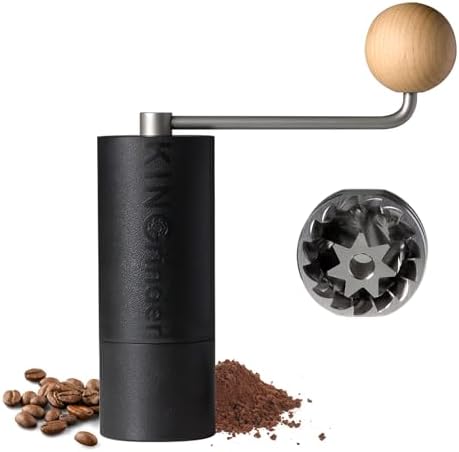
0.0333 mm per click is the finest step any listing here publishes, and the P2 pays for it with the smallest chamber: 20 g.
Key Specifications
| Burr | SUS420 stainless conical |
|---|---|
| Capacity | 20 g per fill |
| Grind settings | 30 clicks per rotation |
| Step per click | 0.0333 mm stated |
| Body | ABS plastic |
| Weight | 330 g stated |
| Recommended use | “Recommended for drip coffee” |
| Warranty | 1 year (part shipping may be charged) |
| Sales | 400+ bought in past month |
| Rank | #10 in Manual Grinders |
| Rating | 4.6 across 359 ratings |
| Best For | Precise pour-over and drip for one |
Why We Recommend It
This is the only listing that gives clicks per turn and microns per click. “With 30 clicks per rotation, each click allows for a fine adjustment of 0.0333mm.” Thirty clicks of 0.0333 mm comes to about 1 mm per full rotation of the dial. Against the CEVING 60g’s 0.05 mm, the KINGrinder’s steps are two-thirds the size, which is the finest resolution stated on the page. It does not give a total number of rotations, so the full range is not published.
The chamber is the trade. “Can grind up to 20g at a time” is the smallest capacity stated here. By the Hario’s 12 g cup it is under two cups per fill, and it is a third of the CEVING 60g’s chamber. KINGrinder is clear about where it fits: the burr is “recommended for drip coffee”. This is a grinder for one careful cup of pour-over or drip, not for a household French press.
The body is plastic, on purpose. ABS, which is how the P2 gets down to 330 g. That is the second-lightest bullet weight here, after the CEVING Mini’s 325 g, and the spec table agrees at 0.73 pounds — one of the few listings where the two figures match. It is a travel and desk grinder first.
The scores are excellent on a small sample. 4.6 across 359 ratings, the smallest sample on the page, alongside 400+ bought in the past month and #10 in Manual Grinders. A 4.6 on 359 ratings can move more than a 4.2 on 25,664 can; read it as promising rather than settled. The listing also cites a YouTuber endorsement, which we note and do not weigh.
The warranty has a footnote. One year, sold by KINGrinder directly, but “Shipping costs for replacement parts may be borne by the customer”. It sits well above the CEVING 60g. That premium buys a finer stated step and a steel grade (SUS420), and gives up 40 g of capacity and the external-ring description. Buy it if your coffee is a single cup through a paper filter and precision is the point.
Pros
- 0.0333 mm per click, the finest stated step here
- 30 clicks per rotation published
- SUS420 stainless burr
- 330 g, and both weight figures agree
- 4.6 across 359 ratings, #10 in Manual Grinders
- Sold by KINGrinder; 1-year warranty
Cons
- 20 g capacity, the smallest stated here
- ABS plastic body
- Total range (rotations) not stated
- Dial position not stated
- 359 ratings is the smallest sample
- Replacement-part shipping may be charged
Best for: One person brewing pour-over or drip who wants the finest stated adjustment.
9. Alpaca Ventures Manual Coffee Grinder — Best Click Guide

The most explicit listing on the page: hardness, bearing steel, a printed click chart and a list of what is not in the box.
Key Specifications
| Burr | 420 stainless conical, hardened to 57 HRC |
|---|---|
| Capacity | 1 oz (28 g) per fill |
| Grind settings | 45 clicks; do not use 0–5 |
| Click guide | Cezve 5–10, espresso 11–15, siphon 16–20, French press 21–30, cold brew 31–45 |
| Body | Aluminium alloy; aluminium catch cup |
| Size | 6.8 in tall, 1.9 in across; 6.3 in crank |
| Weight | 1 lb (460 g) |
| In the box | Grinder, crank, brush; no case |
| Seller | Chernobyl Management LLC |
| Rank | #59 in Manual Grinders |
| Rating | 4.6 across 902 ratings |
| Best For | Repeatable settings across many brew methods |
Why We Recommend It
No other listing here tells you where to set the dial. The Alpaca prints a chart: “Cezve 5-10, espresso 11-15, siphon 16-20, French press 21-30, cold brew 31-45”, counted in clicks back from fully fine. It is the most usable piece of information on the page for a beginner, and it comes with two warnings most listings omit: do not grind between 0 and 5 clicks, and do not turn past 45, “or the burr set can loosen”. That leaves 40 working clicks. Pour-over is not on the chart; on its numbers it would fall somewhere between siphon and French press.
It publishes hardness, which is rare. “420 STAINLESS CONICAL BURR, HARDENED TO 57 HRC”, with a 430 stainless bearing mechanism and a 201 stainless crank. Only the TIMEMORE states a hardness too, as a range of 55–58HRC, so the Alpaca sits inside the TIMEMORE’s band and sits lower in the range. Hardness speaks to how long an edge lasts; it is the nearest thing on this page to a durability number, and it comes from the steel side of the line.
The capacity is a little over two cups. “1 OZ (28 G) PER FILL”, which the listing translates as “roughly two single espressos”. By the Hario’s yardstick it is about two and a third cups. The catch cup is aluminium rather than glass, so it survives a knock in a rucksack, and the body is 6.8 inches tall and 1.9 across, with a 6.3-inch crank. It weighs a stated 1 lb (460 g), the heaviest bullet weight here.
It is candid about its limits. Brush or air blower only, never water or the dishwasher. Roasted beans only, no spices. One grinder, one crank and one brush in the box, “There is no carrying case and no storage tin included”. And a closing note that if you grind a full pot at once, “an electric burr grinder will suit you better”. Few listings argue against their own sale; this one does twice.
The buying signals are thinner than the spec sheet. 4.6 across 902 ratings is the joint second-best score here. But the grinder ranks #59 in Manual Grinders, the lowest rank on the page, with 50+ bought in the past month, and the buy box belonged to a merchant called Chernobyl Management LLC rather than a brand store. No warranty is stated. It is the best-documented grinder here; check the seller and return terms before you rely on it.
Pros
- Printed click chart from Cezve to cold brew
- 420 stainless burr hardened to 57 HRC
- Aluminium body and unbreakable aluminium catch
- 45 clicks with usable range stated
- 4.6 across 902 ratings
- States exactly what is not in the box
Cons
- #59 in Manual Grinders, lowest rank here
- 50+ bought in past month
- Sold by a non-brand merchant
- No warranty stated
- 28 g per fill
- Pour-over missing from the click chart
Best for: Someone switching between several brew methods who wants a starting click for each.
10. TIMEMORE Chestnut C2 Manual Coffee Grinder — Highest Rated

4.7 across 2,634 ratings is the best score on this page and the largest steel-burr sample, at the premium end of the range.
Key Specifications
| Burr | 420 stainless, five-axis CNC cut, 55–58HRC |
|---|---|
| Capacity | 25 g |
| Grind settings | Not stated |
| Adjustment | Internal knob (stated in the title) |
| Bearings | Double bearing positioning |
| Weight | 430 g stated |
| In the box | Grinder, brush, cloth bag, manual |
| Seller | New Sun Mart (reseller); stock flagged scarce |
| Rank | #20 in Manual Grinders |
| Rating | 4.7 across 2,634 ratings |
| Best For | The best-rated hand grinder in the everyday tier |
Why We Recommend It
The score is the case. 4.7 across 2,634 ratings. No grinder on this page scores higher, and none of the steel five has a larger sample. Of the newer designs, it is the one whose high rating rests on thousands of buyers rather than hundreds. That is why it sits at the top of the price range and still earns its place: on the evidence the listings allow, it is the best-rated hand grinder in this tier.
The burr is specified properly. “High quality 420 stainless steel burrs”, cut on a five-axis CNC, at a stated hardness of “55-58HRC”, on a dual-bearing centre axis. Only the Alpaca states a hardness as well, and its 57 HRC falls inside this range. It is the most completely specified burr on the page.
Adjustment is internal, and the count is missing. The title says “Internal Adjustable Setting” and the bullet describes a “built-in grinding degree adjustment knob” — clockwise for fine, counter-clockwise for coarse. It is the only listing on the page to use the word internal, and it gives no number of clicks or step size. At the top of the range that silence is notable: the CEVING 60g publishes both.
The capacity is 25 g, by the title. About two Hario cups, matching the Hario’s own 24 g. That is a single-person grinder. The 430 g bullet weight is reasonable for a metal body; the spec table says 1.3 pounds, which likely includes packaging. A brush and a cloth bag come in the box. The listing asks you not to rinse it with water, and not to strip the burr assembly unless you must.
Mind the buy box. On the capture date the grinder was sold by a reseller, New Sun Mart, and Amazon flagged stock as scarce. Only 50+ were bought in the past month and it ranks #20 in Manual Grinders. No warranty is stated in the listing. The premium manuals in the same family sit in a separate guide; within this one, the C2 is the highest-rated choice, and the step up from the CEVING 60g buys the score, the hardness figure and a long record.
Pros
- 4.7 across 2,634 ratings, the best score here
- Largest sample among the steel five
- 420 stainless, five-axis CNC, 55–58HRC stated
- Double bearing positioning
- 430 g metal body
- Brush and cloth bag included
Cons
- The dearest grinder here
- No click count or step size published
- Internal adjustment only
- Sold by a reseller; stock flagged scarce
- 25 g capacity, about two cups
- No warranty term stated
Best for: Buyers who want the strongest rating in the everyday tier and grind for one.
Ceramic Stops, Steel Starts
Here is the whole page sorted by burr material, with price, score and sample size. This is the finding the rest of the guide rests on.
| Grinder | Burr | Rating | Ratings |
|---|---|---|---|
| CEVING Mini | Ceramic | 4.4 | 1,990 |
| CIRCLE JOY Mini | Ceramic | 4.2 | 508 |
| QIYUEXES 80g | Ceramic | 4.3 | 733 |
| Hario Ceramic Mill | Ceramic | 4.3 | 13,817 |
| JavaPresse Manual | Ceramic | 4.2 | 25,664 |
| CEVING Mega Pro 60g | Steel | 4.5 | 725 |
| NewlukPro M6 | Steel (SUS 420) | 4.4 | 438 |
| KINGrinder P2 | Steel (SUS420) | 4.6 | 359 |
| Alpaca Ventures | Steel (420, 57 HRC) | 4.6 | 902 |
| TIMEMORE C2 | Steel (420, 55–58HRC) | 4.7 | 2,634 |
The split is clean. Five ceramic burrs in the budget tier, five steel burrs above them. The gap between the two groups is small, and nothing on the page sits inside it. We did not arrange that; it is what the twelve in-stock candidates looked like on 5 October 2026, and the two we left out were both ceramic and both budget-tier, so they would only have reinforced it.
The scores divide almost as cleanly. Ceramic runs 4.2 to 4.4; steel runs 4.4 to 4.7. The only overlap is a single 4.4 on each side, the CEVING Mini and the NewlukPro. Every steel grinder rates at least as well as the best ceramic one. That is a pattern in buyer scores, not a measurement of grind quality, and it comes with an important caveat about sample size covered in the next section. But it is consistent across five products and three different steel-burr brands.
What the listings say about why is less useful. The ceramic sellers claim less heat and longer life: JavaPresse says its burr lasts “5 times longer” than stainless, CEVING’s Mini says ceramic generates “less heat than stainless steel”, QIYUEXES says ceramic is “surpassing stainless steel”. The steel sellers claim speed and evenness: NewlukPro says “better grinding effect than ceramic”, CEVING’s 60g says “lightning-fast, ultra-uniform”. Not one cites a test. CEVING, which sells both, makes both arguments. Read them as positioning.
The figures that are measurable belong to the steel side. Two steel listings state a hardness (57 HRC; 55–58HRC). Two state a step size per click (0.05 mm; 0.0333 mm). Three name a steel grade (420 or SUS420). No ceramic listing publishes a hardness, a step size or a ceramic grade. So crossing the line buys you not only a different material but, in most cases, a listing that describes its burr in numbers.
42,712 Ratings Against 5,058: Where the Votes Sit
If the scores favour steel, the volume favours ceramic — and almost all of that volume belongs to two designs.
| Group | Grinders | Total Ratings | Score Range |
|---|---|---|---|
| JavaPresse + Hario | 2 | 39,481 | 4.2–4.3 |
| Other ceramic (CEVING Mini, CIRCLE JOY, QIYUEXES) | 3 | 3,231 | 4.2–4.4 |
| All ceramic | 5 | 42,712 | 4.2–4.4 |
| All steel | 5 | 5,058 | 4.4–4.7 |
| All ten | 10 | 47,770 | 4.2–4.7 |
The JavaPresse and the Hario hold 39,481 of the 47,770 ratings on this page, about 83%. The other eight grinders share the remaining 8,289. The ceramic group as a whole holds about eight times as many ratings as the steel group.
That has two consequences. The first is that the old designs’ scores are fixed in place. A 4.2 across 25,664 ratings and a 4.3 across 13,817 are about as stable as Amazon numbers get; whatever you think of them, they are not going to change. The second is that the steel scores are not yet as settled. A 4.6 across 359 ratings, as on the KINGrinder, or 4.5 across 725, as on the CEVING 60g, rests on a few hundred buyers and can drift. The TIMEMORE’s 4.7 across 2,634 is the steel score most comparable in weight to the classics, and it is also the highest on the page.
The sales figures show where buyers are going now. The CEVING Mini shows 4K+ bought in the past month and the CEVING 60g shows 1K+. The JavaPresse shows 600+, and the Hario 100+. The old designs earned their volume over a long time on sale; the current month’s volume belongs to the newer, cheaper grinders with external dials. The KINGrinder, at 400+, is the steel grinder selling fastest after the CEVING.
So read the two numbers together. A big review count tells you a design is known and its score is reliable. A high score on a small count tells you early buyers are pleased. On this page you cannot have both in one grinder except, partly, in the TIMEMORE, which is why it carries the Highest Rated award despite costing the most.
Grams in the Chamber, Read in Hario Cups
Capacity is the most useful number a hand grinder can publish, because hand grinding is slow and refilling is the part that annoys people. Seven of these ten publish one. The Hario supplies the yardstick: “Approx. 2 cups (coffee powder: Approx. 0.8 oz (24 g)”, so a Hario cup is 12 g.
| Grinder | Stated Capacity | Hario Cups (12 g) |
|---|---|---|
| QIYUEXES 80g | 80 g | About 6.7 |
| CEVING Mega Pro 60g | 60 g | 5 |
| CEVING Mini | 30 g | 2.5 |
| Alpaca Ventures | 28 g (1 oz) | About 2.3 |
| TIMEMORE C2 | 25 g | About 2.1 |
| Hario Ceramic Mill | 24 g | 2 |
| KINGrinder P2 | 20 g | About 1.7 |
| JavaPresse Manual | Not stated | — |
| CIRCLE JOY Mini | Not stated | — |
| NewlukPro M6 | Not stated | — |
Five of the seven stated capacities sit between 20 g and 30 g. That is the classic hand-grinder chamber: enough for one or two cups and no more. Two listings break out of it. The QIYUEXES states 80 g, and the CEVING 60g states 60 g. Capacity does not rise with price on this page. The three most expensive grinders — KINGrinder, Alpaca, TIMEMORE — have three of the four smallest chambers.
That matters most for full-immersion brewing. If you make coffee in a large press for several people, a 20 g or 25 g grinder means two or three fills per pot, and each fill is a minute or more of cranking. Our best French press guide covers the brewers; whichever one you choose, size the grinder to the pot. For a single cup of pour-over, the small chambers are no handicap, and the KINGrinder’s 20 g is all you will load.
Three listings publish no capacity at all, including the JavaPresse with its 25,664 ratings. Silence on the most practical number a hand grinder has is a strange choice, and it is the main reason the CIRCLE JOY ranks below its near-twin, the CEVING Mini, in this guide.
Clicks, Steps and Where the Dial Lives
Every listing promises fine-to-coarse control. Fewer say how much, and fewer still say where the control is. Here is each claim in the listing’s own terms.
| Grinder | Settings | Step Size | Dial Position |
|---|---|---|---|
| QIYUEXES 80g | 48 | Not stated | “Adjustment ring”; position not stated |
| Alpaca Ventures | 45 (use 5–45) | Not stated | Dial; position not stated |
| CEVING Mini | 40 | Not stated | External |
| CIRCLE JOY Mini | 40 | Not stated | External |
| CEVING Mega Pro 60g | 40 | 0.05 mm | External |
| KINGrinder P2 | 30 per rotation | 0.0333 mm | Dial; position not stated |
| JavaPresse Manual | “Over 18” | Not stated | Built-in; position not stated |
| TIMEMORE C2 | Not stated | Not stated | Internal |
| NewlukPro M6 | Not stated | Not stated | Built-in knob |
| Hario Ceramic Mill | Not stated | Not stated | Not described |
The highest click counts come from the cheapest grinders. 48, 40 and 40 belong to budget-tier products. The best-rated grinder on the page, the TIMEMORE, publishes no count at all. A click count is a number of positions; it says nothing about how far apart they are or how wide the whole range is. Only two listings give a step size, and both are steel: 0.05 mm on the CEVING 60g, 0.0333 mm on the KINGrinder. Those are the only two settings figures here you can compare directly.
The word external appears on three listings, all of them recent and two of them CEVING. The CEVING Mini makes the case explicitly against “traditional grinders with internal adjustments”, and the 60g tells you to “Ditch hidden internal adjustments”. That is a real convenience on a daily grinder: you can change the grind with beans in the hopper and see the setting you are on. The TIMEMORE is the only listing to say internal outright, and the NewlukPro’s instruction to empty the bean compartment before adjusting points the same way.
The Alpaca does something nobody else does: it tells you where to start. A click chart from Cezve to cold brew, and a warning about the first five clicks and the last. If you brew several ways and want a repeatable starting point, a chart is worth more than an extra eight positions you have to find by trial.
Best Alternatives
If none of the ten fits, these are the nearest alternatives, including the two candidates we left out.
| Alternative | Why Consider It | Better For | Main Trade-Off |
|---|---|---|---|
| An electric burr grinder | Grinds a full pot without effort; two of these listings recommend one for large batches | Households brewing several cups at once | Noise, a socket, and a higher price; covered in our general grinder guide |
| A premium hand grinder (1Zpresso, Kingrinder K6, Timemore C5 tier) | Above the everyday tier these are the hand grinders enthusiasts buy | Daily pour-over drinkers ready to spend more | Premium models above this page’s range; covered in a separate guide |
| Mason Jar lid grinder (budget) | The cheapest ceramic burr we found, and it grinds straight into a storage jar | Camping, or anyone who already owns regular-mouth jars | Jar sold separately; adjusting means removing the nut and handle; 4.0 across 406 ratings |
| PARACITY two-jar grinder (budget) | Ceramic burr, glass jars, 3,510 ratings | Buyers who want spare jars in the box | No capacity in grams or settings count; 4.1 across 3,510 ratings; title and package line disagree on jar count |
What Each Step Up Actually Buys
The budget ceramic tier: ceramic with modern conveniences. The CEVING Mini, CIRCLE JOY and QIYUEXES. This is where the external dials and the big click counts live, and where the largest chamber on the page (80 g) sits. Two of the three publish a capacity. None publishes a step size. Scores run 4.2 to 4.4. For one or two cups a day, this tier does the job; the CEVING Mini, at 4.4 across 1,990 ratings, is the safest bet in it.
The upper ceramic tier: the classics. The Hario and the JavaPresse. Together they hold 39,481 ratings, and their listings are the least specific on the page: no settings count from the Hario, no capacity from the JavaPresse, no dial position from either. You are paying a little more than the newer ceramic grinders for a much longer record, not for more features.
The first steel: the CEVING 60g and the NewlukPro. Just over the line buys a stainless burr, a stated one-year warranty on both, and in the CEVING’s case a 60 g chamber, 40 external clicks and a 0.05 mm step. The NewlukPro adds an aluminium body and publishes almost nothing else. This is the best value on the page.
Premium steel with numbers attached: the KINGrinder, the Alpaca and the TIMEMORE. Here the listings start publishing what serious buyers ask for: a 0.0333 mm step, a 57 HRC hardness, a 55–58HRC range, a click chart. Scores are 4.6 to 4.7. Capacity goes down, not up: 20 g, 28 g and 25 g. You are paying for precision and a top-tier score, for one person’s coffee.
What to Check Before You Buy
Which burr is it, really?
Two titles on this page say “Stainless Steel” and contain ceramic burrs: the JavaPresse and the CIRCLE JOY. The word describes the body. Read the bullets for the burr. On this page, a ceramic burr means the budget tier and a score of 4.2 to 4.4; a steel burr means the tier above and 4.4 to 4.7.
Does the capacity cover your dose?
Use the Hario’s figure: 24 g for approximately two cups. If you brew for one, anything from 20 g up will do. If you brew for a household, look at the 60 g CEVING or the 80 g QIYUEXES, or accept refilling. A kitchen scale is the cheapest way to know what you actually use, and it turns every capacity on this page into something you can check.
Is the click count backed by a step size?
Forty-eight clicks with no step size is a count. Thirty clicks per turn at 0.0333 mm is a specification. Only the CEVING 60g and KINGrinder P2 publish a step size. If precision matters to you, prefer a listing that tells you how far each click moves.
Can you reach the dial with beans in the hopper?
Three listings state an external adjustment. On those, you can change the grind without emptying the grinder. The TIMEMORE states internal, and the NewlukPro asks you to clear the bean compartment before adjusting. If you switch between brew methods daily, that is a real difference in convenience.
What is the body made of, and does it matter where you take it?
Aluminium on the Alpaca and NewlukPro; ABS plastic on the KINGrinder; resin and polypropylene on the Hario; glass catch jars on the CIRCLE JOY and QIYUEXES. The Alpaca’s listing makes the point for travel: an aluminium catch “survives a knock in a rucksack”. Glass does not.
Can you wash it?
Mostly no. The TIMEMORE, CEVING Mini and Alpaca all say not to use water, and the Alpaca rules out the dishwasher. Plan on a brush. Grinders that say otherwise on this page do not say it clearly, so assume brush-only unless the listing tells you water is fine.
Who is selling it, and with what warranty?
Three of the ten were not sold by the brand on the capture date: the Hario (Ignite Ideas), the TIMEMORE (New Sun Mart, stock flagged scarce) and the Alpaca (Chernobyl Management LLC). Four listings state a warranty: one year on the CEVING 60g, KINGrinder and NewlukPro, six months on the JavaPresse. The rest are silent. On a mechanical product with bearings and a burr, the warranty line is worth reading before you add to cart.
Common Mistakes
- Reading “Stainless Steel” in the title as the burr. The JavaPresse and CIRCLE JOY both say it and both grind with ceramic.
- Treating a 4.7 and a 4.2 as the same kind of number. One rests on 2,634 ratings, the other on 25,664; read both.
- Buying a 20 g grinder for a family pot. By the Hario’s 12 g cup, that is under two cups per fill.
- Counting clicks instead of step size. 48 clicks with no step published tells you less than 0.0333 mm per click.
- Assuming the dearest grinder holds the most. The three priciest here state 20 g, 28 g and 25 g; the QIYUEXES states 80 g.
- Rinsing the burr under the tap. At least three of these listings say not to use water at all.
- Ignoring the merchant. Three of ten were sold by a reseller on 5 October 2026, one with scarce stock.
- Paying the top of the ceramic tier when steel is just above. The gap between the dearest ceramic and the cheapest steel is small.
Who Should Buy Which
Buy the CEVING Mini if you want the cheapest sensible start. Ceramic, 30 g, 40 external clicks, 4.4 across 1,990 ratings, and the most-bought hand grinder this month.
Buy the CIRCLE JOY Mini if you want a glass catch and a steel shell. Same 40 external settings as the CEVING; no stated capacity, and 4.2 across 508 ratings.
Buy the QIYUEXES 80g if you grind for several people. 80 g per fill, 48 settings and two Mason jars; the largest chamber on the page.
Buy the Hario Ceramic Mill if a long record matters more than a spec sheet. 4.3 across 13,817 ratings and a plain 24 g capacity, but no settings described.
Buy the JavaPresse if you want the most-reviewed hand grinder on Amazon. 25,664 ratings at 4.2, a ceramic burr in a steel body, and a 6-month warranty.
Buy the CEVING Mega Pro 60g if you want one grinder that does most things well. The cheapest steel burr, 60 g, 40 external clicks of 0.05 mm, one-year warranty, 4.5 across 725 ratings.
Buy the NewlukPro M6 if you want a metal body above all. Aluminium, SUS 420 burr, double bearing, one-year warranty; capacity and settings not published.
Buy the KINGrinder P2 if you brew one cup of pour-over and want precision. 0.0333 mm per click, 30 clicks a turn, 330 g, 20 g chamber, 4.6 across 359 ratings.
Buy the Alpaca Ventures if you brew several ways and want a starting point for each. A printed click chart, 57 HRC steel, an aluminium catch; check the seller before buying.
Buy the TIMEMORE C2 if you want the best-rated grinder here. 4.7 across 2,634 ratings, 55–58HRC steel and an internal dial; sold by a reseller with scarce stock.
Frequently Asked Questions
What is the best manual coffee grinder?
For most people in the everyday tier, the CEVING Mega Pro 60g. It is the cheapest stainless steel burr on this page, it states a 60 g capacity, 40 external click settings and a 0.05 mm step per click, it carries a stated one-year warranty, and it rates 4.5 across 725 ratings. If you want the highest score regardless of price, the TIMEMORE Chestnut C2 rates 4.7 across 2,634 ratings, though it was sold by a reseller with scarce stock on the capture date. If the budget is tight, the ceramic CEVING Mini does 30 g and 40 external settings with 4.4 across 1,990 ratings. The deciding line on this page is the burr: every ceramic grinder sits in the budget tiers and every steel grinder above them, and the steel group rates 4.4 to 4.7 against 4.2 to 4.4 for ceramic.
Are ceramic or stainless steel burrs better in a hand grinder?
The listings disagree with each other, and none of them cites a test. JavaPresse says its ceramic burr lasts five times longer than stainless; NewlukPro says its steel core grinds better than ceramic; CEVING sells both and praises both. We did not test them. What the data on this page does show is a clean tier line and a scoring pattern. Ceramic burrs here are the budget tiers and rate 4.2 to 4.4. Steel burrs sit above and rate 4.4 to 4.7. Steel listings are also the only ones that publish measurable burr figures: two state a hardness (57 HRC and 55 to 58HRC) and two state a step size per click. If you want a burr described in numbers, cross the line; if you want the lowest price and a very long review record, ceramic is where that lives.
What is the best hand crank coffee grinder for a French press?
Capacity matters most for a French press, because a large press needs a lot of coffee and hand grinding is slow. On this page the QIYUEXES states 80 g per fill, and the CEVING Mega Pro states 60 g. By the Hario listing’s own figure of 24 g for approximately two cups, those are about six and a half cups and five cups per fill. The CEVING adds a steel burr and 40 external settings, which makes it the better all-rounder; the QIYUEXES holds more for less. The smaller grinders, from 20 g to 30 g, will work for a small press but may need two fills. The Alpaca listing’s click chart places French press at 21 to 30 clicks back from fine, which is a useful starting point if you buy that one.
How much coffee does a manual grinder hold?
Seven of the ten grinders here publish a figure, and they range from 20 g to 80 g. Five sit between 20 g and 30 g: the KINGrinder P2 (20 g), the Hario (24 g), the TIMEMORE C2 (25 g), the Alpaca (28 g) and the CEVING Mini (30 g). Two break out: the CEVING Mega Pro at 60 g and the QIYUEXES at 80 g. The Hario’s listing is the most useful for translating grams into coffee, because it says 24 g is approximately two cups, which makes a cup 12 g. Three listings publish no capacity at all: the JavaPresse, the CIRCLE JOY and the NewlukPro. Note that on this page capacity does not rise with price; the three most expensive grinders have some of the smallest chambers. Weigh your usual dose on a kitchen scale and buy a grinder that holds it in one fill.
Is external or internal grind adjustment better?
External adjustment is more convenient for daily use, because you can change the grind without emptying the hopper and you can see the setting. Three listings here state external adjustment: the CEVING Mini, the CIRCLE JOY Mini and the CEVING Mega Pro 60g, all with 40 settings. The TIMEMORE C2 is the only listing that states internal adjustment, and the NewlukPro asks you to clear the bean compartment before adjusting, which points the same way. Internal adjustment is not worse at grinding; it is simply less convenient if you switch between brew methods. Several listings, including the QIYUEXES, KINGrinder and Alpaca, describe a ring or dial without saying where it sits. If convenience is the priority, choose a listing that uses the word external rather than assuming.
Can a manual coffee grinder grind for espresso?
Several listings say so, but only one gives a setting. The Alpaca Ventures prints a click chart that places espresso at 11 to 15 clicks back from fine, and warns against grinding between 0 and 5 clicks. The NewlukPro states plainly that it can grind beans for espresso. The JavaPresse, CEVING and QIYUEXES listings name espresso among their brew methods without a setting. The KINGrinder P2, by contrast, says its burr is recommended for drip coffee. Espresso needs a very fine and very repeatable grind, and the two listings that publish a step size per click, the CEVING Mega Pro at 0.05 mm and the KINGrinder at 0.0333 mm, are the only ones that let you compare fineness of adjustment. We have not tested any of them for espresso, so treat these as listing claims.
Why do the JavaPresse and Hario have so many more reviews?
Most likely because they are the oldest designs on the page and have had far longer to collect ratings. The JavaPresse holds 25,664 ratings and the Hario 13,817; together that is 39,481, about 83% of all 47,770 ratings across the ten grinders here. The newer designs have had less time to collect them: the steel grinders hold 5,058 between them. The scores tell a different story from the volume. The JavaPresse rates 4.2 and the Hario 4.3, at the low end of the page, while the newer steel grinders rate 4.4 to 4.7. Recent sales also favour the newcomers: the CEVING Mini shows 4K+ bought in the past month against 600+ for the JavaPresse and 100+ for the Hario. A large count makes a score reliable; it does not make it high.
How do you clean a hand burr grinder?
With a brush, not water, according to most of these listings. The TIMEMORE C2 says not to rinse it with water. The CEVING Mini says water is not recommended because moisture may affect flavour. The Alpaca says brush or air blower only, never any liquid and never the dishwasher. The QIYUEXES, KINGrinder and NewlukPro all include a brush. Most of these grinders come apart without tools, but the NewlukPro listing warns that springs, washers and bearings must go back in the correct order, and the TIMEMORE advises against disassembling the burr assembly unless necessary. The CEVING Mega Pro adds a tip for static: lightly mist the beans with two or three sprays of water before grinding, which is different from washing the grinder. If in doubt, follow the listing and keep the burrs dry.
Final Verdict
The cheapest steel burr here, with 60 g, 40 external clicks of 0.05 mm, a one-year warranty and 4.5 across 725 ratings.
Ceramic, 30 g and 40 external settings, rated 4.4 across 1,990 ratings with 4K+ bought last month.
4.7 across 2,634 ratings and 55–58HRC 420 steel; internal dial, reseller-sold, scarce stock.
Ten hand grinders, and one line runs through them. Every ceramic burr here sits in the budget tiers; every steel burr sits above them. The gap is small, and nothing sits inside it. The steel group rates 4.4 to 4.7; the ceramic group 4.2 to 4.4.
The volume is on the other side. The ceramic five hold 42,712 ratings, the steel five 5,058, and the JavaPresse and Hario alone hold 39,481. Their scores are settled and modest. The steel scores are higher and younger; the TIMEMORE’s 4.7 across 2,634 is the one that combines both.
Then read grams and clicks. Seven listings state a capacity, from 20 g to 80 g, and the biggest chambers are among the cheapest grinders. Only two state a step size per click, and only three say their dial is external. Use the Hario’s 24 g for two cups as your yardstick, and buy for the dose you actually brew.
If you buy one hand grinder from this page, make it the CEVING Mega Pro 60g — the cheapest way across the line, with a 60 g chamber, 40 external clicks at a stated 0.05 mm and a one-year warranty. If budget comes first, the CEVING Mini is the ceramic to own; if the score is all that matters, the TIMEMORE C2 holds the best one.