Affiliate Disclosure: As an Amazon Associate, we earn from qualifying purchases. This does not affect the price you pay.
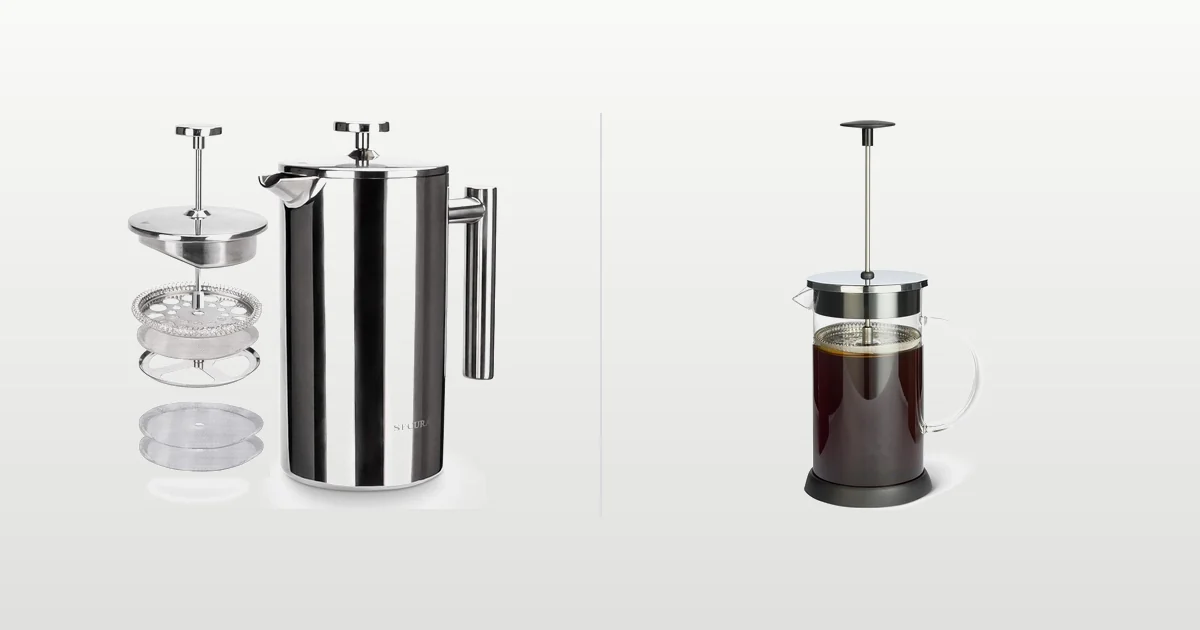
A French press is a jug, a lid and a mesh disc on a stick. There is genuinely very little to it, which is why most comparisons of them end up ranking handle shapes.
But line ten of them up by specification and the category splits cleanly in half, along a line nobody puts on the box: five of these are glass and five are double-walled steel, and everything that matters follows from which side you pick.
The split is not random, either. Every press in this roundup above 34 ounces is steel — the 48-ounce Stanley, the 50-ounce Secura, the 64-ounce YETI. Every press below 22 ounces is glass — the 21-ounce TBGENIUS, the 12-ounce RAINBEAN. Only at 32 to 34 ounces do the two materials actually compete, and that is where six of these ten sit.
The reason is time. A small press is emptied in five minutes and temperature never becomes a problem. A 50-ounce press gets poured from over half an hour, and glass cannot hold heat for half an hour. Manufacturers stopped making large glass presses because large glass presses serve cold coffee.
Which sets up the thing worth understanding before you spend anything. Insulation keeps the coffee hot. It does not stop the coffee brewing. The grounds sit under a mesh screen in the same body of water for as long as the pot is full, and a press pot that is still hot at hour two is also still extracting at hour two. Exactly one press on this page does something about that, and it is not one of the insulated ones.
Our Quick Picks
 Best OverallSecura 34 oz Stainless Steel
Insulated 304 steel inside and out, a three-layer filter, two spare screens and the best rating in this roundup.
 Stays Hot LongestSTANLEY Classic Stay-Hot 48 oz
The only press here with a stated heat-retention figure — brew in five minutes, still hot four hours later.
 Cheapest SteelAgcKuzt 34 oz Full Steel
Double-wall steel, a multi-layer mesh and two spare screens at twenty dollars — and 4.7 stars.
At a Glance
Ten French Presses Compared
Material first, because it decides heat retention, capacity and price — then filtration, which decides how much sludge ends up in the last mouthful.
| # | Model | Body Material | Capacity | Insulated | Filter | Standout | Main Drawback | Check Price |
|---|---|---|---|---|---|---|---|---|
| 1 |
 Secura 34 oz Stainless Steel Secura 34 oz Stainless Steel |
Double-wall 304 steel | 34 oz / 1 L | Yes, double-wall | Three-layer steel, 2 spares | The highest-rated press here at 4.7 stars | You cannot see how much is left | View on Amazon |
| 2 |
 Amazon Basics 34 oz Glass Amazon Basics 34 oz Glass |
Borosilicate glass | 34 oz | No | Three-stage: mesh, spring disk, cross plate | Three-stage filtration for $14.40 | Glass, and it will eventually break | View on Amazon |
| 3 |
 STANLEY Classic Stay-Hot 48 oz STANLEY Classic Stay-Hot 48 oz |
Double-wall vacuum steel | 48 fl oz | Yes, vacuum insulated | Steel mesh plunger | Listed at four hours hot | Tallest thing on the counter at 18 inches | View on Amazon |
| 4 |
 ESPRO P3 32 oz ESPRO P3 32 oz |
Borosilicate glass | 32 oz / 4 cups | No | Patented dual micro-filter, double seal | The only press here that stops extraction | 4.2 stars and the priciest glass here | View on Amazon |
| 5 |
 AgcKuzt 34 oz Full Steel AgcKuzt 34 oz Full Steel |
Double-wall steel | 34 oz / 1000 ml | Yes, double-wall | Multi-layer mesh, 2 spares | 4.7 stars for $20.48 | Brand nobody has heard of | View on Amazon |
| 6 |
 YMMIND 34 oz Glass YMMIND 34 oz Glass |
Borosilicate glass | 34 oz / 1000 ml | No | Four-level, four steel screens | Four filter screens, more than anything here | No insulation, and 34 oz cools fast | View on Amazon |
| 7 |
 Secura 50 oz Stainless Steel Secura 50 oz Stainless Steel |
Double-wall 304 steel | 50 oz / 1.5 L | Yes, double-wall | Three-layer steel, spare screen | 50 ounces of insulated steel | $52.99, and the listing’s dimensions are wrong | View on Amazon |
| 8 |
 YETI Rambler 64 oz YETI Rambler 64 oz |
Double-wall vacuum steel | 64 oz | Yes, vacuum insulated | GroundsControl filter | 64 ounces, biggest in the roundup | $130, four times the next steel press | View on Amazon |
| 9 |
 TBGENIUS 21 oz Glass TBGENIUS 21 oz Glass |
Borosilicate glass | 21 oz / 600 ml | No | Four-level filtration | Four filter levels at 21 ounces | Small, so it cools even faster | View on Amazon |
| 10 |
 RAINBEAN Mini 12 oz RAINBEAN Mini 12 oz |
Borosilicate glass | 12 oz / 350 ml | No | Stainless steel mesh | $9.95, the cheapest press in the roundup | One mug, and only one | View on Amazon |
Specifications, prices and ratings are taken from each manufacturer’s Amazon listing as displayed on 21 August 2026 and may change. Capacity is reproduced as stated, which is why several listings give a weight in pounds where a volume was expected. Three listings contain errors we have flagged in the individual reviews rather than silently corrected: the Secura 50 oz gives a height of 0.79 inches, which is impossible for a 1.5-litre press; the YETI Rambler gives 10.06 x 17.91 inches in its bullet points and 7.1 x 7.1 x 10.1 inches in its specification table; and the RAINBEAN lists its filter type as paper while its own description describes a stainless steel mesh. “Insulated” reflects what each listing claims: Stanley and YETI specify vacuum insulation, Secura and AgcKuzt specify a double wall without claiming a vacuum, and only Stanley publishes a heat-retention figure. Two AeroPress brewers, a Vietnamese phin filter and a Bodum replacement carafe were returned by the same Amazon category and excluded, as none of them is a French press.
Scroll the table sideways to see every column
How We Chose These French Presses
We researched current listings, compared manufacturer specifications and documentation, and examined recurring patterns in customer feedback. We did not carry out hands-on testing, and nothing below is presented as measured performance data.
- Glass or insulated steel — the split that decides heat, weight, price and whether you can see the brew
- Capacity against how you actually drink — 34 oz of glass goes cold before a slow drinker finishes it
- Filter layers, counted — one mesh disc versus a four-screen stack is the difference between sludge and none
- Whether extraction can be stopped — insulation addresses temperature; only a sealed filter addresses bitterness
- Stated grade and construction — 304 steel inside and out is not the same as a steel shell over a liner
- Actual French presses only — AeroPress brewers, a phin filter and a spare carafe were excluded from the category results
The 10 Best French Presses, Reviewed
1. Secura 34 oz Stainless Steel — Best Overall

Secura’s listing makes a point of saying the 18/8 304 steel runs both inside and outside the pot. That matters more than it sounds: plenty of cheap "stainless" presses use a steel shell over a plastic or lower-grade liner, and the liner is the part your coffee touches.
It is also the joint highest-rated press in this roundup, at 4.7 stars, and the highest-ranked, at #4 in Amazon’s Coffee Presses category.
Key Specifications
| Body material | 304 stainless steel, interior and exterior |
|---|---|
| Insulation | Double-wall |
| Capacity | 34 oz / 1000 ml |
| Filter | Three-layer stainless screen, 2 extra screens included |
| Dimensions | 6.1″D x 6.7″W x 9.8″H |
| Weight | 2.4 pounds |
| Cleaning | All parts dishwasher safe |
| Rating | 4.7 out of 5 stars |
| Best For | Anyone who drinks a press pot over an hour rather than a minute |
Why We Recommend It
The three-layer filter is the reason this one gets recommended. Most presses ship a single mesh disc. Secura stacks three screens, and includes two more in the box — and the listing explicitly says you can stack additional screens together for a finer filter.
That is a real answer to the standard French press complaint. Sludge in the last inch of the cup comes from fines slipping past a single mesh; more layers catch more of them.
What insulation does and does not fix. Double-wall steel will keep this hot far longer than any glass press here. It will not stop the coffee extracting, because the grounds stay in the pot underneath a mesh screen either way. Hot and bitter is still bitter. Decant it.
Pros
- Highest-rated press here at 4.7 stars
- 304 steel inside and out, not just a shell
- Three-layer filter with two spare screens included
- Double-wall insulation holds temperature
- Every part dishwasher safe
- #4 in Amazon’s Coffee Presses category
Cons
- Opaque, so you cannot see the brew or the level
- Heavier than glass at 2.4 pounds
- Insulation keeps it hot but does not stop over-extraction
- Twice the price of the glass presses here
Best for: The default recommendation, and the one to buy if you are only reading one entry.
2. Amazon Basics 34 oz Glass — Best Value

This is the cheapest full-size press in the roundup and the one most people should probably start with. Thirty-four ounces of borosilicate glass, a three-piece filter stack, everything dishwasher safe, $14.40.
It sits at #7 in Coffee Presses, which is higher than several presses here costing three times as much.
Key Specifications
| Body material | Borosilicate glass, BPA-free |
|---|---|
| Insulation | None |
| Capacity | 34 oz, stated as 5–6 cups |
| Filter | Three-stage: fine mesh, spring disk, cross plate |
| Weight | 506 g |
| Cleaning | Carafe, plunger and filter all dishwasher safe |
| Also brews | Tea, cold brew, hot chocolate, plant milks |
| Rating | 4.2 out of 5 stars |
| Best For | A first French press, or replacing one that broke |
Why We Recommend It
The filter is the surprise. At this price you expect one mesh disc. The listing specifies three stages — a fine mesh screen, a spring disk that seals against the glass wall, and a cross plate above it. The spring disk is the part that matters; it is what stops grounds escaping around the edge of the plunger rather than through it.
The rating is the honest caveat. At 4.2 stars it is the joint lowest here alongside the ESPRO and the YETI. For a glass press that almost always comes down to the same thing: glass breaks, and a carafe that arrives cracked or cracks in the sink produces a one-star review regardless of how the coffee tasted.
Treat it as a consumable at this price and it is very hard to argue with.
Pros
- Cheapest 34-ounce press here at $14.40
- Genuine three-stage filter, not a single disc
- Borosilicate glass, so you can see the brew
- All parts dishwasher safe
- #7 in Coffee Presses, above much pricier rivals
Cons
- 4.2 stars, joint lowest in this roundup
- No insulation, so it cools quickly
- Glass will eventually break
- Listing does not state dimensions
Best for: Anyone buying their first press, or anyone who has already broken one.
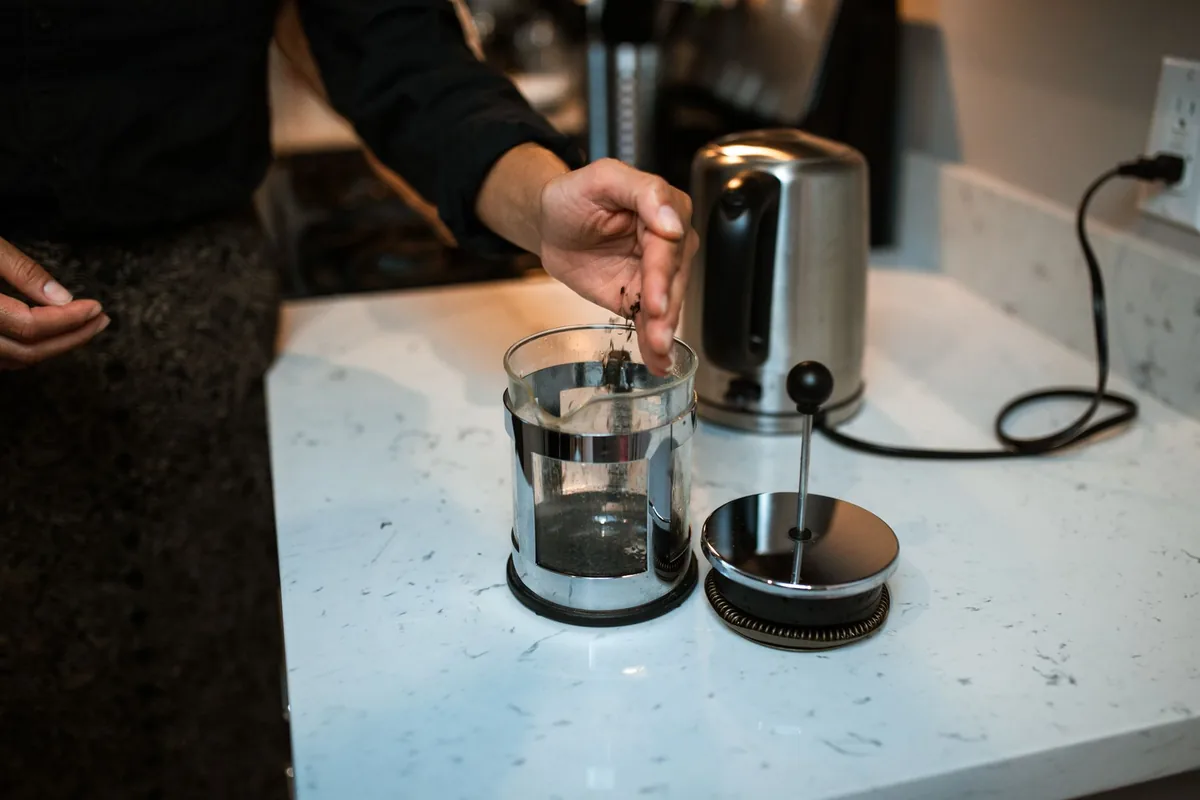
3. STANLEY Classic Stay-Hot 48 oz — Stays Hot Longest

Stanley is a vacuum flask company that has made a French press, rather than a coffee company that added insulation, and the difference shows in the one number nobody else here publishes: four hours hot.
Every other insulated press in this roundup says "keeps coffee hot" and leaves it there. Stanley commits to a figure.
Key Specifications
| Body material | 18/8 stainless steel, BPA-free |
|---|---|
| Insulation | Double vacuum insulation |
| Capacity | 48 fluid ounces |
| Heat retention | Stated as 4 hours hot |
| Filter | Steel mesh plunger |
| Dimensions | 9.52″D x 4.88″W x 18.1″H |
| Weight | 1.13 kg |
| Cleaning | Every piece dishwasher safe |
| Best For | Camping, a workshop, or a desk you do not leave |
Why We Recommend It
Double vacuum insulation is not the same as double wall. Two of the steel presses here are double-walled, which means an air gap. Stanley and the YETI are vacuum insulated, which means the air has been pulled out of that gap. Air conducts heat; a vacuum largely does not. That is the whole difference between a pot that is warm in an hour and one that is hot in four.
The trade-off is the same as every flask. You cannot see the coffee, you cannot see the level, and at 18.1 inches on the listing’s stated dimensions this is by some distance the tallest item here — worth measuring against your cupboard shelf before ordering.
And four hours hot means four hours extracting. Unless you decant it, hour four is a very different drink from minute six.
Pros
- Only press here with a published heat-retention figure
- True vacuum insulation, not just a double wall
- 48 ounces, enough for four large mugs
- 18/8 steel and BPA-free throughout
- Every piece is dishwasher safe
- Built by a flask manufacturer, and it feels like it
Cons
- 18.1 inches tall on the listing’s own figures
- Opaque, no view of the brew or the level
- Four hours hot is also four hours over-extracting
- $54.68, near the top of this roundup
Best for: Anyone who brews once and drinks it slowly — campsite, workshop, home office.
4. ESPRO P3 32 oz — Least Sediment

Every other press in this roundup solves the wrong problem. They insulate the pot so the coffee stays hot, and the coffee carries on brewing while it sits there.
ESPRO does something different. Its double silicone seal presses against the carafe wall so that the grounds are trapped below the filter, not merely pushed to the bottom of the same body of water.
Key Specifications
| Body material | Borosilicate glass, 40% thicker than standard |
|---|---|
| Insulation | None |
| Capacity | 32 oz / 4 cups |
| Filter | Patented dual-layer BPA-free micro-filter |
| Seal | Patented double silicone seal |
| Safety | Twist-lock latch secures the lid |
| Dimensions | 6.6″D x 6.6″W x 10″H |
| Weight | 1.4 pounds |
| Best For | Anyone whose complaint about press coffee is grit or bitterness |
Why We Recommend It
That is the meaningful engineering difference on this page. In a conventional press, plunging separates the grounds physically but not chemically — water still circulates through the bed, and extraction continues until the pot is empty. The listing’s phrasing is that the seal "stops over-extraction and traps bitterness below the filter."
The practical result is that you can leave the second cup in the carafe without it turning harsh, which no other press here can claim.
The filter is dual-layer and micro-perforated, which is also why ESPRO markets it as grit-free. If your objection to French press coffee is the sludge in the last mouthful, this is the direct answer to it.
The caveats are real. It is $39.94, the most expensive glass press here; it sits at 4.2 stars; and it has no insulation at all, so it addresses bitterness while doing nothing about temperature.
Pros
- The only press here that actually halts extraction
- Dual-layer micro-filter, marketed as grit-free
- 40% thicker borosilicate than standard glass
- Twist-lock safety latch on the lid
- Rated for hot brewing and cold brew
- Dishwasher safe
Cons
- $39.94, dearest glass press in this roundup
- 4.2 stars, joint lowest here
- No insulation whatsoever
- Filter and seal are proprietary consumables to replace
Best for: The press to buy if bitterness or grit is what you dislike about the method.
5. AgcKuzt 34 oz Full Steel — Cheapest Steel
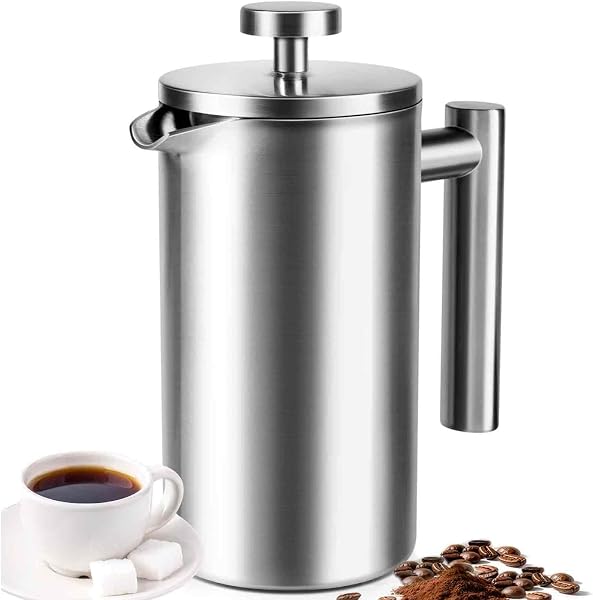
This is the value anomaly of the roundup. It matches the joint highest rating here — 4.7 stars, level with both Securas — at $20.48, which is less than half what the other insulated presses cost.
It also sits at #10 in Coffee Presses, so the rating is not coming from a handful of reviews.
Key Specifications
| Body material | Stainless steel, double wall |
|---|---|
| Insulation | Double-wall (vacuum not stated) |
| Capacity | 34 oz / 1000 ml, stated as 4–8 cups |
| Filter | Multi-layer mesh, 2 extra screens included |
| Finish | Brushed, with pour spout |
| Dimensions | 4.15″D x 7.37″W x 7.18″H |
| Weight | 1.3 pounds |
| Cleaning | Dishwasher-safe components |
| Best For | Insulated steel on a glass-press budget |
Why We Recommend It
Read the insulation claim precisely. The listing says "double-wall stainless steel" and "superior heat retention." It does not say vacuum insulated, and it publishes no heat-retention figure. Stanley and YETI both specify a vacuum; this one specifies an air gap.
An air gap does help — it will hold heat far better than glass. It will not hold it like a flask.
What you do get for the money is a multi-layer mesh with two spare screens, a proper pour spout, dishwasher-safe parts and cold-brew capability, all in steel. The only thing genuinely missing versus the Secura is the brand and the explicit 304 grade.
The listed dimensions are odd — 4.15 inches deep by 7.37 wide by 7.18 high, which does not describe a one-litre cylinder particularly well. Treat the footprint as approximate.
Pros
- Joint highest rating here at 4.7 stars
- $20.48, less than half the other insulated presses
- Multi-layer mesh with two spare screens
- Full steel body with a pour spout
- Dishwasher-safe components
- Works for cold brew as well as hot
Cons
- Double wall, but vacuum insulation is not claimed
- No heat-retention figure published
- Steel grade not stated, unlike the Securas
- Unfamiliar brand name
- Listed dimensions do not obviously match a 1 L pot
Best for: The best-value insulated press here, if you can live without a published heat figure.
6. YMMIND 34 oz Glass — Most Filter Layers

Where the Amazon Basics press stacks three filter stages and the Secura stacks three screens, YMMIND stacks four — and ships two of them separately so you can add or remove layers depending on how fine your grind is.
At 4.6 stars and $17.99 it is the highest-rated glass press in this roundup.
Key Specifications
| Body material | Thickened borosilicate glass |
|---|---|
| Frame and filter | 304 stainless steel, BPA-free plastic |
| Insulation | None |
| Capacity | 34 oz / 1000 ml, stated as 5–6 cups |
| Filter | Four-level system, 4 steel screens, 2 stored separately |
| Dimensions | 4″D x 5.9″W x 8.4″H |
| Also brews | Tea, cold brew, frothed milk |
| Rating | 4.6 out of 5 stars |
| Best For | Grit-free press coffee without paying ESPRO money |
Why We Recommend It
Filter layers are the cheapest fix for the main complaint about this method. Sludge is fines passing the mesh. Every additional screen catches more of them, at the cost of a slower, heavier plunge.
That is genuinely the trade: a four-screen stack takes noticeably more force to push down, and if you grind fine it can be hard work. Coarse grind and it is the cleanest cup available here short of the ESPRO.
It is glass, so it cools. Thirty-four ounces is four mugs, and by the fourth one an uninsulated glass carafe on a room-temperature counter is serving lukewarm coffee. This is a press for people who pour it all out at once.
Pros
- Four-level filter, the most layers in this roundup
- Highest-rated glass press here at 4.6 stars
- Two screens supplied separately so you can tune it
- Thickened borosilicate with a 304 steel frame
- $17.99 for 34 ounces
- Doubles as a tea press and milk frother
Cons
- No insulation, and 34 oz is a lot to keep warm
- Four screens make for a stiff plunge
- Ranked #20 in Coffee Presses, low visibility
- Glass is breakable
Best for: Anyone who wants the cleanest possible cup from a cheap glass press.
7. Secura 50 oz Stainless Steel — Best for Four

Mechanically this is the 34-ounce Secura with a bigger body: same 304 steel inside and out, same three-layer filter structure, same cool-touch handle, same 4.7-star rating.
The difference is 1.5 litres instead of 1, which is the gap between serving two people and serving four.
Key Specifications
| Body material | 304 stainless steel, interior and exterior |
|---|---|
| Insulation | Double-wall |
| Capacity | 50 oz / 1500 ml |
| Filter | Three-layer stainless screen, extra screen included |
| Weight | 3.7 pounds |
| Cleaning | All parts dishwasher safe |
| Handle | Cool-touch handle and knob |
| Rating | 4.7 out of 5 stars |
| Best For | Three or four coffee drinkers at the same table |
Why We Recommend It
Capacity is where insulation stops being optional. A 50-ounce press is not a pot you empty in one go. It gets poured from over twenty or thirty minutes, and an uninsulated 50-ounce carafe would be cold well before it was empty. Every press here above 34 ounces is steel for exactly this reason.
It is also 3.7 pounds empty, which is the heaviest press in this roundup. Full, it is a two-handed pour.
One listing error worth flagging: the stated dimensions are 3.94 inches deep by 5.91 wide by 0.79 high. A 0.79-inch-tall 1.5-litre press does not exist. The height figure is a data-entry mistake; expect something in the region of eleven inches.
Pros
- 50 ounces, the practical large size here
- 4.7 stars, joint highest in this roundup
- 304 steel inside and out
- Three-layer filter with a spare screen
- Cool-touch handle and knob
- Dishwasher safe throughout
Cons
- 3.7 pounds empty, heaviest press here
- Listing height of 0.79 inches is plainly an error
- $52.99
- Opaque, so you are guessing at the level
- Ranked #21, low category visibility
Best for: Households of three or four where one brew has to cover everybody.
8. YETI Rambler 64 oz — Largest Here

Sixty-four ounces is double the standard press size and half again the Secura 50. If you are brewing for a group in a place without a kitchen, this is the only entry here that does it in one go.
It is 18/8 steel, vacuum insulated, dishwasher safe, and it costs $130 — roughly what the Secura 50, the AgcKuzt and the Amazon Basics cost together.
Key Specifications
| Body material | 18/8 kitchen-grade stainless steel |
|---|---|
| Insulation | Double-wall vacuum |
| Capacity | 64 oz |
| Filter | GroundsControl filter |
| Dimensions | 7.1″D x 7.1″W x 10.1″H per specifications |
| Weight | 4.1 pounds |
| Cleaning | Dishwasher safe |
| Accessory | MagSlider lid sold separately, non-standard fitment |
| Best For | A crew, a campsite, or an existing YETI household |
Why We Recommend It
The GroundsControl filter is YETI’s own design and the listing describes it as separating grounds from coffee. YETI does not publish a mesh count or layer count, so it cannot be compared like-for-like against the three- and four-screen stacks elsewhere in this roundup.
The listing contradicts itself on size. The bullet points give 10.06 inches wide by 17.91 high with an empty weight of 3.66 pounds; the specification table gives 7.1 x 7.1 x 10.1 inches and 4.1 pounds. Those cannot both be right. Given a 64-ounce capacity, the taller figure is the more plausible one.
And note the accessory warning. The listing explicitly says a MagSlider lid is available separately but that the standard Rambler twist-to-lock MagSlider must not be used. If you already own YETI drinkware, your lids do not transfer.
Pros
- 64 ounces, by far the largest here
- True vacuum insulation in 18/8 steel
- Puncture and rust resistant
- Dishwasher safe
- Built to the durability standard YETI is bought for
Cons
- $130.00, the most expensive press in this roundup by a wide margin
- 4.2 stars, joint lowest here
- Listing gives two contradictory sets of dimensions
- Filter specification is not published
- Existing YETI MagSlider lids are not compatible
- 4.1 pounds empty
Best for: Groups, camps and anyone already committed to the YETI ecosystem.
9. TBGENIUS 21 oz Glass — Best Small Glass

Six hundred millilitres is the size most people actually need. It is two decent mugs, which is one person having a second cup or two people having one each — and it is small enough that the coffee is gone before temperature becomes an argument.
At $12.99 it is the second-cheapest press here, and it still carries a four-level filter.
Key Specifications
| Body material | Thickened borosilicate glass |
|---|---|
| Filter material | Stainless steel |
| Insulation | None |
| Capacity | 21 oz / 600 ml |
| Filter | Four-level filtration system |
| Base | Moulded base isolating the glass from the counter |
| Dimensions | 5.9″D x 5.5″W x 7.8″H |
| Weight | 0.45 kg |
| Best For | One or two mugs, brewed and poured immediately |
Why We Recommend It
The base is a better detail than it sounds. The listing describes a moulded base that isolates the bottom of the glass from the surface it sits on. Thermal shock — hot glass meeting a cold worktop — is one of the two ways glass presses die. The other is the sink.
Small and uninsulated is an honest combination. A 21-ounce glass press cools quickly, but 21 ounces is a size you finish quickly. The mismatch in this category is buying 34 ounces of glass and then wondering why the last mug is cold.
The listing also mentions frothing milk with the plunger, which every mesh press does and none of them advertise as well as they should.
Pros
- $12.99, second cheapest in this roundup
- Four-level filtration at an entry price
- 600 ml is a genuinely sensible size
- Protective base guards against thermal shock
- Thickened borosilicate rather than thin glass
- Doubles as a milk frother
Cons
- No insulation
- 4.4 stars, mid-table here
- Ranked #22 in Coffee Presses
- 21 oz is too small for three people
- Glass
Best for: One or two people who brew and pour straight away.
10. RAINBEAN Mini 12 oz — Cheapest Here

Ten dollars, twelve ounces, 290 grams. This is the smallest and cheapest thing here and it is not trying to compete with the rest of the list.
It exists for the single-mug case: one person, one cup, somewhere that is not a kitchen.
Key Specifications
| Body material | German borosilicate glass |
|---|---|
| Frame | ABS plastic and stainless steel |
| Insulation | None |
| Capacity | 12 oz / 350 ml |
| Filter | Stainless steel refined filter |
| Dimensions | 2.95″D x 4.53″W x 6.7″H |
| Weight | 0.29 kg |
| Stated brew time | 3 minutes |
| Best For | Camping, a desk drawer, or a single mug a day |
Why We Recommend It
At 350 ml it makes one mug. Not one large mug and a top-up — one mug. If you drink two cups in a morning you will brew twice, which is the main reason to spend three more dollars on the 600 ml TBGENIUS instead.
What it does have is a proper borosilicate carafe rather than plastic, a steel mesh filter, and enough of a rating base to sit at 4.4 stars.
One inconsistency to note: the specification table lists the filter type as "Paper," while the description describes a stainless steel filter and the product plainly has one. The structured field is wrong. No French press at this size uses paper.
Pros
- $9.95, cheapest press in this roundup
- Borosilicate glass, not plastic
- 290 g and under 7 inches tall, genuinely portable
- Steel mesh filter
- 4.4 stars
- Works as a tea and milk press too
Cons
- 12 oz is one mug and no more
- No insulation at all
- Specification field lists the filter as paper, which is incorrect
- ABS plastic frame
- Ranked #24, the lowest visibility here
Best for: A single mug away from a kitchen — camping, travelling, a desk drawer.
Glass or Steel: The Five-and-Five Split
Every press in this roundup falls on one side of this line, and it decides far more than the look.
| Glass (5 here) | Double-wall steel (5 here) | |
|---|---|---|
| Presses | Amazon Basics, ESPRO P3, YMMIND, TBGENIUS, RAINBEAN | Secura 34, Secura 50, Stanley, AgcKuzt, YETI |
| Price range here | $9.95 – $39.94 | $20.48 – $130.00 |
| Capacity range here | 12 – 34 oz | 34 – 64 oz |
| Holds heat | No | Yes, to varying degrees |
| See the brew and level | Yes | No |
| Breakable | Yes | No |
| Weight range here | 0.29 – 1.4 lb | 1.3 – 4.1 lb |
| Best rating here | 4.6 (YMMIND) | 4.7 (both Securas, AgcKuzt) |
Notice where the ranges stop. No glass press here exceeds 34 ounces and no steel press here goes below it, because the two materials are solving for different lengths of time. If you brew and pour immediately, glass costs less, shows you the coffee and does nothing worse. If the pot sits for twenty minutes, glass is serving you tepid coffee and no filter design will fix that. Work out how you actually drink it before you decide anything else, because this choice constrains capacity and price as well.
Double Wall Is Not a Vacuum
Three different insulation claims appear in this roundup, and only one of them comes with a number.
| Claim | Presses | What the listing says | Real-world effect |
|---|---|---|---|
| Vacuum insulated | Stanley 48 oz | “Double vacuum insulation”, 4 hours hot | Flask-grade; the air is pulled out of the gap |
| Vacuum insulated | YETI Rambler 64 oz | “Double-wall vacuum insulation”, no figure given | Flask-grade, but unquantified |
| Double wall | Secura 34 oz, Secura 50 oz | “Insulated”, 304 steel both sides, no figure | Air-gap; far better than glass, short of a flask |
| Double wall | AgcKuzt 34 oz | “Superior heat retention”, no figure | Air-gap; no grade or vacuum claimed |
| None | All five glass presses | Not claimed | Cools steadily from the moment you pour |
A vacuum and an air gap are not the same product. Air conducts heat; a vacuum largely does not, which is why a flask works and a double-glazed window only helps. Stanley is the only press on this page that publishes a retention figure at all, and four hours is a flask number, not a coffee-pot number. That does not make the double-walled Securas bad — they will hold heat vastly better than any glass press here — but if you are paying for insulation specifically, know which kind you are buying.
Best Alternatives
| Alternative | Why Consider It | Better For | Main Trade-Off |
|---|---|---|---|
| An AeroPress | Fast, forgiving, portable, and it presses through paper | One clean strong cup in two minutes | Single serve only, and paper filters are an ongoing cost |
| A pour over dripper | Cleaner cup, more control, costs almost nothing | Bright, tea-like coffee | Needs technique, and paper filters forever |
| A moka pot | Strong and concentrated, no filters at all | Espresso-adjacent stovetop coffee | Easy to scorch, and not remotely the same drink |
| A cold brew jug | The same immersion principle, no heat, far less bitterness | Iced coffee and concentrate | Twelve to twenty-four hours of waiting |
| A drip machine | Hands-off, timer, walk away | Volume and mornings | No control, and most brew below ideal temperature |
What Each Price Tier Actually Buys
$9.95 to $14.40 — RAINBEAN 12 oz, TBGENIUS 21 oz, Amazon Basics 34 oz. All glass, all uninsulated, and all better specified than the price suggests. The Amazon Basics has a three-stage filter and the TBGENIUS a four-level one. This tier is where the value in the category sits, and nothing above it brews measurably better coffee.
$17.99 to $20.99 — YMMIND 34 oz, AgcKuzt 34 oz. The two most interesting entries. YMMIND is the highest-rated glass press here at 4.6 stars with the most filter layers of anything on the page; AgcKuzt is double-walled steel at 4.7 stars for $20.48, less than half what the other insulated presses cost.
$29.99 to $39.94 — Secura 34 oz, ESPRO P3. Where you buy a specific property. The Secura buys 304 steel inside and out with a published grade and the best rating here. The ESPRO buys the only sealed filter on the page, which is the only real answer to bitterness.
$52.99 to $54.68 — Secura 50 oz, Stanley 48 oz. Capacity plus insulation. Above 34 ounces glass stops being an option, and this is what the steel alternative costs.
$130.00 — YETI Rambler 64 oz. The largest press here and the most expensive by a factor of two and a half. You are buying capacity, vacuum insulation and YETI’s durability standard; you are not buying a better filter, because YETI does not publish its specification.
The pattern: the three joint-highest-rated presses in this roundup cost $20.48, $29.99 and $52.99, and the two lowest-rated cost $14.40 and $130.00. Price buys material, capacity and heat retention. It does not buy filtration, and it does not buy ratings.
How to Choose a French Press
Decide How Long the Pot Will Sit
This is the whole decision and everything else follows from it. If you brew and pour within a few minutes, glass is cheaper, lets you watch the brew and gives up nothing. If the pot sits on the table for twenty minutes or travels to a campsite, glass will serve you tepid coffee no matter how good the filter is. Every press in this roundup above 34 ounces is steel for precisely this reason.
Count the Filter Layers Before Anything Else
Sediment in the last inch of the cup is the standard complaint about this method, and it is caused by fine particles passing a single mesh screen. The presses here run from one screen to four. A four-level stack costs $12.99 on this page and a single mesh costs $54.68, so the specification has almost nothing to do with the price — you simply have to read for it.
Understand That Plunging Does Not Stop the Brewing
Pushing the plunger separates the grounds physically. It does not remove them from the water, so extraction continues for as long as the coffee sits in the pot, and by the second cup a conventional press is noticeably harsher than it was. Decanting into a mug, a flask or a thermos immediately after plunging is the single free improvement available to anyone who owns any press. Only the ESPRO, with its sealed dual filter, addresses this in the pot itself.
Read the Insulation Claim Word by Word
“Double wall” means an air gap. “Vacuum insulated” means the air has been removed from that gap, and the two perform very differently over a couple of hours. In this roundup, Stanley and YETI claim a vacuum; the two Securas and the AgcKuzt claim only a double wall. Stanley is the only one that publishes an actual figure — four hours — and a number you can check is worth more than an adjective.
Buy the Size You Drink, Not the Size You Imagine
Capacities here run from 12 ounces to 64. The most common mistake is buying 34 ounces of uninsulated glass and then wondering why the third mug is cold: 34 ounces is four cups, and four cups takes a while. If you are one person having two cups, 600 ml is the right answer and costs $12.99. If you are serving four people, you need steel, and that starts at $20.48.
Grind Coarse, and Coarser Than You Think
A press has the largest filter openings of any brewing method, so fine grounds go straight through and produce both sludge and over-extraction. Medium-coarse — roughly the texture of sea salt — is the standard recommendation, and Stanley’s listing says so explicitly. If your press coffee is muddy and bitter, the grinder is a far more likely culprit than the press, and no number of filter screens fully compensates for grounds that are too fine.
Common French Press Buying Mistakes
- Assuming insulation fixes bitterness. It fixes temperature. The grounds keep extracting in a hot pot exactly as they do in a cold one.
- Buying 34 ounces of glass for a slow morning. Above about 20 ounces, uninsulated glass is serving lukewarm coffee before the pot is empty.
- Ignoring the filter layer count. Presses here ship anywhere from one screen to four, and the four-layer ones are the cheapest on the page.
- Treating “double wall” and “vacuum insulated” as the same claim. One is an air gap; the other is not, and only one press here publishes a retention figure.
- Leaving the coffee in the pot. Decanting after plunging costs nothing and improves every press in this roundup.
- Grinding too fine. A press has the coarsest filter of any method, and fine grounds pass straight through it.
- Paying for a brand instead of a specification. The most expensive press here does not publish its filter design at all.
- Buying a 12-ounce press for two people. Twelve ounces is one mug, and it will not stretch.
Which French Press Should You Buy?
Buy the Secura 34 oz if you want one recommendation and no further thought. 304 steel inside and out, a three-layer filter with two spares, 4.7 stars and #4 in the category.
Buy the Amazon Basics 34 oz if this is your first press. Three-stage filtration and 34 ounces of borosilicate for $14.40, and if it breaks you have lost fourteen dollars.
Buy the ESPRO P3 if your complaint about press coffee is that it turns bitter or gritty. It is the only press here whose seal actually stops the extraction.
Buy the AgcKuzt if you want insulated steel on a glass budget. 4.7 stars at $20.48, with the caveat that it claims a double wall rather than a vacuum.
Buy the Stanley 48 oz if the pot has to stay hot without a kitchen. It is the only press on this page that publishes a heat-retention figure.
Buy the YMMIND 34 oz if you want the cleanest cup a cheap glass press can give — four screens, 4.6 stars, $17.99.
Buy the TBGENIUS 21 oz if you are one or two people. Six hundred millilitres is the size most households actually need, at $12.99.
Buy the Secura 50 oz or the YETI 64 oz if you are serving three or four people and the pot has to last.

Frequently Asked Questions
Does an insulated French press make better coffee?
It makes coffee that stays hot, which is not the same thing. Insulation slows heat loss; it does nothing to the extraction happening inside the pot, because the grounds remain in the water underneath a mesh screen whether the walls are vacuum-sealed or not. A press that is still hot two hours later is also still extracting two hours later, and it will taste harsher for it. If bitterness rather than temperature is your complaint, the fix is either decanting immediately or a press with a sealed filter, of which there is exactly one in this roundup.
How do I stop sediment in French press coffee?
Two things cause it, and both are addressable. The first is grind: a press has the largest filter openings of any brewing method, so anything approaching an espresso grind passes straight through. Medium-coarse, roughly the texture of sea salt, is the standard recommendation. The second is the filter itself, and this is where listings differ enormously. The presses in this roundup ship anywhere from one mesh screen to a four-level stack, and the four-layer models are among the cheapest here. Stacking additional screens, where the manufacturer supplies them, filters finer still at the cost of a stiffer plunge.
Is a glass or stainless steel French press better?
They are answers to different questions rather than better and worse. Glass costs less, lets you see the brew and the level, and cleans easily; it also loses heat continuously and eventually breaks. Steel holds heat, survives being dropped and scales to larger capacities; it is opaque, heavier and dearer. The dividing line in practice is time: if the pot is empty in five minutes, glass gives up nothing, and if it sits for twenty, glass is serving cold coffee. That is why every press in this roundup over 34 ounces is steel and every one under 22 ounces is glass.
What is the difference between double wall and vacuum insulated?
A double wall is two layers of steel with an air gap between them. Vacuum insulation is the same construction with the air evacuated from that gap. Air conducts heat and a vacuum largely does not, so the performance difference over a couple of hours is substantial. Both terms appear on this page: Stanley and YETI specify a vacuum, while the Securas and the AgcKuzt specify only a double wall. Any double wall will hold heat far better than glass, but if long retention is what you are paying for, look for the word vacuum and, better, a published figure in hours.
How long should coffee steep in a French press?
Four minutes is the conventional figure and Stanley’s listing says five. What matters more is what happens afterwards: the coffee does not stop brewing when you press the plunger down, so a pot left standing at eight minutes is not a four-minute brew regardless of when you plunged. Decant everything you are not drinking immediately into a mug or a flask. That single habit changes press coffee more than any equipment difference in this roundup, and it costs nothing.
What size French press do I need?
Smaller than most people buy. The sizes here run from 12 ounces to 64. Twelve ounces is one mug and no more. Around 20 to 21 ounces is two mugs, which covers one person having a second cup or two people having one each, and it is the size that suits the most households. Thirty-four ounces is four cups and the standard large size; above that you are into 48, 50 and 64 ounces, which are entertaining and camping sizes. Remember that capacity and material are linked: a large uninsulated press will be cold before it is empty.
Can you use a French press for cold brew?
Yes, and it is one of the better uses for one. Coarse grounds, cold water, twelve to twenty-four hours in the fridge, then plunge and decant. Several listings in this roundup mention cold brew explicitly, including the ESPRO, the AgcKuzt and the Amazon Basics. Because cold water extracts far less of the bitter compounds, the usual objection to leaving coffee sitting on its grounds mostly disappears — though you should still decant after plunging rather than storing it on the bed.
Are expensive French presses worth it?
Not on the evidence in this roundup. The three joint-highest-rated presses here cost $20.48, $29.99 and $52.99, while the most expensive product on the page, at $130.00, is among the lowest rated and does not publish its filter specification. What money reliably buys in this category is capacity, insulation grade and build durability. It does not buy better filtration — the two four-level filters here cost $12.99 and $17.99 — and it does not buy better-tasting coffee, which comes from grind, ratio and decanting rather than from the pot.
Final Verdict
304 steel inside and out, a three-layer filter with two spare screens, and the joint best rating here.
Three-stage filtration and 34 ounces of borosilicate glass for $14.40.
The only press on this page that publishes a figure: four hours hot, from a vacuum flask manufacturer.
Ten presses, and the category divides in half on a specification that is rarely presented as a choice. Five are glass and five are double-walled steel, and the line is drawn by capacity: nothing here above 34 ounces is glass, and nothing below 22 ounces is steel. Work out whether your pot gets emptied in five minutes or sits for thirty, and you have made most of the decision.
Then read the filter specification, because it does not track the price at all. The two four-level filters in this roundup cost $12.99 and $17.99; the $54.68 Stanley ships a single mesh screen and the $130 YETI does not publish a count. If sludge is what you dislike about press coffee, you can fix it for under twenty dollars.
And remember what insulation does not do. A vacuum-walled press keeps your coffee hot for four hours and keeps it extracting for four hours, and hour four is a much harsher drink than minute five. Only the ESPRO seals the grounds away from the water. Everyone else’s answer — and it is a perfectly good one — is to pour it out of the pot as soon as you have pressed it.