Affiliate Disclosure: As an Amazon Associate, we earn from qualifying purchases. This does not affect the price you pay.
Ten pizza stones on this page are sold for the grill. Read their listings end to end and a pattern appears: most of them were written for an oven, with the grill added afterwards.
Not one of the ten names a gas grill, a pellet grill or a kamado. Not one mentions direct flame. Six put the word “oven” in the product title, and the best-selling stone here, the Old Stone 16-inch round, is “Recommended for up to 500 degrees in a standard home oven” while its own spec table says 1,472°F.
The heat ratings are not the problem. Where they are stated they run from 1,000°F to 1,500°F, far beyond anything a backyard grill produces. A stone on a grill does not fail because it gets too hot. It fails because one face gets hot faster than the other: a cold stone set on a grate over lit burners, a damp stone, a stone with flame playing on one patch of its underside.
Three listings say anything at all about that. Ritual Life writes “Never put a cold stone in a hot oven or bbq, this will cause it to crack.” Gyreuni claims “excellent themal shock resistance”, typo included. Old Stone’s rectangular stone tells you to place it in a cold oven and preheat. The other seven are silent.
The second thing a grill changes is space. An oven rack is a known size; a grill grate is whatever you happened to buy. Only Unicook states a clearance, asking for “a minimum of 1-2 inches of clearance on ALL sides” around its 15 x 12 stone and a 1-inch gap around its 20 x 16. Only Weber designs its stone to sit inside one particular grate.
So this guide reads every listing for the three things a grill actually tests: what the stone is made of and what the maker says about shock, whether it fits your grate with the lid shut, and what else comes in the box. Ratings are quoted with their review counts. Two of those counts are pooled across listings, and we flag both.
The stone with the most useful grill instructions is the Unicook 15 x 12.
Our Quick Picks
 Best OverallUnicook 15 x 12 Pizza Stone
The only stone that states thickness, weight, heat rating, a maximum pizza size and a 1–2 inch clearance.
 Best for Kettle GrillsWeber 8836 Gourmet BBQ System Stone
Built to drop into the Gourmet BBQ System grate, with a carry rack, and rated 4.6 across 2,235 ratings.
 Best Complete KitRitual Life 16 Inch Stone Set
Rated to 1,500°F, with handles that flip into a rack, a peel, a cutter and the clearest crack warning here.
At a Glance
Ten Grill Stones, Sorted by What the Listing Tells You
Material, stone size, stated heat rating and price. Every stated rating here is far past what a grill reaches, so read the size column against your own grate first.
| # | Model | Material | Stone Size | Heat Rating | Best Sellers Rank | Standout | Main Drawback | Check Price |
|---|---|---|---|---|---|---|---|---|
| 1 |
 Unicook 15 x 12 |
Cordierite | 15 x 12 x 0.6 in | 1,450°F | #2 in Pizza Grilling Stones | States clearance, thickness, weight and an 11-inch pizza limit | Rating pooled with the 20 x 16 Unicook | View on Amazon |
| 2 |
 Weber 8836 GBS Stone |
Cordierite | 16.7 x 13.2 in | Not stated | #29 in Pizza Grilling Stones | Sits inside the Gourmet BBQ System grate; carry rack included | Fit claim covers one grate system; no heat rating | View on Amazon |
| 3 |
 Ritual Life 16 Inch Set |
Cordierite | 16 in round x 0.6 in | 1,500°F | #4 in Pizza Grilling Stones | Handles double as a rack; peel and cutter included | Only 210 ratings behind its 4.6 | View on Amazon |
| 4 |
 Unicook 20 x 16 |
Cordierite | 20 x 16 x 0.6 in | 1,450°F | #2 in Pizza Grilling Stones | Largest surface here at 320 square inches | 15.8 lb, and needs a 22 x 18 in space | View on Amazon |
| 5 |
 Hans Grill PRO XL |
Cordierite | 14.9 x 11.8 x 0.6 in | 1,112°F | #1 in Pizza Grilling Stones | Perforated anodised aluminium peel in the box | Rating pooled with a round sibling; weight not stated | View on Amazon |
| 6 |
 Gyreuni 15 x 12 Set |
Cordierite | 15 x 12 x 0.4 in | 1,472°F | #12 in Pizza Pans & Stones | Only listing that claims thermal shock resistance | Spec table gives the material as oak | View on Amazon |
| 7 |
 Old Stone 14 x 16 |
Stoneware / cordierite | 16 x 14 x 0.43 in | 1,450°F | #26 in Pizza Pans & Stones | Tells you to start the stone cold | Spec says stoneware, bullets say cordierite | View on Amazon |
| 8 |
 Culinary Couture 15 x 12 |
Cordierite | 15 x 12 in (title) | 1,000°F | #10 in Pizza Grilling Stones | Cheapest stone here | Lowest heat rating; size and thickness conflict | View on Amazon |
| 9 |
 Cuisinart CPS-445 Pack |
Cordierite / ceramic | 13 in round | Not stated | #290 in Pizza Pans & Stones | 11,473 ratings, with peel and cutter included | Smallest stone here; no heat rating | View on Amazon |
| 10 |
 Old Stone 16 Inch Round |
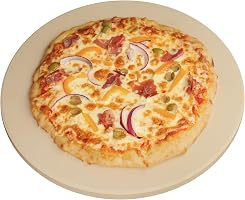
Stoneware | 16 in round x 0.59 in | 500° rec. / 1,472°F | #3 in Pizza Pans & Stones | 2K+ bought in the past month, most here | Recommended to 500 degrees in a home oven | View on Amazon |
Ratings and specifications are taken from each manufacturer’s Amazon listing as displayed on 5 October 2026 through a United States connection, and may change. Two rating pools are shared. Both Unicook stones show 4.5 across 13,425 ratings, and the Hans Grill PRO XL shows the same 4.4 across 13,869 ratings as the brand’s 15-inch round stone, which we left out for that reason. Five listings carry conflicting fields and we report both sides: Old Stone’s 14 x 16 (stoneware in the spec table, cordierite in the bullets), Old Stone’s 16-inch round (500 degrees recommended, 1,472°F in the spec table), Culinary Couture (15 x 12 in the title, 15 x 15 in the spec table; 0.4 in thick in the bullets, 0.5 in in the spec table), Unicook’s 20 x 16 (a second spec field says 20 x 13.5 in) and Cuisinart (cordierite in the bullets, ceramic in the spec table). Weber’s 2 in and Cuisinart’s 13 in “thickness” figures are listed as shown but not treated as the stone’s own thickness. Weights given in kilograms are converted to pounds, and include bundled accessories where the listing weighs the whole set.
Scroll the table sideways to see every column
How We Chose These Ten
We researched current listings, compared manufacturer specifications and documentation, and examined recurring patterns in customer feedback. We did not carry out hands-on testing, and nothing below is presented as measured performance data.
- Sold for grill use, or bought heavily enough to be used on one — nine of ten listings mention a grill or BBQ; the Old Stone 16-inch round does not, and we say so in its entry
- Material read from both the spec table and the bullets — three listings disagree with themselves about what the stone is made of
- Heat rating as published, or “Not stated” — eight publish one, from 1,000°F to 1,500°F; Weber and Cuisinart publish none
- Grill guidance counted line by line — mentions of gas, pellet, kamado, direct flame, cold starts, thermal shock and clearance
- Footprint converted to square inches and to a minimum grate size — so you can hold a tape measure against your grill rather than against a product photo
- Weights converted from kilograms where needed — and flagged where the figure includes a peel, rack or cutter
- Ratings with their review counts, pooled counts marked — two pools cover three of the ten listings
- One deliberate drop — the Hans Grill 15-inch circular stone, which shares the PRO XL’s 13,869-rating pool and #1 rank
- A verified live buy box — all ten confirmed purchasable with US delivery on 5 October 2026
The Ten Grill Stones in Detail
1. Unicook 15 x 12 Pizza Stone — Best Overall

This is the only listing on the page that tells you how much grill a stone needs.
Key Specifications
| Material | Cordierite |
|---|---|
| Stone size | 15 x 12 in, reversible |
| Thickness | 0.6 in (15 mm) |
| Weight | 6.8 lb in the bullets; 2.95 kg (about 6.5 lb) in the spec table |
| Heat rating | 1,450°F (787°C) |
| Clearance stated | 1–2 in on all sides |
| Pizza size stated | Personal pizzas up to 11 in |
| Included | Plastic dough scraper |
| Rank | #2 in Pizza Grilling Stones |
| Rating | 4.5 across 13,425 ratings (pooled with the 20 x 16) |
| Best For | Gas grills with at least 17 x 14 in of grate |
Why We Recommend It
“Please ensure a minimum of 1-2 inches of clearance on ALL sides inside your oven or grill for proper fit and airflow.” That sentence is worth more on a grill than any heat rating on this page. A grill heats a stone from below, and the hot air has to travel up around the stone’s edges to reach the top of the pizza. Close those gaps by buying a stone that fills the grate from side to side and the base cooks while the cheese stays pale. Unicook is the only maker here that turns that into a number. With an inch all round, this stone needs 17 x 14 inches of grate. With two inches, it needs 19 x 16.
It also tells you where not to put it. “For charcoal kettle grill, please check our round stone models.” A rectangle in a round bowl leaves its corners close to the bowl wall, which on a kettle is where the coals are usually banked. No other listing on the page sends a buyer to a different shape. It is a small line, and it is the kind of line that suggests someone wrote this listing with a grill in front of them rather than adding “and grill” to an oven stone.
The numbers are complete. 15 x 12 inches, 0.6 inch thick, 6.8 lb, heat-resistant to 1,450°F, and “ideal for baking personal pizzas up to 11 inches in diameter”. That last figure is honest arithmetic. A 12-inch pizza on a 12-inch-wide stone hangs over the edge or catches it on the launch, and on a grill the overhang drips onto the grate. The one wobble is the weight. The bullet says 6.8 lb and the spec table says 2.95 kg, which is about 6.5 lb. Either way, it is a stone you can lift onto a grate with one hand in a heat glove.
The rating needs a footnote. 4.5 across 13,425 ratings is exactly the figure shown on Unicook’s 20 x 16 stone. It is a pooled number across sizes, so it tells you how buyers feel about the brand’s stones in general and nothing about this size in particular. The signals specific to this listing are strong: 1K+ bought in the past month and #2 in Pizza Grilling Stones, a rank it also shares with its larger sibling.
What it does not cover is shock. The care bullet says to let the stone cool before scraping and not to use detergent, but says nothing about putting the stone on a cold grate before lighting. Pair this listing’s fit rules with the cold-start warning from Ritual Life and you have the full set of instructions that a grill stone needs. It is the stone here that publishes every dimension you need to check against your grill, and that is why it leads.
Pros
- States a 1–2 inch clearance on all sides — only Unicook gives one
- Thickness, weight and heat rating all published
- Honest 11-inch pizza limit in the listing
- Reversible, so both faces can be used
- Sends kettle owners to a round stone instead
- 1K+ bought in the past month
Cons
- 4.5 rating is pooled with the 20 x 16 model
- Pizza size stops at 11 inches
- Weight given as 6.8 lb and as 2.95 kg (about 6.5 lb)
- No guidance on cold starts or thermal shock
- Rectangle suits gas grills, not round kettles or kamados
- Only a plastic scraper in the box — no peel
Best for: A gas grill with at least 17 x 14 inches of grate, and a buyer who wants every dimension in writing.
2. Weber 8836 Gourmet BBQ System Stone — Best for Kettle Grills

The only stone on the page designed around one particular grill part, and the only one from a grill maker.
Key Specifications
| Material | Cordierite |
|---|---|
| Listed dimensions | 16.7 x 13.2 x 2 in |
| Shape | Listed as rectangular; title gives a single 16.7 in figure |
| Weight | 2.72 kg (about 6.0 lb), two-piece set |
| Heat rating | Not stated |
| Fits | Weber Gourmet BBQ System cooking grate |
| Included | Stone and carry rack |
| Warranty | 2 years |
| Model | 8836 |
| Rating | 4.6 across 2,235 ratings |
| Best For | Weber charcoal grills with the Gourmet BBQ System grate |
Why We Recommend It
“Fits into the Gourmet BBQ System cooking grate so that it stays in place while grilling.” Every other stone on this page sits on top of whatever grate you own. Weber’s drops into a specific one, and the description narrows it further: “Designed for use with the Gourmet BBQ System charcoal grate.” If you own that grate, this answers the fit question the other nine leave to you. If you do not, the main selling point does not apply, and you are paying a premium for a cordierite stone with no published heat rating.
A stone that cannot slide matters more on a grill than in an oven. An oven shelf is flat, level and at waist height. A grill grate has bars, sometimes a slight crown, and you are reaching across a hot firebox with a loaded peel. A stone located by the grate, rather than resting on it, is one less thing that moves when the pizza goes on. The carry rack is the other half of the design: “Carry rack makes transporting the pizza quick and easy”, which means the stone and pizza come off the grill in a frame rather than balanced on oven gloves.
The dimensions need careful reading. The title gives one figure, 16.7 inches. The spec table gives 16.7 x 13.2 x 2 inches and calls the shape rectangular. A solid cordierite slab that size and 2 inches thick would weigh far more than the listed 2.72 kg, about 6.0 lb, for the two-piece set, so we read the 2 inches as the height of stone and rack together. The stone’s own thickness is not stated. If you are checking lid clearance on a kettle, measure from the grate to the lid with the rack in mind.
The rating is strong and unpooled. 4.6 across 2,235 ratings is the joint-highest score on the page, tied with Ritual Life, and it rests on more than ten times as many ratings as Ritual Life’s 210. The two-year warranty is the longest stated here. Cuisinart offers one year, Old Stone’s round stone 60 days, and most of the rest state no term at all.
What it lacks is any temperature or handling guidance. No maximum, no thermal shock note, no clearance figure, no preheat method. For a stone built by a grill company for its own grate, the clearance is at least designed in. The silence on heat is harder to excuse, though the material is the same cordierite that other makers here rate to 1,450°F and above. Rank #56,487 in Patio, Lawn & Garden and #29 in Pizza Grilling Stones, with 100+ bought in the past month, describe a niche accessory for one grill system, not a rejected one.
Pros
- Locates in the Gourmet BBQ System grate so it cannot slide
- Carry rack included for moving the stone hot
- 4.6 across 2,235 ratings, unpooled
- Two-year warranty — longest stated here
- Cordierite, the material most stones here use
- Made by a grill maker for its own grate
Cons
- No heat rating published
- Fit claim applies only to the Gourmet BBQ System grate
- Stone thickness not stated separately from the 2 in set height
- Premium for stone and rack, with no peel
- #29 in Pizza Grilling Stones
- No preheat or cold-start guidance
Best for: Weber charcoal kettle owners who already have, or plan to buy, the Gourmet BBQ System grate.
3. Ritual Life 16 Inch Stone Set — Best Complete Kit

The only listing here that tells you, in plain words, how a stone breaks on a barbecue.
Key Specifications
| Material | Cordierite |
|---|---|
| Stone size | 16 in round x 0.6 in |
| Heat rating | 1,500°F (815°C), highest here |
| Handles | Removable stainless steel; flip to act as a resting rack |
| Weight | 5.47 kg (about 12.1 lb), whole set |
| Included | Stone, handles, 14 in bamboo peel, rocker cutter with cover, dough tool, recipe ebook |
| Grills named | Oven, grill, BBQ and smoker |
| Crack warning | Never put a cold stone in a hot oven or bbq |
| Rank | #4 in Pizza Grilling Stones |
| Rating | 4.6 across 210 ratings |
| Best For | Round kettles, smokers and first-time buyers |
Why We Recommend It
“Never put a cold stone in a hot oven or bbq, this will cause it to crack.” This is the sentence missing from seven of the ten listings on this page, and Ritual Life puts it in the care bullet. It is the right warning for a grill in particular. An oven heats a stone from every side at once. A grill heats it from below, and the habit most people bring to it is to light the burners, wait for the lid thermometer to climb and then put the stone on. That is exactly the cold-stone-in-a-hot-grill case. Put the stone on the cold grate and bring the two up together.
The handles are the clever part. They are stainless steel, removable, and per the listing “can also be used upside down as a rack for resting the hot stone”. On a grill that solves two problems at once: lifting a 16-inch disc off a grate without sliding gloves underneath it, and having somewhere to put it down that is not a wooden table or a cold, damp patio slab. Weber solves the same problem with a separate carry rack. Here it is built into the stone.
It is also the most complete kit on the page. A bamboo peel 14 inches wide with a 6-inch handle, a rocker cutter with a blade cover, a metal dough tool and a recipe ebook. A wooden peel is the usual tool for launching raw dough, because it is less sticky than metal, and our pizza peel guide goes into why. Note that 5.47 kg, about 12.1 lb, is the weight of the whole set rather than the stone alone.
1,500°F is the highest rating here and, on a grill, not the reason to buy it. No backyard grill comes near it. The round 16-inch shape is the more useful specification. It suits a round kettle bowl or a kamado, and the listing names smokers as well as grills, the closest any listing on this page comes to a pellet cooker. Sixteen inches across is about 201 square inches, more than the 180 of the common 15 x 12 rectangles. Measure your grate’s diameter and the height under the lid before you buy.
The catch is the sample. 4.6 is the joint-highest score on the page, but it rests on 210 ratings, the fewest here by a factor of five. 400+ bought in the past month and #4 in Pizza Grilling Stones say it is selling; 210 ratings say it is new. The listing also warns “Do not pre-season (this will cause an odor)”, because the porous stone absorbs the oil and then smokes. That is worth reading twice, since seasoning is a habit people carry over from cast iron grill pans.
Pros
- Only listing to warn that a cold stone in a hot BBQ will crack
- Handles remove and double as a resting rack
- 1,500°F rating, highest here
- Peel, cutter, dough tool and ebook included
- 16 in round suits kettle bowls and kamados
- Names smokers as well as grills
Cons
- 4.6 rests on only 210 ratings
- About 12.1 lb set weight; stone weight not given separately
- Third most expensive here
- No clearance figure
- No published thermal shock rating, only the warning
- Do-not-season rule runs against cast iron habits
Best for: Round charcoal kettles, kamados and smokers, and a first-time buyer who wants the peel and cutter in the same box.
4. Unicook 20 x 16 Pizza Stone — Largest Here

320 square inches of stone, and the listing says it needs a 1-inch gap all round. Measure first.
Key Specifications
| Material | Cordierite |
|---|---|
| Stone size | 20 x 16 in (a second spec field says 20 x 13.5 in) |
| Thickness | 0.6 in |
| Weight | 15.8 lb, heaviest here |
| Heat rating | 1,450°F (787°C) |
| Clearance stated | 1 in all round |
| Capacity claim | 2–3 pizzas or loaves; “2 Small Pizzas” in the highlight |
| Included | Plastic dough scraper |
| Rank | #2 in Pizza Grilling Stones |
| Rating | 4.5 across 13,425 ratings (pooled with the 15 x 12) |
| Best For | Wide multi-burner gas grills |
Why We Recommend It
“Fits most home ovens & grills, just ensure a 1-inch gap around the stone.” Do the sum. A 20 x 16-inch stone plus an inch on every side needs a flat 22 x 18-inch area under a closed lid. That is a bigger cooking area than the phrase “most grills” implies, and it is a tighter gap than the one to two inches Unicook asks for around its own smaller stone. On a wide multi-burner gas grill it may well fit. On a kettle, a kamado or a compact pellet grill, check before you order, because a rectangle that size cannot be persuaded into a round bowl.
The size claim moves around within the listing. The title, the bullets and the main dimension line say 20 x 16 inches. A second spec field says 20 x 13.5 x 0.6 inches. The capacity bullet says the stone “allows to bake 2-3 pizzas or loaves at a time”; the item highlight says “Creates Crispy Crust for 2 Small Pizzas”. Our reading is that two small pizzas is the safer expectation. If the 13.5-inch figure turns out to be the right one, the clearance sum drops to 22 x 15.5 inches, which more grills can manage.
15.8 lb is the heaviest stone on the page, more than twice the 6.8 lb of the 15 x 12 from the same maker. More mass stores more heat, which helps on a grill, where every lift of the lid lets the hot air out. It also means a longer preheat and a stone that has to be lifted with two hands over a firebox. There are no handles, no rack and no peel, only the plastic scraper.
The rating is the same pooled number as the smaller Unicook: 4.5 across 13,425 ratings. That says the brand’s stones are well liked and says nothing in particular about this size. The listing-specific signal, 300+ bought in the past month, is a third of the smaller stone’s 1K+, which is roughly what you would expect for a stone that needs a large grill.
It is the most expensive stone here and, per square inch, in the middle of the table. You are paying for area, not for features. Buy it if your grill is wide enough and you cook more than one pizza at a time. Otherwise the 15 x 12 from the same maker is the better buy.
Pros
- 320 sq in — largest surface here
- 1,450°F rating and 0.6 in thickness stated
- States a 1 in clearance
- Reversible for double the surface life
- Two small pizzas or loaves at once
- Mass stores heat between lid openings
Cons
- Needs a 22 x 18 in space under a closed lid
- A second spec field says 20 x 13.5 in
- 15.8 lb with no handles
- Most expensive here
- Rating pooled with the 15 x 12
- Wrong shape for round kettles and kamados
Best for: Wide gas grills, and cooks who want two pizzas on the grate at once.
5. Hans Grill Pizza Stone PRO XL — Best Peel Included

Ranked #1 in Pizza Grilling Stones, and the only stone here sold with a perforated metal peel.
Key Specifications
| Material | “Toughened porous cordierite” |
|---|---|
| Stone size | 14.9 x 11.8 in (highlight says 15 x 12) |
| Thickness | 0.6 in |
| Weight | Not stated |
| Heat rating | 1,112°F (600°C) |
| Included | 12 in perforated anodised aluminium peel, beechwood handle |
| Rank | #1 in Pizza Grilling Stones |
| Rating | 4.4 across 13,869 ratings (pooled with the Hans Grill round stone) |
| Best For | Gas grill owners who also need a peel |
Why We Recommend It
The peel is the product here. “Perforated non stick peel allows excess flour to fall away from the pizza before launching.” On a grill that matters more than in an oven. Loose flour on a stone at full heat scorches, and on a grill you cannot easily brush the floor between pizzas the way a pizzeria brushes its deck. The listing adds that the perforations let steam escape from the underside of a cooked pizza. Anodised aluminium with a turned beechwood handle is thin and stiff, which makes it good at sliding under a finished pizza.
1,112°F is the second-lowest rating published here, and still more than a grill will ask of it. Only Culinary Couture’s 1,000°F is lower. The phrase “toughened porous cordierite” is the closest this listing comes to a thermal shock claim, and it is not quantified. There is no preheat method, no clearance figure and no weight.
The rating comes with an asterisk. 4.4 across 13,869 ratings is shared, to the rating, with Hans Grill’s 15-inch circular stone, which we left off this list for exactly that reason. The #1 rank in Pizza Grilling Stones is shared across both listings too. So the strongest-looking number on this page is a brand number, not a verdict on this stone. The signal that belongs to this listing is 400+ bought in the past month.
Size is the common 15 x 12 class, listed precisely as 14.9 x 11.8 x 0.6 inches. That is about 176 square inches, essentially the same footprint as the Unicook 15 x 12, the Gyreuni and the Culinary Couture. Apply Unicook’s 1–2-inch clearance rule and it wants a grate of about 17 x 14 inches or more. It is a rectangle, so it belongs on a gas grill rather than in a round kettle; Hans Grill sells the round version for that.
Marked down from its list price, it costs noticeably more than the Unicook 15 x 12 for what is, on paper, a near-identical stone with a lower heat rating and no stated weight. The metal peel is what that premium buys. If you already own a peel, it is not worth it. If you do not, it is the simplest way to get a stone and a retrieving peel in one order.
Pros
- Perforated anodised aluminium peel included
- #1 in Pizza Grilling Stones (shared with its round sibling)
- Stated 0.6 in thickness
- Beechwood handle on the peel
- Marked down from its list price
- 400+ bought in the past month
Cons
- 1,112°F, second-lowest rating here
- Rating and rank pooled with a round sibling
- Weight not stated
- No preheat, clearance or cold-start guidance
- Costs more than a near-identical Unicook
- A metal peel sticks more than wood when launching raw dough
Best for: A gas grill owner starting from nothing who wants a metal peel in the same box.
6. Gyreuni 15 x 12 Pizza Stone Set — Best Budget Kit

The only listing that claims thermal shock resistance by name, in a four-piece set.
Key Specifications
| Material | Cordierite stone (spec table says oak, the peel) |
|---|---|
| Stone size | 15 x 12 in |
| Thickness | 0.4 in |
| Weight | 3.22 kg (about 7.1 lb), whole set |
| Heat rating | 1,472°F (800°C) |
| Shock claim | “Excellent themal shock resistance” (sic) |
| Included | Oak peel 12 x 17 in, steel cutter, 10 parchment sheets |
| First use | Preheat 30 minutes at 400°F or more |
| Rank | #12 in Pizza Pans & Stones |
| Rating | 4.4 across 2,172 ratings |
| Best For | A cheap complete start on a gas grill |
Why We Recommend It
“Excellent themal shock resistance.” The typo is the listing’s own, and the claim is the only one of its kind on this page. Thermal shock is how grill stones crack: one face expands faster than the other, and the stone splits along the stress. Cordierite is the material kiln shelves are made from precisely because it tolerates fast temperature change better than ordinary fired clay, and every cordierite stone on this page shares that property. Gyreuni is simply the only maker to say so. Treat it as a material claim, not as permission to drop a cold stone onto a lit grill.
The kit is the value. A solid oak peel measuring 12 x 17 inches, a steel cutter and 10 sheets of parchment come with the stone. That is a lot more kit than the bare Unicook 15 x 12 and costs less than the Hans Grill set. The listing says its wooden peels have “a tapered half-inch blade designed to easily slide under”, which is the right edge for a launching peel. The parchment is more useful on a grill than it looks: for a first few launches, the pizza can go onto the stone on paper, which takes the sticking out of the hardest move in grill pizza.
0.4 inch is thin. It is the thinnest figure stated on this page, shared with Culinary Couture’s bullet, against 0.6 inch for Unicook, Hans Grill and Ritual Life. A thinner stone comes up to temperature faster and stores less heat, which on a grill cuts both ways. It reaches heat sooner from a cold start, which suits the cold-start method, and it gives up heat sooner every time you lift the lid to check.
The spec table is muddled. It gives the material as oak, which is the peel, and the dimensions as 12 x 15 x 0.4 inches, the same rectangle turned round. The bullets are clear: cordierite, 15 x 12 inches, heat-safe to 1,472°F. The 3.22 kg in the spec table, about 7.1 lb, is the weight of the set. The stone alone is not weighed.
The first-use instruction is specific: clean and dry the stone, then “preheat the stone in your oven for 30 minutes at 400+ degrees F”. That was written for an oven, but on a gas grill it translates directly: stone on the cold grate, lid down, then burners on, and half an hour before the first pizza. 4.4 across 2,172 ratings, unpooled, and 700+ bought in the past month, the fourth-highest monthly figure on the page.
Pros
- Only listing to claim thermal shock resistance
- Oak peel, cutter and 10 parchment sheets included
- 1,472°F rating
- Four-piece set at a budget level
- Specific first-use preheat: 30 minutes at 400°F or more
- 4.4 across 2,172 ratings, unpooled
Cons
- 0.4 in — thinner than the 0.6 in stones
- Spec table gives the material as oak
- Weight stated only for the whole set
- No clearance figure
- Shock claim is not quantified
- Rectangle, so not for round kettles
Best for: A budget gas grill setup where the peel and cutter need to come in the same box.
7. Old Stone 14 x 16 Rectangular Stone — Best Handling Advice

One of only two listings that tell you to start the stone cold, which on a grill is the instruction that matters most.
Key Specifications
| Material | Stoneware (spec table); cordierite (bullets) |
|---|---|
| Stone size | 16 x 14 in |
| Thickness | 0.43 in |
| Weight | Not stated |
| Heat rating | 1,450°F |
| Uses named | Residential ovens, pizza ovens and grills |
| Preheat advice | Place in a cold oven, then heat |
| Fat warning | No high-fat foods; the stone absorbs fat and smokes |
| Rank | #26 in Pizza Pans & Stones |
| Rating | 4.4 across 3,448 ratings |
| Best For | Wider gas grills |
Why We Recommend It
“Place it in a cold oven and preheat to 500 degrees for pizza.” The line sits in the long description, and it is the most important handling instruction a grill stone can carry. Translated for a grill: stone onto the cold grate, then light it. Together with Ritual Life’s explicit crack warning, these are the only two listings on the page that tell you how to bring a stone up to heat without shocking it. The other eight leave you to find out.
The material line contradicts itself. The spec table says stoneware. The bullets say “made from durable cordierite that can withstand heat up to 1450°F”, and the description adds that the stone is “made of the same material that lines blast furnaces and kilns”, which describes cordierite better than ordinary stoneware. We report both. On a grill, where the heat comes hard from one side, which of the two is true matters, and the bullets are the more specific claim.
16 x 14 inches is the second-largest rectangle here: 224 square inches against 180 for a 15 x 12 and 320 for the big Unicook. Apply a 1–2-inch clearance and it needs a grate of 18 x 16 to 20 x 18 inches. It is thin for its size at 0.43 inch, and the listing gives no weight. The title says “for Oven and Grill”, and the bullets name residential ovens, pizza ovens and grills, so the maker does intend it for outdoor use.
The fat warning is grill-relevant. “Do not bake cookies, turnovers or other high-fat items on the stone; the stone would absorb the fat and proceed to produce smoke and bad odors.” On a grill the temptation is to use a hot stone for anything: bacon, smash burgers, sausages. A porous stone soaks up fat, and Old Stone tells you so plainly. Ritual Life’s do-not-season rule makes the same point from the other direction. The bullets add that the stone “naturally seasons over time” and wants only a rinse and an air dry.
Marked down from its list price, 4.4 across 3,448 ratings and 500+ bought in the past month. The warranty text promises freedom from defects in materials and workmanship but, as displayed, gives no duration. It is a sensible larger stone for a wide gas grill, bought with the cold-start instruction already in hand.
Pros
- One of two listings with a cold-start instruction
- 16 x 14 in — 224 sq in of surface
- 1,450°F rating in the bullets
- Explicit fat and smoke warning
- Names grills and pizza ovens as uses
- Marked down from its list price
Cons
- Stoneware in the spec table, cordierite in the bullets
- 0.43 in, thin for its size
- Weight not stated
- Needs at least an 18 x 16 in grate
- No warranty duration shown
- Preheat instructions written for an oven
Best for: Wider gas grills, and owners who want the handling rules spelled out before the first pizza.
8. Culinary Couture 15 x 12 Pizza Stone — Cheapest Here

A bare cordierite stone with the lowest heat rating on the page, which is still beyond anything a backyard grill produces.
Key Specifications
| Material | Cordierite |
|---|---|
| Stone size | 15 x 12 in (title); 15 x 15 in (spec table) |
| Thickness | 0.4 in (bullets); 0.5 in (spec table) |
| Weight | Not stated |
| Heat rating | 1,000°F, lowest here |
| Included | Stone only |
| Care | Rinse with warm water, air dry, no soap |
| Rank | #10 in Pizza Grilling Stones |
| Rating | 4.4 across 1,119 ratings |
| Best For | Trying grill pizza for the least money |
Why We Recommend It
This is the lowest-priced stone on the page. For that you get a stone and nothing else: no scraper, no peel, no handles, no rack. 800+ bought in the past month and #10 in Pizza Grilling Stones say plenty of buyers think that is the right trade, and if you already own a peel it may well be.
1,000°F is the lowest rating published here, against 1,450°F to 1,500°F for most of the field. On a grill the gap is academic. Neither number will be reached under a grill lid, and a stone does not crack on a grill because it hits its rated maximum. It cracks because it is heated unevenly or too fast. The listing does not explain why its figure is lower than the others, and we do not guess.
The listing disagrees with itself on size. The title says 15 x 12 inches. The spec table says 15 x 15 x 0.5 inches. The bullets say “a robust 0.4-inch thickness”. If you are fitting a stone to a grate with an inch or two to spare, a three-inch difference in one dimension is the difference between fitting and not. Measure your grill against the larger figure: a 15 x 15 stone with Unicook’s inch of clearance needs 17 x 17 inches of grate.
The crack claims come without a method. The listing says the stone “resists cracking and breaking, even under heavy use” and credits the 0.4-inch thickness for that. It gives no preheat instruction and nothing about cold starts or direct flame. On a grill, how you heat the stone matters more than how the stone is described, so borrow the cold-start rule from the Old Stone and Ritual Life listings.
4.4 across 1,119 ratings, unpooled, is a reasonable sample for the money. The care instructions are the simplest here: rinse with warm water, air dry, no soap. If you are not yet sure grilled pizza is a habit rather than a single summer experiment, this is the cheapest way to find out, with the size conflict checked first.
Pros
- Cheapest here
- Cordierite, like most of the field
- 800+ bought in the past month
- #10 in Pizza Grilling Stones
- Simplest care routine: rinse and air dry
- 4.4 across 1,119 ratings, unpooled
Cons
- 1,000°F, lowest rating here
- Size listed as 15 x 12 and 15 x 15 in
- Thickness listed as 0.4 and 0.5 in
- Weight not stated
- Stone only — no scraper or peel
- No preheat or cold-start guidance
Best for: Finding out whether you like grilled pizza for the least money, with a peel you already own.
9. Cuisinart CPS-445 Pizza Grilling Pack — Best for Small Grills

11,473 ratings, the largest sample on the page that is not shared with another listing, on the smallest stone.
Key Specifications
| Material | Cordierite (bullets); ceramic and stainless steel (spec table) |
|---|---|
| Stone size | 13 in round |
| Thickness | Not usable (listed as 13 in) |
| Weight | 5.7 lb, three-piece set |
| Heat rating | Not stated |
| Included | Folding stainless steel peel, stainless steel pizza wheel |
| Warranty | 1 year limited |
| Model | CPS-445 |
| Rank | #290 in Pizza Pans & Stones |
| Rating | 4.5 across 11,473 ratings |
| Best For | Small and portable grills |
Why We Recommend It
The sample is the strongest thing here. 4.5 across 11,473 ratings is the largest review count on the page that belongs to one listing alone. Unicook’s 13,425 and Hans Grill’s 13,869 are both shared with a sibling. If you want a rating that describes the exact product you are buying, this is the most robust one available in this roundup.
13 inches is the smallest stone on the page: about 133 square inches, against 180 for a 15 x 12 and 201 for a 16-inch round. Apply the same one-inch margin Unicook uses on its 15 x 12, where a 12-inch-wide stone takes an 11-inch pizza, and a 13-inch round suits a pizza of about 12 inches at most. The upside of small is fit. With an inch of clearance it needs only a 15-inch circle of grate, which brings small kettles and compact gas grills into play where the 16-inch and 20-inch stones here will not go.
The kit is grill-minded. “Easily place, rotate, and remove pizzas with the folding, space-saving stainless steel pizza peel.” A folding peel stores in a grill’s side cabinet or a drawer, which a full-length wooden peel does not. The stainless pizza wheel completes the set; our pizza cutter guide explains why blade size matters more than it looks. The 5.7 lb weight covers all three pieces.
Material and temperature are less clear. The bullets say “The 13″ cordierite cooking stone”. The spec table says “Ceramic, Stainless Steel”, which is not necessarily a contradiction, since cordierite is a ceramic and the stainless steel is the tools, but it is less precise. No maximum temperature appears anywhere. The listed dimensions are 13 x 13 x 13 inches, and the thickness figure is plainly not the stone’s, so we do not report one.
The rank is the weakest here: #142,558 in Kitchen & Dining and #290 in Pizza Pans & Stones, with no bought-in-past-month figure shown. Set against 11,473 ratings, that reads as a long-established product selling slowly now rather than a poor one. The warranty is one year limited, and the spec table names The Fulham Group as manufacturer. It costs more than the bigger stones here; you are paying for the peel, the wheel and a size that fits a small grill.
Pros
- 4.5 across 11,473 ratings, the largest unshared sample here
- Folding stainless peel stores in a grill cabinet
- Pizza wheel included
- Needs only a 15 in circle of grate
- Cordierite, per the bullets
- One-year limited warranty stated
Cons
- 13 in — smallest stone here, about 12 in pizzas
- No heat rating published
- Thickness not usable (listed as 13 in)
- Spec table says ceramic, bullets say cordierite
- Rank #142,558, lowest here
- Priced above bigger stones, yet the smallest
Best for: Small kettles and compact gas grills, where a 15 x 12 or 16-inch stone will not leave room for air.
10. Old Stone 16 Inch Round Pizza Stone — Best Seller, Oven First
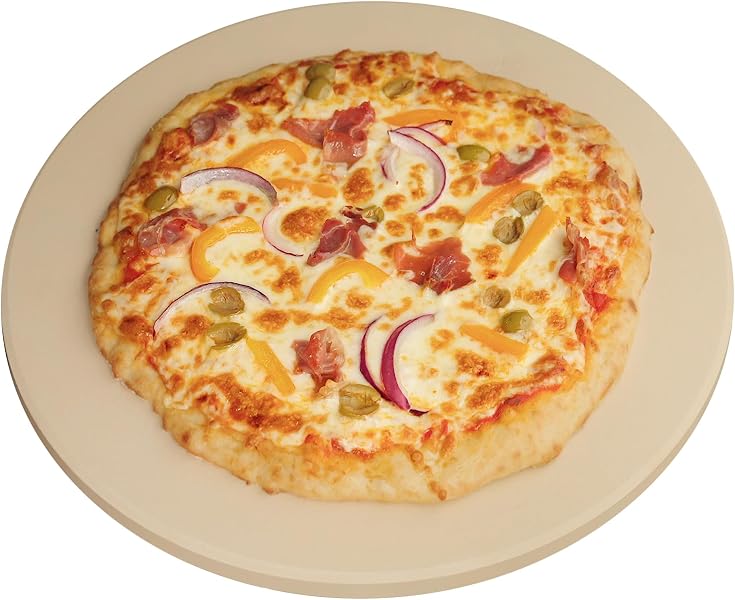
The best-selling stone on the page is the one listing that never mentions a grill.
Key Specifications
| Material | Stoneware, “a blend of lead-free clays” |
|---|---|
| Stone size | 16 in round |
| Thickness | 0.59 in (15 mm) |
| Weight | 7.3 lb |
| Heat rating | “Recommended for up to 500 degrees” in a home oven; spec table 1,472°F |
| Grill use | Not mentioned |
| Underside | Ridges for lifting, per the description |
| Warranty | 60 days |
| Rank | #3 in Pizza Pans & Stones |
| Rating | 4.4 across 3,044 ratings |
| Best For | Ovens first; a grill only with care and a lid thermometer |
Why We Recommend It
“Recommended for up to 500 degrees in a standard home oven.” That is the only operating guidance in the bullets, and it is an oven figure. The spec table, meanwhile, lists a maximum of 1,472°F. Two numbers 972 degrees apart. The fairest reading is that 1,472°F describes what the material survives and 500 degrees is what the maker recommends, and on a grill the recommendation is the one to follow. A gas grill with every burner on high and the lid shut can run past 500 degrees on its own thermometer.
It is stoneware, not cordierite. “Durable, non-cracking; crafted from a blend of lead-free clays.” It is the only stone on the page whose spec table and bullets agree on a clay stoneware body. Where the heat comes from one side, as it does on a grill, cordierite’s tolerance of rapid temperature change is the property you want, and nine of the ten listings here at least claim it somewhere. “Non-cracking” is a claim, not a method.
So why is it here? Because people buy it for the grill anyway. 2K+ bought in the past month is the highest figure on this page, it ranks #3 in Pizza Pans & Stones and #1,594 in Kitchen & Dining, and a 16-inch round is exactly the shape a kettle owner looks for. Anyone shopping for a grill stone will see it, and the listing does not tell them what we have just told you.
The physical specs are good. 16 inches round, 0.59 inch thick, 7.3 lb, and “ridges on the bottom that make it easy to pick up and set down”, according to the description. That is about 201 square inches, the same as the Ritual Life stone, for about half the price of that kit. Care is the simplest on the page: wipe with a dry cloth, and “Do not clean the stone with soap”.
It is the second-cheapest stone here, with 4.4 across 3,044 ratings and a 60-day warranty from Honey-Can-Do. Buy it for the oven, where its own listing says it belongs. If it goes on a grill, put it on cold, keep the lid thermometer at or below the 500 degrees the maker recommends, and do not set it over a single burner on full.
Pros
- 2K+ bought in the past month, most here
- 16 in round — about 201 sq in
- 0.59 in thick, 7.3 lb stated
- Ridged underside for lifting
- Second-cheapest here
- Simple dry-wipe care
Cons
- Never mentions a grill
- Recommended only to 500 degrees in a home oven
- Stoneware, not cordierite
- 1,472°F in the spec table conflicts with the bullet
- 60-day warranty
- No preheat or cold-start guidance
Best for: Oven pizza first, and an occasional kettle pizza for a cook who will keep the heat moderate.
What Ten Listings Say About a Grill
Every product on this page is sold as a pizza stone you can use outdoors. Here is what each listing actually says about the grill, line by line.
| Stone | Grill Named | Shock or Cold-Start Note | Clearance Stated | Heat Rating |
|---|---|---|---|---|
| Unicook 15 x 12 | Grill; kettle owners sent to round stones | None | 1–2 in all sides | 1,450°F |
| Weber 8836 | Gourmet BBQ System charcoal grate | None | Designed into the grate | Not stated |
| Ritual Life 16 in | Grill, BBQ, smoker | “Never put a cold stone in a hot oven or bbq” | None | 1,500°F |
| Unicook 20 x 16 | Grill | None | 1 in all round | 1,450°F |
| Hans Grill PRO XL | Grill, BBQ | “Toughened” cordierite only | None | 1,112°F |
| Gyreuni 15 x 12 | BBQ, grill | Claims thermal shock resistance | None | 1,472°F |
| Old Stone 14 x 16 | Grills, pizza ovens | Place in a cold oven, then preheat | None | 1,450°F |
| Culinary Couture | Grill | “Resists cracking” | None | 1,000°F |
| Cuisinart CPS-445 | Grill | None | None | Not stated |
| Old Stone 16 in round | Not mentioned | “Non-cracking” | None | 500° rec. / 1,472°F |
Count the columns. Gas grills named: none. Pellet grills named: none. Kamados named: none. Direct flame mentioned: never. The nearest any listing comes to a specific grill type is Weber, which names its own charcoal grate, Unicook, which names the charcoal kettle only to send its owners elsewhere, and Ritual Life, which names smokers.
Instructions for bringing a stone up to heat safely appear in two listings, Ritual Life and Old Stone’s rectangle. A third, Gyreuni, claims shock resistance without telling you how to use it. Two more, Culinary Couture and the Old Stone round, say their stones resist cracking, which is a promise rather than a method. A clearance figure appears on both Unicook stones and nowhere else.
Meanwhile every published heat rating sits between 1,000°F and 1,500°F, and the stones with no rating at all, Weber and Cuisinart, are both made of the same cordierite. The column every listing fills in is the one that matters least on a grill. The columns that matter are the ones most of them leave blank.
Gas, Pellet and Kamado: What the Listings Leave to You
Since no listing names your grill, here is how the three grill types in the question differ for a stone, and which stones on this page suit each. None of this is tested; it follows from how each grill puts heat into the cooking chamber, set against what the listings state.
Gas Grills
A gas grill heats from burners a few inches under the grate, so the stone’s underside sits directly over flame. That is the setup most likely to heat one patch of a stone faster than the rest, and the reason the cold start matters most here. Put the stone on before lighting, bring the grill up with the lid down, and once it is hot, the usual home technique is to turn the burner directly under the stone down and leave the outer burners higher so the top of the pizza gets heat too. Rectangular grates suit rectangular stones: the Unicook 15 x 12 needs 17 x 14 inches by its own rule, the Old Stone 14 x 16 about 18 x 16, and the Unicook 20 x 16 needs 22 x 18. The best pizza stone for a gas grill on this page, on the information given, is the Unicook 15 x 12, with the Old Stone 14 x 16 for wider grills.
Pellet Grills
A pellet grill burns pellets in a firepot under a heat baffle and moves hot air around the chamber with a fan. The stone never sees an open flame, which makes uneven heating less of a risk than on gas. The question on a pellet grill is temperature, not shock. Check the maximum printed on your own grill: if it is around what a domestic oven manages, a thicker stone that stores more heat is the better choice, because it has to do more of the work. Ritual Life’s listing is the only one to name smokers. For the best pizza stone for a pellet grill here, look at the 0.6-inch stones, the Unicook pair, Hans Grill and Ritual Life, rather than the 0.4-inch Gyreuni and Culinary Couture.
Kamado Grills
A kamado is a round, thick-walled ceramic cooker with a domed lid, and it can run very hot. For pizza the stone normally sits above a heat deflector rather than straight over the coals, which puts a barrier between flame and stone. Shape is the constraint: the grate is round, so a round stone uses it best, and the dome means a raised stone still has to leave room for the pizza under the lid. Measure the grate diameter and subtract a clearance. The 16-inch rounds here, Ritual Life and Old Stone, suit a larger kamado; the 13-inch Cuisinart suits a small one. Ritual Life, rated to 1,500°F with a cold-stone warning, is the best pizza stone for a kamado grill on this page. Old Stone’s round, recommended to 500 degrees, is not.
Stone Size Against Your Grate and Your Lid
Unicook asks for 1–2 inches of clearance around its 15 x 12 stone and 1 inch around its 20 x 16. Applied to all ten, that rule turns each footprint into a minimum grate size you can check with a tape measure.
| Stone | Footprint | Area | Grate at 1 in Clearance | Grate at 2 in Clearance |
|---|---|---|---|---|
| Unicook 20 x 16 | 20 x 16 in | 320 sq in | 22 x 18 in | 24 x 20 in |
| Culinary Couture (spec table) | 15 x 15 in | 225 sq in | 17 x 17 in | 19 x 19 in |
| Old Stone 14 x 16 | 16 x 14 in | 224 sq in | 18 x 16 in | 20 x 18 in |
| Weber 8836 (as listed) | 16.7 x 13.2 in | 220 sq in | Sits in its own grate | Sits in its own grate |
| Ritual Life 16 in | 16 in round | 201 sq in | 18 in circle | 20 in circle |
| Old Stone 16 in round | 16 in round | 201 sq in | 18 in circle | 20 in circle |
| Unicook 15 x 12 | 15 x 12 in | 180 sq in | 17 x 14 in | 19 x 16 in |
| Gyreuni 15 x 12 | 15 x 12 in | 180 sq in | 17 x 14 in | 19 x 16 in |
| Culinary Couture (title) | 15 x 12 in | 180 sq in | 17 x 14 in | 19 x 16 in |
| Hans Grill PRO XL | 14.9 x 11.8 in | 176 sq in | 16.9 x 13.8 in | 18.9 x 15.8 in |
| Cuisinart CPS-445 | 13 in round | 133 sq in | 15 in circle | 17 in circle |
The spread is wider than it looks. The Unicook 20 x 16 has 2.4 times the area of the Cuisinart, and needs a grate 7 inches wider in one direction and 3 inches in the other. Six of the ten sit in a narrow band of 176 to 201 square inches, which is the class most mid-sized gas grills and full-size kettles will take with room for air.
Area also sets the pizza. Unicook says its 15 x 12 stone suits pizzas up to 11 inches, a one-inch margin on the narrow side. By the same margin a 16-inch round takes a 15-inch pizza and the 13-inch Cuisinart a 12-inch one. The 20 x 16 is sold as two small pizzas at once, not one giant one.
Then there is the lid. The stones here are 0.4 to 0.6 inch thick where the listings say, so the stone itself rarely decides lid clearance. The rack does. Weber lists a 2-inch height for stone and carry rack together, and any stone raised on bricks or an upper rack to get it away from direct flame loses that height from the space under the lid. Check the distance from grate to closed lid at the point where the pizza will sit, not at the highest point of the dome.
Thickness, Weight and What Comes in the Box
| Stone | Thickness | Weight | Bundled |
|---|---|---|---|
| Unicook 15 x 12 | 0.6 in | 6.8 lb (spec: about 6.5 lb) | Plastic scraper |
| Weber 8836 | Not stated (2 in with rack) | About 6.0 lb with rack | Carry rack |
| Ritual Life 16 in | 0.6 in | About 12.1 lb, whole set | Handles/rack, bamboo peel, cutter, dough tool, ebook |
| Unicook 20 x 16 | 0.6 in | 15.8 lb | Plastic scraper |
| Hans Grill PRO XL | 0.6 in | Not stated | Perforated aluminium peel |
| Gyreuni 15 x 12 | 0.4 in | About 7.1 lb, whole set | Oak peel, cutter, 10 parchment sheets |
| Old Stone 14 x 16 | 0.43 in | Not stated | Nothing |
| Culinary Couture | 0.4 or 0.5 in | Not stated | Nothing |
| Cuisinart CPS-445 | Not usable | 5.7 lb, whole set | Folding steel peel, pizza wheel |
| Old Stone 16 in round | 0.59 in | 7.3 lb | Nothing |
Only three weights here are for the stone alone: the Unicook pair at 6.8 lb and 15.8 lb, and the Old Stone round at 7.3 lb. Four are for sets and three are not given. That makes weight a poor basis for comparing stones on this page, but it is still worth knowing what you will be lifting over a hot firebox. A 15.8 lb slab with no handles is a two-hand job; the 12.1 lb Ritual Life set includes handles for exactly that reason.
Thickness is clearer. Four stones are 0.6 inch, two are about 0.4 inch, and the Old Stone pair sit at 0.43 and 0.59. Thicker stores more heat and takes longer to heat through; thinner comes up faster and gives up heat faster when the lid is opened. On a grill, where the lid comes up every time you check or turn a pizza, the 0.6-inch stones hold their temperature better between pizzas.
The bundles divide the field in two. Five stones come with a peel, a rack or both; five come with a scraper or nothing. A stone without a peel is not usable for pizza on a grill, so a bare stone needs a peel added before the comparison with a full kit is fair.
Best Alternatives
| Alternative | Why Consider It | Better For | Main Trade-Off |
|---|---|---|---|
| Hans Grill 15 in circular stone | The round version of the PRO XL: cordierite, 1,112°F, wooden peel | Round kettles and kamados | Shares the PRO XL’s 13,869-rating pool, so its rating is not its own |
| A stone for the kitchen oven instead | Our pizza stone guide covers indoor stones and steels | Year-round pizza where the grill is covered in winter | No smoke, and a domestic oven tops out lower |
| A dedicated outdoor pizza oven | Our pizza oven guide compares ten, up to 1,110°F | Weekly pizza makers who want heat from above as well | A second appliance costing several times any stone here |
| A cast iron pizza pan on the grill | Will not crack from thermal shock | Grills too small for any stone with clearance | Does not draw moisture from the dough the way a porous stone does |
What Each Step Up Actually Buys
Budget tier: a stone. Culinary Couture, the Old Stone round, the Unicook 15 x 12, Gyreuni and the Old Stone 14 x 16. Four of the five are bare stones; Gyreuni adds an oak peel, a cutter and parchment. This tier contains the cheapest stone per square inch and the most useful grill instructions on the page.
Mid tier: a kit or a system. Cuisinart, Hans Grill, Ritual Life and Weber. The money here goes on what surrounds the stone: a folding peel, a perforated metal peel, handles and a full tool set, or a stone shaped to one grate. None of these four stones has a higher stated heat rating than the Unicook 15 x 12 except Ritual Life, and two state no rating at all.
Top tier: area. The Unicook 20 x 16 is the only stone that costs more because it is more stone. It is the one product here where the extra money buys pizza capacity rather than accessories.
| Stone | Area | Cents per Sq In |
|---|---|---|
| Culinary Couture | 180 sq in (title) | 12.8 |
| Old Stone 16 in round | 201 sq in | 15.0 |
| Old Stone 14 x 16 | 224 sq in | 16.9 |
| Unicook 15 x 12 | 180 sq in | 17.4 |
| Gyreuni 15 x 12 (kit) | 180 sq in | 20.4 |
| Unicook 20 x 16 | 320 sq in | 20.9 |
| Weber 8836 (with rack) | 220 sq in (as listed) | 27.2 |
| Ritual Life 16 in (kit) | 201 sq in | 29.8 |
| Hans Grill PRO XL (kit) | 176 sq in | 31.3 |
| Cuisinart CPS-445 (kit) | 133 sq in | 37.7 |
Per square inch of stone, the kits cost roughly twice as much as the bare stones, which is the price of the peel and cutter. The real outlier is the Cuisinart: the smallest stone at the fifth-highest price. Among bare stones, the Old Stone pair and Culinary Couture are cheapest, but each carries a listing conflict, and the Unicook 15 x 12 is the lowest-priced stone whose listing has none.
What to Check Before You Buy
Measure the Grate, Then Add the Clearance
Measure the flat cooking area of your grill, not the outside of the lid, and subtract an inch on every side; two if you can. That gives you the largest stone that will still let hot air round the edges to cook the top of the pizza. Unicook is the only maker to state this rule, at 1–2 inches for its 15 x 12 and 1 inch for its 20 x 16, but it applies to every stone. A stone that covers the grate wall to wall turns your grill into a hotplate with a lid: the base burns while the cheese stays raw. On this page, the 15 x 12 class needs a 17 x 14-inch grate at minimum, the 16-inch rounds an 18-inch circle, and the 20 x 16 Unicook a 22 x 18-inch space.
Match the Shape to the Firebox
Round grills want round stones. Unicook says so outright, pointing kettle owners to its round models, and the geometry is simple: a rectangle in a round bowl puts its corners near the wall, and on a kettle that is often where the coals are. Kettles and kamados suit the 16-inch Ritual Life and Old Stone rounds, the 13-inch Cuisinart, or Weber’s stone in its own grate. Gas grills, with rectangular grates and burners running front to back, suit the 15 x 12 rectangles, the 16 x 14 Old Stone and, on a wide grill, the 20 x 16 Unicook. Pellet grills usually have rectangular chambers too.
Treat the Heat Rating as a Ceiling, Not a Feature
Every stated rating here is between 1,000°F and 1,500°F. A backyard grill does not reach any of them, so the difference between Culinary Couture’s 1,000°F and Ritual Life’s 1,500°F is not one you will cook in. The rating tells you the material is a high-fire ceramic and little else. The one rating that does deserve attention is the exception: the Old Stone round is “Recommended for up to 500 degrees in a standard home oven”, which a hot gas grill can exceed. Two stones, Weber and Cuisinart, state no rating at all; both are described as cordierite, the same material the rated stones use.
Plan the Cold Start Before the First Pizza
The single most useful line on this page is Ritual Life’s: “Never put a cold stone in a hot oven or bbq, this will cause it to crack.” Old Stone’s rectangle gives the positive version: place the stone in a cold oven and preheat. On a grill that means the stone goes on the grate before the burners are lit or before the coals are added beneath it, and the two come up to heat together. Gyreuni suggests 30 minutes at 400°F or more on first use. Keep the stone dry, too: a stone that has been rinsed and not fully dried is carrying water that will turn to steam inside it. Only three of ten listings address any of this.
Check the Material Line Against the Bullets
Three listings here disagree with themselves about what the stone is. Old Stone’s rectangle is stoneware in the spec table and cordierite in the bullets. Cuisinart’s is cordierite in the bullets and “Ceramic, Stainless Steel” in the spec table. Gyreuni’s spec table says oak, which is its peel. The bullets are usually the maker’s own words and the spec table a form someone filled in, so where the two disagree, read the bullets as the more specific claim, but treat the conflict as a reason to look closer. The Old Stone round is the only stone on the page that is consistently described as clay stoneware.
Weigh the Stone Against Your Grate and Your Hands
A stone on a grill gets lifted over a firebox, often while hot. The stated weights run from about 6.0 lb for the Weber with its rack to 15.8 lb for the big Unicook, and three listings give none. Heavier stones store more heat between lid openings, which is a real advantage on a grill, but a 15.8 lb slab with no handles is a two-hand lift. Ritual Life’s removable handles and Weber’s carry rack are the only lifting aids on the page. If you plan to take the stone off the grill hot, budget for one of them or for a pair of proper heat gloves.
Count What Comes in the Box
A grill stone is useless without a peel, and most pizzas need a cutter. Five stones here bring at least one of those: Ritual Life (bamboo peel and rocker cutter), Gyreuni (oak peel and cutter), Cuisinart (folding steel peel and wheel), Hans Grill (perforated aluminium peel) and Weber (carry rack). Five bring a plastic scraper or nothing. A bare Unicook stone plus a peel you buy separately may still be the better grill setup than a full kit, but compare like with like. Wooden peels launch raw dough more easily; metal peels slide under a cooked pizza more easily. Check the peel’s width against the pizza you plan to make: a peel narrower than the pizza makes the launch harder, not easier.

Common Mistakes
- Putting a cold stone onto a lit grill. Ritual Life says plainly that it will crack; only three of ten listings warn you at all.
- Buying the stone before measuring the grate. The 20 x 16 Unicook needs a 22 x 18-inch space by its own 1-inch rule.
- Filling the grate edge to edge. Unicook asks for 1–2 inches all round so heat can reach the top of the pizza.
- Putting a rectangle in a round kettle. Unicook’s own 15 x 12 listing sends kettle owners to its round stones.
- Buying on the heat rating. Every stated rating here is 1,000°F or more; none of it is reachable under a grill lid.
- Washing the stone with soap. Six of the ten listings say no soap or detergent; the stone is porous and holds it.
- Seasoning it like cast iron. Ritual Life warns the oil soaks in and smokes; Old Stone says the same of high-fat food.
- Reading a pooled rating as a verdict on one size. Both Unicook stones show 4.5 across the same 13,425 ratings.
Who Should Buy Which
Buy the Unicook 15 x 12 if you grill on gas and want the instructions in writing. It states thickness, weight, a 1,450°F rating, an 11-inch pizza limit and a 1–2 inch clearance, which makes it the easiest stone here to check against a grill before you buy.
Buy the Weber 8836 if you own a Weber kettle with the Gourmet BBQ System grate. It locates in that grate, comes with a carry rack and is rated 4.6 across 2,235 ratings. Without that grate, its main advantage disappears.
Buy the Ritual Life 16-inch set if you are starting from nothing and cook on a round grill. Stone, handles that double as a rack, peel, cutter and dough tool, a 1,500°F rating and the only cold-stone crack warning on the page. Accept that 4.6 rests on 210 ratings.
Buy the Unicook 20 x 16 if your gas grill has a 22 x 18-inch cooking area and you make two pizzas at a time. 320 square inches and 15.8 lb of stored heat, but no handles.
Buy the Hans Grill PRO XL if you need a metal peel too. The perforated aluminium peel is the reason to pay a premium over the near-identical Unicook stone; its 4.4 across 13,869 ratings is shared with a round sibling.
Buy the Gyreuni set if you want a full kit on a budget. Oak peel, cutter and parchment with a 1,472°F stone, plus the only thermal shock claim here. The stone is 0.4 inch thick.
Buy the Old Stone 14 x 16 if you have a wider gas grill. 224 square inches, a cold-start instruction and a clear fat warning; check the stoneware-or-cordierite conflict and accept that no weight is given.
Buy the Culinary Couture if you want to try grilled pizza cheaply and already own a peel. Measure for 15 x 15 inches, not 15 x 12, because the listing gives both.
Buy the Cuisinart CPS-445 if your grill is small. A 13-inch stone needs only a 15-inch circle of grate, and the folding peel stores in a grill cabinet. 4.5 across 11,473 ratings is the largest unshared sample here.
Buy the Old Stone 16-inch round for your oven. It is the best-selling stone on the page and its own listing recommends 500 degrees in a home oven. If it goes on a kettle, start it cold and keep the heat moderate.
Frequently Asked Questions
What is the best pizza stone for a gas grill?
On the information in these listings, the Unicook 15 x 12. A gas grill heats from burners directly beneath the grate, so the two things that matter are fit and how you bring the stone up to heat. Unicook is the only maker that states a clearance, asking for 1 to 2 inches on every side, which means its 15 x 12 stone needs a cooking area of at least 17 x 14 inches. It also publishes its thickness (0.6 inch), weight (6.8 lb), heat rating (1,450°F) and maximum pizza size (11 inches). For a wider grill, the Old Stone 14 x 16 adds area and is one of only two listings that tells you to start the stone cold. Whichever you buy, put it on the grate before lighting, heat it with the lid down, and turn the burner under the stone down once it is hot.
What is the best pizza stone for a pellet grill?
None of the ten listings names a pellet grill, so this is a judgement from the specifications rather than a maker claim. A pellet grill heats with fan-driven air from a firepot under a baffle, so the stone does not sit over open flame and thermal shock is less of a worry than on gas. The limit is temperature: check the maximum printed on your own grill. If it is close to what a kitchen oven reaches, the stone has to store heat and give it back to the dough, which favours the thicker 0.6-inch stones here, namely the two Unicooks, the Hans Grill PRO XL and the Ritual Life. Ritual Life is the only listing that mentions smokers at all. Most pellet chambers are rectangular, so the Unicook 15 x 12 is the practical first choice if your grate leaves 17 x 14 inches.
What is the best pizza stone for a kamado grill?
The Ritual Life 16-inch round. No listing here names a kamado, but a kamado has a round grate and a domed lid and can run very hot, so you want a round stone, a high heat rating and clear handling guidance. Ritual Life is round, rated to 1,500°F, the highest on the page, and is the only listing that warns a cold stone put into a hot barbecue will crack. Its removable handles help lift a hot stone out of a deep firebox. Measure your grate diameter first: a 16-inch stone with an inch of clearance needs an 18-inch circle. For a small kamado, the 13-inch Cuisinart needs only a 15-inch circle. Avoid the Old Stone round for this job; its own listing recommends it only up to 500 degrees in a home oven.
Can a pizza stone go directly over the flame on a grill?
Not one of the ten listings on this page says, either way. None mentions direct flame at all. What the listings do say points to caution. Ritual Life warns that putting a cold stone into a hot barbecue will crack it, which is a thermal shock problem, and flame playing on one patch of a stone’s underside creates the same kind of uneven heating. On a gas grill the stone necessarily sits over the burners, so the practical approach is to put it on before lighting, bring it up slowly with the lid closed, and then lower the burner directly beneath it once it is hot, leaving the outer burners higher. On a charcoal kettle or kamado, bank the coals to the sides or use a heat deflector so the stone is not sitting over a concentrated bed of coals.
How do I stop a pizza stone cracking on the grill?
Heat it evenly and keep it dry. Every stated heat rating here is between 1,000°F and 1,500°F, so stones on a grill do not crack from being too hot. They crack when one part heats or cools much faster than another. Three habits cover most of the risk. First, start cold: Ritual Life says never put a cold stone in a hot oven or barbecue, and Old Stone tells you to place the stone in a cold oven and preheat, which on a grill means stone on before the burners. Second, never put a damp stone on the heat, since water inside it turns to steam. Third, do not move a hot stone onto a cold or wet surface; Ritual Life’s handles flip to make a rack for exactly that reason. Gyreuni claims thermal shock resistance, but handle it the same way.
What size pizza stone fits my grill?
Measure the flat cooking area and subtract one to two inches on every side. That is Unicook’s stated rule, and it exists so hot air can pass around the stone and cook the top of the pizza. On that basis the 15 x 12 stones here need a grate of at least 17 x 14 inches, the 16 x 14 Old Stone needs 18 x 16, and the 20 x 16 Unicook needs 22 x 18. Round stones need a circle: 18 inches across for a 16-inch stone and 15 inches for the 13-inch Cuisinart. Then check the height under the closed lid where the pizza will sit, especially if the stone is raised on a rack. Remember the stone limits the pizza too: Unicook rates its 15 x 12 for pizzas up to 11 inches.
Is cordierite better than stoneware for grilling?
For a grill, cordierite is the safer choice, and nine of these ten listings claim it somewhere. Cordierite is the ceramic that kiln shelves are made from because it tolerates rapid temperature change, which is exactly what a grill imposes when it heats a stone hard from one side. Stoneware is ordinary fired clay and generally less tolerant of that. The only stone on this page consistently described as stoneware is the Old Stone 16-inch round, made from a blend of lead-free clays and recommended up to 500 degrees in a home oven. The Old Stone 14 x 16 is listed as stoneware in its spec table but cordierite in its bullets. Material is not the whole story, though: even a cordierite stone will crack if it goes onto a hot grill cold.
How do I clean a pizza stone after grilling?
Let it cool completely on the grill first, then scrape and rinse, without soap. Six of the ten listings here say no soap or detergent, because the stone is porous and will hold it. Unicook includes a plastic scraper for removing stuck food once the stone is cool, and recommends warm water and a brush if needed. Culinary Couture says to rinse with warm water and air dry. The Old Stone round says to wipe with a dry cloth. Stains are expected: Hans Grill, Gyreuni and Ritual Life all say discolouration is normal and does not affect performance, and Ritual Life says it improves the non-stick quality. Do not oil or season the stone, which Ritual Life warns will make it smoke, and let it dry fully before it next goes on the heat.
Final Verdict
Every grill-relevant number in writing, including the only clearance rule here. 4.5 across 13,425 ratings, pooled across sizes.
Drops into the Gourmet BBQ System grate with a carry rack. 4.6 across 2,235 ratings and a two-year warranty.
Round stone rated to 1,500°F, handles that become a rack, peel and cutter, and the clearest crack warning on the page. 210 ratings.
Ten pizza stones, and not one listing names a gas grill, a pellet grill or a kamado, or mentions direct flame. Most of them were written for the oven, with “and grill” added to the title. The heat rating every listing fills in, 1,000°F to 1,500°F, is the one number that does not matter on a grill.
What matters is what the listings mostly leave out. Two tell you to bring the stone up from cold; one more claims shock resistance. Two, both from Unicook, give you a clearance. One, Weber, designs the fit into the grate itself. Everything else is left to you and a tape measure.
So buy the fit first and the stone second. Measure the grate, subtract an inch or two on every side, choose round for a kettle or kamado and rectangular for gas, and then start the stone cold every time, whichever one you buy.
If you buy one stone from this page, make it the Unicook 15 x 12: the only listing that gives you the thickness, the weight, the pizza size and the clearance your grill needs before you have to find out the hard way.