Affiliate Disclosure: As an Amazon Associate, we earn from qualifying purchases. This does not affect the price you pay.
Nobody throws a garlic press away because it stopped crushing garlic. They throw it away because cleaning it became worse than using a knife.
The category knows this. Look at what these ten listings actually compete on: three of them include a small brush for poking residue out of the holes, one has a sprung plate that ejects it mechanically, one has a basket that swings out to be emptied, and one is built with no hinge at all so it comes apart in your hand. One maker states the problem outright — rinse it immediately or the pulp and fibres harden.
And two of these are not presses at all. A rocker has no chamber and no holes, so there is nothing to unclog; a twister lets you choose how fine the garlic goes.
That is the real decision here, and it is not about crushing. Every one of these will crush a clove. What separates them is the ninety seconds afterwards, at the sink.
$6.55 to $29.99 below. The one that solves cleaning properly is the dearest, and the one that avoids the problem entirely costs $19.98.
Our Quick Picks
 Best OverallOXO Good Grips Die-Cast Zinc
A die-cast zinc press with a hinged plate of teeth that pushes every hole clear — the cleaning problem solved mechanically rather than with a brush.
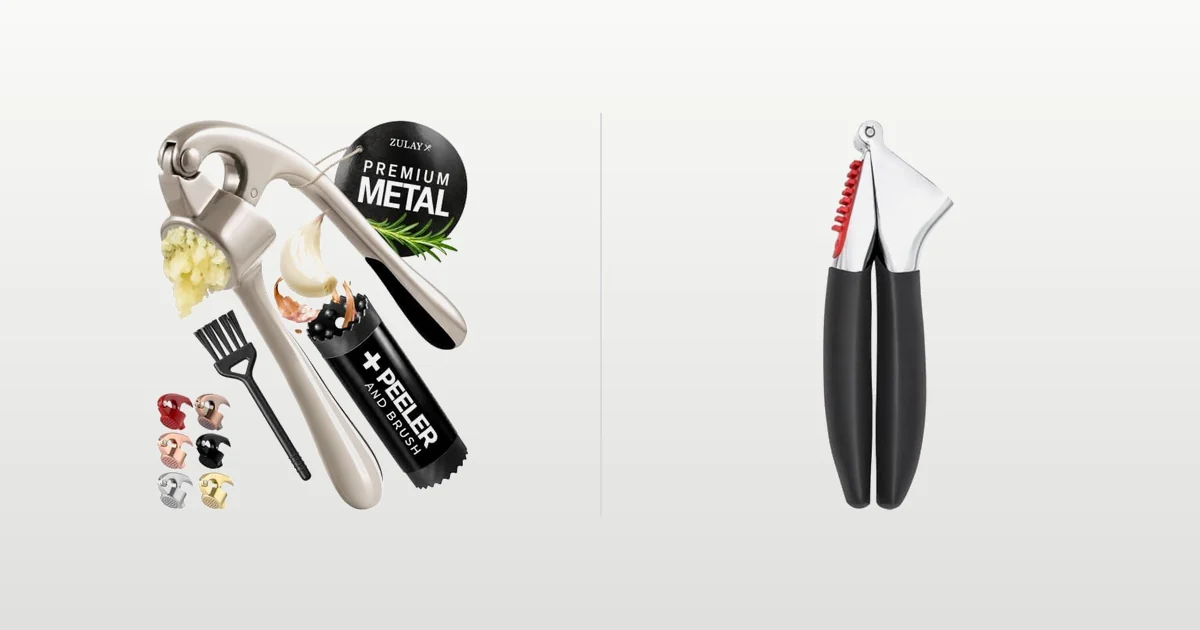
 Most PopularZulay Kitchen Premium Set
The best-selling press on this page, supplied with a silicone roller peeler and a cleaning brush, under a lifetime warranty.
 Nothing to CleanJoseph Joseph Garlic Rocker
A curved stainless slab with ridges that you rock over a clove — no chamber, no holes, and nothing to clean out afterwards.
At a Glance
Ten Tools, Sorted by What Happens After You Use Them
Mechanism, material, how each one deals with residue, and whether it takes unpeeled cloves. The cleaning column is the buying decision.
| # | Model | Type | Material | Cleaning | Unpeeled | Standout | Main Drawback | Check Price |
|---|---|---|---|---|---|---|---|---|
| 1 |
 OXO Good Grips Die-Cast Zinc OXO Good Grips Die-Cast Zinc |
Hinged press | Die-cast zinc | Built-in ejector | Yes | A built-in cleaner that pushes the peel and pulp out of the holes | $20.80, dearer than four presses here combined | View on Amazon |
| 2 |
 Zulay Kitchen Premium Set Zulay Kitchen Premium Set |
Hinged press | Rust-proof alloy | Brush included | Yes | Rank #371 with a silicone peeler and a brush, for $9.99 | A brush is a workaround, and brushes get lost | View on Amazon |
| 3 |
 Joseph Joseph Garlic Rocker Joseph Joseph Garlic Rocker |
Rocker | Stainless steel | No chamber | No | There are no holes, so there is nothing to unclog | You scoop the garlic out yourself, and it is coarser | View on Amazon |
| 4 |
 Kitessensu 37-Stud Press Kitessensu 37-Stud Press |
Hinged press | Zinc | Rinse | Yes | Publishes a count — 37 studs matched to the holes | No brush, ejector or peeler in the box | View on Amazon |
| 5 |
 GORILLA GRIP Peeler and Press Set GORILLA GRIP Peeler and Press Set |
Hinged press | Zinc alloy | Brush included | Yes | Takes a single elephant garlic clove, which most chambers will not | Third-party testing is claimed but not named | View on Amazon |
| 6 |
 Gourmet Easy Hinge-Free 304 Gourmet Easy Hinge-Free 304 |
Detachable press | 304 stainless | Separates fully | Yes | No hinge and no crevices — the handle detaches for cleaning | $29.99, the most expensive press on this page | View on Amazon |
| 7 |
 OXO Good Grips Stainless OXO Good Grips Stainless |
Hinged press | Stainless steel | Swing basket | Yes | A swing-out basket that tips the residue straight into the bin | Ranks far below the zinc version at a lower price | View on Amazon |
| 8 |
 Kitchen Matte Zinc Alloy Set Kitchen Matte Zinc Alloy Set |
Hinged press | Zinc alloy | Brush included | Yes | A three-piece set for $6.99, which is the lowest here | No brand, no warranty and no certification of any kind | View on Amazon |
| 9 |
 NexTrend Garlic Twister 4th Gen NexTrend Garlic Twister 4th Gen |
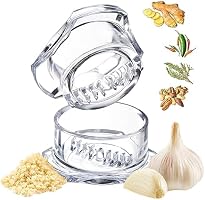
Twister | BPA-free Tritan | Rinse or dishwasher | No | You control how fine it goes by how long you twist | You must smash and peel the cloves first | View on Amazon |
| 10 |
 Emptycolor Mini Chopper and Press Emptycolor Mini Chopper and Press |
Blade chopper | Stainless blades | Rinse | No | It stores the minced garlic in its own container | Blades rather than a plate, and the listing rules out slicing | View on Amazon |
Materials, prices and specifications are taken from each manufacturer’s Amazon listing as displayed on 25 August 2026 through a United States connection, and may change. Two products here are not hinged presses — one is a rocker and one a twister — and one is a blade chopper; they are included because they are sold and searched for as garlic presses, and their entries say plainly how they differ. Only one listing names a specific steel grade (304 stainless); the others say “stainless”, “zinc alloy” or “rust proof” without qualification, and we have not inferred alloys. One listing claims third-party testing to US regulations without naming the testing body, and that is reported as stated. Note that zinc and stainless behave differently with garlic: zinc is non-reactive and stays odour-free, which is why several premium presses use it despite steel sounding better. Sales ranks are shown as displayed and can be pooled across a variant family.
Scroll the table sideways to see every column
How We Chose These Ten
We researched current listings, compared manufacturer specifications and documentation, and examined recurring patterns in customer feedback. We did not carry out hands-on testing, and nothing below is presented as measured performance data.
- Cleaning method recorded for every one — it is the reason these tools get abandoned, and the category competes on it
- Rockers, twisters and choppers included alongside presses — they are sold under the same term and solve the problem differently
- Unpeeled-clove capability noted — because skipping the peeling is the main time saving on offer
- A verified live buy box — all ten confirmed purchasable in the United States on 25 August 2026
- Chamber size compared — a six-clove recipe means six reloads on a small press
- Material claims reported as written — one names 304 stainless; the rest name a class, not an alloy
- No overlap with our published kitchen gadget guides — every tool here is new to the site
The Ten in Detail
1. OXO Good Grips Die-Cast Zinc — Best Overall

Garlic presses are not usually discarded because they stop working. They are discarded because cleaning them is worse than chopping.
Key Specifications
| Type | Hinged press |
|---|---|
| Material | Die-cast zinc |
| Cleaning | Built-in cleaner pushes out peels and pulp |
| Chamber | Large capacity, fits multiple cloves |
| Unpeeled cloves | Yes |
| Handles | Soft, non-slip, absorb pressure while squeezing |
| Dishwasher | Safe |
| Rank | #746 in its category |
| Price | $20.80 |
| Best For | Anyone who has thrown a garlic press away because of the cleaning |
Why We Recommend It
The failure mode is specific and universal. Pressed garlic leaves a plug of pulp and fibre in every one of the small holes, and if it is not rinsed within a minute or two it dries into something with the consistency of glue. Then you are standing at the sink poking at thirty holes with a cocktail stick, and after the third time you decide a knife and a board were fine all along.
OXO’s answer is a hinged plate of small teeth that folds over the chamber and pushes through every hole at once, ejecting the skin and the residue in one motion. Three presses on this page ship a small brush to address the same problem; this one removes the need for it.
Die-cast zinc is the right material and it looks like the cheap one. Zinc is strong in compression, does not react with garlic’s sulphur compounds and takes no smell — which is why it is what most serious presses are made from, despite stainless steel sounding better.
$20.80 is the second dearest press here, and the cleaning mechanism is what you are buying.
Pros
- Built-in ejector clears every hole in one motion
- No brush needed and none to lose
- Die-cast zinc takes no garlic smell
- Large chamber holds several cloves
- Soft handles absorb the squeezing pressure
- Dishwasher safe
Cons
- $20.80 — second dearest on this page
- Heavier than the stainless version
- Hinges still trap residue at the pivot
- Rank #746, below the cheaper Zulay
- No peeler included
- Zinc looks less premium than steel
Best for: The press you will still be using in five years, because cleaning it is not a chore.
2. Zulay Kitchen Premium Set — Most Popular

Rank #371 and a lifetime warranty for $9.99. The interesting part is the sentence Zulay includes that others leave out.
Key Specifications
| Type | Hinged press |
|---|---|
| Material | Food-grade, rust resistant |
| Set contents | Press, silicone peeler, cleaning brush |
| Unpeeled cloves | Yes — crushes with the skin on |
| Cleaning | Rinse immediately; brush supplied |
| Maker’s warning | Rinse right after use or pulp and fibres harden |
| Also for | Ginger |
| Dishwasher | Safe |
| Warranty | Lifetime |
| Rank | #371 — highest on this page |
| Price | $9.99 |
| Best For | Most kitchens, if you will rinse it straight away |
Why We Recommend It
“Rinse the garlic crusher right after use to avoid residual pulp and fibers hardening up.” That is the whole maintenance regime for every hinged press on this page, stated honestly by one of them. Garlic pulp is starchy and fibrous, and it sets hard within minutes; rinsed immediately it falls out under the tap, left until after dinner it needs soaking and picking. If you are the sort of cook who runs a tool under the tap as you put it down, any press here works. If you are not, buy the one with the built-in ejector.
Crushing unpeeled cloves is the genuine time saver. The skin stays behind in the chamber as a flat disc while the flesh goes through, so you skip peeling entirely and lift the skin out afterwards.
The silicone roller peeler is for when you do want peeled cloves — put the cloves inside, roll it on the counter, and the skins come off without your fingers smelling for a day.
A lifetime warranty at $9.99 is the best commitment-to-price ratio here.
Pros
- Rank #371, the best selling press here
- Silicone peeler and brush included
- Crushes unpeeled cloves, skin stays behind
- Lifetime warranty at $9.99
- Works for ginger as well as garlic
- Dishwasher safe
Cons
- Cleaning depends on a brush you can lose
- Pulp hardens fast if not rinsed at once
- Alloy is not specified beyond ‘rust resistant’
- No built-in ejector
- Hinge pivot still traps residue
- Handle is the widest here to squeeze
Best for: Everyday mincing, for cooks who rinse tools as they go.
3. Joseph Joseph Garlic Rocker — Nothing to Clean

Every complaint about garlic presses concerns the holes. This design has none.
Key Specifications
| Type | Rocker — not a press |
|---|---|
| Material | Stainless steel |
| Method | Place on the clove and rock back and forth |
| Chamber | None |
| Holes | None |
| Cleaning | Rinse the surface; nothing to unclog |
| Side effect | Stainless steel removes garlic odour from hands |
| Dishwasher | Safe |
| Rank | #5,209 in its category |
| Price | $19.98 |
| Best For | Anyone whose objection to garlic presses is entirely about cleaning |
Why We Recommend It
A rocker is a curved, ridged slab of steel that you place over a clove on a board and rock from side to side. The clove is crushed against the board rather than extruded through a plate, so there is no chamber to pack, no holes to plug and no hinge to trap fibre. Cleaning is rinsing a smooth piece of metal. That is the entire argument and for a lot of people it is decisive.
What you give up is the fineness and the containment. A press produces a wet paste directly into the pan; a rocker gives you a coarse crush spread across the board, which you then scrape up. For a slow-cooked sauce that difference is invisible. For a dressing or an aioli, where you want garlic to disappear into the liquid, the press wins.
The stainless steel deodorising effect is real chemistry, not marketing: rubbing steel under running water binds the sulphur compounds that cause garlic hands.
You still have to peel first, which the unpeeled-clove presses here do not require.
Pros
- No holes, no chamber, nothing to unclog
- Cleaning is rinsing a flat piece of steel
- Stainless steel removes garlic smell from hands
- Dishwasher safe
- Nothing to break — no hinge or moving part
- Doubles as a hand deodoriser
Cons
- Crush is coarser than a press produces
- You must peel the cloves first
- Garlic ends up on the board, not in the pan
- $19.98 for a piece of shaped steel
- Needs a board and downward force
- Rank #5,209
Best for: Cooks who gave up on presses because of the cleaning, and cook rustic food.
4. Kitessensu 37-Stud Press — Most Specified

Thirty-seven is the only number anyone on this page puts to anything, and it describes the mechanism that decides how hard you squeeze.
Key Specifications
| Type | Hinged press |
|---|---|
| Studs | 37, matched to the holes |
| Material | Zinc |
| Unpeeled cloves | Yes |
| Effort | Designed for minimal pressure |
| Odour | Zinc is non-reactive and does not develop smells |
| Also for | Ginger and other firm ingredients |
| Guarantee | Satisfaction guarantee stated |
| Rank | #1,749 in its category |
| Price | $10.99 |
| Best For | Getting the most garlic through with the least hand strength |
Why We Recommend It
Studs are the small spikes on the upper jaw that press into the chamber holes. Without them, the plate simply pushes the mass of garlic downward and a lot of it stays behind as a compressed cake; with a stud entering every hole, the garlic in each hole is driven all the way through. That is why stud-matched presses both yield more from the same clove and need less hand pressure — the force is concentrated at the points rather than spread across the whole plate.
It also helps the cleaning, because the studs push the residue out of the holes on the way down, though they do not eject it the way the sprung cleaner on the OXO does.
Zinc rather than stainless, and the listing explains why: non-reactive, so it does not pick up the smell that garlic’s sulphur compounds leave in some metals.
$10.99 with no accessories, against $9.99 for a press with a peeler and a brush.
Pros
- Publishes a stud count — 37, matched to the holes
- Studs mean more yield for less hand pressure
- Zinc is non-reactive and stays odour free
- Takes unpeeled cloves
- Works for ginger and firm ingredients
- Satisfaction guarantee
Cons
- No brush, peeler or ejector included
- Rank #1,749
- Studs help cleaning but do not eject residue
- Zinc is heavier than stainless
- Hinge still traps fibre at the pivot
- Dearer than a better-equipped rival
Best for: Cooks with weaker grip strength, or anyone pressing a lot of garlic at once.
5. GORILLA GRIP Peeler and Press Set — Biggest Chamber

Chamber size decides how many times you have to reload, and this is the largest here.
Key Specifications
| Type | Hinged press |
|---|---|
| Material | Heavy-duty zinc alloy |
| Chamber | Large — fits one elephant garlic clove |
| Set contents | Press, silicone peeler, cleaning brush |
| Handle | Oversized, ergonomic, with finger notches |
| Testing | BPA free; third-party tested to US regulations |
| Also for | Ginger, peppercorns, small nuts and seeds |
| Dishwasher | Safe |
| Rank | #2,076 in its category |
| Price | $13.99 |
| Best For | Big-batch cooking, and anyone who buys elephant garlic |
Why We Recommend It
The practical number is cloves per squeeze. A recipe calling for six cloves means six loading cycles on a small press — open, place, close, squeeze, scrape out, repeat — and about ninety seconds of fiddling. A chamber that takes three or four at once halves that. Gorilla Grip quotes the extreme case: one elephant garlic clove, which can be the size of a whole regular bulb and will not fit in most presses at all.
Finger notches on the handle are worth more than they sound. Pressing garlic is a surprisingly hard squeeze, and a smooth handle rotates in a wet hand at exactly the moment you are applying most force.
Third-party testing to US regulations is stated but the body is not named, which puts it a step below a specific certification and a step above the unsupported claims elsewhere.
Peppercorns and seeds are a genuine secondary use for a chamber this size.
Pros
- Largest chamber here — fits an elephant garlic clove
- Finger notches stop the handle turning in a wet hand
- Peeler and brush included
- BPA free and third-party tested
- Handles peppercorns, nuts and seeds
- Dishwasher safe
Cons
- Testing body is not named
- Cleaning relies on the supplied brush
- Large chamber makes the tool bulky in a drawer
- $13.99
- Rank #2,076
- No built-in ejector
Best for: Batch cooking, where reloading a small chamber six times is the real cost.
6. Gourmet Easy Hinge-Free 304 — Easiest to Clean

Three presses here include a brush. One includes an ejector. This one removes the places that need cleaning.
Key Specifications
| Type | Detachable press — no hinge |
|---|---|
| Material | 304 stainless steel |
| Cleaning | Separates fully; no hinges or crevices |
| Plate | Round-hole grill producing a fine mince |
| Unpeeled cloves | Yes — separates skin from mince |
| Handle | Detachable, for leverage and for cleaning |
| Dimensions | 7.8 x 2 x 1.2 inches |
| Dishwasher | Safe |
| Warranty | Lifetime |
| Rank | #5,571 in its category |
| Price | $29.99 — dearest here |
| Best For | Anyone who wants the cleaning problem designed out rather than brushed away |
Why We Recommend It
The hinge is the part nobody thinks about and everybody has to clean. On a conventional press the two arms pivot on a rivet, and the gap around that pivot fills with garlic fibre that no brush reaches and no dishwasher jet clears. Over months it goes black and smells. Building the press so that the handle detaches and the plate separates means every surface can be reached with a cloth, which is the only design here that genuinely solves the problem rather than mitigating it.
304 stainless is the food-industry standard alloy and the only named grade in this roundup, where others say “stainless” or “rust proof” without qualification.
Round holes rather than square give a finer mince, which matters for dressings and marinades where you want garlic to dissolve rather than sit in pieces.
$29.99 is three times the price of the best-selling press here, and what you are buying is a cleaning routine measured in seconds.
Pros
- No hinge and no crevices — fully separable
- Named 304 stainless, the only grade published here
- Round holes produce a genuinely fine mince
- Takes unpeeled cloves and separates the skin
- Detachable handle gives extra leverage
- Lifetime warranty
Cons
- $29.99 — dearest press on this page
- Rank #5,571
- More pieces to reassemble each time
- Stainless takes garlic odour more than zinc
- No peeler or brush included
- Detachable handle is a part that can be mislaid
Best for: Cooks who abandoned garlic presses over cleaning and want it engineered out.
7. OXO Good Grips Stainless — Best Emptying

OXO sells two versions of the same tool. The cheaper stainless one ranks 5,144 places lower than the zinc one.
Key Specifications
| Type | Hinged press |
|---|---|
| Material | Stainless steel |
| Cleaning | Stainless swing basket for emptying and rinsing |
| Hopper | Large capacity, presses multiple cloves |
| Hole pattern | Described as efficient |
| Handles | Soft, absorb pressure while squeezing |
| Unpeeled cloves | Yes |
| Rank | #5,890 in its category |
| Price | $14.97 |
| Best For | People who want OXO’s design in steel rather than zinc |
Why We Recommend It
The difference is the cleaning mechanism, not the metal. The zinc press has a sprung cleaner that pushes through every hole; this one has a basket that swings out of the frame so you can tip the residue out and rinse both parts separately. The swing basket is genuinely good — it is far better than nothing, and better than a brush — but it empties the chamber rather than clearing the holes, and the holes are where the problem lives.
Stainless steel is what buyers ask for and zinc is what performs, which is the awkward truth in this category. Zinc is stronger in compression, non-reactive, and cheaper; stainless looks and feels more premium and picks up garlic odour more readily.
$14.97 against $20.80 for the ejector version, from the same maker, and the price gap is the mechanism.
The soft handles are the same excellent design and matter more than people expect on a tool this hard to squeeze.
Pros
- Swing basket empties and rinses easily
- Stainless steel construction
- Large hopper for multiple cloves
- Soft handles absorb the squeeze
- $5.83 cheaper than the zinc version
- Takes unpeeled cloves
Cons
- Swing basket empties the chamber but does not clear the holes
- Rank #5,890 — far below the zinc version
- Stainless picks up garlic odour more than zinc
- No brush or peeler included
- Hinge pivot still traps fibre
- Lighter feel than the die-cast model
Best for: Buyers who prefer steel to zinc and will accept a slower clean.
8. Kitchen Matte Zinc Alloy Set — Cheapest Press

Six ninety-nine buys the same three pieces the ten-dollar and fourteen-dollar sets supply.
Key Specifications
| Type | Hinged press |
|---|---|
| Material | Zinc alloy |
| Set contents | Press, silicone peeler, cleaning brush |
| Finish | Matte |
| Also for | Ginger, onion and soft nuts |
| Cleaning | Rinse under running water; brush supplied |
| Dishwasher | Safe |
| Rank | #1,265 in its category |
| Price | $6.99 — cheapest press here |
| Best For | Finding out whether you will actually use a garlic press |
Why We Recommend It
The honest position on this category is that a garlic press is a habit, not a tool. Plenty of good cooks own one, use it twice and go back to a knife, because crushing garlic by pressing the flat of a blade on it and then chopping takes about the same time and dirties nothing. Buying the cheapest complete set is a rational way to find out which sort of cook you are before spending $29.99 on a hinge-free stainless one.
Zinc alloy is the correct material and it is the same material the $20.80 OXO uses, so the metallurgy is not what you are economising on.
What you give up is the mechanism and the guarantee. No ejector, no swing basket, no named brand and no warranty — the cleaning routine is rinse-immediately-or-regret-it, with a brush to help.
Rank #1,265 is respectable for an unbranded listing in a category with OXO and Joseph Joseph in it.
Pros
- $6.99 for press, peeler and brush
- Zinc alloy, the same class of metal as the $20.80 press
- Handles ginger, onion and soft nuts
- Dishwasher safe
- Rank #1,265 despite no brand
- Cheap enough to test the habit
Cons
- No warranty of any kind
- No brand or certification
- No ejector or swing basket
- Cleaning relies entirely on prompt rinsing
- Alloy composition unspecified
- Matte finish shows garlic residue
Best for: Finding out whether you are a garlic-press person before spending real money.
9. NexTrend Garlic Twister 4th Gen — Best Texture Control
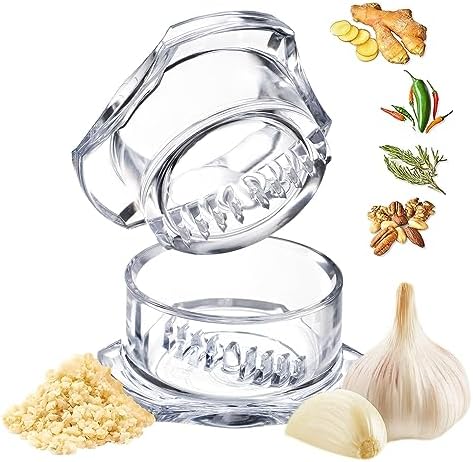
Every press on this page produces exactly one texture. This one lets you choose.
Key Specifications
| Type | Twister |
|---|---|
| Material | BPA-free Tritan |
| Method | Smash to loosen skin, then twist side to side |
| Capacity | 3—5 cloves |
| Texture | Progressive — twist longer for finer pieces |
| Also for | Ginger grating, herbs and nut grinding |
| Origin | Made in the USA, patented design |
| Dishwasher | Safe |
| Rank | #6,076 in its category |
| Price | $26.89 |
| Best For | Cooks who want coarse garlic sometimes and fine garlic other times |
Why We Recommend It
Texture is not a detail in garlic cookery, it is the whole variable. A fine paste dissolves into a dressing or an aioli and delivers a sharp, even heat; a coarse crush stays in identifiable pieces that sweeten and soften as they cook and give a sauce its texture. A press gives you paste and only paste, and a rocker gives you coarse and only coarse. A twister sits between them because you stop when it looks right — two turns for coarse, ten for near-paste.
Tritan rather than metal has a real advantage here: it is transparent, so you can see the texture as you work instead of guessing.
The trade is preparation. You have to smash each clove to loosen the skin and peel it before it goes in, which is exactly the step the unpeeled-clove presses here remove.
$26.89 is the second dearest listing here, and it is made in the USA under a patent, which explains some of it.
Pros
- Texture is controllable, from coarse to near-paste
- Transparent, so you can see the result as you work
- Holds 3—5 cloves
- Also grates ginger and grinds nuts
- BPA-free Tritan, dishwasher safe
- Made in the USA under a patent
Cons
- Cloves must be smashed and peeled first
- $26.89 — second dearest here
- Plastic will scratch and cloud over time
- Twisting takes longer than one squeeze
- Rank #6,076
- Teeth need rinsing between the two halves
Best for: Cooks who care about the difference between crushed garlic and garlic paste.
10. Emptycolor Mini Chopper and Press — Best for Storage

The container is the idea, and it changes when you use the tool rather than how.
Key Specifications
| Type | Blade chopper, not a press |
|---|---|
| Blades | Stainless steel |
| Container | Built in — store the minced garlic in it |
| Suits | Garlic, ginger and small herbs |
| Stated limitation | Not intended for slicing or dicing |
| Grip | Ergonomic, compact |
| Storage | Fits any drawer |
| Rank | #5,028 in its category |
| Price | $6.55 |
| Best For | Prepping a week of garlic at once and refrigerating it |
Why We Recommend It
Mincing garlic once a week instead of once a meal is a real time saving, and the obstacle is usually that the minced garlic has nowhere to live. Chopping a whole bulb and scraping it into a jar means washing the board, the knife and the jar; a chopper that mines into its own sealed container means you prep, click the lid on and put it in the fridge. Minced garlic keeps a few days refrigerated, though its flavour sharpens and then fades — it is a convenience trade, not a free one.
Blades cut rather than crush, which produces a different result. Crushing ruptures more cell walls and releases more allicin, the compound responsible for garlic’s pungency, so pressed garlic tastes markedly stronger than chopped garlic of the same weight.
The listing is unusually candid about scope: designed for mincing and crushing, not intended for slicing or dicing.
$6.55 makes it the cheapest thing on this page, and it is a different tool from the rest of it.
Pros
- Built-in container for storing what you prep
- $6.55 — cheapest listing here
- Stainless blades for a clean cut
- Handles ginger and small herbs
- Compact enough for any drawer
- Candid about what it will not do
Cons
- Blades chop rather than crush — milder flavour
- Cloves must be peeled first
- Not a press, despite the listing name
- Blades are harder to clean safely than a plate
- Plastic housing
- Rank #5,028
Best for: Batch prepping garlic for the week rather than mincing per meal.
How Each One Deals With the Residue
Same job, six different answers to the only question that decides whether you keep using it.
| Tool | Approach | Effort After Use | Price |
|---|---|---|---|
| Joseph Joseph Rocker | No holes at all | Rinse a flat surface | $19.98 |
| Gourmet Easy | No hinge; fully separates | Wipe every surface | $29.99 |
| OXO Die-Cast Zinc | Sprung ejector plate | One squeeze, then rinse | $20.80 |
| OXO Stainless | Swing-out basket | Tip out, then rinse | $14.97 |
| Kitessensu | 37 studs push through | Rinse promptly | $10.99 |
| Zulay | Brush supplied | Rinse at once or soak | $9.99 |
| GORILLA GRIP | Brush supplied | Rinse at once or soak | $13.99 |
| Kitchen Matte | Brush supplied | Rinse at once or soak | $6.99 |
| NexTrend Twister | Two halves, dishwasher | Separate and rinse | $26.89 |
| Emptycolor Chopper | Blades and container | Careful rinse around blades | $6.55 |
Ranked honestly, the tools that engineer the problem away sit at the top and cost the most: no holes at all, no hinge at all, or a mechanism that clears the holes for you. The three brush-equipped presses are not bad tools — rinsed within a minute they all clean easily — but a brush transfers the work to you, and brushes get lost. If you know you are the sort of cook who leaves things in the sink until after dinner, that knowledge should choose your press.
Press, Rocker, Twister or Chopper
Four mechanisms, four different results from the same clove.
| Hinged Press | Rocker | Twister | Chopper | |
|---|---|---|---|---|
| Texture | Fine paste | Coarse crush | Your choice | Chopped pieces |
| Flavour released | Strongest | Strong | Medium | Mildest |
| Needs peeling | No | Yes | Yes | Yes |
| Garlic ends up | In the pan | On the board | In the chamber | In a container |
| Cleaning | Holes to clear | Nothing to clear | Two halves | Around blades |
| Best for | Dressings, marinades | Rustic sauces | Both, if you judge it | Batch prep |
| On this page | Seven | One | One | One |
The flavour difference is real chemistry rather than preference. Crushing ruptures far more cell walls than cutting, which releases more allicin — the compound that makes raw garlic pungent — so a pressed clove tastes noticeably stronger than the same clove chopped. That is why recipes sometimes specify one or the other, and why a press is the right tool for a dressing where the garlic must disappear and the wrong one for a slow braise where you want soft, sweet pieces.
Best Alternatives
| Alternative | Why Consider It | Better For | Main Trade-Off |
|---|---|---|---|
| A chef’s knife and salt | Free, and a coarse salt paste is excellent | Anyone who already has knife skills | Board, knife and hands all need washing |
| A microplane grater | Produces the finest paste of anything | Aioli, dressings, marinades | Grates knuckles, and clogs badly |
| A mortar and pestle | The traditional tool, and it bruises rather than cuts | Pastes with herbs and spices together | Bulky, heavy, slow for one clove |
| Pre-minced garlic in a jar | No prep and no cleaning at all | Weeknight convenience | Tastes markedly different — usually acidic |
What the Money Actually Buys
$6.55 to $10.99 — the chopper, the matte set, Zulay, Kitessensu. Strong value, and it includes the best-selling item on the page. All the presses here rely on prompt rinsing plus a brush; what you are not buying is a cleaning mechanism.
$13.99 to $14.97 — Gorilla Grip and OXO stainless. Bigger chambers and better emptying. The swing basket and the elephant-clove chamber both address real annoyances without solving the holes.
$19.98 to $20.80 — the Joseph Joseph rocker and the OXO zinc press. The two genuinely different answers, and the pick of the page. One clears the holes for you; the other has no holes to clear.
$26.89 to $29.99 — the twister and the hinge-free stainless press. Specialists. Texture control on demand, and the only design here with nowhere at all for residue to hide.
What to Check Before You Buy
Buy for the Cleaning, Not the Crushing
Every tool in this roundup will crush a clove of garlic perfectly well. What separates them is the ninety seconds afterwards, and that is what determines whether the thing gets used or migrates to the back of a drawer. Pressed garlic leaves a plug of starchy fibre in every hole, and it sets hard within a few minutes — rinsed immediately it falls out under the tap, left until after dinner it needs soaking and picking at. Three presses here include a brush for exactly this, one has a sprung plate that ejects the residue, one has no hinge to trap it, and one has no holes at all. Choose according to how disciplined you honestly are about washing up.
Decide Whether You Want to Peel
Four of these tools crush unpeeled cloves, which is the single largest time saving in the category. The flesh extrudes through the holes while the skin stays behind in the chamber as a flat disc you lift out and discard — so you go from a whole bulb to minced garlic without ever handling a clove or picking papery skin off your fingers. The rocker, the twister and the chopper all require peeled cloves first, which is why several sets include a silicone roller peeler: put the cloves inside the tube, roll it under your palm on the counter, and the skins slip off. If you press garlic often, unpeeled capability is worth more than any other feature here.
Prefer Zinc Over Stainless, Counterintuitively
Stainless steel sounds like the premium option and buyers ask for it, but several of the best presses in this roundup are die-cast zinc, and the makers explain why. Zinc is very strong in compression, which is exactly the load a garlic press applies; it is cheap enough to cast thick; and it is non-reactive with the sulphur compounds in garlic, so it does not develop the lingering smell that some metals acquire. One listing here makes that argument explicitly. Note that the same maker sells this design in both metals, and the zinc version ranks far higher than the stainless one at a higher price — though that reflects the different cleaning mechanisms as much as the material.
Look at the Chamber Size Against Your Cooking
The practical measure is cloves per squeeze, and it decides how tedious the tool is in real use. A recipe calling for six cloves means six full cycles on a small press — open, load, close, squeeze hard, scrape out, repeat — and about ninety seconds of fiddling with garlicky hands. A chamber that takes three or four at once halves that. One press in this roundup quotes the extreme case of fitting a single elephant garlic clove, which can be as large as an entire ordinary bulb. If you mostly cook for one or two and use a clove at a time, chamber size is irrelevant; if you batch cook, it is the main thing.
Understand That Pressing Tastes Stronger Than Chopping
This is chemistry rather than preference, and it explains why recipes sometimes specify one or the other. Garlic’s pungency comes from allicin, which does not exist in an intact clove — it forms when cell walls rupture and two previously separated compounds meet. Crushing ruptures far more cells than slicing does, so a pressed clove releases substantially more allicin than the same clove chopped, and tastes correspondingly sharper and hotter. That makes a press ideal for dressings, marinades and anything where garlic should be assertive and invisible, and less suitable for a slow braise where you want soft sweet pieces. A rocker sits between the two.
Check the Hinge, Because That Is Where the Smell Lives
The holes get the attention and the hinge causes the trouble. On a conventional press the two arms pivot on a rivet, and the narrow gap around that pivot packs with garlic fibre that no brush reaches and no dishwasher jet clears. Over a few months it discolours and starts to smell, and there is nothing you can do about it short of replacing the tool. One press in this roundup is built with no hinge at all — the handle detaches and the plate separates, so every surface can be reached — and the rocker has no moving parts whatsoever. If you have owned a press that went smelly for no visible reason, this is why.
Consider Whether You Want One Texture or Several
A hinged press produces a fine wet paste and nothing else. That is the right output for a vinaigrette, an aioli or a marinade, where the garlic should dissolve and season the whole dish evenly. It is the wrong output for a sauce that wants identifiable pieces of garlic softening as it cooks, or for a stir-fry where sliced garlic is the point. A rocker gives you a coarse crush and only that. The twister in this roundup is the only tool here that lets you choose — a couple of turns for coarse, ten for near-paste, judged through a transparent body — at the cost of having to peel first and a higher price.
Common Mistakes
- Leaving it in the sink until after dinner. Garlic fibre sets hard in the holes within minutes.
- Buying stainless because it sounds better. Zinc is stronger in compression and takes no odour.
- Peeling cloves you did not need to peel. Four of these crush them skin and all.
- Using a press for a slow braise. It releases more allicin, so the flavour is sharper than intended.
- Ignoring the hinge. That is where residue collects and where the smell comes from.
- Buying a small chamber for batch cooking. Six cloves means six full cycles.
- Relying on the supplied brush. Brushes get lost long before the press wears out.
Who Should Buy Which
Buy the OXO die-cast zinc at $20.80 if you want one press for good. The sprung ejector clears every hole in a single motion, which is the difference between a tool you keep and one you abandon.
Buy the Zulay at $9.99 if you rinse as you go. Rank #371, a peeler and brush included, unpeeled cloves and a lifetime warranty for ten dollars.
Buy the Joseph Joseph rocker at $19.98 if cleaning is your whole objection. No chamber, no holes, nothing to unclog — and stainless steel takes the smell off your hands.
Buy the Gourmet Easy at $29.99 if you want it engineered out. No hinge, fully separable, 304 stainless and a fine-mince plate.
Buy the Kitchen matte set at $6.99 to find out if you are a press person. Same zinc alloy as the $20.80 press, with a peeler and brush.
Frequently Asked Questions
What is the easiest garlic press to clean?
The ones that remove the problem rather than help you with it. Three presses in this roundup include a small brush for poking residue out of the holes, which works but transfers the job to you. Better designs handle it mechanically: one has a sprung plate of small teeth that folds over the chamber and pushes through every hole at once, ejecting skin and pulp in a single motion; another is built with no hinge at all, so the handle detaches and the plate separates and every surface can be wiped. Best of all for cleaning is the rocker, which has no chamber and no holes whatsoever — you rinse a smooth piece of steel. Whichever you choose, rinse immediately: garlic fibre sets hard within minutes.
Do you have to peel garlic before using a press?
Not with most hinged presses, and this is the biggest time saving the category offers. Four tools in this roundup explicitly crush unpeeled cloves: the flesh extrudes through the holes while the skin stays behind in the chamber as a flat papery disc that you lift out and throw away. You go from a whole bulb to minced garlic without handling a clove or picking skin off your fingers. The rocker, the twister and the blade chopper all need peeled cloves, which is why several sets include a silicone roller peeler — put the cloves in the tube, roll it under your palm on the counter, and the skins come loose. If you press garlic regularly, unpeeled capability matters more than any other feature.
Is a garlic press or a knife better?
They produce genuinely different food, so it is not purely a convenience question. Crushing ruptures far more cell walls than slicing, and that releases more allicin — the compound responsible for raw garlic’s pungency — so pressed garlic tastes noticeably sharper and hotter than the same weight chopped. For a vinaigrette, an aioli or a marinade, where you want garlic to dissolve and season everything evenly, a press is the better tool. For a stir-fry with sliced garlic, or a slow braise where you want soft sweet pieces, a knife is. The practical argument for the press is speed and unpeeled cloves; the practical argument for the knife is that there is nothing extra to wash.
Why does my garlic press smell?
Usually the hinge, occasionally the metal. On a conventional press the arms pivot on a rivet, and the narrow gap around that pivot packs with garlic fibre that no brush can reach and no dishwasher jet clears — over a few months it discolours and starts to smell, and there is no real remedy. One press in this roundup avoids it entirely by having no hinge: the handle detaches and the plate separates for cleaning. The material matters too. Zinc is non-reactive with garlic’s sulphur compounds and stays odour-free, which is why several premium presses are die-cast zinc despite stainless sounding more upmarket. Rubbing stainless steel under running water is itself a way to remove garlic smell from hands.
What is a garlic rocker and is it better than a press?
A rocker is a curved, ridged slab of stainless steel that you place over a peeled clove on a board and rock from side to side, crushing the clove against the board. There is no chamber, no holes and no hinge, so cleaning is rinsing a flat piece of metal — which is the single strongest argument for it, since cleaning is why most garlic presses end up unused. The trade-offs are real: you must peel first, the crush is coarser than a press produces, and the garlic ends up spread on the board to be scraped up rather than delivered straight into the pan. For rustic cooking it is excellent; for a dressing that needs a smooth paste, a press does the job better.
Are expensive garlic presses worth it?
Only for the cleaning mechanism, which is admittedly the thing that decides whether you keep using it. The prices in this roundup run from $6.55 to $29.99, and the metallurgy barely changes across that range — the $6.99 press and the $20.80 one are both zinc alloy. What the money buys at the top end is a sprung ejector that clears the holes, or a hinge-free design that comes apart completely, or a rocker with nothing to clean at all. If you are the kind of cook who rinses a tool the moment you put it down, a $9.99 press with a brush will serve you for years. If you are not, the extra ten dollars buys a tool you will still own in five years rather than one in the back of a drawer.
Final Verdict
A sprung plate that pushes through every hole and ejects the residue in one motion — the cleaning problem solved mechanically rather than with a brush. $20.80.
Rank #371, with a silicone peeler and brush, unpeeled-clove crushing and a lifetime warranty. $9.99.
No chamber, no holes, no hinge — rinse a flat piece of stainless steel, which also takes the garlic smell off your hands. $19.98.
Every tool on this page crushes garlic. The one you will still own in five years is the one you do not dread washing.
Three of these ship a brush, which admits the problem without solving it. One ejects the residue mechanically, one has no hinge for it to hide in, and one has no holes at all.
If you press garlic often, buy one that takes unpeeled cloves. Skipping the peeling saves more time than any other feature in the category, and four of these do it.
And if your objection to garlic presses was always the cleaning rather than the crushing, buy the rocker and stop thinking about it.