Affiliate Disclosure: As an Amazon Associate, we earn from qualifying purchases. This does not affect the price you pay.
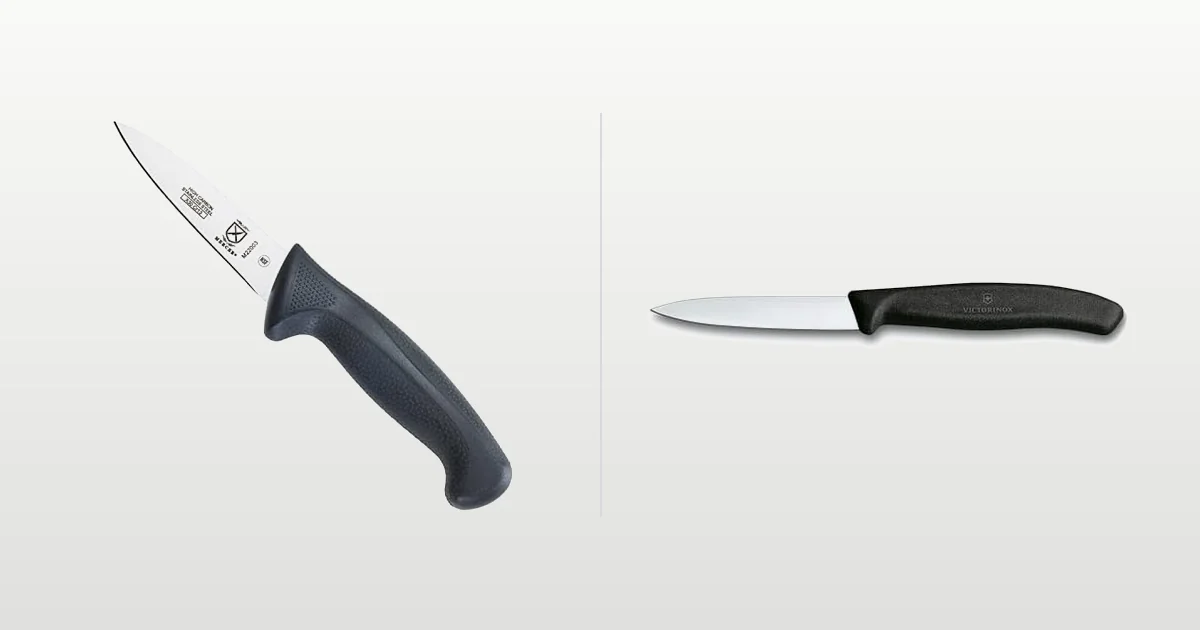
Three of these ten knives have a bolster — the thick collar of steel between blade and handle. On a chef’s knife it is a mark of quality. On a three-inch blade it is a liability.
A bolster does two things: it balances a long blade and it stops your knuckles sliding onto the edge. Neither applies here. A paring blade is short enough to be rigid whatever you do, and most paring is done in the air — an apple in one hand, the knife drawn toward your thumb — a grip in which the bolster contributes nothing at all. What it does instead is add weight to a tool whose entire virtue is disappearing in the hand, and block a sharpening stone from reaching the heel of the edge.
That is why the knife most professional kitchens actually own is a bolsterless $8.00 Victorinox.
The second surprise is that these makers cannot agree whether you may wash the thing. Both Mercers state plainly: do not put it in the dishwasher, and do not submerge it. Victorinox states it is dishwasher safe. Henckels says the dishwasher is fine. All three are right about their own steel — hard high-carbon dulls and etches in alkaline detergent, softer corrosion-resistant stainless does not.
$4.99 to $39.95 below, over a blade-length range of just three to four inches.
Our Quick Picks
 Best OverallVictorinox Swiss Classic 3.25 Inch
Three and a quarter inches, no bolster, NSF approved and explicitly dishwasher safe — for $8.00.
 Most PopularMercer Culinary Millennia 3.5 Inch
One-piece high-carbon Japanese steel with a textured non-slip handle, at $10.19 and rank #243.
 Best Specifiedimarku 3.5 Inch Pakkawood
A 9–15° per side edge, a published carbon content and an FSC-certified pakkawood handle — the most specified knife on this page.
At a Glance
Ten Knives, and Which of Them You Can Wash
Blade length, steel, whether there is a bolster in the way, and what each maker says about the dishwasher. Three of them disagree.
| # | Model | Blade | Steel | Bolster | Dishwasher | Standout | Main Drawback | Check Price |
|---|---|---|---|---|---|---|---|---|
| 1 |
 Victorinox Swiss Classic 3.25 Inch Victorinox Swiss Classic 3.25 Inch |
3.25 in | Stainless | None | Yes | No bolster, NSF approved, dishwasher safe, and eight dollars | No steel grade or hardness is published | View on Amazon |
| 2 |
 Mercer Culinary Millennia 3.5 Inch Mercer Culinary Millennia 3.5 Inch |
3.5 in | High-carbon Japanese | None | No — explicitly | Rank #243 — the best-selling knife on this page | The listing forbids the dishwasher in plain language | View on Amazon |
| 3 |
 imarku 3.5 Inch Pakkawood imarku 3.5 Inch Pakkawood |
3.5 in | High-carbon, 0.6–0.75 carbon | None | Not stated | The only knife here that publishes its edge angle | At $23.99 it is dearer than three knives combined | View on Amazon |
| 4 |
 Mercer Culinary Genesis 3.5 Inch Mercer Culinary Genesis 3.5 Inch |
3.5 in | High-carbon German | Forged | No — explicitly | Precision-forged German steel with a taper-ground edge | Forged weight is a disadvantage on a blade this small | View on Amazon |
| 5 |
 Cuisinart Triple Rivet 3.5 Inch Cuisinart Triple Rivet 3.5 Inch |
3.5 in | High-carbon stainless | Extra-wide | Not stated | A lifetime warranty and a blade guard at $8.95 | An extra-wide bolster on a 3.5-inch blade eats usable edge | View on Amazon |
| 6 |
 Henckels Solution 4 Inch Henckels Solution 4 Inch |
4 in | German | None — stamped | Yes | Four inches of stamped blade, dishwasher safe, $12.99 | Four inches is long enough to be clumsy for detail work | View on Amazon |
| 7 |
 Henckels Forged Accent 2-Piece Henckels Forged Accent 2-Piece |
3 in + 4 in | German forged | Forged | Yes | Both useful lengths in one purchase — 3 inch and 4 inch | $39.95, the most expensive listing on this page | View on Amazon |
| 8 |
 Farberware EdgeKeeper 3.5 Inch Farberware EdgeKeeper 3.5 Inch |
3.5 in | High-carbon stainless | None | No — hand wash | A sheath with a built-in sharpener that works every time you draw it | Sharpening on every draw removes steel on every draw | View on Amazon |
| 9 |
 VITUER 4-Knife Set, 4 Inch VITUER 4-Knife Set, 4 Inch |
4 in x4 | 3Cr13MoV, 56±2 HRC | None | No — hand wash | The only listing here that publishes a steel grade and a hardness | 56 HRC is soft, and 3Cr13MoV is a budget steel | View on Amazon |
| 10 |
 BYkooc 8-Piece Rainbow Set BYkooc 8-Piece Rainbow Set |
Paring x4 | German steel | None | Not stated | Four knives and four sheaths for $4.99 | No length, steel grade or hardness is published anywhere | View on Amazon |
Blade lengths, steels, prices and care instructions are taken from each manufacturer’s Amazon listing as displayed on 25 August 2026 through a United States connection, and may change. Dishwasher guidance conflicts across this page and is reported exactly as each maker gives it: two listings forbid it outright, three permit it, and five give no guidance either way — where a listing is silent, the column says so rather than assuming. Only two listings publish anything about the steel beyond an origin: one gives an edge angle of 9–15° per side and a carbon content, another names 3Cr13MoV at 56±2 HRC. Every other steel description on this page — “German steel”, “high-carbon stainless”, “Japanese high carbon” — names an origin or a class rather than an alloy, and we have not inferred grades. Sales ranks are shown as displayed and can be pooled across a variant family.
Scroll the table sideways to see every column
How We Chose These Ten
We researched current listings, compared manufacturer specifications and documentation, and examined recurring patterns in customer feedback. We did not carry out hands-on testing, and nothing below is presented as measured performance data.
- Bolster presence recorded for every knife — because on a 3-inch blade it costs you edge and sharpening access
- Dishwasher guidance quoted as published — two makers forbid it, three permit it, five say nothing
- Steel claims separated from steel specifications — ‘German steel’ is an origin; 3Cr13MoV at 56 HRC is a specification
- A verified live buy box — all ten confirmed purchasable in the United States on 25 August 2026
- Three to four inches all represented — the classic length is 3–3.5 in, and 4 in is a different tool
- Multi-packs included — because replacing cheap knives is a legitimate strategy
- No overlap with our published knife and cutlery guides — every knife here is new to the site

The Ten Knives in Detail
1. Victorinox Swiss Classic 3.25 Inch — Best Overall

This is the knife you find in professional kitchens, and the three reasons are on the listing.
Key Specifications
| Blade length | 3.25 inches (listed as 3.2 in) |
|---|---|
| Blade shape | Straight edge, spear point |
| Bolster | None |
| Dishwasher | Stated safe |
| Certification | NSF approved — only one here |
| Handle | Textured, non-slip even when wet; ergonomic |
| Balance | Stated as weighted and balanced |
| Steel grade | Not published |
| Rank | #567 in its category |
| Price | $8.00 |
| Best For | Almost everyone — and the only one here a health inspector would accept |
Why We Recommend It
No bolster is the first and least obvious. A bolster is the thick collar between blade and handle, and on a chef’s knife it adds balance and protects the hand. On a three-inch blade it does neither useful thing — it adds weight to a knife whose entire job is to feel like nothing, and it physically blocks a sharpening stone from reaching the heel, so the last half inch of edge gradually goes dull and stays dull. Victorinox’s stamped, bolsterless build is not a cost saving here. It is the correct design.
NSF approval is the second. No other knife on this page carries it, and for anyone selling food it may be a requirement rather than a nicety.
Dishwasher safe is the third, and it is contested. Two makers on this page tell you explicitly not to; Victorinox and Henckels say you may. Victorinox’s plastic handle and softer, more corrosion-resistant steel are exactly why it survives.
No hardness figure is published, which is the one thing we would want.
Pros
- No bolster — the whole edge stays sharpenable
- NSF approved, unique on this page
- Explicitly dishwasher safe
- Non-slip grip even with wet hands
- The standard professional-kitchen paring knife
- $8.00
Cons
- No steel grade or hardness published
- Plastic handle looks utilitarian
- Softer steel needs honing more often
- 3.25 inches is short for larger hands
- No sheath or blade guard included
- Rank #567
Best for: Everyday peeling, trimming and detail work, in any kitchen including a commercial one.
2. Mercer Culinary Millennia 3.5 Inch — Most Popular

Rank #243 across the whole category, and the care instruction is the opposite of the knife above it.
Key Specifications
| Blade length | 3.5 inches |
|---|---|
| Steel | One-piece high-carbon Japanese |
| Construction | Single piece — no forged bolster |
| Handle | Ergonomic with textured finger points |
| Dishwasher | Explicitly not — and do not soak |
| Care | Hand wash, rinse, dry completely with a soft towel |
| Stated uses | Garnishes, seeding jalapeños, deveining shrimp, trimming beans |
| Series | Millennia, aimed at professional kitchens |
| Rank | #243 — highest on this page |
| Price | $10.19 |
| Best For | Cooks who will hand wash, and want a harder edge for it |
Why We Recommend It
“Do not place in dishwasher or submerge for long periods” is not boilerplate. High-carbon steel holds a finer edge because it is harder, and the same hardness makes it more brittle at the very apex and less resistant to corrosion. Dishwasher detergent is strongly alkaline and designed to strip protein and fat; run against a hard, high-carbon edge for ninety minutes at temperature, it etches the steel and dulls the apex. Add blades knocking against a rack and you have the two mechanisms that ruin knives in dishwashers.
So the two best-selling knives on this page take opposite positions, and both are right about their own steel. Softer, more corrosion-resistant stainless survives the machine; harder high-carbon does not.
Textured finger points are a real safety feature on a knife used with wet hands and slippery fruit.
One-piece construction with no bolster means the full edge reaches a stone.
Pros
- Rank #243, best selling here
- One-piece high-carbon Japanese steel
- No bolster to block the heel
- Textured finger points for wet hands
- Named for professional kitchen use
- $10.19
Cons
- Not dishwasher safe, stated outright
- Do not soak — needs drying immediately
- High-carbon steel is less corrosion resistant
- No hardness figure published
- No sheath included
- Handle is plain black plastic
Best for: Hand-washing households that want a harder, finer edge than Victorinox’s.

3. imarku 3.5 Inch Pakkawood — Best Specified

Nine to fifteen degrees per side is the only edge angle published anywhere on this page, and it is the number that matters if you sharpen.
Key Specifications
| Blade length | 3.5 inches |
|---|---|
| Steel | Japanese high-carbon stainless, forged |
| Carbon content | Published as 0.6—0.75 (as listed) |
| Edge angle | 9—15° per side — only published angle here |
| Grind | Taper-ground for stability |
| Finish | Hand polished, band-sharpened |
| Handle | FSC-certified pakkawood |
| Warranty | Lifetime satisfaction stated |
| Rank | #667 in its category |
| Price | $23.99 |
| Best For | Anyone who sharpens their own knives and wants to match the factory angle |
Why We Recommend It
Edge angle is the trade between sharpness and durability, and it is set at the factory. A narrow angle around 10° per side cuts beautifully and chips if it meets a bone or a stone plate; a wide angle around 20° is what German knives traditionally use and survives abuse at the cost of keenness. A paring knife never meets bone — it peels, trims and cuts fruit — so a narrow Japanese angle is the right choice for the job, and imarku is the only maker here to tell you what its is.
This matters practically when you resharpen. Grinding a 12° edge at 20° throws away the geometry you paid for, and without a published figure you are guessing at the angle to hold on the stone.
Pakkawood is resin-impregnated laminated wood, so it looks like timber and does not absorb water or harbour bacteria the way bare wood does.
No dishwasher guidance is given either way, and with a wood-composite handle we would hand wash regardless.
Pros
- Publishes a 9—15° edge angle
- Publishes carbon content, which nothing else here does
- Taper-ground and hand polished
- FSC-certified pakkawood handle
- Lifetime satisfaction commitment
- Rank #667
Cons
- $23.99 — dear for a paring knife
- No dishwasher guidance either way
- Wood-composite handle should be hand washed
- Narrow edge chips if misused
- Carbon content given without units
- No sheath included
Best for: Cooks who sharpen their own knives and want to preserve the factory geometry.
4. Mercer Culinary Genesis 3.5 Inch — Best Forged

Forging is a genuine quality marker on a chef’s knife. On a paring knife it is close to irrelevant, and possibly a drawback.
Key Specifications
| Blade length | 3.5 inches |
|---|---|
| Steel | High-carbon German, precision-forged |
| Grind | Taper-ground edge |
| Construction | Forged |
| Handle | Ergonomic, non-slip with wet hands |
| Dishwasher | Explicitly not; do not submerge |
| Series | Genesis |
| Rank | #3,558 in its category |
| Price | $21.19 |
| Best For | People who want forged construction and know why they want it |
Why We Recommend It
Forging heats and hammers a billet into shape, aligning the grain and allowing a thicker spine and an integrated bolster; stamping cuts the blade from rolled sheet. On an eight-inch chef’s knife that difference produces real rigidity and balance you can feel. On a three-and-a-half-inch paring blade there is almost nothing to stiffen — the blade is short enough to be rigid whatever you do — and the extra mass works against a tool whose whole virtue is disappearing in the hand while you turn an apple against it.
The taper-ground edge is the more meaningful specification here: the blade thins progressively from spine to edge, which reduces the wedge effect as it passes through food.
German steel rather than Japanese, which typically means slightly softer and tougher, holding a slightly coarser edge for longer.
Not dishwasher safe, stated in the same words as the Millennia.
Pros
- Precision-forged German steel
- Taper-ground edge reduces wedging
- Excellent non-slip forged handle
- Tougher steel than a Japanese equivalent
- Professional series from a kitchen-supply brand
- Long-lasting sharpness claimed
Cons
- Forging adds weight where lightness is the point
- Not dishwasher safe
- $21.19 against $8.00 for a comparable job
- Rank #3,558
- No hardness or edge angle published
- No sheath included
Best for: Cooks who want a matched forged set and will hand wash everything in it.
5. Cuisinart Triple Rivet 3.5 Inch — Best Warranty

“Extra-wide safety bolster” is presented as a feature. On this knife it is the thing we would change.
Key Specifications
| Blade length | 3.5 inches |
|---|---|
| Steel | High-carbon stainless |
| Construction | Forged, full tang, stainless rivets |
| Bolster | Extra-wide safety bolster |
| Handle | Ergonomic, triple riveted |
| Included | Blade guard |
| Warranty | Lifetime |
| Rank | #1,880 in its category |
| Price | $8.95 |
| Best For | Buyers who want a warranty and a guard more than a bare edge |
Why We Recommend It
A bolster on a 3.5-inch blade takes a meaningful fraction of the cutting length out of service and puts a permanent obstruction where a sharpening stone needs to reach. On a full-size chef’s knife the bolster sits behind a blade long enough not to miss it, and it stops your knuckles sliding onto the edge. On a paring knife you are usually cutting in the air, holding the food in one hand and drawing the blade toward your thumb — a grip in which the bolster contributes nothing and the heel of the edge, which it blocks from the stone, is exactly where you do detail work.
The full tang and triple rivets are genuinely good construction, and a blade guard at this price is welcome given none of the single knives above include one.
A lifetime warranty at $8.95 is the best value-to-commitment ratio here.
No dishwasher guidance either way, on a knife whose riveted handle would tolerate it better than most.
Pros
- Lifetime warranty at $8.95
- Blade guard included
- Full tang with stainless triple rivets
- Forged construction
- High-carbon stainless blade
- Widely available replacement if damaged
Cons
- Extra-wide bolster blocks the heel from a stone
- Bolster adds weight to a light tool
- No dishwasher guidance
- No steel grade or hardness published
- Rank #1,880
- Forging adds little on a blade this short
Best for: Buyers who value the warranty and the guard over the last inch of edge.

6. Henckels Solution 4 Inch — Longest Blade

Four inches sits between a paring knife and a utility knife, and which side it lands on depends on your hands.
Key Specifications
| Blade length | 4 inches — longest on this page |
|---|---|
| Steel | German, satin finished |
| Construction | Single-piece, precision-stamped — no bolster |
| Dishwasher | Stated safe, or hand wash |
| Blade | Stain and rust free |
| Weight | Described as lightweight |
| Brand claim | Over 100 years of German engineering |
| Rank | #4,886 in its category |
| Price | $12.99 |
| Best For | People who find a 3.25-inch blade too small to control |
Why We Recommend It
The classic paring length is three to three and a half inches, and it is short for a reason. Much paring is done in the air — an apple held in one hand, the blade drawn toward the thumb of the other — and control comes from having very little blade beyond the work. At four inches there is more steel past the cut than most people can steer precisely. On the other hand, a four-inch blade handles a shallot, a lime or a chicken thigh far better than a three-inch one, and anyone with large hands finds the short knives fiddly.
Stamped and bolsterless is the right construction here, and Henckels says so plainly rather than dressing it up: a single-piece precision-stamped blade, lightweight, with nothing blocking the heel.
Dishwasher safe, which two other makers on this page forbid.
Rank #4,886 is modest for a brand this well known.
Pros
- 4 inches suits larger hands and larger jobs
- Stamped and bolsterless — full edge reachable
- Dishwasher safe, stated
- Lightweight despite the extra length
- Stain and rust free finish
- $12.99 from an established maker
Cons
- 4 inches is long for in-hand detail work
- Rank #4,886
- No steel grade or hardness published
- No sheath included
- Stamped blade is thinner at the spine
- German steel takes a coarser edge than Japanese
Best for: Larger hands, and cooks who want one knife between paring and utility work.
7. Henckels Forged Accent 2-Piece — Best Pair

Three inches and four inches are genuinely different tools, and this is the only listing here that gives you both.
Key Specifications
| Blade lengths | 3 inches and 4 inches |
|---|---|
| Steel | German, satin finished |
| Construction | Forged bolster, seamless blade-to-handle transition |
| Dishwasher | Stated safe, or hand wash |
| Balance | Forged bolster for durability and balance |
| Blade | Stain and rust free, finely honed |
| Quantity | 2 knives |
| Rank | #4,578 in its category |
| Price | $39.95 — dearest here |
| Best For | Owning both paring lengths without deciding between them |
Why We Recommend It
The three-inch blade is for in-hand work — hulling strawberries, coring tomatoes, turning an apple against your thumb — where the shorter the blade past the cut, the more control you have. The four-inch is for board work: slicing a shallot, trimming fat from a chop, cutting a lime into wedges. Most people who own one paring knife end up wishing it were the other size roughly half the time, and buying both at once removes the compromise.
The forged bolsters remain our reservation. On a three-inch blade especially, a bolster occupies a real proportion of the edge and blocks a stone from the heel.
$39.95 is by some distance the most expensive listing here — four times the Victorinox, and eight times the four-knife budget set.
Dishwasher safe, unlike both Mercers.
Pros
- Both paring lengths, 3 in and 4 in, in one purchase
- Forged with a seamless blade-to-handle transition
- Dishwasher safe, stated
- Satin-finished, finely honed edges
- Stain and rust free
- Established German maker
Cons
- $39.95 — dearest listing on this page
- Forged bolsters block the heel on both knives
- Bolster mass is most noticeable on the 3-inch
- Rank #4,578
- No hardness or edge angle published
- No sheaths or guards included
Best for: Anyone who has owned one paring knife and kept wanting the other size.
8. Farberware EdgeKeeper 3.5 Inch — Best Sheath

A sheath that sharpens the knife every time you pull it out is either the best idea on this page or the worst, and it depends entirely on you.
Key Specifications
| Blade length | 3.5 inches |
|---|---|
| Steel | High-carbon stainless |
| Sheath | Self-sharpening blade cover with a built-in sharpener |
| Action | Sharpens the edge with every use |
| Handle | Ergonomic comfort grip |
| Care | Hand wash, rinse and dry immediately; wipe the cover |
| Storage | Protected edge in a drawer |
| Rank | #4,587 in its category |
| Price | $10.15 |
| Best For | Households that will never sharpen a knife any other way |
Why We Recommend It
Built-in sharpeners of this kind use fixed carbide or ceramic elements that shave metal off the edge as the blade passes between them. They do not hone or realign — they cut. That is genuinely useful for a knife that would otherwise never be sharpened at all, which describes most knives in most homes, and it keeps a working edge on a $10 knife indefinitely. It is also why nobody would put a $200 Japanese knife through one: a fixed-angle carbide sharpener imposes its own geometry and removes far more steel than a stone.
On this knife, at this price, it is the right answer. The blade is a consumable and the sharpener keeps it cutting.
The protective cover has a second value: a bare paring knife loose in a drawer is how tips get bent, which is the way most of them actually die.
Hand wash only, and dry immediately.
Pros
- Sheath sharpens the edge on every draw
- Protects the tip in a drawer — the usual cause of death
- No bolster
- High-carbon stainless blade
- Requires no sharpening skill or equipment
- $10.15
Cons
- Removes steel every single time you draw it
- Fixed-angle carbide imposes its own geometry
- Hand wash only, dry immediately
- Blade life is shortened by design
- No steel grade or hardness published
- Rank #4,587
Best for: Households that own no sharpener and never will.
9. VITUER 4-Knife Set, 4 Inch — Best Published Hardness

Nine of these ten listings tell you nothing about the steel. This one names the alloy and the hardness, and both numbers are modest.
Key Specifications
| Quantity | 4 knives, 4 sheaths |
|---|---|
| Blade length | 4 inches |
| Steel | 3Cr13MoV German stainless |
| Hardness | 56±2 HRC — only figure published here |
| Handle | Integrated ergonomic PP plastic |
| Safety | BPA free and lead free, knives and sheaths |
| Care | Hand wash recommended |
| Colours | Four, for separating tasks |
| Rank | #2,058 in its category |
| Price | $9.99 |
| Best For | Households that want a knife in every drawer and colour-coded prep |
Why We Recommend It
3Cr13MoV at 56 HRC is a soft, tough, corrosion-resistant budget stainless — the same class of steel used in inexpensive pocket knives. A good kitchen knife typically runs 58 to 61 HRC, and each point of hardness means an edge that holds longer but chips more readily. At 56 the edge dulls comparatively quickly and, crucially, comes back easily on any sharpener, and it will not rust if left damp. For four knives at $9.99 that is the correct engineering choice, and publishing it is more honest than the silence everywhere else.
Colour coding is a real hygiene practice, not a gimmick — commercial kitchens separate boards and knives by food type to prevent cross-contamination, and four coloured knives let a home kitchen do the same.
Individual sheaths for all four, which protects the tips in a drawer.
Four inches each, so this is a set of long paring knives rather than a range of sizes.
Pros
- Publishes 3Cr13MoV and 56±2 HRC
- Four knives and four sheaths for $9.99
- Colour coding supports separating raw and ready food
- Soft steel resharpens easily on anything
- BPA-free and lead-free throughout
- Corrosion resistant if left damp
Cons
- 56 HRC is soft — edges dull quickly
- 3Cr13MoV is a budget alloy
- All four are 4 inches; no size variety
- Hand wash recommended
- PP plastic handles feel cheap
- Rank #2,058
Best for: Busy households wanting several knives and colour-separated prep.
10. BYkooc 8-Piece Rainbow Set — Cheapest Here

Four knives and four sheaths for $4.99 is a different proposition from every other listing here, and it deserves to be taken seriously.
Key Specifications
| Quantity | 4 knives, 4 sheaths |
|---|---|
| Colours | Black, yellow, green, red |
| Steel | German steel, stated without a grade |
| Blade length | Not published |
| Hardness | Not published |
| Handle | PP plastic, ergonomic |
| Sheaths | One per knife, for safe storage |
| Rank | #960 in its category |
| Price | $4.99 — cheapest here |
| Best For | Treating paring knives as consumables and always having a sharp one |
Why We Recommend It
The argument for buying cheap paring knives in quantity is that most people never sharpen anything. A knife that costs $1.25 and stays keen for a year is, in practice, sharper over that year than a $24 knife that goes blunt in four months and is never touched by a stone. Paring knives also lead hard lives: they get left in the sink, used to open packaging, dropped tip-first and lost. Replacing one is trivial; nursing one is not.
The counter-argument is waste and edge quality. A good knife sharpened occasionally outperforms a cheap one at every point in its life, and it lasts decades rather than months.
The listing publishes no blade length, no steel grade and no hardness — only “German steel”, which describes an origin rather than an alloy. We report the absence rather than assuming a figure.
Individual sheaths for all four is the one genuinely useful inclusion.
Pros
- $4.99 for four knives and four sheaths
- Individual sheaths protect every tip
- Colour coding separates raw and ready food
- Cheap enough to treat as consumable
- Rank #960 — strong for the price
- Handles are ergonomic PP plastic
Cons
- No blade length published
- No steel grade or hardness published
- “German steel” names an origin, not an alloy
- No dishwasher guidance
- Edge quality will not match the knives above
- Replacing rather than sharpening is wasteful
Best for: Households that would rather replace a paring knife than sharpen one.
Can You Put It in the Dishwasher? Nobody Agrees.
Five listings answer the question and they do not answer it the same way.
| Knife | Steel | Dishwasher | Price |
|---|---|---|---|
| Victorinox Swiss Classic | Stainless | Yes — stated | $8.00 |
| Henckels Solution 4" | German | Yes — stated | $12.99 |
| Henckels Forged Accent | German forged | Yes — stated | $39.95 |
| Mercer Millennia | High-carbon Japanese | No — explicitly | $10.19 |
| Mercer Genesis | High-carbon German | No — explicitly | $21.19 |
| Farberware EdgeKeeper | High-carbon stainless | Hand wash advised | $10.15 |
| VITUER 4-pack | 3Cr13MoV 56 HRC | Hand wash advised | $9.99 |
| imarku Pakkawood | Japanese high-carbon | Not stated | $23.99 |
| Cuisinart Triple Rivet | High-carbon stainless | Not stated | $8.95 |
| BYkooc 4-pack | “German steel” | Not stated | $4.99 |
The split is not arbitrary and it tracks the steel. Dishwasher detergent is strongly alkaline and runs hot for well over an hour; against a hard, high-carbon edge it etches the steel and blunts the apex, and blades knocking against a rack finish the job. Softer, more corrosion-resistant stainless shrugs it off, which is exactly why the knife rated for commercial kitchens is also the cheapest one here. If you own a dishwasher and will use it, that constraint should choose your knife — not the other way round.

Three Inches, Three and a Half, or Four
The whole category spans one inch, and that inch changes what the knife is for.
| 3 in | 3.25–3.5 in | 4 in | |
|---|---|---|---|
| Best at | In-hand work | Everything, adequately | Board work |
| Hulling and coring | Excellent | Good | Clumsy |
| Peeling in the air | Excellent | Excellent | Fair |
| Slicing a shallot | Poor | Fair | Good |
| Trimming a chop | Poor | Fair | Good |
| Large hands | Fiddly | Fair | Comfortable |
| On this page | Henckels 2-pc | Six knives | Three knives |
Six of the ten sit at 3.25 to 3.5 inches because that length does most jobs acceptably, and if you own one paring knife it should be that. The honest problem is that anyone who owns one ends up wanting the other length about half the time — the short blade for turning fruit against a thumb, the long one for anything that happens on a board. Only one listing here solves it directly by supplying both, at $39.95; buying a $8.00 Victorinox and a $12.99 four-inch Henckels covers the same ground for half.
Best Alternatives
| Alternative | Why Consider It | Better For | Main Trade-Off |
|---|---|---|---|
| A Y-peeler | Faster and safer than a knife for peeling | Potatoes, carrots, apples in quantity | Peels only — cannot core, trim or slice |
| A utility knife (5–6 in) | Bridges paring and chef’s knife | One-knife kitchens | Too long for in-hand work |
| A bird’s beak paring knife | Curved blade follows a round surface | Turning vegetables, decorative work | Useless on a flat board |
| Your chef’s knife tip | Free, and already sharp | Occasional small jobs | Unwieldy and genuinely less safe |
What the Money Actually Buys
$4.99 to $9.99 — BYkooc, Victorinox, Cuisinart, VITUER. Extraordinary value, and it includes the best knife on this page. An $8.00 NSF-approved, dishwasher-safe, bolsterless Victorinox is what professional kitchens buy by the box, and a four-knife set for $4.99 is a legitimate alternative strategy for anyone who will never sharpen.
$10.15 to $12.99 — Farberware, Mercer Millennia, Henckels Solution. The best-selling knife on this page sits here, along with the longest blade and the only self-sharpening sheath. Rank #243 for the Millennia says this band is where most people land.
$21.19 to $23.99 — Mercer Genesis and imarku. Forged German construction and the only published edge angle in the category. Real quality, and hard to justify against a knife costing a third as much for the same tasks.
$39.95 — Henckels Forged Accent pair. Two knives, two lengths, forged bolsters on both. The only listing that removes the size compromise, at four times the price of the best single knife here.
What to Check Before You Buy
Prefer No Bolster on a Blade This Short
A bolster is the thick collar of steel where the blade meets the handle, and on a full-size chef’s knife it earns its place by adding balance and keeping knuckles off the edge. On a three-inch paring blade it does neither. The blade is short enough to be rigid without help, and the usual paring grip — food in one hand, blade drawn toward the thumb of the other — puts your hand nowhere near where a bolster would protect it. What the bolster does do is add mass to a tool that should feel like nothing, and physically obstruct a sharpening stone from reaching the heel of the edge, which is precisely where detail cuts are made. Three knives in this roundup have one.
Let Your Dishwasher Choose the Steel
Two makers in this roundup state outright that their knives must not go in a dishwasher or be submerged; three state that the dishwasher is fine; five say nothing either way. This is not carelessness, it tracks the steel. Dishwasher detergent is strongly alkaline and formulated to strip fat and protein, and a cycle runs hot for well over an hour — conditions that etch hard, high-carbon steel and blunt a fine apex, while blades knocking against the rack chip the edge outright. Softer, more corrosion-resistant stainless tolerates all of it. If a knife is going in the machine, buy one whose maker says it may; if you will hand wash, the harder steels reward you with a finer edge.
Pick Three or Four Inches by How You Hold It
The entire category spans one inch, and that inch decides the tool. Three to three and a half inches is the classic paring length because so much of the work happens in the air rather than on a board, and control comes from having very little blade beyond the cut — hulling strawberries, coring a tomato, turning an apple against your thumb. Four inches is really a small utility knife: better on a board for a shallot, a lime or trimming fat, and noticeably clumsier for in-hand work. Six of these ten sit at 3.25 to 3.5 inches for good reason. If you have large hands and find short knives fiddly, go to four.
Note What Steel Claims Actually Say
Most listings in this roundup describe their steel by origin or class — “German steel”, “high-carbon stainless”, “Japanese high carbon” — none of which is a specification. Two do better. One names 3Cr13MoV at 56±2 HRC, which is a soft, tough, corrosion-resistant budget alloy that dulls fairly quickly and resharpens on anything. Another publishes an edge angle of 9 to 15 degrees per side and a carbon content. Neither of those is a premium steel by kitchen-knife standards, where 58 to 61 HRC is typical, but stating the figure is more useful than the silence elsewhere. Higher hardness means a longer-lasting edge that chips more readily.
Find Out the Edge Angle If You Sharpen
Only one listing in this roundup publishes an edge angle, and it is the number that matters the first time you put the knife on a stone. A narrow bevel of around 10 degrees per side is keen and comparatively fragile; the traditional German angle of about 20 degrees is tougher and less sharp. A paring knife never meets bone, so a narrow angle suits the work. The practical consequence is that resharpening a 12-degree edge at 20 degrees quietly throws away the geometry you paid for and leaves you with a duller knife than you started with — and without a published figure you are guessing. If you use a fixed-angle system, this is the first thing to look for.
Consider Buying Several Cheap Ones Instead
Two listings here supply four knives with four sheaths, at $4.99 and $9.99. The logic is better than it first sounds. Most households never sharpen anything, and a knife that costs a dollar and stays keen for a year is, in practice, sharper across that year than a good knife that goes blunt in four months and is never touched by a stone. Paring knives also lead unusually hard lives — left in the sink, used to open packaging, dropped tip-first. The counter-argument is real too: a good knife sharpened occasionally beats a cheap one at every point in its life and lasts decades. Colour-coded sets have a hygiene benefit, letting you separate raw and ready-to-eat prep.
Protect the Tip, Because That Is How They Die
Paring knives rarely wear out. They get bent tips from being thrown loose into a drawer and knocked against other cutlery, and a bent or snapped tip ends the knife’s usefulness for the detail work it exists to do. Four listings in this roundup include sheaths or blade guards, and one of those sheaths has a built-in sharpener that hones the edge every time the knife is drawn — excellent on a cheap knife that would otherwise never be sharpened, and something you would never do to an expensive one, since it removes steel on every pass. If your knife arrives without a guard, a magnetic strip or an in-drawer knife block does the same job.
Common Mistakes
- Paying extra for a forged bolster. On a 3-inch blade it blocks the stone and adds weight.
- Putting a high-carbon knife in the dishwasher. Two makers here forbid it in writing.
- Buying a 4-inch knife for in-hand work. Too much blade past the cut to steer.
- Resharpening at the wrong angle. Grinding a 12° edge at 20° undoes the geometry.
- Reading ‘German steel’ as a specification. It names an origin, not an alloy.
- Storing a paring knife loose in a drawer. A bent tip is how most of them end.
- Running a good knife through a carbide sheath sharpener. It cuts metal, it does not hone.
Who Should Buy Which
Buy the Victorinox at $8.00 unless you have a specific reason not to. No bolster, NSF approved, dishwasher safe, and the knife professional kitchens actually stock.
Buy the Mercer Millennia at $10.19 if you hand wash. Harder Japanese steel takes a finer edge, and rank #243 says the market agrees.
Buy the imarku at $23.99 if you sharpen your own. The only published edge angle here, so you can match it on the stone.
Buy the Henckels Solution at $12.99 if short knives feel fiddly. Four inches, stamped, bolsterless and dishwasher safe.
Buy the BYkooc four-pack at $4.99 if you will never sharpen anything. Four sheathed knives, colour coded, cheap enough to replace.
Frequently Asked Questions
What size paring knife should I buy?
Three to three and a half inches for most people, and this whole category spans only one inch. The short length is deliberate: a great deal of paring happens in the air rather than on a board — hulling strawberries, coring a tomato, turning an apple against your thumb — and control comes from having very little blade beyond the cut. Six of the ten knives in this roundup sit at 3.25 to 3.5 inches for exactly that reason. Four inches is really a small utility knife, better on a board for slicing a shallot or trimming a chop and noticeably clumsier in the hand. If you have large hands and find short knives fiddly, go to four; one listing here supplies a three-inch and a four-inch together.
Can you put a paring knife in the dishwasher?
It depends on the knife, and the makers in this roundup flatly disagree. Two state that their knives must not go in a dishwasher or be submerged; three state that the dishwasher is fine; five give no guidance at all. The split tracks the steel rather than the price. Dishwasher detergent is strongly alkaline and designed to strip fat and protein, and a cycle runs hot for well over an hour — enough to etch hard, high-carbon steel and blunt a fine edge — while blades knocking against the rack chip the apex outright. Softer, corrosion-resistant stainless tolerates all of it, which is why the knife most commonly found in commercial kitchens is both dishwasher safe and the cheapest one here.
Does a paring knife need a bolster?
No, and on a blade this short a bolster is arguably a disadvantage. The bolster is the thick collar of steel between blade and handle, and on a chef’s knife it genuinely helps: it balances a long blade and keeps your knuckles away from the edge. A paring blade is short enough to be rigid without it, and the standard paring grip puts your hand nowhere near where a bolster would protect anything. Meanwhile it adds mass to a tool whose whole virtue is feeling like nothing in the hand, and it physically blocks a sharpening stone from reaching the heel of the edge — which is exactly where detail cuts are made. Three knives in this roundup have one, and it is presented as a premium feature.
How often should a paring knife be sharpened?
Far more often than most people do, and how often depends on the steel. A softer stainless blade at around 56 HRC dulls comparatively quickly but comes back on almost any sharpener; a harder high-carbon blade holds its edge considerably longer but wants a stone and a consistent angle. For a knife in weekly use, honing every few weeks and properly sharpening two or three times a year is reasonable. The bigger practical point is that most household knives are never sharpened at all — which is the entire argument for the self-sharpening sheath in this roundup, and for buying inexpensive knives in multiples and replacing them. A dull paring knife is also more dangerous, because it slips instead of biting.
What is the difference between a paring knife and a utility knife?
Length, and therefore where the work happens. A paring knife is three to three and a half inches and is designed for in-hand work — you hold the food in one hand and the knife in the other, and the short blade gives you fine control close to your fingers. A utility knife is roughly five to six inches and is a board tool, bridging the gap between a paring knife and a chef’s knife for jobs like slicing a sandwich, breaking down a small vegetable or cutting cheese. The four-inch knives in this roundup sit awkwardly between the two: long for in-hand paring, short for board work, and genuinely useful if you want one knife to do both jobs adequately.
Is an expensive paring knife worth it?
Less than in almost any other knife category. The most expensive listing in this roundup is $39.95 and the best knife on it, by our reckoning, is $8.00 — bolsterless, NSF approved and dishwasher safe, which is what professional kitchens buy by the box. What extra money buys here is harder steel that holds a finer edge for longer, forged construction that matters little on a blade this short, and better handle materials. What it does not buy is a meaningfully better result on the jobs a paring knife actually does. Spend the money on a chef’s knife, where blade length, balance and steel quality all genuinely change how the tool performs.
Final Verdict
No bolster, NSF approved, explicitly dishwasher safe, and the paring knife professional kitchens stock by the box. $8.00.
Rank #243 across the whole category: one-piece high-carbon Japanese steel with textured finger points for wet hands. Hand wash only. $10.19.
The only knife here that publishes its edge angle — 9 to 15° per side — so you can match it the first time you sharpen. $23.99.
The best paring knife on this page costs $8.00, has no bolster, and is the one commercial kitchens buy by the box. That is not a bargain-hunting conclusion; it is what the design constraints of a three-inch blade actually produce.
A bolster is a chef’s-knife feature sold on a paring knife. It adds weight where lightness is the point and blocks the stone from the heel, where the detail work happens.
Let the dishwasher decide, if you use one. Two makers here forbid it in writing and three permit it, and both positions are correct about their own steel.
And if you will never own a sharpening stone, four sheathed knives for $4.99 is a more honest answer than a $39.95 pair you will let go blunt.