Affiliate Disclosure: As an Amazon Associate, we earn from qualifying purchases. This does not affect the price you pay.
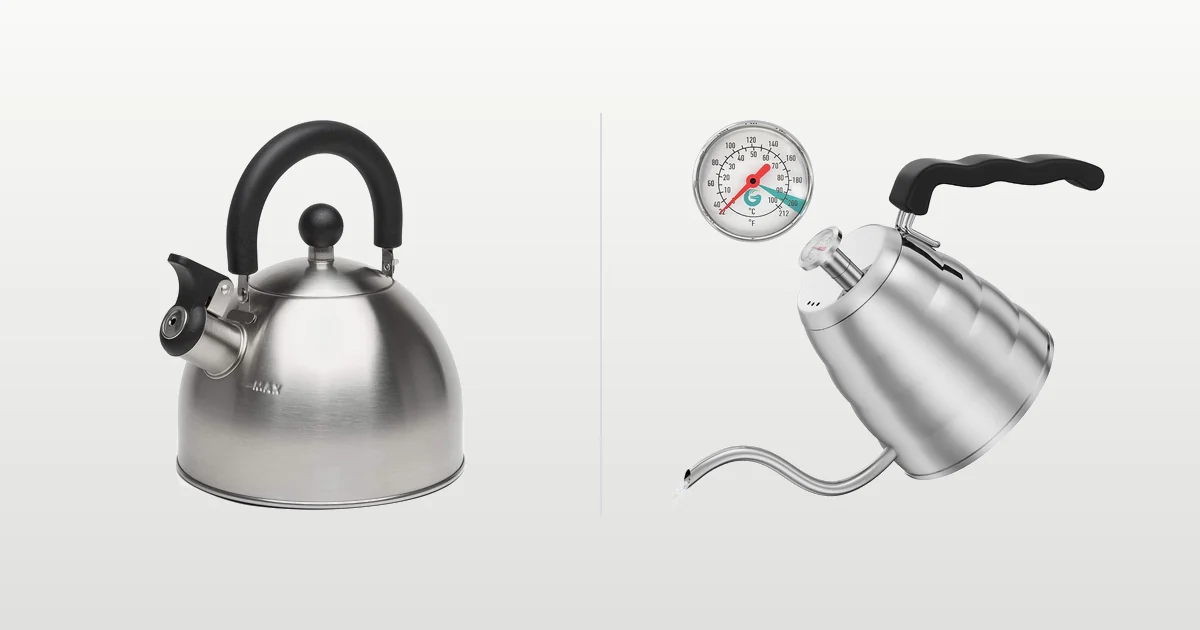
A stovetop kettle has one job beyond boiling water, and it is telling you the water has boiled. That is the whistle, and it is the entire user interface.
So it is worth knowing that three of the ten kettles below do not have one.
They are not faulty. Two are gooseneck pour over coffee kettles, built to control a thin stream rather than announce a boil, and one is a glass teapot for steeping leaves. All three are filed under Tea Kettles, all three are sold on the same search, and none of them will tell you the hob is still on.
Among the seven that do whistle, the difference is how the spout opens — and that is a safety question, because the cover sits directly in the steam path. A flip-up cover means reaching over a jet of steam with your thumb. A trigger in the handle opens the same cover from behind the kettle.
One more warning before the table: three listings here state their capacity in a confused or contradictory way, including one that gives three different figures and one that puts a weight in the capacity field.
Our Quick Picks
 Best SellerPrimula Stewart 1.5 Qt
The best-selling stovetop kettle on Amazon: a flip-up whistling spout, one-handed pouring and seventeen dollars.
 Best GooseneckCoffee Gator Gooseneck 40 oz
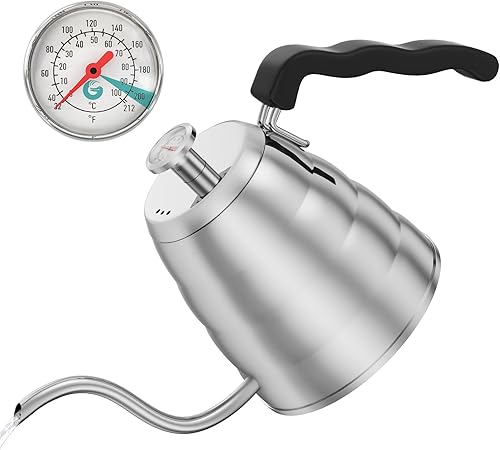
A narrow gooseneck spout with a stated 2.5 mm/s flow rate and a thermometer in the lid — a coffee tool, not a tea kettle.
 Best GlassCafé Brew Glass 12 Cup
Twelve cups of German Schott DURAN borosilicate with a whistling lid and a heat-diffusing trivet in the box.
At a Glance
Ten Stovetop Tea Kettles Compared
Spout design first, because it decides both how you pour and whether anything tells you the water is ready.
| # | Model | Spout | Whistles | Capacity | Material | Standout | Main Drawback | Check Price |
|---|---|---|---|---|---|---|---|---|
| 1 |
 Primula Stewart 1.5 Qt Primula Stewart 1.5 Qt |
Flip-up whistling | Yes | 1.5 quarts | Stainless steel | #1 in Tea Kettles at $17.49 | 1.5 quarts is small for a household | View on Amazon |
| 2 |
 Coffee Gator Gooseneck 40 oz Coffee Gator Gooseneck 40 oz |
Gooseneck, 360° rotating | No | 40 oz / 1.2 litres | Stainless steel | Built-in thermometer, 160–212°F | It does not whistle at all | View on Amazon |
| 3 |
 Café Brew Glass 12 Cup Café Brew Glass 12 Cup |
Whistling lid | Yes | 12 cups | Schott DURAN borosilicate | German borosilicate and a heat-diffusing trivet | Glass on a gas flame needs the trivet | View on Amazon |
| 4 |
 SUSTEAS 2.7 Qt SUSTEAS 2.7 Qt |
Push-button whistling | Yes | Stated as 2.7 qt, 2.64 qt and 3 qt | Stainless, 5-layer base | Five-layer encapsulated base | Three different capacities in one listing | View on Amazon |
| 5 |
 GGC 3.2 Qt Diamond Texture GGC 3.2 Qt Diamond Texture |
Whistling | Yes | 3.2 quarts / 3 litres | Heavy stainless steel | Twelve cups in one boil | No price listed | View on Amazon |
| 6 |
 LUXGRACE 3.1 Qt Trigger LUXGRACE 3.1 Qt Trigger |
Trigger-opened whistling | Yes | 3.1 quarts | Thick stainless steel | One-hand trigger keeps hands from the steam | Sold under near-identical twin listings | View on Amazon |
| 7 |
 Mr. Coffee Flintshire 1.75 Qt Mr. Coffee Flintshire 1.75 Qt |
Flip-up with trigger | Yes | 1.75 quarts | Stainless steel, copper finish | Bakelite handle plus a safety trigger | 1.75 quarts, small for a family | View on Amazon |
| 8 |
 Vegoran 3 Litre Vegoran 3 Litre |
Whistling | Yes | 100 oz / 3 litres | 18/8 stainless steel | Silicone-coated wooden handle | Capacity field contains a weight | View on Amazon |
| 9 |
 Chefbar Gooseneck 28 oz Chefbar Gooseneck 28 oz |
Gooseneck, flow control | No | 28 oz / 0.8 litres | Stainless steel | Gooseneck pouring for $21.69 | No whistle and only four cups | View on Amazon |
| 10 |
 BanYakong Glass Teapot 550 ml BanYakong Glass Teapot 550 ml |
Pour spout, no whistle | No | 550 ml | Borosilicate glass | A steeping teapot, not a boiling kettle | 550 ml, and it does not whistle | View on Amazon |
Specifications, prices and ratings are taken from each manufacturer’s Amazon listing as displayed on 21 August 2026 and may change. Capacity is reproduced as stated, including where listings disagree with themselves: the SUSTEAS gives 2.7QT in its title, 2.64 quarts in its specification field and “3 Quart” in a bullet point; the Vegoran states “6.3 pounds” in its capacity field, which is a weight, with the real figure of 100 oz / 3 litres appearing only in the title; and the Lonffery, excluded here, gives 2.5 litres in its specification and 2.5 QT in its colour field. The SUSTEAS and GGC 3.2 Qt carried no listed price at the time of writing. The LUXGRACE 3.1 Qt included here has a near-identical twin listing from the same brand — same bullet text word for word, 3 quarts rather than 3.1, at $29.99 — which was excluded as a duplicate. Amazon’s Tea Kettles node contains gooseneck pour over coffee kettles and glass steeping teapots alongside whistling kettles; all three types are represented here deliberately, and are labelled.
Scroll the table sideways to see every column
How We Chose These Stovetop Tea Kettles
We researched current listings, compared manufacturer specifications and documentation, and examined recurring patterns in customer feedback. We did not carry out hands-on testing, and nothing below is presented as measured performance data.
- Whether it whistles — the only thing that separates a kettle from a pan of water
- How the spout opens — flip-up, trigger or push-button, and only one keeps your hand out of the steam
- Capacity, checked against the whole listing — three listings here state it inconsistently
- Base construction where disclosed — a single sheet of steel boils far slower than an encapsulated base
- Handle material — Bakelite, silicone, coated wood and bare stainless behave very differently
- All three formats represented — whistling, gooseneck and steeping teapot, because the keyword returns all of them
The 10 Best Stovetop Tea Kettles, Reviewed
1. Primula Stewart 1.5 Qt — Best Seller

The best-selling stovetop tea kettle in the category, at $17.49 and 0.52 kilograms — the lightest full kettle here by a wide margin.
Flip-up whistling spout, stainless body, nothing else.
Key Specifications
| Spout | Flip-up whistling |
|---|---|
| Whistles | Yes |
| Capacity | 1.5 quarts |
| Body | Stainless steel |
| Handle | Stainless steel with black grip |
| Pouring | One-handed operation |
| Weight | 0.52 kg |
| Rank | #1 in Tea Kettles |
| Best For | One or two people who want the standard thing that works |
Why We Recommend It
The flip-up spout cover is the mechanism worth understanding. A whistling kettle whistles because steam is forced through a restricted opening; to pour, that restriction has to move out of the way. There are three ways manufacturers do it, and a flip-up cover is the simplest — you push it up with a thumb and it stays there.
The alternatives on this page are a thumb-press trigger in the handle, which keeps your hand away from steam entirely, and a lift-off cap, which does not.
One and a half quarts is the honest limitation. That is around six cups, and it is the smallest full-size kettle in this roundup — half what the largest holds. For one or two people it boils faster and weighs less; for a household making tea for four it means boiling twice.
At 0.52 kg empty it is genuinely light to lift full, which matters more than it sounds when the alternative weighs twice as much with three litres of water in it.
Pros
- #1 in Tea Kettles, the category best seller
- $17.49
- Flip-up whistling spout for one-handed pouring
- 0.52 kg, the lightest kettle here
- Stainless steel throughout
- Boils faster than the larger kettles here
Cons
- 1.5 quarts, the smallest full-size capacity in this roundup
- Stainless handle conducts heat more than nylon or wood
- 4.4 stars, like most of this category
- No temperature control or thermometer
- Small households only
Best for: The default stovetop kettle, and the right one for one or two people.
2. Coffee Gator Gooseneck 40 oz — Best Gooseneck
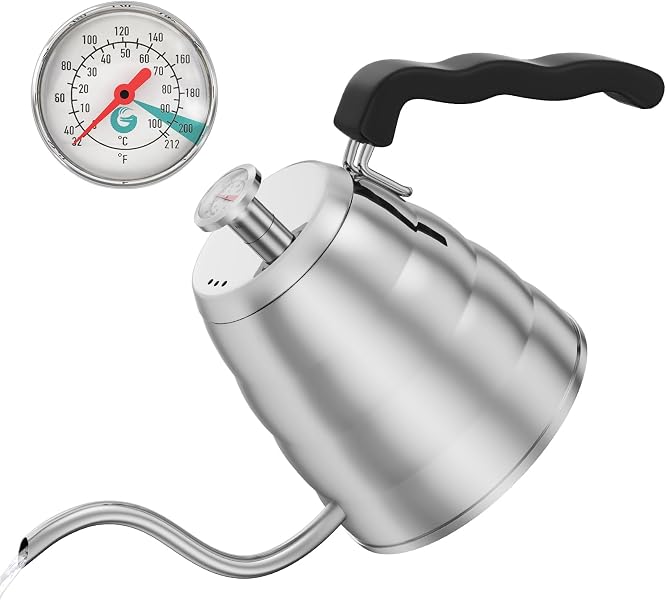
This is the highest-rated kettle in the roundup at 4.5 stars, and it is not really a tea kettle. It is a pour over coffee kettle that Amazon files under Tea Kettles.
It has no whistle.
Key Specifications
| Spout | Gooseneck, 360° rotating |
|---|---|
| Whistles | No |
| Flow rate | 2.5 mm/s, stated |
| Thermometer | Built in, 160°F to 212°F |
| Capacity | 40 oz / 1.2 litres |
| Body | Premium-grade stainless steel |
| Weight | 2.5 pounds |
| Rating | 4.5 out of 5 stars |
| Best For | Pour over coffee, where flow control and temperature are the whole point |
Why We Recommend It
Everything about it is built around controlling the pour instead of announcing the boil. The gooseneck spout produces a thin, slow, steerable stream — Coffee Gator quotes 2.5 mm per second — which is what lets you wet coffee grounds evenly rather than blasting a crater in them. A standard kettle spout dumps.
The thermometer is the other half. Coffee extracts properly between roughly 195 and 205°F, which is below boiling; a kettle that tells you when you have reached 200 is solving a problem a whistling kettle cannot, because a whistle only ever means 212.
Which is exactly why it is the wrong kettle for tea in a busy kitchen. With no whistle, nothing tells you it has boiled, and a forgotten kettle on a gas hob boils dry.
Buy it knowing which tool it is. For pour over coffee it is the best thing on this page.
Pros
- 4.5 stars, the highest rating in this roundup
- Gooseneck spout with a stated 2.5 mm/s flow rate
- Built-in thermometer reading 160–212°F
- 360° rotating spout
- Premium stainless construction
- Ideal for pour over coffee and for tea brewed below boiling
Cons
- No whistle — nothing tells you it has boiled
- 2.5 pounds empty, the heaviest kettle here
- 40 oz is modest for a household
- $31.34, the most expensive here
- A coffee tool sold in a tea category
Best for: Pour over coffee, and green teas brewed below boiling.
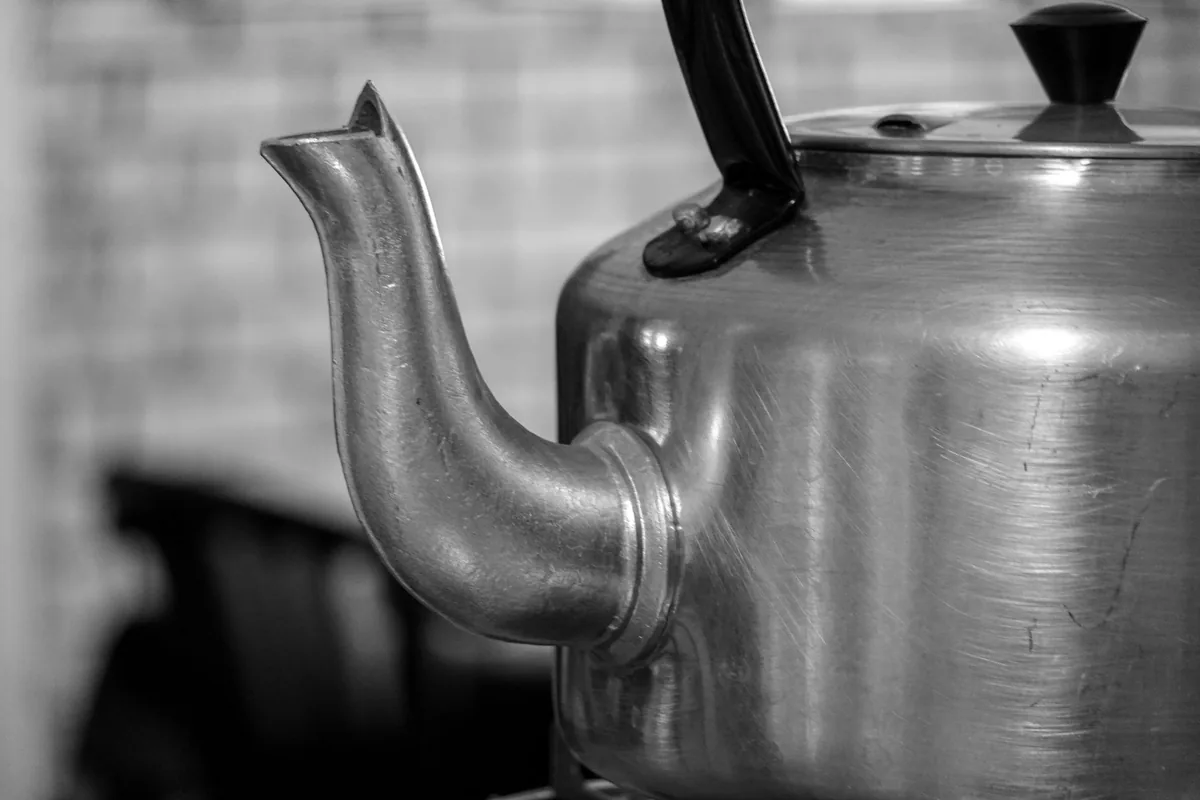
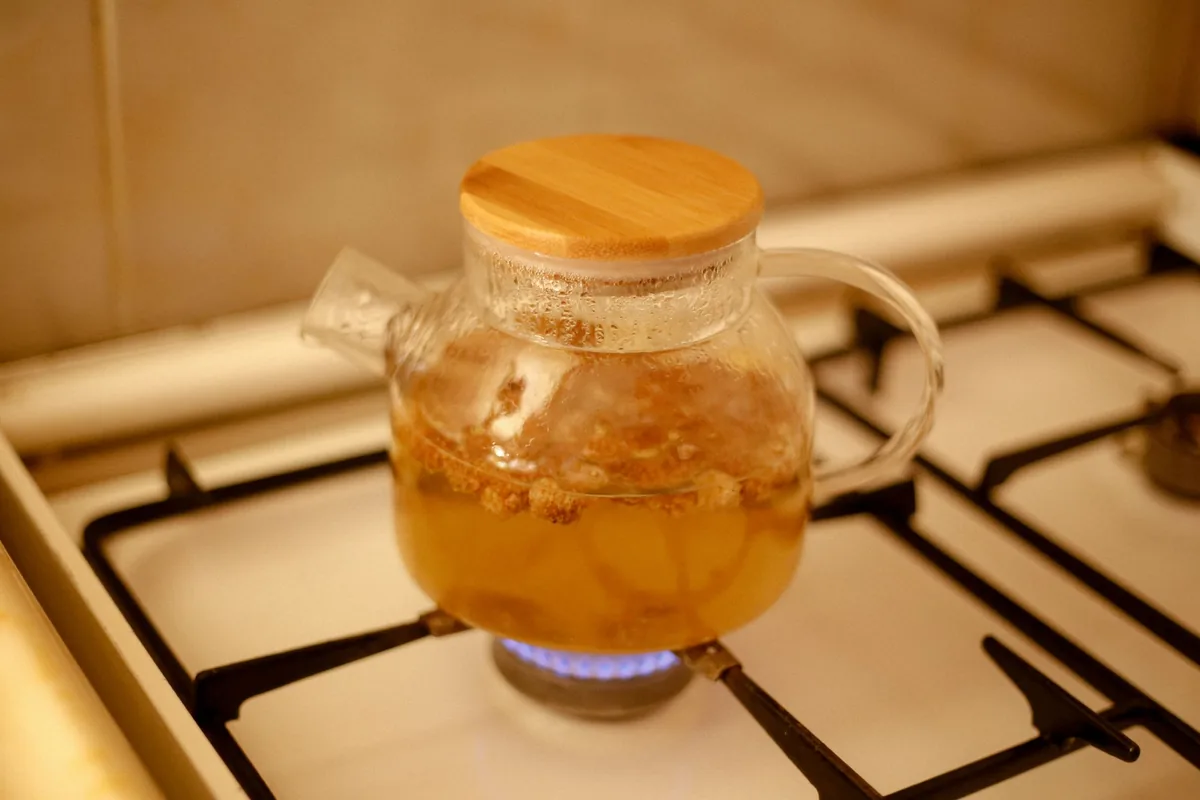
3. Café Brew Glass 12 Cup — Best Glass

Schott DURAN is a named borosilicate, which is unusual specificity in this category — most glass cookware says "borosilicate" and stops. It is the same glass family used for laboratory equipment.
Twelve cups, $19.99, and a trivet in the box.
Key Specifications
| Spout | Whistling lid |
|---|---|
| Whistles | Yes |
| Capacity | 12 cups |
| Material | Schott DURAN borosilicate glass, sourced from Germany |
| Included | Whistling lid, heat-diffusing trivet |
| Compatibility | Gas and electric stoves |
| Weight | 1.4 pounds |
| Rank | #4 in Tea Kettles |
| Best For | Watching the boil, and anyone who dislikes metal-tasting water |
Why We Recommend It
Glass changes what the water tastes like, which is the real argument for it. A stainless kettle used daily and never fully dried develops a metallic edge that some people notice sharply and others never do. Glass is inert and holds nothing.
The trivet is not an accessory, it is a requirement. Borosilicate resists thermal shock but a gas flame licking up the sides of a glass vessel is uneven heating, and a diffuser spreads it. Café Brew including one rather than selling it separately is the right decision.
You can also see the boil, which sounds trivial and is genuinely useful — you know how full it is, when it is close, and whether it needs descaling, none of which a steel kettle tells you.
The obvious risk is breakage. A dropped glass kettle is finished, where a dropped steel one is dented.
Pros
- Named Schott DURAN borosilicate rather than generic glass
- Heat-diffusing trivet included, not sold separately
- See the water level and the boil
- No metallic taste
- 12 cups, generous capacity
- #4 in Tea Kettles at $19.99
Cons
- Glass breaks where steel dents
- Needs the trivet on a gas flame
- Heats less evenly than a clad steel base
- Shows limescale clearly
- 1.4 pounds and fragile to store
Best for: Anyone who wants to see the water and taste nothing but the tea.
4. SUSTEAS 2.7 Qt — Best Whistle

Second in the category, and the only kettle here that describes its base construction in any detail: five encapsulated layers.
Key Specifications
| Spout | Push-button whistling |
|---|---|
| Whistles | Yes |
| Capacity | Title says 2.7 qt; specification says 2.64 qt; bullets say 3 qt |
| Base | 5 layers, encapsulated |
| Handle | Nylon, cool touch, ergonomic |
| Weight | 1.16 kg |
| Rank | #2 in Tea Kettles |
| Colour | Black |
| Best For | Faster boiling on any hob, if you can live with a vague capacity |
Why We Recommend It
That is the specification that governs how fast a kettle boils, and almost nobody publishes it. A single sheet of stainless conducts heat poorly — steel is a mediocre conductor — so good kettles sandwich aluminium or copper inside the base, which spreads heat across the whole disc instead of concentrating it where the flame touches.
It is the same construction principle as clad cookware, and it is why two kettles on the same hob can differ by minutes.
A push-button spout is the safest of the three mechanisms here. Your thumb stays on the handle and the spout opens remotely, so your hand never crosses the steam path — unlike a flip-up cover, which you reach over the spout to lift.
The capacity is stated three different ways. The title says 2.7QT, the specification field says 2.64 quarts, and the second bullet describes a "3 Quart large kettle". Assume the smallest.
No price is listed at the time of writing.
Pros
- #2 in Tea Kettles
- Five-layer encapsulated base for faster, more even boiling
- Push-button spout keeps your hand out of the steam
- Cool-touch ergonomic nylon handle
- Loud whistle
- Full stainless construction
Cons
- Capacity stated three different ways in one listing
- No price listed at the time of writing
- 1.16 kg, heavier than most here
- 4.4 stars
- Nylon handle will not tolerate an oven
Best for: The fastest boiler here, if the capacity ambiguity does not bother you.
5. GGC 3.2 Qt Diamond Texture — Largest Capacity

Three point two quarts is more than double the best seller’s capacity, and GGC states what that means in practice: twelve cups, or enough for seven guests.
Key Specifications
| Spout | Whistling |
|---|---|
| Whistles | Yes, described as powerful |
| Capacity | 3.2 quarts / 3 litres, stated as 12 cups |
| Body | Heavy stainless steel, diamond texture |
| Handle | Silicone with wood pattern |
| Weight | 0.8 kg |
| Rank | #5 in Tea Kettles |
| Serves | Up to 7 guests, per the listing |
| Best For | Households and entertaining, where boiling twice is the annoyance |
Why We Recommend It
Capacity is the specification people get wrong in both directions. A 1.5-quart kettle boils faster and is lighter to lift, which suits one or two people perfectly. For a household of four or for entertaining, it means refilling and reboiling, and the second boil always takes longer because you are starting from a cooled kettle.
The diamond texture is not purely decorative. A textured surface hides fingerprints and water spotting, which on a black stainless kettle sitting permanently on a hob is a real consideration.
Silicone with a wood pattern is a handle material that stays cool without the maintenance real wood needs — two kettles here use actual wood, which cannot go near a dishwasher or a hot hob edge.
At 0.8 kg empty it is lighter than several smaller kettles here, though full it will be the heaviest thing on this page to lift.
No price is listed at the time of writing.
Pros
- 3.2 quarts, the largest capacity here
- States a realistic 12 cups and 7 guests
- Diamond texture hides fingerprints and spotting
- Silicone handle stays cool with no upkeep
- 0.8 kg empty, light for its size
- #5 in Tea Kettles
Cons
- No price listed at the time of writing
- Three litres is heavy to lift when full
- Takes longer to boil than the small kettles here
- 4.4 stars
- Large footprint on a hob
Best for: Households of four or more, and anyone tired of boiling twice.
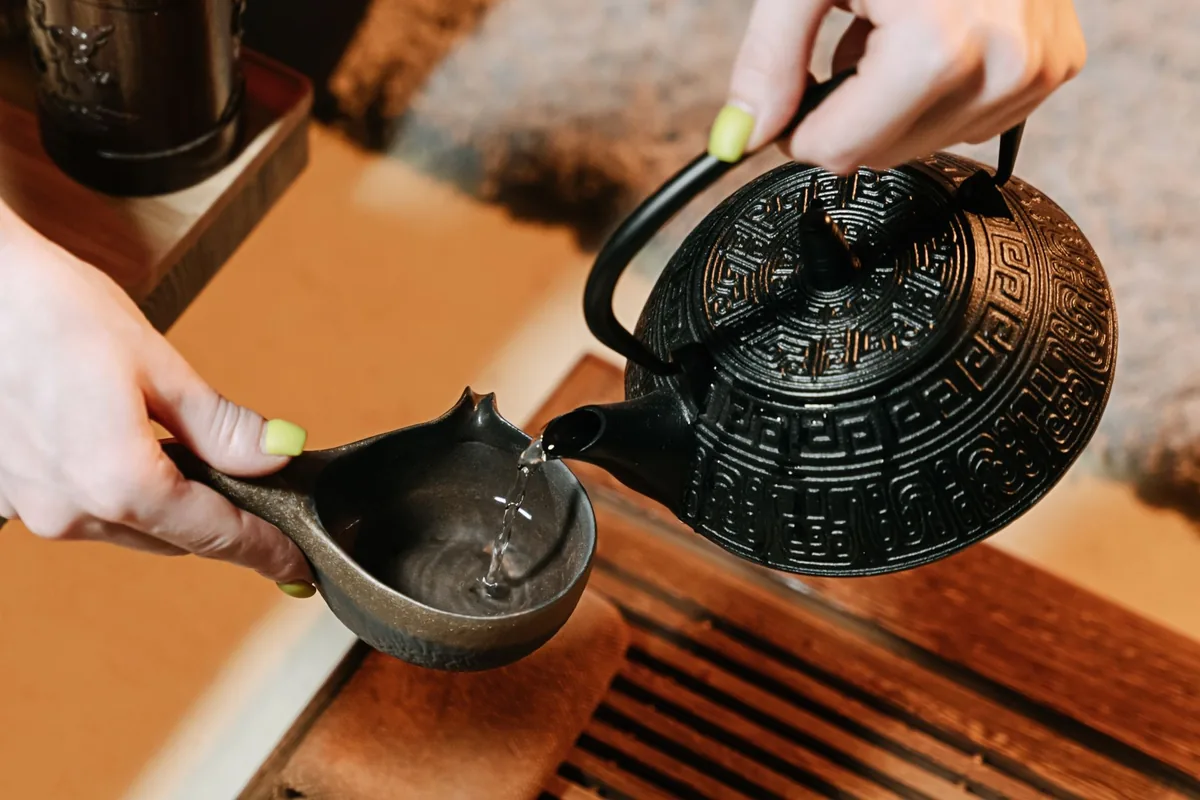
6. LUXGRACE 3.1 Qt Trigger — Best One-Hand Trigger

Three point one quarts with a trigger mechanism in the handle, at $28.99.
Key Specifications
| Spout | Trigger-opened whistling |
|---|---|
| Whistles | Yes |
| Capacity | 3.1 quarts |
| Body | Thick stainless steel throughout |
| Handle | Silicone |
| Lid | Tight-fitting, keeps steam in for the whistle |
| Weight | 0.85 kg |
| Rank | #6 in Tea Kettles |
| Best For | Anyone who has burned a thumb opening a kettle spout |
Why We Recommend It
The trigger is the safest of the three spout mechanisms in this roundup, and it is worth understanding why. A whistling kettle’s spout cover sits directly in the steam path. A flip-up cover means reaching over the spout with a thumb to lift it, at the exact moment the kettle is producing a jet of steam hot enough to scald.
A trigger built into the handle opens the same cover by linkage, so your hand stays behind the kettle throughout.
The tight-fitting lid is mentioned for a reason. A whistle works on pressure, and a loose lid lets steam escape around it rather than through the whistle, which produces a weak or absent sound. Cheap kettles that stop whistling usually have a warped or ill-fitting lid rather than a broken whistle.
One thing to be aware of before buying: this listing has a near-identical twin in the same category — same brand, same bullet text word for word, 3 quarts instead of 3.1, at $29.99. Compare both before choosing.
Pros
- Trigger in the handle keeps your hand out of the steam
- 3.1 quarts, among the largest here
- Thick stainless body
- Tight-fitting lid for a reliable whistle
- Silicone handle stays cool
- #6 in Tea Kettles
Cons
- A near-identical twin listing exists from the same brand at $29.99
- 0.85 kg empty and heavy when full
- 4.4 stars
- Base construction not described
- Brand has no real track record
Best for: The safest pouring mechanism here, on a family-sized kettle.
7. Mr. Coffee Flintshire 1.75 Qt — Best Cool Handle

Bakelite is the handle material to look for on a stovetop kettle, and Mr. Coffee names it directly rather than saying "heat resistant".
Key Specifications
| Spout | Flip-up cover with trigger |
|---|---|
| Whistles | Yes |
| Capacity | 1.75 quarts |
| Body | Solid stainless steel, copper finish |
| Handle | Bakelite, stay cool |
| Dimensions | 8″D x 8″W x 8″H |
| Rank | #13 in Tea Kettles |
| Price | $28.79 |
| Best For | Small households wanting a recognisable brand and a genuinely cool handle |
Why We Recommend It
It is a thermosetting plastic that does not soften with heat, which is precisely the failure mode of cheaper moulded handles — they go slightly tacky and eventually deform where they meet the hot body. Bakelite has been used for kettle and pan handles since the 1920s for that reason.
The safety trigger and flip-up cover together put this between the pure flip-up designs and the fully trigger-operated ones: the cover lifts, but a trigger does the lifting.
The copper finish is cosmetic and worth saying so — this is stainless steel with a copper-coloured coating, not a copper kettle, and it will not conduct like copper. Genuine copper kettles cost several times this.
One and three-quarter quarts puts it near the bottom of the capacity range here, which suits one or two people.
Pros
- Bakelite handle genuinely stays cool and does not soften
- Safety trigger on the spout cover
- Recognisable brand
- Solid stainless construction
- Attractive copper finish
- 8 inches square, compact
Cons
- 1.75 quarts, small for a household
- Copper finish is a coating, not copper
- $28.79 for a small kettle
- 4.4 stars
- Base construction not described
Best for: One or two people who want a handle that will still be cool in five years.
8. Vegoran 3 Litre — Best Handle Comfort

Three litres, 18/8 stainless, and a wooden handle with a silicone coating — which is the best of both handle materials rather than a compromise between them.
Key Specifications
| Spout | Whistling |
|---|---|
| Whistles | Yes, loud |
| Capacity | 100 oz / 3 litres |
| Body | 18/8 food-grade stainless steel |
| Handle | Wood with silicone coating |
| Weight | 0.69 kg |
| Colour | Green |
| Rank | #14 in Tea Kettles |
| Best For | Large capacity with a handle that will not get hot |
Why We Recommend It
Wood is the best insulator of the handle materials here, which is why it appears on traditional kettles. Its weakness is water: bare wood absorbs it, swells, cracks and eventually loosens on the fixing. A silicone coating seals it, so it insulates like wood and cleans like plastic.
Two kettles in this roundup use bare wood and will need more care.
18/8 is the same stainless grade as 304, named by its chromium and nickel content rather than its series number — genuinely food grade and corrosion resistant.
The capacity field reads "6.3 pounds", which is a weight, not a volume. The real figure — 100 oz, or three litres — comes from the title. This is the third listing in this roundup with a confused capacity field.
At 0.69 kg empty it is lighter than several smaller kettles here.
Pros
- 3 litres, joint largest capacity here
- Silicone-coated wood insulates well and cleans easily
- 18/8 food-grade stainless
- 0.69 kg empty, light for the size
- Loud whistle
- Colour options beyond bare steel
Cons
- Capacity field states a weight, not a volume
- Three litres is heavy to lift when full
- 4.4 stars
- Base construction not described
- #14 in Tea Kettles
Best for: Large capacity with the most comfortable handle material here.
9. Chefbar Gooseneck 28 oz — Cheapest Gooseneck

Twenty-one sixty-nine for a gooseneck kettle, against $31.34 for the Coffee Gator. What you give up is the thermometer and about a third of the capacity.
Key Specifications
| Spout | Gooseneck with flow control |
|---|---|
| Whistles | No |
| Capacity | 0.8 litres / 28 oz, about 4 cups |
| Fill advice | 80% full to avoid overflow, per the maker |
| Body | Stainless steel |
| Handle | Heat-resistant Bakelite |
| Weight | 13.44 ounces |
| Rank | #21 in Tea Kettles |
| Best For | Pour over coffee on a budget, or precise pouring for tea |
Why We Recommend It
The fill advice is the useful honesty here. Chefbar recommends filling to 80 per cent, which on a 28-ounce kettle means about 22 ounces of usable water. Gooseneck kettles overflow more readily than standard ones because the spout leaves the body low down — that is what makes the pour controllable, and it also means the water level cannot go above it.
Apply the same 80 per cent to any gooseneck kettle, stated or not.
Twenty-eight ounces is four cups, and that is genuinely all this is for. As a household tea kettle it would be exhausting.
No whistle, like every gooseneck kettle. Nothing tells you it has boiled, which on a gas hob is a real hazard rather than an inconvenience.
At 13.44 ounces empty it is by far the lightest kettle here, which matters when pour over technique depends on a steady hand.
Pros
- Gooseneck control at $21.69, a third less than the alternative
- States a realistic 80% fill level
- 13.44 ounces empty, easy to hold steady
- Heat-resistant Bakelite handle
- Mirror stainless finish
- Ideal for pour over coffee
Cons
- No whistle, so nothing signals the boil
- 28 oz is roughly four cups
- No thermometer, unlike the dearer gooseneck here
- Not a household tea kettle
- #21 in Tea Kettles
Best for: Pour over coffee on a budget — not a kettle for making tea for four.
10. BanYakong Glass Teapot 550 ml — Cheapest Here

Eight ninety-nine, and it is the clearest illustration of how broad this category’s keyword has become. Amazon files it under Tea Kettles; it is a teapot.
Key Specifications
| Spout | Pour spout, no whistle |
|---|---|
| Whistles | No |
| Capacity | 550 ml |
| Material | Borosilicate glass with 304 stainless infuser |
| Infuser | Removable, food-grade 304 stainless |
| Stovetop safe | Yes, resists thermal shock |
| Dimensions | 4″D x 4″W x 5″H |
| Price | $8.99 |
| Best For | Brewing loose leaf tea, once the water is already hot |
Why We Recommend It
The distinction is functional, not pedantic. A kettle boils water and tells you when it has. A teapot holds hot water and leaves together while they steep. This one is stovetop safe, so it can technically do both — but with 550 millilitres and no whistle, using it as your kettle means standing over it.
What it is genuinely good at is the second job. A removable 304 stainless infuser plus a clear body means you watch the tea darken and lift the leaves out at the strength you want, rather than guessing through a steel wall. Over-steeped leaves are the most common way good tea is spoiled.
Borosilicate handles the thermal shock of going from cold to boiling, which ordinary glass does not.
Five hundred and fifty millilitres is two mugs. Buy it as a teapot to sit alongside a kettle, which at $8.99 is an easy thing to do.
Pros
- $8.99, cheapest product in this roundup
- Removable 304 stainless infuser for loose leaf
- Clear glass shows the steep strength
- Borosilicate survives stovetop heat
- Compact at 4 inches across
- Doubles as a serving pot
Cons
- Not a kettle — it does not whistle and holds 550 ml
- Two mugs at most
- Glass breaks
- No heat diffuser included, unlike the glass kettle here
- #23 in Tea Kettles
Best for: Loose leaf tea alongside a real kettle, for under nine dollars.
Which of These Will Tell You It Has Boiled
Three will not, and all three are sold under the same search term as the seven that will.
| Kettle | Type | Whistles | What it is really for |
|---|---|---|---|
| Primula Stewart | Whistling | Yes | Everyday tea, one or two people |
| SUSTEAS 2.7 Qt | Whistling | Yes | Fast boiling for a household |
| GGC 3.2 Qt | Whistling | Yes | Twelve cups at once |
| LUXGRACE 3.1 Qt | Whistling | Yes | Household tea, safest spout |
| Mr. Coffee Flintshire | Whistling | Yes | Small households, cool handle |
| Vegoran 3 Litre | Whistling | Yes | Large capacity, comfortable handle |
| Café Brew Glass | Whistling | Yes | Watching the boil, no metal taste |
| Coffee Gator Gooseneck | Gooseneck | No | Pour over coffee, with a thermometer |
| Chefbar Gooseneck | Gooseneck | No | Pour over coffee on a budget |
| BanYakong Glass Teapot | Teapot | No | Steeping loose leaf, not boiling |
Nothing here is mislabelled by its own manufacturer — the gooseneck kettles say gooseneck and the teapot says teapot. The problem is that the category returns all three for the same search, and the difference only becomes obvious once the thing is on your hob. A kettle without a whistle is a pan with a lid: it will boil dry if you walk away, which on gas is a genuine hazard rather than a spoiled cup. If you want one vessel for both tea and pour over coffee, a whistling kettle with a precise spout is the compromise; a gooseneck is not.
How the Spout Opens, and Why It Matters
The cover sits in the steam path. Three mechanisms move it, and they are not equally safe.
| Mechanism | Kettles here | Where your hand goes | Trade-off |
|---|---|---|---|
| Flip-up cover | Primula Stewart | Over the spout, into the steam path | Simplest and cheapest; stays open once lifted |
| Trigger in the handle | LUXGRACE, Mr. Coffee | Stays behind the kettle | More linkage to fail over time |
| Push button | SUSTEAS | Stays on the handle | Same benefit, fewer moving parts than a lever |
| Whistling lid | Café Brew Glass | Lid comes off entirely | No cover to open, but the lid gets hot |
| None — open spout | Both goosenecks, the teapot | Not applicable | Nothing to open, and nothing to whistle |
A boiling kettle produces a jet of steam at 212°F that will scald considerably faster than dry heat, and the flip-up design asks you to put a thumb across it. That is how most kettle burns happen. Trigger and push-button designs open the same cover through a linkage in the handle, so the hand never crosses the steam — and they cost no more, since two of the three here are around the same price as the flip-up best seller. If anyone in the house has limited dexterity, this is the specification to buy on.
Best Alternatives
| Alternative | Why Consider It | Better For | Main Trade-Off |
|---|---|---|---|
| An electric kettle | Faster, switches itself off, often temperature-selectable | Speed and safety | Another countertop appliance, and it needs a socket |
| A saucepan | You already own one, and it costs nothing | Occasional use, camping | No whistle, no spout, and it pours badly |
| A microwave | Heats one mug in ninety seconds | A single cup | Uneven heating, and it can superheat dangerously |
| A gooseneck kettle | Precise pouring and often a thermometer | Pour over coffee | No whistle, so it will boil dry unattended |
| An instant hot water tap | Boiling water on demand, no waiting | Households that drink a lot of tea | Plumbed installation and a real cost |
What Each Price Tier Actually Buys
$8.99 to $19.99 — BanYakong Teapot, Primula Stewart, Café Brew Glass. The value end, and it holds the category best seller. The Primula is #1 in Tea Kettles at $17.49; the Café Brew gives you named Schott DURAN borosilicate and a heat-diffusing trivet for $19.99.
$21.69 to $25.99 — Chefbar Gooseneck, Vegoran 3 Litre. Two very different things at similar money: the cheapest gooseneck here, and three litres of 18/8 stainless with the most comfortable handle material on the page.
$28.79 to $28.99 — Mr. Coffee Flintshire, LUXGRACE 3.1 Qt. Where the spout mechanisms improve. Both use a trigger rather than asking you to reach over the steam, and the Mr. Coffee names Bakelite rather than saying “heat resistant”.
$31.34 — Coffee Gator Gooseneck. The most expensive kettle here and the highest rated, and it is a coffee tool: a stated 2.5 mm/s flow rate and a thermometer reading 160°F to 212°F.
No price listed — SUSTEAS, GGC 3.2 Qt. Ranked #2 and #5 in the category respectively, with the only disclosed base construction on this page between them. Worth checking, because on specification they compete with everything above.
The pattern: nine of these ten are rated 4.4 or 4.5 stars across $8.99 to $31.34. Money buys spout mechanism, handle material and capacity. It does not buy a better boil, and the best seller costs $17.49.
How to Choose a Stovetop Tea Kettle
Check That It Actually Whistles
It sounds absurd and it is the single most common mismatch in this category. Gooseneck pour over kettles and glass steeping teapots are both filed under Tea Kettles and both come up on the same search, and neither has a whistle. A kettle you cannot hear is a kettle you can forget, and a forgotten kettle on a gas hob boils dry and damages itself. If you want one vessel for tea and pour over coffee, buy a whistling kettle with a narrow spout rather than a gooseneck.
Buy the Spout Mechanism, Not the Finish
Seven kettles here whistle, and the difference between them is how the spout cover opens. A flip-up cover means putting your thumb across a jet of 212°F steam. A trigger or push-button in the handle opens the same cover from behind, so your hand never crosses the steam path. The trigger designs cost about the same as the flip-up best seller, which makes this the easiest safety upgrade in the category.
Look for an Encapsulated Base
Stainless steel is a poor conductor, so a kettle made from a single sheet of it heats where the flame touches and nowhere else. Better kettles sandwich aluminium or copper into the base, spreading the heat across the whole disc — the same principle as clad cookware, and the reason two kettles on the same hob can differ by minutes. Only one listing in this roundup describes its base at all, at five encapsulated layers. Where nothing is said, assume a single sheet.
Take the Smallest Capacity Figure You Find
Three listings here state capacity inconsistently, one of them three different ways across a span of more than a quart, and one puts a shipping weight in the capacity field. Read the title, the bullets and the specification table, and plan around the lowest number. On gooseneck kettles apply a further 80 per cent, because the spout exits low on the body and the water cannot sit above it — one maker here states that limit, and it applies to all of them.
Match the Handle Material to the Hob
Bare stainless handles conduct heat and will be hot on a gas hob where the flame curls up the side. Bakelite is a thermosetting plastic that does not soften with heat and has been used for kettle handles for a century. Silicone stays cool and is easy to clean. Wood insulates best of all but absorbs water, swells and eventually cracks unless it is coated — one kettle here uses silicone-coated wood, which is the best of both.
Consider Glass if the Water Tastes Metallic
A steel kettle used daily and never dried fully can give water a faint metallic edge that some people notice sharply. Borosilicate glass is inert and holds nothing, and it lets you see the water level, the boil and any limescale building up. The trade is fragility, and the requirement for a heat diffuser on a gas flame — the glass kettle in this roundup includes a trivet in the box rather than selling it separately, which is the right way to do it.
Common Stovetop Tea Kettle Buying Mistakes
- Buying a gooseneck kettle for tea. It has no whistle, so nothing tells you the hob is still on.
- Choosing a flip-up spout without thinking. It puts your thumb across a jet of boiling steam.
- Trusting one capacity figure. Three listings here contradict themselves, one across more than a quart.
- Filling a gooseneck kettle full. The spout exits low, so 80 per cent is the real limit.
- Assuming a copper finish means copper. One kettle here is copper-coloured stainless, and it conducts like steel.
- Ignoring the base. A single sheet of stainless boils noticeably slower than an encapsulated base.
- Buying bare wood handles for a gas hob. Uncoated wood absorbs water, swells and eventually cracks.
- Expecting a whistle to mean anything but 212°F. Green tea wants nearer 175, and no whistle can tell you that.
Which Stovetop Tea Kettle Should You Buy?
Buy the Primula Stewart if you want what most people buy. #1 in Tea Kettles, a flip-up whistling spout and 0.52 kg, for $17.49.
Buy the LUXGRACE 3.1 Qt if you want the safest pour. A trigger in the handle opens the spout without your hand crossing the steam — and compare it against its near-identical twin listing first.
Buy the Café Brew Glass if your water tastes metallic. Named Schott DURAN borosilicate, twelve cups, and the trivet is in the box.
Buy the Coffee Gator if what you actually want is pour over coffee. A 2.5 mm/s flow rate and a thermometer — and accept that it will never whistle.
Buy the GGC 3.2 Qt or the Vegoran if you are boiling for four or more and refilling annoys you.
Buy the SUSTEAS if boiling speed matters most. It is the only kettle here that says what its base is made of.
Buy the Mr. Coffee Flintshire if you want a genuinely cool Bakelite handle on a small kettle.
Buy the BanYakong teapot if you drink loose leaf — alongside a kettle, not instead of one.
Frequently Asked Questions
Do all stovetop tea kettles whistle?
No, and it catches people out because the ones that do not are sold on the same search. Gooseneck pour over kettles are built to control a slow stream for coffee and have an open spout with nothing to whistle through; glass steeping teapots are for holding hot water and leaves together. Three of the ten products in this roundup fall into those groups. It matters practically rather than pedantically: a kettle with no whistle gives you no signal at all, and one left on a gas hob will boil dry and damage its own base.
What is the safest way to open a kettle spout?
A trigger or push button in the handle, rather than a flip-up cover on the spout itself. A boiling kettle produces a jet of steam at 212°F, and steam scalds considerably faster than dry heat of the same temperature because it releases its latent heat onto your skin as it condenses. A flip-up cover requires you to reach a thumb over the spout to lift it, directly through that jet. Trigger designs open the same cover through a linkage, keeping your hand behind the kettle throughout, and they cost roughly the same.
How big a tea kettle do I need?
One to one and a half quarts suits one or two people and boils faster and lighter. Two and a half to three quarts covers a household of four, and around three litres — the largest here — is for entertaining, at roughly twelve cups. The trade is weight: three litres of water is over six pounds before you add the kettle, which is a real consideration when pouring. Note that capacity figures in this category are unreliable, with three listings in this roundup stating theirs inconsistently, so read the whole listing and plan around the smallest number.
Is a glass tea kettle safe on a gas hob?
Borosilicate glass is, with a diffuser. Borosilicate has a low coefficient of thermal expansion, which is why it survives going from cold water to boiling without cracking, and it is the same glass used in laboratory glassware. The complication on gas is that a flame licks up the sides and heats the vessel unevenly, so a heat-diffusing trivet between flame and glass is strongly advised — the glass kettle in this roundup includes one rather than selling it separately. Ordinary soda-lime glass should never go on a hob at all.
Why does my kettle whistle weakly or not at all?
Almost always the lid rather than the whistle. A whistle works on pressure: steam has to be forced through a restricted opening to make the sound, and that only happens if the rest of the kettle is sealed. A lid that has warped, or whose gasket has perished, lets steam escape around it instead, and the whistle goes quiet. Limescale narrowing the whistle aperture is the other common cause. Check the lid seats firmly and descale periodically before assuming the kettle is faulty.
Can I use a stovetop kettle on induction?
Only if the base is ferrous, which means stainless steel or cast iron rather than aluminium, copper or glass. Induction works by inducing a current in the base itself, so a glass kettle will not heat at all and an aluminium one will not either. Most stainless kettles work, but not all — some stainless grades are non-magnetic. The reliable test is a fridge magnet: if it sticks firmly to the base, the kettle will work on induction. Several listings in this roundup state induction compatibility directly.
What temperature should water be for tea?
It depends on the leaf, and this is the one thing a whistling kettle cannot help with. Black tea and herbal infusions want a full rolling boil at 212°F, which is exactly what a whistle signals. Green tea is usually brewed nearer 175°F and oolong somewhere between; boiling water scorches delicate green leaves and produces bitterness. The practical workaround with a whistling kettle is to boil and then wait a few minutes, or pour into a cool teapot first. A kettle with a thermometer removes the guesswork, and one in this roundup has one.
How do I descale a stovetop kettle?
Fill it with equal parts white vinegar and water, bring it to a boil, then turn the heat off and leave it for an hour before rinsing thoroughly. Citric acid works the same way and smells less. How often depends entirely on your water: in hard-water areas a monthly descale is reasonable, in soft-water areas twice a year is plenty. Limescale matters beyond taste — a furred base insulates the water from the heat, so the kettle takes longer to boil, and scale narrowing the whistle aperture is a common reason kettles go quiet.
Final Verdict
#1 in Tea Kettles at $17.49, and the lightest kettle here at 0.52 kg.
A stated 2.5 mm/s flow rate and a thermometer — the best pour over kettle here, and it never whistles.
Named Schott DURAN borosilicate, twelve cups, and the heat diffuser is included.
A stovetop kettle is a simple object with one signal, and the first thing to check is whether the one you are looking at produces it. Three of these ten do not — two gooseneck coffee kettles and a steeping teapot, all filed under the same category and all returned by the same search.
Among the seven that whistle, the meaningful difference is how the spout opens, because that cover sits in a jet of steam hot enough to scald. A trigger in the handle costs about the same as a flip-up cover and keeps your hand out of it entirely.
After that, read the capacity figure carefully — three listings here cannot agree with themselves, and one states a shipping weight where the volume should be — and check what the base is made of, which exactly one manufacturer on this page bothers to tell you.