Affiliate Disclosure: As an Amazon Associate, we earn from qualifying purchases. This does not affect the price you pay.
The number on a cold brew maker is not how much coffee it makes. It is how much concentrate it makes, and concentrate is roughly three to four times too strong to drink.
OXO is the only maker here that says so plainly: a 32-ounce pitcher, and up to 14 cups of finished coffee. Everyone else states a volume and leaves you to work out that you will be diluting it.
Once that clicks, the sizes in this roundup rearrange themselves. A 32-ounce maker is a week of coffee for one person. A 64-ounce mason jar is two weeks. The gallon jug at the top of this list is over fifty servings, which is an office rather than a household.
The other thing worth knowing before you compare anything: five of these ten listings state their capacity as “4 pounds” or “3.2 pounds” — a shipping weight sitting in the volume field. The real figure is in the product title every time.
Our Quick Picks
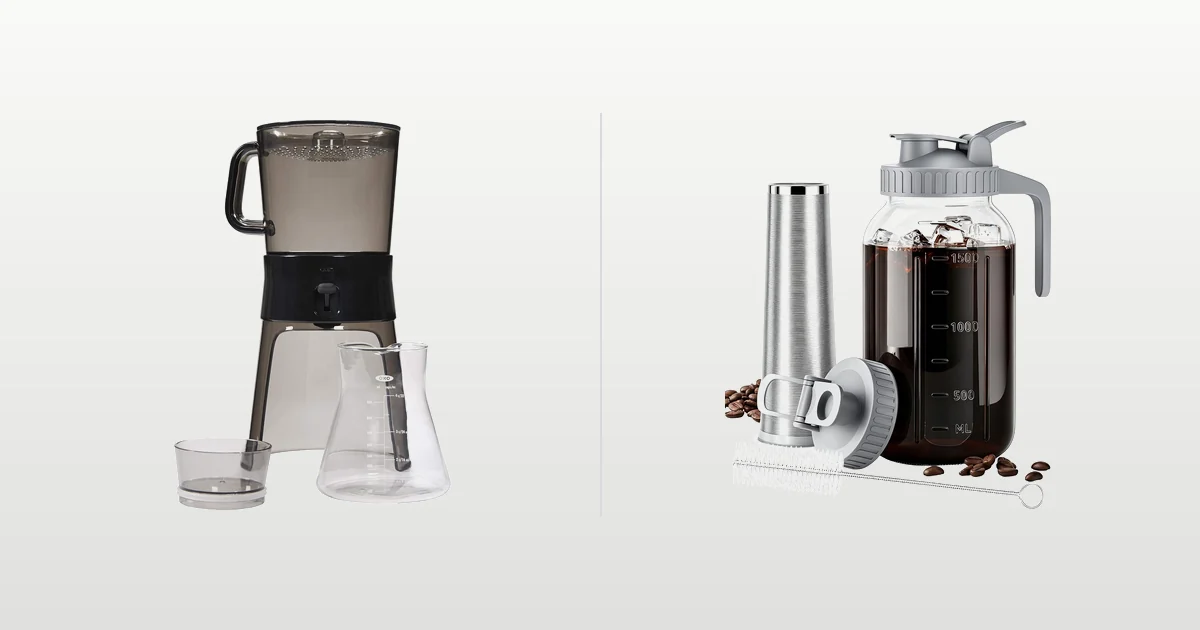
 Best OverallOXO Good Grips 32 oz
The only maker here that tells you what the pitcher is actually worth in cups — 32 ounces of concentrate, up to 14 servings.
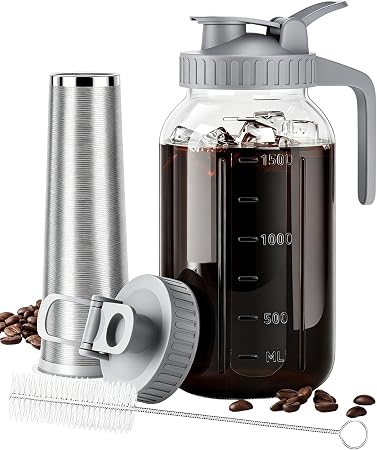 Cheapest Here64 oz Mason Jar Pitcher
Sixty-four ounces of concentrate for seventeen dollars, and 4.7 stars behind it.
 Best Value BrandTakeya Glass 2 Quart
Two quarts of concentrate in an airtight glass pitcher from the brand that made this category mainstream, for twenty-five dollars.
At a Glance
Ten Cold Brew Coffee Makers Compared
Stated capacity against the real volume, with the filter and material that decide sediment and storage.
| # | Model | Stated Capacity | Real Yield | Material | Filter | Standout | Main Drawback | Check Price |
|---|---|---|---|---|---|---|---|---|
| 1 |
 OXO Good Grips 32 oz OXO Good Grips 32 oz |
32 fl oz | Up to 14 cups | Glass and plastic | Rainmaker top | States the yield, not just the volume | Dearest here by thirteen dollars | View on Amazon |
| 2 |
 OVALWARE RJ3 1.5 L OVALWARE RJ3 1.5 L |
3.2 pounds stated | 1.5 L / 51 oz | Borosilicate and steel | Airtight seal | Keeps for two weeks, stated | Its capacity field says 3.2 pounds | View on Amazon |
| 3 |
 Zulay 1 Gallon Zulay 1 Gallon |
1 gallon | 128 oz concentrate | Glass and steel | Spigot dispenser | A gallon of concentrate, with a tap | 16.93 inches wide on the counter | View on Amazon |
| 4 |
 Takeya Glass 2 Quart Takeya Glass 2 Quart |
2 quarts | 64 oz concentrate | Glass | Fine-mesh permanent | An established brand at twenty-five dollars | Narrow 4.1-inch base | View on Amazon |
| 5 |
 Hario Mizudashi 1000 ml Hario Mizudashi 1000 ml |
1000 ml | About 34 oz | Glass | Mesh strainer | Hario design at twenty-one dollars | One litre is modest for concentrate | View on Amazon |
| 6 |
 County Line Kitchen 64 oz County Line Kitchen 64 oz |
4 pounds stated | 64 oz concentrate | Glass | Leak-proof lid | 4.8 stars, highest in the roundup | Price was not shown on the listing | View on Amazon |
| 7 |
 Maestri House 40 oz Maestri House 40 oz |
1.2 litres | 40 oz concentrate | Tritan | 350-mesh filter | Ratio markings printed on the pitcher | Lowest rating in the roundup | View on Amazon |
| 8 |
 64 oz Mason Jar Pitcher 64 oz Mason Jar Pitcher |
4 pounds stated | 64 oz concentrate | Stainless and glass | Silicone seal ring | Seventeen dollars for 64 ounces | No brand behind it at all | View on Amazon |
| 9 |
 JunVpic 64 oz JunVpic 64 oz |
4 pounds stated | 64 oz concentrate | Borosilicate glass | 100 micron, 304 steel | States its filter weave in microns | Generic listing with no brand history | View on Amazon |
| 10 |
 Primula Burke Deluxe Primula Burke Deluxe |
1.6 quarts | 51 oz concentrate | Borosilicate glass | Removable core | Comfort handle and a low profile | 4.0 stars, second lowest here | View on Amazon |
Specifications, prices and ratings are taken from each manufacturer’s Amazon listing as displayed on 21 August 2026 and may change. Stated capacity is reproduced exactly as each listing’s structured field gives it, which is why several read as weights: five of the ten state 4 pounds, 3.2 pounds or similar in the volume field. Real volumes are taken from each product title, which is reliable throughout. Dilution ratios for concentrate vary by taste and by recipe; the 14-cup figure quoted for the OXO is that manufacturer’s own stated yield, and roughly a 1:3 dilution is a common starting point. One listing did not display a price when checked. Nitrogen cartridges and a cold brew tea maker returned by the same Amazon category were excluded as they are not coffee makers.
Scroll the table sideways to see every column
How We Chose These Cold Brew Coffee Makers
We researched current listings, compared manufacturer specifications and documentation, and examined recurring patterns in customer feedback. We did not carry out hands-on testing, and nothing below is presented as measured performance data.
- Real volume from the title, not the capacity field — five of these ten put a shipping weight where the volume belongs
- Whether the yield in cups is stated — only one maker here translates concentrate into servings
- Filter weave where published — sediment is the commonest complaint and the micron figure predicts it
- Airtight storage — cold brew keeps for one to two weeks, which is the whole reason to batch it
- Footprint against a fridge door — a tall narrow pitcher and a wide squat one fit completely different spaces
- Coffee makers only — nitrogen cartridges and a cold brew tea maker from the same category were excluded
The 10 Best Cold Brew Coffee Makers, Reviewed
1. OXO Good Grips 32 oz — Best Overall

Thirty-two ounces sounds like the smallest maker in this roundup. OXO also states what those 32 ounces produce: up to 14 cups of coffee.
That is the single most useful sentence on any listing in this category.
Key Specifications
| Stated capacity | 32 fluid ounces of concentrate |
|---|---|
| Stated yield | Up to 14 cups |
| Water distribution | Rainmaker top for even extraction |
| Dimensions | 9.53″D x 9.53″W x 14.72″H |
| Weight | 3.7 pounds |
| Materials | Glass carafe with plastic brewing container |
| Cleaning | Dishwasher safe |
| Rating | 4.5 out of 5 stars |
| Best For | Anyone who wants to know how much coffee they are actually making |
Why We Recommend It
Cold brew makers produce concentrate, not coffee. You steep a large amount of coarse grounds in cold water for 12 to 24 hours and end up with something roughly three times too strong to drink, which you then dilute with water or milk. So the number on the box is not servings — it is servings divided by about four.
That is why a 32-ounce OXO and a 64-ounce mason jar are closer in real output than they look, and why the gallon jug further down this list is a genuinely enormous amount of coffee rather than a large one.
The Rainmaker lid distributes water evenly over the grounds rather than letting it channel through one spot, which is the same problem pour-over brewers spend money solving. At $59.95 it is the most expensive maker here.
Pros
- States yield in cups, not just pitcher volume
- Rainmaker top distributes water evenly
- Dishwasher safe throughout
- Glass carafe with a switch-release brewing container
- OXO build and support
Cons
- $59.95, dearest in this roundup
- Plastic brewing container above the glass carafe
- 14.72 inches tall, awkward under a shelf
- 32 oz is the smallest stated capacity here
Best for: Anyone who wants the yield stated rather than inferred.
2. OVALWARE RJ3 1.5 L — Best Airtight
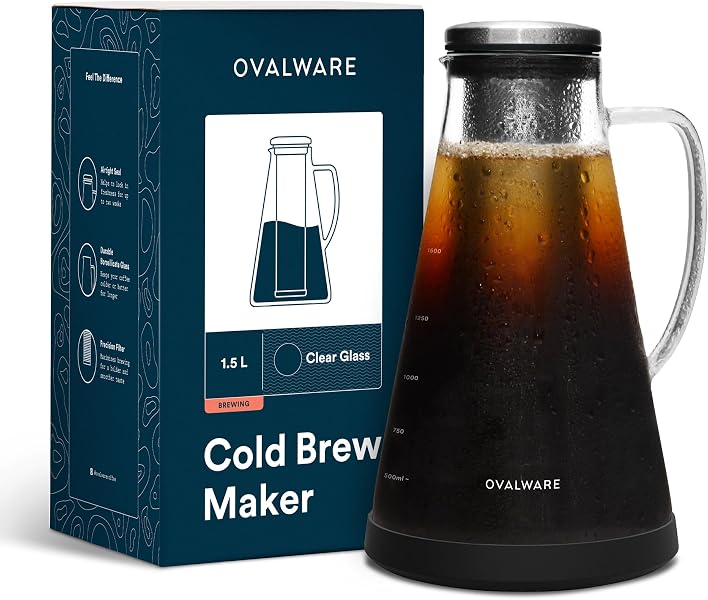
Cold brew’s practical advantage is that it keeps. A batch made on Sunday is still good on Friday, which is the reason to make it at all rather than brewing hot every morning.
OVALWARE states two weeks, and backs it with an airtight seal rather than a loose lid.
Key Specifications
| Real capacity | 1.5 litres, 51 fluid ounces |
|---|---|
| Stated capacity field | 3.2 pounds — see note |
| Seal | Airtight, stated to hold freshness 2 weeks |
| Materials | Borosilicate glass with stainless steel lid and filter |
| Extra | Doubles as a tea infuser |
| Dimensions | 5.51″W x 9.45″H |
| Weight | 1.3 pounds |
| Model | RJ3-06 |
| Best For | Brewing a big batch and drinking it across a fortnight |
Why We Recommend It
That storage claim is the specification that turns a large batch into a sensible one. If the brew goes flat in three days, a 51-ounce maker is over-provisioned for one person. If it holds for two weeks, it is exactly right.
Borosilicate glass with a stainless lid and filter means no plastic touches the coffee at any point, and the same vessel works as a tea infuser.
Its capacity field reads 3.2 pounds, which is a weight rather than a volume. The real figure — 1.5 litres, 51 ounces — is in the product title. That pattern repeats across this category.
Pros
- Airtight seal, stated to hold freshness for two weeks
- Borosilicate glass and stainless, no plastic in contact
- 1.5 litres, second largest real capacity here
- Doubles as a tea infuser
- 1.3 pounds and only 9.45 inches tall
Cons
- Capacity field states 3.2 pounds, which is a weight
- $46.99, second dearest here
- Narrow 5.5-inch base is easy to knock over
- Stainless filter is finer to clean than a basket
Best for: Making one large batch and drinking it over a fortnight.
3. Zulay 1 Gallon — Largest Here

A gallon of concentrate at a typical dilution is somewhere north of fifty servings. This is not a large cold brew maker; it is a different order of thing.
The spigot is what makes it usable at that size.
Key Specifications
| Capacity | 1 gallon, 128 fluid ounces |
|---|---|
| Dispensing | Spigot tap |
| Filter | Removable stainless steel mesh |
| Materials | Thick glass with stainless steel lid |
| Dimensions | 14.17″D x 16.93″W x 7.87″H |
| Weight | 3.3 pounds empty |
| Also for | Iced tea |
| Rating | 4.5 out of 5 stars |
| Best For | Households, offices and anyone brewing weekly rather than daily |
Why We Recommend It
Once a vessel holds a gallon, pouring becomes the problem. A full jug weighs about ten pounds and tipping it one-handed over a glass of ice is how glass pitchers get dropped. A tap means the jug stays on the shelf and the glass comes to it.
Thick glass with a removable stainless mesh filter, and it works equally well for iced tea, which at this volume is a genuine second use.
The footprint is the cost. At 16.93 inches wide it needs a dedicated shelf, and a full one will not fit in most fridge doors — it wants a main shelf, which is a real household negotiation.
Pros
- 1 gallon, by far the largest capacity here
- Spigot means no lifting a full jug
- Removable stainless mesh filter
- Thick glass with a steel lid
- Works for iced tea at the same scale
Cons
- 16.93 inches wide, needs a dedicated fridge shelf
- About ten pounds when full
- Far too much for one or two people
- $36.99
Best for: Offices, households and weekly batch brewing.
4. Takeya Glass 2 Quart — Best Value Brand

Takeya’s cold brew pitchers are the ones most people have seen, and this is the glass version: 64 ounces of concentrate, airtight, with a permanent fine-mesh filter.
Twelve point eight ounces empty makes it the lightest full-size maker here.
Key Specifications
| Capacity | 2 quarts, 64 fluid ounces |
|---|---|
| Filter | Fine-mesh permanent, keeps grounds out |
| Seal | Airtight |
| Material | BPA-free glass |
| Dimensions | 4.1″D x 4.1″W x 12.2″H |
| Weight | 12.8 ounces |
| Model | 10321 |
| Rating | 4.6 out of 5 stars |
| Best For | A proven design at a sensible price |
Why We Recommend It
A permanent mesh filter is the right choice for cold brew specifically, because the grind is coarse. Paper filters are for the fine grinds and fast contact times of hot brewing; cold brew steeps for half a day at a coarse grind, and a mesh basket lets the water circulate through it in a way paper does not.
At 4.1 inches square it fits a fridge door, which the gallon jug and the wider pitchers here do not.
The narrow base is also the drawback: it is tall and thin, and a full one is easy to catch with a sleeve.
Pros
- 2 quarts of concentrate at $25.16
- Airtight seal for fridge storage
- Fits a fridge door at 4.1 inches square
- 12.8 ounces, lightest full-size maker here
- 4.6 stars from an established brand
Cons
- Tall, narrow shape tips easily when full
- Glass, so less forgiving than Tritan
- 12.2 inches tall
- Fine mesh needs care when cleaning
Best for: The mainstream choice, at a price that does not argue.
5. Hario Mizudashi 1000 ml — Best Under $25

Twenty dollars eighty-five for a Hario. The Mizudashi is a glass jug with a full-depth mesh strainer that lifts out with the grounds in it, and nothing else.
One litre of concentrate, which at normal dilution is a week of iced coffee for one person.
Key Specifications
| Capacity | 1000 ml, about 34 fluid ounces |
|---|---|
| Filter | Fine mesh strainer |
| Material | Heatproof glass with plastic lid and strainer |
| Dimensions | 3.7″D x 5.43″W x 11.57″H |
| Weight | 560 g |
| Model | MCPN-14B |
| Price | $20.85 |
| Rating | 4.6 out of 5 stars |
| Best For | One or two people, from a brand that knows coffee |
Why We Recommend It
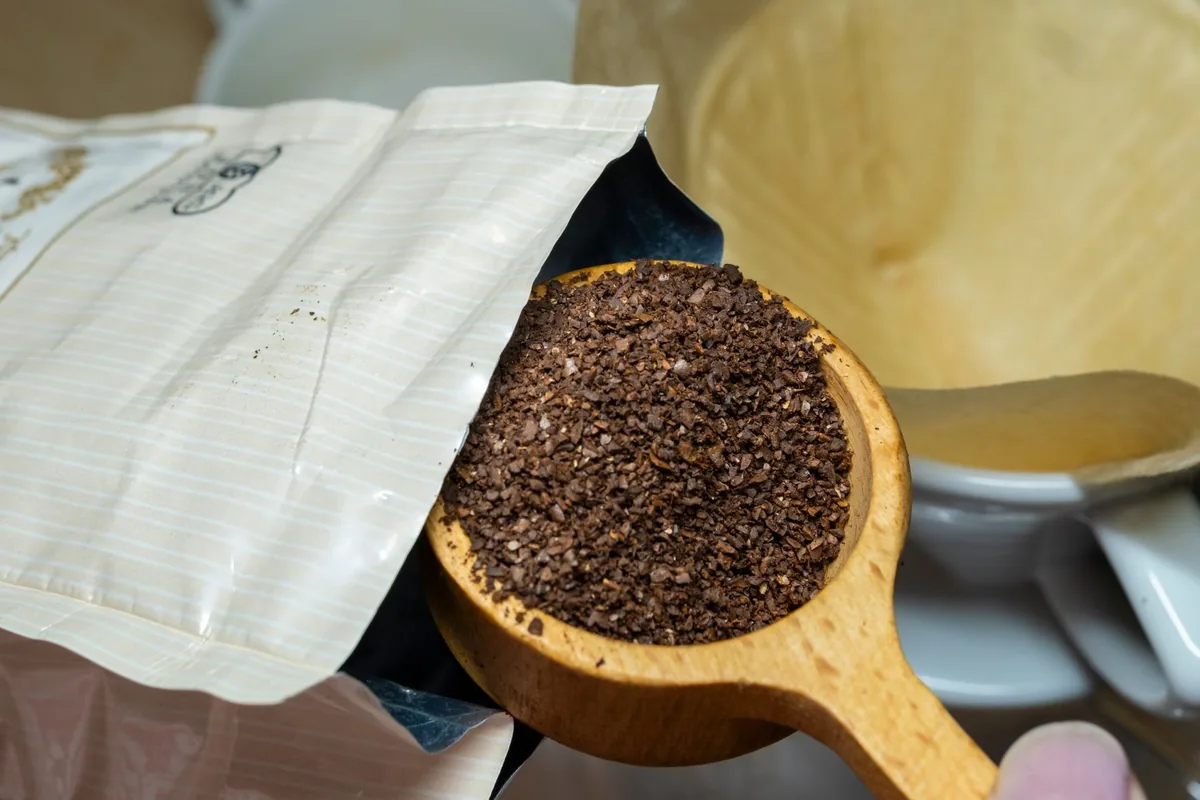
Hario’s own advice on this listing is worth repeating because it is the part beginners get wrong: grind coarse. A fine grind in a 12-hour steep over-extracts and turns bitter, and it also passes straight through a mesh filter as sediment.
The full-depth strainer is the design detail — grounds sit in a basket that runs the height of the jug rather than a shallow cup, so water contacts them evenly throughout.
At 3.7 inches deep it is the narrowest maker here and fits any fridge door. One litre is genuinely modest, though, and for two coffee drinkers it will need refilling twice a week.
Pros
- $20.85 from an established coffee brand
- Full-depth strainer basket for even contact
- 3.7 inches deep, fits any fridge door
- 560 g, very light
- 4.6 stars
Cons
- 1 litre is modest for a concentrate maker
- Plastic lid and strainer frame
- No airtight claim
- Needs refilling twice a week for two people
Best for: One or two people who want a proven design cheaply.
6. County Line Kitchen 64 oz — Highest Rated
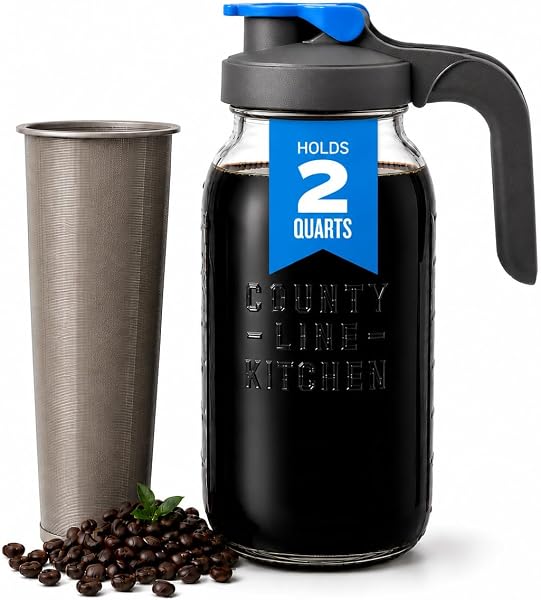
Four point eight is the highest rating in this roundup and unusually high for any kitchen product. Sixty-four ounces of glass with a leak-proof lid and a stainless filter.
The leak claim is the one that earns the reviews.
Key Specifications
| Real capacity | 64 fluid ounces |
|---|---|
| Stated capacity field | 4 pounds — see note |
| Lid | Leak resistant, stated |
| Material | Glass |
| Dimensions | 6.25″D x 4.25″W x 10.25″H |
| Weight | 1.13 kg |
| Model | CLK-FGS-A033-01-AA1US |
| Rating | 4.8 out of 5 stars, highest here |
| Best For | The best-reviewed cold brew maker in this comparison |
Why We Recommend It
A leak-proof lid matters on a cold brew maker because of how they are used. Many people invert or shake the jug during the first hour to wet the grounds evenly, and most designs will weep from the lid when tipped. A seal that holds means you can agitate it without a tray underneath.
At 4.25 inches wide it fits a fridge door, and the 6.25-inch depth gives it a more stable footprint than the very narrow pitchers here.
Its capacity field reads 4 pounds, which is the fifth listing in this roundup to put a weight where a volume belongs. And the listing did not display a price when we checked, so confirm before ordering.
Pros
- 4.8 stars, highest rating in this roundup
- Leak-proof lid allows shaking to wet the grounds
- 64 ounces in a fridge-door footprint
- Stable 6.25-inch base
- Stainless steel filter
Cons
- Price not displayed when checked
- Capacity field states 4 pounds, which is a weight
- Glass, so heavier than Tritan rivals
- No airtight storage claim
Best for: Anyone who buys on reviews and shakes the jug while brewing.
7. Maestri House 40 oz — Best Ratio Markings

Cold brew is a ratio problem. Too little coffee and the concentrate is not concentrated; too much and it is undrinkable even diluted. Most people guess, and most people get it wrong twice before they get it right.
Maestri House prints the ratio on the pitcher.
Key Specifications
| Capacity | 1.2 litres, 40 fluid ounces |
|---|---|
| Filter | 350-mesh ultra-fine |
| Material | BPA-free Tritan |
| Feature | Printed ratio markings |
| Dimensions | 6.29″D x 3.58″W x 9.17″H |
| Weight | 0.93 kg |
| Model | MHCB-02 |
| Rating | 3.9 out of 5 stars, lowest here |
| Best For | Getting the ratio right without weighing anything |
Why We Recommend It
That is a better solution than a printed instruction card, because the card gets lost and the pitcher does not. It also removes the need for scales, which is the other way to solve it and the reason a lot of people never make cold brew twice.
A 350-mesh filter is finer than the 100-micron ones stated elsewhere here, which means less sediment in the cup at the cost of slower flow when you lift the basket.
Tritan rather than glass makes it the one maker here you can drop, which suits a fridge that gets opened by children. At 3.9 stars it is the lowest-rated in this roundup, which is worth weighing against the convenience.
Pros
- Ratio markings printed on the pitcher itself
- 350-mesh filter, finest stated here
- BPA-free Tritan, so it will not shatter
- 3.58 inches wide, fits any fridge door
- 0.93 kg
Cons
- 3.9 stars, lowest rating in this roundup
- Tritan scratches where glass does not
- 40 oz is modest for concentrate
- Fine mesh is slower to drain
Best for: Anyone who has abandoned cold brew because the ratio never came out right.
8. 64 oz Mason Jar Pitcher — Cheapest Here
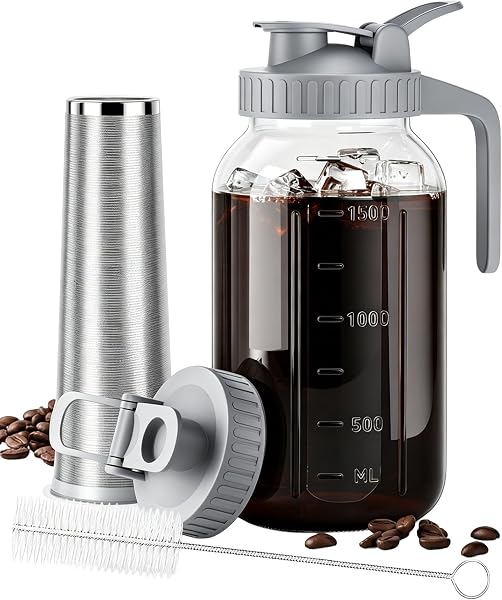
Sixteen ninety-nine for sixty-four ounces, at 4.7 stars — the second highest rating here and roughly a third of what the OXO costs for twice the volume.
A mason jar pitcher with a full-depth stainless filter and a silicone sealing ring.
Key Specifications
| Real capacity | 64 fluid ounces |
|---|---|
| Stated capacity field | 4 pounds |
| Filter | Stainless steel mesh |
| Seal | Food-grade silicone ring |
| Materials | Glass with stainless filter |
| Price | $16.99, cheapest here |
| Rating | 4.7 out of 5 stars, second highest |
| Cleaning | Lead and BPA free, stated |
| Best For | The most concentrate per dollar in this roundup |
Why We Recommend It
The mason jar format is the commodity version of this product and it works. A wide-mouth jar, a mesh cylinder that drops into it and a lid is the entire mechanism, and there is very little in it to go wrong or to clean badly.
The silicone ring is what separates the decent ones from the ones that drip, and this listing calls it out specifically.
What you do not get is a brand. No support, no spare filters in five years, and a listing whose capacity field says 4 pounds like several of its neighbours. At $16.99 that is a reasonable trade, and the 4.7 rating suggests buyers agree.
Pros
- $16.99, cheapest maker in this roundup
- 64 ounces, joint largest of the pitchers
- 4.7 stars, second highest here
- Food-grade silicone sealing ring
- Full-depth stainless filter
Cons
- No brand, no support and no spare filters
- Capacity field states 4 pounds
- Generic listing that may change without notice
- Glass jar with no impact resistance
Best for: The most cold brew per dollar, if a brand name is not the point.
9. JunVpic 64 oz — Finest Filter

Sediment is the most common complaint about home cold brew, and it comes down to two things: grind size and filter weave. JunVpic states the second one — 100 microns — which almost no listing in this category does.
Three hundred and four stainless rather than unspecified steel.
Key Specifications
| Real capacity | 64 fluid ounces |
|---|---|
| Filter | 100 micron weave, 304 stainless steel |
| Material | Food-grade soda-lime glass, thickened |
| Stated capacity field | 4 pounds |
| Price | $19.99 |
| Rating | 4.6 out of 5 stars |
| Design | Mason jar pitcher |
| Seal | Lid seal |
| Best For | Anyone who has had gritty cold brew |
Why We Recommend It
A stated micron figure is worth something because it is comparable. “Fine mesh” and “ultra-fine” are marketing words; 100 microns is a number you can hold against the 350-mesh claim on the Maestri House and against your own grinder’s output.
Thickened soda-lime glass is more robust than thin borosilicate for a jug that lives in a fridge door, at the cost of being heavier.
Like most of the mason-jar entries here, it is a generic listing with no brand behind it, and its capacity field says 4 pounds.
Pros
- States a 100 micron filter weave, rare here
- 304 stainless steel filter
- Thickened glass for fridge-door use
- 64 ounces at $19.99
- 4.6 stars
Cons
- Capacity field states 4 pounds
- Generic listing with no brand history
- Soda-lime rather than borosilicate glass
- No airtight storage claim
Best for: Anyone whose last cold brew came out gritty.
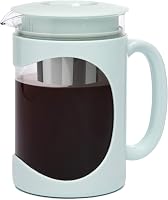
10. Primula Burke Deluxe — Best Compact
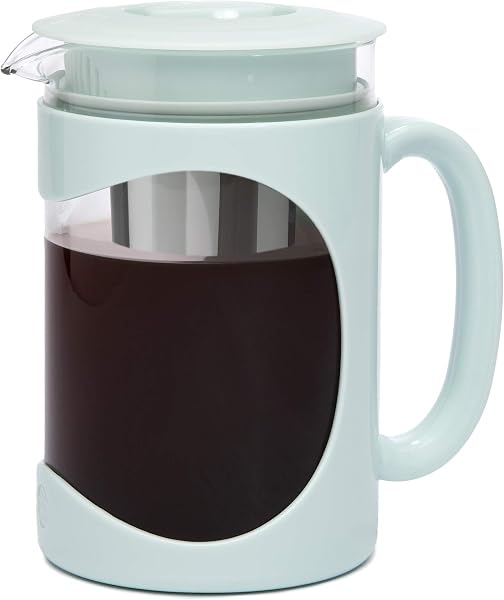
At 7.68 inches tall this is the shortest maker in the roundup by nearly three inches, which is the difference between fitting under a fridge shelf and not.
Fifty-one ounces of concentrate, borosilicate glass, dishwasher safe.
Key Specifications
| Capacity | 1.6 quarts, about 51 fluid ounces |
|---|---|
| Filter | Removable brew core |
| Material | Borosilicate glass |
| Handle | Comfort grip |
| Dimensions | 6.88″D x 4.73″W x 7.68″H, shortest here |
| Cleaning | Dishwasher safe |
| Price | $18.30 |
| Rating | 4.0 out of 5 stars |
| Best For | Fridge shelves with limited height |
Why We Recommend It
The wide, low shape is more stable than the tall narrow pitchers, and the comfort handle makes pouring a full jug one-handed genuinely manageable.
Primula’s own listing opens with a warning rather than a benefit, about grind size, coffee quantity and tamping — which is unusual and, on reflection, useful. Too coarse a grind and too little coffee are the two reasons a first batch tastes of nothing, and most listings would rather not mention it.
At 4.0 stars it is second lowest here, and $18.30 puts it among the cheapest.
Pros
- 7.68 inches tall, fits under a fridge shelf
- Wide base is far more stable than tall pitchers
- Comfort grip handle for pouring when full
- Borosilicate glass, dishwasher safe
- $18.30
Cons
- 4.0 stars, second lowest in this roundup
- 6.88 inches deep takes more shelf area
- Removable core is fiddlier to clean than a basket
- No airtight claim
Best for: Fridges where height, not width, is the constraint.
Concentrate, Not Coffee
Every maker here brews concentrate. This is roughly what each pitcher is worth once diluted, using the maker’s own numbers where stated.
| Maker | Real volume | Roughly serves | Suits |
|---|---|---|---|
| OXO Good Grips | 32 oz | Up to 14 cups, stated | One person, one week |
| Hario Mizudashi | 1 litre | About 12 cups | One person, one week |
| Maestri House | 40 oz | About 16 cups | One person, ten days |
| Primula Burke, OVALWARE | 51 oz | About 20 cups | One person, two weeks |
| Takeya, County Line, mason jars | 64 oz | About 25 cups | Two people, ten days |
| Zulay | 1 gallon | 50 cups and up | A household or an office |
Cold brew keeps for one to two weeks refrigerated, and that is the constraint that should set your size — not how much coffee you drink in a day. A 64-ounce pitcher is about right for two people brewing weekly. A gallon is right for an office or a household of four, and wrong for anyone else, because the last of it will be a fortnight old before you reach it. The OXO’s 32 ounces looks small on the page and is a perfectly sensible week for one person, which is exactly why stating the yield rather than the volume is more useful than it sounds.
What Decides Whether It Comes Out Gritty
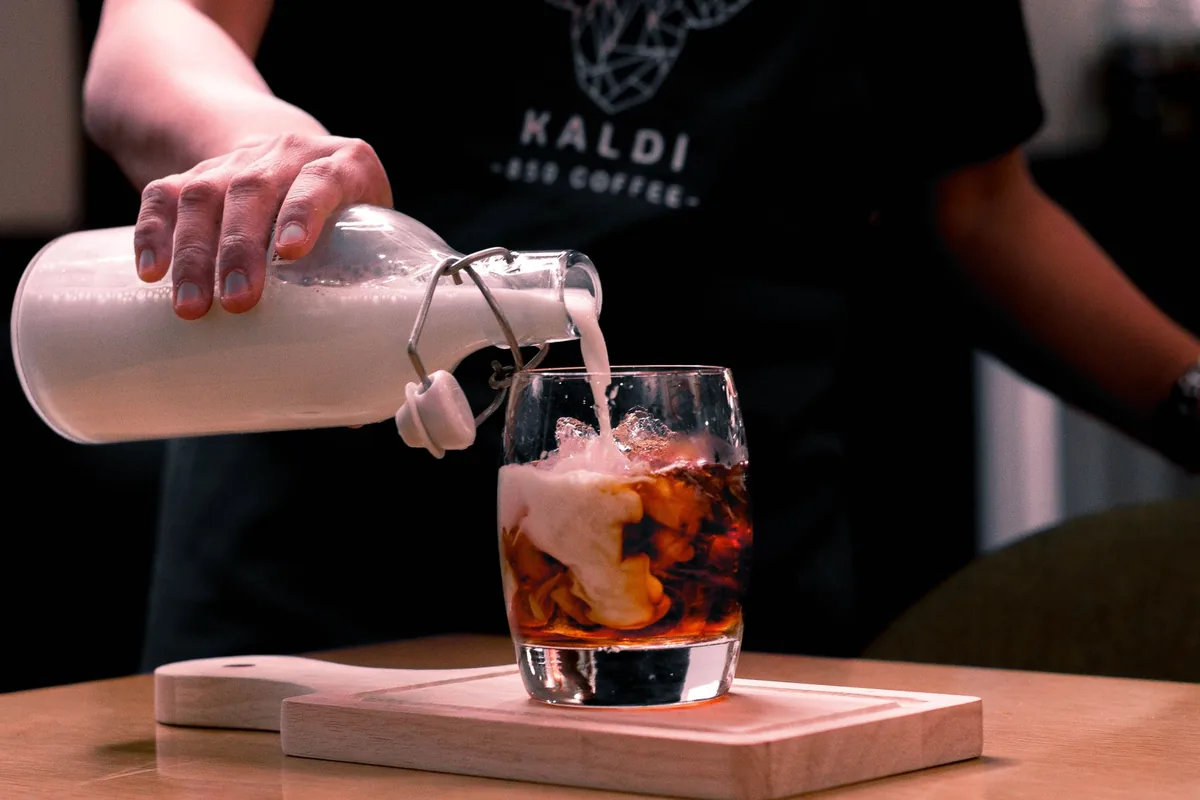
Sediment is the commonest complaint about home cold brew. Two things cause it, and only one is the maker’s fault.
| Fine mesh, stated figure | Fine mesh, unquantified | Your grinder | |
|---|---|---|---|
| Makers here | JunVpic at 100 microns, Maestri House at 350 mesh | Takeya, Hario, OXO, County Line and the rest | — |
| What it controls | Particles above that size are held back | Unknown, brand-dependent | How many fine particles exist at all |
| Effect on cup | Predictable | Usually adequate | Dominant |
| Fixable after purchase | No | No | Yes, grind coarser |
The last column is the one that matters most and the one nobody sells you. Cold brew wants a coarse grind — Hario says so on its own listing — because a twelve-hour steep extracts plenty without help, and fine particles both over-extract into bitterness and slip through any mesh. If your cold brew is gritty, changing the grind will fix it faster than changing the maker. Where a maker does publish a micron figure, as two here do, it is genuinely comparable in a way that ‘ultra-fine mesh’ is not.
Best Alternatives
| Alternative | Why Consider It | Better For | Main Trade-Off |
|---|---|---|---|
| A french press | You may already own one, and it works | Occasional cold brew | No airtight lid, and it holds less |
| A mason jar and a sieve | Costs nothing at all | Trying cold brew once | Messy straining, and sediment |
| Bottled cold brew concentrate | No waiting and no equipment | Very occasional drinkers | Several times the cost per cup |
| A Japanese iced pour over | Ready in four minutes, brighter flavour | Anyone who wants it now | Hot-brewed, so higher acidity |
| An espresso machine over ice | Fast, and very strong | Kitchens that already have one | A completely different flavour profile |
What Each Price Tier Actually Buys
$17 to $21 — mason jar pitchers, Primula, Hario. The mechanism, in glass, with a mesh basket. The $16.99 mason jar holds 64 ounces and rates 4.7 stars, which is more concentrate per dollar than anything else here and a higher rating than most of it. What you give up is a brand and any prospect of spare filters.
$24 to $37 — Maestri House, Takeya, Zulay. Where the design thinking appears: printed ratio markings, an airtight seal from an established name, or a gallon jug with a spigot. Three quite different answers to three different problems.
$47 to $60 — OVALWARE, OXO. The OVALWARE buys borosilicate and steel with nothing plastic touching the coffee, and a two-week freshness claim. The OXO buys the Rainmaker distribution lid and, uniquely here, a stated yield in cups.
The pattern: ratings do not climb with price. The two highest-rated makers in this roundup cost $16.99 and, when it was showing a price, well under the top of the range. Price buys sealing, materials and thought about the ratio, not better coffee.
How to Choose a Cold Brew Coffee Maker
Read the Title for the Volume, Not the Capacity Field
Five of the ten listings here state a weight in pounds where the volume belongs. Every one of them states the real figure in the product title. It takes two seconds and it is the difference between buying 32 ounces and 128.
Remember You Are Buying Concentrate
Cold brew comes out roughly three to four times stronger than you will drink it. So a 32-ounce maker is not two large coffees, it is about fourteen. Work backwards from how many cups you want per week and how long you are prepared to let a batch sit, rather than from the number on the box.
Let Fridge Shape Decide More Than Capacity
These are objects that live in a fridge for twelve hours at a time. A tall narrow pitcher fits a door shelf; a wide squat one does not but is far harder to knock over; a gallon jug needs a main shelf and a household discussion. The dimensions here range from 3.7 inches deep to nearly 17 inches wide.
Grind Coarse, Whatever You Buy
This fixes more problems than any purchase. A fine grind steeped for twelve hours over-extracts into bitterness and pushes fine particles through any mesh, which is where gritty cold brew comes from. Hario puts the advice on its own product page. If your last batch was harsh or silty, change the grind before changing the equipment.
Prefer an Airtight Lid if You Batch Weekly
Cold brew’s advantage over hot coffee is that it keeps — one to two weeks refrigerated. An airtight seal is what protects that, and one maker here states two weeks explicitly. A loose lid means the last third of a large batch tastes flat, which quietly wastes the capacity you paid for.
Check for a Micron Figure if You Have Had Sediment
Most listings say ‘fine mesh’ or ‘ultra-fine’, which are not comparable to anything. Two makers here publish a number — 100 microns and 350 mesh — and those you can weigh against each other and against your grinder. It is a small differentiator, but it is one of the few real ones in a category of very similar glass jugs.
Common Cold Brew Maker Buying Mistakes
- Reading the capacity field. Five of these ten state 4 pounds or 3.2 pounds where the volume should be.
- Treating the volume as servings. It is concentrate; a 32-ounce maker yields about 14 cups once diluted.
- Buying a gallon for one person. Cold brew keeps one to two weeks, so the last of it will be stale before you get there.
- Grinding too fine. It over-extracts over twelve hours and passes straight through the mesh as sediment.
- Ignoring the fridge shelf. These range from 3.7 inches deep to 16.93 inches wide, and the wide ones will not fit a door.
- Assuming a dearer maker brews better coffee. The two highest-rated makers here are among the cheapest.
- Skipping the airtight lid on a big batch. The last third goes flat, which wastes the capacity you paid for.
Which Cold Brew Coffee Maker Should You Buy?
Buy the OXO Good Grips if you want the yield stated rather than inferred, and a lid that distributes water evenly over the grounds. Thirty-two ounces, up to 14 cups.
Buy the 64 oz mason jar pitcher if value is the whole question. Sixty-four ounces at $16.99 and 4.7 stars is the most concentrate per dollar here.
Buy the Takeya Glass 2 Quart if you want an established brand at a sensible price, airtight, and narrow enough for a fridge door.
Buy the Zulay 1 Gallon if you are brewing for a household or an office. A spigot is essential at that weight.
Buy the OVALWARE RJ3 if you want no plastic touching the coffee and a stated two-week freshness window.
Buy the Maestri House if the ratio is what has defeated you before. The markings are printed on the pitcher.
Buy the Primula Burke if your fridge is short on height. At 7.68 inches it is the only one that slips under a low shelf.
Frequently Asked Questions
How much coffee does a cold brew maker actually make?
Far more than the number on it suggests, because cold brew makers produce concentrate rather than finished coffee. The concentrate is roughly three to four times too strong to drink and gets diluted with water or milk. OXO is the only maker in this roundup that states the finished yield: 32 ounces of concentrate, up to 14 cups of coffee. Applying similar arithmetic, a 64-ounce pitcher is around 25 cups and the gallon jug here is over fifty.
Why do so many listings state the capacity in pounds?
Because the structured capacity field has been filled in with the shipping weight rather than the volume. Five of the ten makers in this roundup do it, reporting 4 pounds or 3.2 pounds for pitchers that hold 51 to 64 fluid ounces. It is not deceptive so much as careless, and the real figure is stated correctly in every product title. It is worth knowing before you compare two products by their specification tables.
How long does cold brew take, and how long does it keep?
Twelve to twenty-four hours to brew, in the fridge or at room temperature, and one to two weeks in the fridge once made. That keeping time is the whole reason to batch it, and it is what should determine the size you buy: a pitcher that holds more than two weeks of your drinking is a pitcher whose last third goes flat. One maker here states a two-week freshness window explicitly, backed by an airtight seal.
What grind do you need for cold brew?
Coarse — noticeably coarser than for a drip machine, closer to what you would use in a french press. Two things follow from the long steep: fine particles over-extract into bitterness over twelve hours, and they slip through the mesh filter as sediment. If your cold brew has come out harsh or gritty, the grind is the first thing to change and it will help more than a different maker. Hario puts this advice on its own product page.
Is a glass or plastic cold brew maker better?
Glass does not scratch, stain or hold odours, which matters for a vessel that holds coffee for a fortnight at a time. Tritan plastic will not shatter, which matters in a fridge that gets opened by children or in a household where things get dropped. One maker in this roundup uses Tritan and the rest use glass, mostly borosilicate. If nothing plastic touching the coffee is a priority, one maker here uses only borosilicate and stainless steel.
Do you need a special filter for cold brew?
A permanent mesh basket rather than paper, which is what every maker in this roundup uses. Paper filters suit the fine grinds and fast contact of hot brewing; cold brew steeps coarse grounds for half a day and needs water to circulate through them, which a mesh cylinder allows and paper does not. Where a listing publishes a micron figure — two here state 100 microns and 350 mesh — that is a genuinely comparable measure of how much sediment gets through.
Is cold brew less acidic than hot coffee?
Generally yes, and it is the main reason people switch. Brewing without heat extracts fewer of the acidic compounds that come out under hot water, so the result is smoother and easier on the stomach for a lot of drinkers; one maker in this roundup states 70% less acidity. It also tastes sweeter and less bitter at the same strength, which is why cold brew often needs less sugar than iced coffee made from a hot brew.
Can you use a cold brew maker for tea?
Yes, and several here are sold for it. Cold-steeped tea works on the same principle and produces a less tannic, less bitter result than hot brewing followed by chilling. One maker in this roundup includes a dedicated tea infuser, and the gallon jug is explicitly marketed for iced tea at that scale. The only caution is flavour transfer: a mesh basket that has held coffee for months will pass some of that on, so a dedicated filter is worth having if you do both.
Final Verdict
The only maker here that states its yield in cups, with a Rainmaker lid that distributes water evenly over the grounds.
Sixty-four ounces of concentrate at $16.99, with 4.7 stars — the most coffee per dollar in this roundup.
Two quarts, airtight, from an established name, in a footprint that still fits a fridge door.
The number on a cold brew maker is concentrate, not coffee. Thirty-two ounces is about fourteen cups; sixty-four is about twenty-five; the gallon jug here is over fifty and belongs in an office. Only one maker in this roundup does that arithmetic for you, and it is the reason its modest-looking 32 ounces is a perfectly sensible week for one person.
Then check the title rather than the specification table, because five of these ten put a shipping weight in the capacity field. And size the pitcher to how long cold brew keeps — one to two weeks — rather than to how much coffee you drink, because a batch you cannot finish in a fortnight is capacity you paid for and will pour away.
After that the differences are small and the prices are low. The two highest-rated makers here are among the cheapest, and the single change that will improve your cold brew most costs nothing at all: grind it coarser.