Affiliate Disclosure: As an Amazon Associate, we earn from qualifying purchases. This does not affect the price you pay.
A knife edge is two ground faces meeting at an angle. That angle is the entire specification — Western knives are usually ground around 20 degrees per side, Japanese knives around 15 — and it decides how sharply the knife cuts and how long it stays that way.
Which makes it strange that nine of the ten sharpeners below never state theirs.
A pull-through sharpener has its angle moulded into the slot. Draw a blade through it and the blade comes out at that angle, whatever it was ground at before. On a Western knife meeting a Western slot, nothing happens that you would notice. On a 15-degree Japanese knife meeting a 20-degree slot, the first pull begins grinding the original bevel away, and it does not grow back.
Only three products here let you decide: one electric machine that states it converts 20-degree edges to 15, one handheld guide with an adjustable angle, and one rolling system with a magnetic support. They cost $170.00, $39.99 and $39.99. The other seven cost between $9.01 and $23.99 and choose for you.
That is not an argument against the cheap ones. It is an argument for knowing which of your knives you are willing to let them decide about.
Our Quick Picks
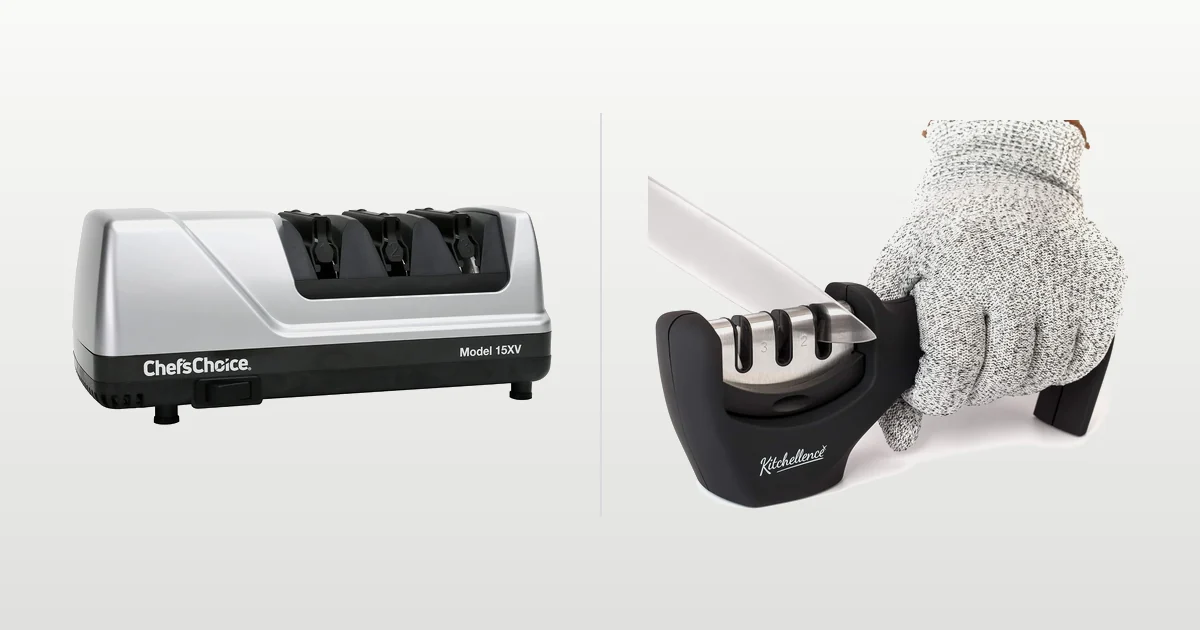
 Best OverallChef’sChoice 15XV EdgeSelect
The one sharpener on this page that treats the edge angle as something you decide rather than something it imposes.
 Highest RatedAccuSharp Knife Sharpener
Ten seconds, eleven dollars, and the highest rating in this roundup — from the simplest tool on it.
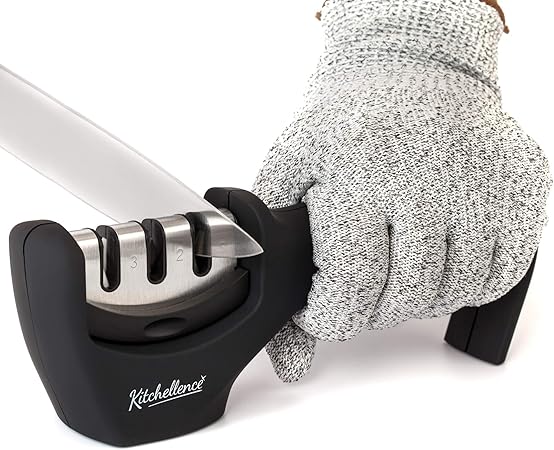 Best SellerKITCHELLENCE 4-in-1
The best-selling knife sharpener on Amazon: three slots, a scissor slot, a safety glove and no decisions to make.
At a Glance
Ten Knife Sharpeners Compared
Type and angle control first, because between them they determine what happens to your edge — then abrasives and stage count.
| # | Model | Type | Angle Control | Abrasives | Stages | Standout | Main Drawback | Check Price |
|---|---|---|---|---|---|---|---|---|
| 1 |
 Chef’sChoice 15XV EdgeSelect Chef’sChoice 15XV EdgeSelect |
Electric, 3 stage | You choose — converts 20° to 15° | 100% diamond abrasives | 3, including a stropping stage | The only sharpener here that rebevels on purpose | $170.00, by far the dearest | View on Amazon |
| 2 |
 Sharp Pebble Precision Adjust Sharp Pebble Precision Adjust |
Guided, handheld | Adjustable by you | Coarse, medium, fine | 3 | You set the angle rather than accepting one | Slower than a pull-through, deliberately | View on Amazon |
| 3 |
 AIERLIAN Rolling Sharpener AIERLIAN Rolling Sharpener |
Rolling, magnetic guide | Multi-angle magnetic support | #400 diamond, #3000 ceramic | 2 discs plus leather strop | Numbered grits, which almost nothing else here states | $39.99 and a large wooden base | View on Amazon |
| 4 |
 AccuSharp Knife Sharpener AccuSharp Knife Sharpener |
Handheld carbide scraper | Preset, not stated | Diamond-honed tungsten carbide | 1 | 4.7 stars, the best on this page | A scraper removes real metal every pass | View on Amazon |
| 5 |
 KITCHELLENCE 4-in-1 KITCHELLENCE 4-in-1 |
Pull-through, 3 stage | Preset, not stated | Diamond, tungsten, ceramic | 3 plus a scissor slot | #363 in all of Kitchen & Dining | The angle is decided for you | View on Amazon |
| 6 |
 Amazon Basics 4-in-1 Amazon Basics 4-in-1 |
Pull-through, 3 stage | Preset, not stated | Coarse, medium, fine | 3 plus a scissor slot | 4.6 stars for $9.01 | No angle figure, no stropping stage | View on Amazon |
| 7 |
 SHARPAL 191H SHARPAL 191H |
Pull-through, 3 stage | Preset, not stated | Tungsten carbide, ceramic, diamond rod | 3 | Suction base with twice the usual grip | Tiny, and it needs a smooth surface | View on Amazon |
| 8 |
 AnySharp GLOBAL AnySharp GLOBAL |
Pull-through, single stage | Preset by design | Tungsten carbide | 1 | Hands-free suction, nothing to judge | One stage means no refining pass | View on Amazon |
| 9 |
 Smith’s CCKS 2-Step Smith’s CCKS 2-Step |
Pull-through, 2 stage | Preset angles, stated as fixed | Tungsten carbide, ceramic rods | 2 | Under two ounces and pocketable | Two stages and no scissor slot | View on Amazon |
| 10 |
 SHARPAL 103N All-in-1 SHARPAL 103N All-in-1 |
Multi-tool, handheld | Preset, single and double bevel | Tungsten carbide, ceramic | 2 plus specialist edges | Sharpens mower blades and axes too | Not really a kitchen tool | View on Amazon |
Specifications, prices and ratings are taken from each manufacturer’s Amazon listing as displayed on 21 August 2026 and may change. “Angle control” reflects what each listing states: only the Chef’sChoice names a resulting angle (converting 20° edges to a 15° Trizor XV edge), the Sharp Pebble describes an adjustable angle, and the AIERLIAN a multi-angle magnetic support; the remaining seven describe no angle at all, and are recorded as preset. Grit fields in this category are filled in loosely — the SHARPAL 191H lists its Grit Type as “Fine” for a three-stage tool spanning tungsten carbide to ceramic, and one excluded model lists “Ultra Fine” for a four-stage system; only the AIERLIAN publishes numbered grits. Four further pull-through sharpeners were excluded as near-duplicates of models already included, one of them rated 3.7 stars.
Scroll the table sideways to see every column
How We Chose These Knife Sharpeners
We researched current listings, compared manufacturer specifications and documentation, and examined recurring patterns in customer feedback. We did not carry out hands-on testing, and nothing below is presented as measured performance data.
- Whether you control the edge angle — the specification that decides what a sharpener does to your knives permanently
- Abrasive type, and whether it abrades or scrapes — carbide shaves metal away fast; diamond and ceramic grind it
- Stage progression — coarse to fine is how sharpening works; a single stage cuts and stops
- Every format represented — pull-through, scraper, rolling, guided, electric and multi-tool
- Stability and safety — suction bases, non-slip feet and cut-resistant gloves, because the blade gets sharper as you work
- Serrated capability — slots cannot sharpen serrations; only a tapered rod can
The 10 Best Knife Sharpeners, Reviewed
1. Chef’sChoice 15XV EdgeSelect — Best Overall

Every other sharpener in this roundup grinds your knife to whatever angle its slots were moulded at. This one states the angle it produces, explains that it is changing yours, and gives you a reason to want that.
Converting a 20-degree Western factory edge to a 15-degree Trizor XV edge is a deliberate rebevel, not a touch-up.
Key Specifications
| Type | Electric, three stage |
|---|---|
| Angle control | Converts 20° factory edges to a 15° Trizor XV edge |
| Abrasives | 100 per cent diamond |
| Stages | Sharpen, hone, and an advanced stropping stage |
| Guides | Patented flexible spring guides set the angle automatically |
| Blades | Straight and serrated |
| Dimensions | 10″L x 4.25″W x 4.25″H |
| Weight | 4.2 pounds |
| Best For | Anyone who owns knives worth more than the sharpener |
Why We Recommend It
Edge angle is the specification this category almost never prints. Western knives are typically ground around 20 degrees per side; Japanese knives around 15. A narrower angle cuts more cleanly and dulls faster; a wider one lasts longer and pushes through food rather than slicing it. Neither is correct in the abstract — it depends on your knives and what you cut.
Pull-through sharpeners make that choice for you silently. If your knife was ground at 15 degrees and the slot is 20, the first pull grinds away the existing bevel to impose its own. That is irreversible.
The stropping stage is the other real distinction. Sharpening leaves a microscopic burr along the edge; stropping removes it. Almost nothing under $40 here does more than a ceramic finishing pass.
One hundred per cent diamond abrasives cut faster and stay flat longer than carbide, and unlike carbide scrapers they abrade rather than shave.
At $170.00 it costs more than nine of the ten sharpeners here combined, which is only sensible arithmetic if your knives cost more still.
Pros
- The only sharpener here that states and controls the resulting edge angle
- 100 per cent diamond abrasives
- Includes a genuine stropping stage to remove the burr
- Spring guides hold the angle automatically
- Handles serrated as well as straight edges
- 4.6 stars from an established sharpening brand
Cons
- $170.00, the most expensive product here by a factor of four
- Rebevelling to 15° is permanent, and wrong for some knives
- 4.2 pounds and a permanent countertop footprint
- Needs a power socket
- Overkill for a block of supermarket knives
Best for: Households with good knives, where the sharpener costs less than what it sharpens.
2. Sharp Pebble Precision Adjust — Best Adjustable Angle

Forty dollars, three grits, and an adjustable angle. That last part is what separates it from the seven pull-through sharpeners further down this page, all of which decide the bevel for you.
It weighs an ounce and a half and stores in a drawer.
Key Specifications
| Type | Guided handheld, three stage |
|---|---|
| Angle control | Adjustable |
| Grits | Coarse, medium, fine |
| Blades | Kitchen, pocket and hunting knives |
| Dimensions | 9.84″L x 0.79″W x 1.97″H |
| Weight | 1.5 ounces |
| Rank | #12 in Knife Sharpeners |
| Price | $39.99 |
| Best For | Matching one sharpener to knives ground at different angles |
Why We Recommend It
Adjustability matters most in a mixed knife block, which is what most kitchens actually have: a couple of German knives at 20 degrees, a Japanese santoku at 15, and something inherited. One preset slot cannot serve all three without regrinding two of them.
Three grits is a genuine progression, not three names for the same abrasive. Coarse resets a damaged edge, medium sharpens, fine refines. Working through them in order is how sharpening is actually done, and pull-through sharpeners compress it into one pass.
The trade-off is speed and skill. A pull-through takes ten seconds and asks nothing of you. A guided system takes several minutes and requires you to hold the blade steady against the guide. It is a better result for more effort, which is the honest summary of everything above $30 in this category.
Pros
- Adjustable angle, rare below $150 here
- Three distinct grits in a proper progression
- Works on kitchen, pocket and hunting knives
- 1.5 ounces and drawer-sized
- No power needed
- $39.99
Cons
- Slower than a pull-through and needs a steady hand
- Angle range not specified in the listing
- 4.4 stars
- #12 in Knife Sharpeners, low visibility
- Sold under a confusing mix of brand names
Best for: Mixed knife blocks, where one preset angle cannot fit everything.
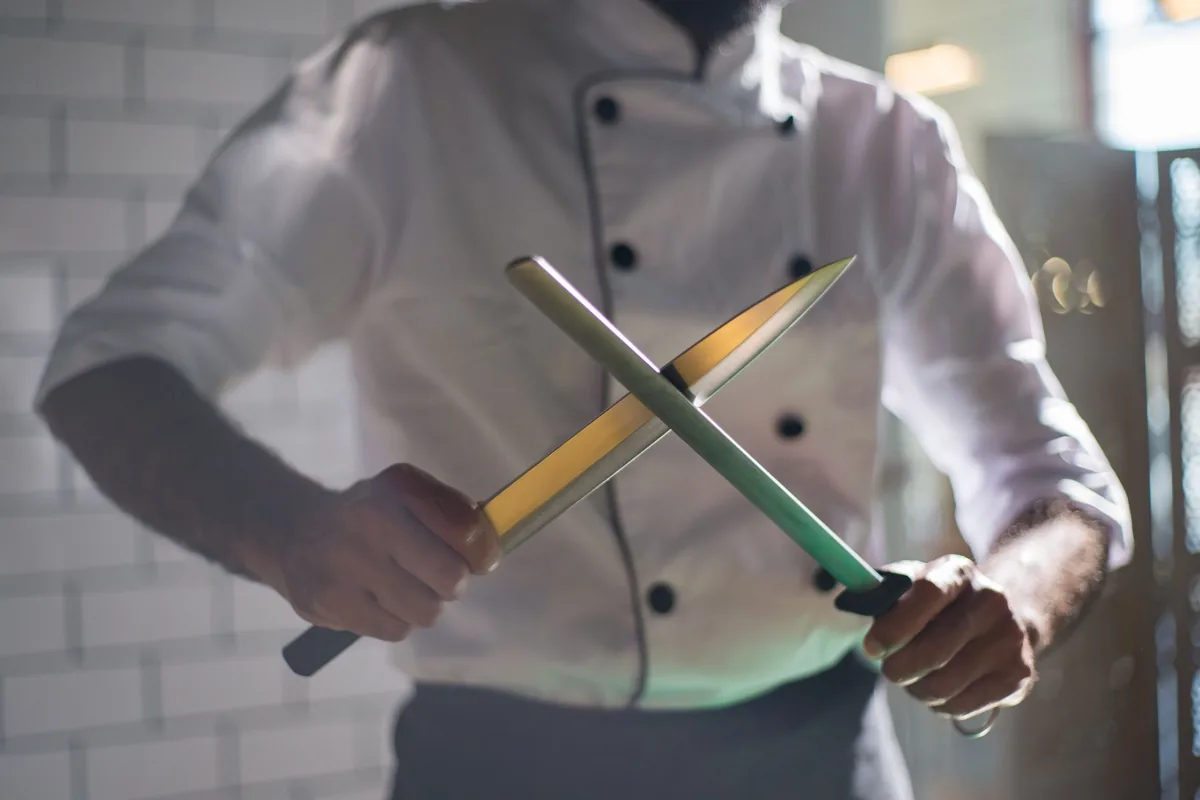
3. AIERLIAN Rolling Sharpener — Best Guided System

The rolling format is the most interesting thing to happen to home sharpening in years. The knife lies flat against a magnetic block that sets the angle; you roll an abrasive disc along the edge. The angle cannot drift because you are not the one holding it.
It is #4 in Knife Sharpeners and rated 4.4 stars.
Key Specifications
| Type | Rolling, magnetic angle guide |
|---|---|
| Angle control | Multi-angle magnetic support, constant through the stroke |
| Discs | #400 industrial diamond, #3000 ceramic |
| Magnets | Four N42 neodymium |
| Included | Rolling sharpener, magnetic support, leather strop, instructions |
| Body | Natural wood |
| Dimensions | 5.49″L x 4.6″W x 2.7″H |
| Weight | 1.3 pounds |
| Best For | Repeatable results without learning to hold an angle freehand |
Why We Recommend It
It is also one of very few products here that gives grit numbers. A #400 diamond disc for cutting and a #3000 ceramic for refining are meaningful, comparable figures. Almost every other listing on this page says "coarse" and "fine" and leaves you to guess — and one describes its grit type as "Ultra Fine" while selling a four-stage system.
The leather strop in the box matters more than it looks. Stropping removes the burr that sharpening raises; without it a freshly sharpened edge feels grabby and dulls quickly. Only this and the $170 electric machine include one.
The catch is bulk and price. A wooden block, a magnetic support and a rolling handle is a lot of kit for a job three of the sharpeners here do in ten seconds for under ten dollars. It also takes practice to run the disc evenly along a long chef’s knife.
Pros
- Magnetic guide holds a constant angle without skill
- States real grit numbers, #400 diamond and #3000 ceramic
- Leather strop included for deburring
- Four N42 neodymium magnets hold firmly
- #4 in Knife Sharpeners
- Natural wood construction
Cons
- $39.99 and much bulkier than a pull-through
- Takes practice on long blades
- Two discs mean two consumables to replace
- 1.3 pounds and needs bench space
- Slower than every pull-through here
Best for: Anyone who wants a consistent angle without learning freehand technique.
4. AccuSharp Knife Sharpener — Highest Rated

Eleven ninety-nine, 1.6 ounces, one carbide blade, and 4.7 stars — the highest rating of any sharpener in this roundup, including the $170 electric machine.
It is #2 in Knife Sharpeners behind only the pull-through best seller.
Key Specifications
| Type | Handheld carbide scraper |
|---|---|
| Angle control | Preset; angle not stated |
| Abrasive | Diamond-honed tungsten carbide |
| Stages | 1 |
| Blades | Chef, paring, serrated, filet, and more |
| Stated time | About 10 seconds |
| Blade life | 5 to 10 years between replacements, per the manufacturer |
| Weight | 1.6 ounces |
| Best For | Fast, cheap edge restoration on knives you are not precious about |
Why We Recommend It
Understand what a carbide scraper does, because it is not quite sharpening. Two hardened carbide edges shave metal off the blade as you draw it through, cutting a new edge in seconds. It is fast and it genuinely works — but it removes far more steel per pass than an abrasive stone does, and it leaves a coarser edge.
On a $15 supermarket knife that is a perfectly good trade. On a $200 Japanese gyuto it is vandalism.
The rating tells you the trade suits most people. Nearly nine thousand-plus buyers rating it 4.7 are not wrong about what it does; they are simply not sharpening knives that would object.
The blades are replaceable, and AccuSharp says most users go five to ten years before needing to — which is a more useful durability claim than anything else on this page.
Pros
- 4.7 stars, the highest rating in this roundup
- $11.99
- Sharpens in about 10 seconds
- Diamond-honed tungsten carbide blades
- Replaceable blades, 5 to 10 years of use
- Handles serrated and filet blades
- 1.6 ounces, fits any drawer
Cons
- A scraper removes noticeably more steel than abrasive sharpening
- Angle is preset and never stated
- Single stage, so no refining pass
- Coarser edge than a guided system produces
- Wrong tool for expensive Japanese knives
Best for: Everyday knives that need to be sharp now, not perfect.
5. KITCHELLENCE 4-in-1 — Best Seller

This is the best-selling knife sharpener on Amazon — #1 in its subcategory and #363 in the whole of Kitchen & Dining — at $17.99 and 4.5 stars.
Three slots in the correct order, a scissor slot, a non-slip base and a cut-resistant glove in the box.
Key Specifications
| Type | Pull-through, three stage |
|---|---|
| Angle control | Preset; angle not stated |
| Stage 1 | Diamond, for repairing damaged edges |
| Stage 2 | Tungsten, for sharpening |
| Stage 3 | Ceramic, for polishing |
| Extra | Dedicated scissor slot, cut-resistant glove |
| Body | ABS with a non-slip base |
| Rank | #1 in Knife Sharpeners, #363 in Kitchen & Dining |
| Best For | The default choice, and a perfectly sound one for most kitchens |
Why We Recommend It
The three-stage progression is genuinely right. Diamond to repair, tungsten to sharpen, ceramic to polish is the same sequence a guided system uses; it is simply compressed into three pulls instead of three careful passes.
What it does not tell you is the angle. Nowhere in the listing does a figure appear, which is true of nine of the ten sharpeners here. You are accepting whatever bevel the slots were moulded at — and on a Japanese knife ground at 15 degrees, a 20-degree slot will grind the existing edge away.
For a block of Western knives, that is a non-issue and this is an excellent purchase.
The glove is not a gimmick. Two sharpeners here include one, and the reason is that pull-through sharpening puts your other hand near a blade that is getting sharper by the second.
Pros
- #1 in Knife Sharpeners and #363 in all of Kitchen & Dining
- Correct three-stage progression: diamond, tungsten, ceramic
- Dedicated scissor slot
- Cut-resistant glove included
- Non-slip base
- Works left or right handed
- 4.5 stars
Cons
- Sharpening angle never stated
- Preset bevel will regrind a Japanese edge
- ABS plastic body
- No stropping or deburring stage
- $17.99 is dearer than better-rated rivals here
Best for: Most kitchens with Western knives — the safe default.
6. Amazon Basics 4-in-1 — Best Budget

Nine dollars and one cent, rated 4.6 stars — higher than the $17.99 best seller and higher than every other pull-through on this page.
Three knife stages, a scissor slot, a silicone base and gloves.
Key Specifications
| Type | Pull-through, three stage |
|---|---|
| Angle control | Preset; angle not stated |
| Stages | Coarse, medium, fine |
| Extra | Dedicated scissor slot |
| Base | Non-slip silicone |
| Included | Cut-resistant gloves |
| Blades | Kitchen, pocket, hunting and other straight edges |
| Dimensions | 8.9″L x 2.17″W x 3.5″H |
| Best For | The same job as the best seller, for half the money |
Why We Recommend It
Compare it directly with the category leader. The KITCHELLENCE is $17.99 at 4.5 stars with diamond, tungsten and ceramic stages plus a glove. This is $9.01 at 4.6 stars with coarse, medium and fine stages plus a glove. The materials are described less precisely, and the price is half.
The vaguer abrasive description is the real difference. "Coarse, medium, fine" tells you the order but not what the slots are made of, where the best seller names diamond, tungsten and ceramic. Whether that reflects cheaper materials or just a thinner listing is not knowable from the page.
Like every pull-through here, the angle is unstated and fixed. And like every pull-through here, that is fine for Western knives and quietly destructive for Japanese ones.
Pros
- $9.01 and rated 4.6 stars, above the category best seller
- Three-stage progression plus a scissor slot
- Non-slip silicone base
- Cut-resistant gloves included
- Handles pocket and hunting knives too
- Amazon’s own return handling
Cons
- Abrasive materials not specified, only “coarse, medium, fine”
- Angle never stated
- No stropping stage
- Plastic and metal build
- #14 in Knife Sharpeners despite the rating
Best for: The value pick: the best seller’s job at half the price and a better rating.
7. SHARPAL 191H — Most Stable

Two and three-quarter inches square, three ounces, and it clamps itself to the counter with a suction base SHARPAL rates at twice the force of comparable products.
It is #3 in Knife Sharpeners.
Key Specifications
| Type | Pull-through, three stage |
|---|---|
| Angle control | Preset; angle not stated |
| Stage 1 | Tungsten carbide, for setting the edge |
| Stage 2 | Ceramic, for finishing |
| Stage 3 | Diamond rod, for serrated blades |
| Base | Suction, stated at twice the force of similar products |
| Dimensions | 2.76″L x 2.36″W x 2.76″H |
| Weight | 3.04 ounces |
| Best For | Anyone nervous about a sharpener sliding mid-pull |
Why We Recommend It
A sliding sharpener is the genuine hazard in this category. Pull-throughs need real downward force, and a unit that skids while a blade is moving through it is how people get hurt. Two products here solve it with suction rather than a rubber foot, and this is the one that publishes a comparative figure.
The third stage is a diamond rod for serrations, which is more useful than it sounds. Serrated bread knives cannot be sharpened in a slot at all — each scallop has to be addressed individually with a tapered rod.
The small footprint is a real advantage and a small drawback. It stores anywhere, and it also means the knife is unsupported along most of its length, so a long chef’s knife needs a steady hand despite the fixed base.
Note that the specification field lists Grit Type as "Fine" for a three-stage tool spanning carbide to ceramic, which is another reminder that these fields are filled in loosely.
Pros
- Suction base rated at twice the grip of rivals
- Diamond rod stage for serrated blades
- Three ounces and under three inches square
- #3 in Knife Sharpeners
- Tungsten carbide and ceramic stages
- $15.29
Cons
- Angle not stated
- Small body offers little blade support on long knives
- Needs a smooth non-porous surface for the suction to hold
- Grit Type field says only “Fine” for a three-stage tool
- 4.4 stars
Best for: Small kitchens, and anyone who wants the sharpener anchored.
8. AnySharp GLOBAL — Simplest to Use

AnySharp’s pitch is the absence of decisions: "no angles to guess, no electricity". It locks to a smooth surface with a suction base and you draw the blade through. That is the whole interaction.
Fifteen dollars, 80 grams, #8 in the category.
Key Specifications
| Type | Pull-through, single stage |
|---|---|
| Angle control | Preset by design; no adjustment offered |
| Abrasive | Tungsten carbide |
| Base | PowerGrip suction, hands-free |
| Power | None — no cord, no batteries |
| Dimensions | 4.33″L x 6.1″W x 2.76″H |
| Weight | 80 g |
| Rank | #8 in Knife Sharpeners |
| Best For | Anyone who finds sharpening intimidating |
Why We Recommend It
The honesty is refreshing and the limitation is the same sentence. Not guessing the angle means not choosing it either — the carbide is set at a fixed bevel and every knife you own will end up at that bevel eventually.
Single stage is the bigger compromise. Where the pull-throughs above it offer coarse-to-fine progressions, this cuts an edge and stops. There is no refining pass, so the finish is rougher than a three-stage tool produces.
For a household that sharpens twice a year and wants tomatoes to stop squashing, that is entirely sufficient.
Hands-free is a real safety feature. With the sharpener anchored, both of your hands are on the knife handle rather than one holding a small plastic body next to a moving blade.
Pros
- Genuinely foolproof — nothing to set or judge
- PowerGrip suction base keeps both hands on the knife
- Tungsten carbide cuts quickly
- 80 g and drawer-sized
- No cord and no batteries
- $14.99
Cons
- Single stage, so no refining or polishing pass
- Fixed bevel with no adjustment at all
- Angle never stated
- Needs a smooth surface for the suction
- Rougher finish than three-stage rivals
Best for: The least intimidating sharpener here, for people who avoid the job.
9. Smith’s CCKS 2-Step — Best Pocket Size

Smith’s is one of the few listings here that describes its angles at all — not with a number, but explicitly as "preset sharpening angles for guaranteed results". That is at least an acknowledgement that the angle is a thing.
Two stages, under two ounces, $9.42.
Key Specifications
| Type | Pull-through, two stage |
|---|---|
| Angle control | Preset angles, described as fixed for guaranteed results |
| Stage 1 | Crossed tungsten carbide blades, coarse |
| Stage 2 | Crossed ceramic rods, fine |
| Dimensions | 2.71″L x 0.88″W x 2.33″H |
| Weight | Under 2 ounces |
| Use | Kitchen, filet, hunting, outdoors |
| Price | $9.42 |
| Best For | A tackle box, a hunting pack or a camping kit |
Why We Recommend It
Crossed abrasives are the design detail worth knowing. Rather than two parallel edges, the carbide blades and ceramic rods cross in a V, so the blade contacts both faces of the bevel simultaneously and the angle is enforced by geometry rather than by your hand.
It is built for outdoors rather than for a kitchen drawer. Smith’s leads with filet knives, hunting packs and tackle boxes, and at 2.71 by 2.33 inches it genuinely disappears into one. As a kitchen sharpener it is small enough that a long chef’s knife feels awkward.
Two stages rather than three means coarse and fine, with nothing in between — adequate for maintaining an edge, less so for repairing a badly damaged one.
Pros
- $9.42, one of the cheapest here
- Under 2 ounces and genuinely pocketable
- Crossed carbide and ceramic enforce the angle geometrically
- Acknowledges its preset angles, unlike most listings here
- Excellent for filet and hunting knives
Cons
- Two stages only, no medium grit
- No scissor slot
- Too small to steady a long chef’s knife
- No specific angle figure given
- 4.3 stars, the lowest of the pull-throughs kept here
Best for: Outdoor and travel kits, where size beats everything else.
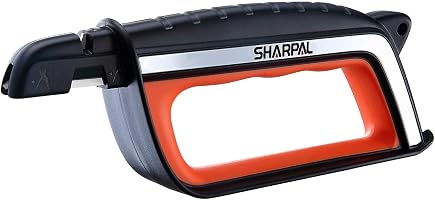
10. SHARPAL 103N All-in-1 — Most Versatile
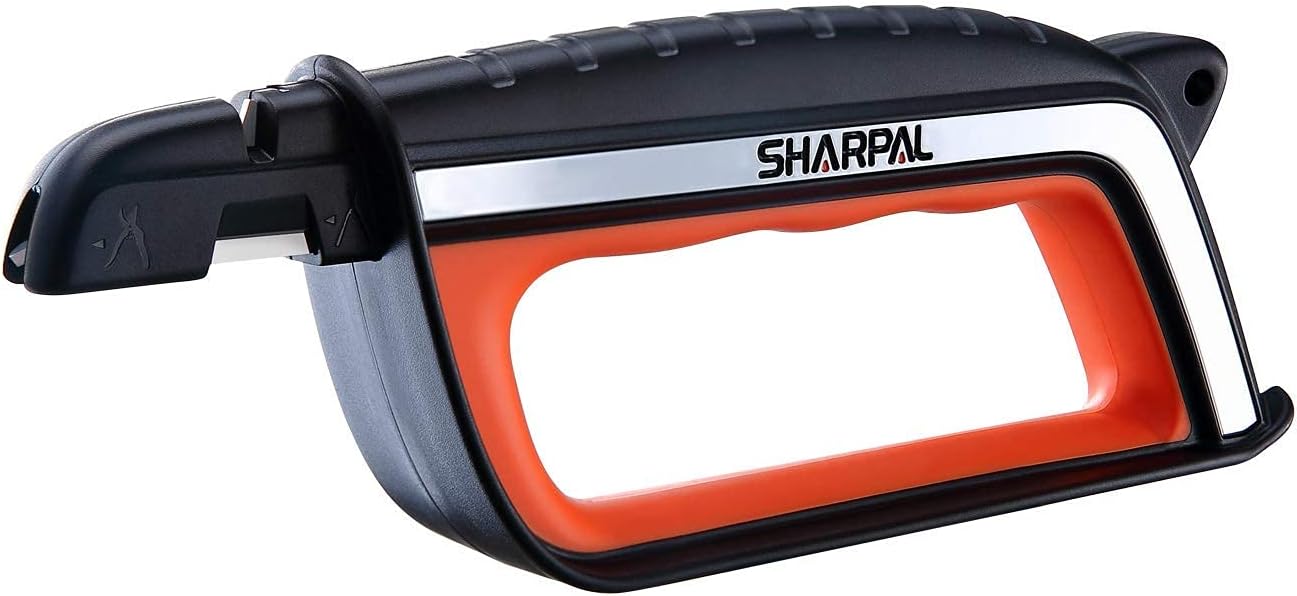
This is the outlier in the roundup and it earns its place by covering blades nothing else here will touch: axes, hatchets, machetes, lawn mower blades and single-bevelled garden tools, alongside kitchen knives.
It is #17 in Knife Sharpeners at $23.99.
Key Specifications
| Type | Multi-tool handheld sharpener |
|---|---|
| Angle control | Preset; handles single and double bevelled blades |
| Abrasives | Tungsten carbide and ceramic |
| Blades | Knives, axes, hatchets, machetes, mower blades, garden tools |
| Durability | Abrasives tested to 10,000 uses, per the manufacturer |
| Safety | Oversized handle and large hand guard, usable with gloves |
| Dimensions | 8.46″L x 2.95″W x 1.34″H |
| Weight | 176 g |
| Best For | A garage or shed rather than a kitchen drawer |
Why We Recommend It
Single versus double bevel is the capability that matters. Kitchen knives are ground on both sides; many garden tools, chisels and some Japanese knives are ground on one. A slot sharpener assumes two sides and will ruin a single-bevel edge. This handles both, which nothing else on this page claims.
The 10,000-use durability claim is unusually specific for this category, where most listings say "long lasting" and stop.
The oversized hand guard is there for a reason. Sharpening a machete or a mower blade is a different risk profile from a paring knife, and this is designed to be used wearing gloves.
As a pure kitchen sharpener it is beaten by cheaper, better-rated tools higher up this page. Buy it because you also have a shed.
Pros
- Handles axes, machetes, mower blades and garden tools
- Works on single and double bevelled edges, unique here
- Abrasives rated to 10,000 uses
- Large hand guard, usable with gloves
- Tungsten carbide and ceramic stages
- 176 g
Cons
- Not optimised for kitchen knives specifically
- $23.99 buys a better kitchen sharpener elsewhere here
- Angle not stated
- #17 in Knife Sharpeners
- Two stages only
Best for: Households where the same tool has to serve the kitchen and the shed.
Who Decides the Angle
Three of these ten let you choose. Seven have it moulded in and never print the figure.
| Sharpener | Angle control | What the listing states | Price |
|---|---|---|---|
| Chef’sChoice 15XV | You choose | Converts 20° edges to a 15° Trizor XV edge | $170.00 |
| Sharp Pebble Precision Adjust | You choose | Adjustable angle | $39.99 |
| AIERLIAN Rolling | Guided, multi-angle | Magnetic support holds a constant angle | $39.99 |
| KITCHELLENCE 4-in-1 | Preset | No angle stated | $17.99 |
| Amazon Basics 4-in-1 | Preset | No angle stated | $9.01 |
| AccuSharp | Preset | No angle stated | $11.99 |
| SHARPAL 191H | Preset | No angle stated | $15.29 |
| AnySharp GLOBAL | Preset | “No angles to guess” | $14.99 |
| Smith’s CCKS | Preset | “Preset sharpening angles” | $9.42 |
| SHARPAL 103N | Preset | Single and double bevel, no angle given | $23.99 |
The pattern is stark: the three products that give you control cost $39.99 or more, and the seven that do not cost $23.99 or less. Note also how the language shifts. AnySharp sells the absence of choice as a feature — “no angles to guess” — and for a nervous user that is honest and correct. Smith’s at least says the angles are preset. The rest simply do not raise the subject, which leaves buyers to assume there is nothing to raise. If every knife you own came from the same Western brand, there genuinely is not. If you own a santoku, there is.
Scraping, Grinding and Straightening Are Three Different Jobs
These tools remove very different amounts of steel, and the fastest ones remove the most.
| Method | Products here | What it does | Steel removed |
|---|---|---|---|
| Tungsten carbide scraper | AccuSharp, AnySharp, and stage 1 of most pull-throughs | Shaves a new edge in seconds | Most |
| Diamond abrasive | Chef’sChoice, AIERLIAN #400 disc, KITCHELLENCE stage 1 | Grinds a new edge quickly and evenly | Moderate |
| Ceramic | Finishing stage on most pull-throughs, AIERLIAN #3000 | Refines and polishes the edge | Little |
| Leather strop | AIERLIAN, Chef’sChoice stropping stage | Removes the burr sharpening leaves | Almost none |
| Honing rod | None in this roundup | Straightens a rolled edge; does not sharpen | None |
Two things follow from this table. First, carbide is fast because it is aggressive — it is cutting metal off your knife, not polishing it, so a knife sharpened weekly on carbide will visibly lose blade height over years. That is a fine trade on a $15 knife and a poor one on a $200 knife. Second, note the bottom row: honing rods are widely sold as sharpeners and are not. A rod pushes a rolled edge back into line, which restores cutting feel without removing metal, and it should be used between sharpenings rather than instead of them. Only two products here include a deburring step at all.
Best Alternatives
| Alternative | Why Consider It | Better For | Main Trade-Off |
|---|---|---|---|
| A whetstone | Total control of angle, removes the least metal, sharpens anything | Good knives, and anyone willing to learn | A real skill, and ten to twenty minutes per knife |
| A honing rod | Restores cutting feel in seconds without removing steel | Between sharpenings, weekly | It does not sharpen; a truly dull edge needs abrasive |
| A professional sharpening service | Correct angle, expert result, no equipment | Expensive or damaged knives | Cost per knife, and days without them |
| Replacing cheap knives | No maintenance at all | Very cheap blades that will not hold an edge | Wasteful, and it never gets you a good edge |
| A ceramic honing rod | Slight abrasion plus straightening, gentler than carbide | Light maintenance on Japanese knives | Slow, and it will not repair damage |
What Each Price Tier Actually Buys
$9.01 to $11.99 — Amazon Basics, Smith’s CCKS, AccuSharp. The value floor, and it is a strong one. The AccuSharp is the highest-rated sharpener in this roundup at 4.7 stars, and the Amazon Basics out-rates the category best seller at half its price. All three fix the angle and none states it.
$14.99 to $17.99 — AnySharp, SHARPAL 191H, KITCHELLENCE. Stability and stage count. Two of the three anchor themselves to the worktop with suction, and the KITCHELLENCE adds a properly described three-stage progression plus a scissor slot. This is where most buyers land.
$23.99 — SHARPAL 103N. Breadth rather than depth: axes, machetes, mower blades and single-bevel garden tools, none of which any other product here will touch.
$39.99 — Sharp Pebble Precision Adjust, AIERLIAN Rolling. The point at which you get to choose the angle. One does it with an adjustable guide you hold, the other with a magnetic block that holds the knife for you. The AIERLIAN also brings numbered grits and a leather strop.
$170.00 — Chef’sChoice 15XV. Diamond abrasives, spring guides, a stropping stage and a stated resulting angle. It is the only product here that treats the bevel as a decision, and it costs more than the other nine combined.
The pattern: the highest-rated sharpener here costs $11.99 and the second highest costs $9.01. Money buys angle control, deburring and gentler abrasion — none of which most buyers notice, which is exactly why the ratings do not follow the price.
How to Choose a Knife Sharpener
Find Out What Angle Your Knives Are Ground At
This costs nothing and decides everything. Western knives — German brands, most supermarket sets — are typically ground around 20 degrees per side. Japanese knives are usually nearer 15, which is why they cut so cleanly and chip more easily. If everything in your block is Western, any preset sharpener here is fine. If you own even one Japanese knife, understand that a 20-degree slot will grind its edge back to 20 degrees, permanently, and that no listing on this page will warn you.
Match the Aggression to the Knife
Tungsten carbide scrapers cut a new edge in ten seconds by shaving metal off. That is a superb trade on knives that cost less than the sharpener and a poor one on knives that cost more. Diamond and ceramic abrasives remove far less material for the same result, and cost more or take longer. Decide which of your knives you are sharpening most often, and buy for those rather than for the best one you own.
Insist on at Least Three Stages Indoors
Sharpening properly means coarse to repair, medium to sharpen, fine to refine. Single-stage tools cut an edge and stop, which leaves a rough finish that feels sharp immediately and dulls quickly. Three stages is the standard in this category and costs as little as $9.01, so there is no real reason to accept fewer unless you are buying something to live in a tackle box.
Check It Cannot Slide
Pull-through sharpening needs downward pressure while a blade moves through the slot, and a unit that skids is the main injury risk here. Look for a suction base or a wide non-slip foot — two sharpeners in this roundup use suction and one publishes a comparative grip figure. Two include cut-resistant gloves, which is a reasonable signal about where the manufacturer thinks your other hand will be.
Do Not Try to Sharpen Serrations in a Slot
A serrated bread knife has a row of individually ground scallops, and pulling it through a straight slot grinds the points flat while never touching the recesses. Serrations need a tapered rod worked into each scallop. One sharpener here includes a diamond rod stage for exactly this, and several others claim serrated capability with no rod in sight — treat those claims sceptically.
Buy a Honing Rod as Well, and Use It More Often
Most knives that feel dull are not; their edge has rolled slightly to one side. A honing rod pushes it back without removing steel, takes ten seconds and can be done weekly. Actual sharpening removes metal and should happen a few times a year. No product in this roundup is a honing rod, and none of them will tell you that using one would let you sharpen far less often — which is the cheapest way to make a good knife last.
Common Knife Sharpener Buying Mistakes
- Assuming the sharpener matches your knives’ angle. Nine of these ten never state theirs.
- Putting a Japanese knife through a Western preset slot. It regrinds the bevel, and that is permanent.
- Confusing a honing rod with a sharpener. A rod straightens an edge; it removes no metal and cannot repair a dull one.
- Using carbide weekly on expensive knives. It shaves real steel off every pass.
- Buying single-stage for kitchen use. Cutting an edge without refining it feels sharp briefly and dulls fast.
- Trying to sharpen serrations in a straight slot. It flattens the points and misses the scallops entirely.
- Ignoring the burr. Only two sharpeners here remove it, and it is why cheap results fade within days.
- Sharpening on a surface the base cannot grip. A sliding sharpener is the real hazard in this category.
Which Knife Sharpener Should You Buy?
Buy the Chef’sChoice 15XV if your knives are worth more than the sharpener. It is the only one here that states the angle it produces, uses 100 per cent diamond, and strops the burr off afterwards.
Buy the AccuSharp if you want the highest-rated tool on this page for $11.99, and your knives are everyday ones. Ten seconds, one carbide stage, 4.7 stars.
Buy the Amazon Basics 4-in-1 if you want the category best seller’s job for half its price. Three stages, a scissor slot, gloves, $9.01 and a better rating.
Buy the AIERLIAN Rolling if you want a consistent angle without learning to hold one. Magnetic guide, real grit numbers, and a leather strop in the box.
Buy the Sharp Pebble Precision Adjust if your block mixes Western and Japanese knives and one preset angle cannot serve both.
Buy the KITCHELLENCE if you want the mainstream pick with a properly described diamond, tungsten and ceramic progression.
Buy the SHARPAL 191H or the AnySharp if a sharpener sliding on the worktop is what puts you off doing it at all.
Buy the SHARPAL 103N if the same tool has to handle the kitchen and the shed, or the Smith’s CCKS if it lives in a pack.
Frequently Asked Questions
What angle should a kitchen knife be sharpened at?
It depends on the knife, which is why it matters that most sharpeners do not say. Western knives — German brands and most supermarket sets — are generally ground at around 20 degrees per side, giving a durable edge that tolerates hard boards and bones. Japanese knives are typically nearer 15 degrees, which cuts more cleanly and chips more readily. A narrower angle is sharper and more fragile; a wider one lasts longer and pushes rather than slices. The practical rule is to sharpen at whatever angle the knife was ground at, and the practical problem is that a preset slot will impose its own regardless.
Do pull-through knife sharpeners damage knives?
They change them, and whether that counts as damage depends on the knife. A pull-through has a fixed angle, so if it differs from your blade’s original grind, the first passes remove the existing bevel to establish a new one. On a $15 knife that is irrelevant. On an expensive Japanese blade it destroys the geometry you paid for. Separately, tungsten carbide stages are scrapers rather than abrasives — they shave metal off quickly, which is why they work in ten seconds and why a knife sharpened that way every week will noticeably lose blade height over the years.
What is the difference between honing and sharpening?
Sharpening removes metal to create a new edge. Honing removes nothing; it pushes an edge that has rolled slightly to one side back into alignment. Most knives that feel dull in normal kitchen use have simply rolled, which is why running them along a honing rod for ten seconds restores the cut so dramatically. The practical routine is to hone often — weekly, or before each big prep session — and sharpen only a few times a year. No product in this roundup is a honing rod, and buying one alongside your sharpener will let you use the sharpener far less.
Can you sharpen serrated knives?
Yes, but not in a slot. Serrations are a row of individually ground scallops, and pulling them through a straight sharpener grinds the raised points flat while never reaching the recesses between them — leaving a knife that looks serrated and cuts like a saw with the teeth filed off. Serrated edges need a tapered diamond or ceramic rod worked into each scallop in turn. One sharpener in this roundup includes a dedicated diamond rod stage for this, and the $170 electric machine handles serrations directly. Several other listings claim serrated capability without describing any mechanism for it.
Are electric knife sharpeners better than manual ones?
They are more consistent and more aggressive, which cuts both ways. An electric machine holds the angle with spring guides so every pass is identical, and the good ones add a stropping stage that manual pull-throughs almost never include. They also remove metal faster and are unforgiving if you use the wrong stage. The evidence on this page is that consistency is not what most buyers are rating: the highest-rated sharpener here is an $11.99 manual carbide scraper, and the $170 electric machine sits slightly below it. Buy electric for control over the edge, not for a higher chance of satisfaction.
How often should you sharpen kitchen knives?
A few times a year for most home cooks, with honing in between. The test is simpler than any schedule: try slicing a ripe tomato without pressing. A sharp edge bites the skin immediately; a dull one slides or squashes. If honing restores that bite, the edge had only rolled and does not need sharpening. If it does not, it is time to remove metal. Over-sharpening is a genuine waste — every pass takes steel off a knife you presumably intend to keep, and carbide scrapers take considerably more than abrasive stones do.
What is a burr, and does it matter?
When you grind one face of an edge, a thin ribbon of displaced steel folds over onto the other side. That is the burr, and its presence is actually how you know you have sharpened far enough. The problem is that it is fragile: left in place it makes the edge feel grabby, and it folds over or breaks off within the first few cuts, leaving a knife that seemed sharp on Monday and dull by Friday. Removing it — stropping, on leather or a fine ceramic — is the last step of sharpening. Only two products in this roundup include one, which is a large part of why cheap results do not last.
Is a rolling knife sharpener any good?
The format solves a real problem well. Holding a consistent angle freehand on a whetstone is the hardest part of sharpening and takes practice; a rolling sharpener puts the knife flat against a magnetic block that sets the angle, so the geometry is enforced by the tool rather than by your wrist. The one in this roundup also publishes actual grit numbers — a #400 diamond disc and a #3000 ceramic — where almost every rival says only “coarse” and “fine”. The trade-offs are bulk, price and a little practice to roll evenly along a long blade.
Final Verdict
The only sharpener here that states the angle it produces, with diamond abrasives and a stropping stage.
4.7 stars and $11.99 — ten seconds, one carbide stage, and no pretensions.
#1 in the category and #363 in all of Kitchen & Dining, with a proper three-stage progression.
The specification that matters in this category is the one nine of these ten listings omit. A knife edge has an angle; a sharpener has an angle; and when they differ, the sharpener wins and the change is permanent.
So the first question is not which sharpener is best but which knives you are sharpening. A block of Western knives at roughly 20 degrees can go through any preset slot on this page quite happily, and the two highest-rated products here cost $11.99 and $9.01. Nothing about spending more will make those knives sharper.
If you own Japanese knives, or a mix, the field narrows to three: an adjustable guide at $39.99, a magnetic rolling system at $39.99, or the $170 electric machine that will tell you exactly what angle it is putting on. And whatever you buy, buy a honing rod too — it costs a few dollars, takes ten seconds, and means reaching for the sharpener far less often.