Affiliate Disclosure: As an Amazon Associate, we earn from qualifying purchases. This does not affect the price you pay.
The hoods below claim between 230 and 1200 CFM from the same 30-inch slot under the same kitchen cabinet. That is a five-fold spread for an identical physical envelope, and the arithmetic explains why.
A 6-inch round duct has an area of about 0.196 square feet. Push 230 CFM through it and the air travels at roughly 1,170 feet per minute, which is ordinary residential design. Push 1200 CFM through the same duct and you need about 6,100 feet per minute — several times what domestic ducting is built for, before you add a single elbow or a wall cap.
These are free-air bench figures, measured with nothing attached. One maker labels its number “Max Blower CFM”, which is the honest form of words, and it happens to publish the lowest figure on the page. Another publishes no airflow figure at all and gives a lifetime warranty on its motors instead.
So compare the CFM claim against the duct outlet the hood actually ships with — 4.92 inches on one of these, 7 inches on another. The duct is the ceiling, and it does not move.
$69.29 to $499.99 below. Two of these publish a noise figure and eight do not.
Our Quick Picks
 Best OverallBroan-NuTone 30 Inch PrintGuard
Two hundred and thirty max blower CFM, made in the USA, with a fingerprint-resistant finish and a dishwasher-safe filter.
 Quietest HereFIREGAS 300 CFM Brushless DC
Three hundred CFM from a brushless DC motor running under 45 decibels at high speed, with a plug fitted and full dimensions published.
 Best BuiltHauslane UC-PS18 6-Speed
Six speeds, three venting configurations, dishwasher-safe baffle filters, a touch screen and a lifetime warranty on the motors.
At a Glance
Ten Hoods, and Whether the Duct Can Carry the Claim
Claimed airflow, the outlet it ships with, published noise, and filter type. Read the first two columns together or neither means anything.
| # | Model | Max CFM | Duct | Noise | Filters | Standout | Main Drawback | Check Price |
|---|---|---|---|---|---|---|---|---|
| 1 |
 Broan-NuTone 30 Inch PrintGuard Broan-NuTone 30 Inch PrintGuard |
230 max blower | Convertible | 2 speed | Aluminium, dishwasher | It calls its figure ‘max blower CFM’, which is the honest label | 230 CFM is the lowest number on this page | View on Amazon |
| 2 |
 FIREGAS 300 CFM Brushless DC FIREGAS 300 CFM Brushless DC |
300 CFM | Ducted | <45 dB high | 3-layer aluminium | A brushless DC motor, which is why it is quiet at full speed | 300 CFM will not cope with heavy wok cooking | View on Amazon |
| 3 |
 Hauslane UC-PS18 6-Speed Hauslane UC-PS18 6-Speed |
Not published | 3-way | Dual motor | Baffle, dishwasher | A lifetime motor warranty and three venting options | $499.99, and it publishes no CFM figure at all | View on Amazon |
| 4 |
 SNDOAS 230 CFM Ultra Slim SNDOAS 230 CFM Ultra Slim |
230 CFM | 6 in or rear | 2 speed | Mesh + carbon | Rank #27 — the best selling hood on this page | Hard-wired with no plug, so it needs electrical work | View on Amazon |
| 5 |
 Zomagas 280 CFM 7-Inch Vent Zomagas 280 CFM 7-Inch Vent |
280 CFM | 7 in top | 2 speed | 3-layer composite | A 7-inch top outlet, the largest duct on this page | No junction box supplied, and the listing warns you | View on Amazon |
| 6 |
 Zomagas 3-Speed Slimline Zomagas 3-Speed Slimline |
280 CFM | 4.92 in round | 3 speed | 2 detachable mesh | 3.94 inches tall — the slimmest body on this page | A 4.92-inch duct is small for 280 CFM | View on Amazon |
| 7 |
 SNDOAS 700 CFM 3-Way Venting SNDOAS 700 CFM 3-Way Venting |
700 CFM | 3 ways | 3 speed | Baffle, dishwasher | Dishwasher-safe baffle filters at a mid-range price | 700 CFM through a 6-inch duct implies high velocity | View on Amazon |
| 8 |
 VIKIO HOME 980 CFM Gesture VIKIO HOME 980 CFM Gesture |
980 CFM | Dual duct | 3 speed | Widened baffles | Gesture control, GU10 bulbs and a three-minute delay shut-off | 980 CFM is a bench figure no domestic duct will pass | View on Amazon |
| 9 |
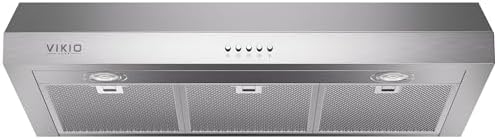 VIKIO HOME 1200 CFM Dual Motor VIKIO HOME 1200 CFM Dual Motor |
1200 CFM | Ducted | 35–60 dB | 5-layer aluminium | The only listing here that publishes a noise range as well as airflow | 1200 CFM in an under-cabinet hood is a bench figure | View on Amazon |
| 10 |
 AURAKICH 620 CFM Insert AURAKICH 620 CFM Insert |
620 CFM | Convertible | ≤65 dB | Charcoal included | A built-in insert, not an under-cabinet hood | It is designed to be enclosed in a custom cabinet | View on Amazon |
Airflow figures, duct sizes, prices and specifications are taken from each manufacturer’s Amazon listing as displayed on 26 August 2026 through a United States connection, and may change. CFM ratings in this category are free-air bench figures, measured with no ducting attached; one listing labels its number “Max Blower CFM” and one publishes no figure at all. The duct velocities quoted in this article are our own arithmetic from published outlet diameters and claimed airflow, offered to show the scale of the gap rather than as a measurement of any product. Installed airflow will be lower than any figure here, and falls further with each elbow, length of flexible duct and wall cap. Only two listings publish a noise level. Note that one product in this roundup is a built-in insert rather than an under-cabinet hood and cannot be fitted the same way; its entry says so. Very high extraction rates can raise makeup-air requirements in tightly sealed homes and rules vary by jurisdiction — check locally before specifying a large hood. Sales ranks are shown as displayed and can be pooled across a variant family.
Scroll the table sideways to see every column
How We Chose These Ten
We researched current listings, compared manufacturer specifications and documentation, and examined recurring patterns in customer feedback. We did not carry out hands-on testing, and nothing below is presented as measured performance data.
- Claimed airflow set against the supplied duct outlet — the duct is the physical ceiling and the CFM figure is a bench number
- Noise levels reported where published — only two listings give one, and airflow and noise trade directly
- Body height recorded where published — it decides whether the hood fits the gap above your hob
- A verified live buy box — all ten confirmed purchasable in the United States on 26 August 2026
- Filter type distinguished — mesh mats clog progressively; baffles drain and go in a dishwasher
- Installation requirements noted — hard-wired or plugged, junction box supplied or not
- No overlap with our published range hood guides — every hood here is new to the site
The Ten in Detail
1. Broan-NuTone 30 Inch PrintGuard — Best Overall

Two hundred and thirty is the smallest airflow figure on this page and it is the one we would trust most, because of three words.
Key Specifications
| Airflow | 230 Max Blower CFM |
|---|---|
| Speeds | 2 |
| Venting | Convertible ducted or ductless |
| Filter | Aluminium, removable and dishwasher safe |
| Finish | PrintGuard fingerprint-resistant stainless |
| Origin | Made in the USA |
| Dimensions | 17.5 in L x 30 in W x 6 in H |
| Parts | Replaceable |
| Rank | #138 in its category |
| Price | $119.00 |
| Best For | Getting a number you can actually plan a duct run around |
Why We Recommend It
“Max Blower CFM” is a careful label. It says the blower, on its own, at its highest speed, moves 230 cubic feet a minute — which is a bench figure measured with nothing attached. Every hood here is rated that way, and most simply print a big number without qualifying it. Once you connect six inches of ducting, add two elbows and a wall cap, the delivered airflow is meaningfully lower than the bench figure. A maker who tells you which number you are looking at is a maker doing you a favour.
230 CFM is also a realistic figure for a 30-inch under-cabinet hood vented through a six-inch duct. See the arithmetic in the guide below.
A dishwasher-safe aluminium filter with replaceable parts is the practical difference between a hood that stays effective and one that quietly clogs with grease.
Made in the USA with published dimensions, at $119.00 and rank #138.
Pros
- Labels its figure ‘max blower CFM’ honestly
- Dishwasher-safe removable filter
- PrintGuard resists fingerprints on stainless
- Made in the USA with replaceable parts
- Full dimensions published
- Established brand at $119.00
Cons
- 230 CFM is the lowest figure here
- Only 2 speeds
- No noise level published
- No warranty term stated
- 6 inches tall — not the slimmest here
- Rank #138
Best for: A conservative, honest hood for ordinary domestic cooking.
2. FIREGAS 300 CFM Brushless DC — Quietest Here

A brushless DC motor in a range hood is unusual, and it is the reason this one is quiet at a speed you will actually use.
Key Specifications
| Airflow | 300 CFM |
|---|---|
| Motor | Brushless DC |
| Noise | Under 45 dB at high speed |
| Speeds | 3 |
| Filters | 3-layer aluminium, easy to clean |
| Lighting | 1.5W LED |
| Dimensions | 29.5 in x 18.90 in x 5.31 in |
| Power | Comes with a plug |
| Warranty | 1 year limited |
| Rank | #223 in its category |
| Price | $110.99 |
| Best For | Kitchens where the hood being audible is why it never gets switched on |
Why We Recommend It
Most hoods use AC induction motors, which are cheap, robust and noisy. A brushless DC motor is electronically commutated, runs at lower slip, generates less vibration and can be speed-controlled smoothly rather than by switching windings — so it produces less mechanical and electrical noise for the same airflow. Under 45 decibels at high speed is roughly the level of a quiet library, and it matters because the near-universal complaint about range hoods is that people cook without them on.
A fitted plug rather than hard wiring is the other quiet advantage here. Two hoods on this page are hard-wired without a plug and one warns you to buy a junction box separately — which turns a bracket-and-screws job into electrical work.
300 CFM is modest and appropriate: enough for everyday frying and boiling, not for sustained high-heat wok cooking.
Full dimensions and a one-year warranty at $110.99, rank #223.
Pros
- Brushless DC motor, under 45 dB at high
- Comes with a plug — no electrical work
- 3 speeds rather than 2
- 3-layer aluminium filters
- Full dimensions published
- 1-year limited warranty
Cons
- 300 CFM is modest for heavy cooking
- Ducted only
- 1.5W LED is dim compared with rivals
- No CFM-versus-noise curve published
- Rank #223
- Black finish shows grease more than steel
Best for: Anyone who does not use their existing hood because of the noise.

3. Hauslane UC-PS18 6-Speed — Best Built

Three venting options in one box is the feature that saves a renovation, and it is worth more than any CFM figure.
Key Specifications
| Speeds | 6 — most here |
|---|---|
| Airflow | Not published |
| Motor | Dual motor with noise-reduced duct design |
| Venting | 3 ways — 6 in round, 3.25 x 10 in rectangular, or ductless |
| Filters | Stainless baffle, dishwasher safe |
| Controls | Touch screen, buttonless, with delay shut-off |
| Lighting | 3000K, swappable |
| Dimensions | 29.75 in W x 22 in D x 8.125 in H |
| Included | Foil tape, cloth, oil tray, 2 baffle filters, both duct adapters |
| Warranty | 2 years limited, lifetime on motors |
| Rank | #180 in its category |
| Price | $499.99 — dearest here |
| Best For | A hood specified around your existing ductwork rather than against it |
Why We Recommend It
The single most expensive discovery in fitting a range hood is that your ductwork does not match the hood. Existing runs are commonly either 6-inch round or 3.25 by 10 inch rectangular, and a hood that offers only one of them means either new ducting through a wall or a cabinet, or an adapter that throttles the airflow. Supplying both adapters and a ductless option means the hood adapts to the house instead of the house adapting to the hood.
Baffle filters are the commercial standard and they are better than mesh: grease condenses on the angled steel and drains into a tray rather than accumulating in a mat you eventually replace. Both go in the dishwasher, and an oil tray is included.
A lifetime motor warranty is the strongest commitment on this page, from a maker that publishes no airflow number at all — an inversion worth noticing.
Six speeds and delay shut-off, which keeps the fan running three minutes after you finish to clear residual smoke.
Pros
- Lifetime motor warranty plus 2 years on the rest
- Three venting options with both adapters supplied
- Dishwasher-safe stainless baffle filters and an oil tray
- 6 speeds with touch control and delay shut-off
- Swappable 3000K lighting
- Full dimensions published
Cons
- Publishes no CFM figure at all
- $499.99 — more than four times some rivals
- 22 inches deep, the deepest here
- 8.125 inches tall reduces cabinet clearance
- Touch screen is a failure point
- Rank #180
Best for: A permanent installation where the ductwork already exists and must be matched.
4. SNDOAS 230 CFM Ultra Slim — Most Popular

Four point seven inches of height is why this outsells everything else here, and it is a constraint most people discover too late.
Key Specifications
| Airflow | MAX 230 CFM |
|---|---|
| Height | 4.7 inches — second slimmest here |
| Dimensions | 29.9 in W x 17.5 in L x 4.7 in H |
| Speeds | 2 |
| Venting | Vertical top or horizontal rear |
| Filter | Aluminium mesh with carbon cotton composite |
| Lighting | Energy-saving LED |
| Power | Hard-wired, no plug |
| Warranty | 1 year limited |
| Rank | #27 — highest on this page |
| Price | $75.44 |
| Best For | Tight cabinet clearances, at the price most people actually pay |
Why We Recommend It
The gap between a cooktop and the cabinet above it is fixed, and codes and manufacturers generally want 24 to 30 inches of clearance above the hob. A hood eats into that from the top: an eight-inch-tall body in a 30-inch gap leaves 22 inches, which may be below what your cooktop’s own instructions require. A 4.7-inch body leaves far more room, which is the difference between a hood that fits your kitchen and one that does not. Measure the gap before comparing anything else.
Rear venting is the other space feature, letting the duct exit horizontally through the wall behind rather than upward through the cabinet.
Hard-wired without a plug means this is an electrical job rather than a bracket job, and the listing says so plainly.
230 CFM matched to a modest slim body is a coherent design, and $75.44 with rank #27 explains itself.
Pros
- Rank #27, best selling hood on this page
- 4.7 inches tall leaves cabinet clearance
- Top or rear venting
- Mesh plus carbon composite filter for ductless use
- Full dimensions published
- $75.44
Cons
- Hard-wired with no plug
- Only 2 speeds
- 230 CFM is the joint-lowest here
- Exhaust pipe not included
- No noise figure published
- Carbon filter needs periodic replacement
Best for: Kitchens where the cabinet gap, not the airflow, is the binding constraint.
5. Zomagas 280 CFM 7-Inch Vent — Best Duct Size

A seven-inch outlet is the largest on this page, and duct diameter is the specification that actually caps airflow.
Key Specifications
| Airflow | 280 CFM maximum |
|---|---|
| Duct | 7 inch top plus rectangular rear |
| Speeds | 2, rocker button |
| Filter | 3-layer aluminium mesh with activated carbon composite |
| Lighting | 2W LED |
| Venting | Ducted or ductless |
| Installation note | No junction box supplied — maker recommends buying one |
| Filter life | Maker suggests periodic replacement |
| Rank | #56 in its category |
| Price | $69.29 |
| Best For | Matching a larger existing duct without an adapter |
Why We Recommend It
Air moving through a duct has a velocity, and velocity has practical limits. A six-inch round duct has an area of about 0.196 square feet, so 230 CFM through it travels at roughly 1,170 feet per minute — comfortably within normal residential design. A seven-inch duct has about a third more area, so the same airflow moves more slowly, which means less resistance, less noise and less pressure loss around every bend. Going up a duct size is one of the few genuinely free improvements in ventilation.
The junction box warning is unusually candid. The listing tells you the package does not include one and recommends buying it separately to enclose the wiring, which is the sort of thing most makers leave you to discover on a ladder.
Three-layer filtration with activated carbon is aimed at ductless use, where odours have to be adsorbed rather than expelled.
$69.29 at rank #56 makes this the cheapest hood on the page.
Pros
- 7-inch top outlet — largest duct here
- Cheapest hood on this page at $69.29
- 3-layer mesh and carbon composite filter
- Ducted or ductless with a rear option
- Candid that no junction box is included
- Rank #56
Cons
- No junction box supplied
- Only 2 speeds
- No noise figure published
- No dimensions in the listing bullets
- Carbon layer needs replacing periodically
- No warranty term stated
Best for: Replacing a hood on an existing larger duct run, cheaply.
6. Zomagas 3-Speed Slimline — Slimmest Here

Under four inches tall is the thinnest hood body here, and the duct outlet is the price you pay for it.
Key Specifications
| Airflow | 280 CFM maximum |
|---|---|
| Height | 3.94 inches — slimmest here |
| Dimensions | 29.33 in x 19.49 in x 3.94 in |
| Speeds | 3, push button |
| Duct | 4.92 inch round top, plus rectangular top and rear |
| Filters | 2 detachable aluminium mesh |
| Lighting | 2W LED, high lumen |
| Venting | Ducted or ductless |
| Rank | #239 in its category |
| Price | $105.94 |
| Best For | The tightest cabinet gaps, where every half inch counts |
Why We Recommend It
A 4.92-inch round outlet has an area of about 0.132 square feet. Pushing the claimed 280 CFM through it implies roughly 2,120 feet per minute, which is at the top of what residential ducting is normally designed for — and every elbow, every foot of flexible duct and the wall cap itself add resistance that reduces the delivered figure further. It will move air; it will simply not move the bench number once installed, and it will be noisier doing it than a wider duct would be.
That is the trade a very slim hood makes, and it is a reasonable one if your cabinet gap is the binding constraint. Three inches of extra clearance above a hob is worth having.
Three speeds rather than two is a genuine improvement over the cheaper Zomagas, and two detachable mesh filters rather than a composite mat.
Full dimensions published, which on this page only half the listings manage.
Pros
- 3.94 inches tall — slimmest here
- 3 push-button speeds
- Two detachable aluminium mesh filters
- Round, rectangular and rear outlets all provided
- Full dimensions published
- 2W high-lumen LED
Cons
- 4.92 inch duct is narrow for 280 CFM
- Implied duct velocity is at the top of normal design
- No noise figure published
- No warranty term stated
- Rank #239
- No carbon filter included for ductless use
Best for: Kitchens where the cabinet gap is genuinely tight and airflow is secondary.
7. SNDOAS 700 CFM 3-Way Venting — Best Filters

Baffle filters at $169.44 is the value story here, and they are meaningfully better than the mesh mats on the cheaper hoods.
Key Specifications
| Airflow | 700 CFM |
|---|---|
| Speeds | 3 — high, mid, low |
| Venting | 3 ways — 6 in top round, 10 x 3.25 in top rectangular, 10 x 3.25 in rear |
| Filters | 2 detachable dishwasher-safe baffle |
| Lighting | Two 2W LED |
| Ductless | Requires carbon filter part #CF-0475, not included |
| Finish | Brushed stainless with protective film |
| Controls | Push button |
| Rank | #465 in its category |
| Price | $169.44 |
| Best For | Baffle filtration and duct flexibility without the flagship price |
Why We Recommend It
A mesh filter is a mat of aluminium wool that traps grease in its fibres. It works, and it loads up: as grease accumulates, airflow drops and the hood becomes progressively less effective while sounding exactly the same. A baffle filter is a set of angled steel plates that force the air to change direction sharply; grease cannot follow the turn, condenses on the plates and drains away. They do not clog in the same way, they go in the dishwasher, and they are what commercial kitchens use.
Three venting outlets put this alongside the $499.99 Hauslane for duct flexibility, at a third of the price.
Treat the 700 CFM figure with the usual caution. Through the supplied six-inch round outlet that implies about 3,600 feet per minute, well above typical residential design — so the installed figure will be lower, and the noise higher, than the bench number suggests.
The carbon filter for ductless use is a separate purchase, and the listing names the part number, which is helpful.
Pros
- Dishwasher-safe baffle filters at a mid price
- Three venting outlets for duct flexibility
- 3 speeds and two 2W LEDs
- Names the carbon filter part number
- Brushed stainless with protective film
- $169.44
Cons
- 700 CFM implies high velocity through a 6-inch duct
- Carbon filter not included for ductless use
- No noise figure published
- No dimensions in the listing bullets
- No warranty term stated
- Rank #465
Best for: Duct flexibility and commercial-style filtration at a domestic price.
8. VIKIO HOME 980 CFM Gesture — Most Features

Standard GU10 bulbs is the most quietly useful specification on this page.
Key Specifications
| Airflow | 980 CFM claimed |
|---|---|
| Motor | High-efficiency DC with independent volute |
| Controls | Gesture and touch, 3 speed levels |
| Lighting | Standard GU10 bulbs — user replaceable |
| Delay | 3-minute run-on after switch-off |
| Filters | Widened stainless baffles, fingerprint resistant |
| Ducting | Dual-duct compatible; round and rectangular adapters included |
| Included | Both adapters, 2 baffles, positioning template |
| Rank | #242 in its category |
| Price | $291.61 |
| Best For | Never having to hunt for a proprietary light bulb |
Why We Recommend It
Range hood lights fail, and on most hoods they are proprietary. An integrated LED strip or a bespoke module means either a parts order from the manufacturer years after purchase, or a hood with a dead light for the rest of its life — and a hood light is what you actually use every evening. GU10 is a standard fitting sold in every hardware shop and supermarket, in any colour temperature you like, for a couple of dollars. It converts a permanent fault into a two-minute errand.
The three-minute delay shut-off is the other genuinely good feature. Smoke and steam linger after the pan comes off, and a hood switched off with the hob is switched off too early.
The 980 CFM claim needs the same scepticism as every other big number here. That is a free-air bench figure; through a six-inch duct it would imply around 5,000 feet per minute, which no domestic installation is designed for.
Gesture control is a real convenience with greasy hands, and one more thing to fail.
Pros
- Standard GU10 bulbs, replaceable anywhere
- 3-minute delay shut-off clears residual smoke
- Gesture control works with greasy hands
- Widened stainless baffle filters
- Both duct adapters and a positioning template included
- DC motor with independent volute
Cons
- 980 CFM is a free-air figure, not an installed one
- $291.61
- Gesture sensing is another failure point
- No noise figure published
- No dimensions in the listing bullets
- Rank #242
Best for: Long-term ownership, where replaceable bulbs beat a headline airflow number.
9. VIKIO HOME 1200 CFM Dual Motor — Highest Claim
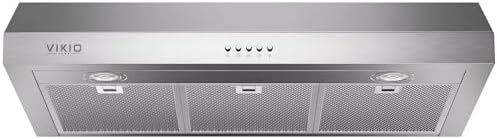
This listing does something unusual and something questionable, and they are worth separating.
Key Specifications
| Airflow | 1200 CFM claimed — highest here |
|---|---|
| Motor | Dual motor |
| Noise | 35 dB low to 60 dB maximum |
| Controls | Mechanical, oil and scratch resistant |
| Lighting | 4000K LED |
| Filters | Reusable 5-layer aluminium |
| Included | All installation hardware and instructions |
| Service | Free replacement accessories |
| Rank | #202 in its category |
| Price | $249.99 |
| Best For | Publishing a noise figure, which almost nobody else does |
Why We Recommend It
The unusual thing is publishing a noise range at all. 35 dB at low and 60 dB at maximum tells you something no other big-CFM hood here will — that using it at full power is genuinely loud, roughly the level of normal conversation, which is why people run hoods on low and wonder why the kitchen still smells. Only two listings on this page publish any noise figure.
The questionable thing is 1200 CFM in an under-cabinet body. Through a six-inch round duct, 1200 CFM implies about 6,100 feet per minute — several times normal residential duct velocity. Free-air bench figures are how this whole category is rated, and this is the largest one here by a factor of five over the most conservative. Treat it as a comparison between blowers rather than a promise about your kitchen.
Very high extraction also raises a question about replacement air in a tightly sealed house, and in some jurisdictions makeup-air provisions apply above certain airflows. Worth checking locally before specifying a large hood.
Mechanical controls rather than touch is a sensible durability choice in a greasy environment.
Pros
- Publishes a 35–60 dB noise range
- Dual-motor system with reusable 5-layer filters
- Mechanical controls resist oil and scratches
- 4000K LED lighting
- All installation hardware included
- Free replacement accessories
Cons
- 1200 CFM implies impossible duct velocity
- 60 dB at maximum is genuinely loud
- May raise makeup-air questions in a sealed house
- No dimensions in the listing bullets
- Ducted only
- $249.99
Best for: Buyers who want maximum extraction and understand what the number means.
10. AURAKICH 620 CFM Insert — Different Format

This is not the same product as the other nine, and the difference determines whether you can install it at all.
Key Specifications
| Format | Built-in insert, not a standard under-cabinet hood |
|---|---|
| Airflow | 620 CFM |
| Venting | Convertible ducted or ductless |
| Included | Charcoal filters and duct pipe |
| Speeds | 3, factory tested |
| Noise | ≤65 dB |
| Lighting | 5500K dual front-mounted LEDs |
| Installation | Positioning template and easy-tear protective film |
| Warranty | 2 years covering motor, lighting and controls |
| Rank | #300 in its category |
| Price | $129.99 |
| Best For | A custom cabinet or chimney surround built around the hood |
Why We Recommend It
An insert is the working parts of a hood without the finished body. It is designed to be built into a cabinet, a chimney breast or a custom surround, so the visible object in the kitchen is your joinery and the hood itself is hidden inside it. That is how you achieve a fully integrated look, and it requires the surround to exist — either already built to the right internal dimensions or made as part of the job. Screwing it under a standard wall cabinet, which is what the other nine hoods here are for, is not what it is designed to do.
Front-mounted LEDs are a genuine improvement over rear-mounted ones: light falls directly onto the pan rather than reflecting off the back wall, so you can see the colour of what you are cooking.
Charcoal filters and duct pipe included is unusual — most hoods here make you buy one or the other separately.
A two-year warranty naming motor, lighting and controls is more specific than most on this page.
Pros
- Charcoal filters and duct pipe both included
- Front-mounted 5500K LEDs light the pan directly
- 2-year warranty naming motor, lighting and controls
- Publishes a noise ceiling of 65 dB
- Positioning template supplied
- 620 CFM with convertible venting
Cons
- An insert, not an under-cabinet hood
- Requires a cabinet or surround to build into
- 65 dB ceiling is the loudest published here
- No dimensions in the listing bullets
- Not a like-for-like replacement for a wall hood
- Rank #300
Best for: Custom cabinetry built around the hood, rather than a hood fitted under a cabinet.
The Claim Against the Duct
Our arithmetic from each listing’s published outlet and claimed airflow. Typical residential duct design runs well under 2,000 fpm.
| Hood | Claimed CFM | Outlet | Implied Velocity |
|---|---|---|---|
| Broan-NuTone | 230 max blower | 6 in | ~1,170 fpm |
| SNDOAS Slim | 230 | 6 in | ~1,170 fpm |
| Zomagas 7" | 280 | 7 in | ~1,050 fpm |
| FIREGAS | 300 | 6 in | ~1,530 fpm |
| Zomagas Slimline | 280 | 4.92 in | ~2,120 fpm |
| AURAKICH Insert | 620 | 6 in | ~3,160 fpm |
| SNDOAS 700 | 700 | 6 in | ~3,570 fpm |
| VIKIO 980 | 980 | 6 in | ~4,990 fpm |
| VIKIO 1200 | 1200 | 6 in | ~6,110 fpm |
| Hauslane | Not published | 6 in or 3.25×10 | — |
The top four rows describe airflow a domestic duct can actually carry. Below that the implied velocities climb past anything residential ducting is designed for, which means the installed performance will be a fraction of the bench figure — and considerably noisier than the quiet end of the range, because noise rises steeply with velocity. None of this makes the large-CFM hoods bad products; their blowers really are more powerful. It means the number on the box is a comparison between blowers on a test bench, not a promise about your kitchen.

What Actually Decides Whether the Hood Works
Four things matter more than the airflow figure, and three of them are about your kitchen rather than the hood.
| Factor | Why it decides the outcome | Best here |
|---|---|---|
| Body height | Eats the gap between hob and cabinet | 3.94 in |
| Duct match | Wrong outlet means adapters and lost airflow | 3-way venting |
| Noise | A loud hood gets run on low, or not at all | Under 45 dB |
| Filter type | Mesh clogs silently and airflow falls | Baffle, dishwasher |
| Airflow claim | Free-air bench figure | Read with the duct |
The most common reason a range hood fails to clear a kitchen is not that it was underpowered. It is that it was never switched on, or was run on speed one, because it was too loud — or that its mesh filter loaded up with grease over two years and airflow halved without anything sounding different. A quiet 300 CFM hood with dishwasher-safe baffles, running on high every time you cook, will outperform a 1200 CFM hood you use on low. Buy the one you will actually run.
Best Alternatives
| Alternative | Why Consider It | Better For | Main Trade-Off |
|---|---|---|---|
| A chimney or wall-mount hood | Larger capture area, genuinely higher airflow | Kitchens with no cabinet above the hob | Requires wall space and looks dominant |
| An island or ceiling extractor | Handles a hob with no wall behind it | Island cooktops | Long duct runs and expensive installation |
| A downdraft extractor | Disappears when not in use | Minimalist kitchens and views | Fights physics — smoke rises |
| Opening a window | Free, and better than a hood you never switch on | Light cooking in mild weather | Useless in winter, and no grease capture |
What the Money Actually Buys
$69.29 to $110.99 — Zomagas x2, SNDOAS Slim, FIREGAS. The sensible band. Modest, believable airflow figures matched to real duct sizes, the slimmest bodies here, and the quietest hood on the page at under 45 dB. Three of these four publish full dimensions.
$119.00 to $169.44 — Broan-NuTone, AURAKICH, SNDOAS 700. Where credibility lives. A US-made hood that labels its figure honestly, dishwasher-safe baffle filters, and three-way venting. The insert in this band is a different format and needs a cabinet built around it.
$249.99 to $291.61 — the two VIKIO hoods. Big claimed numbers, and genuinely useful features underneath them: a published noise range, gesture control, delay shut-off and standard GU10 bulbs you can replace anywhere.
$499.99 — Hauslane. Six speeds, three venting options with both adapters supplied, baffle filters, an oil tray and a lifetime motor warranty — from the one maker that declines to print a CFM figure at all.
What to Check Before You Buy
Read the CFM Claim Against the Duct It Ships With
Airflow figures in this category are free-air bench numbers, measured with the blower running into open air. Once you attach ducting they fall, and how far they fall depends on the duct. The arithmetic is simple: a 6-inch round duct has an area of roughly 0.196 square feet, so 230 CFM travels through it at about 1,170 feet per minute while 1200 CFM would need about 6,100 — several times what residential ducting is designed for. Every elbow, every foot of flexible duct and the wall cap add resistance on top. One maker on this page labels its figure “Max Blower CFM”, which is the honest phrasing, and it publishes the lowest number here.
Measure the Gap Above Your Hob First
This is the constraint that most often decides the purchase and it has nothing to do with airflow. Cooktop manufacturers and building codes generally want 24 to 30 inches of clearance between the hob surface and the hood, and the hood’s own body height eats into whatever gap you have. Bodies in this roundup range from 3.94 inches to 8.125 — a difference of more than four inches, which is the difference between fitting and not fitting. Measure from the cooktop to the underside of the cabinet, subtract the hood height, and check the result against your cooktop’s own installation instructions before comparing anything else.
Match the Outlet to the Ductwork You Already Have
The most expensive surprise in replacing a range hood is discovering that your duct and the new hood do not agree. Existing runs are commonly 6-inch round or 3.25 by 10 inch rectangular, and hoods here ship with outlets of 4.92, 6 and 7 inches plus various rectangular options. A mismatch means either new ductwork through a wall or cabinet, or an adapter that constricts the airflow you paid for. Two hoods in this roundup offer three venting configurations and supply both adapters in the box, which lets the hood adapt to the house rather than the reverse — and one of them costs a third of the other.
Treat Noise as a Performance Specification
Only two listings in this roundup publish a decibel figure, and it is arguably more predictive of real-world results than airflow. The commonest reason a kitchen still smells of frying is not an underpowered hood; it is a hood run on speed one, or not switched on at all, because it is too loud to talk over. One hood here uses a brushless DC motor and publishes under 45 dB at high speed — roughly library quiet — while another honestly publishes 60 dB at maximum, which is conversation level. A quiet 300 CFM hood run on high every time beats a 1200 CFM hood run on low.
Prefer Baffle Filters to Mesh
Mesh filters are mats of aluminium wool that catch grease in their fibres. They work when new and they load progressively: as grease accumulates, airflow drops steadily while the hood sounds exactly the same, so performance degrades invisibly over a year or two. Baffle filters are angled steel plates that force the air to change direction sharply — grease cannot follow the turn, condenses on the plates and drains into a tray. They resist clogging, go in the dishwasher, and are what commercial kitchens use. Four hoods in this roundup have baffles and the rest use mesh, sometimes with a carbon layer for ductless operation.
Check Whether It Arrives With a Plug
Two hoods in this roundup are hard-wired with no plug fitted, one arrives with a plug, and one warns explicitly that no junction box is included and recommends buying one separately. This changes the job. A plug-in hood is a bracket, some screws and a socket. A hard-wired hood is electrical work, which in many places means a qualified electrician and possibly an inspection — a cost that can rival the hood itself and is never in the product price. Read the power line in the specification before you compare prices, and factor the installation in.
Ask Where the Replacement Air Comes From
A hood extracting several hundred cubic feet a minute is removing air from a sealed box, and that air has to be replaced from somewhere. In a draughty older house it seeps in around windows and doors without anyone noticing. In a tightly sealed modern one it can be drawn down flues and vents instead, and at high extraction rates some jurisdictions require dedicated makeup-air provision. Rules vary and we are not going to guess yours. If you are considering one of the very high-airflow hoods here rather than a 230 to 300 CFM unit, it is worth asking your local building authority before ordering.

Common Mistakes
- Comparing CFM figures without looking at the duct. A 4.92-inch outlet caps everything.
- Buying before measuring the gap above the hob. Body heights here vary by four inches.
- Assuming your existing ductwork will match. Round and rectangular are both common.
- Ignoring noise. A hood too loud to talk over gets run on low, or not at all.
- Letting mesh filters load up. Airflow halves and nothing sounds any different.
- Not checking whether it needs hard wiring. That is an electrician, not a screwdriver.
- Buying an insert expecting an under-cabinet hood. One here needs a cabinet built round it.
Who Should Buy Which
Buy the Broan-NuTone at $119.00 if you want an honest number. 230 max blower CFM, labelled as such, made in the USA, with a dishwasher-safe filter and replaceable parts.
Buy the FIREGAS at $110.99 if noise is why you never use your hood. A brushless DC motor under 45 dB at high speed, three speeds, and a plug already fitted.
Buy the Hauslane at $499.99 for a permanent installation. Three venting options with both adapters, baffle filters, an oil tray and a lifetime motor warranty.
Buy the SNDOAS Slim at $75.44 if the cabinet gap is tight. 4.7 inches tall, top or rear venting, and rank #27 on the whole category.
Buy the SNDOAS 700 at $169.44 for filters and duct flexibility. Dishwasher-safe baffles and three venting outlets at a third of the flagship price.
Frequently Asked Questions
How many CFM do I need in a 30 inch under cabinet range hood?
For most domestic cooking, considerably less than the biggest numbers in this roundup suggest — and the honest answer depends on your ductwork rather than your cooking. A common rule of thumb is around 100 CFM per linear foot of cooktop, which puts a 30-inch hob at roughly 250 CFM, and heavier cooking with a gas range or a wok higher. What matters just as much is what your duct can carry: a 6-inch round duct passing 230 CFM runs at a reasonable velocity, while 1200 CFM through the same duct would need several times normal residential design speed. Match the hood to the duct, not to the largest number available.
Is the CFM rating on a range hood accurate?
It is accurate as a bench measurement and misleading as a promise. These figures are free-air ratings — the blower running with nothing attached — which is why one maker in this roundup carefully labels its number “Max Blower CFM”. Once you connect ducting, the delivered airflow drops, and it drops further with every elbow, every foot of flexible duct and the wall cap at the end. Flexible ducting is markedly worse than rigid. The figures remain useful for comparing one blower against another, which is what they are for; they simply do not describe what will move through your kitchen once installed. Read them alongside the duct outlet the hood ships with.
What size duct does a 30 inch range hood need?
Six-inch round is the most common size and the one most hoods in this roundup are built around, with 3.25 by 10 inch rectangular the usual alternative in existing houses. One hood here offers a 7-inch outlet, which is genuinely better — a third more area means the same airflow travels more slowly, with less resistance, less pressure loss at every bend and less noise. One offers only 4.92 inches, which is a real constraint on its claimed airflow. Whatever you buy, use rigid duct rather than flexible where you can, keep the run short, minimise elbows, and never reduce the diameter partway along.
Are baffle filters better than mesh filters?
Yes, for the reason that mesh filters fail invisibly. A mesh filter is a mat of aluminium wool that traps grease in its fibres, and as it loads up airflow falls steadily while the hood sounds exactly the same — so performance degrades over a year or two without anything appearing wrong. Baffle filters are angled steel plates that force air to change direction sharply; grease cannot follow the turn, condenses on the plates and drains into a tray. They resist clogging, wash properly in a dishwasher and last indefinitely rather than needing replacement. Four hoods in this roundup use baffles. Mesh filters with a carbon layer are still needed for ductless operation.
Ducted or ductless — which should I choose?
Ducted, whenever it is physically possible. A ducted hood removes heat, steam, grease and odour from the house entirely. A ductless one passes air through a charcoal filter and returns it to the same room, which adsorbs some odour and removes some grease but leaves the heat and the moisture exactly where they were — and the charcoal filters need replacing periodically at a running cost. Most hoods in this roundup are convertible, meaning they can do either, though several require a carbon filter that is not included in the box. If you have an exterior wall or an existing duct run, use it.
Why is my range hood so loud?
Usually air velocity rather than the motor. Noise rises steeply as air moves faster, so a hood pushing a high airflow through a duct that is too small for it will be loud regardless of how good the blower is — which is one practical consequence of the CFM-versus-duct arithmetic. Undersized or flexible ducting, sharp elbows and a restrictive wall cap all raise velocity and therefore noise. The motor type matters too: one hood in this roundup uses a brushless DC motor and publishes under 45 dB at high speed, considerably quieter than a typical AC induction motor at the same airflow. Only two listings here publish a noise figure at all.
Final Verdict
Labels its figure “230 Max Blower CFM” rather than printing a big number, made in the USA, with a dishwasher-safe filter and replaceable parts. $119.00.
A brushless DC motor running under 45 dB at high speed, three speeds and a plug already fitted — the hood you will actually switch on. $110.99.
Six speeds, three venting options with both adapters supplied, dishwasher-safe baffle filters, an oil tray, and a lifetime warranty on the motors. $499.99.
These hoods claim 230 to 1200 CFM from the same slot under the same cabinet, and the duct they ship with does not change. A 6-inch round outlet carries 230 CFM at ordinary velocity and would need roughly 6,100 feet per minute to carry 1200.
The figures are free-air bench numbers, and the one maker that labels its number honestly publishes the smallest one on the page.
So measure the gap above your hob, identify the duct you already have, and then read the airflow claim through both. Body heights here vary by more than four inches and outlets by two.
After that, buy the quiet one with baffle filters. A hood you run on high every time beats a bigger hood you leave on low.