Affiliate Disclosure: As an Amazon Associate, we earn from qualifying purchases. This does not affect the price you pay.
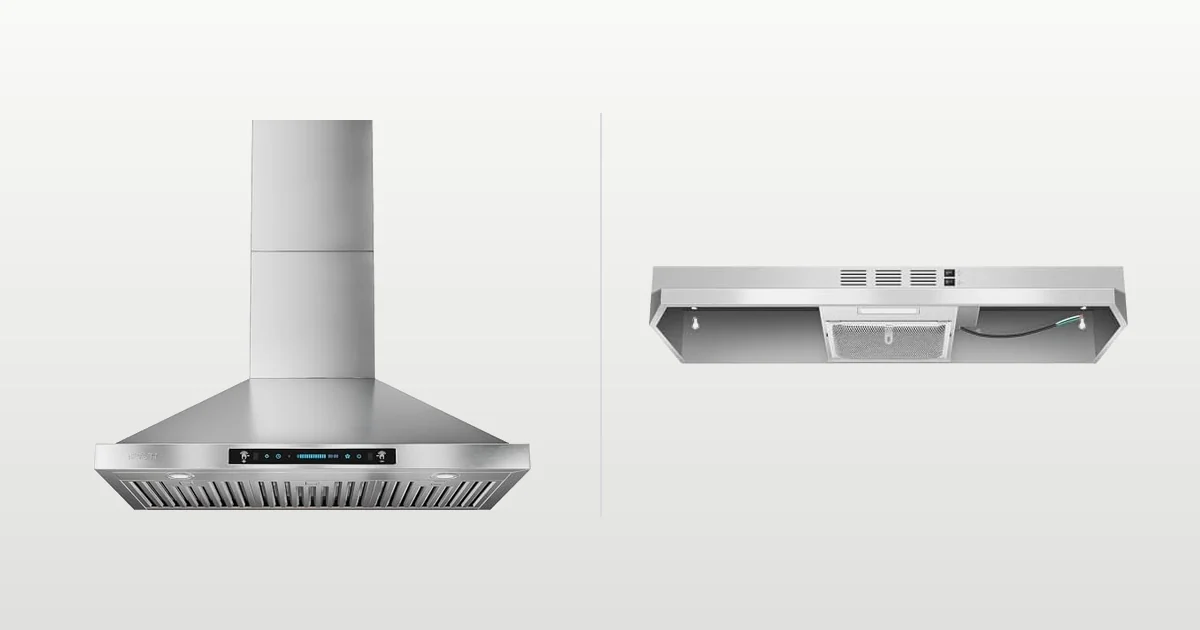
Every 36-inch range hood on this page publishes an airflow figure. Three publish a noise figure. And the two numbers, where you get both, describe different speeds.
Airflow is always quoted at maximum, because a bigger number sells. Noise, when it appears at all, is usually quoted at minimum for exactly the same reason. The IKTCH here states 900 CFM and 40 decibels — and the decibel figure is explicitly “on the lowest speed”. Those are two different machines described in one sentence.
This matters because a loud hood is a hood that gets switched off, and a hood that is off moves zero CFM regardless of what the box says. The single most useful specification in this category is the one almost nobody prints: how loud it is at the speed you would actually cook with.
One product here does exactly that — the Broan-NuTone Luxury Modern quotes 1.5 sones at working speed, and compares it to a running fridge. Another Broan publishes 6.5 sones, which is unflattering and therefore useful. Seven publish nothing.
Ten 36-inch hoods below, from $86.94 to $439.00, with airflow spanning 230 to 1050 CFM — a four-and-a-half-fold range at identical width.
Our Quick Picks
 Best OverallBroan-NuTone Luxury Modern 36
One and a half sones quoted at working speed rather than on the lowest setting — the only noise figure on this page you can actually plan around.
 Most Airflow DetailIKTCH 36-inch Wall Mount
Nine hundred CFM, four speeds, gesture sensing and a remote — with a noise figure that applies to the speed you will rarely use.
 Best Budget RankFIREGAS 36 Under Cabinet
Three hundred CFM for $86.99, and the best sales rank of any budget hood on this page.
At a Glance
Ten 36-Inch Range Hoods, Compared on Air and Noise
Maximum airflow, the noise figure where one exists and which speed it applies to, mounting format, and the one detail each listing chose to publish.
| # | Model | Airflow | Noise | Format | Detail | Standout | Main Drawback | Check Price |
|---|---|---|---|---|---|---|---|---|
| 1 |
 Broan-NuTone Luxury Modern 36 Broan-NuTone Luxury Modern 36 |
350 CFM max | 1.5 sones stated | Under-cabinet | Sones at working speed | Quotes its noise at working speed, not at minimum | 350 CFM is modest against the 1050 CFM machines | View on Amazon |
| 2 |
 Broan-NuTone F403611 Broan-NuTone F403611 |
230 CFM max | 6.5 sones stated | Under-cabinet insert | Publishes an unflattering figure | States 6.5 sones when it could have said nothing | 6.5 sones is genuinely loud | View on Amazon |
| 3 |
 IKTCH 36-inch Wall Mount IKTCH 36-inch Wall Mount |
900 CFM max | 40 dB at lowest | Wall mount | 4-speed, gesture | Quotes decibels, but at the lowest speed | 40 dB is at minimum, not at 900 CFM | View on Amazon |
| 4 |
 AMZCHEF 1050 CFM Dual-Blower AMZCHEF 1050 CFM Dual-Blower |
1050 CFM max | Not stated | Under-cabinet | Dual motor | The highest airflow figure on this page | Claims quiet operation with no figure at all | View on Amazon |
| 5 |
 COSMO Lumin 36-inch Island COSMO Lumin 36-inch Island |
380 CFM max | Not stated | Island mount | Dishwasher-safe filters | Permanent filters that go in the dishwasher rather than the bin | 380 CFM is modest for an island hood | View on Amazon |
| 6 |
 VIKIO HOME 36 Insert VIKIO HOME 36 Insert |
980 CFM max | Not stated | Insert | High airflow insert | 980 CFM in an insert format for under $350 | No noise figure, and inserts are enclosed | View on Amazon |
| 7 |
 Tieasy 36 Wall Mount Tieasy 36 Wall Mount |
700 CFM max | Not stated | Wall mount | Mid-range airflow | 700 CFM at under $250 | No noise figure | View on Amazon |
| 8 |
 Zomagas 36 Under Cabinet Zomagas 36 Under Cabinet |
280 CFM max | Not stated | Under-cabinet | Convertible | Under ninety dollars for a 36-inch hood | 280 CFM is barely adequate | View on Amazon |
| 9 |
 FIREGAS 36 Under Cabinet FIREGAS 36 Under Cabinet |
300 CFM max | Not stated | Under-cabinet | Convertible | Rank #48, the best of the budget hoods | 300 CFM and no noise data | View on Amazon |
| 10 |
 SNDOAS 36 Under Cabinet SNDOAS 36 Under Cabinet |
230 CFM max | Not stated | Under-cabinet | 35.4 x 17.5 x 4.7 in | Publishes its exact dimensions and filter part number | 230 CFM ties for lowest here | View on Amazon |
Specifications and prices are taken from each manufacturer’s Amazon listing as displayed on 23 August 2026 through a United States connection, and may change. Airflow figures are the manufacturer’s maximum-speed CFM ratings. Noise is recorded only where a listing publishes a figure, together with the speed it applies to where stated; seven of these ten publish no noise figure at all. Sones and decibels are different scales and are not directly comparable — sones are linear and perceptual, decibels logarithmic and weighted — so hoods quoting different units cannot be ranked against each other from the numbers alone. Sales ranks are shown as displayed and can be pooled across a variant family; several budget brands here list the same hood in multiple finishes sharing one rank.
Scroll the table sideways to see every column
How We Chose These Ten
We researched current listings, compared manufacturer specifications and documentation, and examined recurring patterns in customer feedback. We did not carry out hands-on testing, and nothing below is presented as measured performance data.
- Genuinely 36 inches — every hood here is specified at 36-inch nominal width for a 36-inch cabinet run
- Airflow published in CFM — all ten publish a maximum figure, so the range is directly comparable
- A verified live buy box — all ten confirmed purchasable in the United States on 23 August 2026
- Noise figures recorded with their speed — the three that publish one are noted, along with which speed it applies to
- No pooled-rank duplicates — several budget brands list one hood in multiple finishes sharing a rank; only one of each family is included
- All four mounting formats represented — under-cabinet, wall mount, insert and island
- Price and airflow spread — $86.94 to $439.00, 230 to 1050 CFM
The Ten Range Hoods in Detail
1. Broan-NuTone Luxury Modern 36 — Best Overall

“1.5 sones on working speed.” Read that phrase carefully, because almost nothing else here specifies which speed its number applies to.
Key Specifications
| Width | 36 inches |
|---|---|
| Airflow | 350 CFM maximum |
| Noise | 1.5 sones at working speed |
| Comparison given | Up to 44% quieter than competition |
| Reference point | Sound equivalent to a refrigerator running |
| Installation | EZ1 brackets, one-person install |
| Rank | #467 in its category |
| Price | $294.00 |
| Best For | Anyone who wants the hood to be usable rather than impressive |
Why We Recommend It
Working speed is the honest way to quote noise. Every hood is quiet on its lowest setting, which is also the setting that moves the least air. Quoting a figure at the speed you would actually use while cooking is a meaningfully harder claim to make, and it is the difference between a specification and a marketing number.
Sones are a perceived-loudness scale and they are linear. Two sones sounds twice as loud as one sone. That is why kitchen ventilation uses them rather than decibels — the decibel scale is logarithmic, so a 10 dB difference is roughly a doubling, which is far less intuitive. It also means figures in sones and figures in decibels cannot be compared directly, and this page contains both.
The refrigerator comparison is genuinely useful and rare. A number means nothing without a reference; a running fridge is a sound everyone has calibrated against.
350 CFM is the honest limitation. Against the 900 and 1050 CFM hoods here it looks weak, and for a heavily used gas range or a lot of high-heat frying it is. For an electric hob and normal cooking it is ample, and it will be running at 1.5 sones rather than being switched off because of the noise.
Pros
- Quotes 1.5 sones at working speed, not minimum
- Gives a real-world reference: a running fridge
- Publishes a comparative claim against competitors
- EZ1 brackets allow one-person installation
- Strong rank at #467
- Sones is the correct unit for ventilation noise
Cons
- 350 CFM is modest for heavy gas cooking
- $294.00 is mid-to-high for the airflow
- Under-cabinet format limits capture area
- No decibel figure for cross-comparison
- Bulb type and count not stated in the summary
- Ducting requirements not detailed
Best for: Anyone who has switched off a loud hood and cooked without ventilation instead.
2. Broan-NuTone F403611 — Most Honest

Six and a half sones is loud, and Broan printed it anyway. Most hoods on this page publish nothing at all.
Key Specifications
| Width | 36 inches |
|---|---|
| Airflow | 230 CFM maximum |
| Noise | 6.5 sones |
| Speeds | 2-speed rocker switch |
| Lighting | Accepts up to 75W incandescent, bulb not included |
| Format | Under-cabinet insert |
| Rank | #121 in its category |
| Price | $129.00 |
| Best For | A basic, honest hood where budget is the constraint |
Why We Recommend It
An unflattering published figure is more useful than a flattering silence. At 6.5 sones this is roughly four times as loud as the 1.5-sone Broan above it — sones being linear, that is a straightforward multiple. Knowing that before you buy lets you decide whether you will tolerate it. Not knowing means finding out after installation.
230 CFM is the entry level of useful. It will clear steam and light frying from an electric hob. It will not keep up with a wok or a heavily used gas range, and the physics does not care how much you paid.
Note that the bulb is not included and the fitting takes an incandescent up to 75W — an older specification that is worth knowing, since it means sourcing a bulb type that is increasingly uncommon.
Rank #121 is the second best on this page, which tells you that a great many people buy the cheapest competent option from a brand they recognise and are content.
Pros
- Publishes its noise figure even though it is unflattering
- $129.00 — cheapest branded option here
- Rank #121, second best in this roundup
- Simple 2-speed rocker switch
- Integrated light with protective lens
- Established brand and parts availability
Cons
- 6.5 sones is roughly four times the quietest here
- 230 CFM is the lowest airflow on this page
- Bulb not included, and takes incandescent
- Only two speeds
- Insert format means limited capture area
- White finish dates quickly
Best for: Budget installations where an honest basic hood beats an unspecified fancy one.

3. IKTCH 36-inch Wall Mount — Most Airflow Detail

Forty decibels — “on the lowest speed”. The 900 CFM figure is at the highest. They are not the same hood.
Key Specifications
| Width | 36 inches |
|---|---|
| Airflow | 900 CFM maximum |
| Noise | 40 dB — stated at the lowest speed |
| Speeds | 4 |
| Controls | Remote control and gesture sensing |
| Material | Stainless steel |
| Rank | #205 in its category |
| Price | $439.00 |
| Best For | High-heat cooking, if you accept the noise at full speed |
Why We Recommend It
This is the pattern to watch for across the whole category. Airflow is quoted at maximum because a bigger number sells. Noise, when quoted at all, is quoted at minimum for exactly the same reason. The two figures describe opposite ends of the machine’s operating range and cannot be combined into a picture of how it will behave while you cook.
Decibels and sones do not convert simply either. The decibel scale is logarithmic and weighted; sones are linear and perceptual. A hood quoting 40 dB and one quoting 1.5 sones cannot be ranked against each other from the numbers alone, and this page contains both conventions.
Nine hundred CFM is genuine capability. For a gas range, a wok burner or serious searing, this is the tier that actually clears the air rather than stirring it. Four speeds means you can run it low most of the time and have the capacity when you need it.
Gesture sensing is a real convenience with greasy hands, and it is the sort of feature that either works reliably or becomes an irritation — the listing does not say which.
Pros
- 900 CFM handles gas ranges and high-heat cooking
- 4 speeds allow low running with capacity in reserve
- Publishes a decibel figure when most publish nothing
- Remote control and gesture sensing
- Stainless steel construction
- Good rank at #205
Cons
- 40 dB is quoted at the lowest speed, not at 900 CFM
- Decibels cannot be compared with sones
- $439.00
- Wall-mount format needs ducting planned
- Gesture sensing reliability not described
- No sone figure for like-for-like comparison
Best for: Gas ranges and heavy cooking, where 350 CFM genuinely will not cope.
4. AMZCHEF 1050 CFM Dual-Blower — Most Airflow

One thousand and fifty CFM for $249.99 — and the word “quiet” with nothing behind it.
Key Specifications
| Width | 36 inches |
|---|---|
| Airflow | 1050 CFM maximum — highest here |
| Design | Dual-blower, dual-motor |
| Claim | 30% more suction than single-fan hoods |
| Noise | Claimed quiet, no figure published |
| Material | 430 stainless steel |
| Lighting | 2 x 1.5W LED |
| Price | $249.99 |
| Best For | Maximum extraction per dollar, if noise is not a concern |
Why We Recommend It
A dual-blower design is a legitimate engineering answer. Two smaller fans can move the same air as one large one at lower tip speed, and tip speed is a major source of fan noise. So the claim that it is both more powerful and quieter is physically plausible — which makes the absence of any number more frustrating rather than less.
Without a sone or decibel figure the claim is unfalsifiable. Two hoods on this page publish sones and one publishes decibels. This one, which makes the loudest airflow claim in the roundup and would therefore benefit most from a noise figure, publishes nothing.
430 stainless is the standard grade for hoods — magnetic, less corrosion-resistant than 304, and considerably cheaper. For an indoor kitchen it is entirely adequate; near coastal air it is not.
Note the listing’s own inconsistency: the title says 36 inch and the body text refers to a 30 inch under-cabinet hood. That kind of copy-paste error is worth noticing on a product where fit is the primary constraint.
Pros
- 1050 CFM is the highest figure in this roundup
- Dual-blower design is a genuine noise-reduction approach
- $249.99 is strong value for the stated airflow
- 430 stainless steel construction
- Two LED lamps included
- 3-speed fan
Cons
- No noise figure of any kind published
- Listing text refers to both 36 inch and 30 inch
- “Quiet” claimed without evidence
- 430 stainless is less corrosion-resistant than 304
- Under-cabinet format limits capture
- Unfamiliar brand
Best for: Buyers who need maximum extraction and will accept unknown noise.
5. COSMO Lumin 36-inch Island — Best Filters

Filters that never need replacing. Over ten years that is a larger number than the price difference between most hoods here.
Key Specifications
| Width | 36 inches |
|---|---|
| Airflow | 380 CFM maximum |
| Format | Island mount, ducted as standard |
| Filters | ARC-FLOW permanent, dishwasher-safe |
| Filter replacement | None needed |
| Motor | Single centrifugal, 3-speed |
| Controls | Soft touch panel |
| Price | $349.99 |
| Best For | Island installations where filter cost adds up over years |
Why We Recommend It
Filter type is the running cost nobody calculates. Carbon filters in a ductless hood need replacing every few months, and even mesh grease filters in cheaper hoods degrade. Permanent baffle-style filters that survive a dishwasher cycle indefinitely remove that entirely — and they also work better, because a clean filter is the single biggest factor in whether a hood actually extracts.
An island hood is a harder engineering problem than a wall hood. There is no wall to help contain the plume and air can escape in every direction, so island hoods generally need more airflow than a wall unit of the same width. Three hundred and eighty CFM is on the modest side for that job.
Ducted as standard is the right default. Ductless recirculation filters odour but returns heat and moisture to the room; ducting removes both. Where a duct run is possible, it is always the better installation.
No noise figure published, which on a hood mounted in the middle of a room — where there is nothing to shield the sound — is a more significant omission than it would be on a wall unit.
Pros
- Permanent filters, dishwasher safe, never replaced
- Ducted as standard rather than recirculating
- Soft touch controls for speed and lighting
- Island format for hobs away from a wall
- Single centrifugal motor, 3 speeds
- Removes an ongoing consumable cost
Cons
- 380 CFM is modest for an island installation
- No noise figure published
- $349.99
- Island mounting is a harder install
- Single motor rather than dual
- Carbon kit sold separately for ductless use
Best for: Island hobs, and anyone tired of buying replacement filters.
6. VIKIO HOME 36 Insert — Most Insert Airflow

An insert is the powered box that goes inside a custom hood surround. You see the joinery; this does the work.
Key Specifications
| Width | 36 inches |
|---|---|
| Airflow | 980 CFM maximum |
| Format | Insert, for building into cabinetry or a custom hood |
| Position | Second-highest airflow here |
| Noise | Not stated |
| Rank | #315 in its category |
| Price | $346.73 |
| Best For | Custom cabinetry where the hood should not be visible |
Why We Recommend It
Inserts exist so the ventilation is invisible. If you have a plastered chimney breast or a bespoke timber canopy over the hob, an insert provides the motor, filters and lighting without imposing a stainless steel box on the design. That is a real architectural advantage and it is why inserts command a premium over equivalent visible hoods.
An enclosed insert is acoustically different from a wall hood. Surrounding cabinetry can damp the sound or resonate with it depending on construction, which makes a published noise figure more useful here than almost anywhere — and none is given.
980 CFM is serious extraction, and in an insert format it suggests the unit is intended for a genuine cooking kitchen rather than a decorative installation.
Installation is the real consideration. An insert has to be specified before the joinery is built, and the aperture, ducting route and electrical supply all have to be planned around it. This is not a swap-out purchase.
Pros
- 980 CFM — second highest here
- Insert format disappears into custom cabinetry
- Good rank at #315
- Suits bespoke chimney breasts and canopies
- $346.73 for high airflow
- Serious extraction in a hidden format
Cons
- No noise figure published
- Enclosure acoustics make noise data more important, not less
- Must be planned before joinery is built
- Not a retrofit or swap-out purchase
- Unfamiliar brand
- Ducting route must be designed in
Best for: Kitchens with bespoke joinery where the hood should not be seen.
7. Tieasy 36 Wall Mount — Best Mid Value

Seven hundred CFM sits exactly between the 350 CFM branded hoods and the 1000-plus CFM machines, at about the same price.
Key Specifications
| Width | 36 inches |
|---|---|
| Airflow | 700 CFM maximum |
| Format | Wall mount |
| Position | Mid airflow, mid price |
| Noise | Not stated |
| Rank | #544 in its category |
| Price | $246.98 |
| Best For | A sensible middle when 350 CFM is too little and 1050 is overkill |
Why We Recommend It
Seven hundred CFM is arguably the right number for most kitchens. It comfortably handles a gas hob and regular frying without the noise penalty that comes with running a 1050 CFM unit at full tilt. Airflow requirements scale with burner output, and most domestic ranges do not justify four figures of CFM.
Wall mount is the standard installation and the easiest to plan — the wall provides a duct route and helps contain the plume, which is why wall hoods can be specified with less airflow than island hoods of the same width.
No noise figure again, which by this point in the roundup is the norm rather than the exception. Seven of these ten publish nothing.
At $246.98 it undercuts the 350 CFM Broan by $47 while offering double the airflow — and gives you no way to know what that airflow sounds like.
Pros
- 700 CFM suits most domestic cooking
- Wall mount is the simplest installation
- $246.98 undercuts lower-airflow branded hoods
- Stainless steel construction
- Sensible middle of the range
- Reasonable rank at #544
Cons
- No noise figure published
- Unfamiliar brand
- No sone or decibel data for comparison
- Filter type not specified
- Lighting specification not given
- Warranty and support unproven
Best for: Most kitchens, if you are willing to buy airflow without knowing the noise.
8. Zomagas 36 Under Cabinet — Cheapest Ducted

Eighty-eight dollars, and rank #72 — the third best on this page. A lot of people buy the cheapest 36-inch hood that works.
Key Specifications
| Width | 36 inches |
|---|---|
| Airflow | 280 CFM maximum |
| Ducting | Convertible — ducted or ductless |
| Format | Under-cabinet |
| Noise | Not stated |
| Rank | #72 in its category |
| Price | $87.94 |
| Best For | Replacing a broken hood on the smallest possible budget |
Why We Recommend It
Convertible means it can be ducted or recirculating, which is the sensible default for a replacement hood because you may not know what the existing installation does until you take the old one down. Ducted is always better where possible; recirculating filters odour but returns heat and steam to the room.
280 CFM is at the bottom of useful. It will handle an electric hob and modest cooking. It will visibly fail to keep up with a gas ring under a wok, and no amount of running it longer compensates — extraction either captures the plume as it rises or it does not.
The strong rank tells you something real about this market. At #72 this outsells almost everything else in the roundup, which suggests most 36-inch hood purchases are replacements chosen on price and fit rather than on performance.
No noise figure, and at this price none should be expected.
Pros
- $87.94 — cheapest 36-inch hood here
- Rank #72, third best in this roundup
- Convertible ducted or ductless
- Fits standard under-cabinet apertures
- Simple replacement for a failed hood
- Stainless finish
Cons
- 280 CFM is barely adequate for gas cooking
- No noise figure published
- No filter type specified
- Unfamiliar brand with unproven support
- Recirculating mode returns heat to the room
- Build quality reflects the price
Best for: Replacing a dead hood cheaply, on an electric hob.
9. FIREGAS 36 Under Cabinet — Best Budget Rank

Rank #48 at $86.99 — more people buy this than anything else in this roundup.
Key Specifications
| Width | 36 inches |
|---|---|
| Airflow | 300 CFM maximum |
| Format | Under-cabinet |
| Ducting | Convertible |
| Noise | Not stated |
| Rank | #48 in its category |
| Price | $86.99 |
| Best For | The most-bought budget option, on an electric hob |
Why We Recommend It
Rank is the only independent signal at this end of the market, and it is worth using. Budget hoods from unfamiliar brands publish almost nothing verifiable: no sones, no filter specification, no motor detail. What a rank of #48 does tell you is that a very large number of these have been sold and are presumably still working, which is a weak form of evidence but not a worthless one.
Three hundred CFM is marginally better than the cheapest here and still firmly in electric-hob territory. The jump that actually changes what a hood can do is to 600 CFM and above.
Convertible ducting again, which is the right specification for a replacement where the existing arrangement is unknown.
Note that FIREGAS lists this hood under several colours and finishes, and those listings share a sales rank. The figure belongs to the family rather than to the black, white or stainless version individually.
Pros
- Best rank in this roundup at #48
- $86.99
- 300 CFM, slightly above the cheapest here
- Convertible ducted or ductless
- Fits standard 36-inch apertures
- Widely bought and presumably reliable
Cons
- No noise figure published
- 300 CFM is inadequate for gas cooking
- Rank is shared across colour variants
- No filter or motor specification
- Unfamiliar brand
- No published warranty terms
Best for: The default budget replacement, chosen on price, fit and sales volume.
10. SNDOAS 36 Under Cabinet — Most Dimensions

35.4 inches wide, 17.5 deep, 4.7 thick — and the replacement filter part number. That is what a fitting decision actually needs.
Key Specifications
| Width | 35.4 inches actual |
|---|---|
| Depth | 17.5 inches |
| Thickness | 4.7 inches, slim body |
| Airflow | 230 CFM maximum |
| Default mode | Ductless, with carbon filter |
| Filter part number | CF-3976, published |
| Rank | #21 in its category |
| Price | $86.94 |
| Best For | Tight apertures, where exact dimensions decide the purchase |
Why We Recommend It
Published dimensions matter more than airflow on a replacement. A “36 inch” hood is typically 35.4 inches so it fits a 36-inch cabinet run, and depth and thickness determine whether it clears the cabinet above and the hob below. Most listings here give a nominal width and nothing else, which means measuring the old hood and hoping.
Publishing the carbon filter part number is quietly excellent. Ductless hoods need their carbon filter replacing every few months, and the commonest reason a recirculating hood stops working is a saturated filter nobody could find a replacement for. A part number turns that into a search rather than a guess.
Ductless by default is the significant limitation. Recirculation filters grease and odour and returns heat and moisture to the kitchen. If a duct route exists, use it — and check whether this model supports ducted conversion before assuming.
230 CFM ties for the lowest airflow here, and combined with recirculation this is a light-duty hood. Rank #21 is nonetheless the best on this page.
Pros
- Publishes exact width, depth and thickness
- Gives the carbon filter part number
- Rank #21, the best in this roundup
- 4.7-inch slim body suits tight clearances
- $86.94
- Brushed stainless, easy to clean
Cons
- 230 CFM ties for lowest airflow here
- Ductless by default returns heat to the room
- No noise figure published
- Carbon filters are an ongoing cost
- Light-duty only
- Unfamiliar brand
Best for: Tight installations where the aperture, not the airflow, is the constraint.
Two Broans, Two Noise Figures
The same brand, publishing sones on both — which makes them the only directly comparable pair on this page.
| Broan Luxury Modern | Broan F403611 | |
|---|---|---|
| Airflow | 350 CFM max | 230 CFM max |
| Noise | 1.5 sones | 6.5 sones |
| Speed quoted | Working speed | Not specified |
| Relative loudness | Baseline | About 4x louder |
| Speeds | Multiple | 2 |
| Price | $294.00 | $129.00 |
Sones are linear, so 6.5 against 1.5 is roughly four times the perceived loudness — not a marginal difference. The cheaper hood moves a third less air and is four times noisier, for $165 less. That is the actual trade, and you can only see it because both listings published a figure.

Airflow Against Price, and What Is Missing
The CFM ladder at 36 inches, and which rungs come with a noise figure.
| Hood | Max CFM | Noise stated | Price |
|---|---|---|---|
| SNDOAS | 230 | No | $86.94 |
| Zomagas | 280 | No | $87.94 |
| Broan Luxury | 350 | 1.5 sones | $294.00 |
| Tieasy | 700 | No | $246.98 |
| IKTCH | 900 | 40 dB at lowest | $439.00 |
| AMZCHEF | 1050 | No | $249.99 |
The hood with the highest airflow claim on this page publishes no noise figure at all, and describes itself as quiet. The hood with the lowest airflow publishes nothing either. In between, the only usable noise data comes from one brand. If you want to know how loud a 36-inch hood will be, the specification sheet will usually not tell you.
Best Alternatives
| Alternative | Why Consider It | Better For | Main Trade-Off |
|---|---|---|---|
| A 30-inch hood | Cheaper, more choice, fits a 30-inch run | Standard 30-inch ranges | Under-covers a 36-inch cooking surface |
| An external or inline blower | Motor sits outside, so the kitchen is far quieter | Anyone prioritising noise above all | Expensive and a much bigger installation |
| A downdraft extractor | No overhead unit at all | Island hobs and sightline-critical kitchens | Fights physics — extracts downward against rising heat |
| Opening a window | Free | Very light cooking in mild weather | Does nothing for grease, and useless in winter |
What the Money Actually Buys
$86.94 to $87.94 — SNDOAS, Zomagas, FIREGAS. Entry-level 36-inch hoods at 230 to 300 CFM, convertible ducted or ductless, no noise figures. These are replacement hoods for electric hobs, chosen on price and fit. Notably they hold the three best sales ranks on this page, which tells you what most 36-inch purchases actually are.
$129.00 to $294.00 — Broan F403611, Tieasy, AMZCHEF, Broan Luxury Modern. The useful middle. Airflow ranges from 230 to 1050 CFM at similar prices, which is a reminder that price predicts airflow poorly. Both hoods with sone figures are here, at opposite ends of the noise scale.
$346.73 to $439.00 — VIKIO insert, COSMO island, IKTCH wall mount. Format and airflow together: an insert for bespoke joinery, an island hood with permanent filters, and 900 CFM with gesture control. Only one publishes a noise figure, and it is quoted at the lowest speed.
What to Check Before You Buy
Ask Which Speed the Noise Figure Applies To
This is the question that separates a specification from marketing. Every hood is quiet on its lowest setting, which is also the setting that barely ventilates. A figure quoted at working speed is a genuinely harder claim, and only one hood here makes it. Where a listing says “40 dB” and adds “on the lowest speed”, it has told you the number is not the one you need.
Sones and Decibels Do Not Convert
Sones are a linear perceptual scale — 2 sones sounds twice as loud as 1, and 6.5 sones is roughly four times 1.5. Decibels are logarithmic and frequency-weighted, so a 10 dB difference is roughly a doubling. Kitchen ventilation conventionally uses sones for exactly this reason. If two hoods quote different units, you cannot rank them from the numbers, and this page contains both.
Match CFM to Your Hob, Not to the Biggest Number
Airflow requirements scale with burner output. An electric hob with normal cooking is well served by 300 to 400 CFM. A gas range, a wok burner or regular high-heat searing wants 600 CFM and up. Beyond about 900 CFM in a domestic kitchen you are into territory where make-up air becomes a real consideration, because a powerful hood in a well-sealed house has to draw replacement air from somewhere.
Ducted Beats Recirculating Wherever Possible
A ducted hood exhausts heat, moisture, grease and odour outside. A recirculating hood filters grease and odour through carbon and returns the heat and steam to the room, which is why kitchens with ductless hoods still feel humid after cooking. Several budget hoods here are convertible, which is the right specification when you do not yet know what the existing installation supports.
Check the Actual Dimensions, Not the Nominal Width
A 36-inch hood is typically about 35.4 inches wide so it fits inside a 36-inch cabinet run. Depth and body thickness decide whether it clears the cupboard above and leaves enough height above the hob. One listing here publishes all three figures; most publish a nominal width and nothing else, which means measuring the old unit and hoping.
Find Out What the Filters Cost Over Time
Carbon filters in recirculating hoods need replacing every few months, and a saturated filter is the commonest reason a ductless hood stops working. Permanent baffle or mesh filters that go in the dishwasher remove that cost entirely. One hood here publishes its replacement filter part number, which is more useful than it sounds when you are trying to buy one three years later.
Decide the Format Before the Model
Under-cabinet fits beneath existing cupboards and is the usual replacement. Wall mount is a visible chimney unit and needs a duct route planned. An insert hides inside bespoke joinery and must be specified before the joinery is built. Island hoods hang over a hob with no wall to help contain the plume, and generally need more airflow than a wall unit of the same width.

Common Mistakes
- Comparing a CFM maximum with a noise minimum. They describe different speeds of the same machine.
- Ranking a hood quoting sones against one quoting decibels. The scales do not convert.
- Buying maximum airflow for an electric hob. 300 to 400 CFM covers normal cooking; the rest is noise you will not use.
- Assuming a ’36-inch’ hood is 36 inches wide. It is usually about 35.4, to fit a 36-inch run.
- Choosing recirculating when a duct route exists. It returns all the heat and steam to your kitchen.
- Specifying an insert after the joinery is built. The aperture, duct route and supply all have to be planned around it.
- Ignoring filter running costs. Carbon filters are a subscription; permanent filters are not.
Who Should Buy Which
Buy the Broan-NuTone Luxury Modern if you want a hood you will actually run. 1.5 sones quoted at working speed, with a running-fridge comparison, and 350 CFM that suits most electric cooking.
Buy the IKTCH if you cook on gas at high heat. 900 CFM and four speeds is genuine capability — and read its 40 dB figure as applying to the lowest setting.
Buy the FIREGAS at $86.99 if this is a straight replacement on an electric hob. It holds the best sales rank on this page and does the basic job.
Buy the COSMO if your hob is on an island and you would rather wash filters than keep buying them.
Buy the SNDOAS if the aperture is tight — it is the only hood here that publishes its exact width, depth and thickness.
Frequently Asked Questions
How much CFM do I actually need for a 36-inch hood?
It depends on the hob rather than the hood. For an electric or induction hob with everyday cooking, 300 to 400 CFM is genuinely sufficient and will run quietly. For a gas range, particularly one used for searing, wok cooking or frying, 600 CFM and above is where extraction stops stirring the air and starts clearing it. A common rule of thumb for gas is roughly 100 CFM per 10,000 BTU of burner output. Beyond about 900 CFM in a well-sealed home, make-up air becomes a real consideration, because a powerful hood has to draw replacement air from somewhere and will otherwise pull it down a flue or through gaps.
What is a sone, and why do hoods use them instead of decibels?
A sone is a unit of perceived loudness and it is linear: 2 sones sounds twice as loud as 1 sone, and 6 sones sounds six times as loud. Decibels are logarithmic and frequency-weighted, so a 10 dB increase is roughly a doubling in perceived loudness — accurate but unintuitive. Kitchen ventilation adopted sones precisely because the linearity makes comparison straightforward for buyers. The practical consequence is that a hood quoting sones and one quoting decibels cannot be ranked against each other from the numbers alone, and this roundup contains both conventions.
Why does the noise figure matter so much?
Because a hood that is too loud gets switched off, and a hood that is off has an airflow of zero regardless of its rating. This is the most common failure in kitchen ventilation and it is entirely predictable. It matters even more in an open-plan room, where the hood is running in your living space rather than behind a wall. The figure to look for is noise at working speed rather than at minimum — every hood is quiet on its lowest setting, which is also the setting that barely ventilates. Only one hood in this roundup publishes a figure at working speed.
Is ducted really better than recirculating?
Yes, wherever a duct route is possible. A ducted hood exhausts heat, steam, grease and odours outside the building. A recirculating hood passes air through a grease filter and a carbon filter and returns it to the kitchen — so odours are reduced, but all the heat and all the moisture stay in the room. That is why kitchens with ductless hoods still feel humid and warm after cooking. Recirculating is a legitimate answer where ducting genuinely cannot be run, such as an interior flat, and several hoods here are convertible so the decision can be made at installation.
What size is a ’36-inch’ range hood actually?
Usually about 35.4 inches wide, so that it fits within a 36-inch cabinet run with a little clearance. Only one listing in this roundup publishes the actual figure along with depth and body thickness, which are the two dimensions that decide whether the hood clears the cupboard above and leaves adequate height above the hob. Most listings give a nominal width only. Before ordering a replacement, measure the aperture, the depth of the cabinet above, and the distance from hob to cabinet — manufacturers typically specify a minimum mounting height above the cooking surface.
Do I need to replace the filters, and how often?
It depends on the type. Aluminium mesh grease filters are washable and last the life of the hood — run them through the dishwasher when they look greasy, typically monthly with regular cooking. Carbon filters, used only in recirculating mode, are a genuine consumable and need replacing every three to six months depending on use; a saturated carbon filter is the commonest reason a ductless hood seems to stop working. One hood here publishes its replacement carbon filter part number, which is worth more than it sounds when you come to buy one years later. Permanent baffle-style filters, as on the COSMO, remove the cost entirely.
Final Verdict
1.5 sones quoted at working speed rather than at minimum, with a real-world reference point. The only noise figure here you can plan around.
900 CFM and four speeds for genuine gas-range extraction — with a 40 dB figure that applies to the lowest setting.
Rank #48 and $86.99. The most-bought hood on this page, and enough for an electric hob.
Buy the Broan-NuTone Luxury Modern at $294.00 if you want ventilation that gets used. One and a half sones at working speed, benchmarked against a running fridge, is the only noise claim on this page that describes the hood in the state you will actually run it. Three hundred and fifty CFM is modest, and a hood you leave on beats a louder one you switch off.
If you cook on gas at high heat, buy the IKTCH. Nine hundred CFM and four speeds is real capability, and 350 CFM genuinely will not cope with a wok burner. Just read its 40 decibel figure for what it says it is — a measurement taken at the lowest speed, not at 900 CFM.
The pattern worth carrying away is that airflow is always quoted at maximum and noise, when quoted at all, is usually quoted at minimum. Seven of these ten hoods publish no noise figure whatsoever, including the one claiming the highest airflow on the page while describing itself as quiet.
Match the CFM to your hob rather than to the biggest number available, check the actual width rather than the nominal one, and if two hoods quote noise in different units, accept that you cannot compare them and choose on something else.