
Affiliate Disclosure: As an Amazon Associate, we earn from qualifying purchases. This does not affect the price you pay.
Every filter on this page puts PFAS on its listing, or the two PFAS most often named, PFOA and PFOS. That was the rule for getting in. It is also the reason this roundup exists. Ten listings make what sounds like the same promise, and they back it in ten different ways. Some cite a standard. Some name a lab. Some say a third party tested them and do not say who. One just says it reduces PFAS.
Some context first. PFAS, the “forever chemicals”, are not one substance. The name covers a family of thousands of synthetic compounds. Filter listings usually name only PFOA and PFOS, the two most studied, and several of the ten here name neither and say “PFAS” or “Total PFAS” without listing which compounds that covers. A reduction claim for PFOA and PFOS is not a claim about every PFAS, and we do not read it as one.
Then the finding. In the United States, PFOA and PFOS reduction claims on drinking-water filters are usually certified under NSF/ANSI 53 or, for reverse osmosis, NSF/ANSI 58. NSF’s P473 protocol was the original test for those two compounds. Three of the ten listings cite one of those numbers. The Aquasana SmartFlow says it “Meets NSF/ANSI standards 42, 53, 58, and 401” under a WQA certification heading. The VIOMI V6 is “NSF/ANSI 53, 42 & 372 Certified”. The Epic Pure XP is certified to 42 and “independently tested against Standards 53, 401, P231, and P473”.
Even those three need a careful read. None ties PFOA or PFOS to a standard in a single sentence. Aquasana lists its standards, then its contaminants. VIOMI’s certification bullet ties 53 to lead and puts its PFOA and PFOS figures in a separate bullet. Epic is certified to 42, a standard generally used for taste and odour claims, and only “tested against” 53 and P473.
Six lean on something else. The Culligan ZeroWater dispenser is “certified by IAPMO to reduce Total PFAS” and names no standard. The Culligan MaxClear names a standard, NSF/ANSI 42, for its microplastics, lead and Total PFAS claim. The iSpring whole-house system uses “SGS-tested media”. Clearly Filtered, Waterdrop and Aquagear cite third-party lab testing without naming the lab. The LifeStraw Home names no standard and no test at all.
And shoppers are not sorting by the number. The two best Best Sellers Ranks on the page belong to the iSpring, #3,791 overall, and the ZeroWater, #6,317. Neither cites 53, 58 or P473. The three that do sit at #12,660, #14,610 and #54,746.
The secondary question, the best water filter for microplastics, gets the same treatment. Six of the ten listings mention microplastics, and only those six get credit for it here. We sort the ten by what each listing cites for its PFAS claim, then by type, filter life and installation. Nothing on this page says a filter removes all PFAS or makes your water safe. That depends on what is in your water, and the place to find out is your utility’s annual water quality report, the consumer confidence report, or a test of a private well.
All ten were captured on 5 October 2026 and were in stock. Star ratings and review counts were not captured; popularity is Amazon’s Best Sellers Rank only, and overall ranks run from #3,791 to #115,366.
Our Quick Picks
 Best OverallAquasana SmartFlow Reverse Osmosis System
The only listing citing both NSF/ANSI 53 and 58, under a WQA heading, with PFAS and microplastics named and a 2-year limited warranty.
 Best Tankless ROVIOMI V6 600GPD Tankless Reverse Osmosis System
NSF/ANSI 53, 42 and 372 certified, PFOS above 99.88% and PFOA above 99.6% stated, and a 3:1 pure-to-drain ratio.
 Best PitcherEpic Pure XP Water Filter Pitcher
The only pitcher that cites NSF/ANSI 53 and P473, as tested-against standards, with PFOA, PFOS and microplastics named and 100 gallons per filter.
At a Glance
Ten PFAS Water Filters, Sorted by What Backs the Claim
Read the first column first: it shows what each listing cites for its PFAS claim, from a PFOA/PFOS standard number at the top to nothing at the bottom.
| # | Model | PFAS Claim Rests On | PFAS Wording | Microplastics | Best Sellers Rank | Standout | Main Drawback | Check Price |
|---|---|---|---|---|---|---|---|---|
| 1 |
 Aquasana SmartFlow RO |
WQA heading; meets NSF/ANSI 42, 53, 58, 401 | “PFAS” | Named | #14,610 overall | Only listing citing both 53 and 58 | Tank system; professional installation recommended | View on Amazon |
| 2 |
 VIOMI V6 Tankless RO |
NSF/ANSI 53, 42, 372 certified | PFOS >99.88%, PFOA >99.6% | Not mentioned | #54,746 overall | Compound-level PFOA and PFOS figures beside a 53 certification | Two holes, an outlet and its own faucet needed | View on Amazon |
| 3 |
 Epic Pure XP Pitcher |
Certified to 42; tested against 53, P473 | PFAS (PFOA/PFOS) | Named | #12,660 overall | Only pitcher citing 53 and P473 | Those two are tested against, not certified | View on Amazon |
| 4 |
 Culligan ZeroWater 32-Cup |
Certified by IAPMO; no standard named | “Total PFAS” | Not mentioned | #6,317 overall | Best-ranked pitcher; named certifier; TDS meter included | No standard number; filter life not stated | View on Amazon |
| 5 |
 Culligan MaxClear Gravity |
Certified to NSF/ANSI 42 | “Total PFAS” | Named, under 42 | #92,495 overall | No power or plumbing; Berkey-compatible | 42 is generally a taste-and-odour standard | View on Amazon |
| 6 |
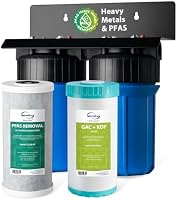 iSpring Whole House PFAS |
SGS-tested media | Up to 99% PFAS, incl. PFOA, PFOS | Not mentioned | #3,791 overall | Treats every tap; 50,000 gallons per filter | Testing is of the media; no standard cited | View on Amazon |
| 7 |
 Clearly Filtered 10-Cup Pitcher |
Third-party lab; NSF only for 42 or 43, and 372 | PFAS/PFOA | Named | #17,179 overall | Says removal rates are published | Lab unnamed; NSF standard number conflicts | View on Amazon |
| 8 |
 Waterdrop 15UA-PF Under Sink |
Third-party lab, unnamed | 99.9% PFOA, 99.8% PFOS | Not mentioned | #16,389 overall | No drilling; uses your existing faucet | No standard and no lab named | View on Amazon |
| 9 |
 Aquagear 10-Cup Pitcher |
Third-party tested, unnamed | PFOA, PFOS | Named | #115,366 overall | 120 gallons per filter; recycling label included | No percentages, lab or standard given | View on Amazon |
| 10 |
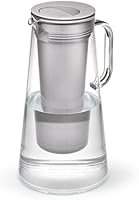 LifeStraw Home 7-Cup |
None named | “PFAS” | Named | #46,959 overall | Membrane microfilter for bacteria and parasites | No test or standard behind the PFAS claim | View on Amazon |
Best Sellers Ranks and specifications are taken from each manufacturer’s Amazon listing as displayed on 5 October 2026 through a United States connection, and may change. The first column records what each listing cites, not what any filter does. “Certified” means the listing uses that word; we did not look up certificates, and you should. NSF, WQA and IAPMO all publish searchable certification listings. Clearly Filtered gives its NSF standards as 43 and 372 in one bullet and 42 and 372 in another; both are reported. VIOMI ties its 53 certification to lead in its certification bullet and gives its PFOA and PFOS figures in a separate bullet. “Microplastics” is marked Named only where the listing uses the word. Ranks are overall Best Sellers Ranks as returned on 5 October 2026; Amazon files these ten in three categories, so category ranks are not comparable across all of them. Five were sold by Amazon.com at capture, one by Woot and four by their brands. The ZeroWater was flagged as scarce stock. Star ratings and review counts were not captured for any product here.
Scroll the table sideways to see every column
How We Chose These Ten
We researched current listings, compared manufacturer specifications and documentation, and read every PFAS, PFOA, PFOS and microplastics claim on each listing line by line. We did not carry out hands-on testing, and nothing below is presented as measured performance data. Star ratings and review counts were not captured for this roundup. We used Amazon Best Sellers Rank, buy-box stock and listing specifications instead, and nothing on this page describes or implies how owners have scored these filters.
- A PFAS claim was the entry ticket — every listing here names PFAS, PFOA or PFOS. We kept the mix of formats that claim turns up on: five pitchers or dispensers, one gravity system, one under-sink filter, two reverse osmosis systems and one whole-house system.
- The basis of each claim recorded exactly as printed — a standard number where one is given, a certifier or lab where one is named, “third-party” where that is all the listing says, and nothing where it says nothing. We did not upgrade a “tested against” to a “certified to”.
- Compounds and percentages only as stated — where a listing names PFOA and PFOS, so do we. Where it says “PFAS” or “Total PFAS”, we quote that and add nothing. Every percentage on this page is the listing’s own.
- Microplastics credited only where named — six listings use the word. The other four get no microplastics credit, whatever their media might do in principle.
- No claim of safety — no listing can tell you what is in your water. We point to your utility’s consumer confidence report, or a well test, as the place to start.
- Practical specs alongside — capacity, filter life, flow, installation and warranty, as stated. Missing figures are written “Not stated”.
- Popularity from Best Sellers Rank only — quoted exactly as returned on 5 October 2026. Ranks move constantly.
- Verified stock and seller — each product was the buy-box offer and in stock on amazon.com on 5 October 2026.

The Ten PFAS Water Filters in Detail
1. Aquasana SmartFlow Reverse Osmosis System, 90 Contaminants, AQ-SFRO2-BN — Best Overall

The only listing on the page that cites both of the standards PFOA and PFOS claims usually sit under, 53 and 58.
Key Specifications
| Type | Under-sink reverse osmosis with tank and remineralizer |
|---|---|
| PFAS claim rests on | WQA Certified Performance heading; meets NSF/ANSI 42, 53, 58 and 401 |
| PFAS wording | “PFAS”, within “up to 99.99% of harmful contaminants” |
| Microplastics | Named |
| Other contaminants named | Fluoride, chromium 6, TDS, asbestos, mercury, chlorine, pharmaceuticals, lead |
| Filter life | Not stated in months or gallons; each set replaces 2,750+ bottles |
| In the box | Filters, RO membrane, RO tank, faucet, installation parts |
| Installation | Under counter; professional installation recommended |
| Dimensions | 12.93 x 15.0 x 4.5 in |
| Warranty | 2-year limited |
| Seller | Amazon.com |
| Best Sellers Rank | #14,610 overall; #135 in Under-Sink & Countertop Filtration |
Why We Recommend It
This is the strongest paper trail on the page. The first bullet carries the heading “WQA Certified Performance” and says the system “Meets NSF/ANSI standards 42, 53, 58, and 401”. No other listing here cites 58, the standard for household reverse osmosis systems, and no other names 53 and 58 together. WQA, the Water Quality Association, is one of the bodies accredited to certify drinking-water products, so the listing names both a certifier and the standards. That is the combination this page is looking for.
It still does not tie PFAS to a standard in so many words. The same bullet goes on: “Effectively reduces up to 99.99% of harmful contaminants including fluoride, chromium 6, TDS, microplastics, PFAS, asbestos, mercury, chlorine, pharmaceuticals, and lead.” The 99.99% is an upper bound across the list, not a PFAS figure. The word is “PFAS”, with no compounds named. The title’s “90 Contaminants” is a count, and the listing does not print the ninety. To see which PFAS claims the certification actually covers, look the model up in WQA’s certified product listings before you buy.
Reverse osmosis is the format to beat for a broad claim. As general context, reverse osmosis membranes, activated carbon and ion exchange are the treatment approaches most often cited for PFAS reduction, and reverse osmosis is the one that also takes dissolved solids down, which is why this listing can name TDS and fluoride. The trade is that it strips minerals too. Aquasana answers that with a “Remineralizer that restores essential minerals like calcium and magnesium”, a stage the VIOMI below does not mention.
Microplastics are named. It is one of six listings here that use the word, and the only reverse osmosis system of the two that does. For a buyer asking about the best water filter for microplastics as well as PFAS, it is the one product on the page that cites a PFOA/PFOS-relevant standard and names microplastics in the same bullet.
It is the most involved install here bar the whole-house unit. The box includes “first set of filters, RO membrane, RO tank, faucet, parts required for under countertop installation”, and the listing says “Professional installation recommended”. A tank means space under the sink. The listing gives 12.93 by 15.0 by 4.5 inches, which reads like the filter unit rather than unit plus tank; it does not say. Filter life is not stated in months or gallons, only that each set replaces “2,750+ plastic water bottles”.
What to weigh. It is sold by Amazon.com, ranks #14,610 overall and carries a 2-year limited warranty, the longest stated on the page. Against the VIOMI, it buys the 58 citation, a named certifier, a remineralizer and a microplastics claim; it gives up the VIOMI’s compound-level PFOA and PFOS figures and its tankless layout. If you want the listing with the most standards behind it, this is it.
Pros
- Only listing citing both NSF/ANSI 53 and 58
- Names a certifier, WQA
- Microplastics named
- Remineralizer included
- 2-year limited warranty, longest stated here
- Sold by Amazon.com
Cons
- PFAS not tied to a standard in one sentence
- No PFAS compounds named
- Filter life not stated in months or gallons
- Tank needs under-sink space
- Professional installation recommended
- Unit-plus-tank size not stated
Best for: A homeowner who wants the most standards cited behind a PFAS claim and can fit a tank under the sink.
2. VIOMI V6 600GPD Under Sink Tankless Reverse Osmosis Water Filtration System — Best Tankless RO

An NSF/ANSI 53 certification and compound-level PFOA and PFOS figures, printed in two different bullets.
Key Specifications
| Type | Under-sink tankless reverse osmosis, 9-stage |
|---|---|
| PFAS claim rests on | NSF/ANSI 53, 42 and 372 certified; 53 tied to lead in that bullet |
| PFAS wording | PFOS >99.88%, PFOA >99.6% |
| Microplastics | Not mentioned |
| Membrane | 0.0001μm stated |
| Output | 600 GPD; over 1 oz per second |
| Pure-to-drain ratio | 3:1 |
| TDS reduction | Up to 94.75% |
| Filter life | RO filter 48 months; PCB filter 24 months |
| Installation | Included faucet only; countertop hole, drain hole, dedicated outlet |
| Size and weight | 16.3 D x 5 W x 12.8 H in; 20.09 lb |
| Warranty | One-year limited |
| Seller | Woot |
| Best Sellers Rank | #54,746 overall; #82 in Under-Sink & Countertop Filtration |
Why We Recommend It
This is the only listing that pairs a 53 certification with a figure for each named compound. One bullet is headed “NSF/ANSI 53, 42 & 372 Certified”. Another gives “targeted reduction rates of PFOS >99.88% and PFOA >99.6%”. NSF/ANSI 53 is the health-effects standard under which PFOA and PFOS claims are usually certified for non-RO filters, and 372 covers lead-free materials. On the face of it, that is the combination a PFAS buyer wants.
Read the two bullets apart, though, and the link loosens. The certification bullet says the system “is certified to reduce lead, as well as chlorine, bad taste and odor, all while meeting strict lead-free material safety requirements”. That maps neatly onto 53 for lead, 42 for chlorine, taste and odour, and 372 for materials. PFOA and PFOS do not appear in it. They appear in the filtration bullet, which says “Certified to NSF/ANSI standards, it is proven to reduce PFAS contaminants such as lead, fluoride, and PFOA.” Lead and fluoride are not PFAS, which suggests loose copywriting rather than a certificate. The listing also does not cite 58, the reverse osmosis standard, although this is a reverse osmosis system. Check the certifier’s database for the exact claims before you rely on the PFAS ones.
The figures themselves are specific. PFOS above 99.88% and PFOA above 99.6% are the only PFAS percentages on the page given to two decimal places, and with the Waterdrop and the iSpring it is one of three listings to put a number on PFOA or PFOS at all. The listing does not say who measured them, at what starting concentration, or over how much of the filter’s life. A percentage without those conditions tells you the filter can perform; it does not tell you what will come out of your tap.
The tankless design is the practical case for it. The listing gives “600 GPD, 3:1 Pure-to-Drain”, output of “over 1 ounce of water per second”, and a body of 16.3 by 5 by 12.8 inches that it says saves “up to 65% of under-sink space”. Filters are long-lived on paper: the RO filter every 48 months and the PCB filter every 24 months, with a faucet LED that turns orange when one is due. TDS reduction is given as “up to 94.75%”. No remineralization stage is mentioned.
The installation note is unusually frank. The purifier “works only with the included faucet—cannot connect to other faucets, refrigerators, or ice-makers”, needs “two holes: one on the countertop for the RO faucet and a second under the sink for the drain pipe”, and needs “A standard dedicated electrical outlet”. Allow 2.0 to 3.9 inches of rear clearance for tubing. That is more work than any other point-of-use filter here, and a renter may not be allowed to do it.
What to weigh. It was sold by Woot at capture, not the brand or Amazon.com, ranks #54,746 overall and carries a one-year limited warranty. Microplastics are not mentioned. Against the Aquasana, it buys compound-level figures, a tankless body and four-year RO filter life; it gives up the 58 citation, the named certifier and the remineralizer.
Pros
- NSF/ANSI 53, 42 and 372 certification stated
- PFOS above 99.88% and PFOA above 99.6% stated
- Tankless; 16.3 x 5 x 12.8 in body
- RO filter life 48 months stated
- 3:1 pure-to-drain ratio
- Frank installation and clearance note
Cons
- 53 tied to lead, not PFAS, in its certification bullet
- Does not cite 58 despite being RO
- Lists lead and fluoride as PFAS
- Microplastics not mentioned
- Two holes, a dedicated outlet and its own faucet
- Sold by Woot at capture
Best for: An owner who can drill and wire for a tankless RO unit and wants PFOA and PFOS figures in writing.
3. Epic Pure XP Water Filter Pitcher with Advanced CoreXchange Filter — Best Pitcher

The only pitcher that cites NSF/ANSI 53 and P473, as standards it was tested against rather than certified to.
Key Specifications
| Type | Gravity-fed pitcher |
|---|---|
| PFAS claim rests on | NSF/ANSI 42 certified; independently tested against 53, 401, P231 and P473 |
| PFAS wording | PFAS (PFOA/PFOS); “Forever Chemicals” |
| Microplastics | Named |
| Claimed scope | Over 70 contaminants; up to 99.99% |
| Capacity | Not stated |
| Filter life | Up to 100 gallons, about 3–4 months |
| Filter design | CoreXchange dual-layer, pleated media, replaceable inner cartridge |
| Dimensions | 12.0 x 10.0 x 6.0 in |
| Made in | USA, Epic-owned facility; media from the US and Japan |
| Seller | Epic Water Filters |
| Best Sellers Rank | #12,660 overall; #37 in Pitcher Water Filters |
Why We Recommend It
No other pitcher here cites a PFOA/PFOS standard number. The second bullet says the Pure XP “is NSF/ANSI Certified to Standard 42 and independently tested against Standards 53, 401, P231, and P473, reducing over 70 contaminants including PFAS (PFOA/PFOS), lead, chlorine, pharmaceuticals, microplastics, bacteria, and viruses.” P473 was NSF’s original protocol for PFOA and PFOS, and 53 is where those claims now usually sit. Of the five pitchers and dispensers on this page, Epic is the only one to put either number on its listing.
The verbs matter, and the listing chose them carefully. It is certified to 42 and tested against 53, 401, P231 and P473. Certification normally means an accredited body has tested the product and keeps auditing it; “tested against” a standard means a lab ran the standard’s method, and does not by itself mean a certificate was issued. Standard 42 is generally the aesthetic standard, used for claims such as chlorine taste and odour. So the title’s “NSF Certified | Removes PFAS” places two true statements side by side that the bullet keeps apart: the certification is for 42, and the PFAS work is testing. The listing does not name the lab.
It names both compounds and microplastics. The first bullet says the cartridge “effectively removes up to 99.99% of tap water contaminants, such as lead, chlorine, fluoride, Forever Chemicals, and microplastics”. As with the Aquasana, 99.99% is a ceiling across a list, not a PFAS figure. But PFOA and PFOS are named, which is more than five of the ten listings manage, and microplastics are named twice. P231, as general context, is the protocol associated with microbiological purifier claims, which fits the listing’s mention of bacteria and viruses.
The filter is built for a gravity pitcher’s weak point. Gravity gives a pitcher filter very little pressure to work with. Epic’s answer is “upgraded pleated filtration media with twice the surface area for improved performance in gravity-fed systems” and a “replaceable inner cartridge that helps reduce plastic waste by up to 75%”. Each filter is rated “up to 100 gallons of filtration, lasting approximately 3–4 months”, level with Clearly Filtered and behind Aquagear’s 120 gallons.
It does not say how much it holds. Capacity is not stated anywhere on the listing, in cups, ounces or litres. The outline is 12.0 by 10.0 by 6.0 inches, similar to the 10-cup Aquagear and Clearly Filtered. If fridge-door fit or family size matters, ask before you order.
What to weigh. It ranks #12,660 overall and #37 in Pitcher Water Filters, and it is made in the USA at an Epic-owned facility. For a pitcher buyer who wants the PFAS claim tied to a recognised method by number, it is the only choice here. Treat the 53 and P473 references as test methods, not certificates, and ask Epic for the lab report.
Pros
- Only pitcher citing NSF/ANSI 53 and P473
- PFOA and PFOS named
- Microplastics named
- Certified to NSF/ANSI 42
- Up to 100 gallons per filter
- Made in USA; replaceable inner cartridge
Cons
- 53 and P473 are tested against, not certified
- Testing lab not named
- Capacity not stated
- Title links NSF Certified and PFAS more closely than the bullet does
- 99.99% is a list-wide ceiling
- Shorter filter life than Aquagear
Best for: A pitcher buyer who wants PFOA, PFOS and microplastics named, with a standard number behind the testing.
4. Culligan ZeroWater 32-Cup Water Filter Dispenser, ZEROD32 — Best-Ranked Dispenser

A named certifier, IAPMO, behind a “Total PFAS” claim, and no standard number anywhere.
Key Specifications
| Type | Pour-through dispenser with spigot, 5-stage |
|---|---|
| PFAS claim rests on | Certified by IAPMO; no standard named |
| PFAS wording | “Total PFAS” |
| Microplastics | Not mentioned |
| Other claims | Lead, chlorine, mercury; 99.9% of dissolved solids |
| Capacity | 32 cups |
| Filter life | Not stated; TDS meter signals change |
| Included | TDS water tester |
| Filter compatibility | New Culligan with ZeroWater Technology filters only, not legacy ZeroWater |
| Dimensions | 10.5 H x 14.8 L x 6.0 W in |
| Warranty field | Reads no warranty |
| Seller | Amazon.com; scarce stock at capture |
| Best Sellers Rank | #6,317 overall; #23 in Pitcher Water Filters |
Why We Recommend It
It names a certifier and stops there. The second bullet is headed “Certified to reduce lead and Total PFAS” and says the dispenser “is certified by IAPMO to reduce Total PFAS (also known as forever chemicals), lead, chlorine, mercury and many other harmful contaminants.” IAPMO is one of the accredited certification bodies for water treatment products, alongside NSF and WQA. What the listing does not give is the standard. A certification is always a certification to something, and without the number you cannot tell from the page whether the PFAS claim sits under 53, under something else, or covers which compounds.
“Total PFAS” is not explained. The listing never names PFOA or PFOS and never says which PFAS the word “total” takes in. Given that PFAS is a family of thousands of compounds, “Total PFAS” cannot mean all of them; it will mean a defined group in whatever test the certificate rests on. IAPMO publishes its certified product listings, and the model number, ZEROD32, is the thing to search for. That is a five-minute check, and it turns this claim from words into a document.
The headline number is about dissolved solids, not PFAS. “5-Stage Advanced Water Filtration technology removes 99.9% of dissolved solids – guaranteed.” Dissolved solids are mostly minerals and salts. Taking them out is what lets the included TDS meter read zero, and the listing says “When the meter reads 0, that means your filter is removing virtually all TDS from your water.” A zero on a TDS meter does not measure PFAS, which are present at concentrations far too small to register. The meter is a filter-change reminder, not a PFAS test. Note too the claim of “5x more contaminants than the leading filter”, which does not say which filter leads.
It is the biggest vessel on the page bar the gravity system. Thirty-two cups, with an “easy-slide lid”, a drop-in filter and a dispenser format that sits in a fridge or on the counter at 10.5 by 14.8 by 6.0 inches. Filter life is not stated in gallons or months; the TDS meter “alerts you when it’s time to change your filter”. One compatibility note matters if you already own ZeroWater gear: it takes “the new Culligan with ZeroWater Technology filters. Not compatible with legacy ZeroWater filters.”
What to weigh. It is sold by Amazon.com, was flagged as scarce stock at capture, and ranks #6,317 overall and #23 in Pitcher Water Filters, the best rank of any pitcher or dispenser here. The warranty field reads no warranty. Microplastics are not mentioned. Buy it for the capacity and the named certifier, and look up the certificate before you count on the Total PFAS claim.
Pros
- Named certifier, IAPMO
- Biggest pour-through capacity here, 32 cups
- TDS meter included
- Best rank of any pitcher or dispenser
- Sold by Amazon.com
- Fridge or counter format
Cons
- No standard number given
- “Total PFAS” compounds not named
- Microplastics not mentioned
- Filter life not stated
- Not compatible with legacy ZeroWater filters
- Scarce stock at capture
Best for: A household that wants a large dispenser and will look up the IAPMO certificate for the model.
5. Culligan MaxClear Gravity Water Filter System, MCS701B — Best Gravity System

A standard number, NSF/ANSI 42, attached to a lead, microplastics and Total PFAS claim it does not usually cover.
Key Specifications
| Type | Countertop gravity system, stainless steel |
|---|---|
| PFAS claim rests on | Certified to NSF/ANSI 42 |
| PFAS wording | “Total PFAS” |
| Microplastics | Named, under the same 42 claim |
| Filter | Ceramic shell with proprietary carbon media; up to 2 filters |
| Filter life | Up to 6 months per filter, asterisked |
| Capacity | Not stated; “high-capacity” |
| Power and plumbing | None required |
| Compatibility | Berkey Black BB9-2 and other gravity filter replacements |
| Size and weight | 26.0 x 8.6 x 8.6 in; nests under 12 in; about 10.02 lb, rounded |
| Seller | Amazon.com |
| Best Sellers Rank | #92,495 overall; #147 in Pitcher Water Filters |
Why We Recommend It
It cites a standard, and the standard is the puzzle. The first bullet is headed “THE ONLY GRAVITY FILTER CERTIFIED TO REDUCE MICROPLASTICS & TOTAL PFAS” and says the MaxClear is “the ONLY gravity water filter system certified to NSF/ANSI 42 standards to reduce microplastics, lead, and Total PFAS (forever chemicals).” As general context, NSF/ANSI 42 is the aesthetic-effects standard, used for claims such as chlorine taste and odour, while health-related claims such as lead and PFOA/PFOS are usually certified under 53. A 42 certificate for lead and PFAS would be unusual.
That does not make the claim false; it makes it unclear. The listing may be compressing several certifications into one sentence, or the product may hold a 42 certificate alongside other claims. We cannot tell from the page, and the listing does not name the certifier. The “only gravity filter” superlative also cannot be checked from here. What a buyer can do is ask Culligan for the certificate, or search the major certifiers’ databases for the model number, MCS701B, and read which contaminants are listed against which standard.
“Total PFAS” again goes unexplained. Like its Culligan sibling, the ZeroWater dispenser, the MaxClear uses the phrase without naming PFOA, PFOS or any other compound. Two Culligan products on this page use “Total PFAS”; no other brand here does. It is one of six listings that name microplastics, and it is the only one that puts microplastics under a specific standard number, 42.
As a gravity system, it is the most self-contained filter on the page. “No electricity or plumbing required”, a brushed or polished stainless steel body, a spigot and a stand, and it “Nests under 12″ when not in use”. The listing pitches it for “countertops, camping trips, and emergency preparedness”. It stands 26.0 inches tall assembled and lists about 10.02 pounds, rounded from the listed figure. Capacity is described only as “high-capacity”; no gallons or litres are given, which matters for a gravity unit because the top chamber decides how much you can filter per fill.
The filters are long-lived and interchangeable. “Culligan MaxClear combines a durable ceramic shell with proprietary carbon media to reduce harmful contaminants, lasting up to 6 months per filter*.” The asterisk is not explained on the listing. You can “add up to 2 filters” for faster flow, and the system is “Compatible with Berkey Black BB9-2 water filter replacement and other gravity filter replacements including Boroux, ProOne, Doulton, Purewell and Waterdrop filters.” Compatibility is about fit; a different maker’s filter brings that maker’s claims, not Culligan’s.
What to weigh. It is sold by Amazon.com and ranks #92,495 overall, the second-weakest rank on the page. For off-grid or countertop use without plumbing, it is the only format of its kind here. Get the certificate before you rely on the PFAS line.
Pros
- No power or plumbing needed
- Microplastics named under a standard number
- Stainless steel body; nests under 12 in
- Up to 6 months per filter stated
- Takes up to 2 filters; Berkey-compatible
- Sold by Amazon.com
Cons
- 42 is generally a taste-and-odour standard
- Certifier not named
- “Total PFAS” compounds not named
- Capacity not stated
- Filter-life asterisk unexplained
- 26 in tall assembled
Best for: A buyer who needs filtration without plumbing or power, for a counter, a cabin or emergencies, and will check the certificate.
6. iSpring PFAS & Heavy Metals Whole House Water Filter System, WGB21B-PFKS — Best Whole House
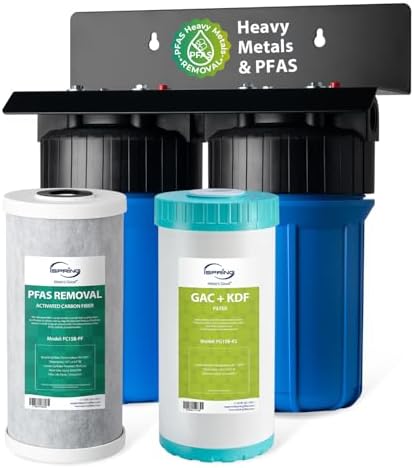
The best-ranked product on the page cites a named lab for its PFAS media and no standard at all.
Key Specifications
| Type | Whole-house, 2-stage, point of entry |
|---|---|
| PFAS claim rests on | SGS-tested media; no standard cited |
| PFAS wording | Up to 99% of PFAS, including PFOA and PFOS |
| Microplastics | Not mentioned |
| Stage 1 | KDF and GAC; sediment to 5 microns |
| Stage 2 | PFAS media |
| Filter life | Up to 50,000 gallons or 12 months |
| Connections | 1 in NPT inlet and outlet |
| Size and weight | 18.0 x 16.0 x 8.0 in; 21.0 lb |
| Warranty | 1 year; lifetime US-based technical support |
| Seller | Amazon.com |
| Best Sellers Rank | #3,791 overall; #3 in Whole House Water Treatment Systems |
Why We Recommend It
The most popular filter on the page names a lab, not a standard. The title says “SGS-Tested to Reduce 99% PFAS”, and the second bullet explains: “Stage 2 features SGS-tested media for advanced removal of up to 99% of PFAS, including PFOA and PFOS.” SGS is a large testing and inspection company, so a lab is named, which is more than three listings here manage. No standard number appears anywhere, and the listing does not say which method SGS used.
Note what was tested. The bullet says media. Testing a filter medium in a lab and certifying a finished system plumbed into a house at household flow are different things, and the listing does not claim the second. The title compresses the bullet into “SGS-Tested to Reduce 99% PFAS”; the bullet itself says “up to 99%”. “Up to” is a ceiling. PFOA and PFOS are named, and “PFAS” is otherwise left undefined.
Whole-house is a different job. This system goes at the point of entry, with “standard 1” NPT ports”, so every tap, shower and appliance gets stage-one and stage-two water. Stage 1 uses “high-performance KDF and granular activated carbon (GAC)” against chlorine, chloramine, lead, mercury, hydrogen sulfide, radon, pesticides and more, and takes out particles “as small as 5 microns”. Each filter is rated “up to 50,000 gallons or 12 months”. Water moves through a whole-house filter far faster than through a pitcher or an under-sink cartridge, and contact time is one of the things PFAS media depend on, which is why many households pair point-of-entry treatment with a dedicated drinking-water filter. The listing itself suggests pairing with an iSpring reverse osmosis system “For TDS-free water”.
The listing’s own scope claim is broad. It describes the system as suiting “both city water and well water filter system needs” and fitting “apartments, small homes, or vacation houses”. Well water can carry iron, hardness or bacteria that this two-stage design does not claim to address, and whether a whole-house unit can go into an apartment is a question for the landlord as much as the plumbing. Microplastics are not mentioned.
What to weigh. It is sold by Amazon.com and ranks #3,791 overall and #3 in Whole House Water Treatment Systems, the best rank on the page by a distance. It weighs 21.0 pounds, measures 18.0 by 16.0 by 8.0 inches and carries a 1-year warranty with lifetime US-based technical support. Buy it if whole-home treatment is the goal; ask iSpring for the SGS report, and do not treat it as a substitute for checking what your drinking tap delivers.
Pros
- Best rank on the page; #3 in its category
- Named lab, SGS
- PFOA and PFOS named
- Treats every tap in the house
- Up to 50,000 gallons or 12 months per filter
- 1 in NPT; lifetime US technical support
Cons
- No standard cited
- Testing is of the media, not the system
- “Up to 99%” is a ceiling
- Microplastics not mentioned
- Plumbing work at the point of entry
- Well-water scope broader than its stages suggest
Best for: A homeowner who wants PFAS media on every tap and is prepared to plumb at the point of entry.
7. Clearly Filtered Water Filter Pitcher, 10 Cup, P-V3 — Most Contaminants Claimed

NSF certification and a third-party PFAS claim sit in the same listing, and they are not the same thing.
Key Specifications
| Type | Gravity-fed pitcher |
|---|---|
| PFAS claim rests on | Third-party lab and EPA-accredited laboratories, unnamed |
| NSF certification | NSF/ANSI 43 and 372 (one bullet); 42 and 372 (another) |
| PFAS wording | PFAS/PFOA |
| Microplastics | Named |
| Claimed scope | 386+ contaminants; up to 99.99% |
| Capacity | 80 fl oz, about 10 cups or 2.4 L |
| Filter life | Up to 100 gallons, about 200 refills or 4 months |
| Material | Tritan, BPA- and BPS-free |
| Size and weight | 11.4 x 10.87 x 5.25 in; 2.8 lb |
| Guarantee | 30-day satisfaction guarantee |
| Seller | Clearly Filtered |
| Best Sellers Rank | #17,179 overall; #26 in Pitcher Water Filters |
Why We Recommend It
This listing says NSF and PFAS often, and keeps them in separate boxes when it is precise. The first bullet says the pitcher “is backed by NSF certification and targets 386+ contaminants at up to 99.99% removal, including fluoride, lead, PFAS/PFOA, arsenic, microplastics, chlorine, and perchlorate.” Read quickly, that sounds like NSF certification for PFAS. The last bullet sets out what the certification covers: “Certified by NSF to NSF/ANSI Standards 42 & 372 for chlorine taste and odor reduction and lead-free materials. It is also independently tested beyond certification standards by EPA-accredited laboratories.” So the NSF certificate is for chlorine taste and odour and for materials. The PFAS claim rests on independent lab testing.
The listing contradicts itself on the standard number. The fifth bullet says “NSF certified to NSF/ANSI 43 and 372”; the sixth says 42 and 372. We report both. As general context, 42 is the familiar aesthetic standard for chlorine taste and odour, which matches the sixth bullet’s description. Either way, neither number is a PFOA/PFOS standard.
Its best point is transparency, as claimed. “Removal rates for fluoride, lead, chlorine, heavy metals, pharmaceuticals, PFAS, phthalates, microplastics, and VOCs are all publicly available.” No other listing here says its test results are published. The lab is not named on the listing, and neither are the PFAS compounds beyond PFOA. If you buy on the basis of that report, read it first: it should say which compounds were tested, at what starting levels and over how many gallons.
It claims the most contaminants on the page. 386-plus, and “up to 73x more contaminants than typical store-bought filters”, through what the listing calls “Affinity Filtration Technology” that “uses ionic binding to capture contaminants while preserving beneficial minerals”. The count is a claim, not a list. Microplastics are named, so it earns credit on the secondary question.
The practical specs are complete. It holds “80 fl oz (approximately 10 cups / 2.4 L)”, fits standard fridge shelves at 11.4 by 10.87 by 5.25 inches, and lists 2.8 pounds. The filter handles “up to 100 gallons, approximately 200 refills or roughly 4 months of daily use”. The body is Tritan, stated as BPA-free and BPS-free. There is a “100% Satisfaction Guarantee for the first 30 days” rather than a stated warranty term.
What to weigh. It is sold by the brand and ranks #17,179 overall and #26 in Pitcher Water Filters. Against the Epic, it offers published results and a stated capacity; the Epic offers PFOA/PFOS standard numbers as test methods. Neither is certified to 53 for PFAS on its listing.
Pros
- Says removal rates are publicly available
- Microplastics named
- Capacity stated: 80 fl oz, about 10 cups
- Up to 100 gallons per filter
- Tritan, BPA- and BPS-free
- NSF certification for chlorine and materials
Cons
- NSF certification does not cover the PFAS claim
- Lab not named on the listing
- Standard given as 43 in one bullet, 42 in another
- Only PFOA named among PFAS
- 386+ is a count, not a list
- 30-day guarantee, no stated warranty term
Best for: A pitcher buyer who will read a published lab report before trusting a PFAS figure.
8. Waterdrop 15UA-PF Under Sink Water Filter System, Reduce 80+ Impurities — Best No-Drill Under-Sink

Precise PFOA and PFOS percentages from a lab it does not name, in the easiest under-sink install here.
Key Specifications
| Type | Under-sink, connects to existing faucet |
|---|---|
| PFAS claim rests on | Third-party lab, unnamed; no standard |
| PFAS wording | 99.9% PFOA, 99.8% PFOS |
| Microplastics | Not mentioned |
| Other figures | 99.5% chlorine, 88.8% fluoride, 96% chloramine |
| Flow | 2.83 oz per second |
| Filter life | Up to 6 months or 1,000 gallons |
| Replacement filter | WD-RF15-PF |
| Installation | No drilling; no separate faucet; 3/8 to 1/2 in converter included |
| Dimensions | 16.7 H x 3.9 x 3.6 in |
| Warranty | 1 year |
| Seller | Waterdrop Filtration Tech |
| Best Sellers Rank | #16,389 overall; #30 in Under-Sink & Countertop Filtration |
Why We Recommend It
The numbers are precise; the source is not. The first bullet says: “Tested by a third-party lab, this under-sink water filtration system effectively reduces 99.5% chlorine, 88.8% fluoride, 99.9% PFOA, 99.8% PFOS, 96% Chloramine, and over 80 other impurities.” That is a specific figure for each of the two named compounds, and the listing says the system was tested, not just the media. What it does not say is which lab, which method or what starting concentration. No standard number appears anywhere on the listing.
Precision is not the same as provenance. A decimal place makes a claim feel measured, and it may well be. But a PFOA percentage depends on how much PFOA went in, at what flow and over how many gallons of the filter’s rated life, and a certification standard exists to fix those conditions. Without a standard or a named lab, the 99.9% and 99.8% cannot be compared with the VIOMI’s figures, which sit next to a 53 certification, or with anything else on this page. Ask Waterdrop for the report.
It is the simplest under-sink installation here. “This system connects Directly to your current kitchen faucet. It does NOT come with a separate dedicated faucet, and you do NOT need to drill any holes in your countertop.” The kit includes inlet and outlet hoses, screws, Teflon tape and a 3/8-inch to 1/2-inch converter, and the filter swaps in “3-second” fashion. For a renter, or anyone who does not want a second faucet, that is the strongest practical argument on the page. Our under-sink water filter roundup covers more systems of this type.
Flow and life are stated. “a strong flow rate of 2.83 oz/sec” through a “3/8″ wider outlet”, which is about 1.3 gallons per minute by our arithmetic. One filter lasts “up to 6 months or 1,000 gallons”, and the replacement is the WD-RF15-PF. The listing warns that “The extended filter life of this filter requires more filter materials, resulting in a larger product size”, and it is 16.7 inches tall, so measure the cabinet. It also notes the carbon is from coconut shells, with an allergy caution.
It keeps minerals and says so. A bullet explains that a TDS meter will not show much change because the filter keeps calcium, potassium, sodium and magnesium. That is honest, and it is also a reminder that this is a carbon filter, not reverse osmosis. Microplastics are not mentioned.
What to weigh. It is sold by Waterdrop Filtration Tech, ranks #16,389 overall and #30 in Under-Sink & Countertop Filtration, and carries a 1-year warranty with 24/7 support. Among filters that connect to an existing faucet, nothing here is easier to fit. Treat its PFOA and PFOS figures as the brand’s, not a certifier’s.
Pros
- 99.9% PFOA and 99.8% PFOS stated
- No drilling and no second faucet
- Up to 6 months or 1,000 gallons per filter
- Flow stated, 2.83 oz per second
- Full fitting kit with converter
- 1-year warranty; 24/7 support
Cons
- No standard cited
- Lab not named
- Microplastics not mentioned
- 16.7 in tall; check cabinet space
- Coconut-shell carbon allergy caution
- Not reverse osmosis; minerals and TDS stay
Best for: A renter or minimalist who wants an under-sink PFOA/PFOS claim without drilling or a second faucet.
9. Aquagear Water Filter Pitcher, 10 Cup, 120 Gallon Filter Life — Best Recycling Programme

PFOA, PFOS and microplastics in the title, “third-party tested” behind them, and no figure for any.
Key Specifications
| Type | Gravity-fed pitcher |
|---|---|
| PFAS claim rests on | Third-party tested, unnamed; no standard |
| PFAS wording | PFOA, PFOS |
| Microplastics | Named |
| Capacity | 10 cups |
| Filter life | 120 gallons |
| Minerals | Calcium and magnesium retained, stated |
| Recycling | Postage-paid return label included |
| Filter media | Made in USA, ISO 9000 facility |
| Size and weight | 11.0 x 11.0 x 6.0 in; about 2.34 lb |
| Seller | Aquagear® |
| Best Sellers Rank | #115,366 overall; #76 in Pitcher Water Filters |
Why We Recommend It
It names the right compounds and gives no numbers for them. The title reads “Lead, Chlorine, PFOA/PFOS, Microplastics Filter”, and the first bullet says the pitcher is “Third-party tested to filter lead, chlorine, microplastics, PFOA, PFOS, and more contaminants other filters miss.” PFOA and PFOS are named, which puts it ahead of the listings that say only “PFAS”. But there is no percentage, no lab and no standard. “Third-party tested to filter” tells you a test happened; it does not tell you what the result was.
The comparison claim is vague. “Removes 20X more contaminants than a traditional pitcher.” The listing does not say which pitcher is traditional or how the twentyfold was counted. Set beside Clearly Filtered’s 73x and ZeroWater’s 5x, the multipliers on this page tell you more about copywriting than about filters, because none of them names the baseline.
The filter life is the longest of the pitchers. “Each Aquagear filter lasts 120 gallons—three times longer than most standard filters.” That beats the 100 gallons Epic and Clearly Filtered state, and the 40 gallons LifeStraw gives for its carbon and ion-exchange stage. A rated life is the point at which the maker stands behind its claims; past it, all bets are off, so a longer rating is worth something on a PFAS filter.
It is the only listing with a recycling programme. “We send you a postage-paid label so you can return your filter for recycling and keep it out of the landfill.” It also says it keeps “healthy minerals like calcium and magnesium” in, and that the filter media is made in the USA in an ISO 9000 facility. ISO 9000 is a quality-management standard, about how a factory runs, not about what a filter removes.
What to weigh. It holds 10 cups, measures 11.0 by 11.0 by 6.0 inches and lists about 2.34 pounds, rounded here from the listed figure. It is sold by Aquagear and ranks #115,366 overall and #76 in Pitcher Water Filters, the weakest rank on the page. Microplastics are named. Buy it for the 120-gallon life and the recycling label; ask Aquagear for the test report before you rely on the PFOA and PFOS line.
Pros
- PFOA and PFOS named
- Microplastics named
- 120 gallons per filter, longest pitcher figure here
- Postage-paid filter recycling
- Calcium and magnesium retained, stated
- Filter media made in USA
Cons
- No percentage for any contaminant
- No lab or standard named
- “20X” has no stated baseline
- Weakest rank on the page
- Warranty not stated
- ISO 9000 is a factory standard, not a filter one
Best for: A pitcher buyer who values long filter life and recycling, and will request the test data.
10. LifeStraw Home Water Filter Pitcher, 7-Cup, Pebble — Best Small Pitcher
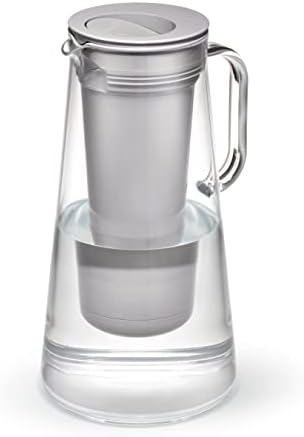
The one listing that says it reduces PFAS and cites nothing at all for it.
Key Specifications
| Type | Gravity-fed pitcher, two-filter |
|---|---|
| PFAS claim rests on | Nothing named |
| PFAS wording | “PFAS (‘forever chemicals’)” |
| Microplastics | Named |
| Other claims | Bacteria, parasites, lead, mercury, chlorine, herbicides, pesticides |
| Capacity | 7 cups |
| Filter life | Membrane 264 gallons (1 year); carbon + ion exchange 40 gallons (2 months) |
| Minerals | Magnesium and potassium retained, stated |
| Size and weight | 11.25 x 5.8 x 9.44 in; about 2.27 lb |
| Made in | United States |
| Seller | Amazon.com |
| Best Sellers Rank | #46,959 overall; #49 in Pitcher Water Filters |
Why We Recommend It
This is the bottom of the evidence ladder. The second bullet says the pitcher “Reduces lead, mercury, and chemicals including PFAS (‘forever chemicals’), chlorine, herbicides, pesticides, dirt, sand, and cloudiness.” No standard, no certifier, no lab and no figure appears anywhere on the listing. No PFAS compound is named. That does not mean the filter does nothing; it means the listing gives you nothing to check. Of the ten, it is the only one in that position.
Its real distinction is the membrane. “The only water filter pitcher that removes bacteria and parasites, in addition to microplastics.” It uses two filters: a “membrane microfilter” that “lasts 264 gallons (1 year)”, and an “activated carbon + ion exchange filter” that “lasts 40 gallons (2 months)”. Carbon and ion exchange are, as general context, two of the approaches commonly used against PFAS, so the media are of the right kind. The “only pitcher” claim conflicts with the Epic listing, which also names bacteria and viruses; we report both.
The 40-gallon stage is the one that matters for PFAS. The membrane’s year-long life is for particles and microbes. The chemical claims, PFAS among them, ride on the carbon and ion-exchange filter, and that is rated at 40 gallons, the shortest filter life on the page. Against Aquagear’s 120 gallons, that is a third of the volume per filter. If you buy this pitcher for PFAS, plan around the two-month change, not the one-year one.
Microplastics are named, in the title and the first bullet, so it earns credit on the secondary question. It is a small pitcher: 7 cups, 11.25 by 5.8 by 9.44 inches, about 2.27 pounds rounded from the listing. It says it retains “essential minerals like magnesium and potassium” and is made in the United States.
What to weigh. It is sold by Amazon.com and ranks #46,959 overall and #49 in Pitcher Water Filters. If microbes and microplastics are your worry, it is the only pitcher here built around a membrane. If PFAS is the main worry, every other listing on this page gives you more to go on.
Pros
- Membrane microfilter for bacteria and parasites
- Microplastics named
- Membrane rated 264 gallons, 1 year
- Small 7-cup body
- Sold by Amazon.com
- Made in the United States
Cons
- No standard, certifier, lab or figure for PFAS
- No PFAS compound named
- Chemical stage rated 40 gallons, shortest here
- Two filters to track
- Smallest capacity on the page
- “Only pitcher” claim conflicts with Epic
Best for: A small household worried first about microbes and microplastics, with PFAS secondary.
Three Grades of Evidence, Counted
Put the ten PFAS claims side by side and they fall into three groups, by what the listing cites. The groups are about paperwork, not performance. A filter in the bottom group may work well; a filter in the top group may hold a narrower certificate than its copy implies. But the groups tell you how much you can check before you buy.
| What the listing cites | Count | Filters | Exact basis |
|---|---|---|---|
| A PFOA/PFOS standard number: NSF/ANSI 53, 58 or P473 | 3 | Aquasana, VIOMI, Epic | Meets 42, 53, 58, 401 (WQA); certified 53, 42, 372; certified 42, tested against 53 and P473 |
| A certifier, a lab or third-party testing, but no PFOA/PFOS standard | 6 | ZeroWater, MaxClear, iSpring, Clearly Filtered, Waterdrop, Aquagear | IAPMO, no number; NSF/ANSI 42; SGS-tested media; unnamed third-party and EPA-accredited labs; unnamed lab; unnamed third party |
| “Reduces PFAS”, nothing cited | 1 | LifeStraw | None |
Inside the middle group, there are steps. Three of the six name the body involved: IAPMO for the ZeroWater, NSF/ANSI 42 for the MaxClear, and SGS for the iSpring. Two of those, both Culligan, use the word “certified” for PFAS. The other three, Clearly Filtered, Waterdrop and Aquagear, rely on testing by a lab they do not name. Clearly Filtered at least says its results are public.
Inside the top group, there are steps too. Only one listing, the Aquasana, cites 58, and it also names its certifier. The VIOMI claims certification to 53 but ties it to lead. The Epic cites 53 and P473 only as standards it was tested against. Not one listing on the page says, in a single sentence, that it is certified to NSF/ANSI 53 or 58 for PFOA and PFOS reduction. That is the sentence to look for, and the certifier’s database is where to confirm it.
The compounds named are a second filter. Five listings name PFOA and PFOS: VIOMI, Epic, iSpring, Waterdrop and Aquagear. Clearly Filtered names PFOA alone, as “PFAS/PFOA”. Two Culligan listings say “Total PFAS”. Aquasana and LifeStraw say only “PFAS”. Three give a PFAS percentage: VIOMI, Waterdrop and iSpring. Every percentage on this page is the listing’s own, and none is a promise about your water.

What PFAS Means on a Label, and What It Cannot
PFAS is a family, not a chemical. Per- and polyfluoroalkyl substances number in the thousands. They are used for non-stick, stain-resistant and water-repellent finishes and in firefighting foams, and they break down very slowly, hence “forever chemicals”. Our non-stick, non-PFAS frying pan guide covers the cookware side of the same family.
Listings name two because tests name two. PFOA and PFOS are the most studied PFAS, and they were the compounds in NSF’s original P473 protocol. When a listing says “reduces PFAS” and names nothing else, the honest reading is that some PFAS were reduced in some test. When it says “Total PFAS”, it means a defined group in a defined test, and the listing should say which. No household filter can be shown to remove every PFAS, and none of the ten here claims to in so many words.
“Up to” is a ceiling, not an average. Aquasana’s and Epic’s “up to 99.99%” covers a whole list of contaminants. iSpring’s “up to 99%” is for PFAS. A reduction percentage also depends on the starting concentration and on where in its rated life the filter was tested; a certification standard fixes those conditions, and an unreferenced percentage does not tell you what they were.
Your water decides what matters. PFAS levels vary widely between supplies. In the US, community water systems publish an annual consumer confidence report, usually available on the utility’s website, and many now report PFAS sampling. If you are on a private well, a certified lab test is the only way to know. Read the report before you choose a filter: it tells you whether PFAS is your problem at all, and what else, such as lead or nitrate, a filter should be certified for.
The Best Water Filter for Microplastics: Six Listings Say the Word
Microplastics are the secondary question here, and we credit a filter only if its listing mentions them. Six do. Four do not, including both of the filters with the most specific PFOA and PFOS figures.
| Filter | Microplastics | What backs it | Type |
|---|---|---|---|
| Aquasana SmartFlow | Named | Same bullet as meets 42, 53, 58, 401 | Reverse osmosis |
| Epic Pure XP | Named | Same bullet as tested against 53, 401, P231, P473 | Pitcher |
| Culligan MaxClear | Named | “certified to NSF/ANSI 42” | Gravity |
| Clearly Filtered | Named | Independently tested; results said to be public | Pitcher |
| Aquagear | Named | Third-party tested | Pitcher |
| LifeStraw Home | Named | Membrane microfilter; no test cited | Pitcher |
| VIOMI V6 | Not mentioned | — | Reverse osmosis |
| Waterdrop 15UA-PF | Not mentioned | — | Under-sink |
| iSpring Whole House | Not mentioned | — | Whole house |
| Culligan ZeroWater | Not mentioned | — | Dispenser |
For PFAS and microplastics together, the Aquasana and the Epic lead. They are the only two listings that cite a PFOA/PFOS standard number and also name microplastics, the Aquasana as an installed reverse osmosis system and the Epic as a pitcher. The LifeStraw is the only one whose design, a membrane microfilter, is built around particles; its PFAS claim is the weakest on the page.
Silence is not proof of absence. The VIOMI’s 0.0001μm reverse osmosis membrane is finer than anything else here, and the Waterdrop and iSpring may well catch plastic particles. But their listings do not say so, and on this page a claim has to be made to be credited. If microplastics are your main concern, buy a listing that names them.
Popularity Runs Against the Paperwork
Star ratings were not captured for this roundup, so the only popularity measure is Amazon’s Best Sellers Rank, as returned on 5 October 2026. Amazon files these ten in three categories, so the overall rank is the fairer comparison.
| Filter | Overall rank | Category rank | PFAS claim rests on |
|---|---|---|---|
| iSpring Whole House | #3,791 | #3 in Whole House Water Treatment Systems | SGS-tested media |
| Culligan ZeroWater | #6,317 | #23 in Pitcher Water Filters | IAPMO, no standard |
| Epic Pure XP | #12,660 | #37 in Pitcher Water Filters | Tested against 53, P473 |
| Aquasana SmartFlow | #14,610 | #135 in Under-Sink & Countertop Filtration | Meets 42, 53, 58, 401 |
| Waterdrop 15UA-PF | #16,389 | #30 in Under-Sink & Countertop Filtration | Unnamed lab |
| Clearly Filtered | #17,179 | #26 in Pitcher Water Filters | Unnamed labs |
| LifeStraw Home | #46,959 | #49 in Pitcher Water Filters | Nothing |
| VIOMI V6 | #54,746 | #82 in Under-Sink & Countertop Filtration | Certified 53 (lead) |
| Culligan MaxClear | #92,495 | #147 in Pitcher Water Filters | NSF/ANSI 42 |
| Aquagear | #115,366 | #76 in Pitcher Water Filters | Unnamed third party |
The two best sellers sit in the middle group. The iSpring and the ZeroWater lead overall, and both put a named organisation on their PFAS claim, SGS and IAPMO, without a standard number. Both titles carry the PFAS promise up front: “SGS-Tested to Reduce 99% PFAS” and “Removes PFAS”. The three listings that cite 53, 58 or P473 rank third, fourth and eighth. Whatever is moving these filters, it is not the standard number, which is one more reason to look for it yourself.
Best Alternatives
| Alternative | Why Consider It | Better For | Main Trade-Off |
|---|---|---|---|
| A general-purpose pitcher; see our water filter pitcher guide | Wider choice when PFAS is not on your water report | Chlorine taste and odour | Most do not claim PFOA or PFOS at all |
| A countertop filter; see our countertop water filter roundup | More media than a pitcher without plumbing | Renters with counter space | Counter footprint; claims vary as much as here |
| A faucet-mounted filter; see our faucet water filter guide | Filters on demand at the tap | Small kitchens and renters | Small cartridges and short filter life |
| A filter certified for your report’s contaminant | Matches the problem you actually have | Lead, nitrate or hardness issues | May not claim PFAS at all |
What Each Step Up in Format Actually Buys
Pitchers and dispensers — LifeStraw, Aquagear, Clearly Filtered, Epic, ZeroWater. No installation, fridge-friendly, and the lowest commitment. Capacity runs from 7 cups on the LifeStraw to 32 on the ZeroWater, and the chemical filter’s life from 40 gallons to 120. Gravity gives the media little pressure, which is why stated filter life matters more here than anywhere: change on time or the claim lapses. Only the Epic cites a PFOA/PFOS standard number, as a tested-against method.
Gravity system — Culligan MaxClear. A bigger vessel and ceramic-shell filters rated up to 6 months, with no plumbing or power. It buys independence from the mains and a stainless body, at the cost of 26 inches of counter height and a 42 certification whose scope for PFAS is unclear.
Under-sink carbon — Waterdrop 15UA-PF. Water on tap at about 1.3 gallons per minute by our arithmetic, 1,000 gallons or 6 months per filter, and no drilling. It buys convenience and stated PFOA and PFOS percentages; it gives up any standard number and leaves minerals and TDS in.
Reverse osmosis — VIOMI V6 and Aquasana SmartFlow. The format that also cuts dissolved solids and fluoride, and the one where PFOA/PFOS standard numbers appear. It buys the strongest paperwork on the page, at the cost of drilling, drain connections, a dedicated faucet, and power for the VIOMI or a tank for the Aquasana.
Whole house — iSpring. Every tap, 50,000 gallons or 12 months per filter, 1-inch plumbing. It buys coverage, not depth: a point-of-entry unit moves water fast, and its PFAS claim rests on SGS-tested media without a standard. Many households would still want a certified drinking-water filter at the kitchen tap.

What to Check Before You Buy
Read Your Water Report First
Your utility’s consumer confidence report, or a certified lab test for a private well, tells you whether PFAS is in your water and at what level, and what else is. A filter certified for lead does nothing for a nitrate problem. If your report shows no PFAS detections, the right filter may be one certified for whatever it does show.
Find the Standard Number
Look for NSF/ANSI 53, or 58 for reverse osmosis, tied to PFOA and PFOS. Three listings here cite 53, 58 or P473, and none ties the number to PFAS in a single sentence. A standard named for chlorine taste, such as 42, is not a PFAS certification.
Separate “Certified To” From “Tested Against”
Certification means an accredited body issued a certificate and keeps checking. “Tested against” a standard means a lab ran the method. Epic uses both phrases, for different standards, on the same line. Read the verbs.
Look Up the Certificate
NSF, WQA and IAPMO each publish searchable listings of certified products. Search the model number: AQ-SFRO2-BN, ZEROD32, MCS701B and so on. The listing shows exactly which contaminants are covered under which standard, which is the detail no Amazon bullet on this page gives in full.
Ask Which PFAS
Five listings here name PFOA and PFOS; others say “PFAS” or “Total PFAS” and stop. If your report names other PFAS, ask the maker whether those were tested.
Budget for the Filter Life
Stated lives run from 40 gallons on the LifeStraw’s chemical stage to 50,000 gallons on the iSpring, and two listings, the ZeroWater and the Aquasana, give no figure in gallons or months. A PFAS claim holds only within the rated life.
Measure for the Installation
The VIOMI needs two holes, a dedicated outlet and 2.0 to 3.9 inches of rear clearance. The Waterdrop needs 16.7 inches of cabinet height and no drilling. The Aquasana needs room for a tank. The iSpring goes on a 1-inch main line. Renters should check what they are allowed to fit.

Common Mistakes
- Reading “NSF Certified” as a PFAS certificate. Epic and Clearly Filtered are NSF certified for taste, odour or materials; their PFAS claims rest on testing.
- Treating a named lab as a standard. The iSpring, the best seller here at #3,791, cites SGS-tested media and no standard.
- Assuming “Total PFAS” means every PFAS. Two Culligan listings use it and neither names a single compound.
- Trusting a decimal place. Waterdrop’s 99.9% PFOA comes from a lab it does not name, under no stated standard.
- Reading a TDS meter as a PFAS test. The ZeroWater meter tracks dissolved solids; PFAS are far too dilute to register.
- Changing the wrong filter on time. The LifeStraw membrane lasts 264 gallons, but its chemical stage lasts 40.
- Assuming microplastics are covered. Four of ten listings never mention them, including the VIOMI and the Waterdrop.
- Buying before reading the water report. No listing here knows your supply; the consumer confidence report does.
Who Should Buy Which
Buy the Aquasana SmartFlow if you want the most standards behind the claim. It is the only listing citing both NSF/ANSI 53 and 58, under a WQA heading, with microplastics named and a remineralizer. Accept a tank under the sink, recommended professional installation and no stated filter life.
Buy the VIOMI V6 if you want tankless reverse osmosis and figures per compound. NSF/ANSI 53, 42 and 372 certified, PFOS above 99.88% and PFOA above 99.6% stated, four-year RO filter life. Accept two holes, a dedicated outlet, its own faucet, and a 53 certification the listing ties to lead.
Buy the Epic Pure XP if you want a pitcher with a standard number behind its testing. Tested against 53 and P473, PFOA, PFOS and microplastics named, 100 gallons per filter. Accept that its certification is for 42 and its capacity is not stated.
Buy the Culligan ZeroWater if capacity comes first. 32 cups, a TDS meter and an IAPMO certification for Total PFAS. Look up the certificate, because the listing names no standard and no compounds.
Buy the Culligan MaxClear if you need filtration with no plumbing or power. A stainless gravity system with filters rated up to 6 months and microplastics named. Ask Culligan which standard really covers its PFAS and lead claims.
Buy the iSpring if you want PFAS media on every tap. The best seller here, 50,000 gallons per filter, PFOA and PFOS named. Accept that SGS tested the media, not a certified system, and consider a drinking-water filter as well.
Buy Clearly Filtered if you will read the lab report. 80 fl oz, 100 gallons per filter, microplastics named and results said to be public. Its NSF certificate is not for PFAS.
Buy the Waterdrop 15UA-PF if you cannot drill. It connects to your existing faucet and states 99.9% PFOA and 99.8% PFOS. Accept that the lab and method are not given.
Buy the Aquagear if filter life and recycling matter most. 120 gallons per filter and a postage-paid return label, with PFOA, PFOS and microplastics named. Ask for test figures; the listing has none.
Buy the LifeStraw Home if microbes and microplastics are the worry. A membrane microfilter and a small 7-cup body. For PFAS, it cites nothing, and its chemical stage lasts 40 gallons.
Frequently Asked Questions
What is the best PFAS water filter?
On the evidence its listing gives, the Aquasana SmartFlow Reverse Osmosis System. It is the only one of the ten here that cites both NSF/ANSI 53 and 58, the standards under which PFOA and PFOS reduction claims are usually certified, and it names a certifier, WQA. It also names microplastics and includes a remineralizer. Its weak points are that it does not tie PFAS to a standard in one sentence, does not name which PFAS, and needs a tank and, the listing recommends, professional installation. If you want tankless reverse osmosis, the VIOMI V6 is certified to 53 and states PFOS above 99.88% and PFOA above 99.6%. If you want a pitcher, the Epic Pure XP is the only one here tested against 53 and P473. Whichever you choose, look up its certificate, and check your consumer confidence report first.
Do water filters really remove PFAS?
Some filters are certified to reduce specific PFAS, usually PFOA and PFOS, under standards that fix the test conditions. As general context, reverse osmosis, activated carbon and ion exchange are the approaches most often cited for PFAS reduction. But a reduction claim is not a promise that every PFAS is gone. PFAS is a family of thousands of chemicals, and listings typically name only two. On this page, three listings cite a PFOA/PFOS standard number, six cite a certifier, a lab or third-party testing without one, and one cites nothing. Every percentage given is the maker’s own, measured under conditions the listing does not describe. A filter also performs only within its rated life, which here runs from 40 gallons to 50,000. Treat any PFAS claim as a claim to check, not a guarantee, and match the filter to what your water report shows.
What certification should a PFAS water filter have?
For PFOA and PFOS, look for certification to NSF/ANSI 53, or NSF/ANSI 58 for reverse osmosis systems, issued by an accredited body such as NSF, WQA or IAPMO. NSF’s P473 protocol was the original test for those two compounds. NSF/ANSI 42 is generally used for aesthetic claims such as chlorine taste and odour, and 372 covers lead-free materials, so neither is a PFAS certification. On this page, the Aquasana cites 53 and 58, the VIOMI cites 53, and the Epic cites 53 and P473 as standards it was tested against. Then confirm it. Each certifier publishes a searchable database; search the model number and read which contaminants appear against which standard. A listing’s bullets are a summary, and on this page no listing ties PFOA and PFOS to a standard in a single sentence.
Is reverse osmosis the best way to remove PFAS at home?
It is one of the approaches most often cited for PFAS reduction, alongside activated carbon and ion exchange, and it is the only one of the three that also takes out most dissolved solids and fluoride. On this page, the two reverse osmosis systems, the Aquasana SmartFlow and the VIOMI V6, carry the strongest paperwork: the Aquasana cites 53 and 58, and the VIOMI cites 53 and gives PFOS above 99.88% and PFOA above 99.6%. The costs are practical. Reverse osmosis sends some water to drain, the VIOMI states a 3:1 pure-to-drain ratio, and it strips minerals unless the system adds them back, as the Aquasana says it does. Installation means drilling, a drain connection and a dedicated faucet, and the VIOMI also needs an outlet. If you rent or cannot drill, a certified carbon filter may be the realistic choice.
Do water filter pitchers remove PFAS?
All five pitchers and dispensers on this page claim to reduce PFAS, and they back the claim very differently. The Epic Pure XP cites NSF/ANSI 53 and P473 as standards it was tested against and names PFOA and PFOS. The Culligan ZeroWater is certified by IAPMO for Total PFAS, with no standard named. Clearly Filtered and Aquagear rely on lab testing by labs they do not name. The LifeStraw Home cites nothing. Gravity gives a pitcher filter very little pressure, so filter life matters: stated figures run from 40 gallons on the LifeStraw’s chemical stage to 120 on the Aquagear, and the ZeroWater gives none. A pitcher claim holds only if you change the filter on time. If you choose a pitcher for PFAS, choose one whose listing gives you a standard or a published report to check.
What is the best water filter for microplastics?
Of the ten filters here, six mention microplastics on their listings: the Aquasana SmartFlow, the Epic Pure XP, the Culligan MaxClear, Clearly Filtered, Aquagear and the LifeStraw Home. We credit only those six. For microplastics and PFAS together, the Aquasana and the Epic lead, because they are the only two that also cite a PFOA/PFOS standard number, the Aquasana as an installed reverse osmosis system and the Epic as a pitcher. The LifeStraw is built around a membrane microfilter, which suits particles and microbes, but cites nothing for its PFAS claim. The Culligan MaxClear is the only one to place microplastics under a specific standard, NSF/ANSI 42. Four listings do not mention microplastics at all, including the VIOMI and the Waterdrop, so if particles are your main worry, buy a listing that names them.
Do I need a whole house PFAS filter?
Most PFAS exposure from water comes from drinking and cooking, which is why most PFAS filters, and most certifications, are for the kitchen tap. A whole-house system such as the iSpring on this page treats every tap, shower and appliance at the point of entry. Its listing claims SGS-tested media that reduce up to 99% of PFAS, including PFOA and PFOS, with filters rated up to 50,000 gallons or 12 months, but cites no standard. Water moves through a whole-house filter quickly, and contact time matters for PFAS media, so many households pair point-of-entry treatment with a certified drinking-water filter. Installation is plumbing work on a 1-inch main line. Read your water report before deciding: if PFAS levels are high, a certified drinking-water filter is usually the first step, and whole-house treatment a second one.
How do I find out if my tap water has PFAS?
If you are on a public supply in the US, start with your utility’s consumer confidence report, the annual water quality report community water systems must publish. It is usually on the utility’s website, and many utilities now report PFAS sampling results. If PFAS is not listed, call the utility and ask whether they have tested. If you are on a private well, nobody tests it for you; a state-certified laboratory can test for PFAS, and your state health or environment agency can point you to one. The result tells you whether you need a PFAS filter at all, which compounds to look for on a certificate, and what else your water contains, such as lead or nitrate, that a filter should also be certified for. No filter listing on this page can answer that question for your house.
Final Verdict
The only listing citing NSF/ANSI 53 and 58 under a WQA heading, with PFAS and microplastics named and a remineralizer.
Certified to NSF/ANSI 53, 42 and 372, with PFOS above 99.88% and PFOA above 99.6% stated.
The only pitcher tested against 53 and P473, with PFOA, PFOS and microplastics named and 100 gallons per filter.
Ten filters promise to reduce PFAS, and three cite a number you can check it against. The Aquasana meets 53 and 58 under a WQA heading. The VIOMI is certified to 53. The Epic is tested against 53 and P473. Even those three never tie PFOA and PFOS to a standard in a single sentence.
The other seven ask for more trust. Six name a certifier, a lab or third-party testing without a PFOA/PFOS standard: IAPMO, NSF/ANSI 42, SGS-tested media, or labs left unnamed. One, the LifeStraw, cites nothing. The two best sellers on the page, the iSpring and the ZeroWater, are both in that middle group.
So buy a PFAS filter by the paperwork, and start with your own water. Read your consumer confidence report or test your well. Look for NSF/ANSI 53 or 58 tied to PFOA and PFOS, separate “certified to” from “tested against”, look the model up in the certifier’s database, and change the filter within its rated life. No filter here removes every PFAS, and none can make a promise about your tap that your water report has not made first.
If you buy one filter from this page, make it the Aquasana SmartFlow: the most standards cited, a named certifier, microplastics named and a remineralizer. If you cannot fit a tank, the VIOMI V6 is the tankless choice with figures per compound; if you cannot drill at all, the Epic Pure XP is the pitcher with a standard number behind its testing.