Affiliate Disclosure: As an Amazon Associate, we earn from qualifying purchases. This does not affect the price you pay.
Pick up almost any budget espresso machine with a built-in grinder and the first number you read is the pressure. Six of the ten machines in this guide print “20 bar”, most of them in the title. Two print 15 bar. It is the number the boxes compete on, and for a beginner it is the least useful number on the box.
A bar figure on a home espresso machine is normally the rating of its pump: how hard the pump can push against a blocked outlet. It is not the pressure your coffee sees. The conventional target for espresso, in cafés and at home, is around 9 bar at the coffee puck, and a machine reaches it, or misses it, depending on the grind, the dose and the tamp far more than on the pump. A 20-bar pump does not make a 20-bar shot, and nobody wants one.
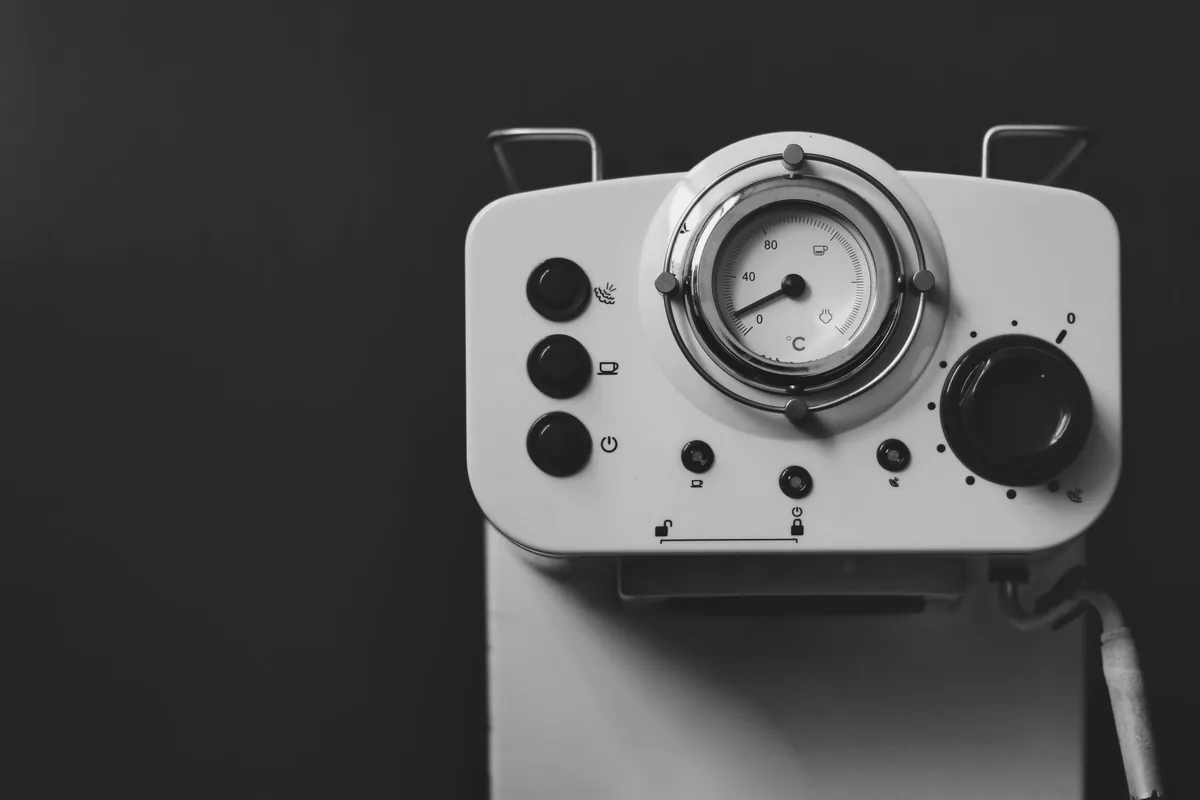
What a beginner actually needs printed is different. A brew temperature you can see and set. A word on pre-infusion, which wets the coffee gently before full pressure and forgives an uneven tamp. A pressure gauge, so you can tell whether the grind is too fine or too coarse without guessing. The size of the portafilter, because every tamper, basket and dosing funnel you buy later depends on it. And the number of grind settings, with some idea of where to start. We read all ten listings for those five things.
Only two of the ten give a brew temperature in degrees, and they are the two cheapest machines on the page. The AMZCHEF states a “3-Level PID Control, 197–205°F” and a 3–10 second pre-infusion. The XIXUBX states 194°F to 203°F, a 1–5 second pre-infusion, a pressure gauge and a 51mm portafilter. It is the only listing here that states all five things we looked for. It is also one of only two that never print a bar figure at all.
The machines in the middle of the range say less. Six listings sit in the middle tier. Between them they average fewer than one and a half of the five beginner controls. The Electactic states a 15-bar pump and none of the five. And the Electactic and the Kismile carry the same model number, CM5020B-UL, and the same three outside dimensions in a different order, while one says 15 bar and the other says 20.
Two machines take the other road. The Ninja Luxe Café Mini Plus and the EUHOMY CM004-02 automatic do not print the controls because they set them for you. For some beginners that is the right answer. For a beginner who wants to learn to pull a shot, it removes the lesson.
This is the budget and beginner guide; our sibling post covers the premium tier. Everything here sits at the budget and mid-range end, so it also answers the best budget espresso machine with grinder and the best espresso machine with grinder under 500.
The ten run from the AMZCHEF to the Ninja Luxe Café Mini Plus as captured on 5 October 2026, and the two that state the most controls are the two that cost the least.
Our Quick Picks
 Best OverallAMZCHEF Espresso Machine With Grinder
The cheapest machine here, with a 197–205°F PID, 3–10 s pre-infusion, 20 grind settings and 4.4 across 183 ratings.
 Most Stated ControlsXIXUBX EM910 Espresso Machine With Grinder
The only listing that states all five beginner controls, including a gauge and a 194–203°F PID; 4.2 across 53 ratings.
 Least Skill NeededNinja Luxe Café Mini Plus ES351
Sets grind, dose, temperature and pressure for you and weighs every dose on a built-in scale; 4.5 across 55 ratings.
At a Glance
Ten Machines, With the Bar Figure Beside What Actually Gets Stated
Read the first column last. The middle two columns are the controls a beginner learns on; “Not stated” means the listing is silent, not that the feature is missing.
| # | Model | Stated Pump | Brew Temperature | Gauge & Pre-Infusion | Best Sellers Rank | Standout | Main Drawback | Check Price |
|---|---|---|---|---|---|---|---|---|
| 1 |
 AMZCHEF 5560 |
20 bar | 3-level PID, 197–205°F | Pre-infusion 3–10 s; no gauge stated | #25 in Semi-Automatic Espresso Machines | Cheapest here; states PID range and a 25–30 s shot | No gauge or portafilter size stated | View on Amazon |
| 2 |
 XIXUBX EM910 |
Not stated | PID, 194–203°F | Gauge; pre-infusion 1–5 s | #77 in Semi-Automatic Espresso Machines | States all five beginner controls we looked for | Only 53 ratings; 51mm portafilter; no grind count | View on Amazon |
| 3 |
 Ninja ES351 |
Not stated | Automatic, adjusted in real time | Neither stated; pressure set automatically | #4 in Espresso Machine & Coffeemaker Combos | Built-in scale doses by weight; also brews drip | Dearest here; 55 ratings; you set almost nothing | View on Amazon |
| 4 |
 Gevi 20 Bar + Separate Grinder |
20 bar | Not stated | Neither stated | #16 in Super-Automatic Espresso Machines | Most ratings here, 1,901; 35 grind settings | Two boxes; states none of the five controls | View on Amazon |
| 5 |
 Chefman Crema Supreme |
15 bar | “Customizable”, no range | Gauge; no pre-infusion stated | #29 in Semi-Automatic Espresso Machines | Gauge, 58mm portafilter and a 3-liter tank | Lowest average here, 4.1 across 799 | View on Amazon |
| 6 |
 EUHOMY CM002 |
20 bar | PID ±1°C, no setpoint | Neither stated | #59 in Semi-Automatic Espresso Machines | 700+ bought last month; 58mm; sold by Amazon | Tolerance stated, temperature itself not | View on Amazon |
| 7 |
 Gevi Built-In Grinder |
20 bar | NTC & PID, no range | Neither stated | #105 in Semi-Automatic Espresso Machines | PID with 1,634 ratings behind it | No gauge, pre-infusion or portafilter size stated | View on Amazon |
| 8 |
 Kismile CM5020B-UL |
20 bar | PID ±2°C, no setpoint | Gauge; no pre-infusion stated | #266 in Semi-Automatic Espresso Machines | Gauge, 58mm, PID; tells you which setting to start on | 4.8 rests on just 22 ratings | View on Amazon |
| 9 |
 Electactic CM5020B-UL |
15 bar | Not stated | Neither stated | #62 in Semi-Automatic Espresso Machines | Anti-clog grind chute; 4.4 across 724 | States none of the five; same model as the Kismile | View on Amazon |
| 10 |
 EUHOMY CM004-02 Automatic |
20 bar | Not stated (automatic) | Neither stated (automatic) | #8 in Super-Automatic Espresso Machines | One-touch drinks, automatic milk, self-cleaning | Fewest grind levels, 15; no portafilter to learn on | View on Amazon |
Ratings and specifications are taken from each manufacturer’s Amazon listing as displayed on 5 October 2026 through a United States connection, and may change. Pump figures are as printed, and on a home machine they normally describe the pump’s maximum, not the pressure at the coffee; the conventional espresso target is around 9 bar. “PID” is reported only where the listing names it. The EUHOMY CM002 and the Kismile state a tolerance (±1°C and ±2°C) but no brewing temperature; the Chefman says its shot temperature is customisable but gives no range and does not name PID. The Ninja and the EUHOMY CM004-02 adjust temperature and pressure themselves, so the blanks in their rows reflect the design as much as the copy. The Electactic and the Kismile share model number CM5020B-UL and print the same three dimensions in a different order; one states 15 bar and the other 20. The Gevi with a separate grinder is a two-piece set: an espresso machine and a separate grinder. Ranks are within the sub-category each listing appears in, which differs between machines.
Scroll the table sideways to see every column
How We Chose These Ten
We researched current listings, compared manufacturer specifications and documentation, and examined recurring patterns in customer feedback. We did not carry out hands-on testing, and nothing below is presented as measured performance data.
- A grinder in the box, at a budget to mid-range level — every machine here grinds whole beans, either through a grinder built into the body or, in one case, a matching grinder sold in the same set. All ten sit below the premium tier covered in our sibling post.
- The beginner controls read first — for each listing we looked for five things in the title, bullets and spec table: a brew temperature stated in degrees, the word PID, a pre-infusion setting, a pressure gauge, and a portafilter size. We report exactly what is printed and treat silence as information.
- The bar figure read last — we record each machine’s stated pump pressure, but we do not rank on it. It describes the pump, not the shot.
- Three kinds of machine kept apart — eight semi-automatics you learn on, one assisted machine that sets itself up, and one fully automatic machine that makes drinks at a touch.
- Ratings only with their sample size — every rating below carries its review count, from 22 ratings to 1,901.
- Verified stock and price — each machine was in stock on amazon.com on 5 October 2026 at the buy-box price shown. Six were sold by Amazon.com; four by the brand’s own store.
The Ten Espresso Machines With Grinders in Detail
1. AMZCHEF Espresso Machine With Grinder, 20 Bar (5560) — Best Overall

The cheapest machine on the page, and the one listing that tells a beginner both what temperature it brews at and how long a shot should take.
Key Specifications
| Type | Semi-automatic with built-in grinder |
|---|---|
| Stated pump | 20 bar |
| Brew temperature | 3-level PID, 197–205°F |
| Pre-infusion | Selectable, 3–10 seconds |
| Grind settings | 20 (burr type not stated) |
| Pressure gauge | Not stated |
| Portafilter size | Not stated |
| Heating | 1350W |
| Water tank | 61oz (size field) |
| Rating | 4.4 across 183 ratings |
| Rank | #25 in Semi-Automatic Espresso Machines; 500+ bought in past month |
| Best For | A first machine for someone who wants to learn the shot, on the smallest budget here |
Why We Recommend It
This is the cheapest machine here, and it states more of what matters than most of the dearer ones. The AMZCHEF names a PID controller, gives its range in degrees, gives a pre-infusion time in seconds, gives a grind-settings count and, alone among the ten, tells you what a finished shot should look like on the clock: “With the right grind, dose, and tamp, a typical espresso shot runs for about 25–30 seconds once preheated.” That one sentence is more practical help than most listings on this page offer in their entire copy. It gives a beginner a target, and a target is how you learn to adjust a grinder.
The temperature is stated, set in three steps, and in the right place. The bullet reads “3-Level PID Control, 197–205°F”. A PID is a controller that holds water temperature steady instead of letting it swing between a thermostat’s on and off points. Three levels is not a fine dial, but for a beginner it is enough to matter: the conventional guidance is to brew lighter roasts a little hotter and darker roasts a little cooler, and 197°F to 205°F sits inside the band most espresso guides recommend. Only one other listing on the page, the XIXUBX, gives its brewing temperature as numbers at all.
The pre-infusion range is the widest here. “Choose a pre-infusion time from 3 to 10 seconds to gently wet the coffee before extraction begins.” The listing explains why: when you change beans, roast or grind, a soak before full pressure helps water move more evenly through the coffee. That is a fair description of what pre-infusion is for, and it is the feature that most forgives a beginner’s uneven tamp. The XIXUBX offers 1 to 5 seconds. No other listing here mentions pre-infusion at all.
The grinder is the modest part. Twenty settings is fewer than the 30 or 35 printed by six other listings, and the listing does not say whether the burrs are conical or flat, steel or ceramic. A settings count tells you how many clicks there are, not how far apart they sit, so 20 well-spaced steps at the fine end can be more useful for espresso than 35 spread from espresso to French press. The listing does not say which this is. What it does say is that grinder, brewer and steam wand share one footprint, and at 14.2 inches tall by 9.1 inches wide, it is one of the narrower machines here.
What it leaves out. There is no pressure gauge in the listing, so you will judge the grind by the shot time rather than by a needle. There is no portafilter size, which means checking before you buy a tamper or a bottomless portafilter. There is no warranty term and no weight. The 20-bar figure appears in the title and the first bullet; read it as the pump rating it is. It is sold by AMZCHEF USA, the brand’s own store, not Amazon. The record is short but healthy: 4.4 across 183 ratings, 500+ bought in the past month and an overall rank of #56,088, second only to the Ninja.
Pros
- Cheapest on the page
- PID with a stated range: 197–205°F, three levels
- Pre-infusion from 3 to 10 seconds, the widest range here
- States a 25–30 second target shot time
- 4.4 across 183 ratings; 500+ bought in past month
- Narrow footprint at 9.1 inches wide
Cons
- No pressure gauge stated
- Portafilter size not stated
- Only 20 grind settings; burr type not stated
- No warranty term in the listing
- Sold by the brand store, not Amazon.com
- Temperature in three steps, not a fine dial
Best for: A first-time home barista who wants a stated temperature, pre-infusion and a target shot time for the least money.
2. XIXUBX Espresso Machine With Grinder, PID & Programmable Settings (EM910) — Most Stated Controls

The only listing here that states all five beginner controls, and one of only two that never print a bar figure.
Key Specifications
| Type | Semi-automatic with built-in conical burr grinder |
|---|---|
| Stated pump | Not stated |
| Brew temperature | PID, adjustable 194°F to 203°F |
| Pre-infusion | Adjustable, 1 to 5 seconds |
| Pressure gauge | Yes, visible on the front |
| Portafilter size | 51mm; dosing ring included |
| Grind settings | Adjustable; count not stated |
| Steam | Adjustable 266°F to 302°F; 360° wand |
| Heating | Thermoblock, under 30 seconds stated |
| Water tank | 60 oz, removable |
| Weight | 11.15 lb |
| Warranty | 1-year limited |
| Rating | 4.2 across 53 ratings |
| Best For | A beginner who wants to see and set every variable |
Why We Recommend It
This is the listing that answers the beginner’s questions, and it does not bother with the pressure number. The XIXUBX states a PID with an adjustable range, an adjustable pre-infusion, a visible pressure gauge and a portafilter size. It is the only machine on the page to state all five of the controls we read for. It never says how many bar its pump makes. That is not a gap that matters: the gauge on the front will show you the pressure your coffee actually sees, which is a more useful number than any rating printed on a box.
The temperature and the steam both have numbers. “Adjust the brewing temperature from 194°F to 203°F” gives a range that covers the usual espresso band. The steam setting runs from 266°F to 302°F, the only steam temperature stated on the page. There is also a cold mode: “switch to the 77°F cold setting for refreshing iced drinks”. The listing does not explain how a 77°F extraction differs from espresso, so treat it as a convenience for iced drinks rather than a substitute for a shot.
The gauge and the pre-infusion are what make this a learning machine. “The visible pressure gauge helps you monitor extraction and repeat your preferred espresso recipe more consistently.” In practice a gauge tells a beginner the most important thing in espresso: whether the grind is right. If the needle barely moves and the shot gushes, the grind is too coarse. If it climbs and the cup drips, it is too fine. Pre-infusion from 1 to 5 seconds softens the start of each shot. Three listings here have a gauge; two have pre-infusion; this is the only one with both.
The portafilter is 51mm, and the grinder is programmable but uncounted. A 51mm basket is smaller than the 58mm that the EUHOMY CM002, the Chefman and the Kismile state. Both work; 58mm simply has the wider choice of aftermarket baskets and tampers. A dosing ring is included. You can “program separate single- or double-shot grinding times”, but the number of grind settings is never given, and the burr is described only as conical, with a “tool-free top burr” for cleaning.
The record is the thinnest of the low-priced picks. The thermoblock “reaches brewing temperature in under 30 seconds”, but 4.2 across 53 ratings is a small sample, and the lowest average among the three cheapest machines. 200+ were bought in the past month. It is sold by XIXUBX Official with a 1-year limited warranty, and the listing adds setup and troubleshooting help through Amazon Product Support. Next to the AMZCHEF, it adds a gauge, a stated portafilter size and a steam temperature.
Pros
- States all five beginner controls we looked for
- PID adjustable from 194°F to 203°F
- Pressure gauge plus 1–5 s pre-infusion
- Only stated steam temperature here, 266–302°F
- Programmable single and double grind times; dosing ring included
- Listed well below its list price
Cons
- Only 53 ratings behind the 4.2
- Grind-settings count not stated
- 51mm portafilter, a smaller accessory market than 58mm
- Pump pressure never stated
- Single thermoblock; brew-and-steam at once not stated
- Sold by the brand store, not Amazon.com
Best for: A beginner who wants a gauge, a temperature dial and pre-infusion to learn on, on a tight budget.
3. Ninja Luxe Café Mini Plus With AutoFroth, Espresso & Drip (ES351) — Least Skill Needed

The dearest machine here does the opposite of the AMZCHEF: it prints almost no controls because it sets them all for you, and it weighs every dose.
Key Specifications
| Type | Assisted espresso and drip machine with built-in conical burr grinder |
|---|---|
| Stated pump | Not stated |
| Brew temperature | Not stated; “monitors & adjusts” in real time |
| Grind | Set automatically by “Barista Assist”; settings count not stated |
| Dosing | Built-in scale, weight-based |
| Milk | Automatic steam wand: steamed, thin or thick |
| Other drinks | Hot or iced drip coffee: classic, rich or over ice |
| Dimensions | 13.4 in H x 10.1 in L x 12.2 in W |
| Weight | 19.4 lb |
| Rating | 4.5 across 55 ratings |
| Rank | #4 in Espresso Machine & Coffeemaker Combos; 400+ bought in past month |
| Best For | A beginner who wants café drinks without learning to dial in |
Why We Recommend It
The Ninja is the other answer to the beginner’s problem. Every other semi-automatic on this page asks you to learn the relationship between grind, dose, temperature and shot time. The Ninja’s listing says it handles that itself: “Automatically calibrates every setting from bean to cup — grind size, dose, temperature & pressure — for consistently perfect results, no guesswork.” Ninja calls it Barista Assist. For someone who wants a flat white before work and has no interest in becoming a barista, that is the whole pitch, and it is a reasonable one.
The scale is the feature nothing else here has. “Built-in precision scale measures the exact amount of grounds for every brew.” Dose is one of the variables beginners get wrong most often, because a grinder that doses by time delivers a different weight with every bag of beans. Most semi-automatic owners eventually buy a separate scale to fix that. The Ninja builds it in. Of the other nine machines, the best any of them offers is a programmable grind time, which is close but not the same thing.
It states almost none of the numbers we read for, and that is consistent with what it is. No bar figure. No temperature. No grind-settings count. No portafilter size. No pressure gauge or pre-infusion setting is named. Where the other listings give you dials, this one gives you a promise: “Monitors & adjusts brew temperature and pressure in real time.” The consequence is that you cannot check any of it, and you learn less.
The record is new, and it is the dearest machine here. The listing’s release date is 17 June 2026, so it had been on sale for under four months at capture. 4.5 across 55 ratings is a strong start on a small sample. 400+ were bought in the past month and its overall rank, #35,295, is the best on this page. It is sold by Amazon.com, listed below its earlier list price. No warranty term is given in the listing.
Pros
- Sets grind, dose, temperature and pressure for you
- Built-in scale: the only weight-based dosing here
- Automatic frothing in three textures
- Brews hot and iced drip coffee as well
- Best overall rank on the page; 400+ bought last month
- Compact for an all-in-one at 13.4 in tall
Cons
- Most expensive here
- Only 55 ratings; on sale since June 2026
- States no bar, temperature or grind-settings count
- Little to adjust if its choices do not suit your beans
- Teaches less than a manual machine
- No warranty term in the listing
Best for: A beginner who wants dependable milk drinks and drip coffee without learning to dial in a grinder.
4. Gevi 20 Bar Espresso Machine With Conical Burr Anti-Static Coffee Grinder — Most Reviewed

The deepest rating record on the page belongs to a two-piece set, and its listing states none of the five beginner controls.
Key Specifications
| Type | Espresso machine plus separate conical burr grinder (two units) |
|---|---|
| Stated pump | 20 bar |
| Grind settings | 35 |
| Brew temperature | Not stated |
| Pressure gauge | Not stated |
| Pre-infusion | Not stated |
| Portafilter size | Not stated |
| In the box | Machine, grinder, portafilter, 2 filters, tamper, milk pitcher, 2 espresso glasses |
| Warranty | 12 months plus lifetime tech support |
| Rating | 4.4 across 1,901 ratings |
| Rank | #16 in Super-Automatic Espresso Machines; 100+ bought in past month |
| Best For | A buyer who trusts a large rating sample and wants a grinder that can stand alone |
Why We Recommend It
More people have rated this set than any other machine on the page. 4.4 across 1,901 ratings is the largest sample here, ahead of the other Gevi’s 1,634 and more than twice the Chefman’s 799. If you choose kitchen appliances by the size of the crowd that has already bought them, this is where the crowd is. It is also the third-cheapest machine on the page.
It is two machines, not one. The box list is explicit: “Espresso Machine *1; Coffee Grinder *1”, and the part number names two models. That is the only separate grinder on the page. If either half fails or you outgrow it, you replace one, not both. The costs are an extra step moving grounds between boxes and counter space for two appliances. The dimensions given, 12.28 by 10.31 by 12.4 inches, do not say which unit they describe.
The machine half says almost nothing about control. There is a “20-bar professional Italian pump” that the listing says gives “optimal espresso extraction”, and a steam wand for microfoam. There is no stated temperature, no PID, no pre-infusion, no gauge and no portafilter size. A beginner can certainly learn on a machine like that, but will learn by taste and shot time alone. Amazon ranks it #16 in Super-Automatic Espresso Machines, which it is not: nothing in the listing describes automatic grinding, dosing or brewing.
The support terms are the clearest here. “Every Gevi product (purchased via an official or authorized channel) is entitled to a 12-month warranty and lifetime tech support.” It is sold by GEVI US LLC, which counts as an official channel. The accessory list is complete for a first setup: tamper, milk pitcher, two filters, two espresso glasses, a cleaning brush and a cleaning pin. Compared with Gevi’s own built-in-grinder machine below, this set is the lower-priced of the two and has 267 more ratings; the built-in model adds one box instead of two and a stated PID.
Pros
- 4.4 across 1,901 ratings, the largest sample here
- Separate grinder can be kept or replaced on its own
- 35 grind settings, the most stated
- Clear 12-month warranty and lifetime tech support
- Complete starter accessories in the box
- Listed below its list price
Cons
- States no temperature, PID, gauge or pre-infusion
- Portafilter size not stated
- Two appliances to fit on the counter
- An extra step moving grounds between units
- Dimensions do not say which unit they describe
- Ranked as super-automatic, which it is not
Best for: A buyer who wants the most-reviewed set here and likes the idea of a grinder that can outlive the machine.
5. Chefman Crema Supreme 15 Bar Espresso Machine With Grinder (RJ54-G-SS-AM) — Gauge and 58mm

A lower pump figure than most, a pressure gauge, a 58mm portafilter and the biggest stated tank, on the lowest average rating here.
Key Specifications
| Type | Semi-automatic with built-in conical burr grinder |
|---|---|
| Stated pump | 15 bar |
| Brew temperature | “Customizable”; range and PID not stated |
| Pressure gauge | Yes, on the display |
| Pre-infusion | Not stated |
| Portafilter size | 58mm; single and double baskets |
| Grind settings | 30; dispenses into the portafilter |
| Water tank | 3 liters, removable |
| Power | 1450 watts / 120 volts |
| Weight | 21.78 lb |
| Warranty | 1-year Chefman warranty; cETL approved |
| Rating | 4.1 across 799 ratings |
| Best For | A household that wants a gauge and a big tank |
Why We Recommend It
The Chefman prints a smaller pressure number and a more useful piece of hardware. Its pump is a stated “15-bar”, five fewer bar than six of the machines on this page. That is not a weakness: any of these pumps has more than enough in hand to reach the 9 bar or so that espresso conventionally runs at. What matters more is the next sentence: “Monitor it all with the pressure gauge display on the user interface.” A gauge shows you what is happening in the puck, and a beginner who can see it learns faster than one reading a number off the box.
The gauge and the 58mm portafilter are the two learning tools. The listing states a “58mm portafilter” with single and double baskets. Fifty-eight millimetres is the common café size, so tampers, distribution tools and spare baskets are easy to find. Only three listings on this page state 58mm; only the Chefman and the Kismile pair it with a gauge. If you expect to keep the machine and add accessories over time, that pairing is worth more than any pump rating.
Temperature is adjustable, but the listing never says to what, or how. It offers “customizable shot temperature and volume settings”. There is no range, no step size and no mention of PID. That leaves a beginner unable to tell from the listing whether the setting moves the brew by a degree or by ten. The grinder is better documented: a conical burr with “30 customizable grind settings” that “dispenses directly into the portafilter”, with a grinding funnel in the box to catch the overspill.
The record is the weakest average on the page, on a decent sample. 4.1 across 799 ratings is the lowest score here, on the third-largest sample. It ranks #29 in Semi-Automatic Espresso Machines and #66,065 overall, the third-best overall rank on the page, and 100+ were bought in the past month. It carries the largest markdown from list price here. It is sold by Amazon.com with a 1-year Chefman warranty. The copy opens with “next to no effort”, but with a gauge, a 58mm basket and a grinder you set yourself, this is a machine you learn on, not one that does the learning for you.
Pros
- Pressure gauge on the display
- 58mm portafilter with single and double baskets
- 3-liter tank, the largest stated here
- 30 grind settings, grinding straight into the portafilter
- The biggest markdown from list price here
- Sold by Amazon.com with a 1-year warranty
Cons
- 4.1 across 799 ratings, the lowest average here
- Temperature adjustable but no range or PID stated
- No pre-infusion stated
- 16.26 inches wide, among the widest here
- 21.78 lb, the second-heaviest stated
- Copy promises “next to no effort” for a manual machine
Best for: A household that wants a gauge, a 58mm portafilter and a large tank, and can live with a 4.1 average.
6. EUHOMY Espresso Machine With Grinder and Milk Frother, 20 Bar (CM002) — Tightest Stated PID

The best seller on the page by monthly volume, with a 58mm portafilter and the tightest temperature tolerance stated, but no temperature.
Key Specifications
| Type | Semi-automatic with built-in grinder |
|---|---|
| Stated pump | 20 bar |
| Brew temperature | PID “within ±1°C”; setpoint not stated |
| Portafilter size | 58mm |
| Grind settings | 30; anti-clog chute |
| Pressure gauge | Not stated |
| Pre-infusion | Not stated |
| Dimensions | 16.2 in H x 12.1 in L x 14.2 in W |
| Weight | Listed figure looks too light to rely on |
| Warranty | “Manufacturer’s warranty”; term not stated |
| Rating | 4.3 across 194 ratings |
| Rank | #59 in Semi-Automatic Espresso Machines; 700+ bought in past month |
| Best For | A buyer who wants a 58mm machine sold by Amazon.com |
Why We Recommend It
More of these were bought last month than any other machine on the page. 700+ in the past month is the highest sales figure here, ahead of the AMZCHEF’s 500+ and the Ninja’s 400+. It is sold by Amazon.com. The rating record is newer than the sales suggest: 4.3 across 194 ratings. It ranks #59 in Semi-Automatic Espresso Machines.
It states how steady its temperature is, but not what the temperature is. “PID temperature control within ±1°C for consistent flavor.” That is the tightest tolerance printed on this page; the Kismile says ±2°C. But a tolerance is only half the information. The listing never says what temperature the PID holds, or whether you can change it. For a beginner, that means the machine is likely to be consistent from shot to shot, which helps, but offers no stated way to adjust for a lighter or darker roast. The AMZCHEF and the XIXUBX both give a range.
The 58mm portafilter is the strongest hardware claim. “The 58mm portafilter provides a wider coffee bed for more even water distribution.” Whether a wider bed is more even depends on the shower screen and the puck preparation as much as the diameter, but 58mm is the size most aftermarket tampers and baskets are made for. It is one of three 58mm machines on the page. Unlike the Chefman and the Kismile, its listing names no gauge.
Two details do not add up. The bullets describe a “compact design” that fits neatly on a counter, while the listed dimensions are 16.2 inches tall and 14.2 inches wide, among the larger machines here; the size field simply says “Large”. The weight in the spec table is far too low for a machine of that size with a grinder in it, so we have not printed it. It is priced the same as the Gevi with a built-in grinder, which has eight times the ratings.
Pros
- 700+ bought in past month, the most here
- PID within ±1°C, the tightest stated
- 58mm portafilter
- 30 grind settings with an anti-clog chute
- Sold by Amazon.com
- Simple single- and double-shot controls
Cons
- Brewing temperature itself not stated
- No pressure gauge or pre-infusion stated
- “Compact” copy against a 14.2-inch width
- Listed weight implausible
- Warranty term not stated
- French press claim from a built-in espresso grinder
Best for: A buyer who wants a 58mm portafilter and a steady PID from Amazon.com, and does not need to set the temperature.
7. Gevi 20 Bar Espresso Machine With Grinder & Steam Wand (ECMI0-SS0A1) — PID With a Track Record

A stated PID with the second-largest rating record on the page behind it, and no numbers attached to either the temperature or the controls.
Key Specifications
| Type | Semi-automatic with built-in conical burr grinder |
|---|---|
| Stated pump | 20 bar |
| Brew temperature | “NTC&PID”; range not stated |
| Grind settings | 30; grinding duration customisable |
| Shot sizes | Single and double, selectable |
| Steam wand | Dual function: steam and hot water |
| Pressure gauge | Not stated |
| Pre-infusion | Not stated |
| Portafilter size | Not stated |
| Height | 16.53 in, the tallest here |
| Rating | 4.4 across 1,634 ratings |
| Rank | #105 in Semi-Automatic Espresso Machines; 100+ bought in past month |
| Best For | A buyer who wants PID and a long rating record in one box |
Why We Recommend It
This is the PID machine with the most owners behind it. 4.4 across 1,634 ratings is the second-largest sample on the page, beaten only by Gevi’s own two-piece set. Of the five listings that name a PID, this one has by far the deepest record: the next is the EUHOMY CM002 with 194. If you want temperature control and also want to know that a lot of people have lived with the machine, this is where those two meet.
The temperature claim names the parts, not the numbers. “Gevi’s espresso machine features advanced NTC&PID temperature control to maintain optimal brewing and milk frothing temperatures.” An NTC is a type of temperature sensor; the PID is the controller that reads it. The first bullet promises you can “customize grind size, brew strength, and temperature”. Neither line says what range the temperature covers, which leaves you to find it in the manual.
The grinder doses by time. “Built-In Burr Grinder with 30 Adjustable Settings”, from coarse to ultra-fine, plus “customizable grinding duration”. Timed grinding is how most built-in grinders dose, and it works, but the weight it delivers drifts as beans age and as you change bags. A beginner who wants repeatable shots will eventually want a small scale to check it. Only the Ninja on this page weighs the dose itself.
Measure under your cabinets first. At 16.53 inches it is the tallest machine on this page, and that is before the bean hopper’s lid swings up to be filled. It sells from Gevi Official, listed below its list price, and 100+ were bought in the past month. No warranty term appears in this listing. Against Gevi’s own two-piece set, you pay more for one box instead of two and a stated PID.
Pros
- 4.4 across 1,634 ratings, the deepest record of any PID machine here
- NTC sensor and PID named
- 30 grind settings with customisable grind time
- Steam wand doubles as a hot-water outlet
- One box, unlike Gevi’s two-piece set
- Listed below its list price
Cons
- No temperature range or step stated
- No gauge, pre-infusion or portafilter size stated
- Tallest machine here at 16.53 inches
- Doses by time, not weight
- No warranty term in this listing
- Second-lowest overall rank on the page
Best for: A buyer who wants a stated PID and a large rating sample, and has the cabinet height for it.
8. Kismile Espresso Machine With Grinder & Milk Frother, 20 Bar, PID (CM5020B-UL) — Highest Rating, Smallest Sample

The only listing that states a gauge, a 58mm portafilter and a PID together, and the only one that tells you which grind setting to start on.
Key Specifications
| Type | Semi-automatic with built-in grinder |
|---|---|
| Stated pump | “stable 20 bar pressure” |
| Brew temperature | PID “within ±2°C”; setpoint not stated |
| Pressure gauge | Yes, visual |
| Portafilter size | 58mm |
| Grind settings | 30; adjustable grind time; start at 15 |
| Pre-infusion | Not stated |
| Hot water | Separate outlet |
| Model | CM5020B-UL (same as the Electactic) |
| Rating | 4.8 across 22 ratings |
| Rank | #266 in Semi-Automatic Espresso Machines |
| Best For | A beginner who wants the full semi-automatic kit and accepts a thin record |
Why We Recommend It
The Kismile has the highest average on the page and the smallest sample under it. 4.8 across 22 ratings. No bought-in-past-month figure was shown at capture, and its overall rank of #1,012,651 is the lowest here by a wide margin. A few unhappy owners would move that average a long way. Read it as an early signal, not a verdict.
On paper, it is the most complete semi-automatic of the mid-range machines. The listing states a “58mm portafilter”, a “visual pressure gauge”, and “Precise PID temperature control” that “keeps brewing temperature within ±2°C”. No other listing here names all three. The Chefman has the gauge and the 58mm but no PID; the EUHOMY CM002 has the 58mm and the PID but no gauge. What it does not state is the temperature itself, or a pre-infusion setting.
Its model number belongs to another machine on this page. The spec table lists model and part number CM5020B-UL. So does the Electactic. The two listings also print the same three dimensions, 13.39, 15.75 and 16.34 inches, with length and width swapped. They may be the same machine from the same factory under two brands, or they may share only a chassis. What is certain is that they describe it differently: the Kismile says “stable 20 bar pressure”, a 58mm portafilter, a gauge and PID; the Electactic says “15 Bar” and mentions none of the rest. If they are one machine, at most one pressure figure is right, and it shows how little the bar number on a box can tell you.
The premium is high for the record. It is the second-dearest machine here, above both the Electactic and the EUHOMY CM002. It is sold by Amazon.com. The listing adds a hot-water outlet for Americanos and cup warming, and a frother that the copy says runs from light froth to silky microfoam. No warranty term, weight or water-tank size is given.
Pros
- Gauge, 58mm portafilter and PID all stated
- Tells you which grind setting to start on: 15
- 30 grind settings with adjustable grind time
- Separate hot-water outlet
- 4.8 average
- Sold by Amazon.com
Cons
- Only 22 ratings behind the 4.8
- No sales figure; lowest overall rank here
- Temperature tolerance stated, setpoint not
- No pre-infusion stated
- Shares a model number with a 15-bar listing
- No warranty, tank or weight figures
Best for: A beginner who wants a gauge, 58mm and PID in one machine and is comfortable being an early buyer.
9. Electactic (2026 Upgrade) Espresso Machine With Anti-Clog Grinder (CM5020B-UL) — Anti-Clog Grinder

A listing that spends its first bullet on the grind chute, states a 15-bar pump and none of the five beginner controls, and shares its model number with the Kismile.
Key Specifications
| Type | Semi-automatic with built-in grinder |
|---|---|
| Stated pump | 15 bar |
| Grinder | “20% wider polished chute + reinforced helical auger” |
| Grind settings | Not stated |
| Brew temperature | Not stated |
| Pressure gauge | Not stated |
| Pre-infusion | Not stated |
| Portafilter size | Not stated |
| Water tank | 2.8 liters, removable |
| Weight | 26.17 lb, the heaviest stated |
| Model | CM5020B-UL (same as the Kismile) |
| Rating | 4.4 across 724 ratings |
| Best For | Dark-roast drinkers worried about grinder jams |
Why We Recommend It
This listing is about the grinder’s plumbing, not the shot. Its first bullet is a headline: “UPGRADED CLOG-CRUSHING GRIND PATH”. It promises “a 20% wider polished chute + reinforced helical auger that EJECTS GROUNDS INSTANTLY – even with oily dark roasts!” Clogging is a real complaint with built-in grinders, especially with very dark, oily beans, and a wider chute is a sensible fix. Twenty per cent wider than what is not said; the title’s “(2026 Upgrade)” suggests an earlier version of the same machine.
It states none of the five beginner controls. No brew temperature, no PID, no pre-infusion, no gauge and no portafilter size. It does not even give a grind-settings count, which every other semi-automatic here except the XIXUBX does. What it states is the pump: “15 Bar Expresso Coffee Machines with Milk Frother Steam Wand”. It is the third-most expensive machine on the page, and the dearer of the two semi-automatics that state none of the five.
It is the one machine here that addresses beginners by name. The last bullet is headed “Effortless Clean & Beginner’s Ease”, and offers a detachable drip tray, a “2.8-liter removable water tank” and ETL certification. The tank is the second-largest stated on the page, after the Chefman’s 3 liters. At a stated 26.17 lb it is the heaviest machine here, which is worth knowing if it has to come off the counter for cleaning.
The record is solid. 4.4 across 724 ratings is a good average on the fourth-largest sample on the page, and 100+ were bought in the past month. It is sold by Amazon.com. The brand in the spec table is Electactic, though the title names no brand at all, which makes it harder to search for later. No warranty term is given.
Pros
- Wider chute and helical auger against grinder jams
- 4.4 across 724 ratings
- 2.8-liter removable tank
- Sold by Amazon.com
- ETL certified; detachable drip tray
- Pitched directly at beginners
Cons
- States none of the five beginner controls
- No grind-settings count stated
- Shares a model number with the Kismile but claims less
- Heaviest stated weight here, 26.17 lb
- No brand in the title; no warranty term
- Premium-priced for the least documented brew
Best for: A dark-roast drinker who has had a built-in grinder clog before and values a big rating sample.
10. EUHOMY Automatic Espresso Machine With Built-In Grinder and Milk Frother (CM004-02) — One-Touch Pick

The only fully automatic machine on the page: no portafilter, no tamping and no steam wand to learn.
Key Specifications
| Type | Fully automatic (super-automatic) with built-in burr grinder |
|---|---|
| Stated pump | 20 bar |
| Grind levels | 15 |
| Bean hopper | 200g |
| Water tank | 1.5L |
| Milk | Built-in automatic frothing system |
| Controls | Touchscreen; drink volume and extraction adjustable |
| Cleaning | Automatic internal programme; one-touch bean purge |
| Dimensions | 13.11 in H x 17.36 in L x 7.32 in W as listed |
| Weight | 19.18 lb |
| Rating | 4.2 across 251 ratings |
| Rank | #8 in Super-Automatic Espresso Machines; 100+ bought in past month |
| Best For | A beginner who wants a button, not a skill |
Why We Recommend It
This is a different kind of machine from the rest of the page. The EUHOMY CM004-02 is fully automatic. It grinds, doses, tamps and brews inside the body, and froths the milk on its own: “Craft your favorite café drinks in seconds with this fully automatic espresso machine—from creamy lattes and rich espresso to smooth Americanos.” There is no portafilter to fill, no tamper and no steam wand to learn. For the beginner question, that changes everything: the five controls we read for mostly do not apply, because you never touch them.
The grinder has the fewest stated levels here. “15 adjustable grind levels” from an integrated burr grinder, against 20 to 35 on the other machines that give a count. On a fully automatic machine that matters less than it sounds; you adjust the grind to change strength and flow, not to rescue a shot by hand. The “20-bar pump” is stated, as it is on five other machines here, and tells you as little.
The convenience features are the point. The touchscreen sets drink volume and extraction. Status alerts cover “beans, water, grounds and component placement”, which is the machine telling you what a semi-automatic leaves you to notice. An “automatic internal cleaning program” handles daily maintenance, and a “one-touch bean purge” clears old beans when you switch bags. The coffee spout height adjusts for different cups. None of these makes a better shot than a well-run semi-automatic, but each removes a step a beginner can get wrong.
The record and the price sit in the middle. 4.2 across 251 ratings, #8 in Super-Automatic Espresso Machines and 100+ bought in the past month. It is sold by Amazon.com, listed below its earlier list price. Against the Ninja, the other machine here that takes decisions away from you, it is the lower-priced and fully automatic rather than assisted; the Ninja adds a scale, drip coffee and hands-free frothing on a wand, and keeps a portafilter in the routine. If you want to press a button and get a latte, this is the most direct route on the page.
Pros
- Fully automatic: no portafilter, tamping or wand to learn
- Automatic milk frothing system
- Status alerts for beans, water, grounds and parts
- Self-cleaning programme and bean purge
- Adjustable spout height
- Lower-priced than the Ninja
Cons
- 15 grind levels, the fewest stated
- 1.5L tank and 200g hopper
- Teaches nothing about pulling a shot
- 17.36 inches deep as listed
- 4.2 across 251 ratings
- No warranty term in the listing
Best for: A beginner who wants one-touch lattes and Americanos and has no wish to learn espresso technique.
Twenty Bar Is the Pump, Not the Shot
The number on the front of the box is the first thing a beginner compares, so it is the first thing to put in its place. Here is what each listing says about pressure, and whether it gives you any way to see the pressure that matters.
| Machine | Stated pump | Pressure gauge | Where the bar figure appears |
|---|---|---|---|
| AMZCHEF 5560 | 20 bar | Not stated | Title and first bullet |
| XIXUBX EM910 | Not stated | Yes | Nowhere |
| Gevi + separate grinder | 20 bar | Not stated | Title and first bullet |
| Chefman Crema Supreme | 15 bar | Yes | Title and third bullet |
| EUHOMY CM002 | 20 bar | Not stated | Title and third bullet |
| Gevi built-in grinder | 20 bar | Not stated | Title and first bullet |
| EUHOMY CM004-02 automatic | 20 bar | Not stated | Second bullet |
| Electactic CM5020B-UL | 15 bar | Not stated | Third bullet |
| Kismile CM5020B-UL | 20 bar | Yes | Title and second bullet |
| Ninja ES351 | Not stated | Not stated | Nowhere |
Six say 20 bar, two say 15, two say nothing. Five of the six 20-bar claims are in the product title. Only three listings give you a pressure gauge, and one of those, the XIXUBX, does not print a bar figure at all. The Ninja, the most expensive machine here, prints neither: it says it monitors and adjusts pressure itself.
What the number describes. Home espresso machines at this price normally use a small vibratory pump. The bar figure on the box is that pump’s rated maximum: the pressure it can build against a closed outlet. During a real shot the pressure in the basket depends on the resistance of the coffee puck, which depends on how finely you grind, how much you dose and how firmly you tamp. Many machines also have a relief valve that caps the pressure below the pump’s rating. The conventional target for espresso is around 9 bar. A pump rated at 15 bar and one rated at 20 bar both have plenty of headroom to get there.
Why a higher number can mislead a beginner. A grind that is too coarse lets water rush through at low pressure whatever the pump is rated for; one that is too fine chokes the flow. The pump rating moves neither outcome. That is why a gauge, which shows the result, is worth more than the rating.
The same model, two pressures. The Electactic and the Kismile both list model CM5020B-UL. Their heights match at 13.39 inches and their other two dimensions are the same pair of numbers, 15.75 and 16.34 inches, swapped between length and width. One listing says 15 bar; the other says “stable 20 bar pressure”. We cannot tell from the pages whether these are the same machine, but if a single model can be sold as both, the bar figure is a marketing line rather than a specification you can shop on.
Five Things a Beginner Needs Printed, Counted
For each listing we looked for five things that make learning espresso easier: a brew temperature stated in degrees, a named PID controller, a pre-infusion setting, a pressure gauge, and a portafilter size. Here they are in price order.
| Machine | Temp in degrees | PID named | Pre-infusion | Gauge | Portafilter | Stated |
|---|---|---|---|---|---|---|
| AMZCHEF 5560 | 197–205°F | Yes | 3–10 s | — | — | 3 of 5 |
| XIXUBX EM910 | 194–203°F | Yes | 1–5 s | Yes | 51mm | 5 of 5 |
| Gevi + separate grinder | — | — | — | — | — | 0 of 5 |
| Chefman Crema Supreme | — (adjustable) | — | — | Yes | 58mm | 2 of 5 |
| EUHOMY CM002 | — (±1°C) | Yes | — | — | 58mm | 2 of 5 |
| Gevi built-in grinder | — (adjustable) | Yes | — | — | — | 1 of 5 |
| EUHOMY CM004-02 automatic | — | — | — | — | None (automatic) | 0 of 5 |
| Electactic CM5020B-UL | — | — | — | — | — | 0 of 5 |
| Kismile CM5020B-UL | — (±2°C) | Yes | — | Yes | 58mm | 3 of 5 |
| Ninja ES351 | — (automatic) | — | — | — | — | 0 of 5 |
The two cheapest machines state the most. The AMZCHEF and the XIXUBX state eight of the ten possible items between them. The six mid-range machines state eight of thirty between them, fewer than one and a half each. The Ninja, at the top, states none, by design.
Temperature in degrees is the rarest item. Only two listings give a brewing temperature as numbers. Two more give a tolerance — the EUHOMY CM002’s ±1°C and the Kismile’s ±2°C — which tells you the machine holds its temperature steadily but not where. Two more, the Chefman and the Gevi with a built-in grinder, say the temperature can be customised without saying across what range.
Pre-infusion is the second rarest. Two listings offer it: the AMZCHEF at 3 to 10 seconds and the XIXUBX at 1 to 5. Pre-infusion runs water into the puck at low pressure for a few seconds before the pump comes up to full pressure. It does not fix a bad grind, but it softens the consequences of an imperfect tamp.
Two listings also give you a starting point. The AMZCHEF says a typical shot runs about 25 to 30 seconds once preheated. The Kismile says to start on grind setting 15. Nobody else on the page gives a beginner either a target or a starting place.
Grinders: Counts, Burrs and How the Dose Is Measured
The grinder is the part of an espresso setup that most affects the shot, and the part these listings describe least precisely. Here is what each one says.
| Machine | Settings stated | Burr as described | How the dose is set | Note |
|---|---|---|---|---|
| Gevi + separate grinder | 35 | Conical, anti-static | Not stated | Separate unit |
| Gevi built-in grinder | 30 | Conical | Customisable grind time | Coarse to ultra-fine |
| EUHOMY CM002 | 30 | Not stated | Not stated | Anti-clog chute; claims French press |
| Chefman Crema Supreme | 30 | Conical | Not stated | Grinds into the portafilter; funnel included |
| Kismile CM5020B-UL | 30 | Not stated | Adjustable grind time | Start at setting 15 |
| AMZCHEF 5560 | 20 | Not stated | Not stated | Target shot time 25–30 s |
| EUHOMY CM004-02 automatic | 15 | Burr, type not stated | Automatic | Bean purge |
| XIXUBX EM910 | Not stated | Conical | Programmable single and double times | Dosing ring; tool-free top burr |
| Ninja ES351 | Not stated | Conical | Built-in scale, by weight | Grind set automatically |
| Electactic CM5020B-UL | Not stated | Not stated | Not stated | Wider chute, helical auger |
A settings count is not a range or a step size. Thirty-five settings sounds finer than twenty, but no listing says how far apart its steps are or how many of them fall in the espresso range. Espresso needs small steps at the fine end, because a tiny change in grind changes the shot time by several seconds. Our budget espresso grinder roundup goes further into why click counts mislead.
Dose is the variable the listings say least about. Only the Ninja weighs the coffee. Three let you program grind time: the Gevi with a built-in grinder, the XIXUBX and the Kismile. The rest do not say how the dose is set, which in practice usually means you grind until the basket looks full. Timed grinding is a fair method, but the weight it delivers changes with the beans, the roast and the grind setting. A scale that reads to 0.1 gram fixes that; see our kitchen scale roundup.
Milk is the other skill. Eight machines have a manual steam wand or frother. The Ninja’s wand froths on its own, and the EUHOMY CM004-02 has an automatic milk system. Steaming milk by hand takes practice of its own; a beginner who mostly drinks lattes should weigh the two automatic options, or see our milk frother roundup.
Best Alternatives
| Alternative | Why Consider It | Better For | Main Trade-Off |
|---|---|---|---|
| A basic espresso machine plus a separate burr grinder | Lets you choose a grinder for its fine-end adjustment; see our espresso grinder roundup | Beginners who expect to upgrade one part at a time | Two appliances and usually a higher total price |
| A premium machine with a built-in grinder | The premium tier covered in our sibling guide adds better-known brands and more refined controls | Buyers who already know they will keep at it | Roughly double the price of the budget picks here |
| An espresso machine without a grinder | Cheaper, and pairs with pre-ground or a grinder you already own; see our espresso machine roundup | Kitchens that already have a good grinder | Pre-ground coffee goes stale fast and cannot be adjusted |
| A pod or capsule machine | No grinding, dosing or tamping at all; see our single-serve roundup | People who want a quick strong coffee and nothing more | Higher cost per cup and less control over the result |
What Each Step Up Actually Buys
Every machine on this page sits well under the premium tier, so every one of them answers a search for the best espresso machine with grinder under 500. The useful question is what each step up in price adds.
The budget tier — AMZCHEF, XIXUBX, Gevi with separate grinder. The three cheapest machines, and the best-documented tier. The AMZCHEF and the XIXUBX state a PID with a range in degrees and a pre-infusion setting; the XIXUBX adds a gauge and a portafilter size. The Gevi set states none of that but brings the largest rating record on the page, 1,901 ratings, and a grinder you can keep if the machine goes. If you are looking for the best budget espresso machine with grinder, this tier is where the information is.
The mid-range tier — Chefman, EUHOMY CM002, Gevi built-in, EUHOMY CM004-02, Electactic, Kismile. Six machines and the widest spread of approaches, from the Chefman’s gauge and 3-liter tank to the automatic EUHOMY with no portafilter at all. What this tier mostly buys is bulk and features, not more stated control: across these six, fewer than one and a half of the five beginner controls each.
The top tier — Ninja Luxe Café Mini Plus. The one machine that sets grind, dose, temperature and pressure for you, weighs every dose, froths hands-free and brews drip coffee. It is the dearest machine here, and what the extra money buys is the absence of a learning curve rather than a better-specified shot.
Stated control runs the other way from price. The two cheapest machines state the most about the shot; the dearest states the least, by design.
What to Check Before You Buy
Look for a Gauge, Not a Bar Figure
Six of the ten print 20 bar, and two print 15. None of those figures tells you what pressure the coffee sees. A gauge does. Three listings here have one: the XIXUBX, the Chefman and the Kismile. If a gauge is not offered, a target shot time is the next best feedback, and the AMZCHEF is the only listing that prints one, 25 to 30 seconds. A bigger bar number gives you neither.
Ask What Temperature, Not Just Whether There Is a PID
Five listings name a PID. Only two say what temperature it holds: the AMZCHEF at 197°F to 205°F in three levels and the XIXUBX at 194°F to 203°F. The EUHOMY CM002 and the Kismile give a tolerance without a setpoint; the Gevi with a built-in grinder gives neither. A PID that holds the wrong temperature steadily is still the wrong temperature. If the listing does not give a figure, check the manual, which is often downloadable, before you buy.
Decide How Much of the Job You Want to Do
There are three kinds of machine on this page. Eight semi-automatics make you grind, dose, tamp and steam, and teach you espresso in the process. The Ninja assists: it sets the grind, weighs the dose and froths the milk, but you still handle the portafilter. The EUHOMY CM004-02 is fully automatic: a touch on the screen and the drink arrives. None of these is the right choice for every beginner. If you want to learn, buy a semi-automatic with stated controls. If you want the drink, buy one of the other two.
Find the Portafilter Size Before You Buy Accessories
Four listings state it: 58mm on the EUHOMY CM002, the Chefman and the Kismile, and 51mm on the XIXUBX. The other six do not say. Within a few weeks most new owners want a better tamper or a dosing funnel, and both are sized to the basket. Fifty-eight millimetres has the widest choice of accessories because it is the common café size. If your machine’s size is not printed, measure the inside of the basket before you order.
Budget for a Scale and Fresh Beans
Only the Ninja weighs your dose. For every other machine here, a small kitchen scale that reads to 0.1 gram is the cheapest upgrade you can make, because it turns grinding into a repeatable recipe. Fresh beans matter as much: buy small bags, and do not fill the hopper with more than a week or two of coffee.
Measure Under Your Cabinets
The Gevi with a built-in grinder stands 16.53 inches tall, the Chefman 16.34 and the EUHOMY CM002 16.2, before the hopper lid opens. Many kitchens leave about 18 inches between worktop and wall cabinet. Measure yours, then add room to lift the hopper lid and pour in beans. Check width too: the Chefman is 16.26 inches wide and the Kismile is listed at 16.34. The AMZCHEF, at 9.1 inches wide, and the XIXUBX, at 9.5, are the narrowest semi-automatics here.
Read the Rating Sample, the Seller and the Warranty
The samples here run from 22 ratings to 1,901. The Kismile’s 4.8 rests on 22; the Gevi set’s 4.4 rests on 1,901. Six machines were sold by Amazon.com at capture and four by the brand’s own store. Only three listings state a warranty term: the Gevi set at 12 months with lifetime tech support, the Chefman at one year, and the XIXUBX at one year limited. For anything with a pump, a heater and a grinder in one body, a stated warranty is worth a few dollars of price difference.
Common Mistakes
- Shopping on the bar figure. Six of ten print 20 bar; espresso conventionally runs at around 9, and the gauge, not the box, shows what you get.
- Assuming a dearer machine states more. The two cheapest state eight of ten possible beginner controls; the six mid-range machines state eight of thirty.
- Taking “PID” as a temperature. Five listings name a PID; only two say what temperature it holds.
- Trusting a 4.8 on 22 ratings over a 4.4 on 1,901. One unhappy owner moves a small sample far more than a large one.
- Buying a grinder by its settings count. 35 settings is a count, not a step size; no listing here says how many sit in espresso range.
- Forgetting the hopper lid. Three machines stand over 16 inches before the lid opens, against an 18-inch gap in many kitchens.
- Assuming two listings with one model number match. The Electactic and the Kismile are both CM5020B-UL; one says 15 bar, the other 20.
- Buying an automatic machine to learn espresso. The EUHOMY CM004-02 and the Ninja set the shot for you; neither teaches you to pull one.
Who Should Buy Which
Buy the AMZCHEF 5560 if you want to learn on the smallest budget. It states a 197–205°F PID in three levels, 3–10 seconds of pre-infusion and a 25–30 second target shot, with 4.4 across 183 ratings. It has no stated gauge or portafilter size.
Buy the XIXUBX EM910 if you want every control on paper. PID from 194°F to 203°F, 1–5 seconds of pre-infusion, a gauge, a 51mm portafilter and a stated steam temperature. The record is thin: 4.2 across 53 ratings.
Buy the Ninja Luxe Café Mini Plus if you want the drink, not the lesson. It sets grind, dose, temperature and pressure itself, weighs every dose on a built-in scale and brews drip coffee too. 4.5 across 55 ratings on a machine first listed in June 2026.
Buy the Gevi with separate grinder if you trust the biggest crowd. 4.4 across 1,901 ratings, 35 grind settings and a 12-month warranty with lifetime tech support. Its listing states none of the five beginner controls, and it takes two spaces on the counter.
Buy the Chefman Crema Supreme if you want a gauge and a big tank. 58mm portafilter, a pressure gauge, a 3-liter tank and a 1-year warranty, sold by Amazon.com. It has the lowest average here, 4.1 across 799 ratings, and no stated temperature range.
Buy the EUHOMY CM002 if you want 58mm from Amazon.com. PID within ±1°C, a 58mm portafilter and 30 grind settings, with 700+ bought last month and 4.3 across 194 ratings. It does not say what temperature the PID holds.
Buy the Gevi with built-in grinder if you want PID and a long record. 4.4 across 1,634 ratings, 30 grind settings and a steam wand that also gives hot water. It states no temperature range, gauge or portafilter size, and it is the tallest machine here at 16.53 inches.
Buy the Kismile if you want gauge, 58mm and PID together and do not mind being early. It also tells you to start at grind setting 15. Its 4.8 rests on 22 ratings, and it shares a model number with the Electactic.
Buy the Electactic if grinder jams are your worry. A wider chute and helical auger, a 2.8-liter tank and 4.4 across 724 ratings, sold by Amazon.com. It states a 15-bar pump and none of the five beginner controls.
Buy the EUHOMY CM004-02 if you want one-touch lattes. Fully automatic with automatic milk, status alerts and self-cleaning, at 4.2 across 251 ratings. It has the fewest grind levels here, 15, a 1.5L tank and a 200g hopper.
Frequently Asked Questions
What is the best espresso machine with grinder for beginners?
For most beginners who want to learn, the AMZCHEF Espresso Machine with Grinder. It is the cheapest machine on this page and one of only two that state a brewing temperature in degrees: a three-level PID from 197 to 205°F. It offers pre-infusion from 3 to 10 seconds, 20 grind settings, and it is the only listing that tells you what a shot should take, about 25 to 30 seconds. It carries 4.4 stars across 183 ratings. If you want a pressure gauge as well, the XIXUBX EM910 states all five beginner controls we looked for, including a gauge and a 51mm portafilter, though on only 53 ratings. If you would rather not learn to dial in at all, the Ninja Luxe Café Mini Plus sets grind, dose, temperature and pressure for you and weighs every dose.
What is the best budget espresso machine with grinder?
The three cheapest machines here are the budget tier, and two of them are among the best-documented machines on the page at any price. The AMZCHEF states a PID with a 197 to 205°F range, adjustable pre-infusion and a target shot time, with 4.4 stars across 183 ratings. The XIXUBX adds a pressure gauge, a 51mm portafilter and a steam temperature, with 4.2 stars across 53 ratings. The Gevi set comes with a separate 35-setting conical burr grinder and the largest rating record on the page, 4.4 stars across 1,901 ratings, but its listing states no temperature, gauge or pre-infusion. On this page, spending more than the budget tier buys bigger tanks, automation or a deeper record, not more stated control over the shot.
What is the best espresso machine with grinder under 500?
Every machine on this page sits under that mark, as captured on 5 October 2026. Which is best depends on what you want the machine to do. To learn espresso on a machine that tells you what it is doing, the AMZCHEF or the XIXUBX. For a pressure gauge, a 58mm portafilter and a big 3-liter tank, the Chefman Crema Supreme, though its average is the lowest here at 4.1 across 799 ratings. For no learning curve at all, the Ninja Luxe Café Mini Plus, which sets the grind, dose, temperature and pressure itself, weighs each dose and also brews drip coffee; it has 4.5 stars across 55 ratings. For one-touch drinks with automatic milk, the EUHOMY CM004-02.
Does a 20 bar espresso machine make better espresso than a 15 bar one?
Not on its own. On home machines like these, the bar figure is normally the maximum rating of the pump, the pressure it can build against a closed outlet. During a shot, the pressure in the basket depends mostly on how finely you grind, how much coffee you dose and how firmly you tamp, and many machines limit it with a relief valve. The conventional target for espresso is around 9 bar, and a 15-bar pump and a 20-bar pump both have plenty in reserve to get there. On this page six machines print 20 bar, two print 15 and two print nothing. Two listings even share a model number, CM5020B-UL, and claim different pressures. A pressure gauge, which three machines here have, tells you far more than the number on the box.
Does a beginner need PID temperature control?
It helps, but only if you know what temperature it holds. A PID controller keeps the water close to a set temperature instead of letting it swing up and down, so one shot tastes more like the next, and consistency is what a beginner needs most while learning to adjust the grind. On this page, five listings name a PID. Only two say what temperature it runs at: the AMZCHEF at 197 to 205°F in three steps and the XIXUBX at 194 to 203°F. The EUHOMY CM002 and the Kismile give a tolerance, ±1°C and ±2°C, without a setpoint. The Gevi with a built-in grinder says the temperature is customisable without giving a range. A stated range lets you follow the brewing temperature suggested on a bag of beans.
Is a built-in grinder or a separate grinder better for a beginner?
A built-in grinder is simpler. It saves counter space, cuts out the step of moving coffee from one appliance to another, and on machines like the Chefman grinds straight into the portafilter. Nine of the ten machines here work that way. A separate grinder, as in the Gevi set, has two advantages: you can replace or upgrade either part on its own, and a standalone grinder is usually easier to clean thoroughly. The trade-off is space and an extra step every morning. For a first machine, either works. What matters more than where the grinder lives is whether you can make small adjustments at the fine end, and no listing on this page gives a step size, only a count of settings from 15 to 35.
What grind setting should a beginner start on?
Start in the middle of the range and adjust from the shot. The Kismile is the only listing here that gives a starting point: setting 15 of its 30. That is good general advice for any of these machines. Pull a double shot, time it from when you start the pump, and taste it. The AMZCHEF listing gives a useful target: a typical shot runs about 25 to 30 seconds once the machine is preheated. If the shot runs much faster and tastes sour or thin, grind finer by a step or two. If it runs much slower and tastes bitter or harsh, grind coarser. Change one thing at a time and keep the dose the same, ideally by weighing it, so you know what made the difference. A pressure gauge, if your machine has one, shows the same story as the clock.
Is a fully automatic espresso machine better for beginners?
It is easier, which is not quite the same thing. A fully automatic machine like the EUHOMY CM004-02 grinds, doses, tamps, brews and froths milk at a touch of the screen, and adds status alerts, a self-cleaning programme and a bean purge. You will get a consistent drink from the first morning, but you will not learn to pull a shot, and you have fewer ways to fix a cup you do not like; it has 15 grind levels, the fewest here. The Ninja Luxe Café Mini Plus sits between the two approaches: it sets grind, dose, temperature and pressure for you, but keeps a portafilter in the routine. If you want espresso as a hobby, choose a semi-automatic with stated controls. If you want lattes before work, an automatic is the honest choice.
Final Verdict
197–205°F PID, 3–10 s pre-infusion, a stated 25–30 s shot target and 4.4 across 183 ratings, from the cheapest machine here.
All five beginner controls stated, including a gauge and 194–203°F PID. 4.2 across 53 ratings.
Sets grind, dose, temperature and pressure itself and weighs every dose. 4.5 across 55 ratings.
The number every box leads with is the one a beginner can ignore. Six of these ten machines print 20 bar and two print 15. Those are pump ratings. Espresso conventionally runs at around 9 bar at the coffee, and what gets it there is the grind, the dose and the tamp, not the figure on the front. Two listings even share a model number and disagree about the pressure.
What a beginner needs printed is rarer, and it is cheapest here. We looked for five things: a brew temperature in degrees, a named PID, pre-infusion, a pressure gauge and a portafilter size. The XIXUBX states all five. The AMZCHEF states three, plus the only target shot time on the page. The six mid-range machines average fewer than one and a half. Only two listings give a temperature in degrees, and they are the two cheapest.
Spending more buys a different kind of machine, not a better-explained one. The Ninja and the automatic EUHOMY take the controls away. For a beginner who wants the drink rather than the skill, that is a sound choice, and the Ninja’s built-in scale is the most useful single feature on the page. For a beginner who wants to learn, it is money spent on not learning.
If you buy one machine from this page to learn espresso on, make it the AMZCHEF: a PID with its range in degrees, 3 to 10 seconds of pre-infusion, a 25 to 30 second shot target written into the listing, and 4.4 across 183 ratings behind it, from the lowest-priced machine here.