Affiliate Disclosure: As an Amazon Associate, we earn from qualifying purchases. This does not affect the price you pay.
Nearly every pressure cooker sold has a button marked Soup. It is the least useful thing on the panel.
A preset is a time and a pressure with a name printed on it. What actually decides whether soup comes out of a pressure cooker well is two things the presets have nothing to do with: whether the machine can brown before it seals, and whether you can control how the pressure comes off at the end.
Two of the ten cookers below do not state a sauté function at all. Without one, the onions, the garlic and the meat get browned in a separate pan and tipped in, which is two pans to wash and the fond left in the wrong one.
And only one listing here mentions natural release, which is the release soup needs. Drop the pressure quickly on a pot of liquid and the whole thing boils at once and comes up the valve. Everyone learns this the same way.
The other thing worth knowing before you compare capacities: a sealed pot evaporates nothing, so soup that would have thickened on the hob comes out thin. One cooker in this roundup has a Reduce program for that. The rest expect you to work it out.
Our Quick Picks
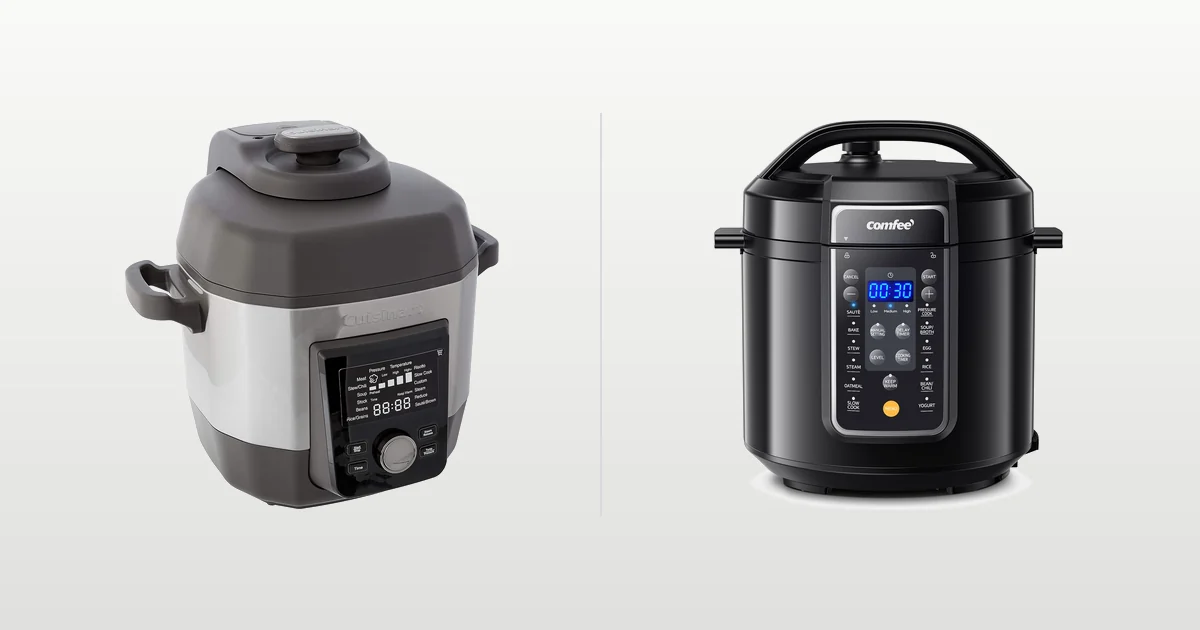
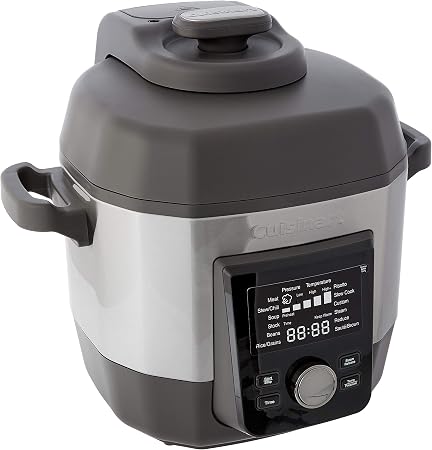 Best OverallCuisinart CPC-900
The only cooker here with a dedicated Stock program and a Reduce function — the two stages of soup that happen outside pressure.
 Best ValueCOMFEE’ 12-in-1
Eighty-two dollars for sauté, fourteen presets and ten stated safety features, from a Midea brand.
 Best Release ControlChefman 13-in-1
The one cooker here whose listing spells out that you can choose natural release — which for soup is the release you want.
At a Glance
Ten Pressure Cookers for Soup Compared
Whether it browns, what it does at the end, and how much it actually holds — rather than how many presets it counts.
| # | Model | Sauté | Soup Programs | Capacity | Power | Standout | Main Drawback | Check Price |
|---|---|---|---|---|---|---|---|---|
| 1 |
 Cuisinart CPC-900 Cuisinart CPC-900 |
Sauté/Brown | Stock and Reduce | 5.7 L stated | 15 psi | The only one with Stock and Reduce programs | States 5.7 litres, not 6 quarts | View on Amazon |
| 2 |
 Chefman 13-in-1 Chefman 13-in-1 |
Sauté | Quick or natural | 6 quarts | 1000 W | The only listing that names natural release | Touchscreen, which greasy hands dislike | View on Amazon |
| 3 |
 Blue Diamond 16-in-1 Blue Diamond 16-in-1 |
Sauté | Soup/Broth, Bean/Chili | 6 quarts | 1000 W | Ceramic nonstick rated for metal utensils | Ceramic wears faster than bare stainless | View on Amazon |
| 4 |
 Zavor LUX LCD Zavor LUX LCD |
Sauté | 33 settings | 6 L stated | 1000 W | High and low pressure, both selectable | States 6 litres, which is 6.3 quarts | View on Amazon |
| 5 |
 Midea 12-in-1 8QT Midea 12-in-1 8QT |
Sauté | Soup and bean chili | 8 quarts | 1200 W | Eight quarts and 1200 watts | Eight quarts, so not a 6-quart cooker | View on Amazon |
| 6 |
 COMFEE’ 12-in-1 COMFEE’ 12-in-1 |
Sauté | 14 presets | 6 quarts | 1000 W | Ten stated safety features at eighty-two dollars | Aluminium pot rather than stainless | View on Amazon |
| 7 |
 prepAmeal 9-in-1 prepAmeal 9-in-1 |
Sauté | 16 smart programs | 6 quarts | 1000 W | Sixteen programs including Chili/Stew and Soup | Largest footprint in the roundup | View on Amazon |
| 8 |
 NutriChef NCHS60ZW NutriChef NCHS60ZW |
Not stated | 9 functions | 6 quarts | 1000 W | Adjustable time and temperature, plainly laid out | No sauté function stated anywhere | View on Amazon |
| 9 |
 Zuguachi 10-in-1 Zuguachi 10-in-1 |
Not stated | 24-hour reservation | 6 quarts | 1050 W | A 24-hour delay and 1050 watts | No sauté stated, and the lowest rating here | View on Amazon |
| 10 |
 carori HPC-610 carori HPC-610 |
Sauté | 12 presets | 6 quarts | 1000 W | Sauté and twelve presets for sixty-nine dollars | Structured spec list omits the soup program | View on Amazon |
Specifications, prices and ratings are taken from each manufacturer’s Amazon listing as displayed on 20 August 2026 and may change. Sauté is recorded as present only where the listing states it in the title, bullets or specification table; two listings state no sauté function anywhere and are marked accordingly, which is not proof the hardware lacks one. Capacity is as stated: eight cookers give quarts, the Cuisinart gives 5.7 litres (about 6.0 quarts) and the Zavor gives 6 litres (about 6.3 quarts). Nine of the ten are 6-quart models; the Midea is 8 quarts and is included as the batch option, which its review states plainly. Maximum fill guidance referenced in this article is standard manufacturer safety practice, not a figure from these listings. None of these ten ASINs appears in any of the five pressure cooker articles already published on this site.
Scroll the table sideways to see every column
How We Chose These Pressure Cookers for Soup
We researched current listings, compared manufacturer specifications and documentation, and examined recurring patterns in customer feedback. We did not carry out hands-on testing, and nothing below is presented as measured performance data.
- Whether it states a sauté or brown function — the base of almost every soup is browned, and two of these ten do not mention one
- Whether release is discussed at all — natural release is what stops a pot of liquid spitting through the valve
- Anything that helps after pressure — a sealed pot does not reduce, and only one cooker here has a program for it
- Real capacity for liquid — fill limits mean a 6-quart pot does not make 6 quarts of soup
- Pot material and utensil tolerance — deglazing fond is part of soup, and coatings decide what you can scrape with
- Fresh product set — none of these ten appears in the five pressure cooker articles already on this site
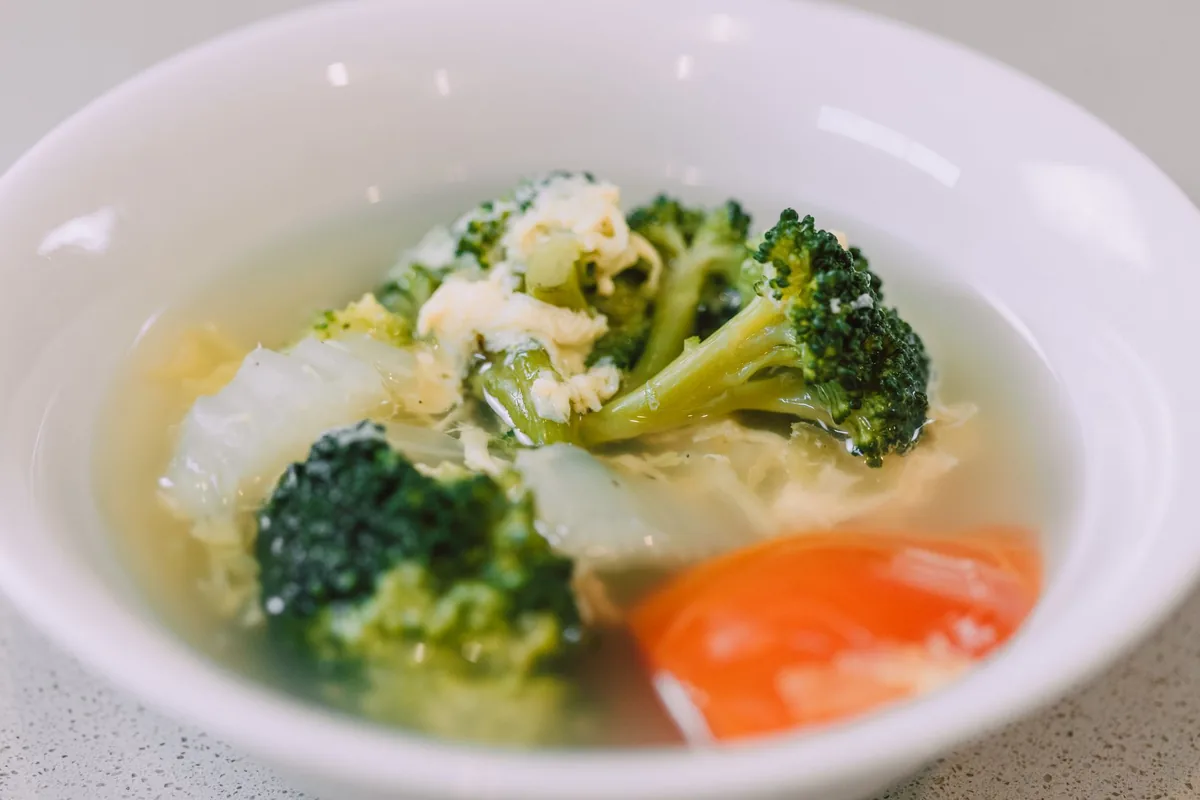
The 10 Best Pressure Cookers for Soup, Reviewed
1. Cuisinart CPC-900 — Best Overall
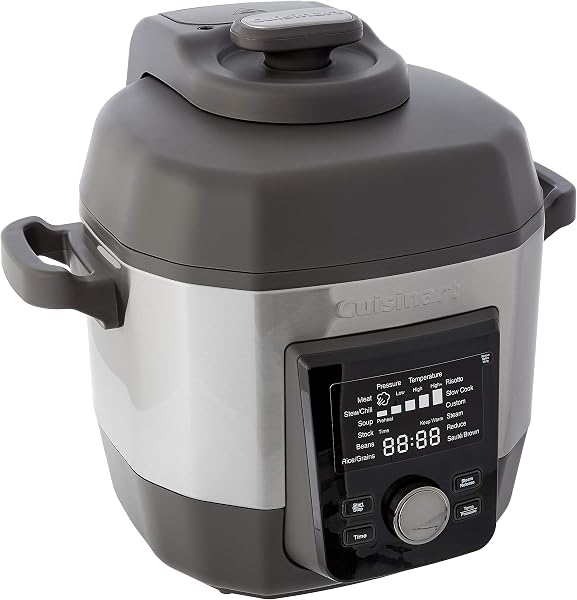
Soup has three stages and only one of them happens under pressure. You brown the aromatics and the meat, you cook under pressure, and then you often need to reduce what comes out because pressure cooking adds no evaporation at all.
Cuisinart is the only cooker in this roundup with a program for all three: Sauté/Brown, Stock, and Reduce.
Key Specifications
| Sauté | Sauté/Brown program |
|---|---|
| Soup-specific programs | Soup, Stock, Stew/Chili, Beans |
| Finishing | Reduce program |
| Pressure | Up to 15 psi |
| Capacity | 5.7 litres stated, sold as 6-quart |
| Pot | Nonstick, dishwasher safe |
| Dimensions | 14.9″D x 13.7″W x 13.5″H |
| Model | CPC-900ES |
| Best For | Making stock and soup properly in one pot |
Why We Recommend It
Reduce is the function nobody else offers and soup most often needs. A sealed pot loses no water, so a soup that would have thickened over an hour on the hob comes out thin. Without a reduce setting you finish it with the lid off on sauté, which works but is not what the machine is telling you to do.
A separate Stock program matters for the same reason: stock wants a long, gentle extraction, not the short aggressive cycle a Soup preset runs.
Fifteen psi is at the top of the domestic range, and the capacity is stated as 5.7 litres rather than 6 quarts — 5.7 litres is about 6.0 quarts, so the two figures agree once converted.
Pros
- Only cooker here with a Reduce program
- Dedicated Stock program alongside Soup
- Sauté/Brown for building the base
- 15 psi, top of the domestic range
- Nonstick dishwasher-safe pot
Cons
- $189.95, most expensive here
- States 5.7 litres where rivals state 6 quarts
- 14.9 inches deep, the largest footprint
- Nonstick rather than bare stainless inside
Best for: Anyone who makes stock as well as soup and wants both done in the pot.
2. Chefman 13-in-1 — Best Release Control

Every pressure cooker can do a natural release. Only this one puts the choice in its listing as a feature, and for soup it is the more important of the two.
Thirteen programs, 1000 watts, a stainless body and a touchscreen.
Key Specifications
| Sauté | Yes |
|---|---|
| Release | Quick or natural, both stated |
| Functions | 13 one-touch programs |
| Capacity | 6 quarts |
| Wattage | 1000 watts |
| Controls | Touchscreen |
| Dimensions | 12.09″D x 12.09″W x 14″H |
| Weight | 12 pounds |
| Best For | Anyone who has had a pressure cooker spit soup at them |
Why We Recommend It
Quick release with a pot full of liquid is the mistake almost everyone makes once. Dropping the pressure suddenly makes the whole contents boil violently, and soup comes up the valve with the steam — over the lid, the counter and the wall. Natural release lets the pressure fall as the pot cools, and nothing spits.
The cost is time: natural release on a full pot takes fifteen to twenty-five minutes, which has to be counted in the cooking time. That is why the distinction is worth having on the panel rather than in the manual.
The touchscreen is the one reservation. Soup-making involves wet and greasy hands, and a physical dial responds to both in a way a capacitive panel does not.
Pros
- Only listing here that names natural release explicitly
- Sauté for building the base
- 13 one-touch programs
- Stainless steel body at $99.99
- 12 pounds, easy to move to the sink
Cons
- Touchscreen is awkward with wet or greasy hands
- No dedicated stock or reduce program
- 14 inches tall with the lid on
- 4.4 stars, mid-pack here
Best for: Cooking soup and stew where the release matters as much as the cook.
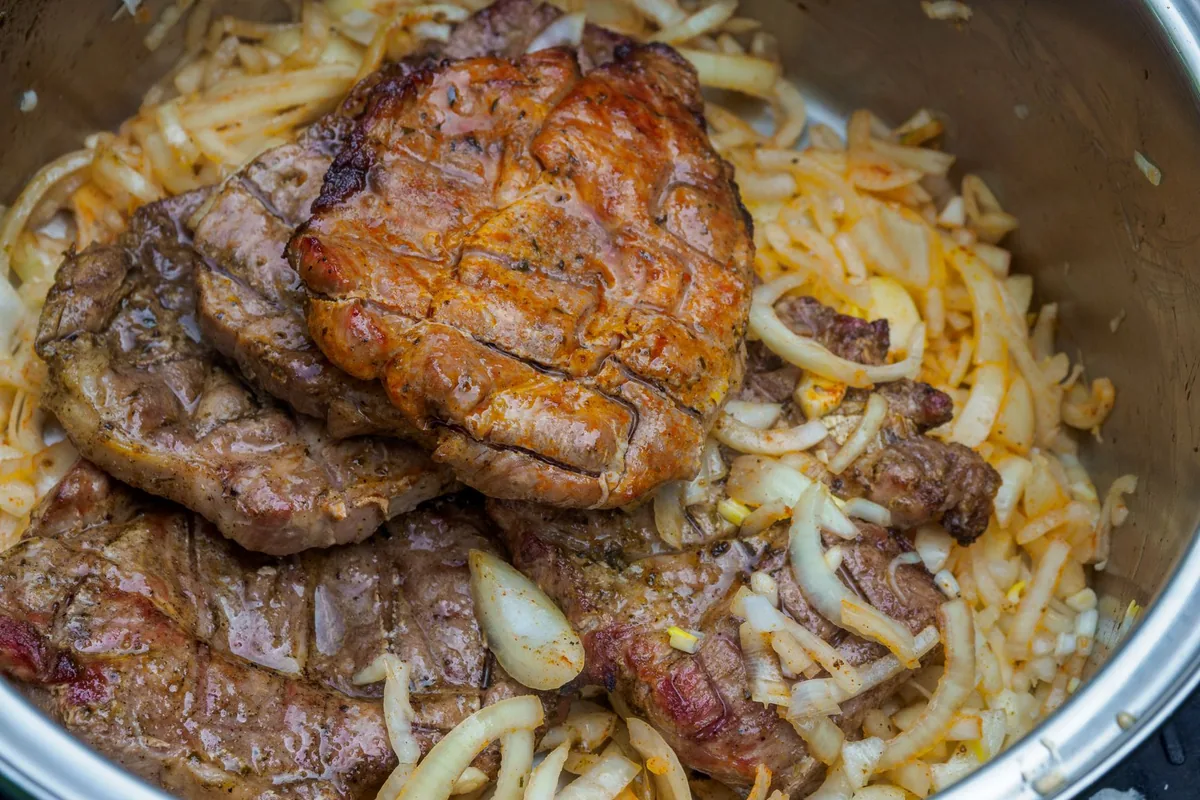
3. Blue Diamond 16-in-1 — Best Pot Coating

The browning stage is where soup gets its flavour, and it leaves a layer of caramelised fond stuck to the base that you deglaze into the liquid.
On most nonstick pots you have to do that with wood or silicone. This one is rated for metal utensils.
Key Specifications
| Sauté | Yes |
|---|---|
| Soup programs | Soup/Broth and Bean/Chili |
| Pot | Diamond-infused ceramic nonstick, metal utensil safe |
| Functions | 16-in-1 |
| Capacity | 6 quarts |
| Wattage | 1000 watts |
| Weight | 13.6 pounds |
| Rating | 4.6 out of 5 stars, joint highest here |
| Best For | Browning hard and deglazing without wrecking the pot |
Why We Recommend It
That is a genuinely soup-relevant specification. Fond does not always come up with a soft spatula, and if you cannot get it off the bottom, the flavour you built by browning stays welded to the pan instead of going into the pot.
Sixteen programs include separate Soup/Broth and Bean/Chili settings, which is a sensible split — pulses need longer than a vegetable soup and foam more while they cook.
Ceramic coatings are less durable than bare stainless over years of use, and at 4.6 stars this is joint highest rated in the roundup.
Pros
- Ceramic pot rated for metal utensils
- Separate Soup/Broth and Bean/Chili programs
- 4.6 stars, joint highest here
- 16 programs including sauté
- Diamond-infused coating stated as harder wearing
Cons
- Ceramic will wear faster than bare stainless
- $139.99, upper-middle here
- No stock or reduce program
- 13.6 pounds
Best for: Cooks who brown hard and want to deglaze with whatever is nearest.
4. Zavor LUX LCD — Most Programmable
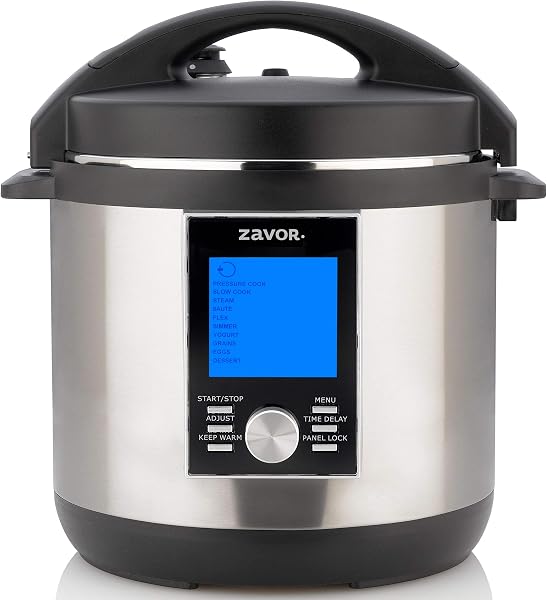
Almost every cooker here has one pressure setting. Zavor gives you high and low, and for soup that is a more useful choice than another preset.
Thirty-three programmable settings include Soup, Beans, Risotto, Meat and Vegetables.
Key Specifications
| Sauté | Yes |
|---|---|
| Pressure | High and low, both selectable |
| Settings | Over 33 programmable |
| Capacity | 6 litres stated, about 6.3 quarts |
| Wattage | 1000 watts |
| Dimensions | 11.4″D x 12.2″W x 13.8″H |
| Weight | 14.4 pounds |
| Body | Stainless steel |
| Best For | Soups where delicate ingredients would overcook at full pressure |
Why We Recommend It
Low pressure is for things that fall apart at high. Fish soups, delicate vegetables, anything you want to hold its shape rather than dissolve into the broth. At full pressure a chowder becomes a purée; at low it stays a chowder.
The stainless body and the LCD panel are a step above the painted finishes at this price, and the Flex function allows manual time and pressure entry rather than only presets.
Its capacity is stated as 6 litres, which is 6.3 US quarts rather than 6 — slightly more than the quart-stated cookers here, and the kind of small discrepancy worth noticing if you are matching a recipe to a pot.
Pros
- High and low pressure, both selectable
- Over 33 programmable settings
- Stainless steel body with an LCD panel
- 6 litres is 6.3 quarts, slightly more than rivals
- Manual time and pressure entry, not presets only
Cons
- $199.95, second most expensive here
- States litres where most rivals state quarts
- 14.4 pounds
- No reduce function for finishing
Best for: Fish soups, chowders and anything that should not dissolve.
5. Midea 12-in-1 8QT — Largest Here

This is the only cooker in this roundup that is not a 6-quart, and for soup that is the point. Every pressure cooker has a maximum fill line, so the usable volume is always well below the rated one.
Eight quarts of pot is what you want if you are making stock or freezing portions.
Key Specifications
| Sauté | Yes |
|---|---|
| Capacity | 8 quarts, largest here |
| Wattage | 1200 watts, highest here |
| Functions | 12-in-1 including soup and bean chili |
| Pot | Stainless steel inner pot |
| Dimensions | 11.1″D x 11.6″W x 11.6″H |
| Safety | REALSAFE system, 9-in-1 protection |
| Model | MPC8002SBSK |
| Best For | Batch soup and stock, where 6 quarts runs out |
Why We Recommend It
Twelve hundred watts is the other reason it suits soup. A bigger pot of cold liquid takes longer to come up to pressure, and that time is dead time before the cooking clock even starts. More power shortens the part of the process nobody counts.
A bare stainless inner pot rather than a coating is the right choice for a pot that will be browning and deglazing repeatedly, and it will outlast any nonstick.
It is here as the large option, and it is honestly not a 6-quart cooker. If your recipes and your storage are built around six quarts, one of the others fits your kitchen better. If you cook stock in batches, this is the one.
Pros
- 8 quarts, real headroom for stock and batches
- 1200 watts, fastest to pressure here
- Bare stainless inner pot, no coating to wear
- 12 functions including sauté and soup
- Compact 11.6-inch footprint for the capacity
Cons
- 8 quarts, so it is not a 6-quart cooker
- Larger pot takes longer to come to pressure
- $106.99 against sub-$85 six-quart rivals
- No stock or reduce program
Best for: Batch stock, freezer portions and households that run out of six quarts.
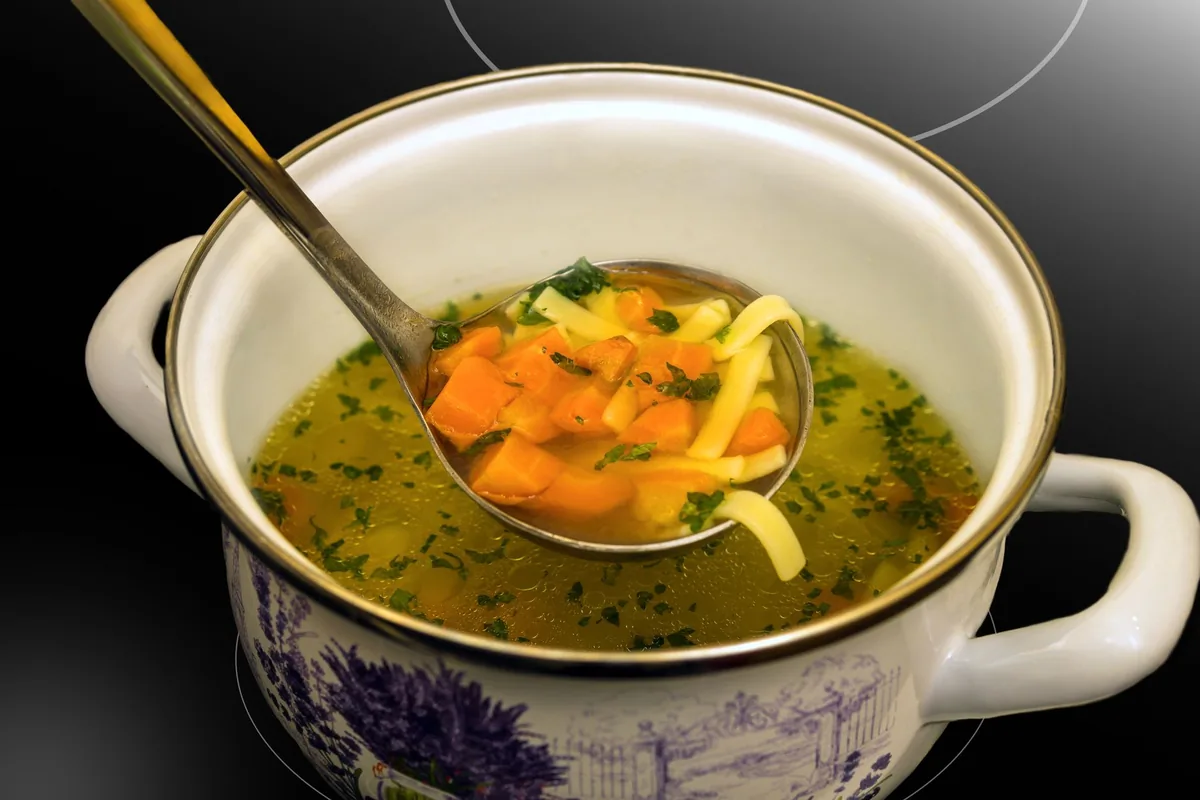
6. COMFEE’ 12-in-1 — Best Value

Eighty-one ninety-nine buys sauté, fourteen presets, a 1000-watt element and 4.6 stars — joint highest rating in this roundup.
At 10.2 by 10.8 inches it is also the smallest footprint here by a clear margin.
Key Specifications
| Sauté | Yes |
|---|---|
| Presets | 14 programmable |
| Functions | 12-in-1 including slow cook, rice, steam |
| Capacity | 6 quarts |
| Wattage | 1000 watts |
| Safety | 10 stated safety features |
| Dimensions | 10.2″D x 10.8″W x 11.1″H, smallest here |
| Rating | 4.6 out of 5 stars, joint highest |
| Best For | A first pressure cooker that can still brown |
Why We Recommend It
The thing that matters for soup at this price is that it browns. Three cookers in this roundup do not mention a sauté function at all, and without one the first stage of every soup worth making happens in a separate pan that you then have to wash.
Ten stated safety features is more disclosure than most listings here offer, and COMFEE’ sits under Midea, so there is a real manufacturer behind it.
The pot is aluminium with a nonstick coating rather than stainless. That is lighter and heats faster, but it is the component that wears, and deglazing with a metal spoon is off the table.
Pros
- $81.99 with a sauté function
- 4.6 stars, joint highest in the roundup
- Smallest footprint here at 10.2 by 10.8 inches
- 10 stated safety features
- Backed by Midea
Cons
- Aluminium nonstick pot rather than stainless
- No metal utensils for deglazing
- No stock or reduce program
- Structured spec list omits a soup program
Best for: A first pressure cooker where browning still has to happen in the pot.
7. prepAmeal 9-in-1 — Most Presets

Sixteen programs is the most in this roundup, and the list is genuinely soup-shaped: Chili/Stew, Soup, Beans, Pot Roast, Ribs, Whole Chicken.
Sixty-nine ninety-nine, with 4.6 stars.
Key Specifications
| Sauté | Yes |
|---|---|
| Programs | 16 smart, including Chili/Stew and Soup |
| Pot | 304 stainless steel, non-stick coated, removable |
| Capacity | 6 quarts |
| Wattage | 1000 watts |
| Extras | Delay timer, Keep Warm |
| Dimensions | 13.8″D x 15.3″W x 13.8″H |
| Rating | 4.6 out of 5 stars, joint highest |
| Best For | Set-and-forget soup on a timer |
Why We Recommend It
The delay timer is the feature worth having for soup specifically. Load the pot in the morning, set it to start so it finishes when you get home, and the natural release happens while you take your coat off. Soup is one of the few things that genuinely improves from sitting on Keep Warm afterwards.
The pot is 304 stainless with a nonstick coating and lifts out, which makes both the deglazing and the washing easier than a fixed bowl.
It has the largest footprint here at 13.8 by 15.3 inches — wider than the 8-quart Midea, for two fewer quarts of capacity. On a small counter that is the wrong trade.
Pros
- 16 smart programs, most in this roundup
- 4.6 stars, joint highest here
- $69.99, cheapest but one
- Delay timer for finishing on arrival
- Removable 304 stainless pot
Cons
- 13.8 x 15.3 inch footprint, largest here
- Wider than the 8-quart Midea for less capacity
- Nonstick coating over the stainless
- No stock or reduce program
Best for: Weekday soup you want waiting when you get in.
8. NutriChef NCHS60ZW — Best Simple Panel

Nine functions rather than sixteen, with adjustable time and temperature rather than a wall of named programs. For a lot of people that is the better interface.
Stainless steel body, auto shut-off, locking lid, dishwasher-safe parts, at $80.99 and 4.5 stars.
Key Specifications
| Sauté | Not stated on the listing |
|---|---|
| Functions | 9, digital |
| Control | Adjustable time and temperature |
| Capacity | 6 quarts |
| Wattage | 1000 watts |
| Safety | Auto shut-off, locking lid |
| Dimensions | 13.1″D x 11.4″W x 11.6″H |
| Weight | 12 pounds |
| Best For | Straightforward pressure cooking without a preset maze |
Why We Recommend It
A preset is only a time and a pressure with a name on it. If you know that soup wants roughly ten minutes at high pressure and a natural release, a panel that lets you set exactly that is more useful than one offering sixteen buttons whose timings it never tells you.
The gap for soup is browning. This listing does not state a sauté function anywhere — not in the title, the bullets or the specification table. One other cooker here has the same omission. Without sauté the aromatics go in a frying pan first, and you have two things to wash instead of one.
If you make blended vegetable soups where browning matters less, that is a smaller loss than it sounds.
Pros
- Adjustable time and temperature rather than presets only
- Simple 9-function panel
- 4.5 stars at $80.99
- Auto shut-off and locking lid
- Dishwasher-safe removable parts
Cons
- No sauté function stated anywhere on the listing
- Browning has to happen in a separate pan
- No soup or stock program named
- 13.1 inches deep
Best for: Blended and vegetable soups where the base is not browned.
9. Zuguachi 10-in-1 — Best Delay Timer

A twenty-four hour reservation is longer than anything else here offers, and 1050 watts is second only to the 8-quart Midea.
Nine pounds makes it the lightest cooker in this roundup, which matters when a full pot has to go to the sink.
Key Specifications
| Sauté | Not stated on the listing |
|---|---|
| Delay | 24-hour reservation |
| Wattage | 1050 watts, second highest here |
| Functions | 10-in-1 including slow cook |
| Capacity | 6 quarts |
| Extras | One-click exhaust, intelligent insulation |
| Weight | 9 pounds, lightest here |
| Rating | 4.1 out of 5 stars, lowest here |
| Best For | Soup timed to a schedule a day ahead |
Why We Recommend It
One-click exhaust is a small convenience that soup benefits from: a single control for the release rather than twisting a valve over a pot of hot liquid.
Like the NutriChef, it does not state a sauté function. Ten functions are listed and browning is not among them, so the base has to be built elsewhere. For a machine sold on convenience features that is the one that is missing.
It also carries 4.1 stars, the lowest rating in this roundup, and comes from a brand with no track record to fall back on.
Pros
- 24-hour delay timer, longest here
- 1050 watts, second highest
- 9 pounds, lightest cooker in the roundup
- One-click exhaust for the release
- $78.88 with slow cook included
Cons
- No sauté function stated
- 4.1 stars, lowest rating in this roundup
- Unfamiliar brand with no track record
- No soup or stock program named
Best for: Scheduled cooking where the base is browned in a separate pan.
10. carori HPC-610 — Cheapest Here

Sixty-nine ninety-eight is the lowest price in this roundup, and unlike the two cookers just above it, this one does state a sauté function — it is in the product title.
Twelve presets, an IMD touchscreen and 4.6 stars, joint highest here.
Key Specifications
| Sauté | Yes, stated in the title |
|---|---|
| Presets | 12, IMD touchscreen |
| Functions | 9-in-1 |
| Capacity | 6 quarts |
| Wattage | 1000 watts |
| Safety | 16+ stated protections |
| Weight | 12 pounds |
| Rating | 4.6 out of 5 stars, joint highest |
| Best For | The cheapest cooker here that still browns |
Why We Recommend It
For soup that combination is the important one. The cheapest cooker that can brown is more useful than a dearer one that cannot, because browning is the stage that separates soup from boiled vegetables in water.
Sixteen-plus safety protections including lid lock, steam release and overheat protection is more disclosure than several dearer machines manage.
Its structured Cooking Program field reads Cook, Keep Warm, Melt, Roast, Simmer — no soup program at all, although the bullets describe twelve presets. Given the argument of this article that is not much of a loss, but it is another example of a specification table that does not match the marketing copy.
Pros
- $69.98, cheapest cooker in the roundup
- States sauté in the product title
- 4.6 stars, joint highest here
- 16+ stated safety protections
- 12 presets on an IMD touchscreen
Cons
- Spec table lists no soup program despite 12 presets
- Touchscreen with wet hands
- 14.49 inches tall
- Unfamiliar brand
Best for: The lowest price at which the cooker can still build a base.
Can It Brown? The Question the Presets Do Not Answer
Sauté is the first stage of almost every soup and the one specification worth checking before anything else. Recorded here only where the listing actually states it.
| States a sauté function | States none | |
|---|---|---|
| Cookers here | Cuisinart, Chefman, Blue Diamond, Zavor, Midea, COMFEE’, prepAmeal, carori | NutriChef, Zuguachi |
| Count | 8 of 10 | 2 of 10 |
| Price range | $69.98–$189.95 | $78.88–$80.99 |
| What it costs you | — | A second pan, and the fond left in it |
| Matters most for | Meat, onion and stock-based soups | Less for blended vegetable soups |
The cheapest cooker in this roundup states sauté in its product title; two costing more state it nowhere at all. That is the inversion worth noticing, because sauté is not an expensive feature to include — it is the same heating element run without the lid sealed. If you make blended vegetable soups, browning matters less and the omission is survivable. If you make anything built on softened onions or browned meat, a cooker without sauté means the first ten minutes of every recipe happen somewhere else.
What Happens After the Cooking Stops
Two stages of soup happen outside the pressure cycle, and the listings barely mention either.
| Stage | What it needs | Cookers here that address it |
|---|---|---|
| Releasing pressure | Natural release, so liquid does not boil up the valve | Chefman states both quick and natural |
| Reducing the soup | Open-lid simmer, because sealed pots do not evaporate | Cuisinart has a Reduce program |
| Making stock, not soup | A longer, gentler extraction than a Soup preset | Cuisinart has a separate Stock program |
| Deglazing the fond | A pot you can scrape properly | Blue Diamond is metal-utensil safe; Midea and prepAmeal use stainless |
| Holding it after | Keep Warm, which soup genuinely improves on | Most, including prepAmeal’s delay timer |
Read down the third column. Ten cookers, and each row is answered by one or two of them. Every machine here can pressure cook soup perfectly well — that part is close to solved — but the stages either side are where they differ, and almost none of it appears in the preset count that the listings lead with. A cooker with sixteen programs and no reduce function is not more capable at soup than one with nine programs and a reduce function; it just has more names on the panel.
Best Alternatives
| Alternative | Why Consider It | Better For | Main Trade-Off |
|---|---|---|---|
| A stockpot on the hob | No fill limit, and you can see and taste as you go | Large batches and stock | Two to four hours instead of thirty minutes |
| A slow cooker | Genuinely hands-off, and very forgiving | Soups left all day | Six to eight hours, and most cannot brown either |
| A stovetop pressure cooker | Faster to pressure, and no electronics to fail | Cooks who want speed and simplicity | No presets, no timer, needs watching to hold pressure |
| A soup maker | Blends in the same jug it cooks in | Smooth vegetable soups specifically | One job only, and small capacity |
| A Dutch oven in the oven | Even, gentle heat and it browns beautifully | Flavour above speed | The slowest option, and it heats the oven |
What Each Price Tier Actually Buys
$69 to $82 — carori, prepAmeal, Zuguachi, NutriChef, COMFEE’. Four of these five rate 4.5 or 4.6, so this is not a compromise tier. It is where the sauté question decides things: carori, prepAmeal and COMFEE’ state it, and NutriChef and Zuguachi do not. At these prices the presence of a browning function is worth more than any other difference between them.
$99 to $107 — Chefman, Midea 8QT. The Chefman brings the only explicit natural-release discussion and a stainless body; the Midea brings eight quarts, 1200 watts and a bare stainless pot. Different problems: release control versus batch capacity.
$140 — Blue Diamond. Sixteen programs, separate Soup/Broth and Bean/Chili settings, and a ceramic pot rated for metal utensils, which is the one that helps most with deglazing.
$190 to $200 — Cuisinart, Zavor. The two that add something structural rather than more presets. Cuisinart has Stock and Reduce programs, which no other cooker here offers. Zavor has selectable high and low pressure, which matters for anything delicate in the pot.
The pattern: under $110 you are buying whether it browns. Above $140 you are buying what happens before and after the pressure cycle. Nothing in between is really about soup.
How to Choose a Pressure Cooker for Soup
Check for Sauté Before You Read Anything Else
It will be in the title, the bullets or the specification table, and in two of the ten listings here it is in none of them. Browning is the first stage of most soups and the one that puts flavour in. A cooker that cannot do it means a frying pan as well, and the browned residue you wanted in the soup stays in the wrong pan.
Plan for Natural Release, Not Quick Release
With a pot full of liquid, opening the valve suddenly makes everything boil at once and soup comes out with the steam. Natural release lets pressure fall as the pot cools and takes fifteen to twenty-five minutes on a full pot, which has to be added to the recipe time. Only one listing in this roundup discusses the choice at all, but every one of these cookers can do it.
Size the Pot for the Fill Limit, Not the Label
Pressure cookers have a maximum fill line, and for liquids it is normally about two thirds of the pot, dropping to about half for foaming foods like beans, lentils, pasta and grains. That means a 6-quart cooker makes roughly four quarts of soup and closer to three of lentil soup. If you batch-cook or freeze portions, the 8-quart option in this roundup exists for that reason.
Expect to Reduce Afterwards
A sealed pot loses no water at all, so a recipe adapted from the hob comes out thinner than you expect. Either start with less liquid than the original recipe, or plan to simmer with the lid off at the end. One cooker here has a Reduce program for exactly this; on the rest you use the sauté setting with the lid off, which is the same thing without the label.
Match the Pot Coating to How You Cook
Deglazing the fond is what gets the browning into the soup, and not all of it lifts with a soft spatula. A bare stainless pot takes anything. One ceramic pot here is rated for metal utensils. Aluminium nonstick is lighter and heats faster but restricts you to wood or silicone, and the coating is the part that wears out first.
Treat the Preset Count as Marketing
Sixteen programs and nine programs are the same machine with different labels; a preset is a stored time and pressure. What is worth having is a cooker that lets you set time and pressure manually, and ideally one that offers low pressure as well as high for delicate ingredients. Judge the panel on control, not on how many named buttons it has.
Common Mistakes Buying a Pressure Cooker for Soup
- Buying on the Soup preset. It is a stored time and pressure with a name on it, and it is on almost every machine here.
- Not checking for sauté. Two of the ten cookers here state no browning function anywhere.
- Quick-releasing a pot of soup. The whole contents boil at once and come up through the valve.
- Filling to the rim. Liquids go to about two thirds, and foaming foods like beans and lentils to about half.
- Expecting hob quantities to work unchanged. Nothing evaporates under pressure, so the soup comes out thinner than the recipe intended.
- Assuming a nonstick pot can be scraped. Deglazing with metal is fine on bare stainless and on one ceramic pot here, and not on the aluminium nonstick ones.
- Counting programs instead of controls. Manual time and pressure, and a low-pressure option, beat sixteen named buttons.
Which Pressure Cooker Should You Buy for Soup?
Buy the Cuisinart CPC-900 if you make stock as well as soup. It is the only cooker here with a dedicated Stock program and a Reduce function for finishing.
Buy the COMFEE’ 12-in-1 if you want the best value that still browns. Eighty-two dollars, sauté included, 4.6 stars, and the smallest footprint here.
Buy the Chefman 13-in-1 if the release is what worries you. The only listing here that spells out quick and natural as a choice.
Buy the Midea 8QT if you cook stock in batches or freeze portions. Eight quarts and 1200 watts, with a bare stainless pot.
Buy the Blue Diamond if you brown hard and deglaze harder. The ceramic pot is rated for metal utensils, which no other coated pot here is.
Buy the Zavor LUX if you make fish soups or chowders. Selectable low pressure keeps delicate ingredients from dissolving.
Buy the carori HPC-610 if price is the binding constraint. Sixty-nine ninety-eight, and it still states sauté in the title.
Frequently Asked Questions
Do I need the Soup button on a pressure cooker?
No. A preset is a stored time and pressure with a name printed on it, and almost every cooker in this roundup has one. What actually determines whether soup works is whether the machine can brown the base before it seals, and whether you handle the release properly at the end. A cooker with sixteen presets and no sauté function is worse at soup than one with nine presets that browns.
Should you use quick release or natural release for soup?
Natural release, essentially always. Quick release drops the pressure suddenly, which makes the entire contents of the pot boil at once, and with a pot full of liquid that means soup coming up through the valve and over the lid. Natural release lets the pressure fall as the pot cools and produces no spitting. It takes roughly fifteen to twenty-five minutes on a full pot, so it has to be counted as part of the cooking time rather than treated as an afterthought.
How much soup does a 6-quart pressure cooker actually make?
Around four quarts, and closer to three for anything that foams. Pressure cookers carry a maximum fill line, normally about two thirds of the pot for liquids and about half for beans, lentils, pasta and grains, which froth as they cook and can block the valve. So a 6-quart cooker is a four-quart soup pot in practice. If you batch-cook or freeze portions, that is the reason to consider the 8-quart option in this roundup.
Why is my pressure cooker soup too thin?
Because nothing evaporates. On a hob, a soup simmering for an hour loses a significant amount of water and thickens as it goes; a sealed pressure cooker loses none at all, so a recipe adapted straight from the hob comes out watery. There are two fixes: start with noticeably less liquid than the original recipe calls for, or simmer with the lid off at the end. One cooker in this roundup has a Reduce program for that; on every other one you use the sauté setting with the lid off.
Can you make stock in a pressure cooker?
Yes, and it is one of the things pressure cooking does best, turning a four-hour job into about forty-five minutes. It is worth knowing that stock and soup are not the same cycle, though: stock wants a longer, gentler extraction from bones and vegetables, while a Soup preset typically runs a shorter aggressive cycle aimed at cooking ingredients through. Only the Cuisinart in this roundup provides a separate Stock program; on the others you set the time manually.
Do you have to brown ingredients before pressure cooking soup?
You do not have to, but it is the single biggest difference in the result for anything savoury. Browning onions, meat and tomato paste creates the caramelised layer that dissolves into the liquid and gives soup its depth; skip it and you get a cleaner, thinner flavour. Blended vegetable soups suffer least. This is why the sauté function matters more than any preset, and why the two cookers here that do not state one are a real limitation rather than a technicality.
Is a pressure cooker or a slow cooker better for soup?
They suit different days. A pressure cooker makes soup in twenty to forty minutes including release, and is far better for stock and for anything with pulses or tough meat. A slow cooker takes six to eight hours and is genuinely hands-off, which suits soup you want ready when you get home. Several cookers in this roundup do both, and one has a twenty-four hour delay timer, so the choice is often not either-or.
What size pressure cooker is best for soup?
Six quarts suits most households and makes about four quarts of finished soup after the fill limit. Eight quarts is the right choice if you make stock, batch-cook for the freezer, or regularly cook for more than four people. Going bigger has a cost beyond counter space: a larger pot of cold liquid takes longer to come up to pressure, and that time sits before the cooking timer even starts, which is why the 8-quart model here also carries the highest wattage.
Final Verdict
The only cooker here with both a Stock program and a Reduce function — the two stages of soup that happen outside the pressure cycle.
Eighty-two dollars with a sauté function and 4.6 stars, in the smallest footprint in the roundup.
The one listing that spells out quick versus natural release, which is the choice that decides whether soup stays in the pot.
Every pressure cooker sold for soup has a Soup button, and it is the part of the machine you will think about least. A preset is a stored time and a stored pressure; the cooking under pressure is the easy stage and every cooker here does it competently.
What separates them is either side of that. Whether the machine browns, which two of the ten do not say they do. Whether you get the pressure off gently, which one listing discusses and the rest leave you to learn the messy way. And whether anything helps you reduce a soup that a sealed pot could not evaporate, which exactly one cooker addresses with a program.
So check for sauté first, plan on natural release, buy for about two thirds of the capacity printed on the box, and expect to finish with the lid off. Do that and any of these ten will make good soup — which is rather the point, because the button marked Soup was never what was deciding it.