
Affiliate Disclosure: As an Amazon Associate, we earn from qualifying purchases. This does not affect the price you pay.
Food safety agencies give one number for a home freezer: 0°F, or about −18°C. Food held at that temperature or colder stays safe to eat, and it keeps its quality for months. A small chest freezer has one job, which is to hold that line in a box the size of a bedside cabinet. So the first thing to read on any listing is the temperature range its dial or display can reach.
Eight of the ten listings on this page print that range, and all eight run warmer than 0°F at the top. The warmest settings run from 6.8°F on the Kismile and the TABU to 50°F on the WANAI. The coldest settings cluster tightly: four listings stop at exactly −7.6°F, which is −22°C, and the coldest on the page, the DEMULLER, reaches −15°F.
Put those two ends together and a pattern appears. On every stated range, between 47% and 82% of the span sits above 0°F, by our arithmetic. The Kismile, the TABU and the 5 Sunday Living freezer split almost evenly. The Igloo splits exactly in half, −10°F to 10°F. The Climate Choice 4.0 runs from −7.6°F to 21.2°F, so nearly three quarters of its range is too warm for long-term storage. The WANAI’s two warmest levels are labelled a defrost mode and reach 50°F.
That has a practical consequence the listings do not spell out. On a seven-step dial, the middle setting is not 0°F. If the steps are spaced evenly, which no listing confirms, the Climate Choice reaches 0°F only on its two coldest settings, and the Kismile on its four coldest. Leave a small chest freezer on its middle number and you may be storing food anywhere from about −0.6°F to 21.2°F, depending on the model and if the steps are even. A thermometer inside the lid answers the question; the dial on its own does not.
The two listings that print no range are the two big names. BLACK+DECKER describes a “mechanical temperature control dial” and gives no figures. Midea, the only listing on the page sold as a convertible fridge and freezer, prints “38°F to 110°F in fridge mode, 0°F to 110°F in freezer mode”. Read closely, those are the room temperatures it is built to work in, not the temperatures it holds inside. Meanwhile two freezers that never call themselves convertible, the DEMULLER at 41°F and the WANAI at 50°F, print warm ends that reach fridge territory.
So this guide sorts the ten by what each listing lets you work out about temperature: the stated range, the share of it that reaches 0°F, and what the warm end is for. We also set out the other numbers a small freezer buyer needs and the listings print only patchily. Four give energy use per day. Four give a noise figure in decibels. Every one gives dimensions, and two of those sets of dimensions look too small for the capacity claimed. Star ratings and review counts were not captured for this roundup; popularity below is Amazon’s Best Sellers Rank only.
All ten were captured on 5 October 2026. They run from 1.8 to 4.0 cubic feet. Their overall Best Sellers Ranks, reported exactly as Amazon returned them, run from #37 to #634, and in Chest Freezers from #2 to #37.
Our Quick Picks
 Best OverallKismile 3.2 Cu Ft Chest Freezer
The best rank on the page, #2 in Chest Freezers, with a stated −7.6°F to 6.8°F range, 0.68 kWh a day, under 40 dB and two baskets.
 Best ValueClimate Choice 4.0 Cu Ft Chest Freezer
The largest capacity here, 4.0 cu ft, at 0.469 kWh a day and under 40 dB; set it near the cold end, because its range climbs to 21.2°F.
 Best Temperature RangeDEMULLER 3.5 Cu Ft Chest Freezer
The coldest setting on the page, −15°F, a digital display accurate to 1°F, and a warm end of 41°F.
At a Glance
Ten Small Chest Freezers and Where Their Dials Cross 0°F
Read the second and third columns together: the stated range tells you how cold a freezer can go, and the share above 0°F, our arithmetic, tells you how much of the dial is too warm for long storage.
| # | Model | Capacity | Stated Range | Share of Range Above 0°F (ours) | Best Sellers Rank | Standout | Main Drawback | Check Price |
|---|---|---|---|---|---|---|---|---|
| 1 |
 Kismile 3.2 Cu Ft |
3.2 cu ft | −7.6°F to 6.8°F | About 47% | #37 overall; #2 in Chest Freezers | Best rank; energy, noise and two baskets stated | Coldest setting only 7.6°F below zero | View on Amazon |
| 2 |
 Climate Choice 4.0 Cu Ft |
4.0 cu ft | −7.6°F to 21.2°F | About 74% | #74 overall; #6 in Chest Freezers | Most capacity; lowest stated kWh per cu ft | Most of its dial is above 0°F | View on Amazon |
| 3 |
 DEMULLER 3.5 Cu Ft |
3.5 cu ft | −15°F to 41°F | About 73% | #111 overall; #8 in Chest Freezers | Coldest setting here; digital to 1°F | No energy, noise or weight figure | View on Amazon |
| 4 |
 Igloo 3.5 Cu Ft |
3.5 cu ft | −10°F to 10°F | 50% | #45 overall; #3 in Chest Freezers | Sold by Amazon.com; rollers and drain plug | No kWh or dB figure; stock scarce | View on Amazon |
| 5 |
 Midea 3.5 Cu Ft Convertible |
3.5 cu ft | Not stated (room range only) | Not stated | #53 overall; #5 in Chest Freezers | Only stated fridge mode; 48-hour outage claim | Internal temperatures not printed in either mode | View on Amazon |
| 6 |
 EUHOMY 1.8 Cu Ft |
1.8 cu ft | −7.6°F to 10°F | About 57% | #192 overall; #12 in Chest Freezers | Most fully specified; 38 dB; 23.6 in tall | Smallest capacity; highest kWh per cu ft | View on Amazon |
| 7 |
 TABU 3.5 Cu Ft |
3.5 cu ft | −7.6°F to 6.8°F | About 47% | #116 overall; #9 in Chest Freezers | Range given in °F and °C; 40 dB or less | Stated box looks small for 3.5 cu ft | View on Amazon |
| 8 |
 BLACK+DECKER 2.0 Cu Ft |
2.0 cu ft | Not stated | Not stated | #168 overall; #11 in Chest Freezers | Dial and light outside the lid; 70 lb load | No range, energy or noise figure | View on Amazon |
| 9 |
 WANAI 3.5 Cu Ft |
3.5 cu ft (title) | −11.2 to 50, unit not stated | About 82% | #415 overall; #28 in Chest Freezers | Lowest stated energy, 0.44 kWh a day | Two warmest levels are a defrost mode | View on Amazon |
| 10 |
 5 Sunday Living 3.5 Cu Ft |
3.5 cu ft | −11.4°F to 10.2°F | About 47% | #634 overall; #37 in Chest Freezers | Second-coldest setting here; budget pick | Listed depth of 11.8 in looks implausible | View on Amazon |
Best Sellers Ranks and specifications are taken from each manufacturer’s Amazon listing as displayed on 5 October 2026 through a United States connection, and may change. Ranges are as printed by each seller. The share above 0°F is our arithmetic: the part of each stated span that is warmer than 0°F, divided by the whole span. It says nothing about how the steps are spaced. The WANAI gives its range in two parts, levels 1–2 from 32 to 50 and levels 3–7 from 32 to −11.2, with no unit; we read the figures as Fahrenheit, since 50°C would make no sense in a freezer. Midea prints only the room temperatures it is built to run in, 38°F to 110°F in fridge mode and 0°F to 110°F in freezer mode. The WANAI’s capacity comes from its title; its size field reads “Medium”. Ranks are Best Sellers Ranks exactly as returned on 5 October 2026; the overall figures are lower than we would normally expect for major appliances, and we report them as listed without adjustment. Four of the ten were sold by Amazon.com at capture, and three were flagged as scarce stock. Star ratings and review counts were not captured for any product here.
Scroll the table sideways to see every column
How We Chose These Ten
We researched current listings, compared manufacturer specifications and documentation, and read each listing’s claims about temperature, capacity, energy, noise and size line by line. We did not carry out hands-on testing, and nothing below is presented as measured performance data. Star ratings and review counts were not captured for this roundup. We used Amazon Best Sellers Rank, buy-box stock and listing specifications instead, and nothing on this page describes or implies how owners have scored these freezers.
- Small chest freezers only — every product here is a top-opening chest freezer between 1.8 and 4.0 cubic feet. Upright freezers, mini fridges with freezer compartments and full-size chest freezers of five cubic feet and up were not in the running. Two listings use the word “upright” in their copy; both are top-opening chests.
- Temperature range recorded exactly as printed — the coldest and warmest figure each listing gives, in the unit it gives. Where a listing gives a room-temperature range instead of an internal one, we say so. Where a listing gives none, we write “Not stated”.
- The 0°F line as the yardstick — 0°F is the standard storage temperature for home freezers. For each stated range, we worked out how far below 0°F the coldest setting reaches and what share of the range sits above it. Those figures, and every Celsius conversion on this page, are our arithmetic.
- Energy and noise only where printed — kilowatt-hours a day and decibels are quoted from the listing. Annual figures and energy per cubic foot are our arithmetic from the daily figure. Words like “quiet” and “energy saving” are recorded as words.
- Dimensions as listed, with a sense check — we multiplied each set of outer dimensions into a box volume, our arithmetic, and flagged the two listings whose box looks too small for the capacity claimed. Where two fields disagree, we report both.
- Popularity from Best Sellers Rank only — ranks are quoted exactly as returned on 5 October 2026, overall and in Chest Freezers, where Amazon files all ten. The overall figures look low for appliances; we print them as listed.
- Verified stock and seller — each product was the buy-box offer and in stock on amazon.com on 5 October 2026. The Igloo, the Climate Choice and the 5 Sunday Living freezer were flagged as scarce stock at capture.
The Ten Small Chest Freezers in Detail
1. Kismile 3.2 Cubic Feet Chest Freezer, Small Deep Freezer for Home, Black — Best Overall

The best-ranked small chest freezer here prints a range, an energy figure, a noise figure and two baskets.
Key Specifications
| Capacity | 3.2 cu ft |
|---|---|
| Stated range | 6.8°F to −7.6°F |
| Share of range above 0°F | About 47% (our arithmetic) |
| Controls | 7-grade dial; 1 warmest, 7 coldest, 0 off; power and run lights |
| Energy use | 0.68 kWh per day; about 248 kWh a year (our arithmetic) |
| Noise | Below 40 dB |
| Baskets | 2 included |
| Dimensions | 20.67 W x 17.12 D x 31.89 H in |
| Listed weight | Not stated |
| Lid | Balanced hinge, stays open 45–90 degrees |
| Seller | ICE DRAM |
| Best Sellers Rank | #37 overall; #2 in Chest Freezers |
Why We Recommend It
This is the most popular freezer on the page and one of the best documented. It holds the best overall rank here, #37, and the best category rank, #2 in Chest Freezers. Those figures look low for a major appliance, and we report them exactly as Amazon returned them. What sets the listing apart is that it gives the four numbers a small freezer buyer most needs: a temperature range, a daily energy figure, a noise ceiling and outer dimensions. Only the Climate Choice and the EUHOMY match it on all four.
Its range is narrow and sits close to the line. “Temperature can be controlled from 6.8 ℉ to -7.6 ℉”, on a dial where ““1” being the warmest and “7” being the coldest” and 0 is off. That is a span of 14.4°F, of which 6.8°F, or about 47%, is above 0°F, by our arithmetic. If the seven steps are evenly spaced, which the listing does not say, each step is about 2.4°F, and settings 4 to 7 are the ones at or below 0°F. Treat setting 4 as the warmest you would use for long storage, and check it with a thermometer.
The coldest setting is not especially cold. −7.6°F is −22°C, and it is the most common coldest figure on the page: the Climate Choice, the EUHOMY and the TABU stop at exactly the same point. The DEMULLER goes to −15°F and the 5 Sunday Living freezer to −11.4°F. For everyday freezing, 7.6°F of margin below 0°F is enough to absorb a lid opening or a warm room, but there is no deep-freeze setting here for anyone who wants to hold fish or ice cream well below the standard.
The energy figure is the highest of the four stated, and the noise figure is in line. “Only 0.68 kilowatt-hour power needed per day.” Over a year that is about 248 kWh, by our arithmetic, against about 161 to 171 kWh for the three other listings that give a figure. Per cubic foot it is about 78 kWh a year, more than the Climate Choice and the WANAI and less than the smaller EUHOMY. The noise claim is “noise below 40 db”, the same ceiling as the Climate Choice and the TABU, and slightly louder than the EUHOMY’s 38 dB.
Two baskets are the practical bonus. “1x deep freezer, 2x basket are included in the package”, and they hang and slide so you “can quickly see items underneath”. In a chest freezer, the bottom is where food goes to be forgotten, so a second basket is worth more than it sounds. Only the DEMULLER also includes two. The balanced lid stays open between 45 and 90 degrees, so both hands are free for loading.
What to weigh. No listed weight is given, the warranty field reads only “1”, and the seller is ICE DRAM rather than Amazon.com. The listing also notes that the power cord leaves the left side of the unit, which matters if the freezer will sit against a wall with the socket on one side. At 20.67 by 17.12 inches, its footprint is about 2.46 square feet, by our arithmetic, roughly the same as the EUHOMY’s. Leave it upright for 24 hours before plugging in, as the listing asks.
Pros
- Best rank here, #2 in Chest Freezers
- Range, energy, noise and dimensions all stated
- Two hanging baskets included
- Below 40 dB stated
- Power and run indicator lights
- Lid holds open from 45 to 90 degrees
Cons
- Coldest setting only −7.6°F
- 0.68 kWh a day, highest of the four stated
- No listed weight
- Warranty field reads only “1”
- Sold by a third-party seller
- Step spacing not stated
Best for: A buyer who wants a well-documented 3.2 cu ft freezer with two baskets and is happy to run it on its colder settings.
2. Climate Choice 4.0 Cu Ft Chest Freezer, 7-Temp Adjustable, Gray (BD-108A) — Best Value

The most capacity on the page and the lowest stated energy per cubic foot, with the warmest dial top of any pure freezer here.
Key Specifications
| Capacity | 4.0 cu ft |
|---|---|
| Stated range | −7.6°F to 21.2°F, 7 settings |
| Share of range above 0°F | About 74% (our arithmetic) |
| Energy use | 0.469 kWh per 24h; about 171 kWh a year (our arithmetic) |
| Noise | Below 40 dB |
| Basket | Removable basket |
| Dimensions | 20.67 x 16.34 x 32.52 in |
| Listed weight | 39.95 pounds |
| Defrost | Built-in drain at the bottom |
| Warranty | 1 year |
| Seller and stock | climate choice; scarce at capture |
| Best Sellers Rank | #74 overall; #6 in Chest Freezers |
Why We Recommend It
This is the largest freezer on the page, and its listing does not lead with its brand. The title reads “4.0 Cu.Ft Chest Freezer – 7-Temp Adjustable Deep Freezer”; the brand, Climate Choice, appears only in the spec table and the seller name. At 4.0 cubic feet it holds about 14% more than the 3.5 cubic foot freezers and more than twice the EUHOMY, by our arithmetic. It ranks #74 overall and #6 in Chest Freezers.
Its range has the warmest top of any freezer-only listing here. “Seven adjustable temperature settings allow you to customize the freezing level from -7.6°F to 21.2°F.” 21.2°F is about −6°C, by our arithmetic: below the freezing point of water, so the box still freezes, but well above the 0°F storage standard. The span is 28.8°F, and about 74% of it sits above 0°F. Only the WANAI, with its defrost levels, has more of its range on the warm side.
That makes the setting matter more here than on most of the page. If the seven steps were evenly spaced, each would be about 4.8°F, and only the two coldest would reach 0°F; the middle setting would sit near 6.8°F. The listing does not say how the steps are spaced or which way the numbers run, so treat that as an illustration rather than a fact. The practical point stands either way: start at the cold end and confirm with a thermometer. Ice cream in particular stays scoopable but grainy well above 0°F.
Its energy figure is the most efficient per cubic foot on the page. “Consuming only 0.469kWh/24h” works out at about 171 kWh a year, or about 43 kWh a year per cubic foot, by our arithmetic. The WANAI comes close at about 46; the Kismile is about 78 and the EUHOMY about 91. A daily figure from a listing is not a laboratory energy rating, and it will rise in a warm room or with frequent opening, but it is the best evidence on the page. The noise claim is “below 40dB”.
The box is compact for its capacity. “Its compact dimensions (20.67 × 16.34 × 32.52 inches)” give a footprint of about 2.35 square feet, by our arithmetic, among the smallest on the page, despite the largest stated capacity. Multiplied out, the outer box is about 6.36 cubic feet, so the stated 4.0 cubic feet would be about 63% of it. That is a high share for a freezer with insulated walls; the Igloo’s 3.5 cubic feet is about 45% of its box. We cannot say the capacity is wrong, but it is generous on paper, and it is worth asking the seller what the figure measures.
What to weigh. The listed weight is 39.95 pounds, the warranty one year, and the stock was scarce at capture. It includes a removable basket and a drain for defrosting. Against the Kismile, it buys more capacity, a lower energy figure and a smaller footprint, and gives up the second basket, the better rank and a range that sits closer to 0°F.
Pros
- 4.0 cu ft, the most here
- About 43 kWh a year per cu ft, lowest stated (our arithmetic)
- Below 40 dB stated
- Footprint about 2.35 sq ft (our arithmetic)
- Removable basket and drain
- Range and dimensions stated
Cons
- About 74% of the range is above 0°F
- Coldest setting only −7.6°F
- Capacity generous for the box size
- Scarce stock at capture
- Brand not in the title
- Step spacing not stated
Best for: A buyer who wants the most space and the lowest stated running energy per cubic foot, and will keep the dial near its cold end.
3. DEMULLER Chest Freezer Small Deep Freezer with 2 Removable Baskets, Digital Control, White — Best Temperature Range

The coldest setting on the page, a digital display, and a warm end that reaches fridge temperature.
Key Specifications
| Capacity | 3.5 cu ft |
|---|---|
| Stated range | −15°F to 41°F |
| Share of range above 0°F | About 73% (our arithmetic) |
| Controls | Digital display, accurate to 1°F |
| Energy use | Not stated |
| Noise | Not stated |
| Baskets | 2 hanging wire baskets, described as stainless steel |
| Dimensions | 29.5 H x 20.7 L x 16.5 W in |
| Listed weight | Not stated |
| Lid | Stays open 45–75 degrees |
| Warranty | One year |
| Best Sellers Rank | #111 overall; #8 in Chest Freezers |
Why We Recommend It
This is the only small chest freezer here with a digital temperature setting, and it has the widest true freezer range. “Intelligent digital display and precise temperature control accurate to 1℉. With a temperature range from -15℉ to 41℉.” Every other listing with a range uses a seven-step dial, which means you choose a number and hope it lands where you want. Here you choose the temperature itself.
−15°F is the coldest setting on the page. It is about −26°C, by our arithmetic, and 7.4°F colder than the −7.6°F where four other listings stop. That margin matters for anyone who wants food held well below the 0°F line: fish, large batches of meat, or ice cream that should stay hard. It also gives more room to recover after the lid has been open or after a load of room-temperature food goes in.
41°F at the top is a fridge temperature, though the listing never says so. 41°F is about 5°C. Food safety guidance puts a refrigerator at 40°F or below, so the very top setting is a degree warm for that job, and the settings just under it are in range. The DEMULLER is not sold as a convertible, and the listing does not describe a fridge mode, so treat that use as unconfirmed. But a buyer who wants a small box that can hold drinks or overflow chilled food for a party, and freeze the rest of the year, has a digital range here that covers both.
The share above 0°F is large, and here it does not matter much. About 73% of the 56°F span is warmer than 0°F, by our arithmetic, nearly the same share as the Climate Choice. On a seven-step dial, that would mean most settings are too warm for storage. On a display accurate to 1°F, you simply set 0°F, or colder, and the warm part of the range is there only if you want it.
Two baskets and a narrower lid angle. “Two hanging wire storage baskets are included for your convenience”, and the package list calls them “two Stainless Steel Baskets”. The lid stays open from 45 to 75 degrees, a little less than the 85 to 90 degrees most others state, which is worth checking if it will sit under a shelf. The outer dimensions are 29.5 inches high, 20.7 long and 16.5 wide, a footprint of about 2.37 square feet, by our arithmetic.
What to weigh. The listing gives no energy figure, no noise figure and no weight, three of the numbers that four other listings print. The title misspells it as “Deep Freeezer”. The seller is YOU XUN, the warranty one year, and it ranks #111 overall and #8 in Chest Freezers. Buy it for the temperature control; ask the seller about running energy before you rely on it in a bedroom or an office.
Pros
- −15°F, the coldest setting here
- Digital display accurate to 1°F
- Warm end of 41°F covers near-fridge use
- Two baskets included
- Set 0°F directly, no dial guessing
- One-year warranty stated
Cons
- No energy figure
- No noise figure
- No listed weight
- Fridge use not described by the listing
- Lid opens only to 75 degrees
- Third-party seller
Best for: A buyer who wants to set an exact temperature, colder than most dials reach, with near-fridge settings in reserve.
4. Igloo 3.5 Cu Ft Deep Freezer Chest with Removable Basket and LED Lights, White — Most Balanced Dial

A range split exactly in half by 0°F, sold by Amazon.com, with no energy or noise figure.
Key Specifications
| Capacity | 3.5 cu ft |
|---|---|
| Stated range | −10°F to 10°F |
| Share of range above 0°F | 50% (our arithmetic) |
| Controls | Adjustable thermostat, simple dial |
| Energy use | Not stated (“consumes less energy”) |
| Noise | Not stated (“low noise”) |
| Basket | Removable basket |
| Dimensions | 32.5 H x 21.88 L x 18.88 W in |
| Listed weight | 48.2 pounds |
| Extras | Front rollers, drain plug, LED lights, lid holds 45°–90° |
| Seller and stock | Amazon.com; scarce at capture |
| Best Sellers Rank | #45 overall; #3 in Chest Freezers |
Why We Recommend It
The Igloo has the neatest range on the page. The listing says the freezer runs “quietly from −10 °F to 10 °F”, so 0°F sits exactly in the middle, by our arithmetic. If the dial is evenly graded, which the listing does not say, the middle of it is the storage standard, and everything colder is margin. That is a simpler dial to live with than one where the middle setting lands near 7°F.
−10°F gives more margin than the four listings that stop at −7.6°F. It is about −23°C, by our arithmetic. Only the DEMULLER, the 5 Sunday Living freezer and the WANAI go colder. The listing pairs the range with a “D-type refrigeration tube” and an “aluminum interior” that it says help the box cool quickly, and a gasket and foam insulation to hold the temperature.
It gives no number for energy or noise. The title says “Low Noise” and a bullet is headed “Quiet Energy Efficiency”, saying the freezer “operates quietly and consumes less energy”. Less than what is not stated. Four listings on this page print a daily kWh figure and four print a decibel ceiling; the Igloo prints neither. For a freezer pitched “as a mini freezer for bedroom or office”, a noise figure is the number you would want.
It is the most mobile box here. “Front rollers and a drain plug make it easy to move and defrost.” No other listing states rollers. At 48.2 pounds it is the heaviest listed weight on the page, so the rollers earn their place. The balanced hinge holds the lid between 45° and 90°, and there is a removable basket and, per the title, LED lights. The footprint, 21.88 by 18.88 inches, is about 2.87 square feet, by our arithmetic, one of the two largest here.
The copy calls it upright, but it is a chest. The title says “Upright Deep Freezer Chest”, and the bullets alternate between chest freezer and upright freezer. Everything in the description, a top lid on a balanced hinge, a hanging basket, a drain plug, describes a chest. If you need a true upright with a front door and shelves, see our upright freezer roundup.
What to weigh. It is sold by Amazon.com, carries a one-year limited warranty, and ranks #45 overall and #3 in Chest Freezers, the second-best rank on the page. The manufacturer field names Nostalgia, which makes Igloo-branded appliances under licence. Stock was scarce at capture. Against the Kismile, it buys a range centred on 0°F, a colder bottom setting, rollers and Amazon as the seller, and gives up the energy and noise figures and the second basket.
Pros
- Range centred on 0°F, −10°F to 10°F
- Sold by Amazon.com
- Front rollers and drain plug
- Second-best rank here
- Lid holds open 45° to 90°
- One-year limited warranty
Cons
- No kWh figure
- No decibel figure
- 48.2 lb, the heaviest listed
- Largest footprint class here
- Scarce stock at capture
- Copy mixes “upright” and “chest”
Best for: A buyer who wants a dial centred on 0°F, rollers for a garage or basement, and Amazon as the seller.
5. Midea 3.5 Cu Ft Chest Freezer, Fridge Freezer Convertible with LED Light (MERC04C4BAWW) — Best Convertible

The only listing sold as a fridge and a freezer, and it prints the room it works in rather than the temperatures it holds.
Key Specifications
| Capacity | 3.5 cu ft |
|---|---|
| Stated range | Not stated for the interior |
| Room range, fridge mode | 38°F to 110°F |
| Room range, freezer mode | 0°F to 110°F |
| Modes | Convertible between freezer and fridge |
| Power outage | Keeps items frozen for up to 48 hours, stated |
| Energy and noise | Not stated |
| Basket | Removable plastic basket |
| Dimensions | 33.5 H x 17.6 L x 21.5 W in |
| Listed weight | 47.8 pounds |
| Seller and warranty | Amazon.com; 1 year |
| Best Sellers Rank | #53 overall; #5 in Chest Freezers |
Why We Recommend It
This is the only small chest freezer here sold as a convertible. “Easily converts between freezer and fridge modes to suit your ever-changing food storage needs.” For a buyer who wants extra chilled space in summer and extra frozen space at the holidays, that is the feature that matters, and Midea is the only listing that commits to it in words. It ranks #53 overall and #5 in Chest Freezers, and it is sold by Amazon.com.
The temperatures it prints are the room’s, not the box’s. “Garage Ready – Designed and tested to operate efficiently in non-climate-controlled environments. (38°F to 110°F in fridge mode, 0°F to 110°F in freezer mode)”. Read in context, those are the ambient temperatures in which the unit is designed to run. It would make no sense for a fridge to hold 110°F inside. So the listing tells you where you can put the Midea, which is unusual and useful, and does not tell you how cold either mode gets, which is the number every other listing with a range leads on.
That ambient range is the best garage evidence on the page. A compressor freezer in an unheated garage faces two problems: summer heat, which makes it work harder, and winter cold, which can confuse a thermostat that senses the box rather than the room. Several listings here mention garages; the Igloo even calls itself “garage ready”. Only Midea gives figures, down to 0°F and up to 110°F in freezer mode. Our mini fridge cooler explainer explains why a cooling appliance’s performance is always relative to the room around it.
The 48-hour outage claim is the other standout. “Keeps items frozen for up to 48 hours after losing power.” No other listing gives a hold time. It is a manufacturer claim, and real hold time depends on how full the box is and how often the lid opens, but it gives you a figure to plan around in a storm.
The rest is plainly specified. The listing describes “small yet large enough for 1-3 people needs”, adjustable legs and a removable plastic basket. The title mentions an LED light. There is no energy figure, no noise figure and no internal range. The outer dimensions are 33.5 inches high, the tallest on the page, 17.6 long and 21.5 wide, a footprint of about 2.63 square feet, by our arithmetic. The listed weight is 47.8 pounds, and the model was released in September 2024.
What to weigh. If you want a convertible, this is the only stated one; ask Midea or the seller for the internal temperature in each mode before you plan around it. If you need precise freezer temperatures more than a fridge mode, the DEMULLER prints a range that reaches 41°F digitally, and the Igloo one that centres on 0°F. A small fridge with its own freezer compartment is another route; see our mini fridge with freezer guide.
Pros
- Only stated fridge and freezer convertible
- Ambient range stated, 0°F to 110°F in freezer mode
- 48-hour power outage claim
- Sold by Amazon.com
- Adjustable legs and removable basket
- Third-best rank here
Cons
- Internal temperature range not stated
- No energy figure
- No noise figure
- Tallest box, 33.5 in
- Basket is plastic
- 47.8 lb listed
Best for: A buyer who wants one small box that can run as a fridge or a freezer, possibly in a garage.
6. EUHOMY 1.8 Cu Ft Chest Freezer, Small Deep Freezer Top Door, Black (MCF-18H) — Best Compact
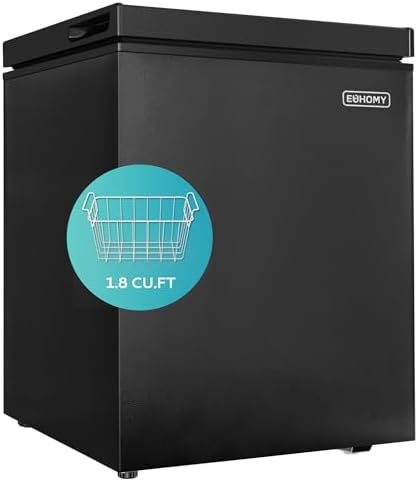
The smallest freezer here and the most fully specified, at 38 dB and 23.6 inches tall.
Key Specifications
| Capacity | 1.8 cu ft; about 17 lb beef and 25 lb fish, stated |
|---|---|
| Stated range | −7.6°F to 10°F, 7 stages |
| Share of range above 0°F | About 57% (our arithmetic) |
| Energy use | About 0.45 kWh per day; about 164 kWh a year (our arithmetic) |
| Noise | 38 dB |
| Freezing capacity | 12 pounds in 12 hours, stated |
| Footprint | 2.5 sq ft, stated |
| Dimensions | 20.7 W x 17.5 D x 23.6 H in |
| Listed weight | 33.1 pounds |
| Included | Mesh basket, ice shovel, water plug |
| Seller | Amazon.com |
| Best Sellers Rank | #192 overall; #12 in Chest Freezers |
Why We Recommend It
This is the listing that answers the most questions. It gives a range, a daily energy figure, a decibel figure, a stated footprint, a freezing rate and a capacity in pounds of food. No other freezer here prints all six. At 1.8 cubic feet it is also the smallest, which makes it the closest thing on the page to a true mini chest freezer.
It is short enough to fit where others will not. “The compact size: 20.7″(W) x 17.5″(D) x 23.6″(H) allows the deep freezer to fit into cabinets.” At 23.6 inches tall it is about four inches shorter than the BLACK+DECKER and six to ten inches shorter than every 3.5 cubic foot unit with plausible dimensions. The listing states “a small footprint of 2.5 ft²”, and the width and depth agree with it: about 2.52 square feet, by our arithmetic.
Its range, and one internal inconsistency. “Temperature range: -7.6℉ ~ 10℉”, on a seven-stage knob where 1 is warmest and 7 coldest. About 57% of that 17.6°F span is above 0°F, by our arithmetic. The listing also says “each stage can adjust the temperature difference of about 2℉”. Seven stages give six steps, and six steps of 2°F cover 12°F, not 17.6°F; evenly spread, the stated range implies about 2.9°F a step, by our arithmetic. Either the steps are uneven or one figure is approximate. In practice it means the same thing as on every dial here: use the colder half and check with a thermometer.
The energy and noise figures are good, with a caveat on scale. The listing says the compressor “consumes about 0.45kWh of power per day” and runs at “only 38dB low noise”, the lowest decibel figure on the page. Over a year, 0.45 kWh a day is about 164 kWh, by our arithmetic, close to the 4.0 cubic foot Climate Choice. Per cubic foot it is about 91 kWh a year, the highest of the four stated, because a small box has more wall per unit of space. Small costs less to run in total, not less per cubic foot.
It is the only listing to state a freezing rate. “A 12-hour freezing power of 12 pounds” tells you how much fresh food it can bring down to freezing in half a day. Load more than that at once and the rest of the contents will warm while it catches up. The capacity is also put in food terms, “about 17lbs of beef and 25lbs of fish”, which is a more honest picture of 1.8 cubic feet than the number alone.
What to weigh. It is sold by Amazon.com, weighs 33.1 pounds as listed, carries a one-year warranty and comes with a mesh basket, an ice shovel and a water plug for the drain. The lid hovers between 45° and 85°. It ranks #192 overall and #12 in Chest Freezers. The trade-off is simply size: it holds about half of what a 3.5 cubic foot freezer claims.
Pros
- 38 dB, the lowest stated here
- Range, energy, noise, footprint and freeze rate all stated
- 23.6 in tall, fits into cabinets
- Sold by Amazon.com
- Capacity given in pounds of food
- Ice shovel and basket included
Cons
- 1.8 cu ft, the smallest here
- About 91 kWh a year per cu ft, highest stated (our arithmetic)
- Coldest setting only −7.6°F
- Per-stage figure does not match the range
- Lid hovers only to 85°
- Lower rank than the 3.5 cu ft leaders
Best for: A buyer with a small kitchen, office or bedroom who wants the quietest stated freezer and the most complete set of numbers.
7. TABU 3.5 Cubic Feet Chest Freezer, Compact Deep Freezer, Black — Tightest Dial

A narrow range given in both Fahrenheit and Celsius, under 40 dB, in a box whose stated size looks too small.
Key Specifications
| Capacity | 3.5 cu ft |
|---|---|
| Stated range | −7.6°F to 6.8°F (−14°C to −22°C) |
| Share of range above 0°F | About 47% (our arithmetic) |
| Controls | Front-facing 7-level dial; higher setting is colder |
| Energy use | Not stated |
| Noise | 40 dB or less |
| Basket | Removable basket |
| Dimensions | 18 x 16 x 26 in (bullet); 18.0 H x 16.0 L x 26.0 W in (spec table) |
| Listed weight | Not stated |
| Defrost | Manual |
| Seller | TABU Center |
| Best Sellers Rank | #116 overall; #9 in Chest Freezers |
Why We Recommend It
The TABU gives the same range as the Kismile, in two units. “Ranging from -7.6°F to 6.8°F (-14°C to -22°C)—the higher the setting, the lower the temperature.” The Celsius figures check out against the Fahrenheit ones, by our arithmetic, which is a small sign of care. The span is 14.4°F, the narrowest on the page alongside the Kismile, and about 47% of it is above 0°F.
A narrow range is easier to set. On a seven-level dial covering 14.4°F, each level is about 2.4°F if evenly spaced, by our arithmetic, and the coldest four would sit at or below 0°F. Compare the Climate Choice, where the same seven positions cover twice the span. Fewer degrees per click means a mis-set dial costs you less. The price of a narrow range is that the coldest setting is only −7.6°F, and the warmest, 6.8°F, is not warm enough for anything but freezing.
The noise figure is a ceiling. “Operating at a noise level of ≤40dB, this freezer runs quietly enough to go unnoticed in your home.” That puts it alongside the Kismile and the Climate Choice, and just above the EUHOMY. It uses an R600a compressor, as does the EUHOMY. There is no energy figure: “keeping energy consumption low” is a claim without a number.
The stated dimensions do not add up for 3.5 cubic feet. The listing calls it a “compact footprint (18 x 16 x 26 inches)”, and the spec table assigns those as 18 inches high, 16 long and 26 wide. Multiplied out, that box is about 4.33 cubic feet, by our arithmetic. For the inside to hold 3.5 of them, the walls, lid, floor and compressor compartment would take up less than a fifth of the box. On the plausible listings here, the stated capacity is between 35% and 49% of the outer box. Either the dimensions or the capacity is off, and it may be that the dimensions are the inside of the cabinet. Ask the seller for the outer size before you measure a space for it.
The rest of the design is standard for the page. The lid opens between 45° and 90°, there is a removable basket, and adjustable leveling legs “ensure stable placement even on uneven floors”. Defrost is manual, which the listing presents as a benefit: “reducing temperature fluctuations and maintaining consistent cooling.” That is broadly true of manual-defrost chest freezers, which do not warm themselves to clear frost, but it also means you will empty and defrost it by hand.
What to weigh. No warranty and no weight are stated. It is sold by TABU Center and ranks #116 overall and #9 in Chest Freezers. If the dimensions turn out to be right, it would be the most compact 3.5 cubic foot freezer here by a wide margin; until the seller confirms them, plan your space as if it were the size of the Kismile.
Pros
- Range in °F and °C, and they agree
- Narrow span, about 2.4°F per step if even (our arithmetic)
- 40 dB or less stated
- Removable basket and leveling legs
- Manual defrost holds temperature steady
- Lid opens 45° to 90°
Cons
- Stated box looks too small for 3.5 cu ft
- No energy figure
- No warranty stated
- No listed weight
- Coldest setting only −7.6°F
- Warm end too cold for chilling
Best for: A buyer who wants a narrow, easy-to-set freezer dial and a quiet box, and will confirm the outer size first.
8. BLACK+DECKER 2.0 Cu Ft Compact Chest Freezer, BCFK206, White — Simplest Controls

A known brand, a dial on the outside and a 70-pound load, with no temperature figures at all.
Key Specifications
| Capacity | 2.0 cu ft; holds 70 lb of frozen food, stated |
|---|---|
| Stated range | Not stated |
| Share of range above 0°F | Not stated |
| Controls | Mechanical dial and indicator light, outside the cabinet |
| Energy use | Not stated |
| Noise | Not stated |
| Basket | Removable basket |
| Dimensions | 27.6 H x 17.3 L x 20.9 W in |
| Listed weight | 41.3 pounds |
| Defrost | Manual, with easy-access drain |
| Seller and warranty | Amazon.com; 1 year limited |
| Best Sellers Rank | #168 overall; #11 in Chest Freezers |
Why We Recommend It
The BLACK+DECKER is the only freezer on the page that states neither an internal range nor a room range. The listing describes “a mechanical temperature control dial and indicator light located on the outside, allowing precise adjustments without opening the freezer”. Precise adjustments to what, it does not say. For a page sorted by temperature, that silence is the main fact about it.
The outside dial is a real convenience. On most small chest freezers here, the dial is either on the front or not described. A control you can read and turn without lifting the lid means you can adjust it without letting cold air out, and an indicator light on the outside tells you at a glance that the unit has power. The Kismile also has power and run lights; the BLACK+DECKER is the only listing that puts the emphasis on reaching the control from outside.
It gives capacity in pounds, which is useful. “2.0 cu. ft. capacity holds a substantial 70 lbs. of frozen foods including cold meat, frozen dinners and ice cream.” Only the EUHOMY gives a similar food-weight figure, about 17 pounds of beef and 25 of fish in 1.8 cubic feet. The two figures are hard to compare, since they assume different foods and packing, but 70 pounds is a generous claim for 2.0 cubic feet.
The box is small but not short. At 27.6 inches tall, 17.3 long and 20.9 wide, its footprint is about 2.51 square feet, by our arithmetic, almost exactly the EUHOMY’s, and it stands about four inches taller. Multiplied out, the outer box is about 5.78 cubic feet, so the stated 2.0 is about 35% of it, the lowest share on the page. That points to thick walls, a large compressor space, or both, and it is the kind of figure you expect from a conservatively rated freezer.
The rest is standard. A removable basket, manual defrost with “an easy access drain”, and a one-year limited warranty. The listing suggests it for “your kitchen or temperature-controlled basement”, which reads as a hint that it is not intended for an unheated garage. The manufacturer field names W Appliance Company, which makes appliances under the BLACK+DECKER name.
What to weigh. It is sold by Amazon.com, weighs 41.3 pounds as listed, and ranks #168 overall and #11 in Chest Freezers. It is one of the higher-priced freezers on the page and prints the fewest numbers. Buy it for the brand, the outside dial and a conservatively sized box, and put a thermometer inside on day one, because the listing gives you nothing to set the dial against.
Pros
- Dial and indicator light outside the cabinet
- Capacity stated as 70 lb of food
- Sold by Amazon.com
- Conservative box-to-capacity ratio (our arithmetic)
- Removable basket and drain
- One-year limited warranty
Cons
- No temperature range at all
- No energy figure
- No noise figure
- Only 2.0 cu ft
- Suggested for temperature-controlled spaces
- Among the fewest numbers on the page
Best for: A buyer who wants a known brand with a dial outside the lid in a heated room, and will check the temperature themselves.
9. WANAI Deep Chest Freezer 3.5 Cu Ft with Storage Basket, Black — Lowest Stated Energy

The lowest daily energy figure on the page, and a dial whose two warmest levels are a defrost mode.
Key Specifications
| Capacity | 3.5 cu ft (title); size field reads “Medium” |
|---|---|
| Stated range | Levels 1–2: 32 to 50; levels 3–7: 32 to −11.2; no unit given |
| Share of range above 0°F | About 82% (our arithmetic, read as °F) |
| Controls | 7-grade dial; 1 is defrost mode, 7 coldest |
| Energy use | 0.44 kWh per day; about 161 kWh a year (our arithmetic) |
| Noise | Not stated (“whisper quiet”) |
| Basket | 1 removable basket |
| Dimensions | 20.7 x 16.3 x 29.5 in |
| Listed weight | 46.0 pounds |
| Warranty | 1 year |
| Seller | Karote |
| Best Sellers Rank | #415 overall; #28 in Chest Freezers |
Why We Recommend It
The WANAI prints the lowest daily energy figure on the page. “Only 0.44 kilowatt-hour power needed per day.” That is about 161 kWh a year, by our arithmetic, and about 46 kWh a year per cubic foot of its stated 3.5, second only to the Climate Choice. If the figure holds in your room, it is among the cheapest boxes here to run, though no listing figure is a laboratory energy rating.
Its range is the strangest on the page. ““1” being the defrost mode and “7” being the coldest. Level 1-2 can be controlled from 32 to 50. Level 3-7 can be controlled from 32 to -11.2.” No unit is given. Read as Fahrenheit, which is the only reading that makes sense, levels 1 and 2 hold the box between freezing and 50°F, about 10°C, and levels 3 to 7 run from 32°F down to −11.2°F, about −24°C, by our arithmetic.
So about 82% of the full range sits above 0°F, the largest share here. That figure overstates the problem a little, because the listing itself tells you the two warmest levels are for defrosting, not storing. Treat levels 3 to 7 as the freezer. Even then, if those five levels are evenly spaced, which the listing does not say, they fall about 10.8°F apart, and only levels 6 and 7 reach 0°F, by our arithmetic. Level 5 would be near 10°F. On this freezer, more than on any other, a thermometer is not optional.
A defrost mode that reaches 50°F is also a cool-box mode. The listing does not suggest it, but a setting that holds the box between 32°F and 50°F could keep drinks cold. 50°F is too warm for perishable food, which needs 40°F or below, so this is not a convertible fridge in any food-safety sense. If a drinks box is what you want, our beverage refrigerator roundup covers appliances built for it.
The rest is plainly specified. “All functions of the deep freezer are designed in such a compact size (20.7*16.3*29.5 In)”, a footprint of about 2.34 square feet, by our arithmetic, among the smallest here. The listed weight is 46.0 pounds. The lid hinges between 45 and 90 degrees, leveling legs balance it on an uneven floor, and the package includes one basket, although the title says “Storage Baskets”. There is no decibel figure, only “whisper-quiet”.
What to weigh. The size field reads “Medium” rather than a capacity, so the 3.5 cubic feet rests on the title. It is sold by Karote, carries a one-year warranty, and ranks #415 overall and #28 in Chest Freezers, well behind the leaders. Buy it for the energy figure and the colder bottom setting, and plan to run it at level 6 or 7.
Pros
- 0.44 kWh a day, the lowest stated
- Coldest setting about −11.2°F
- Footprint about 2.34 sq ft (our arithmetic)
- Leveling legs; lid holds 45 to 90 degrees
- One-year warranty
- Defrost mode labelled on the dial
Cons
- No unit on the temperature figures
- About 82% of range above 0°F
- Only the two coldest levels likely reach 0°F
- No decibel figure
- One basket despite plural title
- Capacity only in the title
Best for: A buyer who puts running energy first and will set the dial at its coldest levels and check it.
10. 5 Sunday Living Small Deep Freezer with Removable Basket, 3.5 Cu Ft, 7 Grade Control, Light Grey — Budget Alternative

The second-coldest setting on the page in a budget box whose listed depth cannot be right.
Key Specifications
| Capacity | 3.5 cu ft |
|---|---|
| Stated range | −11.4°F to 10.2°F, 7 levels |
| Share of range above 0°F | About 47% (our arithmetic) |
| Controls | 7-level control; start at level 2–3, stated |
| Energy use | Not stated |
| Noise | Not stated (“runs quietly”) |
| Basket | Detachable wire basket |
| Dimensions | 30.71 H x 11.8 L x 22.4 W in |
| Listed weight | Not stated |
| Warranty | 1 year, stated in bullet |
| Seller and stock | Sunday Living US; scarce at capture |
| Best Sellers Rank | #634 overall; #37 in Chest Freezers |
Why We Recommend It
This budget freezer reaches further below 0°F than all but one listing here. “7 precise temperature levels of this deep freezer, from light chill to deep freeze, ranging from -11.4°F all the way up to 10.2°F.” −11.4°F is about −24°C, by our arithmetic, 3.8°F colder than the four listings that stop at −7.6°F. Only the DEMULLER, at −15°F, goes colder.
Its range splits almost evenly. The span is 21.6°F, and about 47% of it is above 0°F, by our arithmetic, the same share as the Kismile and the TABU. If the seven levels are evenly spaced, which the listing does not say, each step is about 3.6°F and levels 4 to 7 reach 0°F or colder. “Light chill” at the warm end is 10.2°F, still well below freezing; it is a light freeze, not a chill in the fridge sense.
It tells you how to start. “When you use it at first time, don’t choose the temperature too low, you could first choose level 2-3, and then turn to high level gradually.” No other listing gives start-up advice beyond leaving the unit upright for 24 hours, which this one also asks. Note what it implies about the dial: on this freezer, a higher level is colder, and if the steps are even, levels 2 and 3 would sit above 0°F. They are a run-in setting, not a storage setting.
The listed depth cannot describe a 3.5 cubic foot chest. The spec table gives 30.71 inches high, 22.4 wide and 11.8 long. A freezer 11.8 inches from front to back would leave an interior only a few inches deep once the walls are counted. Multiplied out, the box is about 4.70 cubic feet, by our arithmetic, and 3.5 cubic feet would be about 75% of it, far above the 35% to 49% of the plausible listings. One of the figures is wrong, most likely the depth. Ask the seller before you measure a space.
The design details are practical. The lid has a recessed handle and “stays fixed at an angle for hands-free loading”, adjustable leveling legs keep it balanced, and a detachable wire basket keeps small items on top. There is no energy figure, no decibel figure and no listed weight. The brand field reads “5 SUNDAY LIVING”; the title names no brand at all.
What to weigh. It is the lowest-priced freezer on the page, sold by Sunday Living US, with a one-year warranty stated in a bullet and a promise to respond within 24 hours. It ranks #634 overall and #37 in Chest Freezers, the lowest on the page, and stock was scarce at capture. It earns its place for the cold bottom setting and the honest start-up advice, but it prints too few numbers to be a first choice.
Pros
- −11.4°F, second-coldest setting here
- Range splits almost evenly around 0°F
- Start-up advice stated
- Recessed handle; lid holds open
- Leveling legs and wire basket
- Budget option
Cons
- Listed 11.8 in depth implausible
- No energy figure
- No decibel figure
- No listed weight
- Lowest rank here
- Scarce stock at capture
Best for: A buyer on a tight budget who wants a colder bottom setting than most and will confirm the size with the seller.
Where Each Dial Crosses 0°F
The table below sets out each stated range, its Celsius equivalent, how far below 0°F its coldest setting reaches, and what share of the whole range is warmer than 0°F. Everything except the stated range is our arithmetic. The share above 0°F is a property of the printed range; it does not tell you how the steps on a dial are spaced.
| Freezer | Stated range | In °C (ours) | Below 0°F at coldest (ours) | Share above 0°F (ours) |
|---|---|---|---|---|
| DEMULLER | −15°F to 41°F | −26.1 to 5.0 | 15°F | About 73% |
| 5 Sunday Living | −11.4°F to 10.2°F | −24.1 to −12.1 | 11.4°F | About 47% |
| WANAI | −11.2 to 50, no unit | −24.0 to 10.0, read as °F | 11.2°F | About 82% |
| Igloo | −10°F to 10°F | −23.3 to −12.2 | 10°F | 50% |
| Kismile | −7.6°F to 6.8°F | −22.0 to −14.0 | 7.6°F | About 47% |
| TABU | −7.6°F to 6.8°F | −22 to −14, stated | 7.6°F | About 47% |
| EUHOMY | −7.6°F to 10°F | −22.0 to −12.2 | 7.6°F | About 57% |
| Climate Choice | −7.6°F to 21.2°F | −22.0 to −6.0 | 7.6°F | About 74% |
| Midea | Not stated; room range only | — | — | — |
| BLACK+DECKER | Not stated | — | — | — |
The cold ends cluster; the warm ends scatter. Four of the eight stated ranges bottom out at exactly −7.6°F, which is −22°C to the decimal, and four more reach between −10°F and −15°F. The warm ends run from 6.8°F to 50°F. In other words, these freezers differ far more in how warm they can be set than in how cold they can get. The cold limit is what the compressor can do in a small insulated box; the warm limit is a design choice about what else the box is for.
Every stated range climbs past 0°F, and on every one at least 47% of the range is above it. That is not a flaw in itself. A freezer has to start somewhere, and a range that only went from −7.6°F to 0°F would leave no room for a softer setting for ice cream. But it means the middle of the dial is never a safe assumption. On the Igloo it happens to be 0°F; on the Climate Choice and the WANAI it would be well above it.
If the steps are even, here is where the line falls. No listing describes its step spacing except the EUHOMY, whose “about 2°F” does not match its own range. With that caveat, an evenly spaced seven-step dial would cross 0°F at these points, by our arithmetic.
| Freezer | Approx. degrees per step (ours) | Settings at or below 0°F if even (ours) | Middle setting if even (ours) |
|---|---|---|---|
| Kismile | 2.4°F | 4 of 7 (settings 4–7) | About −0.4°F |
| TABU | 2.4°F | 4 of 7 | About −0.4°F |
| 5 Sunday Living | 3.6°F | 4 of 7 | About −0.6°F |
| EUHOMY | 2.9°F (listing says about 2°F) | 3 of 7 | About 1.2°F |
| Climate Choice | 4.8°F | 2 of 7 | About 6.8°F |
| WANAI, levels 3–7 | 10.8°F | 2 of 5 freezer levels | About 10.4°F at level 5 |
Read that table as a reason to buy a thermometer, not as a setting guide. Real thermostats are rarely linear, and a dial number is a position, not a temperature. The useful conclusion is simpler: on a narrow range like the Kismile’s or the TABU’s, a mis-set dial costs you about two degrees; on a wide range like the Climate Choice’s or the WANAI’s, it can cost you five to ten. A digital control, which only the DEMULLER has here, removes the guesswork altogether.
Why the line matters. 0°F is the temperature at which frozen food stays safe indefinitely and keeps its quality for the times printed on freezer charts. Above it, food is still frozen and still safe, but texture and flavour decline faster: ice crystals grow, surfaces dry out, and ice cream turns grainy. If you store bulk meat or batch-cooked meals for months, the setting is the difference between a freezer that preserves and one that merely holds. Good packaging helps too; our vacuum sealer guide covers the freezer-burn side of the problem.

A Fridge Setting on Two Freezers, and No Temperature on the Convertible
The keyword “convertible” appears on one listing, the Midea. But the stated ranges show that two other freezers can be set warm enough to chill, and that the convertible itself prints no internal temperature. Here is what each listing says about the warm end.
| Freezer | Sold as convertible | Warmest stated setting | What the listing says it is for |
|---|---|---|---|
| Midea | Yes | Not stated | Fridge mode; room range 38°F to 110°F |
| DEMULLER | No | 41°F | Part of a digital −15°F to 41°F range |
| WANAI | No | 50, no unit | Levels 1–2, “defrost mode” |
| Climate Choice | No | 21.2°F | A freezing level |
| Others with a range | No | 6.8°F to 10.2°F | Freezing levels |
A refrigerator needs to hold 40°F or below. That is the standard food safety line for chilled food, and it is the test any fridge mode has to meet. The DEMULLER’s top setting is 41°F, a degree warm, and the digital settings just below it fall inside the fridge band. The WANAI’s defrost levels run from 32 to 50, so part of their range is fridge-cold and part is not, and a dial gives you no way of knowing which part you are on without a thermometer.
The Midea commits to the mode and leaves out the number. It is the only listing that says it converts, and that is worth something: a manufacturer that sells a fridge mode has designed its thermostat and controls for it. What it prints, “38°F to 110°F in fridge mode, 0°F to 110°F in freezer mode”, is the room the unit is designed to stand in. A buyer skimming the listing could easily read 38°F as the fridge setting and 0°F as the freezer setting. They may well be close, but the listing does not say so.
Which way to go depends on how often you will switch. If you want a box that is a freezer most of the year and a drinks or overflow fridge for a week at a time, the Midea is the only listing that promises it, and the DEMULLER is the only one whose stated range lets you set a chilled temperature to the degree. If you will chill more often than you freeze, a small fridge with a freezer compartment is a better fit; see our mini fridge with freezer guide.
Energy and Noise: Four Numbers Each
A small chest freezer often lives near people, in a flat, an office or a bedroom, and it runs all day. Energy use and noise are the two figures that decide whether it is welcome there. Four listings give a daily energy figure, and four give a decibel figure, but only three give both.
| Freezer | Stated energy | Per year (ours) | Per cu ft per year (ours) | Stated noise |
|---|---|---|---|---|
| WANAI | 0.44 kWh/day | About 161 kWh | About 46 kWh | Not stated |
| EUHOMY | About 0.45 kWh/day | About 164 kWh | About 91 kWh | 38 dB |
| Climate Choice | 0.469 kWh/24h | About 171 kWh | About 43 kWh | Below 40 dB |
| Kismile | 0.68 kWh/day | About 248 kWh | About 78 kWh | Below 40 dB |
| TABU | Not stated | — | — | 40 dB or less |
| Igloo, Midea, DEMULLER, BLACK+DECKER, 5 Sunday Living | Not stated | — | — | Not stated |
Three of the four energy figures are nearly identical. The WANAI, the EUHOMY and the Climate Choice all claim between 0.44 and 0.469 kWh a day, roughly 160 to 170 kWh a year, by our arithmetic, despite capacities from 1.8 to 4.0 cubic feet. The Kismile claims about half as much again. Per cubic foot, the spread is wider: about 43 kWh a year for the Climate Choice against about 91 for the EUHOMY. A small box has more wall per cubic foot, so it loses more heat per unit of space; that is physics, not a defect.
Treat these as claims, not ratings. None of the listings says how its figure was measured, at what room temperature, or with how many lid openings. A freezer in a 90°F garage will use more than one in a 70°F kitchen. But the figures are useful for comparison, and their absence on six listings, including all three big brands, is worth noting.
The noise figures sit in a narrow band. 38 dB on the EUHOMY and 40 dB or less on the Kismile, the Climate Choice and the TABU. For reference, 40 dB is roughly the level of a quiet library. The difference between 38 and 40 dB is small, and none of the listings says at what distance it was measured. Five listings use words instead: “low noise”, “quiet”, “whisper quiet”. For a bedroom, the four with a number are the ones that let you hold the seller to something.

Footprint, and What Fits in the Box
Every listing gives outer dimensions, and for a small freezer they matter as much as capacity. The table below gives the stated size, the footprint, and the outer box volume set against the stated capacity. Footprint, box volume and share are our arithmetic. A freezer needs thick insulated walls and a compressor compartment, so the stated capacity should be well under the outer box volume. Where it is not, one of the figures is probably wrong.
| Freezer | Stated size (in) | Footprint (ours) | Outer box (ours) | Stated capacity as share of box (ours) |
|---|---|---|---|---|
| BLACK+DECKER | 27.6 H x 17.3 x 20.9 | About 2.51 sq ft | About 5.78 cu ft | About 35% |
| EUHOMY | 23.6 H x 17.5 x 20.7 | About 2.52 sq ft (2.5 stated) | About 4.95 cu ft | About 36% |
| Igloo | 32.5 H x 21.88 x 18.88 | About 2.87 sq ft | About 7.77 cu ft | About 45% |
| Midea | 33.5 H x 17.6 x 21.5 | About 2.63 sq ft | About 7.34 cu ft | About 48% |
| Kismile | 31.89 H x 17.12 x 20.67 | About 2.46 sq ft | About 6.53 cu ft | About 49% |
| DEMULLER | 29.5 H x 20.7 x 16.5 | About 2.37 sq ft | About 5.83 cu ft | About 60% |
| WANAI | 29.5 H x 16.3 x 20.7 | About 2.34 sq ft | About 5.76 cu ft | About 61% |
| Climate Choice | 32.52 H x 16.34 x 20.67 | About 2.35 sq ft | About 6.36 cu ft | About 63% |
| 5 Sunday Living | 30.71 H x 11.8 x 22.4 | About 1.84 sq ft | About 4.70 cu ft | About 75% |
| TABU | 18 x 16 x 26 | Depends on orientation | About 4.33 cu ft | About 81% |
The big brands are conservative; some of the rest are not. BLACK+DECKER, EUHOMY, Igloo, Midea and Kismile all claim between about 35% and 49% of their outer box as storage. The DEMULLER, WANAI and Climate Choice claim about 60% to 63%. The 5 Sunday Living and the TABU claim 75% and 81%, figures that leave almost no room for walls. We cannot measure any of these freezers, and a capacity figure can be gross or net, but on the listings alone a buyer comparing a 3.5 cubic foot Igloo with a 3.5 cubic foot TABU may not be comparing the same amount of space.
Footprints are closer than capacities. Eight of the ten take up between about 2.3 and 2.9 square feet of floor, by our arithmetic. The differences that matter for fitting are height and lid clearance. The EUHOMY, at 23.6 inches, is the only one short enough to sit under a standard worktop. Every other freezer with credible dimensions stands between 27.6 and 33.5 inches, and a chest lid needs its own depth again in clear space above it when open.
Two listings need checking before you measure a space. The 5 Sunday Living lists a depth of 11.8 inches, too shallow for a 3.5 cubic foot chest. The TABU lists 18 by 16 by 26 inches and calls it a footprint, while the spec table makes 18 inches the height. Either way its box is the smallest on the page for the capacity it claims. Ask both sellers for confirmed outer dimensions.
Popularity by Best Sellers Rank
Star ratings were not captured for this roundup, so the only popularity measure here is Amazon’s Best Sellers Rank, as returned on 5 October 2026. All ten are filed in Chest Freezers, so the category ranks are directly comparable. The overall figures are lower than we would expect for major appliances; we report them exactly as listed and read the order rather than the size of the numbers.
| Freezer | Overall rank | Chest Freezers rank | Stated range |
|---|---|---|---|
| Kismile | #37 | #2 | −7.6°F to 6.8°F |
| Igloo | #45 | #3 | −10°F to 10°F |
| Midea | #53 | #5 | Not stated |
| Climate Choice | #74 | #6 | −7.6°F to 21.2°F |
| DEMULLER | #111 | #8 | −15°F to 41°F |
| TABU | #116 | #9 | −7.6°F to 6.8°F |
| BLACK+DECKER | #168 | #11 | Not stated |
| EUHOMY | #192 | #12 | −7.6°F to 10°F |
| WANAI | #415 | #28 | −11.2 to 50, no unit |
| 5 Sunday Living | #634 | #37 | −11.4°F to 10.2°F |
The top two have the two ranges closest to 0°F. The Kismile’s range is split almost evenly by 0°F, and the Igloo’s exactly. Whether buyers notice that is impossible to say from a rank, but the best-sellers are not the freezers with the widest or coldest ranges. The three 3.5 cubic foot units with the coldest bottom settings, the DEMULLER, the WANAI and the 5 Sunday Living, rank fifth, ninth and tenth.
Best Alternatives
| Alternative | Why Consider It | Better For | Main Trade-Off |
|---|---|---|---|
| A small upright freezer; see our upright freezer roundup | Shelves and a front door, so nothing gets buried | Frequent access and tidy storage | Usually loses more cold air each time the door opens |
| A mini fridge with a freezer compartment; see our mini fridge with freezer guide | Fridge and freezer in one box | Dorms and offices that chill more than they freeze | Freezer sections are small and often not cold enough for long storage |
| A beverage refrigerator; see our beverage refrigerator roundup | Built to hold drinks at chilled temperatures | Drinks, not frozen food | Cannot freeze at all |
| A full-size chest freezer of 5 cu ft or more | More space per unit of floor and energy | Bulk meat and large families | Needs a garage or basement and more floor |
What the Step Up in Size and Control Buys
The 1.8 to 2.0 cubic foot class — EUHOMY and BLACK+DECKER. The true mini chest freezers. The EUHOMY buys the lowest stated noise, 38 dB, a 23.6 inch height that fits into cabinets and the most complete set of numbers on the page. The BLACK+DECKER buys a known brand, a dial outside the lid and a conservative box, and prints no temperature figures. Both use about 2.5 square feet of floor. Both suit a single person, a bedroom or an office, and both cost more per cubic foot to run than the bigger boxes.
The 3.2 to 3.5 cubic foot class — Kismile, Igloo, Midea, TABU, DEMULLER, WANAI and 5 Sunday Living. The best 3.5 cu ft chest freezer depends on what you want from the dial. The Kismile and TABU buy a narrow, easy-to-set range; the Igloo buys a range centred on 0°F and rollers; the DEMULLER buys a digital display and the coldest setting here; the Midea buys a stated fridge mode. Roughly twice the space of the mini class for about the same floor area, at a few inches more height.
The 4.0 cubic foot step — Climate Choice. The most stated space in a footprint no larger than most 3.5s, with the best stated energy per cubic foot. The cost is a range where about three quarters of the dial is above 0°F, so it asks more care in setting. Its capacity is generous for its box by our arithmetic, which is worth confirming.
The control step — dial to digital. Nine listings use a dial or describe none; the DEMULLER alone uses a display accurate to 1°F. The step from dial to display buys certainty about where 0°F is, a much colder bottom setting and access to near-fridge temperatures. It gives up the energy and noise figures, which the DEMULLER does not print.
Brand does not buy numbers. The three best-known brands here, Igloo, Midea and BLACK+DECKER, print no energy figure and no decibel figure between them, and two of the three print no internal temperature range. The listings that give the most numbers are from EUHOMY, Kismile and Climate Choice. On this page, the brand buys a known seller and, by our arithmetic, a more conservative capacity claim; the specifications you have to look for elsewhere.
What to Check Before You Buy
Find the Stated Temperature Range
Eight of ten listings print one. Look for the coldest figure first: on this page it runs from −7.6°F to −15°F. Then look at the warmest, which runs from 6.8°F to 50°F. A listing with no range, like the BLACK+DECKER, gives you nothing to set the dial against, and a range given without a unit, like the WANAI’s, needs reading with care.
Work Out How Much of the Dial Reaches 0°F
Divide the warm end by the whole span. On this page, between 47% and 82% of every stated range is above 0°F, by our arithmetic. The larger that share, the more of the dial is too warm for long storage, and the more a mis-set dial costs you. Narrow ranges, like the Kismile’s and the TABU’s 14.4°F, are the most forgiving.
Put a Thermometer Inside
A dial number is a position, not a temperature, and no listing here says how its steps are spaced. An inexpensive freezer thermometer, left in the basket for a day after the box settles, tells you where 0°F falls on your dial. On a digital model like the DEMULLER, it confirms the display. Check again in summer if the freezer lives in a garage.
Read Room Ranges as Room Ranges
The Midea’s 38°F to 110°F and 0°F to 110°F are the temperatures of the space it can stand in, not the temperatures it holds. That is valuable for a garage, and it is the only listing that gives one. But it is not a setting range, and the listing gives no internal figures for either mode.
Look for kWh and dB Figures
Four listings give a daily energy figure, from 0.44 to 0.68 kWh, and four give a noise figure, from 38 to 40 dB. Six give no energy figure, five no noise figure. For a freezer in a bedroom or a small flat, the listings with numbers are the ones you can compare and hold to account.
Sense-Check the Dimensions Against Capacity
Multiply the outer height, width and depth and divide by 1,728 for cubic feet. On the plausible listings here, stated capacity is 35% to 49% of the outer box. The 5 Sunday Living and the TABU claim 75% and 81%, which suggests a wrong dimension. Measure your space for the larger plausible figure, and leave room above for the lid.
Count the Baskets and Check the Lid
Two listings include two baskets, the Kismile and the DEMULLER; the rest include one, and the WANAI’s plural title includes one. Lids hold open between 45° and 75° on the DEMULLER, 85° on the EUHOMY and 90° on most others. If the freezer will sit under a shelf or worktop, the lid angle and height together decide whether you can load it.

Common Mistakes
- Assuming the middle of the dial is 0°F. On the Climate Choice, an evenly spaced middle setting would sit near 6.8°F, by our arithmetic.
- Reading the Midea’s 38°F and 0°F as settings. They are the lowest room temperatures it is built to run in, not internal temperatures.
- Treating any warm setting as a fridge mode. The WANAI’s defrost levels reach 50°F; a fridge needs 40°F or below.
- Comparing 3.5 cu ft with 3.5 cu ft. The Igloo’s 3.5 is about 45% of its box; the TABU’s is about 81%, by our arithmetic.
- Trusting “quiet” without a number. Five listings give no decibel figure; the EUHOMY states 38 dB.
- Comparing energy without capacity. The EUHOMY uses about 0.45 kWh a day for 1.8 cu ft; the Climate Choice uses 0.469 for 4.0.
- Measuring for the listed depth. The 5 Sunday Living lists 11.8 inches deep, which cannot describe a 3.5 cu ft chest.
- Skipping the 24-hour wait. Kismile, DEMULLER, EUHOMY and 5 Sunday Living all ask you to leave the freezer upright for 24 hours before plugging in.
Who Should Buy Which
Buy the Kismile 3.2 Cu Ft if you want the best-documented freezer that is also the most popular. Range, energy, noise and dimensions all stated, two baskets, and #2 in Chest Freezers. Accept a coldest setting of only −7.6°F and the highest stated energy use of the four.
Buy the Climate Choice 4.0 Cu Ft if you want the most space and the lowest stated energy per cubic foot. 4.0 cu ft, 0.469 kWh a day and under 40 dB, in a small footprint. Accept that about three quarters of its range is above 0°F, and set it near the cold end.
Buy the DEMULLER if you want to set an exact temperature. A digital display accurate to 1°F, the coldest setting here at −15°F, and a warm end of 41°F. Accept that it prints no energy, noise or weight figure.
Buy the Igloo if you want a range centred on 0°F and Amazon as the seller. −10°F to 10°F, front rollers, a drain plug and the second-best rank. Accept that it gives no kWh or decibel figure and weighs 48.2 lb.
Buy the Midea if you need one box to be a fridge and a freezer. The only stated convertible, with a stated room range for garages and a 48-hour outage claim. Ask for the internal temperatures before you rely on them.
Buy the EUHOMY if space and noise are the limits. 1.8 cu ft, 23.6 inches tall, 38 dB, and the most complete set of numbers here. Accept the smallest capacity and the highest energy per cubic foot.
Buy the TABU if you want a narrow, quiet dial and will confirm the size. −7.6°F to 6.8°F in both units and 40 dB or less. Get the outer dimensions from the seller first.
Buy the BLACK+DECKER if you want a known brand with a dial outside the lid in a heated room. 2.0 cu ft and a stated 70 lb load. Put a thermometer in it on day one, because it prints no range.
Buy the WANAI if running energy comes first. 0.44 kWh a day, the lowest stated, and a cold bottom setting. Run it at its coldest levels and check them.
Buy the 5 Sunday Living if budget comes first. A −11.4°F bottom setting and sensible start-up advice. Confirm the dimensions with the seller, since the listed depth cannot be right.
Frequently Asked Questions
What is the best small chest freezer?
For most buyers, the Kismile 3.2 Cubic Feet Chest Freezer. It holds the best Best Sellers Rank on this page, #2 in Chest Freezers, and its listing gives the four numbers a small freezer buyer needs: a temperature range of 6.8°F to −7.6°F, energy use of 0.68 kWh a day, noise below 40 dB and full outer dimensions. It also includes two hanging baskets, which only one other freezer here matches. Its weaknesses are a coldest setting only 7.6°F below zero and the highest daily energy figure of the four stated. If you want more space and lower stated running energy, the Climate Choice 4.0 is the alternative, as long as you keep its dial near the cold end. If you want to set an exact temperature, the DEMULLER is the only digital model here.
What is the best mini chest freezer?
The EUHOMY 1.8 Cu Ft is the best documented of the two true mini chest freezers here. It is 23.6 inches tall, short enough to fit into cabinets by the listing’s account, with a stated footprint of 2.5 square feet. It prints a temperature range of −7.6°F to 10°F, a daily energy figure of about 0.45 kWh, a noise figure of 38 dB, the lowest on the page, and a freezing rate of 12 pounds in 12 hours. It is sold by Amazon.com. The BLACK+DECKER 2.0 Cu Ft is the other mini option, with a dial and indicator light outside the cabinet and a stated 70 lb load, but it prints no temperature range, energy or noise figure. If you can give up the extra height, the 3.2 to 3.5 cubic foot freezers take roughly the same floor space and hold about twice as much.
What is the best 3.5 cu ft chest freezer?
Seven freezers on this page are sold at 3.5 cubic feet, and the best one depends on what you want from the controls. The Igloo has the neatest range, −10°F to 10°F, centred exactly on 0°F, plus front rollers, Amazon as the seller and the second-best rank here. The DEMULLER is the only digital model, accurate to 1°F, reaching −15°F at the cold end and 41°F at the warm end. The Midea is the only stated convertible fridge and freezer. The WANAI states the lowest energy use, 0.44 kWh a day. Be careful comparing capacities across brands: by our arithmetic, the Igloo’s 3.5 cubic feet is about 45% of its outer box, while the TABU’s and the 5 Sunday Living’s claims are 81% and 75%, which suggests a wrong dimension. Ask those sellers to confirm the outer size.
What temperature should a small chest freezer be set to?
0°F, about −18°C, or colder. That is the standard food safety figure for home freezers: food held there stays safe indefinitely and keeps its quality for the times on freezer storage charts. The difficulty on this page is that most small chest freezers use a seven-step dial, and the middle of the dial is not 0°F. Between 47% and 82% of every stated range here is warmer than 0°F, by our arithmetic. If the steps are evenly spaced, which no listing confirms, the Climate Choice reaches 0°F only on its two coldest settings and the Kismile on its four coldest. The reliable answer is a freezer thermometer: set the dial to a cold setting, leave the thermometer in the basket for a day, and adjust until it reads 0°F or a little below.
Can a small chest freezer be used as a fridge?
Only one listing here says so: the Midea 3.5 Cu Ft, which converts between freezer and fridge modes. It does not print the internal temperature for either mode; its 38°F to 110°F and 0°F to 110°F figures are the room temperatures it is designed to run in. Two other freezers can be set warm by their stated ranges. The DEMULLER’s digital range reaches 41°F, so its settings just below the top fall inside the 40°F-or-below band a fridge needs, but the listing does not describe a fridge mode. The WANAI’s two warmest levels run from 32 to 50 and are labelled a defrost mode, which is too warm at the top for perishable food. For regular chilling, a fridge built for it is the safer choice, and a thermometer is essential with any of these.
How much electricity does a small chest freezer use?
On this page, four listings give a daily figure. The WANAI claims 0.44 kWh a day, the EUHOMY about 0.45, the Climate Choice 0.469 and the Kismile 0.68. Over a year that is about 161, 164, 171 and 248 kWh respectively, by our arithmetic. Per cubic foot of stated capacity, the Climate Choice is the most efficient at about 43 kWh a year, and the small EUHOMY the least at about 91, because a small box has more wall area per cubic foot to lose heat through. None of the listings says how its figure was measured or at what room temperature, so treat the numbers as claims for comparison rather than ratings. Expect higher use in a hot garage, with frequent lid openings, or when loading a lot of unfrozen food at once. Six listings give no energy figure at all.
Can I put a small chest freezer in a garage?
Several listings here suggest garages, but only the Midea gives figures: it is designed to operate in rooms from 0°F to 110°F in freezer mode and 38°F to 110°F in fridge mode. That is the only stated ambient range on the page. The Igloo calls itself garage ready and has front rollers and a drain plug, but gives no room temperature limits. The BLACK+DECKER suggests a kitchen or a temperature-controlled basement, which reads as a hint that an unheated garage is not intended. A garage is hard on a freezer in two ways: summer heat makes the compressor work harder and use more energy, and winter cold can confuse a thermostat that senses the box rather than the room. If your garage swings widely, choose a listing that states an ambient range, and check the inside temperature with a thermometer in both seasons.
How quiet is a small chest freezer?
Four listings give a number, and they sit close together. The EUHOMY states 38 dB, the lowest here. The Kismile and the Climate Choice state below 40 dB, and the TABU 40 dB or less. For reference, about 40 dB is the level of a quiet library or a quiet room at night. None of the four says at what distance it was measured, and compressor freezers cycle on and off, so the sound comes and goes rather than staying constant. The other six listings use words instead, such as low noise, runs quietly or whisper quiet, which give you nothing to compare. If the freezer will sit in a bedroom, a studio flat or an office, choose one of the four with a stated figure, and leave a little space behind it, since a freezer pushed tight against a wall or cabinet can transmit more vibration.
Final Verdict
The best rank here, a stated −7.6°F to 6.8°F range split almost evenly by 0°F, 0.68 kWh a day, under 40 dB and two baskets.
The most capacity, 4.0 cu ft, and the lowest stated energy per cubic foot by our arithmetic; keep the dial near its cold end.
A digital display accurate to 1°F, from −15°F, the coldest here, to 41°F at the warm end.
Eight of ten small chest freezers print a temperature range, and every one of those ranges climbs past 0°F. Between 47% and 82% of each stated range is warmer than the storage standard, by our arithmetic. The cold ends cluster, with four stopping at exactly −7.6°F; the warm ends scatter from 6.8°F to 50°F. What separates these freezers is less how cold they can get than how much of the dial is spent on settings you should not use for long storage.
The labels do not line up with the numbers. The one freezer sold as a convertible, the Midea, prints the room it can stand in and not the temperatures it holds. Two freezers not sold as convertibles, the DEMULLER and the WANAI, print warm ends of 41°F and 50°F. The three big brands print no energy or noise figures between them, and two print no range at all. And two listings claim 3.5 cubic feet in boxes that, by our arithmetic, leave little room for walls.
So buy a small chest freezer by its range, and then check it. Find the coldest setting and the warmest, work out how much of the dial reaches 0°F, and prefer a narrow range or a digital display if you do not want to guess. Look for a kWh and a dB figure if it will live near people. Sense-check the dimensions against the capacity. Then put a thermometer in the basket and set the dial by what it reads.
If you buy one freezer from this page, make it the Kismile 3.2 Cu Ft: the best rank here, a narrow range split almost evenly by 0°F, stated energy and noise figures, and two baskets. If you want the most space, the Climate Choice 4.0 adds capacity and the lowest stated energy per cubic foot; if you want to set the temperature exactly, the DEMULLER is the only digital control here.