Affiliate Disclosure: As an Amazon Associate, we earn from qualifying purchases. This does not affect the price you pay.
A skinning knife is shaped so that most of it cannot stab. That is the design, and it is the opposite of almost every other knife you own.
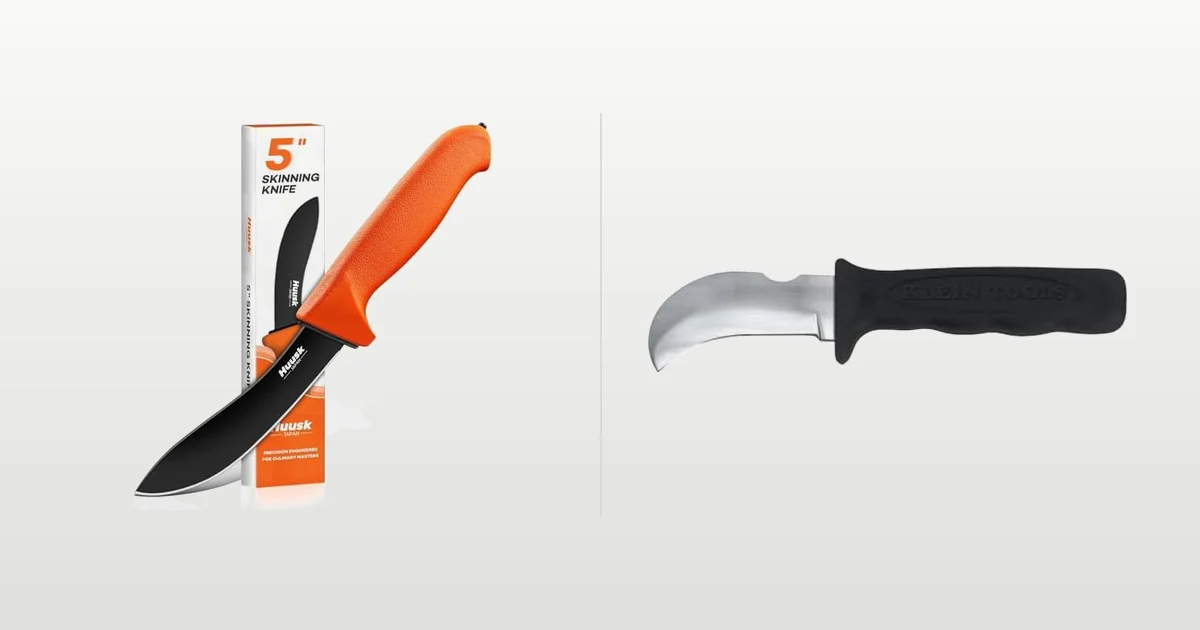
Skinning is separation, not piercing. You work the blade into the membrane between hide and muscle and run it along, and every time the point digs in you either cut the hide — which ruins it — or cut into the meat, which wastes it. So a skinner has a deep curved belly that does the work and a base that is deliberately rounded, and the Huusk listing on this page says so directly: a fine tip at the front and a rounded base behind it, so the blade follows the animal’s contour.
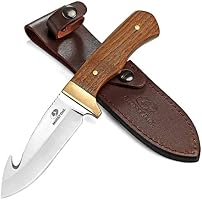
One knife here removes the risk entirely. A gut hook is a small sharpened crescent cut into the spine — you slip it under the hide and pull, and it physically cannot cut deeper than the hook is deep.
And one product here is not for animals at all. Klein Tools make a lineman’s skinning knife, three inches with a hooked blade, for stripping the jacket off electrical cable. It appears in this search because skinning names two different trades.
Ten below, $13.59 to $36.49. Only one names its blade geometry and only one seals the handle joint against bacteria.
Our Quick Picks
 Best OverallHuusk 5 Inch Curved Oval
A thin, curved oval blade with a fine tip and a deliberately rounded base, on a flame-orange handle you can find when you put it down.
 Best SteelMercer Culinary BPX 5.9 Inch
Precision-forged high-carbon German steel, ice hardened for blade strength, on a textured glass-reinforced nylon handle.
 Best Gut HookMossy Oak Gut Hook 9.5 Inch
A 4.5-inch blade with a gut hook, 3.3 mm thick, full tang through a walnut handle with a finger guard.
At a Glance
Ten Knives, Compared on Shape and Steel
Blade length and profile, steel where named, the feature each maker leads on, and what it is genuinely for.
| # | Model | Blade | Steel | Detail | Spec | Standout | Main Drawback | Check Price |
|---|---|---|---|---|---|---|---|---|
| 1 |
 Huusk 5 Inch Curved Oval Huusk 5 Inch Curved Oval |
5 in | Curved oval | Rounded base | Hi-vis | A rounded base so the blade follows the hide instead of cutting through it | Unfamiliar brand at a mid price | View on Amazon |
| 2 |
 Mercer Culinary BPX 5.9 Inch Mercer Culinary BPX 5.9 Inch |
5.9 in | German | Ice hardened | Forged | Precision-forged German steel, ice hardened, from a professional cutlery house | A kitchen brand rather than a hunting one | View on Amazon |
| 3 |
 Outdoor Edge Zip Blade Outdoor Edge Zip Blade |
4.0 in | 420J2 | 8.8 in | Blaze TPR | A dedicated gutting blade rather than a general skinner | 420J2 is soft stainless | View on Amazon |
| 4 |
 Victorinox 5 Inch Lamb Skinner Victorinox 5 Inch Lamb Skinner |
12 cm | Scandinavian | Fibrox | Swiss | The only listing here that names its blade geometry | A very sparse listing otherwise | View on Amazon |
| 5 |
 Mossy Oak Gut Hook 9.5 Inch Mossy Oak Gut Hook 9.5 Inch |
4.5 in | 3.3 mm | Full tang | Walnut | A gut hook opens the hide without any risk of cutting into it | A gut hook is very hard to sharpen | View on Amazon |
| 6 |
 Dexter-Russell SB12-6 Sani-Safe Dexter-Russell SB12-6 Sani-Safe |
6 in | DEXSTEEL | Sealed handle | Made in USA | A sealed blade-to-handle joint that bacteria cannot get into | White polypropylene shows every stain | View on Amazon |
| 7 |
 BOLEXINO 6 Inch Skinning Butcher BOLEXINO 6 Inch Skinning Butcher |
6 in | X50CrMoV15 | 11.5 in | Finger guard | It names X50CrMoV15, which almost nothing here does | A generic brand at a budget price | View on Amazon |
| 8 |
 Wiebe Beaver Knife Wiebe Beaver Knife |
Curved | High carbon | Fleshing | Sure-Grip | Designed with fur handlers for beaver, muskrat and raccoon | A specialist tool for a specialist job | View on Amazon |
| 9 |
 DRAGON RIOT 6 Inch DRAGON RIOT 6 Inch |
6 in | Stainless | Non-slip | Trimming | Thirteen fifty-nine for a six-inch trimming and skinning blade | Nothing published beyond the length | View on Amazon |
| 10 |
 Klein Tools 1570-3LR Lineman's Klein Tools 1570-3LR Lineman's |
3 in | Hook blade | Notch | Made in USA | It skins cable, not carcasses — and it appears in this search | No use whatever for game | View on Amazon |
Specifications and prices are taken from each manufacturer’s Amazon listing as displayed on 24 August 2026 through a United States connection, and may change. Blade steel is named on only three of these ten listings. One product in this roundup is a lineman’s cable-stripping knife and is included because it appears in this search; it has no application to game. Another is a fur handler’s fleshing tool designed for beaver and muskrat rather than large game. Where a listing describes one blade as suitable for skinning, trimming, deboning and filleting simultaneously, treat that as a compromise across four different optimal geometries rather than four capabilities. Field dressing is food preparation; one knife here states a sealed blade-to-handle joint meeting professional sanitation standards, and none of the others mentions the issue. Sales ranks are shown as displayed.
Scroll the table sideways to see every column
How We Chose These Ten
We researched current listings, compared manufacturer specifications and documentation, and examined recurring patterns in customer feedback. We did not carry out hands-on testing, and nothing below is presented as measured performance data.
- Blade profile assessed against the actual job — a skinner needs a curved belly and a tip that stays out of the way
- Steel recorded where named — three of ten give a grade, and corrosion resistance matters more than hardness here
- A verified live buy box — all ten confirmed purchasable in the United States on 24 August 2026
- No overlap with our published knife guides — every knife here is new to the site
- Handle material and guards noted — hands get slippery and the cut is drawn toward you
- Sanitation noted where a maker addresses it — exactly one does, and it is a food-preparation job
- A cable knife included deliberately — because ‘skinning’ returns it and buyers should know why
The Ten Knives in Detail
1. Huusk 5 Inch Curved Oval — Best Overall

The important word in this listing is rounded. A skinning knife is shaped so that most of its edge cannot puncture what it is sliding under.
Key Specifications
| Blade length | 5 inches, curved oval |
|---|---|
| Profile | Thin and lightweight, maximising cutting surface along the curve |
| Tip | Fine point at the front, rounded base behind it |
| Why rounded | The blade follows the animal’s contour rather than puncturing hide |
| Handle | Flame-orange high-visibility |
| Ergonomics | Shaped to reduce hand fatigue over long sessions |
| Rank | #20,463 in its category |
| Price | $24.99 |
| Best For | Separating hide from carcass without cutting into either |
Why We Recommend It
Skinning is a separating job, not a piercing one. You are working the blade into the membrane between hide and muscle and running it along, and every time the point digs in you either cut the hide, which ruins it, or cut the meat, which wastes it. So a skinner is built with a deep curved belly that does the cutting and a base that is rounded rather than sharp, and you work with the curve rather than the tip.
Thin is deliberate too. A thick blade wedges and drags in the membrane; a thin one glides. This is the opposite of what you want in a batoning knife, which is why a survival knife makes a poor skinner and vice versa.
The flame-orange handle is not styling. A knife set down during processing disappears into leaf litter, mud, snow or a pile of hide within seconds, and hunters lose them constantly. Blaze handles exist for the same reason as blaze clothing.
Rank #20,463 at $24.99 from a brand better known for kitchen knives — the geometry is right, and the steel is unnamed.
Pros
- Rounded base prevents puncturing the hide
- Deep curved belly does the cutting
- Thin blade glides through membrane
- High-visibility handle is genuinely practical
- Ergonomic shape for long sessions
- $24.99
Cons
- Blade steel never named
- Rank #20,463
- Thin blade is wrong for any heavy work
- Brand better known for kitchen knives
- No overall length or weight published
- Fine tip can still catch if you lead with it
Best for: Anyone separating hide from carcass who wants the correct geometry.
2. Mercer Culinary BPX 5.9 Inch — Best Steel

Ice hardening is a real process and almost nobody at this price mentions it.
Key Specifications
| Blade length | 5.9 inches |
|---|---|
| Steel | High-carbon German, precision forged |
| Treatment | Ice hardened for increased blade strength |
| Handle | Textured glass-reinforced nylon, non-slip |
| Stated use | Separating skin from meat of large game; also gutting |
| Series | Mercer Culinary BPX butcher line |
| Care | Hand wash in warm water after each use |
| Rank | #21,675 in its category |
| Price | $23.67 |
| Best For | Anyone who wants professional cutlery steel at a hunting knife price |
Why We Recommend It
Cryogenic or ice hardening is a step in heat treatment, not a coating. After the steel is quenched, some austenite remains untransformed; chilling the blade well below freezing converts more of it to martensite, producing a harder, more dimensionally stable edge with fewer soft spots. On a blade that will be drawn through hide and hair for hours, that translates directly into fewer stops to re-sharpen.
Precision forged rather than stamped means the blade was shaped under pressure rather than cut from sheet, which aligns the grain structure along the edge.
It comes from a professional kitchen house rather than a hunting brand, and that is the reason it is good. Mercer supplies working butchers, where a skinning knife is used all day every day and edge retention is measured in shifts rather than in seasons.
Hand wash only. High-carbon steel and dishwashers do not agree, and the listing says so directly.
Pros
- Precision-forged high-carbon German steel
- Ice hardened for a stronger, more stable edge
- Glass-reinforced nylon grips when wet
- From a professional butchery cutlery line
- $23.67 — excellent value for the steel
- Stated for large game specifically
Cons
- Hand wash only
- No sheath included
- Rank #21,675
- A kitchen brand, so no field carry solution
- White handle shows staining
- No published weight or overall length
Best for: Anyone processing at a bench who wants proper cutlery steel.
3. Outdoor Edge Zip Blade — Best for Gutting

Gutting and skinning are different cuts, and this blade is shaped for the first one.
Key Specifications
| Blade length | 4.0 inches, 420J2 stainless |
|---|---|
| Overall length | 8.8 inches |
| Finish | Precisely heat treated and hand finished shaving sharp |
| Handle | Rubberised blaze orange TPR |
| Sheath | Black nylon belt sheath |
| Stated audience | Guides and professional hunters |
| Support | Outdoor Edge service for life |
| Rank | #26,068 in its category |
| Price | $19.99 |
| Best For | Opening the abdominal cavity without cutting into what is inside |
Why We Recommend It
The gutting cut is the one that goes wrong. You are opening the abdominal wall from the inside out, with the point running just under the skin and the intestines directly beneath. Puncture them and the carcass is contaminated. A gutting blade is short, deeply curved and often has a blunted or guarded tip so that it can be driven along under the hide with the edge upward, cutting the wall without reaching the viscera.
420J2 is a soft stainless and that is a deliberate choice for this application — it resists corrosion extremely well, which matters on a blade repeatedly wetted with blood and gut contents, and it re-sharpens in seconds when it dulls, which it will.
Blaze orange TPR is the same reasoning as the Huusk above. Rubberised rather than hard plastic, so it grips when wet and bloody.
Eight point eight inches overall for a four-inch blade means nearly five inches of handle, which is generous and correct for a knife used in gloves.
Pros
- Purpose-shaped for gutting rather than general use
- Blaze TPR grips when wet and bloody
- 420J2 resists corrosion and resharpens fast
- Publishes blade and overall length
- Nylon belt sheath included
- Service for life from Outdoor Edge
Cons
- 420J2 dulls quickly
- 4 inches is short for skinning a large animal
- Rank #26,068
- Specialist shape, poor as a general knife
- Nylon sheath rather than leather
- Blade steel is the softest here
Best for: The gutting cut specifically, where the tip must not reach the viscera.
4. Victorinox 5 Inch Lamb Skinner — Best Named Geometry
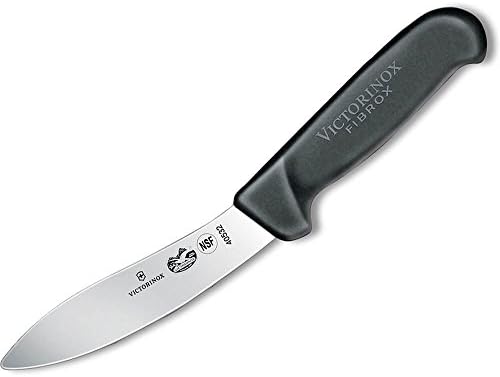
“Blade type: Scandinavian form.” It is three words, and it is more than any other listing on this page tells you about its geometry.
Key Specifications
| Blade length | 12 cm / about 5 inches |
|---|---|
| Blade type | Scandinavian form — stated |
| Steel | Stainless |
| Handle | Black Fibrox |
| Maker | Victorinox, Switzerland |
| Model | 5.7903.12 |
| Rank | #64,031 in its category |
| Price | $36.49 |
| Best For | Sheep and small game, from the professional standard brand |
Why We Recommend It
A Scandinavian skinner has a distinctive shape — a broad, deeply curved belly sweeping up to a tip that sits roughly level with the spine rather than dropping below it. The effect is that the whole cutting edge presents at a shallow angle when the knife is drawn flat along a carcass, so it separates rather than slices. It is the traditional form for sheep and reindeer work in northern Europe, hence the name and hence this being sold as a lamb skinner.
Fibrox is Victorinox’s textured thermoplastic elastomer, the same handle material found on their professional chef knives, and it grips reliably when wet or greasy. It is also dishwasher safe, which for a knife used on animals is genuinely useful.
The listing is remarkably sparse — three bullet points, no steel grade, no weight, no overall length. Victorinox trades on the name and on the fact that professional abattoirs buy these by the box.
Thirty-six forty-nine is the second highest price here for the least documented product, which is a fair summary of what buying a Swiss brand costs.
Pros
- Names its blade geometry, which nothing else does
- Scandinavian form is the traditional skinning shape
- Fibrox grips when wet and is dishwasher safe
- Victorinox professional reputation
- Used by working abattoirs
- Model number given for reordering
Cons
- Extremely sparse listing — three bullets
- No steel grade named
- No overall length or weight
- $36.49, second most expensive here
- Rank #64,031
- No sheath included
Best for: Sheep and small game, from the brand professional processors actually use.
5. Mossy Oak Gut Hook 9.5 Inch — Best Gut Hook
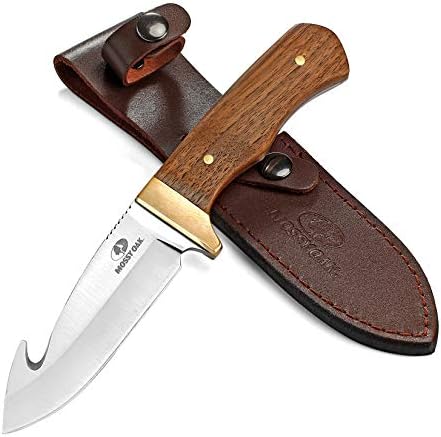
A gut hook is a small sharpened crescent cut into the spine. You slip it under the hide and pull, and it can only cut what passes through the hook.
Key Specifications
| Overall length | 9.5 inches |
|---|---|
| Blade length | 4.5 inches |
| Handle length | 5 inches |
| Blade thickness | 3.3 mm |
| Feature | Gut hook on the spine |
| Construction | Full tang with a finger guard |
| Handle | Classic walnut |
| Sheath | Genuine leather with a snap fastener |
| Rank | #65,404 in its category |
| Price | $19.99 |
| Best For | Opening hide in a straight line with no chance of a deep cut |
Why We Recommend It
That is the entire safety argument for it. Running a knife point along under the hide requires judgement about depth on every inch; a gut hook physically cannot reach anything more than a few millimetres deep because the hook is only a few millimetres deep. You open the hide from sternum to pelvis in one confident pull with no possibility of nicking the stomach wall. For anyone who is not doing this weekly, it removes the step most likely to go wrong.
The cost is sharpening. A gut hook is a curved internal edge, and no flat stone will reach it. You need a round ceramic or diamond rod of the right diameter, and most people never buy one, which is why gut hooks on old knives are almost always blunt.
Every dimension is published — overall, blade, handle and thickness — which almost nothing else on this page manages.
Full tang with a finger guard and a leather sheath at $19.99 is genuinely good value; the steel is named only as stainless.
Pros
- Gut hook cannot cut deeper than the hook
- Opens hide in one confident pull
- Publishes overall, blade, handle and thickness
- Full tang with a finger guard
- Genuine leather sheath with a snap
- $19.99
Cons
- Gut hooks need a round rod to sharpen
- Most gut hooks end up blunt and unused
- Steel named only as stainless
- Rank #65,404
- 3.3 mm is thick for detailed skinning
- Walnut needs occasional oiling
Best for: Occasional hunters who want the opening cut made foolproof.
6. Dexter-Russell SB12-6 Sani-Safe — Most Hygienic

The seal between blade and handle is the specification that matters and nobody else on this page mentions it.
Key Specifications
| Blade length | 6 inches |
|---|---|
| Steel | DEXSTEEL high-carbon alloy, stain-free |
| Edge | Hand honed |
| Handle | Slip-resistant textured polypropylene, white |
| Key feature | Impervious blade-to-handle seal preventing bacteria buildup |
| Standard | Meets professional sanitation requirements |
| Origin | Made in USA |
| Rank | #136,706 in its category |
| Price | $34.32 |
| Best For | Anyone processing meat they intend to eat, which is everyone here |
Why We Recommend It
The joint where a blade enters a handle is where bacteria live. On a knife with riveted scales or a slip-fit handle, there is a hairline gap running the width of the tang that traps blood and tissue, cannot be reached by a brush, and does not dry. Commercial kitchens and processing plants care about this enough that sanitation standards address it directly, which is why Dexter-Russell moulds the handle onto the tang to form an impervious seal with no gap at all.
Field dressing and skinning is food preparation, and it is easy to forget that while standing in a wood. Everything that touches the carcass ends up touching meat you will eat.
White polypropylene is deliberate too — commercial colour coding, and it shows contamination rather than hiding it, which is the point.
Rank #136,706 reflects that this is a trade tool sold mainly to butchers rather than to hunters. At $34.32 it is the professional answer on this page.
Pros
- Sealed blade-to-handle joint with no bacteria trap
- Meets professional sanitation standards
- Hand-honed DEXSTEEL high-carbon alloy
- Slip-resistant even with wet hands
- Made in USA by a commercial cutlery house
- 6-inch blade suits large game
Cons
- White handle shows every stain
- Rank #136,706
- No sheath included
- No published weight or overall length
- Trade tool with no field carry solution
- $34.32
Best for: Anyone who takes the food-safety half of this job seriously.
7. BOLEXINO 6 Inch Skinning Butcher — Best Named Steel

X50CrMoV15. It is the German stainless used by Wusthof and Zwilling, and it is named here on a sixteen-dollar knife.
Key Specifications
| Blade length | 6 inches |
|---|---|
| Overall length | 11.5 inches |
| Steel | X50CrMoV15 high-carbon stainless — named |
| Handle | Textured TPE SoftGrip, non-slip when wet |
| Safety | Built-in finger guard |
| Stated use | Deerskin, sheepskin, cowhide |
| Rank | #89,993 in its category |
| Price | $15.99 |
| Best For | A named steel and a finger guard for sixteen dollars |
Why We Recommend It
Knowing the grade tells you what to expect. X50CrMoV15 is a high-carbon stainless with chromium, molybdenum and vanadium — around 0.5 percent carbon and 15 percent chromium. It takes a keen edge, resists rust genuinely well, and sits in the middle for hardness, so it sharpens easily and does not hold an edge as long as a high-carbon tool steel would. For a knife repeatedly wetted with blood, corrosion resistance matters more than ultimate edge retention.
A built-in finger guard is the safety feature that matters most on a skinner. Hands get slippery, the blade is drawn toward you along a carcass, and a raised guard between handle and edge is what stops your grip sliding forward onto it.
Both dimensions published — six-inch blade in an 11.5-inch knife, so five and a half inches of handle, which is generous.
Rank #89,993 from an unfamiliar brand, but on stated specification alone this is the best value on the page.
Pros
- Names X50CrMoV15, a genuine German stainless
- Excellent corrosion resistance for bloody work
- Built-in finger guard
- Publishes blade and overall length
- TPE SoftGrip handle grips when wet
- $15.99
Cons
- Rank #89,993
- Unfamiliar brand with no service record
- Mid hardness, so edge retention is moderate
- No sheath included
- Straight profile rather than a deep skinner belly
- No weight published
Best for: Anyone who wants the steel named and a guard, at the lowest price.
8. Wiebe Beaver Knife — Best for Furbearers
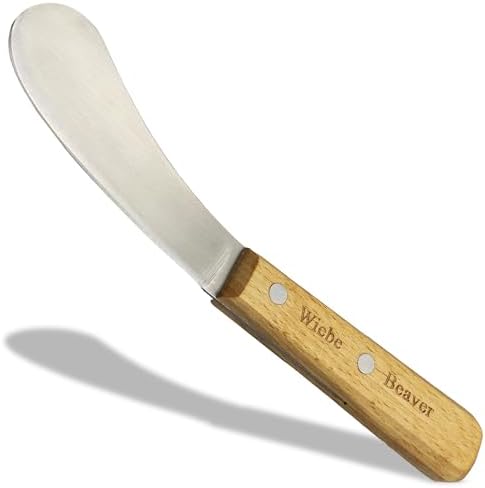
Fleshing is a different operation from skinning, and this knife does both because fur handling requires both.
Key Specifications
| Type | Skinning and fleshing tool |
|---|---|
| Blade | Curved high-carbon stainless |
| Species | Beaver, muskrat, raccoon and other furbearers |
| Handle | Sure-Grip ergonomic, non-slip |
| Second function | Fleshing — removing fat and tissue from the pelt |
| Development | Designed with and tested by seasoned fur handlers |
| Rank | #131,564 in its category |
| Price | $17.95 |
| Best For | Fur handling, where the pelt is the product rather than the meat |
Why We Recommend It
When the pelt is the product the priorities invert. Skinning meat animals treats the hide as packaging; fur handling treats it as the whole point, and the carcass as waste. That changes the tool: after the pelt is off, it has to be fleshed — every trace of fat and membrane scraped from the inside, because fat left on a drying pelt goes rancid and the hide spoils. A curved blade with a deep belly and no aggressive point does both jobs, cutting on the draw and scraping on the push.
Beaver in particular are demanding, which is why the knife is named after them — heavy fat layers, a large round pelt, and a lot of fleshing.
Developed with working fur handlers rather than designed and then marketed at them, which the listing states directly and which shows in the blade shape.
At $17.95 it is inexpensive for a specialist tool, and rank #131,564 reflects how few people trap.
Pros
- Handles both skinning and fleshing
- Curved blade with no aggressive point
- Developed with working fur handlers
- Sure-Grip handle for long sessions
- High-carbon stainless resists rust
- $17.95 for a specialist tool
Cons
- A specialist tool for furbearers
- Rank #131,564
- Wrong shape for large game butchery
- No blade length published
- No sheath included
- Of no use if you are processing for meat
Best for: Trappers and fur handlers, where the pelt is what you are keeping.
9. DRAGON RIOT 6 Inch — Cheapest

Thirteen fifty-nine, and it claims four jobs. That breadth is the thing to read carefully.
Key Specifications
| Blade length | 6 inches |
|---|---|
| Steel | Stainless, grade not named |
| Handle | Ergonomic non-slip |
| Stated uses | Skinning, trimming, deboning, filleting |
| Design note | 6 inches for control on detailed cutting |
| Rank | #70,055 in its category |
| Price | $13.59 |
| Best For | A cheap second blade for trimming alongside a proper skinner |
Why We Recommend It
Skinning, trimming, deboning and filleting want different blades. A skinner is broad with a deep curved belly. A boning knife is narrow and stiff with a fine point for working around joints. A fillet knife is long, narrow and flexible so it bends along a fish’s ribs. A trimming knife is short and straight. One blade cannot be optimised for all four, so a knife sold for all of them is a compromise across every one.
What that makes it is a decent general processing blade for someone who already owns a proper skinner and wants a second knife to trim with while the first stays clean.
Six inches with a non-slip handle is the right size for bench work and slightly large for detail.
Nothing beyond the length is published — no steel grade, no overall length, no weight, no thickness. At $13.59 that is what you would expect, and it is the cheapest knife on this page.
Pros
- $13.59 — cheapest here
- 6 inches suits general bench processing
- Non-slip ergonomic handle
- Useful as a second trimming blade
- Stainless resists the corrosion this work causes
- Rank #70,055
Cons
- Sold for four jobs, optimised for none
- No steel grade named
- No overall length, weight or thickness published
- Straight profile lacks a skinner’s belly
- No sheath included
- Unfamiliar brand
Best for: A cheap second blade for trimming, next to a knife that actually skins.
10. Klein Tools 1570-3LR Lineman's — Not for Animals
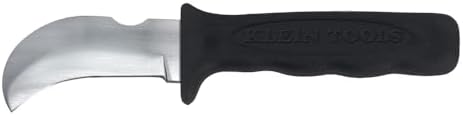
Skinning means two entirely different trades, and this is the other one.
Key Specifications
| Intended use | Scoring and slitting cable jacket |
|---|---|
| Blade | 3-inch steel fixed hook |
| Notch | On the blade back, for scraping or removing wire insulation |
| Construction | Blade securely moulded into the handle |
| Handle | Textured with finger grooves and a guard |
| Origin | Made in USA |
| Sheath | Leather available separately, Cat. No. 5163 |
| Rank | #106,725 in its category |
| Price | $24.97 |
| Best For | Electricians. It is here so nobody buys it by mistake |
Why We Recommend It
An electrician skins cable — scoring and slitting the outer jacket to expose the conductors inside without nicking them. The tool for that is a hooked blade that catches the jacket and draws it into the edge as you pull, with a notch in the spine for stripping individual conductor insulation. The parallel with a hunting skinner is genuine: both are separating an outer layer from what is underneath without damaging either. The tools look nothing alike.
It is in this roundup because it appears in the search, and because the vocabulary collision is worth knowing about. If you are searching for a game knife, ignore anything described as lineman’s, cable or jacket.
A blade moulded into the handle is the same sealed-joint principle as the Dexter-Russell above, for different reasons — here it is about strength rather than sanitation.
Made in the USA at $24.97, and genuinely good at the job it was built for. That job is not this one.
Pros
- Excellent at stripping cable jackets
- Notch for removing conductor insulation
- Blade moulded securely into the handle
- Finger grooves and a guard
- Made in USA by a trade brand
- Leather sheath available separately
Cons
- Not a game knife in any sense
- Hook geometry is wrong for hide
- 3 inches is far too short for skinning
- Appears in this search regardless
- Rank #106,725
- No sheath included as standard
Best for: Electricians. It is on this page so that hunters do not order one.
A Skinner Against a Gut Hook
Two ways to open a hide, and one of them cannot go wrong.
| Huusk Curved Oval | Mossy Oak Gut Hook | |
|---|---|---|
| Opening cut | Freehand with the point | Hook, depth-limited |
| Risk of cutting the meat | Depends on your judgement | Effectively none |
| Blade length | 5 in | 4.5 in |
| Thickness | Thin, stated | 3.3 mm |
| Dimensions published | Blade only | All four |
| Sharpening | Any stone | Needs a round rod |
| Rank | #20,463 | #65,404 |
| Price | $24.99 | $19.99 |
The gut hook makes the opening cut foolproof, which for anyone who does this a few times a season is worth more than any amount of blade geometry. The catch arrives later: a gut hook is a curved internal edge that no flat stone will reach, so it needs a round ceramic or diamond rod, and most people never buy one. That is why gut hooks on second-hand knives are almost always blunt. Buy the rod at the same time or the feature quietly stops working.
What Each Knife Is Actually Shaped For
Read the intended job before the price.
| Knife | Job | Steel named | Dimensions | Rank | Price |
|---|---|---|---|---|---|
| Huusk Curved Oval | Skinning | No | Blade only | #20,463 | $24.99 |
| Mercer BPX | Skinning large game | German high-carbon | Blade only | #21,675 | $23.67 |
| Outdoor Edge Zip Blade | Gutting | 420J2 | Blade + overall | #26,068 | $19.99 |
| Victorinox Lamb Skinner | Skinning, Scandinavian form | No | Blade only | #64,031 | $36.49 |
| Mossy Oak Gut Hook | Opening the hide | No | All four | #65,404 | $19.99 |
| DRAGON RIOT 6 Inch | Skin, trim, debone, fillet | No | Blade only | #70,055 | $13.59 |
| BOLEXINO 6 Inch | Skinning butcher | X50CrMoV15 | Blade + overall | #89,993 | $15.99 |
| Klein 1570-3LR | Cable jacket | No | Blade only | #106,725 | $24.97 |
| Wiebe Beaver Knife | Fleshing furbearers | High carbon | None | #131,564 | $17.95 |
| Dexter-Russell SB12-6 | Commercial butchery | DEXSTEEL | Blade only | #136,706 | $34.32 |
Three knives here are not general skinners: one gutting blade, one fleshing tool for furbearers, and one for stripping electrical cable. Of the seven that are, only three name a steel and only two publish more than a blade length. The Mossy Oak gut hook is the single most completely documented product on the page, at $19.99.
Best Alternatives
| Alternative | Why Consider It | Better For | Main Trade-Off |
|---|---|---|---|
| A replaceable-blade hunting knife | A factory edge every time, no sharpening in the field | Hide and hair, which dull an edge fast | You buy blades forever, and they are thin |
| A full processing kit | Skinner, boning knife, saw and shears in one roll | Taking an animal from field to freezer | Several tools to carry and clean |
| A butcher’s boning knife | Narrow, stiff and pointed for working around joints | Breaking down after the hide is off | Poor at separating hide |
| Paying a game processor | No tools, no learning curve, no mess | Anyone who takes one animal a year | Costs per animal and you lose control of the cuts |
What the Money Actually Buys
$13.59 to $19.99 — DRAGON RIOT, BOLEXINO, Wiebe, Outdoor Edge Zip Blade, Mossy Oak gut hook. The value tier and a genuinely strong one. It contains the only knife here that publishes all four dimensions, the only budget knife that names a German stainless, and a purpose-built gutting blade with service for life.
$23.67 to $24.99 — Mercer BPX, Huusk, Klein. Where the two best general skinners sit. The Mercer brings precision-forged ice-hardened German steel from a professional butchery line; the Huusk brings the correct curved-oval geometry and a high-visibility handle. The Klein is the cable knife.
$34.32 to $36.49 — Dexter-Russell, Victorinox. The professional tier, and both are trade tools rather than hunting products. The Dexter-Russell has the sealed handle joint that commercial sanitation requires; the Victorinox names its Scandinavian blade form and otherwise tells you almost nothing.
What to Check Before You Buy
Look for a Belly, and a Tip That Stays Out of the Way
The defining shape of a skinning knife is a deep curved belly with the point swept up out of the cutting line. You work along the membrane between hide and muscle with the curve, not the tip, because the tip is what punctures the hide from underneath or dips into the meat. Several knives sold as skinners on this page are actually straight-profile butcher knives, which will do the job in experienced hands and give you far less margin. One listing describes a rounded base behind a fine tip, which is exactly the right description of the geometry.
Corrosion Resistance Beats Edge Retention Here
This runs against the instinct that harder steel is always better. A skinning knife is repeatedly wetted with blood, gut contents and fat, often for hours, frequently in cold and wet conditions, and often not cleaned until the job is finished. Under those conditions a high-carbon tool steel will spot and pit. The steels that appear on this page — 420J2, X50CrMoV15, ice-hardened German stainless — are all chosen for chromium content rather than ultimate hardness, and they resharpen quickly, which matters because hide and hair dull an edge remarkably fast.
Insist on a Finger Guard
The skinning cut is drawn toward you, along a carcass, with hands that are wet with blood and fat. If your grip slips forward there is nothing between your fingers and the edge except whatever the maker built in. A raised finger guard or a deep choil is the difference between a slip and a hospital visit, and several knives here state one explicitly. It is a more important feature on this kind of knife than on almost any other, precisely because the working conditions are the worst a knife encounters.
Remember This Is Food Preparation
Exactly one knife on this page addresses it. Dexter-Russell moulds the handle onto the tang to form an impervious seal, because the joint where a blade meets a handle is a hairline gap that traps blood and tissue, cannot be reached by a brush and does not dry out. Commercial sanitation standards care about this; hunting knife marketing does not mention it. Everything that touches the carcass ends up touching meat you intend to eat, and a riveted wooden-scale handle is considerably harder to make genuinely clean than a sealed synthetic one.
A Gut Hook Needs a Round Sharpener
Gut hooks are excellent and they are the feature most often found blunt on second-hand knives, for one simple reason. The cutting edge is on the inside of a small curve, and no flat stone, no pull-through sharpener and no steel will reach it. You need a tapered round ceramic or diamond rod of roughly the right diameter. If you buy a gut-hook knife, buy the rod at the same time, or accept that after one or two animals the feature will stop working and become a notch that catches on things.
High-Visibility Handles Are Not a Gimmick
Two knives here have blaze orange handles and both are made by people who process animals for a living. A knife set down mid-job disappears within seconds into leaf litter, mud, snow, or a pile of hide, and dark tactical finishes make it worse. Losing a knife halfway through field dressing is common enough that manufacturers design against it. It is the same reasoning as blaze clothing, applied to the tool rather than the person, and it costs nothing.
Beware One Knife Sold for Four Jobs
One listing here offers skinning, trimming, deboning and filleting from a single six-inch blade. Those want genuinely different geometries: a skinner is broad with a deep belly, a boning knife is narrow and stiff with a fine point for working joints, a fillet knife is long and flexible to follow ribs, and a trimming knife is short and straight. A blade claiming all four is a compromise across every one of them. That can be a perfectly reasonable second knife to have on the bench, and it is not the knife to reach for first.
Common Mistakes
- Using a pointed general-purpose knife. The tip is what cuts the hide and the meat you were trying to save.
- Buying on hardness. Corrosion resistance matters more on a blade repeatedly wetted with blood.
- Skipping the finger guard. The cut is drawn toward you with slippery hands.
- Buying a gut hook without a round rod. No flat stone will ever reach the inside of that curve.
- Choosing a dark handle. Knives set down during processing vanish into leaf litter.
- Ignoring the handle joint. This is food preparation and riveted scales trap tissue.
- Ordering a lineman’s knife. It skins cable jackets, and it appears in this search.
Who Should Buy Which
Buy the Huusk at $24.99 for the correct geometry. A thin curved oval blade with a rounded base so it follows the contour instead of puncturing it, on a high-visibility handle you will not lose.
Buy the Mercer BPX at $23.67 for the best steel. Precision-forged, ice-hardened high-carbon German steel from a professional butchery line, stated for large game, at less than the Huusk.
Buy the Mossy Oak gut hook at $19.99 if you do this a few times a year. It makes the opening cut foolproof and publishes every dimension — just buy a round sharpening rod with it.
Buy the Dexter-Russell at $34.32 if you care about the food-safety half. A sealed blade-to-handle joint with no gap for bacteria, made in the USA to commercial standards.
Buy the BOLEXINO at $15.99 for the most specification per dollar. X50CrMoV15 named, both lengths published, and a built-in finger guard.
Frequently Asked Questions
What makes a skinning knife different from a hunting knife?
Shape, and specifically what the shape is trying to avoid. A general hunting knife is a drop point or clip point with a usable tip, because it has to do everything — cutting cord, preparing food, general camp work. A skinning knife is built for one job: separating hide from muscle along the membrane between them. That calls for a deep curved belly that does the cutting and a point swept up out of the working line, and on several skinners the base of the blade is deliberately rounded so it cannot puncture at all. The result is a knife that is superb at one thing and noticeably worse than a general knife at everything else, including piercing, which it is designed not to do.
Do I need a gut hook?
If you process a few animals a season rather than a few a week, it is genuinely worth having. The opening cut runs from sternum to pelvis with the blade just under the hide and the intestines directly beneath, and puncturing them contaminates the carcass. A gut hook is a small sharpened crescent cut into the spine: you slip it under the hide and pull, and it physically cannot cut deeper than the hook is deep, which removes the judgement from the step most likely to go wrong. The drawback is sharpening. The edge is on the inside of a tight curve and no flat stone will reach it, so it needs a tapered round ceramic or diamond rod. Buy one at the same time, because a blunt gut hook is just a notch that snags.
What steel should a skinning knife be?
Something corrosion resistant rather than something hard, which inverts the usual advice. This knife spends hours wet with blood, fat and gut contents, frequently in cold or rain, and it often is not properly cleaned until the whole job is done. High-carbon tool steels that hold a magnificent edge will spot and pit under those conditions. The grades named on this page are all chosen accordingly: 420J2 is soft and extremely rust resistant, X50CrMoV15 is the German stainless used in quality kitchen knives, and one maker ice-hardens its high-carbon German steel for extra strength. All of them resharpen quickly, which matters because hide and hair blunt an edge faster than almost anything else you will cut.
Why is a lineman’s knife in these results?
Because skinning describes two unrelated trades and Amazon matches the word rather than the job. An electrician skins cable: scoring and slitting the outer jacket to expose the conductors without nicking them. The tool is a short hooked blade that catches the jacket and pulls it into the edge, usually with a notch in the spine for stripping individual conductor insulation. Klein Tools have made them for decades and the one in this roundup is excellent at that job. The underlying idea is even parallel — separating an outer layer from what is underneath without damaging either — but the geometry is completely different and it has no application to game. If you are shopping for a hunting knife, ignore anything described as lineman’s, cable or jacket.
Does hygiene really matter on a hunting knife?
Yes, and exactly one product in this roundup addresses it. Field dressing and skinning are food preparation, which is easy to forget while standing in a wood in the rain. The specific weak point is the joint where the blade enters the handle: on a knife with riveted scales there is a hairline gap running the width of the tang that traps blood and tissue, cannot be reached with a brush, and does not dry out. Dexter-Russell moulds the handle directly onto the tang to form an impervious seal with no gap at all, which is why commercial processors use that construction. If you prefer a wooden-handled knife, clean the joint deliberately and dry it thoroughly rather than assuming a rinse has done it.
Can one knife do skinning, boning and filleting?
Not well, and one listing on this page claims all four jobs plus trimming. The geometries genuinely conflict. A skinner is broad with a deep curved belly and a swept tip. A boning knife is narrow, stiff and sharply pointed so it can work around joints and follow bone. A fillet knife is long, narrow and deliberately flexible so it bends along a fish’s ribcage. A trimming knife is short and straight. A single blade attempting all of them is a compromise on each, which does not make it useless — it makes a reasonable second knife for general bench work, particularly at under fourteen dollars. It is not the knife to reach for when the hide comes off.
Final Verdict
A thin curved oval blade with a rounded base that follows the contour instead of puncturing it, on a high-visibility handle. $24.99.
Precision-forged, ice-hardened high-carbon German steel from a professional butchery line, stated for large game. $23.67.
A gut hook that cannot cut deeper than the hook, with all four dimensions published, for $19.99.
A skinning knife is designed not to stab, and once you see that the category makes sense. The deep belly does the cutting, the point stays out of the way, and one knife here removes the risk altogether with a hook that cannot reach past its own depth.
Then buy for the conditions rather than the spec sheet. Corrosion resistance over hardness, because the blade will sit wet for hours. A finger guard, because the cut comes toward you with slippery hands. A handle you can see when you put it down.
And remember what this actually is. One maker on this page seals the handle joint against bacteria and states why. Everyone else is selling you a hunting product; that one is selling you a food-preparation tool, which is what all of them are.
Buy the Huusk for the shape, the Mercer for the steel, and a round rod alongside whichever gut hook you choose.