Affiliate Disclosure: As an Amazon Associate, we earn from qualifying purchases. This does not affect the price you pay.
A survival knife is not defined by its length, its coating, or how many things came in the box with it. It is defined by what happens when you hammer it through a log.
That is decided by the tang — whether the steel of the blade continues at full width and thickness all the way through the handle, or narrows to a stub buried in moulded rubber. A full-tang knife bends before it breaks. A rat-tail tang snaps at the handle, and it snaps at the moment you are leaning on it.
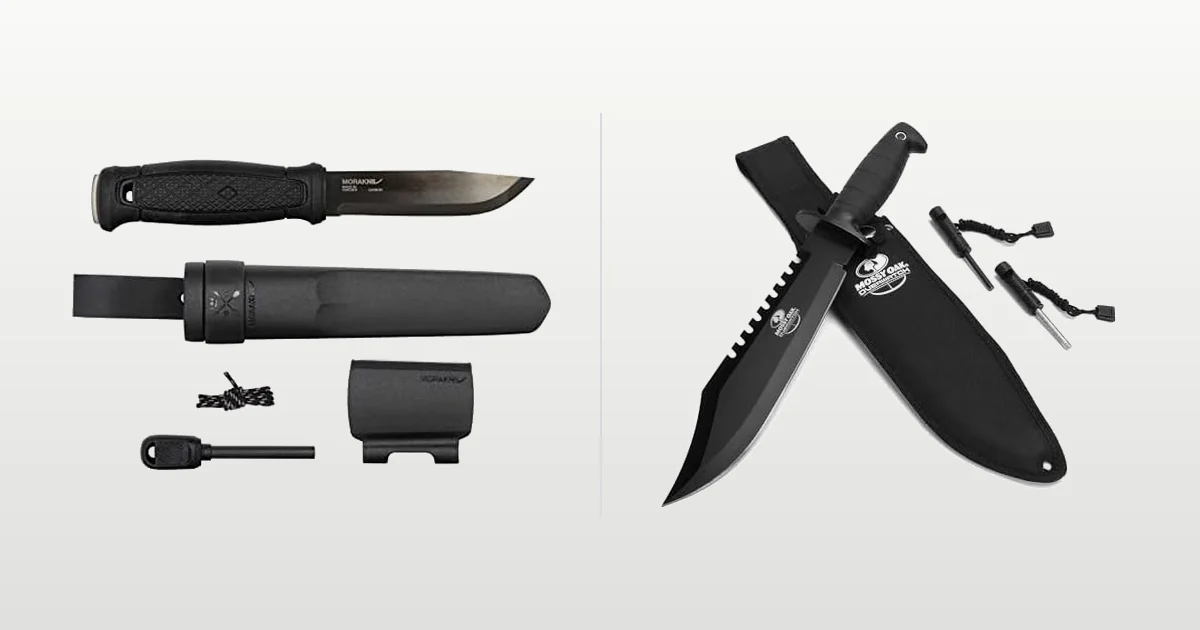
So it is worth knowing that of the twenty-four survival knives we verified in stock, only eight state full tang anywhere in their listing. And the pattern of which ones do is the opposite of what you would guess: the 4.3-inch Morakniv says so in its product name. The 15-inch “survival knife” with the saw back, the fire starter and the sharpener says nothing about it at all — while describing itself as “stronger than any hunting knife or bowie knife”.
The long knives sell on presence and bundles. The short ones sell on construction. Only one of those is load-bearing.
Ten survival knives below, from $17.08 to $109.99, sorted by what their listings actually commit to — including two that turn out to be the same knife.
Our Quick Picks
 Best OverallMorakniv Garberg
Full tang, Sandvik 12C27, a Scandi grind and a spine ground square specifically so it will throw sparks — every claim on the listing is a specification.
 Best Value Full TangFreelander D2 Full Tang
A 5 mm full-tang spine in D2 tool steel with a Kydex sheath, for less than a third of what the named brands here charge.
 Best Sheath SystemGerber StrongArm
Full tang 420HC under a Cerakote coating, in a sheath that mounts four ways — the most thought-through carry system on this page.
At a Glance
Ten Survival Knives, Compared on Construction
Blade length, steel grade where one is named, whether full tang is stated, and stock thickness — the four things that decide whether a knife survives being used hard.
| # | Model | Blade | Steel | Tang | Stock | Standout | Main Drawback | Check Price |
|---|---|---|---|---|---|---|---|---|
| 1 |
 Morakniv Garberg Morakniv Garberg |
4.3 in blade | Sandvik 12C27 | Full tang, stated | 0.13 in / 3.2 mm | A 90° spine ground to strike a ferro rod | 4.3 inches is short if you expect to chop | View on Amazon |
| 2 |
 Gerber StrongArm Gerber StrongArm |
4.8 in blade | 420HC | Full tang, stated | Cerakote coated | A multi-mount sheath that carries horizontally or vertically | 420HC is a modest steel at $109.99 | View on Amazon |
| 3 |
 Holtzman’s Bloodline Holtzman’s Bloodline |
Full tang 1095 | 1095 high carbon | Full tang, in the name | G10 handle | Ferro rod, scraper, paracord and Kydex all included | 1095 carbon steel will rust if neglected | View on Amazon |
| 4 |
 Cold Steel SRK Cold Steel SRK |
6 in blade | SK-5 carbon | Not stated on the listing | Kray-Ex handle | A design carried by military and tactical users for decades | The listing never states the tang construction | View on Amazon |
| 5 |
 Freelander D2 Full Tang Freelander D2 Full Tang |
D2 tool steel | D2 | Full tang, 5 mm spine | Kydex sheath | Full tang D2 and a 5 mm spine for $24.99 | Little brand history behind a good specification | View on Amazon |
| 6 |
 Smith & Wesson M&P Special Ops Smith & Wesson M&P Special Ops |
8Cr13MoV | 8Cr13MoV | Full tang, stated | Fixed blade | A named steel and a stated tang from a known brand for $27.19 | 8Cr13MoV is entry-grade stainless | View on Amazon |
| 7 |
 Dream Reach Fixed Blade Dream Reach Fixed Blade |
Full tang | Not named | Full tang, stated | Outdoor survival | States full tang without naming a steel | No steel grade published anywhere | View on Amazon |
| 8 |
 SZCO Full Tang 13-Inch SZCO Full Tang 13-Inch |
13 in overall | Not named | Full tang, stated | Fixed blade | The only long knife here that claims full tang | Thirteen inches is more knife than most tasks need | View on Amazon |
| 9 |
 Mossy Oak 15-Inch Survival Mossy Oak 15-Inch Survival |
10 in blade | Stainless, ungraded | Not stated | 5/32 in / 3.97 mm | Fire starter and sharpener bundled for $17.08 | Fifteen inches, and no tang claim anywhere | View on Amazon |
| 10 |
 FLISSA 15-Inch Survival FLISSA 15-Inch Survival |
10 in blade | Stainless, ungraded | Not stated | 5/32 in / 3.97 mm | Publishes the same dimensions as the Mossy Oak, in the same wording | Two dollars more for what appears to be the same knife | View on Amazon |
Specifications and prices are taken from each manufacturer’s Amazon listing as displayed on 23 August 2026 through a United States connection, and may change. The Tang column records only what a listing states: “Not stated” means the listing does not describe the tang construction, which is not the same as a claim that the knife is not full tang. Steel is recorded only where a grade is named; four of these ten name none. Stock thickness is the manufacturer’s figure and is quoted in the units the listing uses. Sales ranks are shown as displayed and can be pooled across a variant family.
Scroll the table sideways to see every column
How We Chose These Ten
We researched current listings, compared manufacturer specifications and documentation, and examined recurring patterns in customer feedback. We did not carry out hands-on testing, and nothing below is presented as measured performance data.
- Whether the listing states a tang construction — the single specification that decides whether a knife survives batoning, and only 8 of 24 state it
- A verified live buy box — all ten confirmed purchasable in the United States on 23 August 2026
- No overlap with our hunting knife roundup — 3 candidates already appeared there and were excluded, so these are ten fresh products
- Whether it is a knife at all — the search returns multitools, machetes, hatchet sets and gift kits; none are included here
- A named steel grade, or an honest note that there is none — four of the ten name no grade whatsoever
- Stock thickness where published — the second structural number, after tang
- Brand spread — ten brands across ten slots

The Ten Survival Knives in Detail
1. Morakniv Garberg — Best Overall

Blade length, thickness, overall length, steel grade, grind and tang — all six stated on one listing. Nothing else here manages that.
Key Specifications
| Blade length | 4.3 inches / 109 mm |
|---|---|
| Blade thickness | 0.13 inch / 3.2 mm |
| Overall length | 9 inches / 229 mm |
| Steel | Hardened Sandvik 12C27 stainless |
| Tang | Full, stated in the product name |
| Grind | Scandi |
| Spine | 90°, compatible with the included fire starter |
| Price | $99.99 |
| Best For | One knife that has to do everything, done properly |
Why We Recommend It
The 90° spine is the detail that shows this was designed rather than assembled. A ferro rod needs a sharp square edge to scrape burning shavings off it. Most knife spines are rounded or chamfered during finishing, which makes them useless for that and forces you to use the cutting edge — blunting the thing you most need sharp. Morakniv grinds the spine square on purpose and says so.
Full tang is in the product name, which is where you want it. The steel runs the full width and length of the handle, so there is no thin stub of metal inside a moulded grip waiting to snap when you baton through a log. That is the single structural thing separating a survival knife from a knife sold for survival.
Sandvik 12C27 is a specified steel — a fine-grained stainless that takes a very keen edge and, importantly, can be brought back on a simple stone. That matters more in the field than exotic edge retention you cannot restore.
Four point three inches will not chop. This is a cutting, carving and fire-prep knife, and if you expect to fell or limb with it you want an axe alongside. The Scandi grind is superb for feather sticks and poor for slicing food, which is the trade you are choosing.
Pros
- Full tang, stated in the product name
- Every key dimension published: blade, thickness, overall
- Sandvik 12C27 named and hardened
- 90° spine ground to strike a ferro rod
- Integrated firestarter and diamond sharpener
- Scandi grind excels at feather sticks
Cons
- 4.3 inches is too short to chop with
- Scandi grind is poor at food prep
- $99.99
- Stainless holds an edge less long than 1095 carbon
- 13.8 oz with sheath is not light
- No serration or saw back
Best for: Anyone buying one knife that must carve, prep fire and survive being levered.
2. Gerber StrongArm — Best Sheath System

Full tang stated in the opening line, and a sheath that solves the problem nobody markets: where the knife actually lives.
Key Specifications
| Blade length | 4.8 inches |
|---|---|
| Steel | 420HC, plain edge |
| Tang | Full, stated in the first bullet |
| Coating | Cerakote for wear and corrosion resistance |
| Grip | Rubberised diamond texture |
| Sheath | Multi-mount — horizontal, vertical or MOLLE |
| Rank | #16,116 in its category |
| Price | $109.99 |
| Best For | Anyone who carries a knife daily rather than occasionally |
Why We Recommend It
Carry is the underrated half of a fixed blade. A knife on your belt in the one orientation the maker chose is a knife you will eventually leave in the pack. The StrongArm’s sheath mounts vertically, horizontally, or onto MOLLE webbing, which means it can sit somewhere it does not dig in when you sit down — and a knife you keep on you is worth more than a better knife you left behind.
420HC is honest but unexciting at this price. It is the same grade as the Buck 110, a modest stainless that sharpens easily and does not hold an edge as long as the 1095 or D2 elsewhere here. Gerber leans on the Cerakote coating and the build rather than the alloy, which is a defensible choice and still leaves $109.99 buying a middling steel.
The diamond-texture rubber grip is a genuine wet-hands feature, and the reason this knife shows up in kit lists where gloves and rain are assumed.
Four point eight inches is the practical sweet spot for a do-everything fixed blade — long enough to be useful, short enough to control.
Pros
- Full tang stated plainly on the listing
- Multi-mount sheath carries four ways
- Cerakote resists wear and corrosion
- Rubberised diamond grip works wet
- 4.8 inches is a versatile length
- Best rank among the genuine survival knives here
Cons
- 420HC is a modest steel for $109.99
- No fire starter included
- Highest price on this page
- Coating will wear at the edge over time
- No 90° spine mentioned for ferro use
- Plain edge only
Best for: Someone who carries a fixed blade regularly and cares where it sits.
3. Holtzman’s Bloodline — Best Kit

Full tang 1095 with the ferro rod, scraper and paracord already in the box — nothing else to buy before it works.
Key Specifications
| Steel | 1095 high carbon |
|---|---|
| Tang | Full, stated in the product name |
| Handle | Textured G10 |
| Sheath | Custom-fit Kydex |
| Included | Ferro rod, scraper, paracord, belt clip, mounting hardware |
| Intended use | Wood prep, feather sticks, fire starting |
| Rank | #109,885 in its category |
| Price | $82.22 |
| Best For | A complete fire-and-wood kit in one purchase |
Why We Recommend It
1095 is the traditional survival steel and the trade is well understood. It is a simple high-carbon steel: tough, easy to sharpen on almost anything, and it takes a very hard edge. It also rusts if you put it away wet, which stainless will not. For a knife used hard and maintained deliberately, most bushcraft opinion still favours carbon.
G10 is the right handle material for this job. It is a glass-fibre laminate that does not absorb water, does not swell or shrink with temperature, and grips better wet than dry — unlike wood, which moves, or smooth polymer, which does not grip at all.
The kit framing is the actual proposition. Ferro rod, scraper, paracord and a Kydex sheath with mounting hardware means this arrives ready. Buying the Morakniv and adding equivalents separately costs more and takes several orders.
The rank is very low, which for a boutique brand is not surprising and is worth knowing. You are buying on specification rather than on the weight of other people’s experience.
Pros
- Full tang 1095 high carbon steel
- Ferro rod, scraper and paracord included
- Kydex sheath with mounting hardware
- G10 handle grips wet
- Arrives complete — nothing else to buy
- Specification stated clearly throughout
Cons
- 1095 carbon steel rusts if stored wet
- #109,885 rank — very little field feedback
- $82.22 from a brand with limited track record
- No blade length stated on the listing
- Carbon steel needs oiling
- Kydex is noisy on the draw
Best for: Someone who wants the whole fire-and-wood kit in one box, and will oil the blade.
4. Cold Steel SRK — Best Proven Design

SK-5 steel, a six-inch clip point, decades of service use — and no mention of the tang anywhere in the listing.
Key Specifications
| Blade length | 6 inches, clip point |
|---|---|
| Steel | SK-5 carbon |
| Tang | Not stated anywhere on the listing |
| Handle | Kray-Ex, textured |
| Sheath | Secure-Ex heavy duty |
| Finish | Black tuff finish |
| Rank | #38,169 in its category |
| Price | $44.65 |
| Best For | A proven service design at a sensible price |
Why We Recommend It
The omission is worth flagging rather than filling in. The SRK is a well-regarded design with a long history, and the absence of a tang claim in these bullets is not evidence of a weak knife. But on a page where the defining specification is tang construction, a listing that names its steel, its handle material, its sheath and its finish while saying nothing about the tang is a listing that has left out the thing we are checking. We record it as unstated.
SK-5 is a genuine carbon steel — roughly comparable to 1095, tough and abrasion resistant, and it takes a hard working edge. Like all carbon steels it needs drying and oiling.
Six inches is towards the long end of useful. It is enough blade to baton usefully and still short enough to control for fine work, which is why the design has persisted in kit lists for so long.
Kray-Ex is Cold Steel’s textured elastomer, and its virtue is grip when wet. The Secure-Ex sheath is rigid rather than leather, which means it will not soften and lose the blade when soaked.
Pros
- SK-5 carbon steel, tough and abrasion resistant
- A design with decades of documented service use
- 6 inches suits batoning and general work
- Kray-Ex handle grips wet
- Rigid Secure-Ex sheath will not soften
- $44.65 for a proven design
Cons
- Tang construction is not stated anywhere
- Carbon steel needs drying and oiling
- No fire starter or extras included
- 6 inches is long for fine carving
- Black coating wears at the edge
- Clip point is weaker at the tip than a drop point
Best for: Anyone who wants a long-proven service design and will accept an unstated tang.
5. Freelander D2 Full Tang — Best Value Full Tang

Full tang, D2, and a 5 mm spine — on paper the strongest construction here, for $24.99.
Key Specifications
| Steel | D2 tool steel |
|---|---|
| Tang | Full, with a 5 mm thick spine |
| Spine thickness | 5 mm — the thickest stated here |
| Sheath | Custom-fitted Kydex with belt attachment |
| Handle | Contoured, non-slip when wet or cold |
| Stated uses | Batoning firewood, bushcraft, camping |
| Rank | #14,102 in its category |
| Price | $24.99 |
| Best For | The specification that matters, at the lowest price it appears |
Why We Recommend It
Five millimetres is the thickest spine stated on this page. Spine thickness is what resists bending and what takes the hammering when you baton a blade through a log; the Morakniv is 3.2 mm and costs four times as much. Thickness is not free — a thick spine makes a worse slicer, because the wedge behind the edge is fatter — but for the specific job of surviving abuse it is the right direction.
D2 at this price is unusual. It is a high-carbon, high-chromium tool steel that holds an edge far longer than 420HC. The catch, as with the D2 knife in our hunting roundup, is that it is correspondingly harder to bring back once it does go — and in the field you sharpen with what you carried.
The listing names batoning explicitly, which combined with full tang and a 5 mm spine is at least a coherent set of claims rather than a marketing word attached to a thin knife.
What you are not buying is history. There is no service record, no decades of field reports, no brand to stand behind a failure. The specification is excellent; the evidence that it is delivered is thin.
Pros
- Full tang with a 5 mm spine — thickest here
- D2 tool steel at $24.99
- Kydex sheath included
- Explicitly rated for batoning
- Contoured grip stated to work wet and cold
- Best specification per dollar on this page
Cons
- Very little brand track record
- D2 is hard to resharpen in the field
- Thick spine makes it a poorer slicer
- No blade length stated on the listing
- No fire starter included
- Heat treatment quality is unverifiable at this price
Best for: Anyone who wants full tang and thick stock and cannot justify $100.
6. Smith & Wesson M&P Special Ops — Best Budget Brand

Both of the things this page is checking — a named steel and a stated tang — for $27.19.
Key Specifications
| Steel | 8Cr13MoV high carbon stainless |
|---|---|
| Tang | Full, stated |
| Type | Fixed blade |
| Brand position | Recognised name at a budget price |
| Steel class | Entry-grade stainless, easy to sharpen |
| Rank | #51,866 in its category |
| Price | $27.19 |
| Best For | A cheap fixed blade that is not a mystery |
Why We Recommend It
8Cr13MoV is entry-grade and that is fine here. It is a Chinese stainless roughly equivalent to AUS-8: it will not hold an edge like D2 or 1095, and it sharpens back in minutes on almost anything. For a knife that will be used and resharpened rather than curated, easy restoration is arguably the more useful property.
Full tang stated at this price is the point. The two cheapest knives on this page cost less and state nothing about their tang. This one costs ten dollars more and tells you. That is the entire spectrum of this category compressed into one comparison.
The brand is doing real work, and it should be read carefully. Smith & Wesson licenses its name onto knives; this is not a firearms-grade manufacturing operation applied to cutlery. It does mean a returns path and a warranty, which the unbranded competition does not reliably offer.
Rank #51,866 is mid-table here and unremarkable in either direction.
Pros
- Full tang, stated on the listing
- Named steel: 8Cr13MoV
- Recognised brand with a returns path
- $27.19
- 8Cr13MoV sharpens back quickly
- Cheapest knife here that states both tang and steel
Cons
- 8Cr13MoV holds an edge poorly next to D2 or 1095
- Licensed brand rather than in-house manufacturing
- No blade length in the listing bullets
- No fire starter or extras
- Middling rank
- Entry-grade fit and finish
Best for: A first fixed blade, or a spare, where you still want the specification stated.
7. Dream Reach Fixed Blade — Most Overlooked

It tells you the one thing most listings here omit, and omits several things the better listings include.
Key Specifications
| Tang | Full, stated |
|---|---|
| Steel | Not named on the listing |
| Type | Fixed blade, outdoor survival |
| What is stated | Construction |
| What is not | Steel grade, hardness, blade length |
| Rank | #24,444 in its category |
| Price | $28.64 |
| Best For | Buyers who rank construction above alloy |
Why We Recommend It
Full tang without a named steel is an interesting trade. Of the two facts, tang is arguably the more load-bearing: a full-tang knife in mediocre steel will bend and blunt but is unlikely to snap at the handle, whereas a rat-tail tang in excellent steel can fail catastrophically at exactly the wrong moment. If a listing is only going to tell you one thing, this is the better one to be told.
That said, the gaps are real. No steel grade, no hardness figure, no blade length. You cannot predict edge retention, corrosion behaviour or how it will sharpen. We record what is stated and flag what is not rather than assuming a grade from the price.
At $28.64 it sits directly against the Freelander, which states full tang and D2 and a 5 mm spine for four dollars less. On published specification the comparison is not close.
Rank #24,444 is respectable for an unknown brand and better than several better-specified knives here, which is a reminder that rank measures sales rather than merit.
Pros
- Full tang stated clearly
- $28.64
- Better rank than several better-specified knives
- Sheath included
- Construction claim is the more important of the two
- Straightforward, no overclaiming
Cons
- No steel grade named anywhere
- No hardness figure
- No blade length published
- Outspecified by the Freelander at a lower price
- No brand track record
- No extras included
Best for: Someone who values stated construction over a named alloy, at a low price.
8. SZCO Full Tang 13-Inch — Longest Full Tang

Thirteen inches with a stated full tang. The two 15-inch knives further down claim no tang at all.
Key Specifications
| Overall length | 13 inches |
|---|---|
| Tang | Full, stated |
| Steel | Not named on the listing |
| Type | Large fixed blade |
| Position | The only 13-inch-plus knife here claiming full tang |
| Rank | #48,580 in its category |
| Price | $38.56 |
| Best For | Camp chopping where a big blade is genuinely wanted |
Why We Recommend It
Length and construction usually move in opposite directions in this category, and this is the exception. The pattern across these listings is that the longer the knife, the less likely the tang is mentioned — big blades sell on presence, and presence does not require steel running through the handle. A 13-inch knife that claims full tang is claiming to be usable as well as impressive.
A long blade is a real tool for a specific job. Clearing brush, limbing, splitting kindling by batoning — these want mass and length, and a 4-inch bushcraft knife is the wrong tool. If those are your tasks, this is a more honest purchase than a short knife you will be tempted to abuse.
The steel is unnamed, so edge retention and corrosion resistance are unknown. On a chopping knife that matters slightly less than on a carving one — you are relying on mass and geometry more than on a keen edge.
Thirteen inches is a lot of knife to carry, and the honest question before buying is whether an axe or a folding saw would do the job better for the same weight.
Pros
- Full tang stated on a 13-inch knife
- Genuine length for chopping and limbing
- $38.56
- Sheath included
- The only large knife here claiming its construction
- Mass suits batoning and brush work
Cons
- No steel grade named
- 13 inches is heavy to carry
- An axe may do the job better for the weight
- No fire starter or extras
- Too long for carving or fine work
- No blade-only length stated
Best for: Camp and brush work where a long, heavy blade is genuinely the right tool.
9. Mossy Oak 15-Inch Survival — Most Bundled
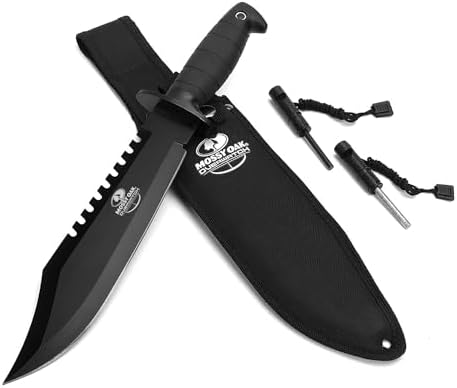
Every dimension published, a bundle included, and no mention of the tang in any of the five bullets.
Key Specifications
| Overall length | 15 inches |
|---|---|
| Blade length | 10 inches |
| Thickness | 5/32 inch / 3.97 mm |
| Tang | Not stated anywhere on the listing |
| Steel | Stainless, no grade given |
| Handle | Rubber, non-slip |
| Included | Fire starter and sharpener |
| Price | $17.08 |
| Best For | A cheap camp knife bought with clear eyes |
Why We Recommend It
The specification it does publish is oddly good. Overall 15 inches, blade 10 inches, thickness 5/32 inch — that is 3.97 mm, actually thicker than the Morakniv’s 3.2 mm. On thickness alone this looks like the more robust knife, which is exactly why thickness alone is not the right measure. A thick blade attached to a thin stub of tang inside a rubber handle fails at the handle, not the blade.
Read what the marketing claims instead. The listing describes it as “stronger than any hunting knife or bowie knife” while naming no steel grade and no tang construction. That is a strength claim with nothing behind it, and it sits directly above the published dimensions that would let you check.
The bundle is the real proposition and it is decent value. Fire starter, sharpener, sheath and a big knife for $17.08. As a car or camp knife for cutting cord and splitting kindling gently, it will do the job.
See also the FLISSA below. The two listings publish the same dimensions in near-identical wording, which is worth knowing before you compare them as alternatives.
Pros
- Every dimension published: 15 in overall, 10 in blade, 5/32 in thick
- 3.97 mm stock is thicker than the Morakniv’s 3.2 mm
- Fire starter and sharpener included
- $17.08 for knife plus bundle
- Rubber handle grips wet
- Saw back on the spine
Cons
- No tang construction stated anywhere
- No steel grade given
- “Stronger than any hunting knife” with nothing to support it
- Near-identical to the FLISSA listing below
- 15 inches is unwieldy for real tasks
- Bundled sharpener is a token item
Best for: A cheap car or camp knife, bought understanding what is not stated.
10. FLISSA 15-Inch Survival — Same Knife, Different Badge

Identical published dimensions to the Mossy Oak above, in near-identical wording, for $1.91 more.
Key Specifications
| Overall length | 15 inches |
|---|---|
| Blade length | 10 inches |
| Thickness | 5/32 inch |
| Tang | Not stated anywhere on the listing |
| Steel | Stainless, no grade given |
| Included | Fire starter and sharpener |
| Relationship to the Mossy Oak | Same published dimensions, near-identical bullet wording |
| Price | $18.99 |
| Best For | Illustrating how this category is actually sold |
Why We Recommend It
Set the two listings side by side and the wording barely changes. Mossy Oak: “Ultra-sharp combat knife, stronger than any hunting knife or bowie knife.” FLISSA: “Ultra-sharp combat knife, stronger than traditional hunting or bowie knives.” Both then publish 15 inches overall, a 10-inch blade and 5/32-inch thickness, a clip point with a saw back, a rubber handle and a bundled fire starter and sharpener.
That pattern almost always means one factory and several brand names. It is the same thing we found among the budget food processors, where three listings shared a capacity and a wattage across two brands. It matters here because a buyer comparing “the Mossy Oak against the FLISSA” believes they are choosing between two products.
Neither states a tang. Whatever is inside the handle is the same in both, and neither listing will tell you what it is.
It ranks slightly better than the Mossy Oak, which is the clearest evidence that badge and listing position, rather than the knife, are what separate them.
Pros
- Same published specification as the Mossy Oak
- Fire starter and sharpener included
- Every dimension published
- Slightly better rank than its twin
- Rubber handle and saw back
- $18.99
Cons
- Appears to be the same knife as the Mossy Oak, for $1.91 more
- No tang construction stated
- No steel grade given
- Strength claim with no specification behind it
- 15 inches is unwieldy
- Comparing it against the Mossy Oak compares labels, not knives
Best for: Nobody, in preference to the identical Mossy Oak — but useful to recognise.
Four Inches Against Fifteen
The shortest knife here against the longest. Note which one commits to a construction.
| Morakniv Garberg | Mossy Oak 15-Inch | |
|---|---|---|
| Blade length | 4.3 inches | 10 inches |
| Overall length | 9 inches | 15 inches |
| Stock thickness | 3.2 mm | 3.97 mm |
| Tang | Full, in the product name | Not stated |
| Steel | Sandvik 12C27, named | Stainless, no grade |
| Spine ground for ferro rod | Yes, 90° | Not stated |
| Price | $99.99 | $17.08 |
The cheap knife has thicker stock, which sounds like the better answer until you ask what the blade is attached to. Thickness resists bending; tang resists snapping. A thick blade on a thin tang fails at the handle, and the listing that publishes its thickness in three units declines to mention its tang at all.

The Same Knife, Two Badges
Two listings, two brands, and one specification sheet.
| Mossy Oak | FLISSA | |
|---|---|---|
| Overall length | 15 inches | 15 inches |
| Blade length | 10 inches | 10 inches |
| Thickness | 5/32 inch | 5/32 inch |
| Blade shape | Clip point, saw back | Clip point, saw back |
| Handle | Rubber, non-slip | Rubber, non-slip |
| Bundle | Fire starter, sharpener | Fire starter, sharpener |
| Tang stated | No | No |
| Price | $17.08 | $18.99 |
The marketing lines differ by a few words — “stronger than any hunting knife or bowie knife” against “stronger than traditional hunting or bowie knives” — and every published number is identical. Comparing these two is comparing labels. If you want this knife, the Mossy Oak is $1.91 cheaper.
Best Alternatives
| Alternative | Why Consider It | Better For | Main Trade-Off |
|---|---|---|---|
| A hatchet or small axe | Chops far better for the same carried weight | Firewood, limbing, shelter building | Useless for anything fine |
| A folding saw | Cuts wood faster and safer than any blade | Processing firewood | One job only |
| A Mora Companion | The same maker’s £15 knife, not full tang | Carving and camp tasks on a budget | Partial tang, so no batoning |
| A quality folder plus a ferro rod | Pocketable, legal in more places | Everyday carry that covers emergencies | Cannot be batoned at all |
What the Money Actually Buys
$17.08 to $28.64 — Mossy Oak, FLISSA, Freelander, S&W M&P, Dream Reach. The most revealing tier on the page, because it contains both extremes. Two knives here state neither steel nor tang and lead on bundles and length. Three state full tang, and one of those — the Freelander at $24.99 — also names D2 and a 5 mm spine. Same money, opposite propositions.
$38.56 to $44.65 — SZCO, Cold Steel SRK. A large stated-full-tang knife and a proven service design with an unstated tang. Both are reasonable buys and neither gives you the complete picture.
$82.22 to $109.99 — Holtzman’s Bloodline, Morakniv Garberg, Gerber StrongArm. At this level everything is stated: tang, steel, dimensions, grind, coating. What you are paying for is not just better material but a listing that tells you what the material is — and a maker willing to be held to it.
What to Check Before You Buy
Find the Word ‘Tang’ Before Anything Else
Full tang means the blade steel continues at full width and thickness through the handle, with the grip scales bolted either side. A rat-tail or partial tang narrows to a rod inside a moulded handle. Under batoning or prying, the first bends and the second snaps — and it snaps where your hand is. If a listing does not use the phrase, it has not made the claim, and on a knife sold for survival that silence is the most important thing on the page.
Do Not Read Thickness as Strength
The cheapest knife in this roundup has thicker stock than the $99.99 Morakniv: 3.97 mm against 3.2 mm. Thickness resists bending along the blade. It says nothing about what the blade is attached to. Two numbers matter and they are not interchangeable — check the tang first, then the stock.
Length Is a Task Decision, Not a Quality One
Four to five inches carves, prepares fire and handles camp tasks. Ten inches and up chops and clears brush. Neither is better; they are different tools. What is worth noticing is that in this category the longer the knife, the less likely its listing is to mention construction — big blades sell on presence, and presence needs no steel in the handle.
Check Whether the Spine Is Ground Square
A ferro rod needs a sharp 90° edge to scrape sparks. Most spines are rounded during finishing, which leaves you scraping with the cutting edge and blunting the thing you most need. Only one knife here states that its spine is ground square for the purpose. If fire-starting matters, this small detail matters more than the rod included in the box.
Carbon or Stainless Is a Maintenance Decision
1095 and SK-5 are carbon steels: tough, easy to sharpen with anything, and they will rust if put away damp. Sandvik 12C27, 420HC and 8Cr13MoV are stainless: more forgiving of neglect, generally less hard. Neither is the right answer in the abstract. The right answer is whether you will dry and oil a blade after a wet day.
Treat an Unnamed Steel as an Unknown, Not a Bad One
Four of these ten name no grade. That does not make them poor steel — it means you cannot predict edge retention, corrosion behaviour or how the knife will sharpen. Where a listing states construction but not alloy, as one here does, that is the better half to be told: tang failure is catastrophic, a soft edge is merely annoying.
Check Whether You Are Comparing Two Products or Two Labels
Two knives in this roundup publish identical dimensions in near-identical wording under different brand names, $1.91 apart. That pattern — one factory, several badges — runs right through budget kitchen and outdoor gear. Before you weigh brand A against brand B, check whether the specification sheets are the same document.

Common Mistakes
- Assuming a big knife is a strong knife. The longest knives here are the least likely to state a tang.
- Reading stock thickness as overall strength. A thick blade on a thin tang fails at the handle.
- Buying the bundle. A fire starter and a sharpener cost a few dollars; a full tang cannot be added later.
- Batoning a knife that never claimed full tang. This is the specific way these knives break.
- Putting a carbon steel blade away wet. 1095 and SK-5 will rust; the sheath keeps the moisture in.
- Using the cutting edge on a ferro rod. Use the spine, and buy a knife whose spine is ground for it.
- Comparing two listings that share a specification sheet. Check the numbers before you weigh the brands.
Who Should Buy Which
Buy the Morakniv Garberg if you want one knife done properly. Full tang in the product name, every dimension published, and a spine ground square for the fire steel.
Buy the Freelander if $99.99 is not happening. Full tang, D2 and a 5 mm spine for $24.99 is the best specification per dollar on this page — accepting that you are buying a specification rather than a reputation.
Buy the Gerber StrongArm if you carry daily. The multi-mount sheath is the difference between a knife on your belt and a knife in a drawer.
Buy the Holtzman’s Bloodline if you want it complete. Full tang 1095, G10, Kydex, ferro rod and paracord in one box.
Buy the SZCO if you actually want a big blade — it is the only long knife here that claims the construction to justify its size.

Frequently Asked Questions
What does full tang actually mean, and why does it matter so much?
Full tang means the steel of the blade continues at its full width and thickness right through the handle, with grip scales bolted or pinned to either side. The alternative — variously called rat-tail, partial or stick tang — narrows the steel to a rod that is glued or pinned inside a moulded handle. Under normal cutting neither will fail. Under batoning, prying or chopping, the full tang bends and the rat-tail snaps at the point where the steel narrows, which is inside your hand. It is the defining specification of a survival knife because survival tasks are precisely the ones that apply those loads. Only eight of the twenty-four knives we verified state it.
Is a longer survival knife better?
No, and in this category length and quality tend to move in opposite directions. Four to five inches covers carving, feather sticks, food prep and fire preparation, and is controllable for fine work. Ten inches and above is for chopping and clearing, where mass does the work. What is worth noticing in the data is that the short knives here are the ones stating full tang, named steels and published grinds, while the fifteen-inch models publish dimensions and bundles and say nothing about construction. Long blades sell on presence, and presence does not require steel running through the handle.
Why do two of these knives look identical?
Because as far as their listings are concerned, they are. The Mossy Oak and the FLISSA both publish 15 inches overall, a 10-inch blade and 5/32-inch stock, both describe a clip point with a saw back, a rubber non-slip handle and a bundled fire starter and sharpener, and their marketing sentences differ by a handful of words. That pattern — one factory supplying multiple brand names — is common in budget outdoor and kitchen gear, and we found the same thing among budget food processors. The practical consequence is that comparing these two is comparing labels rather than products; the Mossy Oak is $1.91 cheaper.
Carbon steel or stainless for a survival knife?
It is a maintenance decision more than a performance one. Carbon steels like 1095 and SK-5 are tough, take a very hard edge and can be sharpened on almost anything including a river stone — but they will rust, and a sheath holds moisture against the blade. Stainless steels like Sandvik 12C27, 420HC and 8Cr13MoV tolerate neglect far better and are generally a little softer. If you will dry and oil a blade after a wet day, carbon rewards you. If the knife lives in a pack and gets remembered occasionally, stainless is the honest choice.
Do I need the fire starter that comes in the box?
The rod itself is a few dollars and largely interchangeable. What is not interchangeable is whether the knife can use it well. A ferro rod is scraped with a sharp 90-degree edge to shave off burning particles, and most knife spines are rounded or chamfered during finishing — which leaves you scraping with the cutting edge and blunting it. One knife in this roundup states that its spine is ground square specifically for this. If fire-starting is part of why you are buying, that detail is worth more than the rod that came free.
Can I baton with any of these?
Only with the ones that state full tang, and even then within reason. Batoning means hammering the blade through a log by striking the exposed spine, and it applies loads a knife was not originally designed for. On a full-tang knife with thick stock — the Freelander’s 5 mm, for instance — it is a normal, expected use. On a knife whose listing never mentions the tang, you are testing an unknown, and the failure mode is a blade separating from a handle you are holding. If you plan to baton regularly, a small axe does the job better and more safely than any knife here.
Final Verdict
Full tang in the product name, every dimension published, Sandvik 12C27 and a 90° spine ground to throw sparks. $99.99.
Full tang, D2 tool steel and a 5 mm spine for $24.99 — the best specification per dollar on this page.
Full tang 420HC in a sheath that mounts horizontally, vertically or on MOLLE. A knife you keep on you.
Buy the Morakniv Garberg if you can. It is the only knife on this page that publishes its tang, its steel, its blade length, its thickness, its overall length and its grind — and then adds a spine ground square so the included fire steel actually works. Ninety-nine dollars buys a knife that has been designed rather than assembled, and a listing willing to be checked.
If that is too much, buy the Freelander at $24.99. Full tang, D2 and a 5 mm spine is a better specification than knives here costing four times as much. What you give up is track record: there is no service history behind it, and heat treatment quality is the one thing a specification sheet cannot prove.
What to take away is the shape of the category. Twenty-four knives verified, eight stating full tang. The ones that state it are mostly short, and the ones that do not are mostly long, bundled and loudly described as strong. A fifteen-inch blade with a saw back, a fire starter and the phrase “stronger than any hunting knife” tells you a great deal about its packaging and nothing whatsoever about what is inside the handle.
Before you buy anything sold as a survival knife, search the listing for one word. If “tang” is not there, the claim has not been made.