Affiliate Disclosure: As an Amazon Associate, we earn from qualifying purchases. This does not affect the price you pay.
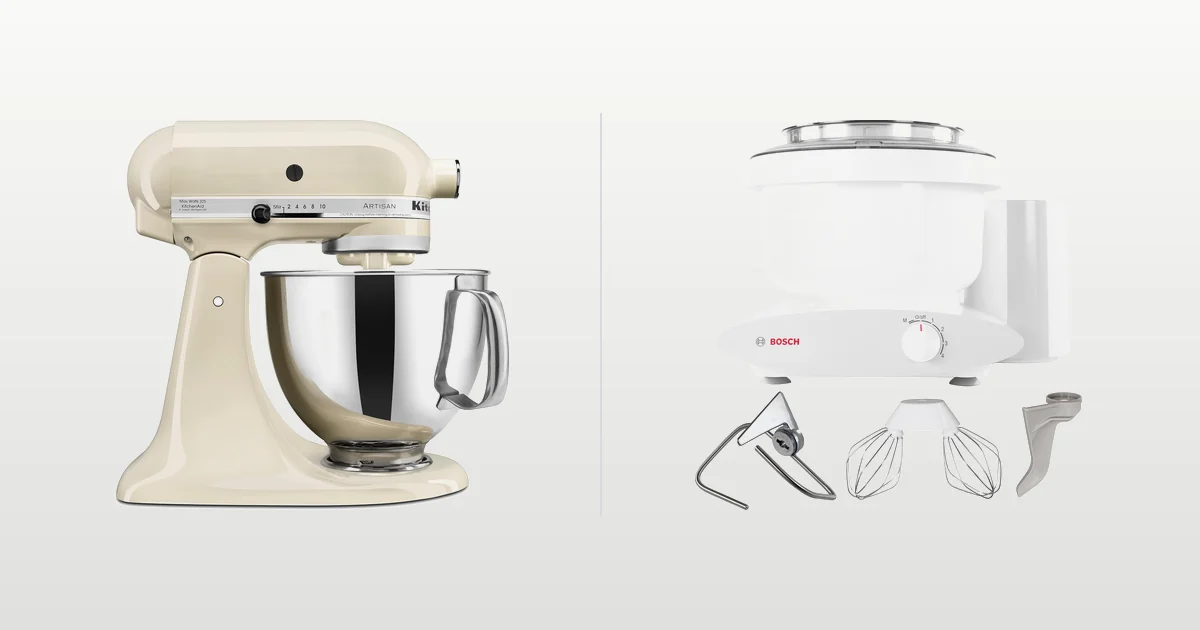
Stand mixer listings compete on wattage, and for bread dough wattage is close to the least useful number on the page. The KitchenAid Artisan states 325 watts. Four budget machines below state 660. The KitchenAid is not half as capable as any of them.
Different manufacturers rate motors differently — some quote peak draw, some continuous output, and none of the listings here say which. Comparing those figures across brands tells you nothing reliable, which is why this roundup ranks on the two specifications that are comparable: bowl capacity and weight.
Weight matters because stiff dough fights back. As gluten develops, the hook loads up and a light machine starts to travel across the worktop. The mixers here run from 7 lbs to 33 lbs — a near fivefold spread that predicts behaviour under dough far better than the wattage does.
Only two of the ten listings state what they can actually handle: one gives 3 kg of dough, another says three loaves. That is the figure to want, and its absence everywhere else is telling.
Our Quick Picks
 Best OverallKitchenAid Artisan KSM150PS
The benchmark machine, and the clearest illustration that stated wattage does not rank stand mixers.
 Best for Heavy DoughBosch Universal Plus
A bottom-drive design rather than a tilt head, which is the architecture bread bakers tend to prefer.
 Best ValueMartha Stewart 5.3 QT
Twelve speeds, three attachments and a stainless bowl for well under half the price of the premium machines.
At a Glance
Ten Stand Mixers Compared for Bread
Bowl capacity, stated power, weight and control, with the specifications each listing declines to publish shown as gaps.
| # | Model | Bowl | Stated Power | Weight | Control | Standout | Main Drawback | Check Price |
|---|---|---|---|---|---|---|---|---|
| 1 |
 KitchenAid Artisan KSM150PS KitchenAid Artisan KSM150PS |
5 qt | 325 W stated | 11 kg | Metal, 59 touchpoints | Heaviest-built mixer under 8 quarts | Lowest stated wattage here | View on Amazon |
| 2 |
 8.4 QT Commercial 800 W 8.4 QT Commercial 800 W |
8.4 qt | 800 W | 33 lbs | Aluminium die casting | Only listing here that states a dough limit | 33 lbs is genuinely hard to move | View on Amazon |
| 3 |
 Bosch Universal Plus Bosch Universal Plus |
6.5 qt | 500 W | Not published | Bowl-drive, dual beaters | Bottom-drive design suits stiff dough | Plastic bowl feels cheap for the price | View on Amazon |
| 4 |
 Cuisinart 5.5 QT Cuisinart 5.5 QT |
5.5 qt | 500 W | 18.4 lbs | 12 speeds | Second-heaviest under 8 quarts | Narrow footprint can rock at speed | View on Amazon |
| 5 |
 Martha Stewart 5.3 QT Martha Stewart 5.3 QT |
5.3 qt | 660 W stated | 9 lbs | 12 speeds | Three attachments and 12 speeds under $140 | 9 lbs is light for stiff dough | View on Amazon |
| 6 |
 Aucma 6.5 QT Aucma 6.5 QT |
6.5 qt | 660 W stated | 11.7 lbs | 6 speeds | Largest bowl at the budget end | Only 6 speeds | View on Amazon |
| 7 |
 VIVOHOME 6 QT VIVOHOME 6 QT |
6 qt | 660 W stated | 11 lbs | 10 speeds | States a loaf count, which most do not | 18.8 inches tall | View on Amazon |
| 8 |
 CEBORY 3-in-1 6.5 QT CEBORY 3-in-1 6.5 QT |
6.5 qt | 660 W stated | Not published | 10 speeds, DC motor | Three appliances in one housing | Weight not published | View on Amazon |
| 9 |
 AIZIYO DoughChief 7.4 QT AIZIYO DoughChief 7.4 QT |
7.4 qt | 250 W | Not published | S-hook, ferment function | Only machine here that proves the dough | 250 W is the second-lowest here | View on Amazon |
| 10 |
 Kitchen in the box 3.2 QT Kitchen in the box 3.2 QT |
3.2 qt | 300 W | 7 lbs | 6 speeds | Lightest and smallest here | Too small and light for bread dough | View on Amazon |
Specifications and ratings are taken from each manufacturer’s Amazon listing as displayed on 20 August 2026 and may change. Stated wattages are reproduced as published and are not comparable across brands — no listing here specifies whether its figure is peak or continuous. “Not published” means the listing omits that figure; we have not estimated it. Dough capacity claims (3 kg for the commercial machine, three loaves for the VIVOHOME) are the manufacturers’ own.
Scroll the table sideways to see every column
How We Chose These Stand Mixers for Bread Dough
We researched current listings, compared manufacturer specifications and documentation, and examined recurring patterns in customer feedback. We did not carry out hands-on testing, and nothing below is presented as measured performance data.
- Weight, where published — the best available proxy for whether a mixer stays put under stiff dough
- Bowl capacity in quarts — comparable across every brand, unlike wattage
- Any stated dough limit — 3 kg or a loaf count beats a wattage figure every time
- Drive architecture — bottom drive carries load through the base; a tilt head carries it through a hinge
- Speed count at the low end — dough lives in the bottom two speeds, so the spread there matters
- What the listing refuses to say — three of these machines do not publish a weight, which we have treated as a mark against them
The 10 Best Stand Mixers for Bread Dough, Reviewed
1. KitchenAid Artisan KSM150PS — Best Overall

On paper this is the weakest motor in the roundup — 325 watts against the 660 watts claimed by four budget machines below. In practice it is the mixer every other mixer here is measured against.
That gap is the single most useful thing to understand before buying, and it is covered in full further down: wattage figures from different manufacturers are not measuring the same thing.
Key Specifications
| Bowl capacity | 5 quarts, stainless steel with handle |
|---|---|
| Stated wattage | 325 watts |
| Weight | 11 kg |
| Construction | Metal body, 59 touchpoints |
| Batch claim | Mixes up to 9 dozen cookies, per listing |
| Head | Tilt head |
| Dimensions | 9.3″D x 14.3″W x 14″H |
| Rating | 4.7 out of 5 stars |
| Best For | One mixer you keep for twenty years |
Why We Recommend It
What you are actually buying is the metal body and the 11 kg of mass. A stand mixer working stiff bread dough tries to walk itself across the counter, and weight plus a wide base is what stops that. This is the heaviest machine here under 8 quarts.
The 5-quart bowl is the smallest of the serious options, which matters for bread: a full 5 quarts of dough is near the practical ceiling for this size.
Pros
- Metal construction rather than ABS plastic
- 11 kg of mass keeps it planted with stiff dough
- The widest attachment ecosystem of any mixer here
- Bowl has a handle, which not all rivals do
- 4.7 rating and a decades-long track record
Cons
- Lowest stated wattage in the roundup
- 5 quarts is the smallest of the serious bowls
- By far the most expensive per quart
- Tilt head flexes more than a bowl-lift under heavy dough
Best for: Bakers who want one machine for the long term and are not chasing a spec sheet.
2. 8.4 QT Commercial 800 W — Best for Large Batches

Every other listing here advertises bowl capacity and motor watts. This one publishes the number you actually need: a maximum dough load of 3 kg. That is the specification that tells you whether a mixer can do the job, and almost nobody states it.
At 33 lbs with a die-cast aluminium body, it is also the machine least likely to move under load.
Key Specifications
| Bowl capacity | 8.4 quarts |
|---|---|
| Stated wattage | 800 watts |
| Maximum dough | 3 kg / 6.6 lbs, per listing |
| Weight | 33 lbs |
| Body | Aluminium die casting |
| Standard | Stated to meet NSF/ANSI 8-2 |
| Display | LED with timer function |
| Head | Tilt head |
| Dimensions | 18.11″D x 12.2″W x 16.3″H |
| Rating | 4.7 out of 5 stars |
| Best For | Batch baking and heavy dough |
Why We Recommend It
The NSF/ANSI 8-2 reference is a commercial food equipment standard. The listing states the machine meets it; treat that as the manufacturer’s claim rather than independently confirmed certification, but it does indicate the build target.
The trade-offs are real: 18 inches deep and 16.3 inches tall means it will not fit under most wall cabinets, and 33 lbs means it lives permanently on the counter.
Pros
- Publishes an actual dough limit, 3 kg
- Largest bowl here at 8.4 quarts
- 33 lbs and die-cast aluminium resist walking
- LED display with timer
- Built to a stated commercial standard
Cons
- 33 lbs is a two-handed lift
- 18.11-inch depth will not fit under most cabinets
- Overkill for anyone baking one loaf a week
- Brand has no long-term consumer record
Best for: Anyone kneading multiple loaves at once, or working dough regularly.

3. Bosch Universal Plus — Best for Heavy Dough

The important difference here is architectural. A tilt-head mixer drives the beater from above on a hinge; stiff dough pushes back against that hinge and the head flexes. The Bosch drives from the bottom of the bowl, so the load is carried by the base rather than a pivot.
For bread specifically, that is the more robust arrangement, and it is why this machine has a following among people who bake a lot of dough.
Key Specifications
| Bowl capacity | 6.5 quarts, BPA-free plastic with handle |
|---|---|
| Stated wattage | 500 watts |
| Drive | Bottom drive with removable drive shaft |
| Beaters | Dual beaters, triple whipping action |
| Included | Wire whips, dough hook, NutriMill attachment |
| Whipping minimum | As little as one egg white, per listing |
| Dimensions | 11″D x 12″W x 15″H |
| Model | MUM6N10UC-DE |
| Rating | 4.7 out of 5 stars |
| Best For | Regular bread baking without a tilt head |
Why We Recommend It
Dual beaters with what Bosch calls triple whipping action also handle the opposite extreme — the listing claims it will whip a single egg white, which most 6.5-quart machines cannot.
The bowl is BPA-free plastic rather than stainless, which at this price is the most common complaint. It is lighter and it will not chill for whipping cream, but it is also not going to dent.
Pros
- Bottom-drive design carries dough load through the base
- Dual beaters handle both stiff dough and single egg whites
- 6.5-quart bowl with an easy-grip handle
- Wire whips, dough hook and NutriMill attachment included
- Removable drive shaft makes cleaning straightforward
Cons
- Plastic bowl rather than stainless
- Weight not published, so stability is hard to judge
- Most expensive machine in this roundup
- Looks utilitarian next to a KitchenAid
Best for: Bakers who make bread weekly and want the load off a tilt-head hinge.
4. Cuisinart 5.5 QT — Best Mid-Range

At 18.4 lbs this is the second-heaviest machine here under 8 quarts, and mass is what keeps a mixer still when dough tightens. It shares the KitchenAid’s 4.7 rating.
Twelve speeds is the finest control in the roundup alongside the Martha Stewart, which matters more for whipping and creaming than for dough.
Key Specifications
| Bowl capacity | 5.5 quarts, polished stainless steel |
|---|---|
| Stated wattage | 500 watts |
| Speeds | 12 |
| Weight | 18.4 lbs |
| Body | Aluminium |
| Head | Tilt-back head |
| Included | Chef’s whisk, mixing paddle, dough hook |
| Extra | One power outlet for optional attachments |
| Dimensions | 7.87″D x 7.87″W x 14.13″H |
| Rating | 4.7 out of 5 stars |
| Best For | Most of the KitchenAid’s substance for less |
Why We Recommend It
The bowl is polished stainless with a half-quart more capacity than the Artisan, and the standard three attachments are included rather than sold separately.
Note the footprint. At 7.87 inches square this is the narrowest base here, and a narrow base under an 18-pound machine is a less stable combination than the numbers alone suggest. Keep it away from the counter edge when kneading.
Pros
- 18.4 lbs, second-heaviest under 8 quarts
- 12 speeds for fine control
- Stainless bowl with 5.5-quart capacity
- Whisk, paddle and dough hook all included
- Power outlet for optional attachments
Cons
- Narrowest base in the roundup at 7.87 inches square
- Tilt-back head still flexes under stiff dough
- 500 W stated, but not comparable across brands
- Dearer than every budget option here
Best for: Buyers who want serious build without the KitchenAid premium.
5. Martha Stewart 5.3 QT — Best Value

On the numbers this looks like it beats the KitchenAid twice over: double the stated wattage, twelve speeds instead of ten, three attachments included. It is a genuinely good value machine and those features are real.
What the numbers do not show is the 9 lbs.
Key Specifications
| Bowl capacity | 5.3 quarts, polished stainless steel |
|---|---|
| Stated wattage | 660 watts |
| Speeds | 12 |
| Weight | 9 lbs |
| Included | Stainless whisk, dough hook, flat beater with silicone edge |
| Head | Tilt head |
| Dimensions | 16.93″D x 10.43″W x 16.93″H |
| Rating | 4.3 out of 5 stars |
| Best For | A capable first stand mixer |
Why We Recommend It
Weight is the specification to weigh against wattage here. At 9 lbs this is among the lightest machines in the roundup, and light mixers move when stiff dough grabs the hook. For cakes, batters, whipped cream and soft doughs that is irrelevant. For a firm bread dough at 60 per cent hydration, expect to keep a hand on it.
The flat beater has a silicone edge, which scrapes the bowl as it turns — a genuinely useful feature that the KitchenAid charges extra for.
Pros
- Twelve speeds and three attachments included
- Silicone-edged beater scrapes the bowl as it mixes
- Polished stainless bowl at a budget price
- Highest stated wattage relative to price here
- Available in colours that look far dearer
Cons
- 9 lbs is light for stiff bread dough
- 4.3 rating is mid-pack
- 660 W stated figure is not comparable with KitchenAid’s 325 W
- 16.93-inch height is tall for under-cabinet storage
Best for: First-time buyers doing cakes and soft doughs more often than bread.
6. Aucma 6.5 QT — Best Budget Large Bowl

Six and a half quarts is the same bowl capacity as the Bosch and the CEBORY, and at 11.7 lbs this is heavier than both the Martha Stewart and the VIVOHOME. For bread that combination is the right way round.
A 4.6 rating puts it above every other budget machine in this roundup.
Key Specifications
| Bowl capacity | 6.5 quarts, stainless steel with handles |
|---|---|
| Stated wattage | 660 watts |
| Motor | Described as pure copper |
| Speeds | 6, variable |
| Weight | 11.7 lbs |
| Body | ABS |
| Head | Tilt head |
| Dimensions | 15.2″D x 9.4″W x 12.4″H |
| Rating | 4.6 out of 5 stars |
| Best For | Big batches on a small budget |
Why We Recommend It
The body is ABS plastic rather than metal, which is the usual compromise at this price and the main structural difference from the KitchenAid.
Six speeds is the real limitation, not the wattage. Half the machines here offer ten or twelve, and the gaps between six settings are wide enough that you sometimes want one between two of them. For dough, which lives at the bottom two speeds, it hardly matters.
Pros
- 6.5-quart bowl with handles at a budget price
- 11.7 lbs, heavier than most budget rivals
- 4.6 rating, best among the budget machines
- Bowl has handles, which several rivals omit
- Compact 12.4-inch height fits under most cabinets
Cons
- Only 6 speeds
- ABS body rather than metal
- Stated 660 W is not comparable across brands
- No dough capacity published
Best for: Batch bakers who need bowl volume more than they need refinement.
7. VIVOHOME 6 QT — Best Stated Loaf Capacity

Bowl quarts are an awkward unit for bread because dough volume changes as it works. VIVOHOME states a loaf count instead — up to three — which is the more useful translation and one only this listing and the commercial machine attempt.
Ten speeds and 11 lbs put it in the same class as the Aucma, with four more speed settings.
Key Specifications
| Bowl capacity | 6 quarts |
|---|---|
| Stated wattage | 660 watts |
| Speeds | 10 |
| Weight | 11 lbs |
| Batch claim | Up to 3 loaves of bread, per listing |
| Body | ABS, steel and aluminium |
| Head | Tilt head |
| Dimensions | 15.2″D x 8.8″W x 18.8″H |
| Rating | 4.5 out of 5 stars |
| Best For | Knowing what you can actually bake in it |
Why We Recommend It
The listing says the 660 W motor handles heavy doughs with no hand-kneading needed. Treat that as a claim rather than a measurement; at 11 lbs this machine is lighter than the Cuisinart and much lighter than the commercial unit, and weight is what resists a stiff dough.
Check your cabinet height. At 18.8 inches this is the tallest machine in the roundup, and tilt-head mixers need clearance above that figure to open.
Pros
- States a real loaf capacity, up to 3
- 10 speeds at a budget price
- 11 lbs, respectable for the class
- Mixed ABS, steel and aluminium construction
- Bright colour options
Cons
- Tallest here at 18.8 inches, plus tilt clearance
- 11 lbs is still light for stiff dough
- 660 W stated figure not comparable across brands
- No dough weight limit published
Best for: Bakers who want to know how many loaves before they buy.
8. CEBORY 3-in-1 6.5 QT — Best Multi-Function

DC motors hold speed better under changing load than the brushed AC motors usual at this price, which is genuinely relevant to dough — the load rises sharply as gluten develops.
The 3-in-1 arrangement adds blender and grinder functions in the same housing, which is the argument for it over the Aucma at similar money.
Key Specifications
| Bowl capacity | 6.5 quarts |
|---|---|
| Stated wattage | 660 watts |
| Motor type | DC |
| Speeds | 10 |
| Functions | Mixing, kneading and whipping, plus attachments |
| Body | ABS, aluminium and plastic |
| Dimensions | 13.8″D x 8.6″W x 12.9″H |
| Rating | 4.4 out of 5 stars |
| Best For | One appliance instead of three |
Why We Recommend It
At 12.9 inches tall and 8.6 inches wide this is one of the more compact 6.5-quart machines, and it fits under most wall cabinets, unlike the VIVOHOME.
The weight is not published, which on a machine sold for kneading is the specification you most want. Every heavier machine here states its weight; read the omission as a caution rather than a detail.
Pros
- DC motor holds speed as dough load rises
- 6.5-quart bowl with 10 speeds
- Blender and grinder functions in one housing
- Compact 12.9-inch height fits under cabinets
- Good colour range
Cons
- Weight not published
- 4.4 rating is mid-pack
- Multi-function machines compromise on each job
- No dough capacity stated
Best for: Small kitchens replacing a mixer, blender and grinder with one unit.
9. AIZIYO DoughChief 7.4 QT — Best Dedicated Dough Maker

This is the only machine in the roundup that does the step after kneading. A ferment cycle holds the dough at a controlled temperature to prove it, which otherwise means finding a warm spot in the kitchen and hoping.
The S-shaped hook is designed to fold dough the way hands do, rather than dragging it round a bowl like a spiral hook.
Key Specifications
| Bowl capacity | 7.4 quarts, 304 stainless steel |
|---|---|
| Stated wattage | 250 watts |
| Hook | Removable S-shaped, hand-kneading simulation |
| Special function | Ferment cycle |
| Purpose | Dough only, per listing |
| Dimensions | 11.42″D x 12.2″W x 9.6″H |
| Model | 804-7L White |
| Rating | 4.3 out of 5 stars |
| Best For | Bread and nothing else |
Why We Recommend It
At 9.6 inches tall it is the shortest machine here by a clear margin and the only one that comfortably lives in a cupboard between bakes.
Understand what you are giving up. 250 watts and a dough-specific hook mean this will not whip cream, cream butter and sugar, or beat egg whites. It is a bread machine’s mixing half, sold separately — excellent at one job and incapable of the others.
Pros
- Built-in ferment cycle, unique in this roundup
- 7.4-quart 304 stainless bowl
- S-shaped hook designed to fold rather than drag
- Shortest machine here at 9.6 inches
- Genuinely purpose-built for bread
Cons
- Cannot whip, cream or beat — dough only
- 250 W is the second-lowest stated figure here
- Weight not published
- 4.3 rating on a young listing
Best for: Dedicated bread bakers who already own a mixer for everything else.
10. Kitchen in the box 3.2 QT — Best Compact

Seven inches wide and 7 lbs makes this the only genuinely portable machine here. If counter space is the binding constraint, that matters more than any other specification.
The 3.2-quart stainless bowl is enough for a single loaf’s worth of dough or a standard cake batter.
Key Specifications
| Bowl capacity | 3.2 quarts / 3 litres, stainless steel |
|---|---|
| Stated wattage | 300 watts |
| Speeds | 6 |
| Weight | 7 lbs |
| Body | ABS plastic, stainless steel and aluminium |
| Head | Tilt head |
| Dimensions | 12.9″D x 7″W x 10.2″H |
| Rating | 4.4 out of 5 stars |
| Best For | Small kitchens and small batches |
Why We Recommend It
Be honest with yourself about bread. At 7 lbs and 300 watts this is the least suitable machine in the roundup for stiff dough — it is light enough to move on the counter and small enough that a full batch fills the bowl. It earns its place as the compact option, not as a bread machine.
For cakes, biscuits, icing, whipped cream and soft enriched doughs in small quantities, it does the job in a footprint nothing else here matches.
Pros
- Lightest and smallest machine in the roundup
- 7 inches wide, genuinely cupboard-storable
- Stainless bowl despite the size and price
- Tilt head with 6 speeds
- Lowest counter commitment of anything here
Cons
- Too light at 7 lbs for stiff bread dough
- 3.2 quarts limits batch size
- 300 W stated, lowest here alongside KitchenAid’s 325 W
- Only 6 speeds
Best for: Flats, dorms and anyone baking small batches occasionally.
Tilt Head or Bottom Drive?
This is an architectural difference, and for bread specifically it matters more than the brand on the front.
| Tilt head | Bottom drive | |
|---|---|---|
| Models here | Nine of the ten | Bosch Universal Plus |
| Where dough load goes | Through the hinge at the head | Through the base of the bowl |
| Behaviour with stiff dough | Head can flex and lift | Load carried by the machine body |
| Adding ingredients | Easy, head tilts back | Through the bowl opening |
| Cabinet clearance | Needs headroom to tilt | Needs less |
| Attachment ecosystem | Very wide on KitchenAid | Narrower |
For cakes, batters and whipped cream a tilt head is more convenient and the flex never becomes an issue. For a firm bread dough worked for ten minutes, the bottom-drive design puts the load somewhere structurally better. If bread is genuinely the main job, that is a real argument for the Bosch; if bread is one of several jobs, a heavy tilt head like the KitchenAid or the Cuisinart is the more flexible buy.
Does Weight Matter More Than Wattage?
For dough, on the evidence in these listings, yes — because weight is comparable across brands and wattage is not.
| Light (7–11 lbs) | Heavy (18–33 lbs) | |
|---|---|---|
| Models here | Kitchen in the box 7, Martha Stewart 9, VIVOHOME 11, Aucma 11.7 | Cuisinart 18.4, KitchenAid 11 kg, Commercial 33 |
| Stated wattage | 300–660 W | 325–800 W |
| Behaviour under stiff dough | Can travel on the worktop | Stays planted |
| Soft dough and batters | No practical difference | No practical difference |
| Storage | Liftable into a cupboard | Lives on the counter |
Note what that table shows: the lightest machines carry some of the highest stated wattages, and the KitchenAid carries the lowest stated wattage of any serious machine while weighing 11 kg. If wattage figures were comparable across brands, that would make no sense. They are not, so it does. Buy the weight if you bake bread; the wattage number is not telling you what it appears to.
Best Alternatives
| Alternative | Why Consider It | Better For | Main Trade-Off |
|---|---|---|---|
| Bread machine | Mixes, proves and bakes in one | Hands-off loaves on a timer | One loaf shape, and a paddle hole in the base |
| Food processor with a dough blade | Kneads a dough in about a minute | Speed, and small kitchens | Small batches, and it heats the dough |
| Hand mixer with dough hooks | A fraction of the price and the space | Soft and enriched doughs | Not enough torque for a firm lean dough |
| Kneading by hand | Free, and the best way to learn dough feel | One or two loaves, and control | Ten minutes of work per batch |
| Dedicated dough maker | Kneads and proves, nothing else | Bread bakers who own a mixer already | Cannot whip, cream or beat |
What the Wattage Figure Actually Tells You
The short answer: less than you would hope, and nothing across brands. No listing in this roundup states whether its wattage is peak draw or continuous output, and those can differ by a factor of two on the same motor. A 660-watt figure from a budget brand and a 325-watt figure from KitchenAid are not measuring the same quantity.
Where wattage is useful: within one brand. If a manufacturer offers a 300 W and a 660 W machine in the same range, the second one is stronger. Across brands, the comparison collapses.
What to use instead, in order. First, any stated dough limit — the commercial machine’s 3 kg and the VIVOHOME’s three loaves are the only two here, and they are worth more than every wattage figure combined. Second, weight, which is measured the same way by everyone and predicts whether the machine stays still. Third, bowl capacity, which is comparable and sets your batch size.
A note on motor type. The CEBORY specifies a DC motor and the Aucma describes a pure copper motor. DC motors hold speed better as load rises, which is exactly what happens as gluten develops. That is a more meaningful distinction than the watt figure printed beside it.
How to Choose a Stand Mixer for Bread
Work Out Your Batch Size First, in Loaves
Bowl quarts are a poor guide because dough changes volume as it works. A 5-quart bowl comfortably handles one to two standard loaves; 6.5 quarts handles two to three; the 8.4-quart commercial machine states 3 kg, which is around four to five. Decide the number of loaves, then pick the bowl.
Buy Weight, Not Watts
The machines here span 7 lbs to 33 lbs. A mixer under about 11 lbs will move on the worktop when a firm dough tightens, and you will find yourself steadying it. If bread is the main job, treat weight as the headline specification and the wattage as decoration.
Check the Height Against Your Cabinets
Tilt-head mixers need clearance above their stated height to open. The VIVOHOME is 18.8 inches before tilting; the AIZIYO is 9.6. If the machine lives under a wall cabinet, measure before ordering, because this is the specification that most often ends in a return.
Prefer a Listing That States a Dough Limit
Two of these ten publish what they can actually knead. That willingness to be measured is itself a quality signal — it is a number a manufacturer can be held to, unlike a wattage figure with no stated basis.
Consider Whether You Need a General-Purpose Mixer at All
If you only bake bread, the AIZIYO does the kneading and the proving and stores in a cupboard. If you also make cakes, meringues and buttercream, you need a machine that whips — and a dough-only unit will frustrate you within a week.
Treat Plastic Bowls and ABS Bodies as a Price Signal
Not a dealbreaker, but a real difference. The KitchenAid’s metal body and the commercial machine’s die-cast aluminium are why they weigh what they do, and weight is what you are buying for dough.
Common Stand Mixer Buying Mistakes
- Comparing wattage across brands. The single most common error, and the listings encourage it. A 660 W budget machine is not twice a 325 W KitchenAid.
- Buying a light machine for stiff dough. Under about 11 lbs, a firm dough will walk the mixer across the counter.
- Choosing bowl size by quarts alone. Dough volume changes as it works; think in loaves, not litres.
- Forgetting tilt clearance. A mixer 18.8 inches tall needs several more inches above it to open the head.
- Assuming every mixer whips. The dedicated dough maker here cannot cream butter or beat egg whites at all.
- Ignoring an unpublished weight. Three machines here do not state one. On a device sold for kneading, that omission is information.
- Paying for speeds you will not use. Dough is worked at the bottom two settings; twelve speeds help with whipping, not kneading.
Which Stand Mixer Should You Buy?
Buy the KitchenAid Artisan if you want one machine for twenty years and value metal construction and the attachment ecosystem over the number on the spec sheet.
Buy the Bosch Universal Plus if bread is genuinely the main job and you want the dough load carried through the base rather than a tilt-head hinge.
Buy the 8.4-quart commercial machine if you knead several loaves at a time and have the counter space for a 33 lb, 18-inch-deep appliance. It is the only one here that tells you its dough limit.
Buy the Cuisinart if you want most of the KitchenAid’s mass and twelve speeds for meaningfully less — and you keep it away from the counter edge.
Buy the Martha Stewart or the Aucma if budget is the constraint and you bake cakes and soft doughs more often than firm bread.
Buy the AIZIYO DoughChief if you already own a mixer and want a machine that kneads and proves bread specifically.
Buy the Kitchen in the box if counter space decides everything and your batches are small.

Frequently Asked Questions
How many watts do you need to knead bread dough?
There is no reliable answer, because manufacturers do not measure wattage the same way. The KitchenAid Artisan states 325 watts and is the benchmark machine; several budget mixers here state 660 and weigh a third as much. No listing in this roundup says whether its figure is peak or continuous, so the comparison is meaningless across brands. Use weight and any stated dough limit instead.
What size stand mixer do I need for bread?
Think in loaves rather than quarts. A 5-quart bowl handles one to two standard loaves, 6.5 quarts handles two to three, and the 8.4-quart commercial machine here states a 3 kg dough maximum, which is roughly four to five. VIVOHOME is the only consumer machine in this group that publishes a loaf figure, at up to three.
Why does my stand mixer move across the counter?
Because it is too light for the dough it is working. As gluten develops, the hook meets more resistance and the reaction pushes the machine. The mixers here range from 7 lbs to 33 lbs. Anything under roughly 11 lbs will travel with a firm dough; the KitchenAid at 11 kg and the commercial machine at 33 lbs will not.
Is a tilt head or a bowl-lift design better for dough?
For stiff dough, a design that carries the load through the base is structurally better than one that carries it through a hinge. The Bosch Universal Plus is the bottom-drive machine in this roundup. That said, nine of these ten are tilt heads and heavy tilt-head mixers handle bread perfectly well — it is a question of degree, not a dealbreaker.
Can a stand mixer replace hand kneading?
For most doughs, yes — it is doing the same work with more consistency and less effort. What it cannot do is teach you how a properly developed dough feels, which is why many bakers finish by hand. The AIZIYO here uses an S-shaped hook specifically to fold dough more like hands do than a spiral hook does.
What is a ferment function?
It holds the dough at a controlled temperature to prove it after kneading, so you do not have to find a warm corner of the kitchen. Only the AIZIYO DoughChief in this roundup has one. It is a genuine convenience for bread and irrelevant for anything else.
Are plastic bowls a problem?
Not functionally. The Bosch uses a BPA-free plastic bowl and is one of the most respected bread machines here. Plastic is lighter and will not dent; stainless can be chilled for whipping cream and feels more substantial. It is a preference rather than a quality gap.
Do I need 10 or 12 speeds?
Not for bread. Dough is worked at the lowest one or two settings on any machine, so the Aucma’s six speeds are no handicap for kneading. More speeds help with creaming, whipping and gradual incorporation — useful for cakes and meringues, not for loaves.
Final Verdict
Metal construction and 11 kg of mass, from the machine every other mixer here is measured against — despite carrying the lowest stated wattage of any serious option.
The only bottom-drive design in the roundup, so a stiff dough loads the base rather than a tilt-head hinge.
Twelve speeds, three attachments and a stainless bowl for well under half the premium price — provided you accept 9 lbs under firm dough.
Wattage sells stand mixers and weight bakes bread. The machine with the lowest stated power figure in this roundup is also the heaviest under eight quarts, and it is the one the whole category is benchmarked against. That is not a contradiction — it is what happens when a number gets used for marketing rather than measurement.
So choose in this order. Decide how many loaves you want to make at once, which sets the bowl. Check the weight, because under roughly 11 lbs a firm dough will move the machine. Look for a stated dough limit and prefer the listings honest enough to give one. Measure your cabinet clearance before you order. And treat the wattage figure as the last tiebreaker rather than the first filter.
Do that and the shortlist gets short quickly — usually to a heavy machine with a bowl sized to your batch, from a listing that was willing to tell you what it can actually knead.