Affiliate Disclosure: As an Amazon Associate, we earn from qualifying purchases. This does not affect the price you pay.
Toasters look interchangeable and mostly are not. The specifications that actually change your breakfast are wattage per slot, how wide the slots are, how many shade settings you get, and whether the toaster does anything to stop a single slice toasting unevenly.
Wattage per slot is the one people miss. An 840 W four-slice toaster has less power per slot than a 900 W two-slice one, and it shows in how long a full load takes. Slot width decides whether a bagel or a thick slice fits at all, and self-centering slots decide whether a thin slice toasts evenly once it does.
We compared ten current models on power, slot design, shade range, construction and useful extras. This guide is for anyone replacing a toaster and wanting to know what the differences actually are.
Our Quick Picks
 Best OverallBreville BTA840XL Die-Cast
The only toaster here that lets you check progress and add time without restarting the cycle.
 Best Even ToastingHamilton Beach 4 Slice
Sure-Toast technology targets the classic problem of a single slice toasting unevenly.
 Best BudgetAmazon Basics 2 Slice
Nine hundred watts and six shade settings at the lowest price of any toaster here.
At a Glance
Electric Toaster Comparison
Ten toasters compared on the specifications that decide how the toast comes out.
| # | Model | Slices | Power | Best For | Housing | Key Advantage | Main Drawback | Check Price |
|---|---|---|---|---|---|---|---|---|
| 1 |
 Breville BTA840XL Die-Cast Breville BTA840XL Die-Cast |
4 slice | 1800 W | Control while toasting | Die-cast metal | Lift & Look and A Bit More | Heaviest and priciest here | View on Amazon |
| 2 |
 Hamilton Beach 4 Slice Hamilton Beach 4 Slice |
4 slice | 1560 W | Single slices done evenly | Stainless steel | Sure-Toast for one-slice evenness | Large footprint | View on Amazon |
| 3 |
 Cuisinart 4-Slice Cuisinart 4-Slice |
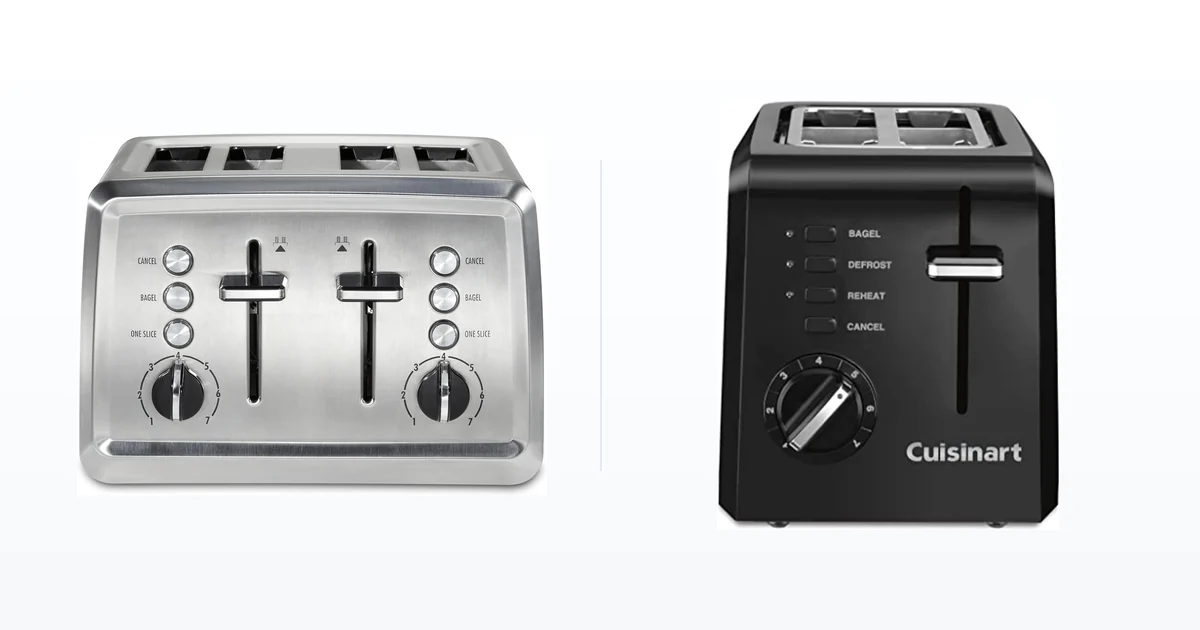
4 slice | 840 W | Four slots cheaply | Plastic and stainless | Four functions at a low price | 840 W across four slots | View on Amazon |
| 4 |
 BLACK+DECKER 4-Slice BLACK+DECKER 4-Slice |
4 slice | 1400 W | Thin and thick bread alike | Aluminium | Self-centering slots hold bread upright | Plastic controls | View on Amazon |
| 5 |
 GE 2 Slice Stainless GE 2 Slice Stainless |
2 slice | 850 W | Everyday two-slice toasting | Stainless steel | Seven shades in a stainless body | Only two slots | View on Amazon |
| 6 |
 Cuisinart Compact 2-Slice Cuisinart Compact 2-Slice |
2 slice | 800 W | Small counters | Plastic | Seven shades in a small footprint | Plastic housing | View on Amazon |
| 7 |
 Amazon Basics 2 Slice Amazon Basics 2 Slice |
2 slice | 900 W | Cheapest sensible option | Plastic | 900 W at the lowest price | Basic feature set | View on Amazon |
| 8 |
 OVENTE 2 Slice TP2210B OVENTE 2 Slice TP2210B |
2 slice | 700 W | Occasional use | Plastic | Lightest toaster here at 1.8 lb | 700 W is the lowest here | View on Amazon |
| 9 |
 bella 2-Slice Extra Wide bella 2-Slice Extra Wide |
2 slice | 900 W | Kitchens where it stays out | Plastic and stainless | Colour finishes beyond stainless | Plastic body | View on Amazon |
| 10 |
 Elite Gourmet ECT-1027 Elite Gourmet ECT-1027 |
2 slice | 750 W | Households with children | Aluminium | Cool-touch exterior and non-slip feet | 750 W is modest | View on Amazon |
Wattage figures are as listed by each manufacturer. Note that a higher total wattage across four slots is not necessarily more power per slot than a two-slice model.
Scroll the table sideways to see every column
How We Chose These Electric Toasters
We researched current listings, compared manufacturer specifications and documentation, and examined recurring patterns in customer feedback. We did not carry out hands-on testing, and nothing below is presented as measured performance data.
- Power per slot — total wattage divided by slots, which decides speed
- Slot width — whether bagels, thick bread and pastries actually fit
- Self-centering slots — whether thin slices are held upright and toast evenly
- Shade range — six settings against seven, and how fine the steps are
- Single-slice performance — whether one slice toasts evenly in a multi-slot toaster
- Progress control — lift-and-look or add-more functions
- Construction — stainless and die-cast against plastic
- Crumb tray design — slide-out against swing-out and how easily it cleans
- Footprint and weight — whether it suits the counter space available
- Safety — cool-touch exteriors and auto shut-off
The 10 Best Electric Toasters
1. Breville BTA840XL Die-Cast — Best Overall

Every other toaster asks you to guess a browning level and hope. Lift & Look raises the carriage to check without cancelling the cycle, and A Bit More adds a short extra burst if it is nearly right.
Key Specifications
| Slices | 4 |
|---|---|
| Power | 1800 W |
| Housing | Die-cast metal |
| Features | Lift & Look, A Bit More, extra-wide slots |
| Weight | 9.6 lb |
| Best For | Anyone who has ever burnt toast by guessing |
Why We Recommend It
Those two features solve the actual problem with toasters, which is that the correct setting varies by bread, by freshness and by how many rounds you have already toasted.
At 1800 W across four slots it is also the most powerful here, and die-cast metal construction explains the 9.6 lb weight — roughly three times most 2-slice models.
Pros
- Lift & Look checks progress without cancelling
- A Bit More adds time when it is nearly right
- 1800 W, the most powerful here
- Die-cast metal rather than plastic
Cons
- By far the most expensive toaster here
- Heavy at 9.6 lb
- Four slots take significant counter space
Best for: Anyone who values control over price in a daily-use appliance.
2. Hamilton Beach 4 Slice — Best Even Toasting

Toasters are calibrated for a full load, which is why a single slice in a four-slot toaster often comes out patchy — one side faces a cold empty slot.
Key Specifications
| Slices | 4 |
|---|---|
| Power | 1560 W |
| Material | Stainless steel |
| Features | Sure-Toast, extra-wide slots, bagel setting, Toast Boost |
| Weight | 5.3 lb |
| Best For | Households toasting one or two slices at a time |
Why We Recommend It
Hamilton Beach states Sure-Toast addresses exactly that, toasting a single slice evenly on both sides. For a household where people eat at different times, that is the most useful feature on the list.
Toast Boost lifts smaller items so you can retrieve them, and at 1560 W across four slots it is well powered without the Breville’s price.
Pros
- Sure-Toast targets uneven single-slice toasting
- 1560 W across four slots
- Toast Boost lifts smaller items
- Stainless steel at a mid-range price
Cons
- Four slots need real counter space
- Heavier than 2-slice models at 5.3 lb
- No lift-and-look style progress check
Best for: Households where people toast one or two slices at different times.
3. Cuisinart 4-Slice — Best Value 4-Slice

Four-slice toasters usually carry a premium. This one does not, and it still includes the four functions most people use: toast, bagel, defrost and reheat.
Key Specifications
| Slices | 4 |
|---|---|
| Power | 840 W |
| Slot width | 1.5 inches |
| Functions | Toast, Bagel, Defrost, Reheat |
| Shade settings | 7-setting dial |
| Material | Plastic and stainless steel |
| Best For | Four-slot capacity on a budget |
Why We Recommend It
The seven-setting dial gives finer shade control than the six-setting models here, which matters more than it sounds when your preference sits between two notches.
The trade-off is power: 840 W across four slots is roughly half the Hamilton Beach’s rating, so a full load takes noticeably longer.
Pros
- Four slots at a two-slice price
- Seven shade settings for finer control
- Bagel, defrost and reheat included
- 1.5-inch slots take thicker bread
Cons
- 840 W across four slots is slow with a full load
- Plastic housing on much of the body
- No progress check or extra-time function
Best for: Households wanting four slots without paying four-slot prices.
4. BLACK+DECKER 4-Slice — Best Self-Centering

Extra-wide slots solve thick bread but create a new problem: thin slices flop against one wall and toast unevenly. Self-centering slots close in to hold each slice upright regardless of thickness.
Key Specifications
| Slices | 4 |
|---|---|
| Power | 1400 W |
| Material | Aluminium |
| Slots | Extra-wide, self-centering |
| Functions | Bagel, Frozen, Cancel |
| Weight | 3 lb |
| Best For | Households toasting very different breads |
Why We Recommend It
If your household toasts both thin sandwich bread and thick sourdough, that mechanism matters more than an extra shade setting.
At 1400 W and only 3 lb it is well powered and light for a four-slice model, though the controls are plastic rather than the metal used on premium toasters.
Pros
- Self-centering slots hold thin and thick bread upright
- 1400 W across four slots
- Light at 3 lb for a 4-slice toaster
- Bagel, frozen and cancel functions
Cons
- Plastic controls on an aluminium body
- No progress check function
- Four slots need counter space
Best for: Households that toast very different kinds of bread.
5. GE 2 Slice Stainless — Best 2-Slice Build

Most households toast two slices at a time, and a well-built two-slice toaster takes half the counter space of a four-slot model for the same daily result.
Key Specifications
| Slices | 2 |
|---|---|
| Power | 850 W |
| Material | Stainless steel |
| Shade settings | 7 |
| Slots | Extra wide for bagels and pastries |
| Weight | 2.9 lb |
| Best For | Everyday two-slice toasting that will last |
Why We Recommend It
Seven shade settings put it ahead of the six-setting budget models, and a stainless body wipes clean and resists the scratching that makes plastic toasters look old quickly.
At 850 W across two slots the power-per-slot is respectable — better than the Cuisinart 4-slice manages across four.
Pros
- Stainless body rather than plastic
- Seven shade settings
- Good power per slot at 850 W for two
- Extra-wide slots for bagels and pastries
Cons
- Two slots only
- No bagel-specific one-sided setting stated
- Nothing to check progress mid-cycle
Best for: Households that toast two slices and want it to last.
6. Cuisinart Compact 2-Slice — Best Compact

Cuisinart designed this specifically to fit comfortably on a crowded counter, and in a small kitchen that is a more useful property than an extra pair of slots.
Key Specifications
| Slices | 2 |
|---|---|
| Power | 800 W |
| Slot width | 1.5 inches |
| Shade settings | 7 |
| Material | Plastic |
| Weight | 3.5 lb |
| Best For | Small kitchens and limited counter space |
Why We Recommend It
The 1.5-inch slots still take bagels and thicker bread, so compact here means the footprint rather than the capability.
Seven shade settings is generous at this size and price. The housing is plastic, which keeps weight and cost down but will not wear as well as stainless.
Pros
- Genuinely small footprint
- Seven shade settings
- 1.5-inch slots still take bagels
- Well-known brand at a low price
Cons
- Plastic housing
- Two slots only
- 800 W is modest, though adequate for two slices
Best for: Small kitchens where counter space matters more than capacity.
7. Amazon Basics 2 Slice — Best Budget

At the bottom of the market, the question is whether the basics are actually covered. Here they are: 900 W, six shade settings and extra-wide slots.
Key Specifications
| Slices | 2 |
|---|---|
| Power | 900 W |
| Shade settings | 6 |
| Slots | Extra wide for bagels |
| Weight | 2.5 lb |
| Best For | A first toaster or a second one for a spare kitchen |
Why We Recommend It
Nine hundred watts across two slots is more power than several pricier models manage, so it toasts at a sensible speed rather than slowly drying the bread.
What you give up is refinement: six settings rather than seven, plastic construction, and no bagel or reheat functions to speak of.
Pros
- 900 W is strong for the price
- Extra-wide slots for bagels
- Very light at 2.5 lb
- Cheapest toaster in this comparison
Cons
- Six shade settings rather than seven
- Plastic construction
- No bagel or reheat functions
Best for: First toasters, spare kitchens and anyone replacing one cheaply.
8. OVENTE 2 Slice TP2210B — Best Lightweight

Not every kitchen wants a toaster permanently on the counter. At 1.8 lb this is light enough to live in a cupboard and be brought out when needed.
Key Specifications
| Slices | 2 |
|---|---|
| Power | 700 W |
| Shade settings | 6 |
| Material | Plastic |
| Weight | 1.8 lb |
| Best For | Occasional use, small households and storage |
Why We Recommend It
OVENTE states the 700 W element toasts in a few minutes, and six browning levels cover normal preferences.
Seven hundred watts is the lowest rating here, so it is slower than the 850 to 900 W models. For occasional use that matters far less than it would for a household toasting every morning.
Pros
- Lightest toaster here at 1.8 lb
- Easy to store rather than display
- Six shade settings
- Very inexpensive
Cons
- 700 W is the lowest power here, so slower
- Plastic construction
- No bagel or reheat functions
Best for: Occasional toasting and kitchens without permanent counter space.
9. bella 2-Slice Extra Wide — Best Looking

A toaster is one of the few appliances that lives permanently on the counter, so how it looks is a legitimate consideration rather than a frivolous one.
Key Specifications
| Slices | 2 |
|---|---|
| Power | 900 W |
| Shade settings | 6 |
| Slots | Extra wide |
| Material | Plastic and stainless steel |
| Weight | 2.4 lb |
| Best For | Kitchens where the toaster is on display |
Why We Recommend It
bella offers finishes beyond the standard black or brushed steel, and at 900 W and 2.4 lb the specification is competitive with the plainer budget models.
Extra-wide slots take bagels and thicker bread. The body is largely plastic, so treat the finish as the reason to choose it rather than the durability.
Pros
- Colour finishes rather than only black or steel
- 900 W, competitive for the price
- Extra-wide slots
- Light at 2.4 lb
Cons
- Largely plastic construction
- Six shade settings rather than seven
- No bagel or reheat functions
Best for: Kitchens where the toaster is part of the decor.
10. Elite Gourmet ECT-1027 — Best Cool-Touch

Toasters get hot on the outside, which is a genuine consideration in a kitchen with small children at counter height. A cool-touch exterior addresses that directly.
Key Specifications
| Slices | 2 |
|---|---|
| Power | 750 W |
| Slot width | 1.5 inches |
| Browning levels | 7 |
| Safety | Cool-touch exterior, non-slip feet |
| Crumb tray | Swing-out |
| Weight | 2.1 lb |
| Best For | Kitchens where children are nearby |
Why We Recommend It
Seven browning levels and 1.5-inch slots put the actual toasting specification ahead of several pricier two-slice models here.
The swing-out crumb tray is a small practical advantage — it wipes clean rather than needing to be slid out and emptied over a bin.
Pros
- Cool-touch exterior for safety around children
- Seven browning levels
- Swing-out crumb tray wipes clean
- Light at 2.1 lb with non-slip feet
Cons
- 750 W is on the low side
- Plastic and aluminium rather than full stainless
- Two slots only
Best for: Family kitchens where a hot appliance exterior is a concern.
Breville BTA840XL vs Hamilton Beach 4 Slice
The two best four-slice toasters here, at very different prices.
| Feature | Breville BTA840XL | Hamilton Beach 4 Slice |
|---|---|---|
| Power | 1800 W | 1560 W |
| Housing | Die-cast metal | Stainless steel |
| Progress check | Lift & Look | None |
| Extra time | A Bit More button | Restart the cycle |
| Single-slice evenness | Not specifically addressed | Sure-Toast technology |
| Weight | 9.6 lb | 5.3 lb |
| Main advantage | Check and adjust without restarting | Even single slices at a far lower price |
| Main drawback | Considerably more expensive | No way to check progress |
Choose the Breville if: you toast varied breads and want to see what is happening before committing.
Choose the Hamilton Beach if: your household toasts one or two slices at a time and even browning matters more than control.
Two Slices or Four?
Four slots sound obviously better. Power per slot and counter space say otherwise.
| Feature | GE 2 Slice | Cuisinart 4 Slice |
|---|---|---|
| Slots | 2 | 4 |
| Total power | 850 W | 840 W |
| Power per slot | 425 W | 210 W |
| Shade settings | 7 | 7 |
| Counter space | Half the width | Full width |
| Main advantage | Twice the power per slot | Four slices at once |
| Main drawback | Only two at a time | Noticeably slower with a full load |
Choose two slots if: one or two people toast at a time, and you would rather have speed and counter space.
Choose four slots if: a household eats together and waiting for a second round is the real annoyance — but check the wattage, not just the slot count.
Best Alternatives
| Alternative | Why Consider It | Better For | Main Trade-Off |
|---|---|---|---|
| BLACK+DECKER 4-Slice | Self-centering slots | Households toasting varied breads | Plastic controls |
| Cuisinart Compact | Small footprint, 7 shades | Tight counters | Plastic housing |
| Amazon Basics 2 Slice | 900 W at the lowest price | First or spare toaster | Basic feature set |
| OVENTE TP2210B | Only 1.8 lb | Occasional use and storage | Lowest power here |
| Elite Gourmet ECT-1027 | Cool-touch exterior | Kitchens with children | 750 W is modest |
What Separates a Cheap Toaster From an Expensive One?
Budget toasters at the Amazon Basics and OVENTE end give you a working element, six shade settings and a plastic body. They toast bread perfectly adequately; what they lack is consistency across different breads and any way to intervene mid-cycle.
Mid-range toasters add stainless construction, seven shade settings, bagel and defrost functions, and mechanical improvements such as self-centering slots. This is where most households should buy, and where the GE, BLACK+DECKER and Hamilton Beach models sit.
Premium toasters such as the Breville add control: checking progress without cancelling, adding a short extra burst, and die-cast construction. Whether that is worth several times the price depends entirely on how much toast you make and how varied your bread is.
How to Choose an Electric Toaster
Divide the Wattage by the Slots
This is the calculation nobody makes. The Cuisinart 4-slice is 840 W across four slots, or 210 W per slot; the GE 2-slice is 850 W across two, or 425 W. That difference is why a cheap four-slice toaster feels slow with a full load.
Check Slot Width Against What You Eat
Standard slots are around an inch; extra-wide are 1.25 to 1.5 inches. Bagel halves, thick home-sliced bread, crumpets and pastries all need the wider size. If you only toast sandwich bread, standard slots toast it perfectly well.
Look for Self-Centering Slots if Your Bread Varies
Extra-wide slots solve thick bread and create a new problem for thin. Self-centering slots close in to hold each slice upright regardless of thickness, which is the difference between an even slice and one browned on a single side.
Count the Shade Settings
Six settings is standard; seven gives you a genuinely finer step. It sounds trivial until your preference sits between two notches on a six-setting dial, and every piece of toast is slightly wrong.
Ask How It Handles a Single Slice
Multi-slot toasters are calibrated for a full load, so one slice often browns unevenly. Hamilton Beach’s Sure-Toast specifically addresses this. If people in your house eat at different times, it is worth more than an extra pair of slots.
Consider Whether You Want to Intervene
Most toasters commit you to the setting you chose. Lift-and-look and add-more functions let you check and adjust. If you toast varied breads — sourdough one day, sandwich bread the next — that flexibility is the main reason to spend more.
Prefer Metal Where It Is Touched
A toaster lives on the counter and gets handled daily. Stainless and die-cast bodies wipe clean and resist scratching; plastic housings discolour and scuff. Note that several models here are stainless on the shell but plastic on the controls.
Check the Crumb Tray
Every toaster has one and most people never empty it, which is both a performance and a fire-safety issue. A swing-out tray that wipes clean, as on the Elite Gourmet, gets emptied more often than one that slides out awkwardly.
Common Toaster Buying Mistakes
- Buying four slots without checking wattage. Power per slot decides speed, not the slot count.
- Assuming extra-wide slots suit thin bread. Without self-centering, thin slices toast unevenly.
- Ignoring single-slice performance. Most multi-slot toasters brown one slice unevenly.
- Choosing by looks alone. A toaster is used daily; construction matters more than colour.
- Never emptying the crumb tray. It affects both performance and safety.
- Toasting anything buttered. Butter drips onto the element and is a fire risk.
- Buying a compact toaster for a family. Two slots means a queue at breakfast.
- Expecting a toaster to handle very tall bread. Slot length matters as much as width.
Who Should Buy an Electric Toaster?
A dedicated toaster is worth the counter space if you:
- Toast most mornings — where speed and consistency compound daily
- Eat bagels or thick bread — which need extra-wide slots
- Have several people eating at different times — where single-slice evenness matters
- Toast frozen bread or crumpets — where a defrost function saves guesswork
- Want speed over versatility — a toaster beats an oven for two slices
- Value counter space — a 2-slice toaster is far smaller than a toaster oven
Who May Be Better With Something Else?
If you want to toast wide items, melt cheese on top, or reheat pizza, a toaster oven does all of that and a toaster does none of it. If you toast rarely, a grill or a dry pan works without owning another appliance. And if counter space is genuinely scarce, a toaster oven that replaces two appliances may make more sense than a dedicated toaster.
Frequently Asked Questions
How many watts should a good toaster have?
Judge power per slot rather than total. Around 400 to 450 W per slot is strong — the GE 2-slice manages 425 W per slot. A four-slice toaster at 840 W total gives only 210 W per slot and will be noticeably slower with a full load. Higher-end four-slice models run 1400 to 1800 W.
What is the difference between wide and standard slots?
Standard slots are around an inch and suit ordinary sliced bread. Extra-wide slots of 1.25 to 1.5 inches take bagel halves, thick home-sliced bread, crumpets and pastries. If you only ever toast sandwich bread, standard slots are perfectly adequate and often toast more evenly.
Why does one slice toast unevenly?
Because most toasters are calibrated for a full load, so a single slice has a cold empty slot on one side radiating less heat. Some models address this specifically — Hamilton Beach’s Sure-Toast is designed for it. Otherwise, expect to use a slightly higher setting for a single slice.
Is a 4-slice toaster better than a 2-slice?
Only if the wattage keeps up. Four slots save time when several people eat together, but a cheap four-slice model can have half the power per slot of a good two-slice one, making a full load slower. Check total wattage divided by slots before assuming more slots is better.
What do the bagel and defrost settings actually do?
The bagel setting typically heats the inner elements more than the outer ones, so the cut face toasts while the crust merely warms. Defrost adds a thawing stage before toasting, so frozen bread is not browned on the outside while still cold inside. Both are genuinely useful rather than marketing.
How often should I empty the crumb tray?
Regularly — weekly is a reasonable habit for daily use. Accumulated crumbs affect toasting performance and are a fire risk. Always unplug the toaster and let it cool before emptying, and never poke inside the slots with anything metal.
Are stainless steel toasters better than plastic?
For durability, generally yes. Stainless wipes clean, resists scratching and does not discolour over years of daily use. Note that some models are stainless on the shell but plastic on the controls and base, so check what the listing actually specifies rather than assuming.
Can you toast anything other than bread in a toaster?
Bread, bagels, crumpets, English muffins, waffles and toaster pastries are all fine. What you should not put in is anything buttered or topped, because fat drips onto the element and is a fire risk. For anything with a topping, use a toaster oven or a grill instead.
Final Verdict
The only toaster here that lets you check progress and add a short burst without restarting, in a die-cast body at 1800 W.
Sure-Toast targets the single-slice unevenness that affects almost every multi-slot toaster, at a mid-range price.
900 W and extra-wide slots at the lowest price here — more power per slot than several models costing considerably more.
Choosing an electric toaster comes down to five things: power per slot rather than total wattage, whether the slots are wide enough for what you eat, whether they hold thin bread upright, how finely you can set the shade, and whether you want the ability to check and adjust mid-cycle. Do the wattage-per-slot calculation first — it reorders the field more than any other single number.