Affiliate Disclosure: As an Amazon Associate, we earn from qualifying purchases. This does not affect the price you pay.
A slow cooker is only as good as what you cook in it, and the appliance almost never comes with recipes worth keeping. The best-selling slow cooker cookbooks fall into distinct camps, and picking the wrong camp is why so many end up unopened.
Big collections give you hundreds of recipes with almost no photography or technique. Test-kitchen books give you far fewer, but explain why each one works. Specialist books cover a diet, an appliance mix or a household of one, and are far more useful than a general book if you fit their brief.
We compared ten current titles on recipe count, whether the recipes were tested or collected, photography, format and who each book is actually for. This guide is for anyone deciding which one to put on the shelf.
Our Quick Picks
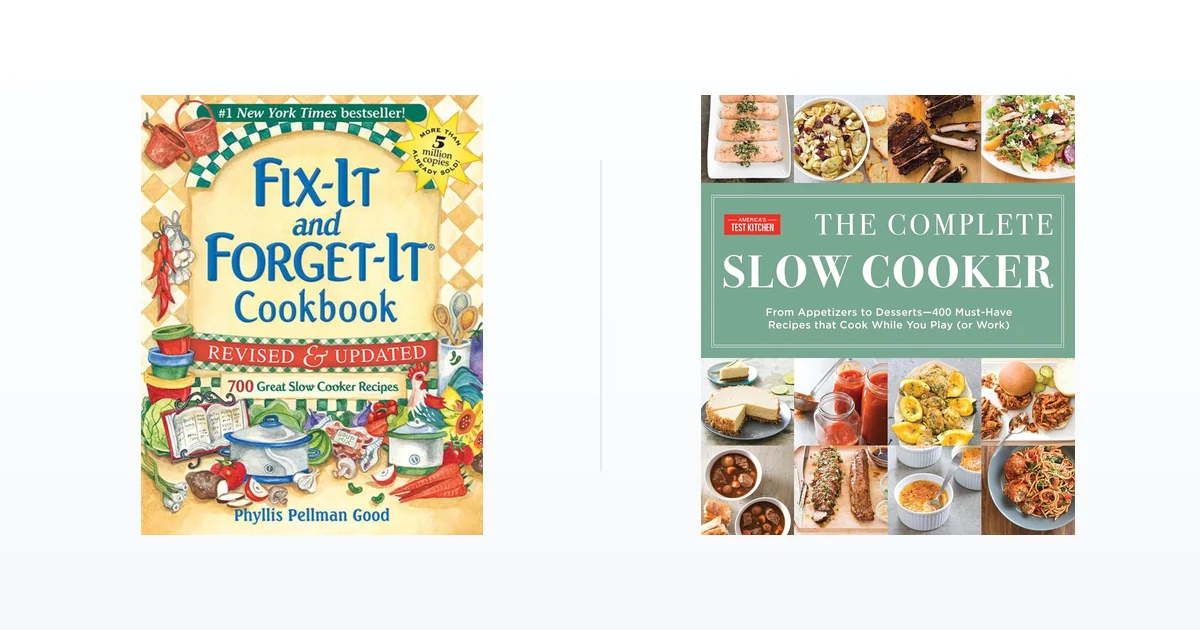
 Best Overall BestsellerFix-It and Forget-It Revised
Seven hundred slow cooker recipes in a single paperback — the long-running benchmark of the category.
 Best Tested RecipesThe Complete Slow Cooker
Four hundred recipes developed and tested by America’s Test Kitchen, with the reasoning explained.
 Best Multi-ApplianceSkinnytaste One and Done
One hundred and forty dinners written for the slow cooker, Instant Pot, air fryer, sheet pan and skillet.
At a Glance
Slow Cooker Cookbook Comparison
Ten best-selling titles compared on recipe count, format, publisher and what each does best.
| # | Model | Recipes | Format | Best For | Publisher | Key Strength | Main Drawback | Check Price |
|---|---|---|---|---|---|---|---|---|
| 1 |
 Fix-It and Forget-It Revised Fix-It and Forget-It Revised |
700 | Paperback | A lifetime of everyday recipes | Good Books | 700 recipes in one paperback | Few photographs | View on Amazon |
| 2 |
 The Complete Slow Cooker The Complete Slow Cooker |
400 | Paperback | Recipes that work first time | America’s Test Kitchen | Every recipe developed and tested | Fewer recipes than rivals | View on Amazon |
| 3 |
 Fix-It and Forget-It Big Cookbook Fix-It and Forget-It Big Cookbook |
1400 | Hardcover | Sheer volume | Good Books | 1400 recipes in one hardcover | 704 pages is unwieldy | View on Amazon |
| 4 |
 Skinnytaste One and Done Skinnytaste One and Done |
140 | Hardcover | Cooking across several appliances | Clarkson Potter | Covers slow cooker, Instant Pot and more | Only 140 recipes | View on Amazon |
| 5 |
 Skinnytaste Fast and Slow Skinnytaste Fast and Slow |
140 | Hardcover | Lighter everyday dinners | Clarkson Potter | Pairs quick-fix and slow recipes | Not slow cooker only | View on Amazon |
| 6 |
 Taste of Home Everyday Slow Cooker Taste of Home Everyday Slow Cooker |
250+ | Paperback | Reliable family dinners | Trusted Media Brands | 250+ recipes with photography | Familiar rather than adventurous | View on Amazon |
| 7 |
 Taste of Home Skinny Slow Cooker Taste of Home Skinny Slow Cooker |
278 | Paperback | Lighter slow cooking | Trusted Media Brands | 278 recipes with nutrition data | Portion sizes can be modest | View on Amazon |
| 8 |
 Anti-Inflammatory Slow Cooker Anti-Inflammatory Slow Cooker |
Prep-and-go | Paperback | Eating for a specific diet | Callisto | Built around one dietary approach | Narrow focus, 152 pages | View on Amazon |
| 9 |
 Crock Pot Meals for One Person Crock Pot Meals for One Person |
Single-serve | Paperback | Cooking for yourself | Oak and Vine Press | Genuinely single-serve portions | Only 114 pages | View on Amazon |
| 10 |
 The Best Slow Cooker Cookbook The Best Slow Cooker Cookbook |
50 | Paperback | Learning the basics | Independently published | Fifty recipes, nothing overwhelming | Only 50 recipes | View on Amazon |
Recipe counts, page counts, authors and publishers are taken from each book’s Amazon listing. We have not cooked every recipe in every book; assessments describe each book’s approach and scope, not measured results.
Scroll the table sideways to see every column
How We Chose These Slow Cooker Cookbooks
We researched current listings, compared manufacturer specifications and documentation, and examined recurring patterns in customer feedback. We did not carry out hands-on testing, and nothing below is presented as measured performance data.
- Recipe count — how much cooking you actually get for the price
- Tested or collected — whether recipes were developed in a test kitchen or gathered from cooks
- Photography — whether you can see what a dish should look like
- Technique guidance — whether the book explains why a method works
- Format and binding — paperback against hardcover, and how it sits on a worktop
- Specialisation — diet, appliance mix, household size or skill level
- Publisher track record — established houses against independent publishing
- Everyday usefulness — whether the recipes suit ordinary shopping
- Value per recipe — cost against how much you will genuinely cook
- Who it is for — being honest that no single book suits everyone
The 10 Best Selling Slow Cooker Cookbooks
1. Fix-It and Forget-It Revised — Best Overall Bestseller

Fix-It and Forget-It is the book most slow cooker owners eventually end up with. Seven hundred recipes covering soups, roasts, sides and desserts, gathered from home cooks rather than a test kitchen.
Key Specifications
| Recipes | 700 |
|---|---|
| Author | Phyllis Good |
| Publisher | Good Books |
| Format | Paperback |
| Pages | 284 |
| Best For | Everyday cooking across every category |
Why We Recommend It
The strength is breadth. Whatever is in the fridge, there is almost certainly a recipe for it here, and the format is deliberately plain — ingredients, method, done.
That plainness is also the trade-off. At 284 pages for 700 recipes there is very little photography and almost no technique instruction, so it suits cooks who already know what they are doing.
Pros
- Seven hundred recipes in one affordable paperback
- Covers every category from dips to desserts
- Recipes contributed by home cooks, written plainly
- Long-established and widely trusted
Cons
- Very few photographs for the number of recipes
- Little technique or troubleshooting guidance
- Dense layout makes browsing harder
Best for: Anyone who wants the widest possible everyday recipe library in one book.
2. The Complete Slow Cooker — Best Tested Recipes

Where most slow cooker books collect recipes, this one develops them. America’s Test Kitchen works a dish repeatedly until it behaves, then explains what they changed and why.
Key Specifications
| Recipes | 400 |
|---|---|
| Author | America’s Test Kitchen (Editor) |
| Publisher | America’s Test Kitchen |
| Format | Paperback |
| Pages | 400 |
| Best For | Cooks who want to know why a recipe works |
Why We Recommend It
That matters more in slow cooking than in most methods, because the usual failure modes — watery sauces, grey meat, vegetables turned to pulp — are all fixable with technique rather than ingredients.
A page per recipe means only 400 of them, far fewer than Fix-It and Forget-It, but a much higher proportion you will actually cook twice.
Pros
- Every recipe developed and tested rather than collected
- Explains the reasoning behind each method
- Roughly a page per recipe, so instructions are complete
- Covers appetizers through to desserts
Cons
- Fewer recipes than the big collections
- Costs more than a basic recipe compilation
- Test-kitchen style can feel technical to casual cooks
Best for: Cooks who would rather have 400 reliable recipes than 1400 untested ones.
3. Fix-It and Forget-It Big Cookbook — Most Recipes

The maximalist option. Fourteen hundred recipes is more than most people will cook in a decade, gathered into a single hardback.
Key Specifications
| Recipes | 1400 |
|---|---|
| Author | Phyllis Good |
| Publisher | Good Books |
| Format | Hardcover |
| Pages | 704 |
| Best For | Cooks who never want to run out of ideas |
Why We Recommend It
If your complaint about recipe books is that you exhaust them, this solves it permanently. The range covers regional American home cooking in a depth that smaller books cannot approach.
Seven hundred pages is genuinely heavy, and finding a specific recipe means relying on the index rather than browsing. Treat it as a reference volume rather than a book you read.
Pros
- Fourteen hundred recipes, the largest collection here
- Hardcover binding stands up to kitchen use
- Enormous regional and seasonal range
- Excellent value per recipe
Cons
- 704 pages is heavy and awkward on a worktop
- Browsing is impractical, you must use the index
- Minimal photography for the size
Best for: Cooks who want a permanent reference they will never exhaust.
4. Skinnytaste One and Done — Best Multi-Appliance

Rather than assuming you own only a slow cooker, this book writes each dinner for whichever appliance suits it — slow cooker, Instant Pot, air fryer, sheet pan, skillet or Dutch oven.
Key Specifications
| Recipes | 140 |
|---|---|
| Authors | Gina Homolka and Heather K. Jones R.D. |
| Publisher | Clarkson Potter |
| Format | Hardcover |
| Pages | 304 |
| Best For | Kitchens with more than one cooking appliance |
Why We Recommend It
For anyone who owns a multicooker as well as a crock, that is genuinely useful: you pick the method by how much time you have rather than by which book is open.
The nutritional information throughout reflects Skinnytaste’s focus on lighter cooking, and the photography is far better than in the big recipe compilations.
Pros
- Each dinner written for several different appliances
- Strong photography and clear layout
- Nutritional information given throughout
- Bestseller across several major lists
Cons
- Only 140 recipes, and not all are slow cooker
- Assumes you own several appliances
- Hardcover price for a smaller collection
Best for: Cooks who own a slow cooker alongside an Instant Pot or air fryer.
5. Skinnytaste Fast and Slow — Best Healthy Everyday

The premise is that real weeks contain both kinds of evening — the ones where you have eight hours and the ones where you have twenty minutes. This book covers both.
Key Specifications
| Recipes | 140 |
|---|---|
| Authors | Gina Homolka and Heather K. Jones R.D. |
| Publisher | Clarkson Potter |
| Format | Hardcover |
| Pages | 304 |
| Best For | Lighter cooking with a slow cooker in rotation |
Why We Recommend It
The slow cooker recipes are written with the same nutritional discipline as the fast ones, which is unusual: many slow cooker books lean heavily on condensed soups and processed shortcuts.
Photography and layout are excellent, and nutritional information is given per serving throughout.
Pros
- Slow cooker recipes written to a proper nutritional standard
- Fast alternatives for evenings with no time
- Per-serving nutritional information throughout
- Strong photography and clear instructions
Cons
- Roughly half the book is not slow cooker
- 140 recipes is modest against the big collections
- Lighter cooking will not suit every household
Best for: Cooks who want the slow cooker in a lighter, more balanced rotation.
6. Taste of Home Everyday Slow Cooker — Best Everyday Collection
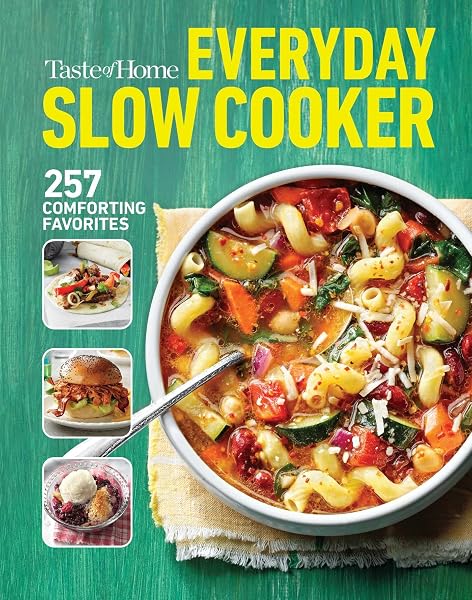
Taste of Home recipes come from readers and are tested before publication, which lands this book between the untested big collections and the technical test-kitchen volumes.
Key Specifications
| Recipes | 250+ |
|---|---|
| Author | Taste of Home (Editor) |
| Publisher | Trusted Media Brands |
| Format | Paperback |
| Pages | 256 |
| Best For | Straightforward family dinners |
Why We Recommend It
The balance of photography to recipes is the practical advantage over Fix-It and Forget-It — 256 pages for 250 recipes means you can usually see what you are aiming for.
The cooking is deliberately familiar: pot roasts, casseroles, chilli, pulled pork. Comforting rather than surprising, which is exactly what most people want from a slow cooker.
Pros
- More than 250 tested family recipes
- Roughly a page and a photograph per recipe
- Paperback price for a well-photographed book
- Recipes are genuinely everyday rather than aspirational
Cons
- Familiar cooking with few surprises
- Less technique guidance than test-kitchen books
- Some recipes rely on convenience ingredients
Best for: Families who want reliable, recognisable dinners with pictures to match.
7. Taste of Home Skinny Slow Cooker — Best Low-Calorie

Slow cooking has a reputation for heaviness — cream soups, fatty cuts, long-cooked starch. This book sets out to keep the method and drop the calories.
Key Specifications
| Recipes | 278 |
|---|---|
| Author | Taste of Home (Editor) |
| Publisher | Trusted Media Brands |
| Format | Paperback |
| Pages | 256 |
| Best For | Calorie-aware slow cooking |
Why We Recommend It
With 278 recipes it is one of the larger collections here, and every one carries nutritional information, which is what makes it genuinely usable if you are tracking intake.
The compromises are honest ones: leaner cuts need more attention to liquid, and some portions are smaller than a family cook might expect. Both are noted in the recipes.
Pros
- 278 recipes, a large collection for a lighter book
- Nutritional information on every recipe
- Keeps the convenience of slow cooking without the heaviness
- Paperback price
Cons
- Leaner cuts are less forgiving over long cooks
- Portion sizes are modest by family standards
- Less indulgent than classic slow cooker cooking
Best for: Anyone counting calories who does not want to give up the slow cooker.
8. Anti-Inflammatory Slow Cooker — Best Special Diet

A single-purpose book. Every recipe is written around an anti-inflammatory eating pattern, using the slow cooker as the prep-and-go method.
Key Specifications
| Focus | Anti-inflammatory eating |
|---|---|
| Author | Madeline Given |
| Publisher | Callisto |
| Format | Paperback |
| Pages | 152 |
| Best For | Cooking to a specific dietary approach |
Why We Recommend It
Special-diet cooking is where a dedicated book earns its place. Adapting general slow cooker recipes to a restrictive pattern is tedious; having them written that way from the start is not.
At 152 pages it is much smaller than the general collections, and the focus is narrow by design. Worth saying plainly: this is a cookbook, not medical advice, and dietary approaches are worth discussing with a professional.
Pros
- Recipes written for the diet rather than adapted to it
- Prep-and-go format suits busy weeks
- Compact and easy to work from
- Clear ingredient guidance throughout
Cons
- Only 152 pages, far smaller than general collections
- Narrow focus if you are not following this approach
- A cookbook rather than clinical guidance
Best for: Anyone following an anti-inflammatory pattern who wants recipes written for it.
9. Crock Pot Meals for One Person — Best for Single Cooks

Almost every slow cooker book assumes a family. Halving those recipes rarely works cleanly, because liquid does not scale the way solids do.
Key Specifications
| Focus | Truly single-serve portions |
|---|---|
| Author | Maggie Lowe |
| Publisher | Oak and Vine Press |
| Format | Paperback |
| Pages | 114 |
| Best For | Cooking for one without leftovers |
Why We Recommend It
This book solves that by writing for one from the outset — the quantities, the liquid ratios and the cooking times are all set for a small crock rather than adapted from a large one.
At 114 pages it is a slim book, and the range is correspondingly narrower than the big collections. It is a specialist tool, and useful precisely because of that.
Pros
- Recipes portioned for one from the start
- Liquid ratios correct for a small crock
- No leftovers to store or freeze
- Compact and inexpensive
Cons
- Only 114 pages, a narrow range
- Little use if you cook for more than one
- Small independent press with less editorial polish
Best for: Single cooks tired of halving family recipes and getting it wrong.
10. The Best Slow Cooker Cookbook — Best Beginner Starter

Seven hundred recipes is paralysing when you have owned a slow cooker for a week. Fifty is a number you can actually get through.
Key Specifications
| Recipes | 50 |
|---|---|
| Author | Mira Glenn |
| Publisher | CreateSpace Independent Publishing Platform |
| Format | Paperback |
| Pages | 118 |
| Best For | A first slow cooker book |
Why We Recommend It
The recipes are deliberately simple and cover the dishes people buy a slow cooker for in the first place — stews, pulled meats, chilli, soups. Cook the book and you will know how the appliance behaves.
It is independently published, so the editorial polish is below the major houses, and 118 pages is slim. As a first book to build confidence rather than a permanent reference, that is the right trade.
Pros
- Fifty recipes is a realistic number to work through
- Covers the core dishes people buy a slow cooker for
- Very inexpensive
- Simple instructions suited to beginners
Cons
- Only 50 recipes, quickly exhausted
- Independently published, less editorial polish
- Slim at 118 pages
Best for: First-time slow cooker owners who want to build confidence before buying a big collection.
Fix-It and Forget-It vs The Complete Slow Cooker
The two ends of the category: the biggest collection against the most carefully tested one.
| Feature | Fix-It and Forget-It Revised | The Complete Slow Cooker |
|---|---|---|
| Recipes | 700 | 400 |
| Origin | Collected from home cooks | Developed by America’s Test Kitchen |
| Pages | 284 | 400 |
| Pages per recipe | Roughly 0.4 | Roughly 1.0 |
| Photography | Minimal | Substantial |
| Technique guidance | Little | Extensive |
| Main advantage | Enormous range for the price | Recipes that work the first time |
| Main drawback | No explanation when something fails | Far fewer recipes |
Choose Fix-It and Forget-It if: you already cook confidently and want the widest possible bank of ideas.
Choose The Complete Slow Cooker if: you have had watery sauces or overcooked meat and want to understand why.
General Collection or Specialist Book?
The second real decision. A general book covers everything adequately; a specialist book covers your situation properly.
| Feature | Taste of Home Everyday Slow Cooker | Crock Pot Meals for One Person |
|---|---|---|
| Scope | 250+ general family recipes | Single-serve recipes only |
| Portions | Family sized | Portioned for one |
| Scaling required | Halve for one, imperfectly | None |
| Pages | 256 | 114 |
| Photography | Substantial | Limited |
| Main advantage | Covers every situation adequately | Correct for one household, no adaptation |
| Main drawback | Needs scaling if you cook for one | Useless if you cook for more |
Choose the general collection if: you cook for two or more, or want one book to cover everything.
Choose the specialist book if: you cook for one, follow a specific diet, or own several appliances — the adaptation a general book demands is where recipes go wrong.
Best Alternatives
| Alternative | Why Consider It | Better For | Main Trade-Off |
|---|---|---|---|
| Fix-It and Forget-It Big Cookbook | 1400 recipes in one hardcover | Never running out of ideas | 704 pages is unwieldy |
| Skinnytaste One and Done | Written for several appliances | Multicooker and air fryer owners | Only 140 recipes |
| Taste of Home Skinny Slow Cooker | 278 recipes with nutrition data | Calorie-aware cooking | Modest portion sizes |
| Anti-Inflammatory Slow Cooker | Recipes written for the diet | Following a specific eating pattern | Narrow focus, 152 pages |
| The Best Slow Cooker Cookbook | Fifty simple starter recipes | A first slow cooker book | Quickly exhausted |
What Kind of Slow Cooker Cookbook Do You Need?
Starter books carry 50 to 150 recipes and exist to build confidence. The Best Slow Cooker Cookbook and the single-serve title sit here — small enough to work through rather than dip into.
General collections run from 250 to 1400 recipes and become the book you reach for automatically. Fix-It and Forget-It and the Taste of Home titles are the mainstream choices, and most kitchens want one.
Test-kitchen and specialist books trade quantity for depth. The Complete Slow Cooker explains technique; the Skinnytaste and anti-inflammatory titles write for a specific way of eating. These are second books, bought once you know what you want to cook.
How to Choose a Slow Cooker Cookbook
Tested or Collected?
This is the most useful question and the least advertised. Collected recipes come from home cooks and are printed largely as submitted. Tested recipes have been cooked repeatedly and adjusted. Collected books give you range; tested books give you reliability, and cost more per recipe for it.
Count the Pages Per Recipe
A quick proxy for how much you get. Fix-It and Forget-It gives roughly 0.4 pages per recipe; The Complete Slow Cooker gives about one. More pages per recipe means photography, technique notes and troubleshooting; fewer means a bare ingredient list and method.
Decide Whether You Need Photographs
Photography is the first thing cut to fit more recipes in. If you cook by eye and want to see the target, choose a book with roughly a page per recipe. If you cook from instructions and want volume, the dense collections are better value.
Match the Book to Your Household
Almost every general slow cooker book assumes four to six servings. If you cook for one, halving those recipes rarely works because liquid does not scale proportionally — a dedicated single-serve book solves a real problem rather than an imagined one.
Consider Which Appliances You Own
If you own a multicooker or air fryer as well as a crock, a book written across appliances lets you choose the method by the time available. If the slow cooker is your only appliance, a dedicated title wastes none of its pages.
Check the Format for Kitchen Use
A paperback lies flat on a worktop; a 704-page hardcover does not. Consider where the book will physically sit while you cook, and whether you will resent wiping it down.
Look at the Publisher
Established houses — Good Books, Clarkson Potter, America’s Test Kitchen, Trusted Media Brands — put recipes through editorial checking. Independently published titles can be excellent, but the quality control varies more, and it is worth knowing which you are buying.
Be Honest About How Many Recipes You Will Cook
Most people cook fewer than thirty recipes from any book they own. A 1400-recipe volume is superb value on paper, but if fifty well-photographed recipes get cooked and 1400 dense ones do not, the smaller book was the better purchase.

Common Slow Cooker Cookbook Buying Mistakes
- Buying on recipe count alone. Most people cook fewer than thirty recipes from any book.
- Assuming recipes were tested. Many big collections print submissions largely as received.
- Ignoring pages per recipe. It tells you instantly whether you get photography and technique.
- Buying family recipes when you cook for one. Halving slow cooker recipes rarely works cleanly.
- Overlooking format. A heavy hardcover that will not lie flat gets used far less.
- Buying a general book for a specific diet. Adapting every recipe is more work than it sounds.
- Expecting technique from a recipe compilation. If dishes keep failing, buy a tested book instead.
- Duplicating what you own. Two general collections overlap heavily; a second book should specialise.
Who Should Buy a Slow Cooker Cookbook?
A dedicated cookbook is worth buying if you:
- Have just bought a slow cooker — and want to learn how it behaves
- Keep cooking the same four dishes — the usual reason a cooker ends up in a cupboard
- Have had recipes fail — watery sauces and grey meat are technique problems a tested book fixes
- Cook for one — where a single-serve book saves constant guesswork
- Follow a specific diet — adapting general recipes is tedious and error-prone
- Own several appliances — a cross-appliance book lets you pick by time available
Who May Not Need One?
If you already cook confidently and improvise happily, free recipes online will cover most of what a general collection offers. A book earns its place when you want reliability, technique, or recipes written for a situation the internet handles badly — single portions and specific diets being the clearest examples.
Frequently Asked Questions
What is the best selling slow cooker cookbook?
Fix-It and Forget-It has been the category’s long-running benchmark, with 700 recipes in the revised edition and 1400 in the Big Cookbook. For reliability rather than volume, America’s Test Kitchen’s The Complete Slow Cooker is the most respected, with 400 developed and tested recipes.
How many recipes should a slow cooker cookbook have?
More is not automatically better. Fifty is enough to learn the appliance; 250 to 400 covers most households indefinitely; 700 to 1400 is a reference volume. Look at pages per recipe as well — roughly one page per recipe means photography and technique, far less means a bare list.
Are tested recipes worth paying more for?
If your slow cooker dishes have been disappointing, yes. Tested books explain why sauces go watery, why lean cuts dry out and how to layer ingredients by cooking time. Collected recipe books give you far more ideas but no explanation when something goes wrong.
Which slow cooker cookbook is best for beginners?
A smaller book you can work through beats a huge reference you dip into. Fifty straightforward recipes covering stews, pulled meats and chilli will teach you how the appliance behaves faster than a 1400-recipe volume you never finish.
Is there a slow cooker cookbook for one person?
Yes, and it solves a genuine problem. Family recipes do not halve cleanly because liquid does not scale proportionally with solids, so a book portioned for one from the start avoids constant guesswork. Crock Pot Meals for One Person is written specifically for this.
Do slow cooker cookbooks work with any brand of cooker?
Broadly yes — recipes are written around capacity and heat setting rather than brand. Check that the recipe capacity matches your crock, since a recipe written for six quarts will behave differently in a three-quart pot, and cookers should sit between half and three-quarters full.
Should I buy a hardcover or paperback cookbook?
Paperbacks lie flatter on a worktop and cost less; hardcovers survive kitchen use better and suit reference volumes you will own for years. For a 700-page book the hardcover binding is worth having; for a book you will prop open daily, paperback is more practical.
Are cookbooks for specific diets worth it?
If you follow the diet, yes — adapting every general recipe is more work than people expect, and mistakes are easy. If you are merely curious, a general book with nutritional information, such as the Skinnytaste or Taste of Home Skinny titles, gives you flexibility without the narrow focus.
Final Verdict
Seven hundred recipes in one affordable paperback, covering every category a slow cooker owner is likely to want.
Four hundred recipes developed and tested by America’s Test Kitchen, with the reasoning explained rather than assumed.
One hundred and forty dinners written for the slow cooker, Instant Pot, air fryer and sheet pan, with nutrition throughout.
Choosing a slow cooker cookbook comes down to five things: whether you want range or reliability, whether you need photographs to cook from, how many people you cook for, whether you are following a specific diet, and how many recipes you will realistically make. Answer the range-versus-reliability question first — it separates the big collections from everything else.