Affiliate Disclosure: As an Amazon Associate, we earn from qualifying purchases. This does not affect the price you pay.
A gravity water filter does one simple thing. You pour water into a top chamber or a bag, and gravity pulls it through a filter element into a lower chamber or a bottle. There is no pump, no plumbing and no power. What the filter takes out of the water is the whole point of buying one, and that is the one thing you cannot check for yourself on the counter.
That is why the certification line matters more than any other line on these listings. NSF/ANSI standards are the published test standards that drinking water filters in North America are certified against. A listing that names one is making a claim you can, in principle, look up. A listing that names none is asking you to trust its contaminant list on its own word.
Read the ten listings side by side and four name a standard; six do not. The Big Berkey, the best-known name here, says its elements reduce “a broad range of commonly found contaminants” and names no standard. The British Berkefeld Doulton goes further and claims its ceramic candles remove “up to 99.99% of harmful bacteria, cysts, and other waterborne pathogens”, again with no standard or test named. The Purewell PW-KS-CF, the Boroux and both camping bags name none either. Sawyer says its MINI filters are “individually tested three times to performance standards by Sawyer”, which is the maker testing its own product, not a published standard.
The four that do name one are naming two standards, attached to three different things. The Purewell PW-OB says “The black carbon filter has passed authoritative NSF/ANSI 42 certification” and that the system “has also passed authoritative NSF/ANSI 372 certification.” The SINCHO names 372 for its “lead-free, BPA-free construction”. The Culligan MaxClear claims its system is “certified to NSF/ANSI 42 standards to reduce microplastics, lead, and Total PFAS”. The IceJoy puts “NSF/ANS 42 Certifcation”, spelled that way, at the end of its title.
None of the four names who did the certifying, and none names a health-effects standard. No listing names a certification body, gives a certificate or listing number, or says a third-party laboratory tested the product to a standard. NSF/ANSI 42 covers aesthetic effects such as chlorine taste and odour. NSF/ANSI 372 covers the lead content of the materials that touch the water. NSF/ANSI 53, the standard generally used for health-related reduction claims such as lead, appears on no listing here, though the Culligan claims lead and PFAS reduction and the Doulton claims to remove bacteria and cysts. So “certified” is a word you need to follow up, not a box already ticked.
So this guide sorts the ten by what each listing lets you verify: which standard is named, whether it covers the whole system, a single filter element or the materials, and what is left as the listing’s own claim. Every contaminant figure below, from “99% chlorine” to “99.99% of harmful bacteria”, is quoted as the listing’s claim. We also set out the numbers a buyer actually lives with: capacity in gallons, how many filter elements, flow rate, filter life in gallons, the grade of stainless steel, and whether you can see the water level.
The ten split into two kinds of product, and we keep them apart. Eight are countertop stainless steel systems for the kitchen. Two, the Sawyer SP160 and the Katadyn BeFree Gravity, are camping bags that hang from a branch and filter stream water for a trail or a campsite. They answer different questions, and the comparison treats them separately. Star ratings and review counts were not captured for this roundup; popularity below is Amazon’s Best Sellers Rank only.
Before you weigh any contaminant claim, look up what is actually in your water. In the United States your water supplier publishes an annual water quality report, often called a Consumer Confidence Report; private well owners need their own test. A filter claim only matters against a contaminant you actually have.
All ten were captured on 5 October 2026. Their overall Best Sellers Ranks run from #6,031 to #182,963, and the best-ranked listing on the page, the Purewell PW-OB, is also the only one that says which part of it is certified to what.
Our Quick Picks
 Best OverallPurewell 3-Stage Gravity Water Filter System, PW-OB
The only listing that says which part is certified, NSF/ANSI 42 for the carbon filter and 372 for the system, plus a stated 4 gallons per hour.
 Best Off-Grid BagSawyer SP160 One Gallon Gravity System
A 1-gallon bag and a 0.1 micron absolute MINI filter rated up to 100,000 gallons by the maker, sold by Amazon.com.
 Best With a WindowSINCHO 2.25G Gravity System with Level Window
A water-level window, a 304 stainless body, NSF/ANSI 372 named for its construction and two ceramic filters rated 5,000 gallons each.
At a Glance
Eight Countertop Systems, Then Two Camping Bags, Sorted by What Their Certification Line Says
Rows 1 to 8 are countertop stainless systems and rows 9 and 10 are camping bags; read the first column as the listing’s own wording, not a verified certificate.
| # | Model | NSF/ANSI Named | Capacity | Filter Life Stated | Best Sellers Rank | Standout | Main Drawback | Check Price |
|---|---|---|---|---|---|---|---|---|
| 1 |
 Purewell PW-OB (K8626) |
42 (carbon filter); 372 (system) | 2.25 gal | 3,000 gal each; 6,000 per pair | #6,031 overall | Only listing that names the certified part | No certifier named; no water-level window | View on Amazon |
| 2 |
 Culligan MaxClear MCS701B |
42 (system, as claimed) | Not stated | Up to 6 months; gallons not stated | #72,453 overall | Takes Berkey BB9-2 and other gravity elements | Lead and PFAS claims tied to standard 42 | View on Amazon |
| 3 |
 IceJoy 8-Stage 3.0 Gallon |
“NSF/ANS 42” in title only | 3.0 gal (title); 2.25G (colour field) | 3,000 gal black; 1,000 gal white | #72,892 overall | 3.0 gal in title; sight glass spigot | Certified part, scope and certifier all unstated | View on Amazon |
| 4 |
 SINCHO 2.25G (S1) |
372 (construction) | 2.25 gal | 5,000 gal each; 10,000 total | #157,595 overall | Window, 304 body and washable ceramic elements | Its standard covers materials, not reduction | View on Amazon |
| 5 |
 Purewell PW-KS-CF (K8772B-2) |
None named | 2.25 gal | 6,000 gal carbon pair; 1,000 gal fluoride pair | #23,177 overall | Window plus four elements, two filter types | Stainless grade and flow rate not stated | View on Amazon |
| 6 |
 Big Berkey BK4X2-BB |
None named | 2.25 gal | 6,000 gal per pair | #22,748 overall | AISI 304; nests for storage; 1–4 people stated | No standard named; not shipped to California or Iowa | View on Amazon |
| 7 |
 Boroux Compact 1.8 Gallon |
None named | 1.8 gal | Not stated | #182,963 overall | Smallest countertop footprint; spigot fits 5/8–3/4 in | Bullets describe the spigot, not the filters | View on Amazon |
| 8 |
 British Berkefeld Doulton W9361137 |
None named | 3.17 gal (12 litre) | Not stated | #66,368 overall | Largest stated capacity; ceramic candles | Pathogen claims with no standard or test named | View on Amazon |
| 9 |
 Sawyer SP160 (camping bag) |
None named; tested by Sawyer | 1 gal bag | Up to 100,000 gal (maker rating) | #9,231 overall | 0.1 micron absolute; 2 oz filter | No standard; flow rate not stated | View on Amazon |
| 10 |
 Katadyn BeFree Gravity 3L (camping bag) |
None named | 3 L bag | Up to 1,000 L | #18,235 overall | Only stated flow on the bags, 2 L/min | Filter life about 264 gal, our arithmetic | View on Amazon |
Best Sellers Ranks and specifications are taken from each manufacturer’s Amazon listing as displayed on 5 October 2026 through a United States connection, and may change. The first column quotes each listing; it is not a verified certificate. No listing names a certification body or gives a certificate number, so none of these claims could be checked against a certifier’s database from the listing alone. The IceJoy title spells its claim “NSF/ANS 42 Certifcation”. Capacities are as stated and do not say whether they describe the top chamber, the bottom chamber or the system; the IceJoy gives 3.0 gallons in its title and 2.25G in its colour field, and the Katadyn’s 3 L is about 0.8 gallons and its 1,000 L about 264 gallons, by our arithmetic. The Sawyer’s 100,000-gallon figure sits in the listing’s warranty field as “Rated up to 100,000 gallons by manufacturer”. The Doulton’s 3.17 gallons and its size field’s 12 litre agree, by our arithmetic. The Culligan’s main rank is in Pitcher Water Filters, #131; the other countertop systems are ranked in Under-Sink & Countertop Filtration and the bags in Water Filters. Two listings were sold by Amazon.com at capture: the Sawyer and the Culligan. Star ratings and review counts were not captured for any product here.
Scroll the table sideways to see every column
How We Chose These Ten
We researched current listings, compared manufacturer specifications and documentation, and read each listing’s certification wording, contaminant claims and filter specifications line by line. We did not carry out hands-on testing, and nothing below is presented as measured performance data. Star ratings and review counts were not captured for this roundup. We used Amazon Best Sellers Rank, buy-box stock and listing specifications instead, and nothing on this page describes or implies how owners have scored these filters.
- Gravity-fed only — every product here moves water through its filter by gravity alone, with no pump, no plumbing and no power. Pitchers, faucet filters and under-sink systems were not in the running; see our water filter pitcher guide and reverse osmosis water filter roundup for those.
- Two product types, kept apart — eight countertop stainless steel systems and two hanging camping bags. They are compared side by side only where the comparison means something, such as filter life and stated certification. Replacement filter packs sold without a housing were left out.
- One product per design — where two listings carried near-identical model codes, we kept one and replaced the other, so each row here is a distinct product.
- Certification recorded exactly as printed — the standard number, the part it is said to cover and any named certifier or laboratory. Where a listing says “certified” without saying by whom, we say so. Where a listing names no standard, we record “None named”, even if the brand may hold certificates elsewhere.
- Contaminant claims quoted as claims — percentages and contaminant lists are the listing’s words. We make no claim that any filter here makes water safe to drink or improves health, and we did not verify any reduction figure.
- The working numbers — capacity in gallons, number of filter elements, flow rate, filter life in gallons, stainless steel grade, spigot and water-level window. A spec the listing does not give is marked Not stated.
- Model numbers compared — we read each listing’s model and part fields and flag where two products from different sellers carry near-identical codes. Our arithmetic, such as litre-to-gallon conversions, is labelled as ours.
- Popularity from Best Sellers Rank only — ranks are quoted exactly as returned on 5 October 2026, overall and in the category Amazon assigned. Ranks move constantly.
- Verified stock and seller — each product was the buy-box offer and in stock on amazon.com on 5 October 2026.

The Ten Gravity Water Filters in Detail
1. Purewell 3-Stage 0.01μm Ultra-Filtration Gravity Water Filter System, 2.25G, PW-OB — Best Overall

The best-ranked listing here is also the only one that tells you which part of it carries the certification.
Key Specifications
| NSF/ANSI named | 42 (black carbon filter); 372 (system), stated |
|---|---|
| Certifier named | Not stated |
| Capacity | 2.25 gallons |
| Filter elements | 2 black carbon filters |
| Flow rate | 4 gallons per hour, stated |
| Filter life | 3,000 gal each; 6,000 gal per pair; replace every 6 months |
| Pore size | 0.01 μm hollow fiber UF membrane |
| Stainless steel | 304, housing and spigot |
| Water-level window | Not stated; stand included |
| Model | K8626 (PW-OB in title) |
| Seller | OUBI |
| Best Sellers Rank | #6,031 overall; #11 in Under-Sink & Countertop Filtration |
Why We Recommend It
This is the one listing that tells you what the certificate is attached to. The first bullet says “The black carbon filter has passed authoritative NSF/ANSI 42 certification”, then later “This water filter system has also passed authoritative NSF/ANSI 372 certification.” Two standards, two different scopes. NSF/ANSI 42 is the standard for aesthetic effects, things like chlorine taste and odour, and it is claimed here for the filter element. NSF/ANSI 372 is about the lead content of the parts that touch the water, and it is claimed for the system. No other listing on the page separates the element from the system like this.
What it does not say is who certified it. The listing never names a certifying body, a certificate number or a laboratory. That matters, because the next step for a careful buyer is to look the product up in the certifier’s public database, and without a name or a number you would have to search by brand and hope the model matches. The model field reads K8626; the title code is PW-OB. If you want to check the claim, ask the seller for the certifier and the listing number before you buy.
The contaminant list is broader than the certificate. The listing says the filter uses “a 0.01μm hollow fiber UF membrane, a silver ion membrane and an activated carbon block to reduce chlorine and intercept rust, sediment, organic matter and heavy metals”, and the title claims “Reduce 99% Chlorine”. The chlorine claim sits inside what standard 42 covers. Heavy metals are not part of standard 42, so read that part as the listing’s own claim. The listing is also plain about a limit: “The filter element DOES NOT lower TDS value.” Dissolved minerals pass through.
It is the only countertop system that gives a flow rate. The listing says it maintains “the optimal flow rate (4 gallon/hour)” with the smaller pore size. At that rate, a full 2.25-gallon top chamber would take a little over half an hour to pass through, by our arithmetic, though gravity flow slows as the top chamber empties and the listing does not say at what fill level the 4 gallons is measured. Nobody else on the countertop side gives you any number to plan around.
The filter life is stated two ways, and you should plan for the shorter. “The two carbon filters (black) can provide up to 6000 gallons drinking water, the service life of a single filter element is 3000 gallons”, and then: “for optimum performance, the filter elements should be replaced every 6 months.” Six thousand gallons in six months would be more than 30 gallons a day, by our arithmetic, so for most households the six-month line will come first.
What to weigh. It is sold by OUBI and ranks #6,031 overall and #11 in Under-Sink & Countertop Filtration, the best rank on the page by a wide margin. The housing and spigot are 304 stainless, and a non-slip stand is included. There is no water-level window, so you will lift the lid to check. The listing’s own warning applies: when the bottom chamber is full, do not add water to the top, or it will leak. Its model code, K8626, shares only the K8 prefix with the Purewell PW-KS-CF’s K8772B-2, which looks like the brand’s numbering scheme rather than a shared design.
Pros
- Only listing that names the certified part
- Two standards named: 42 and 372
- Only countertop flow rate stated, 4 gal per hour
- 304 stainless housing and spigot
- Stand included
- Best Sellers Rank #6,031, best on the page
Cons
- No certifier or certificate number named
- Heavy-metal claim sits outside standard 42
- No water-level window
- Does not lower TDS, stated
- 6-month replacement line likely comes before 6,000 gal
- Sold by a third party, not Amazon.com
Best for: A buyer who wants the most specific certification wording on the page and a stated flow rate, and will ask the seller for the certifier.
2. Culligan MaxClear Gravity Water Filter System, MCS701B — Boldest Claim

The loudest certification claim on the page ties lead and PFAS reduction to a standard that is about taste and odour.
Key Specifications
| NSF/ANSI named | 42, claimed for the system |
|---|---|
| Certifier named | Not stated |
| Contaminants claimed | Microplastics, lead, Total PFAS |
| Capacity | Not stated (“high-capacity”) |
| Filter elements | 1 included (size field); up to 2 |
| Flow rate | Not stated |
| Filter life | Up to 6 months per filter; gallons not stated |
| Stainless steel | Brushed or polished; grade not stated |
| Spigot and window | Ergonomic spigot; window not stated |
| Size and weight | 26 in high; nests under 12 in; 10.0 lb |
| Seller | Amazon.com |
| Best Sellers Rank | #72,453 overall; #131 in Pitcher Water Filters |
Why We Recommend It
This listing makes the boldest certification claim on the page. The first bullet is in capitals: “THE ONLY GRAVITY FILTER CERTIFIED TO REDUCE MICROPLASTICS & TOTAL PFAS”. It goes on: “the ONLY gravity water filter system certified to NSF/ANSI 42 standards to reduce microplastics, lead, and Total PFAS (forever chemicals).” Unlike the Purewell, it attaches the certificate to the system, not a single part. It is one of four listings here that name a standard, and the only one to claim a certificate for contaminant reduction across the whole system.
The standard and the contaminants do not obviously match. NSF/ANSI 42 covers aesthetic effects such as chlorine, taste and odour. In NSF’s published scheme, lead and PFAS reduction claims are normally certified under NSF/ANSI 53, the health-effects standard, which this listing never names. That does not prove the claim is wrong; the product may hold more certificates than the listing mentions, or the sentence may be compressed marketing. It does mean you cannot take the lead and PFAS claims from this listing at face value. Ask Culligan which standard covers which contaminant, and who the certifier is, before you rely on them.
Its numbers are thin. The listing never states a capacity in gallons, only “The high-capacity design means fewer refills”. It never states a flow rate. Filter life is given in time, not volume: “lasting up to 6 months per filter”, with an asterisk the listing does not explain. The size field reads “+ 1 Filters (6 Months Life)”, so one element appears to be in the box, and the bullet says you can “add up to 2 filters in your Scout system” for faster flow. The stainless finish is “brushed or polished”, grade not stated.
It is the open platform on the page. The second bullet says it is “Compatible with Berkey Black BB9-2 water filter replacement and other gravity filter replacements including Boroux, ProOne, Doulton, Purewell and Waterdrop filters.” That is useful if you already own Berkey elements. It also raises a question the listing does not answer: if you fit a different brand’s element, the Culligan certification claim, whatever it covers, would not travel with it. Doulton is on the list too, and the British Berkefeld Doulton system on this page names no standard for its own candles. As for “THE ONLY”: no other listing here claims a PFAS certificate, so nothing on this page contradicts it, but nothing on the listing lets you check it either.
It is the tallest system here and the most compact when stored. The height field is 26 inches, against about 20 inches for the Purewells, and the listing says it “Nests under 12″ when not in use”. It weighs 10.0 pounds, the heaviest listed weight on the page. A stand and an “ergonomic spigot” are included; a water-level window is not mentioned.
What to weigh. It is sold by Amazon.com and ranks #72,453 overall. Amazon files it under Pitcher Water Filters, #131, rather than with the other countertop systems. If the certification is the reason you are buying it, verify it first. If the reason is the Berkey compatibility and Amazon.com as the seller, it stands on those alone.
Pros
- Names a standard, NSF/ANSI 42, for the system
- Takes Berkey BB9-2 and other gravity elements
- Sold by Amazon.com
- Nests under 12 in for storage
- Room for a second element
- Stand and spigot included
Cons
- Lead and PFAS claims tied to standard 42, not 53
- No certifier or certificate number named
- Capacity in gallons not stated
- Filter life in months only
- Stainless grade not stated
- Heaviest listed weight here, 10.0 lb
Best for: A Berkey-element owner who wants an Amazon.com-sold housing, and who will verify the certification claim with Culligan first.
3. IceJoy 8-Stage Gravity Water Filtration System, 3.0 Gallon, 304 Stainless Steel — Best Sight Glass

Its certification claim is six words at the end of its title, spelled wrong, and never explained.
Key Specifications
| NSF/ANSI named | “NSF/ANS 42 Certifcation”, title only |
|---|---|
| Certifier named | Not stated |
| Capacity | 3.0 gal (title); 2.25G (colour field) |
| Filter elements | 4 (black carbon and white filters) |
| Flow rate | Not stated |
| Filter life | Black 3,000 gal; white 1,000 gal; about 6 months |
| Stages | 8, media listed |
| Stainless steel | 304, lead-free, food-grade |
| Spigot and window | Sight glass spigot shows lower-chamber level |
| Height | 15.7 in listed |
| Seller | IceJoy |
| Best Sellers Rank | #72,892 overall; #110 in Under-Sink & Countertop Filtration |
Why We Recommend It
The certification claim is in the title and nowhere else. The title ends “Reduce 99.9% Chlorine, NSF/ANS 42 Certifcation”. None of the eight bullets mentions NSF, a standard, a certifier or a test. The listing does not say whether the claim covers the whole system, the black carbon element, the white element or a material. With two misspellings in five words and no detail behind it, this is the weakest of the four standard-naming claims on the page, and it should be read as unverified until the seller shows you otherwise.
The capacity is stated two ways. The title says “3.0 Gallon” and a bullet repeats “3.0 Gallon Large Capacity”. The colour field reads “2.25G Carbon Block & White Filters & UV”. The listed height is 15.7 inches with a 9.8-inch width, which is shorter than the 2.25-gallon Purewells at 20 inches. Taken at face value, 3.0 gallons would be second only to the Doulton’s 3.17 gallons here. Given the conflict, ask the seller which size you will receive. The colour field also mentions UV, which no bullet describes.
It names its filter media in full. “Silver Ions, Carbon Rods, Fine Mesh, KDF55, Ion Exchange Resin, PP cotton, Carbon Granules, and Non-woven Fabric.” The contaminant claim is that it is “designed to reduce 99.9% of chlorine and capture rust, sediment, organic compounds, and heavy metals”, all as the listing’s claim. Like the Purewells, it is frank about one limit: “The filter element does not reduce TDS levels.” It also suggests you can pour “unfiltered tap or outdoor water” into it, but names no microbiological standard; we would not read that as a claim about untreated surface water.
The working parts are well described. The housing is “premium food-grade, lead-free 304 stainless steel”. The “sight glass spigot” lets you “see the water level in the lower chamber at a glance”, one of three countertop systems here with some way to see the level. Four filters are included, and the filter lives are given by type: “The black carbon filter can purify up to 3,000 gallons of water, while the white filter core filters up to 1,000 gallons.” Replacement is typically every six months.
Two element types means two replacement clocks. The white filter’s 1,000-gallon life is a third of the black filter’s, so the white pair will likely need changing first. The listing gives two replacement product codes in its last bullet. The flow rate is not stated.
What to weigh. It is sold by IceJoy and ranks #72,892 overall and #110 in Under-Sink & Countertop Filtration. The model and part fields both read “IceJoy-Water Filter”, which gives you nothing to look up. If the NSF line is why it caught your eye, ask IceJoy which part is certified, to what, and by whom. If you want a large capacity with a sight glass, confirm the 3.0 gallons first.
Pros
- 3.0 gal stated in title, second-largest here
- Sight glass spigot shows the level
- 304 lead-free stainless, stated
- Four filters included
- All eight filter media named
- Filter life stated by element type
Cons
- NSF claim in title only, misspelled
- Certified part and certifier not stated
- Colour field says 2.25G, title says 3.0
- White filters last 1,000 gal
- Flow rate not stated
- Model field gives no usable code
Best for: A household that wants a large stated capacity and a sight glass, and will confirm the size and the certification claim with the seller.
4. SINCHO 2.25G Gravity Water Filter System with Level Window, 3-Stage Stainless Steel, 2 Washable Ceramic Filters — Best With a Window

A window, a 304 body and ceramic elements, with a standard named for the materials rather than the filtering.
Key Specifications
| NSF/ANSI named | 372, for “lead-free, BPA-free construction” |
|---|---|
| Certifier named | Not stated |
| Capacity | 2.25 gallons |
| Filter elements | 2 washable ceramic filters |
| Flow rate | Not stated |
| Filter life | 5,000 gal each; 10,000 total |
| Stages | 3: ceramic, activated carbon, silver-infused layer |
| Stainless steel | 304 body |
| Water-level window | Yes, transparent window |
| Listed size and weight | 10.0 x 13.0 x 10.0 in; 7.0 lb |
| Part number | S1 |
| Seller | YS Kitchen US |
| Best Sellers Rank | #157,595 overall; #251 in Under-Sink & Countertop Filtration |
Why We Recommend It
It names a standard, and the standard is about the materials. The third bullet reads “NSF/ANSI 372 certified lead-free, BPA-free construction.” That places it among the four listings on the page that name a standard, and it attaches the claim to the right kind of thing: NSF/ANSI 372 is about the lead content of the materials that touch the water. It is not a contaminant-reduction standard. It tells you about the housing and the parts, not about what the filters take out. No certifier, certificate number or laboratory is named.
The filtering claims stand on the listing’s word. “Outer ceramic layer traps sediment; activated carbon core removes 99% chlorine & chemicals; silver-infused inner layer”. No standard is named for the 99% chlorine figure or for “chemicals”, which the listing does not define. Like the Purewells and the IceJoy, it is clear about one limit: “Note: Does not reduce TDS.”
The window is the headline feature. The first bullet: “Transparent water level window lets you check water levels at a glance—no need to open the system, reducing mess and saving time.” It is one of two countertop systems here with a window in the body, alongside the Purewell PW-KS-CF, and of those two it is the one that names a standard and a steel grade: “Durable 304 stainless steel body built to last.”
Its ceramic elements state a long life. “Each ceramic filter lasts up to 5,000 gallons (10,000 total).” That is the longest per-element life of any complete countertop system on the page; the PW-OB gives 3,000 per element and the Berkey 6,000 per pair. The elements are washable: “Clean filters with included sponge—never use soap.” The listing gives no replacement interval in months and no flow rate. Ceramic shells are typically scrubbed to restore flow, which is why the listing includes the sponge.
The listed size looks like a box, not the system. The dimension fields give 10.0 by 13.0 by 10.0 inches, which is shorter than any assembled 2.25-gallon system here; the Purewells stand 20 inches tall. It is likely a packaging figure, though the listing does not say. The weight is 7.0 pounds. Measure your counter against a typical 2.25-gallon height, or ask the seller.
What to weigh. It is sold by YS Kitchen US and ranks #157,595 overall and #251 in Under-Sink & Countertop Filtration. The part number is S1, which shares nothing with any other code on the page. Choose it if you want a window, 304 steel and a named materials standard on one system, and accept that its filtering claims are unverified and its popularity is modest.
Pros
- Water-level window in the body
- NSF/ANSI 372 named for construction
- 304 stainless body, stated
- Ceramic elements rated 5,000 gal each
- Washable elements; sponge included
- Honest that it does not reduce TDS
Cons
- 372 covers materials, not contaminant reduction
- No certifier or certificate number named
- 99% chlorine figure is the listing’s claim
- Flow rate not stated
- Listed dimensions look like packaging
- Rank #157,595, low on the page
Best for: A buyer who wants a water-level window and 304 steel with a named materials standard, and long-life washable elements.
5. Purewell 2.25G Gravity Water Filter System with Water Level Window, 8-Stage, PW-KS-CF — Best for Fluoride Claims
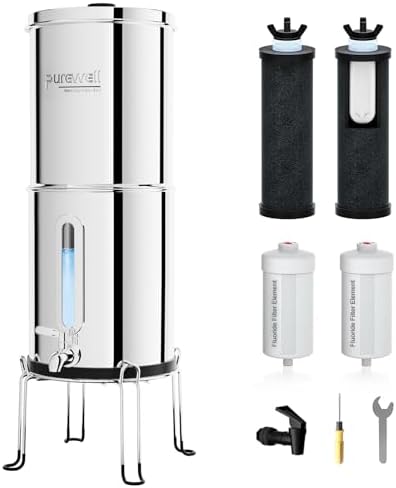
A window, four elements and two filter types, but no standard named for any of them.
Key Specifications
| NSF/ANSI named | None named |
|---|---|
| Capacity | 2.25 gallons |
| Filter elements | 4: 2 black carbon, 2 white fluoride |
| Flow rate | Not stated |
| Filter life | Carbon pair 6,000 gal; fluoride pair 1,000 gal; 6 months |
| Pore size | 0.01 μm hollow fiber UF membrane (carbon filter) |
| Stainless steel | Stainless steel; grade not stated |
| Water-level window | Yes, transparent window |
| Stand | Included |
| Part number | K8772B-2 |
| Seller | Purewell |
| Best Sellers Rank | #23,177 overall; #42 in Under-Sink & Countertop Filtration |
Why We Recommend It
This is the same brand as the best-ranked system on the page, without the certificate. The PW-OB names NSF/ANSI 42 for its carbon filter and 372 for the system. This Purewell names no standard anywhere in its title or bullets. Its black carbon filter is described in nearly the same words, “a 0.01μm hollow fiber UF membrane, a silver ion and an activated carbon block to intercept rust, sediment, organic matter, and heavy metals”, but the sentence about certification is gone. Whether the same element carries the same certificate, the listing does not say. Ask Purewell before assuming it.
The window is the reason to choose it. The first bullet is “Water Level Window – This Purewell stainless steel filtration system features a transparent window, allowing you to easily monitor the water level without having to open it.” On a 20-inch stainless cylinder, knowing how much filtered water is left without lifting the lid is a daily convenience. Three of the eight countertop systems here offer some way to see the level, and this is one of two with a window in the body; the SINCHO is the other, and it names a standard where this one does not.
It adds a second filter type. Alongside the two black carbon filters come two white fluoride filters: “a Fluoride reduction membrane, an activated carbon block, and triple sediment PP membranes to reduce fluoride and chlorine.” The listing claims “90% Fluoride Reduction”, and makes a comparative claim about alumina-based media elsewhere on the market. Those are the listing’s claims; no standard is named for them, and we cannot verify either. If fluoride matters to you, your local water quality report will tell you how much is in your supply.
The two filter types wear out at very different rates. “The pair of fluoride filters (white) and the pair of carbon filters (black) can effectively filter up to 1,000 gallons of water and 6,000 gallons of water”, with replacement recommended every six months. The fluoride pair has a sixth of the carbon pair’s stated life. At a steady 5 gallons a day, the fluoride pair would reach 1,000 gallons in about 200 days, by our arithmetic, so the six-month line and the gallon line arrive close together for a typical family.
The specifications stop short in two places. The listing says stainless steel but not which grade, where the PW-OB says 304. And there is no flow rate. Its part number, K8772B-2, matches no other code on the page; the nearest is the PW-OB’s K8626, which shares only the K8 prefix. Like the PW-OB, it “does NOT lower the TDS value”.
What to weigh. It is sold by Purewell and ranks #23,177 overall and #42 in Under-Sink & Countertop Filtration, far better than the SINCHO’s #157,595. It is the system to pick if a dedicated fluoride element matters more to you than a named standard. If you want a window with a standard named, the SINCHO is the alternative; if the standard matters most, the PW-OB is the Purewell that names one.
Pros
- Water-level window in the body
- Four elements, two filter types
- Carbon pair life 6,000 gal stated
- Stand included
- 0.01 μm UF membrane stated
- Sold by the brand
Cons
- No NSF/ANSI standard named
- Fluoride pair life only 1,000 gal
- Stainless grade not stated
- Flow rate not stated
- 90% fluoride figure is the listing’s claim
- Does not lower TDS, stated
Best for: A buyer who wants to see the water level without lifting the lid and wants a separate fluoride element, accepting no named standard.
6. Big Berkey 2.25 Gal Gravity Water Filter System with BB9-2 Filters — Best Known Name

The best-known name on the page describes its elements as the Gold Standard and names no standard at all.
Key Specifications
| NSF/ANSI named | None named |
|---|---|
| Capacity | 2.25 gallons; designed for about 1–4 people |
| Filter elements | 2 Black Berkey (BB9-2) |
| Flow rate | Not stated |
| Filter life | Up to 6,000 gal per pair |
| Stainless steel | Polished AISI 304 |
| Spigot and window | Spigot not named in the included list; window not stated |
| Size | About 8.5 in diameter, 19.25 in tall assembled (bullet); 7.58 in (height field) |
| Warranty | 6 months system; elements 2-year prorated |
| Shipping | Not available to ship to California or Iowa, stated |
| Model | BK4X2-BB |
| Seller | DistrictSale |
| Best Sellers Rank | #22,748 overall; #41 in Under-Sink & Countertop Filtration |
Why We Recommend It
This is the name most people associate with gravity filters, and its listing names no standard. The elements are called “the Gold Standard in gravity-fed water filtration”, which is a slogan, not a certification. The contaminant claim is careful and general: the elements “are designed to reduce a broad range of commonly found contaminants that may be present in treated drinking water sources and may affect drinking water quality, taste, and odor.” No contaminant is named, no percentage given and no NSF/ANSI standard cited.
The warranty field adds a detail the bullets do not. It reads, in part, “Not available to ship to California or Iowa.” The listing does not say why. Both states have their own rules on how water treatment devices may be marketed, and a shipping restriction like this is a reason to look harder at certification, not less. If you live elsewhere, it simply means the listing will sell to you; it is still worth asking what testing stands behind the element claims.
The working numbers are solid where they are given. Capacity is “2.25-gallon”, designed for “approximately 1–4 people”. Two Black Berkey elements are included, and “Each pair of authentic Black Berkey filter elements provides up to 6,000 gallons of filtered water before replacement is recommended.” The listing adds that more pairs, sold separately, each add up to 6,000 gallons. Unlike the Purewells, it gives no six-month replacement line, only the gallon figure. No flow rate is stated.
The steel grade is stated, and the dimensions conflict. The housing is “polished AISI 304 stainless steel”, one of four of the eight countertop systems here to name a grade. The bullet says it measures “approximately 8.5 inches in diameter and 19.25 inches tall when assembled”, and the upper chamber nests inside the lower for storage. The height field says 7.58 inches, which cannot describe an assembled 2.25-gallon system; plan for the 19.25.
Read the box contents closely. The listing says it includes “two authentic Black Berkey filter elements, priming button, blocking plugs, washers, and assembly instructions.” A spigot is not named in that list, and there is no stand or water-level window mentioned. Setup involves priming the elements before first use. Ask the seller whether a spigot is in the box; the Boroux listing on this page sells a spigot that it says fits Berkey systems.
What to weigh. It is sold by DistrictSale and ranks #22,748 overall and #41 in Under-Sink & Countertop Filtration. The system carries a six-month warranty and the elements a two-year prorated one, the only countertop warranty stated on the page. It weighs 7.28 pounds. Buy it for the 304 steel, the 6,000-gallon pair and the ecosystem of compatible parts: the Culligan on this page says it takes Berkey BB9-2 elements, and the Boroux spigot says it fits Berkey systems. Do not buy it for a certification claim, because the listing makes none.
Pros
- AISI 304 stainless, stated
- 6,000 gal per element pair
- Only stated countertop warranty
- Upper chamber nests for storage
- Elements named as compatible by the Culligan listing
- Sized for 1–4 people, stated
Cons
- No NSF/ANSI standard named
- No contaminant named or quantified
- Not shipped to California or Iowa
- Spigot not named in the box list
- Height field conflicts with the bullet
- Flow rate not stated
Best for: A buyer who wants a 304 housing and long-life elements from an established system, and does not need a named standard on the listing.
7. Boroux Compact Gravity-Fed Countertop Stainless Steel Water Filter System, 1.8 Gallons — Most Compact

A compact 1.8-gallon system whose bullets spend almost all their words on the spigot.
Key Specifications
| NSF/ANSI named | None named |
|---|---|
| Capacity | 1.8 gallons |
| Filter elements | 2 Black Foundation filters (title) |
| Flow rate | Not stated |
| Filter life | Not stated |
| Stainless steel | Stainless steel; grade not stated |
| Spigot | Fits openings of 5/8–3/4 in; washers and nut included |
| Water-level window | Not stated |
| Size | 17.5 x 8.0 in |
| Model | BX-L-SYS-COM+BX-FND9-2 |
| Seller | BOROUX |
| Best Sellers Rank | #182,963 overall; #301 in Under-Sink & Countertop Filtration |
Why We Recommend It
This listing tells you more about its tap than its filters. The title promises a “Compact Gravity-Fed Countertop Stainless Steel Water Filter System | 1.8 Gallons with 2 Authentic Black Foundation Filters”. The three bullets then describe the spigot: it “fits all BOROUX water filter systems as well as other gravity fed water filtration systems and beverage containers with an opening of 5/8″ – 3/4″ including Berkey, ProOne, and British Berkefeld”, and the box includes “the spigot, two food-grade silicone sealing washers, two stainless steel washers, an easy thread stainless steel fastening nut”. It reads as if spigot copy has been attached to a system listing.
So the filter facts are almost all missing. No NSF/ANSI standard is named. No contaminant is named. No filter life is given, in gallons or months. No flow rate, no stage count, no pore size. The only filter facts are in the title and model field: two “Black Foundation” filters, and a model code, BX-L-SYS-COM+BX-FND9-2, that reads like a system code joined to a filter-pair code. On a page about what can be verified, this is the listing with the least to verify.
The size is the clear point in its favour. At 1.8 gallons and 17.5 by 8.0 inches, it is the smallest countertop system here, about 2.5 inches shorter than the 20-inch Purewells. The first bullet’s claim is that “With its 1.8-gallon capacity, you will never have to go without great-tasting water again”, which is marketing. For one or two people, or a counter under low cabinets, the smaller size may be the deciding fact.
The spigot details are useful in their own right. A spigot that fits a 5/8 to 3/4 inch opening, with silicone and stainless washers and a threaded nut, is a common replacement need on stainless gravity systems. The listing does not mention a water-level window or a sight glass, and the stainless steel grade is not stated.
What to ask before buying. Ask Boroux what the Black Foundation filters are rated for, in gallons; whether they carry any NSF/ANSI certification and from whom; and what grade of stainless the housing uses. Without those answers you are buying a compact housing and a well-specified tap.
What to weigh. It is sold by BOROUX and ranks #182,963 overall and #301 in Under-Sink & Countertop Filtration. Buy it if size is your constraint and you are prepared to get the filter specifications from the brand directly.
Pros
- Smallest countertop system, 1.8 gal
- 17.5 in tall listed
- Spigot fits 5/8–3/4 in openings
- Washers and nut included
- Two filters included (title)
- Sold by the brand
Cons
- No NSF/ANSI standard named
- No filter life stated
- No contaminant named
- Bullets describe the spigot only
- Stainless grade not stated
- No water-level window stated
Best for: One or two people with limited counter height, who will get the filter ratings from Boroux before relying on them.
8. British Berkefeld Doulton 3.17 Gallon W9361137 Countertop Gravity-Fed Water Filtration System — Largest Capacity

The largest stated capacity on the page, and the boldest pathogen claim, with no standard named for either.
Key Specifications
| NSF/ANSI named | None named |
|---|---|
| Certifier named | Not stated |
| Contaminants claimed | Up to 99.99% of bacteria, cysts and other waterborne pathogens |
| Capacity | 3.17 gallons (title); 12 litre (size field) |
| Filter elements | 2 Ultra Sterasyl ceramic candles |
| Flow rate | Not stated |
| Filter life | Not stated (“lasts a long time”) |
| Stainless steel | Stainless steel; grade not stated |
| Spigot and window | Neither described |
| Listed size and weight | 23.6 in high; 11.8 in wide; 5.2 lb |
| Model and part | FBA-UK-W9361137; W936 – |
| Seller | Lehman’s Home and Garden |
| Best Sellers Rank | #66,368 overall; #172 in Under-Sink & Countertop Filtration |
Why We Recommend It
This listing makes the strongest contaminant claim on the page and names no standard behind it. The second bullet says the system “is capable of removing up to 99.99% of harmful bacteria, cysts, and other waterborne pathogens.” That is a microbiological claim, the kind no other countertop listing here makes. Yet the listing names no NSF/ANSI standard, no certifier, no certificate number and no laboratory. Its other bullets lean on reassurance rather than evidence: “a trusted brand for almost 200 years” and “Don’t settle for anything less than the original.” Treat the 99.99% figure as the listing’s claim until the seller shows you the test behind it.
Heritage is not a certificate. The listing’s pitch is the brand’s history and the reputation of its “Ultra Sterasyl ceramic filter candles”. A brand may well hold certificates for its candles elsewhere, but this listing does not cite one, and a buyer comparing listings can only weigh what is written. The candle name is specific enough to look up; ask the seller which standard, if any, the Ultra Sterasyl candles are certified to, and by whom, and whether the certificate lists the bacteria and cyst claims.
It is the largest stated capacity on the page. The title says “3.17 Gallon” and the size field says “12 litre”, which agree: 12 litres is about 3.17 gallons, by our arithmetic. That edges past the IceJoy’s disputed 3.0 gallons and is about 40% more than the 2.25 gallons four other systems state, our arithmetic again. The listing does not say whether 12 litres is the top chamber, the bottom chamber or both. The listed height is 23.6 inches and the width 11.8 inches, against about 20 by 8.8 inches for the Purewells, so check the space under your cabinets.
Most of the working numbers are missing. No flow rate. No filter life in gallons or months, only “lasts a long time, so you won’t have to worry about constantly changing the filter.” No stainless grade, only “the stainless steel construction is easy to clean and maintain.” No spigot, stand or water-level window is described. Two candles are included. The listed weight is 5.2 pounds, the lightest of the countertop systems that give a weight.
The model field points to a UK listing. It reads FBA-UK-W9361137, and the part number reads “W936 -”. Neither overlaps any other code on the page. The FBA-UK prefix suggests stock sourced from a British listing, though the listing does not say so; if certification matters to you, confirm that the candles supplied are the ones any certificate covers. Doulton elements are also named as compatible by the Culligan listing, and British Berkefeld housings by the Boroux spigot.
What to weigh. It is sold by Lehman’s Home and Garden and ranks #66,368 overall and #172 in Under-Sink & Countertop Filtration. The listing pitches it for the kitchen, camping and RV trips. Buy it for the 3.17-gallon capacity and the ceramic candles, and get the certification and filter-life facts from the seller before relying on the pathogen claim.
Pros
- Largest stated capacity, 3.17 gal (12 litre)
- Title and size field agree on capacity
- Two ceramic candles included
- Lightest listed countertop weight, 5.2 lb
- Candle name specific enough to look up
- Doulton elements widely named as compatible
Cons
- No NSF/ANSI standard named
- 99.99% pathogen claim with no test named
- Filter life not stated
- Flow rate and stainless grade not stated
- Spigot and window not described
- 23.6 in tall listed
Best for: A household that wants the largest stated capacity and ceramic candles, and will get the certification and filter life from the seller.
9. Sawyer Products SP160 One Gallon Gravity Water Filtration System with Dual-Threaded MINI Filter — Best Off-Grid Bag

A 1-gallon bag and a 2-ounce filter rated up to 100,000 gallons, tested by Sawyer itself.
Key Specifications
| NSF/ANSI named | None named |
|---|---|
| Testing stated | “individually tested three times to performance standards by Sawyer” |
| Capacity | 1-gallon bladder |
| Filter elements | 1 Sawyer MINI |
| Pore size | 0.1 micron absolute |
| Flow rate | Not stated |
| Filter life | Rated up to 100,000 gallons by manufacturer |
| Filter weight | 2 ounces (bullet) |
| In the box | MINI, bladder, cleaning plunger, coupling, gravity hose, adapters |
| Model | SP160 |
| Seller | Amazon.com |
| Best Sellers Rank | #9,231 overall; #17 in Water Filters |
Why We Recommend It
This is a camping system, and it should be judged as one. The bag fills at a stream, hangs from a branch, and gravity pushes the water through the inline MINI filter into a bottle or pot. It answers a different question from the countertop systems: not what is in your tap water, but how to get clearer water from a lake or a stream without pumping. Compare it with the Katadyn below, and with our backpacking water filter roundup, not with the stainless systems above.
The testing claim is the maker’s own. “100% of MINI units individually tested three times to performance standards by Sawyer”. That is a quality-control statement: every unit checked, by the company that made it, against its own standard. It is not an NSF/ANSI certification and does not name a third-party laboratory. No standard is named anywhere on the listing.
The filter is described precisely. It is a “0.1 micron absolute dual-threaded Sawyer MINI water filter”. Absolute means the listing is claiming a maximum pore size rather than an average. The listing does not name any organisms or contaminants it removes. In particular, it does not mention viruses, and it does not claim to reduce chemicals; a mechanical filter at this size is not described as doing either. For backcountry use, follow local guidance on whether water also needs chemical treatment or boiling.
The life figure is the largest on the page. The listing’s warranty field reads “Rated up to 100,000 gallons by manufacturer.” That is twenty times the 5,000 gallons per element stated for the SINCHO’s ceramic filters, the longest-lived countertop elements here. It relies on cleaning: the box includes a cleaning plunger and a cleaning coupling for backflushing. The listing does not state a flow rate, so you cannot compare its speed with the Katadyn’s 2 litres a minute.
It is light and simple. The filter “fits in the palm of your hand and weighs just 2 ounces”. The listing’s overall weight field gives a figure below the filter’s own 2 ounces, so we do not print it. The “Dual-threaded MINI allows you to use the cap on the filter for easy on/off functionality”, and the bag is “wide-mouth” with a carry handle. The listing pitches it for “travel, backcountry treks, emergency prepping, and disaster kits.” For a van or trailer setup, our RV water filter guide covers plumbed options.
What to weigh. It is sold by Amazon.com and ranks #9,231 overall and #17 in Water Filters, the second-best overall rank on the page. One gallon is a modest batch, only a little more than the Katadyn’s 3 litres by our arithmetic, so for a group you will refill often. It is the off-grid pick for its stated life, its precise pore size and its weight; just know that its testing claim is in-house.
Pros
- Rated up to 100,000 gal by the maker
- 0.1 micron absolute, stated
- Filter weighs 2 oz
- Cleaning plunger and coupling included
- Sold by Amazon.com
- Second-best overall rank here
Cons
- No NSF/ANSI standard named
- Testing is by Sawyer itself
- Flow rate not stated
- No contaminant or organism named
- Viruses and chemicals not mentioned
- Weight field not credible
Best for: A camper, hiker or emergency kit that needs a light gravity filter with a very long stated life.
10. Katadyn BeFree Gravity Water Filter 3L — Fastest Stated Bag
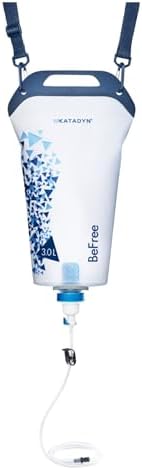
The only bag with a stated flow rate, 2 litres a minute, and a much shorter filter life than the Sawyer.
Key Specifications
| NSF/ANSI named | None named |
|---|---|
| Capacity | 3 L collapsible bag |
| Filter elements | 1 EZ-Clean hollow fiber |
| Pore size | 0.1 micron |
| Flow rate | Up to 2 L/min |
| Filter life | Up to 1,000 L |
| Listed weight | 0.4 pounds |
| Cleaning | Shake or swish; no tools |
| Warranty | 2 year manufacturer |
| Model | 8020470 |
| Seller | M Emporium |
| Best Sellers Rank | #18,235 overall; #41 in Water Filters |
Why We Recommend It
This is the other camping bag, and the faster one on paper. “The 0.1 micron EZ-Clean hollow fiber filter processes water from streams, lakes, and rivers at up to 2 L/min.” It is the only bag here with a stated flow rate, and one of only two products on the whole page to give one. Two litres a minute is about 31.7 gallons an hour, by our arithmetic, though up to means best case and the listing does not say how full the bag is when that is measured.
No standard is named, and no contaminant is either. The listing promises “Clean, Clear Water” and “reliable performance in the backcountry”, and leans on heritage: “Katadyn has been delivering clean water solutions for nearly a century.” It names no NSF/ANSI standard, no third-party test and no organisms removed. Like the Sawyer, it does not mention viruses or chemicals. Treat the claims as the listing’s, and check local guidance for the water you will be drawing from.
The life is much shorter than the Sawyer’s. “Up to 1,000L capacity” is about 264 gallons, by our arithmetic, against the Sawyer’s maker rating of up to 100,000 gallons. For weekend trips that may be plenty; a two-person trip using 8 litres a day would reach 1,000 litres after about 125 days of use, our arithmetic again. For a household emergency supply or long expeditions, the gap matters. The listing does say cleaning is easy: “Clean by shaking or swishing the filter in water – no tools or disassembly required.”
The bag is bigger and packs flat. At 3 litres, about 0.8 gallons by our arithmetic, it is a little smaller than the Sawyer’s 1-gallon bladder despite the bigger-sounding number. “The 3L collapsible water bag packs flat when empty and is ideal for solo or small group trips.” You hang it “from a branch, pole, or anchor point”. The listed weight is 0.4 pounds, and the warranty is two years.
Three units of measure, one buyer. The flow is in litres per minute, the life in litres and the bag in litres, while every countertop system on this page works in gallons. When you compare across the page, convert first; we have done it here and labelled it as ours.
What to weigh. It is sold by M Emporium and ranks #18,235 overall and #41 in Water Filters. Pick it over the Sawyer if a stated flow rate and simple shake-clean maintenance matter more to you than filter life. Pick the Sawyer if you want the longer stated life and an Amazon.com seller.
Pros
- Only bag with a stated flow rate, 2 L/min
- 0.1 micron hollow fiber, stated
- Packs flat when empty
- Shake-to-clean, no tools
- 2-year warranty stated
- 0.4 lb listed weight
Cons
- No NSF/ANSI standard named
- Life up to 1,000 L, about 264 gal by our arithmetic
- No contaminant or organism named
- Viruses and chemicals not mentioned
- 3 L is less than the Sawyer’s 1 gal
- Sold by a third party
Best for: A solo hiker or small group who wants a stated flow rate and easy cleaning for trips, not a long-term supply.
Four Listings Name a Standard: What Each Claim Actually Covers
Four of the ten listings name an NSF/ANSI standard. The table sets out exactly what each says, what part of the product the claim attaches to, and what it leaves out. Everything in the first four columns is quoted or summarised from the listing. The scope column is our reading of what the named standard is generally understood to cover.
| Listing | Standard named | Attached to | Certifier named | Scope of the named standard |
|---|---|---|---|---|
| Purewell PW-OB | NSF/ANSI 42 | The black carbon filter | No | Aesthetic effects such as chlorine, taste and odour |
| Purewell PW-OB | NSF/ANSI 372 | The system | No | Lead content of materials in contact with water |
| Culligan MaxClear | NSF/ANSI 42 | The system; claimed for microplastics, lead and Total PFAS | No | Aesthetic effects; lead and PFAS are normally certified under NSF/ANSI 53 |
| IceJoy 8-Stage | “NSF/ANS 42” | Not stated | No | Aesthetic effects, if standard 42 is meant |
| SINCHO 2.25G | NSF/ANSI 372 | “Lead-free, BPA-free construction” | No | Lead content of materials in contact with water |
| Other six | None | — | — | — |
The count is four of ten, and the scopes split three ways. One claim attaches to a filter element: the PW-OB’s 42. Two attach to materials or construction: the PW-OB’s 372 and the SINCHO’s 372. One attaches to a whole system for contaminant reduction: the Culligan’s 42. The IceJoy attaches its claim to nothing. No listing names a certifier or a certificate number. None says a product was “tested to” a standard by an independent laboratory, which is the weaker wording you will often see elsewhere, and which our countertop water filter roundup looks at in detail.
No listing names a health-effects standard. NSF/ANSI 53 is the standard generally used for health-related claims such as lead. It appears nowhere on this page. That matters because two listings make exactly that kind of claim: the Culligan names lead and PFAS, tied to standard 42, and the British Berkefeld Doulton claims to remove “up to 99.99% of harmful bacteria, cysts, and other waterborne pathogens” with no standard at all.
A component certificate is not a system certificate. When a single filter element is certified, the test covers that element in the configuration tested. A housing, a spigot and a gasket can still affect what reaches your glass, and an element certified in one housing is not automatically certified in another. That is why the PW-OB’s two-part wording is the most useful on the page: it tells you the carbon element carries 42 and the system carries 372, and you can ask about the rest.
A materials certificate is not a reduction certificate. NSF/ANSI 372 is about how much lead is in the materials that touch the water. It says nothing about how much lead the filter removes. The PW-OB and SINCHO both name 372; neither uses it to claim lead reduction.
Several contaminant claims stand on no standard at all. The Doulton claims bacteria, cysts and pathogens. The Purewell PW-KS-CF claims “90% Fluoride Reduction”. The IceJoy and the PW-OB claim heavy metals, and the SINCHO “99% chlorine & chemicals”. The Berkey names no contaminant. Each of those is the listing’s claim. On a filter, the only way to know whether a contaminant claim holds up is a published test, and none is cited for these.

Countertop Systems: The Working Numbers
Certification aside, these are the numbers you live with every day on the eight countertop systems. Not stated means the listing does not give it.
| System | Capacity | Elements | Flow | Filter life | Stainless grade | Level visible |
|---|---|---|---|---|---|---|
| Purewell PW-OB | 2.25 gal | 2 | 4 gal/hour | 3,000 each; 6,000 per pair | 304 | Not stated |
| Culligan MaxClear | Not stated | 1 (up to 2) | Not stated | Up to 6 months | Not stated | Not stated |
| IceJoy 8-Stage | 3.0 gal (title); 2.25G (colour field) | 4 | Not stated | 3,000 black; 1,000 white | 304 | Sight glass spigot |
| SINCHO 2.25G | 2.25 gal | 2 | Not stated | 5,000 each; 10,000 total | 304 | Window |
| Purewell PW-KS-CF | 2.25 gal | 4 | Not stated | 6,000 carbon pair; 1,000 fluoride pair | Not stated | Window |
| Big Berkey | 2.25 gal | 2 | Not stated | 6,000 per pair | AISI 304 | Not stated |
| Boroux Compact | 1.8 gal | 2 | Not stated | Not stated | Not stated | Not stated |
| British Berkefeld Doulton | 3.17 gal (12 litre) | 2 | Not stated | Not stated | Not stated | Not stated |
Four of eight state 2.25 gallons. The PW-OB, the SINCHO, the PW-KS-CF and the Berkey all state 2.25 gallons, which looks like a shared housing size across the category. The Doulton is the largest at 3.17 gallons, and its 12-litre size field agrees. The IceJoy claims 3.0 in its title and 2.25 in its colour field. The Boroux is the small one at 1.8. The Culligan gives no number. None says whether its figure means the top chamber, the bottom chamber or both.
One countertop system gives a flow rate. The PW-OB’s 4 gallons an hour is the only figure on the stainless side. Gravity filters are slow by nature, and flow falls as the top chamber empties, so a stated rate is useful even as a best case. Everyone else leaves you to find out after delivery.
Four of eight name 304 stainless, and three can show you the water level. The PW-OB, IceJoy, SINCHO and Berkey state 304 (AISI 304 is the same grade). The other four say stainless steel and stop. For the water level, the SINCHO and PW-KS-CF windows and the IceJoy sight glass let you check without lifting the lid.
Element life runs from 1,000 to 5,000 gallons, and three systems give no gallon figure. The fluoride elements are the short ones: 1,000 gallons for the PW-KS-CF’s pair and the IceJoy’s white filter. Carbon elements sit at 3,000 each on the PW-OB and IceJoy and 6,000 per pair on the Berkey and PW-KS-CF. The SINCHO’s ceramic elements state the most, 5,000 each. The Culligan gives months only, and the Boroux and Doulton nothing. The Purewell systems also recommend replacement every six months whatever the volume.
Camping Bags: The Working Numbers
The two bags are a different product with different units. We convert to gallons for comparison; every conversion is our arithmetic.
| Bag | Bag size | Pore size | Flow | Filter life | Standard named |
|---|---|---|---|---|---|
| Sawyer SP160 | 1 gal | 0.1 micron absolute | Not stated | Up to 100,000 gal (maker rating) | None; tested by Sawyer |
| Katadyn BeFree Gravity | 3 L (about 0.8 gal, ours) | 0.1 micron | Up to 2 L/min (about 31.7 gal/hour, ours) | Up to 1,000 L (about 264 gal, ours) | None |
The bags trade life against speed on paper. The Sawyer states the longer life by a wide margin and gives no flow rate. The Katadyn states a flow rate and a life well under one percent of the Sawyer’s, by our arithmetic. Neither names a standard, and neither names a contaminant or organism. Both are sold for streams and lakes, and for that use, follow local guidance on whether water also needs boiling or chemical treatment. For more on trail filters, see our backpacking water filter roundup.
Reading the Model Numbers: No Twins Left, One Shared Prefix
Model and part numbers are the closest thing a listing has to a fingerprint. We compared every code on the page; where two products carried near-identical codes, one was replaced so that each row is a distinct product. Here is what remains.
| Listing | Model or part code | Nearest code on the page | Overlap |
|---|---|---|---|
| Purewell PW-OB | K8626 | K8772B-2 (Purewell PW-KS-CF) | K8 prefix only |
| Purewell PW-KS-CF | K8772B-2 | K8626 (Purewell PW-OB) | K8 prefix only |
| British Berkefeld Doulton | FBA-UK-W9361137; part W936 – | — | None |
| SINCHO 2.25G | S1 | — | None |
| Culligan MaxClear | MCS701B | — | None |
| Big Berkey | BK4X2-BB | — | None |
| Boroux Compact | BX-L-SYS-COM+BX-FND9-2 | — | None |
| IceJoy 8-Stage | “IceJoy-Water Filter” | — | No usable code |
| Sawyer SP160 | SP160 | — | None |
| Katadyn BeFree | 8020470 | — | None |
The two Purewell codes share a prefix and nothing more. K8626 and K8772B-2 look like one brand’s numbering scheme, not variants of one product. The PW-OB and PW-KS-CF are different systems with different filters, and only the PW-OB names a standard.
Two codes are too thin to look up. The SINCHO’s S1 matches nothing here and is too generic to search on its own, and the IceJoy gives no code at all, only its brand name. Ask either seller for a full model number if you want to check a certificate. The Doulton’s FBA-UK prefix suggests UK-sourced stock; confirm the candles supplied are the ones any certificate would cover.
The lesson from the near-twins still applies. When two listings share a housing or a code, a certification claim belongs to the listing and product that makes it. A related design does not inherit a certificate, and neither does a certified element fitted into another brand’s housing.
Compatibility claims cut across brands. The Culligan says it takes Berkey BB9-2 elements and Boroux, ProOne, Doulton, Purewell and Waterdrop filters. The Boroux spigot says it fits Berkey, ProOne and British Berkefeld. Fitting is not the same as certification; an element certified in one configuration is a new combination in another.
Best Alternatives
If none of the ten fits, these are the nearest alternatives by type. Each trades away gravity filtration for something else.
| Alternative | Why Consider It | Better For | Main Trade-Off |
|---|---|---|---|
| Countertop filter that connects to the tap | Faster than gravity; many list certificates. See our countertop water filter roundup | Kitchens with a standard faucet | Needs a tap connection; not off-grid |
| Water filter pitcher | Small, fridge-friendly; some name a standard number. See our water filter pitcher guide | One or two people | Small batches; frequent refills |
| Reverse osmosis system | Reduces dissolved solids, which these gravity filters say they do not. See our reverse osmosis water filter roundup | Buyers who want TDS reduced | Plumbing, waste water, often power |
| Squeeze or pump backpacking filter | Lighter and faster for one person on the move. See our backpacking water filter roundup | Solo hikers | Hands-on work; no hands-free batch |
What Each Step Up Actually Buys
Gravity filters on this page climb in four steps, and each step buys a specific, checkable thing.
From no standard to a named standard. Six of ten listings name no standard. The step to the PW-OB, the Culligan, the IceJoy or the SINCHO buys a standard number you can ask about. On its own that is a starting point, not proof: none names a certifier, and none names the health-effects standard, 53.
From a named standard to a named part. The PW-OB says the carbon element carries 42 and the system 372. The SINCHO says its construction carries 372. Knowing what the certificate is attached to is what makes it checkable.
From an unstated grade to 304 stainless. Four countertop systems state 304. The others say stainless steel. If the housing material is part of why you are buying stainless over plastic, the grade is worth having in writing.
From a closed lid to a visible level. Three systems add a window or a sight glass. It is a small convenience that you will use every day.

What to Check Before You Buy
Read Your Local Water Quality Report First
Before comparing contaminant claims, find out what is actually in your water. In the United States, community water suppliers publish an annual water quality report, often called a Consumer Confidence Report, listing what was detected and at what levels. Private wells are not covered and need their own test. A claim about fluoride, lead or PFAS only matters if that contaminant is present in your supply, and the report tells you which claims to look for.
Find the Standard Number, Then the Part It Covers
A listing that says “certified” without a standard number gives you nothing to check. When a number appears, read the sentence around it: is the claim for the whole system, a single filter element or the materials? The PW-OB says the carbon element carries NSF/ANSI 42 and the system carries 372; the SINCHO names 372 for its construction. That is the level of detail to look for, and to ask for when it is missing.
Match the Standard to the Contaminant
NSF/ANSI 42 covers aesthetic effects such as chlorine taste and odour. NSF/ANSI 53 is the standard generally used for health-related reduction claims such as lead. NSF/ANSI 372 covers lead content in materials, not lead removal. If a listing pairs lead or PFAS with standard 42 only, as the Culligan does, ask which standard actually covers those claims. If it claims bacteria or cysts with no standard at all, as the Doulton does, ask for the test behind the claim.
Ask Who Certified It, and Look It Up
None of the ten listings names a certification body or gives a certificate number. Certifiers publish searchable listings of the products they have certified. Ask the seller for the certifier and the listing number, then check that the model on the certificate matches the model on the listing, element and housing both.
Plan for the Shorter of Gallons and Months
Filter life is stated in gallons, months or both. The PW-OB gives 3,000 gallons per element and six months; most households will hit the six months first. The fluoride elements here are rated for 1,000 gallons, which a family can reach well inside six months. Where two element types are included, track each separately.
Check the Capacity Against Your Household
Four systems state 2.25 gallons, and the Berkey says that suits 1–4 people; the Doulton states 3.17. A larger household will refill more often, and with only one stated flow rate on the countertop side, about 4 gallons an hour on the PW-OB, gravity filters reward topping up before you run dry. Check whether the IceJoy you receive is 3.0 or 2.25 gallons.
Confirm Element Compatibility and What Comes in the Box
Several housings and element packs claim cross-brand fit. Some listings name a spigot and a stand, and the Berkey’s box list does not name a spigot at all. Before ordering, confirm what is included, which replacement elements fit, and whether a certification claim still applies once an element sits in a different housing.

Common Mistakes
- Reading “certified” as verified. Four listings name a standard and none names a certifier or a certificate number.
- Assuming a filter certificate covers the system. The PW-OB certifies its carbon element to standard 42; the housing is a separate claim, 372.
- Reading NSF/ANSI 372 as lead removal. The PW-OB and SINCHO name 372; it covers lead in the materials, not lead taken out.
- Taking a lead or PFAS claim on standard 42. The Culligan ties both to 42; health-related claims are normally certified under 53.
- Taking a pathogen claim on heritage. The Doulton claims 99.99% of bacteria and cysts and names no standard or test.
- Ignoring the second filter clock. Fluoride elements here are rated 1,000 gallons, a sixth of the 6,000-gallon carbon pair.
- Comparing litres with gallons. The Katadyn’s 1,000 L is about 264 gallons, by our arithmetic, not 1,000.
- Buying for a contaminant you do not have. Your local water quality report lists what was detected; start there.
Who Should Buy Which
Buy the Purewell PW-OB if the certification line on a complete system matters most. It names which part is certified, NSF/ANSI 42 for the carbon filter and 372 for the system, and it is the only countertop system with a stated flow rate, 4 gallons an hour. It is 304 stainless and the best-ranked product on the page. Ask for the certifier, and accept that there is no window.
Buy the Culligan MaxClear if you own Berkey elements and want an Amazon.com seller. It names NSF/ANSI 42 for the system, but its lead and PFAS claims need checking against the right standard. Capacity and filter gallons are not stated.
Buy the IceJoy if you want a large stated capacity and a sight glass. Confirm whether you will receive 3.0 or 2.25 gallons, and treat the misspelled title claim as unverified until IceJoy explains it.
Buy the SINCHO if you want a window, 304 steel and a named standard on one system. Its 372 claim covers the construction, its ceramic elements are rated 5,000 gallons each, and its filtering claims are the listing’s own.
Buy the Purewell PW-KS-CF if you want a separate fluoride element and a window. Four elements, 6,000 gallons on the carbon pair and 1,000 on the fluoride pair. No standard is named.
Buy the Big Berkey if you want 304 steel and 6,000-gallon elements from an established system. It names no standard and cannot ship to California or Iowa. Check whether a spigot is in the box.
Buy the Boroux Compact if counter height is your limit. At 1.8 gallons and 17.5 inches it is the smallest, but its listing gives no filter life or standard; ask Boroux.
Buy the British Berkefeld Doulton if capacity comes first. At 3.17 gallons it is the largest stated here, with two ceramic candles. Its pathogen claim names no standard, and no filter life is given; ask the seller for both.
Buy the Sawyer SP160 for camping, travel or an emergency kit. A 0.1 micron absolute filter rated up to 100,000 gallons by the maker, a 1-gallon bag, sold by Amazon.com. Its testing is in-house.
Buy the Katadyn BeFree Gravity if you want a stated flow rate on the trail. 2 litres a minute and easy shake-cleaning, with a much shorter stated life of 1,000 litres.
Frequently Asked Questions
What is the best gravity water filter?
On the evidence in the listings, the Purewell 3-Stage PW-OB. It is the only one of ten that says which part of it is certified to what: NSF/ANSI 42 for its black carbon filter and NSF/ANSI 372 for the system. It is also the only countertop system with a stated flow rate, 4 gallons an hour, it uses 304 stainless steel for the housing and spigot, and it holds the best Best Sellers Rank on the page at #6,031 overall. Its filters are rated 3,000 gallons each, with replacement recommended every six months. Two caveats apply. The listing does not name who certified it, so ask the seller for the certifier and the certificate number. And there is no water-level window. If you want a window, the SINCHO has one and names 372 for its construction. For camping, the Sawyer SP160 is the stronger pick.
What is the best gravity fed water filter system for a household?
For a household, look at the countertop stainless systems rather than the camping bags. Four of the eight state 2.25 gallons, and the Berkey listing says that suits about 1 to 4 people; the British Berkefeld Doulton is the largest at 3.17 gallons. The PW-OB names the most specific certification and states a flow rate. The Big Berkey states 6,000 gallons per element pair and 304 stainless, but names no standard. The SINCHO adds a window and ceramic elements rated 5,000 gallons each. The IceJoy claims 3.0 gallons in its title and 2.25 in another field, so confirm the size. For a larger family, filter life matters: the fluoride elements on the PW-KS-CF and the IceJoy are rated 1,000 gallons, which a busy household can reach well inside six months. Check your local water quality report first, and match any certification claim to the contaminants actually in your supply.
What is the best countertop gravity water filter with a water-level window?
Three of the eight countertop systems give you some way to see the water level without lifting the lid. The SINCHO and the Purewell PW-KS-CF both have a transparent window in the body, and the IceJoy has a sight glass spigot that shows the level in the lower chamber. Of the three, the SINCHO is the one we pick: it states a 304 stainless body, names NSF/ANSI 372 for its lead-free construction and rates its two ceramic elements at 5,000 gallons each. The PW-KS-CF ranks far better, #23,177 overall against the SINCHO’s #157,595, and adds a separate fluoride element, but names no standard or steel grade. The IceJoy states 304 steel and four elements, and its only certification claim is a misspelled line in its title. None of the three names a certifier.
What is the best off grid water filter system?
It depends what off-grid means for you. For a cabin or an emergency at home, any of the countertop gravity systems works without power or plumbing; they need only a supply of water to pour into the top. The SINCHO listing names camping, RVs and emergencies, and the IceJoy mentions camping too. For carrying, the Sawyer SP160 is the stronger choice: a 1-gallon bag, a 2-ounce filter with a 0.1 micron absolute rating, and a maker rating of up to 100,000 gallons. The Katadyn BeFree Gravity is the alternative, with a stated flow of 2 litres a minute but a life of 1,000 litres. Neither bag names a standard, a contaminant or viruses. For untreated surface water, follow local guidance on whether boiling or chemical treatment is also needed.
Is the Big Berkey NSF certified?
The Big Berkey listing on this page does not name any NSF/ANSI standard. It calls its Black Berkey elements the Gold Standard in gravity-fed filtration, which is a slogan, and says they are designed to reduce a broad range of commonly found contaminants that may affect water quality, taste and odour. It names no specific contaminant, gives no reduction figure and cites no certifier or laboratory. Its warranty field also says it is not available to ship to California or Iowa, without saying why. None of that tells you whether the elements have been tested elsewhere; it only tells you the listing does not claim a certification. If certification matters, ask the maker which standard, if any, the elements are certified to, and by whom. The Culligan, which names NSF/ANSI 42 for its own system, says it accepts Black Berkey BB9-2 elements.
What do NSF/ANSI 42, 53 and 372 mean on a gravity filter?
They are three different standards with three different scopes. NSF/ANSI 42 covers aesthetic effects such as chlorine, taste and odour. NSF/ANSI 53 is the health-effects standard generally used for claims such as lead reduction. NSF/ANSI 372 covers the lead content of the materials that touch the water, not how much lead a filter removes. On this page, the PW-OB names 42 for its carbon filter and 372 for its system; the Culligan names 42 for its system while claiming lead and PFAS reduction; the IceJoy names 42 in its title with no detail; and the SINCHO names 372 for its construction. No listing names 53. Certification means a product was tested by a certification body, and none of the four listings names that body, so ask the seller and look the model up.
Do gravity water filters remove bacteria?
Some listings claim so, and none here backs the claim with a named standard. The British Berkefeld Doulton says its two Ultra Sterasyl ceramic candles remove up to 99.99% of harmful bacteria, cysts and other waterborne pathogens. That is the listing’s claim; it names no NSF/ANSI standard, certifier or laboratory. The two camping bags, the Sawyer SP160 and the Katadyn BeFree Gravity, state 0.1 micron pore sizes but name no organisms at all, and neither mentions viruses. The Purewell systems say they use silver ions and the IceJoy mentions silver among its media, without a microbiological claim tied to a standard. If you are filtering untreated water from a stream, well or tank, follow local guidance on testing and on whether boiling or chemical treatment is also needed, and ask any seller making a pathogen claim for the test behind it.
Do gravity water filters remove fluoride or dissolved minerals?
One system here claims fluoride reduction; none claims to lower dissolved solids. The Purewell PW-KS-CF claims 90% fluoride reduction from a dedicated fluoride element, and the IceJoy includes white filters with ion exchange resin among its media. Those figures are the listing’s claims, with no standard named behind them. On dissolved minerals, the listings are clear: the PW-OB, the PW-KS-CF, the SINCHO and the IceJoy all state that their filters do not lower TDS, the total dissolved solids reading. If reducing dissolved solids is your goal, a reverse osmosis system is the usual route, with the trade-offs of plumbing and waste water. If fluoride is your concern, your local water quality report will tell you how much is in your supply, which is the first thing to know before paying for an element designed to reduce it.
Final Verdict
The only listing that names the certified part, 42 for the carbon filter and 372 for the system, with a stated 4 gallons per hour.
A 0.1 micron absolute filter rated up to 100,000 gallons by the maker, a 1-gallon bag, sold by Amazon.com.
A water-level window, a 304 body, NSF/ANSI 372 named for its construction and ceramic elements rated 5,000 gallons each.
Ten gravity water filters sell what they take out of your water; four name a standard and none names who certified it. The Big Berkey, the British Berkefeld Doulton, the Boroux, the Purewell PW-KS-CF and both camping bags make their claims on their own word. The Doulton claims 99.99% of bacteria and cysts with nothing behind it, and the Sawyer’s testing is its own.
The four that name a standard do not settle the question either. The PW-OB says which part is certified, 42 for the carbon element and 372 for the system. The SINCHO names 372 for its materials. The Culligan ties lead and PFAS to standard 42, which is about taste and odour. The IceJoy misspells its claim in its title. Not one listing names NSF/ANSI 53, the health-effects standard, though two make health-related claims.
So buy a gravity filter by the certificate, and check it yourself. Start with your local water quality report. Find the standard number, the part it covers and the certifier, and look the model up. Then weigh the working numbers: capacity, element life in gallons and months, 304 steel, and whether you can see the level.
If you buy one gravity water filter from this page, make it the Purewell PW-OB: the only listing that says which part is certified, the only countertop system with a stated flow rate, 304 stainless, and the best rank on the page. If you need a window, the SINCHO has one with a named materials standard; for the trail or an emergency kit, the Sawyer SP160 is the bag to pack.