Affiliate Disclosure: As an Amazon Associate, we earn from qualifying purchases. This does not affect the price you pay.
Search Amazon for a hunting knife and the first three results are a rescue folder with a glass breaker, a tactical pocket knife, and an everyday-carry blade under three inches. None of them is a hunting knife. All three outrank every genuine skinner on this page.
Scroll a little and the other distortion appears: fifteen-inch survival knives, fourteen-inch Bowies, machete-adjacent things with saw teeth on the spine. They photograph well and they are the wrong tool. Field dressing is close work — separating hide from muscle, opening a body cavity without puncturing the gut, working around joints. It is done with the first three inches of a blade.
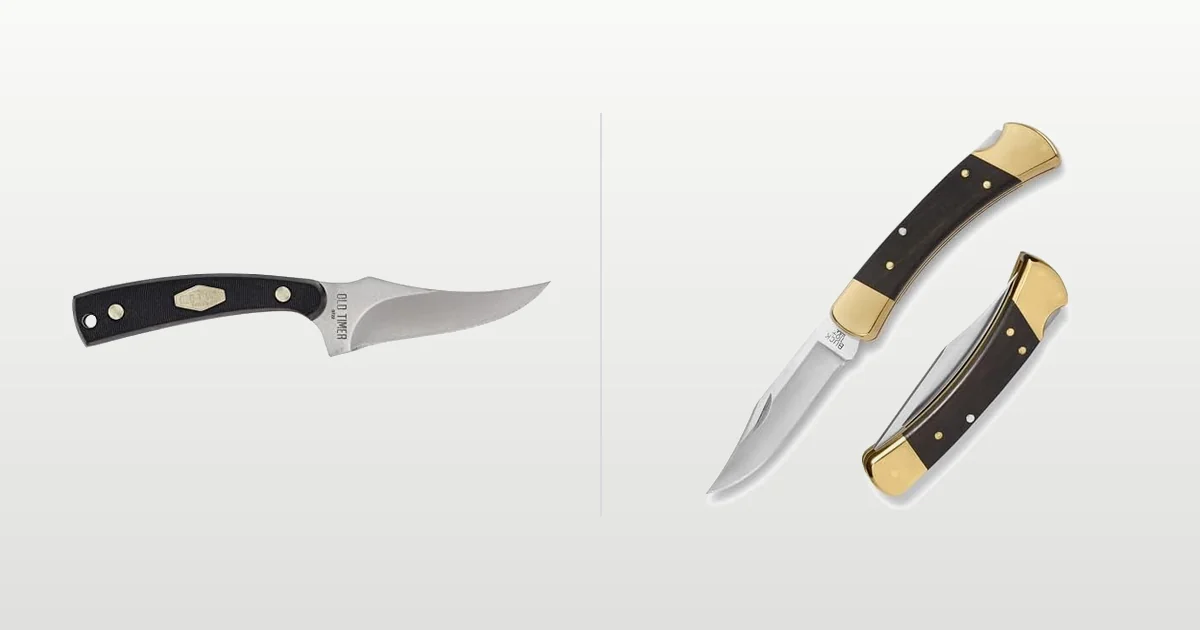
Every knife on this page that was actually designed for the job proves it. The Schrade Sharpfinger is 3.3 inches. The Outdoor Edge blades are 3.5. The Buck 110 is 3.75. The Mossy Oak caping knife is 3.4. Not one purpose-built hunting blade here reaches six inches, and the two that pass five are the ones sold as survival knives.
The second thing worth knowing before you spend anything: hide, hair and bone dull an edge faster than any kitchen task, and the category has split into three answers. Carry a stone. Build the stone into the sheath. Or stop sharpening altogether and swap the blade.
Below: ten hunting knives verified in stock, sorted by what they are actually shaped to do.
Our Quick Picks
 Best OverallSchrade Old Timer Sharpfinger
Seven inches overall, 3.3 of blade, and a shape drawn for one job — the skinner that has outlived almost everything sold beside it.
 Best Replaceable BladeOutdoor Edge Razor-Lite
Six razor blades in the box and a lock-release that swaps them in seconds — the answer to a dull edge halfway through an animal.
 Best Budget FixedSmith & Wesson SWHRT9B
Under eighteen dollars for a named steel, a full-length blade and a proper hand guard — the value fixed blade here.
At a Glance
Ten Hunting Knives, Compared by Blade and Upkeep
Blade length, steel grade where the listing names one, fixed or folding, and what each one expects you to do when the edge goes.
| # | Model | Blade | Steel | Type | Dull Edge Plan | Standout | Main Drawback | Check Price |
|---|---|---|---|---|---|---|---|---|
| 1 |
 Schrade Old Timer Sharpfinger Schrade Old Timer Sharpfinger |
3.3 in blade | High carbon stainless | Fixed, full tang | Sharpen it | The shortest blade here, and the one shaped for skinning | No gut hook, and the steel is not premium | View on Amazon |
| 2 |
 Buck Knives 110 Folding Hunter Buck Knives 110 Folding Hunter |
3.75 in blade | 420HC stainless | Folding lockback | Sharpen it | The knife that defined the category in 1963 | 7.2 ounces closed — heavy for a folder | View on Amazon |
| 3 |
 Outdoor Edge Razor-Lite Outdoor Edge Razor-Lite |
3.5 in blade | Replaceable stainless | Folding, TPR grip | Swap the blade | Six spare blades in the box — no sharpening at all | Blades are consumable, so there is an ongoing cost | View on Amazon |
| 4 |
 Outdoor Edge RazorGuide Pak Outdoor Edge RazorGuide Pak |
3.5 in blades | Replaceable, four types | Two knives plus bone saw | Swap the blade | Twelve spare blades, four blade types, and a bone saw | $99.99 — the most expensive on this page | View on Amazon |
| 5 |
 Old Timer Heritage 169OT Old Timer Heritage 169OT |
5 in blade | D2 tool steel | Fixed, drop point | Sharpen it | The only named premium steel here — D2 | Five inches is long for close skinning work | View on Amazon |
| 6 |
 Gerber Ultimate Fixed Blade Gerber Ultimate Fixed Blade |
4.8 in blade | Stainless, half-serrated | Fixed, drop point | Sharpener in the sheath | The sheath carries a sharpening stone and a fire starter | Half-serrated is a compromise for skinning | View on Amazon |
| 7 |
 Mossy Oak 4-Piece Field Kit Mossy Oak 4-Piece Field Kit |
3.4 to 3.9 in blades | Fixed, four pieces | Kit with carry bag | Sharpener included | A gut hook, a caping knife and a bone saw for $31.99 | Steel is unspecified across the whole kit | View on Amazon |
| 8 |
 KNINE Outdoors 10-Piece Set KNINE Outdoors 10-Piece Set |
12 in boning knife | 7Cr17MoV, ten pieces | Full butchery set | Sharpen it | Ten pieces including a ribcage spreader and butcher axe | Far more kit than one deer needs | View on Amazon |
| 9 |
 Smith & Wesson SWHRT9B Smith & Wesson SWHRT9B |
4.7 in blade | 7Cr17MoV high carbon | Fixed, full tang | Sharpen it | A named steel and a hand guard for $17.84 | Boot-sheath design is aimed at carry, not dressing | View on Amazon |
| 10 |
 Bone Collector BC808 Skinner Bone Collector BC808 Skinner |
Skinner profile | Fixed blade | Fixed, hand tooled sheath | Sharpen it | Twelve dollars for a dedicated skinning shape | The listing states almost no specifications at all | View on Amazon |
Specifications and prices are taken from each manufacturer’s Amazon listing as displayed on 23 August 2026 through a United States connection, and may change. Blade length is quoted separately from overall length wherever a listing gives both; several listings publish only an overall figure, which includes the handle and is not the cutting length. Steel is recorded only where a grade is actually named — two products here state none, and that is shown as stated rather than inferred. Sales ranks are displayed as shown and can be pooled across a variant family, so a rank may belong to a sibling product.
Scroll the table sideways to see every column
How We Chose These Ten
We researched current listings, compared manufacturer specifications and documentation, and examined recurring patterns in customer feedback. We did not carry out hands-on testing, and nothing below is presented as measured performance data.
- Whether it is actually a hunting knife — the three highest-ranked results for this search are a rescue folder, a tactical folder and an EDC knife, and none is on this page
- Blade length stated separately from overall length — a 15-inch knife with a 9-inch blade is not a 15-inch blade, and the distinction is buried in most listings
- A verified live buy box — all ten were confirmed purchasable in the United States on 23 August 2026
- A named steel grade, or an honest note that there is none — two products here state no grade at all and are marked accordingly
- What the design expects when the edge dulls — sharpen, sharpen-in-sheath, or replace — this is the real split in the category
- Grip security named in the listing — a choil, a quillon or a guard, because wet hands are the failure mode
- Brand spread — eight brands across ten slots
The Ten Hunting Knives in Detail
1. Schrade Old Timer Sharpfinger — Best Overall

Three point three inches of blade and three ounces in the hand. Almost everything the search returns is three times longer.
Key Specifications
| Blade length | 3.3 inches |
|---|---|
| Overall length | 7.1 inches |
| Weight | 3.1 ounces |
| Steel | High carbon stainless |
| Edge upkeep | Sharpenable — carry a stone |
| Grip security | Thumb rise and finger choil |
| Handle | Sawcut Delrin slabs, full tang |
| Price | $20.99 |
| Best For | Anyone who wants the shape the job actually asks for |
Why We Recommend It
The upswept shape is the entire argument. A skinning blade curves up towards the point so the belly of the edge does the cutting, which lets you separate hide from muscle with the flat of the curve rather than the tip. A straight blade wants to puncture; this shape wants to peel. It is why the design has survived essentially unchanged for decades while tactical fashions came and went.
The thumb rise and finger choil matter more when your hands are wet. Field dressing is done in cold, slick conditions, and the two features the listing names — a raised spine for the thumb, a scalloped notch for the forefinger — are what stop the hand sliding forward onto the edge. That is the same problem a kitchen mandoline solves with a food holder, addressed differently.
Full tang at three ounces is a good trade. The steel runs the whole length of the handle, so there is no join to fail, and the knife still weighs less than a small apple. Weight matters on a knife you carry all day and use for twenty minutes.
What you give up is the steel and the gut hook. “High carbon stainless” is unspecified — no grade, no hardness — and there is no gut hook, so opening a body cavity is done with the point and care. At $20.99 those are reasonable omissions.
Pros
- 3.3-inch blade, the length the job actually needs
- Upswept skinning shape peels rather than punctures
- Thumb rise and finger choil keep a wet hand back
- Full tang at only 3.1 ounces
- $20.99
- Lifetime warranty and a leather belt sheath
Cons
- Steel is named only as “high carbon stainless”, with no grade
- No gut hook
- Needs sharpening — carry a stone
- Delrin handle looks dated beside modern grips
- Short blade is wrong for heavy camp chores
- Leather sheath needs drying after a wet day
Best for: The hunter who wants one small knife shaped correctly, and will keep it sharp.
2. Buck Knives 110 Folding Hunter — The Icon

The lockback folder that made folding knives credible for real work, and the only knife here with a warranty measured in lifetimes since 1902.
Key Specifications
| Blade length | 3.75 inches, clip point |
|---|---|
| Closed length | 4.875 inches |
| Weight | 7.2 ounces |
| Steel | 420HC stainless, heat treated and performance tested |
| Lock | Lockback |
| Edge upkeep | Sharpenable |
| Carry | Genuine leather sheath with snap and belt loop |
| Price | $89.99 |
| Best For | A knife bought once and handed on |
Why We Recommend It
The lock is the reason this knife exists. Before the 110, a folding knife under load was a knife that might close on your fingers. A lockback holds the blade open against pressure in the cutting direction, which is what makes a folder usable for anything more than opening envelopes. The listing’s claim that it “changed the hunting knife industry” is, unusually for a bullet point, historically accurate.
420HC is a modest steel used well. It is not a premium alloy and Buck does not pretend otherwise; what the listing emphasises is the heat treatment and testing rather than the grade. That is the honest framing — 420HC treated properly holds a working edge and, crucially, comes back quickly on a stone in the field. Exotic steels are harder to bring back with what you are carrying.
Seven point two ounces is the cost of brass and ebony. This is a heavy folder. On a belt in a leather sheath that is fine; in a trouser pocket it is not, and anyone expecting a modern lightweight folder should know that going in.
Folding costs you cleaning. A pivot and a lock channel trap what a fixed blade does not, and field dressing produces exactly the material you do not want trapped. It is the real trade against the Sharpfinger, and it is why fixed blades still dominate this job.
Pros
- The lockback design that made folding hunters trustworthy
- 3.75-inch clip point suits skinning and general work
- 420HC comes back fast on a field stone
- Handcrafted in the USA since 1902
- Forever warranty
- Genuine leather sheath included
Cons
- 7.2 ounces is heavy for a folding knife
- $89.99 — the second-highest price here
- Pivot and lock trap material a fixed blade does not
- 420HC is a modest steel grade
- Nail-notch opening is slow with cold hands
- Brass bolsters need occasional care
Best for: Someone buying one hunting knife for life, who accepts the weight.
3. Outdoor Edge Razor-Lite — Best Replaceable Blade

Field dressing dulls an edge faster than any other cutting task. This one is designed around that fact rather than against it.
Key Specifications
| Blade length | 3.5 inches, replaceable |
|---|---|
| Blades included | Six single-edge stainless |
| Edge upkeep | None — replace rather than sharpen |
| Handle | Bright orange TPR, contoured and textured |
| Why orange | Visible when put down in leaf litter |
| Carry | Camo nylon belt sheath |
| Price | $44.99 |
| Best For | Anyone who has ever finished a job with a blunt knife |
Why We Recommend It
Hide, hair and bone are abrasive in a way food is not. A knife that starts shaving-sharp can be sliding rather than cutting well before the job is finished, and a blunt knife needs more force, which is precisely when hands slip. The conventional answer is to stop and sharpen with cold, wet, occupied hands. This one replaces the blade in seconds instead.
The orange handle is a practical decision, not a styling one. A dark-handled knife put down on the forest floor is a knife you will spend ten minutes finding, and a knife you cannot find is a knife left behind edge-up. Bright TPR also grips when wet or bloody, which the listing states plainly.
The trade is that blades are a consumable. Six come in the box; after that you are buying more. Over years that is a running cost a Sharpfinger and a stone do not have. Whether it is worth it depends on how many animals you process and how good you are with a stone in the field.
It is still a folder, with the same cleaning penalty as the Buck — though a blade you remove entirely does make rinsing the frame easier than scrubbing around a fixed edge.
Pros
- Six replacement blades included — no field sharpening
- Blade swaps in seconds via lock release
- Orange TPR handle grips wet and is easy to find
- Folds to pocket size
- Camo nylon belt sheath included
- Service-for-life support
Cons
- Blades are an ongoing consumable cost
- Replaceable blades are thinner than a ground edge
- Folding pivot traps material
- Spare blades must be carried and stored safely
- $44.99 before any replacements
- Not a knife for batoning or camp chores
Best for: Hunters who process several animals a season and hate sharpening.
4. Outdoor Edge RazorGuide Pak — Best Complete Kit

Two knives, four blade types, twelve spares and a bone saw. The whole kit is built on not sharpening anything.
Key Specifications
| Contents | RazorBone and Zip Pro knives, bone saw, case |
|---|---|
| Blade length | 3.5 inches, skinning and gutting |
| Spare blades | Twelve, across four types |
| Edge upkeep | None — replace rather than sharpen |
| Blade change | Push the lock release, swap, continue |
| Handles | Stainless frame with rubberised TPR |
| Price | $99.99 |
| Best For | A season’s worth of processing without a stone |
Why We Recommend It
Four blade types is the part that matters, not twelve spares. Skinning, gutting, boning and caping are different cuts, and on a conventional kit that means carrying different knives. Here it means changing the blade in the same handle. Fewer handles, less to carry, and every edge is factory sharp when it goes in.
A bone saw is the tool people forget and then need. Splitting a pelvis or a ribcage with a knife is how knives get broken and hands get hurt. Including one in the kit is more useful than a tenth spare blade.
“Never sharpen your knife again” is the listing’s actual claim, and it is worth taking literally rather than as marketing. This is a genuine philosophical split in the category: one camp maintains an edge, the other replaces it. Neither is wrong, but they lead to different kit, different costs and different skills.
At $99.99 it needs to replace several purchases to make sense. Against a single knife it looks expensive; against a knife, a caping blade, a boning knife, a bone saw and a sharpener it does not.
Pros
- Four blade types from two handles
- Twelve spare blades included
- Bone saw included — the commonly forgotten tool
- Every edge is factory sharp on insertion
- Rubberised TPR handles grip when wet
- Organised carry case
Cons
- $99.99, the highest price in this roundup
- Ongoing blade cost after the twelve are used
- More parts to keep track of in the field
- Replaceable blades are thin and will snap if levered
- Overkill for one deer a year
- Case adds bulk to a pack
Best for: Hunters processing multiple animals who want one kit and no sharpening.
5. Old Timer Heritage 169OT — Best Steel
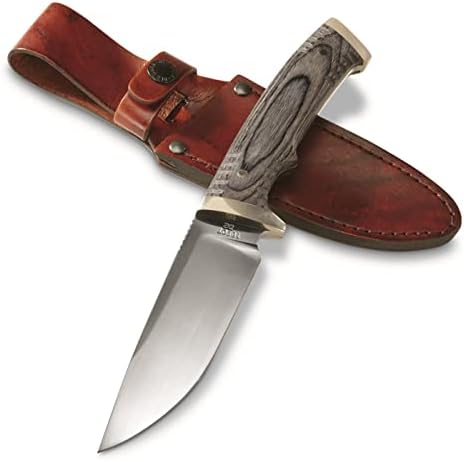
D2, named and specified. Most listings on this page say “stainless steel” and stop there.
Key Specifications
| Blade length | 5 inches, drop point |
|---|---|
| Overall length | 10.25 inches |
| Weight | 8 ounces |
| Steel | D2 stainless tool steel |
| Blade shape | Drop point with a bigger belly for slicing |
| Grip security | Front quillon |
| Handle | Laminate wood, fitted leather sheath |
| Price | $54.15 |
| Best For | Anyone who cares which steel they are buying |
Why We Recommend It
Naming the steel is rarer than it should be. D2 is a high-carbon, high-chromium tool steel that holds an edge substantially longer than the 420-series alloys elsewhere in this roundup. The trade is well known: it is harder to bring back once it does go, so it rewards a proper stone and punishes a quick swipe on a pocket sharpener.
A drop point with a big belly is the generalist’s shape. The point drops below the spine, so it is less likely to puncture something you did not intend — the exact risk when opening a body cavity — and the deep belly gives a long curved cutting surface for skinning. It is a compromise between the Sharpfinger’s specialisation and a camp knife’s bluntness, and it is a good one.
Five inches is the honest reservation. For close work around joints and hide, a 3-to-4-inch blade is easier to control. Five inches is better for larger game and general camp use, and slightly more knife than a deer strictly requires.
The front quillon does the safety job that the Sharpfinger’s choil does — a raised guard stopping the hand running forward onto the edge under a wet grip.
Pros
- D2 tool steel, actually named on the listing
- Drop point resists accidental puncture
- Deep belly gives a long skinning curve
- Front quillon guards a wet hand
- Fitted leather sheath
- Lifetime warranty
Cons
- Five inches is long for close skinning
- D2 is harder to resharpen once it goes
- 8 ounces on the belt
- $54.15
- Laminate wood needs more care than TPR
- No gut hook
Best for: The hunter who wants specified steel and one knife for game and camp.
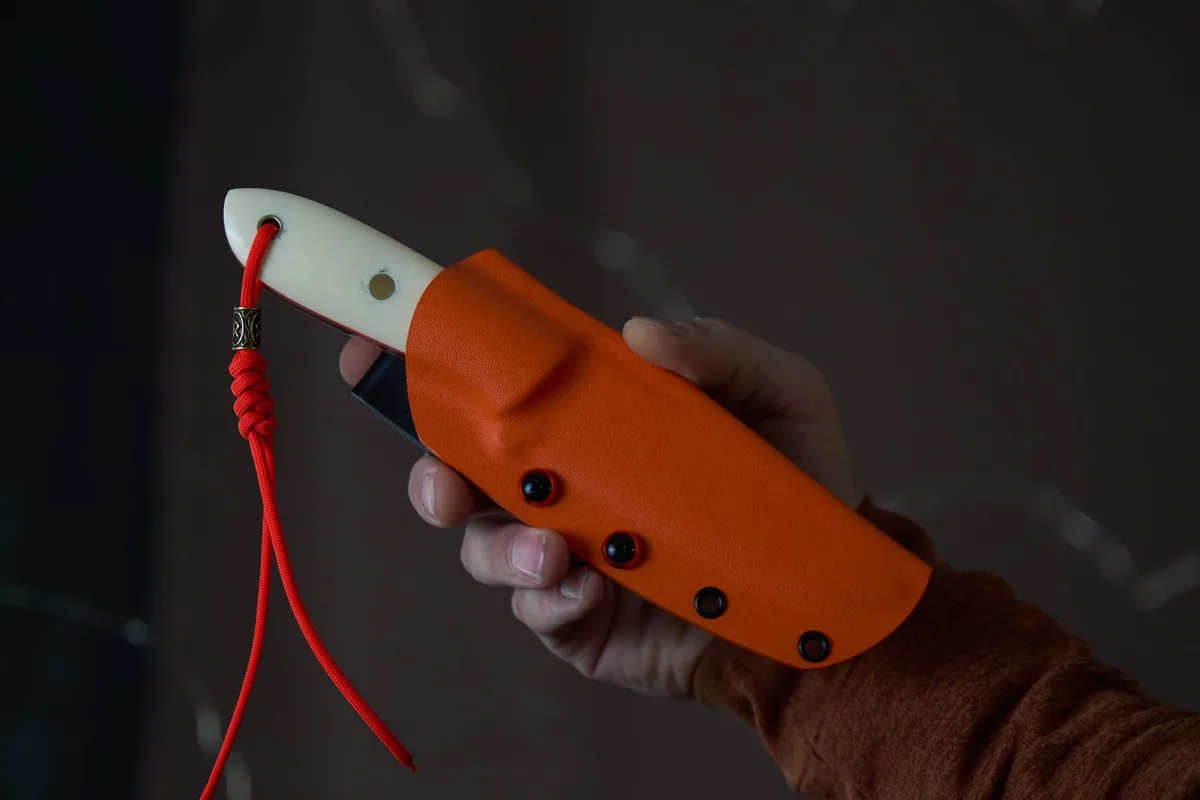
6. Gerber Ultimate Fixed Blade — Best Self-Contained

The third answer to a dull edge: not sharpen later, not swap the blade, but carry the stone in the sheath.
Key Specifications
| Blade length | 4.8 inches, drop point |
|---|---|
| Overall length | 10 inches |
| Weight | 11.02 ounces |
| Edge | Half-serrated stainless |
| In the sheath | Sharpening stone and ferrocerium rod |
| Pommel | Hammer |
| Extras | Emergency whistle |
| Price | $42.55 |
| Best For | One tool carrying its own maintenance |
Why We Recommend It
Integrating the sharpener is genuinely clever. The reason people do not sharpen in the field is not skill, it is that the stone is at home. A sheath with the stone in it removes the excuse, and it means the maintenance kit cannot be the thing you forgot.
Half-serrated is the compromise you should think hardest about. Serrations cut rope and webbing well and keep working when the plain section is dull. They are also poor at skinning — they snag hide and tear rather than slice, and they cannot be maintained with the flat stone in the sheath. On a knife sold for hunting, half the edge is optimised for something other than hunting.
The rest is survival kit rather than hunting kit. A hammer pommel, a ferro rod and a whistle are useful things to have in the woods and none of them help you process an animal. This is a survival knife that hunts, rather than a hunting knife.
Eleven ounces is the heaviest here, which is what happens when the sheath is carrying tools of its own.
Pros
- Sharpening stone built into the sheath
- Ferrocerium fire starter included
- Drop point resists accidental puncture
- Hammer pommel and emergency whistle
- Textured rubber grip
- $42.55 for knife plus kit
Cons
- Half-serrated edge snags hide when skinning
- Serrations cannot be maintained on the flat sheath stone
- 11.02 ounces — the heaviest on this page
- 4.8 inches is long for close work
- Much of the kit is survival, not hunting
- No gut hook
Best for: Someone who wants one blade for hunting and general backcountry use.
7. Mossy Oak 4-Piece Field Kit — Best Value Kit

Four tools, four jobs, $31.99 — and both blade lengths land exactly where field-dressing blades should.
Key Specifications
| Pieces | Gut-hook skinner, caping knife, bone saw, sharpener |
|---|---|
| Gut-hook skinner | 3.9-inch fine-edge blade, 8.75 inches overall |
| Caping knife | 3.4-inch blade, 8.25 inches overall |
| Bone saw | 7.5 inches, hooked profile |
| Edge upkeep | Sharpener included in the kit |
| Carry | Portable camouflage bag |
| Price | $31.99 |
| Best For | Getting all four field-dressing jobs covered cheaply |
Why We Recommend It
A gut hook does one job and does it without the risk. The listing describes it as opening game “like a zipper without piercing internal organs”, which is precisely the hazard: a punctured gut contaminates meat and turns a clean job into a ruined one. The hook rides under the hide and cuts upward, so the point never goes where it should not.
The caping knife at 3.4 inches is the specialist here. Caping is close work around the head and shoulders where a large blade cannot go, and a shorter, finer point is the difference between a usable cape and a damaged one.
The bone saw’s hooked shape is a safety feature. A straight saw skates; a hooked profile stays in the cut, which the listing links to not breaking the bladder or intestines. Again the theme is avoiding contamination rather than cutting power.
The steel is the gap. Nothing in the kit has a named grade, and at $31.99 for four tools that is not surprising. Expect to use the included sharpener more often than you would with the D2 or 420HC knives here.
Pros
- Four tools covering four distinct field jobs
- Gut hook opens game without piercing organs
- 3.4-inch caping knife for close work
- Hooked bone saw stays in the cut
- Sharpener included
- $31.99 for the whole kit
Cons
- No steel grade named on any of the four pieces
- Edges will need frequent attention
- Camouflage bag is bulkier than a single sheath
- Four items to keep track of
- Individually none is as good as a dedicated knife
- No folding option
Best for: First-season hunters who want every job covered without spending much.
8. KNINE Outdoors 10-Piece Set — Most Complete

A ribcage spreader and a butcher axe are not field-dressing tools. They are butchery tools, and that is the point of this set.
Key Specifications
| Pieces | Ten, including boning knife and bone saw |
|---|---|
| Boning knife | 12 inches |
| Also includes | Gut-hook skinner, hawkbill, caping knife |
| Heavy tools | Gut-hook butcher axe, skinning cleaver |
| Unusual inclusion | Ribcage spreader, game shear |
| Steel | 7Cr17MoV, seven heat treatments |
| Price | $59.97 |
| Best For | Processing the whole animal, not just field dressing |
Why We Recommend It
This crosses the line from dressing to processing. Field dressing is opening and gutting so the carcass cools; butchery is breaking it down into cuts. Most kits here stop at the first. A 12-inch boning knife, a skinning cleaver and a ribcage spreader belong to the second, which makes this the only set on the page that takes an animal all the way to the freezer.
7Cr17MoV is a specified steel, which is worth noting at this price. It is a mid-tier stainless — roughly comparable to 440A — and the listing claims seven heat treatments. It is not D2, but it is named, and across ten pieces that is more transparency than the cheaper kits offer.
The size is the drawback and it is not small. Ten pieces in a case is a thing you leave in the truck or the garage, not something you carry up a hill. Pair it with a small belt knife rather than treating it as one.
The safety note in the listing is unusually direct — keep every tool in its place, stay aware of the blades, clean after use. With ten edges in one case that is not boilerplate.
Pros
- Ten pieces covering dressing through to butchery
- Named steel, 7Cr17MoV, with stated heat treatment
- Includes tools nothing else here has — spreader, cleaver, axe
- 12-inch boning knife for breaking down cuts
- Organised carry case
- $59.97 for ten tools
Cons
- Far more than field dressing requires
- Case is truck or garage kit, not belt kit
- 7Cr17MoV is mid-tier, not premium
- Ten edges to maintain
- No single piece is best-in-class
- Heavy
Best for: Hunters who butcher their own animals rather than sending them out.
9. Smith & Wesson SWHRT9B — Best Budget Fixed

Seventeen dollars, and the listing still tells you the steel grade and the blade length. Several knives here at three times the price do not.
Key Specifications
| Blade length | 4.7 inches |
|---|---|
| Overall length | 9 inches |
| Weight | 7.7 ounces |
| Steel | 7Cr17MoV high carbon stainless |
| Grip security | Hand guard |
| Handle | Black rubber wrapped |
| Carry | Belt or boot sheath, lanyard hole |
| Price | $17.84 |
| Best For | A cheap second knife that is not a mystery |
Why We Recommend It
7Cr17MoV at this price is a fair deal. It is the same steel the $59.97 KNINE set uses. It is mid-tier stainless that sharpens easily and does not hold an edge as long as D2, which for a budget knife is arguably the right trade — easy to bring back matters more than staying sharp when the tool costs less than the sharpener.
A hand guard rather than a choil. The listing names it directly as the reason the blade will not slip, and a full crossguard is the most positive version of that protection — more stopping power than a thumb rise, at the cost of a bulkier profile near the handle.
The sheath tells you what this was designed for. Belt or boot carry with a lanyard hole is tactical framing, not hunting framing, and at 4.7 inches with a rubber-wrapped handle this is a general outdoor knife that will field dress adequately rather than a purpose-built skinner.
Rubber grip is the practical advantage over the wood and Delrin here — it stays grippy wet without any care at all.
Pros
- Named steel grade at $17.84
- Full hand guard stops a wet hand slipping
- Rubber-wrapped handle needs no care
- Full 4.7-inch blade and 9 inches overall
- Belt or boot sheath with lanyard hole
- Limited lifetime warranty
Cons
- Designed as a tactical carry knife, not a skinner
- 4.7 inches is long for close work
- 7.7 ounces is heavy for the price bracket
- No gut hook and no upswept skinning belly
- 7Cr17MoV needs regular sharpening
- Rubber handle will perish eventually
Best for: A cheap, honest second knife for the pack or the truck.
10. Bone Collector BC808 Skinner — Cheapest Skinner

Twelve dollars buys the correct shape and a leather sheath. It does not buy you any specifications.
Key Specifications
| Type | Fixed blade skinning knife |
|---|---|
| Blade length | Not stated on the listing |
| Steel | Not stated on the listing |
| Sheath | Custom hand-tooled leather |
| Edge upkeep | Sharpenable |
| Stated purpose | Hunting, camping, fishing, hiking |
| Specification detail | The least of any product here |
| Price | $11.99 |
| Best For | A spare skinner, or a gift, at minimum cost |
Why We Recommend It
What the listing tells you is almost nothing, and that is the review. Four bullet points, two of which are the same sentence repeated. No blade length, no steel, no weight, no hardness. We have recorded that as stated rather than filling the gaps, because guessing specifications is how buying guides become fiction.
The shape is right, which is not nothing. It is a dedicated skinner with the upswept profile that job wants, and at $11.99 owning the correct geometry in unspecified steel is a defensible trade against owning the wrong geometry in good steel.
The hand-tooled leather sheath is unusual at this price and is genuinely part of what you are buying — most knives near this money ship in nylon.
Set expectations on the edge. Unspecified steel at twelve dollars will not hold an edge like D2 or 420HC. Buy it as a second skinner, a loaner, or a knife to learn sharpening on, rather than as the one you rely on.
Pros
- $11.99 — the cheapest knife here
- Correct upswept skinning geometry
- Hand-tooled leather sheath, unusual at this price
- Fixed blade, nothing to trap material
- Reasonable as a loaner or spare
- Light
Cons
- No blade length stated anywhere on the listing
- No steel grade stated
- Least-specified product in this roundup
- Edge retention will be poor
- Two of its four bullet points are duplicates
- No hand guard or choil described
Best for: A spare skinner, a loaner for a guest, or a first knife to practise sharpening.
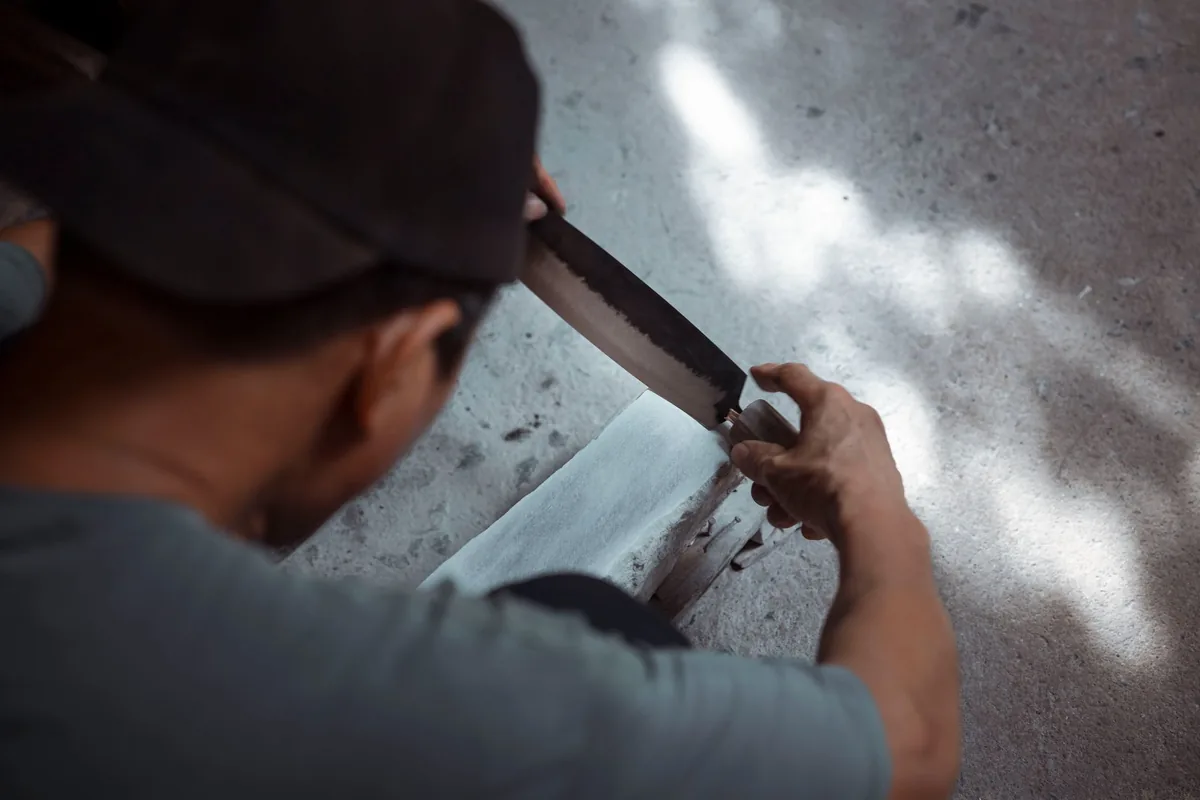
Sharpen It, or Replace It
The genuine philosophical split in this category, and it decides what else you carry.
| Sharpenable (Sharpfinger) | Replaceable (Outdoor Edge) | |
|---|---|---|
| Blade when dull | Restore on a stone | Swap in seconds |
| Skill needed in the field | Real | None |
| Ongoing cost | A stone, once | Blades, forever |
| Edge on a fresh start | As good as you are | Factory sharp |
| Blade strength | Full ground edge | Thinner — will snap if levered |
| Price | $20.99 | $44.99 |
Neither is wrong. If you process one deer a year and enjoy sharpening, a Sharpfinger and a stone will outlive you. If you process several and have ever finished a job sawing with a blunt knife, the running cost of blades buys back something real.
Three Inches Against Five
The purpose-built skinner against the general-purpose fixed blade.
| Schrade Sharpfinger | Old Timer Heritage 169OT | |
|---|---|---|
| Blade length | 3.3 inches | 5 inches |
| Blade shape | Upswept skinner | Drop point, deep belly |
| Steel named | No — “high carbon stainless” | Yes — D2 |
| Weight | 3.1 oz | 8 oz |
| Close work around joints | Easier | Harder |
| Camp chores | Poor | Good |
| Price | $20.99 | $54.15 |
The shorter knife is better at the job the category is named after; the longer one is better at everything else you do in the woods. If the answer is genuinely both, that is an argument for carrying the Sharpfinger and a small axe rather than compromising on a five-inch blade.
Best Alternatives
| Alternative | Why Consider It | Better For | Main Trade-Off |
|---|---|---|---|
| A boning knife from the kitchen | Thin, flexible, superb around joints | Butchery at home, once the animal is back | No sheath, no guard, wrong for field use |
| A dedicated caping knife | Fine point for close work around the head | Anyone keeping a cape for mounting | Too specialised to be your only knife |
| A folding saw | Splits pelvis and ribcage safely | Larger game | Another item on the belt |
| A replaceable-blade scalpel handle | Surgical sharpness for very little money | Skinning small game | Blades snap under any lateral load |
What the Money Actually Buys
$11.99 to $20.99 — Bone Collector, Smith & Wesson, Schrade Sharpfinger. This tier contains our overall pick. It also contains the least-specified product on the page, whose listing states neither blade length nor steel. What separates them is not price but disclosure: at $17.84 the Smith & Wesson names its steel and its dimensions; at $11.99 the Bone Collector names nothing.
$31.99 to $59.97 — Mossy Oak kit, Gerber, Outdoor Edge Razor-Lite, Old Timer Heritage, KNINE set. This is where you buy either a specified steel or a complete set of jobs. The D2 on the Heritage and the four matched tools in the Mossy Oak kit are two entirely different ways to spend forty dollars well.
$89.99 to $99.99 — Buck 110, Outdoor Edge RazorGuide Pak. One is a knife bought for life with a warranty to match; the other is a system that assumes you will never sharpen anything. They are opposite philosophies at the same price, which is a fair summary of this category.
What to Check Before You Buy
Find the Blade Length, Not the Overall Length
This is the single most misleading number in the category. A “15-inch hunting knife” has a handle in that measurement. The Schrade Sharpfinger is 7.1 inches overall and 3.3 inches of blade — less than half. Where a listing gives only one figure, assume it is overall and that the cutting edge is far shorter than you pictured.
Three to Four Inches Is the Working Range
Field dressing is close, controlled work. Every purpose-built hunting blade in this roundup falls between 3.3 and 3.9 inches, and the ones at 4.7 and 4.8 are sold as survival or tactical knives that also hunt. Longer blades are harder to control around joints and no better at anything the job actually requires.
Decide Your Answer to a Dull Edge Before You Buy
Hide, hair and grit dull steel faster than food ever will, and you will hit that point mid-job. There are three designs on this page and they assume three different answers: carry a stone, carry a sheath with a stone built into it, or carry spare blades and never sharpen. Choose deliberately, because it determines what else lives in your pack.
Look for the Grip Feature by Name
A wet hand sliding forward onto the edge is the injury this category produces. The listings that take it seriously name the mechanism: a finger choil and thumb rise on the Sharpfinger, a front quillon on the Heritage, a hand guard on the Smith & Wesson. If a listing says only that a knife is “ergonomic”, it has told you nothing.
Treat an Unnamed Steel as a Real Gap
“Stainless steel” is not a specification. 420HC, D2 and 7Cr17MoV behave differently in edge retention, ease of resharpening and corrosion resistance, and a listing that names its grade is telling you something a listing that does not cannot. Two products here name nothing at all, and we have recorded that rather than guessing.
A Gut Hook Is a Safety Feature, Not a Gimmick
Opening a body cavity with a point risks puncturing the gut, which contaminates the meat and ruins the animal. A gut hook rides under the hide and cuts upward so the point never goes near anything it should not. Only the kits here include one.
Fixed Blades Clean, Folders Carry
A folding knife is easier to carry and harder to clean, and field dressing produces exactly the material you do not want trapped in a pivot. A fixed blade in a sheath has nowhere for it to hide. The Buck 110 is the finest folder here and this is still its real drawback.
Common Mistakes
- Buying by overall length. A 15-inch knife may have a 9-inch blade, and 9 inches is far too much knife for this job anyway.
- Trusting the top search results. The three highest-ranked products for this search are a rescue folder, a tactical folder and an EDC knife.
- Confusing a survival knife with a hunting knife. A hammer pommel and a ferro rod are useful in the woods and useless inside an animal.
- Buying serrations. They cut rope well and tear hide badly, and you cannot maintain them with a flat stone.
- Going into the field with no plan for a dull edge. You will reach one, and forcing a blunt knife is how hands slip.
- Levering with a replaceable blade. They are thin by design and will snap under lateral load.
- Buying the ten-piece set as your carry knife. It is excellent kit and it belongs in the truck.
Who Should Buy Which
Buy the Schrade Sharpfinger if you want the right tool. At $20.99 it has the correct length, the correct shape and named grip features, and it has outlasted decades of fashion. Learn to sharpen it.
Buy the Outdoor Edge Razor-Lite if you have ever finished a job with a blunt knife. Six factory edges in the box and a swap that takes seconds solves the problem the Sharpfinger asks you to solve with skill.
Buy the Buck 110 if you want one knife for life. Accept the 7.2 ounces and the pivot to clean; you are buying a lockback with a forever warranty and sixty years of evidence.
Buy the Mossy Oak kit for your first season. $31.99 covers gut hook, caping, bone saw and sharpener — four jobs, correctly shaped tools, no steel grades.
Buy the KNINE set if you butcher your own animals. It is the only thing here that takes a carcass all the way to the freezer, and it should live in the truck rather than on your belt.
Frequently Asked Questions
What length hunting knife do I actually need?
Three to four inches of blade covers field dressing for essentially all North American game. Every purpose-built hunting knife in this roundup sits between 3.3 and 3.9 inches: the Schrade Sharpfinger is 3.3, the Outdoor Edge blades are 3.5, the Buck 110 is 3.75, the Mossy Oak caping knife is 3.4. Longer blades are harder to control in the close work around joints and inside the cavity, and they are no better at any part of the job. If you also want a knife for camp chores and batoning, that is a second tool rather than a longer first one. Be careful with listings that advertise a total length — a 15-inch knife has a handle included in that figure.
Should I get a fixed blade or a folder?
Fixed, if the knife is mainly for processing animals. A folding knife has a pivot and a lock channel, and field dressing produces exactly the blood, hair and tissue you do not want trapped in either — cleaning one properly takes real effort, and an incompletely cleaned pivot corrodes. A fixed blade has nowhere for anything to hide and is stronger for the same weight. The counter-argument is carry: a folder rides in a pocket where a fixed blade needs a sheath on a belt. The Buck 110 on this page is the best folding hunter ever made and the cleaning penalty still applies to it.
Are replaceable-blade knives actually good, or a gimmick?
They are a genuine answer to a genuine problem. Hide, hair and incidental grit dull an edge far faster than kitchen work does, and the traditional response is to stop mid-job and sharpen with cold, wet, occupied hands. Outdoor Edge’s answer is to make the blade a consumable: push a release, drop in a factory-sharp replacement, carry on. The trades are real too. The blades are thinner than a ground edge and will snap if you lever with them, and you are buying blades forever rather than a stone once. For someone processing several animals a season it is a straightforwardly good deal.
Why do the top search results not look like hunting knives?
Because they are not. The three highest-ranked products returned for this search are a rescue-style folder with a glass breaker, a tactical folding knife, and a sub-three-inch everyday-carry blade — all of them ranked far above any dedicated skinner. Search ranking reflects how many people bought something after searching a term, not whether the product suits the term. It is the same effect that puts box choppers at the top of a mandoline search. Read what a knife is shaped to do rather than where it appears.
What steel should I look for?
Look first for whether a grade is named at all. Two products in this roundup state none, which tells you something in itself. Among those that do: 420HC on the Buck is a modest stainless that Buck heat-treats well, and its real virtue is that it comes back quickly on a field stone. D2 on the Old Timer Heritage holds an edge considerably longer but is harder to restore once it goes. 7Cr17MoV, on the Smith & Wesson and the KNINE set, is mid-tier and sharpens easily. For a field knife, easy to resharpen often beats long edge retention, because the sharpening happens where your equipment is worst.
Do I need a gut hook?
It is not essential, but it removes a specific and expensive risk. Opening a body cavity with a knife point means working a blade along the abdomen with the tip near the intestines, and a puncture contaminates the meat. A gut hook sits behind the point, rides under the hide and cuts upward, so the tip is never pointed at anything fragile. On this page only the kits include one — the Mossy Oak skinner and the KNINE set. If you buy a single knife without one, the technique is to lift the hide with two fingers and cut upward against them, slowly.
Final Verdict
3.3 inches, 3.1 ounces, an upswept skinning shape and named grip features for $20.99. The right tool, and it has been for decades.
Six factory-sharp blades in the box and a swap that takes seconds — the answer to a dull edge halfway through the job.
$17.84 for a named steel, a stated blade length and a full hand guard, when pricier knives here state none of the three.
The Schrade Old Timer Sharpfinger is the knife to buy, and it is the cheapest recommendation on this page bar one. Three point three inches, three ounces, a shape drawn for skinning and two grip features named in the listing rather than implied. It does not have a premium steel and it does not have a gut hook, and neither matters as much as being the correct length and shape for the job.
If you would rather not sharpen, buy the Outdoor Edge Razor-Lite. The split between maintaining an edge and replacing it is the real decision in this category, and both answers are legitimate — but only one of them works when it is nearly dark, your hands are cold, and the stone is at home. If you want a knife to hand on, buy the Buck 110 and accept the weight.
The thing to take away, though, is the length. Not one purpose-built hunting blade in this roundup reaches six inches, and the two that pass five are sold as survival knives. The category’s search results are dominated by fifteen-inch Bowies and tactical folders that outrank every genuine skinner here. What you need is a short, curved blade you can control an inch at a time — and that is not what the first page of results will offer you.
Whatever you buy, check the blade length rather than the overall length before you spend anything. It is the number the listings are least keen to isolate, and it is the only one that describes the tool.