Affiliate Disclosure: As an Amazon Associate, we earn from qualifying purchases. This does not affect the price you pay.
Every kitchen scale listing leads with capacity. Eleven pounds, twenty-two, thirty-three. It is the biggest number available and it is almost never the one that matters.
The number that decides whether a scale is useful to you is the smallest weight it can resolve. Seven of the ten scales below read in whole grams. That is entirely fine for pasta, meat and flour by the hundred grams — and it is close to useless for the ingredients where precision actually changes the outcome.
Four grams of instant yeast measured on a 1-gram scale can be anywhere from 3.5 to 4.5 grams: a 25 per cent error, displayed as a confident whole number. An 18-gram espresso dose cannot be held to a ratio at all. Two grams of baking soda is a coin flip.
The trade-off is real and physical. A load cell sized to carry 15 kilograms cannot also resolve a hundredth of a gram, which is why the two 0.01 g scales here top out at 200 g and 500 g, and why most kitchens end up owning two scales rather than one.
Exactly one product on this page refuses that compromise: 0.1 gram resolution across a full eleven-pound range. Everything else asks you to choose which half of your cooking to measure properly.
Our Quick Picks
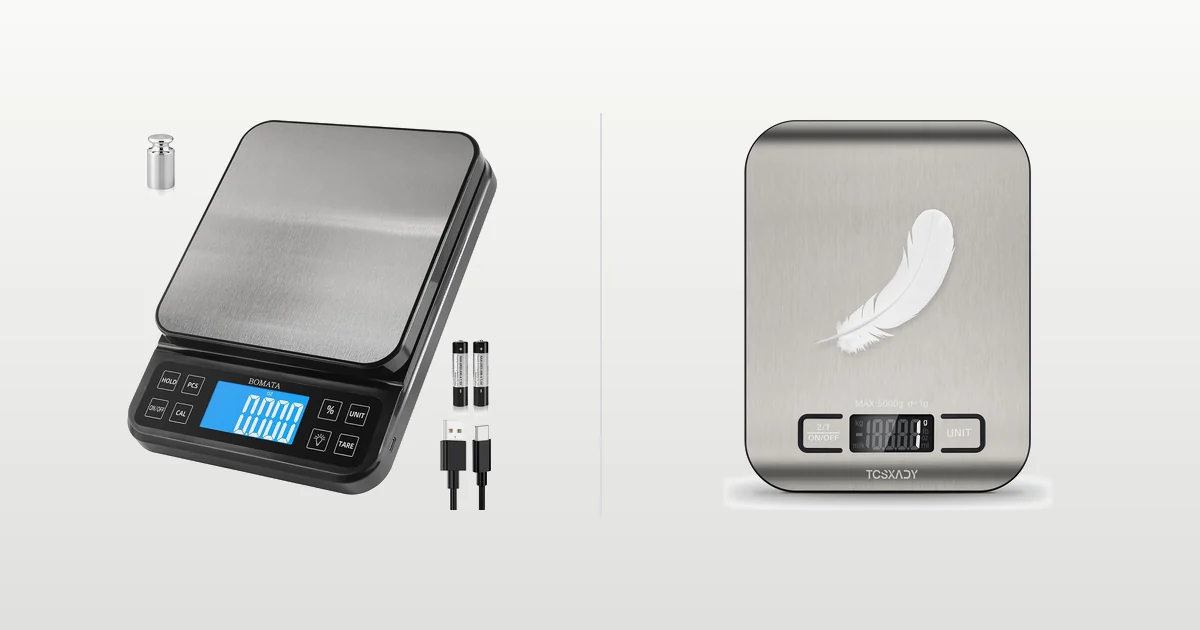
 Best OverallBOMATA Large Precision Scale
The only scale here that gives tenth-of-a-gram resolution across a full eleven-pound range, on a 7.2-inch platform.
 Best ValueTcsxady 11 lb Food Scale
Six units, a backlit display and 4.6 stars for under seven dollars — the sensible default for weighing ordinary food.
 Best PrecisionWeigh Gram 200 g Pocket Scale
Hundredth-of-a-gram resolution with a 100 g calibration weight in the box — and a capacity of just 200 grams.
At a Glance
Ten Kitchen Scales Compared
Capacity and resolution together, because one is meaningless without the other — then units, power and what each one is actually for.
| # | Model | Capacity | Resolution | Units | Power | Standout | Main Drawback | Check Price |
|---|---|---|---|---|---|---|---|---|
| 1 |
 BOMATA Large Precision Scale BOMATA Large Precision Scale |
11 lb / 5 kg | 0.1 g | g, oz and more | USB-C rechargeable | 0.1 g resolution at full 11 lb capacity | Will not read below 0.5 g | View on Amazon |
| 2 |
 Tcsxady 11 lb Food Scale Tcsxady 11 lb Food Scale |
11 lb / 5 kg | 1 g | 6: g, kg, lb, oz, ml, milk ml | Batteries included | #94 in all of Kitchen & Dining | 1 g resolution is coarse for baking | View on Amazon |
| 3 |
 Maestri House S2 Espresso Scale Maestri House S2 Espresso Scale |
Palm-sized, coffee dose | 0.1 g | g, oz, ml | USB-C rechargeable, 500 mAh | Built-in shot timer alongside the weight | Too small for a mixing bowl | View on Amazon |
| 4 |
 Weigh Gram 200 g Pocket Scale Weigh Gram 200 g Pocket Scale |
200 g | 0.01 g | 6: g, oz, ozt, dwt, ct, gn | Battery, auto shut-off | 0.01 g and a calibration weight included | 200 g capacity is a tenth of a bag of flour | View on Amazon |
| 5 |
 Greater Goods 22 lb Scale Greater Goods 22 lb Scale |
22 lb / 10 kg | 1 g | g, oz, lb:oz, ml | Batteries, auto shut-off | Display extends beyond the platform | 1 g resolution at every capacity | View on Amazon |
| 6 |
 Escali Primo Digital Scale Escali Primo Digital Scale |
11 lb / 5 kg | 1 g / 0.05 oz | g, oz, lb, kg | Battery | Two buttons and a sealed control panel | 1 g, and no backlight mentioned | View on Amazon |
| 7 |
 OXO Good Grips 11 lb Scale OXO Good Grips 11 lb Scale |
11 lb | Not stated | Not stated | Battery | Removable platform for cleaning | $64.95, and the listing states almost nothing | View on Amazon |
| 8 |
 GGQ 33 lb Food Scale GGQ 33 lb Food Scale |
33 lb / 15 kg | 1 g | 5: g, kg, lb:oz, oz, ml | Rechargeable, USB cable | 33 lb, the largest range here | Glass platform and 4.2 stars | View on Amazon |
| 9 |
 MAXUS 500 g Pocket Scale MAXUS 500 g Pocket Scale |
500 g | 0.01 g | 6: g, oz, ozt, dwt, ct, gn | AAA battery | 500 g at 0.01 g, with a tray lid | No calibration weight included | View on Amazon |
| 10 |
 Nicewell 22 lb Food Scale Nicewell 22 lb Food Scale |
22 lb / 10 kg | 1 g / 0.1 oz | g, kg, lb:oz, fl.oz, ml | Batteries included | 9 x 6.3 inch platform, biggest here | Tempered glass under a steel top | View on Amazon |
Specifications, prices and ratings are taken from each manufacturer’s Amazon listing as displayed on 21 August 2026 and may change. Resolution is reproduced as stated; the OXO Good Grips listing states no resolution, no units and no platform dimensions anywhere in its four bullet points, and is recorded as not stated rather than assumed. Only the BOMATA publishes a lower measurement limit (0.5 g), which is a figure every scale has and almost none discloses — below it, a scale reads zero regardless of its advertised resolution. “Milk ml” appears as a distinct unit on several listings and reflects milk’s density of roughly 1.03 g/ml rather than water’s 1.0. Four further 1 g scales were excluded as near-duplicates of models already included, including a second colourway of one model listed as a separate product.
Scroll the table sideways to see every column
How We Chose These Kitchen Scales
We researched current listings, compared manufacturer specifications and documentation, and examined recurring patterns in customer feedback. We did not carry out hands-on testing, and nothing below is presented as measured performance data.
- Resolution first, capacity second — the smallest readable weight decides what the scale is good for
- Both halves of the trade-off represented — high-capacity 1 g scales and 0.01 g precision scales, because most kitchens need both
- Whether the lower limit is stated — every scale has a minimum it will register; almost none publishes it
- Platform size against real containers — a dinner plate is ten inches across and will overhang most scales here
- Calibration and drift — load cells drift, and one scale here ships with a reference weight
- Cleaning — sealed panels and removable platforms, because raw meat ends up on the surface
The 10 Best Kitchen Scales, Reviewed
1. BOMATA Large Precision Scale — Best Overall

Almost every scale in this roundup makes you choose: a big platform that reads to the nearest gram, or a tiny pocket scale that reads to a hundredth but tops out at 200 grams. This one does not.
Eleven pounds of capacity, 0.1 g resolution, a 7.2-inch platform.
Key Specifications
| Capacity | 11 lb / 5 kg |
|---|---|
| Resolution | 0.1 g / 0.001 oz |
| Stated range | 0.5 g to 5 kg |
| Platform | 7.2 x 7.2 inches |
| Baking function | Percentage mode for scaling recipes |
| Extra | HOLD function for oversized items |
| Power | USB-C rechargeable lithium, or run plugged in |
| Weight | 3.53 ounces |
| Best For | Anyone who bakes by weight and also weighs yeast and salt |
Why We Recommend It
That combination is the whole reason to buy it. A 1 g scale weighing 4 g of instant yeast can be out by 25 per cent and will still show a plausible number. At 0.1 g the same measurement is out by 2.5 per cent. Bread, pastry and anything with chemical leavening care about that; a stew does not.
The percentage function is a genuine baker’s tool. Baker’s percentages express every ingredient as a proportion of flour weight, which is how recipes scale up and down without arithmetic. Nothing else on this page offers it.
Note the stated range: 0.5 g to 5 kg. That lower figure is the honest one, and it is the number most listings hide. Below half a gram this scale reads nothing at all — so a 0.3 g pinch of saffron is beyond it, as it is beyond every scale here except the two pocket models.
USB-C rechargeable, or run it plugged in permanently, which removes the slow drift that tired AAA cells cause in cheap scales.
Pros
- 0.1 g resolution at a full 11 lb capacity, unique here
- 7.2-inch platform fits a mixing bowl
- Percentage mode for baker’s percentages
- HOLD function for items that cover the display
- USB-C rechargeable or mains powered
- States its true lower limit of 0.5 g
Cons
- $33.88, mid-to-upper price here
- Will not register anything under 0.5 g
- 4.4 stars
- #15 in Digital Kitchen Scales, low visibility
- Unfamiliar brand
Best for: The one scale here that does not force a choice between range and resolution.
2. Tcsxady 11 lb Food Scale — Best Value

Six dollars ninety-eight, 4.6 stars, and #94 in the whole of Kitchen & Dining. For weighing pasta, meat, flour by the hundred grams or a parcel, there is very little argument for spending more.
Six units, including a separate scale for milk.
Key Specifications
| Capacity | 11 lb / 5 kg |
|---|---|
| Resolution | 1 g |
| Units | 6 — g, kg, lb, oz, ml and a separate milk ml |
| Display | High-contrast backlit LED |
| Power | Batteries included, auto shut-off |
| Platform | Stainless steel |
| Weight | 0.25 kg |
| Rank | #3 in Digital Kitchen Scales, #94 in Kitchen & Dining |
| Best For | Everyday cooking, portions and packages |
Why We Recommend It
The milk unit is less silly than it sounds. Millilitres and grams are only interchangeable for water; milk is denser at roughly 1.03 g/ml, so a scale that converts properly saves a small error on every liquid measurement. Several scales here offer it and none explains why.
One gram is the resolution to think about. It is entirely sufficient for anything you would measure in tens or hundreds of grams, and it is genuinely poor for the small, potent ingredients — yeast, baking soda, salt, spices — where being a gram out changes the result.
If you bake bread, that limitation will find you. If you cook dinner, it never will.
Batteries in the box is a small thing that a surprising number of scales at this price omit.
Pros
- $6.98 and rated 4.6 stars
- #3 in Digital Kitchen Scales, #94 in all of Kitchen & Dining
- Six units including a milk-specific conversion
- Backlit display readable in dim light
- Batteries included
- Stainless steel platform
- Auto shut-off
Cons
- 1 g resolution, too coarse for yeast or leavening
- Lower measurement limit not stated
- No rechargeable option
- Platform dimensions not published
- Unfamiliar brand
Best for: Most kitchens, most of the time — provided you are not weighing yeast.
3. Maestri House S2 Espresso Scale — Best for Coffee

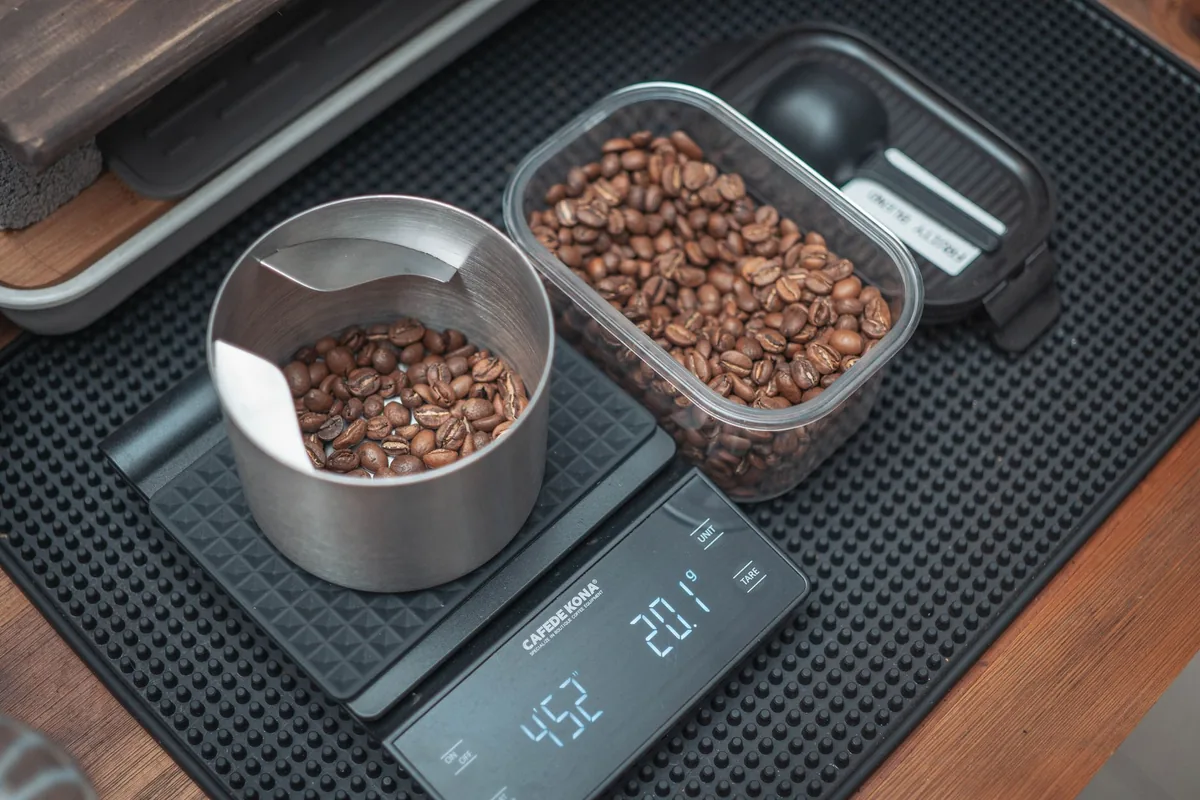
Coffee is the one kitchen task where 0.1 g resolution is not fussiness but the basic requirement. An espresso dose is around 18 g and the yield around 36 g; a scale that rounds to the nearest gram cannot hold a ratio to any useful precision.
This one reads to a tenth and times the shot at the same time.
Key Specifications
| Type | Espresso and coffee scale |
|---|---|
| Resolution | 0.1 g |
| Size | 4.13 x 4.13 x 0.78 inches |
| Units | 3 — g, oz, ml |
| Timer | Dual timekeeping modes |
| Power | 500 mAh lithium, USB-C |
| Display | LED |
| Included | Silicone pad, USB-C cable |
| Best For | Espresso, pour over and anyone brewing by ratio |
Why We Recommend It
The timer is the part a general kitchen scale cannot replace. Espresso is judged on dose, yield and time together — 18 g in, 36 g out, in about 28 seconds. Watching a separate stopwatch while a shot pulls is exactly as awkward as it sounds.
Four inches square and three-quarters of an inch thick is deliberate: it has to fit on a drip tray, under a portafilter, with a cup on top. That also makes it useless for weighing a bowl of flour, which is why this is a second scale rather than a first one.
The silicone pad in the box is there to keep hot cups off the electronics and stop the scale sliding on a wet tray — a small detail that suggests the designers had actually used one.
At $31.99 it costs five times the general-purpose scale above it and does a job that scale cannot do at all.
Pros
- 0.1 g resolution, the requirement for coffee ratios
- Built-in shot timer with two modes
- Fits on an espresso machine drip tray
- USB-C rechargeable, 500 mAh
- Silicone protective pad included
- 4.5 stars
- LED display rather than LCD
Cons
- Far too small for general kitchen weighing
- $31.99 for a single-purpose tool
- Only three units
- Capacity not stated in the listing
- A second scale, not a first
Best for: Espresso and pour over — the one job a 1 g scale genuinely cannot do.
4. Weigh Gram 200 g Pocket Scale — Best Precision

Two hundred grams of capacity sounds absurd next to the 33-pound scale further down this page, until you consider what you actually weigh in single-gram quantities: yeast, baking soda, salt, saffron, tea, curing salts.
For those, 0.01 g resolution is the difference between a measurement and a guess.
Key Specifications
| Capacity | 200 g |
|---|---|
| Resolution | 0.01 g |
| Calibration | 100 g calibration weight included |
| Units | 6 — g, oz, ozt, dwt, ct, gn |
| Size | 5.2 x 2.99 x 0.79 inches |
| Display | Blue backlit LCD |
| Functions | Tare, auto shut-off |
| Weight | 3.52 ounces |
| Best For | Spices, yeast, leavening and anything measured in single grams |
Why We Recommend It
The calibration weight is the specification that separates this from cheap precision scales. Load cells drift with temperature and age, and a scale reading to a hundredth of a gram that has never been calibrated is offering false precision. A 100 g reference weight lets you check it in ten seconds and correct it.
Nothing else in this roundup includes one.
The exotic units tell you the market. Troy ounces, pennyweights, carats and grains are jewellery and reloading units, not cooking ones — this is a pocket scale that happens to be excellent in a kitchen, which is also why it costs $9.98.
Treat it as a companion, not a replacement. Two hundred grams will not hold a bowl, and the tare function only helps if the container itself weighs less than the capacity.
Pros
- 0.01 g resolution for $9.98
- 100 g calibration weight included, unique here
- 4.6 stars and #5 in Digital Kitchen Scales
- Six units including troy and carat
- Blue backlit LCD
- Fits in a drawer or a pocket
Cons
- 200 g capacity, far too little for general cooking
- A light bowl already uses much of the range
- Not a substitute for a kitchen scale
- Cheap plastic construction
- Calibration needs redoing periodically
Best for: The cheap second scale that makes a 1 g kitchen scale usable for baking.
5. Greater Goods 22 lb Scale — Best Large Capacity

The design detail worth paying for here is the display position. On most scales it sits under the platform edge, so the moment you put a mixing bowl on top you cannot read it and have to lean around the bowl.
Greater Goods pushes the screen out beyond the platform specifically to solve that.
Key Specifications
| Capacity | 22 lb / 10 kg |
|---|---|
| Resolution | 1 g |
| Units | g, oz, lb:oz, ml |
| Display | Hi-Def LCD, extends beyond the platform |
| Controls | Touch-sensitive |
| Zero function | Yes |
| Platform | Stainless steel |
| Weight | 12.96 ounces |
| Best For | Bulk cooking, meal prep and anything that needs a large bowl on top |
Why We Recommend It
Twenty-two pounds is the capacity that matters for bulk work — a full stockpot, a large tray of meal-prep portions, a bread dough for four loaves. The 11 lb scales here run out sooner than people expect once the container is on the platform.
The trade-off is the usual one and it is unavoidable. Load cells sized for 10 kg cannot also resolve a tenth of a gram, so this reads in whole grams throughout. Weighing 3 g of yeast on it is guesswork.
Touch-sensitive controls and a sealed stainless top mean there are no button crevices for flour to pack into, which is a genuine hygiene advantage on a scale used for raw meat portioning.
At 4.6 stars it is among the best-rated scales in this roundup.
Pros
- 22 lb capacity for bulk cooking and meal prep
- Display extends past the platform so bowls do not hide it
- 4.6 stars
- Touch controls with no crevices to clean
- Four units including lb:oz
- Stainless steel platform
Cons
- 1 g resolution, unsuitable for small quantities
- $24.99 is dear next to $6.98 scales with the same resolution
- Battery powered, not rechargeable
- #13 in Digital Kitchen Scales
- Large footprint on a counter
Best for: Bulk cooking, big bowls and anyone tired of leaning round the mixing bowl.
6. Escali Primo Digital Scale — Simplest to Use

Escali’s Primo has been the default recommendation in this category for years and the reason is legible in the specification: two buttons, a sealed control panel, eleven pounds, 4.6 stars.
There are no modes to get lost in and no touch panel to mis-trigger with a wet finger.
Key Specifications
| Capacity | 11 lb / 5,000 g |
|---|---|
| Resolution | 1 g / 0.05 oz |
| Controls | Two-button operation |
| Panel | Sealed against spills |
| Dimensions | 8.5 x 6 x 1.5 inches |
| Functions | Tare, auto shut-off |
| Weight | 431 g |
| Rating | 4.6 out of 5 stars |
| Best For | A scale that will still make sense to everyone in the house in five years |
Why We Recommend It
The sealed panel is the durability feature. Kitchen scales die from liquid getting into the button apertures far more often than from load cell failure, and a membrane panel with no gaps is the fix. It is also why this one wipes clean rather than needing picking at.
Two-button simplicity is a real design choice, not a limitation. Several scales here offer six units and multiple modes, which means a family member will eventually leave it in troy ounces and confuse everyone. This offers four units and almost no ways to be wrong.
What it does not offer is a backlight, a rechargeable battery, a percentage mode or any resolution finer than a gram. At $25.00 that is a lot of money for a plain 1 g scale, and you are paying for build and for the brand’s track record rather than for capability.
Pros
- 4.6 stars and a long-standing reputation
- Sealed control panel resists spills
- Two-button operation with nothing to misconfigure
- Tare and auto shut-off
- 8.5 x 6 inch platform
- Established kitchen brand
Cons
- $25.00 for 1 g resolution and four units
- No backlight described
- No rechargeable option
- No percentage or baking functions
- Cheaper scales here match it on every measurable specification
Best for: Households that want one obvious scale everyone can operate.
7. OXO Good Grips 11 lb Scale — Most Premium
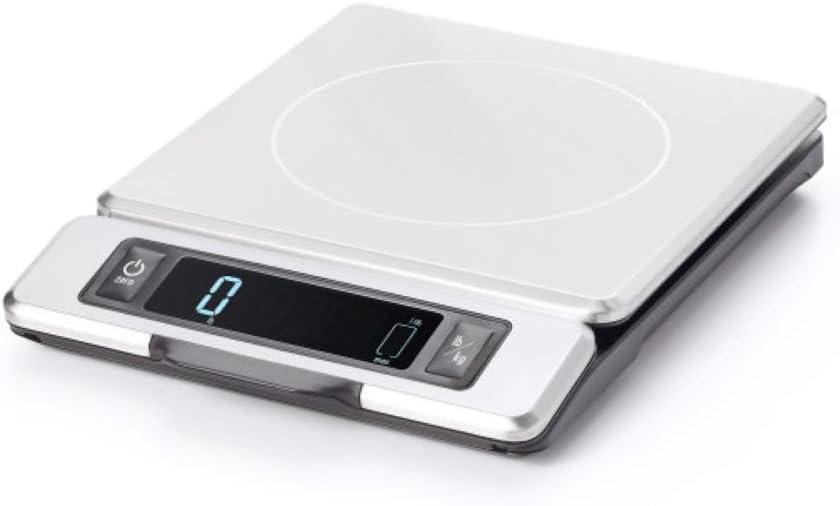
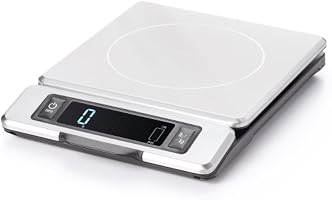
OXO makes genuinely good kitchen tools and this scale has the one feature nothing else here offers: the weighing platform lifts off completely for washing.
At $64.95 it is also the most expensive scale in this roundup by $31.
Key Specifications
| Capacity | 11 lb |
|---|---|
| Resolution | Not stated in the listing |
| Units | Not stated in the listing |
| Platform | Removable for cleaning |
| Finish | Smudge and fingerprint-resistant stainless |
| Display | Large, easy-to-read digits |
| Zero function | Yes |
| Weight | 1.8 pounds |
| Best For | Buyers who want OXO build and do not need the numbers |
Why We Recommend It
The removable platform is a real advantage on a food scale. Raw chicken, fish and flour all end up on the weighing surface, and every other scale here expects you to wipe around a fixed panel with electronics underneath. Lifting the top off and washing it properly is a hygiene difference, not a convenience one.
But this listing publishes less than any other on the page. No resolution. No units. No platform dimensions. Four bullet points in total. For a scale — a device whose entire purpose is producing a number — not stating the smallest number it can produce is a conspicuous omission.
The capacity is in the title, so it is an 11 lb scale, and OXO’s other kitchen scales read in 1 g increments. But that is inference, not specification.
At 4.4 stars and #14 in the category, it is neither the best-rated nor the most popular scale here, and it costs roughly nine times the highest-rated one.
Pros
- Removable platform lifts off for proper washing, unique here
- Smudge and fingerprint-resistant stainless steel
- Large, clearly legible digits
- OXO’s build quality and support
- Zero/tare function
Cons
- $64.95, most expensive scale in this roundup
- Resolution never stated in the listing
- Units never stated either
- Only four bullet points of specification
- 4.4 stars, below several scales costing under $10
- 1.8 pounds
Best for: OXO loyalists, and anyone who prioritises washing the platform properly.
8. GGQ 33 lb Food Scale — Highest Capacity

Thirty-three pounds is half again what the largest other scale here manages, and three times the common 11 lb figure. For a turkey, a bulk meat order or a heavy parcel, nothing else on this page will take the load.
It is #6 in Digital Kitchen Scales at $17.98.
Key Specifications
| Capacity | 33 lb / 15 kg |
|---|---|
| Resolution | 1 g |
| Sensors | Four high-precision load sensors |
| Units | 5 — g, kg, lb:oz, oz, ml |
| Platform | Waterproof anti-collision glass |
| Power | Rechargeable, data cable and 2 AAA batteries included |
| Alerts | Low power and overload warnings |
| Auto-off | 2 minutes |
| Best For | Large joints of meat, big batches and parcels |
Why We Recommend It
Four load sensors rather than one is the reason it can do this. A single sensor scale is accurate only when weight sits centrally; four sensors at the corners average the load, so an off-centre roasting tin still reads correctly. That matters far more at 33 lb than at 200 g.
The overload alarm is a practical inclusion. Exceeding capacity is how load cells get permanently damaged, and a scale that warns you rather than silently deforming is worth having at this size.
Rechargeable, with batteries also supplied, which is a sensible belt-and-braces arrangement.
The rating is the caveat at 4.2 stars, the lowest of the scales kept in this roundup, and the glass platform — while easy to wipe — is heavier and more fragile than the stainless tops elsewhere here.
Pros
- 33 lb capacity, by far the largest here
- Four load sensors handle off-centre weight
- Rechargeable, with AAA batteries also included
- Overload and low-power alarms
- Five units including lb:oz
- Waterproof glass platform
- $17.98
Cons
- 4.2 stars, the lowest rating kept in this roundup
- 1 g resolution across the whole range
- Glass platform is heavier and more breakable
- 2-minute auto-off can cut short slow weighing
- Unfamiliar brand
Best for: Turkeys, bulk buying and parcels — capacity above everything else.
9. MAXUS 500 g Pocket Scale — Best Small Capacity

Five hundred grams at 0.01 g is the more useful pocket-scale specification than the usual 200 g, because it covers a coffee dose, a jar of spices and a small bowl rather than just a pinch.
It is 4.6 stars at $8.98.
Key Specifications
| Capacity | 500 g |
|---|---|
| Resolution | 0.01 g |
| Units | 6 — g, oz, ozt, dwt, ct, gn |
| Tray | Clear cover doubles as a weighing tray |
| Power | AAA battery, auto shut-off |
| Protection | Overload protection |
| Functions | Tare |
| Weight | 4 ounces |
| Best For | Spices, tea, coffee doses and small baking quantities |
Why We Recommend It
The cover that becomes a tray is the practical detail. Weighing loose powder directly on a bare pocket scale is how the buttons get clogged; a removable tray means you tare it, fill it, and tip it out.
What it lacks against the Weigh Gram above is a calibration weight. At 0.01 g resolution, a scale that cannot be checked against a known mass is quietly asking you to trust it, and load cells drift.
Overload protection matters more on a precision scale than a big one. Putting a 2 kg bag of flour on a 500 g load cell is an easy mistake and an expensive one; this warns rather than breaking.
Like every pocket scale, it is a second scale. Five hundred grams will not hold a mixing bowl and is not meant to.
Pros
- 500 g capacity, more than double a standard pocket scale
- 0.01 g resolution at $8.98
- 4.6 stars
- Clear cover doubles as a weighing tray
- Overload protection
- Six units including troy and carat
Cons
- No calibration weight included, unlike its closest rival here
- 500 g will not take a bowl
- AAA battery rather than rechargeable
- Small platform for anything bulky
- Still a companion scale, not a main one
Best for: A more usable pocket scale — if you can calibrate it some other way.
10. Nicewell 22 lb Food Scale — Largest Platform

Nine inches by six and a third is the largest weighing surface in this roundup, and platform size is one of the few things a specification sheet cannot fudge.
Twenty-two pounds, four load sensors, backlit display, $25.99.
Key Specifications
| Capacity | 22 lb / 10 kg |
|---|---|
| Resolution | 1 g / 0.1 oz |
| Platform | 9 x 6.3 inches, stainless over tempered glass |
| Sensors | Four high-precision load sensors |
| Units | g, kg, lb:oz, fl.oz, ml |
| Display | Large backlit LCD |
| Included | 2 x AAA batteries |
| Weight | 1.3 pounds |
| Best For | Wide bowls, dinner plates and portioning |
Why We Recommend It
Platform area matters more than people expect. A dinner plate is around ten inches across; on a small scale it overhangs on all sides, covers the display, and rocks if the load is off-centre. A wide platform with sensors at the corners solves both problems at once.
Tempered glass under a stainless top gives rigidity without flex — a large thin platform that bends slightly under load transmits less of that load to the sensors and reads inconsistently.
Five units including fluid ounces, which is genuinely useful in American recipes that mix weight and volume in the same ingredient list.
The limitation is the familiar one. One gram across 22 pounds, so this is a food scale rather than a baking scale, and at $25.99 it costs four times a 4.6-star scale with the same resolution.
Pros
- 9 x 6.3 inch platform, the largest here
- Four load sensors for off-centre loads
- Tempered glass under stainless for rigidity
- Backlit LCD
- Fluid ounces as well as ml
- Batteries included
Cons
- 1 g resolution across the full range
- $25.99 against $6.98 for comparable resolution
- 1.3 pounds and a large counter footprint
- 4.4 stars
- Glass construction is more fragile than plain steel
Best for: Wide bowls and plates, where a small platform makes weighing awkward.
Capacity Against Resolution
The physical trade-off, laid out. Read both columns together; either alone tells you nothing.
| Scale | Capacity | Resolution | What it can weigh well |
|---|---|---|---|
| Weigh Gram Pocket | 200 g | 0.01 g | Yeast, spices, saffron, tea |
| MAXUS Pocket | 500 g | 0.01 g | The above, plus a coffee dose or a small bowl |
| Maestri House S2 | Coffee dose | 0.1 g | Espresso in, espresso out, timed |
| BOMATA | 11 lb / 5 kg | 0.1 g | Almost everything, down to 0.5 g |
| Tcsxady | 11 lb / 5 kg | 1 g | Food, portions, packages |
| Escali Primo | 11 lb / 5 kg | 1 g | The same, with a sealed panel |
| OXO Good Grips | 11 lb | Not stated | Unknown from the listing |
| Greater Goods | 22 lb / 10 kg | 1 g | Bulk cooking and meal prep |
| Nicewell | 22 lb / 10 kg | 1 g | Wide bowls and plates |
| GGQ | 33 lb / 15 kg | 1 g | Turkeys, bulk meat, parcels |
Read down the resolution column and the shape of the category appears. Capacity climbs from 200 g to 33 lb, a factor of seventy-five, while resolution moves in exactly the opposite direction. That is not manufacturers being lazy; a strain-gauge load cell has a finite number of steps between zero and its maximum, so stretching the range coarsens the increments. The BOMATA is the interesting row because it sits at 0.1 g and 11 lb simultaneously, which is the combination most home cooks would choose if listings made the trade-off visible. Most do not, because capacity is the number that sells.
The Number No One Prints: the Lower Limit
Every scale stops registering below a certain weight. Only one listing here says what that is.
| What it means | Why it is hidden | |
|---|---|---|
| Advertised resolution | The size of each displayed step, e.g. 1 g | It is the flattering number |
| Lower limit | The weight below which the scale reads zero | It is usually several times the resolution |
| BOMATA, stated | 0.5 g on a 0.1 g scale | Rare disclosure |
| A typical 1 g scale | Often 2 g to 5 g before it registers at all | Never stated |
| Practical effect | A 3 g pinch of yeast may show nothing, or jump straight to 5 g | Buyers assume resolution is the limit |
This is the most common disappointment with cheap kitchen scales and it is not a fault — it is physics being undersold. A load cell needs a minimum deflection before it produces a usable signal, so a 1 g scale typically ignores the first few grams entirely. Put an empty bowl on first and tare it, and the problem largely disappears, because the bowl has already loaded the cell past its dead zone. That single habit makes a cheap scale considerably more accurate, and no listing on this page mentions it.
Best Alternatives
| Alternative | Why Consider It | Better For | Main Trade-Off |
|---|---|---|---|
| Measuring cups and spoons | No batteries, no calibration, cost almost nothing | Liquids and rough cooking | Flour varies by up to 20% per cup depending on packing |
| A mechanical spring scale | No power at all, lasts decades | Rustic kitchens and power cuts | Coarse, drifts with age, no tare |
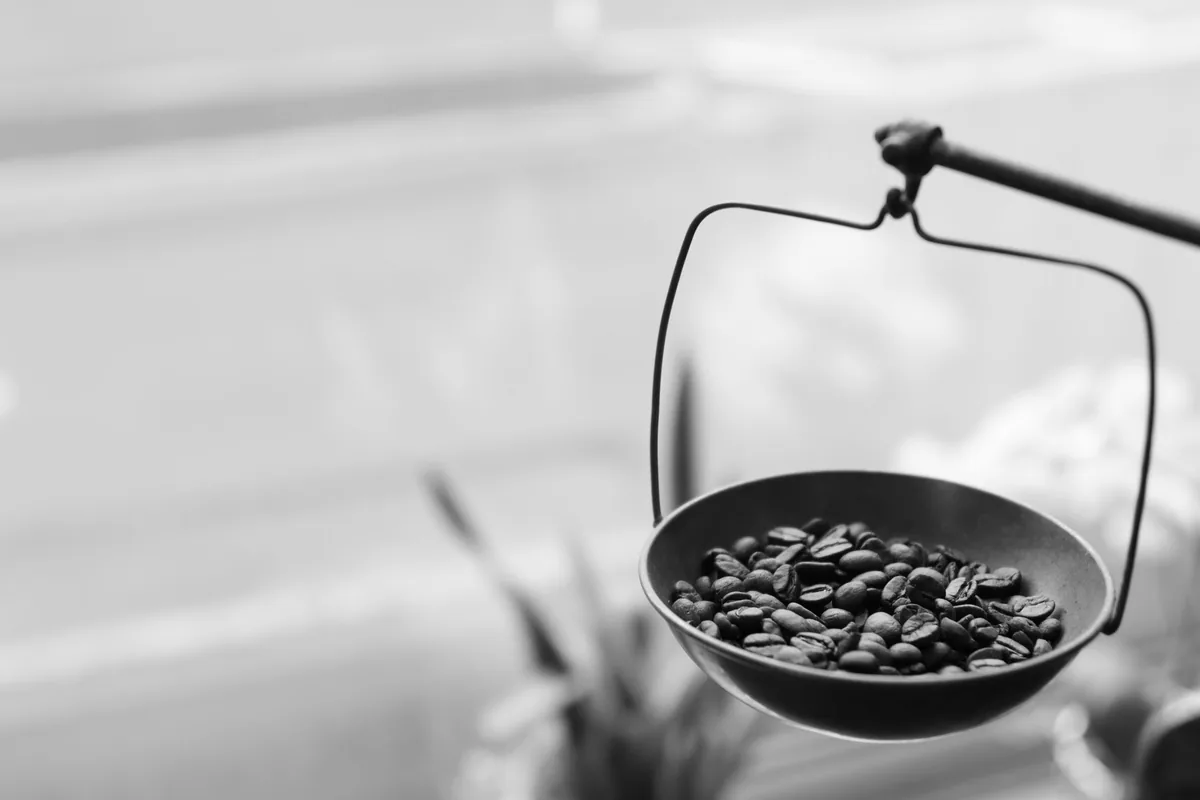
| A balance scale with weights | Never needs calibration, inherently accurate | Traditionalists and display | Slow, bulky, and you must own the weights |
| Weighing on a postal scale | You may already own one | Occasional large weights | Rarely food-safe surfaces, and coarse resolution |
| A smart scale with an app | Nutrition tracking and recipe scaling | Calorie counting | App dependency, and the scale outlives the app |
What Each Price Tier Actually Buys
$6.98 to $9.98 — Tcsxady, MAXUS Pocket, Weigh Gram Pocket. Remarkable value, and between them they cover the whole range. The Tcsxady is #94 in all of Kitchen & Dining at 4.6 stars; the two pocket scales give 0.01 g resolution for under ten dollars, one of them with a calibration weight.
$17.98 — GGQ 33 lb. The capacity outlier: four load sensors, rechargeable, overload alarm, and half again the range of anything else here.
$24.99 to $25.99 — Greater Goods, Escali Primo, Nicewell. Build and usability rather than capability. All three read in whole grams like the $6.98 scale; what you get is a display that clears the bowl, a sealed spill-proof panel, or the largest platform in the roundup.
$31.99 to $33.88 — Maestri House S2, BOMATA. Where resolution finally improves. The Maestri House adds a shot timer for coffee; the BOMATA gives 0.1 g across a full 11 lb range plus a baker’s percentage mode.
$64.95 — OXO Good Grips. A removable platform you can actually wash, from a brand with a strong reputation — on a listing that never states its resolution, its units or its dimensions.
The pattern: five scales here are rated 4.6 stars and they cost $6.98, $8.98, $9.98, $24.99 and $25.00. Money buys resolution, platform size and build. Below about $30 it does not buy accuracy, because the resolution is the same 1 g all the way up.
How to Choose a Kitchen Scale
Decide What Your Smallest Ingredient Is
Work from the bottom of your recipes, not the top. If the lightest thing you ever weigh is 50 g of butter, any 1 g scale on this page is perfect and you should buy the cheapest well-rated one. If you weigh 4 g of yeast, 2 g of baking soda or an 18 g coffee dose, a 1 g scale will round those into meaninglessness and you need 0.1 g or finer. Capacity is easy to satisfy; resolution is the constraint.
Expect to Own Two Scales, and Budget Accordingly
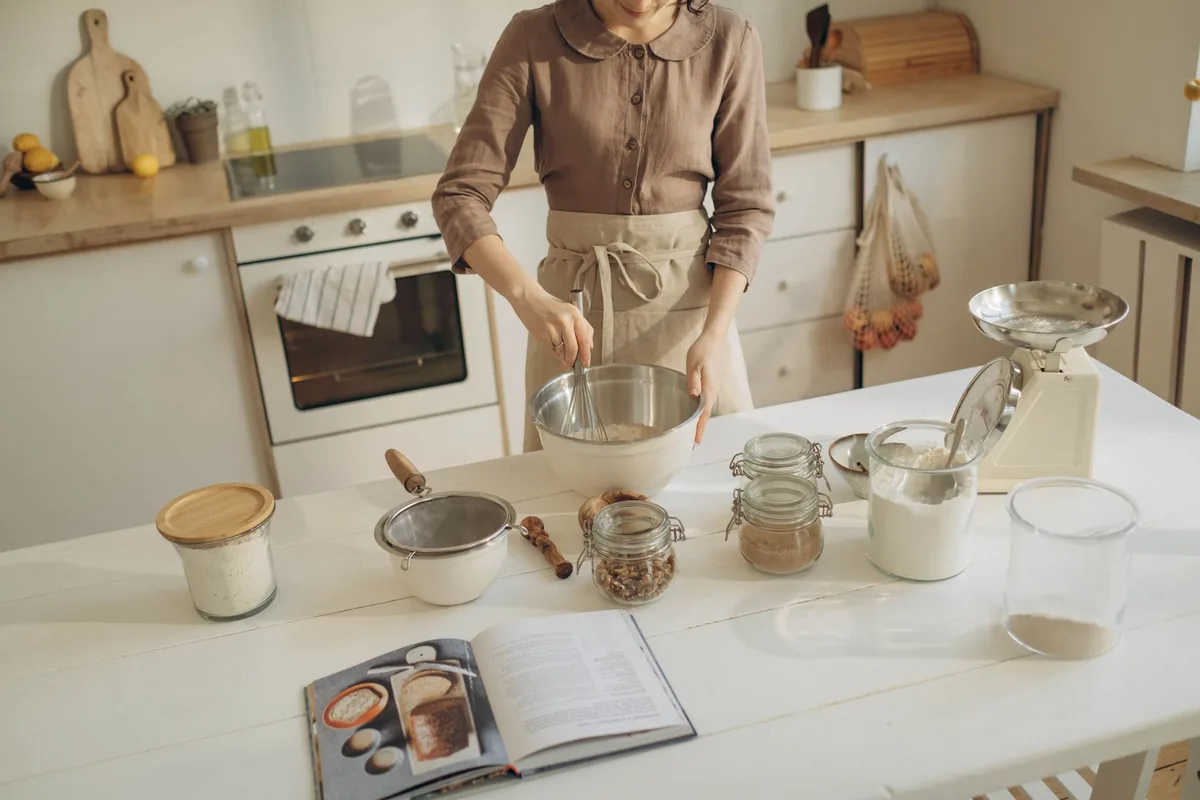
Because load cells cannot deliver wide range and fine resolution at once, the standard solution is a large 1 g scale for food and a small 0.01 g scale for potent ingredients. On this page that pairing costs about sixteen dollars in total, which is less than half of any single scale that spans both. Buy the pair before you consider spending $30 or more on one device, unless you specifically need a shot timer or a percentage mode.
Put the Empty Container On First and Tare It
This is free and it materially improves cheap scales. Load cells have a dead zone at the bottom of their range where small weights produce no usable signal, so a 3 g pinch dropped onto a bare platform may read zero or jump to 5 g. Placing a bowl on first loads the cell past that dead zone, and taring it to zero means your ingredient is measured in the responsive part of the range. No listing in this roundup mentions this.
Check the Platform Against Your Actual Bowls
Platform sizes here run from about three inches square to nine by six and a third. A dinner plate is around ten inches across, and a standard mixing bowl wider still, so on a small scale the container overhangs, hides the display and rocks if the load sits off-centre. Two scales here solve it differently — one with a large platform, one by pushing the display out beyond the weighing surface — and both approaches work.
Prefer Four Load Sensors on Large Scales
A single-sensor scale is accurate only when the weight sits over the sensor, which is fine for a small platform and unreliable for a big one. Four sensors at the corners average the load, so an off-centre roasting tin still reads correctly. Three scales in this roundup specify four sensors and all three are 22 lb or larger — which is exactly where it matters, since a heavy off-centre load produces the largest error.
Think About How It Will Be Cleaned
Raw meat, fish and flour all end up on the weighing surface, and most scales here expect you to wipe around fixed buttons with electronics directly beneath. Two designs address it properly: a sealed membrane panel with no crevices for liquid to enter, and a platform that lifts off entirely for washing. Given that scales fail from liquid ingress far more often than from load cell failure, this is a durability question as much as a hygiene one.
Common Kitchen Scale Buying Mistakes
- Choosing on capacity. Resolution decides what a scale is useful for; capacity is the easy specification to satisfy.
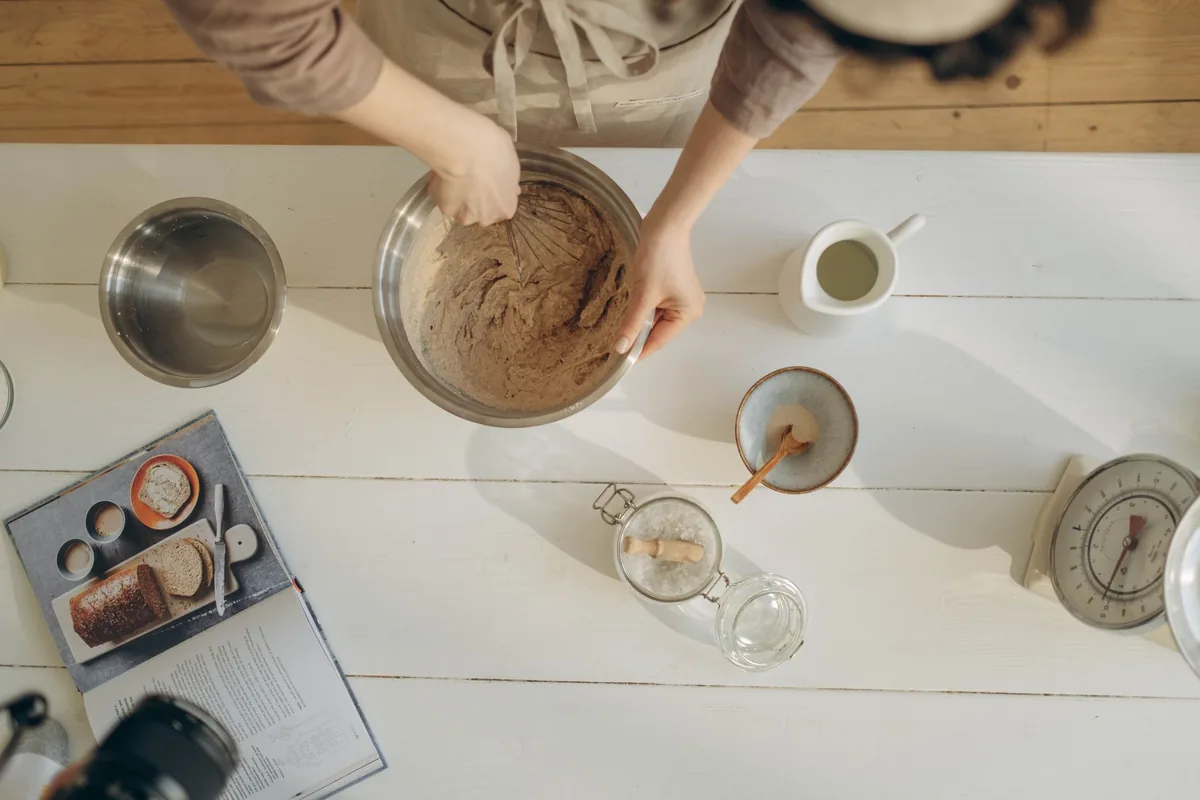
- Weighing yeast on a 1 g scale. Four grams measured in whole-gram steps can be 25 per cent out and still look precise.
- Assuming the resolution is the lower limit. Most scales ignore the first few grams entirely, and only one listing here says so.
- Weighing small amounts on a bare platform. Put a bowl on and tare it first, so the load cell is out of its dead zone.
- Buying one expensive scale instead of two cheap ones. A $6.98 food scale plus a $8.98 pocket scale covers more than either alone.
- Ignoring platform size. A dinner plate overhangs most scales here and hides the display.
- Never calibrating a precision scale. Load cells drift; one scale here ships with a reference weight for exactly this reason.
- Trusting a listing that omits the resolution. One scale on this page costs $64.95 and never states it.
Which Kitchen Scale Should You Buy?
Buy the BOMATA if you want one scale rather than two. Nought point one gram resolution across a full 11 lb range, a percentage mode for baker’s maths, and a stated lower limit.
Buy the Tcsxady if you are weighing food rather than chemistry. Six dollars ninety-eight, 4.6 stars, and #94 in all of Kitchen & Dining.
Buy the Weigh Gram pocket scale if you bake. Nought point nought one gram resolution and a calibration weight for $9.98 — the cheapest fix for a 1 g scale’s blind spot.
Buy the Maestri House S2 if you pull espresso. It is the only scale here that weighs to a tenth and times the shot at once.
Buy the Greater Goods if you cook in bulk and are tired of leaning around a mixing bowl to read the display.
Buy the GGQ if you need 33 lb of capacity for turkeys, bulk meat or parcels.
Buy the Escali Primo if you want two buttons, a sealed panel and a scale that everyone in the house can operate.
Buy the Nicewell if your containers are wide, or the OXO if lifting the platform off to wash it is worth $64.95 to you.
Frequently Asked Questions
What resolution do I need on a kitchen scale?
It depends entirely on your smallest ingredient, not your largest. For general cooking — meat, pasta, vegetables, flour by the hundred grams — 1 g is completely sufficient, and that is what seven of the ten scales in this roundup offer. For baking, 1 g stops being enough the moment you weigh yeast, baking soda, salt or anything else measured in single grams: 4 g of yeast on a 1 g scale can be 25 per cent out while displaying a confident whole number. For coffee, 0.1 g is the minimum that lets you hold a dose-to-yield ratio. The physical constraint is that high capacity and fine resolution pull against each other, which is why most kitchens end up with two scales.
Why does my kitchen scale not register small amounts?
Because load cells have a dead zone at the bottom of their range. A strain gauge needs a certain minimum deflection before it produces a signal the electronics can read, so a scale advertised at 1 g resolution will typically ignore the first few grams placed on a bare platform — a light pinch of spice may read zero, then jump straight to 3 or 4 g. Only one listing in this roundup publishes its lower limit at all. The fix costs nothing: put an empty bowl on the platform first and tare it to zero. The bowl loads the cell past its dead zone, so your ingredient is measured in the responsive part of the range.
Should I buy one scale or two?
Two, for most people, and it is cheaper. Because a load cell sized for 10 or 15 kilograms cannot resolve hundredths of a gram, the practical solution is a large 1 g scale for food and a small 0.01 g pocket scale for potent ingredients. In this roundup that pairing costs about sixteen dollars combined — less than half the price of the single scale that spans both ranges. The exception is if you brew espresso, since a general scale cannot resolve a dose and a pocket scale cannot time a shot; then a dedicated coffee scale or the wide-range precision model earns its place.
Do kitchen scales need calibrating?
Precision scales do; general 1 g food scales rarely repay the effort. Load cells drift over time and with temperature changes, so a scale reading to 0.01 g that has never been checked against a known mass is offering precision it may not have. One scale in this roundup ships with a 100 g calibration weight for exactly this reason, and most precision scales have a calibration mode that needs one. For a 1 g food scale the drift is usually smaller than the resolution, so it does not show up. A quick sanity check with anything of known weight is worth doing occasionally either way.
What is the difference between grams and millilitres on a scale?
They only match for water. One millilitre of water weighs one gram, which is why the two are used interchangeably so often, but every other liquid has its own density — milk is about 1.03 g/ml, oil around 0.92, honey about 1.42. A scale offering a millilitre unit is simply dividing the measured weight by an assumed density, and several scales in this roundup offer a separate “milk ml” mode precisely because milk differs from water enough to matter. For accuracy, weigh in grams and convert with the actual density if a recipe insists on volume.
Why do bakers weigh ingredients instead of using cups?
Because volume measurement of dry ingredients is unreliable in a way weight is not. A cup of flour can vary by as much as 20 per cent depending on whether it was scooped, spooned or sifted and how much it has settled in the bag, and in bread and pastry that variation changes hydration enough to alter the result noticeably. Weight is unambiguous. This is also why baker’s percentages exist — expressing every ingredient as a proportion of flour weight — and one scale in this roundup calculates them directly.
How much capacity does a kitchen scale need?
Less than the marketing implies, and remember the container counts. Eleven pounds — five kilograms — covers essentially all home cooking, including a large mixing bowl of dough with the bowl’s weight included. Twenty-two pounds is useful for bulk meal prep and big batches; thirty-three pounds is for turkeys, bulk meat orders and parcels rather than cooking. The catch is that raising capacity coarsens resolution, so buying more capacity than you need actively costs you precision at the small end. Buy the smallest capacity that comfortably holds your largest container.
Are expensive kitchen scales more accurate?
Not below about thirty dollars, on the evidence here. Five scales in this roundup are rated 4.6 stars and they cost $6.98, $8.98, $9.98, $24.99 and $25.00 — and the $6.98 and the $25.00 read in identical 1 g increments. What money reliably buys in this category is resolution once you cross roughly $30, a larger or better-placed display, four load sensors instead of one, a sealed or removable platform, and rechargeable power. It does not buy a more accurate reading at the same stated resolution, and the most expensive scale on this page does not state its resolution at all.
Final Verdict
Nought point one gram resolution at a full 11 lb capacity, plus a baker’s percentage mode.
4.6 stars, six units and #94 in all of Kitchen & Dining, for $6.98.
Hundredth-of-a-gram resolution with a calibration weight in the box, for $9.98.
Kitchen scales are sold on capacity because capacity is the flattering number. Thirty-three pounds sounds like more scale than eleven. In practice the ceiling is easy to satisfy and irrelevant most of the time, and the specification that decides whether you are happy is the one at the other end: how small a weight the thing can actually read.
Seven of these ten read in whole grams. For food that is plenty. For yeast, leavening, spices and coffee it is not, and no amount of capacity fixes it — the two properties pull against each other inside the load cell.
So either accept the split and buy two scales, which costs about sixteen dollars here and covers almost everything, or buy the one product on this page that gives a tenth of a gram across eleven pounds. What is not worth doing is paying $25 or more for the same 1 g resolution you can have for $6.98 — unless what you are actually buying is a display you can read past the bowl, or a platform you can lift off and wash.